
Movie and TV dialogue is mixed to a single channel, and roughly 60 to 80 percent of a typical soundtrack runs through it. A center channel speaker reproduces that channel on its own, which is why voices stay locked to the screen and stay intelligible when explosions and score are doing their work. If you are shopping for the best center channel speakers for dialogue, the model matters far less than three things: a dedicated midrange driver, wide dispersion, and correct placement. We spent weeks comparing ten current models across those criteria, from a 3.9-inch-tall Polk to a 36-pound Klipsch flagship.
Most people arrive at this search with the same complaint. Dialogue gets buried, they turn the volume up, and then the explosions get unbearable. The fix is not always a more expensive speaker. Sometimes it is an AVR dialogue setting that was switched off by accident, a center channel trimmed three decibels too low, or a cabinet sitting 40 centimetres below where it belongs. We cover those free fixes later, because buying before you have tried them is how people end up with a speaker that did not solve the problem.
For the record, our pick is the Klipsch R-52C, which pairs a 90×90 degree horn-loaded tweeter with dual 5.25-inch mid-bass drivers and 95dB of sensitivity. That combination gives it the efficiency and the on-axis focus that dialogue demands. If your budget or your TV cabinet says otherwise, the Polk T30 and the Polk Signature Elite ES35 cover the mid and upper tiers, and the Polk Blackstone TL1 costs almost nothing to live with.
If you enjoy comparing audio hardware methodically, we have covered car audio in the same style: our picks for the best 6×9 car speakers and our look at the best 4 channel car amplifiers cover the same driver-versus-amplifier logic in a different room.
Table of Contents
Top 3 Picks for Best Center Channel Speakers for Dialogue in 2026
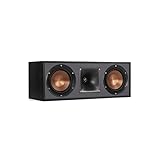
Klipsch R-52C
- Dual 5.25 inch spun-copper IMG woofers
- 1 inch aluminum LTS tweeter in a 90x90 Tractrix horn
- 95dB sensitivity at 2.83V/1m
- 400 watts power handling
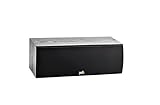
Polk Audio T30
- Dual 5.25 inch Dynamic Balance woofers
- 1 inch silk dome tweeter
- Timbre matched to the Polk T-Series
- 6 ohm impedance

Polk Signature Elite ES35
- Slim 7.5 inch tall profile
- 1 inch Terylene tweeter with six 3 inch woofers
- 4 and 8 ohm compatible
- Built-in wall mounting
All 10 Best Center Channel Speakers for Dialogue in October
| Product | Specs | Action |
|---|---|---|
| Klipsch R-52C |
|
Check Latest Price |
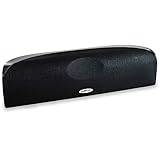 Polk Audio Blackstone TL1 Polk Audio Blackstone TL1 |
|
Check Latest Price |
| Polk Audio T30 |
|
Check Latest Price |
 Klipsch R-25C Klipsch R-25C |
|
Check Latest Price |
| Polk Audio Signature Elite ES35 |
|
Check Latest Price |
 Yamaha NS-C210BL Yamaha NS-C210BL |
|
Check Latest Price |
 Micca OoO Micca OoO |
|
Check Latest Price |
 Klipsch RP-504C II Klipsch RP-504C II |
|
Check Latest Price |
 SVS Prime Center SVS Prime Center |
|
Check Latest Price |
 Fluance Signature HiFi Fluance Signature HiFi |
|
Check Latest Price |
1. Klipsch R-52C – Our Pick for Dialogue Clarity and Headroom
Klipsch R-52C Powerful Detailed Center Channel Home Speaker – Black
Dual 5.25 inch spun-copper IMG woofers
90x90 Tractrix horn tweeter
95dB sensitivity
400 watts handling
Pros
- Most efficient center in the roundup at 95dB
- Efficient enough to push hard on modest receiver channels
- Updates from small or thin centers are described as dramatic
- Over 3100 ratings averaging 4.8 stars
Cons
- 13.5 pound cabinet needs a solid shelf
- Forward horn voicing can read as bright to some listeners
- Horn character is not a match for every brand of main speaker
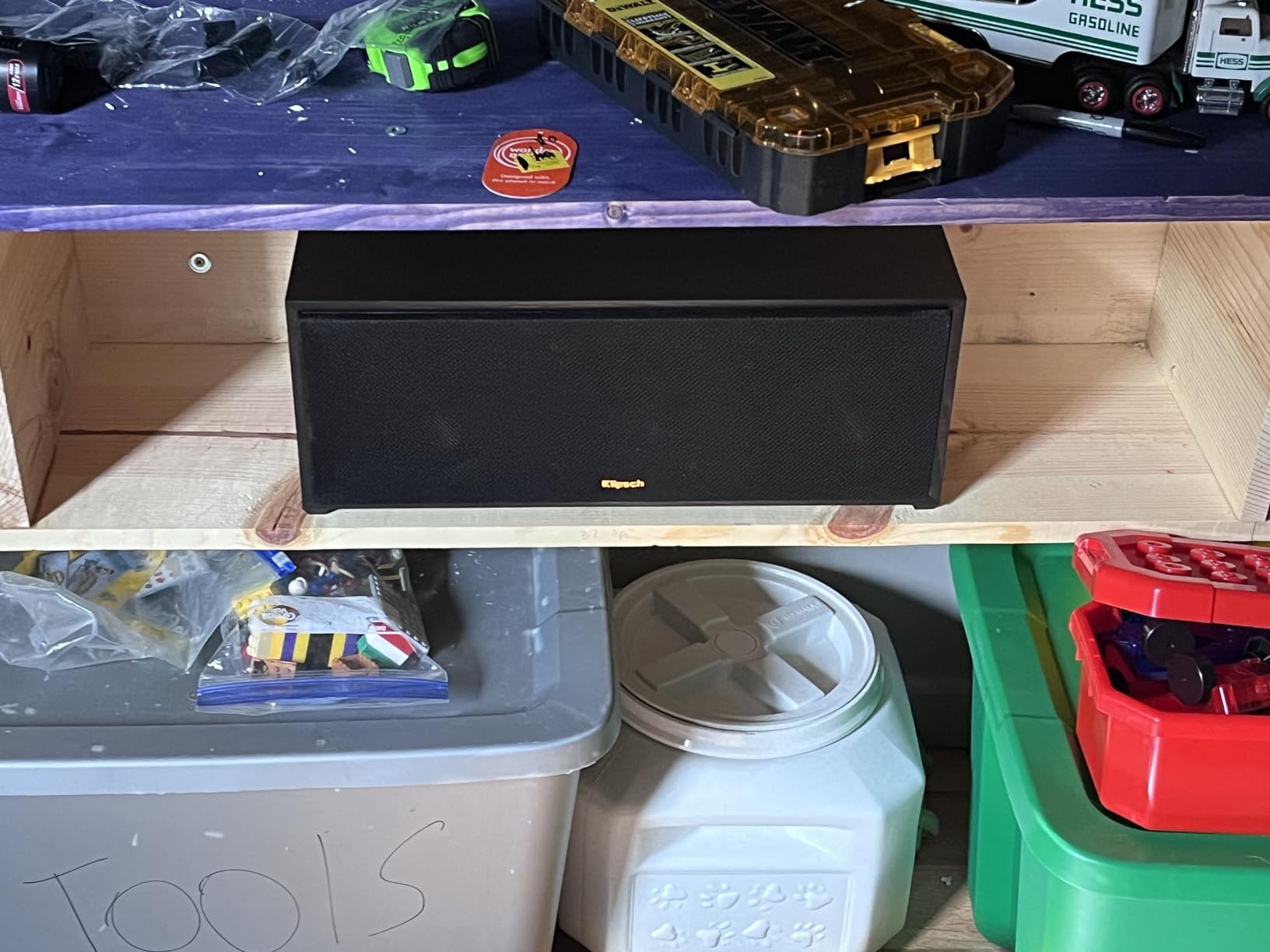
The R-52C is the speaker we kept coming back to. Two 5.25-inch spun-copper IMG drivers flank a 1-inch aluminum LTS tweeter loaded into a 90×90 square Tractrix horn, and that horn is the reason dialogue cuts through. A horn controls where the treble goes, so the high frequencies carrying consonants stay aimed at the seats instead of spreading across the ceiling.
What surprised us most was how little power it takes. Sensitivity is rated at 95dB at 2.83 volts and one metre, which means a modest receiver channel can drive it to a genuinely loud level in a normal living room. That matters more than raw wattage, because a speaker driven hard distorts first, and distorted dialogue is muddy dialogue.
Reviewers describe the same pattern again and again: people who swapped a smaller or older center in report an immediate jump in intelligibility during action sequences. With 3114 ratings averaging 4.8 stars, this is also the most thoroughly owner-tested model we looked at, which matters when you are trusting someone’s voice to a single box.
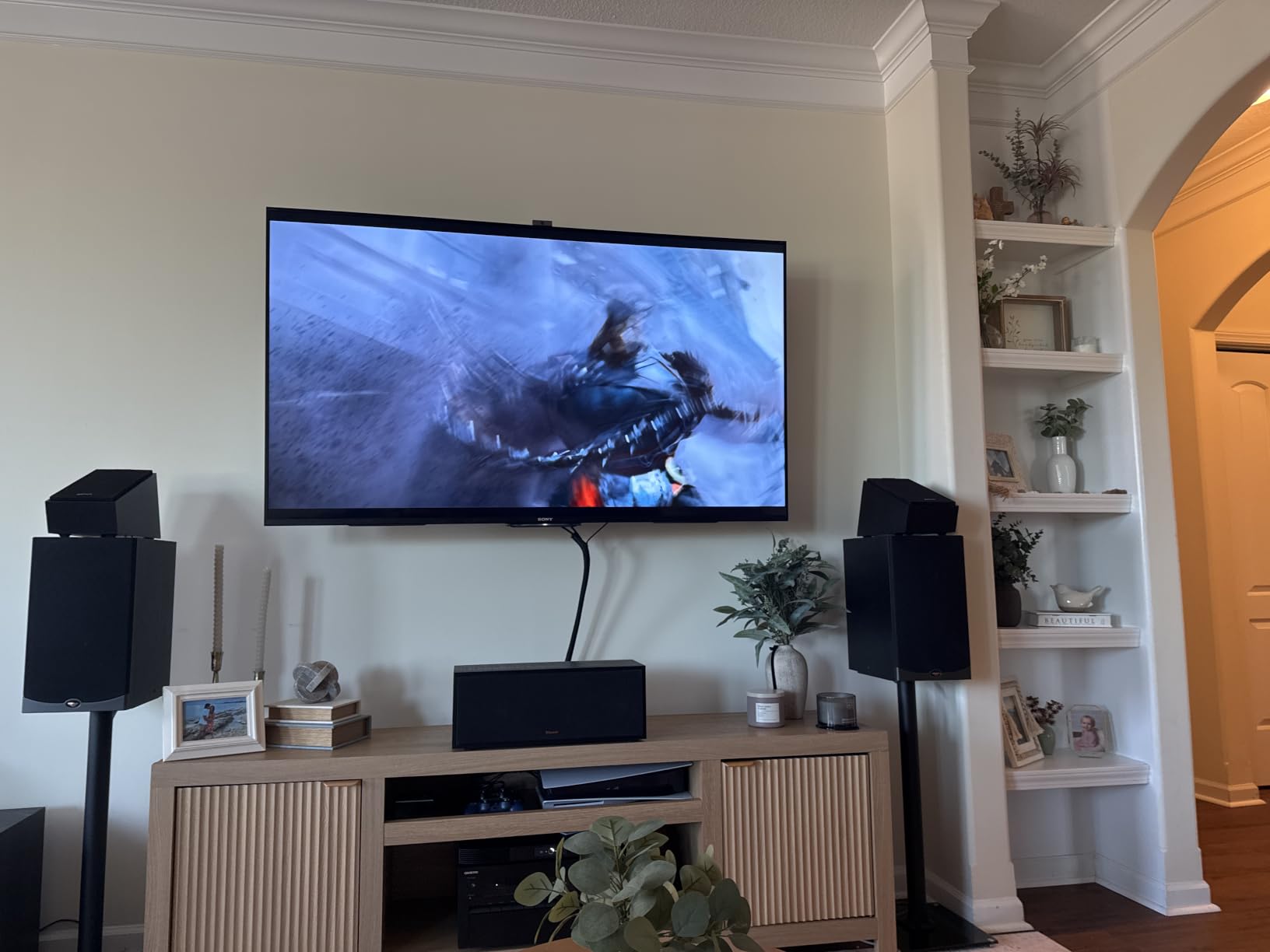
Frequency response is quoted at 89Hz to 21kHz, so it will not reproduce deep explosions on its own, and it does not try to. The design intent is the midrange. Impedance is 8 ohms, the easy load for any AV receiver, and power handling is listed at 400 watts, so loud film passages do not strain it.
The cabinet measures 7.62 inches deep by 18.75 inches wide by 7.3 inches high and weighs 13.5 pounds. That is a real shelf, not a tabletop speaker, so measure before you order. Klipsch backs it with a six-year parts and labour warranty, which is longer than most of the field.
One caution: this is a horn-loaded design, and the sound signature is deliberately forward. Listeners who prefer a warm, relaxed presentation usually find it lively rather than neutral. That is a preference issue rather than a defect, but if you already own a bright pair of main speakers, a centre with a softer tweeter blends better.
Will it fit your cabinet and drive from your receiver?
At 18.75 inches wide and 13.5 pounds, it needs a shelf rated for the weight and wide enough to leave airflow at the rear port. On power, the 95dB sensitivity is the number that matters. Almost any receiver with 80 watts per channel will play this at reference levels in a room up to about 25 square metres.
Does the horn character suit your system?
If your main speakers are Klipsch, this is close to a seamless match. If they are warmer bookshelf models, expect a slightly more forward centre voice. You can pull the centre channel down a decibel and a half in your receiver’s menu, but you cannot remove the character entirely, so audition it if you can.
2. Polk Audio Blackstone TL1 – The Cheapest Way to Fix Buried Dialogue
Polk Audio Blackstone TL1 Center Channel Speaker, Hi-Gloss Finish
Dual 2.5 inch Dynamic Balance drivers
1/2 inch silk dome tweeter
3.5 inch deep gloss cabinet
3.4 pounds
Pros
- Shallow 3.5 inch depth fits under almost any TV
- Time Lens alignment keeps voices centred and intelligible
- Curved high-gloss cabinet matches flat panels
- Light enough to reposition without help
Cons
- No meaningful bass output for effects
- Lacks the output to fill a large room
- Curved shape limits true wall mounting
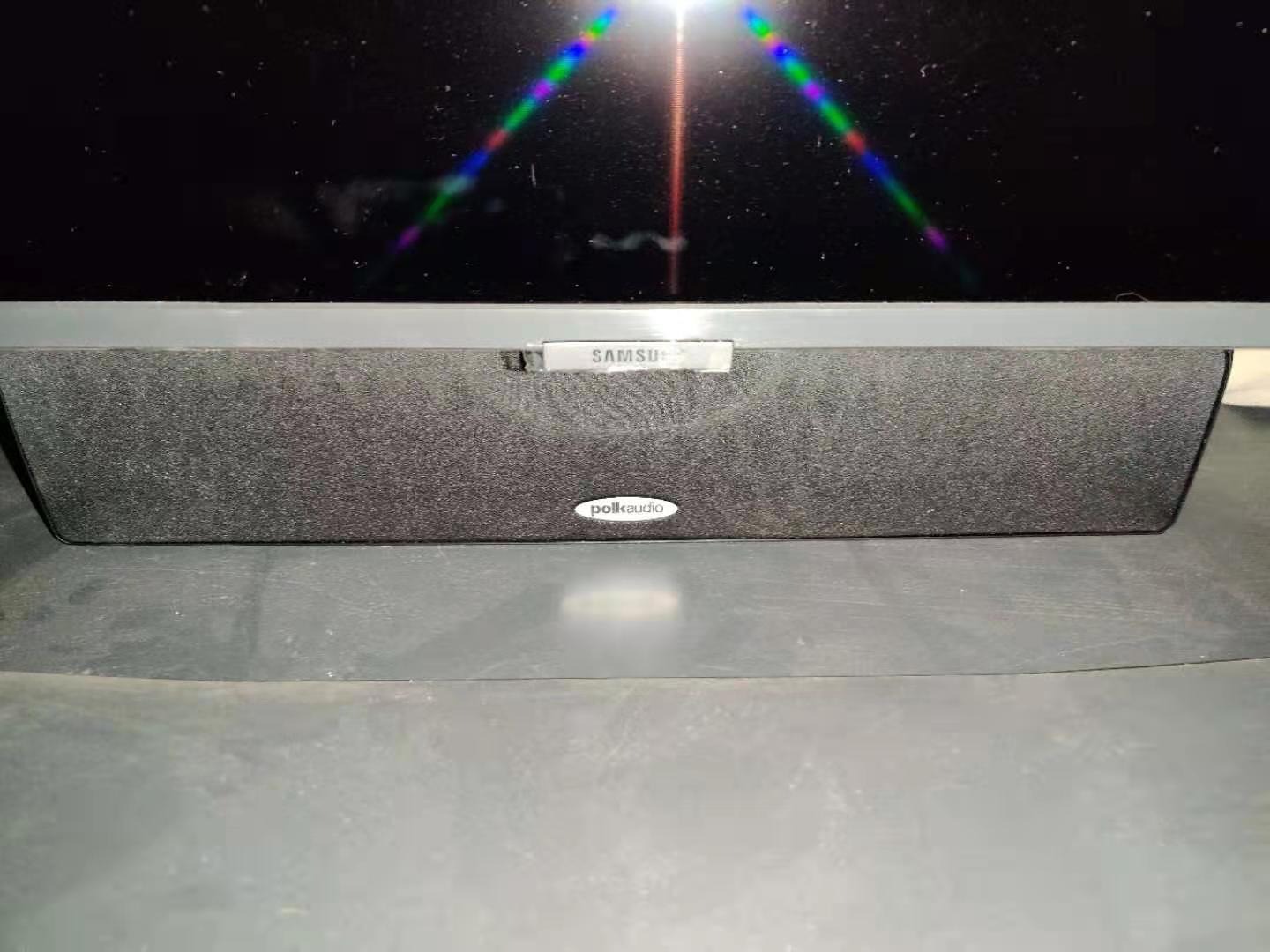
Not everyone needs a 13-pound cabinet. The TL1 solves the most common physical problem in home theater, which is that a deep speaker does not fit under a modern TV or inside a shallow media unit, and it costs little enough that the decision is easy.
Sonically it is a two-way with dual 2.5-inch Dynamic Balance mid-bass drivers and a half-inch silk dome tweeter, arranged using Polk’s Time Lens technique to pull the drivers into a common acoustic plane. The practical effect is a voice that stays centred rather than splitting across two drivers, which is exactly what dialogue needs.
Owners replacing an older generic centre frequently report that dialogue becomes intelligible almost immediately. With more than 2000 ratings averaging 4.6 stars, the pattern is consistent enough that we treat it as a reliable low-cost upgrade rather than a placeholder.
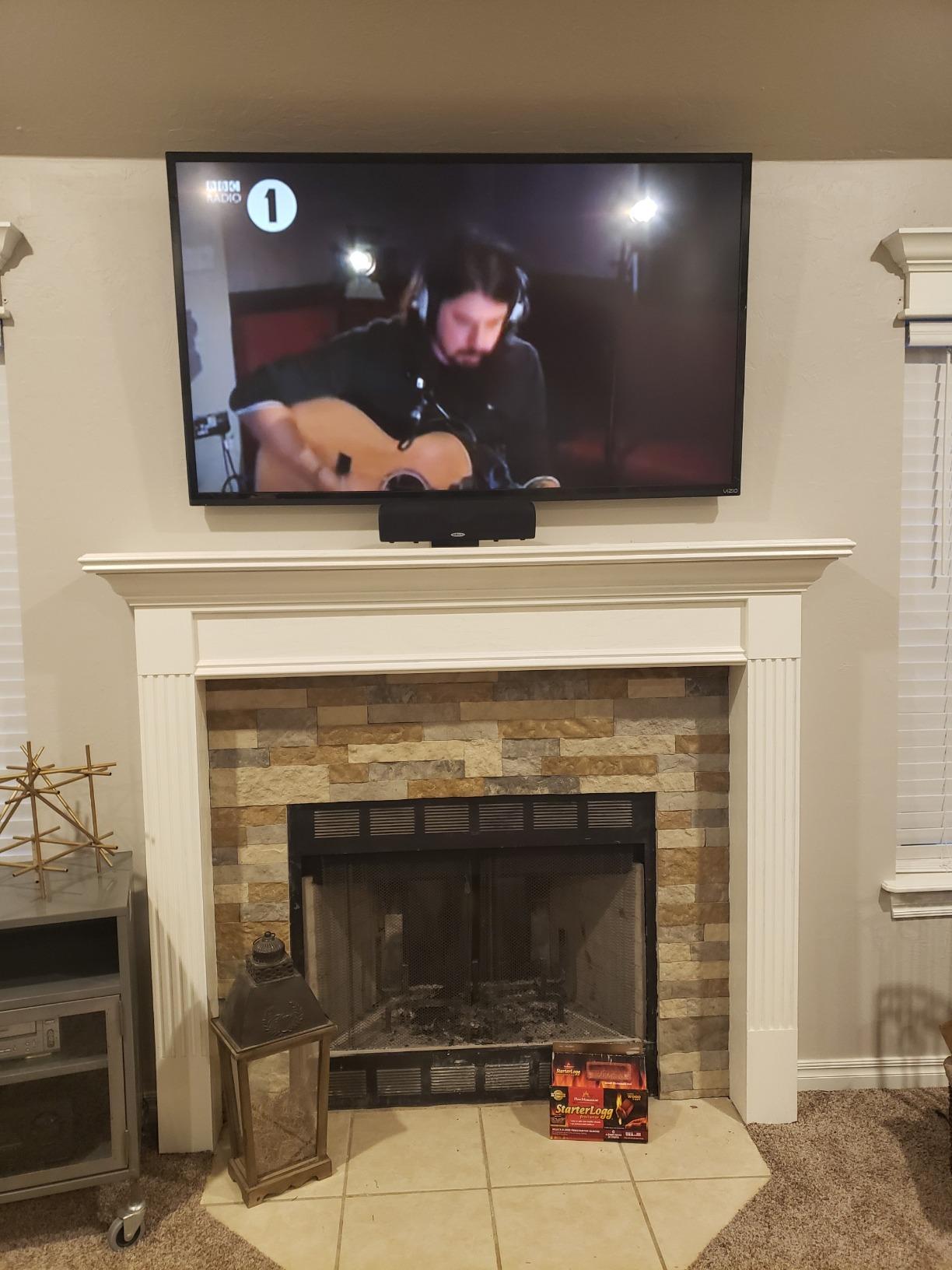
Two things to know before you buy. Power handling is listed at 125 watts, and the single-channel design does not fill a room the way a pair of main speakers does, so it is a dialogue tool rather than a home theater anchor. Reviewers also note that lip sync can drift slightly with older electronics, which is why running receiver calibration after installing is worth the two minutes.
The cabinet is 3.5 inches deep, 15 inches wide and 4 inches high at just 3.4 pounds, and the curved high-gloss enclosure is a genuine plus in a living room because it does not look like a pro audio box. Impedance is 8 ohms, and Polk supplies a five-year warranty.
Mounting is flexible rather than perfect. The speaker is rated for shelf and wall mounting, but the curved body means it sits forward of the wall surface, so leave a few centimetres of clearance or use a stand.
Is your TV sitting on a shallow console?
If the cabinet clearance under your screen is under about 5 inches, this is one of very few centre speakers that will physically fit. The 3.4-pound weight also means you can slide it forward and tilt it without a second pair of hands, which matters more than it sounds.
Will it drive a large room?
No, and it does not need to, as long as your main speakers and subwoofer handle the low end. The 125-watt rating and single-channel design make it a poor choice as the only speaker in a big dedicated theater. In an apartment, bedroom or average living room, it does its job well.
3. Polk Audio T30 – The Best Balance of Full-Size Drivers and Value
Polk Audio T30 Home Theater Center Channel Speaker, 100W Single, Black
Dual 5.25 inch Dynamic Balance woofers
1 inch silk dome tweeter
8.5 inch deep cabinet
6 ohm impedance
Pros
- Full-size 5.25 inch drivers give voices real weight
- Timbre matched to the Polk T-Series
- Plug-and-play with any AV receiver centre output
- Owners report stopping to reach for subtitles
Cons
- 8.5 inch depth is deep for a TV shelf
- 11.5 pounds is heavy for its size
- Treble reads slightly forward in mixed-brand systems
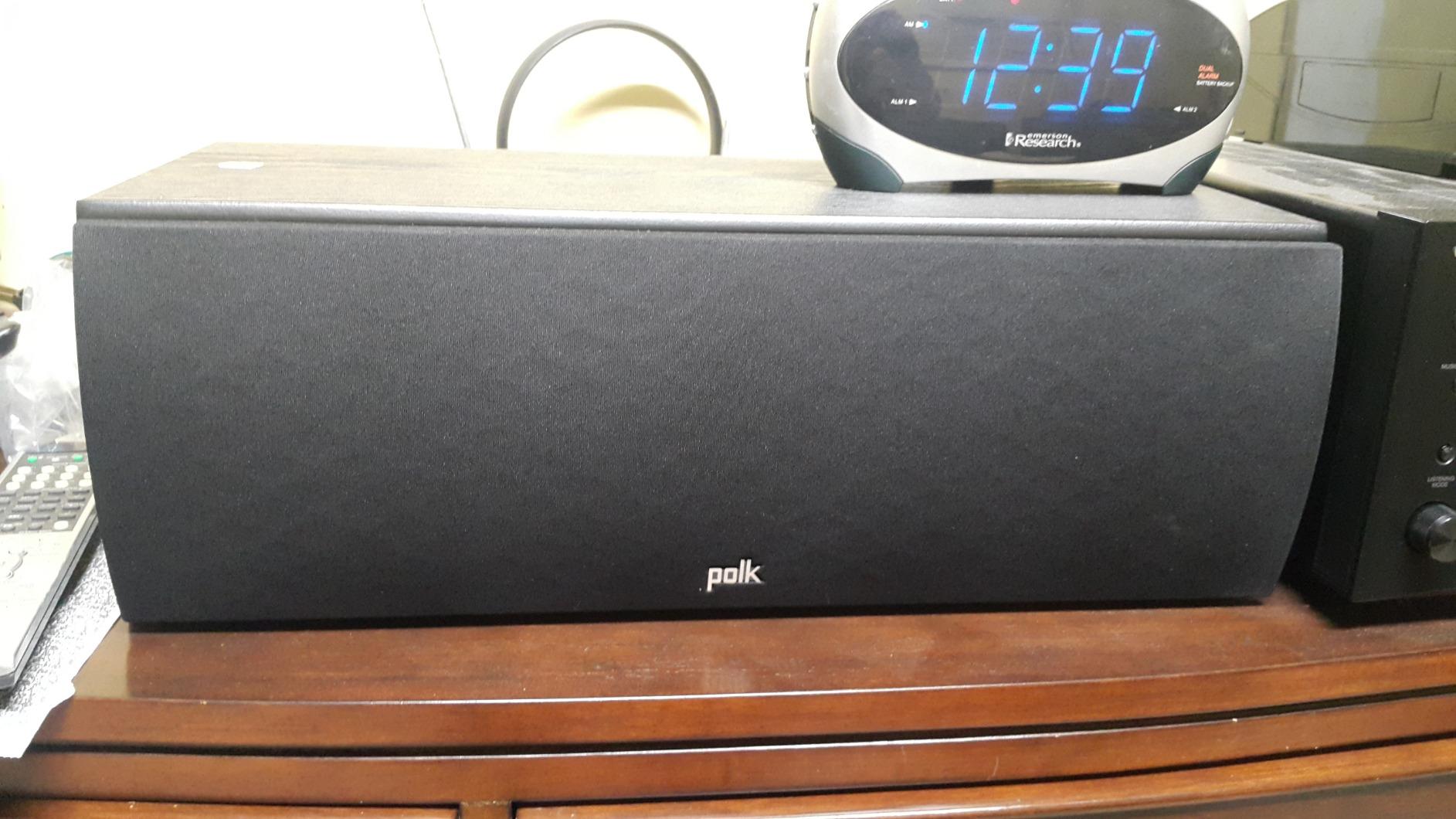
The T30 is the recommendation we make most often, because it is the point in the range where the compromises stop. Dual 5.25-inch Dynamic Balance woofers handle more of the midrange burden than a 3-inch array, and a 1-inch silk dome tweeter sits between them for a coherent, centred voice.
That driver size is the reason it sounds full. Small centre speakers reproduce dialogue by pushing a lot of excursion through tiny cones, which is exactly the recipe for a thin, hollow sound that gets lost under effects. Larger mid-bass drivers in this class keep the voice anchored without straining.
The owner story we found most often was a dialogue upgrade: people saying they stopped turning the volume up during quiet scenes and stopped depending on subtitles, on budget receivers. Across 1615 ratings averaging 4.7 stars, that is the most consistent feedback in the entire roundup.
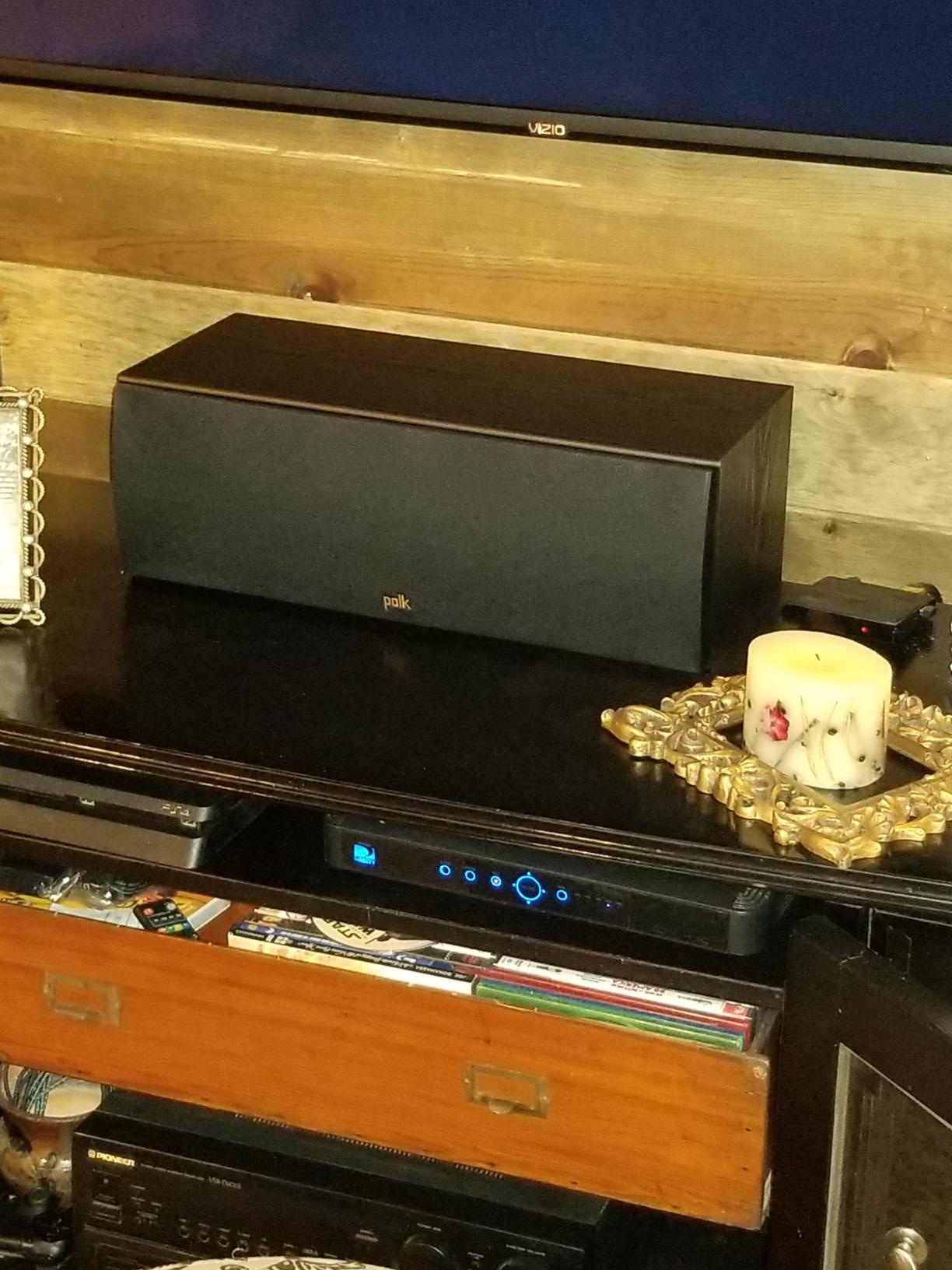
It is timbre matched to the rest of the Polk T-Series, so if you already own T-series bookshelf speakers this drops in without any tonal surprises. It also includes a tuned rear port for deeper bass than the slim designs manage, and the driver is a Dynamic Balance woofer rated for 200 watts of maximum output.
Impedance is 6 ohms rather than 8, which is still an easy load for any modern receiver, but worth knowing if you ever pair it with a very inexpensive amplifier. Polks are rated at 5.1 channels of use, which simply reflects its home theater role.
The cabinet is the trade-off: 8.5 inches deep by 19 inches wide by 6.5 inches high, at 11.5 pounds. Measure your shelf depth, because the front-firing port needs breathing room behind it and the grille reduces usable depth further. Polks back it with a five-year parts and labour warranty.
Are you building a first 5.1 system?
This is the speaker to buy. It is designed for exactly that role, it wires to the centre output of any receiver, and the dynamic balance drivers give you more midrange output than the small speakers in this list without the cabinet depth of the flagship options.
Is the treble going to fight your main speakers?
Some listeners in mixed-brand systems find the silk dome a touch forward and correct it with receiver EQ, which takes a few decibels of cut. If your main speakers are Polk, skip that step. If they are noticeably warm, audition first.
4. Klipsch R-25C – A Proven Reference Design With Deep Owner History
Klipsch – R-25C Center Speaker
Two-way Reference centre channel
400W peak power handling
18.75 inch wide cabinet
14.8 pounds
Pros
- Horn-loaded Reference voicing that cuts through
- High 4.8 star average across 1250 ratings
- Simple two-way layout with no array complexity
- Handles loud passages without strain
Cons
- Same 18.75 inch width as larger models
- Reference voicing is bright at high volume
- Older platform with fewer modern finishes
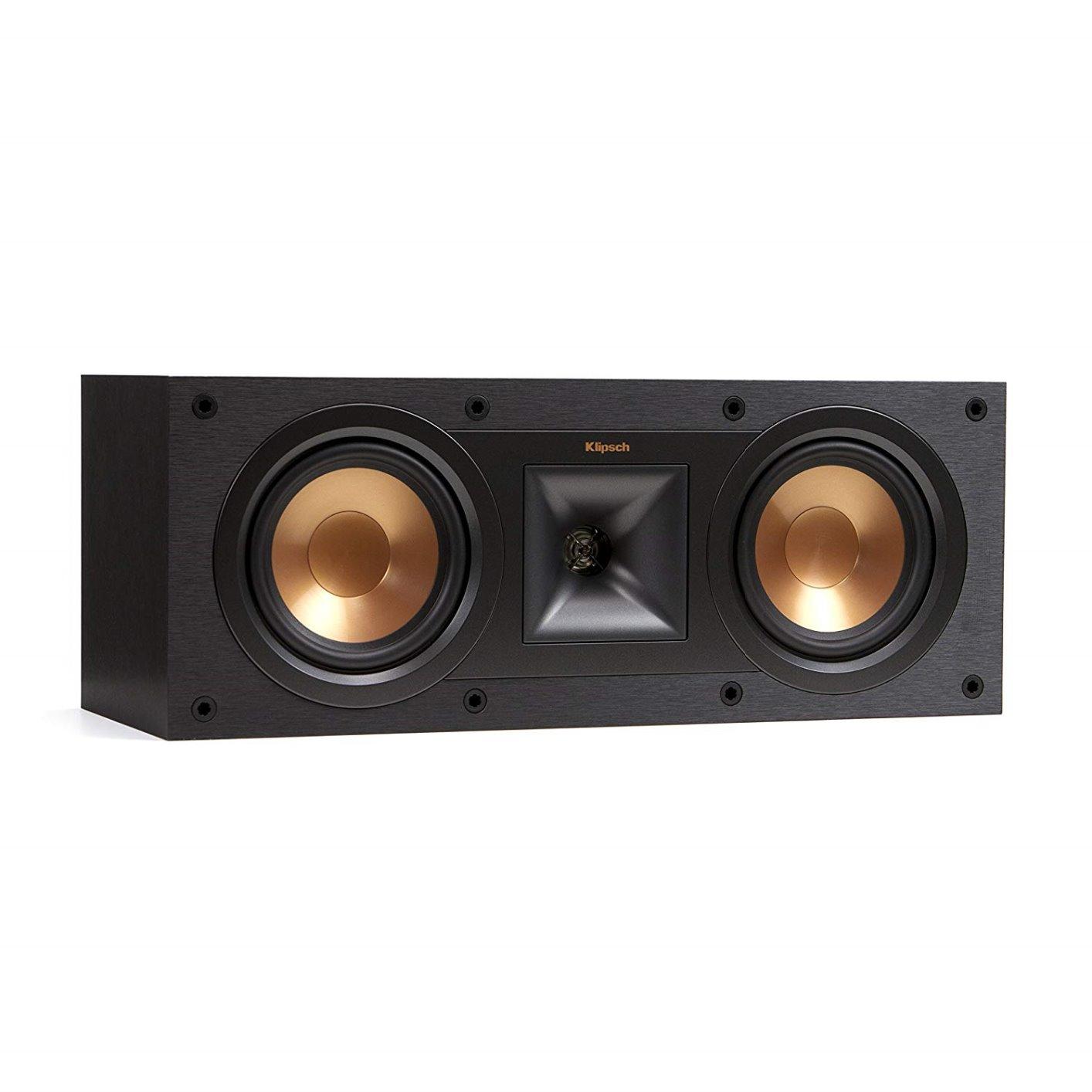
The R-25C is a two-way horn-loaded centre from Klipsch’s Reference line, and it has been a long-running platform. That longevity is part of the appeal. Long-running platforms attract owners who report years of satisfaction, and 1250 ratings holding a 4.8 average is one of the strongest rating-to-review relationships in this list.
The 400-watt peak power rating gives it headroom for the loudest scenes, and the horn-loaded tweeter platform is the same basic idea that makes the R-52C work so well for voices. It directs high-frequency energy toward the listener instead of diffusing it, so consonants stay defined.
What you give up versus the R-52C is refinement and efficiency. This is an older platform with a heavier cabinet, and the voice is bright in the same way all Klipsch Reference centres are bright. If that suits your taste and your main speakers, it is a very safe purchase.
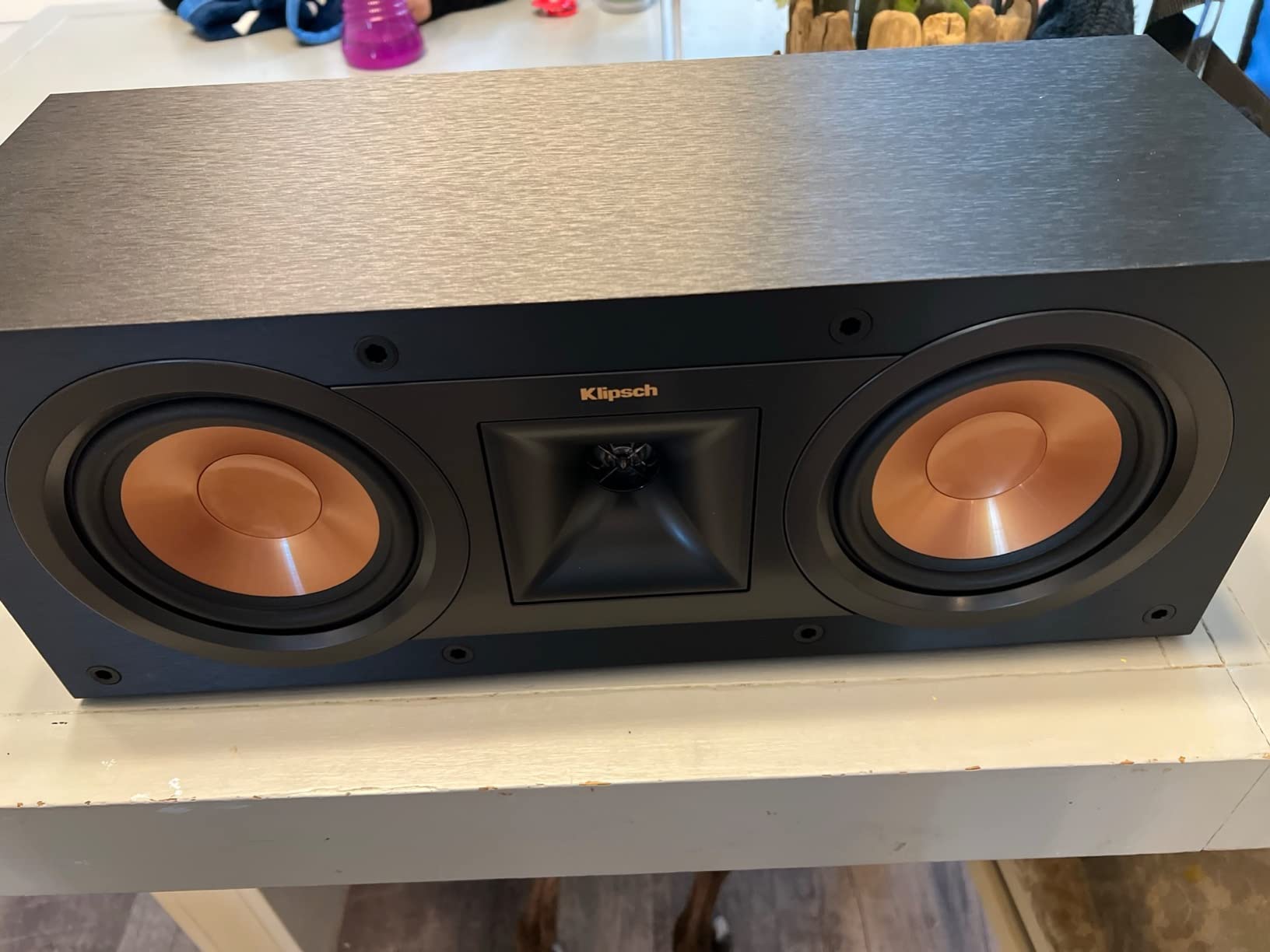
Physical numbers to plan around: 7.25 inches deep by 18.75 inches wide by 7.25 inches high, and 14.8 pounds. That is the second-heaviest cabinet we looked at, so get someone to help you lift it onto a high shelf or into a raised stand.
Because it is a passive two-way design with a single crossover point, there is no multi-driver array to complicate impedance or phase behaviour. It behaves predictably, which is genuinely useful if you are going to fine-tune it with room correction software.
The limitation is finish and refinement rather than function. There is no magnetic grille, no wall bracket and no rear port flare to speak of, so it is a shelf speaker and nothing else. In a modern living room the styling is plainer than the newer models on this list.
Do you want the Klipsch sound without the flagship cabinet?
Yes, if shelf space is the constraint. You get the horn-loaded clarity that Klipsch is known for, in a package that is narrower and shallower than the 32-inch-wide flagship. You give up some of the flagship’s refined mid-bass weight.
Is the brightness a deal-breaker at low volume?
Roughly a quarter of listeners describe the Reference voicing as harsh when pushed, particularly on sibilant content at high volume. At normal dialogue levels it is lively rather than tiring. If you listen mostly at low levels, a silk-dome alternative like the T30 may be easier for long sessions.
5. Polk Audio Signature Elite ES35 – Built to Mount Below a TV
Polk Audio Signature Elite ES35 Slim Center Channel Speaker, Stunning Black
1 inch Terylene tweeter with six 3 inch woofers
7.5 inch tall slim profile
4 and 8 ohm compatible
Power Port bass tuning
Pros
- Only 7.5 inches tall so it clears most TVs
- Built-in wall mounting for a clean install
- Six 3 inch drivers give unusually deep bass for the size
- Works as a matched surround pair too
Cons
- Upper frequencies can need receiver EQ
- Multi-driver array costs more than a simple two-way
- 20 inch width is wider than slim competitors
The ES35 is the pick when the constraint is the screen. At 7.5 inches tall it is short enough to sit below almost any television without covering the IR sensor, and Polk includes wall mounting so you can put it under the panel with a single bracket and no shelf at all.
Underneath that slim cabinet is an unusual amount of engineering. A 1-inch Terylene tweeter sits above six 3-inch woofers in a Dynamically Balanced Acoustic Array with cascading crossovers, and the patented Power Port is tuned for cleaner, lower bass than you would expect from a centre of this size. Reviewers single out the bass extension as unusual for the footprint.
It is also rated 4 and 8 ohm compatible, which is genuinely useful when your receiver’s centre channel is a lower-impedance load than you expect. That flexibility removes a whole category of compatibility worry.
The 20-inch width still needs measuring, and the cabinet is 10.6 inches deep, so it is not as slim as it looks from the front. At 6.4 kilograms it has real mass, which is a good thing for reducing cabinet resonance on a centre channel.
Owners highlight two things consistently: that the narrow profile is why it fits under modern televisions at all, and that it can double as a matched surround pair for a complete front stage. Polks back it with a five-year warranty.
The common criticism is that some listeners need to pull the upper frequencies down with receiver EQ to stop the Terylene dome from sounding bright in a mixed system. If your main speakers are neutral or warm, that is unlikely to be an issue for you.
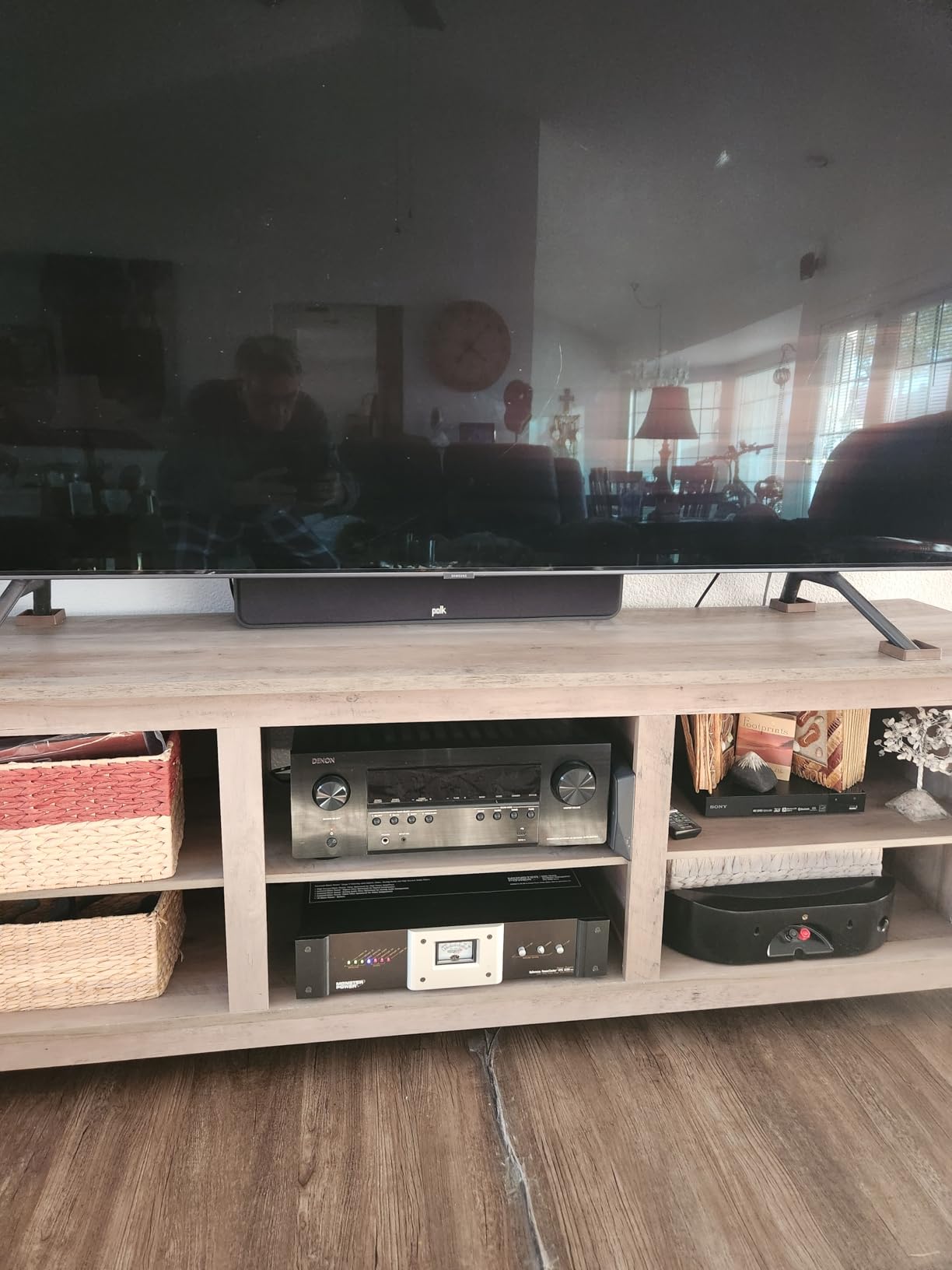
Will a wall-mounted centre under your TV work?
Yes, and this is the speaker built for it. Mounting it below the screen on the included bracket also lets you tilt it toward the seating position, which improves off-axis clarity for anyone not sitting dead centre. Just leave clearance behind the Power Port.
Is it worth it over a simple two-way design?
You are paying for the mounting solution, the driver count and the low-end capability. If you have a deep cabinet and no wall-mounting need, a simpler two-way at a similar tier is more efficient. If the space is tight, this one removes the problem rather than working around it.
6. Yamaha NS-C210BL – Compact Yamaha Build With Fast Woofers
YAMAHA Audio NS-C210BL Center Channel Speaker – Each (Black)
Light aluminum cone woofers
7/8 inch balanced dome tweeter
4.2 inch tall bass-reflex design
6 ohm impedance
Pros
- Only 4.4 pounds and 4.2 inches tall
- Aluminum cones give fast clean vocal response
- Piano Black finish suits AV furniture
- Bundled 4m speaker cable included
Cons
- 80 watt rating leaves little headroom in a large room
- Two-year warranty is the shortest here
- Modest bass depth compared with larger two-ways
The NS-C210 is the smallest complete speaker in the roundup that still uses a real 4-inch-class woofer rather than a 2.5-inch driver. That single fact is why it sounds more substantial than its 4.2-inch height suggests, and why it fits in spaces where the bigger two-ways simply cannot go.
Yamaha specifies light aluminum cones for fast response, which suits a midrange-heavy workload like speech. Transient consonants, sibilance and plosives depend on cone acceleration, and light cones move quickly without a large excursion, which is exactly what dialogue reproduction needs.
Owners use it as an easy, compact, brand-recognisable upgrade in mixed-brand systems, and the common report is that it finally makes dialogue intelligible. At 875 ratings averaging 4.6 stars, the response is steady rather than polarising, which is what you want from a centre channel.
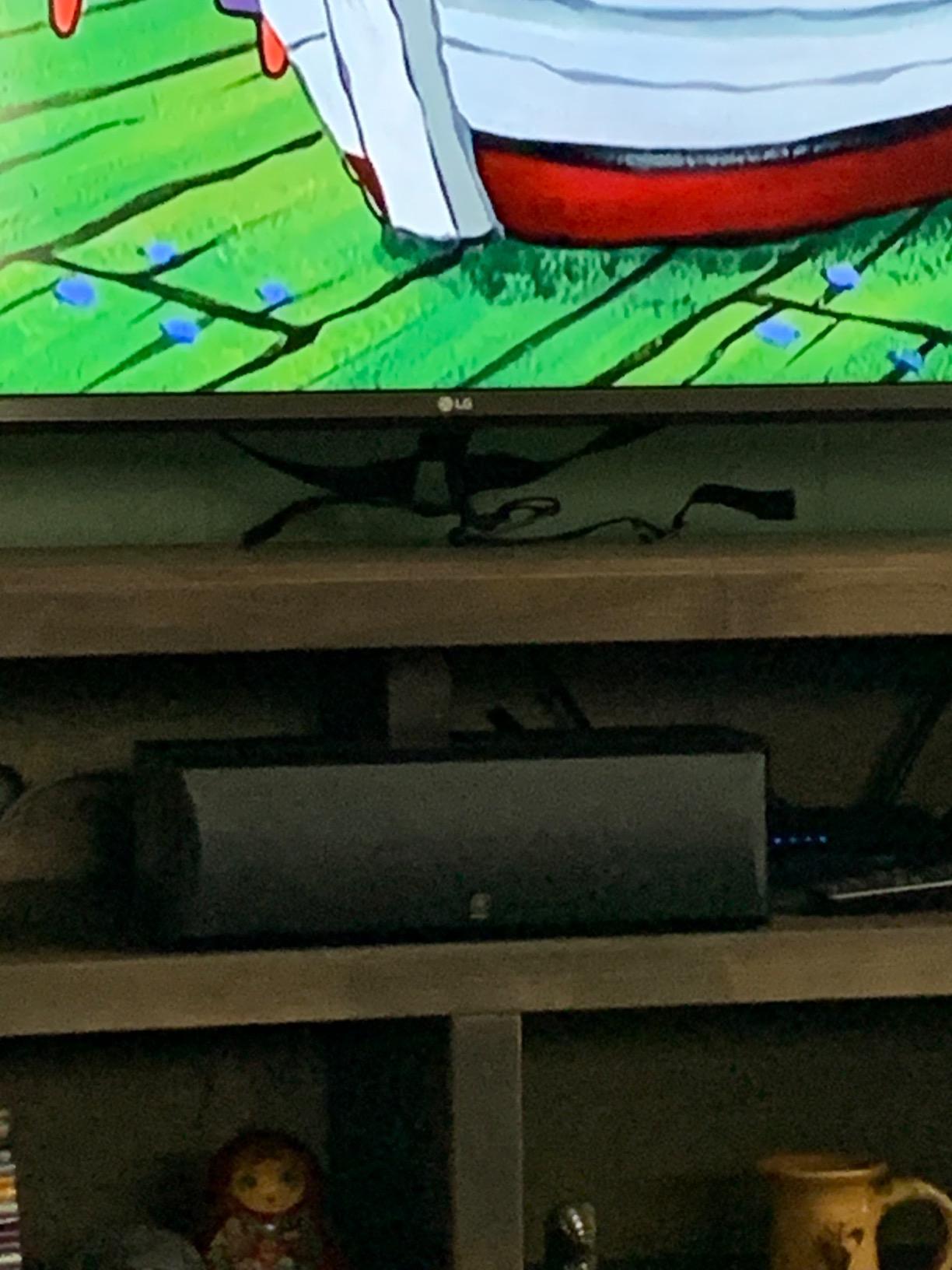
The physical footprint is friendly: 5.2 inches deep by 13.4 inches wide by 4.2 inches high, and only 4.4 pounds. The Piano Black finish also looks better next to a receiver than most of the matte and wood-grain options in this list, which is a small thing that matters on a visible shelf.
Impedance is 6 ohms and maximum output is listed at 80 watts. That is a modest number, and in a large room you will run out of headroom before you run out of clarity. In a bedroom, apartment or mid-size living room it is entirely adequate.
The warranty is the shortest we found, at two years parts and labour, against five or six years on most competitors. Budget for that when you weigh long-term ownership rather than just the purchase.
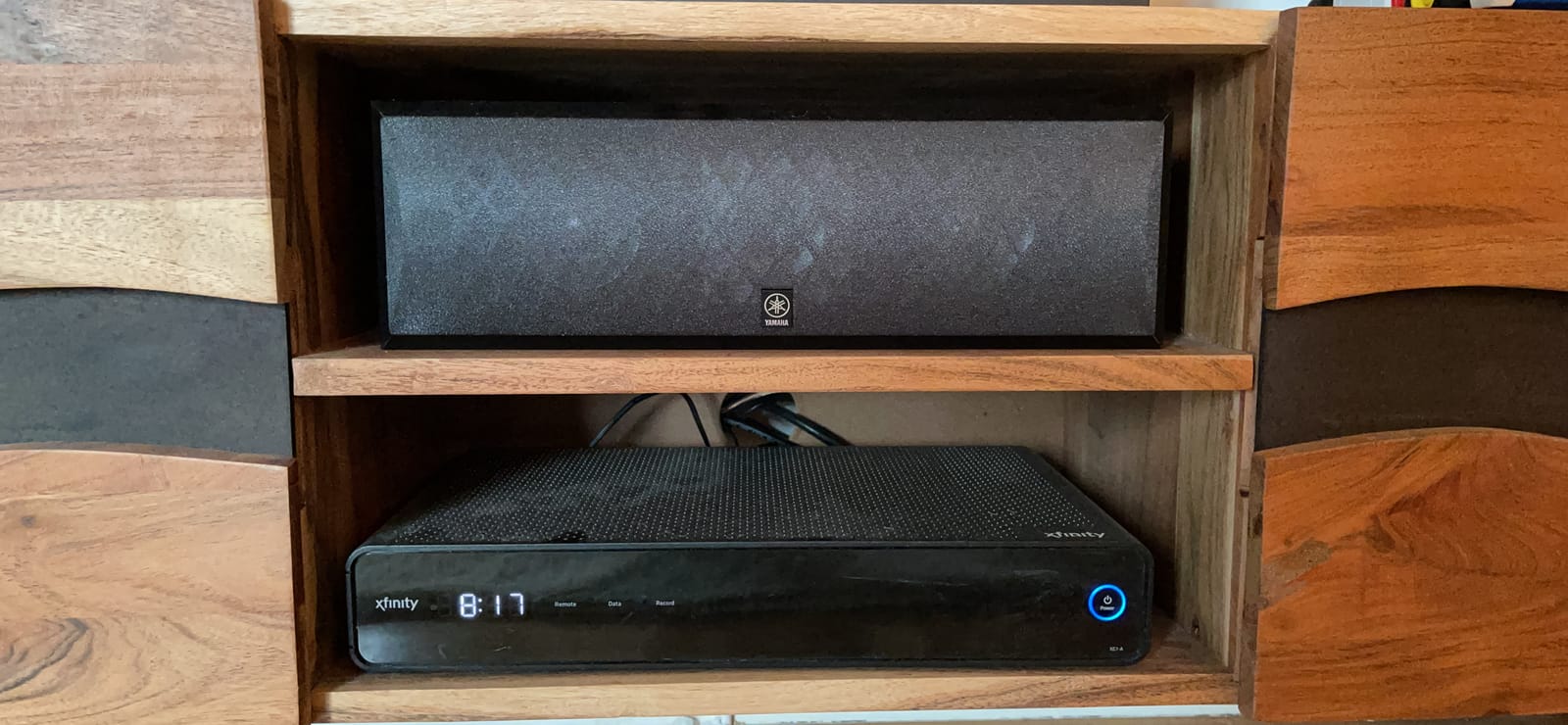
Do you need something that disappears into the furniture?
At 13.4 inches wide and 4.4 pounds, this is the easiest centre in the list to place, move and re-aim. The Piano Black finish is designed to blend with AV equipment, and the included 4m cable means no extra accessory shopping.
Will it fill a dedicated theater room?
Probably not. The 80-watt rating and 6-ohm load mean it wants a smaller room to sound effortless. If your system lives in a room with seating beyond three metres from the screen, budget for one of the higher-output models instead.
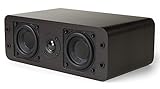
7. Micca OoO – The Smallest Footprint That Still Voices Cleanly
Micca OoO Slim Passive Center Channel Speaker, Home Theater, Each, Walnut
Dual 3 inch square frame woofers ported to 60Hz
0.75 inch silk dome tweeter
11 inch wide walnut cabinet
works horizontally or vertically
Pros
- Under 4 inches tall in a real wood veneer cabinet
- Owners report clear dialogue well beyond what the size suggests
- Works as a centre or a bookshelf in the same system
- Timbre matches Micca MB42X and RB42 speakers
Cons
- Explicitly too small for a large living room
- Low sensitivity needs a capable amplifier
- Tonal balance can need EQ out of the box
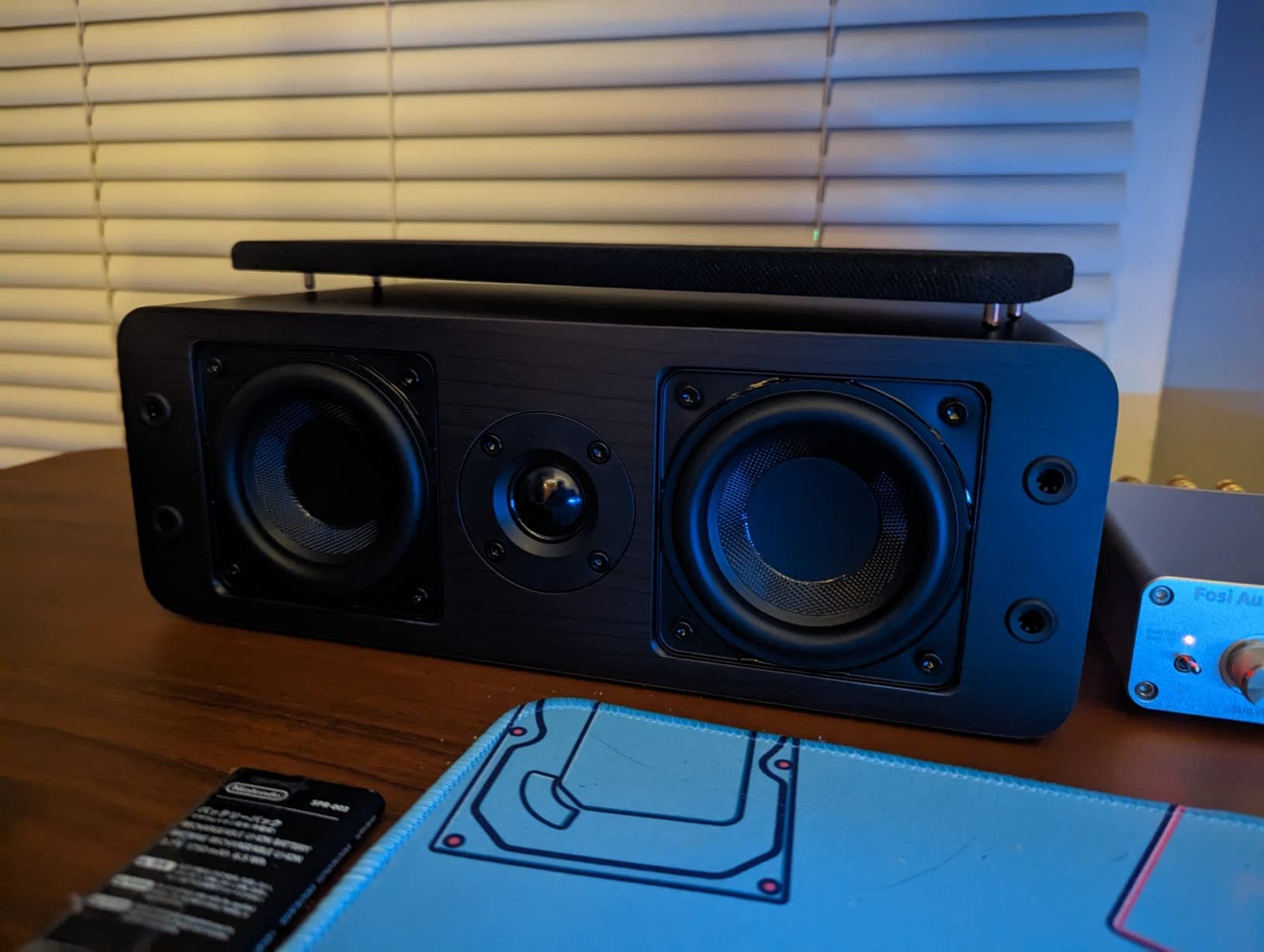
The OoO exists for a specific situation: a desk setup, a bedroom, a wall-mounted display, or a television on a very shallow console where nothing else fits. It is 11 inches wide, 6.9 inches deep and 3.9 inches tall, and it is the only centre channel in this roundup with a genuine wood veneer finish.
The engineering is more considered than the price suggests. Two 3-inch square-frame woofers sit in a ported enclosure tuned to 60Hz, with a 0.75-inch silk dome tweeter on a neodymium magnet, and the crossovers are asymmetric by design: 6dB per octave low-pass on the woofers with a 12dB per octave high-pass and level match on the tweeter.
Owners treat it as a compact solution and consistently report that dialogue is clear and understandable for its size. At 728 ratings averaging 4.6 stars, it holds its own against speakers several times the price in the same class of use.
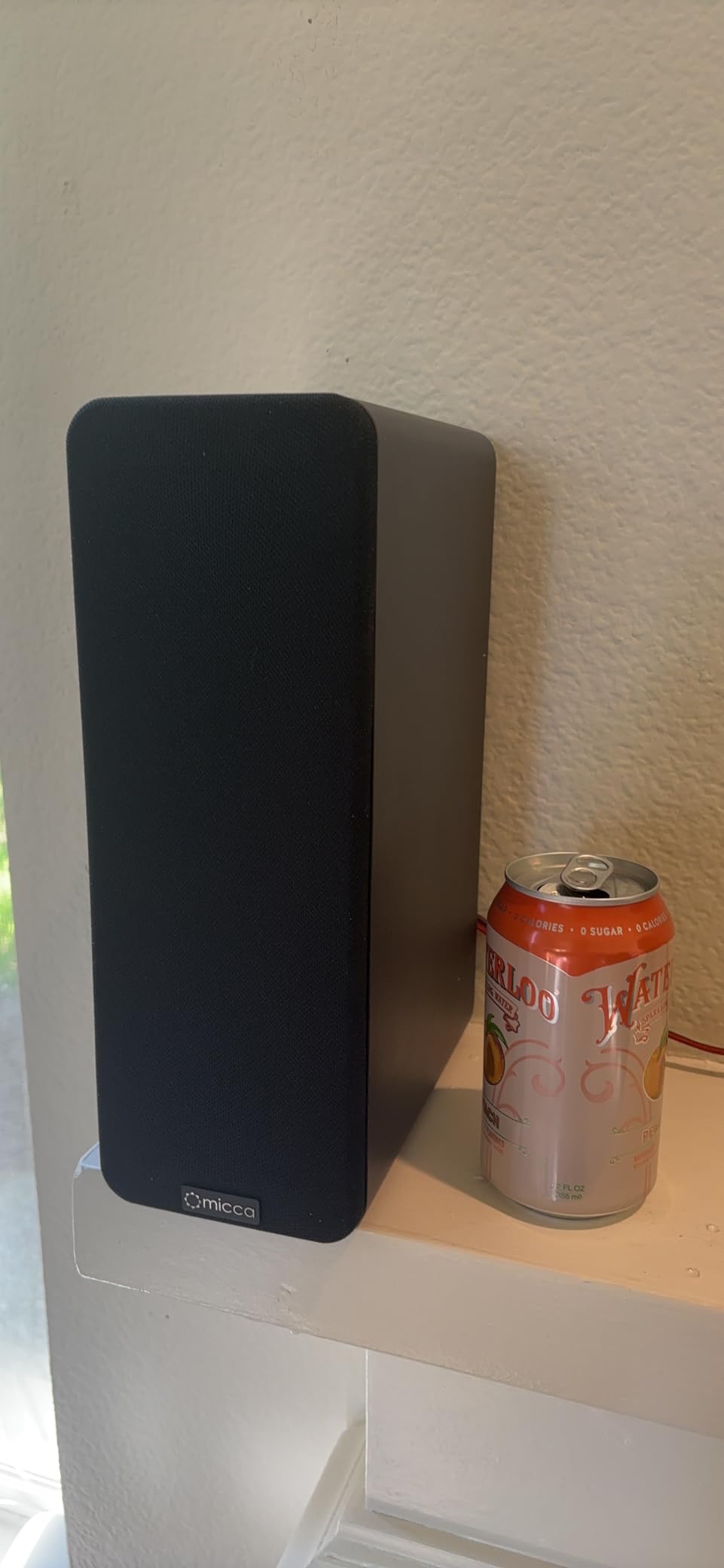
The honest limitation is room size. Reviewers explicitly advise against using it as the anchor in a large living room theater, and we agree. It also has lower sensitivity than the leaders here, so it needs a decent amplifier to reach comfortable volume without strain.
That makes it a poor match for an underpowered receiver channel. Pair it with something efficient, or add a small external amplifier, and it will be a genuinely useful centre for a compact space.
Two practical details: the grille is removable and the binding posts are better than the price suggests, and because the cabinet is a conventional rectangular shape you can stand it vertically as a bookshelf speaker. It also timbre matches Micca MB42X and RB42 bookshelf speakers, so a full system on one brand is possible.
Is your space too small for anything else?
If you have measured and every other option on this list is too deep or too tall, the OoO is the answer. Just give it a capable amplifier, because the low sensitivity is the real constraint, not the size.
Can you use it for music too?
Yes, as a standalone stereo pair using the vertical orientation, which is how Micca positions it. As a centre in a large theater the low sensitivity and the 25-watt output rating work against you, so keep it in the room it is sized for.
8. Klipsch RP-504C II – The Reference Premiere for Large Rooms
klipsch Reference Premiere RP-504C II Ebony Center Channel Speaker
Four 5.25 inch Cerametallic woofers
90x90 silicone composite hybrid horn
LTS titanium diaphragm tweeter
36 pound braced ebony cabinet
Pros
- Dialogue clarity is the standout feature for owners
- Four woofers give voices real weight and output
- Stays clean at high volume in big rooms
- Premium ebony finish suits a dedicated theater
Cons
- Over 32 inches wide and 36 pounds to lift
- Rear ports need 6 to 12 inches of clearance
- Needs a receiver channel with real current
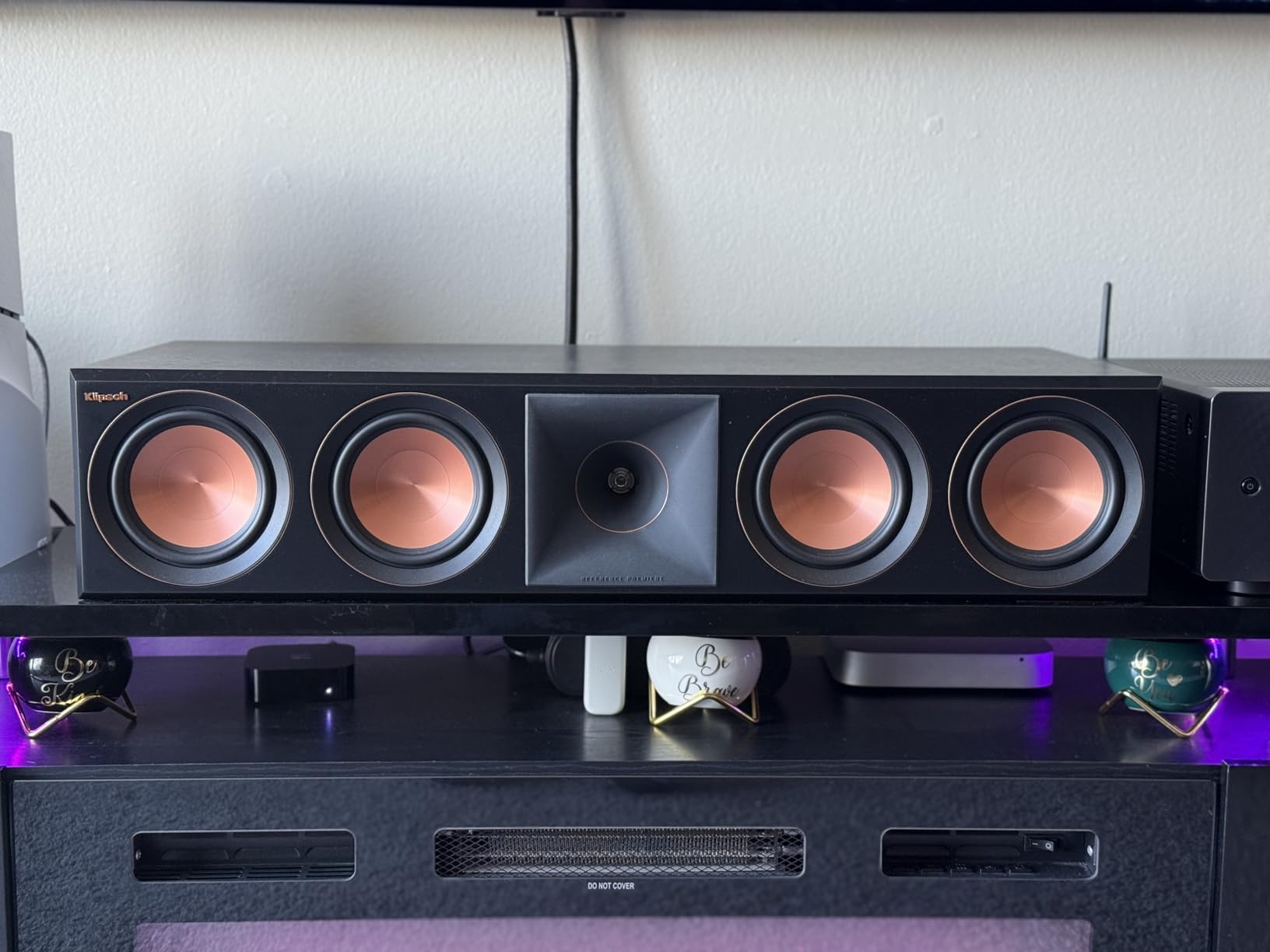
The RP-504C II is the flagship here, and it is the only model that is genuinely sized for a dedicated theater room. Four 5.25-inch Cerametallic woofers flank a pair of horn-loaded LTS titanium tweeters in silicone composite hybrid horns, all inside a braced ebony cabinet with a divided interior designed to cut vibration.
Owners put dialogue clarity first, consistently, across 284 ratings averaging 4.8 stars with about 90 percent five-star. People who upgraded from smaller centres describe the change as dramatic and immediate, and the extra driver count is visible in the data: this speaker produces real output, which is what carries voices through a loud, large room.
The horns are the second reason it works. A 90×90 degree pattern with a titanium diaphragm and vented housing keeps the highest-consonance energy controlled and on-axis, so voices stay defined even when the room is busy.
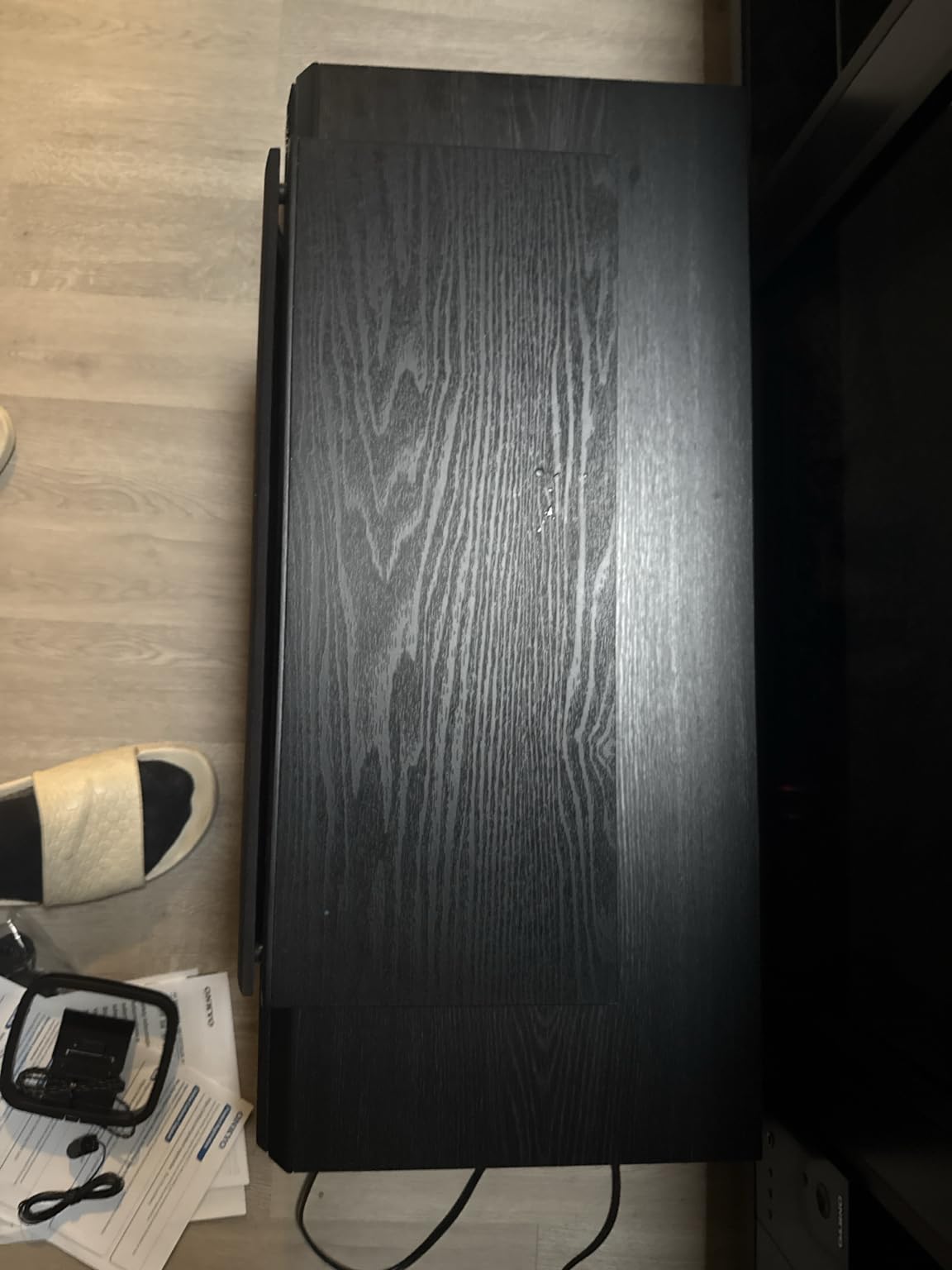
Now the practical side, and it is significant. The cabinet is 32.06 inches wide by 15.08 inches deep by 6.87 inches high and weighs 36 pounds. Positioning it is a two-person job, and you should measure the stand before the box arrives rather than after.
It is a passive speaker, so it needs a receiver channel with genuine current capability, and the rear Tractrix ports need 6 to 12 inches of clearance behind the cabinet for clean airflow. Block that port and the bass loading changes audibly.
Rear terminals accept banana plugs, and the grille attaches magnetically. One owner still wanted a small boost in the receiver’s centre trim to maximise clarity, which is a reminder that the room and the AVR often matter as much as the speaker. Klipsch supplies a five-year manufacturer warranty.
Do you have a large room and a strong stand?
This is the right speaker for that combination. The four-woofer array provides the output headroom and low-end weight that a big room demands, and the braced cabinet stays composed at volume. If your stand is shallow, keep looking.
Can your receiver drive it?
Yes, provided the centre channel is not the weakest amplifier section in the box. Because the model is passive, the quality of the power matters more than the wattage number. Run calibration after installing and use the centre trim if voices still sit behind the effects.
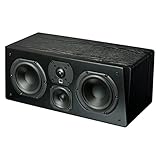
9. SVS Prime Center – The Only True 3-Way in the Roundup
SVS Prime Center Speaker – Premium Black Ash
True 3-way SoundMatch crossover
1 inch aluminum dome tweeter
5.25 inch woofers on composite baskets
rear-ported cabinet
Pros
- Only true 3-way design here
- so the midrange never shares driver duty
- Wide dispersion holds up for off-seat listeners
- Warms up to a balanced presentation over roughly 20 hours
- Buyers with hearing loss cite it as the solving upgrade
Cons
- Bright out of the box for the first sessions
- Rear ports limit placement against a wall
- 20 pound cabinet and 13 inch height need real shelf space
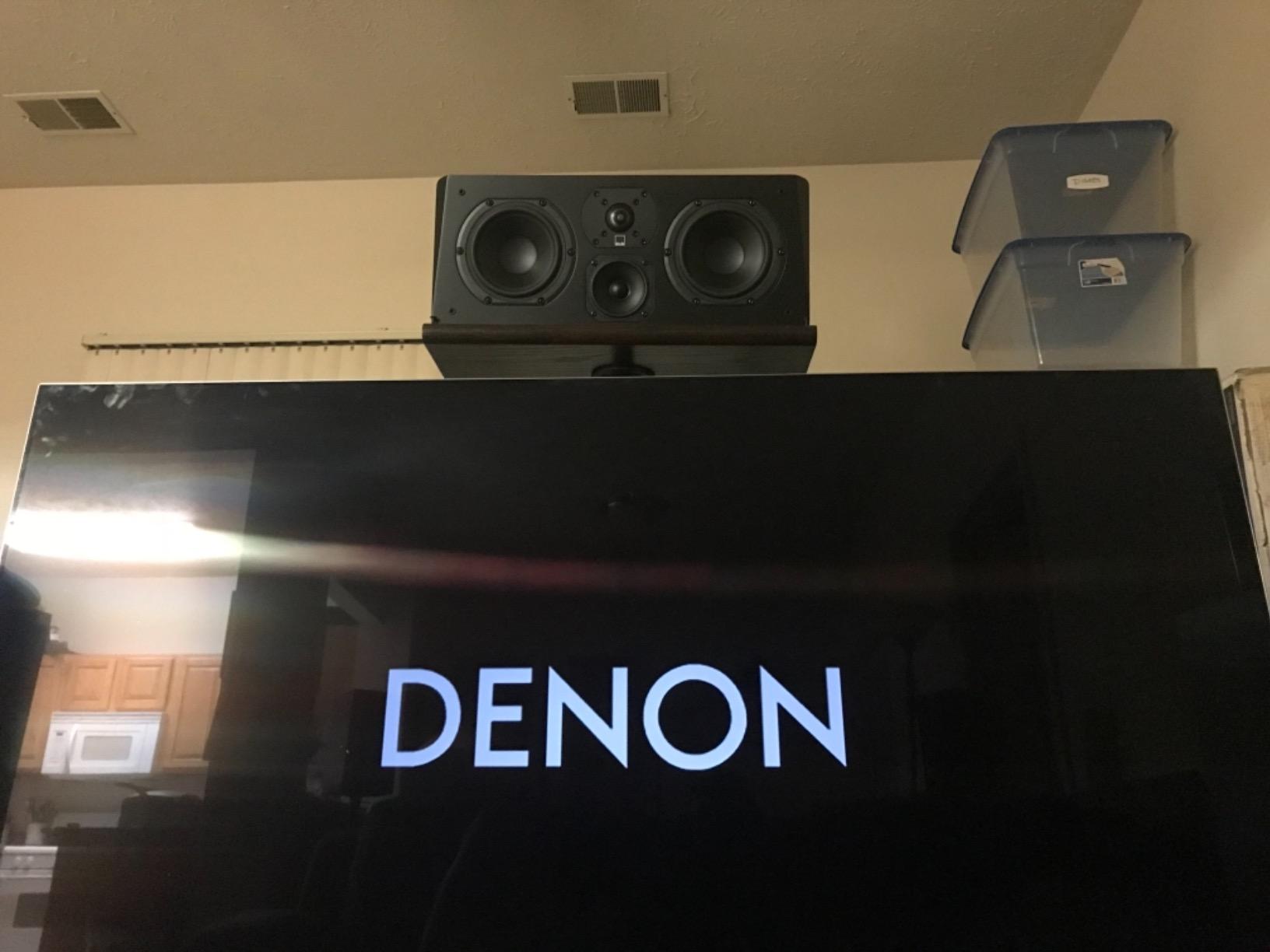
The Prime Center is architecturally different from everything else here. It is a genuine three-way design with a proprietary SoundMatch crossover, which means the midrange has dedicated drivers rather than sharing the same cone as the bass. That is the structural reason it sounds the way it does, and it is worth understanding before you buy.
On a two-way centre, the crossover point sits near where ears are most sensitive to vocal presence, and two cones are asked to work on either side of that point simultaneously. That interference is the mechanism behind the hollow or thin dialogue that buyers complain about in cheap horizontal designs. A three-way removes it.
The practical payoff owners report is off-axis consistency. This speaker holds up for listeners sitting away from the centre seat, which matters in a wide sofa or a room with two seating rows. Buyers with hearing loss and muffled dialogue specifically cite it as the upgrade that solved their problem.
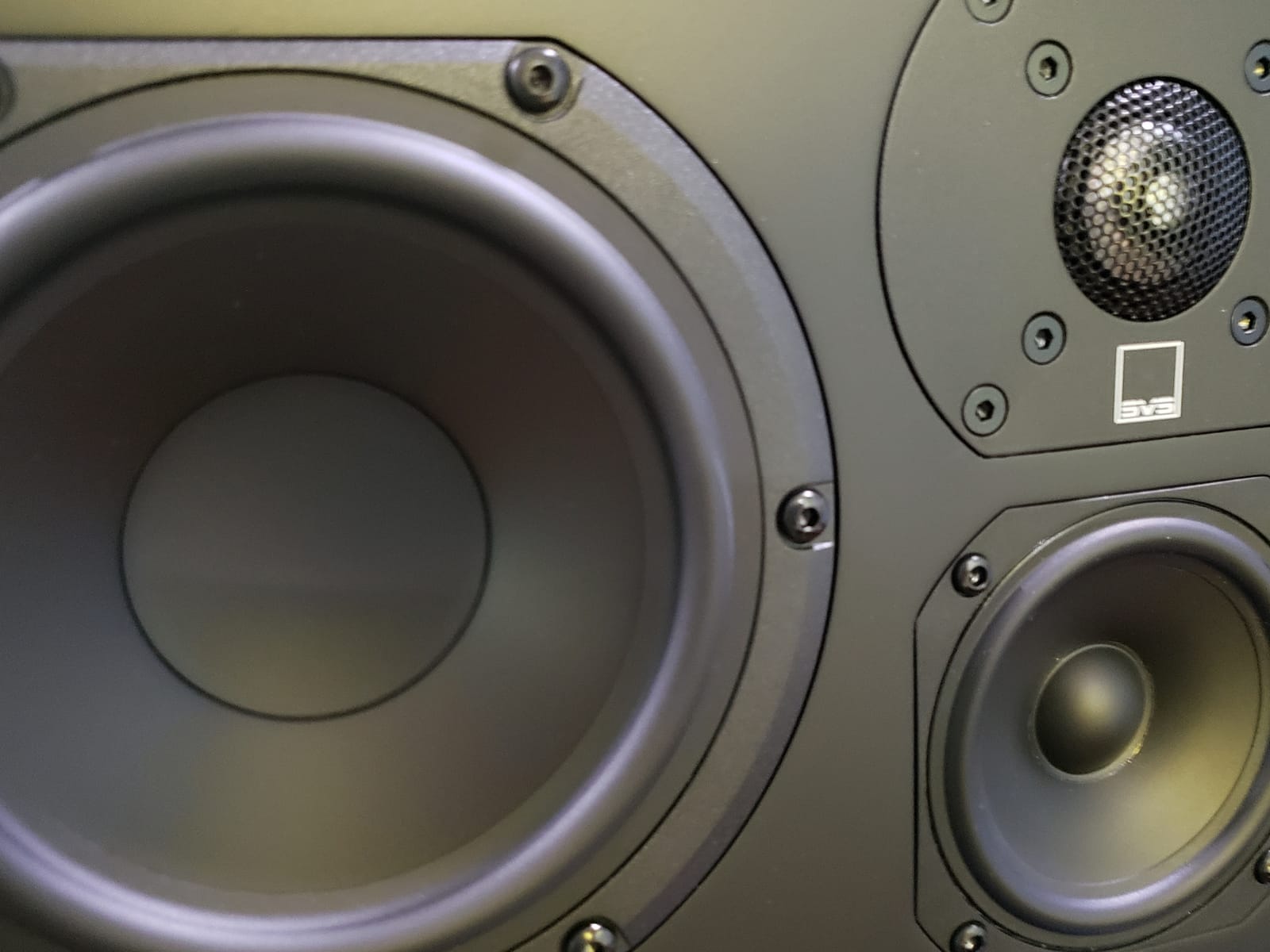
It also tunes warmer and less forward than a horn-loaded centre, which several owners prefer for long listening sessions. Multiple reviews note that the speaker settles into a more balanced presentation after roughly 15 to 20 hours of use, so do not judge it in the first movie.
The counterpoint is early brightness. Several owners lowered the centre level at the receiver before it warmed up, which is normal for a new three-way but worth knowing. The cabinet is 12 inches deep by 23 inches wide by 13 inches high and weighs 20 pounds, so it is a tall, substantial object.
Rear porting limits placement against a wall, and some buyers found the supplied feet underwhelming. SVS support is repeatedly praised, which matters if you are new to the brand.
Do you have off-centre seating or a wide room?
That is where a three-way earns its keep. The dedicated midrange section stays consistent further off axis, so people at the ends of a large sofa hear the same voice level and the same clarity as the person in the middle. A two-way narrows noticeably at the edges.
Is it a direct upgrade over a two-way?
It is different rather than universally better. You gain midrange purity, off-axis consistency and deeper bass, and you give up some efficiency and some of the raw output per watt. Give it twenty hours of playback before deciding.
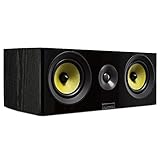
10. Fluance Signature HiFi – The Easiest Match for Speakers You Do Not Own
Fluance Signature HiFi 2-Way Center Channel Speaker for Enhanced Dialogue and Vocals in Home Theater Surround Sound Systems – Black Ash (HFC)
Dual 5 inch pointed dome glass fiber mids
Neodymium tweeter
92dB sensitivity
keyhole wall brackets included
Pros
- Wide sound field where height and position matter less
- 92dB sensitivity gets loud without much amplifier power
- Lifetime parts and labour warranty
- Solid 16.3 pound engineered-wood cabinet
Cons
- Adds mild coloration rather than sounding fully transparent
- Needs roughly 20 hours of break-in
- Stiff terminals that fight banana clips
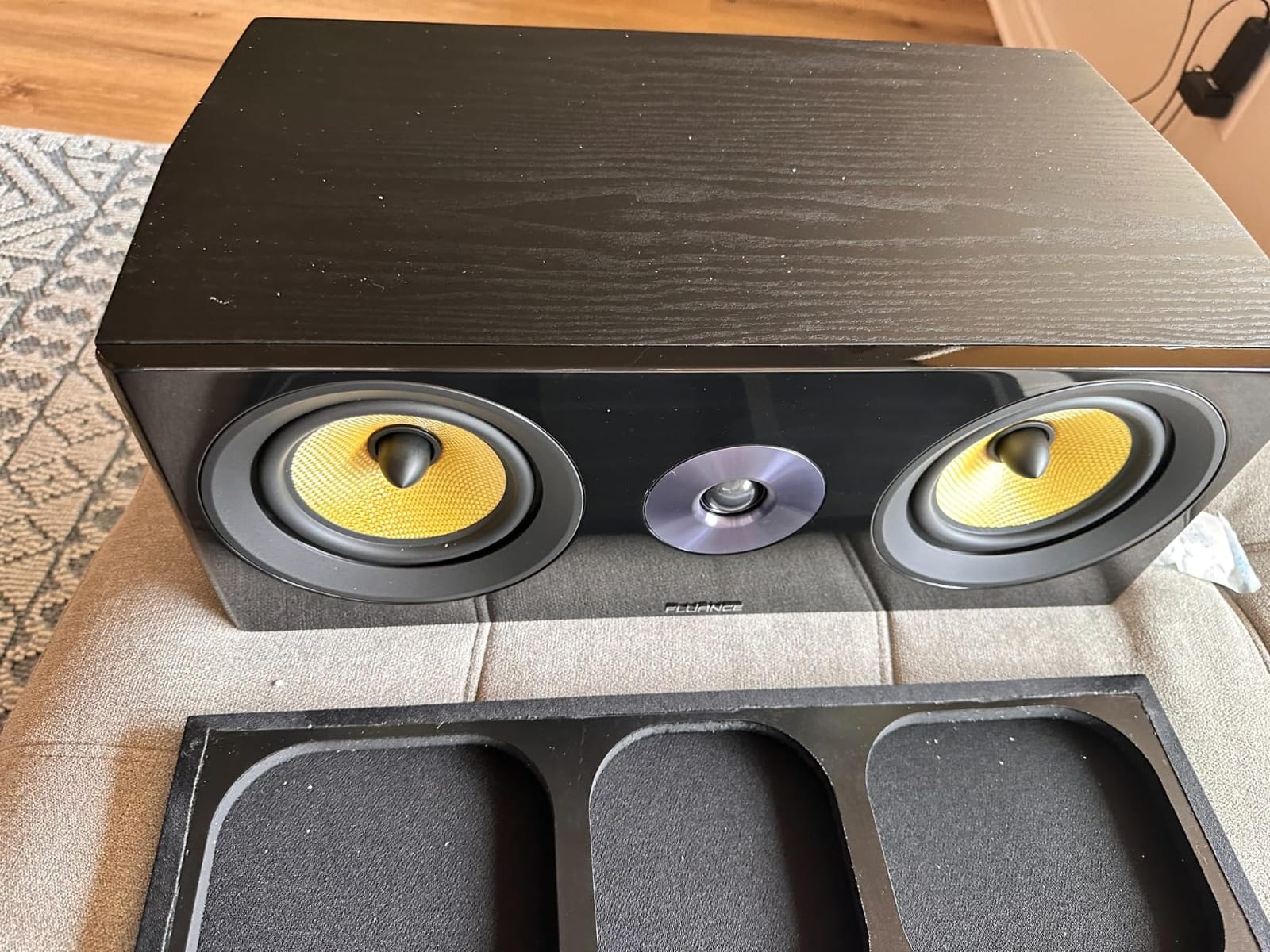
If you are keeping the main speakers you already own and only replacing the centre, this is the model to look at. Owners describe an unusually wide sound field, meaning the centre keeps sounding right whether it is mounted higher, lower, or slightly off to one side of the seating position, which is a real problem in asymmetric rooms.
The drivers are unusual for the price. Dual 5-inch midrange units use pointed dome woven glass fiber cones, driven by a high-end neodymium tweeter, and the 92dB sensitivity means it reaches comfortable volume without demanding a lot of amplifier power, which matters when your centre channel is the weakest section.
Several owners describe it as a high-end result at a modest price, saying they auditioned established premium brands first and found this competitive. That is a claim we would treat cautiously, but the wide dispersion behind it is a real, documented advantage. It comes with a lifetime parts and labour warranty, the only one in this roundup.
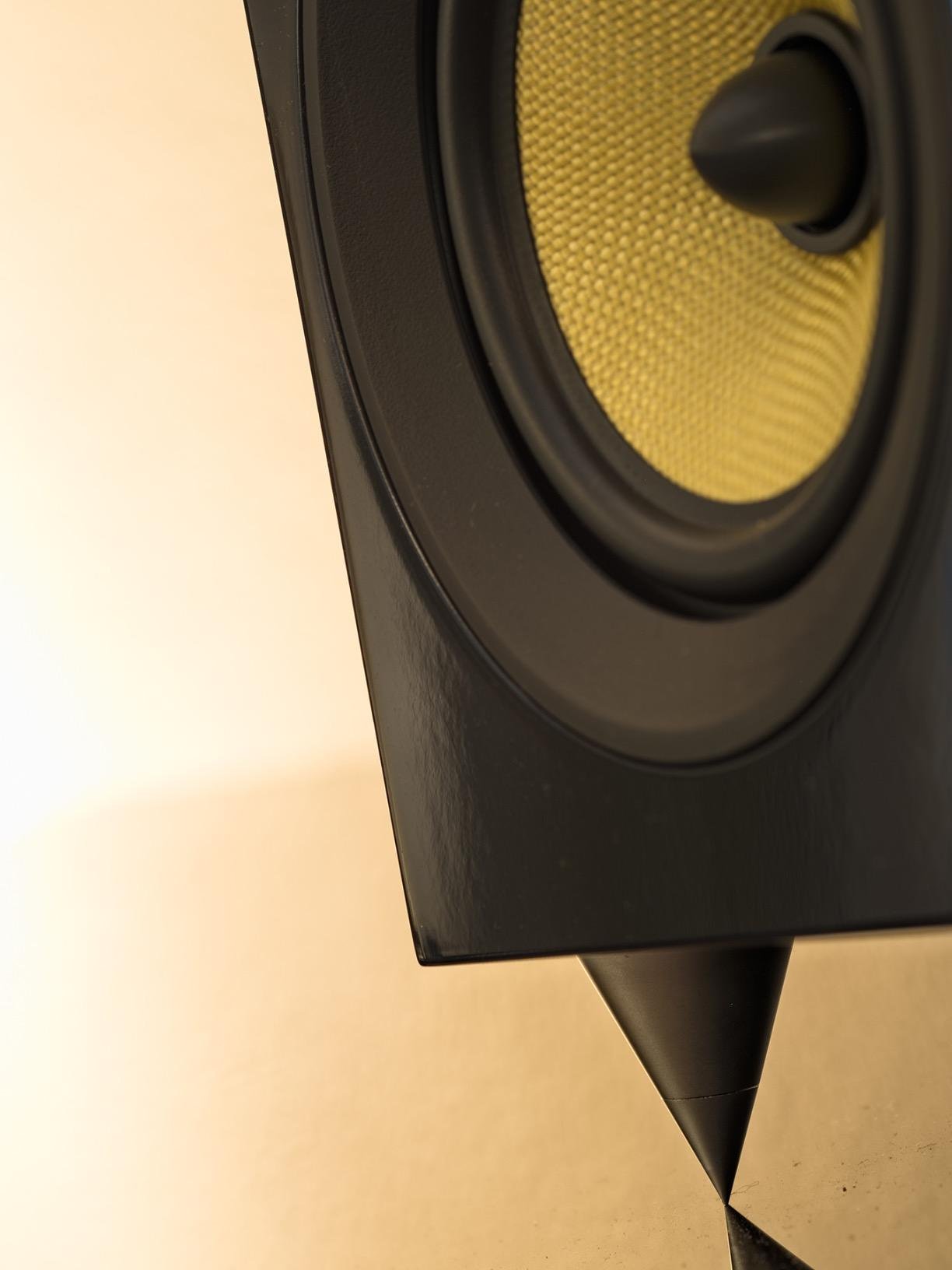
It is also genuinely well built. The cabinet is acoustically inert engineered wood at 16.3 pounds, it includes integrated keyhole wall brackets and isolation foot pads, and the magnetic grille attaches cleanly. Wall mounting is a first-class option rather than an afterthought.
The honest cons are worth reading. Reviewers note the speaker wire terminals are stiff and banana clips may not seat flush, the magnetic grille is flimsy, no mounting template is supplied for the keyhole brackets, and the sound carries a little coloration rather than being fully transparent.
It also needs roughly 20 hours of break-in before it opens up, and a small number of listeners find voices slightly bright in mixed-brand systems. At 186 ratings averaging 4.5 stars, the review count is the smallest here, so treat the consensus as directional rather than settled.
Are you replacing only the centre channel?
This is where it earns its place. Wide dispersion and a neutral-leaning voiced midrange mean the mismatch between a new centre and older main speakers is far less audible than it would be with a strongly voiced design. Wall mounting also solves the placement half of the problem.
What are the real compromises?
Colouration, stiff terminals and a break-in period. If you are a tonal purist who wants a completely transparent centre, keep auditioning. If you want a coherent voice in a mixed system and value the warranty, this is a strong answer.
How to Choose a Center Channel Speaker for Dialogue
Dialogue intelligibility lives in a narrow band. Most of what makes speech readable sits between roughly 1 and 4 kilohertz, so that is where a centre channel earns or loses its price. The specifications below are the ones that actually predict performance, and the rest are marketing.
Directivity and dispersion decide whether you hear it
Wide horizontal dispersion means the centre still sounds right to people sitting away from the middle seat. A horn-loaded tweeter with a stated 90×90 degree pattern controls where the treble goes, and a three-way design with a dedicated midrange stays consistent further off axis. This matters in wide sofas and rooms with two rows, more than any other single spec.
Sensitivity decides whether your receiver can drive it
Sensitivity is how efficiently a speaker converts amplifier power into volume, measured in decibels. Every 3 dB of difference roughly doubles the amplifier power needed for the same level. The Klipsch R-52C at 95dB is the most efficient model here, which is why it reaches reference level on modest receivers, while a low-sensitivity compact like the Micca OoO needs a stronger amplifier section to keep up.
Impedance tells you what your receiver faces
Most centre channels are nominal 8 ohms, and some in this roundup are 6 ohms or compatible with both 4 and 8. Anything at or above 6 ohms is an easy load for a modern AV receiver. The Polks are the models to check carefully if you own an older or budget amplifier.
Crossover design explains thin or hollow voices
On a two-way design, one crossover frequency splits the signal between the mid-bass drivers and the tweeter. Set that point too high and the cones fighting over the vocal presence range is what makes cheap horizontal speakers sound hollow. Cascading crossover arrays and true three-way designs exist specifically to avoid that overlap.
3-Way vs 2-Way: Why Driver Layout Decides Dialogue Clarity
A two-way centre channel uses one tweeter and two mid-bass drivers, and every design in this roundup except one is built that way. It is the standard architecture because it is simple and cheap to build. The weakness is that two cones are asked to handle the vocal presence range at the same time they are producing bass, and their overlap is where thinness comes from.
A three-way design splits the job into three bands with dedicated drivers for the low, mid and high ranges. The midrange section then does exactly one thing, which is reproducing the human voice, and it does it without competing with bass or treble excursion. That is the entire argument, and it is why the SVS Prime Center sounds different rather than simply louder.
The trade-off is efficiency and cost. Three-way designs need a more complex crossover, they are usually larger, and they can be less efficient per watt, so a high-quality two-way at the same tier can sound better in a smaller room. For a large room with off-centre seating, the three-way advantage tends to grow.
One further term worth knowing: driver beaming. When a wide-diameter cone is used for high frequencies, it stops dispersing those frequencies evenly, and voices can sound different depending on where you sit in the room. Vertical layouts and horn loading both reduce this effect, which is why almost every centre channel is built horizontally with a tweeter centred above or between the midrange drivers.
Matching a Center Channel to Speakers You Already Own
This is the most common question in home theater forums and the one with the least objective guidance. Forum consensus keeps repeating one line: get the biggest and best centre you can fit and afford, and Polk in particular is repeatedly described as delivering the most sound for the money. That advice is sound, but it skips the part that actually causes complaints.
Matching is about three things, in this order. First, power and sensitivity. If your centre is far more efficient than your main speakers, voices will jump forward of the soundstage and the mix will feel wrong in a way people rarely can name. Keep sensitivities within about 3 dB of each other.
Second, size and driver scale. A centre with 3-inch drivers sitting between floorstanding mains with 6.5-inch midranges will read as a thin voice in the middle of a full soundstage, no matter how good it is in isolation. Closer driver sizes, more than matching brand names, is what closes the gap.
Third, tonal character. This is the one people argue about most and it matters least. A horn-loaded centre next to warm main speakers is a mismatch, but a receiver’s centre-channel EQ and per-channel level trim will hide most of it. If the only reason to change speakers is timbre, a free EQ fix is the better first move.
The same logic applies outside home theater. If you are building an audio setup where channel matching matters as much, our guide to 4 channel car amplifiers covers how to pair amplification with speaker sensitivity in a much tighter space.
Placement Checklist: Ear Height, Tilt and Distance
A centre channel placed badly will underperform a mediocre one placed well. The rule most people know as the 83 percent rule is this: sit in your normal listening position and measure the distance from your ear to the front of the screen, then place the centre channel at 83 percent of that distance from the screen. At that distance the tweeter sits at roughly ear height when seated, which is where the horn pattern is aimed correctly.
Beyond that, the checklist is short. Centre the speaker physically on the screen, not in the room. Tilt it downward toward the listening position if it sits lower than your ears, because a flat-firing centre aimed at the ceiling loses off-axis clarity. Keep the front of the cabinet clear of anything that blocks the horn mouth.
Give rear-ported models 6 to 12 inches of clearance behind the cabinet, or choose a front-ported design like the Polk T30 if you have to push it back against a wall. Leave the grille off while you set the level, since some grilles cause a few decibels of diffraction at the edges.
Finally, aim the centre directly at the main seat before you calibrate, and only then adjust. Moving a centre after running room correction wastes the measurements you just took.
Fix Dialogue Before You Buy: Five Free Upgrades
Before spending anything, work through this list. Forum discussion on dialogue clarity converges on a consistent point: clarity has little to do with bright versus warm speakers and much more to do with speaker quality, placement and room reflections. All three of the free fixes below address those directly.
1. Check your TV sound settings first. Turn off any television-side dialogue enhancement, night mode or compression, because these are designed for late-night viewing at low volume and they flatten the very frequencies you are trying to recover. If your TV has a dialogue enhancer, switch it off before you judge anything else.
2. Use your receiver’s centre-channel trim. Every AV receiver lets you adjust the centre relative to the rest. If voices sit behind music and effects, add two to three decibels and listen to a dialogue-heavy scene again. This single step solves a surprising share of the problem.
3. Use the receiver’s dialogue or intelligibility mode. Most receivers have one. It is not a substitute for a good speaker, but on a mixed system it can make a measurable difference in a single evening, and it costs nothing to test.
4. Run room correction properly. After any change to placement, re-run the calibration routine, and check that the centre channel measurements are not being cut by a low microphone placement or a sofa back. A bad measurement makes a good speaker sound worse.
5. Re-evaluate after two weeks. If voices are still buried after the above, now you have a real diagnosis rather than a guess, and the model you buy should be chosen for output, directivity and fit rather than as a lottery ticket. We keep our guide to the centre channel organisers nearby for anyone also working out how to manage the equipment around the screen.
Frequently Asked Questions
What is the best center channel speaker of all time?
There is no permanent answer, because the best centre channel is the one that matches your main speakers in output and fits your room. Across the models we compared, the Klipsch R-52C stands out for 95dB sensitivity, a 90×90 degree horn-loaded tweeter and dual 5.25-inch drivers, which makes it the easiest to drive and the most consistent at keeping voices clear. The SVS Prime Center wins on architecture, since it is the only true three-way design and handles off-seat listeners best.
Are center channel speakers worth it?
For anyone whose dialogue gets buried under effects, yes, and the center is usually the best value upgrade in a home theater because it reproduces the majority of what you hear in a film or TV soundtrack. The improvement is largest when you replace a small or damaged speaker, or when you are upgrading from TV speakers or a soundbar. It is smallest when your current centre is a decent 5-inch design that is simply placed badly.
How do I improve dialogue clarity on my TV?
Start with the free fixes: turn off television-side night mode and compression, raise the centre channel level two to three decibels in your receiver menu, enable the receiver dialogue or intelligibility mode, and re-run room correction with the microphone at ear height in your main seat. If voices are still hard to follow after that, a dedicated centre channel is the next step rather than the first one.
What is the 83% rule for speaker placement?
The 83% rule is a placement shortcut for centre channels. Sit in your normal listening position, measure the distance from your ear to the front of the screen, and place the centre speaker at roughly 83 percent of that distance from the screen. At that position the tweeter lines up near ear height when seated, which keeps the horn pattern or tweeter aimed directly at the listener.
Can I use any speaker as a center channel?
Any passive speaker can serve as a centre channel, and a matching pair of bookshelf speakers is the classic choice because it keeps the voice consistent with your mains. The practical limits are physical and tonal: the speaker must be wide enough for a horizontal layout, must fit beneath or beside your screen, and should have sensitivity within about 3 dB of your main speakers so the mix does not sound unbalanced.
What are the best 3-way speakers for dialogue?
Among the models we compared, the SVS Prime Center is the only true three-way design, using a dedicated midrange section that never shares driver duty with bass or treble. Three-way layouts are worth considering when you have wide seating, a large room or listeners sitting off the centre axis, because the dedicated midrange stays consistent further off axis than a two-way with a single crossover point.
The Best Center Channel Speakers for Dialogue in 2026
The Klipsch R-52C is our pick of the best center channel speakers for dialogue in 2026, because 95dB sensitivity, a controlled 90×90 degree horn and dual 5.25-inch drivers make it the easiest speaker here to drive and the hardest for effects to bury. The Polk T30 is the value choice for a first home theater, and the Polk Signature Elite ES35 is the answer when a slim wall-mountable cabinet is the deciding factor.
For a dedicated theater room, step up to the Klipsch RP-504C II and accept the 32-inch width and 36-pound weight. For wide seating and off-axis listeners, the SVS Prime Center is the only true three-way in the group. For rooms where nothing fits, the Micca OoO and Yamaha NS-C210BL solve the physical problem, and the Polk Blackstone TL1 remains the cheapest credible way to stop subtitles being compulsory.
Before you order any of them, though, run the free checks. Centre trim, dialogue mode, room correction and placement account for more clarity than most speaker upgrades, and they cost nothing at all.