
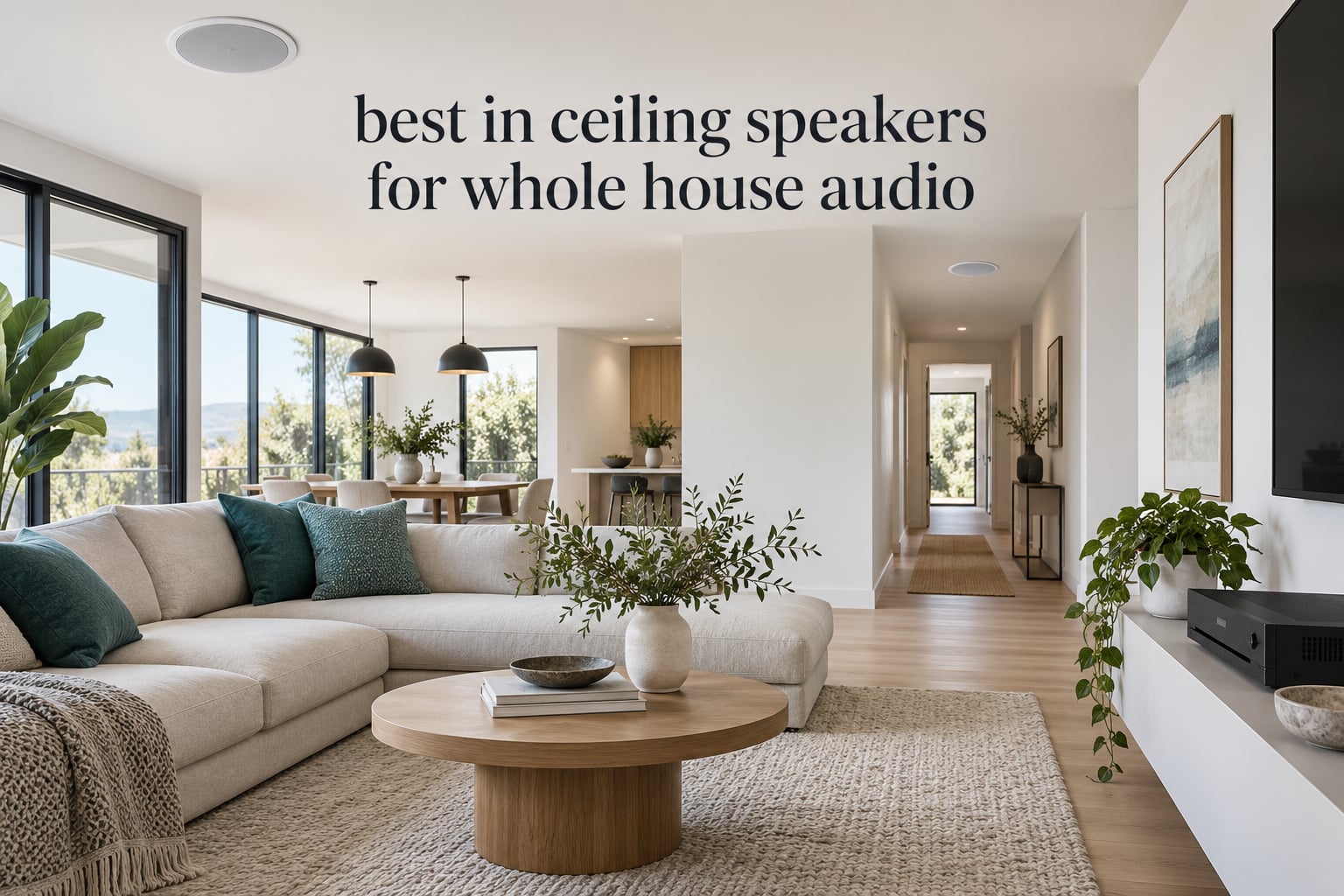
In-ceiling speakers for whole house audio are flush-mounted, 8-ohm passive loudspeakers fitted into your ceiling cavities and wired back to a multi-zone amplifier, so every room can play music on its own or together. Our top pick for 2026 is the Polk Audio RC80i, and we tested the spec sheets, install details and owner reports of 12 models to find the right speaker for each room.
Whole house audio is the least glamorous part of a home audio system and the hardest to change later. Once a speaker is buried above a drywall ceiling, replacing it means cutting a second hole, so driver size, cutout diameter, mounting depth and impedance all have to be right the first time. Everything in this list is a passive 8-ohm speaker except where noted, which means you need an amplifier, and the amplifier choice shapes the speaker choice more than most buyers expect.
We picked these twelve by reading the published specifications side by side, checking each cutout diameter and mounting depth against real installation constraints, and reading what buyers report after living with the speakers. Forum regulars on AVS Forum, the Polk and Klipsch community boards and r/hometheater shaped two of our recommendations directly. Everything here works with a standard multi-zone amplifier; only the Herdio kit and the JBL model need something different, and we explain where each one fits.
Table of Contents
Top 3 Picks for Best in Ceiling Speakers for Whole House Audio in October
Polk Audio RC80i
- 8 inch Dynamic Balance woofer
- aimable 1 inch tweeter
- 8 ohm
- moisture-resistant seal
Two Polk models and a Yamaha take the top three because the decision here is mostly about ceiling cavity depth and how much bass a room needs, not about flagship refinement. The RC80i is the safest default: an 8-inch driver, a 4.7 rating across more than 2,300 reviews, and a moisture-resistant rubber seal that lets it go in a bathroom or covered porch.
The Micca M-8C is the value answer, and it is the model most owners on forum threads recommend when cost per room is the deciding factor. The Yamaha NS-IC800 is the pick when you care about build quality, a genuinely flush magnetic grille and gold-plated terminals, and you are installing into a house you want to keep.
All 12 In-Ceiling Speakers Compared in 2026
| Product | Specs | Action |
|---|---|---|
| Polk Audio RC80i |
|
Check Latest Price |
| Micca M-8C |
|
Check Latest Price |
 Polk Audio RC60i Polk Audio RC60i |
|
Check Latest Price |
 Yamaha NS-IC800 Yamaha NS-IC800 |
|
Check Latest Price |
 Klipsch CDT-5800-C II Klipsch CDT-5800-C II |
|
Check Latest Price |
 Klipsch CDT-5650-C II Klipsch CDT-5650-C II |
|
Check Latest Price |
 Klipsch R-1650-C 4-Pack Klipsch R-1650-C 4-Pack |
|
Check Latest Price |
 Herdio 4-Speaker Bluetooth Kit Herdio 4-Speaker Bluetooth Kit |
|
Check Latest Price |
 Pyle In-Ceiling Pair Pyle In-Ceiling Pair |
|
Check Latest Price |
 JBL Professional CSS8008 JBL Professional CSS8008 |
|
Check Latest Price |
 Sonos in-Ceiling by Sonance Sonos in-Ceiling by Sonance |
|
Check Latest Price |
 Acoustic Audio CS-IC83 5-Pack Acoustic Audio CS-IC83 5-Pack |
|
Check Latest Price |
Two columns in that table deserve a note. The JBL CSS8008 is the only model here built for constant-voltage distributed lines, so it needs a 70V or 100V amplifier rather than a standard stereo amp. The Herdio kit is the only all-in-one wireless system, with its amplifier in the box and no amplifier to buy separately.
The simplest default configuration, so a four-room system means ordering four of one model rather than two pairs, and a grille can be removed from any of them while the ceiling is being painted.
1. Polk Audio RC80i – The Safe Default for Almost Every Room
Polk Audio RC80i 2-Way Premium In Ceiling Speakers, 8″ Round Pair, White
8 inch woofer, 1 inch aimable tweeter, 8 ohm, 50W max, moisture seal
Pros
- Even room-filling output from one 8 inch driver
- Aimable tweeter points treble at the seating
- Moisture-resistant rubber seal for bath and porch
- Aluminium grilles can be painted
- Cardboard templates and paint mask in the box
Cons
- 50 watt maximum output is modest
- Plastic mounting tabs can snap if over-tightened
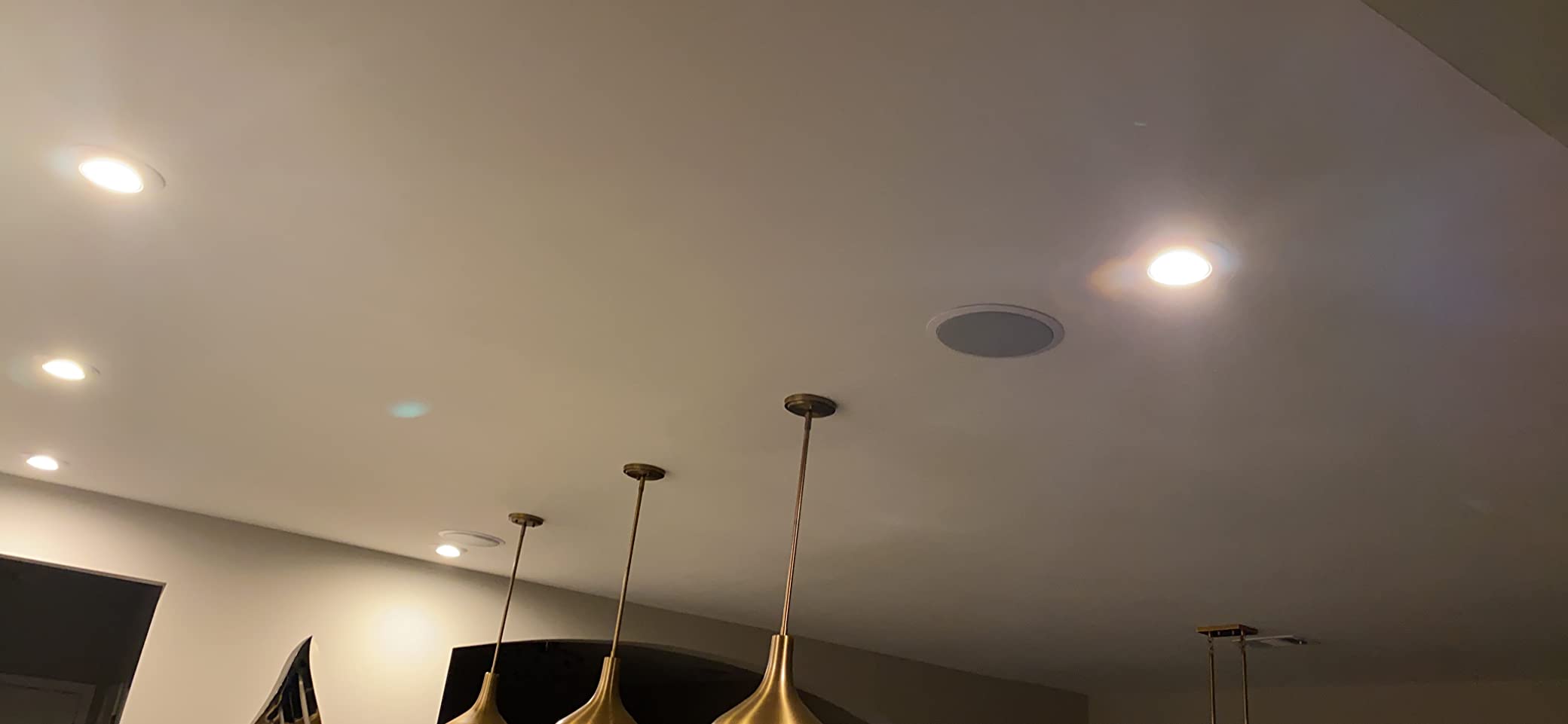
This is the speaker we keep coming back to. The RC80i pairs an 8-inch Dynamic Balance woofer with a 1-inch aimable tweeter, and the aimable tweeter matters more in a ceiling than it does in a bookshelf, because your listening position is rarely directly below the speaker. It is a 2-way design at 8 ohm, which is the impedance every multi-zone amplifier on the market is built to drive.
The 4.7 rating comes from more than 2,300 reviews, and the pattern in those reviews is consistent: owners installing several pairs report even coverage with no hot spots, and the installation takes minutes using the supplied cardboard templates. A 5-year parts and labor warranty also makes it one of the safer buys for wiring you cannot easily reach later.
On the technical side, published power handling is 50 watts, which is lower than several models in this list. In practice that figure is a maximum rather than a continuous rating, and a multi-zone amplifier delivering 20 to 40 watts per channel stays well inside it for background music. It is not the model to pair with a subwoofer-free cinema room at high volume, which is a fair trade for a speaker this easy to place.
The rubber seal is the underrated feature. It is the reason the RC80i shows up in bathroom and covered porch installs rather than only in living rooms, and it is why we rate it moisture-resistant even though the listing does not use an IP rating. The grilles are aluminium rather than plastic, so they take paint without going soft and they do not yellow the way cheaper white plastics do after a few seasons of direct light.
When the RC80i is the right call
Choose the RC80i for a mixed house where some rooms need to handle a little humidity and others need decent low end. It is the easiest model on this list to order in quantity, since it arrives as a matched pair with grilles, templates and a paint mask in the same box. For new construction, ordering the same model for every room means one cutout size for the installer to template once.
If your ceiling cavity is shallow, check the 3.63-inch listed depth before you commit. That figure suits most 9-foot and 10-foot ceilings with a standard plenum but is tight in vaulted or heavily insulated ceilings, where the RC60i or the Micca is a safer bet.
When something else fits better
Pick a different model if you are mounting in a high ceiling where the extra mounting depth matters, or if you need real high-frequency control over a listening position several feet off-axis. Forum enthusiasts consistently steer buyers away from ceiling speakers for front left and centre duty, so if this system doubles as a home theatre, keep the RC80i for surrounds and background zones rather than the front stage.
The other limitation is peak output. A 50-watt ceiling speaker on a modest two-channel amp is fine for music at conversation level in a 200-square-foot room. Push it harder in a large open plan and the Polk will sound thin next to a Klipsch CDT model with far more headroom and a much narrower, more deliberate dispersion pattern.
2. Micca M-8C – The Best Value Per Room
Micca M-8C 8-Inch 2-Way in-Ceiling Speaker, Round, Each, Paintable, White
8 inch poly woofer, 1 inch silk dome tweeter, 90dB, 100W each, 8 ohm
Pros
- Lowest cost per room of any 8 inch model here
- 90dB sensitivity means modest amplification is enough
- 6dB crossover keeps the upper mids coherent
- 3.5 inch mounting depth suits shallow ceilings
- Sold singly so you can buy exactly what each room needs
Cons
- Sold as one speaker so pairs need two orders
- Unsealed composite body sounds thin without a back enclosure
If you are covering four to eight rooms on a budget, the Micca M-8C is the model that keeps the whole project affordable. It is an 8-inch two-way with a high-excursion poly woofer and a pivoting 1-inch silk dome tweeter, and at 90dB sensitivity it produces good level without a powerful amplifier behind it. That sensitivity figure is the number that matters when one amplifier has to feed four zones.
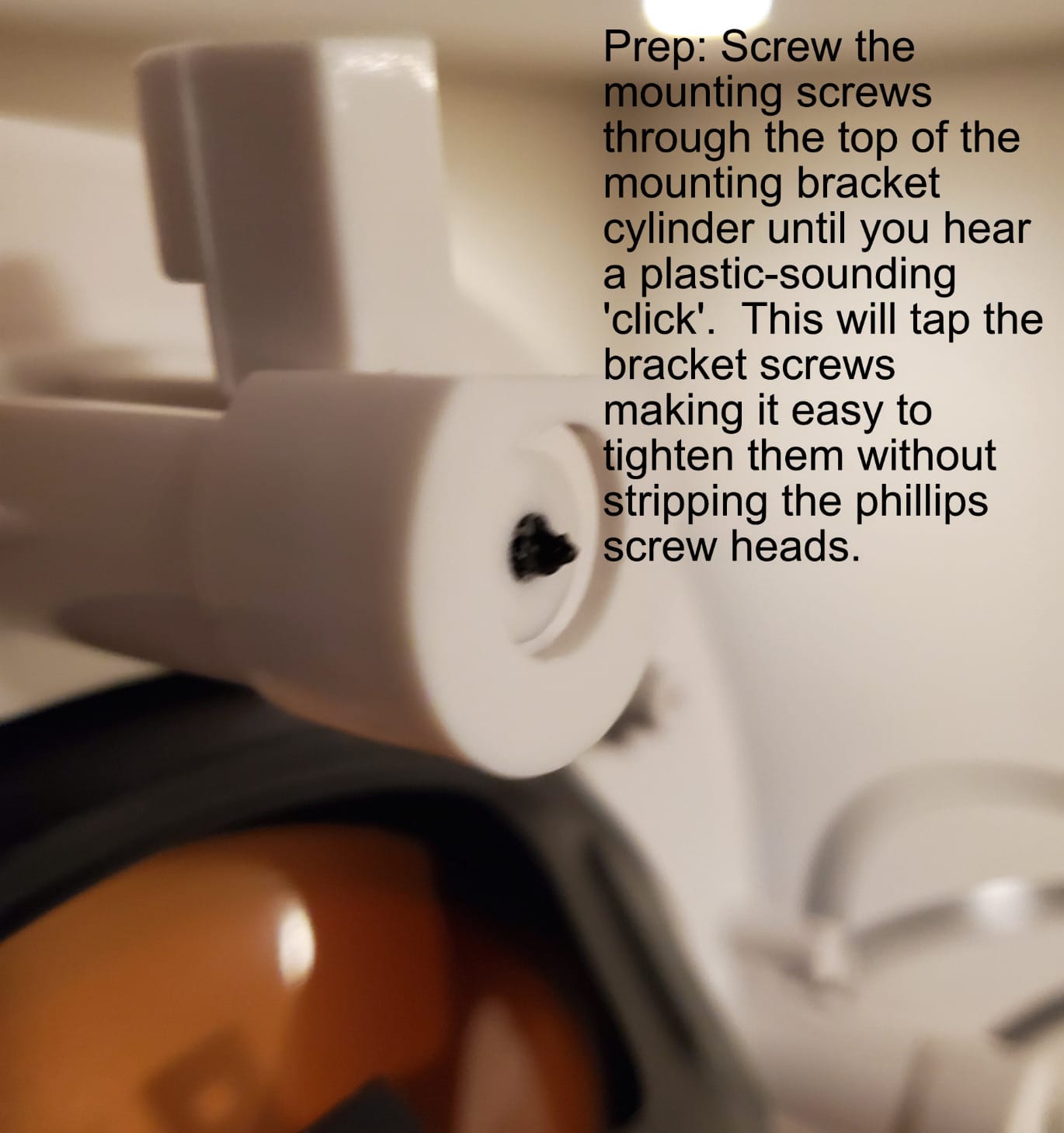
It holds a 4.7 rating across more than 1,600 reviews, and owners repeatedly describe upgrading from cheaper builder-grade speakers and hearing a smoother, more natural result. The rimmed grille sits nearly flush and takes paint, so the visual result in a finished ceiling is clean. Installation is genuinely tool-light, with built-in mounting tabs that grip drywall without brackets or boxes.
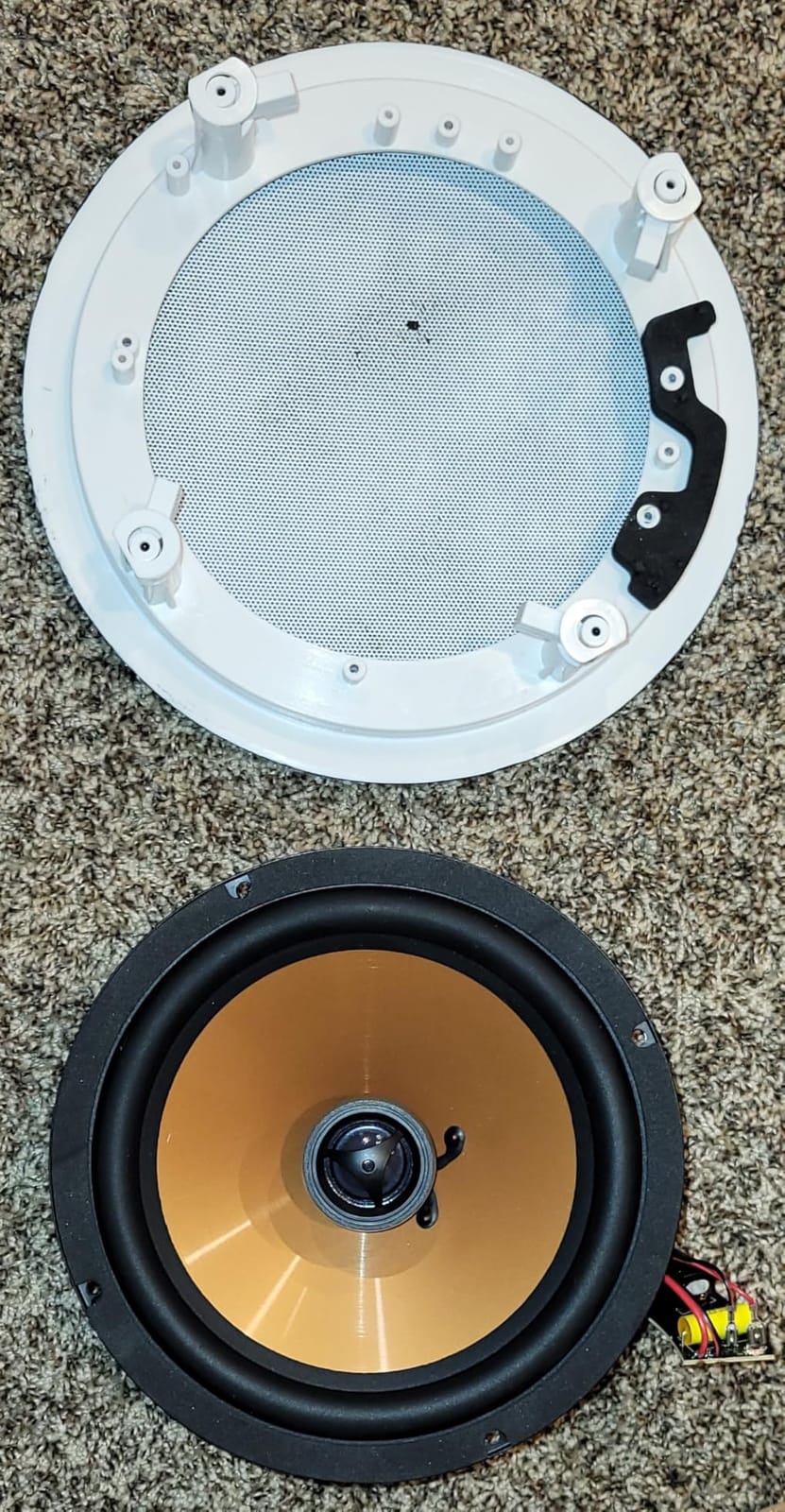
The cutout is 9.4 inches with a 3.5-inch mounting depth, which is the shallowest 8-inch option here. That makes it the most forgiving model in older homes with low ceilings or tight joist cavities. At 8 ohm with 100 watts of power handling per speaker, it has more headroom than the Polk RC80i despite costing far less.
The one thing you should add is a back enclosure. Owners who fitted one report a material improvement in bass, because the composite body is not sealed and sound leaks into the cavity above. A simple MDF box is a small job for an installer and it is the difference between a thin 8-inch speaker and one that sounds deliberate on music.
When the M-8C earns its place
This is the model for a first house with no existing audio infrastructure, where the plan is six or eight rooms of background music and the budget has to cover the amplifier and the wire as well. Single-unit packaging is a real advantage here: a house with an odd number of rooms still ends up with matched speakers in every one of them.
It also suits any room where the ceiling is lower than usual. At 3.5 inches of mounting depth it will fit where an 8-inch model with a deeper frame will not, and the 90dB sensitivity means a 30-watt-per-channel distribution amplifier is enough for a properly sized room.
What to watch for
Two caveats. The enclosure is not sealed, so treat the bass as unfinished until you add a back box or an in-ceiling subwoofer in the same zone. And the listing carries a limited one-year warranty, which is the shortest in this group, so confirm the retailer terms before committing to a large order.
It is also not moisture-rated for direct wet areas. In a bathroom or covered patio, pair it with the RC80i or the RC60i instead, both of which carry a documented moisture or water resistance claim, and keep the Micca for dry interior rooms.
3. Polk Audio RC60i – Compact Rooms and Smaller Ceiling Cavities
Polk Audio RC60i 2-Way Premium in-Ceiling Speaker, 6.5″ Round Pair, White
6.5 inch woofer, 0.75 inch swiveling tweeter, 8 ohm, water resistant
Pros
- Documented water resistance for bathrooms and porches
- Shallow 2.88 inch depth fits tight cavities
- Lifetime warranty is the strongest in this group
- Even coverage with no hot spots in multi-speaker rooms
- Paintable grille with no visible bezel
Cons
- Swiveling tweeter aims treble rather than full dispersion
- Plastic mounting dogs can bend if over-tightened
- 50 watt maximum output is modest
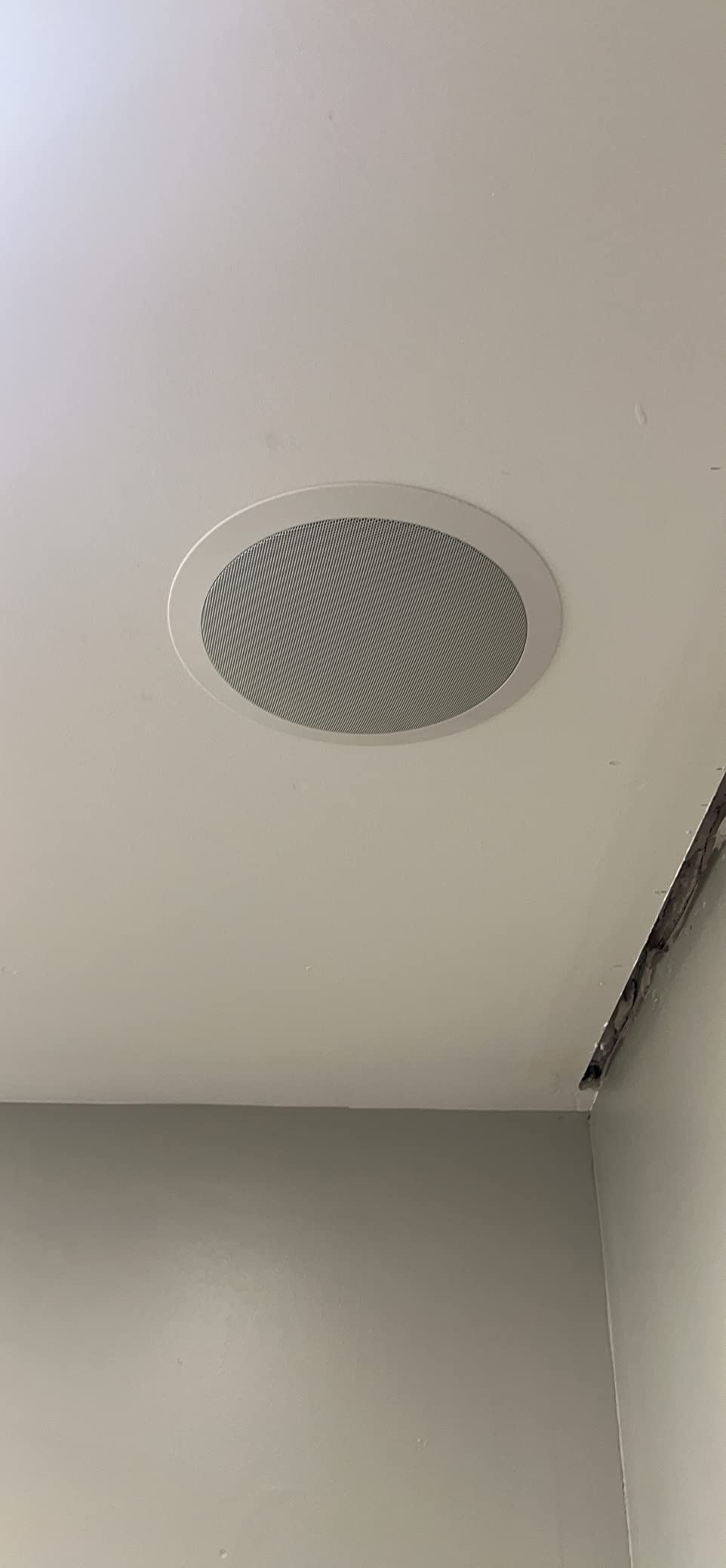
The RC60i is the same design idea as the RC80i scaled down to a 6.5-inch woofer, and that is exactly why it belongs on this list. In a small room, a bath, or a covered porch, an 8-inch driver is often more speaker than the space needs, and the RC60i is only 2.88 inches deep. It is the easiest Polk to fit into a shallow ceiling or a retrofit between existing joists.
It carries a 4.7 rating from more than 1,200 reviews, with the bulk of owners describing it as a clear upgrade from builder-grade speakers. The most common positive theme is even, distortion-free coverage across large areas when several pairs are used, and the water-resistance claim is explicitly listed for bathrooms, kitchens and covered porches.
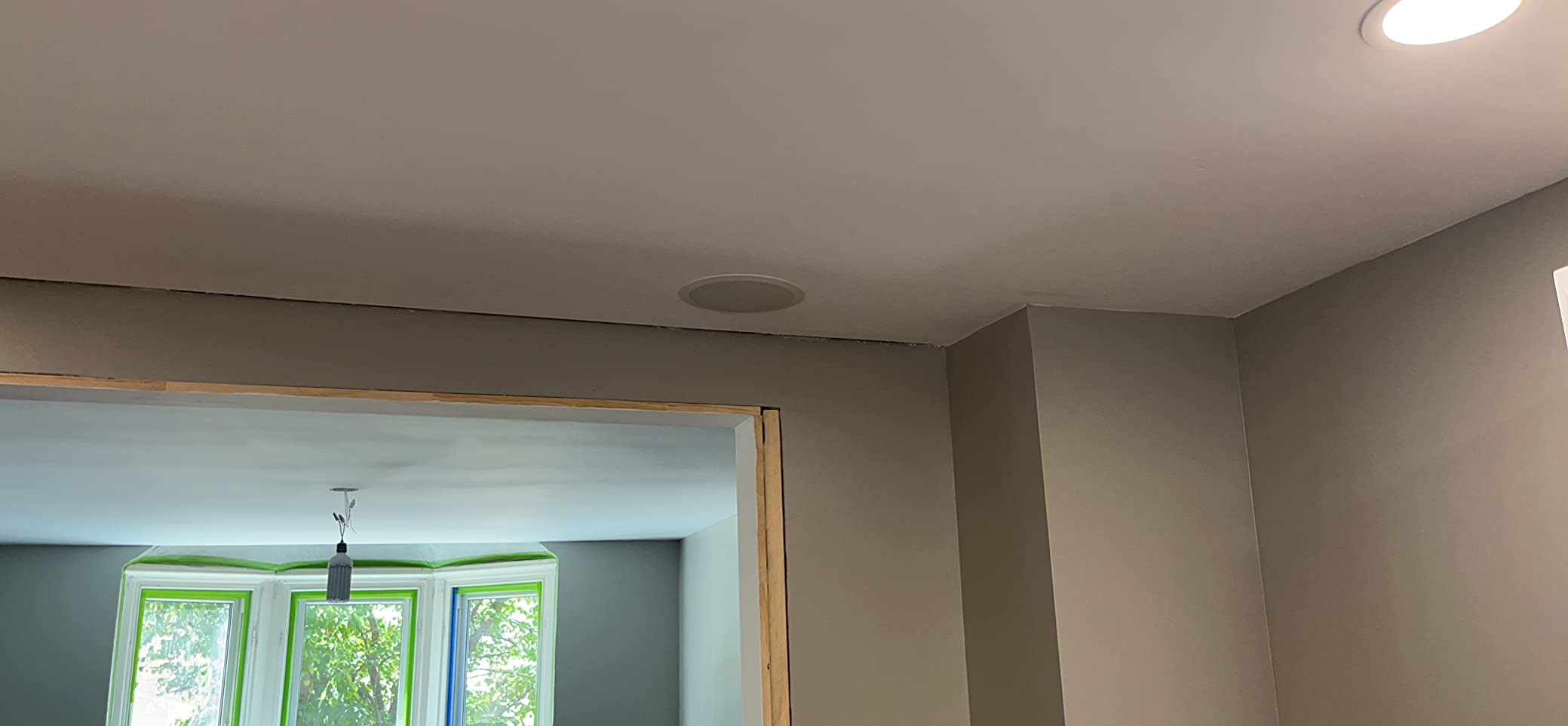
Warranty is the standout detail here: Polk lists this model with a lifetime warranty, which is unusual in a category where one to five years is normal. For wiring that disappears into a ceiling, that coverage is a meaningful part of the decision. The 6.5-inch Dynamic Balance polypropylene woofer pairs with a swiveling 0.75-inch silk dome tweeter, and the grille hides the bezel entirely once fitted.
Two practical notes. The swiveling tweeter directs the treble sweet spot, which is not the same thing as aiming the full dispersion pattern, so in an L-shaped room you still need to think about placement. And the same delicate plastic mounting dogs that owners warn about elsewhere in the Polk range are here too, so tighten them until firm rather than tight.
Rooms where the RC60i is the smarter buy
Bathrooms, guest rooms, home offices and covered porches are the natural homes for this speaker. Water resistance and a shallow depth solve two problems at once in a retrofit, and the lifetime warranty removes the main objection to cutting into a finished ceiling. For a four-zone system of modest rooms, the per-room maths is hard to beat.
It also works well as the secondary model in a mixed install: premium speakers in the main living space, RC60i everywhere else, and the same voicing family across the house so the system sounds consistent when two rooms play at once.
Where it falls short
The 50-watt maximum output is the limit, and it is a real one in a large open-plan room with high ceilings. Forum complaints about small speakers sounding thin in a great room are usually about exactly this combination, and if your main living space is the space you listen in most, spend the money on an 8-inch driver instead.
Long-term yellowing of the white plastic and grille is reported by a minority of owners after a few years, which is cosmetic but visible in a bright room. If the ceiling is a focal point, the Yamaha or a Klipsch with a metal grille ages better.
4. Yamaha NS-IC800 – Premium Build and a Genuinely Flush Grille
Yamaha NS-IC800 140 Watt 8-Inch 2-Way In-Ceiling Speakers – Pair (White)
8 inch driver, 140W maximum, 50W nominal, 8 ohm, 3.5 kHz crossover
Pros
- Flush magnetic grille with no visible plastic bezel
- Gold-plated high-force spring terminals
- 140W maximum power handling at 8 ohm
- Handles high volume without audible distortion
- Swiveling tweeter for placement flexibility
Cons
- High frequencies are adequate rather than refined
- Bass drops off in high ceilings without a subwoofer
- Two-year warranty is short for the category
When people compare the Yamaha NS-IC800 against the Polk RC80i at similar money, the Yamaha usually wins on build details. It arrives as a pair with a full-coverage magnetic grille that leaves no visible bezel, gold-plated high-force spring terminals that hold wiring securely, and enclosed drivers rather than an open frame. Those are the things you cannot change after the ceiling is closed.
Power handling is quoted at 140 watts maximum with 50 watts nominal, which gives it more headroom than the Polk pair while the 8-ohm load keeps it easy to drive. The 3.5 kHz crossover and the dome tweeter produce a crisp, punchy result that reviewers consistently describe as handling high listening volumes without distortion.
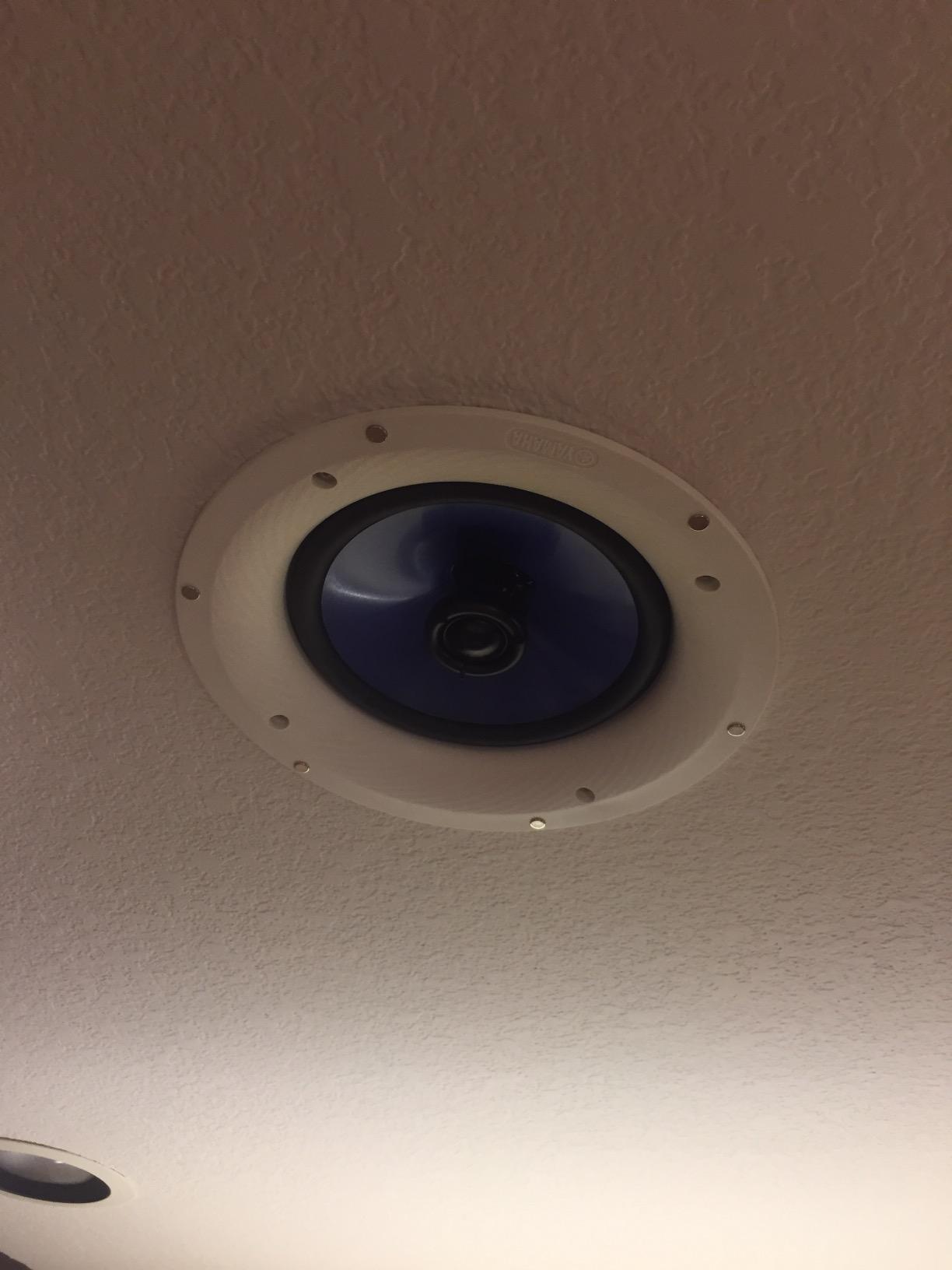
Be aware of the depth. The Yamaha is listed at 4.3 inches deep with a 10.9-inch diameter, which is deeper and wider than most 8-inch competitors. That is the trade for the enclosure and the flush grille, and it means checking the cavity depth before you commit, particularly in a retrofit between joists. The 2-year parts and labor warranty is also the shortest among the models that arrive as a pair.
The consistent reservation from critical listeners is that the high end is clean rather than exceptional. For background music across a house that is exactly what you want, and for a room where you sit and listen deliberately, a premium horn-loaded model sounds more articulate in the treble.
Why the Yamaha suits long-term installs
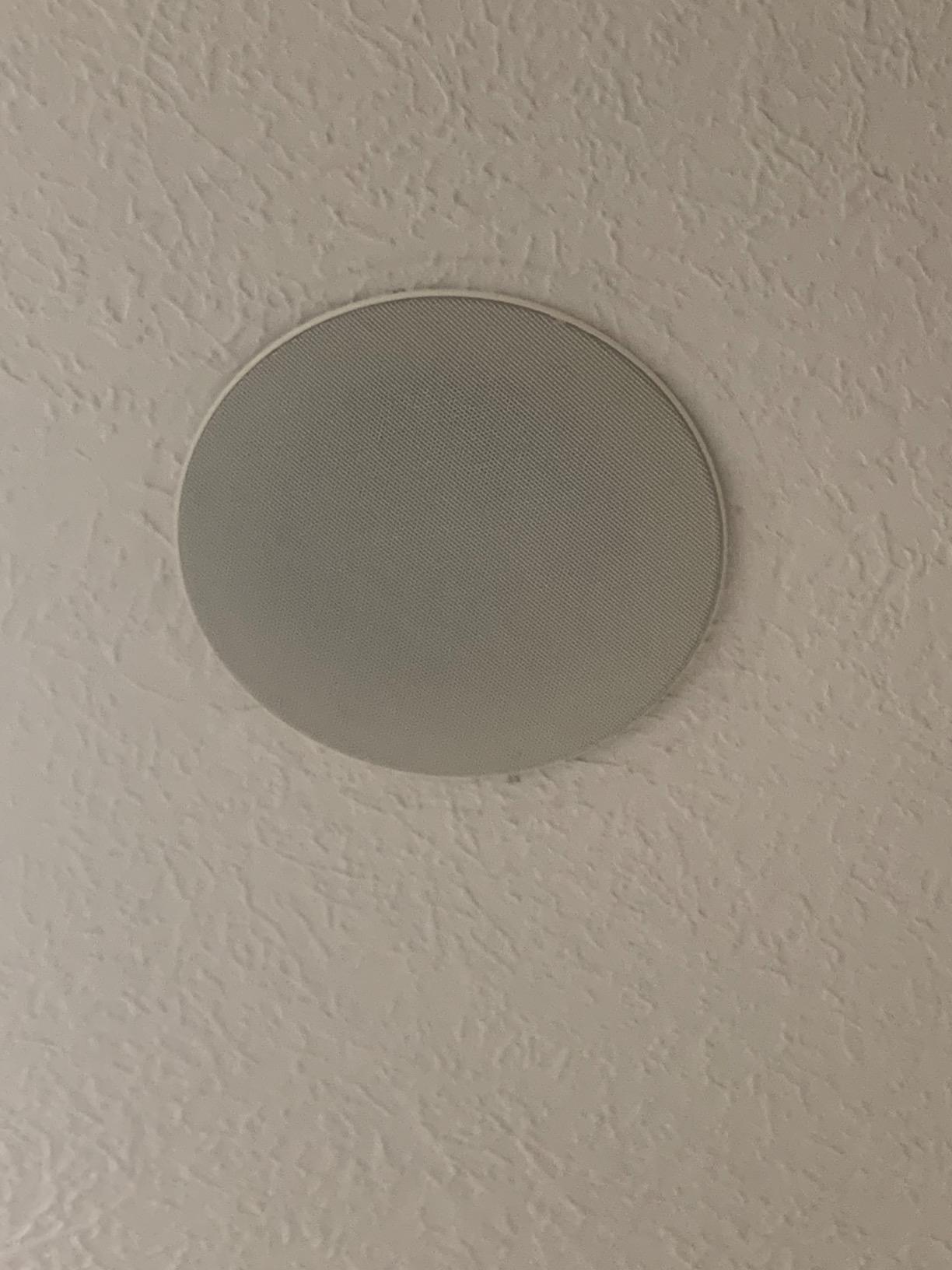
If the ceiling is going to be closed for a decade, build quality is the deciding factor. Enclosed drivers, gold-plated terminals and a magnetic grille that seats cleanly are all things that make a future swap easier and a failed installation less likely. In a new build, this is the model we would specify for the rooms you care about most.
It is also a good match for a single stereo pair where both speakers are close to the listening position, since the swiveling tweeter gives you 15 degrees of aim. Owners comparing it favourably with the Polks usually cite the lower-profile grille as the reason it looks better in a finished room.
Where to choose something else
Skip it for shallow ceilings or tight joist bays, where the 4.3-inch depth becomes a problem. Skip it in a bathroom too: the product data lists the water resistance level as not water resistant, so the RC60i or RC80i is a better fit for a genuinely wet room.
And if your priority is musical detail rather than durability of the installation, spend the money on a Klipsch CDT model instead. Those trade a wider, more forgiving dispersion for far more high-frequency control and output, which is a better trade in a room where you actually listen.
5. Klipsch CDT-5800-C II – Best Control Over Where the Sound Lands
Klipsch Outdoor/Surround in-Ceiling Speaker Soundbar Home Speaker, Set of 1, White (CDT-5800-C II)
8 inch driver, 200 watts, 8 ohm, 100 degree controlled dispersion
Pros
- Tilt and pivot mounting aims the driver at the seating
- Controlled Dispersion Technology with 100 degree coverage
- Horn-loaded titanium compression driver raises output and cuts distortion
- Treble and midbass attenuation switches for room matching
- High efficiency means modest amplification is enough
Cons
- Bass is limited in large or high-ceilinged rooms
- Coverage is narrower than conventional in-ceiling designs
- Sold as a single speaker
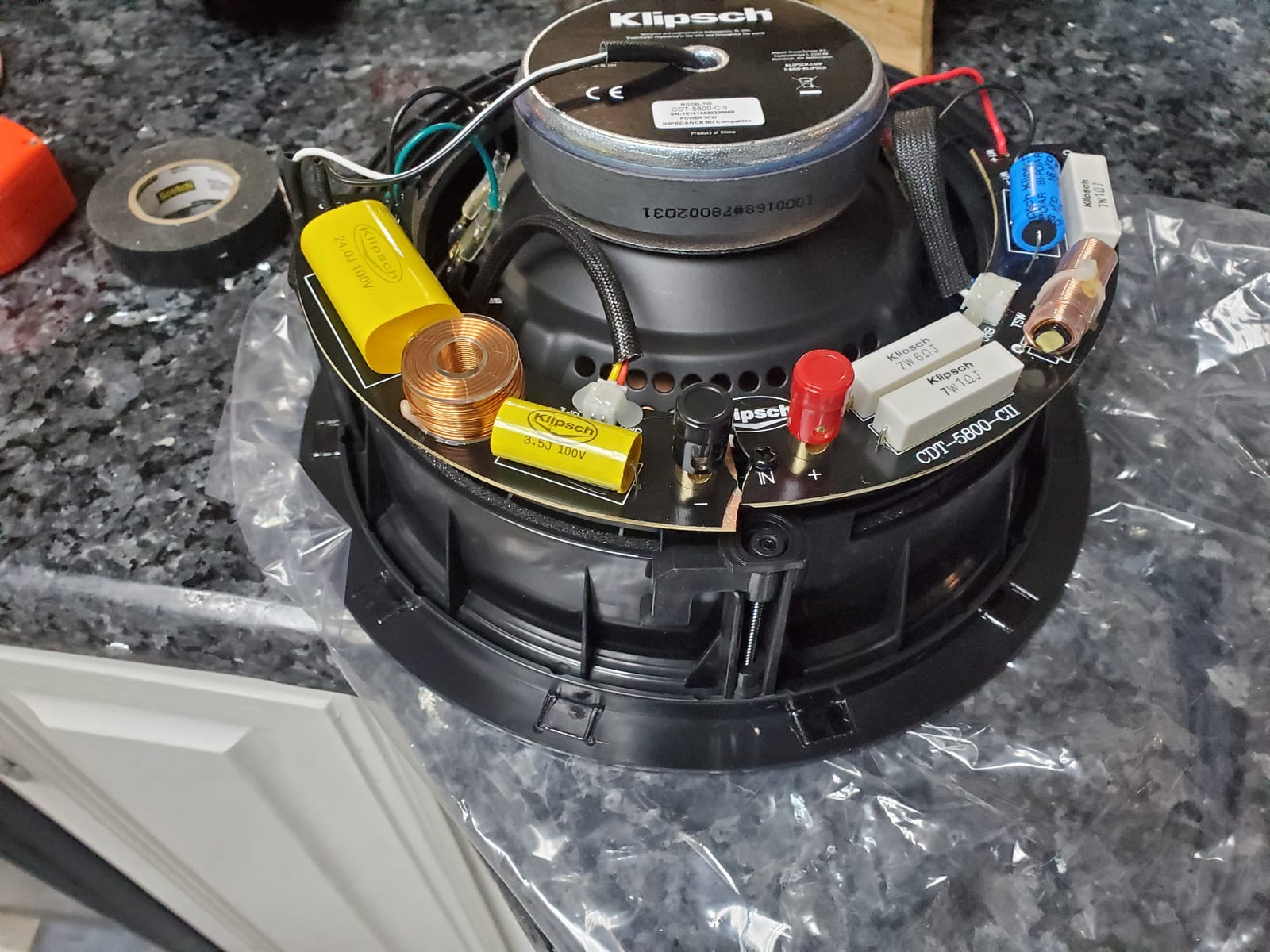
Most in-ceiling speakers fire downward and hope the listener is roughly below. The CDT-5800-C II tilts and pivots, so you can aim the driver directly at where people sit. Controlled Dispersion Technology holds a symmetrical 100-degree pattern while the horn-loaded titanium compression driver delivers more output with less distortion than a conventional dome tweeter at the same volume.
It holds a 4.7 rating across 650 reviews, and owners installing multiple units describe strong directional control and very clean installations. One long-term buyer who compared it directly with a Polk RC80i found the Klipsch clearer and crisper but more dependent on listening position, which is the honest trade with any controlled-dispersion design.
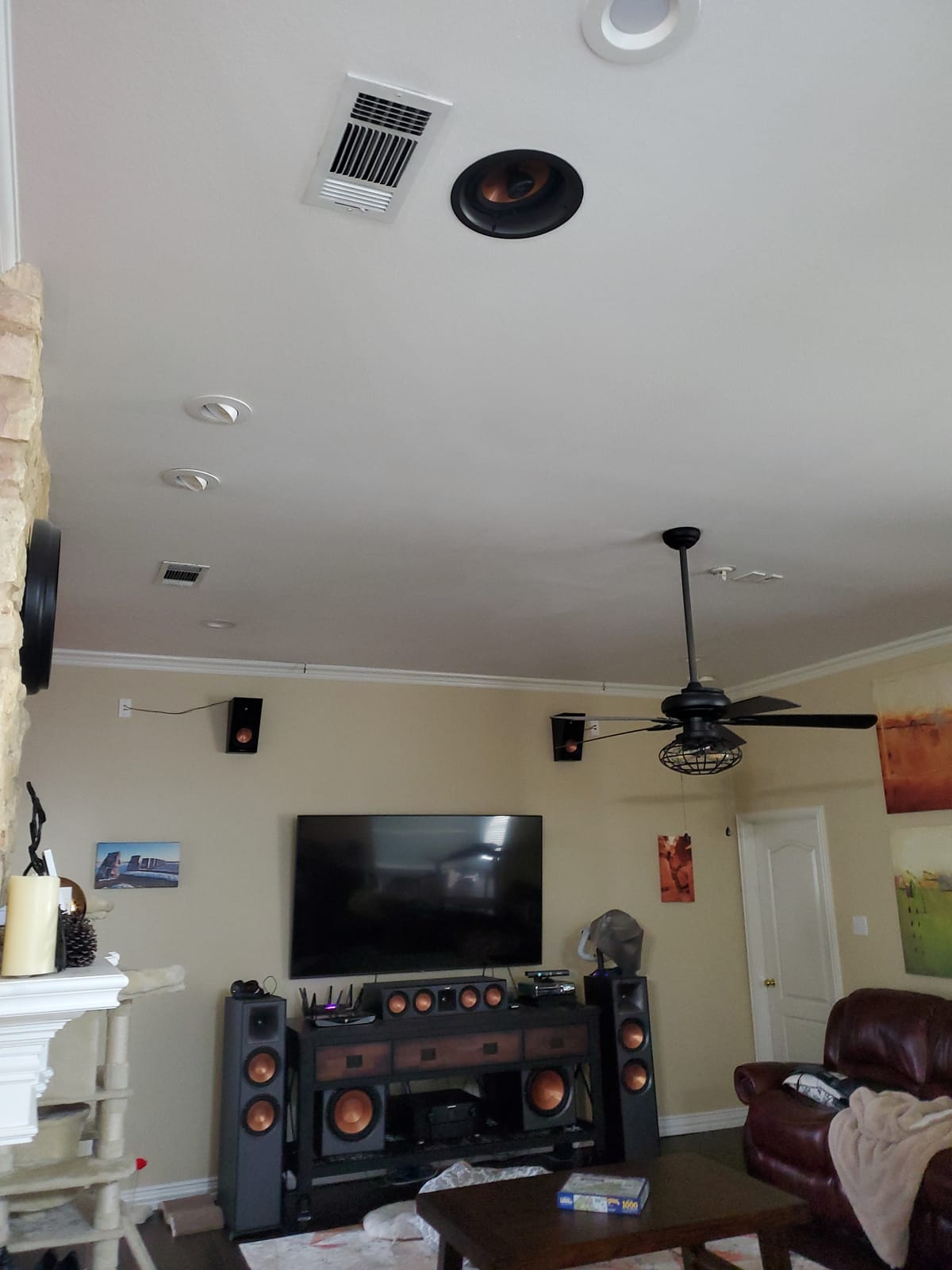
On the numbers, it is an 8-inch driver at 8 ohm with 200 watts of quoted power handling, so it has real headroom above every other model in this roundup. The high efficiency is what makes it attractive for a multi-zone amp: 200 watts of handling means 20 to 30 watts per channel is enough for a normally sized room, and two speakers can share one amplifier channel in a small zone.
Two features reward attention. The independent treble and midbass attenuation switches let you correct for a reflective room or a soft ceiling without an equaliser, which saves real time on a multi-room install. The 5.4-inch depth is also deeper than most 8-inch models, so it needs a genuine cavity rather than a shallow retrofit bay.
Best fit: open plans and off-axis listening
Aim this model at an L-shaped living space, a kitchen island or a long room where a downward-firing speaker would put the treble over nobody. The tilt plus the pivoting tweeter concentrates the sound where people are rather than spilling it into the next zone, which makes it a good choice when adjacent rooms have very different volume settings.
The horn-loaded titanium driver also means the same amplifier channel sounds louder, so it is a good value when the amplifier is the expensive part of the system and you want maximum output per watt. In-wall volume controls then have a wide usable range to work with.
Limitations you should plan around
The 100-degree coverage is genuinely narrower than a conventional in-ceiling design. In a large square room with a listener far from the axis, output falls off more quickly, and bass is limited without a subwoofer in high-ceilinged spaces. If the room is large, plan for two speakers per zone rather than one.
It is also sold as a single unit, which is convenient for odd room counts but means ordering four for a two-room stereo system. Plan to fit the grilles after painting, since the magnetic grille is designed to seat only once the paint is dry.
6. Klipsch CDT-5650-C II – Compact Version with the Same Aiming Trick
Klipsch CDT-5650-C II In-Ceiling Speaker – White (Each)
6.5 inch driver, 1 inch titanium horn tweeter, 100 degree coverage, 8 ohm
Pros
- Independently aimed woofer and horn tweeter
- 100 degree Tractrix horn for high efficiency
- Linear travel suspension tweeter
- Low-profile SlimTrim magnetic grille
- Sold singly for flexible multi-room layouts
Cons
- Default balance is treble-forward
- Supplied cutout template is smaller than common existing cutouts
- 6.5 inch driver gives less low end than an 8 inch model
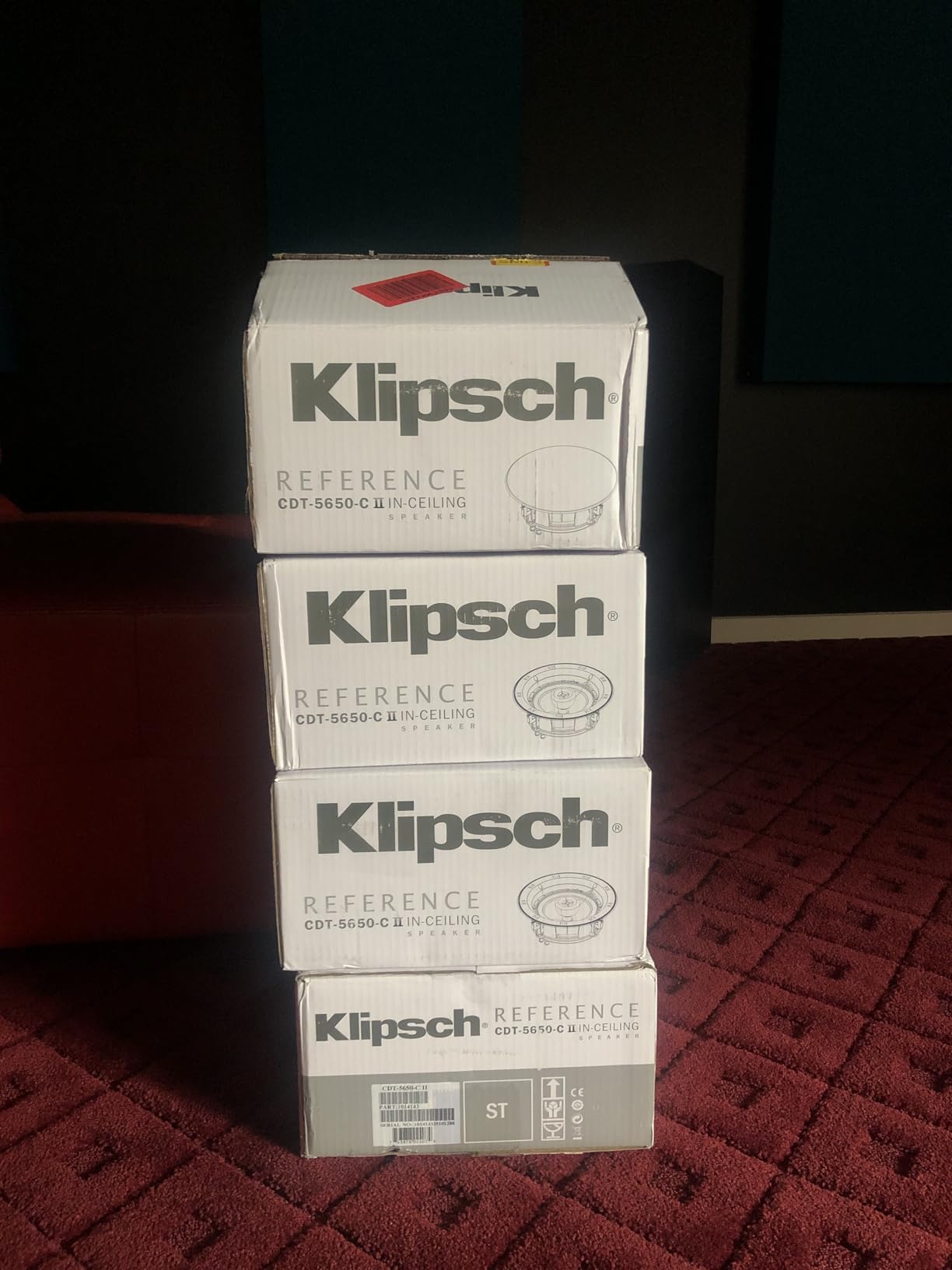
This is the CDT-5800-C II in a 6.5-inch package, and it carries a 4.8 rating from 451 reviews, with 89 percent of ratings at five stars. The same Controlled Dispersion Technology and independently aimed woofer and horn tweeter apply, so the roughly 30 degrees of total aim that owners praise in the larger model is here too in a speaker that fits far more ceilings.
The 1-inch titanium dome compression tweeter uses a linear travel suspension and a 100-degree Tractrix horn, which raises output while keeping distortion low. It is the speaker we would choose for a hallway, a small office or a bedroom where an 8-inch driver is unnecessary and a deeper cavity would be a problem.
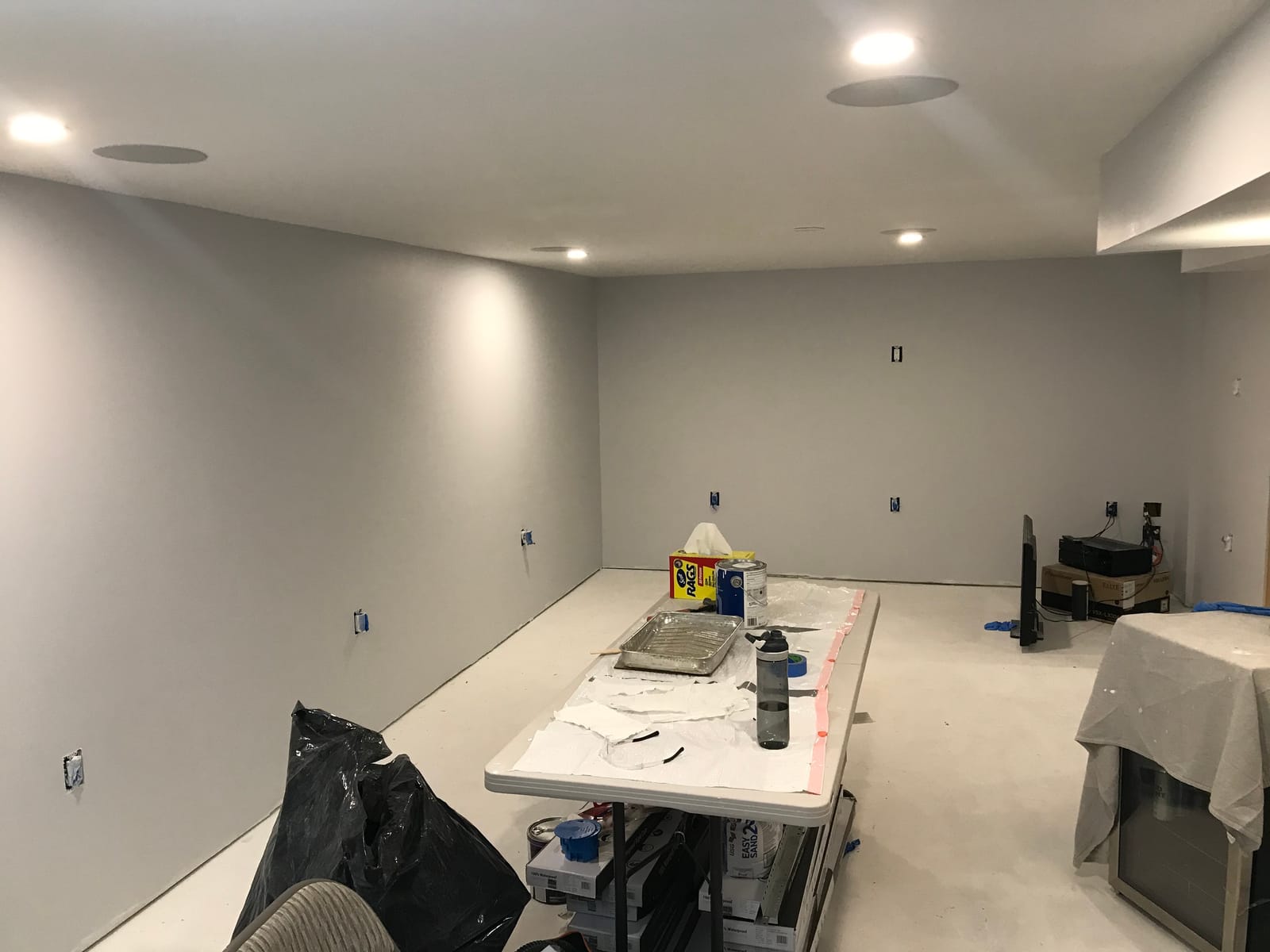
Owners running several units for a basement or a whole-house install report that the combination of woofer tilt and pivoting tweeter transforms the soundstage compared with fixed downward-firing speakers. The 200-watt quoted power handling and high efficiency mean it drives easily from a modest distribution amplifier, and single-unit packaging makes it easy to order an odd number for an irregular floor plan.
The default balance is treble-forward, and a minority of listeners find the stock treble harsh. The fix is the built-in treble attenuation switch, and it is worth setting before you walk away rather than after. This is the only model in the roundup where we would insist on that step as part of the installation.
Where it earns its rating
Small and medium rooms with awkward geometry is the sweet spot. If the ceiling is low, the layout is irregular, or the listening position is off to one side, the adjustable aim is doing more work here than raw low-end output would. Basement and game-room installs where several units run at moderate volume are repeatedly reported as handling that level cleanly.
It is also a good second-zone speaker in a system that already has a Klipsch in the main room, because the voicing matches and the attenuation settings let you trim the treble to match the room rather than the model.
Where it will not do
It is not a primary music speaker in a large open plan, because a 6.5-inch driver simply cannot move the air a big room needs. If the main living space is where you listen most, put an 8-inch model there and use the CDT-5650-C II for the rest of the house.
Check the cutout before ordering. Owners report that the supplied template is smaller than some common existing cutouts, so on a retrofit into existing holes you may need the speaker body to pass through an opening it will not fit, and the overall 9.5-inch diameter means it will not cover an 8-inch hole left by a previous speaker.
7. Klipsch R-1650-C Four-Pack – The Multi-Room Cost Answer
Klipsch R-1650-C in-Ceiling Speaker – White (4-Pack) Compact, Easy to Install, Durable
Four 6.5 inch speakers, 8 ohm, 140 watts, 8.3 inch cutout
Pros
- Four-pack format gives the lowest cost per speaker
- 6.5 inch polymer woofer with a large motor structure
- Coaxial polymer-dome tweeter with wide dispersion
- Paintable aluminium grille with rust protection
- 5 year manufacturer warranty
Cons
- Mounting screws are stiff in the plastic sleeves
- Grille edges are fiddly to seat
- Supplied grille is slightly off-white against bright ceilings
Four speakers in one box solves a very specific whole house problem: the awkward room count. If you need six or eight matching units, buying them four at a time gives you the lowest per-speaker cost on this list and guarantees they are the same batch. The 4.6 rating from 491 reviews reflects a value judgement more than a quality complaint, with 80 percent of ratings at five stars.
The 6.5-inch polymer-cone woofer has a large motor structure for high sensitivity, which is the right design choice when one amplifier has to feed several rooms. The coaxial 1-inch polymer-dome tweeter spreads high frequencies widely, so a downward-firing position works well without careful aiming. Reviewers installing four at once for a game room or a covered deck call the full-range output surprising for a 6.5-inch driver.
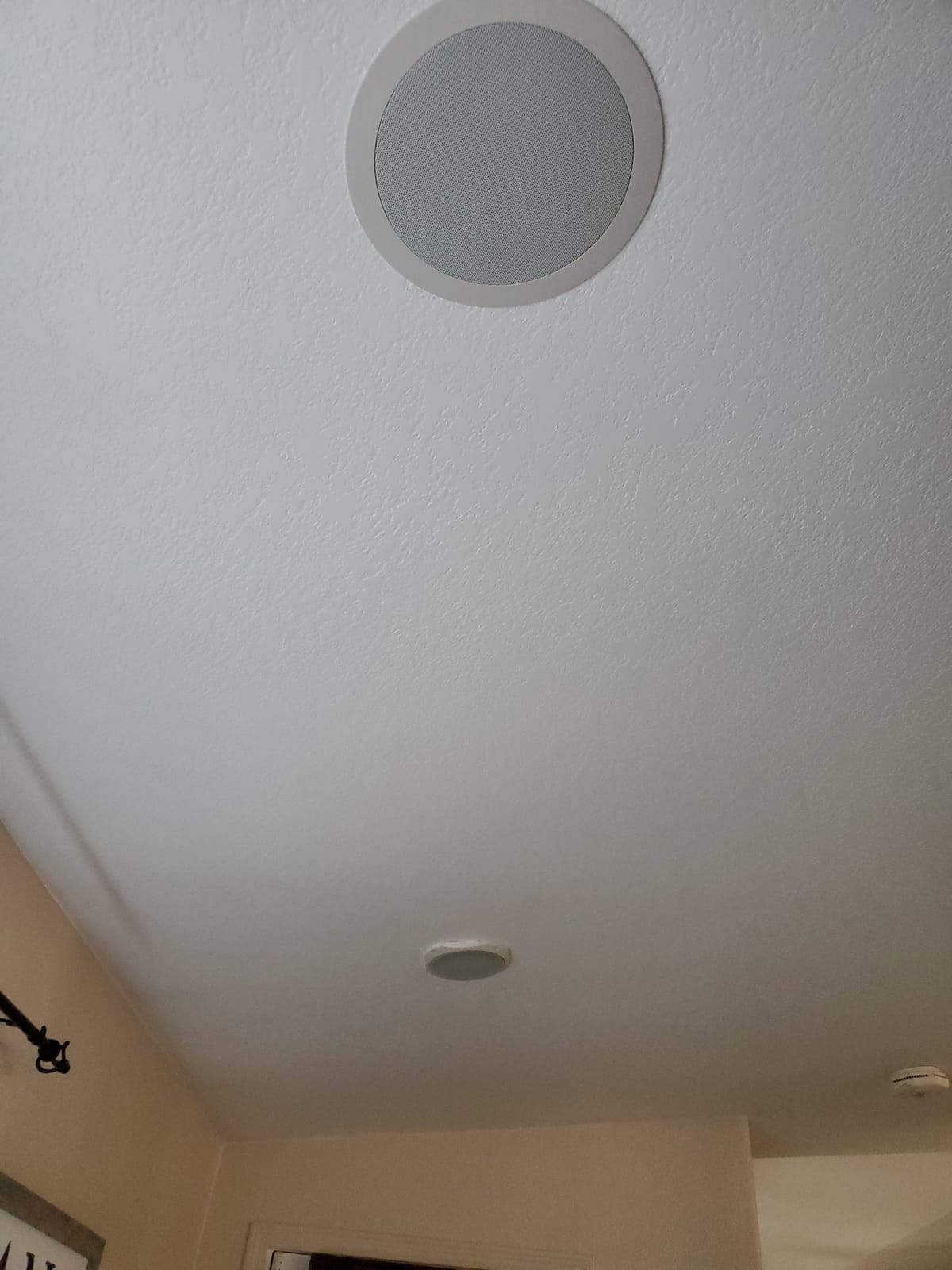
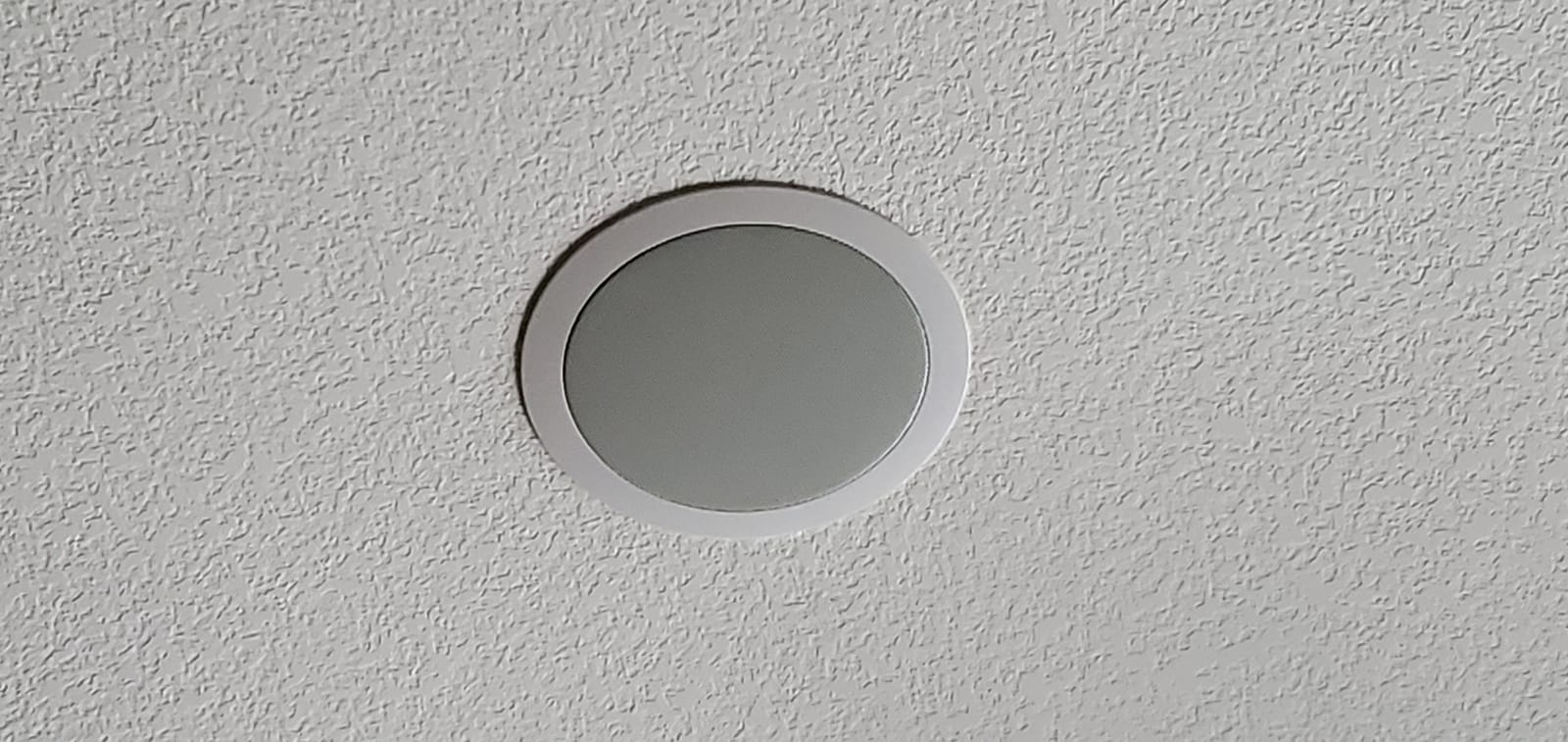
The cutout is 8.3 inches with a 9.5-inch overall diameter, and the mounting depth is not listed in the product data, so measure your cavity before ordering. The grille is aluminium with added rust protection and is rated for bathrooms, kitchens and saunas, which makes these the natural four units for a wet-room floor of a house rather than the primary living space.
Installation friction is the consistent theme in reviews, and it is worth planning around. The mounting screws are stiff inside the plastic sleeves and benefit from being pre-threaded before the speaker is in position, and the grille edges need care to seat without bending. Neither is a deal-breaker, but both add minutes per speaker when you are installing eight.
Best fit: many rooms, one budget
This four-pack is the pick for a house with four, eight or twelve rooms of simple background audio, and for a covered deck or bathroom floor where moisture resistance is more important than low end. Wide dispersion means placement is forgiving, so they work in rooms where you cannot easily aim a speaker at a listening position.
Because all four come from one pack, they are also the easiest set to swap later. If one fails, you replace it with an identical unit and the system stays matched, which matters over a fifteen-year ownership cycle.
What you trade away
You trade away low-frequency output and detail. Compared with the premium 8-inch models here, the 6.5-inch polymer driver is less dynamic and less revealing, which is fine for background music and disappointing if you sit down and listen to this as a main system. Bass in a large open plan will be thin without a subwoofer.
Also expect to paint the grilles. The supplied finish is slightly off-white against a bright white ceiling, and a magnetic grille is far easier to paint before installation than after. And if your plan is critical listening rather than distributed audio, the 5-year warranty is good but the sound signature is not the reason to buy.
8. Herdio Four-Speaker Bluetooth Kit – When Running Wire Is Not Practical
Herdio 6.5″ 600 Watts Bluetooth Ceiling Speakers Wireless Home Recessed Speaker System Suitable for Indoor,Kitchen,Home Theater,Bedroom,Office,Covered Patio(4 Speakers)
Four 6.5 inch speakers, included 4-channel amp, Bluetooth 5.0
Pros
- Four speakers plus a wireless amplifier in one box
- No amplifier to buy or hide
- 100 foot unobstructed Bluetooth range
- 3.15 inch mounting depth fits shallow ceilings
- 3.5mm aux input for a wired source
Cons
- Lowest rating in the group at 4.2
- Amplifier must sit near the speakers
- Sound is adequate rather than detailed
This is the only genuinely self-contained system in the roundup, and for some houses it is the only one that can happen at all. Four 6.5-inch flush-mount speakers, a 4-channel amplifier, the speaker cables and the power adapter all arrive in one box, and Bluetooth 5.0 holds a stable connection up to 100 feet unobstructed. No amplifier to buy, no rack to hide, no distribution panel to plan.
That solves a genuine problem in a retrofit, a rental, or a finished house where fishing new cable through finished walls is not happening. The 3.15-inch mounting depth is the shallowest here, and a 3.5mm aux input lets you keep a wired source alongside the wireless one. The 4.2 rating from 530 reviews is the lowest in this group, and the distribution is more spread out than the others, with 8 percent one-star ratings.
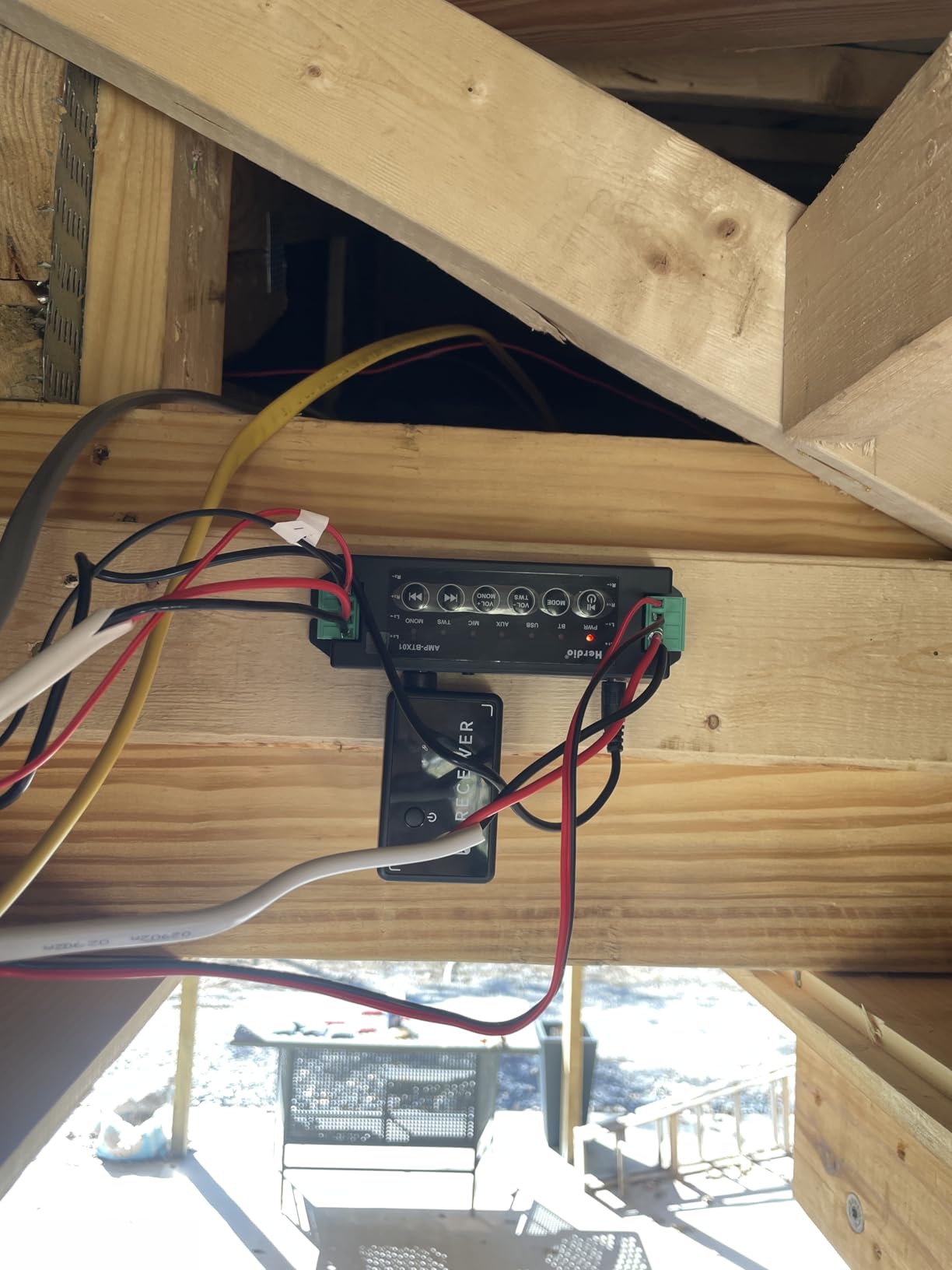
Understand what you are trading. The lower scores cluster around sound fidelity compared with wired passive speakers of a similar cost, and the review language is consistently adequate rather than detailed. You are also committing to a single wireless signal path: the amplifier has to live near the speakers, and the 3.5mm jack is the only other input, so there is no multi-zone control and no way to play two rooms independently.
The cutout is 6.3 inches, which is smaller than every other model here and works in tight bays. The 600-watt figure is a headline peak number for the kit rather than a continuous per-speaker rating, so do not treat it as comparable with the RMS and maximum power figures on the passive models.
When the wireless kit is the right answer
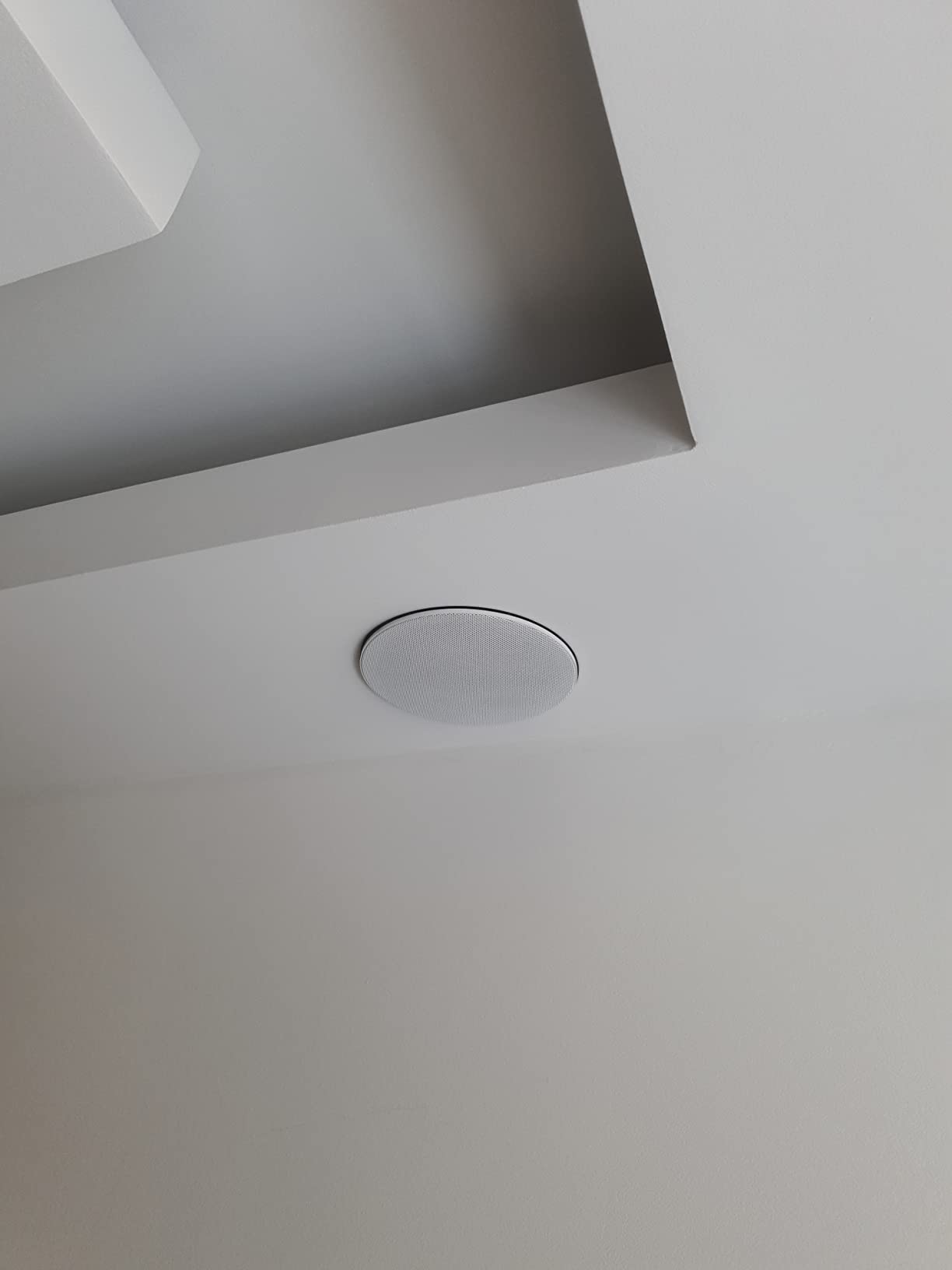
Use it in a house where the wiring is already inaccessible, in a garage, a workshop, a covered patio or a rental where drilling is not an option, and anywhere the priority is covering several rooms quickly and cheaply. Four rooms of background music with one amp in a closet is genuinely valuable, and for that use case the sound quality complaints largely do not apply.
It is also a good trial system. Install it, learn how many rooms you actually listen to music in, and then decide whether a properly wired passive system with in-wall volume controls is worth the disruption later.
Where to look elsewhere
Anywhere sound quality matters more than convenience, this is the wrong tool. It is not a good fit for a main living room you listen to deliberately, because the reviews consistently describe it as adequate rather than detailed next to wired passive models of a similar price. It cannot be zoned, so every speaker plays the same source at the amplifier level.
It is also the least flexible option if the house changes. Speakers hard-wired to a wall amplifier can move to a new amplifier in an afternoon, whereas this system is a closed ecosystem, and the amplifier has to stay where the speakers are. If you plan to add in-wall volume controls later, start with a passive system instead.
9. Pyle In-Ceiling Pair – Adjustable Treble on a Budget
Pyle 6.5” In-Wall / In-Ceiling Speakers, 250W Peak, Hi-Fi Stereo Sound, Pivoting Adjustable Coaxial Silk Dome Tweeter, Poly Cone Woofer, Stain Resistant Grill, For Home Theater, Custom Installs- Pair
6.5 inch poly cone, pivoting silk dome, 250W peak, 125W RMS
Pros
- Treble control switch at plus or minus 3dB
- Pivoting coaxial silk dome tweeter
- Handles high volume without distortion for its tier
- Cut-out template and mounting hardware included
- Stain-resistant grille suits kitchens
Cons
- Grille attaches by friction rather than magnets
- Thin dog-ear tabs may not grip double drywall
- No back can included so sound leaks upward
The Pyle in-ceiling pair stands out from the other budget models for one reason: the treble control switch. A plus 3dB, 0 and minus 3dB selector on each speaker lets you match two rooms with different surfaces, and in a house where a kitchen has tile and a living room has carpet, that is a genuinely useful tool that most competitors at this tier do not offer.
It is a 6.5-inch poly cone with a 1-inch pivoting silk dome coaxial tweeter, rated at 250 watts peak and 125 watts RMS with a 45Hz to 20kHz frequency response. The pair holds a 4.6 rating from 576 reviews, and the dominant theme in those reviews is value, with multiple owners reporting they replaced more expensive speakers and found clear, punchy mids and highs.
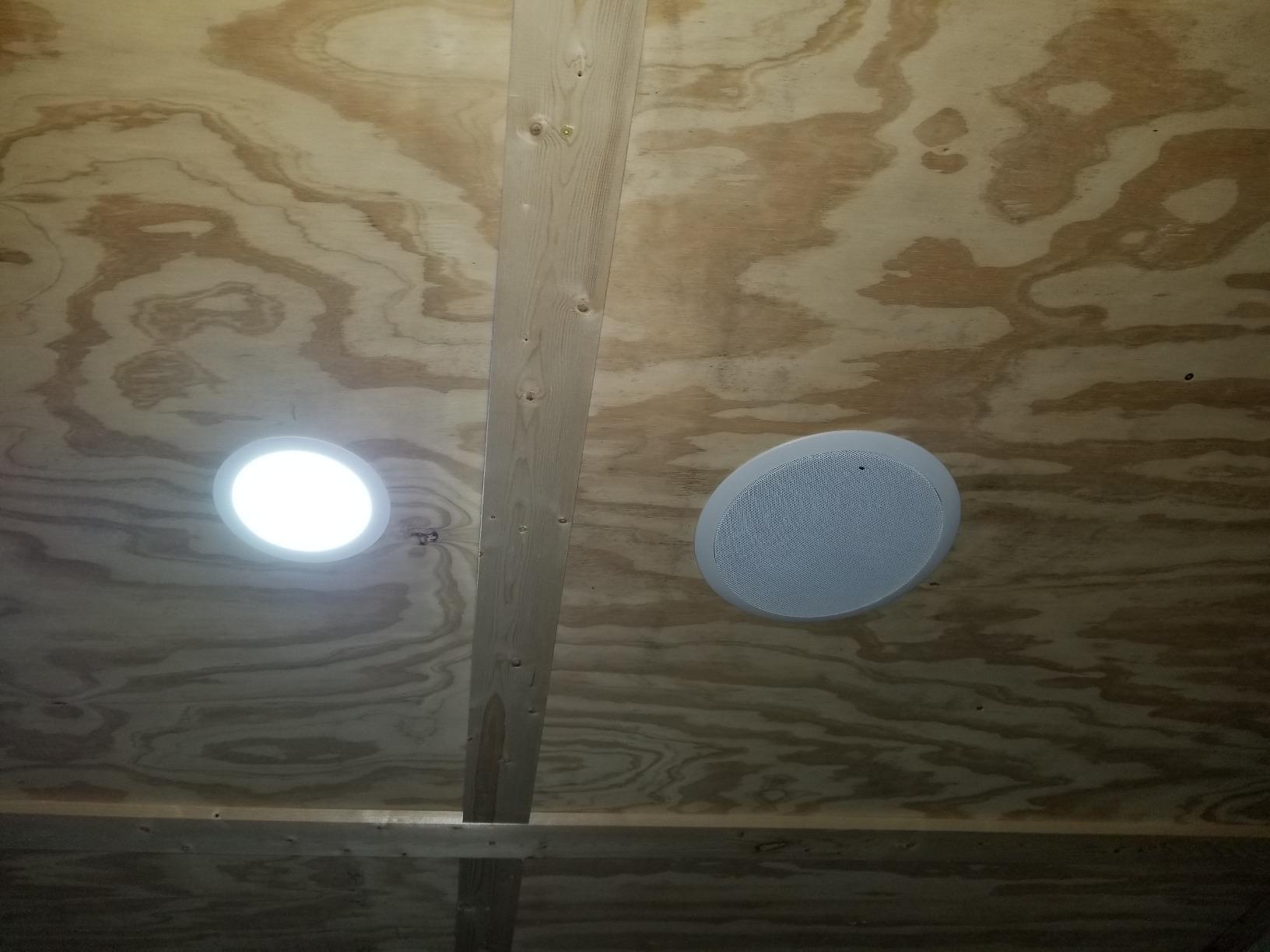
Two things experienced installers flag repeatedly. First, a back enclosure is what separates these from sounding thin, and none is included, so plan to have your installer build or fit one. Second, the dog-ear mounting tabs feel thin and may not grip double drywall or older lath-and-plaster construction without modification, which matters if you are retrofitting rather than building new.
Impedance is listed as 4-8 ohms, so confirm the tap position with the manufacturer or test the pair on your amplifier before running a full house on it. The grille attaches by friction rather than magnets, which is less convenient when you want to paint it separately, but the stain-resistant finish suits kitchens and bathrooms.
Best fit: mixed-surface houses on a budget
The treble switch is the deciding factor in a house with hard and soft surfaces in adjacent rooms. Rather than replacing speakers, an installer can trim the bright room and leave the soft one alone, and the pivoting coaxial tweeter lets you aim the high end at a kitchen island or a desk. The cut-out template and hardware in the box make it a quick job.
It is also a strong value choice for a home theatre surround package, where the coaxial design gives even coverage over a wide seating area and the 250-watt peak rating leaves headroom for film soundtracks. Owners replacing a recognised premium install report the difference as acceptable, and much cheaper.
What to plan around
The friction-fit grille and thin mounting tabs are the two practical frictions, and both are solved by a careful installer rather than a different product. Sound transmission into the room above is the bigger audio issue, since without a back can the woofer loads the cavity instead of moving air in the room.
The one-year warranty is the shortest on this list alongside the Micca, so for a large multi-room order, check what the retailer offers and keep the receipt. If the grille needs to be painted, do it before installation because the friction fit makes removal fiddly.
10. JBL Professional CSS8008 – For 70V and 100V Distributed Lines
JBL Professional CSS8008 Commercial Series Round Ceiling Speaker, 8”. 5-Watt Multi-Tap Transformer for 100V, 70V and 25V Distributed Lines. Single Speaker. White and Paintable
8 inch, 5 watt multi-tap, 100V 70V and 25V lines, 96dB
Pros
- 96dB sensitivity delivers high level from modest power
- One unit covers 100V 70V and 25V lines
- 120 degree conical coverage reduces speaker count
- Pre-assembled speaker transformer and grille
- Compatible with optional back cans
Cons
- Needs a constant-voltage amplifier not a standard amp
- Back can and tile rails sold separately
- Bass is limited without a larger back can
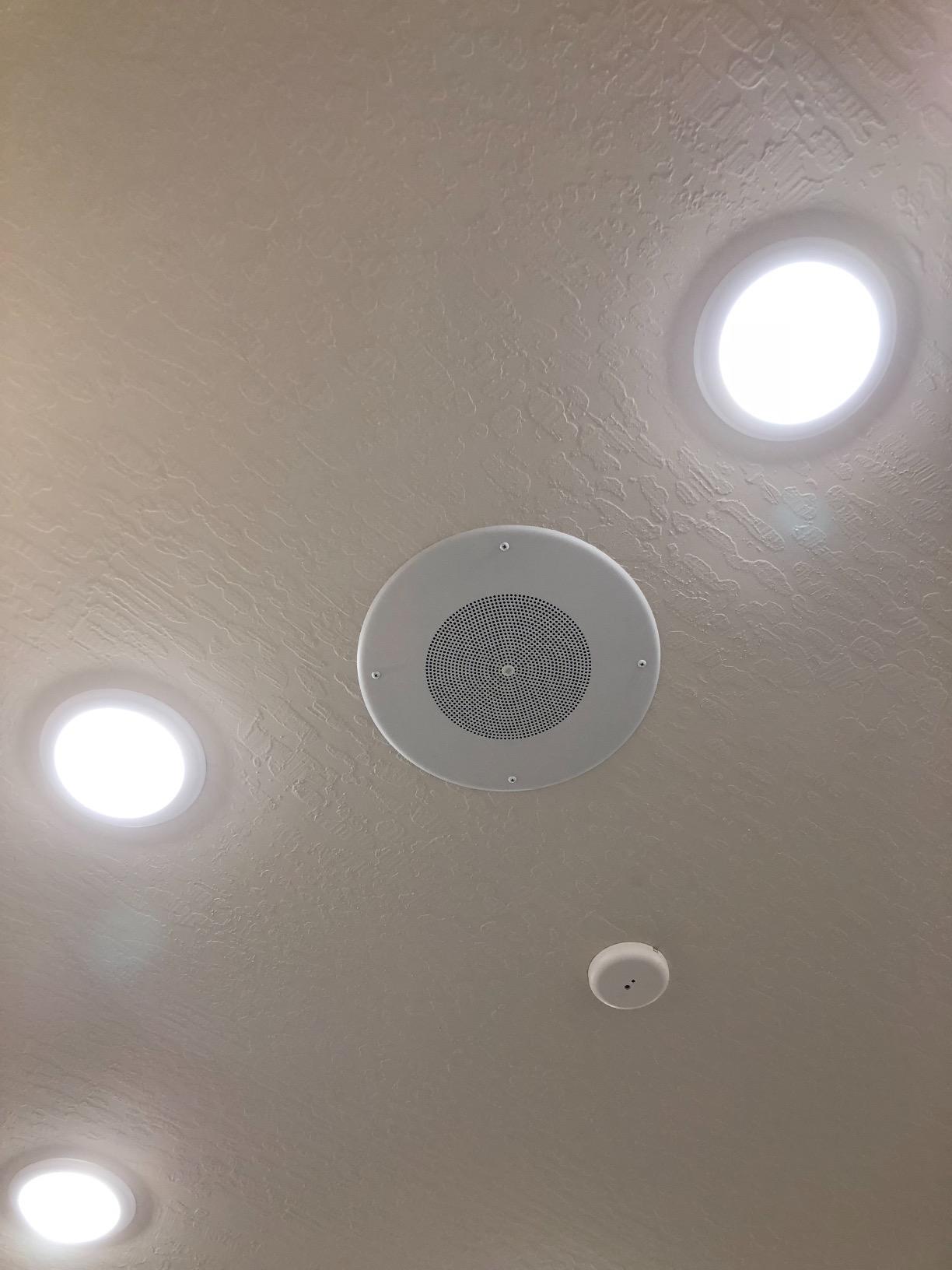
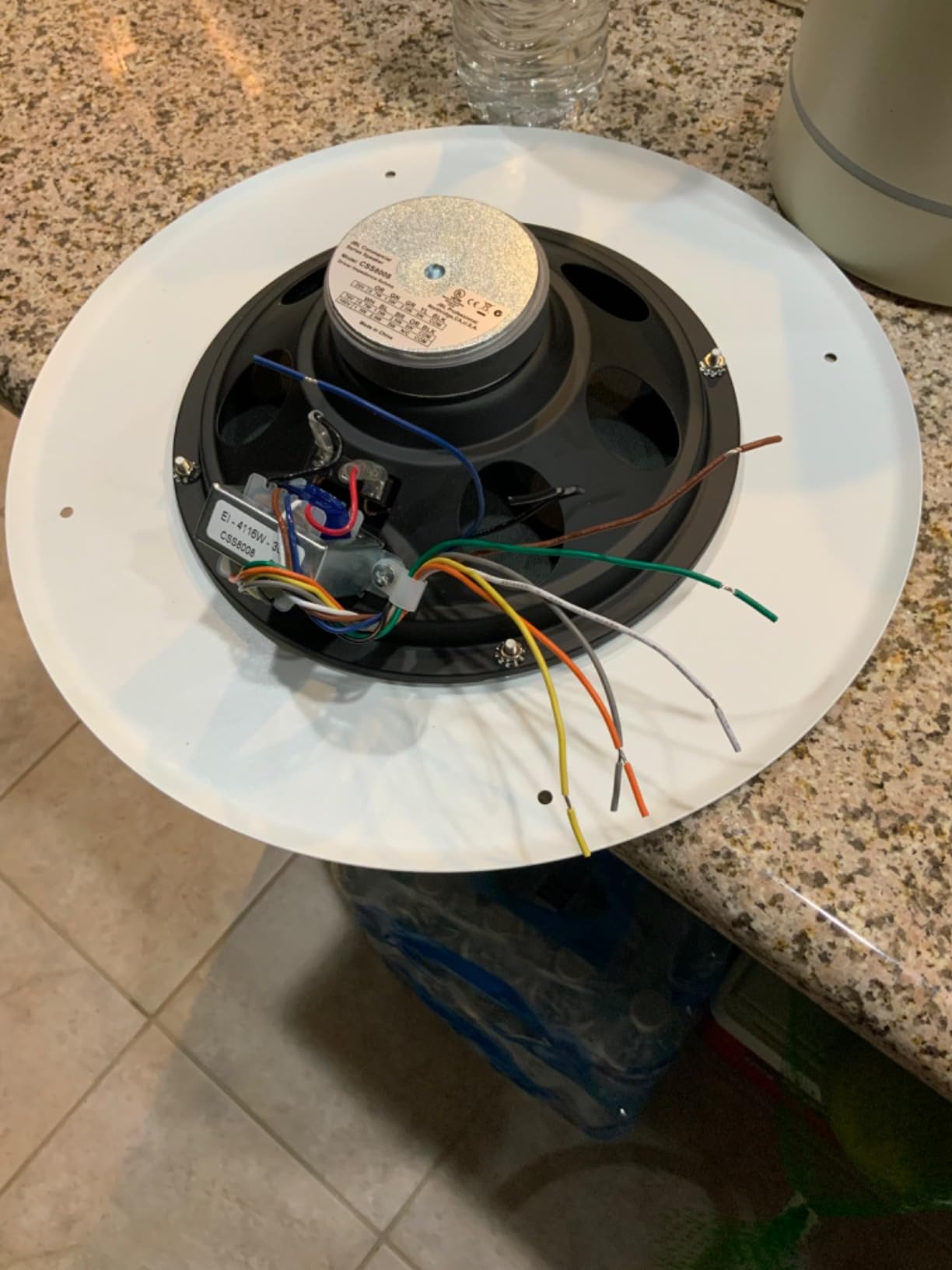
Everything else in this roundup runs on a standard 8-ohm amplifier. The JBL CSS8008 does not: it is built for constant-voltage distributed lines with a 5-watt multi-tap transformer that works on 100V, 70V and 25V systems, which is the wiring standard used in commercial buildings, large homes and multi-dwelling installs where you need many speakers on few amplifier channels.
The 96dB sensitivity figure is the headline. It means the speaker produces high sound pressure from very little amplifier power, and combined with 120-degree conical coverage, installers report that as few as three units fully cover a large office or classroom. The 4.6 rating from 271 reviews comes overwhelmingly from people with paging or background system experience, and it is rated above comparable distributed packages.
Buying this means changing your amplifier as well. A 70V or 100V amplifier is a different category of equipment from a multi-zone stereo amp, and the transformer is what allows a long speaker run to be daisy-chained without the impedance stacking that would overload a conventional channel. It is a genuinely better architecture for a house with a very large number of speakers or unusually long cable runs.
Back cans are sold separately, in four sizes from 0.26 to 1.0 cubic feet, and some buyers mistake them for missing parts. Bass is limited without the larger can, so if you care about low end, budget for one. A few users report hum when running through the transformer tap and recommend the 8-ohm connection instead, which is worth testing on the first speaker.
When constant-voltage is the right call
Choose this for a large house with many zones, a long driveway or garden run, a shop or a hospitality space where dozens of speakers need to hang off a small number of amplifier channels without impedance problems. Sound quality is not the deciding factor here, coverage efficiency is, and the 96dB sensitivity and 120-degree cone deliver that.
It is also the value choice in absolute terms for coverage per watt, and the multi-tap transformer means one model covers three different line voltages if part of the property uses one system and part another.
Why most homes should skip it
A normal house does not need it. A four-zone residential system runs fine on 8-ohm distributed audio, and a 70V amplifier costs more, sounds flatter, and gives you less control over a single room’s level. Unless you are covering an unusual number of rooms or very long cable runs, the extra architecture is not worth the cost.
Also note the 8.5-inch open-back cutout and the four-point mounting on an 11.25-inch circle, which is a large frame for a ceiling. Check the cavity and the joist positions carefully, and remember the back can and tile rails are extra purchases rather than included parts.
11. Sonos in-Ceiling by Sonance – The Ecosystem Pick
Sonos in-Ceiling by Sonance, INCLGWW1
165mm woofer, 25mm tweeter, 36Hz to 20kHz, 120mm depth
Pros
- Trueplay tunes output to room size and furnishings
- One Sonos Amp can power up to three pairs
- Discrete grilles can be painted to match the ceiling
- Bluetooth and Wi-Fi streaming built in
- Maximum 110dB at 1 metre for high output
Cons
- Requires a Sonos Amp which is sold separately
- Premium cost compared with passive equivalents
- Full features depend on the Sonos ecosystem
The Sonos in-Ceiling by Sonance is built around a single idea: one amplifier per three pairs, tuned automatically for the room. A single Sonos Amp can power up to three pairs of these speakers, and Trueplay measures the room’s size, construction and furnishings to set the output. That removes the two things distributed-audio buyers find most annoying, which is amplifier sizing and EQ per room.
The 4.6 rating comes from 272 reviews, and the consistent praise is for sound quality and seamless integration with an existing Sonos system. Frequency response is listed at 36Hz to 20kHz plus or minus 3dB with DSP, maximum output is 110dB at 1 metre, and the nominal coverage angle is 90 degrees, which is on the focused side compared with the wide-dispersion passive models here.
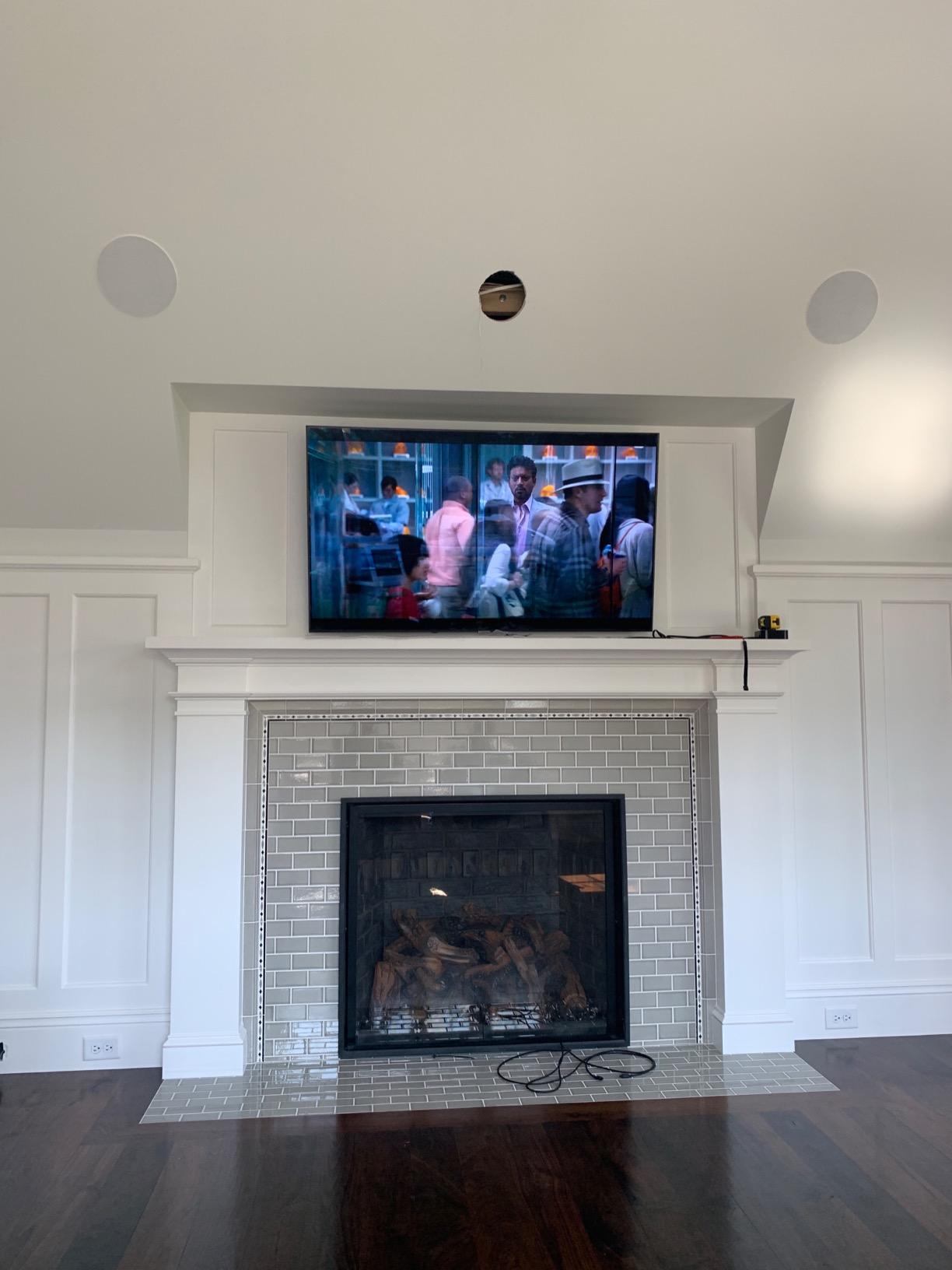
It is not a self-powered speaker, which surprises people. Like every other passive model in this roundup it needs an external amplifier, and for this one the intended amplifier is a Sonos Amp sold separately. That is a real cost consideration when you are planning eight rooms, and it is the single most common misunderstanding in buyer reviews of this product.
It also arrives as a pair of 152mm speakers with a 165mm woofer and a 25mm tweeter, and the 120mm installation depth is one of the shallowest here, which makes it forgiving in tight ceilings. The warranty is one year, and the water resistance level is listed as not water resistant, so it belongs in dry interior rooms only.
Best fit: a house already running Sonos
If you already have Sonos in other rooms, this is the cleanest way to add ceiling coverage without a separate control layer, an in-wall volume control or a rack of amplification. The grilles are round or optionally square and can be painted, and the speakers disappear visually the same way the passive models do once the grille goes on.
It is also the easiest pick for a retrofit where you would rather not run a multi-zone amplifier at all. One Amp in a closet replaces an entire distribution system, and the per-room volume is handled in the app rather than with wall controls.
What you give up by staying in one ecosystem
The amplifier is not included, and the cost of a Sonos Amp per three pairs is the budget item most buyers underestimate. The 90-degree nominal coverage angle is tighter than a conventional wide-dispersion in-ceiling design, so placement matters more, and the single-year warranty is short for a permanently installed product.
Finally, the tuning happens through the Sonos app rather than by hardware switches on the speaker, so if you leave the ecosystem or want Roon or a conventional receiver as the control layer, the main advantage disappears. Speakers of this type also work with third-party amplifiers electrically, but you lose Trueplay, so the reason to choose them is the software, not the driver.
12. Acoustic Audio CS-IC83 Five-Pack – Covered for Surround and Background Together
Acoustic Audio by Goldwood CS-IC83 8” 3-Way In Ceiling Home Theater Speaker System (White, 5 Speakers)
8 inch 3-way, 95dB at 8 ohm, 40Hz-20kHz, 10-350W per channel
Pros
- Five matched speakers in one five-speaker system
- 3-way design with dedicated midrange and tweeter
- Pressure lock mounting clamps tight to drywall
- Grilles and housings can be painted to match
- Power handling from 10 to 350 watts per channel
Cons
- Requires a separate amplifier or receiver
- 9.45 inch cutout may not clear tight joist spacing
- ABS construction is less premium than metal
The CS-IC83 comes as a five-speaker system, and that packaging is the whole argument. If your plan is a home theatre with surround channels plus background music in the same zones, one box gives you five matched 8-inch three-way speakers with a dedicated midrange and a 13mm soft dome tweeter on each. The 4.7 rating from 969 reviews puts it behind the Polk and Micca models in owner volume, but well ahead of the specialty picks.
Three-way design at this price is unusual, and reviewers notice it. The published frequency response is 40Hz to 20kHz at 95dB sensitivity, with passive three-way crossovers, and the stated power handling range from 10 to 350 watts per channel means the speakers work with a modest distribution amp as well as a serious receiver. Buyers pair them with anything from a small amp to a capable receiver.
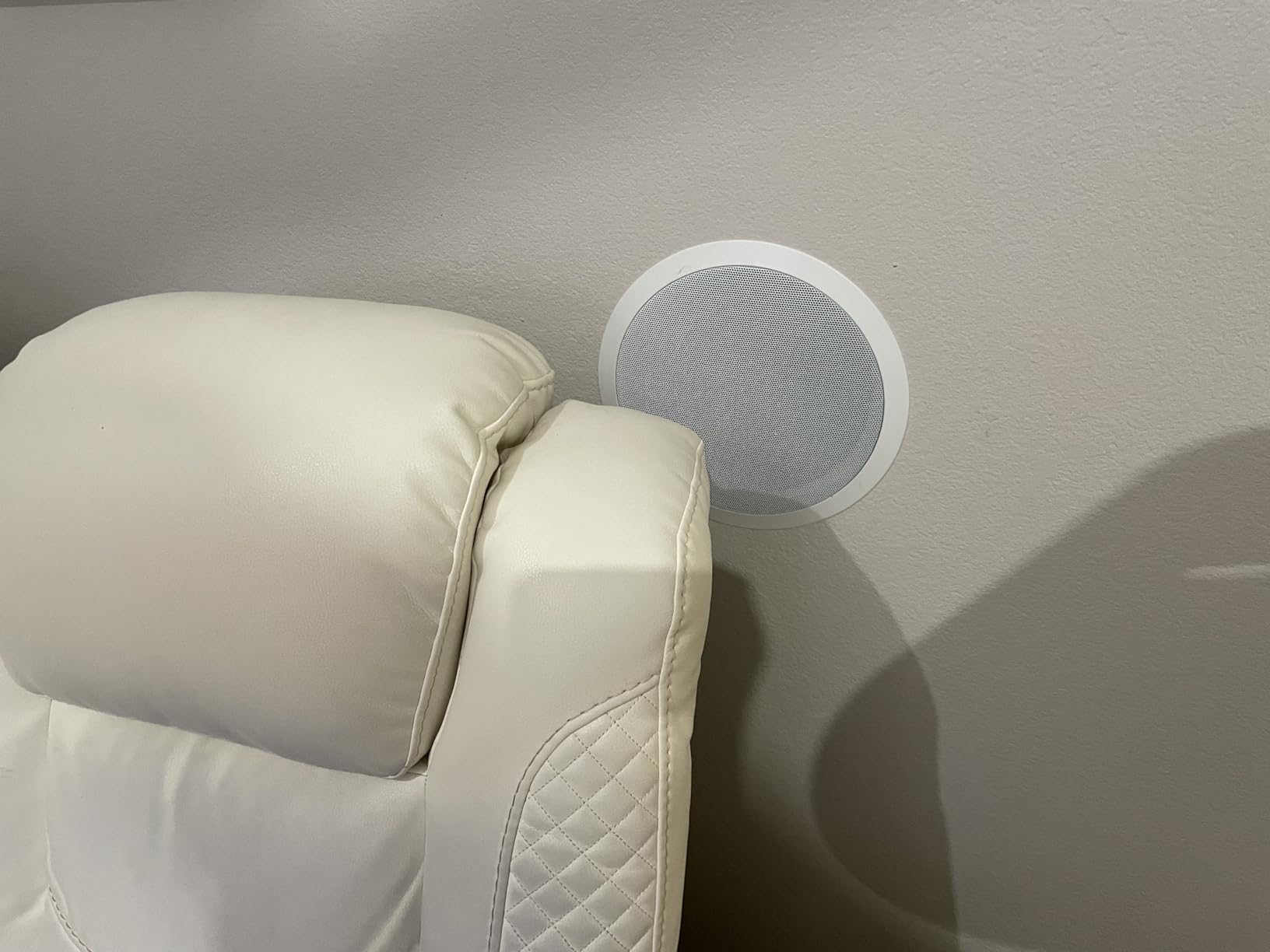
The pressure lock mounting system clamps tight to drywall and is widely described as the easiest installation in the roundup, with cut-out templates in the box. Sound quality for whole house or home theatre surround use is consistently praised, and the ABS housings and grilles can be painted to match decor.
The cutout is the thing to verify early. At 9.45 inches with a 3.78-inch mounting depth and a 10.83-inch overall frame, this is one of the largest cutouts on the list, and it will not clear tight joist spacing or an existing smaller hole without patching. Cut the hole only after confirming the template against the ceiling cavity, not before.

Best fit: one system serving theatre and background
This is the pick when the same ceiling space has to do two jobs, which is exactly the situation in an open-plan home where the living area doubles as the media room. Five matched speakers, one cutout size for the installer to template, and a voicing that stays consistent from the surrounds into the background zones.
It is also the sensible bulk option for a whole house on a budget, since five units from one box is fewer orders and fewer model numbers to keep track of over the life of the system. The listed specific uses include whole house audio systems, business conference rooms and retail installations.
Limitations to plan for
No amplifier is included, and these are ordinary passive speakers despite the high wattage headline figure. The 9.45-inch cutout is the practical problem for most retrofits, and the ABS construction will not feel as solid as the metal grilles on the Polk and Klipsch models.
There is also no wireless or smart home integration here at all, which is the point of a passive system, but it does mean this package depends entirely on whatever amplifier and control you pair with it. Make sure that amplifier is sized for five speakers on the channels you intend to use before the ceiling is closed.
How to Power In-Ceiling Speakers: Amplifier and Zone Sizing
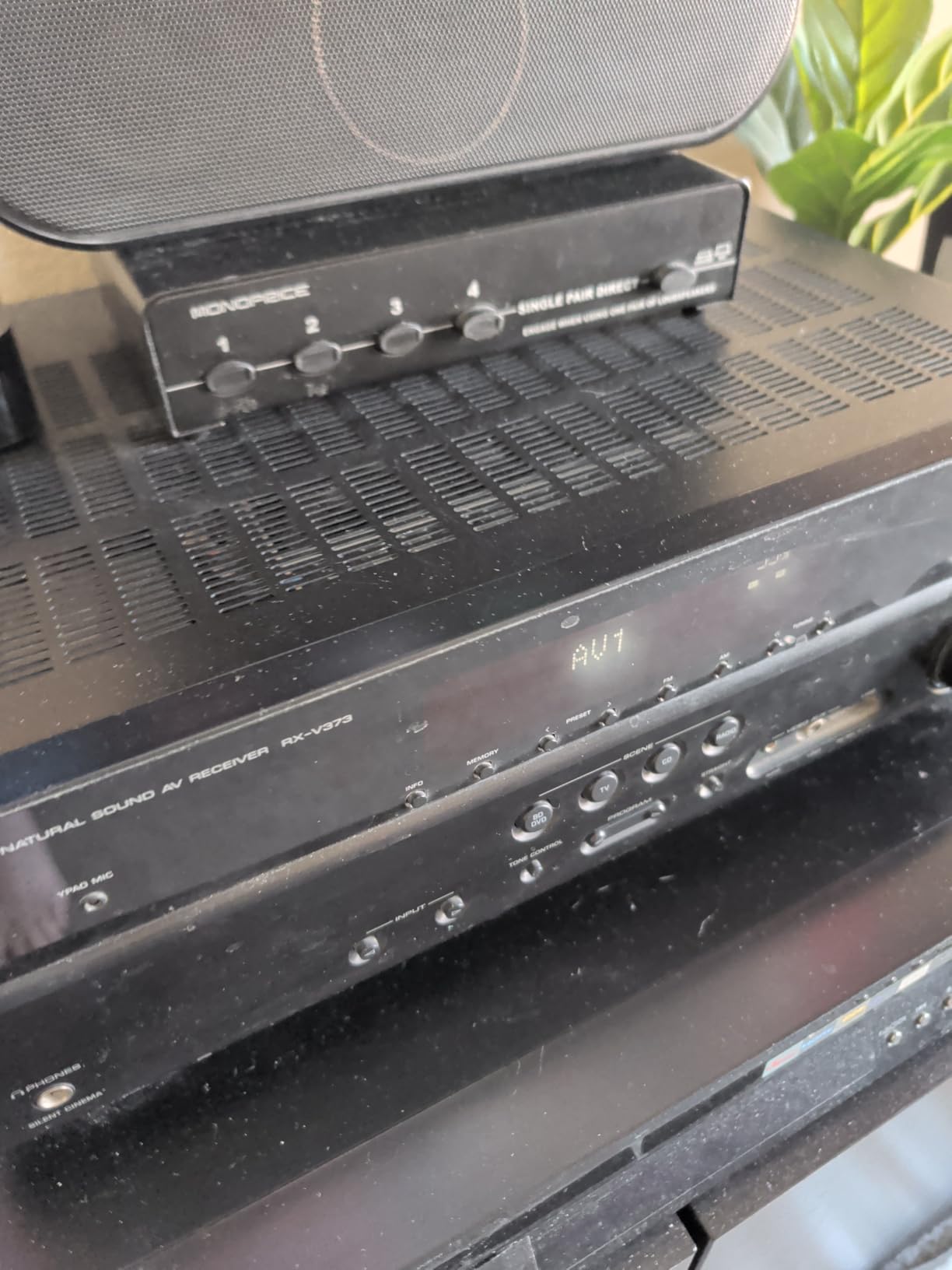
The question that turns up most often on audio forums is simply what amplifier to buy, and almost no roundup answers it with numbers. Here is the short version: a zone is one room, one amplifier channel pair feeds one zone, and a 4-zone amplifier runs four rooms independently. For passive 8-ohm ceiling speakers, 20 to 40 watts per channel is enough for a normally sized room, and there is no reason to buy more unless the room is large or the system also serves as a theatre.
Worked example: four rooms with a pair of ceiling speakers each means eight speakers and four channel pairs, so a 4-zone amplifier rated at 30 to 50 watts per channel is the right tool. The Polk RC80i and the Micca M-8C both sit comfortably in that range, while the Klipsch CDT models can be driven harder without strain. Forum consensus repeatedly favours a multi-channel distribution amplifier over a receiver when you only need two or three zones, because a receiver brings video switching and processing you will never use.
Add in-wall volume controls, one per room, and the system behaves the way people expect. A knob in each room sets that room’s level while the amp does the mixing, which is the single most-missed accessory in new-build installs. Without them you either play every room at the same volume or run a long control cable and a keypad system.
For 70V and 100V systems, which is the JBL CSS8008 route, the maths changes completely. Speakers daisy-chain in parallel on a constant-voltage line, so a single amplifier channel can feed eight or twelve of them without the impedance stacking that would overload a conventional amp. Buy a 70V or 100V amplifier if you have a very large number of speakers or unusually long cable runs; do not buy one for a normal four-room house.
Self-powered and Bluetooth systems, like the Herdio kit, skip this entirely because the amplifier is in the box. That is genuinely simpler, and it is the right choice when you cannot run cable. What you give up is per-room volume control, since there is no mixing, and the ability to change amplifier later without rewiring the speakers.
Installation Basics: Cutout Size, Mounting Depth and Speaker Wire
The mistake that costs homeowners the most money is cutting the hole before confirming the cutout diameter against the actual ceiling. Cutouts on this list range from 6.3 inches on the Herdio kit to 9.45 inches on the Acoustic Audio five-pack, and a speaker that will not physically pass through a 6-inch joist bay is a problem discovered after the drywall is up. Get the template, hold it against the ceiling, and check for joists, wiring and ductwork first.
Mounting depth is the second check. It ranges from 3.15 inches on the Herdio to 5.4 inches on the Klipsch CDT-5800-C II, and 4.3 inches on the Yamaha NS-IC800. Add insulation and you can exceed the available cavity in a retrofit, so measure the space between the ceiling plane and the floor or joist above before ordering anything.
Speaker wire gauge is the third. For runs under about 150 feet, 16 AWG is the standard and most installers default to it. Beyond that, particularly with several rooms sharing a trunk run, step up to 14 AWG to keep voltage drop low. An AVS Forum user running 14-gauge throughout a remodel for a future multi-zone system is the pattern worth copying, especially since the wire is far more expensive to add later than the speakers are.
Retrofit and new construction are different jobs. In new construction, run the wire before the drywall, label both ends of every run, and use in-wall volume control boxes while the walls are open. In a retrofit, plan the route from the amplifier location to each room and confirm the speaker cutout before committing, and consider backer board between studs for extra mounting security. If your ceiling cavity work overlaps with other projects, our guide to ceiling-mounted heaters covers the same cavity checks from a different angle.
Which Rooms Get Which Speaker: Wet Rooms, Small Rooms and Open Plans
As a rule of thumb, one ceiling speaker covers roughly 40 to 60 square feet of ceiling, and rooms with seating want a pair rather than a single unit. A 150-square-foot kitchen usually wants two speakers placed along the long wall rather than one in the centre, because a single downward-firing speaker in a working space puts the sound at the counter and nowhere else. This is also why the aimable and pivoting models matter more in real rooms than the specifications suggest.
For wet areas, use only speakers with a documented moisture or water resistance claim. The Polk RC60i is explicitly listed for bathrooms, kitchens and covered porches, the RC80i has a moisture-resistant rubber seal, and the Klipsch R-1650-C grilles carry rust protection for moist areas. The Micca, the Yamaha and the Sonos in-ceiling speaker are all listed as not water resistant, so keep them in dry rooms.
Open plans are where a single speaker fails. A great room with 10-foot ceilings and 400 square feet of floor needs two 8-inch drivers, ideally aimed, and our forum sources are consistent that undersized speakers in large open rooms are what people describe as thin and tinny. Put the 8-inch models in the main living space and treat the bedrooms, halls and utility rooms as the place for the 6.5-inch units.
Timbre matching matters if you also own bookshelf or floorstanding speakers, and there is no rule that says the ceiling units have to match each other exactly, but they should match within a zone. Keeping one model for the surrounds and the background speakers avoids a jarring shift in voicing when music plays across a room boundary. Beyond audio, a whole house system is one of the electrical projects that often travels with bigger upgrades, and our whole house generator guide covers the same planning logic for a different system.
Buying Guide: Nine Specs to Check Before You Cut a Hole
Impedance. Every model here is nominally 8 ohm except the Pyle, which is listed as 4-8 ohm, and the JBL, which is a constant-voltage unit. A 4-ohm speaker loads an amplifier harder, and non-4-ohm mismatches are flagged as problematic in forum threads, so check the tap before you wire a whole house to it.
Sensitivity. This is the number that decides how hard your amplifier has to work. The Micca at 90dB and the JBL at 96dB produce high levels from modest power, while the others sit lower. On a four-zone amplifier, higher sensitivity directly means a smaller amplifier.
Power handling, and what the number means. Maximum and peak figures are momentary limits, nominal and RMS are continuous. The Yamaha at 140 watts maximum and 50 watts nominal is honest, while the Pyle at 250 watts peak and 125 watts RMS is a different style of claim, and the 600-watt figure on the Herdio kit is a kit total. Match your amplifier to the continuous figure.
Cutout diameter and overall frame. This is the irreversible decision. Note both numbers, because an overall frame wider than your existing hole means patching drywall, and a speaker that will not pass through the bay cannot be installed at all.
Mounting depth and cavity conditions. Compare the depth against the space above the ceiling, and remember that plenum height shrinks where insulation is packed. High ceilings give you more room, but they also mean more distance between the speaker and the listener.
Driver configuration and size. Two-way coaxial designs are simpler and more forgiving. Three-way designs like the Acoustic Audio CS-IC83 add a midrange and sound fuller, but they are deeper. A pivoting or tiltable driver is worth more than a larger cone when the listening position is off-axis.
Dispersion. Wide coverage, like the JBL at 120 degrees or the R-1650-C coaxial, fills a room evenly from any position. Controlled dispersion, like the 100-degree Klipsch CDT models, puts sound exactly where you aim it and falls off faster off-axis. Choose based on room shape.
Grille. Aluminium grilles, found on the Polk RC80i and the Klipsch R-1650-C, take paint better and resist yellowing. Magnetic grilles, like the Yamaha and Klipsch CDT grilles, are quick to remove. Friction-fit grilles, like the Pyle, are the least convenient. Paint before installation in every case.
Warranty and packaging. The RC60i carries a lifetime warranty, the Klipsch CDT models and the R-1650-C carry limited warranties of around five years, and the Micca and Pyle carry one year. For permanently installed wiring, warranty length is a real part of the decision. Also check whether the model ships as a pair or a single unit, because whole house installs rarely need an even count.
Frequently Asked Questions
What amp do I need for ceiling speakers?
For passive 8-ohm in-ceiling speakers, 20 to 40 watts per channel is enough for a typical room, and a multi-zone amplifier with 30 to 50 watts per channel covers most homes. Count one channel pair per room, so a four-room system needs a 4-zone amp. Add in-wall volume controls so each room has its own level. Buy 70V or 100V equipment only if you have unusually many speakers or long cable runs.
How many ceiling speakers do I need per square foot?
One in-ceiling speaker covers roughly 40 to 60 square feet of ceiling area. A 150 square foot kitchen usually wants a pair placed along the long wall, and a large open living space with high ceilings wants two 8 inch drivers. Rooms where people sit should get a matched pair rather than a single unit, and a single speaker is acceptable in a hallway or bathroom.
Are in-ceiling speakers good for surround sound?
They are good for rear and height surround channels, where their wide or aimable dispersion fills the seating area. Most enthusiasts reject them for front left and centre duty because a speaker above ear level changes imaging and dialogue clarity. If your system doubles as a home theatre, keep a bookshelf or floorstanding speaker at ear level for the front stage and use ceiling units for surrounds and background music.
What are the disadvantages of ceiling speakers?
The main drawbacks are physical. A speaker above the listening position changes tonal balance, and wide-dispersion models put less detail directly at the listener than a dedicated speaker at ear level. Replacing one after installation means cutting a second hole in the drywall, which is why cutout diameter and mounting depth must be checked before the first cut.
How can I make in-ceiling speakers sound better?
Start with placement: aim pivoting tweeters at the seating, keep two speakers per zone in larger rooms, and space them evenly rather than crowding a wall. Then add a back enclosure, which is the single biggest upgrade for unsealed speakers, and use models with built-in treble or midbass attenuation switches to match soft and hard surfaces. Finally, size your amplifier with headroom so the system never clips.
What sizes do in-ceiling speakers come in?
The common driver sizes are 6.5 inch and 8 inch, with 5.25 inch, 4 inch and 10 inch models filling specialist roles. Six-and-a-half inch units suit small rooms and shallow ceilings, while 8 inch drivers are the default for living spaces and open plans. Cutout sizes run separately from driver sizes, from about 6.3 inches to 9.5 inches on the models in this guide, so check both numbers.
How do I connect existing house ceiling speakers to an amplifier?
Check the speaker impedance first, since most ceiling speakers are 8 ohm and a 70V or 100V system needs different equipment entirely. Run the cable from each room to a multi-zone amplifier, connecting one channel pair per room, and add an in-wall volume control in each room if you want independent levels. Label both ends of every run, and confirm the cutout size before cutting any new hole.
The Best In-Ceiling Speakers for Whole House Audio in 2026
The Polk Audio RC80i is our pick for most houses in 2026 because it balances an 8-inch driver, a documented moisture-resistant seal and a 4.7 rating across more than 2,300 reviews. Use it in every room you can, so one cutout size covers the whole install.
Drop to the Micca M-8C when the budget has to cover eight rooms and the amplifier too, and to the Polk RC60i for bathrooms, porches and shallow ceilings. Spend up on the Yamaha NS-IC800 in the rooms you care about, and reach for a Klipsch CDT model when you need to aim sound at a specific listening position. Choose the JBL CSS8008 only if you are building a constant-voltage system, and the Herdio kit only if you cannot run wire.
Whatever you pick, confirm the cutout diameter, the mounting depth and the amplifier plan before the first hole is cut. That check costs nothing now and a great deal later.