
Updated for 2026. We compared ten floorstanding speakers for home theaters, reading the spec sheets, the owner reviews and the recurring questions on r/hometheater and r/BudgetAudiophile. Ten models, one question throughout: which tower actually suits the room you are putting it in?
Floorstanding speakers, or tower speakers, are full-range passive loudspeakers built tall enough to stack a woofer, a midrange driver and a tweeter in one narrow cabinet. They became the standard front channels in home theaters because film soundtracks are loud and dynamic, and a tower delivers that output with less strain than a bookshelf speaker on a stand.
That is the honest case for towers. The honest case against them is just as important: in a room under about 150 square feet, a big cabinet fights the walls, the bass piles up, and the same money spent on bookshelf speakers plus a subwoofer usually wins. Every roundup you will read, ours included, is really a room-matching exercise.
Two things decide the outcome before any brand preference enters the picture. The first is room size, because a tower needs air behind it and space to the side, not just floor space. The second is amplifier matching, because sensitivity and impedance decide whether your receiver can drive the speakers cleanly at reference volume or merely push them to a whisper.
The ten models below span the range from a compact 39-inch two-way to a 47-inch three-way with dual 8-inch woofers, and they include the two things buyers most often miss: whether a speaker comes as a pair or as a single tower, and whether an advertised Dolby Atmos claim means a real integrated height driver or simply an empty slot on top. Last updated 2026, and every rating and review count shown is copied from the listing rather than estimated.
If you are still working out the basics of driver design and crossovers, the same physics apply everywhere speakers are sold, including in car speakers, and that grounding helps when a spec sheet starts flying past you.
Table of Contents
Top 3 Best Floorstanding Speakers for Home Theaters in 2026
Three picks carry this roundup. The Polk Audio T50 is the one to buy if you want a matched front stage on a sensible budget. The Klipsch R-26FA is the one to buy if you want overhead effects without buying separate height modules. The Klipsch R-610F is the one to buy if you want a matched pair for the least money and you have a modest receiver.

Polk Audio T50
- 1 inch tweeter
- 6.5 inch Dynamic Balance driver
- dual 6.5 inch passive radiators
- 6 ohm impedance

Klipsch R-26FA
- Integrated Dolby Atmos elevation driver
- 90 by 90 degree Tractrix horn
- dual 6.5 inch copper-spun woofers
- 8 ohm impedance
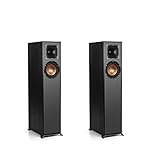
Klipsch R-610F
- 94dB sensitivity
- 45Hz to 21kHz response
- 1 inch LTS tweeter with Tractrix horn
- eight ohm impedance
All 10 Floorstanding Speakers at a Glance in October
| Product | Specs | Action |
|---|---|---|
| Polk Audio T50 |
|
Check Latest Price |
 Rockville TM150B Rockville TM150B |
|
Check Latest Price |
| Klipsch R-26FA |
|
Check Latest Price |
| Klipsch R-610F |
|
Check Latest Price |
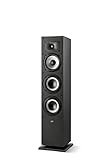 Polk Audio Monitor XT60 Polk Audio Monitor XT60 |
|
Check Latest Price |
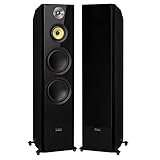 Fluance Signature HiFi Fluance Signature HiFi |
|
Check Latest Price |
 Klipsch RP-8000F II Klipsch RP-8000F II |
|
Check Latest Price |
 BIC America RTR-1530 BIC America RTR-1530 |
|
Check Latest Price |
 Rockville RockTower 68B Rockville RockTower 68B |
|
Check Latest Price |
 Dayton Audio Classic T65 Dayton Audio Classic T65 |
|
Check Latest Price |
1. Polk Audio T50: The Best Floorstanding Speaker for Home Theaters Overall
Polk Audio T50 Home Theater Floor Standing Tower Speaker 150W, Black
1 inch tweeter
6.5 inch Dynamic Balance driver
Dual 6.5 inch passive radiators
6 ohm impedance
Pros
- Deep effortless bass from dual passive radiators
- Crisp highs and detailed mids for film and music
- Part of a matched Polk T Series lineup
- Works with any standard AV receiver
Cons
- Sold as a single tower so you need two
- Passive design needs an external receiver or amplifier
The T50 is the pick I keep coming back to, because it solves the problem most home theater buyers actually have: getting two capable front channels into a room without spending the budget on a subwoofer first. A 1-inch tweeter sits above a 6.5-inch Dynamic Balance driver, and beneath both sit dual 6.5-inch passive radiators that do the low-end work without needing a powered subwoofer to hide their limits.
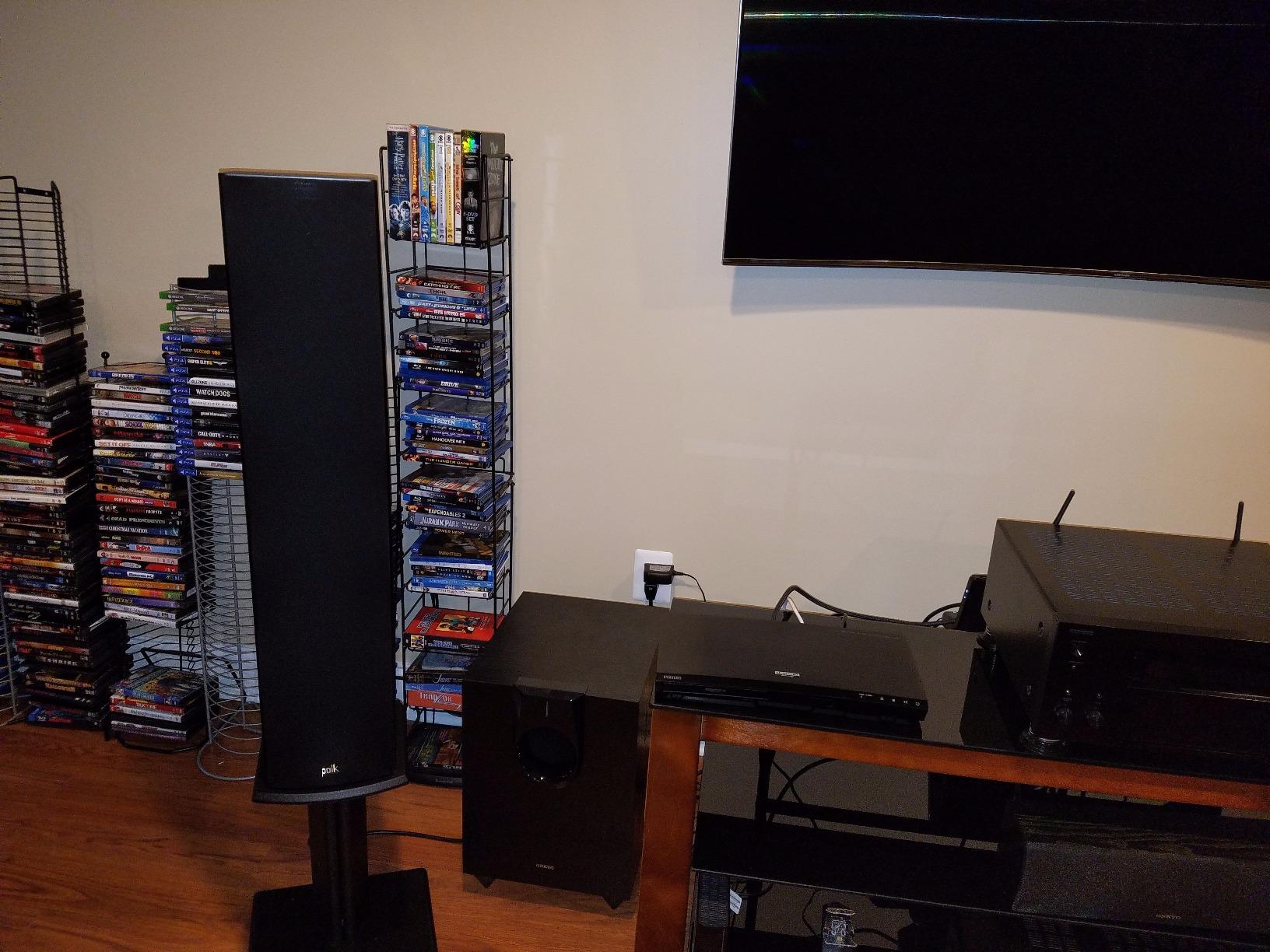
At 36.25 inches tall and 20.4 pounds, it is a genuinely manageable tower. That matters more in a real media room than any spec sheet, because a speaker you can physically place and move is a speaker you will actually position properly.
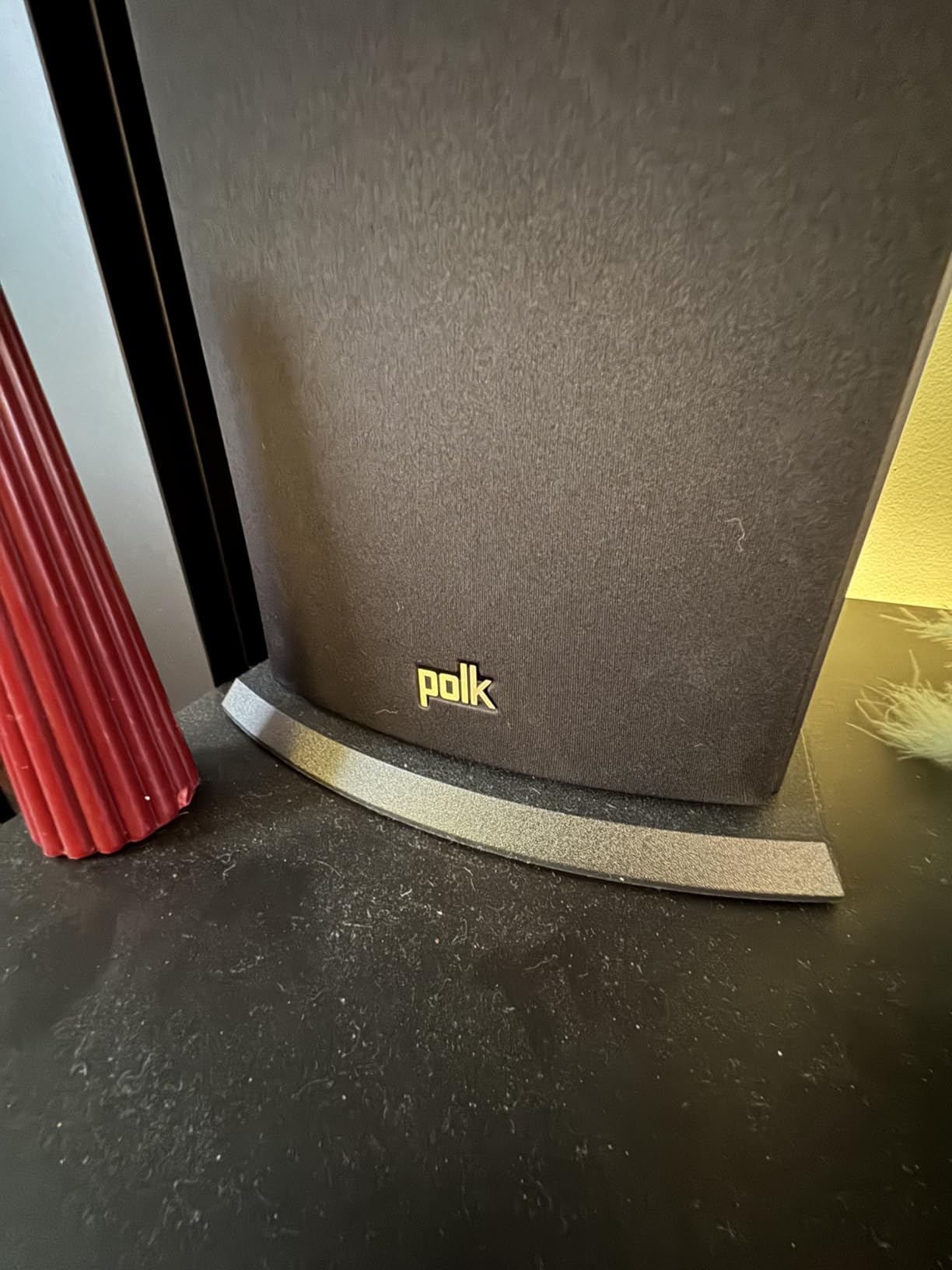
Reviewers consistently describe the same character: room-filling, balanced, with strong weight from the radiators and clean highs that never turn harsh on a long film. Across 2494 ratings the average sits at 4.6, and the summary of owner feedback is remarkably consistent about value for a first matched system.
The Polk T Series is the quiet advantage here. T15 bookshelf speakers handle surrounds and a T30 center handles dialogue, all voiced to match, so building a coherent 5.1 set is a matter of adding parts rather than hunting for a compatible one. That single-speaker ecosystem is why this tower ranks near the top in floorstanding speaker best sellers.
Which room sizes suit the Polk Audio T50
This is a medium-room speaker. Its 8.75-inch width and 7.75-inch depth leave plenty of air behind it in a 150 to 300 square foot space, which is where it sits in our matching bands. Give it six inches of clearance and it behaves.
In a room much larger than 300 square feet you will still get clean dialogue and front-stage scale, but the subwoofer becomes non-negotiable for the deepest effects. In a room under 150 square feet, the passive radiators become the problem: bass builds up in the corners long before it reaches your seat.
When the T50 is the wrong choice
If your system needs real overhead Atmos, the T50 gives you nothing. There is no elevation driver and no mounting hardware for one, so you are looking at on-ceiling or in-ceiling height speakers as a separate purchase.
It is also a passive design with no built-in amplification, so it needs an AV receiver or a stereo amplifier to make any sound. And remember it comes as a single tower, which changes the arithmetic on any comparison you make against a pair. Both facts are easy to miss and both show up at checkout.
2. Rockville TM150B: All-in-One Power With Built-In Subwoofers
Rockville TM150B Black Powered Home Theater Tower Speakers Dual 10″ Subs
250W RMS self powered
Twin 10 inch subwoofers
Six full range drivers
Two silk dome tweeters
Pros
- Two 10 inch subwoofers and high output in one cabinet
- Bluetooth USB SD and FM so no receiver is needed
- Eight EQ presets with bass and treble adjustment
- Two 1/4 inch mic inputs for karaoke
Cons
- Onboard DSP limits true stereo separation
- Karaoke and EQ features do nothing for critical listening
This is the only fully self-powered option in the roundup, and that changes who it is for. Two 10-inch subwoofers, six full-range drivers and two silk dome tweeters live in one 37.4-inch cabinet, driven by 250W RMS and rated to 1000W peak. You plug a phone or TV into it and you have sound.
For a garage setup, a rental apartment where you cannot run speaker wire, or a room where someone will not approve an AV receiver, that simplicity is genuinely valuable. The bass output from those twin 10-inch drivers is the reason it exists, and it delivers plenty of it.
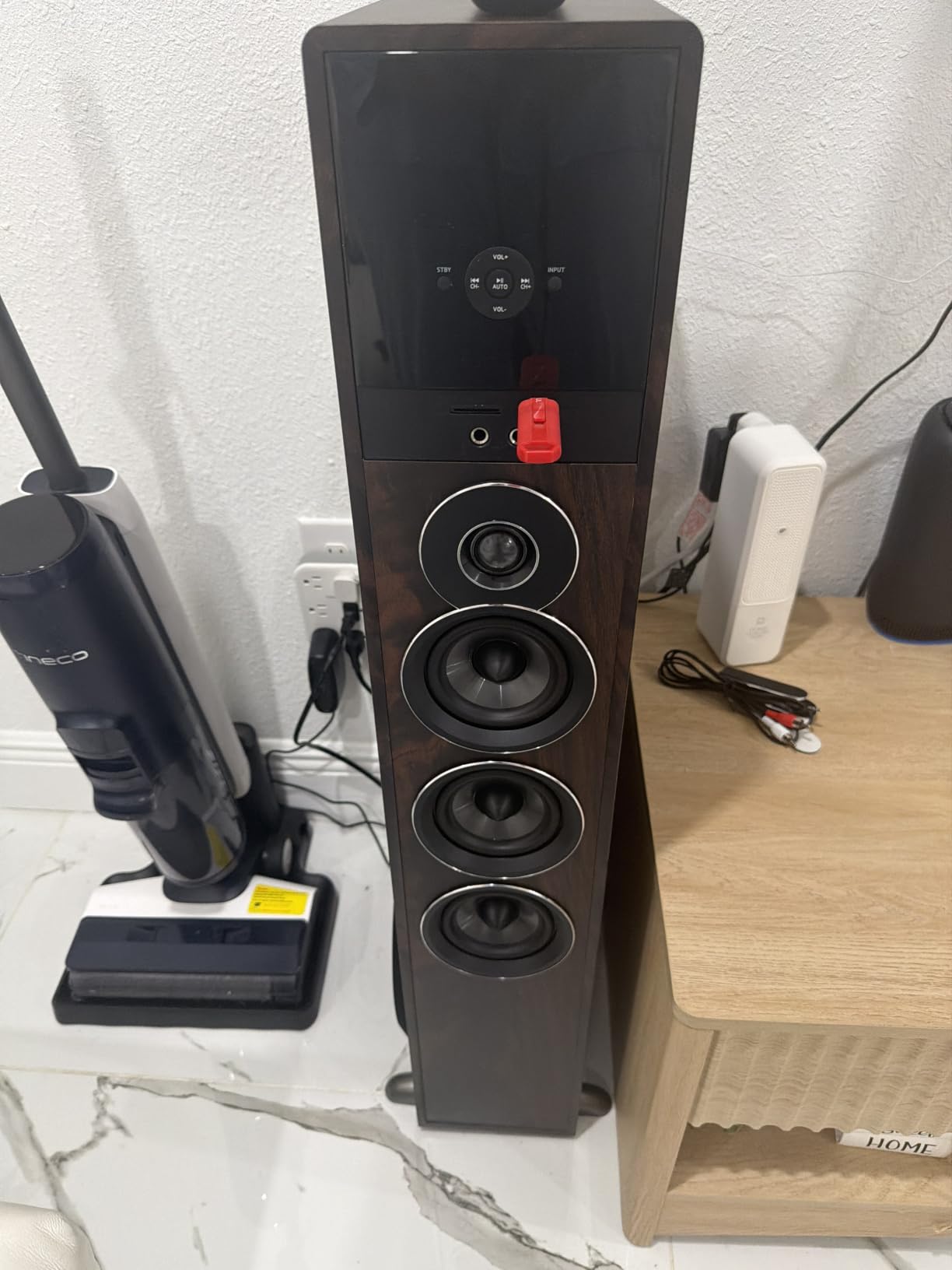
The rating tells you where the compromises are. At 4.1 across 2146 ratings it sits well below the dedicated passive towers here, and the pattern in the reviews is consistent: owners love the volume and the convenience, while critical listeners find the onboard processing limiting.
There is a real structural limitation too. A single cabinet with onboard DSP cannot give you the same stereo separation as two separately amplified towers, and that matters for the front soundstage in a home theater where effects need to move across the screen rather than sit in the middle of it.
Who the TM150B works for
It suits anyone without a receiver, and anyone who wants movie night to work the moment the TV turns on. Bluetooth, USB, SD card and FM radio mean no extra boxes, and the included remote handles the eight EQ presets plus bass and treble trim.
It also suits a large open-plan living space where one cabinet is easier to live with than two towers and a subwoofer. Just be clear that you are buying convenience and volume, and that this is not a reference front stage.
Where it falls short as a theater front pair
The features that make it fun are the features that do nothing for home theater. Karaoke mic inputs with echo control are party equipment, and the DSP presets flatten the dynamics that make a film mix work.
At 57.4 pounds and 12.99 inches deep, it also demands more floor space than most slim towers, and the one-year warranty is the shortest in this group. If you already own an AV receiver, this is strictly worse than spending the same money on a passive pair plus a subwoofer.
3. Klipsch R-26FA: Real Dolby Atmos From a Single Cabinet
Klipsch Reference R-26FA Floorstanding Speaker, Black, Pair
Integrated Dolby Atmos elevation driver
1 inch compression driver with Tractrix horn
Dual 6.5 inch copper-spun IMG woofers
8 ohm impedance
Pros
- Integrated elevation driver for overhead Atmos effects
- Tractrix horn gives crisp highs and fine detail
- Dual copper-spun woofers with front firing port
- Dual binding posts allow bi-wiring and bi-amping
Cons
- Pair pricing is higher than single-tower listings
- 100W continuous handling is modest against big premium towers
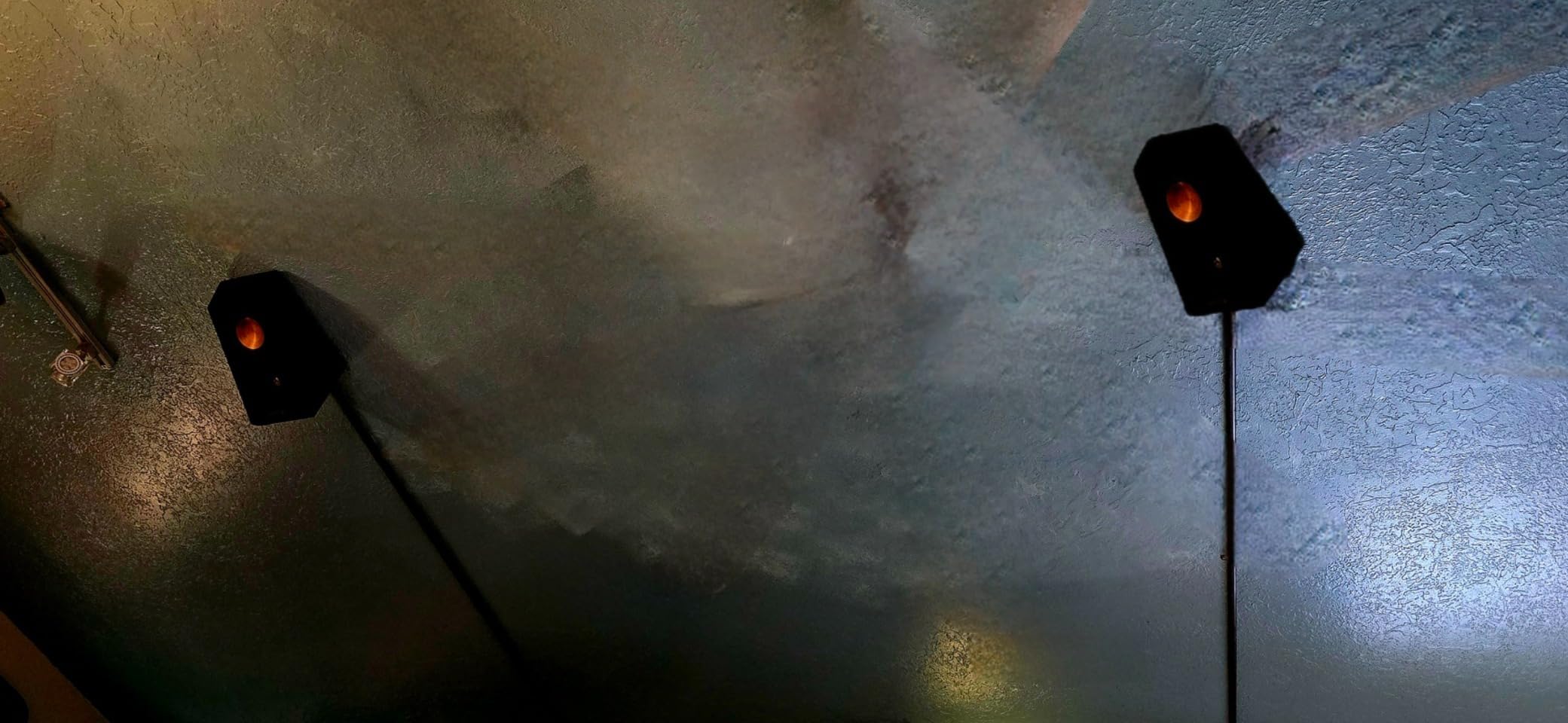
This is the Atmos answer on this list. Rather than selling you empty slots on top of the cabinet, the R-26FA has an integrated elevation driver pointed at the ceiling, so overhead effects come from real hardware instead of a separately purchased up-firing module. That is the honest version of the claim, and it is why we treat this speaker differently from towers that merely advertise Atmos compatibility.
Below the elevation driver, a 1-inch aluminum diaphragm compression driver sits in a 90 by 90 degree Tractrix horn, feeding dual 6.5-inch copper-spun IMG woofers through a front-firing port. That horn is the source of the dialogue clarity people notice first on a film.
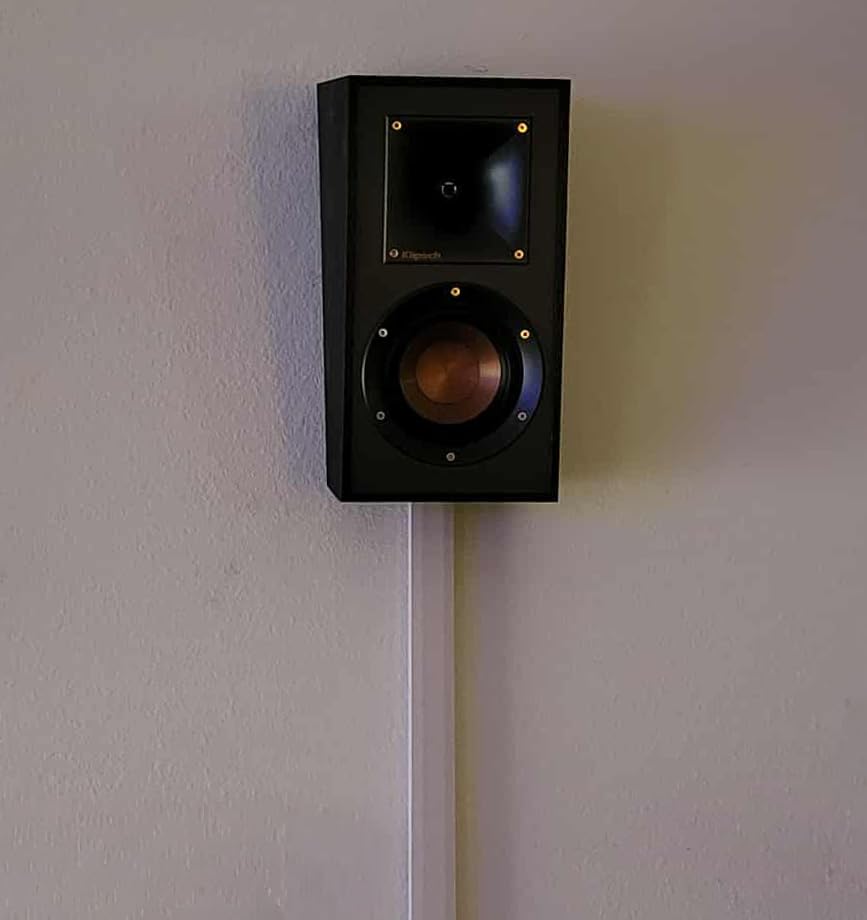
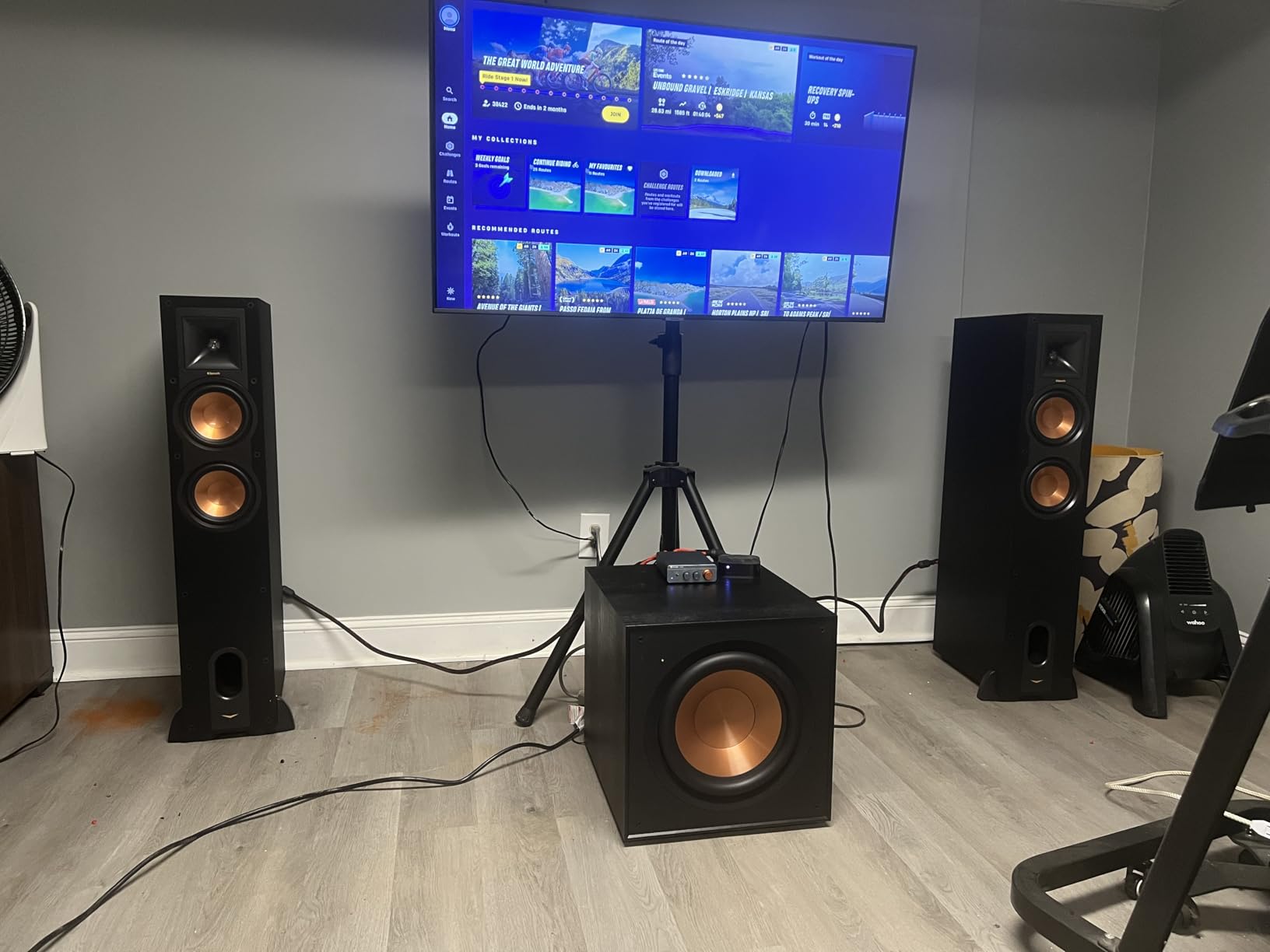
The ratings support that read. It holds 4.7 across 966 ratings, and the review summary highlights exactly what a home theater buyer cares about: easy integration with receivers and effective bass from the dual 6.5-inch woofers. Owners also note a very high share of top marks, which tells you the fit and finish are as good as the sound.
Front-firing ports make placement forgiving too. You are not trapped against a wall with a rear port chuffing, which is a common reason buyers give up on a tower and end up with a soundbar. Eight-ohm impedance keeps it friendly to almost any receiver.
Where the R-26FA makes the most sense
Buy it if your room has a flat ceiling and you want overhead effects without cutting holes or running new cable. Ceiling height between roughly 8 and 9 feet gives the up-firing driver the reflection angle it needs; much lower and the effect collapses into the front stage.
It also suits medium rooms where a pair of large towers would be overkill. With 100W continuous and 400W peak handling plus 8-ohm impedance, it plays loudly on a mid-range receiver without demanding a serious amplifier.
The limits of an up-firing Atmos module
An up-firing driver bounces sound off the ceiling, so it cannot place an object the way a true height speaker on a wall or in-ceiling can. Height effects appear and move, but they do not hold a precise position. If your ceiling is vaulted, or you run very high, the effect is weak.
There is also the fact that the elevation driver shares power with the main array. At 100W continuous, the speaker has less headroom for reference-level movie playback than the dual 8-inch models further down this list, in a room much over 300 square feet you would want more.
4. Klipsch R-610F: Horn Clarity and High Sensitivity for Less
Klipsch Reference R-610F Floorstanding Speaker, Black, Pair
94dB sensitivity
45Hz to 21kHz frequency response
1 inch LTS tweeter with Tractrix horn
8 ohm impedance
Pros
- 94dB sensitivity drives loud on modest receivers
- 45Hz to 21kHz response covers the film band
- Comes as a matched pair
- Five-way binding posts accept banana plugs
Cons
- Needs an external amplifier or receiver
- Deep bass still needs a dedicated subwoofer
- Included foot screws are low quality
The R-610F is the value pick, and the reason is a single number: 94dB sensitivity. For a home theater buyer with an entry-level AV receiver, that figure is more important than any driver size. High sensitivity means the speaker converts amplifier power into volume efficiently, so a modest 5-channel receiver gets you real cinema levels without straining.
A 1-inch aluminium LTS tweeter in a 90 by 90 degree Square Tractrix horn handles the top end, with a single 6.5-inch copper-spun woofer underneath. Rated 85W continuous and 340W peak, and measured from 45Hz to 21kHz, it covers the band where film dialogue and effects live.
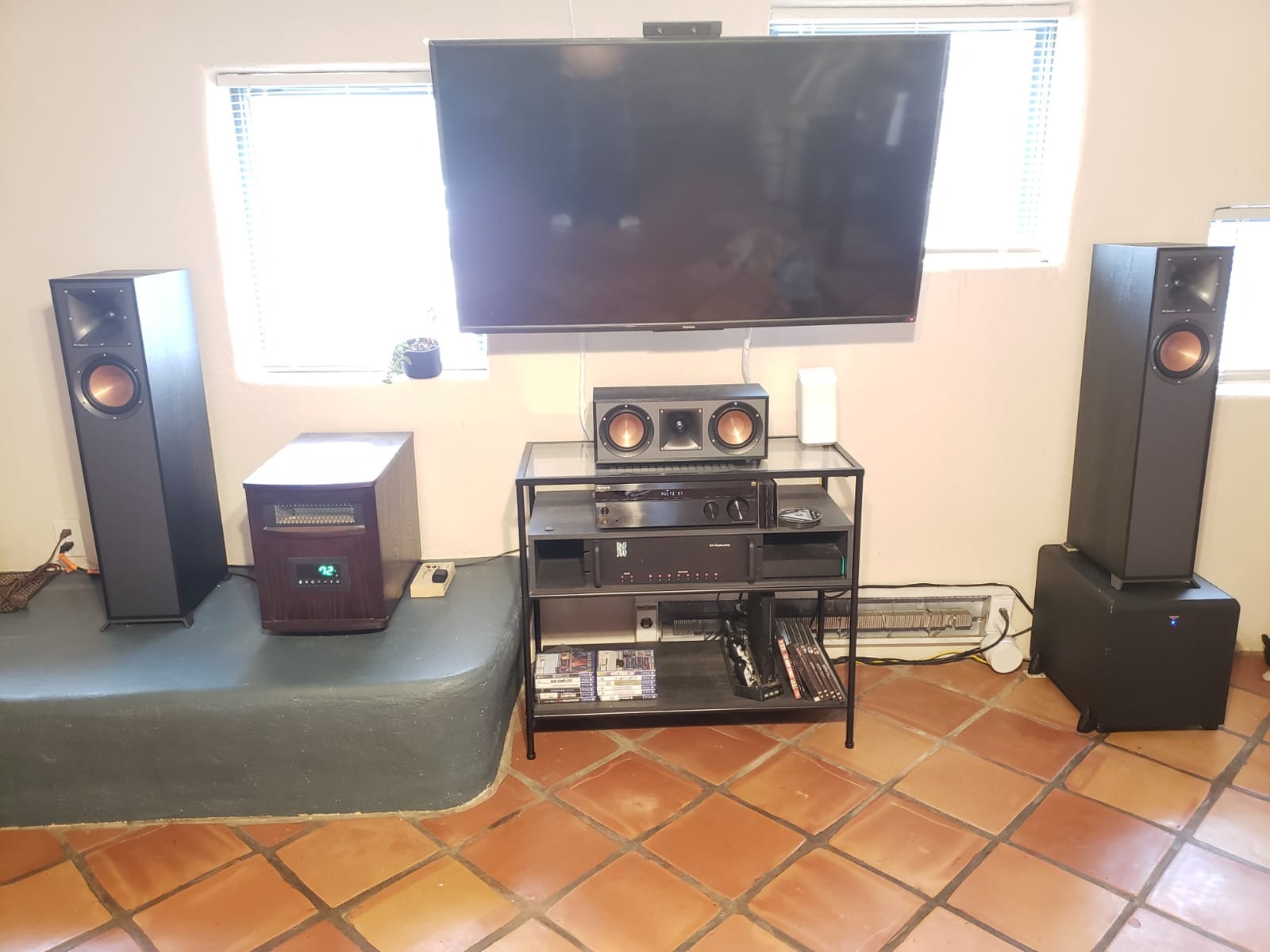
It holds a 4.7 across 627 ratings, and the owner consensus is unusually settled: accurate, uncolored, easy to drive. Reviewers also report using them as rear surrounds in 5.1 and 7.1 systems, which is worth knowing since a matched horn soundstage front to back is the goal.
Eight-ohm impedance removes another common worry. Speakers that dip into 4 ohms are the ones that overheat budget receivers, and this one stays clear of that territory entirely.
Which rooms and receivers suit the R-610F
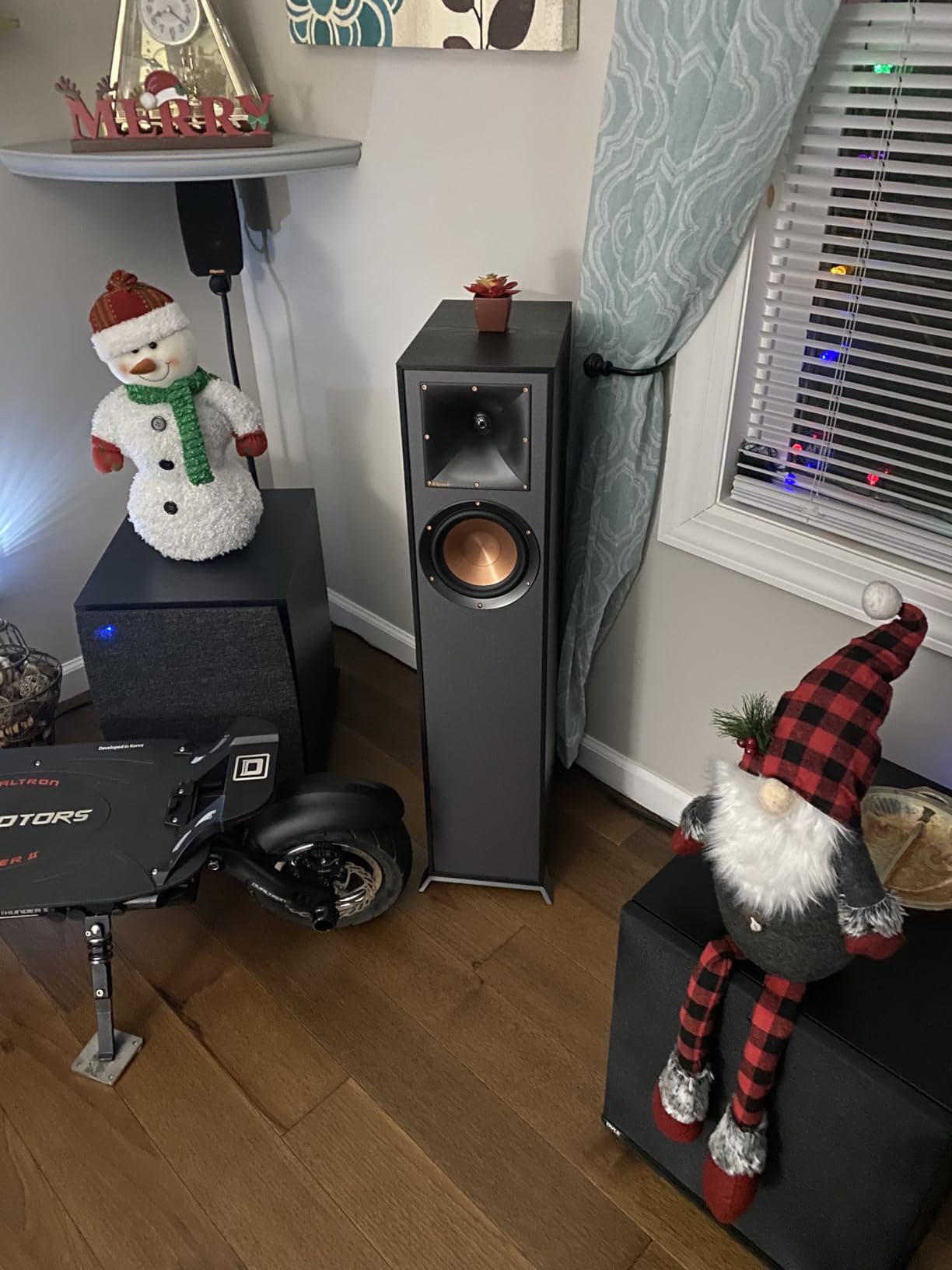
It works across the whole middle of this roundup’s room bands, from a 150 square foot bedroom theater up to roughly 300 square feet of dedicated space. At 18.25 inches deep and 41.25 inches tall it is compact enough for a real living room.
It is the safest pairing here with an older or mid-range Denon, Yamaha or Onkyo receiver. That anxiety about whether an amplifier can handle a speaker is the one thing that stops a lot of home theater builds before they start, and the R-610F removes it.
Where you will want to upgrade later
One 6.5-inch woofer will not deliver the deepest sub-bass effects in a large dedicated theater. Owners consistently note the subwoofer still handles the lowest frequencies, which is normal, but in a room over 300 square feet you are leaving scale behind.
Bi-wiring and bi-amping through the five-way posts are available, though with a single crossover and a 94dB speaker you are unlikely to hear the difference on a home receiver. Replace the included foot screws before you worry about any of that; they are the part reviewers most often complain about.
5. Polk Audio Monitor XT60: A Modern-Looking Tower With Hi-Res Certification
Polk Audio Monitor XT60 Home Theater Tower Speaker (Single, Midnight Black)
1 inch tweeter
6.5 inch Dynamically Balanced woofer
Two 6.5 inch passive radiators
8 ohm impedance
Pros
- Hi-Res Audio certified with Atmos Auro and DTS:X support
- Twin passive radiators for smooth bass
- Modern finish that suits a living room
- Rubber feet for carpet or hardwood
Cons
- Sold as a single tower
- Six inch footprint and sixteen inch width need room
- Passive with no built-in amplification
The XT60 is the pick for a room that has to look right as well as sound right. Where some towers shout about furniture-friendly wood grain, this one reads as a modern design object, and at 16 inches wide it still disappears against a wall better than a flagship cabinet.
Underneath that styling the engineering is familiar Polk: a 1-inch tweeter, a 6.5-inch Dynamically Balanced woofer and two 6.5-inch passive radiators. Rated to 200W with eight-ohm impedance, it is an efficient design that suits home theater use where long film sessions matter more than critical two-channel listening.
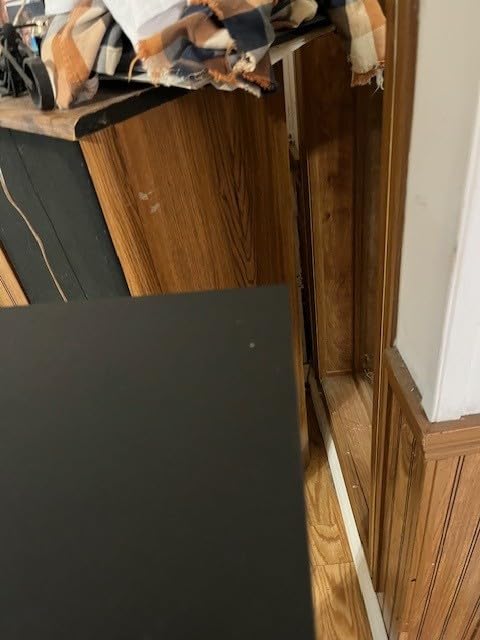
It carries 4.6 across 509 ratings. The owner feedback describes a smooth, room-filling soundstage for movies, television and music, with particular appreciation for the high-resolution certification and the ability to build a coherent system around it.
Those decoding badges are worth a note. Dolby Atmos, Auro 3D and DTS:X compatibility means the speaker sits happily in whatever mixing mode your receiver offers, which matters more in 2026 than it did a few years ago as more films mix for immersive formats.
Matching the XT60 into a Monitor XT system
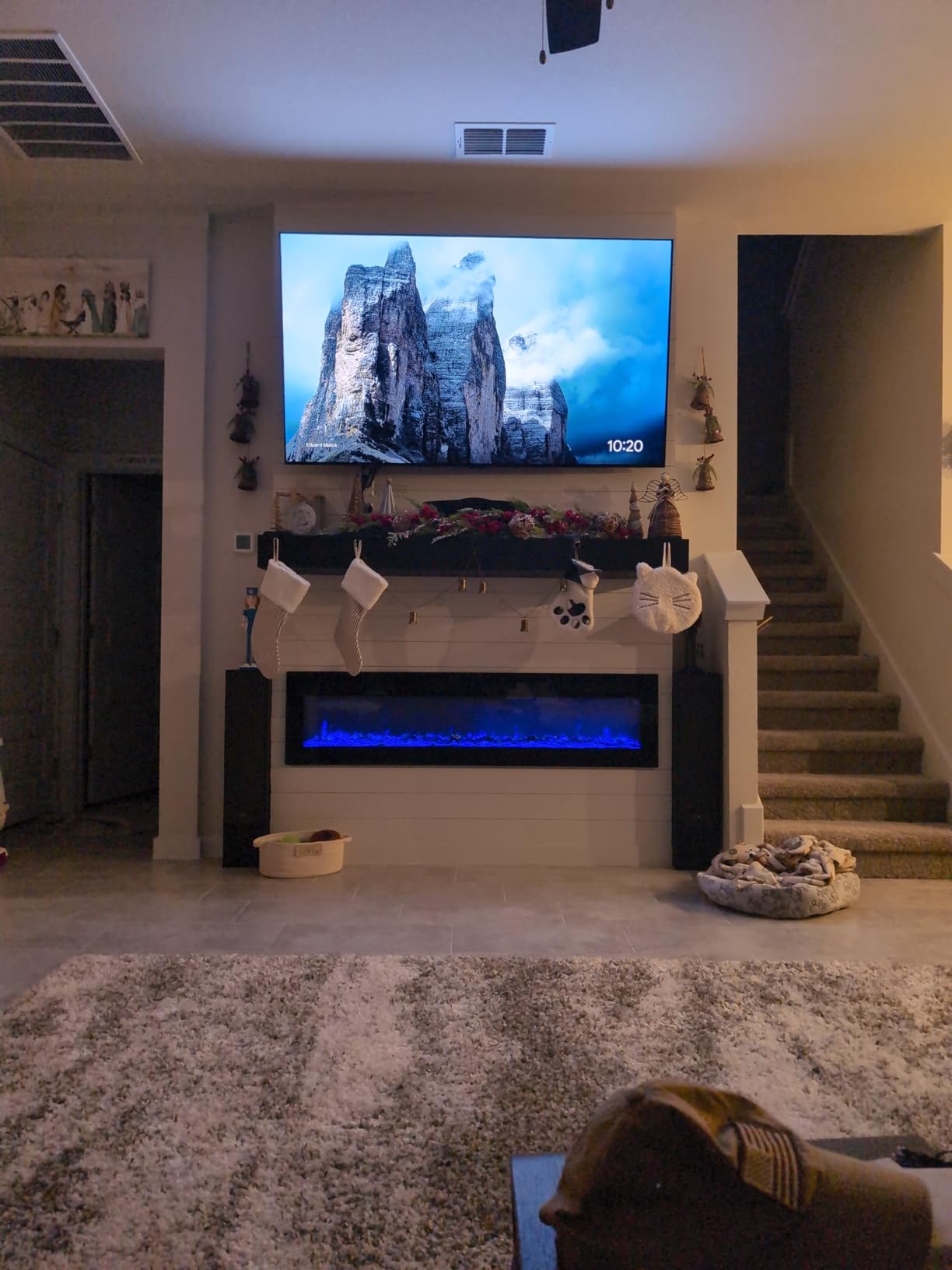
This is where the line pays off. The Monitor XT range is timbre-matched, so the XT60 fronts, the matching center and the XT-series surrounds and height speakers all share a voice. Nothing gets swallowed by the center channel during dialogue.
For a first 5.1.2 build, that coherence is the whole point. A center channel that matches the fronts is the single most effective upgrade to dialogue intelligibility, and buying within one line is the easiest way to guarantee it.
Where the XT60 stops being the right answer
There is no integrated height driver, so Atmos overhead effects require separate on-ceiling or in-ceiling speakers. It also sells as a single tower, so budget for two, and check the 17.9-inch depth against your front wall before you commit.
Rubber feet rather than spikes or outriggers means it is stable on carpet and hardwood, but it will not resist being nudged on a hard floor near a busy walkway. In a small room, the 16-inch width is the constraint, not the sound.
6. Fluance Signature HiFi: The Genuine Three-Way Design
Fluance Signature HiFi 3-Way Floorstanding Tower Speakers with Dual 8″ Woofers for 2-Channel Stereo Listening or Home Theater System – Black Ash/Pair (HFF)
Three-way with dual 8 inch woofers
Neodymium tweeters
Woven glass fiber pointed-dome midrange
Response from 35 hertz
Pros
- True three-way crossover keeps drivers in their optimal band
- Dual 8 inch woofers for clean controlled bass
- 1.4 inch chamfered MDF baffle reduces diffraction
- Lifetime parts and labor warranty with spikes and outriggers
Cons
- Largest and heaviest cabinet here at 47.3 inches and 62.4 pounds
- No height drivers so Atmos needs separate modules
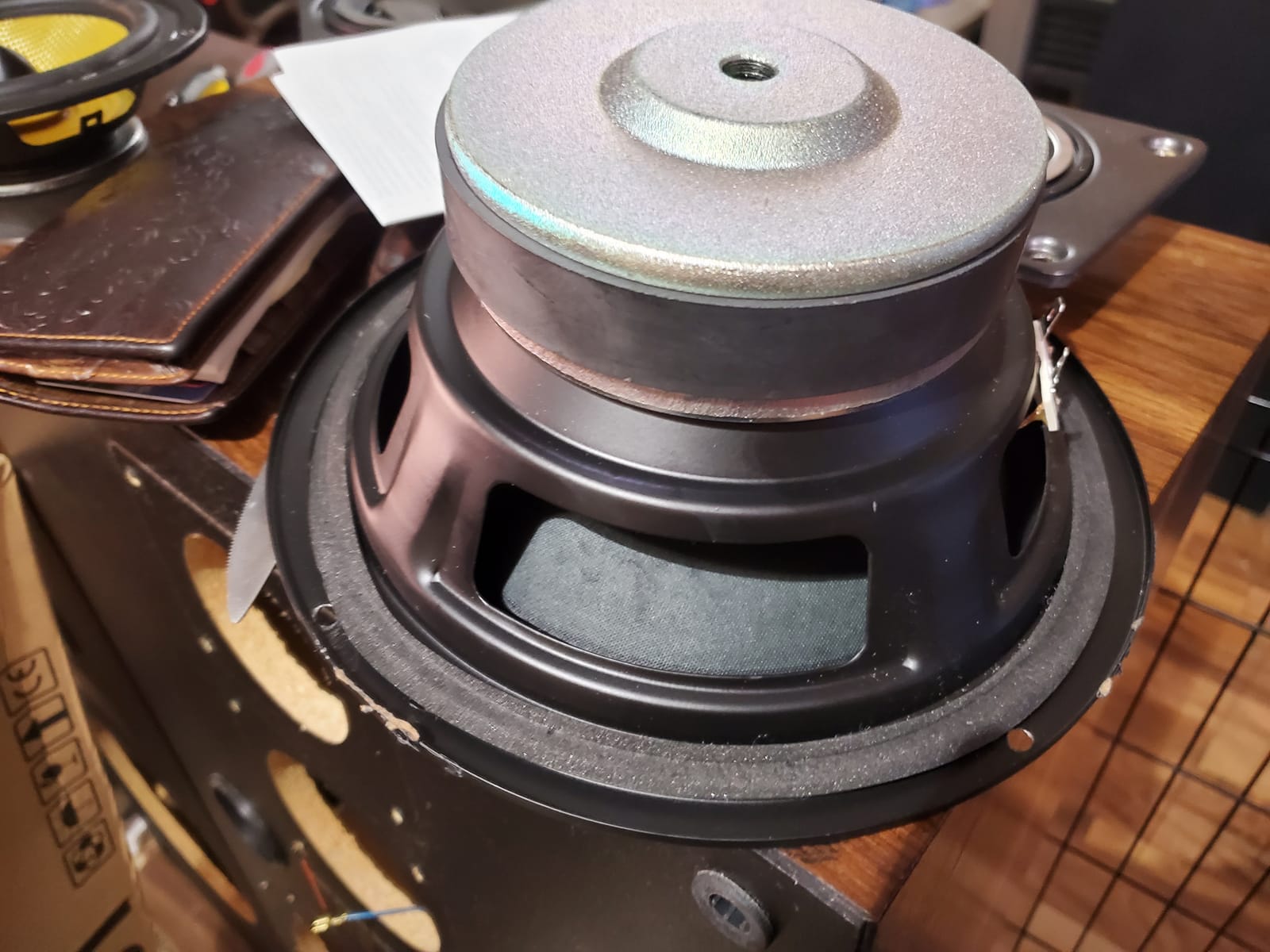
This is the audiophile-leaning pick, and the distinction that sets it apart from everything else here is the three-way architecture. A dedicated woven glass fiber midrange with a pointed dome handles vocals on its own, while the dual 8-inch woofers concentrate on bass. That is why your voice arrives without bass smearing over it.
That separation matters for home theater more than for music. Dialogue clarity is the most common complaint in film sound, and a speaker that does not ask one driver to handle both vocals and low effects is structurally better at fixing it.
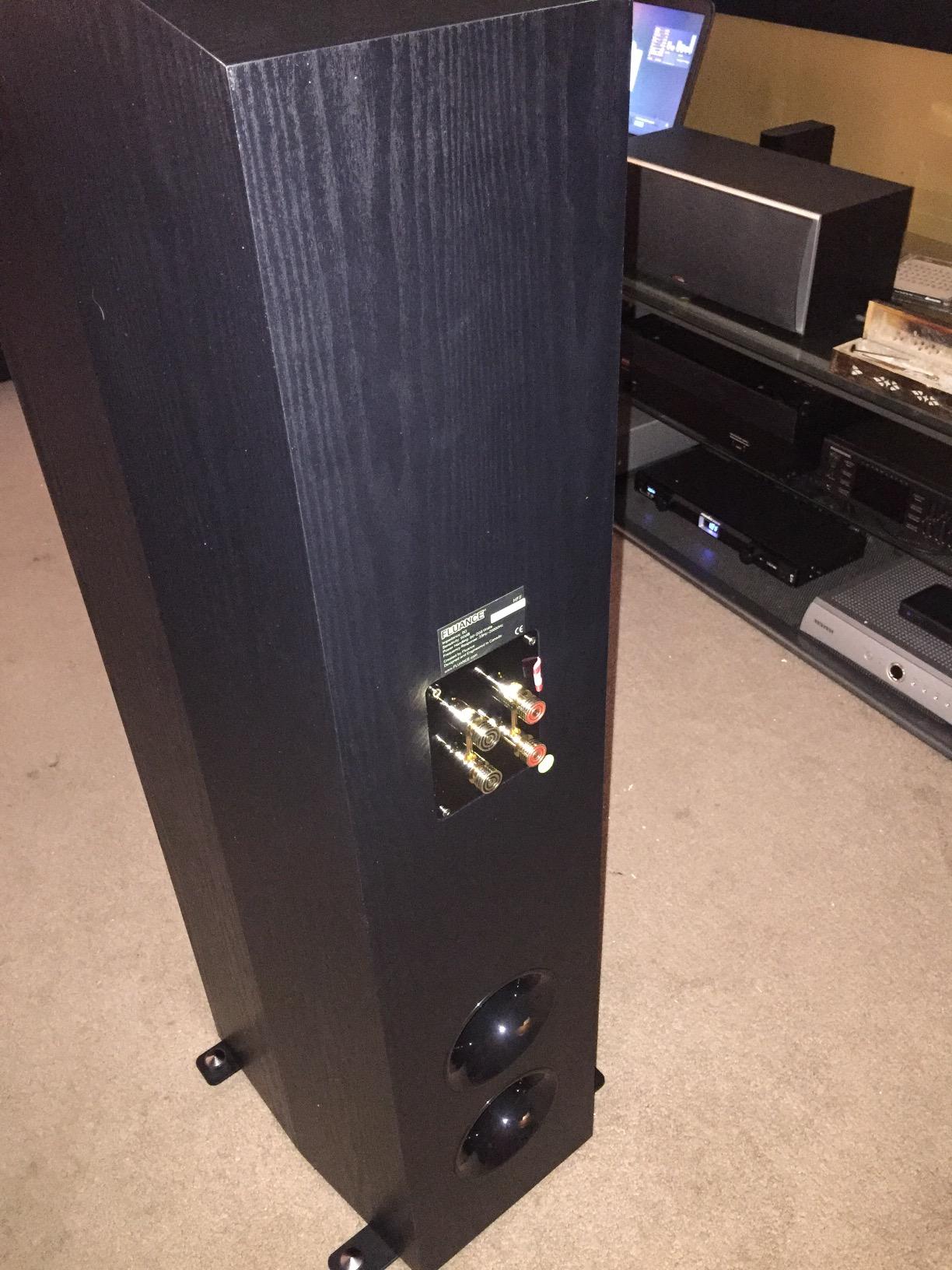
The cabinet is built like the acoustic claims suggest: medium-density fiberboard with a 1.4-inch chamfered front baffle that reduces edge diffraction, rated to 200W and reaching down to 35Hz. Floor spikes and outriggers are included, which matters for stability at 47.3 inches tall.
At 4.3 across 180 ratings it scores modestly, and the review pattern is explanatory rather than negative: audiophile-leaning design, excellent tweeter clarity, controlled low end, real room-filling scale, but a smaller owner base and a more specialized signature. The lifetime parts and labor warranty is the standout feature buyers repeatedly single out.
What the Fluance Signature does better than a two-way
A true three-way gives each driver a narrower band, so distortion stays low when the film mix gets loud. In practice you get cleaner dialogue at higher volume, which is exactly when most home theater listening happens.
The pointed-dome midrange also widens the soundstage more than a conventional cone, so the front stage spreads past the cabinets on wide film mixes. Response from 35Hz means it does useful work below the usual sub crossover region.
Where the size becomes the problem
At 47.3 inches tall, 15.4 inches wide, 10.9 inches deep and 62.4 pounds, this is a two-person lift and a permanent piece of furniture. If the room is under 200 square feet or the front wall is shallow, the footprint alone disqualifies it.
It also has no height drivers at all, so a Dolby Atmos setup means buying separate modules, and the 200W rating means a large dedicated room will want an external amplifier to push it hard.
7. Klipsch RP-8000F II: Maximum Scale for Large Dedicated Rooms
Klipsch Reference Premiere RP-8000F II 2.0 Dual Floorstanding Speaker Pair with Larger 90° x 90° Hybrid Tractrix Horn, 8” Cerametallic Woofers for Premium Home Theater Sound in Ebony
Dual 8 inch Cerametallic woofers
1 inch LTS titanium tweeter
Larger 90 by 90 degree hybrid horn
400W maximum power handling
Pros
- Largest driver array here for deep punchy bass
- Titanium LTS tweeter stays detailed at high volume
- Big horn improves soundstage width and clarity
- Efficient enough for a mid-range receiver
Cons
- Most expensive model in the roundup
- 48 inch cabinets weigh 61.4 pounds each
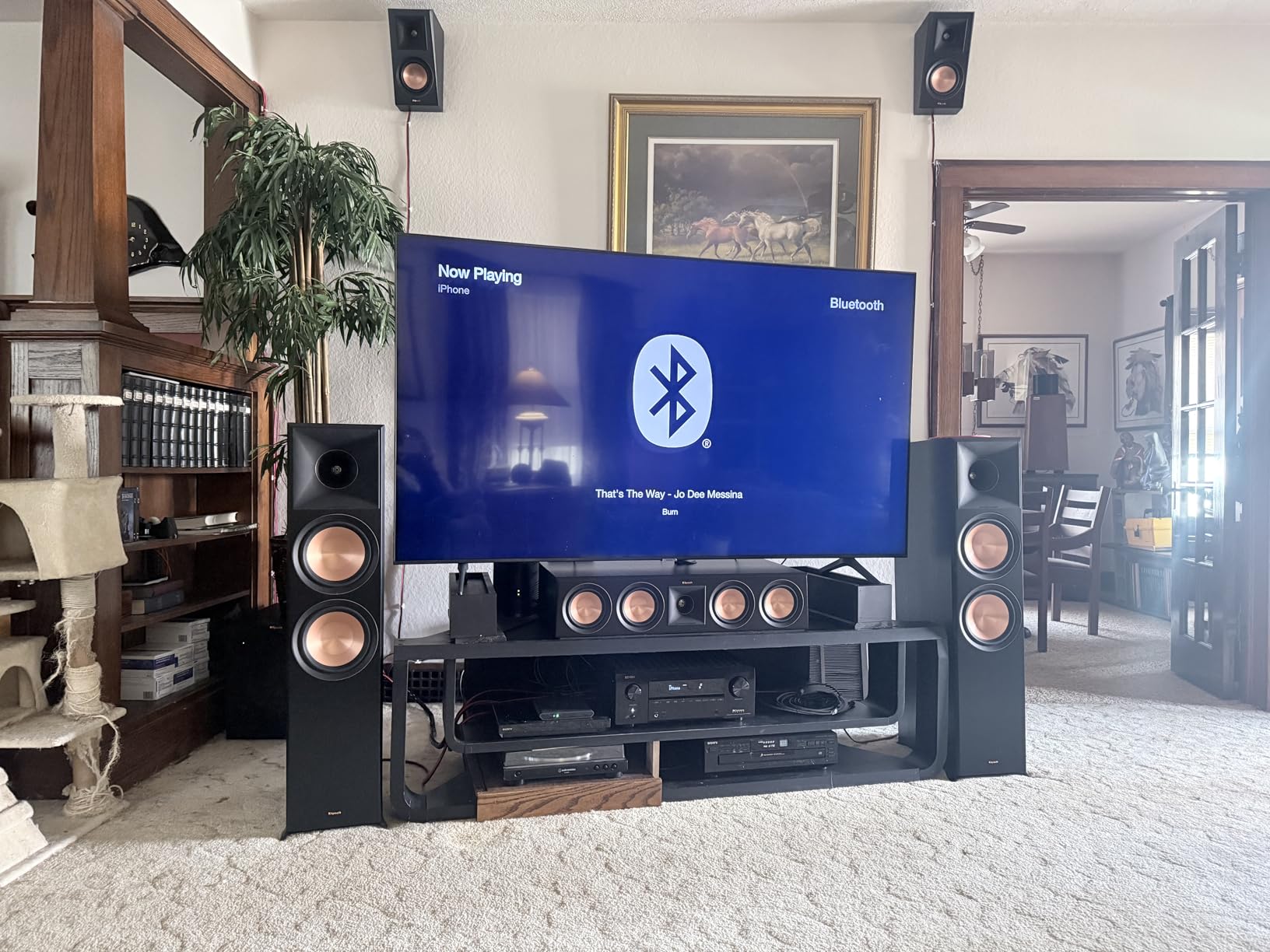
When a dedicated theater is over 300 square feet, this is the kind of front stage that justifies the term. Dual 8-inch Cerametallic woofers, a 1-inch LTS titanium diaphragm tweeter and a larger 90 by 90 degree silicone composite hybrid Tractrix horn give you the headroom that a mixed soundtrack needs.
The horn is the part that changes the experience. A wider horn pattern spreads the high frequencies across a large seating area, so people in the third row hear dialogue as clearly as people in the middle, and the titanium tweeter stays composed when the mix gets loud.
It carries 4.5 across 160 ratings. Owners consistently describe it as a dramatic step up from bookshelf speakers, with room-filling scale and deep bass before adding subs. That is unusual in a pair of towers and it is why this one keeps appearing in buyer conversations.
Efficiency is the underrated detail. Reviewers note it plays loudly on a mid-range 95W per channel receiver, so the flagship-sounding option does not force a flagship amplifier. Dual terminals allow bi-wiring and bi-amping if your processor supports it.
Room requirements for the RP-8000F II
It belongs above 300 square feet, or in a 150 to 300 square foot room where you want film-level dynamics and plan to run a subwoofer. Rated to 400W and reaching from 20Hz, it wants to be driven, not just fed.
Give it real clearance. At 48 inches tall and 22 inches wide, toe-in and wall distance matter, and the bass response firms up considerably when the cabinets are pulled off the front wall.
Where buyers get disappointed
It is the most expensive model here by a wide margin, and the improvement over the R-610F is refinement rather than a different category of sound. If your receiver is entry-level, that gap in performance will shrink noticeably.
The weight is the practical issue. At 61.4 pounds each, moving these for placement experiments means two people and a clear floor path. Buyers in smaller rooms regret the footprint; owners in large dedicated spaces almost never do.
8. BIC America RTR-1530: The Most Physical Bass in the Roundup
BIC AMERICA RTR-1530 15-Inch 3-Way Floor Standing Speaker (BIC AMERICA RTR1530)
Heavy duty 15 inch woofer
2.5 inch fluid-cooled tweeter
4 inch wide dispersion midrange
8 ohm impedance
Pros
- 15 inch woofer delivers substantial low-end output
- Three-way design separates tweeter mid and bass
- Wide dispersion midrange covers a big seating area
- Handles up to 325W per channel
Cons
- Very large at 60 pounds and 43.8 inches tall
- Sold as a single speaker so you need two
- Powerful rather than refined
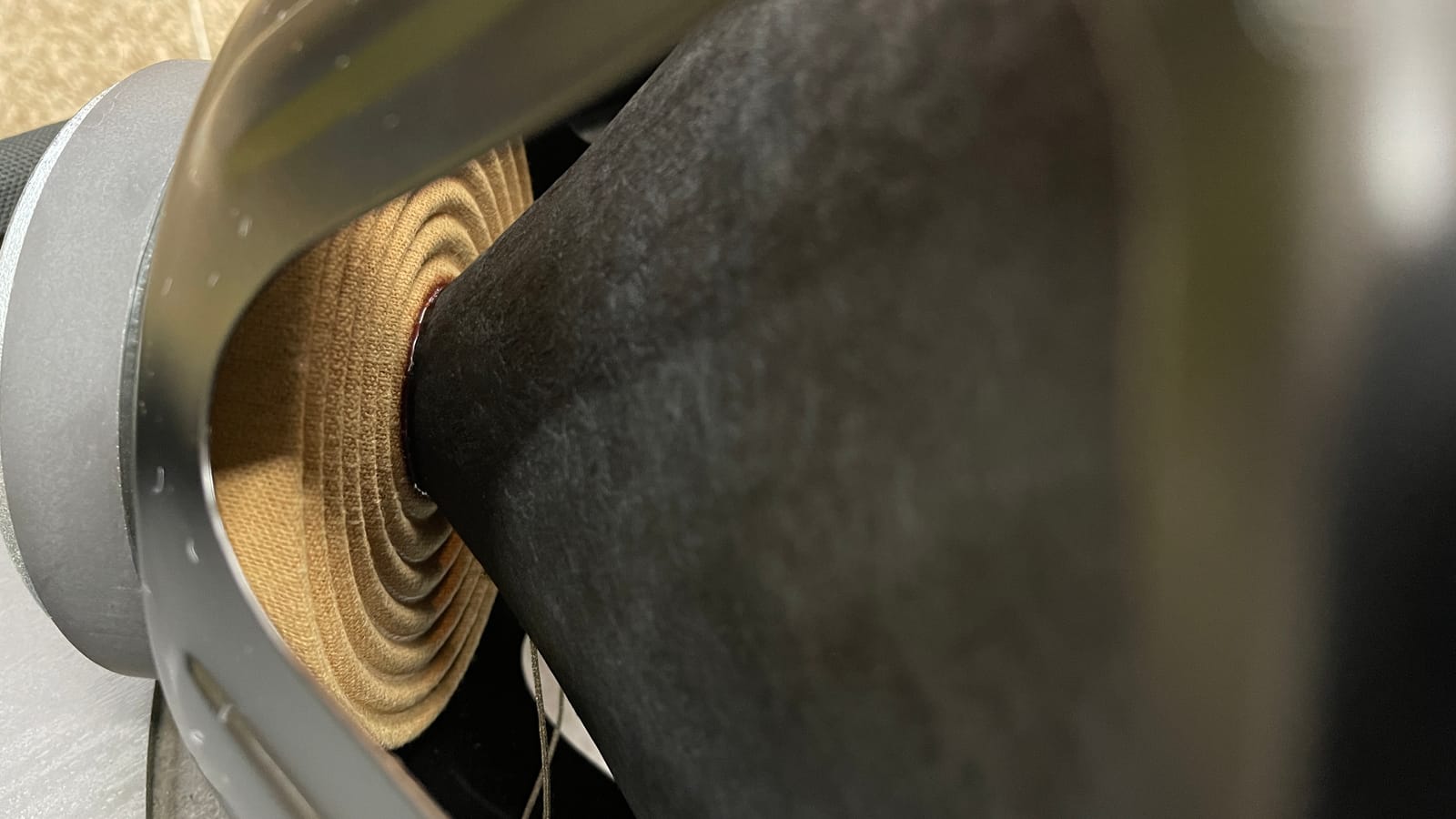
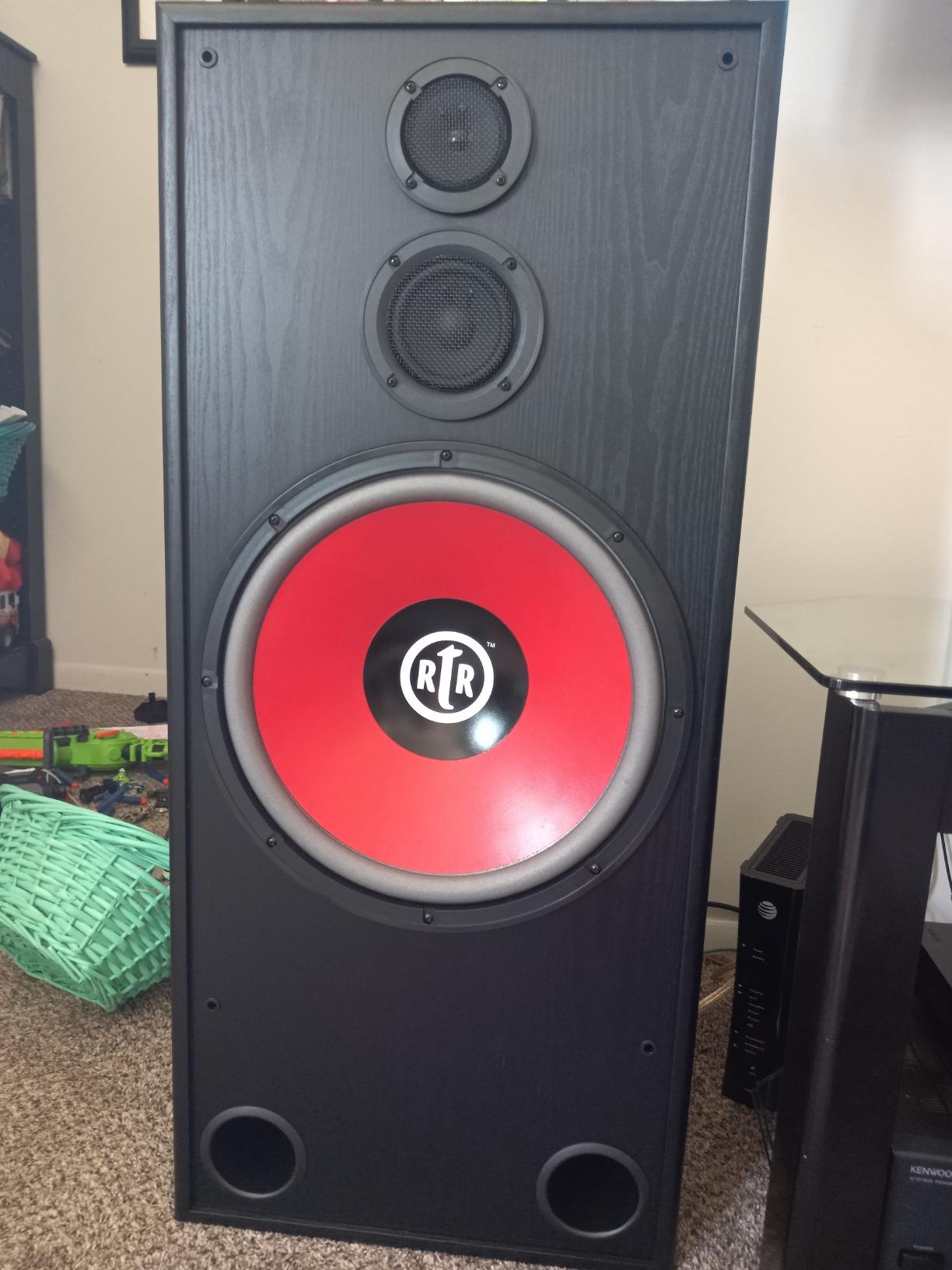
The RTR-1530 answers a question most roundups avoid: how much physical bass do you actually want in the room. The answer is a 15-inch woofer, a 4-inch wide-dispersion midrange and a 2.5-inch fluid-cooled tweeter, all in a 43.8-inch tower, with response measured from 33Hz to 19kHz.
That wide-dispersion mid is the home theater asset. It spreads sound across a large seating area rather than a narrow cone, which is helpful when the sofa is broad or when you sit well off center.
Recommended power runs from 10W to 325W per channel and sensitivity is 90dB, so it is not difficult to drive despite the size. A built-in bass boost circuit adds low-end punch on top of the driver, which is a matter of taste rather than measurement.
At 4.3 across 141 ratings, the feedback centers on power rather than polish. Owners like the room-shaking low end for films and accept that the sound is forceful rather than refined. The trade-off people mention most is the same one we would: size, weight and the fact that it sells as a single speaker.
Where a 15-inch woofer actually helps
In a large open-plan room or a basement theater over 350 square feet, it makes an audible difference on effects like explosions, engines and orchestral swells. The 325W handling means you can push it during the loudest passages without folding.
It also works as a starting point if you want deep output now and plan to add a subwoofer later, since the low end is already doing work most towers delegate entirely.
Why it frightens buyers off
It weighs 60 pounds and is 20.8 inches wide. In a room with furniture in the way, or one where the cabinets get moved regularly, this is genuinely difficult to live with, and it is the first thing reviewers warn buyers about.
The bass boost circuit also invites over-correction in a small room. If you are tempted by the driver size but live below 200 square feet, a smaller tower with a subwoofer will sound better than this one driven flat.
9. Rockville RockTower 68B: A Genuine Three-Way at the Bottom of the List
Rockville RockTower 68B Black Home Audio Tower Speakers Passive 8 Ohm
Three-way with 6.5 inch woofers
Dedicated midrange driver and 1 inch silk dome tweeter
125W RMS and 500W peak
8 ohm impedance
Pros
- Real three-way layout at the lowest cost here
- Gold plated 5-way binding posts take banana plugs or spades
- 125W RMS handles room-filling volume
- Tall 46.5 inch cabinet gets the tweeter to good height
Cons
- Passive only and needs an external amplifier
- Vented MDF cabinet is functional rather than refined
- One-year warranty
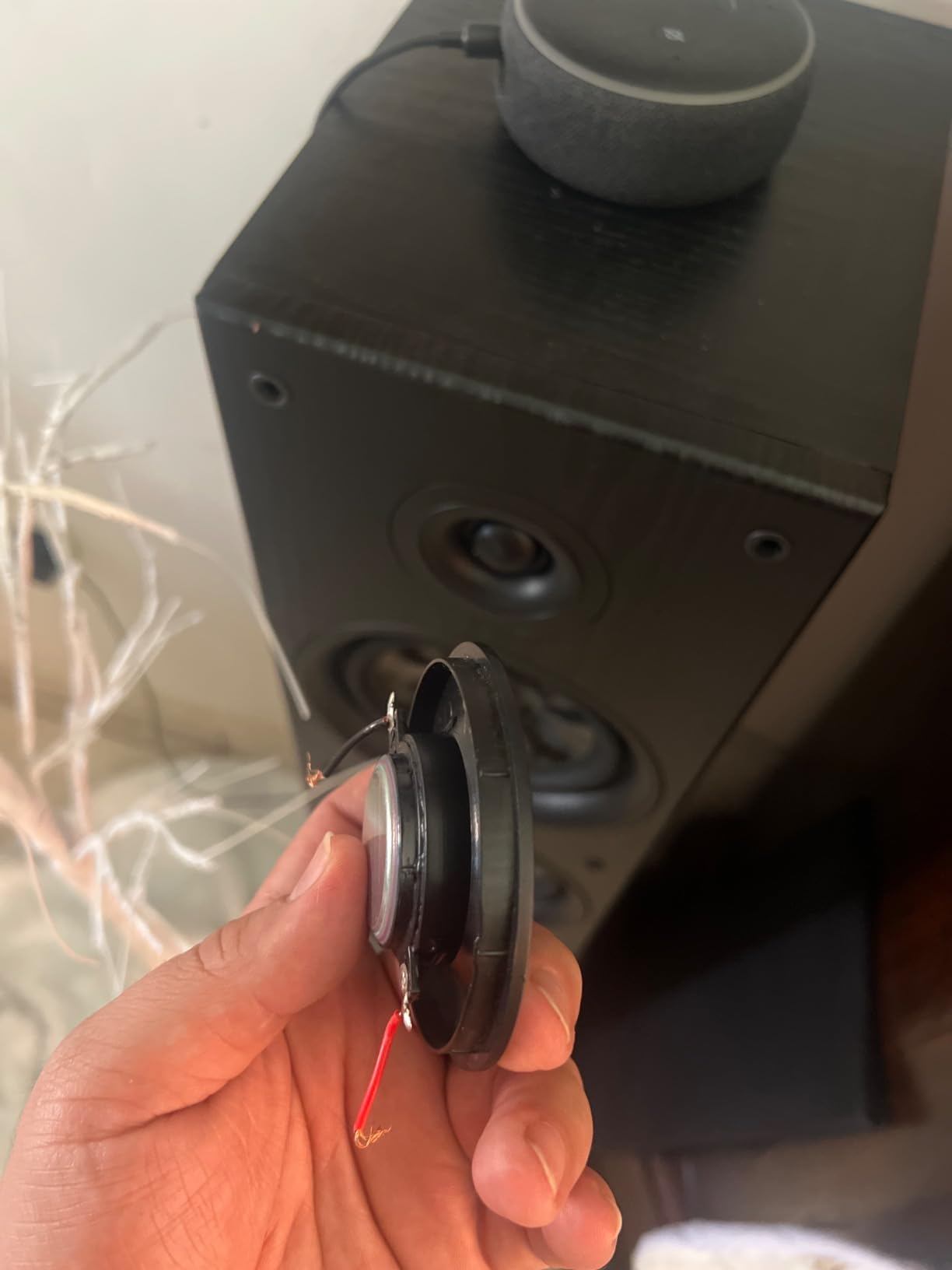
What makes the RockTower 68B interesting is the architecture for the money. You get a genuine three-way design: dedicated 6.5-inch woofers, a separate midrange driver and a 1-inch silk dome tweeter, split by the crossover rather than by a two-way compromise.
At 46.5 inches tall, the tweeter also lands close to ear level on a seated listener, which is a real ergonomic advantage over shorter towers. Most of the budget category stops around 36 inches, where you end up looking up at the high frequencies.
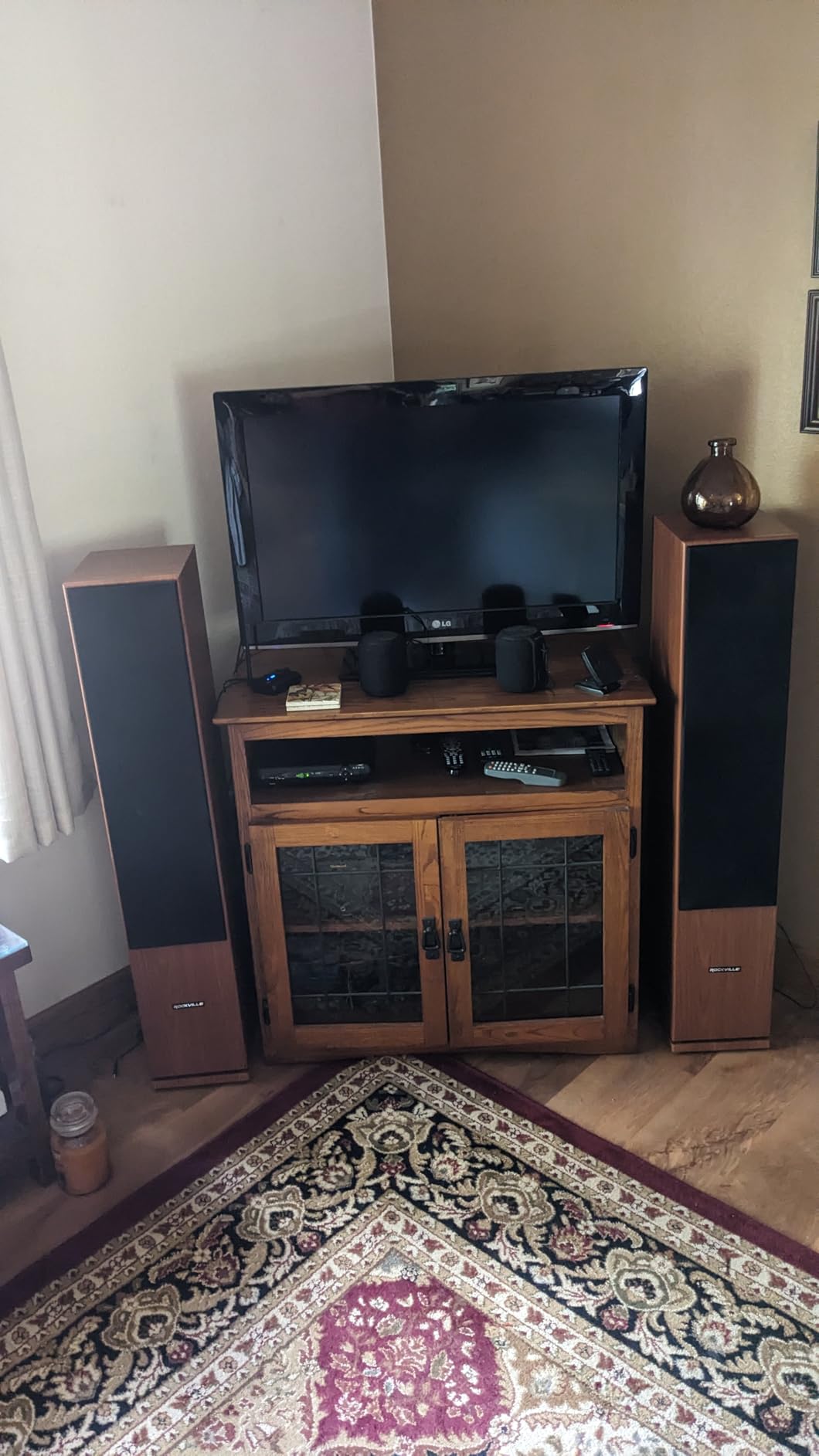
It rates 4.4 across 165 ratings, with owners describing clear, punchy sound well beyond what the tier usually delivers. The gold-plated five-way binding posts get specific mention, because they accept banana plugs, spade terminals and bare wire, which makes hookup easy with whatever receiver you already own.
Handling is 125W RMS and 500W peak at eight ohms, with response up to 20kHz. Frequency response is listed to 20 KHz with no lower figure published, so treat the deep bass as dependent on a subwoofer rather than built in.
Where the RockTower 68B makes sense
It suits a first theater build where the budget has to cover fronts, a center, surrounds and a subwoofer, and something has to give. This is where it gives least. A three-way layout at this tier is unusual, and the tall cabinet gets the tweeter where you want it.
It also suits anyone who wants genuine floorstanders without spending real money, and it pairs easily with an existing entry-level receiver thanks to eight-ohm impedance and banana plug ready terminals.
What you trade away for that low entry point
The vented MDF cabinet is functional rather than acoustically refined. You will not get the baffle control of a chamfered MDF design, and in a hard-surfaced room that shows up as a brighter edge on cymbals and dialogue sibilance.
The one-year warranty is also the shortest in this group, and it is passive only, so it needs an amplifier. If you are starting from nothing at all, budget for a receiver and a subwoofer before you fall for the driver count.
10. Dayton Audio Classic T65: The Neatest Fit for Smaller Rooms
Dayton Audio Classic T65 Floor-Standing Tower Speaker Pair (Black)
Bass reflex tower over 39 inches tall
Dual 6.5 inch custom poly drivers
True analog crossover network
150W power handling
Pros
- 39.4 inch height puts the tweeter near ear level
- Only 7.25 inch wide so placement is easy
- True analog crossover network
- Gold plated binding posts and a five-year warranty
Cons
- Midrange and soundstage are less detailed than premium rivals
- A subwoofer is still advisable for surround use
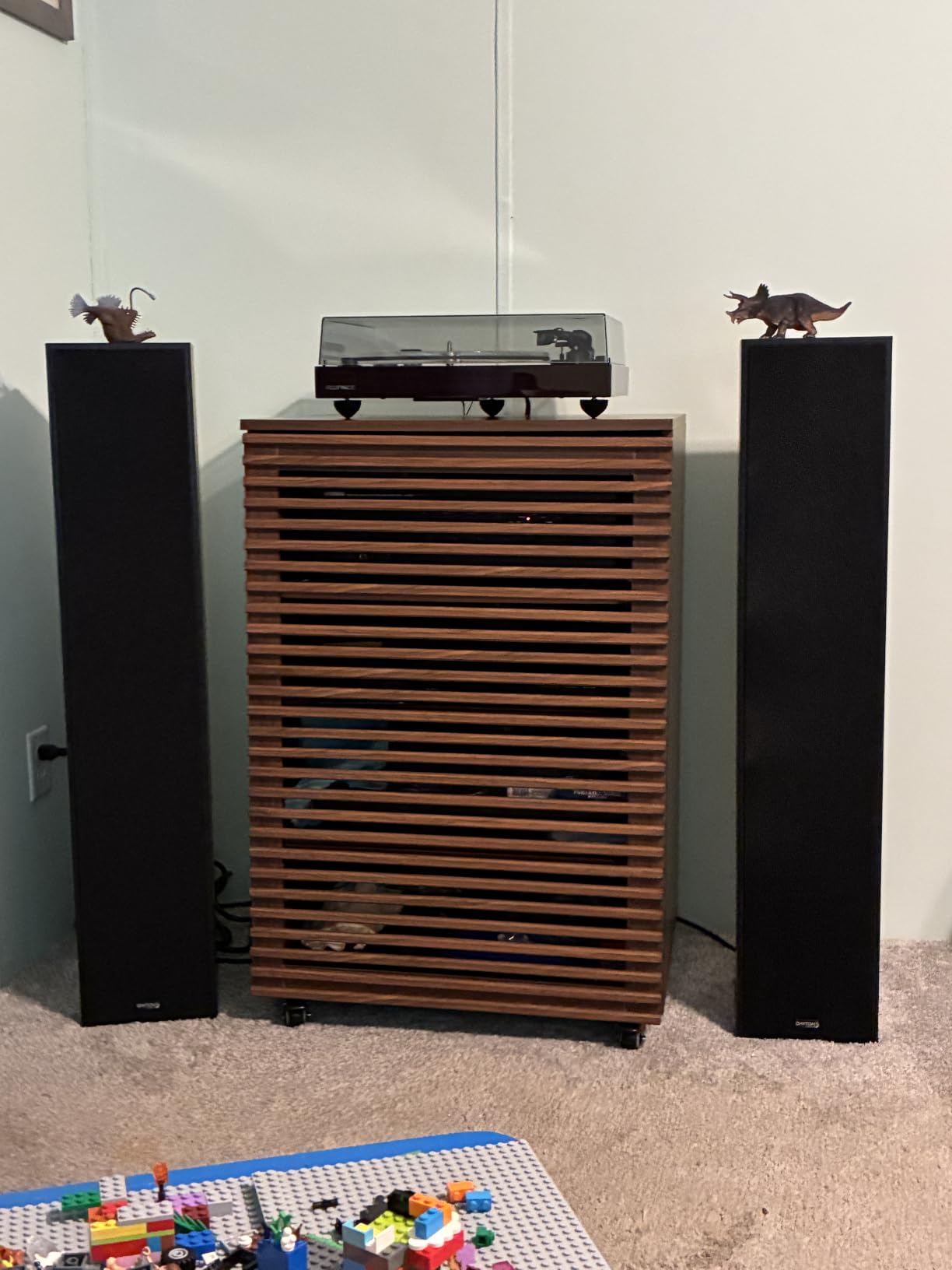
The Classic T65 solves the constraint that kills most tower recommendations: the room is too small. At 7.25 inches wide and 7.8 inches deep, it is the slimmest tower here, and at 39.4 inches tall it still puts the 1-inch silk dome tweeter near ear level on a seated listener.
It is a proper bass reflex design with two custom poly 6.5-inch bass drivers and a true analog crossover network distributing signal between the drivers and the tweeter. Rated to 150W, it handles both quiet listening and higher-volume playback without strain.
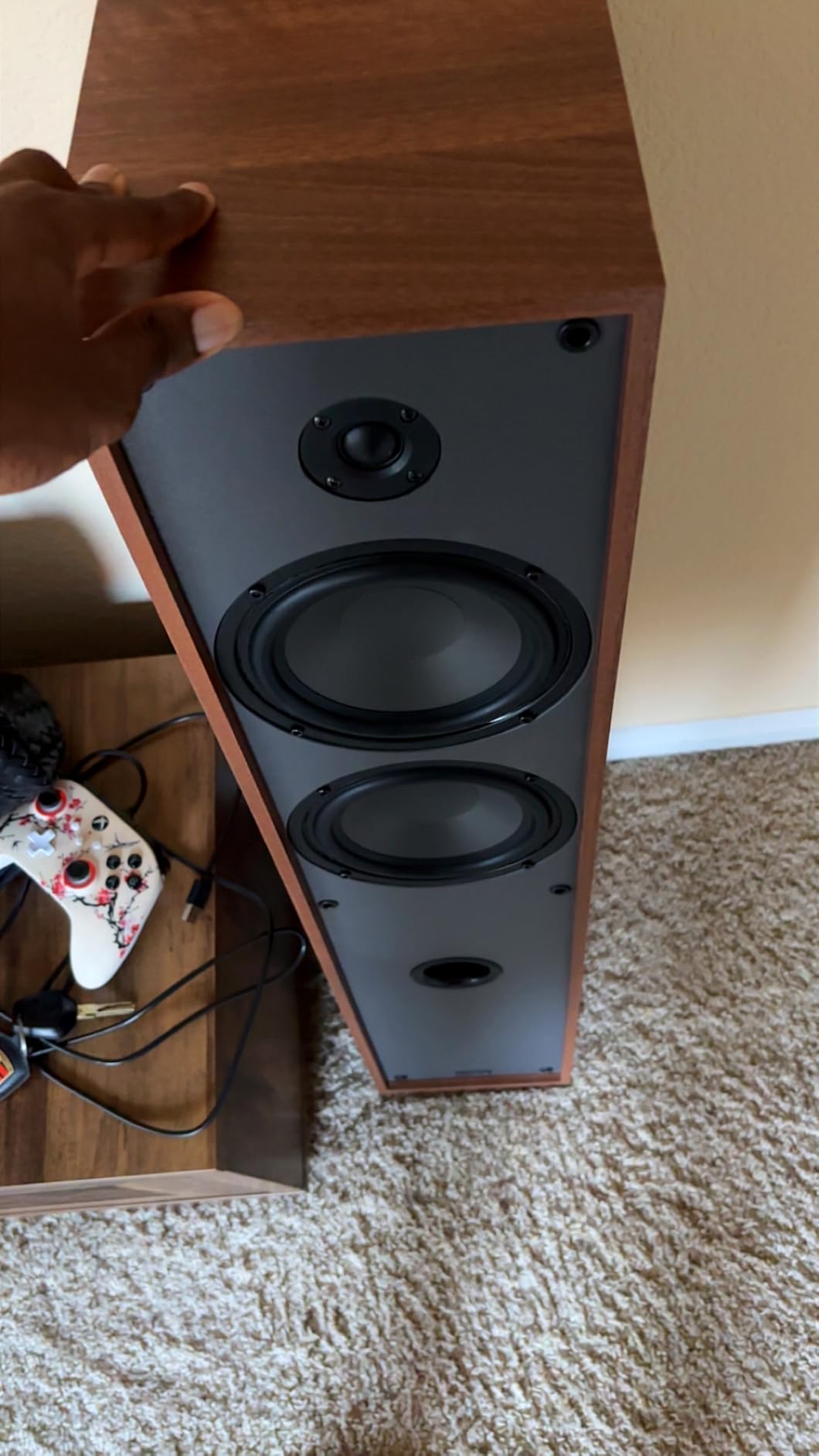
It carries 4.6 across 123 ratings, and owners regularly describe performance above what the tier suggests, with a finish that looks better than expected. The measured midrange and soundstage are less detailed than premium rivals, which is the honest limit.
Gold-plated binding posts accept banana plug cables, and the five-year warranty is one of the longest at this tier. It comes as a pair, which removes the doubling-up cost that catches buyers out with several models on this list.
Why the Dayton T65 works in rooms the others do not
A narrow footprint means it fits between a sofa arm and a wall without pushing furniture forward, and the slim depth leaves clearance for the rear port. Under 150 square feet, that physical simplicity is worth more than a large driver.
Because it is a pair, you can start with a 2.1 setup and add a matching center and surrounds later. r/BudgetAudiophile consensus is consistent on this point: small towers plus a subwoofer give big sound and more placement choices.
Where it stops being enough
A subwoofer remains advisable for home theater surround use, since the Classic T65 covers the front stage rather than the deepest effects. For a dedicated room over 300 square feet, the scale will feel thin against a large screen.
The midrange and soundstage are the tradeoff reviewers mention when they compare against higher-end towers. Expect clear and bright rather than wide and layered, and if your priority is music as much as film, spend the difference elsewhere.
How to Choose Floorstanding Speakers for a Home Theater
Brand matters far less than five technical decisions, and you can make all of them before you fall in love with a cabinet finish. Work through them in order, because each one narrows the list faster than any other filter.
Match the speaker to the room, not to the screen
This is the single most requested piece of advice in home theater forums, and the simplest version of the rule is: speaker size should follow room size. Below 150 square feet, towers need a subwoofer doing real work and a small cabinet. Between 150 and 300 square feet, most mid-size towers are ideal. Above 300 square feet, you want at least dual 8-inch woofers or you will run out of scale on big scenes.
Here is how the picks in this roundup map to those bands, using the ranges buyers on r/hometheater actually discuss:
Under 150 square feet: Dayton Audio Classic T65, Polk Audio T50, Rockville RockTower 68B. All three are narrow, and all three want a subwoofer for effects.
150 to 300 square feet: Klipsch R-610F, Klipsch R-26FA, Polk Audio Monitor XT60, Fluance Signature HiFi. This is the sweet spot where towers earn their footprint.
Over 300 square feet: Klipsch RP-8000F II, BIC America RTR-1530, Rockville TM150B. Each has the driver area or the amplification to move a large space.
Read sensitivity before you read the driver size
Sensitivity, measured in dB at 1 watt and 1 meter, tells you how efficiently a speaker converts amplifier power into volume. Every 3dB is roughly a doubling of perceived loudness, so a 94dB speaker such as the Klipsch R-610F plays as loud as an 88dB speaker driven with four times the power.
That is why sensitivity is the number to check first. Budget receivers run out of clean watts before budget buyers expect them to, and a high-sensitivity horn tower keeps you away from that wall. The R-610F at 94dB and the Klipsch RP-8000F II are both efficient enough for mid-range amplification.
Understand what 4 ohm, 6 ohm and 8 ohm actually mean
Impedance is the electrical load your receiver sees. Higher numbers are easier. An 8-ohm speaker is the safest, a 6-ohm speaker is fine on most modern receivers, and a 4-ohm speaker can push a budget amplifier into thermal protection on sustained movie playback.
In this roundup, eight-ohm designs dominate: the Klipsch R-610F, R-26FA, RP-8000F II, RockTower 68B, BIC RTR-1530 and Dayton Audio Classic T65. The Polk T50 sits at 6 ohm, which is still comfortable on current receivers.
Decide between 2-way, 2.5-way and 3-way designs
A two-way design has a woofer and a tweeter, and it is simple, efficient and reliable. A two.5-way adds a second woofer that rolls off at the top of its range to help the midrange, which buys a little more bass without needing more power. A three-way separates tweeter, dedicated midrange and bass into their own bands.
For home theater, dialogue clarity is the deciding factor, which favors a dedicated midrange. The Fluance Signature HiFi and RockTower 68B are the true three-ways here, and the Fluance is the one built specifically around keeping voices clean.
Do you still need a subwoofer with towers?
Yes, in almost every room. Tower speakers extend low, but a film soundtrack spends most of its energy below 40Hz, where a single tower pair working alone is at its limit. A subwoofer does the deep work so the towers stay in the range where they are accurate.
Start the crossover at 80Hz and try 60Hz for movies. Below 60Hz you are asking the towers to do very little, and above 80Hz you invite overlap and muddy bass. Most receivers with automatic calibration set this correctly on the first try.
Choose how you want your height channels
There are three ways to get Dolby Atmos overhead effects, and the difference matters more than most marketing suggests. An integrated up-firing module inside the tower, as on the Klipsch R-26FA, bounces sound off the ceiling and needs no extra wiring but cannot place a height object precisely. On-ceiling speakers mount above the front stage and angle down. Dedicated in-ceiling height speakers placed behind the seating give the most accurate placement.
Be careful with slots on top of a cabinet. Some towers advertise Atmos and then sell the actual module separately, which turns one purchase into two. The R-26FA here has a real integrated elevation driver, and everything else in this roundup needs separate height speakers.
Get placement and toe-in right before you blame the speaker
Form an equilateral triangle between the two front speakers and your main listening position, which puts the front left and right channels roughly 30 degrees either side of center. Then angle the cabinets inward until both are aimed at your ear. That toe-in trades a slightly narrower soundstage for a much tighter center image, which is exactly what films need.
On height, the golden rule is that the tweeter should sit near seated ear level, which is why the taller towers in this roundup are not automatically better. Leave at least 6 inches of clearance behind the cabinet for ports, and damp the first reflection points on the front wall before you pull speakers further into the room.
Placement matters more than model. Experienced forum users are consistent on this: the priority is damping those first reflection points, not dragging towers out to the middle of the room.
Know when not to buy floorstanding speakers
In a room under about 150 square feet, or in an oddly shaped space where the front wall forces the cabinets into corners, bookshelf speakers on stands plus a subwoofer will beat towers. Two good standmounts and a decent sub also give you more placement flexibility, which is the small-tower argument that comes up constantly in budget audio communities.
A soundbar wins on convenience and on dialogue-focused television. If most of what you watch is dialogue-heavy television in a shared living room, towers are solving a problem you do not have.
Build the rest of the system around the towers
A center channel does most of the dialogue work in a film, and if it does not match your fronts you will hear it. Buy the center and surrounds from the same line where possible, which is the main argument for the Polk T50 and Polk Monitor XT60, both of which sit in complete matched ranges.
Set a realistic total budget too. Fronts are one line item among towers, center, surrounds, a subwoofer and possibly a new receiver, and several models here sell as a single tower, which doubles that line before you start.
What to check if you buy used or open-box
The used market is where many tower buyers actually shop, and it is active and trusted for good reason. Listen for cabinet knocks, buzzes on pink noise and any rattle when you play something with sustained low output, then check the drivers for dents and tears.
Inspect the spikes or feet, since these are the parts most often missing from older sets, and look at grille frames for warping. Confirm that every binding post is tight and accepts your cable, and ask whether the speaker has been driven by an amplifier it was never designed for.
Frequently Asked Questions
What are the best speakers for a home theatre?
The best speakers for a home theatre are floorstanding speakers for the front left and right channels, a timbre-matched center channel, matched surrounds and a subwoofer. For towers, our top pick is the Polk Audio T50 for most rooms, the Klipsch R-26FA for integrated Dolby Atmos, and the Klipsch R-610F for a matched pair on a modest receiver.
What is the best sound system for a home theatre?
The best sound system for a home theatre is a 5.1 or 7.1.2 setup built around floorstanding fronts: two towers, one center, four surrounds, one subwoofer, and on-ceiling or in-ceiling height speakers for Atmos. Add an AV receiver with enough clean power for the speaker sensitivity you choose, and run the sub crossover between 60Hz and 80Hz.
What speakers do most theaters use?
Most commercial cinemas use arrays of dedicated professional loudspeakers with heavy signal processing, far more units and far more processing than any home system. A home theater cannot replicate that, and the realistic goal is a coherent 5.1 or 7.1.2 room where dialogue stays clear and effects move across the screen.
What is the best speaker brand for home theater?
There is no single best brand, but Klipsch, Polk Audio and Monitor Audio appear repeatedly in home theater forums and in buyer recommendations because each sells a complete matched range: towers, a center, surrounds and often height speakers in the same voice. Matching within one line matters more to dialogue clarity than any brand ranking.
How high should tower speakers be?
Aim for the tweeter to sit near seated ear level, roughly 3 to 4 feet off the floor. Anything taller is fine as long as you can angle the cabinet down toward your listening position. Very tall towers in a low-ceilinged room often point the tweeter above your head and lose both imaging and dialogue clarity.
What is the golden rule for speaker placement?
Start from the equilateral triangle: the two front speakers and your main listening position should form an equal-sided triangle, which puts the front channels about 30 degrees either side of center. Keep at least 6 inches behind the cabinets for ports and damp the first reflection points on the front wall before moving anything else.
What is the 83% rule for speaker placement?
The 83% rule is a digital mixing guideline used by cinema sound engineers: dialogue must average 83 percent of the total dialogue-plus-music-plus-effects level in a scene. If dialogue sits lower than that, viewers turn up the volume and miss the next line. It explains why a good center channel matters more to home theater than tower upgrades.
What is the 38% rule for speaker placement?
The 38% rule is a home theater setup guideline: leave about 38 percent of the screen width as the distance between your seating and the screen wall, which sets the viewing distance and stereo separation. It is a starting geometry rather than a law, and it helps you judge whether tower speakers will sit too far apart for your room.
Final Thoughts: Which Floorstanding Speakers for Home Theaters Fit Your Room
Measure your room before you choose anything, and pick the category that matches it. Under 150 square feet, the Dayton Audio Classic T65 or the Polk Audio T50 paired with a subwoofer is the sensible answer. Between 150 and 300 square feet, most of this list works, and the Klipsch R-610F is the pair we would buy first on a modest receiver.
For Dolby Atmos without rewiring your ceiling, the Klipsch R-26FA is the pick, because its integrated elevation driver is real hardware rather than an empty slot. In a dedicated room over 300 square feet, step up to the Klipsch RP-8000F II, or choose the BIC America RTR-1530 if physical bass output matters more to you than refinement.
None of these speakers makes a small room larger or a bad amplifier good. Room size, amplifier matching and placement decide most of the outcome, and the towers above simply make it easier to get those three right. Whatever you choose, buy the center and surrounds from the same line, run the sub crossover at 60Hz to 80Hz, and give the cabinets room to breathe.
If you still want a single name to search for first, that is the Polk Audio T50: it is our editor’s choice for the best floorstanding speakers for home theaters because it balances room-friendliness, matched-system flexibility and bass depth better than anything else at this tier. Everything else on this list is a smarter choice only when your room or your amplifier says so.