

Workshop heat is the kind of problem that sneaks up on you. One August afternoon with the bay door up and the sun on the west wall is enough to turn a productive Saturday into a heat-stress stoppage. The fix most people land on is a refrigerant air conditioner, and the fix that actually holds up in a dry shop is a swamp cooler, also called a portable evaporative cooler.
That is the whole idea behind this roundup of the best swamp coolers for workshops in 2026. A swamp cooler moves a large volume of air across water-saturated pads, and the evaporation pulls heat out of that air before it reaches your workbench. No compressor, no refrigerant, and typically 60 to 250 watts of draw, which is a fraction of what a portable AC pulls.
One thing to settle before we get into the picks. Evaporative cooling only works in dry air, and the practical threshold is roughly 50 percent relative humidity. In a humid region, in a sealed insulated room, or during paint and finishing work, a different tool is the right one. We will say exactly where that line falls, because forum owners on r/garageWorkshops keep asking the same question and the answer is never a flat yes or no.
If you are still deciding whether you need cooling at all, start with the electric coolers picks to see how the compressor-based alternative behaves in a hot space. For the rest of this guide, assume a dry or semi-arid shop with an open bay door.
Table of Contents
Top 3 Best Swamp Coolers for Workshops in 2026
These three cover the widest range of real workshop situations, from a one-bay hobby shop to a unit that gets run eight hours a day through summer.
All 12 Swamp Coolers Compared for Workshop Use in October
The full lineup, with the specs that actually change how a unit behaves on a shop floor.
| Product | Specs | Action |
|---|---|---|
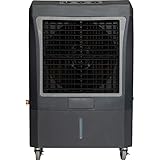 Hessaire MC37V Hessaire MC37V |
|
Check Latest Price |
 Hessaire MC37M Hessaire MC37M |
|
Check Latest Price |
 Uthfy 4800 CFM Uthfy 4800 CFM |
|
Check Latest Price |
 NewAir 1600 CFM NewAir 1600 CFM |
|
Check Latest Price |
 VEVOR 1400 CFM VEVOR 1400 CFM |
|
Check Latest Price |
 SereneLife 2500 CFM SereneLife 2500 CFM |
|
Check Latest Price |
 Hexago 7500 CFM Hexago 7500 CFM |
|
Check Latest Price |
 Hessaire DC18 Hessaire DC18 |
|
Check Latest Price |
 Uthfy 4000 CFM Uthfy 4000 CFM |
|
Check Latest Price |
 PNTCK Compact PNTCK Compact |
|
Check Latest Price |
 OEMTOOLS 23968 OEMTOOLS 23968 |
|
Check Latest Price |
 Antarctic Star Mini Antarctic Star Mini |
|
Check Latest Price |
How Much CFM Does Your Workshop Need?
Use this formula: multiply your shop length by width by ceiling height to get cubic feet, then divide by two. That gives you the CFM you want as a baseline.
A 20 by 30 workshop with a 10 foot ceiling is 6,000 cubic feet, so the baseline is 3,000 CFM. A 30 by 60 shop with a 12 foot ceiling is 21,600 cubic feet, so you are looking at 10,800 CFM, which is more than any single portable in this roundup delivers. Shops at that size are honestly a two-unit or installed-system job, not a single rolling cooler.
Round the result up rather than down, and treat square footage claims on retail listings cautiously. Two units in this lineup carry coverage claims that reviewers have measured and found optimistic, so a nameplate figure is a starting point, not a promise. Aim the airflow across your work area rather than at stored parts.
If you want a rule of thumb that fits on a spec sheet: a 400 to 500 square foot two-car garage wants roughly 3,000 CFM, a 700 square foot single-bay shop wants 4,000 to 5,000 CFM, and anything above 1,000 square feet with a high ceiling is better served by a shop-grade unit or two smaller units working together.
1. Hessaire MC37V Mobile Evaporative Cooler – Our Pick for Most Workshops
MC37V MOBILE EVAPORATIVE COOLER
3100 CFM
950 sq ft
10.3 gal tank
250 W
3 speeds
Pros
- 3100 CFM suits bays up to 950 sq ft
- 10.3 gal tank with hose fill float adapter
- Four locking casters roll easily over concrete
- Three-sided rigid high-density pads
- Stainless steel fasteners
- no rust after two years for one owner
Cons
- Louder than expected on high speed
- Full tank runs about four hours
- Needs daily draining and periodic pad cleaning
This is the unit I keep coming back to for a mixed workshop. It moves 3100 CFM, carries a 10.3 gallon tank, and covers roughly 950 square feet, which lines up almost exactly with a 20 by 30 bay with a 10 foot ceiling. That puts it right on the sizing formula rather than above or below it.
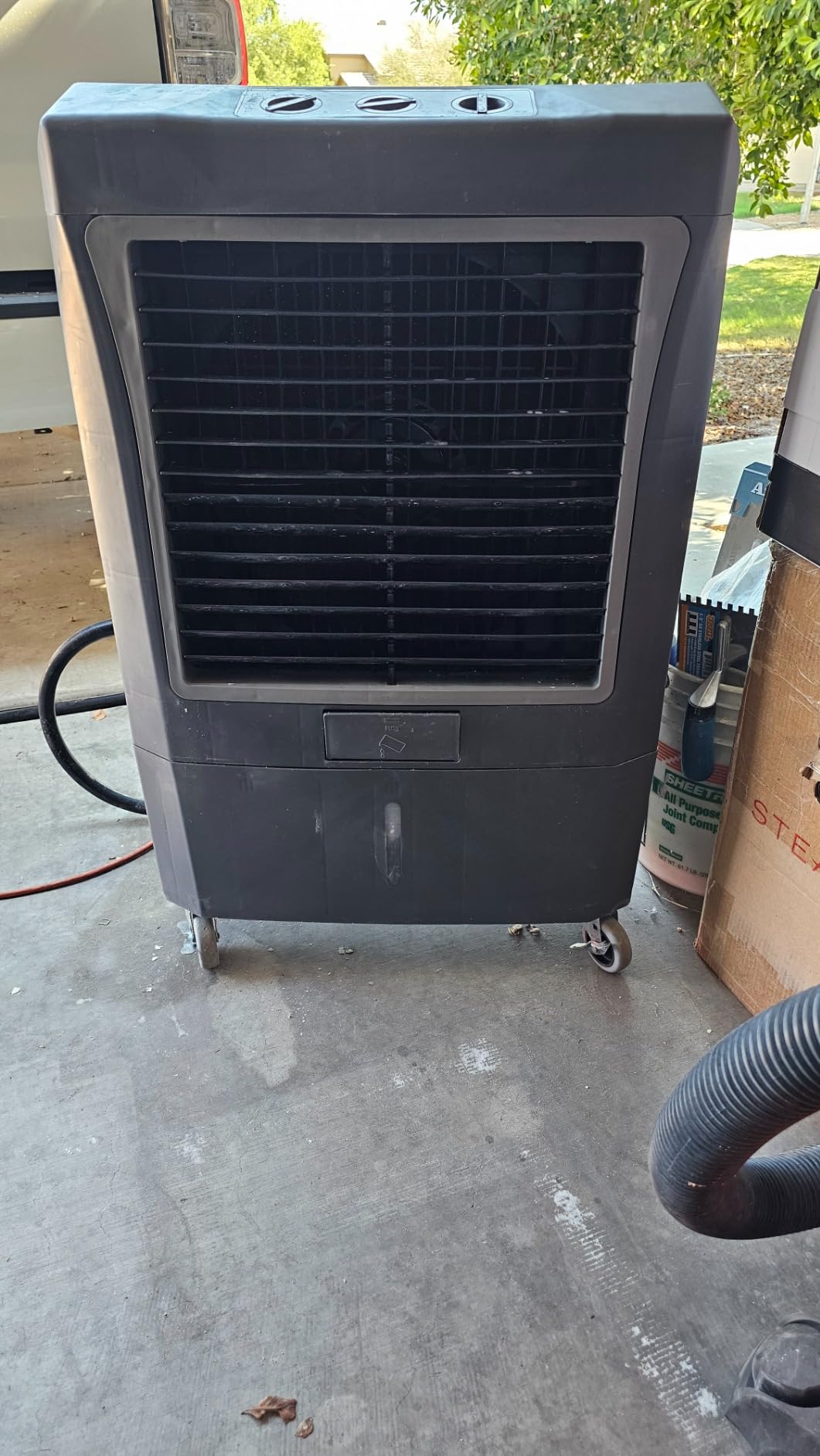
Owners in dry climates report a real cooling effect in garages and open work areas, with a large share of five-star ratings. The tank accepts a continuous hose fill through the included float adapter, so an all-day session does not depend on somebody remembering the reservoir.
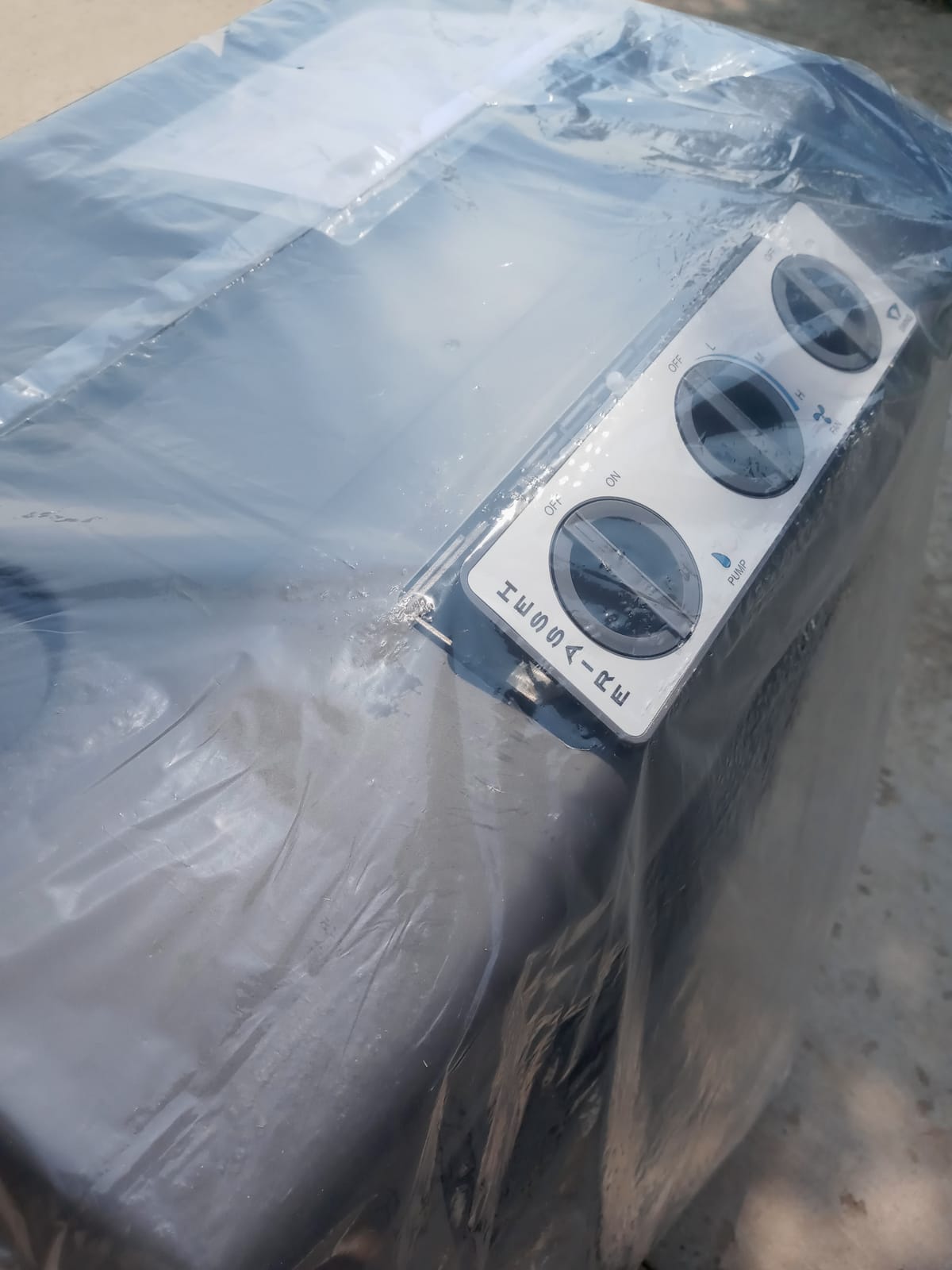
The physical design suits a shop better than most. Four heavy duty locking casters let you reposition it as the sun moves, and independent rotary controls for fan, pump and oscillation mean you can drop the fan without shutting the pump down when you want airflow without cooling.
Two things to plan around. It is loud on the top setting, which is a real issue in a quiet shop with a headset on. And a full tank runs roughly four hours on its own, so the hose fill matters more here than on a small unit.
What you should check before buying
Confirm your outlet and your bay door clearance. At 21 inches deep and 35 inches tall it needs a wall or door gap you can actually work around, and at 250 watts it draws about 2.1 amps, which any 15 amp shop circuit handles with room to spare.
Measure your shop before you trust the 950 square foot figure. High ceilings, an uninsulated metal door on the west wall and a lot of glass all push the real requirement up, and undersizing is the most common reason owners say a swamp cooler did nothing for them.
Who this unit suits
It suits hobby and home shops that want real area cooling with a manageable footprint, and anyone who wants three-sided rigid pads rather than a single thin sheet. If you need cordless operation or your shop is genuinely larger than 950 square feet, move up or sideways in this list.
2. Hessaire MC37M 3100 CFM – The One With the Long Owner History
Hessaire MC37M 3100CFM Evaporative Cooler
3100 CFM
10.3 gal tank
59 dB
250 W
115 V
Pros
- Largest review base in the lineup
- Low setting drops a large bay 20-plus degrees in dry air
- Built-in float valve and hose adapter
- Water-level window
- Locking casters and quick drain plug
Cons
- Fit and finish described as mediocre
- Float valve can fail on continuous fill
- Airflow is noticeably loud
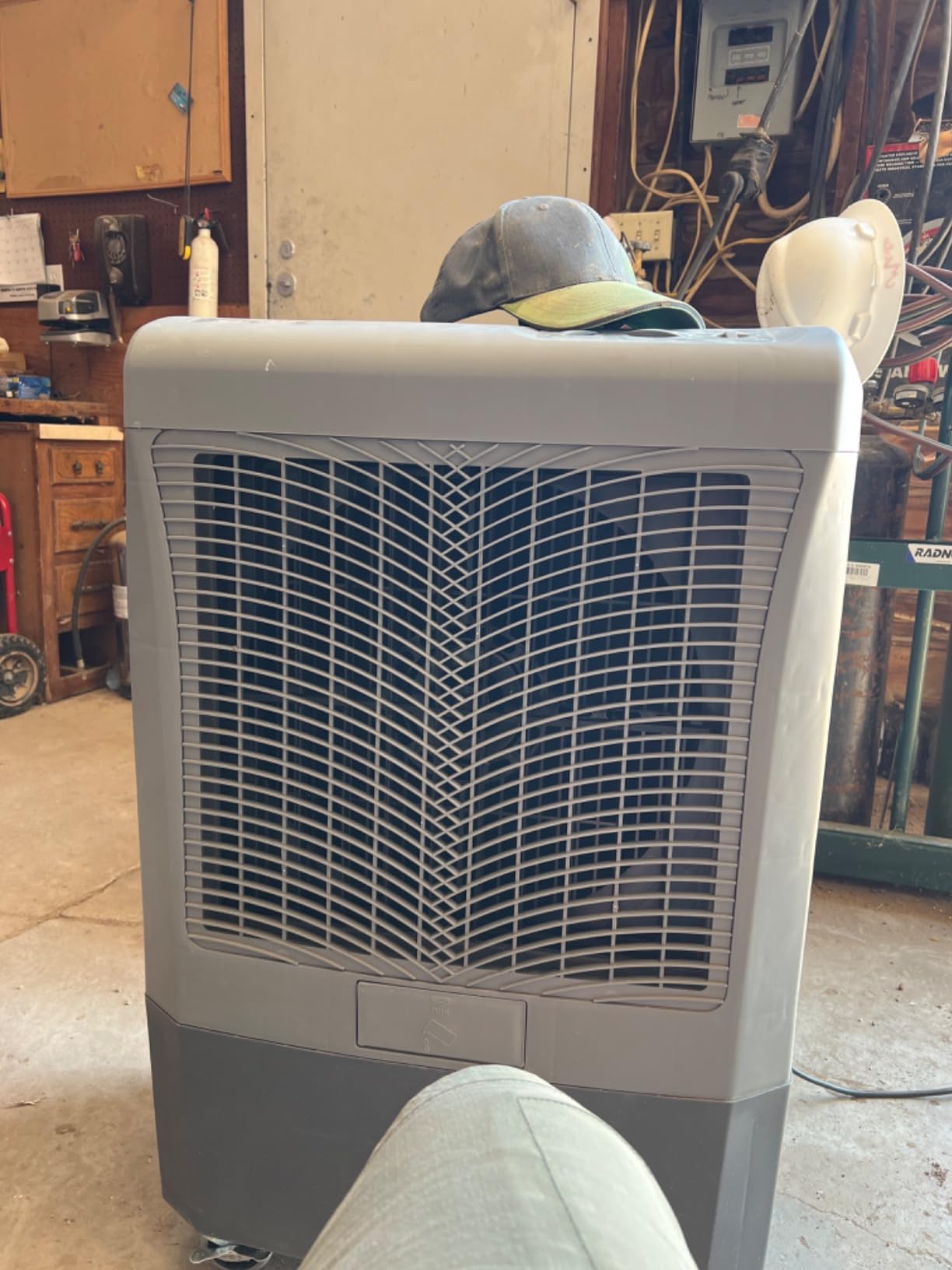
Same core airflow as the MC37V, but with a far bigger install base. An r/hvacadvice owner put this model at the center of their home setup and described cooling that worked with maintenance staying simple, and that is representative of the feedback pattern: people in the American Southwest and other dry regions report dependable cooling for garages, storage barns and outdoor work booths.
For a workshop decision, the review volume is itself a data point. When something has thousands of owners across multiple seasons, the failure modes are documented rather than rumored. What owners consistently report is that performance is climate-dependent, with humidity as the limiting factor, and that build quality and cooling performance pull in opposite directions.
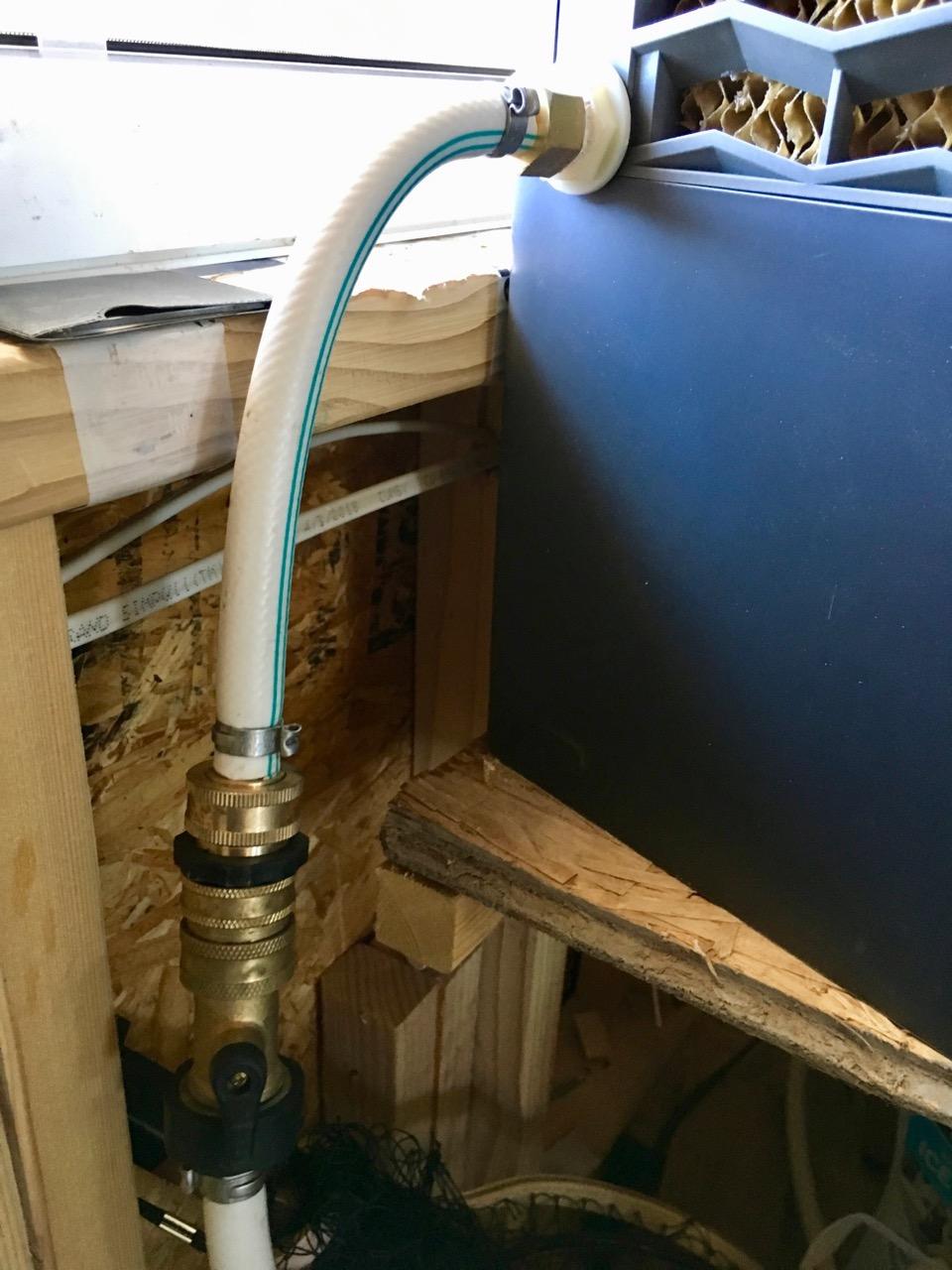
The useful workshop details are all here: a water-level window so you check the tank at a glance instead of guessing, locking casters that handle concrete, and a quick-release drain plug that makes end-of-season cleaning painless. The built-in float valve takes a garden hose for continuous fill.
The honest weakness is the float valve itself. Owners running a permanent hose fill report leaks and failures on that part, and directions are thin on indoor use, which is how people accidentally build humidity inside a closed shop.
How this compares to the MC37V
Both move 3100 CFM into roughly 950 square feet with the same 10.3 gallon tank. Choose this one for parts availability and a documented long-term owner base, and choose the MC37V for a newer body and three-sided rigid pads. Power draw is identical at 250 watts, so the circuit requirement is the same.
At 59 dB it is not quiet, but the noise complaint is about airflow rather than rattle. If your shop is quiet enough that fan noise ruins concentration, test a 45 dB unit first.
Where it fits in a working shop
It works best in an active, ventilated shop rather than a storage space. Point the louvers across your bench where you stand, keep a bay door or window cracked for exhaust, and avoid aiming it at bare steel, brake rotors, or a vehicle mid-restoration. Persistent humidity plus unfinished metal is the combination that produces surface rust.
3. Uthfy 40 inch 4800 CFM Swamp Cooler – Metal Frame for a Rough Shop
Uthfy 40″ 4800 CFM Swamp Cooler, Large Evaporative Cooler with 11 Gal Water Tank, 3 Speeds, 120° Oscillation, 3 Ice Packs, Metal Frame Portable Air Conditioners for Outdoor, Patio, Shop, Yard, Factory
4800 CFM
970 sq ft
11 gal tank
50 dB
200 W
Pros
- Metal frame and iron construction feel durable
- 4800 CFM covers up to 970 sq ft
- 11 gal tank with manual and auto fill
- Four 360-degree casters with two lockable
- Three ice packs and ice curtain included
Cons
- 4.0 star average with a wide spread of early experiences
- Consumes noticeable water per hour
- Desert form factor in the listing metadata
Most coolers in this class are plastic. This one is a galvanized iron frame with a copper motor, and buyers single that out first. If your shop has a habit of rolling things over, bumping casters and knocking units against benches, the frame is a genuine upgrade over roto-molded plastic.
At 4800 CFM it carries one of the strongest airflow ratings in the lineup while drawing 200 watts, so it is efficient by workshop standards. It also runs quieter than the MC37M at a listed 50 dB, which matters if the unit sits near where you work rather than across the bay.
The 11 gallon tank takes either a manual top fill or a continuous auto-refill, and 120 degree oscillation spreads the output across a wide arc. Three ice packs and a four-in-one composite ice curtain add a short-lived extra chill on the outlet air, which is a pleasant trick on the hottest afternoons rather than a substitute for airflow.
Be realistic about the review base. At 103 reviews and a 4.0 average, experiences vary widely, and the listing itself is positioned for shops, warehouses and industrial areas rather than rooms. Verify the tank and pump work before you commit to a permanent hose line.
When the extra airflow earns its cost
It earns its cost when your shop is bigger than the 950 square foot sweet spot or has a high ceiling that makes the volume requirement climb. A 25 by 30 shop with a 12 foot ceiling is 9,000 cubic feet, so 4,800 CFM is closer to correct than 3,100 CFM would be.
Water consumption is the trade. At this airflow the unit drinks noticeably more per hour than a 3,100 CFM model, so a continuous fill is close to mandatory for a full shift. Budget for a drain line or a bleed-off if your water is hard.
Who should skip it
Skip it if your shop is small enough that a personal unit will do, or if you need verified long-term reliability and cannot tolerate a thin review base. It is also not the right pick for anyone who needs a guaranteed cool spot rather than broad area cooling.
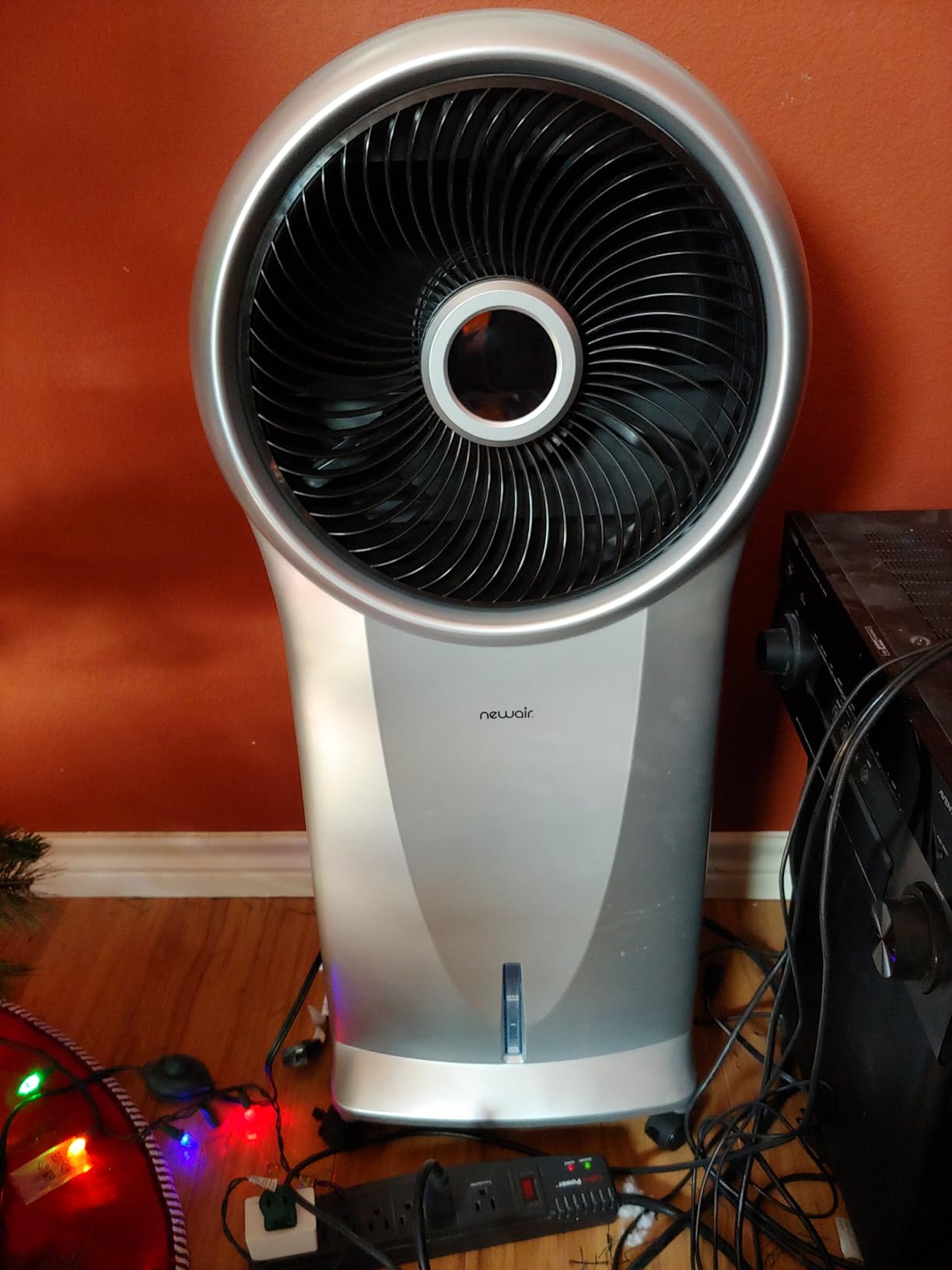
4. NewAir 1600 CFM Portable Evaporative Cooler – Best for Spot Cooling
Newair Evaporative Air Cooler | AC Portable Air Conditioner Alternative with 1,600 CFM Airflow | Room Cooling Fan for Bedroom, Garage & Indoor Use | White
1600 CFM
3.16 gal tank
95 W
under 56 dB
remote
Pros
- Only 95 W so running cost is low
- Top-loading ice chamber with two ice packs
- Remote with 1-9 hour timer and digital display
- 17.6 lb body rolls without draining
- Under 56 dB with a dust filter and ETL listing
Cons
- Cools people rather than rooms
- Small 3.17 gal tank needs frequent refills
- Plastic tank and lid crack easily
Owners consistently treat this as a personal cooler rather than a room unit. Aimed at you in arid weather, it works. Pointed at a whole bay, it will not change the space much, and pretending otherwise is how people end up disappointed by evaporative cooling in general.
Where it genuinely earns a place in a workshop is a bench-side or trailer spot. At 17.6 pounds with casters, you can move it without draining the tank, which is a real difference when you only need cooling during the hours you are actually working.
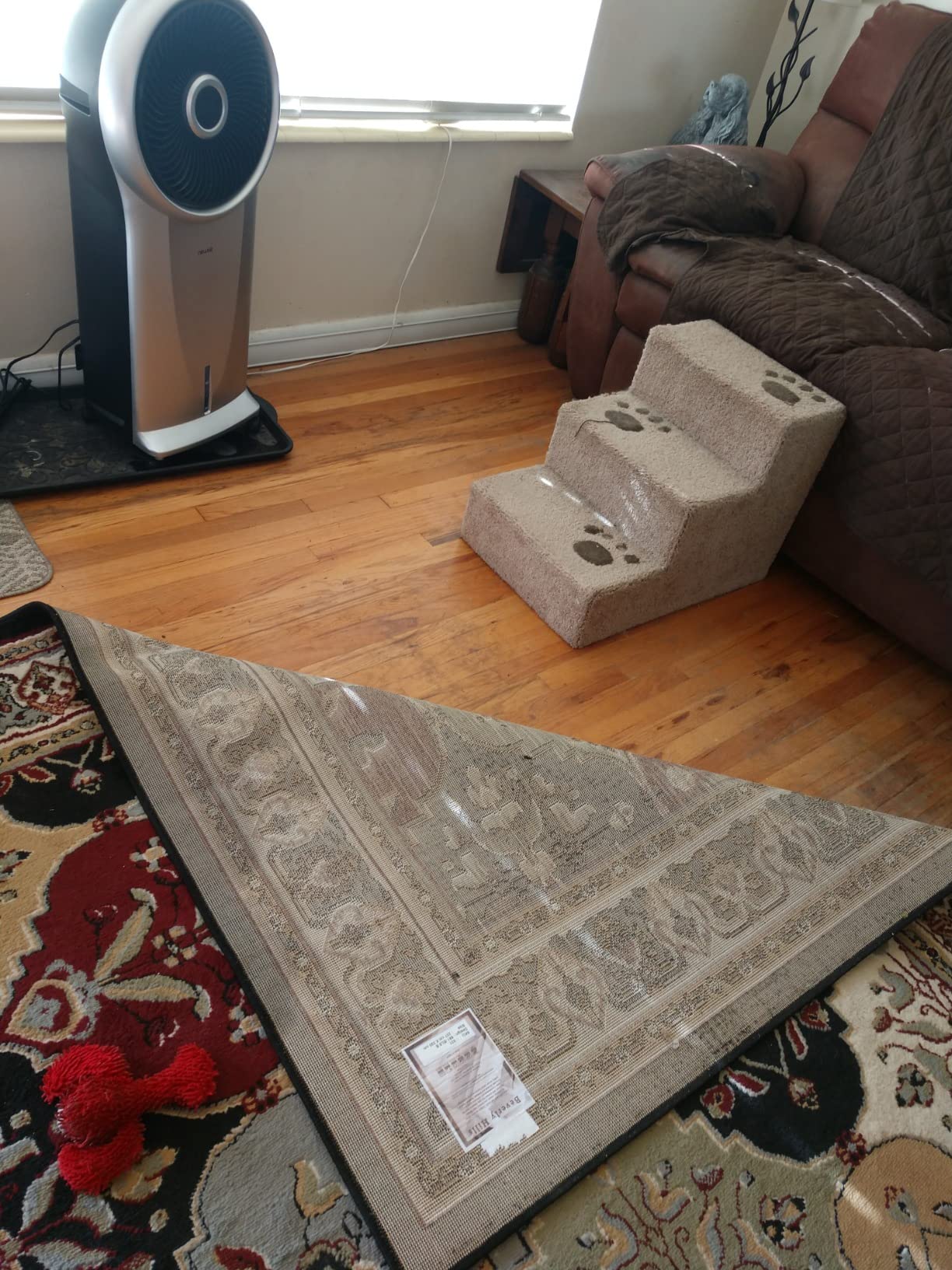
The feature set is unusually good for the class: a remote with a 1 to 9 hour timer and a digital display, a top-loading ice chamber that adds a noticeable chill in dry air, at a listed noise level under 56 dB, which is quieter than most of what is on this list. The built-in dust filter is a sensible addition in a shop full of sawdust and grinding dust.
The 3.17 gallon tank is the weak point. It needs refilling every few hours, and the plastic tank and lid are described as prone to cracking or chipping. Some units also arrive without the remote or the manual.
When spot cooling is the right call
Spot cooling is right when the heat problem is localized: a welding bay, a trailer, a single workstation under a west window. It is also the answer for a shop too small to justify area cooling, or for anyone who wants to test whether evaporative cooling works in their climate before committing to a big unit.
At 95 watts it draws under one amp, so it shares a circuit with tools and shop lights without complaint. That makes it the easiest unit here to run continuously during a long session.
What it will not do
It will not cool a 900 square foot shop. Coverage claims in this class assume an open outdoor space, not a shop with walls and a workbench. If you want area cooling, go up in airflow and step to one of the 3,000 CFM units.
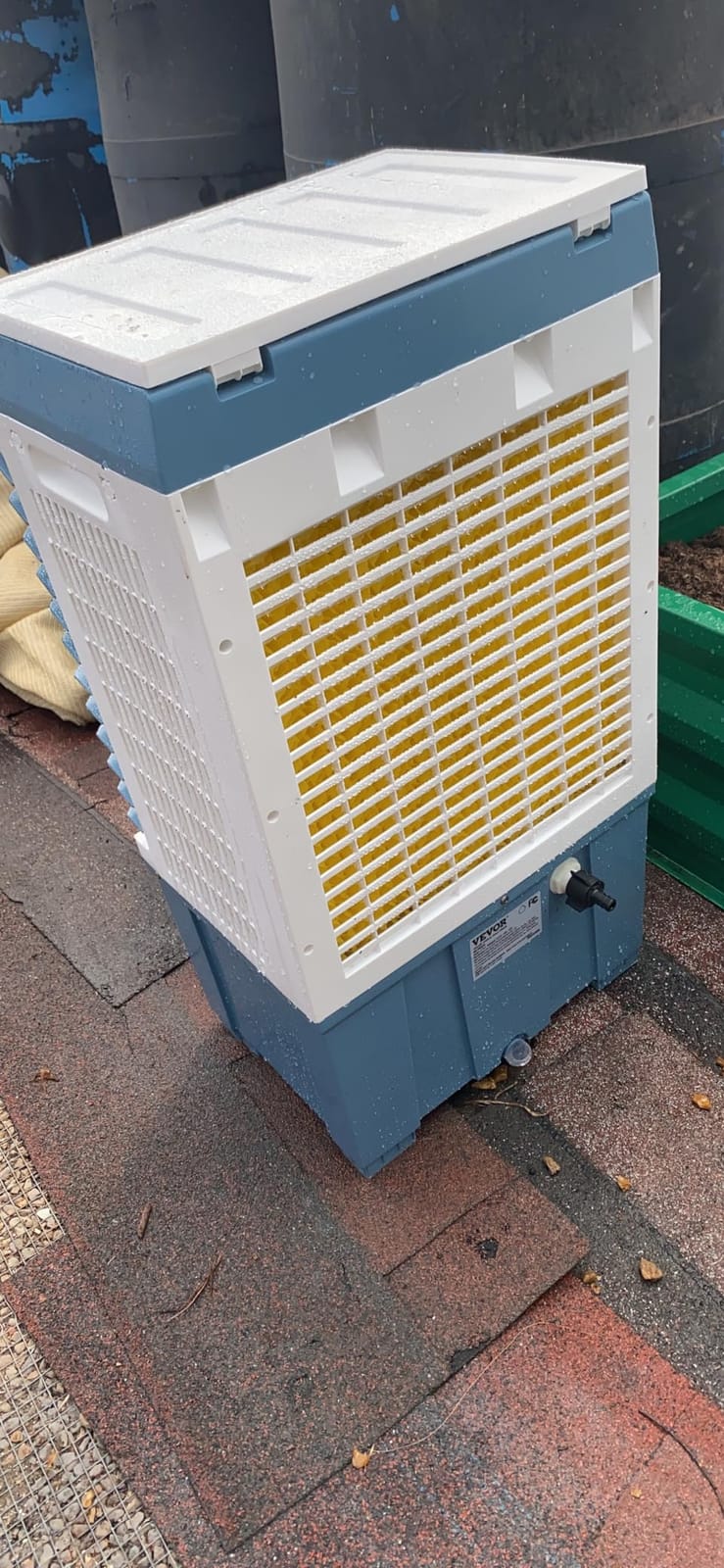
5. VEVOR 1400 CFM Evaporative Air Cooler – The Budget Entry Point
VEVOR Evaporative Air Cooler,1400 CFM 11X31 inch Air Cooler,3 Speeds Cooler Portable Air Conditioner,Energy-Saved Swamp Cooler for party,pool and patio,5 Gal Water Tank & 550 Sq.Ft…
1400 CFM
550 sq ft
5 gal tank
60 W
60 dB
Pros
- Shallow 10 inch deep footprint
- Only 60 W
- 5 gal tank with top fill and brass hose adapter
- 0-72 degree oscillation with vertical louvers
- Low water shortage indicator
Cons
- Cooling effect well short of a compressor unit
- One-sided pads limit evaporative surface
- Around 60 dB and light-duty plastic
This is the most direct way to find out whether evaporative cooling suits your shop, and it does that job honestly. Owners accept it as an outdoor, patio and small-bay cooler rather than a room air conditioner, and rate it as adequate value once the principle is understood.
At 60 watts it draws less than any other unit here, and at just over 10 inches deep it fits where larger cabinets cannot. For a corner of a small shop, a hobby bench or a covered work area, the footprint alone can justify it.
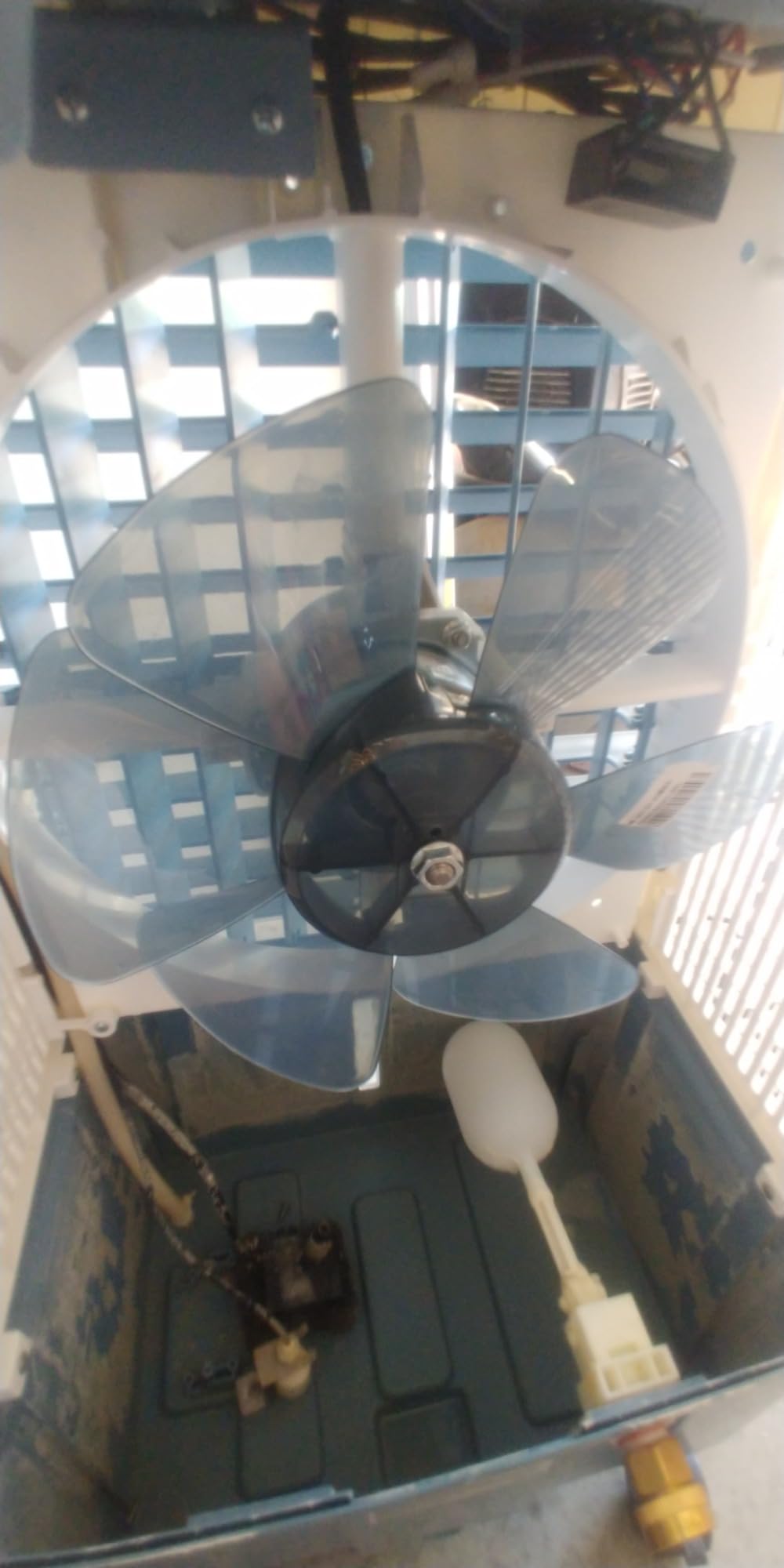
The 5 gallon tank takes a top refill or a continuous garden hose connection through the included brass adapter, and the automatic oscillation sweeps 0 to 72 degrees. Mechanical buttons stay legible after long use, which matters more than it sounds in a dusty shop, and a low-water indicator is built in.
The single-sided cooling pad is the technical weak point. It gives the unit less evaporative surface than the three-sided rivals, and that shows up directly in how much cooling you get per watt. The 3.7 star average reflects that, with 14 percent one-star reviews mostly from unmet cooling expectations.
Whether the low airflow is enough
Its 550 square foot coverage claim is for an open area. If your working shop is 300 square feet with an open door and you sit near the unit, it can be genuinely useful. If you need to cool a bench on the far side of a two-car bay, it is the wrong tool and no amount of positioning will fix it.
Check humidity before anything else. Performance falls off sharply in humid air, and that is where most disappointed reviews of budget evaporative coolers come from.
Upgrade triggers
Move up if you find yourself refilling constantly, if the shop gets busy and you need airflow beyond your immediate spot, or if noise becomes an issue while you are working with headphones. The step up in this list is the NewAir for spot cooling, or the Hessaire MC37V for area cooling.
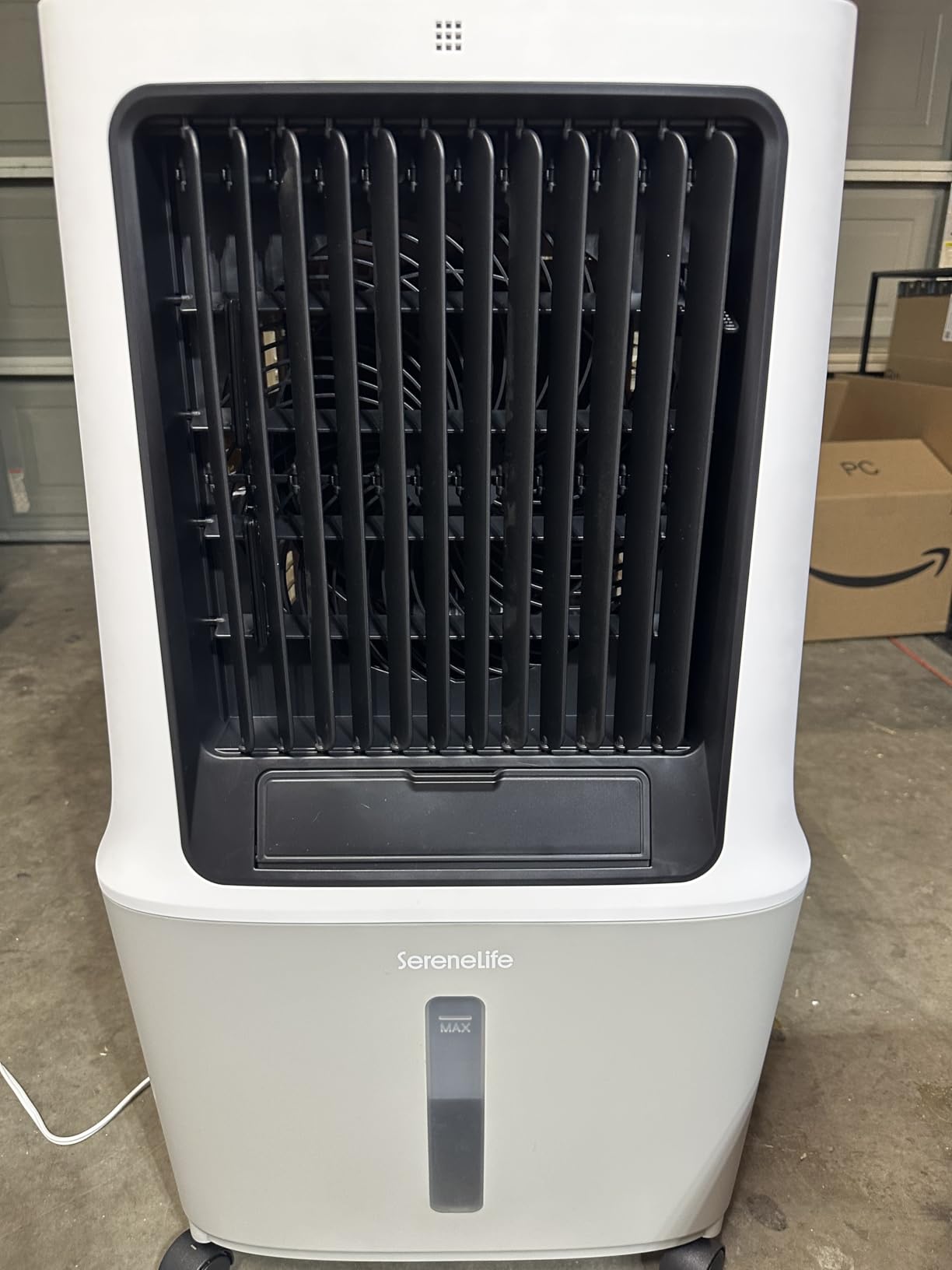
6. SereneLife 2500 CFM Portable Swamp Cooler – Feature Rich, Light on Results
SereneLife Portable Swamp Cooler Air Conditioner – 2500 CFM Airflow, 8 Gallon Water Tank Portable Evaporative Air Cooler for Room & Outdoors, WiFi, Humidifier & Fan Modes, Ice Packs & Remote Included
2500 CFM
8 gal tank
140 W
WiFi
12-hour timer
Pros
- 8 gal detachable tank on wheels
- WiFi app plus LED panel and remote
- Cooler
- fan and humidifier modes with 12-hour timer
- Washable filter and auto-dry pad system
Cons
- Cools only the person in front of it
- Pump cannot fully drain the tank
- Reports of clogging and leaking within under a year
The paper spec sheet here is the longest in the lineup: WiFi control, three modes, a 12-hour timer, a washable filter, an auto-dry pad system, dual ice packs. The owner satisfaction is the lowest here at 3.2 stars, with 30 percent one-star reviews. That gap is the most useful thing I can tell you about this unit.
The consensus is that it is a strong personal air mover with a convenient tank, not an effective room cooler. Many owners report one or two degrees of change at best at the room level, which is exactly what a personal cooler does.
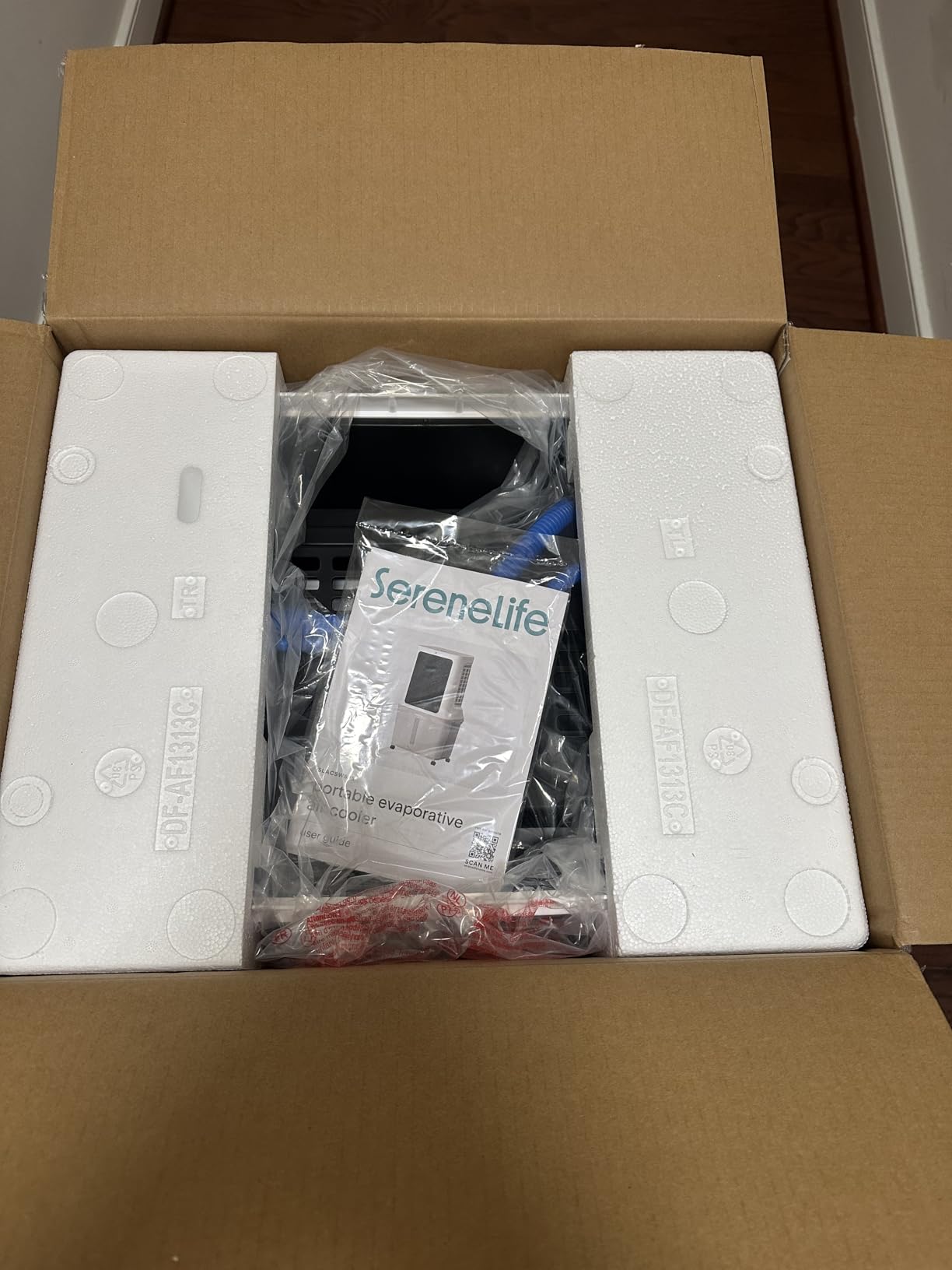
Where it is genuinely convenient is filling. The 30 liter tank sits on casters and detaches, so you are not lifting a heavy reservoir. It is the easiest refill arrangement for a large-capacity unit, and that convenience is real if you are using it as a spot cooler at a desk or bench.
The design also creates friction. The pump cannot fully drain the tank, so standing water and heavy drippage show up when the top half is removed, and there are no handles on the upper section. Swapping the ice packs means detaching the entire upper half, which owners consistently rate as awkward.
Who should consider it anyway
Consider it if you want app control and scheduled cooling for a personal zone and you will not expect area cooling. It also runs without venting, which makes it usable indoors in a way most evaporative units should not be.
Skip it if you have had a shop floor long enough to distrust a floating promise. The reports of clogging and leaking within under a year are consistent enough to weigh, and replacement parts are the sticking point when a pump fails.
Running cost and noise
At 140 watts and under 65 dB it sits in the middle of the lineup on both measures. The noise is real in a quiet shop, and the sleep and natural modes behave much like normal mode, so treat them as speed presets rather than distinct functions.
7. Hexago 7500 CFM Evaporative Air Cooler – Big Claims, Measure Carefully
Hexago 7500 CFM Evaporative Air Cooler, Swamp Cooler With 13.2 Gal Tank, Remote, 24H Timer, Oscillation, 3 Speeds, Portable swamp cooler for Garage, Patio, Commercial Use, ETL Safety Listed, 950 Sq.Ft
7500 CFM rated
13.2 gal tank
150 W
55 dB
24-hour timer
Pros
- Large 13.2 gallon tank with top fill and hose connection
- ETL Safety Listed with dust screens and drip trays
- Electronic panel plus remote with 24-hour timer
- Water shortage warning protects the pump
- Four 360-degree wheels
Cons
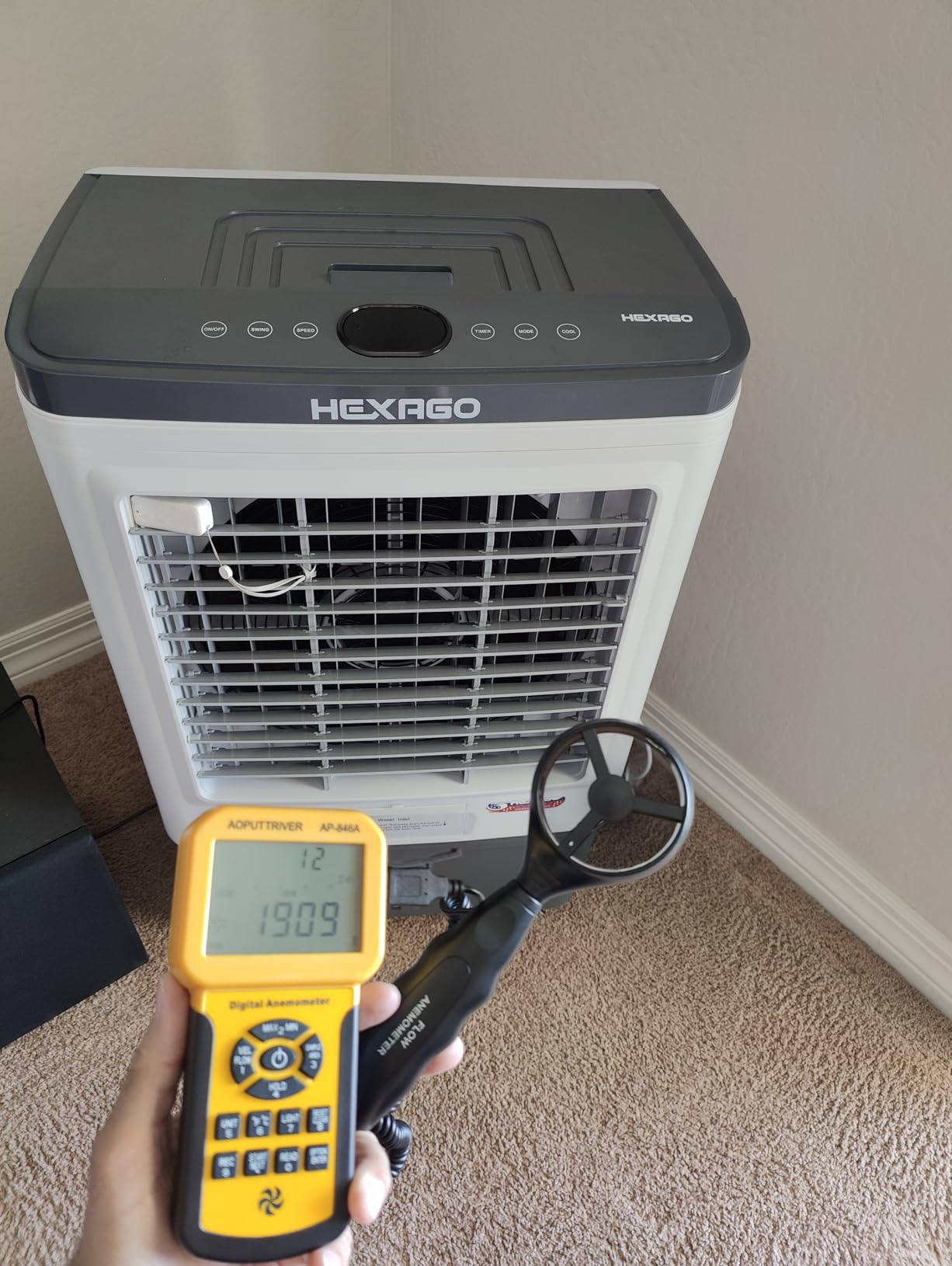
- One owner measured about 1900 CFM on a 7500 CFM rating
- Touch buttons often unresponsive after power-on
- Thin plastic construction throughout
The headline number here is 7,500 CFM, the highest rating in the lineup, and it deserves skepticism. One owner put an anemometer on a unit and measured roughly 1,900 CFM. That does not make the cooler bad, it makes the label unusable for sizing decisions.
With a 15-review base at 3.2 stars, there is not enough owner history here to argue past that. Owners who get a working unit report genuinely good cooling in 80 to 90 degree dry heat, and 26 percent one-star ratings point at three recurring problems: overstated airflow, unresponsive touch controls out of the box, and weak plastic construction.
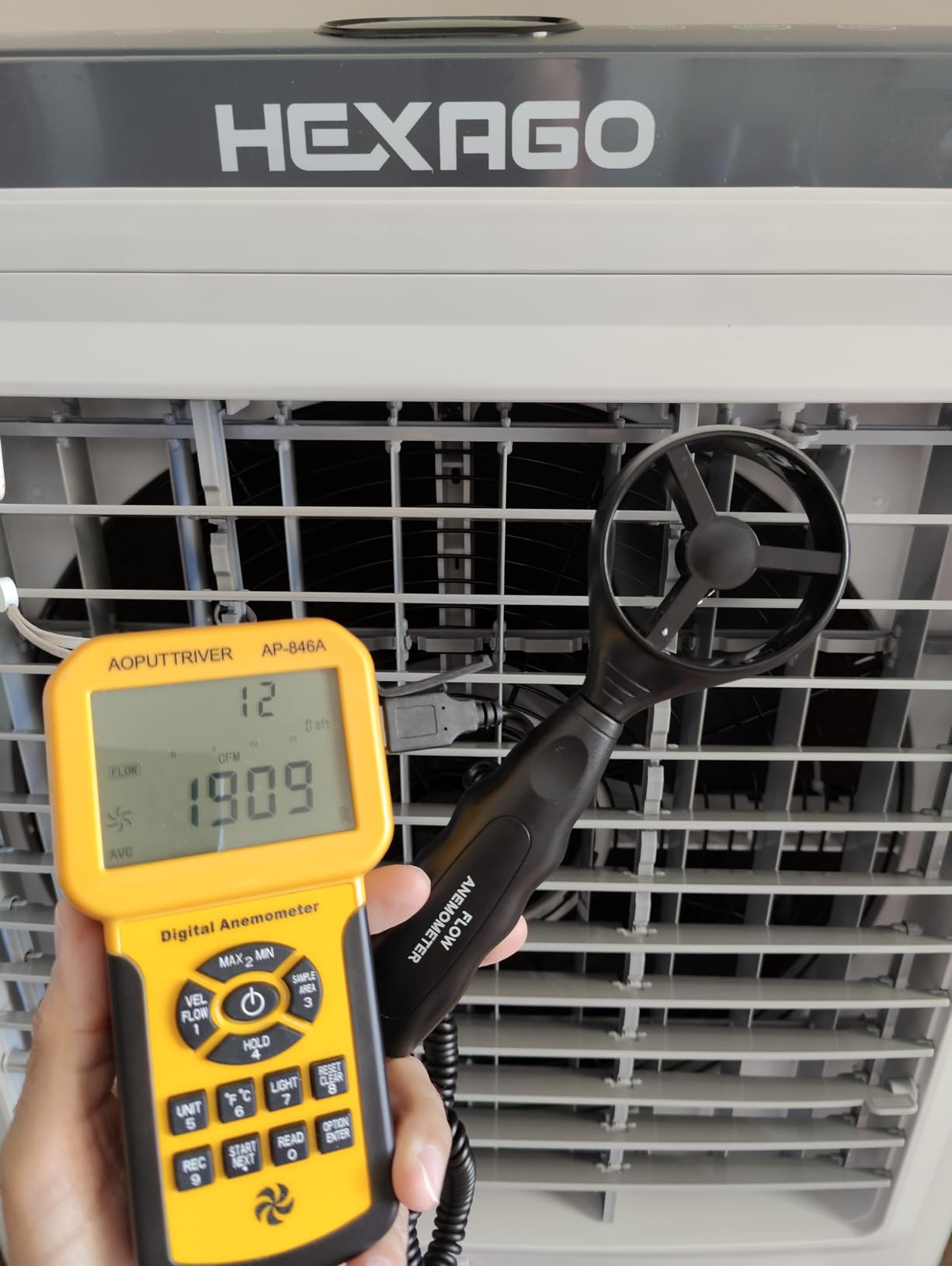
What it does well is water management, which matters in a dry shop where you do not want to babysit a refill. The 13.2 gallon tank is among the larger here, it takes a manual top fill or a garden hose, and there is a water-level window plus a shortage warning that protects the pump. At 150 watts it draws 1.25 amps, so it is easy on a 15 amp circuit.
The ETL Safety Listed rating and the internal drip trays are meaningful in a shop, where splashing noise and electrical safety are both real concerns. Dust screens help with shop dust, and four 360 degree wheels make it easy to reposition as the sun moves.
How to judge the airflow claim
Ignore the number and size from the tank, pad configuration and your shop volume. If you need a shop-grade unit, compare it against the 3,100 and 4,800 CFM units in this list where independent owner reports at least describe what they felt.
Expect the unit to need a level floor. Owners report it must sit perfectly level for the pads to wet evenly, which is a floor-plan constraint worth checking before you commit to a spot.
Where it earns a place
The 24-hour timer and remote are genuinely useful for a shop that cools on a schedule rather than continuously, and the large tank reduces the number of refills during a long day. If you buy it, test all three speeds and the remote immediately, because those are the parts with the failure reports.
8. Hessaire DC18 Mobile Evaporative Cooler – Runs on a Tool Battery
Hessaire DC18 Mobile Evaporative Cooler
900 CFM
300 sq ft
2.8 gal tank
18V/20V tool battery
Pros
- Runs on any 18V or 20V tool battery
- No outlet needed on the shop floor
- Quiet for the amount of cooling delivered
- Used daily in an automotive shop
- Simple rotary and button controls
Cons
- Only 900 CFM so it is a personal cooler
- Evaporative performance collapses above 60% humidity
- Included adapter is 24V while the manual warns against batteries over 20V
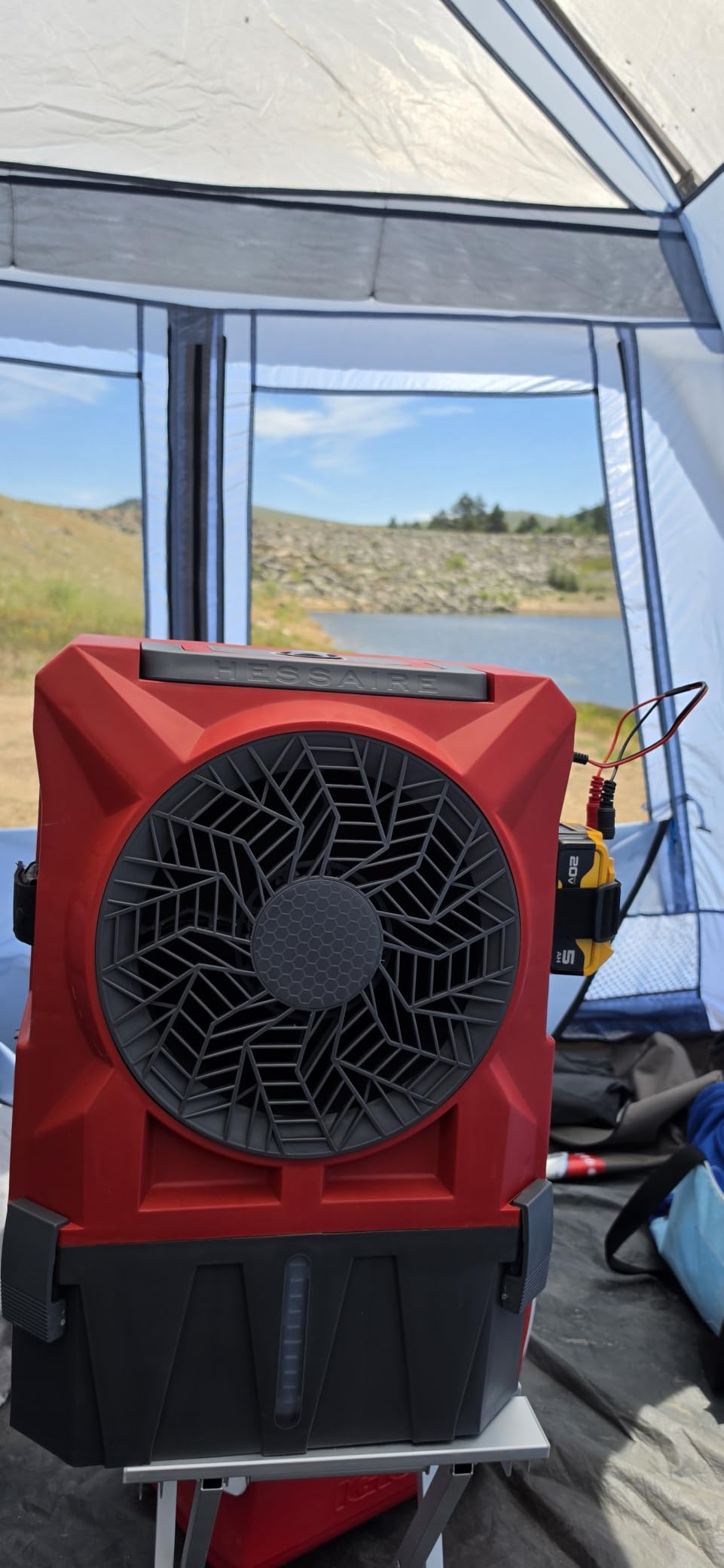
No other cooler in this roundup does this. It runs on any 18V or 20V tool battery from all major platforms, or on the included 115V AC adapter. In a shop where the nearest outlet is behind a bench or across a bay, that removes the single most annoying limitation of every other unit here.
Owners in auto shops, trailers and camps praise the cordless runtime and the quiet, effective spot cooling. One reports it holding a trailer near 75 degrees with 95 degrees outside. The battery is not included, so factor that into the decision if you already own packs.
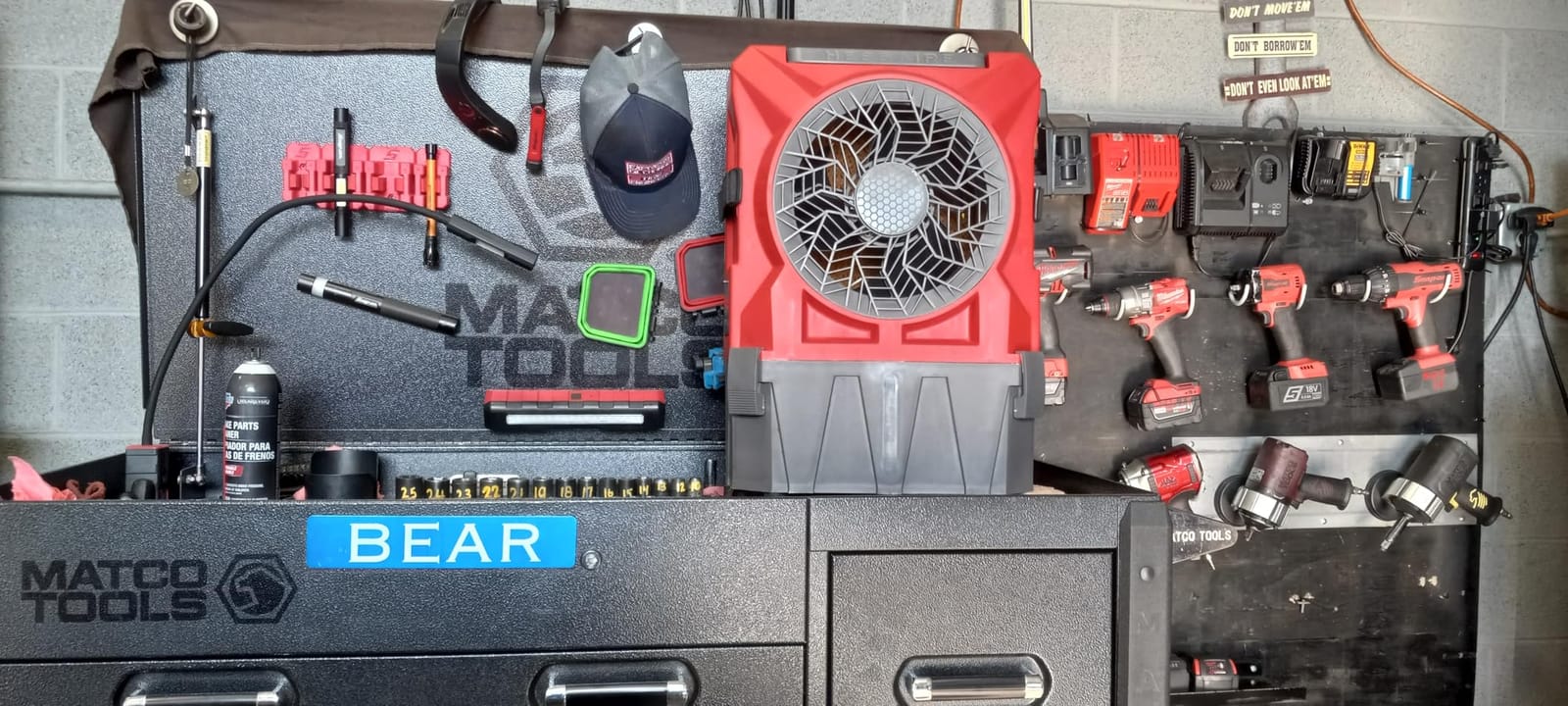
It carries 900 CFM and a 2.8 gallon tank, which is a personal cooler by any honest reading, and it is quiet for the amount of cooling it delivers. The adjustable speed control is simple rotary and buttons, which is refreshing next to the touch panels that cause problems elsewhere in this list.
Two cautions. At 900 CFM it is not going to cool a shop bay, whatever the marketing implies. And the included AC adapter outputs 24V while the manual warns against batteries over 20V, so read the manual before you plug anything unusual into it.
Where cordless cooling changes the decision
It changes the decision in field service work, mobile repairs, job sites and trailer-based shops where there is no outlet at the point of work. For a fixed shop with a clean 15 amp circuit, corded units give you more airflow for the same money.
At a 4.3 star average with 75 percent five-star ratings, this is one of the better-rated units in the lineup despite a 54-review base, which tells you the owners who bought it are largely happy with what it is.
Limits worth knowing
Evaporative performance collapses above roughly 60 percent humidity, so the dry-climate rule applies here as strictly as anywhere. And at 42 pounds with a 2.8 gallon tank, it is larger and heavier than expected for a portable unit, so plan where it will live between uses.
9. Uthfy 4000 CFM Swamp Cooler – Quiet but Thin-Padded
Uthfy 4000CFM Swamp Cooler for Large Room, 41” Evaporative Air Cooler with 13.5Gal Detachable Water Tank, 12H Timer, Ambient Light, 120° Oscillation, Indoor & Outdoor Air Conditioner for Patio, Garage
4000 CFM
13.5 gal tank
120 W
45 dB
12-hour timer
Pros
- 13.5 gal tank fully detachable and fills under a tap
- Three refill methods with dry-run pump protection
- Quiet at 45 dB even on top speed
- Remote control with 12-hour timer and ambient light
Cons
- Rated CFM drops sharply once the pads are wet
- Thin pads compared with thicker rivals
- Pump can stop engaging with tank half full
This is the quietest rated unit in the lineup at 45 dB while drawing 120 watts, and the 13.5 gallon detachable tank is one of the two easiest refill arrangements here. The problem is the pad and pump, and those two things determine whether you will still be running it in September.
At 3.1 stars with 33 percent one-star reviews, it sits at the bottom of the ratings. Even favourable owners measure only a 2 degree room-temperature drop in dry air. The recurring complaints are thin pads that choke airflow and pumps cutting out early.
The feature list is generous: 120 degree oscillation, three speeds, three modes, a 12-hour timer, an LED ambient light, four wheels with two brakes, a drain port and a visible water line. Owners like the tank specifically, because it fills under a tap instead of a hose.
What undermines it is physical. Rated airflow drops sharply once the pads are wet, and owners comparing to thicker-pad units describe a night-and-day difference. Four supplied ice packs are empty shells with little practical effect, and there is no float switch, so continuous hose use still needs manual water management.
Judge this unit by the pads
Pad thickness and media density are what separate a cooler that cools a shop from one that just moves humid air. If you buy this, check the pad on arrival and be prepared to replace it, because airflow restriction is the core complaint and the pads are the reason.
Do not rely on the 4,000 CFM figure if the pads are compressed or clogged. Owners who measured output after filling report far less than the rating, which is a recurring theme across this whole category.
Who it suits
It suits a shop where noise is the deciding factor and cooling is a nice-to-have rather than the reason you bought it. The quiet operation and detachable tank are real, and for a bench-side zone in a dry shop that combination is worth something.
For area cooling in a working bay, step up to a unit with three-sided rigid pads. If you want a quiet unit with better pad quality, the NewAir is rated under 56 dB and uses honeycomb media.
10. PNTCK 3-in-1 Swamp Cooler – Small Shop Corners and Benches
PNTCK Portable Air Conditioners, 3-IN-1 Swamp Cooler with 3 Fan Speeds, 4 Modes, 12H Timer, Remote, Ice Packs, 2.1Gal Water Tank, Evaporative Air Cooler for Bedroom Dorm Office Garage Home
2.1 gal tank
4 modes
3 speeds
12-hour timer
10 lb
Pros
- Only 10 lb and 25 inches tall
- 4 modes and 3 speeds including sleep
- Remote
- top touch buttons and four universal casters
- 2.1 gal tank with visible level plus two ice packs
- Child lock and adjustable blades
Cons
- Small 2.1 gal tank needs frequent refills
- Sized for personal spot cooling
- Modest airflow for a workshop
This is the smallest and lightest unit here, and that is the entire reason to consider it. At 10 pounds and 25 inches tall, it fits under a bench or in a shop corner where nothing else will, and the four casters and carry handle make it trivial to move.
The 4.2 star average with 64 percent five-star ratings is well above the lineup average. Buyers cite the light weight, the feature set, and a quiet sleep mode. The limitation they name is tank size and the small area it can effectively cool.
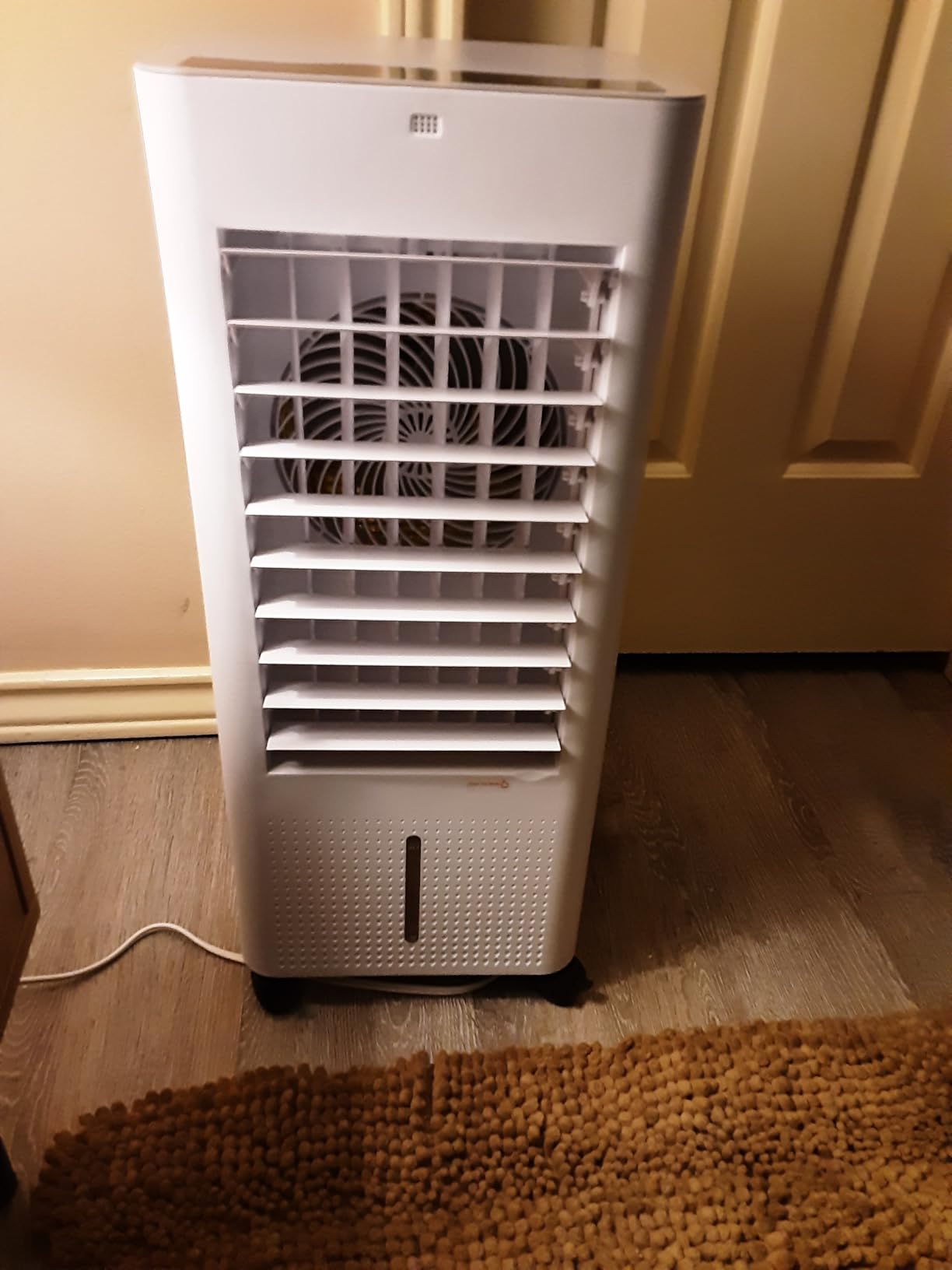
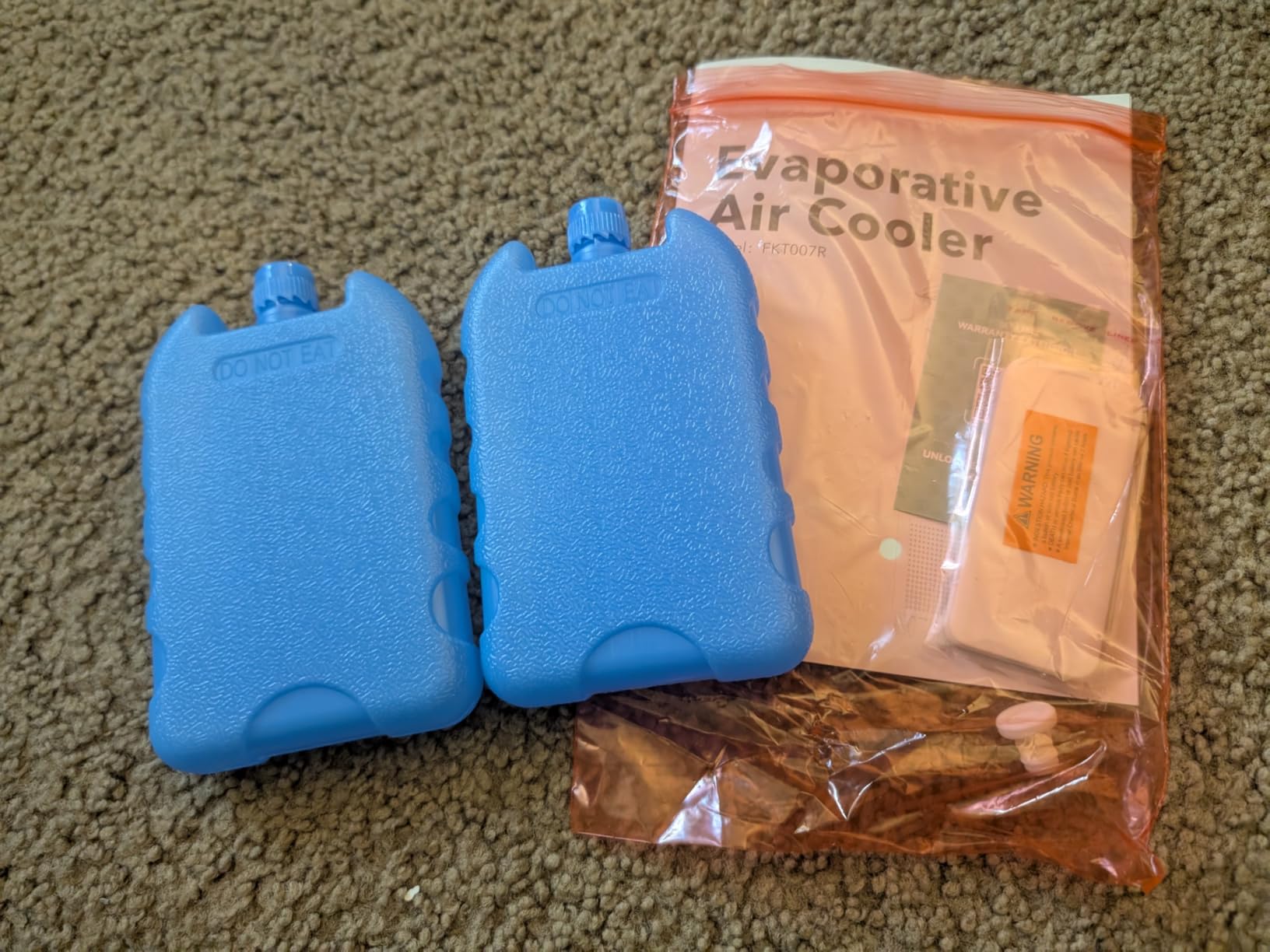
Control is thorough for a compact unit: three speeds, four modes including sleep, a 12-hour timer, a remote, top touch buttons, and 80-degree automatic swing with manual up and down louvers. The child lock is a small thing that matters in a shared space or a shop with visitors.
The 2.1 gallon tank is the practical constraint, and it means refills every couple of hours during active work. There is no CFM figure in the listing, so treat this as a personal cooler rather than anything you would try to size to a shop.
When 10 pounds is the deciding factor
Weight decides it when the unit has to move between a workbench, a hobby corner and a vehicle, or when floor space is tight enough that a 40-pound cabinet is a problem. It also suits a small office or break area inside a shop.
It is not the answer for a bay that gets hot. Frequent refills interrupt work, and the modest airflow will not change conditions across a shop floor.
Better pairings
Pair it with a larger unit for area cooling, and use this one where you actually stand. That two-tier approach is common in working shops: broad airflow from a shop-grade unit, close cooling from a small personal cooler at the bench.
Its 120V requirement and low draw mean it can share a circuit with bench tools without a second outlet, which is convenient in older shops with few outlets.
11. OEMTOOLS 23968 3100 CFM – Built Around the Shop It Lives In
OEMTOOLS 23968 3-Speed Portable Swamp Cooler 3100 CFM 10.3-Gal. Water Tank
3100 CFM
950 sq ft
10.3 gal tank
68 dB
GFCI plug
Pros
- Marketed for garages with casters and tool compartments
- High-density media with about 80% more surface area
- Patented axial propeller with oscillation
- 10.3 gal reservoir and 1/5 HP three-speed motor
- UL-listed GFCI plug and UV-resistant resin
Cons
- Loud unit at 68 dB
- Over 41 pounds needs two hands to move
- Cooling is climate-dependent
- Loud and heavy for a rolling cabinet
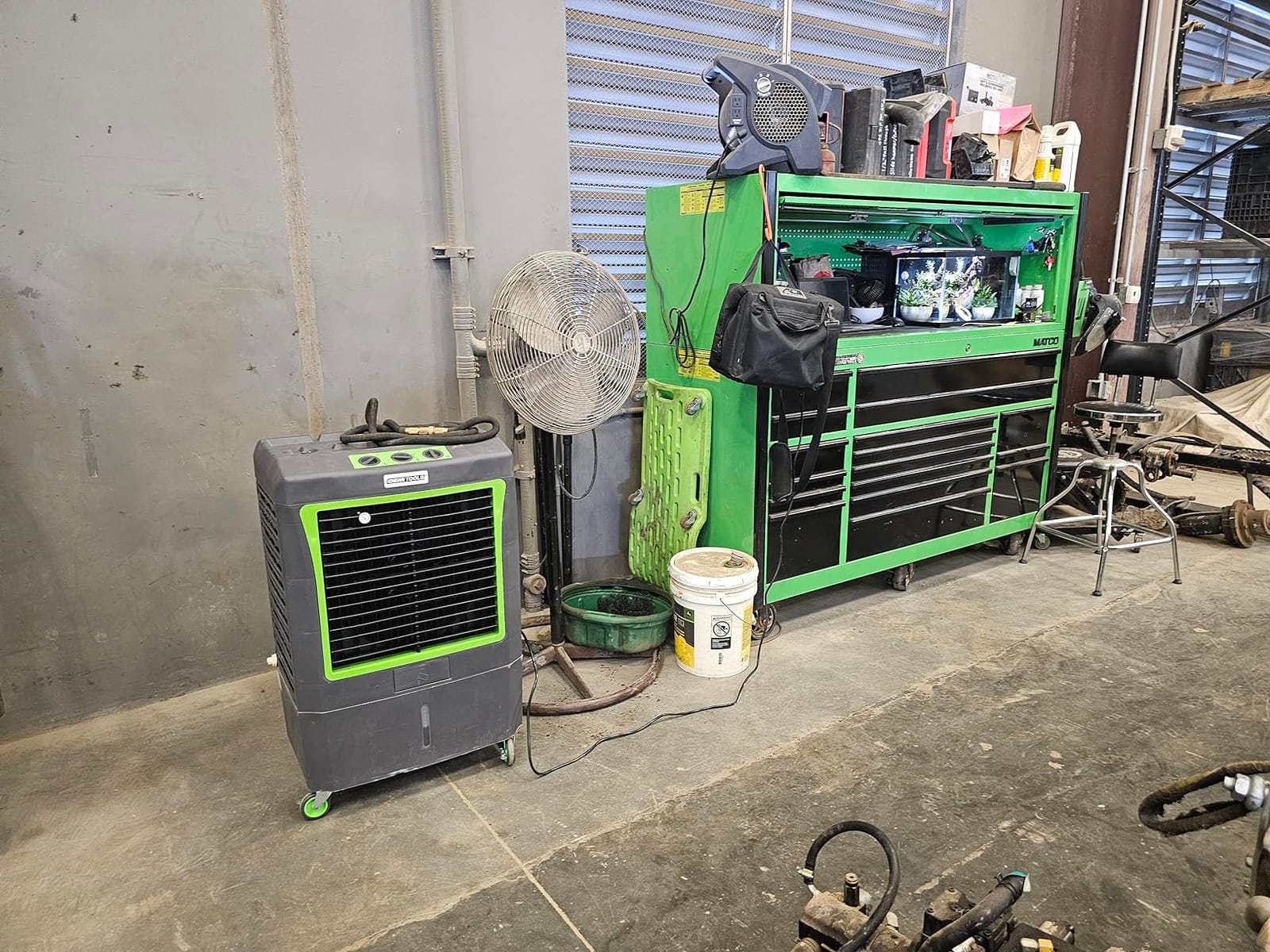
This is the unit in the roundup most explicitly designed for a garage, and the details show it. It has casters and integrated tool compartments, a UL-listed GFCI plug, and UV-resistant resin. In a shop with concrete floors, extension cords and a lot of water, those are not cosmetic choices.
The high-density media panels are the technical argument for it. Owners cite roughly 80 percent more evaporative surface area than standard-density panels, and pad surface area is the single biggest driver of how much cooling a given wattage produces.
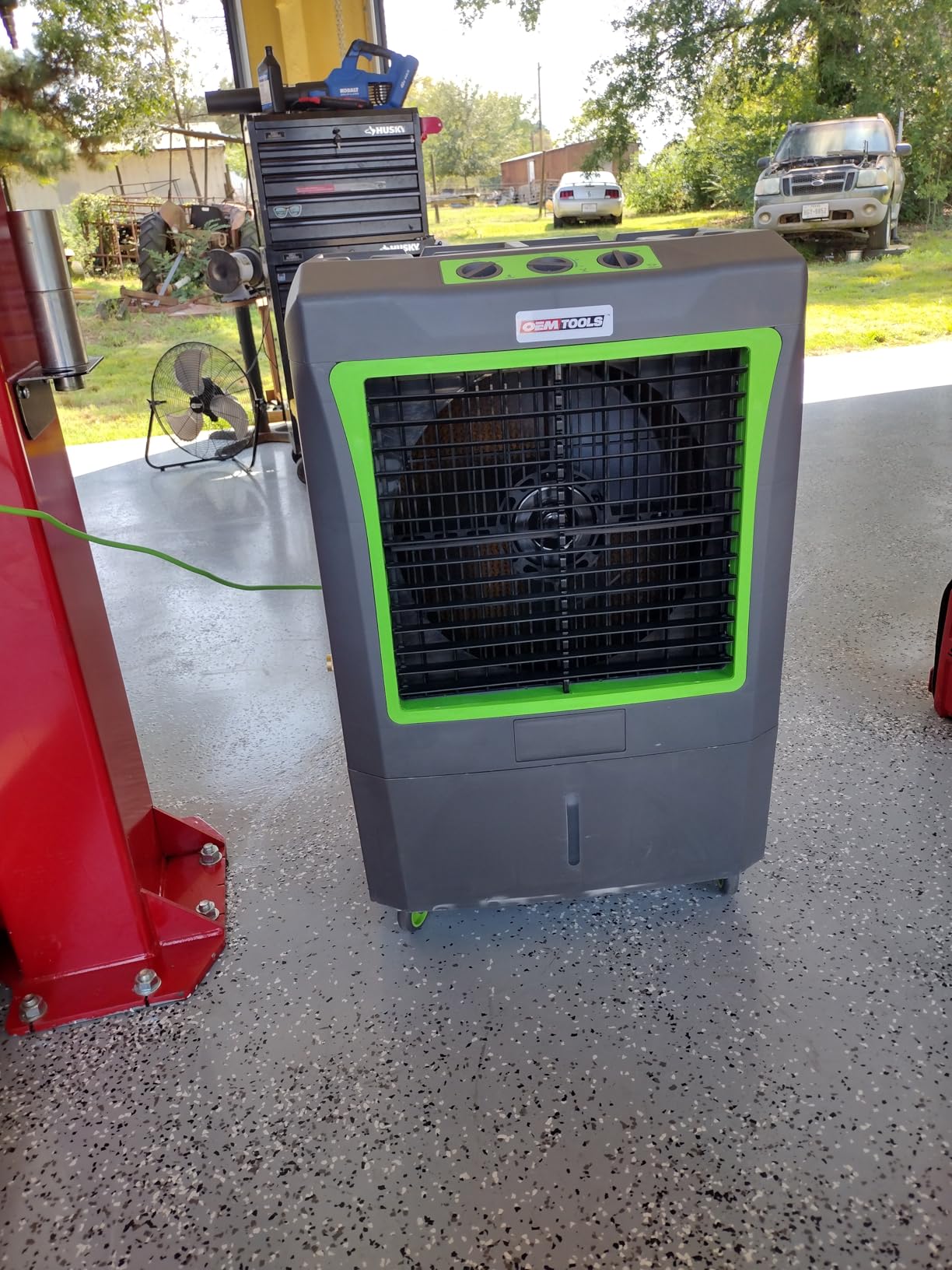
Airflow is 3100 CFM across about 950 square feet from a 1/5 HP three-speed motor, with a patented axial propeller and oscillation for more even distribution than a plain axial fan. The 10.3 gallon reservoir is a proper all-day tank, and the tool compartments keep the small stuff off your bench.
You accept two costs for that. At 68 dB it is a loud unit, which owners acknowledge as the trade for the larger motor and steel-grade chassis. And at over 41 pounds it takes two hands to move across a shop.
Why the GFCI plug matters in a shop
Wet equipment in a space with concrete floors and metal shelving is exactly the situation a GFCI plug is for. If your shop outlets are not GFCI protected, this unit is the safer pick and it removes one item from the mental list.
On circuits, it draws 250 watts and about 1.3 amps on 115V, so it fits a 15 amp circuit comfortably. Leave headroom if you plan to run a second unit or a dust collector on the same circuit.
Where it sits against the Hessaire pair
It matches the MC37V and MC37M on airflow and tank capacity, and beats both on pad density and shop-specific hardware, while losing on noise and weight. Choose it for pad surface area and shop features, and choose the Hessaire units for a lighter chassis and a lower noise floor.
12. Antarctic Star Evaporative Air Cooler – Smallest and Simplest
Antarctic Star Evaporative Air Cooler, Portable Air Conditioner
1.5 gal tank
50 dB
3 modes
140-degree oscillation
13.5 lb
Pros
- Quiet 50 dB operation
- 1.5 gal tank advertised for up to 15 hours
- Four ice crystal boxes included
- 140-degree oscillation
- Remote with 16.4 foot range
- Light 13.5 lb body on casters
Cons
- 1.5 gal tank limits sustained output
- Entry-level airflow for personal spot cooling
- 25% one-star ratings
- Listed wattage of 780 W is high for this size
This is one of the quietest personal units in the roundup at a listed 50 dB, and it stays quiet because it does very little. At 1.5 gallons and entry-level airflow, it is a personal cooler for a desk, a patio or a small corner of a shop, and it should be judged as one.
Owners like the 50 dB footprint, the claimed 15 hour runtime from the small tank, and the four included ice boxes. The 3.4 star average with 25 percent one-star reviews reflects modest cooling and light construction.
The 140 degree oscillation and a remote with a 16.4 foot range give it better coverage than its size suggests for a single person. The removable tank and casters make it easy to move between an office, a patio and a work corner, and the three modes give you normal, nature and sleep behaviour.
One specification deserves attention in a workshop: the listed wattage is 780W, which is high for a unit this size and, at 110V, works out to roughly 7 amps. That is a meaningful load on a 15 amp circuit if you also want to run a saw or a compressor-based tool.
When this size is the right one
This is the right size for a small office, a break area, or a spot in a workshop where one person needs cooling for a few hours. The 13.5 pound weight and casters mean it moves easily, and a single outlet is all it needs.
It is the wrong size for anything you want to cool by area. If a bay gets hot, you need airflow measured in thousands of CFM rather than a small tank and four ice boxes.
Checking the runtime claim
The 15 hour figure comes from a 1.5 gallon tank, which assumes intermittent duty rather than continuous pump operation. In a shop where the pump runs whenever you are working, expect frequent refills and treat the runtime claim as an idle figure.
Buying Guide: What Actually Matters in a Workshop
CFM is the first filter, and it is the one most shoppers get wrong. Divide your shop’s cubic feet by two, round up, and treat any coverage claim as a starting point. Manufacturers measure airflow at the outlet in ideal conditions, and reviewers with anemometers regularly find the real number lower once the pads are wet.
Pad media quality is the second filter, and it is the one that separates a 3.7-star unit from a 4.6-star one at the same airflow. Three-sided rigid high-density pads give you more evaporative surface per watt than a single thin sheet, and the OEMTOOLS unit’s high-density panels are rated at roughly 80 percent more surface area than standard density. Rigid media also tolerates scale better than loose cellulose.
Tank capacity and fill method decide how much of the day you spend managing water. A 10 gallon tank running three to four hours without a hose means refills twice in a shift. A garden hose connection with a float valve, which the Hessaire units include, removes that from your day, but it also means a permanent water line in your shop.
Mobility and build are workshop-specific. Locking casters matter because you will want to move the unit as the sun moves, and metal frames or high-density cabinets survive a shop better than light plastic. Dry-run protection and a low-water warning protect the pump, which is the component most likely to fail.
Noise is the specification shoppers skip and mechanics notice. Ratings here run from 45 dB to 68 dB. A shop-grade unit with a 1/5 HP motor will be loud, and if you work with headphones or do precision tasks where you need to hear a compressor or a customer, factor that in before you buy.
Power draw is the last filter, and it is where evaporative cooling wins decisively. Everything in this roundup draws 60 to 250 watts, and the small models run from 95 to 140 watts. A portable air conditioner of the size people put in a garage typically draws 1,000 to 1,500 watts. That difference is why a shop owner can run a cooler all day without thinking about it.
On circuits, all of the low-wattage units here sit comfortably on a 15 amp circuit, most drawing between one and two amps. Avoid extension cords for anything with a pump, and if you use one, keep it short and heavy gauge. Two units on one 15 amp circuit is usually fine at these draw levels, but add your dust collector and compressor-based tools before assuming it. If you are still comparing cooling gear, our differential cooler picks cover a different cooling problem entirely.
Humidity, Rust and the Tools in Your Shop
This is the concern that comes up most on forums, and it deserves a direct answer. A swamp cooler adds moisture to your shop air. On bare steel, brake rotors, a chassis mid-restoration, or unfinished MDF and plywood, sustained humidity produces surface rust, swelling and mold. An r/garageWorkshops thread asked whether a swamp cooler caused excessive moisture, rust and corrosion, and nobody gave a decisive answer.
Here is the decisive answer. Point the unit at where you stand, not at your inventory. A workshop is a space you are actively working in, and a cooler running during a work session is a very different proposition from one running for months next to a stored project. If you are storing a vehicle, a bare-metal project or finished wood long-term, keep the unit off during storage or add dehumidification.
Do not run one during spray finishing, paint prep, or precision machining. A woodworking commenter put it plainly: the unit is essentially blowing moisture into the shop, and keeping tools and lumber rust-free becomes a full-time job. A r/DIY user raised the same point about painting. For those jobs, air movement from a plain fan is the correct tool.
Two other interactions are worth planning. A dust collector already moves air out of your shop, and running it with a recirculating cooler fights you: the collector exhausts the volume you are trying to cool. And in a humid region, a swamp cooler can make a shop less comfortable, not more, which defeats the purpose entirely.
Setup, Maintenance and Winterizing
Start with the exit path. Open the bay door or a window before you turn the unit on, because the moisture it adds needs somewhere to go. A Garage Journal owner with a 30×60 Texas shop asked how to cool it without a big install, and the useful part of that question is the door: evaporative cooling in an open shop is a different and easier problem than cooling a sealed room.
Place the unit so airflow crosses your work area rather than pointing at stored parts. Roll it as the sun moves. Pre-soak the pads before a long session so you are not waiting for saturation, and connect the hose if you have a float valve so the tank manages itself.
On a monthly cadence during the season, rinse the pads and let them dry, clean the tank, and check the float valve for leaks. A bleed-off or periodic drain-and-refresh keeps mineral scale from building in hard water areas, and it is the single thing that most extends pad life.
At the end of the season, drain the tank, run the fan for about half an hour to dry the pads, and store the unit somewhere dry and above freezing. Pads left wet and frozen are how coolers get thrown out in spring, and replacement pads are inexpensive compared to replacing the whole unit.
One safety note for the shop: our workshop fire extinguisher picks cover the equipment that matters if you run a wet cooler near hot work.
Swamp Cooler vs Portable AC in a Workshop
A swamp cooler wins in a dry, open shop, and a portable AC wins in a sealed, humid one. The decision comes down to four things: power, humidity, whether you work with the door open, and whether you need actual dehumidification.
Power is the cleanest comparison. Everything in this roundup runs between 60 and 250 watts. A portable AC that can cool a similar space runs 1,000 to 1,500 watts, so an all-day shop session is an order of magnitude cheaper with a swamp cooler. Running cost is water rather than electricity, and the water is cheap.
Humidity is the decisive factor. A swamp cooler raises relative humidity, which is exactly what you do not want in a humid region, in a paint room, or around electronics. A portable AC removes moisture as a side effect of condensation, which is why it is the right tool for humidity-heavy spaces.
The open bay door flips the argument. A portable AC in an open shop dumps its cold air outside as fast as it makes it, which is why a r/hvacadvice plant-room owner watched two window units fail to hold 95 degrees in a 115 degree space until a ductless mini-split solved it. In a shop you work with the door up, that is a real and recurring failure mode.
My honest position after weighing both sides: for a dry-climate shop worked with the door open, a swamp cooler is the correct first purchase. For a humid region, a sealed insulated room, a finishing room, or a shop where you need the space held below ambient, spend the money on a compressor-based unit instead. The forum consensus leans AC for brutal heat, and that is not wrong, it is a different problem.
Frequently Asked Questions
Do swamp coolers work in 100 degree weather?
Yes, provided relative humidity stays low, roughly under 50 to 60 percent. Temperature itself is not the limiting factor, humidity is. A 3,000 to 4,800 CFM unit can pull a 1,500 sq ft shop down 15 to 30 degrees in dry desert heat. It fails when humidity climbs, when the shop is sealed with no air exit, or when the unit is undersized for the volume.
How many CFM do I need for my workshop?
Multiply length by width by ceiling height to get cubic feet, then divide by two. A 20 by 30 workshop with a 10 foot ceiling is 6,000 cubic feet, so 3,000 CFM. Round up rather than down, and keep a bay door or window cracked to give the added moisture an exit path.
Will a swamp cooler make my tools rust?
It can, if you point it at your inventory. Sustained added humidity plus bare steel, brake rotors, or unfinished MDF and plywood produces surface rust, swelling and mold. Aim the unit at where you stand rather than at stored parts, and shut it down when you are storing a project long-term or doing paint and finishing work.
Which is better for cooling my garage, a swamp cooler or a portable AC?
A swamp cooler in a dry climate, because it works with the bay door open, draws 60 to 250 watts instead of 1,000 to 1,500, and does not need a sealed room. A portable AC if humidity is high, if the space is sealed and insulated, or if you need dehumidification or temperatures held below ambient.
Do swamp coolers need to be vented?
Yes, you need an air exit path. A portable evaporative cooler recirculates air in place and adds moisture, so it works in an open or ventilated shop. Keep a bay door or window open, and do not rely on a closed room, because humidity builds until the cooling effect disappears.
What are the downsides of using a swamp cooler?
It adds humidity, which brings rust risk on bare steel and damp MDF and plywood. It does nothing useful above roughly 60 percent relative humidity, needs a steady water supply, requires an open air exit path, and its pads need periodic cleaning and replacement. It cannot cool below outdoor temperature or hold a thermostat setting.
Final Verdict: Which Swamp Cooler Fits Your Shop
For most workshops in 2026, the Hessaire MC37V is the right first buy. It moves 3,100 CFM into roughly 950 square feet with a 10.3 gallon tank that accepts a hose fill, and its 4.6 rating across hundreds of owners is the best balance in this roundup.
Step up to the Uthfy 4800 CFM for bigger volume, and to the OEMTOOLS 23968 when you want pad density and a GFCI plug. Step down to the NewAir or PNTCK for spot cooling at a bench, and check your humidity before you buy anything, because in a humid region no unit here is the right tool.
If you are still working out the rest of your shop setup, our roto-molded cooler picks cover storage, and electric coolers cover the compressor-based alternative.