
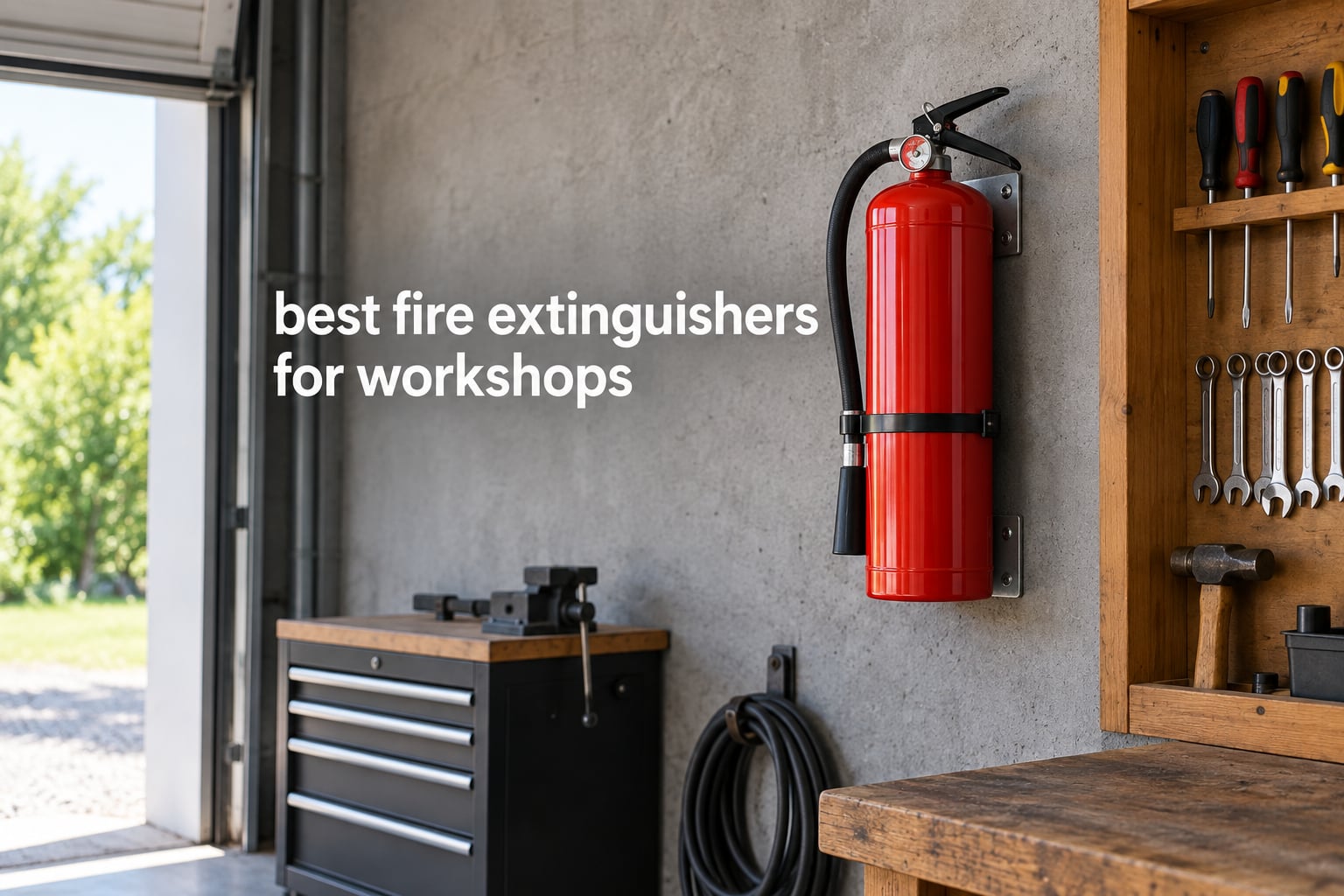
A workshop concentrates every ingredient a fire needs in one small building. Sawdust and wood offcuts, solvent and finish, a welder throwing sparks, a battery charger humming on the wall, and half a gallon of thinner sitting next to a rag.
That combination is exactly why the best fire extinguishers for workshops are not a single unit but a small plan: a mounted ABC dry chemical extinguisher sized to your floor area, a second unit by the exit, and a clean agent or water-based unit for the electrical bench. Get that wrong and you own a red cylinder that sits in a corner for six years, loses pressure, and is useless the one afternoon you need it.
We spent weeks comparing the units that show up most often in shop recommendations, reading customer reviews and forum threads from woodworkers, welders and auto restorers, and mapping each one back to the hazards it actually covers. What follows covers the eight picks worth mounting on a wall, plus a buying guide that tells you which class your shop needs, how big it should be, and where it belongs.
If your workshop is a home garage rather than a dedicated shop, start with our garage extinguisher guide first, then come back here for the commercial-grade units.
Table of Contents
Top 3 Fire Extinguisher Picks for Workshops in 2026
Quick Overview: Best Fire Extinguishers for Workshops (September 2026)
| Product | Specs | Action |
|---|---|---|
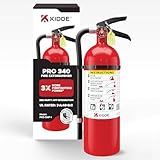
| Kidde Pro 340 Commercial Fire Extinguisher 3A:40-B:C |
|
Check Latest Price |
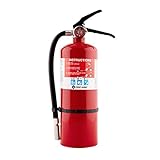
| First Alert HOME2PRO Heavy Duty Fire Extinguisher |
|
Check Latest Price |
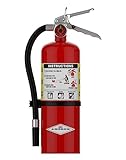 Amerex B402 5 lb ABC Dry Chemical Fire Extinguisher Amerex B402 5 lb ABC Dry Chemical Fire Extinguisher |
|
Check Latest Price |
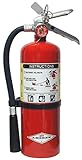 Amerex B500 5 lb ABC Dry Chemical Fire Extinguisher Amerex B500 5 lb ABC Dry Chemical Fire Extinguisher |
|
Check Latest Price |
 Buckeye 10914 ABC Multipurpose Hand Held Extinguisher Buckeye 10914 ABC Multipurpose Hand Held Extinguisher |
|
Check Latest Price |
 Ougist FF2KG 5 lb ABC Dry Chemical Extinguisher Ougist FF2KG 5 lb ABC Dry Chemical Extinguisher |
|
Check Latest Price |
 Kidde Full Home Fire Extinguisher 3-A:40-B:C Kidde Full Home Fire Extinguisher 3-A:40-B:C |
|
Check Latest Price |
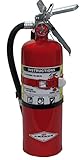 Amerex B402T 5 lb ABC Multi-Purpose Fire Extinguisher Amerex B402T 5 lb ABC Multi-Purpose Fire Extinguisher |
|
Check Latest Price |
1. Kidde Pro 340 Commercial Fire Extinguisher – Our Best Overall Workshop Pick
Kidde Pro 340 Commercial Fire Extinguisher, 3A:40-B:C, PRO-5MP-1
3A:40-B:C UL rated
5.5 lbs monoammonium phosphate
13-15 second discharge
6-year warranty
Pros
- Rechargeable metal valve assembly
- 13-15 second discharge with 12-18 foot range
- UL-approved metal wall hanger included
- Color-coded pressure gauge
- QR code for registration and warranty
Cons
- Heavier to lift than a 2.5 lb unit
- Metal hanger only - no vehicle bracket
- Needs professional service after any discharge
The Pro 340 is the unit we ended up recommending to almost every shop we asked. It carries a 3A:40-B:C UL rating, which puts it a full step above the 2-A:10-B:C baseline that most residential extinguishers settle for, and it holds 5.5 lbs of monoammonium phosphate agent.
The all-metal valve assembly is the detail that matters most in a working shop. A plastic valve is the first thing to fail on cheap units, and it can corrode or snap in a dusty, temperature-cycled space. This one has a rust and impact-resistant handle with an easy-pull safety pin, and it discharges in 13 to 15 seconds across a 12 to 18 foot range.
For a two-car garage with a bench, a dust collector and a charger on the wall, that coverage means you can fight the fire from the doorway rather than walking into it. We like that range figure more than the raw agent weight, because most shop fires start away from where you are standing.
Rechargeability is where the economics start to make sense. After a discharge it goes to a certified shop for a refill instead of straight in the bin, and the 6-year limited manufacturer’s warranty covers the hardware. There is a QR code on the label for registration, warranty and product information, which is a small thing that saves a phone call later.
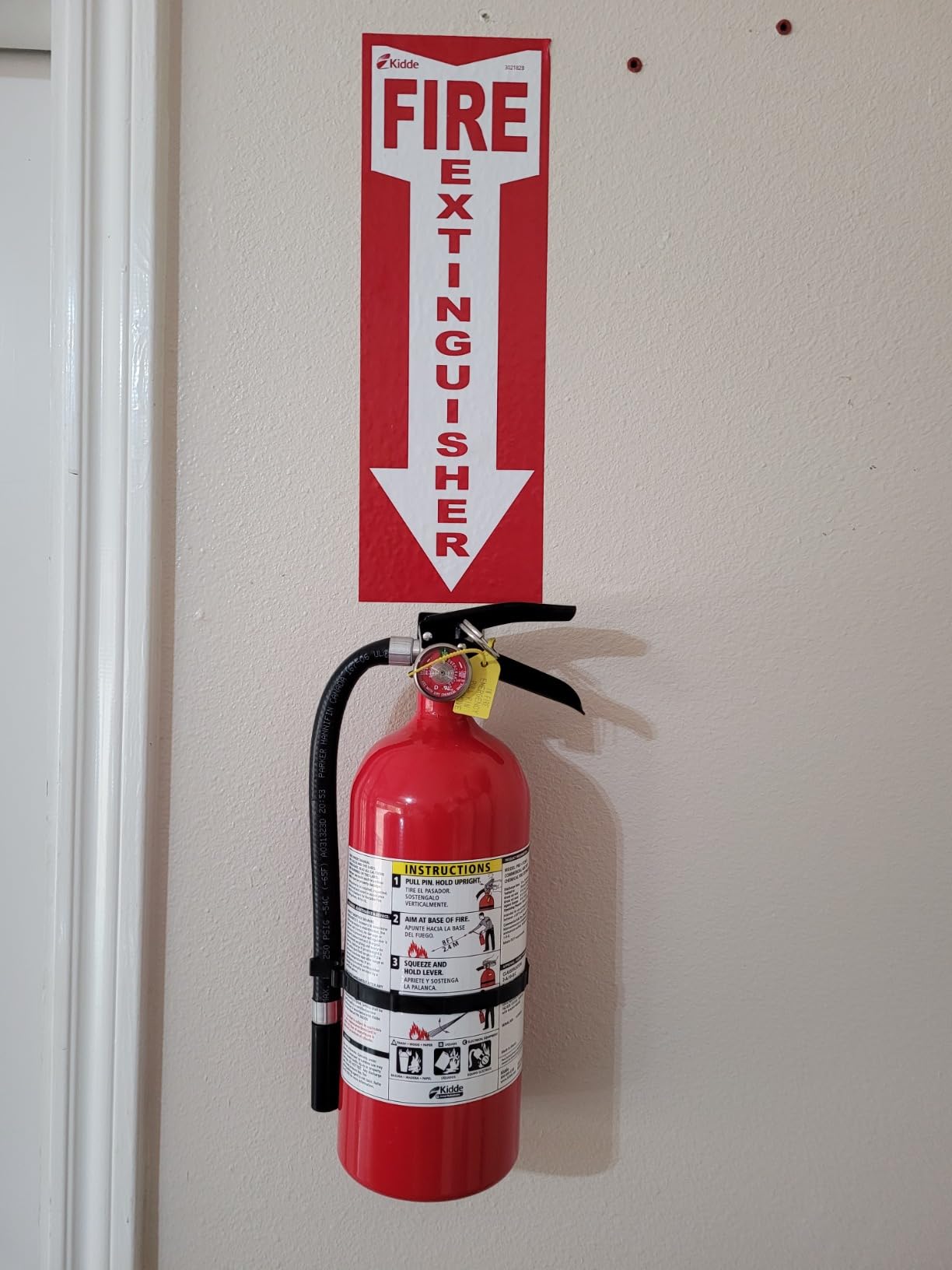
The included UL-approved metal wall hanger is the other quiet win. Plenty of extinguishers arrive with a plastic clip or nothing at all, and a cylinder that rolls under a workbench is a cylinder you will not find in a fire. We have seen shop owners hunt for a bracket months after the extinguisher arrived.
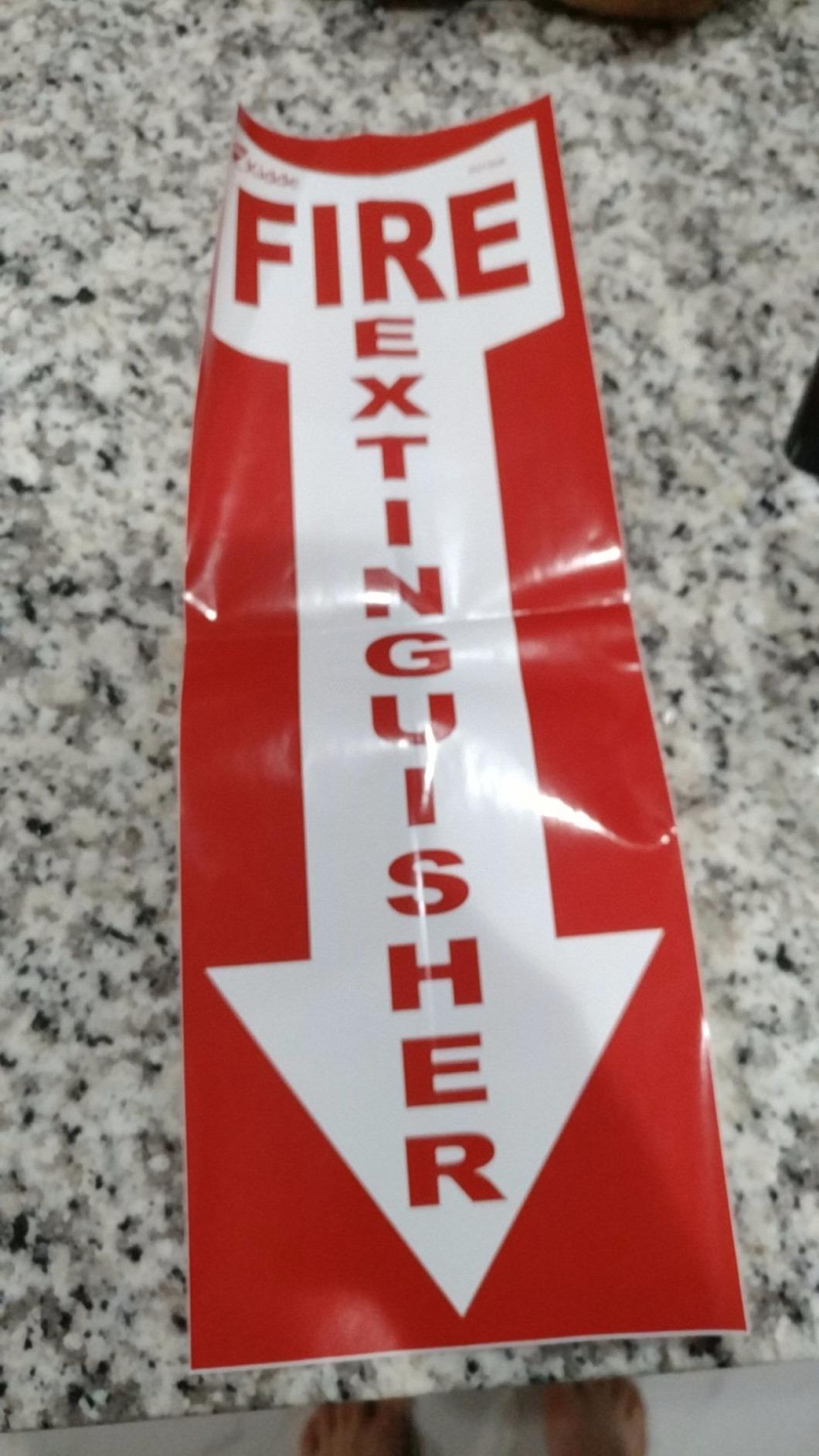
Check the rating number and mounting height before you buy
The 3A:40-B:C marking is the single most useful thing on the label. The A figure tells you water equivalency, the B figure tells you square footage of flammable liquid coverage, and C simply confirms it is rated on energized electrical. Anything at 2-A:10-B:C is a code-minimum unit and works fine in a small shop.
At 8.95 lbs as listed, this is a two-hand carry in a panic. Mount it so the top of the cylinder sits below shoulder height. Lifting a full 10 lb rechargeable unit off a high shelf is how people drop extinguishers in the first few seconds of an emergency.
Where the Pro 340 is the wrong choice
If your shop is under roughly 200 square feet and holds only hand tools, this unit is more than you need to carry. A smaller single-use unit mounted higher handles a small shop and is easier for anyone in the building to use.
It is also the wrong pick for a paint booth, a server closet or a bench full of powered electronics. Monoammonium phosphate leaves a corrosive powder that has to be scrubbed off metal, and getting that powder into a control cabinet or a motor housing is a repair bill. Those rooms want a clean agent or a water mist unit instead.
Because it is rechargeable, someone in the building has to remember the service cycle. Set a reminder now, not later. A rechargeable unit that quietly ages past its hydrostatic interval is the same as having nothing on the wall.
2. First Alert HOME2PRO Heavy Duty Fire Extinguisher – 12-Year Warranty, Metal Valve
First Alert Fire Extinguisher, Heavy Duty for Home & Commercial Use
2-A:10-B:C UL rated
Commercial-grade metal valve
12-year limited warranty
Wall hook included
Pros
- 4.8 rating with 6456 reviews
- 12-year limited warranty
- Commercial-grade metal valve and trigger
- Color-coded corrosion-resistant gauge
- Wall hook included for mounting
Cons
- 2-A:10-B:C is the code-minimum rating
- Heaviest listed item weight at 9.6 lbs
- Only 3 variants available
With 6456 reviews averaging 4.8 stars, this is the most proven unit in the group by sheer volume of owner feedback. First Alert built its reputation in residential safety starting in 1958, and this heavy-duty line brings the commercial valve and trigger to a workshop-friendly format.
The spec sheet reads 2-A:10-B:C. That is the minimum rating most codes accept for a general-purpose unit, which means it covers ordinary combustibles, flammable liquids and live electrical fires, but it sits below the 3A:40-B:C units in this list. In a workshop under about 400 square feet, that gap rarely shows up in practice.
What impressed us most is the 12-year limited warranty, which is double the six years carried by most of the rechargeable units here. First Alert also builds this one to be recharged by certified professionals after use, so a single discharge is not the end of its life.
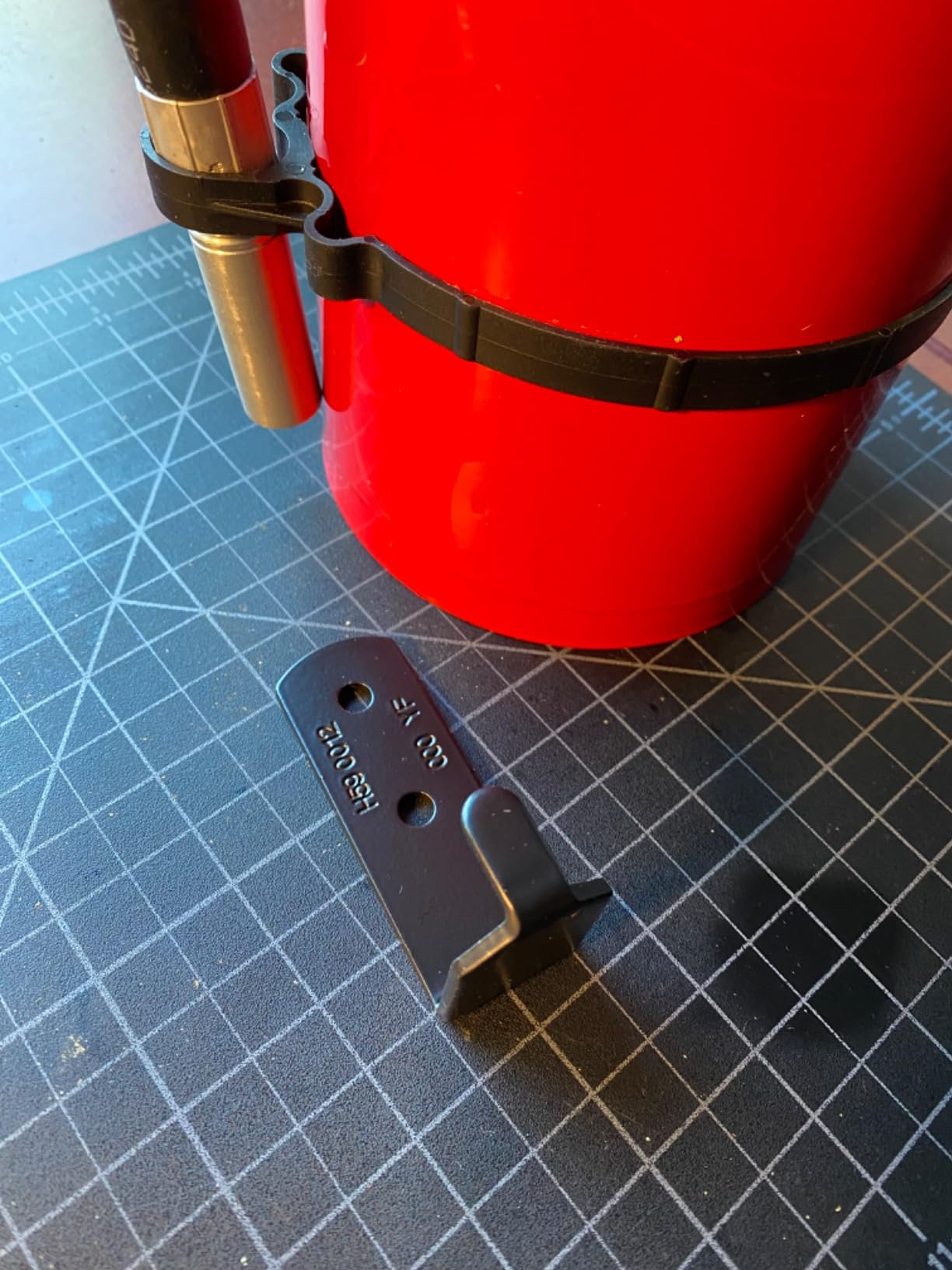
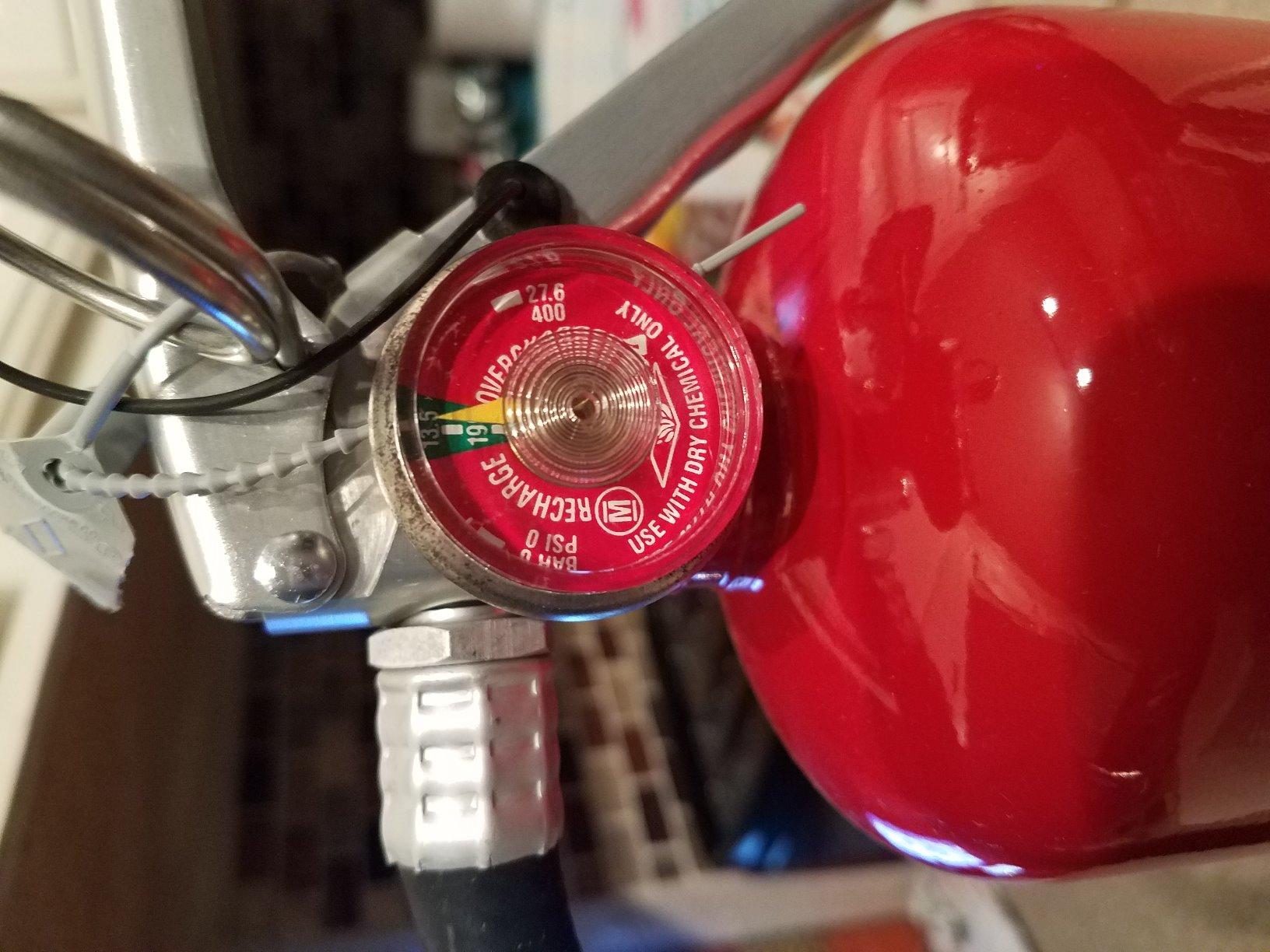
Mounting is handled with a wall hook in the box and a color-coded, corrosion-resistant pressure gauge that you can read from a couple of feet away. That gauge matters more than it sounds. The cheapest insurance against a dead extinguisher is a glance at the needle, and a gauge you can read across a room makes people actually do it.
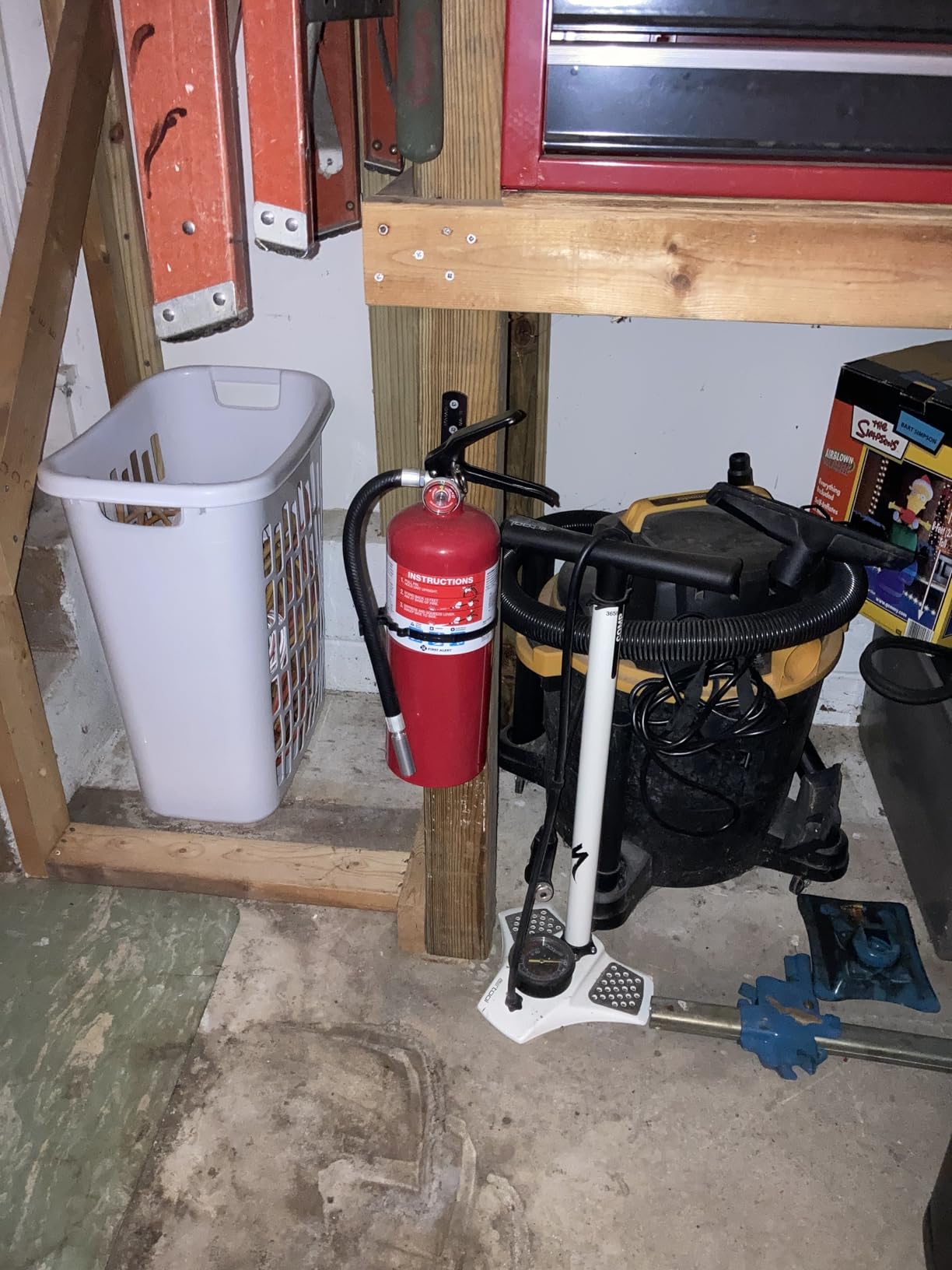
The agent is mono ammonium phosphate in a durable all-metal body, and the listing is aimed squarely at offices, homes and workshops. It measures 5.75 inches deep by 6 inches wide by 17 inches tall, which is a fairly slim cylinder for its capacity and easy to fit between studs or beside a door frame.
How the 2-A:10-B:C rating compares in real shops
Two A units equal 2.5 gallons of water equivalency, and 10-B covers 200 square feet of flammable liquid fire. A 300 square foot wood shop with a bench grinder and a wall of hand tools fits inside that comfortably. A 900 square foot shop with a paint booth and a solvent store does not.
So the question is not whether the rating is good, it is whether the rating matches your floor area and your worst hazard. If you have a lot of flammable liquid storage, step up to a 3A:40-B:C unit. If you have mostly wood and paper, this one is fine and the extra coverage buys you little.
Where this unit falls short
The 9.6 lbs item weight is the highest listed among the units in this group, and that matters in a small shop with one person working alone. A heavy unit that you hesitate to grab is worse than a lighter unit you move without thinking about it.
It is also sold in only three variants, so if you want a different capacity or a different mounting style within this line, your options are limited. Buyers who need a vehicle bracket or a bulk pack for a multi-room shop will find more flexibility elsewhere.
Finally, at roughly 17 inches tall the cylinder is tall enough to look like it might topple if knocked, so the wall hook is worth installing properly rather than leaning it in a corner.
3. Amerex B402 5 lb ABC Dry Chemical Fire Extinguisher – Professional Metal Valve Build
Amerex B402, 5 lb. ABC Dry Chemical Fire Extinguisher, with Wall Bracket
5 lb ABC dry chemical
All-metal aluminum valve
Wall bracket included
Rechargeable design
Pros
- All-metal valve that resists the corrosion plastic valves suffer
- Rechargeable rather than single-use
- Sturdy wall bracket in the box
- 5 lb of agent suits mid-size shops
Cons
- Listed weight of 9.44 lbs is heavy for prolonged carry
- Discharge time is not published in the specs
- Some third-party listings omit the bracket
Amerex is the brand that comes up again and again when shop owners and fire service people talk about extinguishers, and the B402 is the reason. It is a straightforward 5 lb ABC dry chemical unit with an all-metal valve and aluminum valve construction, which is the hardware standard the whole category is measured against.
It handles Class A ordinary combustibles, Class B flammable liquid spills and Class C fires involving live electrical equipment. That covers the three hazards that account for nearly every workshop fire we read about, from a dust filter fire to a solvent spill to a motor that shorts while you are welding next to it.
The rechargeability is the difference between this and a disposable unit of similar size. When the powder is spent, a technician refills the same cylinder and it goes back on the wall, which over the life of a shop is the difference between one purchase and several.
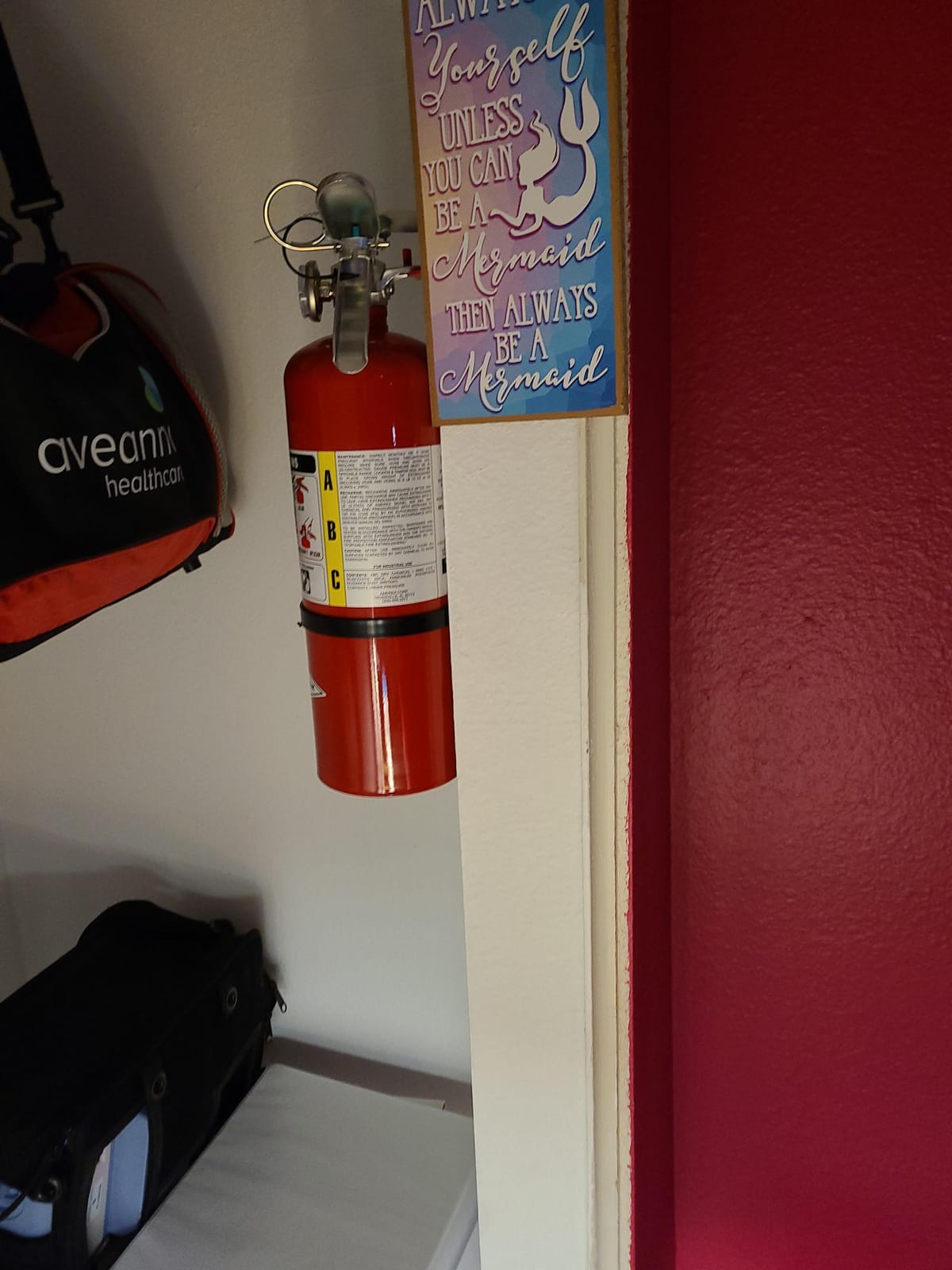
Reviewers with fire service experience point at the metal valve specifically when they compare this against cheaper brands. Plastic valves are the component that lets go first, and once a valve leaks down the unit reads low on the gauge forever. The B402 does not have that failure mode in the same way.
Several buyers report putting these to work in real events, including grease fires, electrical fires and vehicle fires, and the included wall bracket is a quick-release hanger style that lets you grab the unit with one hand. That is a genuinely useful detail when your other hand is holding a fire door.
What the missing discharge time means for planning
The published specifications for the B402 do not list a discharge time, and that is the one gap we would want a shop owner to know about. A comparable 5 lb Amerex unit in this list states 14 seconds, and most 5 lb dry chemical units in this class run in that range.
Practically, that is enough agent to cover something the size of a waste bin or a small bench fire. It is not enough for a fire that has reached the wall studs. Know your building’s construction and treat the first minute as the only window you will get.
The bracket-inclusion issue is worth a second look at the listing when you order. Most buyers receive the wall bracket as described, and reviewers describe it as a quick-release hanger, but a few third-party listings arrive without one. Check the box contents the moment it arrives.
Where the B402 is the wrong choice
The listed weight of 9.44 lbs puts it among the heavier units here, and for a workshop where one person works alone in a detached building, that is a real consideration. It is a fine unit for a two-person shop, less so for a solo maker working solo.
It is also the wrong tool for electronics and for anything where powder landing on a surface is expensive. Monoammonium phosphate is mildly corrosive, and it will find its way into switches, connectors and bearing housings. A clean agent unit in the same room handles that fire without the cleanup.
Finally, a single 5 lb ABC unit is not a substitute for two. Workshops that buy one and stop should read our mounting section below, because travel distance and the path of travel matter more than the model on the label.
4. Amerex B500 5 lb ABC Dry Chemical Fire Extinguisher – 14-Second Discharge
Amerex B500 Fire Extinguisher, 5 lb. ABC Dry Chemical
5 lb ABC dry chemical
14 second discharge time
Rechargeable
6-year warranty
Pros
- Published 14 second discharge time
- All-metal valve with aluminum construction
- Wall bracket included
- Rechargeable with a 6-year warranty
Cons
- Rating listed only as Class A:B:C with no numbers
- Published item weight appears wrong in the listing
- Same weight class as other 5 lb Amerex units
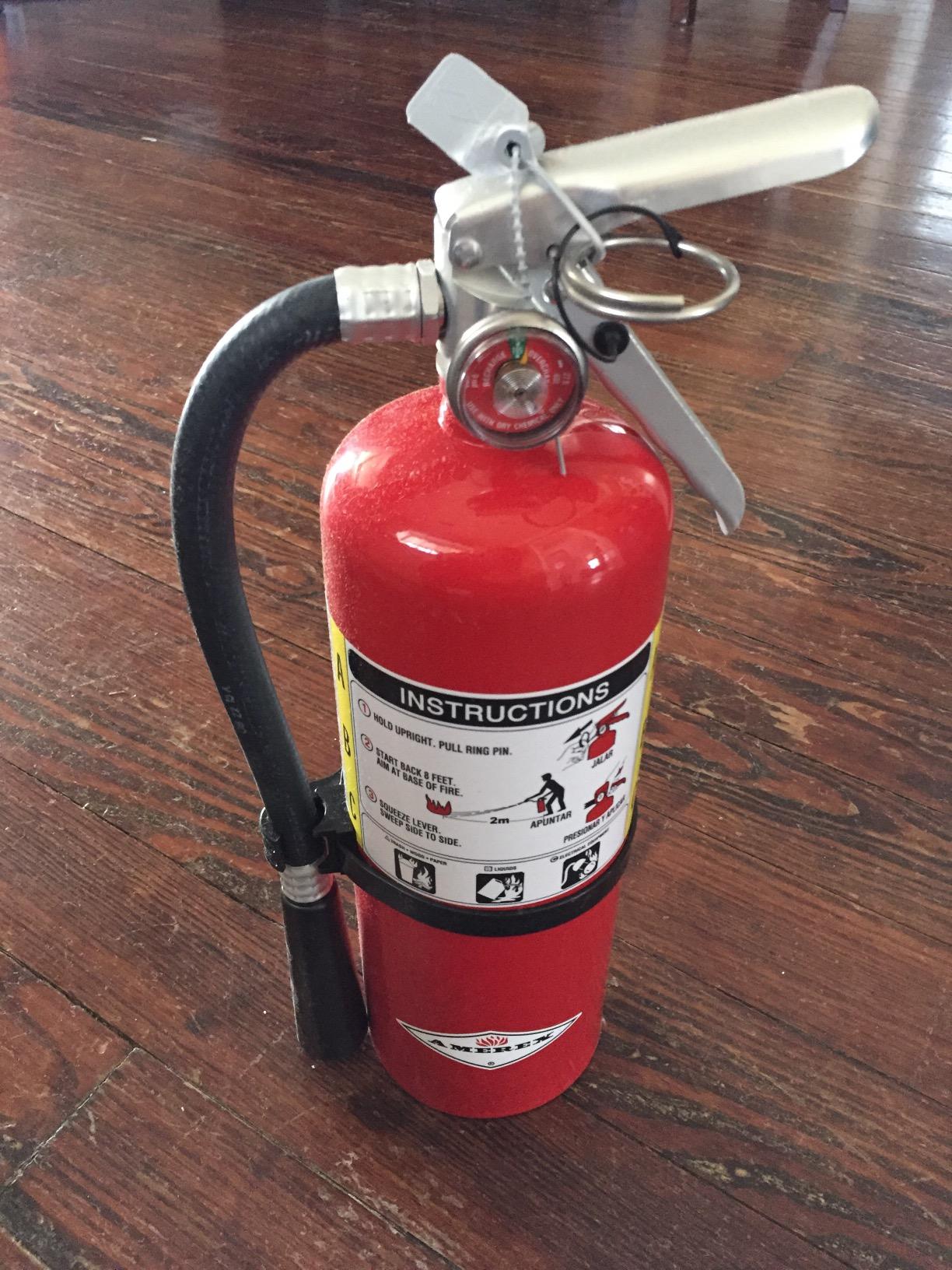
The B500 is the same Amerex design language as the B402 with one difference you can actually plan around: a published 14 second discharge time. For a shop owner trying to work out whether a unit is sized for the fire they are worried about, that number is worth more than most of the marketing on the box.
It is a 5 lb ABC dry chemical unit rated for Class A ordinary combustibles, Class B flammable liquid spills and Class C live electrical fires, with an all-metal valve and a wall bracket in the box. The cylinder is aluminum, which resists the corrosion that shows up on steel units parked in a damp shop for years.
Like the B402, it is rechargeable, and it carries a 6-year warranty. If you are choosing between two Amerex 5 lb units, this is the one to pick when discharge duration and cylinder material matter more to you than a specific brand of valve.
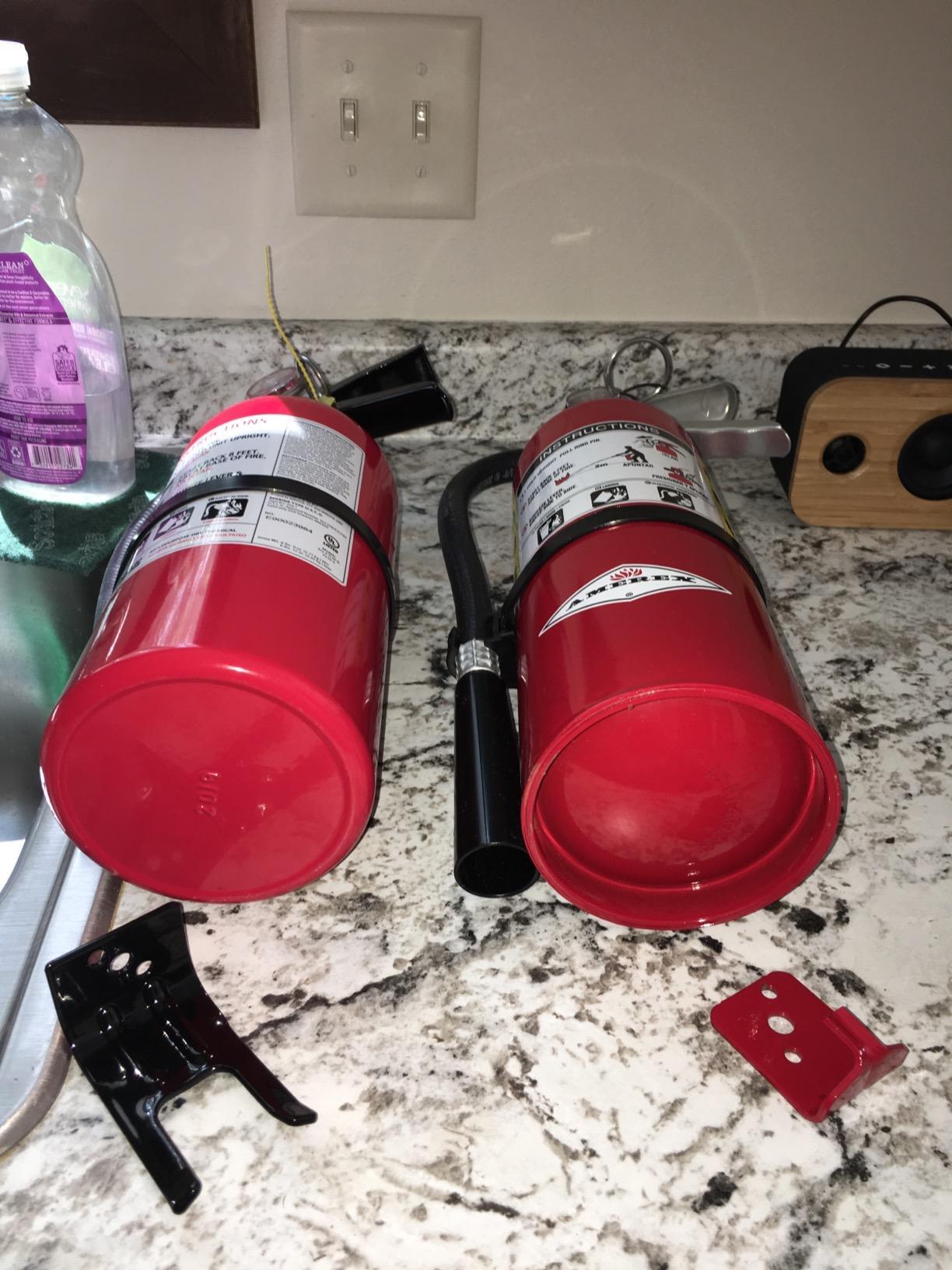
Feedback on this unit skews consistent: 85 percent of reviews are five star, and owners describe it as a solid commercial or residential choice with no drama. It has been on the market since 2013, which means there is a long record of owners reporting how it held up after a decade of shop dust and heat.
The wall bracket being in the box is still the detail that separates these Amerex units from generic ones. People on forums asking where to mount a workshop extinguisher consistently want the hardware included rather than as a separate purchase, and this one answers that.
Why the 14-second figure changes your planning
Fourteen seconds of discharge at a normal sweep is roughly the difference between catching a fire while it is still in the pan and missing the window. It also tells you something about the agent quantity: about 5 lb of powder, which is the standard mid-size load for shop work.
Pair that with the 5 lb figure and you have a clear rule. Anything larger than a bin fire, a small bench fire or a pilot ignition is past what this unit can hold, and at that point the correct move is to get out and let the fire department work.
Because the label lists the rating as Class A:B:C without the numeric A and B values, you will need to confirm the exact UL rating before using it to satisfy a code requirement for a commercial space. For a private shop, it does not change the buying decision.
Where the B500 falls short
The listing’s weight field is unreliable. It shows 1 lb, which is obviously a data error, so do not plan your mounting height from the product page alone. Compare physical dimensions instead, at 16 by 15 by 7 inches, and mount conservatively.
Its 4.6 rating sits a touch below the two Kidde units and the B402, and the 1-star share is fractionally higher. That is a small gap, but in a list this tight it is the kind of thing that shows up if you read a hundred reviews looking for a recurring complaint.
Like every dry chemical unit here, it leaves corrosive residue. It is the right call for structure and solvents, and the wrong call for a clean electronics bench.
5. Buckeye 10914 ABC Multipurpose Extinguisher – Anodized Aluminum Valve
Buckeye 10914 ABC Multipurpose Dry Chemical Hand Held Fire Extinguisher with Aluminum Valve and Wall Hook, 5 lbs Agent Capacity, 3-3/8″ Diameter x 7-1/4″ Width x 16-3/8″ Height
5 lb agent capacity
Anodized aluminum valve
Class A B C rated
Wall hooks included
Pros
- Anodized aluminum valve resists corrosion
- Color-coded gauge reads status at a glance
- Wall hooks included for extended service life
- Proven in real vehicle and structure fires
Cons
- Only 381 reviews to learn from
- Less brand recognition for resale listings
- Weight specification unclear
Buckeye is a fire equipment manufacturer rather than a consumer brand, and the 10914 is built to the same commercial expectations as the Amerex units. The valve is anodized aluminum, which is the finish that holds up best in a wet, dusty or salty environment over a decade of service.
It holds 5 lbs of ABC dry chemical agent and is rated for Class A, B and C fires. The physical body measures 3-3/8 inches in diameter by 7-1/4 inches wide by 16-3/8 inches tall, which is a compact footprint for the capacity and easy to fit on a wall bracket between studs.
Wall hooks are included, described by the manufacturer as extending the unit’s service life by keeping the cylinder off the floor and out of the way of mops, chips and castings.
What stands out in the reviews is real-world deployment. Owners report using these on vehicle fires, structure fires and even a grass fire, and fire department inspectors have signed off on them for commercial and institutional settings. That is a different kind of validation than a star rating from someone who stored it.
Color-coded gauges give an at-a-glance status check, which is the same low-cost reliability signal that shop owners mention everywhere. If the needle is out of the green, you know before the fire that you need a service, not during it.
Why commercial-construction hardware suits a paid shop
The anodized aluminum valve is the differentiator. Anodizing creates an oxide layer that resists the moisture and chemical exposure that eventually pits a plain aluminum or steel valve, and in a shop with a paint booth or a wet fabrication area that difference accumulates quietly.
For a commercial operation, this is also the unit a fire inspector is most likely to recognize. Buckeye units appear in warehouses, churches and machine shops, and reviewers mention inspector approval directly.
The wall hooks are the other quiet advantage. Units stored on the floor get kicked, spilled on, and hit by pallet jacks. Units on hooks stay where you put them.
Where this is the wrong pick
With 381 reviews, this has one of the thinner evidence bases in the list, and a shop owner who wants to compare thousands of owner experiences will find less to read here. The specification is sound, but the long-term owner data is thinner than the Kidde and First Alert units.
The published weight is also unclear, listing 2.2 lbs which is most likely the agent weight rather than the full unit. Plan the mounting height from the physical dimensions and from the weight of any comparable 5 lb unit, not from that number.
It is also a dry chemical unit with the same residue problem as the rest of the ABC group. A clean agent belongs alongside it in any room with sensitive equipment.
6. Ougist FF2KG 5 lb ABC Extinguisher – Patented Handle, Bracket and Tags Included
Ougist ABC Dry Chemical Fire Extinguisher, 5 lb – 2-A:10-B:C Rated for Home, Office & Vehicle, Quick Release, Easy-Grip Handle, Ideal for Electrical & Grease Fires, Car Extinguisher, Model FF2KG
2-A:10-B:C UL rated
Patented easy-grip handle
Screw-in bracket included
5 lb ABC dry chemical
Pros
- Patented handle designed for fast activation by anyone
- Bracket guide signs and tags all included
- Works down to -40F and up to 120F
- 4.8 rating across 184 reviews
Cons
- Newest brand in the group with the shortest history
- Only 184 reviews to learn from
- 2-A:10-B:C is the minimum UL rating
The Ougist is the most interesting newcomer here, and the reason is the handle. The patented design is meant to let anyone pull and start the unit without training, which matters in a household or a shop where the person who notices the fire is not the person who installed the equipment.
It is UL rated 2-A:10-B:C with 5 lb of ABC dry powder, covering grease, electrical faults, wood, textiles and flammable gases. The manufacturer claims activation from up to 15 feet away, which is a useful number when smoke is already filling the room.
For a small workshop or a home garage, that 2-A:10-B:C rating is genuinely sufficient. It is the same class-minimum rating that most residential codes require, and it matches the floor area of a single-car garage with a workbench comfortably.
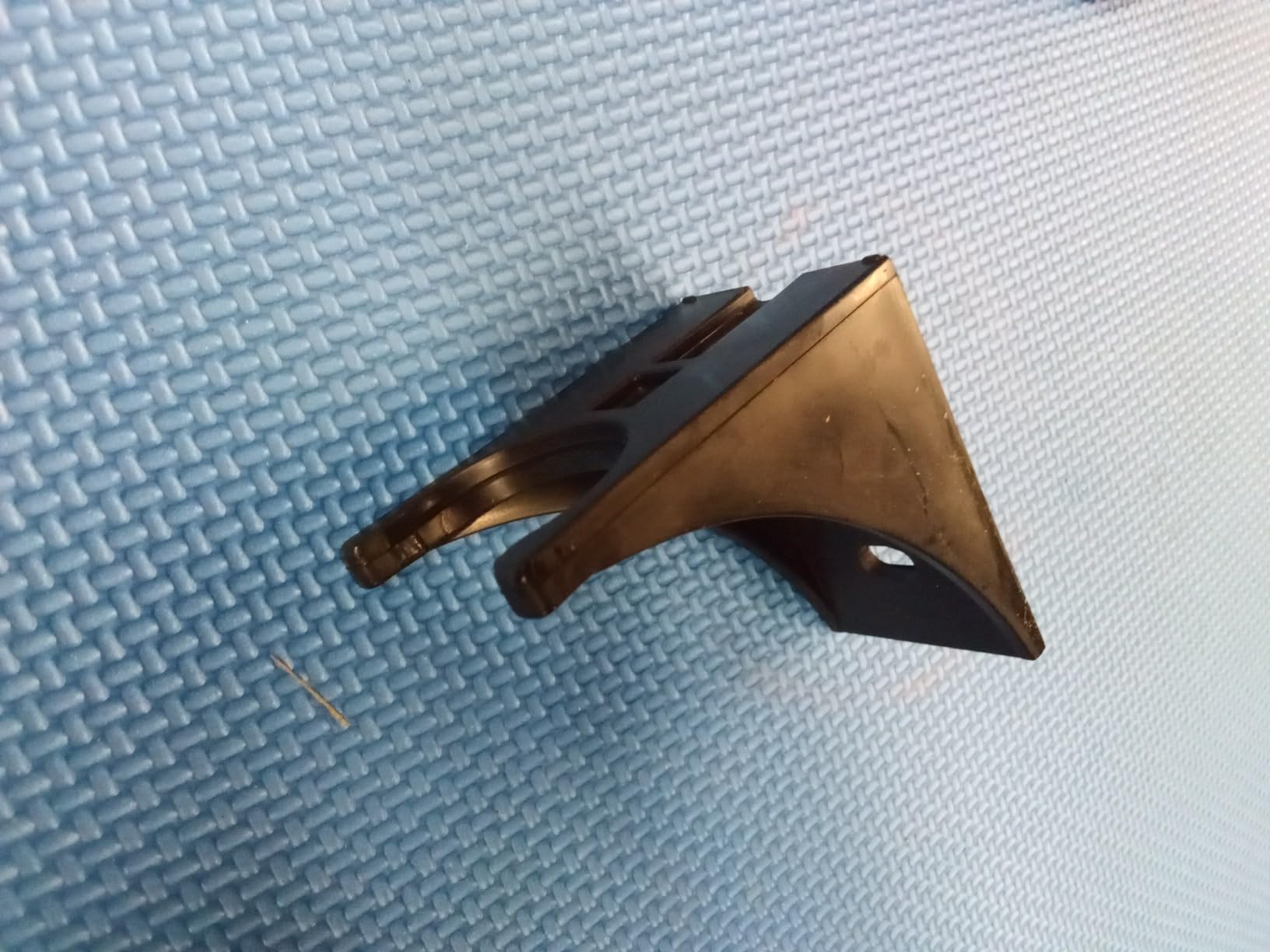
The package is unusually complete. You get the extinguisher, a screw-in mounting bracket, an operating guide, fire extinguisher signs and inspection tags. The signs and tags matter more than they sound, because they are how a commercial shop documents that the unit was inspected.
The listed operating temperature range of -40F to 120F is a spec you rarely see printed on a unit in this group, and for a workshop in a climate with real winters that matters. Freeze-thaw cycles are the leading cause of pressure loss in units stored in unheated shops.
Item weight is listed at 8.27 lbs, which makes it a manageable 5 lb unit and an easy one to move quickly in a panic.
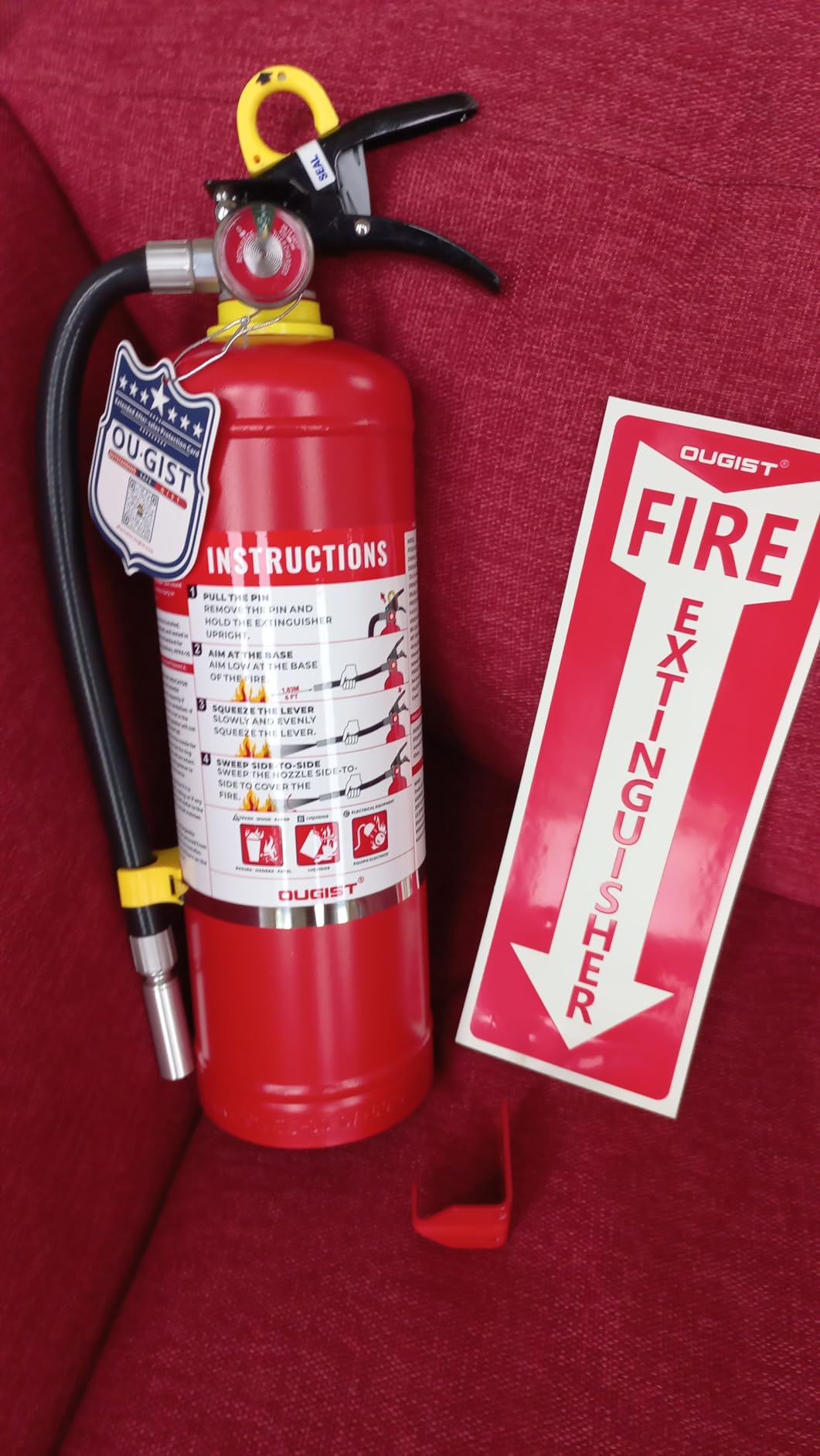
Check the temperature range and the mounting kit
If your workshop is in an unheated shed or a detached garage that sees hard freezes, that -40F to 120F range is the spec to look for. A unit that cannot tolerate the cold in the room you actually store it in is a unit that will read low on the gauge by February.
The screw-in bracket is the second thing to verify on arrival. A bracket that needs two screws into masonry is more secure than one that expects a drywall anchor, and knowing which you have before you are holding a drill over a ladder matters.
The included tags and signs close a loop most buyers ignore. A tag gives you a place to write the last inspection date, and a sign tells everyone else where the unit lives.
Where the Ougist falls short
This brand launched in September 2024, which means it has the shortest field history in the group. A 4.8 rating across 184 reviews is encouraging, but nobody can yet tell you how the valve looks after six years in a dusty shop.
That is exactly the objection experienced owners raise in the forums, and they are right to raise it. On a device you may never use, long-term reliability is the whole product. Buy a proven brand if you want evidence rather than a good spec sheet.
It is also a dry chemical unit, so the residue question applies here as it does to the rest of the ABC group. And one reviewer flagged a weight discrepancy against the advertised 5 lb, which the seller resolved, but it is a reminder to check the agent label yourself.
7. Kidde Full Home Fire Extinguisher 3-A:40-B:C – Service-Free Design
Kidde Full Home Fire Extinguisher, 3-A:40-B:C, KD176-340ABC
3-A:40-B:C UL rated
5.5 lbs monoammonium phosphate
13-15 second discharge
Single-use, not rechargeable
Pros
- 3-A:40-B:C rating in a service-free design
- 13-15 second discharge at 12-18 foot range
- Metal valve assembly and easy-read gauge
- 8.25 lbs listed weight in a slim cylinder
Cons
- Single-use only and cannot be recharged after a discharge
- Plastic wall hanger instead of metal
- Mounting screws not included
This is the odd one out in the list, and the reason is the 12-year service-free design. There is no recharge to schedule, no service tag to expire and no hydrostatic test to remember. It is a disposable unit built to sit on a wall and be trusted for a decade, which is a different philosophy from the rechargeable units above it.
Underneath that, the hardware is good. You get a 3-A:40-B:C UL rating, 5.5 lbs of monoammonium phosphate, a 13 to 15 second discharge across a 12 to 18 foot range, and a metal valve assembly with a rust and impact-resistant handle and an easy-pull safety pin.
That rating is the same as the Pro 340, which makes it one of the stronger-rated units available for a workshop, and it is widely used for foster care and daycare inspections where inspectors want a documented service life rather than a maintenance record.
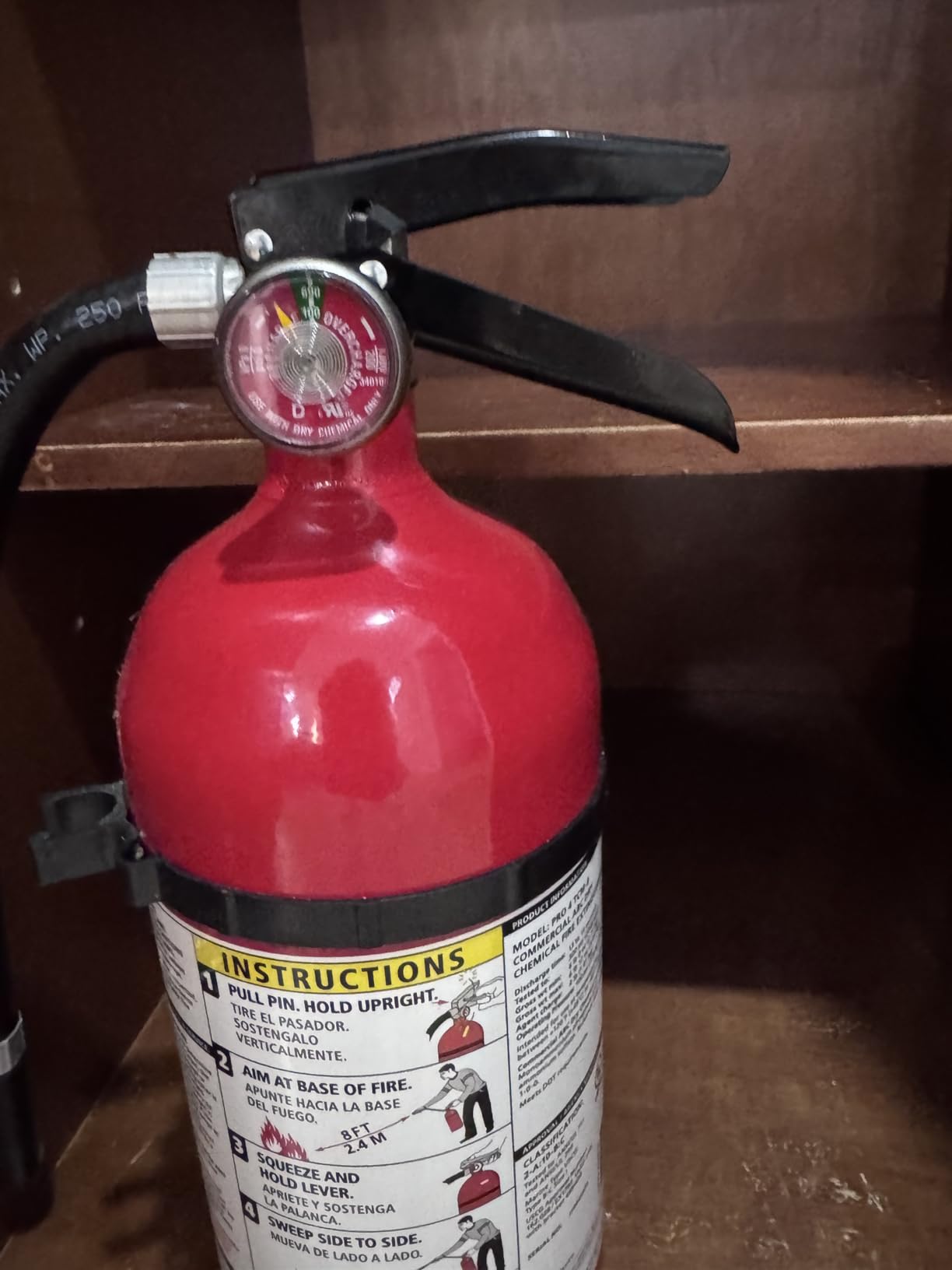
The pressure gauge is easy to read, and the arrow in the green means charged. The QR code on the label gives you quick access to registration, warranty and product information without hunting for a paper card.
At 8.25 lbs as listed and 4.5 by 4.5 by 16.8 inches, it is a slim, light cylinder that fits a narrow wall gap. For a solo operator in a small shop, those two numbers together make it an easy unit to grab and use.
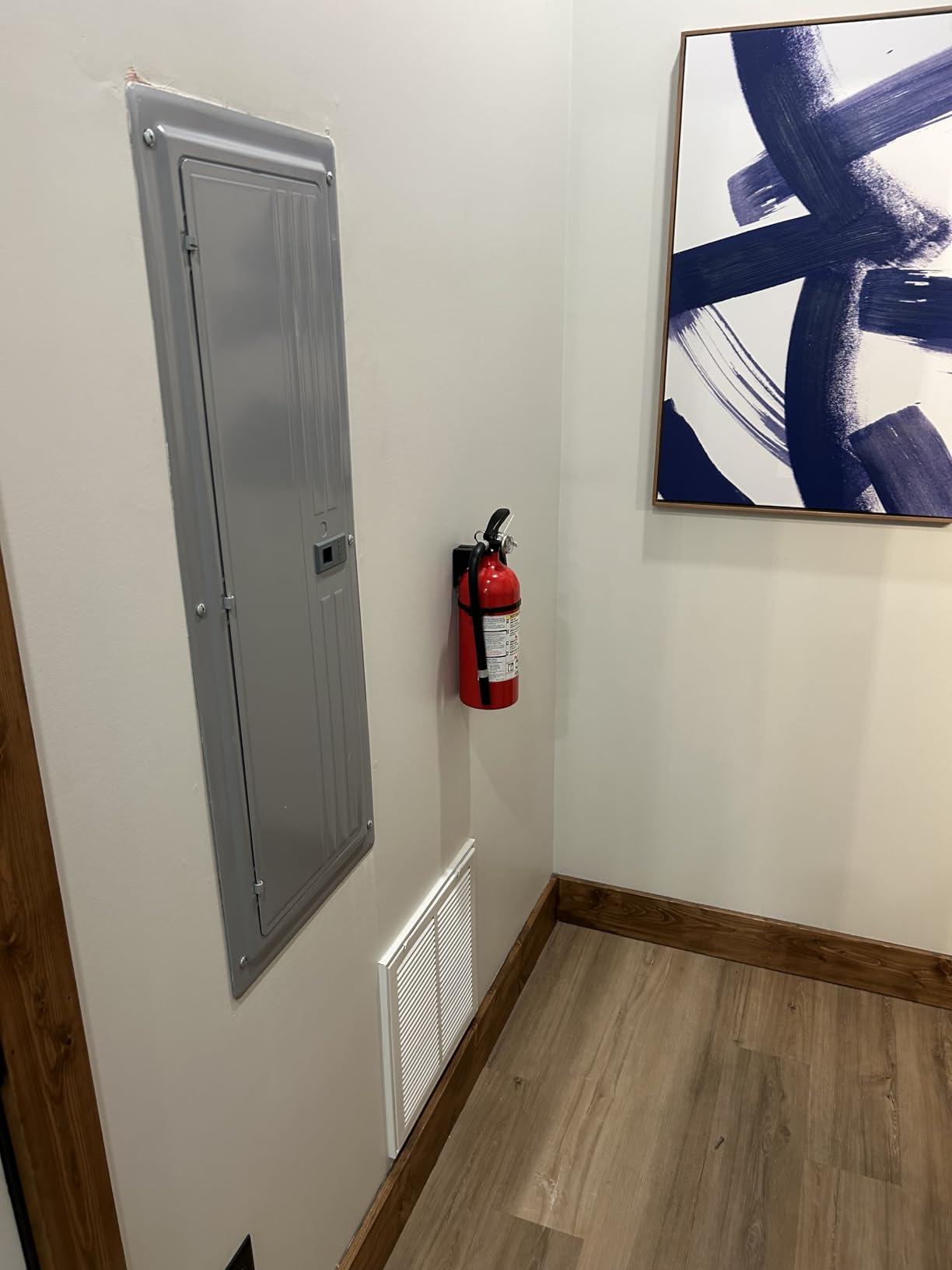
What service-free actually means for you
Service-free does not mean maintenance-free in the sense of ignoring it. You still want a monthly glance at the gauge and a check that the pin is intact and the seal is unbroken. What it means is that there is no six-year service cycle and no refill cost if you do use it.
For most home and small shop situations that is the simpler system. A rechargeable unit is cheaper over many years in a busy shop, but it depends on remembering a date that has no reminder in your calendar.
If your operation is inspected, the 12-year service life is often easier to evidence than a service tag. That is why this unit shows up on inspection checklists.
Where this unit falls short
It is single-use only. After one discharge it is finished, and that is the point where the rechargeable comparison gets decided. In a shop with several extinguishers that get used for training or small incidents, replaceability adds up.
The included wall hanger is UL-approved plastic rather than metal, and mounting screws are not included. A plastic hanger in a hot shop near a welding bay is the first component we would replace.
And one 5.5 lb cylinder is still one cylinder. A shop with a dust collection system, a paint booth or a solvent store needs a second unit on the far wall, because travel distance decides more than the number printed on the label does.
8. Amerex B402T 5 lb ABC Multi-Purpose Fire Extinguisher – Vehicle Bracket Included
Amerex B402T ABC Multi-Purpose Fire Extinguisher, 5 lb.
3A:40B:C UL rated
5 lb ABC dry chemical
Vehicle bracket included
All metal valve
Pros
- 3A:40B:C rating with a 5 lb agent load
- Vehicle bracket suits a service truck or mobile kit
- All metal valve construction
- Compact 15.25 by 7.25 by 4.25 inch body
Cons
- Highest 1-star rate in this group at 5 percent
- Smallest best-seller rank in the list
- Marketed as commercial rather than consumer
The B402T is the variant of the Amerex 5 lb ABC that comes with a vehicle bracket instead of a wall bracket, and that one change defines its use. If your shop is a service truck, a mobile repair setup or a trailer, this is the unit that stays put where the work happens.
It carries a 3A:40B:C UL rating with 5 lb of ABC dry chemical and an all metal valve, covering ordinary combustibles, flammable liquids and energized electrical equipment. The body measures 15-1/4 by 7-1/4 by 4-1/4 inches, which fits under a bench seat or in a service body without dominating the space.
Mobile work is where the rating numbers matter most, because a vehicle fire grows faster than a room fire and the first thirty seconds decide whether you are clearing a tool chest or losing a truck.
Feedback on this unit comes from commercial and industrial buyers rather than home users, which shows up in how reviewers describe it. They talk about spec compliance and mounting in vehicles, not about which cupboard it lives in.
Our broader guide to the best fire extinguishers for cars covers the tradeoffs between agent types for vehicles in more detail, and it is worth reading if the mobile unit is your only coverage.
Why a 3A:40B:C rating matters in a vehicle
The A figure here is the water equivalency of the unit and the B figure is the square footage of flammable liquid coverage. A vehicle or a machine full of solvent is almost entirely a flammable liquid fire, so the B side of the rating is doing most of the work in that scenario.
Three A units give 3.75 gallons of water equivalency and 40 B units cover 800 square feet of Class B surface. On a truck carrying fuel, oil and aerosol cans, that headroom is what lets you deal with a spill fire rather than just knocking flame off it.
Pair the mobile unit with a smaller unit inside the vehicle. A 5 lb cylinder will not help much if it is bolted outside the cab and the fire is under the seat.
Where the B402T is the wrong choice
It carries a 5 percent 1-star share, the highest in this group, and only 330 reviews. The complaints tend to center on listings and packaging rather than on failure, but at this sample size a few bad experiences move the number a long way.
For a fixed shop, the wall-mounted variants in this list are the better buy. You would be paying for a vehicle bracket you will not use if the unit is going on a stud wall.
It is a commercial product, so expect commercial handling. The cylinder is not designed to be dropped off a tailgate repeatedly, and the bracket is meant for a fixed mount point rather than a loose one.
What Type of Fire Extinguisher Is Best for a Workshop?
An ABC-rated dry chemical fire extinguisher, UL listed at 2A-10B-C or better, mounted on the path of travel, is the right answer for almost every workshop. ABC monoammonium phosphate covers ordinary combustibles like wood and sawdust, flammable liquids like solvent and finish, and live electrical equipment, which together account for nearly all workshop fires. Add a clean agent unit for electronics and welding bays.
The five fire classes are worth knowing by name, because a label you cannot read is a label you cannot shop around. The identification symbols are printed next to the rating: a green triangle for Class A ordinary combustibles, a red square for Class B flammable liquids, a blue circle for Class C electrical, a yellow star for Class D combustible metals and a black hexagon for Class K cooking oils.
Mapped onto a workshop, the classes line up like this. Wood, paper, sawdust, cloth and cardboard are Class A. Solvent, thinner, paint, body filler, gasoline and cooking oil near a shop kitchen are Class B. A live panel, a motor winding, a charger and a cordless tool battery are Class C. Magnesium and aluminium swarf from welding is Class D, and a break room with a cooking appliance is Class K.
There is no single unit that is correct for all of those. Dry chemical ABC units are what most shops buy, and they work, but a shop owner on a classic car forum made the fairest criticism of that advice I read: a dry chemical extinguisher knocks down a gas fire and is poor on a wood fire and a real electrical fire, and the residue gets into everything. The practical answer is not to replace the ABC unit, it is to add a second one matched to the room.
For a welding bay specifically, add a CO2 or clean agent unit alongside the ABC, because arc flash and energized equipment fires happen at the bench and dry powder makes a mess of the machine. If anyone in the shop grinds magnesium or welds aluminium, a Class D dry powder unit belongs in that bay too.
And if you have lithium-ion tool packs or an EV charger on site, treat that as a Class C and Class D overlap. Keep the packs off concrete in a metal container away from the extinguisher itself, and never seal a venting battery in an airtight box. The extinguisher on the wall handles the fire; the storage habits determine whether you ever face one.
5 lb or 10 lb: Sizing a Fire Extinguisher by Shop Size
Five pounds is enough for a workshop up to roughly 400 square feet with ordinary hazards. Ten pounds belongs in shops above that, anywhere with heavy solvent storage, a paint booth or a large sawdust collection system, and any space with a second person working who would struggle to lift a full unit quickly.
The size question is really about the distance between the extinguisher and the fire, because the jet has a limited useful range. Most 5 lb units in this class discharge for 13 to 15 seconds across 12 to 18 feet. If the far corner of your shop is more than that from any wall-mounted unit, you are asking someone to stand in the fire to use it.
So size the shop first, then check the travel distance. A 250 square foot two-car garage is comfortably served by a 2.5 or 3 lb unit mounted by the door. A 500 square foot shop with a table saw, a bandsaw and a dust collector wants a 5 lb ABC at minimum. A 1,500 square foot fabrication shop with a welding bay, a paint area and a parts store wants at least one 5 lb ABC and one larger unit, mounted so nobody has to cross the whole floor.
Weight is the honest limiter here. A 10 lb rechargeable unit with a brass or metal valve is genuinely hard to control one-handed, and that is why people in the forums keep coming back to the line that the biggest unit you can handle is the best one. A unit you can lift and aim in a smoke-filled room beats a bigger one you never get out of the bracket.
If you find yourself torn between two sizes, take the smaller one and buy a second unit rather than a bigger one. Two 5 lb units on opposite walls of a large shop do more for you than one 10 lb unit that lives in a cabinet nobody opens.
How to Read the UL Rating Numbers on a Fire Extinguisher
The rating on the label is written as a Class A number, a colon, a Class B number, then a C, with a K following when a wet chemical unit is rated for cooking media. The A figure is water equivalency, and the standard conversion is 1.25 gallons of water per A unit. The B figure is square footage, and the standard conversion is 20 square feet of Class B coverage per B unit.
Worked example. The Kidde Pro 340 is labeled 3A:40-B:C. Three A units equal 3.75 gallons of water equivalency, and 40 B units cover 800 square feet of flammable liquid surface. The C confirms it is rated on fires involving live electrical equipment. The Amerex B402T carries the same 3A:40B:C figures on a 5 lb agent load.
Second example. The First Alert HOME2PRO and the Ougist are both 2-A:10-B:C. Two A units give 2.5 gallons of water equivalency, and 10 B units cover 200 square feet of flammable liquid. That is the code minimum for a general-purpose unit and it suits a home garage or a small shop.
Notice what has no number. There is no numeric rating for Class C because any agent listed for A or B is assumed to be non-conductive and therefore usable on electrical fires. Class D is rated by test rather than by number, because a magnesium fire and an aluminium fire behave differently. Class K is passed or failed against a cooking-media fire test.
So when a shop owner asks what the different UL ratings for fire extinguishers actually mean, the short answer is this: the A number sizes you for combustibles, the B number sizes you for flammable liquids, the C is a yes or no for electrical, and D and K are pass or fail. For a workshop, look for 2A-10B-C as the floor and 3A:40-B:C as the target.
One more practical note. UL listed means the whole unit, including the agent, valve and cylinder, was tested and certified. UL rated applies to a component. A label that says only UL rated on the extinguisher itself is a reason to look more closely at what exactly was tested.
Rechargeable vs Disposable Fire Extinguishers for Workshops
A rechargeable unit has an all-metal valve, a service tag and a six-year cycle of internal inspection and hydrostatic testing, and it can be refilled after use. A disposable unit has a plastic or simplified valve, no service tag, and a defined service life of roughly 12 years before it is replaced. The rechargeable unit costs more up front and less per discharge. The disposable unit costs less up front and the same every time after.
The break-even question is how often you will actually discharge a unit. In a busy shop with apprentices, hot work permits and occasional electrical faults, units do get used, and a recharge beats a replacement. In a one-person shop where the extinguisher has never left its bracket, a service-free disposable is the simpler system and the one fewer thing to forget.
Forum experience points at the same split. The failure people complain about most is not a bad cylinder, it is a unit that sat in a freezing shed for three winters, lost pressure and never got noticed because nobody remembered to look. That failure is a maintenance problem, and it can happen to either type.
Metal valve assemblies resist the corrosion and impact damage that end plastic valve units. What tips the decision in most workshops is that hardware. That is the kind of specification worth paying for, and on a unit that may hang on a wall for a decade it decides more than the brand on the label does.
Our rule of thumb: rechargeable all-metal units for any shop with more than one person or any hot work, service-free disposable units for a single-operator garage. Whichever you choose, buy the one that comes with a wall bracket, because the most common failure is the unit ending up in the wrong place.
How Many Extinguishers a Workshop Needs and Where to Mount Them
Two units is the working minimum for any workshop with more than one room or more than 600 square feet, mounted so that no point in the building is more than about 75 feet of travel from a unit along the normal path of exit. In practice that means one unit by the exit door you actually use, and a second one on the far side of the shop or in the room with the worst hazard.
Mount them where you can see them and reach them. Not behind a parked vehicle, not behind a stack of plywood, not on a shelf above your head. Large and heavy units belong with the top of the cylinder below shoulder height, and nothing should sit in front of them. The number of workshop extinguishers that have ended up blocked by a car is the most reliably reported complaint in the forums.
Storage conditions decide whether any of this matters. A unit parked in a hot truck bed all summer, or in a shed that freezes and thaws all winter, will lose pressure regardless of what kind it is. Store them indoors, mounted, between roughly 40F and 100F, and off the floor.
Check the gauge within 30 days of any purchase. Owners across the woodworking forums keep finding units that arrive partially discharged or with the pin seal already broken, and a unit that has quietly leaked in transit is not a unit you want to discover during a fire. A 60-second monthly check covers most of it: needle in the green, pin intact, seal unbroken, no rust or dents, nozzle clear.
If you have employees, the compliance layer matters too. Under OSHA, providing portable fire extinguishers for employee use means you also need an emergency action plan, a written inspection schedule and training for anyone expected to use one. Our guide to preventing and fighting fires around fuel and electrical systems covers the hot-work side of that.
And do not cover the whole question with one unit. A 5 lb ABC handles structure, liquids and electrical in one cylinder, but the moment a fire reaches the wall, or a solvent fire spreads along a bench, that unit is out of capacity. Get out, close the door behind you, and let the fire department work from the outside.
How to Use a Fire Extinguisher: The PASS Method
PASS is the standard sequence and it takes about fifteen seconds to remember: Pull, Aim, Squeeze, Sweep. Before any of it, make sure the fire is small enough to fight, the room is not full of smoke, and you have a clear exit behind you. If any of those are false, you are leaving, not fighting.
Pull the pin. This breaks the tamper seal and unlocks the handle. Twist to break the seal first if it is intact.
Aim the nozzle at the base of the flames, where the fuel is. Aim low, not at the flames themselves, because that is where the fire is being fed.
Squeeze the handle to start the discharge, and hold it down.
Sweep side to side across the base of the fire until it goes out, watching for re-ignition as you back away.
Two cautions specific to workshop equipment. With a CO2 unit, the horn discharge is extremely cold and the gas displaces oxygen, so never use one in a small enclosed space without ventilation, and never aim it at a person. With a dry chemical unit, plan for the powder. It will get into bearings, switches and control cabinets whether or not the fire is out.
A fire blanket beats an extinguisher for a small pan or solvent fire on a person or a machine surface, because it smothers without residue. It does nothing for a spreading fire, and a blanket over a liquid fire with the lid off will let the burning liquid run down the sides. Keep one in the welding bay and one near the solvent store, and know which is which before you need it.
Fire Extinguisher Maintenance and Inspection Schedule
A workable maintenance calendar has four intervals. Monthly, walk the gauge on every unit and confirm the needle is in the green. Annually, have a fire equipment company service the rechargeable units and replace the tags. Every six years, rechargeable units need a hydrostatic test on the cylinder. At twelve years, disposable units come out of service regardless of appearance.
The monthly check is the one that actually saves you. It takes about 60 seconds per unit and it catches the failure modes that matter: a needle in the red, a broken pin, a missing or broken seal, corrosion around the neck, a nozzle packed with powder, or a unit that has been knocked over and is no longer where you left it.
After any discharge, the unit is out of service immediately even if the fire was small. Tag it, and either send a rechargeable unit for a refill or replace a disposable one. A unit that looks fine after being used once is the most common way a workshop ends up with no working extinguisher at all.
Recharge turnaround is the practical annoyance. Local fire equipment dealers handle it, and they are the right call for rechargeable units rather than big-box retail. Set the reminder for year six when you buy the unit, not in year six when you notice the tag.
One last storage rule worth repeating, because it is the one that quietly kills units. Hot truck beds, unheated sheds and freezing garages are all bad storage, and pressure loss follows temperature cycling. If the only place you have for the extinguisher is a vehicle or a shed that sees winter, buy a unit rated for that temperature range and bring it indoors at the first hard freeze.
Frequently Asked Questions
What type of fire extinguisher is best for a workshop?
An ABC-rated dry chemical fire extinguisher, UL listed at 2A-10B-C or better, mounted on the path of travel, is right for almost every workshop. The ABC agent covers wood, sawdust and cardboard, flammable liquids like solvent and finish, and live electrical equipment. Add a CO2 or clean agent unit for electronics benches and welding bays, because dry chemical leaves corrosive powder on everything it touches.
What type of fire extinguisher is best for a garage?
For a home garage, a 2.5 to 3 lb ABC unit by the door handles the common fires, which are gasoline, a heating unit and a paper or fabric load. A 5 lb ABC rated 2A-10B-C or better is the better choice if you run power tools, store solvents or do any welding. Mount it where it is visible and not behind the vehicle, and check the pressure gauge once a month.
Do I need a 5 lb or 10 lb fire extinguisher?
Five pounds is enough for a workshop up to roughly 400 square feet with ordinary hazards. Ten pounds belongs in larger shops, anywhere with heavy solvent storage, a paint booth or a large dust collection system, and any space with a second person who would struggle to lift a full unit quickly. If you are unsure, two 5 lb units on opposite walls beat one heavy unit in a cabinet.
Which type of fire extinguisher should be kept in a woodworking shop?
An ABC dry chemical unit rated at least 2A-10B-C, sized 5 lb for a typical shop, is the right starting point because wood, sawdust, paper and varnish are the dominant hazards. A water mist unit is worth adding if you work near lithium-ion tool batteries, where water is safer than dry powder. Keep a second unit by the exit and never rely on a single ABC cylinder for a multi-room shop.
What kind of fire extinguisher for commercial building?
Commercial buildings need units sized and placed to NFPA 10 travel distance guidance, so no point in the space is more than about 75 feet of travel from a unit along the normal exit path. Heavy units mount with the top below shoulder height. Under OSHA, providing extinguishers for employee use also means a written emergency action plan, a documented inspection schedule and training for anyone expected to use one.
What are the different UL ratings for fire extinguishers?
The rating reads as an A number, a colon, a B number, then a C, with a K added for wet chemical units. The A figure is water equivalency at 1.25 gallons per unit, and the B figure is square footage at 20 square feet per unit. So 3A:40-B:C means 3.75 gallons of water equivalency and 800 square feet of flammable liquid coverage, plus approval for live electrical fires.
Our Best Fire Extinguishers for Workshops in 2026
For most shops, the Kidde Pro 340 is the unit we would mount first. Its 3-A:40-B:C rating, rechargeable all-metal valve, 13 to 15 second discharge and an included metal wall hanger cover the three hazards that cause nearly every workshop fire, and 5203 reviews give you a large body of owner evidence that it holds up.
If you want a lower maintenance option, the First Alert HOME2PRO pairs a 2-A:10-B:C rating with a 12-year service-free design and a 4.8 rating across 6456 reviews. For a commercial operation, the Buckeye 10914 brings an anodized aluminum valve that inspectors already recognize. And where the work happens in a truck rather than a building, the Amerex B402T comes with a vehicle bracket rather than a wall bracket.
Whatever you choose, the plan around it matters more than the model: two mounted units, monthly gauge checks, a service date on the calendar, and an exit path you can find with your eyes closed. That is what makes the best fire extinguishers for workshops actually work when it counts.