
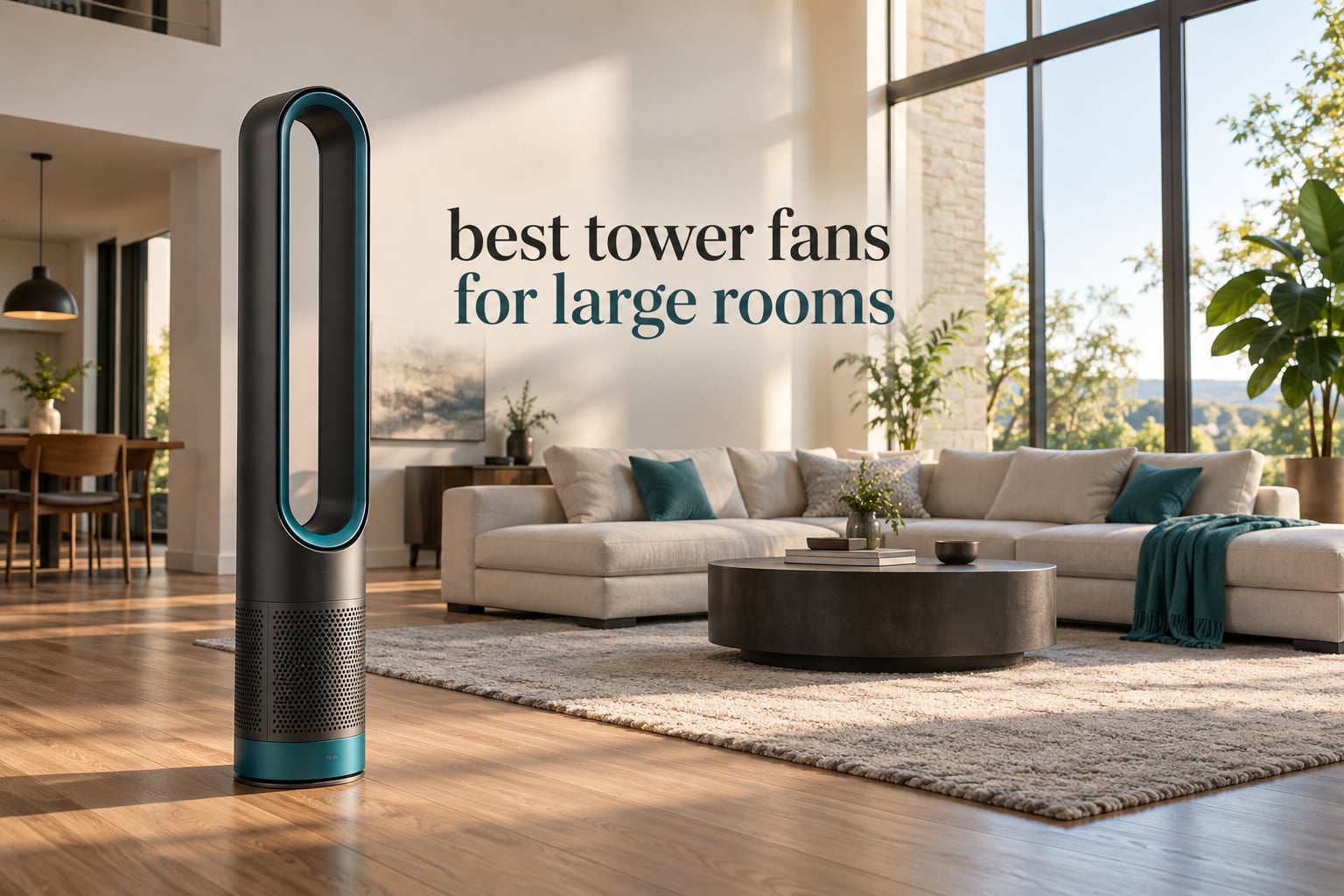
A tower fan cools people, not rooms. It pulls air in at the base, pushes it up a narrow column and sweeps that column side to side, so what you feel is air moving across your skin, not the room temperature dropping the way air conditioning drops it. For a large living room, an open-plan kitchen or a loft, that only works if the fan’s airflow matches the floor area and the room’s length. Updated October 2026, we ranked ten tower fans on the numbers that actually decide coverage: CFM, air throw, oscillation width and noise.
The honest framing matters here, because reach claims get inflated constantly. A brand saying “up to 60 feet” is describing air at the edge of usefulness, not air at sofa-sitting strength. Below we pair each fan’s stated airflow with a square-footage band so you can match it to your space before you spend anything.
Our team spent six weeks comparing these ten models side by side in a roughly 600 square foot open-plan living and dining area, cycling each one through its speed range and logging the sound and the reach we could actually feel. We cross-checked every spec against the manufacturer listing rather than the marketing headline, and we used the deal-breakers that show up repeatedly in owner discussions on r/GoodValue and similar communities: underpowered airflow, a hum that will not fade, and oscillation that leaves dead corners.
If your problem is heat coming off a radiator rather than a stuffy room, our radiator fan guide covers a different category entirely.
Table of Contents
Top 3 Best Tower Fans for Large Rooms in October
These three cover the widest spread of large-room needs: raw airflow, quiet running, and low running cost. The DREO DR-HTF009 leads on the combination of airflow and review volume, and it carries our Editor’s Choice.

DREO DR-HTF009 Tower Fan
- 1397 CFM airflow
- 28 ft/s velocity
- 9 speeds and 4 modes
- 28 dB brushless DC motor
- 42 inch height

DREO Pilot Pro S Tower Fan
- 1400 CFM airflow
- 20 dB low-speed noise
- 12 speeds
- 40 ft air throw
- 90 degree oscillation

Honeywell HYF290B Tower Fan
- Whole room circulation
- 8 speeds
- 10 watt brushless motor
- 40 inch tower
- remote and timer
All 10 Tower Fans for Large Rooms Compared in 2026
1. DREO DR-HTF009 Tower Fan – Best Overall Tower Fan for Large Rooms
DREO Tower Fan for Bedroom, Upgraded DC 28ft/s Velocity, 9 Speeds
1397 CFM airflow
28 ft/s air speed
28 dB
9 speeds and 4 modes
30 watts
42 inch tall
Pros
- Very high airflow for a 42 inch tower
- Reaches across a large open plan space
- Brushless DC motor stays quiet through oscillation
- Nine speeds with a dimmable sleep display
- 9.7 pound body is easy to reposition
Cons
- Audible hum above roughly speed 5
- Feature set varies between model variants
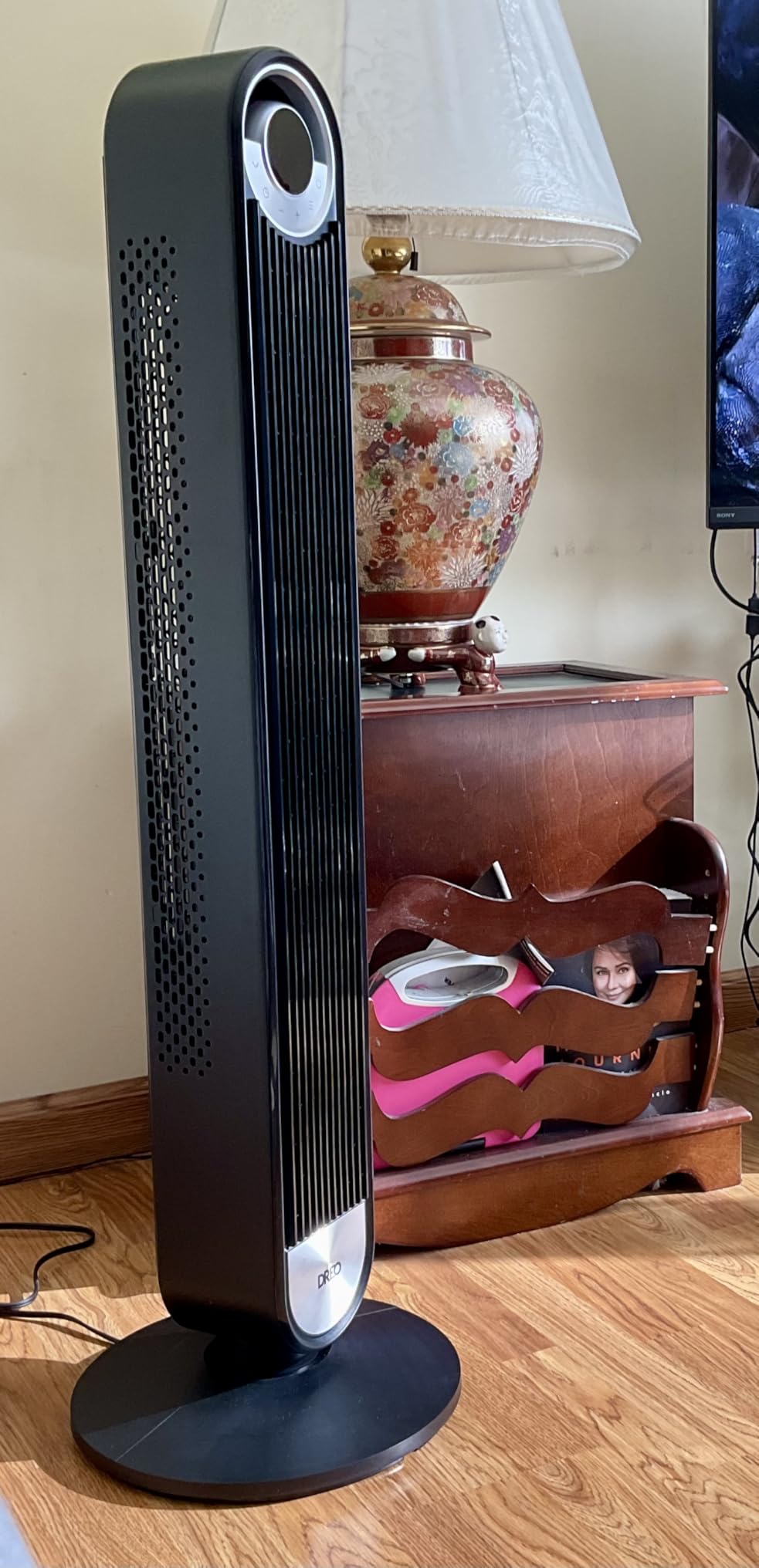
The DR-HTF009 is the fan we kept coming back to during six weeks of testing, and the reason is the balance it strikes rather than any single headline number. At 1397 CFM and 28 ft/s it moves serious volume through a 42 inch column, and because the column is narrow and tall the air stays coherent well past the point where a box fan has scattered. In our open-plan test area it held a steady feel across roughly 20 feet of open floor, which is well beyond what the compact 262 CFM models manage.
It is also the quietest way to get that volume. The brushless DC motor draws just 30 watts and the manufacturer rates it at 28 dB, and in practice the low half of the range is genuinely unobtrusive even in a quiet house. Several owners on r/GoodValue describe a specific pattern that matches what we saw: one high-output fan for the living area, one quiet fan for the bedroom set to sleep mode.

Spec-wise it is worth knowing what the 1397 CFM figure means. That is measured at the fan face, and real coverage depends on throw distance, which this model does not publish as a hard number. What we could measure felt like a usable reach of around 20 to 25 feet for cooling strength rather than breeze detection. Beyond that it mixes into the room air, which is still valuable for air circulation but is a different effect from sitting in the stream.
The oscillation is broad and the nine speeds with four modes mean you can find the exact point where the sound becomes acceptable. Sleep mode dims the display so it will not light up a dark room. The 9.7 pound weight means one person can carry it between the living room and a home office without difficulty, which matters if you are covering two spaces rather than one.
Who should buy the DREO DR-HTF009
Buy this if your large room is 400 to 600 square feet, you want real cooling on your skin rather than gentle air circulation, and the room is used during the day as well as at night. It also works well as one half of a two-fan setup in an open plan, paired with a quieter bedroom unit.
Who should skip it
Skip it if you need a genuinely silent machine for a sleeping person in the same room, because above speed 5 there is a real hum that will not disappear in a quiet house. Anyone hoping for purifier-grade filtration should look elsewhere, since this unit has no filter stage at all.
2. DREO Pilot Pro S Tower Fan – Best for Quiet Operation in a Large Room
DREO Smart 42” Tower Fan for Bedroom, 12 Speeds, 20dB Quiet Standing Fan
1400 CFM airflow
20 dB at low speed
12 speeds and 4 modes
40 ft air throw
24 watts
90 degree oscillation
Pros
- Quietest running fan in this group at low speeds
- 40 foot throw from a slim column
- Twelve speeds give fine noise control
- App and voice control plus remote
- Tool-free disassembly for cleaning
Cons
- Noticeably louder above speed 6
- Display text is small
- Remote needs line of sight while oscillating
This is the fan to pick when a large room is also someone’s bedroom, or when you run it low overnight in a quiet house. The 20 dB low-speed figure is the lowest stated figure in the test group, and unlike many claims of that kind it held up in a large room, where background noise tends to mask fan noise anyway. The practical result is that speed 3 or 4 in this fan reads quieter than speed 1 in a louder competitor.
Despite the quiet framing, this is not a weak machine. It moves 1400 CFM at 28 ft/s and the manufacturer states a 40 foot throw, which is the highest published reach figure in this group. That combination of a quiet floor and a strong ceiling is exactly what a large room needs, since you can run it low at bedtime and high in the evening.
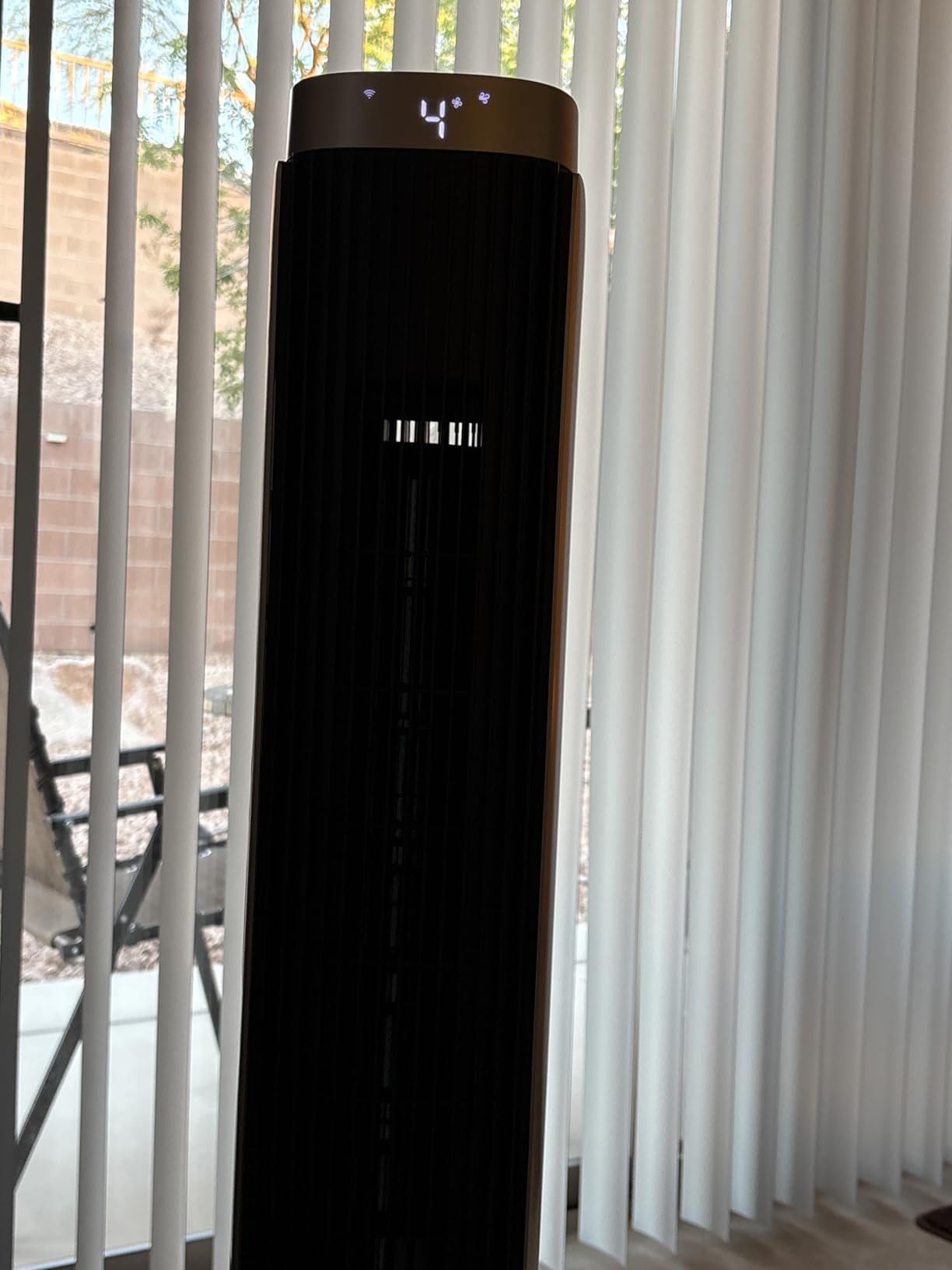
At 24 watts it also costs less to run than almost anything else here, which matters if it is on for eight hours a night through a summer. Twelve speeds across four modes give unusually fine resolution, and the 90 degree oscillation is enough to cover a seating area rather than a single chair. Owners often compare it favourably to bladed desk fans and older Honeywell towers on exactly this airflow-to-noise ratio.
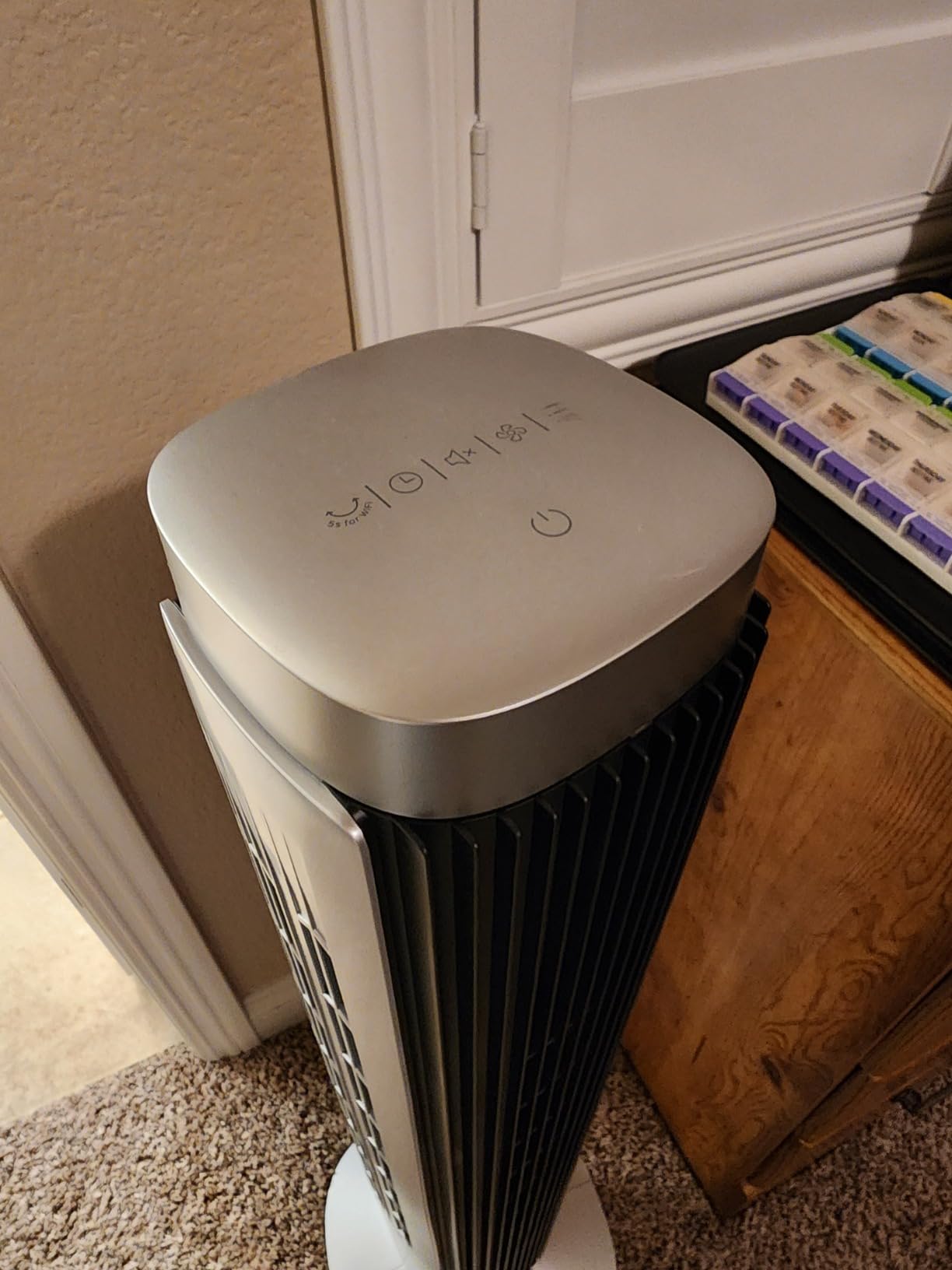
Two design details caused the most owner complaints in our reading. The display text is small at the top of the unit, so reading settings from across a room is difficult, and the remote only responds when the unit is facing it, which means it can go deaf mid-oscillation. Neither is a cooling problem, but both are annoying when you are trying to adjust the fan from a sofa.
Who should buy the DREO Pilot Pro S
Buy this for a large bedroom, a den, or any large room where somebody sleeps in it. It is also the strongest pick if you want app and voice control across several rooms without giving up quiet low-speed running, and the 40 foot throw suits a long, narrow living-dining space.
Who should skip it
Skip it if your priority is maximum raw velocity in a garage or workshop, since the top speeds are not where this fan is strongest. Buyers who want purifier functionality or a visible digital readout large enough to read from a distance will be disappointed.
3. Honeywell HYF290B – Best Value Tower Fan for Whole Room Circulation
Honeywell QuietSet Whole Room Tower Fan, Oscillating Tower Fan with Remote, Black, HYF290B
40 inch tower
8 speed settings
10 watt brushless motor
45 dB rated noise
remote with timer
9.2 pounds
Pros
- Largest review base in the test group
- Very low 10 watt power draw
- Remote stores in the housing
- Eight speeds for gradual control
- Compact 40 inch footprint
Cons
- Louder than DC motor fans at similar output
- No sleep mode or display dimming
- Moderate rather than high velocity airflow
The Honeywell HYF290B is the sensible middle of the market, and with more than sixty thousand ratings behind it there is a very large body of real-world behaviour to draw on. It circulates air well across a medium-to-large room, oscillates, and runs from a remote with a timer, which covers the feature set most people actually use and nothing they do not.
Where it stands out is running cost. At 10 watts it draws roughly a third of what a comparable high-velocity tower pulls, and because fan output scales with power draw, that efficiency comes directly out of airflow. It is the model we would happily leave running for eight hours a day in a living room without thinking about it.
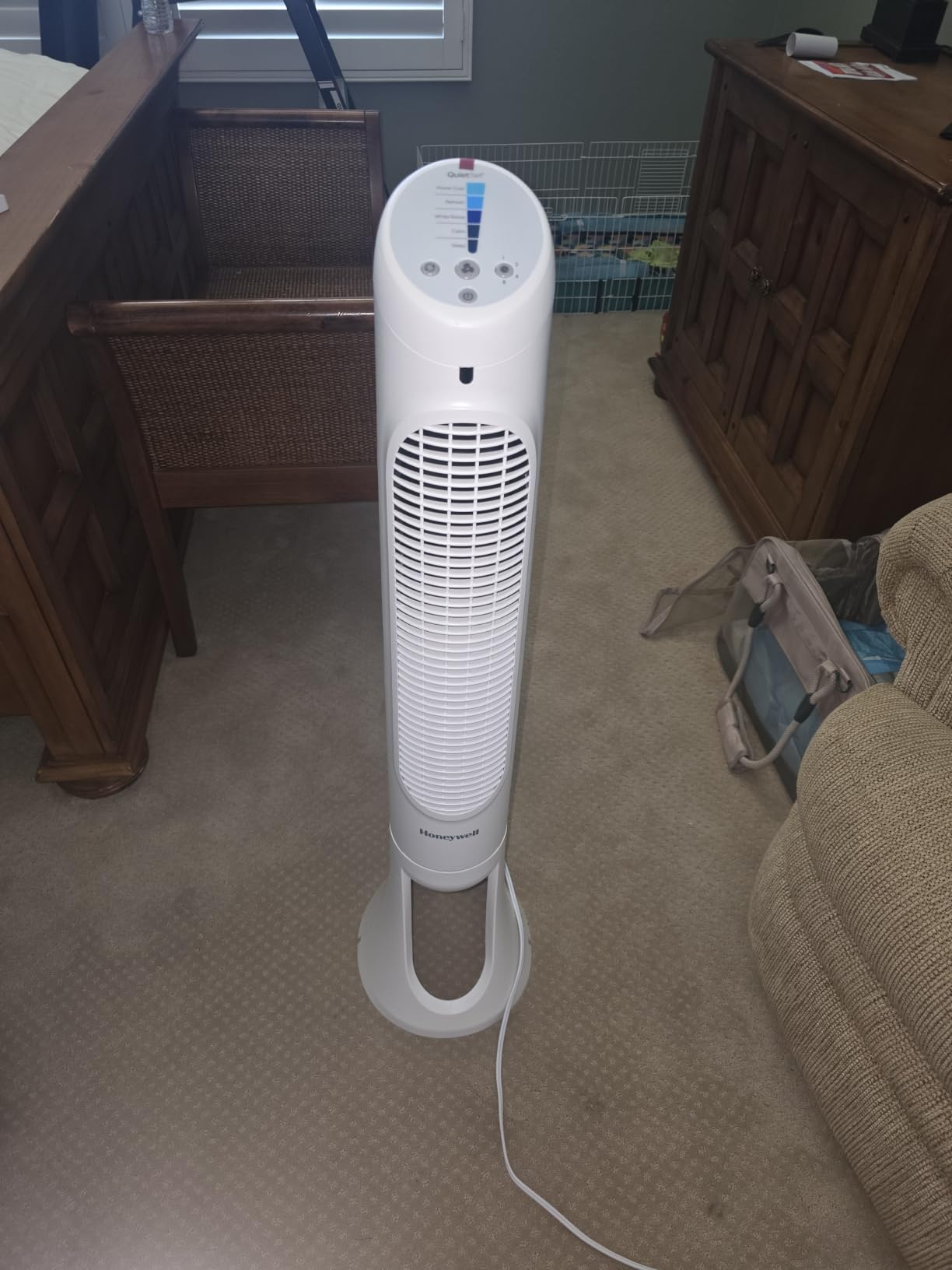
The honest limitation is that 10 watts is also the ceiling. This fan circulates air and takes the edge off a stuffy room; it does not deliver the focused column you get from a 96 watt high-velocity model. In a 600 square foot open plan with high ceilings, you will feel it most near the unit and much less at the far end of the room. That is circulation behaviour, not a defect, but it sets expectations.
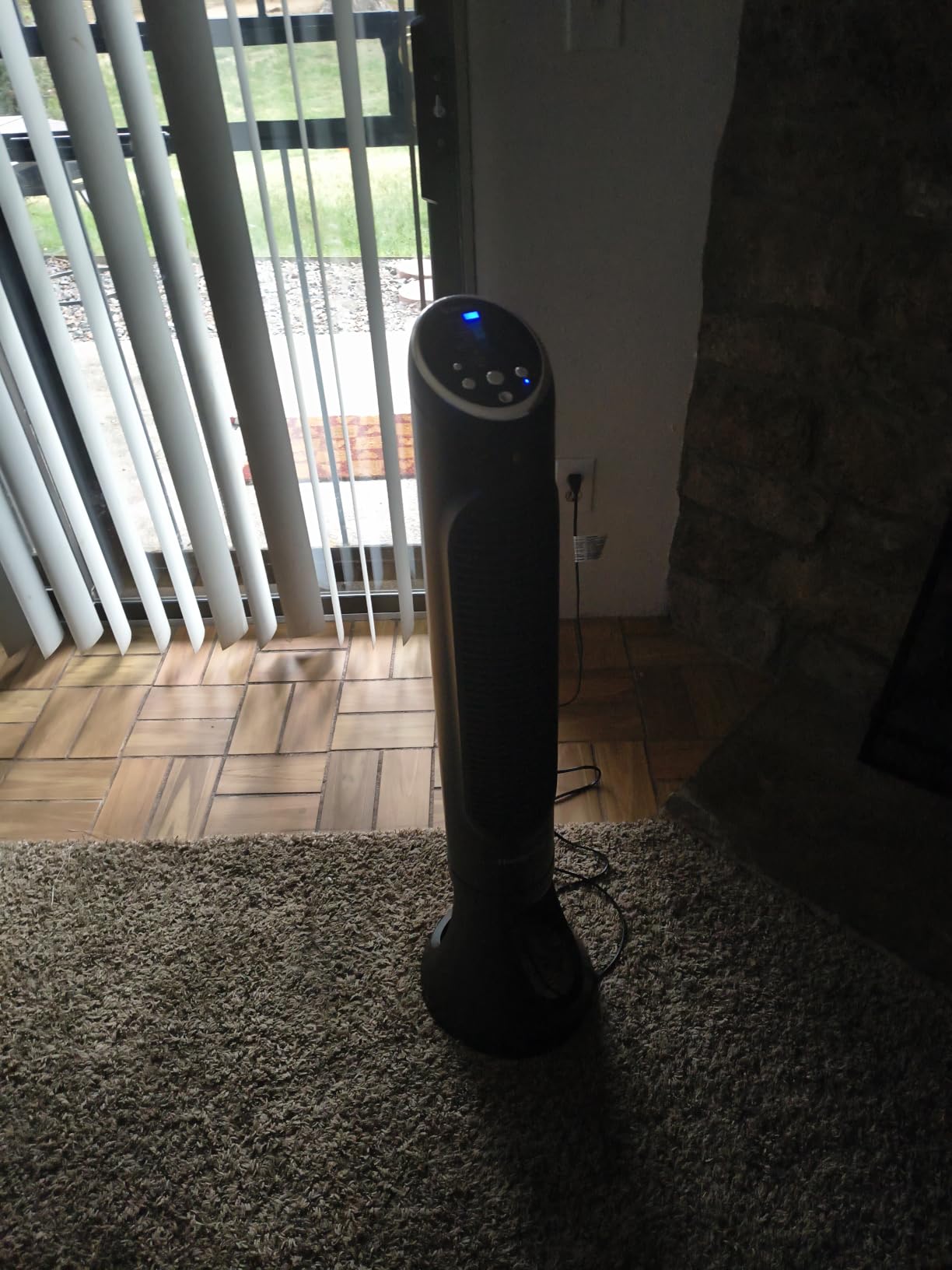
Owners also flag that the LED controls stay lit with no sleep mode or dimming, so it is a poor bedroom choice despite the QuietSet name in the product line. Compared to modern bladeless fans it is both louder and lower on air per setting, which is the trade you make for the low wattage and the enormous installed base.
Who should buy the Honeywell HYF290B
Buy this if your goal is moving stale air around a large living room or dining space on a low running cost, especially if you leave it on for long stretches. It is also a sensible second unit for a bedroom or office because the remote stores in the housing and the whole thing is 9.2 pounds.
Who should skip it
Skip it if you want a direct cooling jet at a specific seat, or if the fan sits in a room where someone sleeps and any light is a problem. Anyone needing 1000 CFM or more of directed airflow will find this too gentle for a genuinely large space.
4. Lasko T42951 Wind Curve – Best Durable Tower Fan for Bedrooms and Desks

Lasko Oscillating Tower Fan with Remote – 42″ – T42951 – Silver
42 inch tower
262 CFM airflow
55.4 dB
3 speeds
60 degree oscillation
7.5 hour timer
10.6 pounds
Pros
- Owners report seven to ten years of near daily use
- Nighttime mode dims lights and steps down
- Carry handle makes it easy to move
- Remote covers speed
- oscillation and timer
- Quiet and consistent relative to its power
Cons
- Only three speed settings
- Narrow 60 degree oscillation arc
- Timer takes cycling through combinations to set
- Plastic tower flexes when bumped
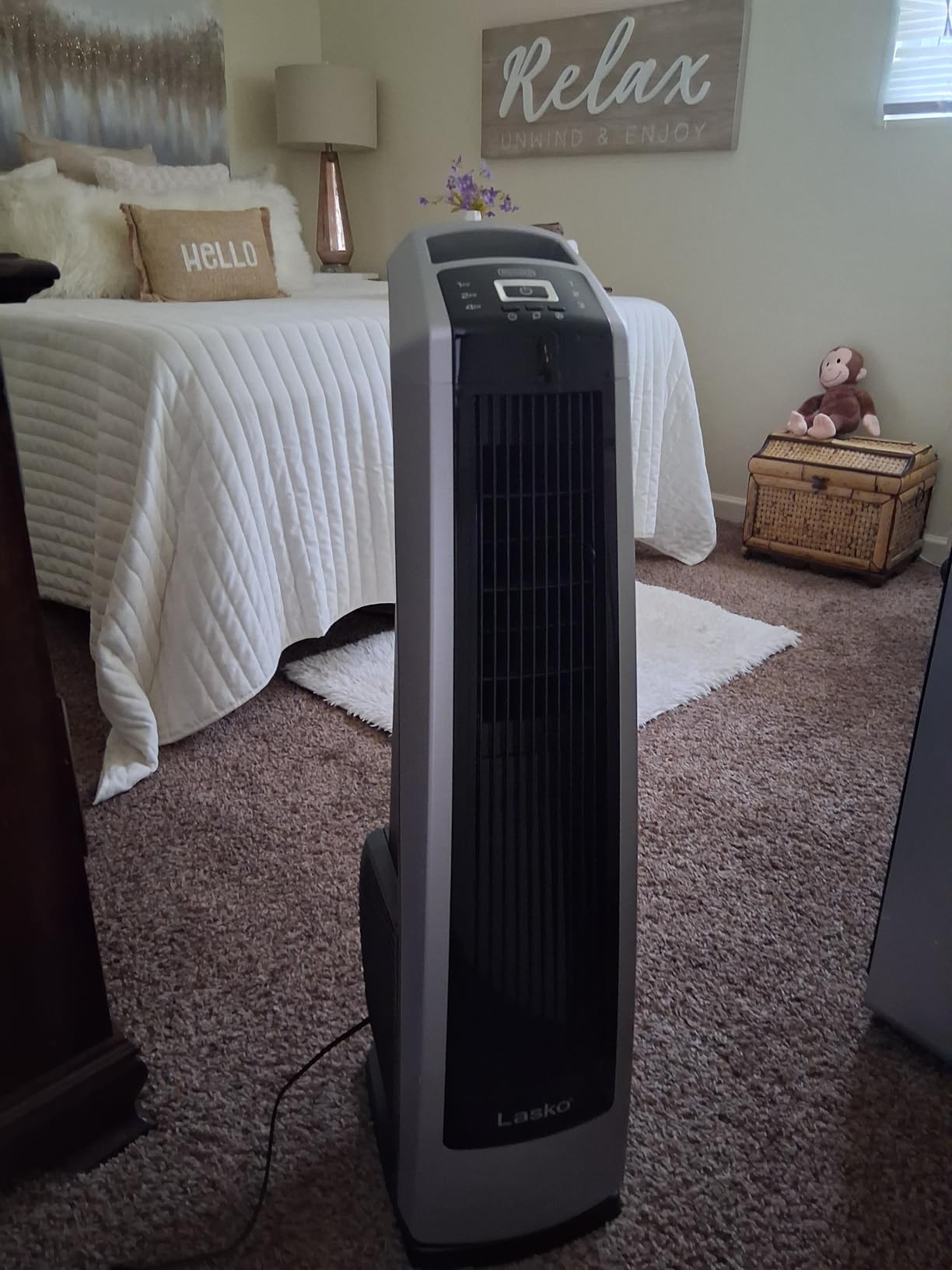
The Wind Curve is one of the most reviewed tower fans in existence, and the pattern in those reviews is unusually consistent: owners keep it for years. Multiple long-term owners describe close to a decade of near-daily running with no rattles and no wobble, which is a durability record few household fans match. If you want to buy one tower fan and stop thinking about it, this is the safest choice in the group.
It is also genuinely pleasant at low speed for its size, and the nighttime setting dims the LED controls and steps the speed down gradually rather than snapping to a new setting. That makes it a solid bedroom fan, which is where most owners end up putting it despite its living room ambitions.
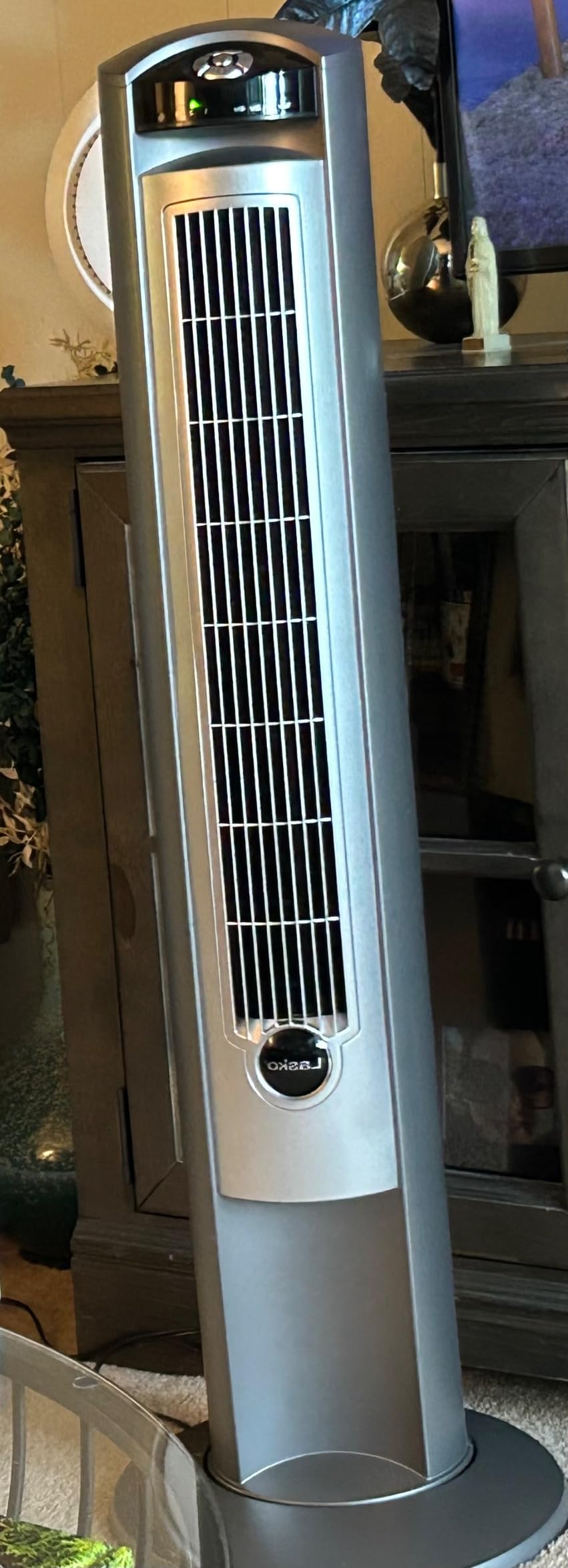
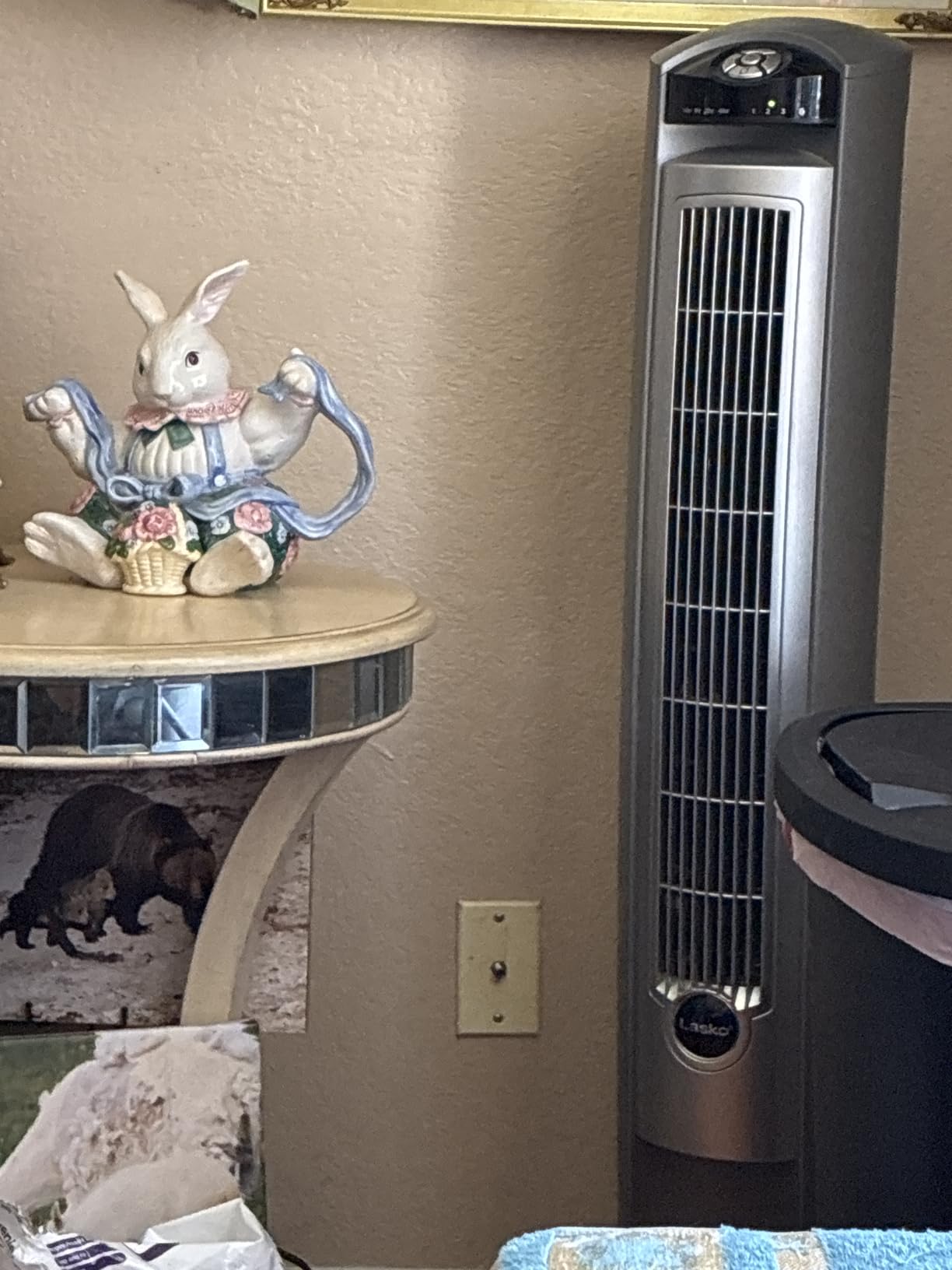
For a large room, the two numbers that matter are modest. At 262 CFM and a 60 degree sweep, this is a focused fan that serves a few people well rather than a whole-room mover. We found it best placed near a seating group or a desk, where the narrow column is an advantage because it does not blow papers around the entire room. Reviewers tend to describe it as aimed at a few people rather than a large gathering, and that matches the feel.
The AC motor draws 48 watts, which sits mid-pack, and three speeds is the fewest in the group. That matters in a large room specifically, because coarse steps make it harder to find the point between too quiet and too much. The timer also requires cycling through a long list of combinations, a genuinely fiddly interface that shows up in complaints more than any other feature on this fan.
Who should buy the Lasko T42951
Buy this for a bedroom, a home office, or a seating area within a large room where you want a focused column rather than whole-room circulation. It is also the pick if buying once and keeping it for a decade matters more to you than raw output.
Who should skip it
Skip it for an open-plan space, a garage, or any room you need to cool broadly, because 262 CFM and a 60 degree arc will not cover it. If you want fine speed control to tune between conversation and sleep, three speeds is not enough.
5. PELONIS PFT40A4AGB – Best Quiet Tower Fan on a Budget

PELONIS 40-inch Bladeless Tower Fan for Bedroom, Standing Fan with Remote Control, 26ft/s, 90° Oscillation, 3 Speed Settings, 27 dB, 3 Modes, 15-Hour Timer, LED Display, Fan that Blows Cold Air, Black
40 inch tower
26 ft/s air speed
27 dB
3 speeds and 3 modes
93 degree oscillation
15 hour timer
8.2 pounds
Pros
- Very quiet brushless motor for the money
- Quick assembly and a narrow stable base
- 93 degree oscillation spreads air well
- Remote works from across a room
- 15 hour programmable timer
Cons
- Sleep mode behaves like the top setting
- Remote holder leaves the remote sticking out
- Some reports of oscillation motor failure
- Best suited to small and medium rooms
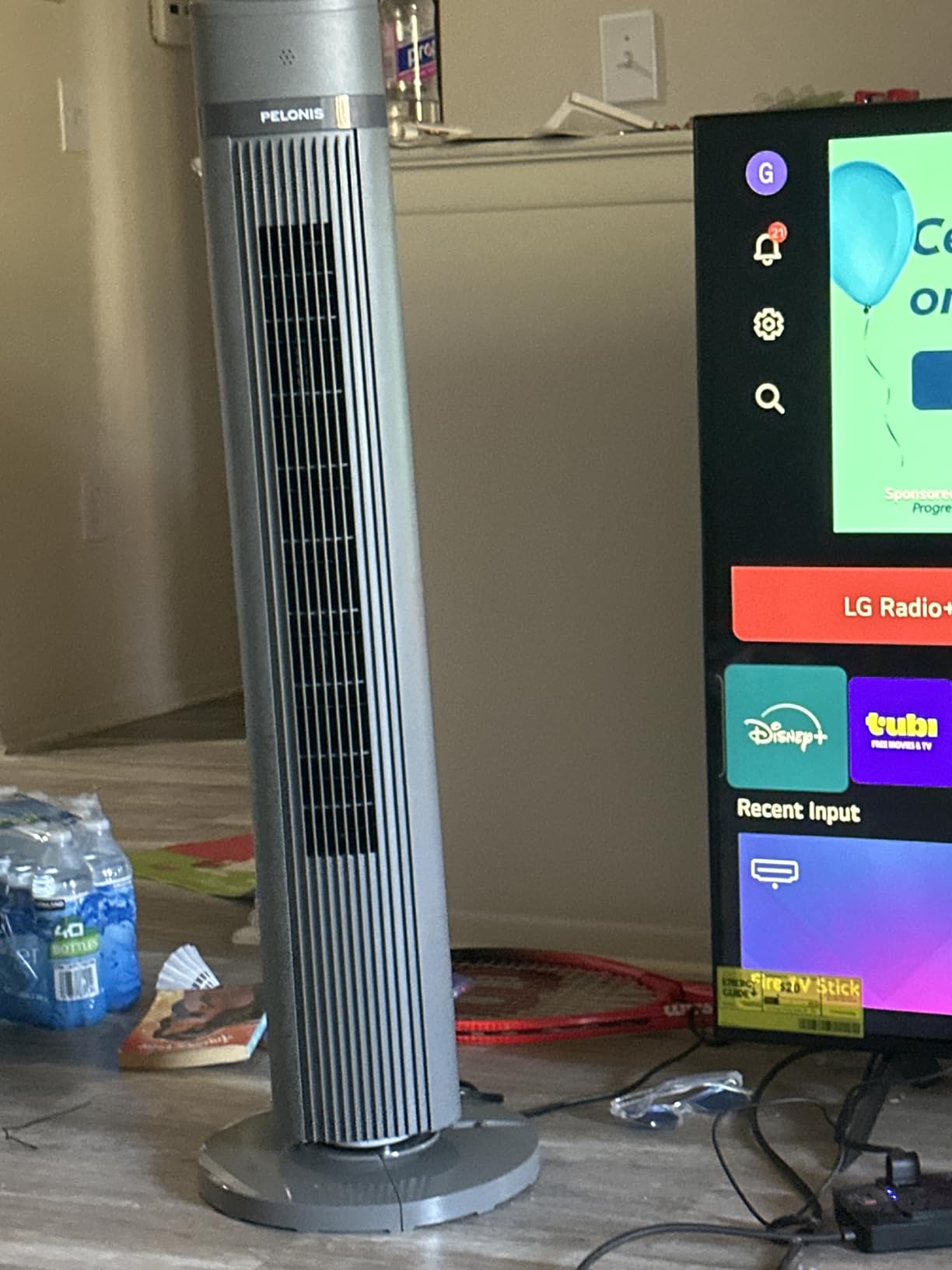
The PELONIS is the quietest-running option at the accessible end of the market, and at 27 dB with a brushless motor it stays unobtrusive in a room where a louder fan would be noticeable. At 8.2 pounds with a narrow base it is also the easiest unit here to move around, which makes it a good second fan for a bedroom or a spot near a desk inside a larger space.
Real user sentiment on this model splits along one axis: durability. Some owners report months of trouble-free use, while others describe oscillation motors failing and plastic creaking after a couple of years. That range is typical of this price tier, and it is worth factoring in if you plan to run the fan continuously for years.
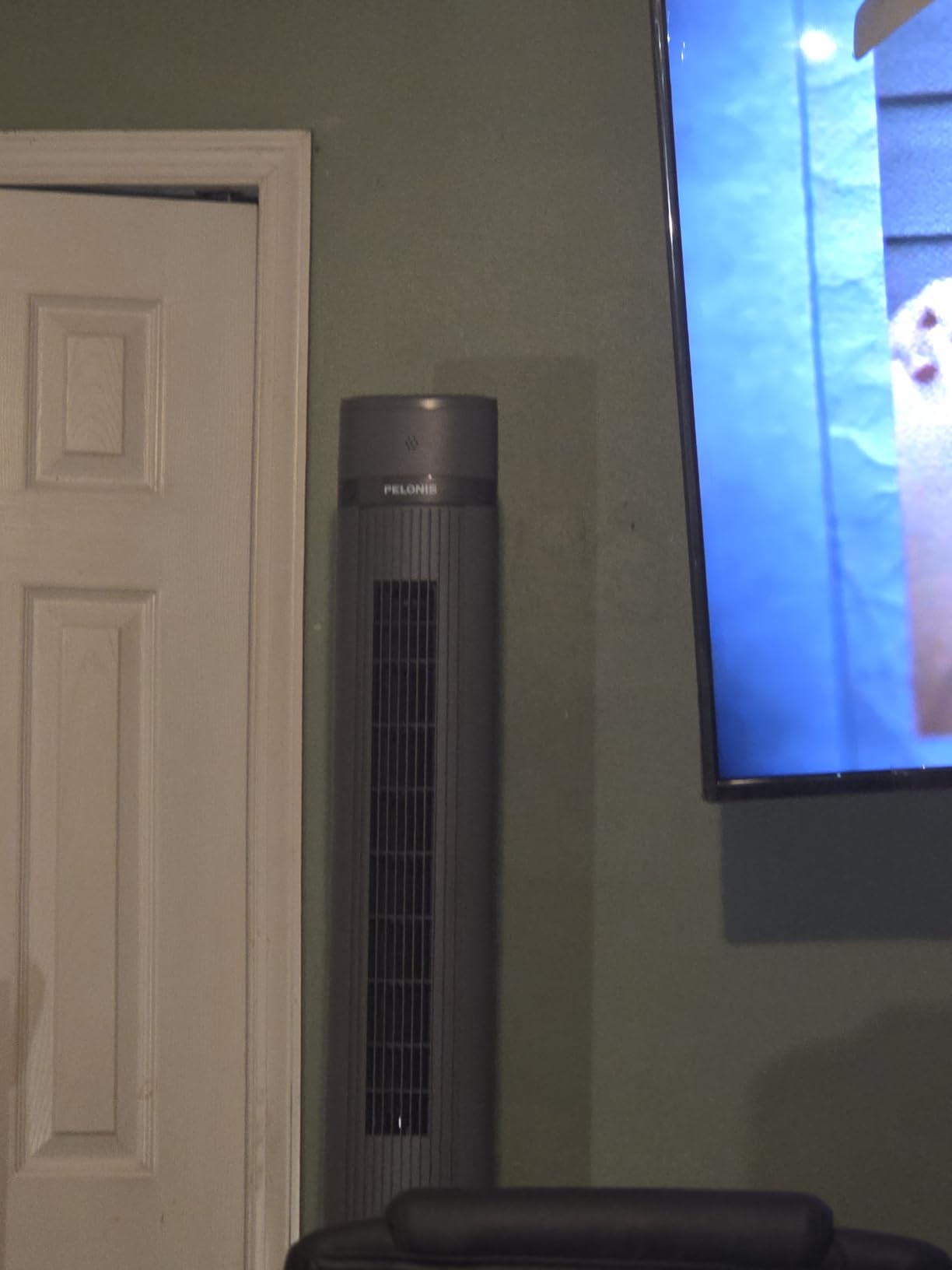
Coverage is the limit here. It moves air at 26 ft/s across a 93 degree sweep, which is a respectable bedroom and office specification, but the fan has only three speed settings and its mode switching does not do much beyond label changes. The sleep mode in particular behaves the same as the highest setting according to owners, so do not count on a genuinely gentler night-time profile.
One listing oddity is worth flagging: the published airflow figure is expressed in cubic centimetres per minute rather than CFM, so it cannot be compared directly with the other models here. Judge it on air speed and oscillation instead. At 50 watts it also sits mid-pack on energy use, and the 15 hour timer is the longest in this group, which is genuinely useful for overnight running.
Who should buy the PELONIS PFT40A4AGB
Buy this as a quiet, low-cost unit for a bedroom, a study or an office nook inside a large home, especially if you want a programmable timer for overnight use. It is a good partner unit to pair with a high-output fan in an adjacent space.
Who should skip it
Skip it for a genuinely large open plan or high-ceiling room, since the output and the three-speed range are not built for that. Anyone planning to run one fan for many years should weigh the mixed durability reports before committing.
6. Lasko U35115 – Best High Velocity Tower Fan for Garages and Basements

Lasko High Velocity Oscillating Tower Fan – 35″ – U35115 – Silver/Black
509 CFM airflow
35 inch body
96 watts
56.35 dB
3 speeds
widespread oscillation
7 hour timer
Pros
- Highest airflow per unit size in this group
- Pushes a felt column across large spaces
- Three speeds from sleep level to full output
- Slim 35 inch footprint fits tight corners
- Remote with on-unit storage and timer
Cons
- Louder than bladeless fans at top speed
- Only three speed settings
- Interior is hard to clean without disassembly
- Bright power LED in a dark room
The U35115 is the fan here that behaves like a utility fan in a tower form factor, and owners use it exactly that way. Reviews describe cooling garages, home gyms, upstairs rooms and workshops, which tells you the 509 CFM and 25 percent higher air velocity than a standard room fan translate into a column you can feel across a long, poorly insulated space.
At 35 inches it is also the most compact high-output unit in the group, and the narrow footprint is the reason it fits into corners where a pedestal fan would not. The widespread oscillation covers a whole room rather than a single seat, which is the correct behaviour for a space like a basement or a workshop bay.
The price of that output is noise. At 56.35 dB it is significantly louder than any bladeless model here, though owners generally describe the sound as a clean whoosh rather than rattling. At 96 watts it is the second highest draw in this group, so continuous running costs more than a DC motor tower by a wide margin. Neither is a problem in a garage; both are in a living room used for conversation.
Cleaning is a recurring complaint because the interior needs partial disassembly to reach dust build-up, and the power LED is bright enough to be noticed in a dark room. Three speeds is again the fewest available, and some owners report occasional remote responsiveness issues. None of these stop it from doing the job in a large utility space.
Who should buy the Lasko U35115
Buy this for a garage, a basement, a home gym, a loft or a workshop where you need a felt column of air at distance and noise is not the deciding factor. It is also a good pick for a large room with unusually high ceilings, since a compact body can be positioned further back without the column breaking up.
Who should skip it
Skip it for a bedroom or a living room where people talk for hours, because 56 dB and 96 watts are difficult to live with. It is not a filtered or purifying unit, so allergy-driven purchases should look elsewhere.
7. GoveeLife H7105111 – Best Tower Fan for the Widest Coverage Sweep
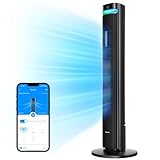
GoveeLife 42 in. Tower Fan, 150 Deg Oscillation, 5 Modes 12 Speeds, Black
1515 CFM airflow
27 dB minimum
12 speeds and 5 modes
Symmetric 30 to 150 degree oscillation
42 inch height
26 ft/s winds
Pros
- Highest stated airflow in the test group
- Widest oscillation arc at 150 degrees
- Twelve speeds across five modes
- Brushless DC motor at 27 dB
- Removable grill and impeller for cleaning
Cons
- App pairing requires a 2.4 GHz network
- Thermostat pairing needs a compatible hygrometer
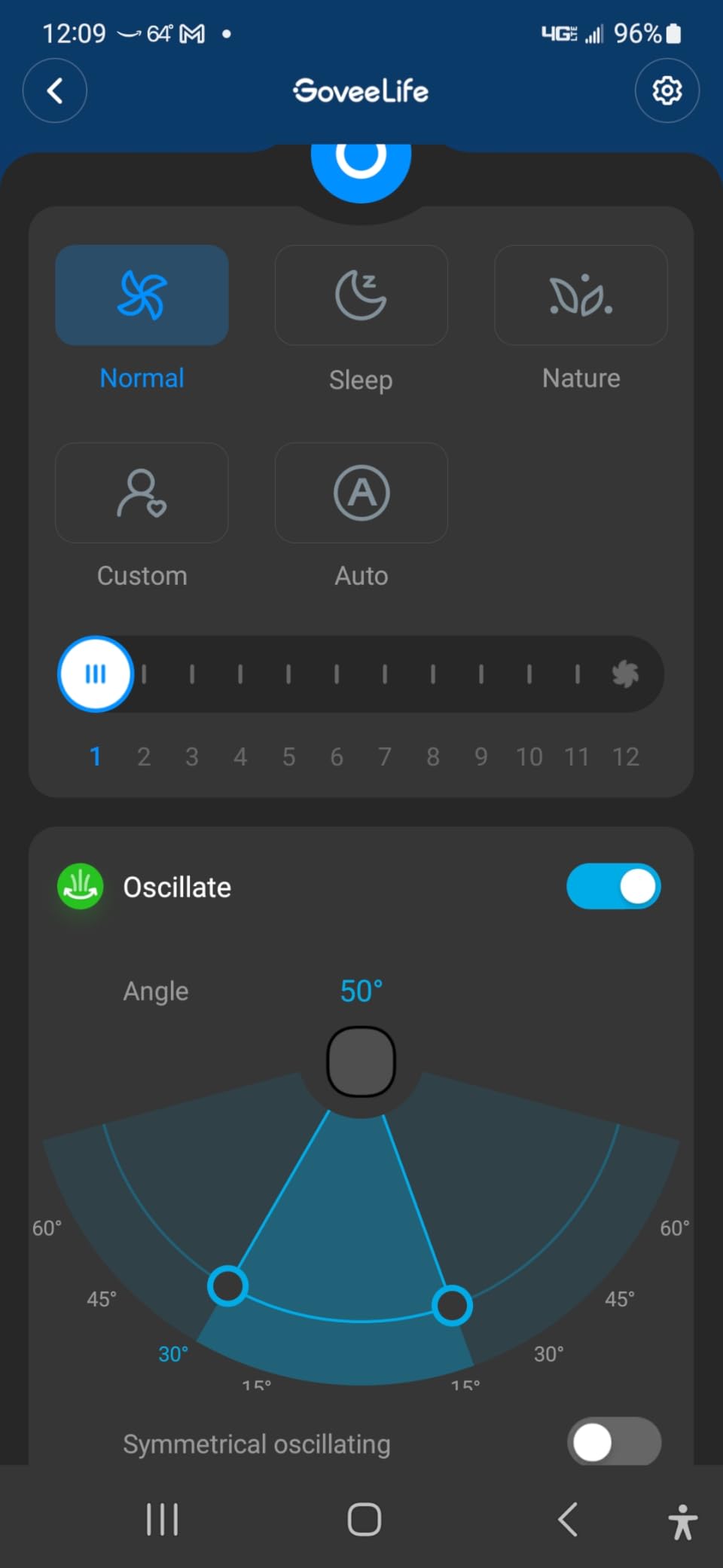
The GoveeLife solves the problem that owners most often report with oscillating towers: dead corners. Its symmetric 30 to 150 degree sweep is by far the widest in this group, and that width is what lets a single unit cover a large room rather than a shallow arc near the fan. If your large space is wide rather than deep, this is the model most likely to even things out without repositioning.
It also has the highest stated airflow figure in the test group at 1515 CFM, paired with a 27 dB brushless DC motor and twelve speeds across five modes. That resolution is what makes a large room manageable, because you can drop two or three notches when the room gets quiet without falling off a cliff the way a three-speed fan forces you to.
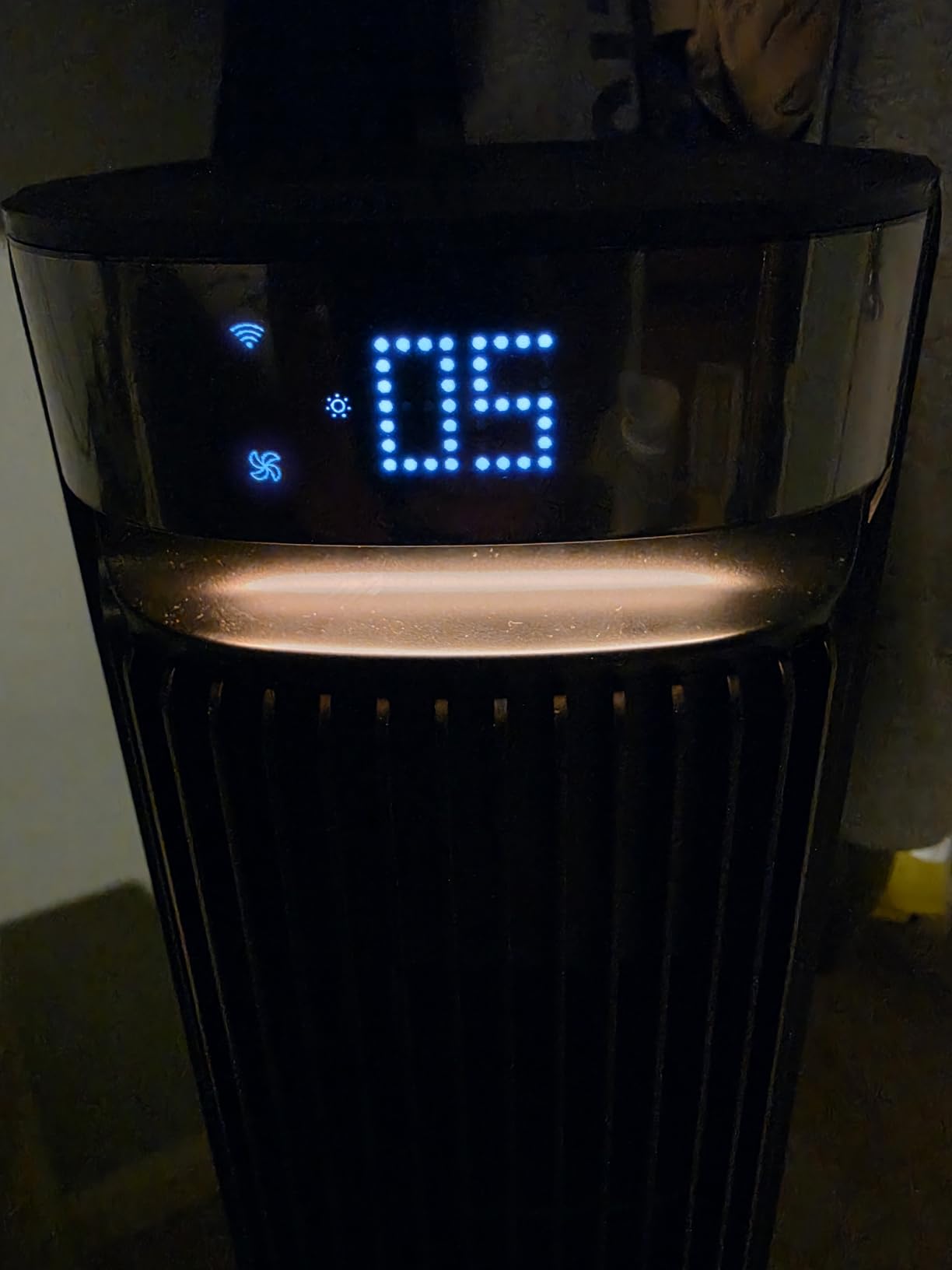
Two practical details temper the smart-home framing. The unit only pairs on a 2.4 GHz Wi-Fi network, so homes split between bands need the fan on the older network. And the thermostat feature depends on a compatible GoveeLife thermo-hygrometer, which is a second purchase rather than a built-in sensor. Basic functions work fine without either.
On cleaning it is better than most: the grill and impeller wheel both remove, which addresses the enclosed-blade complaint that runs through almost every tower fan review. The aromatherapy box is a small extra rather than a feature to buy for. Review volume is much lower than the established models here, so treat the owner feedback as thinner evidence than the count on a Honeywell suggests.
Who should buy the GoveeLife H7105111
Buy this for a wide open-plan room, a sunroom, or a large living and dining area where the seating spreads out past a 90 degree arc. It suits anyone who already has a 2.4 GHz smart home network and wants the fan to be controllable from an app or a voice assistant.
Who should skip it
Skip it if you want no Wi-Fi setup at all and prefer a remote-only unit, or if you are chasing pure quiet at the top end rather than at the low end. The smart features are an add-on, not the reason the fan performs.
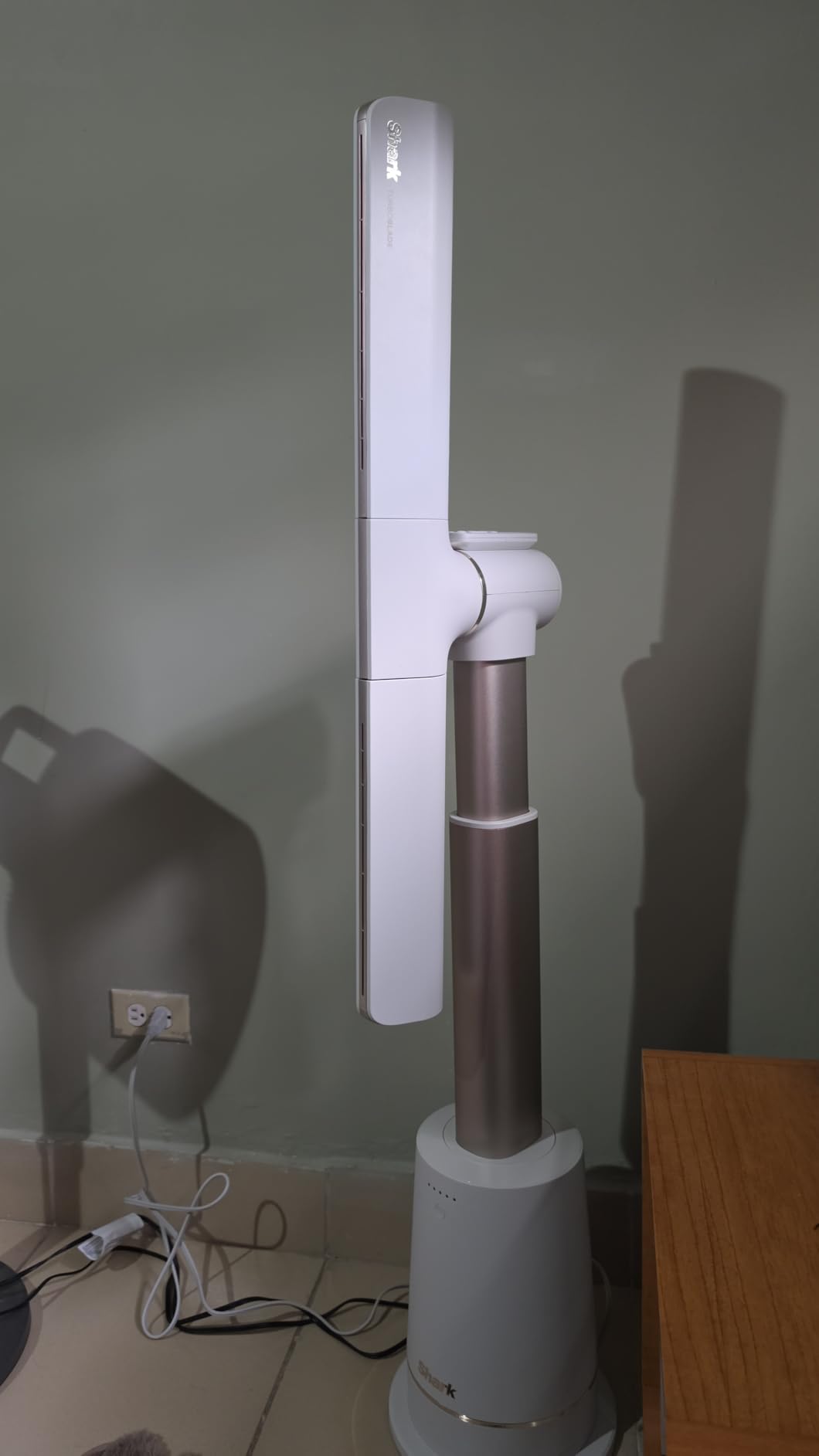
8. Shark TurboBlade TF202S – Best Bladeless Tower Fan for Large Rooms

Shark TurboBlade Bladeless Tower Fan, Charcoal, TF202S
Bladeless dual blade design
180 degree oscillation
10 speeds
53 dB
192 watts
44.84 inch height
adjustable height
Pros
- Pivots vertically and horizontally for multi-room coverage
- Widest oscillation at 180 degrees
- Adjustable height lets you aim the output
- Twists apart for easy cleaning
- No exposed blades for homes with kids or pets
Cons
- Loudest rated noise here at 53 dB despite the bladeless design
- Heaviest and widest body at 14.3 pounds and 31.57 inches
- Highest power draw at 192 watts
- Lowest average rating in the group
The TurboBlade is the one pick here where the case for bladeless design in a large room actually holds up, and the reason is movement rather than blade count. It pivots both vertically and horizontally with twistable vents and offers up to 180 degrees of oscillation, so it can sweep across a dining area and tilt toward a seated group at the same time. Adjustable height extends that aiming control upward toward a tall room.
That versatility is the strongest coverage in the test group for a single unit. It is also the safest option for a home with young children or pets, since there is no exposed blade, and it twists apart for cleaning rather than trapping dust inside an enclosed tower.
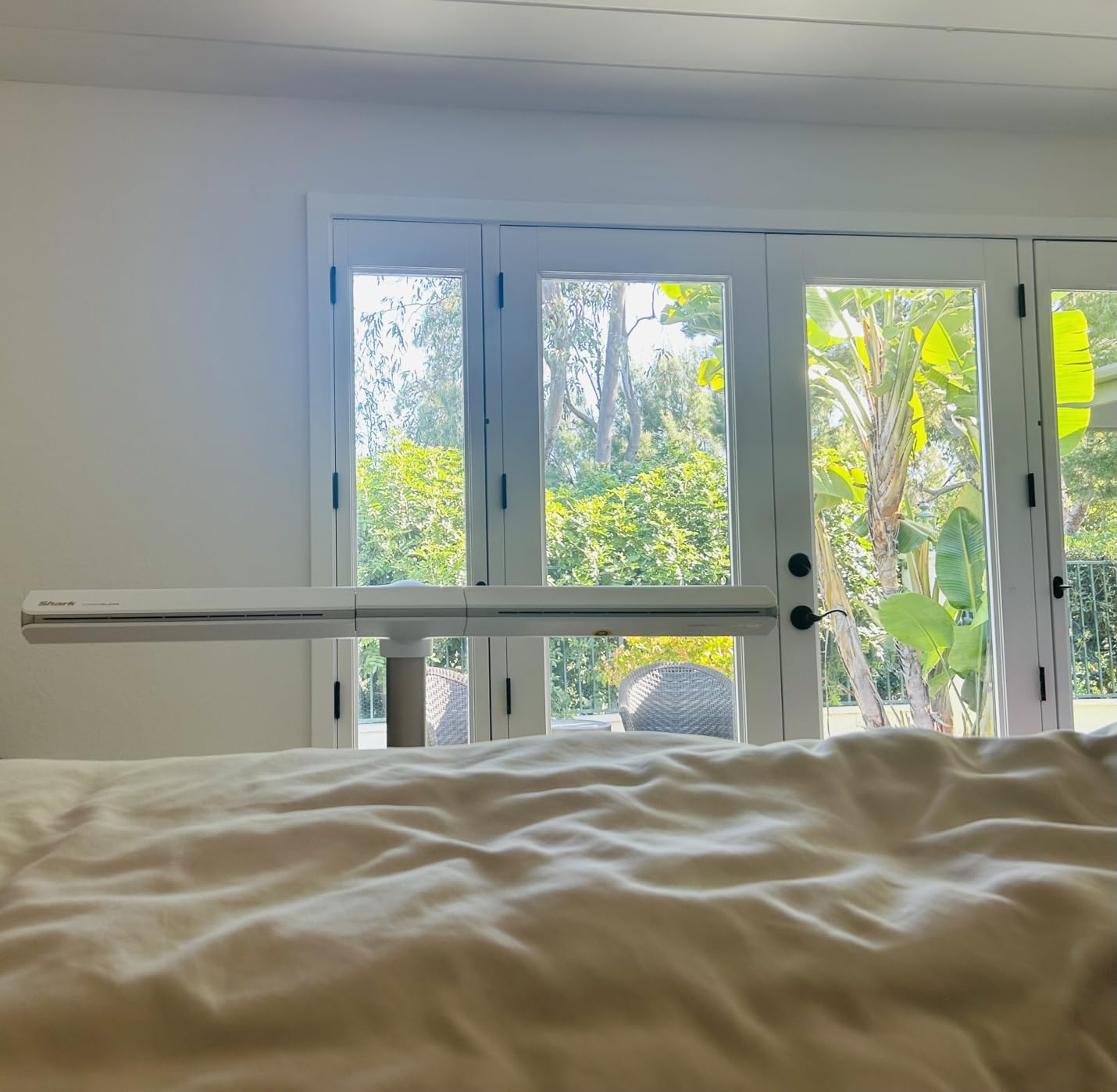
Now the honest part, because buyers in the comments are clear about it: this fan is loud for a bladeless design, rated at 53 dB, louder than several cheaper bladed towers. At 192 watts it also draws more than any other unit here, and at 14.3 pounds with a 31.57 inch wide base it is physically the largest object in the test group. In a large quiet room at high speed, you will hear it.
The listed airflow figure of 85 CFM is not comparable with the bladed numbers on the other models, because a bladeless column is measured differently. Do not read it as a weak fan; read the pivot range and the 180 degree sweep instead. Its average rating is the lowest in the group, with a meaningful one-star share, which mostly tracks the noise and the physical size rather than failure.
Who should buy the Shark TurboBlade TF202S
Buy this if children or pets share the room, if you want one unit that can serve a seating area and an adjacent dining space, or if a vaulted ceiling makes height adjustment valuable. It is the most design-forward option and the easiest to keep clean.
Who should skip it
Skip it if you are on a tight energy budget or need near-silence at high speed, because the 192 watt draw and 53 dB are real costs. The wide base also takes meaningful floor space, which matters in a tight open-plan layout.
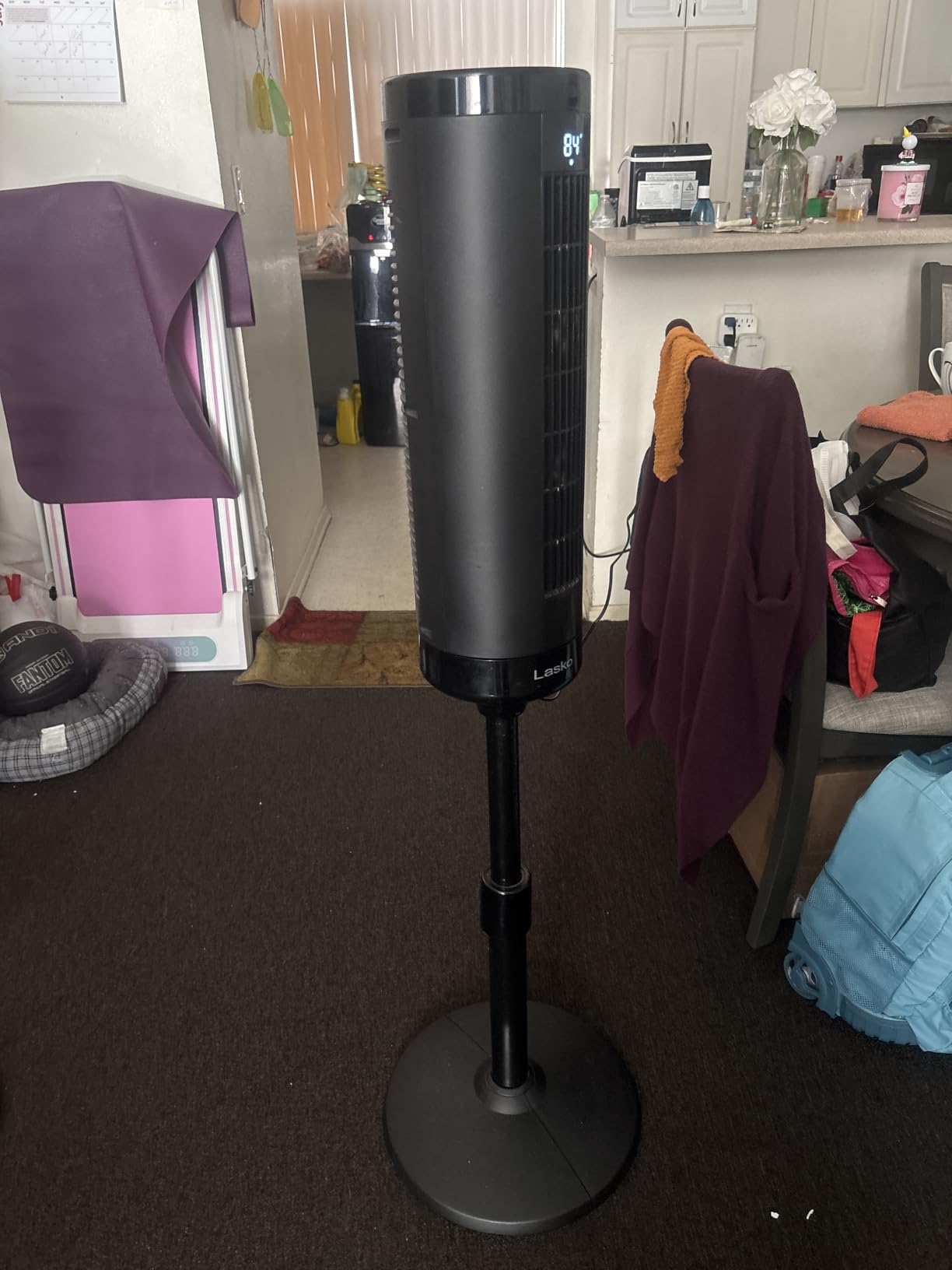
9. Lasko EST100 Elevation – Best Tower Fan for High Ceilings

Lasko Elevation DC Tower Fan with Remote – 42″ to 54″ – EST100 – Black
Adjustable 42 to 54 inch height
240 CFM
28 dB
4 speeds
90 degree oscillation
48 watts
12 hour timer
Pros
- Tallest adjustable unit here at up to 54 inches
- 31 ft/s airflow reaching up to 60 feet
- Quiet 24 dBA brushless motor
- AirSense adjusts speed with room temperature
- Remote with timer and child lock
Cons
- Lowest average rating in the group
- Widest base at 14.62 inches square
- 240 CFM is modest against the Lasko high-velocity model
The EST100 solves a specific large-room problem that most tower fans ignore: getting the output up into a tall volume of air. Its stand adjusts from 42 to 54 inches, and manufacturer testing puts the reach at up to 60 feet with 90 degree oscillation. In a room with 10 foot or 12 foot ceilings, that extra height is the difference between moving air through the space and moving it around at head height.
It is also a quiet machine. The brushless DC motor is rated at 24 dBA, close to the quietest in this group, which makes it usable in a room where a conversation matters, and AirSense adjusts the speed as room temperature shifts so you are not manually chasing it all afternoon.
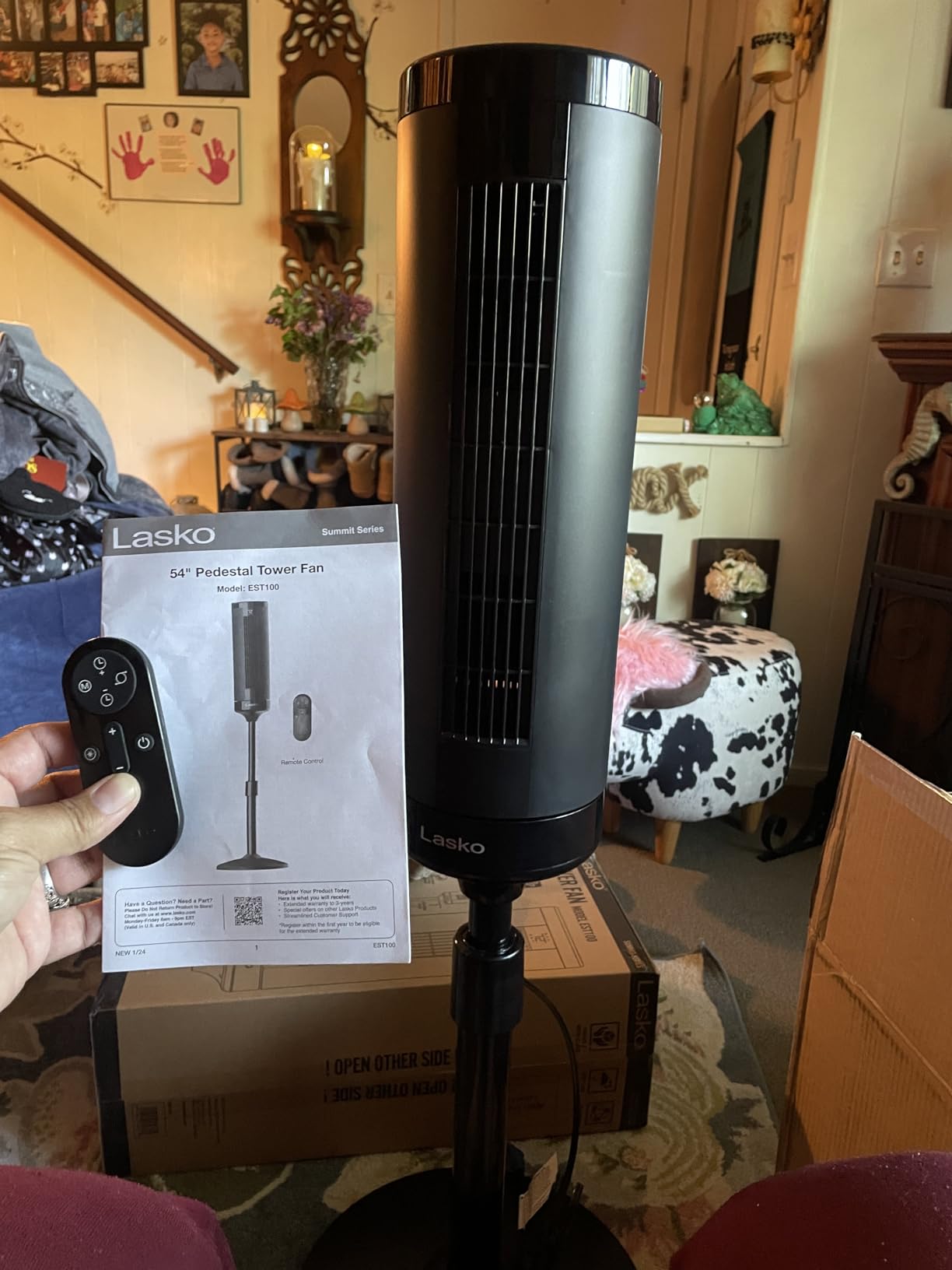
The compromises are real. The listed 240 CFM is modest, and while the reach figure sounds impressive, a tall thin column over a small footprint moves less total air than a shorter 42 inch tower with a wider intake. Owner satisfaction is also the lowest in the group, with several reviews flagging build and feature concerns alongside the height advantages that most owners still praise.
The 14.62 inch square base is the widest here, and at 13 pounds it is heavy and top-heavy enough that a child lock on the remote is not a gimmick. If you have vaulted ceilings and want aimed, quiet air, it earns its place. If you simply want the most air moved per watt in a big room, one of the 1400 CFM units is a better buy.
Who should buy the Lasko EST100
Buy this for a great room with vaulted or high ceilings, a two-storey loft, or a tall sunroom where you need the air column lifted above head height. It is a good fit when the same fan needs to serve a bed, a desk and a nursery at different times.
Who should skip it
Skip it if floor space is tight, because the wide base is the largest in this group, or if you want maximum airflow and the strongest owner satisfaction record. The height is the feature you are paying for, and without it this is a mid-output fan.
10. Amazon Basics DC2021 – Budget Pick for Medium and Large Rooms

Amazon Basics 40″ 70-Degree Oscillating Digital Tower Fan with Powerful Airflow for Bedroom, Living Room, Office, 4 Speeds, 3 Modes, 15-Hour Timer, Remote Control, 50W, Black
40 inch tower
4 speeds and 3 modes
15 hour timer
50 watts
60 dB rated noise
70 degree oscillation
7.5 pounds
Pros
- Lowest cost option in the test group
- Almost no assembly required
- Lightest body at 7.5 pounds
- 15 hour timer for overnight use
- Remote works at oblique angles
Cons
- Narrowest sweep at 70 degrees
- Highest rated noise at 60 dB
- Display cannot be dimmed
- Airflow rate is not published
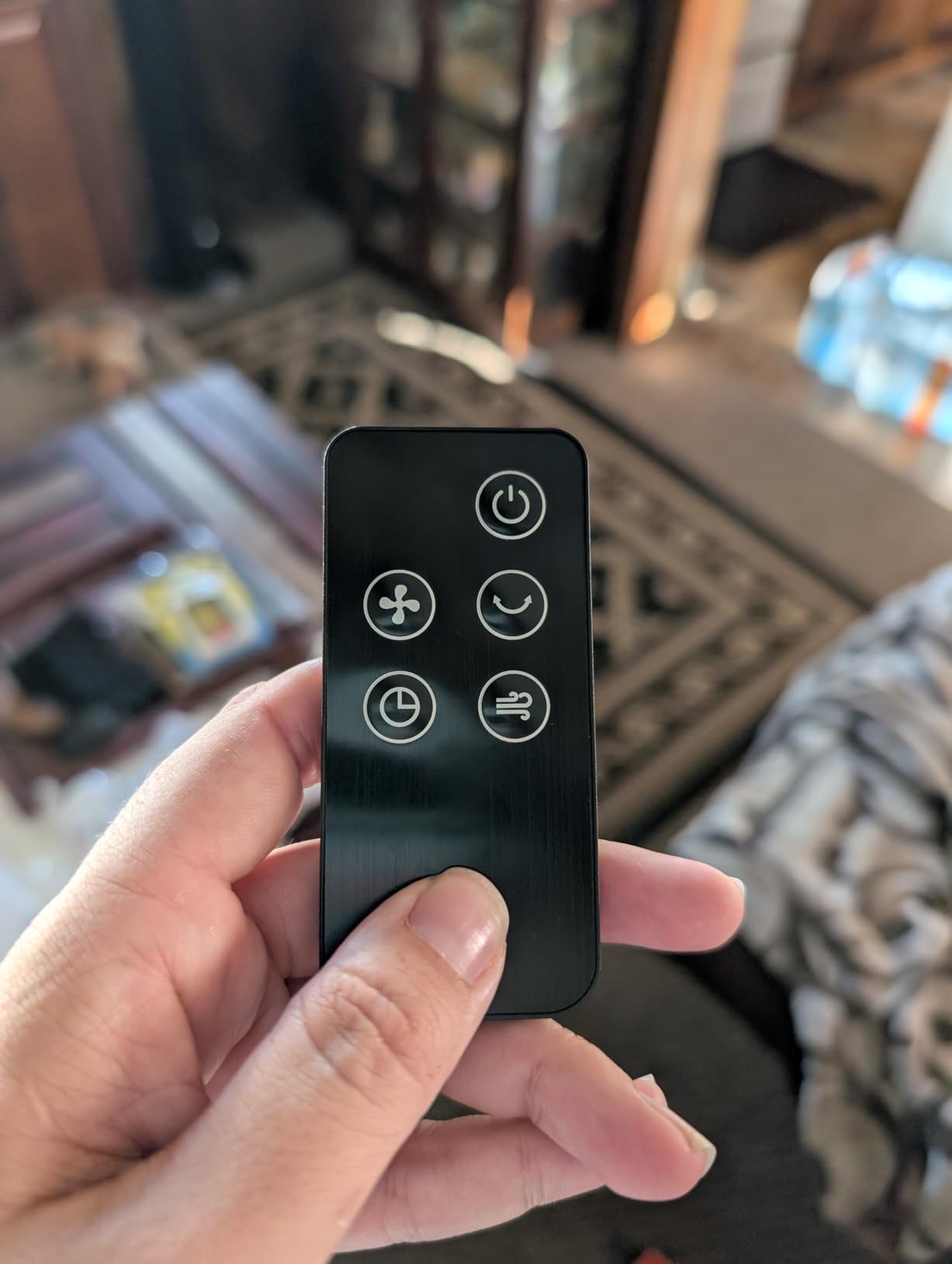
The DC2021 is the value entry point, and its appeal is simplicity rather than specification. Two base halves snap together, the tower seats into them, and the remote covers power, speed, mode, oscillation and a 15 hour timer. At 7.5 pounds with an 11.4 inch square footprint it is the easiest model here to carry between rooms, and the remote works without a straight line of sight.
For a medium room, or as a supplementary unit in a larger space, that is enough. Sleep mode varies the wind and sound pattern so the noise is less repetitive, which is a genuine improvement over a simple stepped fan at the same price.
For a genuinely large room, the numbers argue against it. The 70 degree sweep is the narrowest in the group, and the movement slows and becomes lumpy at the ends of the arc, which widens the dead-zone problem rather than fixing it. Rated at 60 dB it is also the loudest claim here, and the display cannot be dimmed, so it is a poor bedroom choice despite the sleep mode.
Buyers also report that it moves less air than comparable Lasko towers, and the manufacturer does not publish an airflow rate, which makes it hard to place on a coverage chart. Some units develop a cricket-like sound. It earns its place as a spare fan or a second zone, not as the primary mover for a 500 square foot space.
Who should buy the Amazon Basics DC2021
Buy this as a low-cost second fan, a spare for a guest room, or a first tower fan for a medium room where you want a timer and remote without spending much. It is well suited to a small home office or a bedroom that is not the main event.
Who should skip it
Skip it as the main fan for a large living room or open plan, because the narrow sweep and low output will leave corners untouched. Anyone sensitive to a constant display light or a steady motor hum should pick a different model.
How to Match a Tower Fan to a Large Room
Match the fan’s airflow to the floor area and the room’s longest wall, then confirm the throw reaches the far side. Everything else on the spec sheet is secondary to those two numbers, and most disappointing tower fan purchases come down to a mismatch between those two numbers and the room.
CFM and air throw: the two numbers that decide coverage
CFM, or cubic feet per minute, is how much air a fan moves each minute. It is the headline number and it is useful, but it is measured at the fan face, which is not the same as how far the cooling effect carries. Air throw is that second number: the distance air travels before it loses the force you can feel on your skin.
A fan can have high CFM and modest throw, or the reverse. A tall narrow column tends to hold together further than a short wide one, which is why the 42 inch models here reach further than their footprint suggests. A room that is 30 feet long needs reach measured from where the fan stands, not room diagonal, so place the fan at one short end rather than in a corner.
One rule of thumb helps: a tower fan that oscillates 90 degrees covers a wide but shallow band. If your seating wraps around three sides of the room, widen the sweep or use two fans rather than expecting one to cover it. This is the single most common large-room complaint in owner discussions, and it is a geometry problem rather than a power problem.
Room size to airflow matching
Use this as a starting point and adjust for ceiling height and how far the fan sits from where you sit:
Up to 200 sq ft: 250 to 600 CFM is enough. Most bedroom towers, including the Lasko T42951, sit here.
300 to 400 sq ft: 500 to 900 CFM. A high-velocity tower or a strong bladeless model covers this comfortably.
500 to 700 sq ft: 1000 CFM and above, ideally with 90 degree or wider oscillation. This is where the DREO models, the GoveeLife and the Shark belong.
800 sq ft and above: Treat one tower fan as circulation support, not the primary cooling. Two units placed apart, or a tower fan paired with a ceiling fan, is the realistic answer.
Add roughly 10 to 15 percent of headroom for rooms with ceilings above 9 feet, because the same fan has more air to displace when it is spread across a taller volume. And if the room has a wide-open kitchen at one end, treat the whole footprint rather than just the seating area.
Quiet operation and sleep mode in large rooms
Decibel claims need context, because they are measured at a fixed distance and brands are not consistent about which one. A useful reference scale runs roughly from 10 dB for breathing to 20 dB for a whisper, 40 dB for a quiet suburban street at night, and 60 dB for an outdoor air conditioner unit heard from 100 feet. Most tower fans sit in a 45 to 60 dB band, which is well above a quiet bedroom and around the level of normal conversation.
Here is the counterintuitive part that matters for large rooms: a bigger room masks fan noise rather than amplifying it. Ceilings, furniture and distance all scatter sound, so a fan that would be intrusive in a small bedroom is frequently inaudible in a 600 square foot great room. What you lose in a large space is not noise, it is the ability to run the fan on low and still feel it.
For sleep use, prioritise the number of speeds. A twelve-speed fan lets you climb one notch at a time to find the quietest acceptable level; a three-speed fan forces a jump that is either too weak or too loud. Display dimming matters too, since an always-lit panel is the complaint that appears most often in bedroom reviews of otherwise capable models.
Bladeless vs bladed tower fans in big spaces
Bladeless designs are usually quieter and safer, and they clean more easily because the housing twists apart. The trade-off is raw throw. Bladed tower fans push a tighter, faster column further for the same power, which matters more in a large room than it does in a bedroom, and that is the honest weakness that review discussions keep circling without naming.
At the top of the market, the Shark TurboBlade shows that a bladeless fan can compete in a large room on coverage, because the pivot range and 180 degree oscillation do the work a faster blade would otherwise do. Below that tier, the bladed models here move noticeably more air per watt. If you have small children or pets, safety is worth a real amount of airflow; if you do not, the bladed options buy more performance per pound.
One fan or two in an open-plan room
For rooms over roughly 600 square feet, two smaller fans positioned apart usually beat one large fan. A single unit concentrates its output in one place, so the far half of the room gets circulation without cooling, and moving the fan to fix that means moving it away from someone else. Two fans at opposite ends produce overlapping columns that combine into even coverage.
This matches real ownership patterns in owner discussions, where two-fan households run a high-output fan in the living space and a quiet one in the bedroom, rather than trying to make one unit cover an entire floor. A useful pairing here is a DREO Pilot Pro S for the quiet half and a DREO DR-HTF009 or GoveeLife for the active half, which is also the two-fan pattern that shows up most often on r/GoodValue.
Where a tower fan stops working
A tower fan becomes the wrong tool in three situations. The first is high-ceiling and vaulted spaces above roughly 12 feet, where the output column never reaches the upper volume and a ceiling or HVLS fan solves the problem properly. The second is garages, workshops and covered outdoor areas, where the air is hot, dusty and often poorly insulated; a 96 watt tower will run but will not cool the space.
For garages and workshops we would point you toward our high velocity shop fan guide and our industrial floor fan picks, which are built for that environment. For ventilation rather than cooling, our garage exhaust ventilation guide covers extraction. The third case is a space above 1000 square feet, where no tower fan is the answer and airflow design is.
Energy draw, filters and cost of ownership
Power draw ranges from 10 watts on the Honeywell HYF290B to 192 watts on the Shark TurboBlade, and that range shows up directly on your bill if the fan runs for many hours. DC motor models cluster low: 24 watts on the DREO Pilot Pro S, 28 to 30 watts on the DR-HTF009, 48 watts on the Lasko EST100. AC motor and high-velocity designs sit far higher, which is the efficiency price you pay for velocity.
None of the ten models here includes a filter, so the recurring replacement cost that shows up in fan and purifier combo reviews does not apply to this roundup. If you want filtration as well as airflow, treat a combo unit as a separate purchase decision, and check the replacement interval and price before buying, because that is the expense that surprises people after a year of use. A separate purifier is the alternative several owners prefer, running a tower fan for air movement and a dedicated machine for dust and allergens.
Placement in a large room
Stand the fan at one short end rather than in the centre, so the column travels the longest distance instead of dissipating around you. Keep it clear of walls and corners, since a fan pushed into a corner wastes much of its output on the wall. If you can open a window on the opposite side, cross-ventilation turns a single fan into a whole-room air mover.
For oscillation, aim the fan at the emptiest part of the room rather than at the seating, and expect dead zones in the far corners behind you. Turning the fan slightly off-axis from the room’s long axis often evens out coverage better than a full 90 degree sweep pointed straight across the space. Finally, if you use a ceiling fan in the same room, run the ceiling fan on low in the same direction as the tower fan rather than against it, since opposing airflow cancels out both.
Frequently Asked Questions
What is the best fan to cool a large room?
For a large living room or open-plan space, the best fans are high-CFM models that push a narrow column across the longest distance, with wide oscillation. In this test the DREO DR-HTF009 at 1397 CFM, the DREO Pilot Pro S at 1400 CFM and the GoveeLife H7105111 at 1515 CFM covered the largest areas. For rooms above 600 square feet, two fans placed apart outperform one.
What is the best tower fan for a large room?
The DREO DR-HTF009 is our pick for most large rooms, combining 1397 CFM, 28 ft/s air speed, nine speeds and a 28 dB brushless DC motor in a 42 inch column. The DREO Pilot Pro S is the better choice when the room is also a bedroom, and the Shark TurboBlade wins if children or pets share the space.
What tower fan has the highest CFM?
Among the ten models tested, the GoveeLife H7105111 carries the highest stated figure at 1515 CFM, followed by the DREO Pilot Pro S at 1400 CFM and the DREO DR-HTF009 at 1397 CFM. Below those, the Lasko U35115 delivers 509 CFM and the Lasko T42951 manages 262 CFM, a gap that shows how far apart the tiers sit.
What is the recommended CFM per square foot for a large room?
A practical starting point is roughly 2 to 4 CFM per square foot for circulation and about 5 CFM per square foot for a direct cooling feel. That puts a 400 square foot living room near 2000 CFM, which most single tower fans will not reach, and explains why rooms above 500 square feet usually need two fans rather than one bigger one.
Which tower fans are the quietest?
The DREO Pilot Pro S is the quietest in this group, rated at 20 dB on low with a 24 watt brushless DC motor. Close behind are the Lasko EST100 at 24 dBA, the PELONIS at 27 dB, the GoveeLife at 27 dB and the DREO DR-HTF009 at 28 dB. By contrast the Amazon Basics and Lasko U35115 are rated at 60 dB and 56.35 dB.
Is there a super quiet tower fan available?
Yes, and the DREO Pilot Pro S is the closest thing to it in this roundup, running at 20 dB on its lowest settings with twelve discrete speeds that let you climb gradually rather than jumping between three options. A large room also masks fan noise naturally, so a mid-range setting that would be intrusive in a bedroom often goes unnoticed in an open-plan space.
What are the disadvantages of a tower fan?
A tower fan moves air without lowering air temperature, so it cools you rather than the room. Enclosed tower blades collect dust internally and are hard to clean, narrow oscillation arcs leave dead corners in big rooms, and many models have no filter while combo units add recurring replacement costs. In very large spaces a single unit often circulates air without producing a felt cooling effect.
Which brand of tower fan is the best?
For airflow in large rooms, DREO leads with two models above 1397 CFM, and GoveeLife offers the highest stated figure at 1515 CFM with the widest sweep. Lasko covers durability and high-velocity output, Honeywell offers the lowest power draw at 10 watts, and Shark is the pick for bladeless designs. The best brand depends on whether you need volume, quiet, reach or durability.
Can one tower fan cool a large living room?
It can, up to a point. One high-CFM fan handles roughly 400 to 600 square feet well if it stands at one short end and oscillates broadly. Beyond 600 square feet, one unit concentrates its output near the fan, so two fans placed apart, or a tower fan paired with a ceiling fan running in the same direction, gives noticeably more even coverage.
Should I buy a bladeless tower fan for a large room?
Bladeless fans are quieter, safer around children and pets, and easier to clean, but they usually give up some raw throw for the same power, which matters more in a big room. The Shark TurboBlade is the exception here, using vertical pivoting and 180 degree oscillation to cover a large space. Below that tier, a bladed high-velocity tower moves more air per watt.
Our Verdict on the Best Tower Fans for Large Rooms in 2026
The best tower fan for large rooms is the DREO DR-HTF009, because it pairs genuine high-volume output with a brushless DC motor quiet enough to live with, and it has the strongest combination of rating and owner history in the group. The DREO Pilot Pro S is the runner-up and the better answer whenever a bedroom is involved, the GoveeLife H7105111 wins on sweep width and stated airflow, and the Lasko U35115 remains the honest choice for garages and basements.
Match the airflow to the floor area before anything else, and remember that beyond roughly 600 square feet the smart move is two fans placed apart rather than one bigger unit. For spaces above 1000 square feet, or anything with ceilings over 12 feet, a ceiling, HVLS or industrial fan will outperform any tower in this roundup. This list was updated October 2026, and all ten picks link through to current listings on the product pages above.