
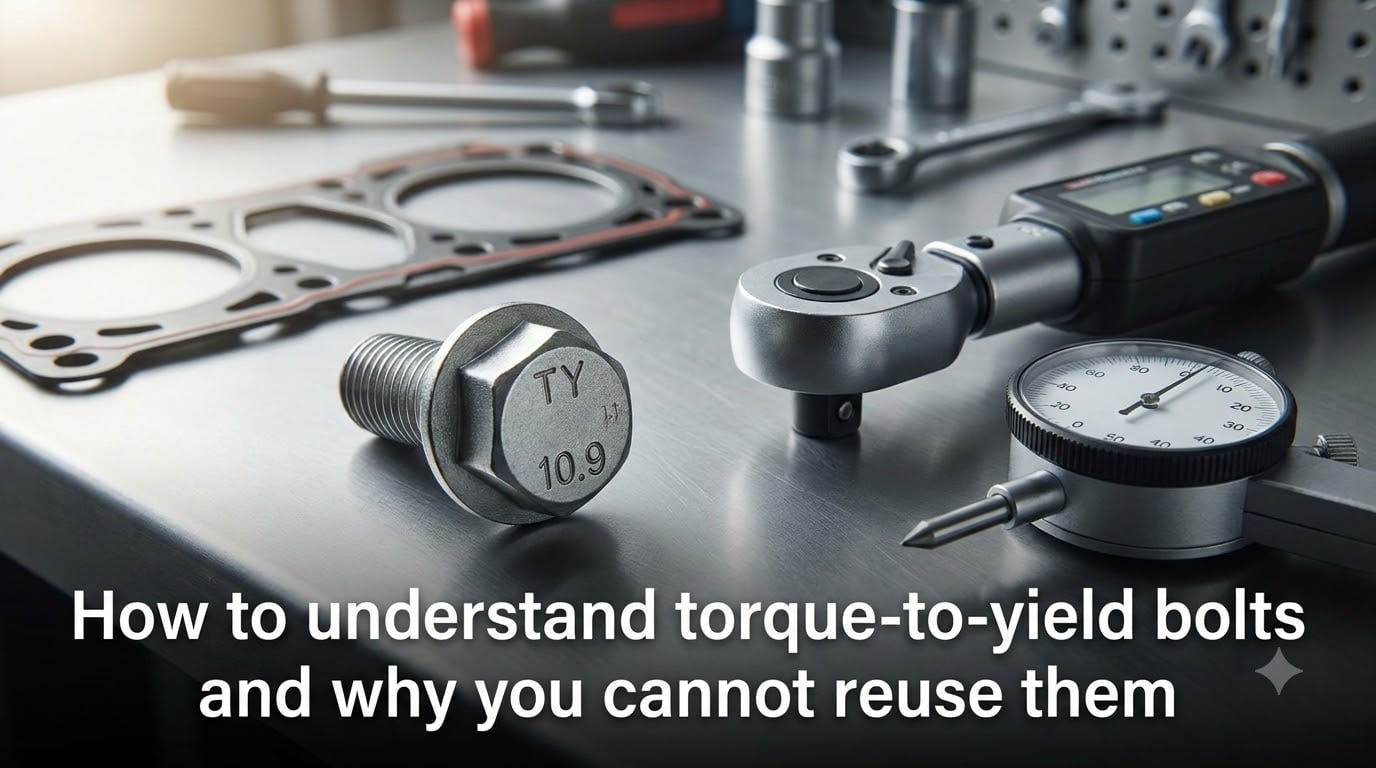
Torque-to-yield bolts are specialized fasteners that get tightened past their elastic limit into permanent plastic deformation. I know that sounds like engineering jargon, but stick with me, because understanding this concept can save you from a blown head gasket, a thrown rod, or a $4,000 engine rebuild. In this guide, I’ll walk you through exactly how these bolts work, why manufacturers started using them in the 1980s, and why every official service manual on the planet tells you to never reuse them.
If you’ve ever turned a wrench on a modern engine, you’ve probably seen the warnings stamped right on the head bolt packaging: “Do Not Reuse.” Maybe you ignored them. Maybe you figured one-time-use bolts were a scam. I’ve been there, and I want to explain the science that makes those warnings non-negotiable.
Table of Contents
What Are Torque-to-Yield Bolts and How Do They Work?
Torque-to-yield bolts (often abbreviated TTY or called stretch bolts) are fasteners designed to be tightened past their elastic limit and into controlled plastic deformation. The first time you hear this, it sounds backward. Why would engineers design a bolt to permanently deform? The answer comes down to precision.
Every metal has a yield point, which is the stress level where it stops acting like a spring and starts acting like putty. Below the yield point, a bolt returns to its original length when you loosen it. Above it, the bolt stays stretched. A standard bolt is tightened well below its yield point, which means it relies entirely on friction to maintain clamping force. That friction varies wildly depending on thread lube, surface condition, and torque wrench accuracy.
TTY bolts solve that problem. Engineers tighten them just past the yield point, where a small increase in stretch produces a large, predictable increase in clamping force. The result is a bolt that holds consistent clamp load regardless of minor variations in lubrication or surface finish. This is why modern engines with aluminum cylinder heads and iron blocks can survive 200,000 miles without leaking compression.
The Elastic Limit and Plastic Deformation Explained
Think of a rubber band. Pull it gently and it snaps back. Pull it hard enough and it loses its shape. Steel behaves the same way, just with much higher forces involved. The elastic limit is the maximum stress a bolt can handle while still returning to its original length.
When a TTY bolt crosses that line, it enters a zone called plastic deformation. The metal stretches permanently, but in a controlled way that engineers have mapped out to the exact angle of rotation. This controlled stretch is the entire point of the design. Without it, you’d need a much larger, heavier bolt to achieve the same clamping force.
The Science Behind Torque-to-Yield Fasteners
Torque-to-yield fasteners deliver consistent clamping force through axial preload. The bolt stretches along its length, and that stretch is what holds the cylinder head or main cap down. Because the bolt is operating in its plastic zone, small variations in torque don’t translate into large variations in clamp load.
Here’s a number that surprised me when I first learned it: in a typical small-block V8, the head bolts must hold about 8,000 pounds of clamping force per bolt to keep the head gasket sealed under combustion pressure. Standard bolts sized to reach that number through friction alone would be massive. TTY bolts achieve the same preload with smaller, lighter hardware.
The other major factor is thermal expansion. Aluminum expands roughly twice as much as steel when heated. In an iron block with aluminum heads, the bolts must accommodate that differential expansion hundreds of times per drive cycle. TTY bolts handle this by sitting in their plastic zone, where the clamp load stays stable as temperature swings change the gap between mating surfaces.
Why Manufacturers Use Torque-to-Yield Bolts
GM, Ford, BMW, and Chrysler all use TTY bolts for the same set of reasons. The first is accuracy. The second is weight savings, since smaller bolts reduce overall mass. The third is fatigue life. A bolt operating in its plastic zone experiences smaller stress cycles during thermal cycling, which means it lasts longer.
Holley performance engineers and Fel-Pro gasket specialists both recommend TTY bolts specifically because they pair perfectly with modern multi-layer steel head gaskets. Together, the system seals combustion pressure reliably even under the higher cylinder pressures of direct-injection and turbocharged engines.
How to Identify Torque-to-Yield Bolts in Your Engine?
You can identify torque-to-yield bolts by their appearance, markings, and documentation. Most TTY bolts have a grade marking on the head, typically 10.9, 11.9, or 12.9 in the metric system. Some have additional manufacturer-specific stamps, and many factory service manuals explicitly call out which fasteners are TTY.
Here are the three most reliable ways to identify them. First, check your vehicle’s service manual under the “Fastener Specifications” section. TTY bolts are always listed separately. Second, look at the bolt itself. TTY bolts often have a smoother, more polished shank than standard bolts. Third, check the original packaging or replacement part number. OEM replacement bolts always come in labeled bags stating “Do Not Reuse” or “Single Use Only.”
If you’re working on a GM LS engine, the head bolts are clearly marked TTY in the manual. Ford Modular V8s use a similar system. Chrysler Hemi engines have main cap bolts that are TTY. When in doubt, the service manual is always the source of truth.
The Torque-to-Yield Installation Process Step by Step
Installing torque-to-yield bolts requires a two-stage process: a base torque, then an angle rotation. This is not optional, and it cannot be skipped. The base torque seats the bolt and the gasket, while the angle rotation takes the bolt into its plastic zone.
Step one, install all bolts hand-tight in the correct sequence. For most cylinder heads, the sequence starts at the center and spirals outward. Step two, torque each bolt to the base specification using a calibrated torque wrench. This is usually between 22 and 44 foot-pounds depending on the application.
Step three, set your angle gauge or mark the bolt heads with paint. Step four, rotate each bolt the additional specified angle, typically 90 to 130 degrees, following the same sequence. Step five, do not re-torque these bolts after the engine has been run, and do not attempt to reuse them if the head gasket fails.
Lubrication Requirements for TTY Bolts
Torque-to-yield bolts should be lubricated with the exact product specified by the manufacturer. Most OEMs call for a specific thread sealant that includes anti-seize and thread-locking compounds. The lube is critical because it controls the friction coefficient, which directly affects how much of your torque input becomes actual bolt preload.
If you use the wrong lubricant, the angle spec is no longer accurate. The bolt may not reach the intended clamp load, or it may over-stretch. This is why I never substitute generic motor oil or WD-40 when a service manual calls for a specific thread treatment.
Where Torque-to-Yield Bolts Are Used in Modern Engines?
Torque-to-yield bolts appear in the most demanding joints of an engine assembly. Cylinder head bolts are the most common application, because the head gasket must seal thousands of combustion events per minute under extreme thermal cycling.
Main bearing cap bolts are another frequent use, since they hold the crankshaft in place. Flywheel and flexplate bolts, especially on aluminum engine blocks, are also TTY. Suspension subframe bolts and some engine mount bolts use the same technology, although the angle specs are usually much smaller, around 45 to 90 degrees.
Outside the engine, you’ll find TTY bolts in steering knuckles, control arm pivots, and certain transmission housings. Any time a manufacturer needs precise clamp load in a critical joint, TTY is the answer.
Why You Cannot Reuse Torque-to-Yield Bolts?
You cannot reuse torque-to-yield bolts because they are already permanently stretched past their elastic limit. Once a TTY bolt has been torqued to spec, its length is now fixed at a longer value than its original factory dimension. If you loosen and re-tighten it, the bolt will not return to the same clamp load because the metal has already yielded.
The mechanical reality is that the bolt’s cross-section has been reduced by the stretching process. This means its ultimate tensile strength is now lower. In an engine application, a reused TTY bolt can fail under load by snapping in half, pulling its threads out of the block, or simply losing enough clamp load to allow the head gasket to leak.
Real failure stories from mechanics on Reddit’s r/Justrolledintotheshop and EngineBuilding forums confirm this. Reused head bolts often break flush with the block, requiring complete disassembly to extract. Other mechanics report head gasket failures within weeks of reusing TTY bolts. The cost of a set of replacement head bolts is trivial compared to the cost of pulling a thread or replacing a damaged head.
The Cost vs Risk Calculation
A typical set of OEM head bolts runs between $80 and $250 depending on the engine. A set of quality aftermarket bolts from ARP or Fel-Pro can cost more, but they’re designed for repeatable service. Compare that to a head gasket job at $2,000 to $4,000 at a shop, or a damaged cylinder head that runs $1,500 or more to replace. The math is not close. Always replace TTY bolts with new ones, every time.
Torque-to-Yield vs Torque-to-Angle vs Standard Bolts
Standard bolts rely entirely on friction to maintain preload, and they’re tightened to a single torque value without any angle rotation. Torque-to-angle bolts use the same two-stage process as TTY, but they’re tightened to a torque value well below their yield point before the angle is applied. Torque-to-yield bolts, in contrast, are designed to operate in their plastic zone from the start.
The table below summarizes the key differences between these three fastener types.
| Feature | Standard Bolt | Torque-to-Angle | Torque-to-Yield |
|---|---|---|---|
| Operation zone | Elastic | Elastic then controlled | Plastic (yield zone) |
| Reusable | Yes | Usually yes (per spec) | Never |
| Clamp load consistency | Variable | High | Very high |
| Installation method | Single torque value | Torque then angle | Torque then angle |
| Typical applications | Non-critical joints | Connecting rods, main caps | Cylinder heads, subframes |
Some manufacturers use the terms torque-to-yield and torque-to-angle interchangeably, but the engineering difference matters. Always follow the service manual for your specific engine.
Common Mistakes and Warning Signs When Working With TTY Bolts
The most common mistake is reusing a TTY bolt because it “looks fine.” It will always look fine, right up until it doesn’t. A stretched bolt has no visible deformation, which is exactly why the warnings exist. If you don’t have documentation that the bolt is new and never installed, replace it.
The second mistake is using the wrong torque wrench or angle gauge. Click-type torque wrenches need to be calibrated, and angle gauges need to be zeroed properly. I check my torque wrench against a known spec before every major job. The third mistake is using incorrect lubrication, which throws off the entire torque-to-angle relationship.
Warning signs of impending TTY bolt failure include a head gasket that weeps coolant, a faint exhaust smell from coolant vapor, or visible steam from the radiator overflow. If you see any of these after a head job, suspect a reused or improperly torqued bolt immediately.
FAQs
How many times can you use a torque-to-yield bolt?
You can use a torque-to-yield bolt exactly one time. Once it has been torqued to its specified angle, the bolt has been permanently stretched into its plastic deformation zone. Reusing it will result in inconsistent or insufficient clamping force, and the bolt may fail under load.
Can I replace torque-to-yield bolts with regular bolts?
No, you should not substitute standard bolts for torque-to-yield bolts in critical applications like cylinder heads or main bearing caps. The engineering specifications for clamp load, thermal expansion, and fatigue life depend on the controlled stretch of TTY bolts. Using standard bolts risks head gasket failure, oil leaks, and catastrophic engine damage.
Why does GM use torque-to-yield bolts?
GM uses torque-to-yield bolts to achieve consistent clamping force on aluminum cylinder heads paired with iron blocks. The differential thermal expansion between these metals demands a fastener that operates in its plastic zone to maintain stable preload. TTY bolts also allow smaller hardware, reducing overall engine weight while improving sealing reliability.
Should torque-to-yield bolts be lubricated?
Yes, torque-to-yield bolts should be lubricated with the exact thread treatment specified by the manufacturer. Most OEMs require a specific thread sealant that includes anti-seize compounds. Using the wrong lubricant changes the friction coefficient and invalidates the angle specification, leading to incorrect clamp load.
Final Thoughts on Torque-to-Yield Bolts
Torque-to-yield bolts are a brilliant engineering solution to a real problem: how to maintain precise clamping force in an engine that experiences extreme heat, pressure, and vibration. The reason you cannot reuse them is not a marketing scheme. It’s a direct consequence of how the bolts achieve their clamping force in the first place, through controlled plastic deformation that cannot be reversed.
Every time you do a head gasket, a main cap, or a flywheel job, treat TTY bolts as a consumable part. Buy fresh bolts from a reputable source, follow the torque-and-angle sequence exactly, and use the specified lubricant. The few dollars you save by reusing old bolts are not worth the risk of a damaged engine, a thrown rod, or worse. If you want to understand torque-to-yield bolts and why you cannot reuse them, the answer is simple. The bolt has already done its job, and now it needs to be replaced so it can do its job again, properly.