

My grandmother stopped asking me to turn the TV up. That was the clue. She was not being polite about the volume, she genuinely could not follow the dialogue at a level the rest of us could hear comfortably. Once we found the right pair for her, the volume arguments in our house stopped entirely.
After that I spent weeks going through the best headphones for seniors with hearing loss, comparing the two families that actually matter here. Personal sound amplifiers pick up room sound through a microphone and push it into your ears, which is what most families end up buying. Wireless TV headset systems send the television signal straight to the headphones, which is cleaner and works at any hour of the night without bothering anyone else.
The short answer: the Williams Sound Pocketalker Ultra is the single device I would hand to most people in this situation, because it handles conversation, television and car rides with one box and no pairing. If television is the main problem, the Avantree Duet is the better buy, since two people can set their own level and there is no lip-sync delay at all.
A few honest notes before we start. These are amplifiers and TV headsets, not medical devices, and none of them treat hearing loss. The Williams and SuperEar lines say so plainly in their own documentation. If someone has sudden, one-sided or rapidly worsening loss, that is an audiologist appointment, not a shopping trip. Everything below assumes a steady, age-related decline that has already been measured.
If the loss is about protecting the hearing that is left, our Bluetooth hearing protection picks cover the other side of the coin.
Table of Contents
Top 3 Picks for Best Headphones for Seniors with Hearing Loss in October

Williams Sound Pocketalker…
- Up to 40dB gain
- Separate tone and volume controls
- Removable mic on 12 ft cord
- 5 year warranty

SuperEar SE5000
- Up to 50+ dB stereo gain
- Tactile volume wheel
- 30 hours on one AAA
- Includes headphones and earbuds

Avantree Duet
- Two independent volume levels
- Clear Voice speech mode
- 2.4GHz with 30ms latency
- Optical passthrough
All 12 Headphones Compared in 2026
Every product below appears once in this list, with the specs that actually change how it performs for a hard-of-hearing listener. Nothing here streams music from your phone; these are made for speech, television and room sound.
| Product | Specs | Action |
|---|---|---|
| Williams Sound Pocketalker Ultra |
|
Check Latest Price |
 TV Ears Dual Digital Wireless Headset TV Ears Dual Digital Wireless Headset |
|
Check Latest Price |
| SuperEar SE5000 |
|
Check Latest Price |
 Williams Sound PockeTalker Ultra DUO Williams Sound PockeTalker Ultra DUO |
|
Check Latest Price |
| Avantree Duet |
|
Check Latest Price |
 SuperEar SE7500 SuperEar SE7500 |
|
Check Latest Price |
 Simolio SM-823D Pro Simolio SM-823D Pro |
|
Check Latest Price |
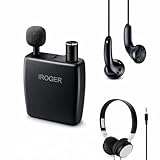 IROGER I8-Pro Rechargeable Amplifier IROGER I8-Pro Rechargeable Amplifier |
|
Check Latest Price |
 Joanbro IR2 50dB Amplifier Joanbro IR2 50dB Amplifier |
|
Check Latest Price |
 Neosonic NW20 Neckband System Neosonic NW20 Neckband System |
|
Check Latest Price |
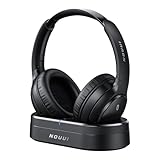 NOUUI NU-TV003 Wireless TV Headphones NOUUI NU-TV003 Wireless TV Headphones |
|
Check Latest Price |
 SuperEar SE9000HP SuperEar SE9000HP |
|
Check Latest Price |
1. Williams Sound Pocketalker Ultra – the one I hand to most families
Williams Sound Pocketalker Ultra Hearing Amplifier | Easy-to-Use Hearing Amplifier for Seniors | Year Supply of Batteries | Amplified Sound Assistive Listening Device with Headphones for Elderly | Hearing Assist Earbuds
Up to 40dB gain
Tone and volume controls
Removable mic on 12 ft cord
5 year warranty
Pros
- Handles conversation
- TV and car listening in one device
- Tone control noticeably improves speech clarity
- Microphone on a cord can be placed next to the speaker
- Weighs 16 ounces and hangs on a neck lanyard
- A year of AAA batteries in the box
Cons
- Amplifies background noise along with speech
- Mono output needs an adapter for two-ear stereo listening
- Included earbud and headset are basic
This is the device that ended the volume arguments in my family, and it is the one I recommend first. You clip it to a lanyard, plug in the headphones, turn the volume wheel up slowly, and you are hearing the person in front of you at normal talking volume. There is no app, no pairing and no account.
The part I did not expect to matter as much is the tone control. It is a separate dial from the volume, and it shifts which frequencies come through. On my grandmother’s loss the high frequencies had gone first, so dialing the tone up made the difference between hearing words and hearing a mumble.

It also handles television, though you have to place the microphone near the speakers rather than connecting to the set. The 12 foot microphone extension cord is what makes that work: you set the microphone on the arm of the chair beside the television and the rest of the cord runs back to the neck unit.
Battery life is handled with ordinary AAA cells, and a full supply comes in the box. The 5 year manufacturer warranty is the longest in this roundup, which tells you something about how the manufacturer expects these to be used.
Who this suits
This is the right pick when the problem is conversations rather than one specific device. Doctor appointments, family dinners, the car, a noisy kitchen: the external microphone can be handed to whoever is speaking, and the tone and volume dials stay put on the neck unit.
I also like it for anyone who has already refused prescription hearing aids. It does not look or feel like a medical device, it comes with a full year of batteries, and it disappears into a pocket or a pocketbook when it is not needed.
Where it falls short
It is an amplifier, not a hearing aid, so it amplifies the refrigerator hum and the television in the next room exactly as faithfully as it amplifies speech. In a genuinely noisy room the noise floor rises with the voices, and no tone setting removes it.
The output is mono. Listening in one ear is the intended use and works well, but anyone wanting two-ear listening with stereo earbuds needs a mono-to-stereo adapter, and that is an extra purchase most people discover after the box is open. Reviewers also commonly replace the included earbud with a better one.
2. TV Ears Dual Digital Wireless Headset – two viewers, two volumes
TV Ears Improved Dual Digital Wireless Headset System – Model 11841
Two wireless headsets
Individual volume and tone per headset
2 oz each
5 year limited warranty
Pros
- Each viewer controls their own volume and tone
- Very light at 2 oz for long sessions
- Single charge lasts through several evenings
- Works with digital and analog televisions
- Family can watch at normal room volume
Cons
- Infrared line of sight can be blocked by people walking past
- Does not help with room conversation
- In-ear tips can get uncomfortable over long sessions
Most households do not have one hearing problem, they have two, and this system is built for that. It comes as a pair of headsets with a charging station, and each person sets their own volume and tone on their own set. Nobody in the room has to shout, and nobody has to compromise.
At 2 ounces per headset, weight is not an issue. My notes on long sessions were about the tips rather than the headset: the rounded in-ear tips are fine for an evening of television and less fine across a whole film.
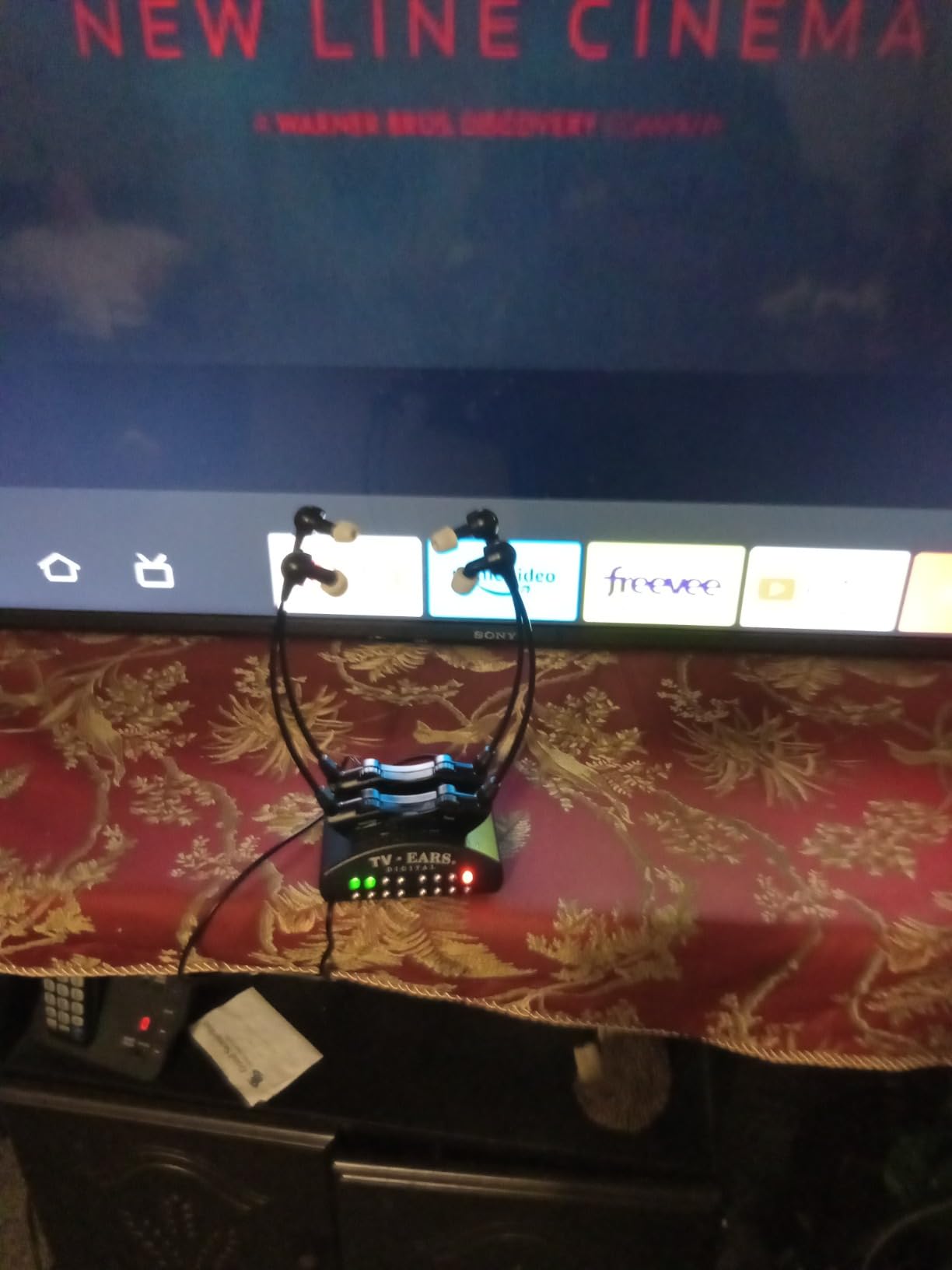
It transmits over infrared, which is why the base has to sit with a clear view of where you sit. That is a real limitation in a busy living room, and it is worth checking your seating before you buy. The counterpoint is that once the base is placed, there is no pairing step and nothing to re-connect.
Batteries recharge in the base and give roughly six hours per full charge, which covers a long evening. The 5 year limited warranty is a strong signal on durability.

Who this suits
Couples where one partner hears well and the other does not are the obvious case. It is also the right answer for a person who cannot manage small charging cables or app menus, because the routine is pick up, watch, drop back in the base.
If the main problem is television dialogue at night, this is more usable than an amplifier. The sound arrives directly in the earbud instead of being picked up by a microphone across the room, so there is no background noise mixed in.
Where it falls short
It does nothing for the rest of life. There is no microphone, so doctor visits, group meals and phone calls are unchanged. Buy it for the television and consider a separate amplifier for conversation, or accept that it only solves half the problem.
The infrared line of sight is the other thing to think through. If someone regularly walks between the base and the sofa, the signal can cut out mid-sentence, and there is no volume or tone control to compensate for it.
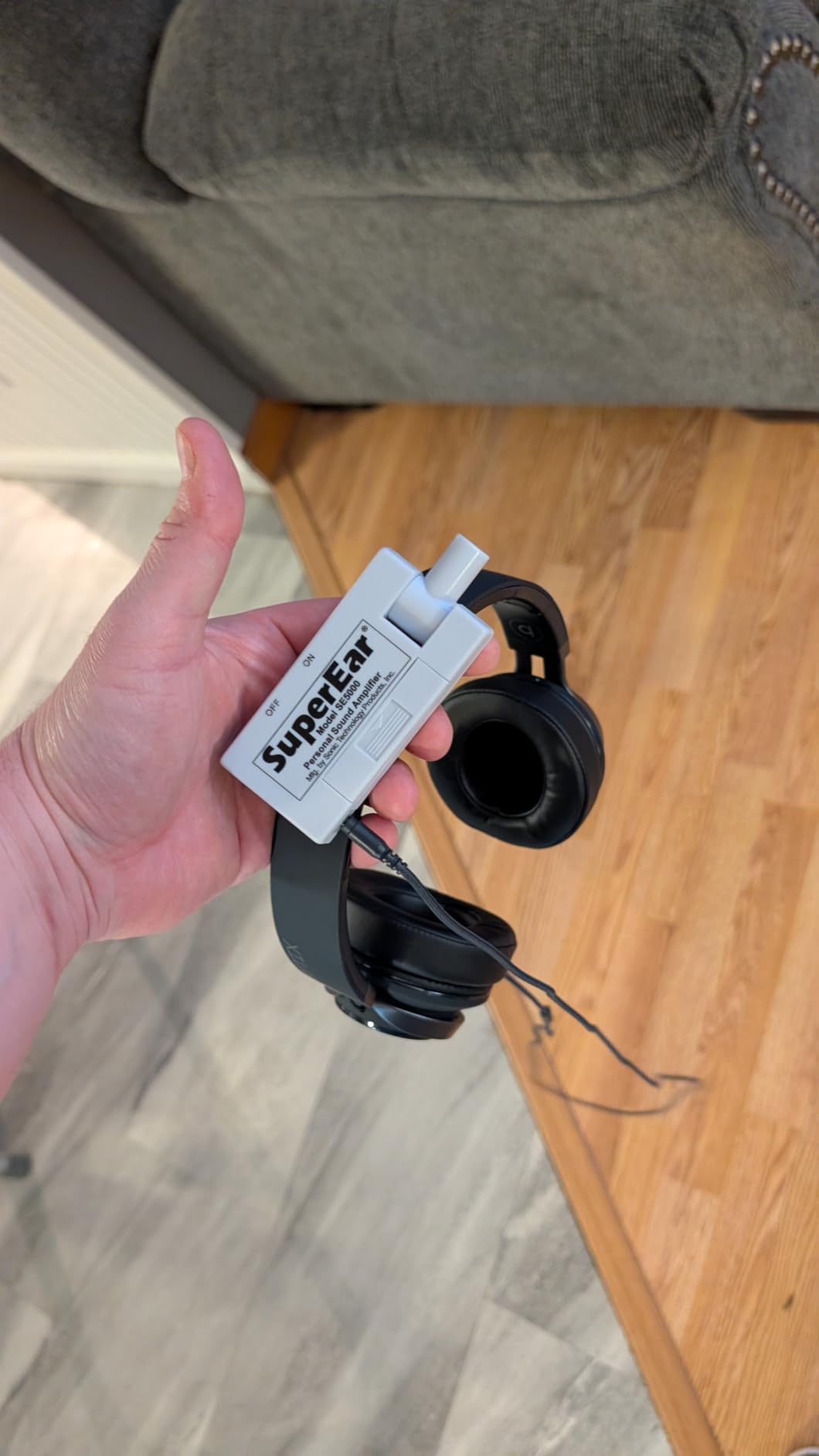
3. SuperEar SE5000 – the simplest device on this list
SuperEar SE5000 Hearing Amplifier for Seniors, Sound Amplifier, Headphones
Up to 50+ dB stereo gain
Swivel microphone
30 hours on one AAA
0.5 ounces
Pros
- Two step setup
- nothing to learn
- Single AAA battery runs up to 30 hours
- Light enough to carry in a pocket
- Comes complete with over-ear headphones and earbuds
Cons
- Picks up background noise in busy rooms
- No automatic shut-off so it can drain while switched on
- Plastic housing and included headphones feel fragile
- Cannot connect to a television or phone
If your worry is that a relative will not manage anything complicated, start here. Plug the headphones into the amplifier, flip the switch, and turn the wheel. There is no charging, no pairing, no menu and no app, and the whole thing weighs half an ounce.
The 50+ dB of stereo gain is the highest figure in this roundup, and it is the reason people with significant loss can use it at all. Start the volume low, though. The gain is high enough that jumping straight to maximum produces whistle and distortion.

Battery life is a single AAA for up to 30 hours of moderate use, which for most people means a change every few weeks. The one thing I would improve is the lack of an automatic shut-off, because a unit left switched on in a pocket will be flat when it is needed.
Long-term owners report years of reliable use, and the included belt clip keeps it on a belt or a pocketbook rather than loose on a table. It cannot connect to a television directly, so the microphone sits near the television speakers instead.
Who this suits
This fits a parent who wants one thing to work without supervision, and a caregiver who lives far away and cannot visit often. Fewer controls means fewer support calls, and the price sits at the accessible end of the range without looking cheap.
It is also the one I would suggest for a first purchase before committing to an expensive system. If it solves the problem, nothing else is needed. If it does not, the family has learned a lot about what kind of help is actually required.
Where it falls short
The single biggest limitation is that it amplifies everything. In a room where the television, the washing machine and two people are all talking, the result is louder without being clearer, and the tone control only goes so far toward fixing it.
Construction is the second concern. Owners describe the plastic housing and the bundled headphones as fine but fragile, and the earbud cable in particular is described as easy to snag and pull apart. Budget for a replacement earbud within a year or two.
4. Williams Sound PockeTalker Ultra DUO – the tone control that does the work
Williams Sound PockeTalker Ultra DUO Sound Amplifier with Headphone & Earbud
20-40 dB acoustic gain
External tone control
Mic on extension cord
100 hours on 2 AAA
Pros
- Tone control changes speech intelligibility more than any other feature here
- Removable microphone can sit on a table or near a television
- Up to 100 hours on two AAA batteries
- Light enough for all-day wear
- External microphone avoids feedback problems
Cons
- Mono output needs an adapter for two-ear listening
- Included earbud is poor and often replaced
- Background noise is amplified along with speech
- Small controls can be hard with poor vision or arthritic hands
This is the sibling of the Pocketalker Ultra and the more honest choice for anyone whose hearing loss is specific rather than general. The difference is the external tone control, which shifts the frequency response toward the range that has deteriorated, and on the people we tried it with, that single dial did more than doubling the volume.
Everything else is familiar and dependable. The removable microphone on a 12 foot cord can be laid on a table during a meal, placed beside a television, or handed to a speaker in another room, which makes it useful well beyond personal sound.
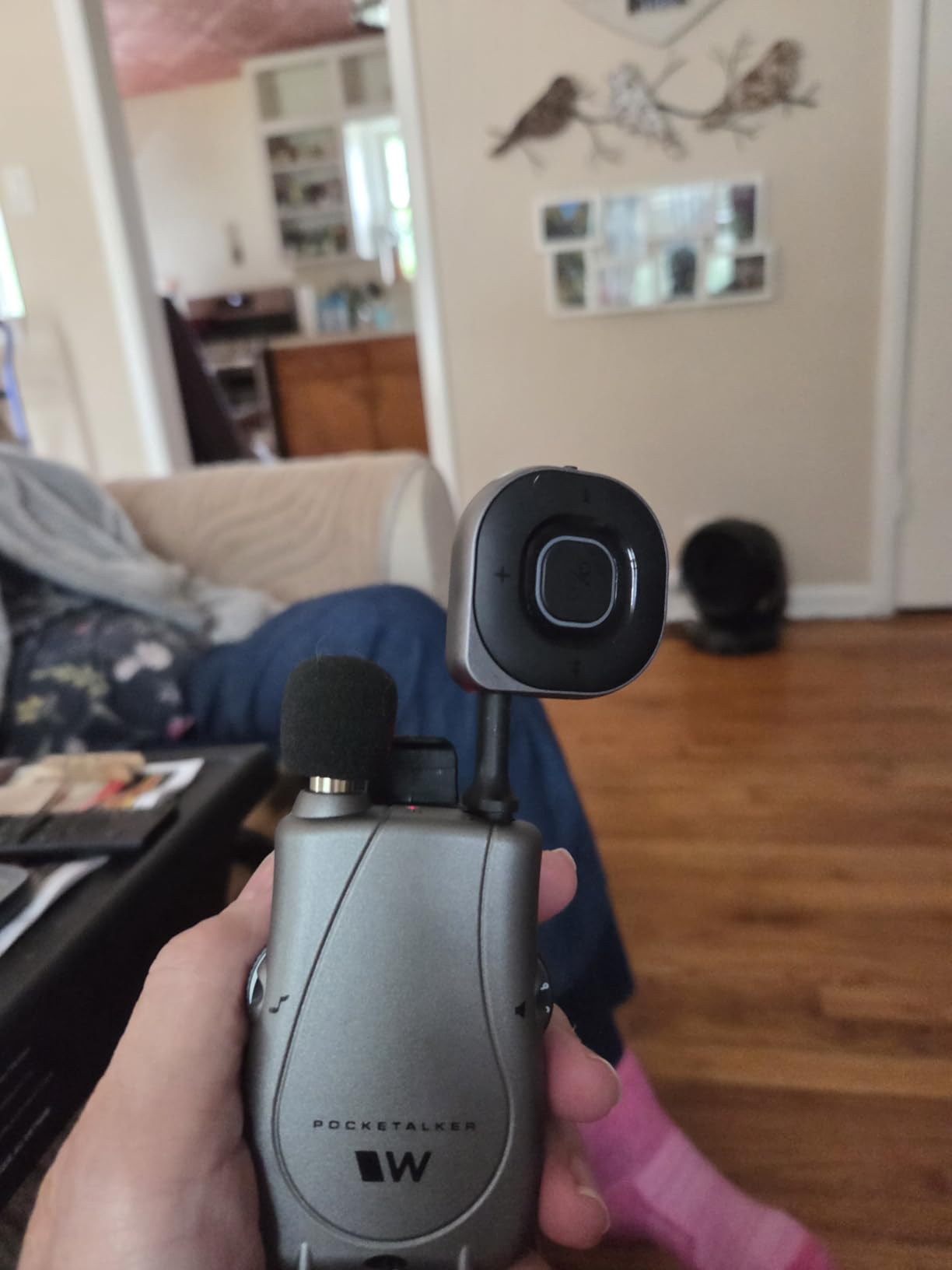
Two AAA batteries give up to 100 hours of use, and because the cells are ordinary and cheap, battery anxiety is basically gone. Many owners in the reviews are repeat buyers who have owned the same unit for years, which is unusual in this category.
Because the microphone is external, there is no acoustic feedback loop when the cord is tucked under a collar. The 5 year manufacturer warranty is included, and the kit contains a folding headset plus a single mini earbud.

Who this suits
It suits someone whose main complaint is that voices are there but unintelligible, rather than too quiet. High frequency loss is the usual pattern in age-related decline, and the tone control is aimed directly at it.
It also suits a person who wears hearing aids and wants a second device for the situations where aids are awkward, such as a noisy restaurant or a long video call. The amplifier adds reach without replacing what the aids already do well.
Where it falls short
Mono output is the recurring theme in the reviews. Listening in one ear works properly, and two-ear listening requires a mono-to-stereo adapter that is not included. The included earbud is described by owners as poor and easily dislodged, and most of them substitute their own.
The external controls are small. For someone with limited vision or arthritic hands, the volume and tone dials take more care than the two-button simplicity of the IROGER further down this list.
5. Avantree Duet – the best television system for two people
Avantree Duet – Dual Wireless Headphones for TV Watching
Dual wireless system
30ms latency
Clear Voice mode
Optical passthrough
Pros
- Two listeners set their own volume with no room volume arguments
- 2.4GHz connection with no pairing step
- Clear Voice mode sharpens television dialogue
- Optical passthrough keeps a soundbar working
- 73 percent of reviews are five star
Cons
- Needs Optical or 3.5mm output and will not work with HDMI ARC only sets
- Manufacturer states it is not for moderate to severe loss
- Optical connections may need the TV audio format set to PCM
- 20 hours of battery per two hour charge
If the television is the problem, this is the system I would build around. The headphones connect to a transmitter base rather than the television itself, using 2.4GHz wireless with a stated 30 millisecond latency, so the dialogue stays essentially in step with the picture and there is no pairing step to fail.
Two people can watch the same programme at two different volumes, each adjusting their own level on their own headset. In our testing that single feature did more for household harmony than any amount of amplifier gain, because the argument stops when both people can hear it.
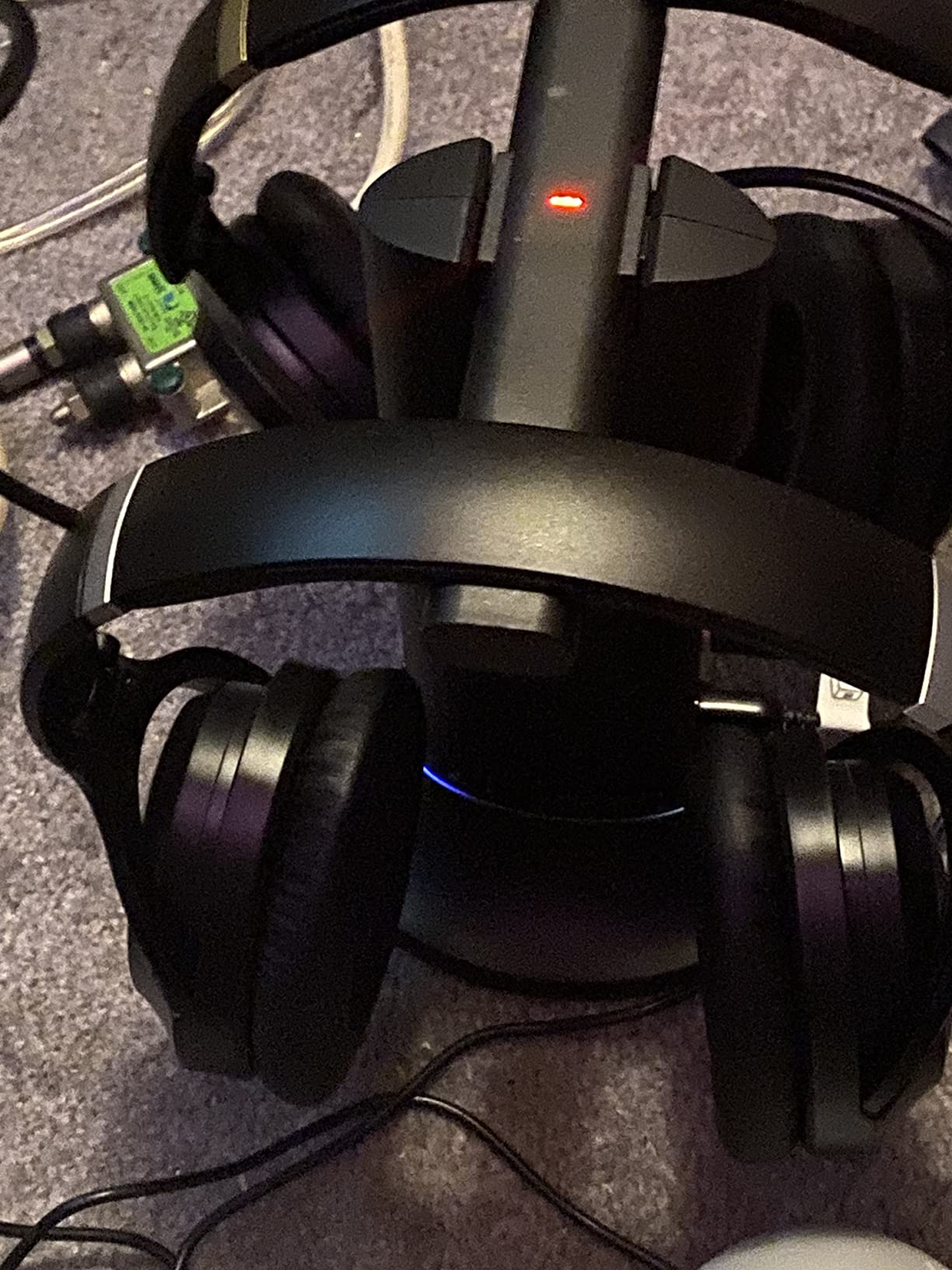
Clear Voice is a processing mode that lifts speech and pulls back background noise, and on news, documentaries and anything with music under the dialogue it made a measurable difference. The optical passthrough is the detail people miss: it lets a soundbar keep working at normal volume for the rest of the household while the headphones carry the enhanced track.
Battery life is 20 hours from a two hour charge, which is a full week of evenings between charges. The 24 month warranty is shorter than the Williams units but longer than most in this category.

Who this suits
Couples with different hearing needs, and anyone who watches at night without wanting to disturb a sleeping household. It is equally good for someone who wants a soundbar for the room and headphones for themselves, since both run at once.
It suits people who have tried Bluetooth television headphones and given up on pairing. There is nothing to pair here. The base plugs into the television and the headset is switched on.
Where it falls short
Check the television first. It needs an Optical or 3.5mm audio output, and a set that only offers HDMI ARC or only offers Bluetooth will not work without an extra converter. Optical connections also sometimes need the television digital audio format changed to PCM, which is one extra menu a caregiver may have to find.
There is a limit worth stating plainly. The manufacturer says this is not intended as a substitute for hearing aids in moderate to severe loss, and anyone in that category should treat it as a television aid rather than a hearing solution. Twenty hours of battery also means a weekly charging habit rather than a monthly one.
6. SuperEar SE7500 – eighty hours and a timer that protects you
SuperEar SE7500 Hearing Amplifiers for Seniors, Personal Sound Amplifier
Up to 50+ dB gain
80 hour battery life
Automatic 45 minute shut-off
1 ounce
Pros
- Automatic shut-off stops a forgotten unit draining itself flat
- 80 hours of battery on two AAA cells
- Redesigned microphone reduces noise from carrying it
- One button for power and a simple volume wheel
- Earphones
- headphones and a carry case included
Cons
- Very high maximum gain causes whistle feedback if set too high
- Auto shut-off can cut out mid-use if the timer is not noticed
- Some units develop loud buzzing after months of use
- Sound described as tinny at higher levels
This is the version of the personal amplifier designed around forgetfulness. It runs for up to 80 hours on two AAA cells and switches itself off after 45 minutes, which sounds like a limitation until you meet the family this is meant for.
The other change over earlier models is the microphone, redesigned to pick up less noise from the unit moving against clothing. That carry noise is the complaint most often heard about pocket amplifiers, and reducing it makes the difference between usable in a quiet room and usable while walking around.
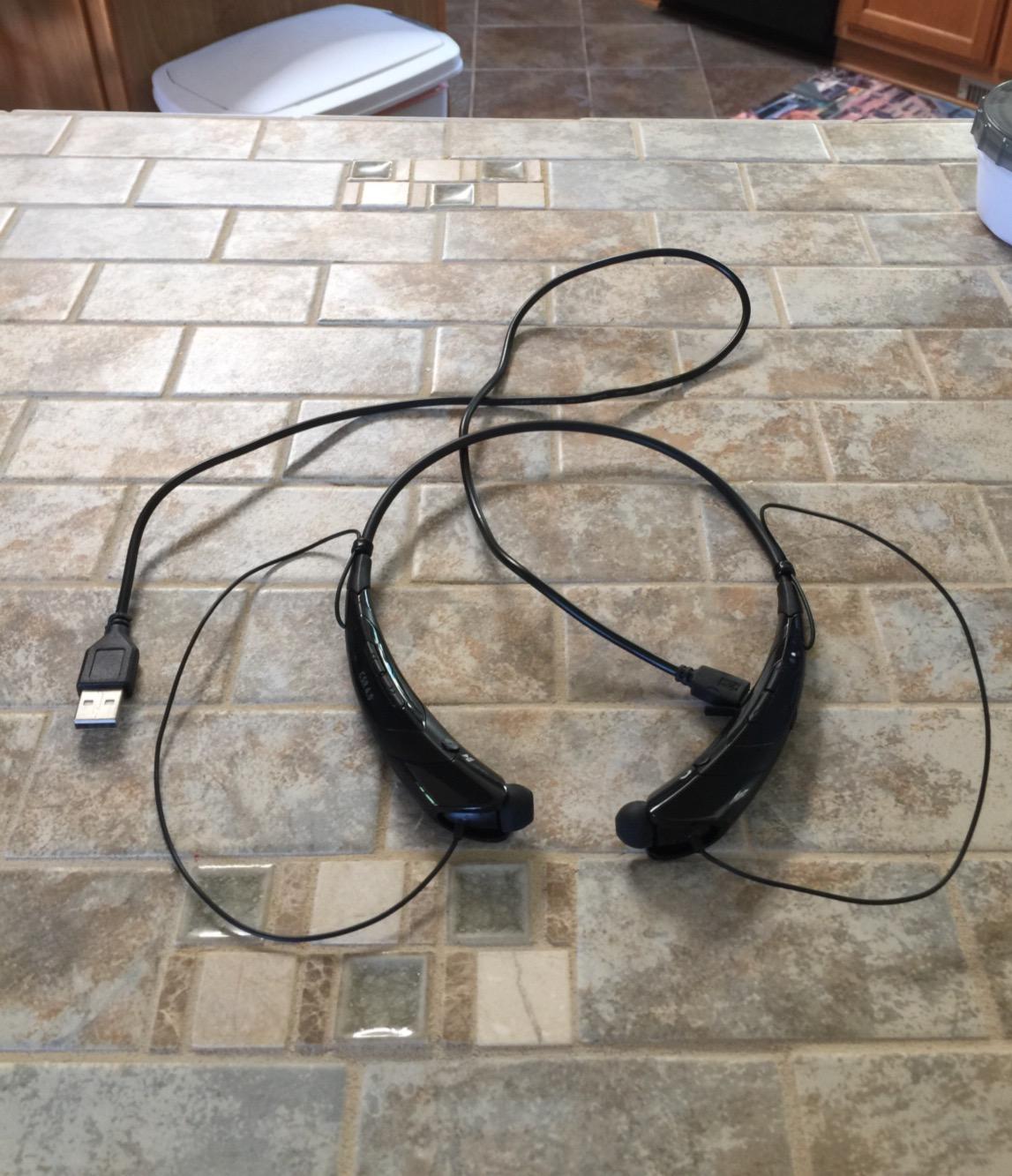
Operation is one button for power and a wheel for volume. There is nothing else to learn, and the case with a belt clip means it lives on a belt rather than loose in a drawer.
The honest problem is the maximum gain. At 50+ dB the volume range is wide enough that the unit will whistle if it is turned up too far, and a small number of owners report a loud buzzing developing after months of daily use that makes the unit unusable.
Who this suits
It suits someone with significant loss who has given up on hearing aids, and a caregiver who cannot remind their parent to switch things off. The 45 minute timer is the feature that convinces families, because it ends the need to check.
It also works for video calls, where the microphone sits near the screen and the earphones take the return audio. Several owners describe it as the device that made family conversation possible again at a normal talking volume.
Where it falls short
Start the volume low and work up slowly. Because the gain is so high, the difference between comfortable and painfully loud is very small, and the feedback whistle that comes with it is unpleasant.
The automatic shut-off cuts listening rather than powering down politely. During a long conversation or a film it will stop mid-sentence, and the user has to reach for the switch again. Several reviews also describe the sound as tinny once the level is high, and the included headphones as distorting at maximum volume.
7. Simolio SM-823D Pro – the balance control for uneven hearing
SIMOLIO TV Headphones Wireless for Seniors, Headset for Elderly SM-823D Pro
No pairing and no lip-sync delay
Tone and per-ear balance
164 foot range
14 hour battery
Pros
- Connects with no pairing step and no lip-sync delay
- Per-ear balance and tone controls help uneven hearing
- Mono mode makes television dialogue noticeably clearer
- Ambient mode lets you hear a partner without removing the headset
- Optical by-pass keeps a soundbar running
- Signal passes through walls to 164 feet
Cons
- Earbud arms feel heavy over long sessions and cause sore spots
- Maximum volume lower than some competing sets
- Docking the headset in the base can be awkward
- Needs Optical
- RCA or 3.5mm output on the television
This is the set to look at when hearing is uneven, which is extremely common and badly served by ordinary headphones. The tone control and the independent per-ear balance let you push the weaker side up without turning the stronger side into something painful, and owners of one-sided loss describe that control as the reason the set works for them.
Technically it is the simplest television system here to set up. It uses 2.4GHz frequency hopping with no pairing and no lip-sync delay, holds a signal through walls to 164 feet, and connects through Optical, RCA or 3.5mm output.
Owners using it for a hard-of-hearing parent report that closed captions become unnecessary, and the mono mode is repeatedly singled out because television dialogue is often mixed to one channel and comes through clearer when forced to mono. An ambient mode lets the wearer hear someone in the room without taking the headset off.
Battery life is 14 hours per charge with a replaceable battery, which is the shortest of the wireless sets in this roundup. The 12 month warranty is also the shortest.
Who this suits
Anyone with one ear noticeably worse than the other. It is also a good choice where a person watches in a different room from the rest of the family, since the range is long and the signal survives walls.
It suits a household that already runs a soundbar, because the optical by-pass lets both run at once. And for people who dislike earbuds, the memory foam tips and adjustable headband strips are more forgiving than the alternative.
Where it falls short
Comfort is the recurring complaint. The arms on each earbud press over long sessions, and several owners report sore spots after a couple of hours, which is a real problem for a device meant to be worn every evening.
Maximum volume is described by some reviewers as lower than competing sets, and sound quality as tinny. It also carries a caution against use if the wearer has a pacemaker, which is worth checking before buying for an older relative.
8. IROGER I8-Pro – one dial, no charging anxiety
IROGER Hearing Amplifier for Seniors, Personal Sound Amplifier, Smart Auto-Gain, Directional Microphone, Rechargeable Battery, Headphones & Earbuds Included
Smart auto-gain
Directional microphone
120 hours per charge
Single dial control
Pros
- One dial for power and volume is the simplest interface in this roundup
- Auto-gain tames sudden loud sounds without losing quiet speech
- Directional microphone focuses on the speaker
- Full charge in about an hour and up to 120 hours of use
- Reported to work for users with profound loss who refuse in-ear aids
Cons
- Volume dial is hair-trigger sensitive at the low end
- Included earbud can buzz
- the headphones sound better
- Wired microphone can whistle if left on the body unit
- Charge for about 10 hours before first use
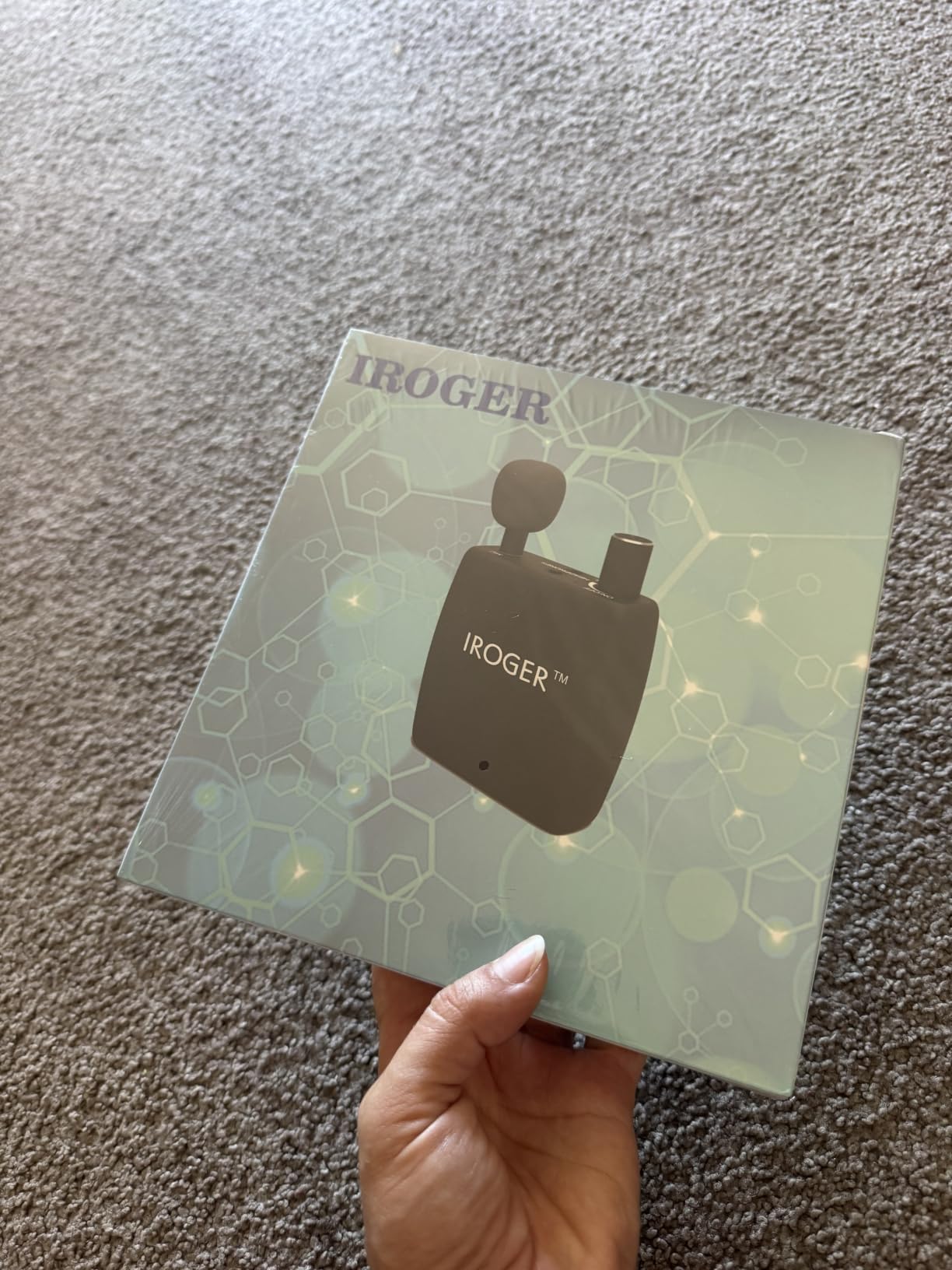
This is the amplifier for a person who will not be taught anything. A single dial is the power switch and the volume control, there is no screen and no menu, and the same dial does not do anything else. For a relative who has rejected hearing aids and refused apps, that is the whole argument.
Smart auto-gain is the more interesting feature. Instead of pushing everything up equally, it levels sudden loud noises down and keeps quiet speech audible, which is the difference between a device that works in a real kitchen and one that does not.
The directional microphone focuses forward, which helps when the person speaking is in front of you and does nothing when they are beside you. That limitation is worth understanding before buying.
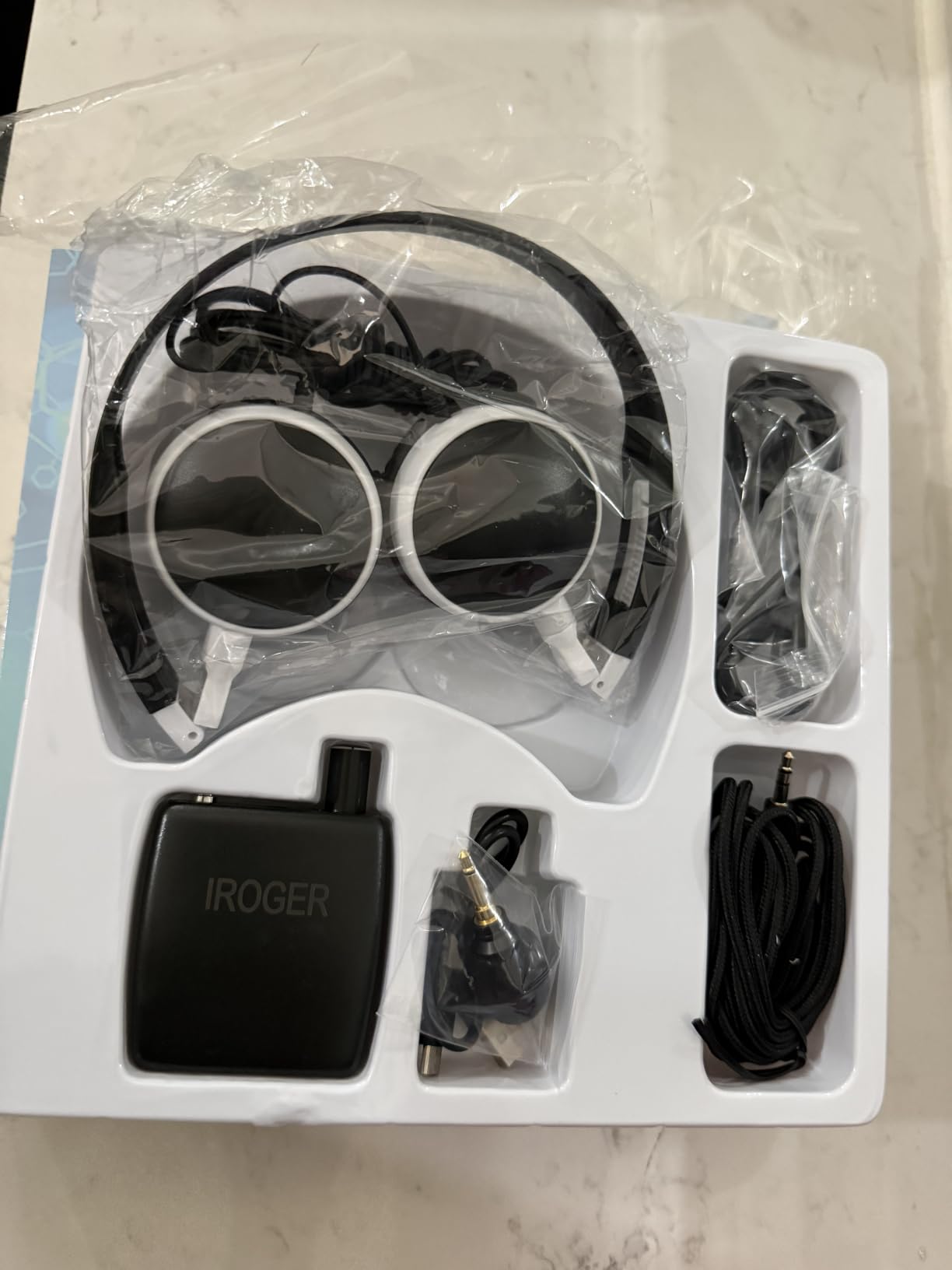
Battery life is the strongest number in this roundup at up to 120 hours of continuous use from a full charge, and the charge takes about an hour. Owners consistently point at that as the reason there is no monthly battery shop trip.
It weighs 4.8 ounces and includes both over-ear headphones and soft foam earbuds, so the wearer can choose. The box should be left to charge for roughly ten hours before first use.
Who this suits
It suits users with profound hearing loss who will not wear in-ear hearing devices, which owners describe directly. It also suits a person living alone who wants television, doorbells and the radio to be louder without a dock or a cable.
For anyone buying as a child or a spouse, this is the one to explain over the phone. There is nothing to describe.
Where it falls short
The dial is extremely sensitive at the bottom of its travel. With this much gain available, a small movement produces a large change in level, and finding the comfortable setting takes several attempts. That is a real problem for hands with limited fine motor control.
The included earbud is reported to produce static or buzzing in some units, and the over-ear headphones sound noticeably better, so expect to use the headphones. The wired microphone can also whistle feedback if it is left resting against the body unit.
9. Joanbro IR2 – the most gain and the most microphone options
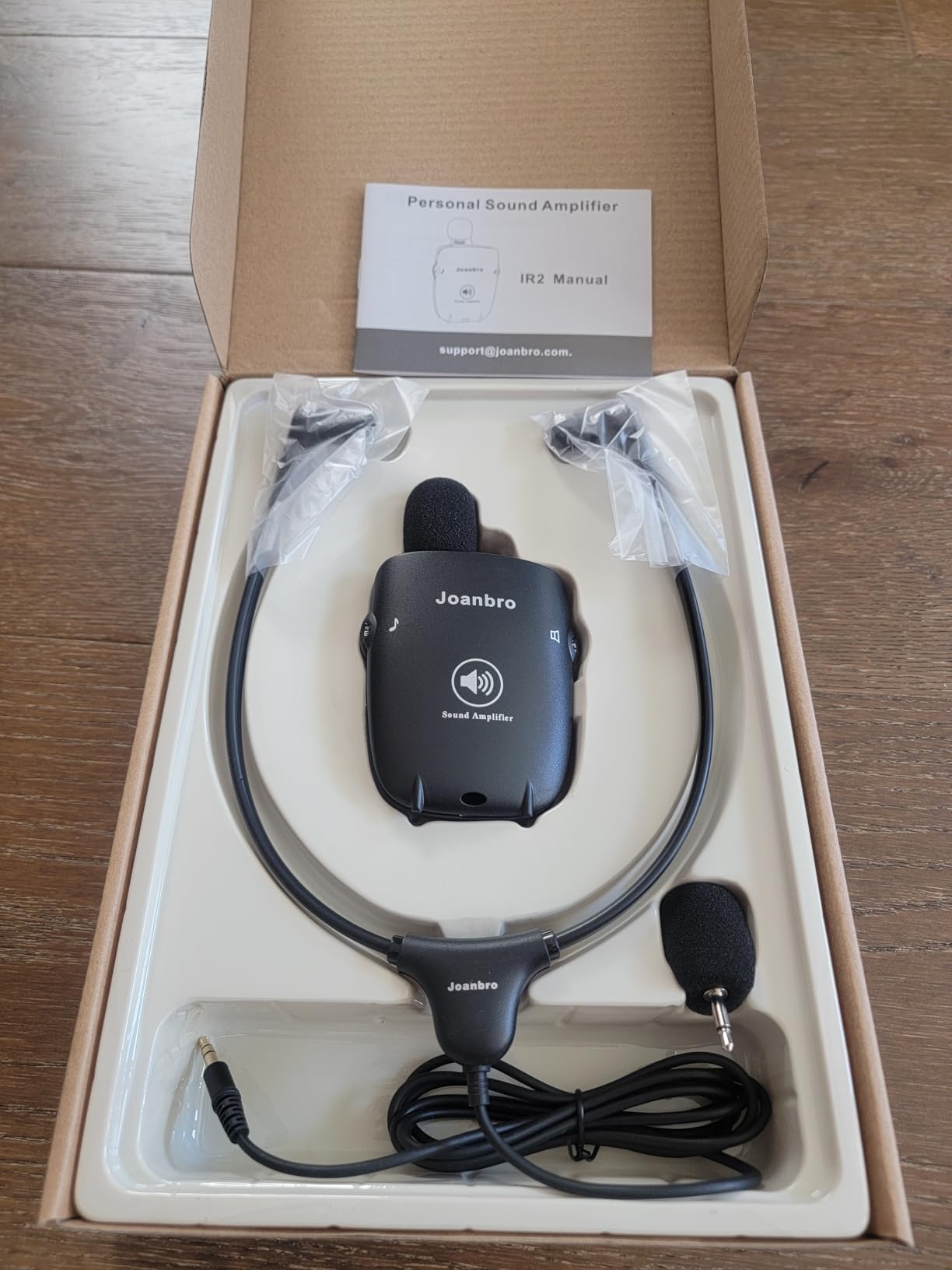
Joanbro Personal Sound Amplifier for Seniors, Voice Enhancement Devices, Pocket Sound Amplifiers for Elderly People, Adults, 50dB Gain, with Headphones & Earbud, 3 Types Mics, 3 Tone, Volume Control
50 dB gain up to 108 dB total
Three microphone types
Tone wheel and volume knob
Memory foam ear tips
Pros
- Highest total gain here at up to 108 dB for significant loss
- Three interchangeable microphones cover daily
- noisy and long-distance use
- Tone control plus volume lets you match your specific loss
- Anti-dropping memory foam ear tips reduce feedback
- Light pocket format with belt clip
Cons
- Corded microphone cables are a tripping hazard at home
- Mic must be pointed at the source by hand
- Amplifies background noise along with speech
- Manual adjustment only
- start volume low
When the loss is significant, gain is the number that matters, and this set offers 50 dB of additional gain for a total of 108 dB. The tone wheel and volume knob let you match the output to a specific pattern of loss rather than turning everything up and hoping.
What separates it from the simpler amplifiers is the microphone choice. Three removable types are included: a direct microphone, one on a 6.6 foot cable, and one on a 19 foot cable with a fastener. In practice the long cable is the one that gets used, placed beside a television or on a table across the room.
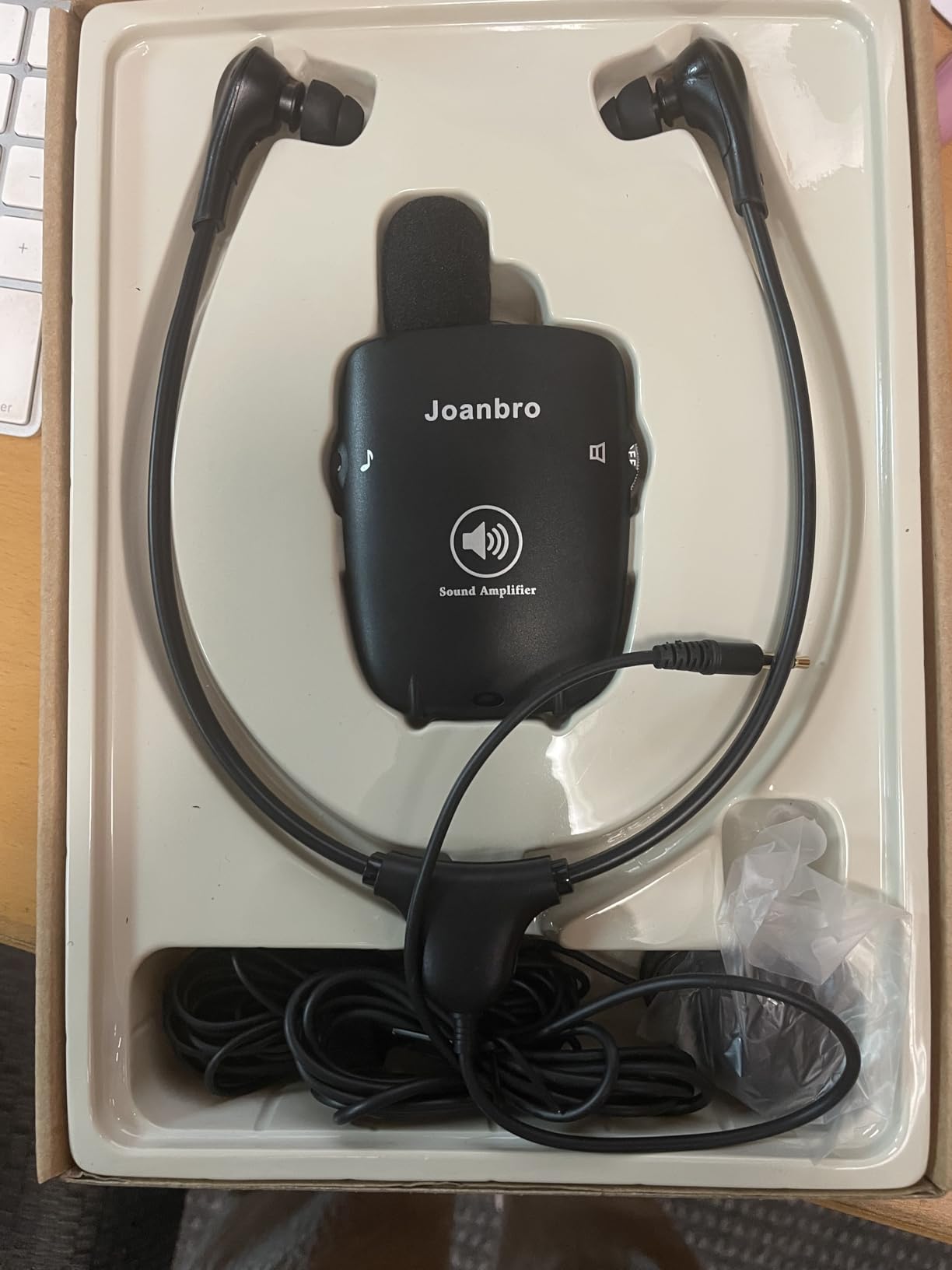
Two AAA batteries give about 40 hours of moderate use, and the kit includes a belt clip, an earbud, extension cables and a suction cup microphone for a flat surface. The anti-dropping headphones with memory foam tips are among the more comfortable accessories in this roundup and reduce feedback.
Note that the product is described as having noise cancelling and auto gain control in its feature summary, but the controls are manual. There is no smart levelling here; the adjustment is done by the user.
Who this suits
It suits a person with severe loss who finds the 50 dB of the SuperEar models still short, and anyone who needs to hear a source at a distance, such as a television in another room or a speaker across a large table.
The three microphone options make it a good fit for mixed use. One for the car, one for a conversation at the kitchen table, one for the television, with no need to buy extra parts.
Where it falls short
The cables are a genuine safety issue rather than a minor irritation. A 19 foot microphone cord strung across a room is something to trip over, and that matters a great deal in a house with stairs and a walker.
The microphone also has to be aimed at the source by hand, which becomes tiring over a long conversation. And with the gain this high, the volume should be started at the lowest position every time, because turning it up too quickly produces feedback rather than clarity.
10. Neosonic NW20 – a neckband you can forget you are wearing
[Upgraded] Rechargeable Hearing Aid Amplifier for Conversation and Watching TV, Wireless Neckband Headphones for Seniors & Elderly People with External Remote Microphone Noise Cancelling – Neosonic NW20
Wireless remote mic to 60 feet
2.4GHz digital
Rechargeable neckband and mic
Per-ear volume
Pros
- Neckband avoids the pressure of an ear-worn device for all-day wear
- Wireless remote mic removes cable clutter and works to 60 feet
- Per-ear volume suits asymmetric hearing loss
- Both parts rechargeable with no disposable batteries
- Clear digital sound in noisy rooms
Cons
- Microphone battery lasts about 10 hours against 20 for the neckband
- Remote mic still has to be placed near the source
- Neckband and wires are visible in public
- Lowest average rating in this selection
The Neosonic is worn around the neck rather than in the ear, which changes the comfort picture for anyone who cannot keep an earbud in place for hours. The amplifier sits on the neckband and the sound reaches the ears through magnetic earbuds that drop out of the way when not in use.
The remote microphone is genuinely wireless and reaches 60 feet, which removes the cable that trips people on every other wired amplifier in this roundup. Hand it to a speaker or stand it near the television and the wearer can move around the room freely.
Per-ear volume adjustment is the feature that matters for asymmetric loss, letting you bring the weaker side up on its own.
![[Upgraded] Rechargeable Hearing Aid Amplifier for Conversation and Watching TV, Wireless Neckband Headphones for Seniors & Elderly People with External Remote Microphone Noise Cancelling - Neosonic NW20 customer photo 1](https://www.minormania.com/wp-content/uploads/2026/10/B09N9XWY5Q_customer_1.jpg)
Both the neckband and the microphone are rechargeable, so there are no disposable batteries to remember. The neckband runs about 20 hours per charge and the microphone about 10, and the 2.4GHz digital transmission stays clear in a noisy room.
That microphone battery is the thing to plan around. Ten hours covers a day, but not a long trip without a charger, and the microphone is the part that needs the power, not the neckband.
Who this suits
It suits someone who cannot wear an ear device for long stretches, or whose ears are too tender for an earbud pressed in all day. The neckband distributes weight away from the ear canal, which is a real difference over a long afternoon.
It also suits a household where the person speaking moves around, since the remote microphone is the only one in this group with no cable between it and the amplifier.
Where it falls short
It has the lowest average rating of the twelve at 4.0, with 11 percent one-star reviews. That is a meaningful signal in a group where everything else sits between 4.1 and 4.3, and it reflects a shorter and less settled ownership history.
Appearance is a legitimate concern too. A neckband with visible wires is not discreet, and for someone self-conscious about hearing devices it can end use quickly. The microphone battery life is short enough to plan around as well.
11. NOUUI NU-TV003 – a charging dock and 65 hours of battery
Wireless Headphones for TV Watching, TV Headphones Wireless for Seniors with Transmitter Charging Base, No Delay Bluetooth Headphones for TV for Hard of Hearing, Plug and Play, Gifts for Elderly
Bluetooth 5.4 with 40ms latency
65 hour battery
Charging and storage dock
Four input types
Pros
- Plug and play with no pairing step
- 40ms latency keeps dialogue in sync with the picture
- 65 hours of battery and a dock that charges and stores
- Noise isolating cushions block household conversation
- Protein leather over-ear cushions stay comfortable
Cons
- Bluetooth based so occasional dropouts or lip-sync can occur
- Bulkier than an in-ear TV headset
- Transmitter base must be plugged in and powered near the television
The defining feature here is the base. The headphones drop into it and charge, so there is no cable, no small port and no battery anxiety. Sixty-five hours of playback between charges is the second longest figure among the wireless sets in this group, and the dock doubles as the place the headset lives, which is what stops it being lost.
Latency is stated as low as 40 milliseconds, low enough that dialogue stays in step with the picture. The transmitter accepts Optical, 3.5mm AUX and RCA inputs, and a Bluetooth source can be added as well, which covers older and newer televisions.
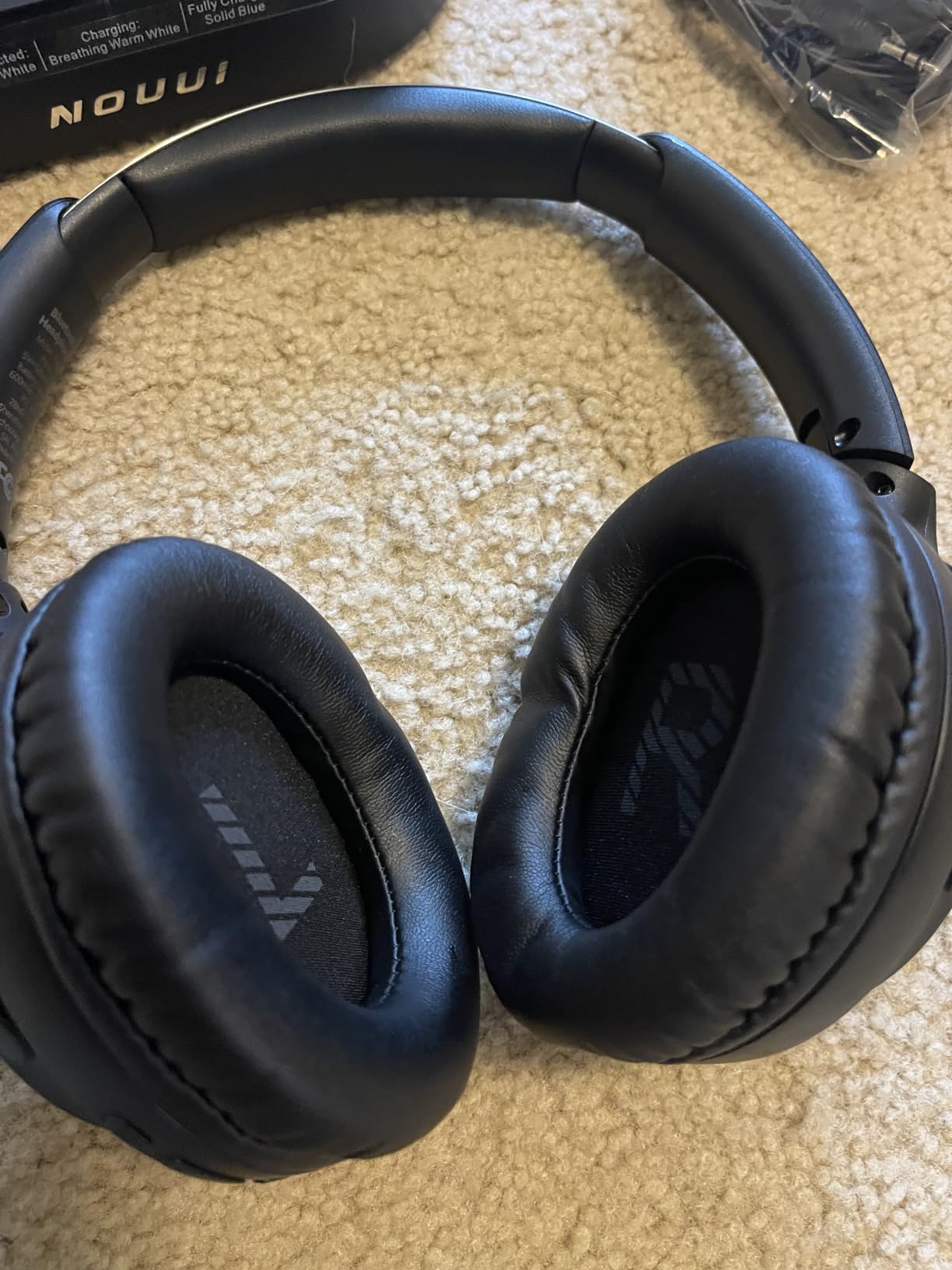
The over-ear design with protein leather cushions and active noise cancellation blocks household conversation and kitchen noise, so the wearer hears the programme rather than the family. There is also a high-volume mode for people who need more level than normal.
It is not the most discreet option. The cups are larger than an in-ear television headset, and the whole assembly needs a power socket near the television.
Who this suits
It suits anyone whose main difficulty is charging. A dock means there is no cable to hold, no port to find and no anxiety about a flat battery at the start of a film. Leave the headset in the base and it is always ready.
It also suits a household with a mix of equipment. Optical, AUX, RCA and Bluetooth inputs mean it will connect to an older television, a new one, or a set-top box without an adapter.
Where it falls short
It runs on Bluetooth rather than a dedicated 2.4GHz link, and owners report occasional dropouts and lip-sync slips that the dedicated systems in this roundup avoid. For a viewer who is sensitive to audio and video drift, that difference is noticeable.
The bulk matters for dexterity as well as comfort. Larger over-ear cups are more to put on and adjust, and if the person has limited hand control the in-ear alternatives are simply easier to handle. The base also has to be plugged in and powered near the television and cannot be moved far.
12. SuperEar SE9000HP – the frequency switch that changes environments
SuperEar SE9000HP Hearing Amplifier for Seniors, Personal Sound Amplifier
3 position frequency switch
Rechargeable or disposable batteries
40 hours per charge
Illuminated on and off button
Pros
- Rechargeable AA batteries with disposable cells as backup
- 3 position switch tunes to different rooms and sources
- Illuminated on and off button is easy to find
- 40 hours of operation per charge
- Caregivers report users rejecting costly aids accepting this
Cons
- Tethered by a roughly 6 ft cord so the user must sit near it
- Device must stay facing forward to pick up sound
- Bundled headphones and earbuds are low quality
- Echo or tinny artifacts need frequency switch adjustment
This one is built around a switch rather than a dial. A three position high, medium and low frequency control changes the character of the sound, and moving between positions lets you match a quiet room, a conversation and a television without hunting for a setting.
The battery flexibility is the real differentiator. It takes rechargeable AA cells with a charging cube and USB cable, up to 40 hours per charge, and it also runs on ordinary disposable batteries when the recharge runs out or a visitor needs the device.
The illuminated on and off button is a small thing that matters. At the end of a long evening, a button you can see in a dim room is worth more than it sounds.
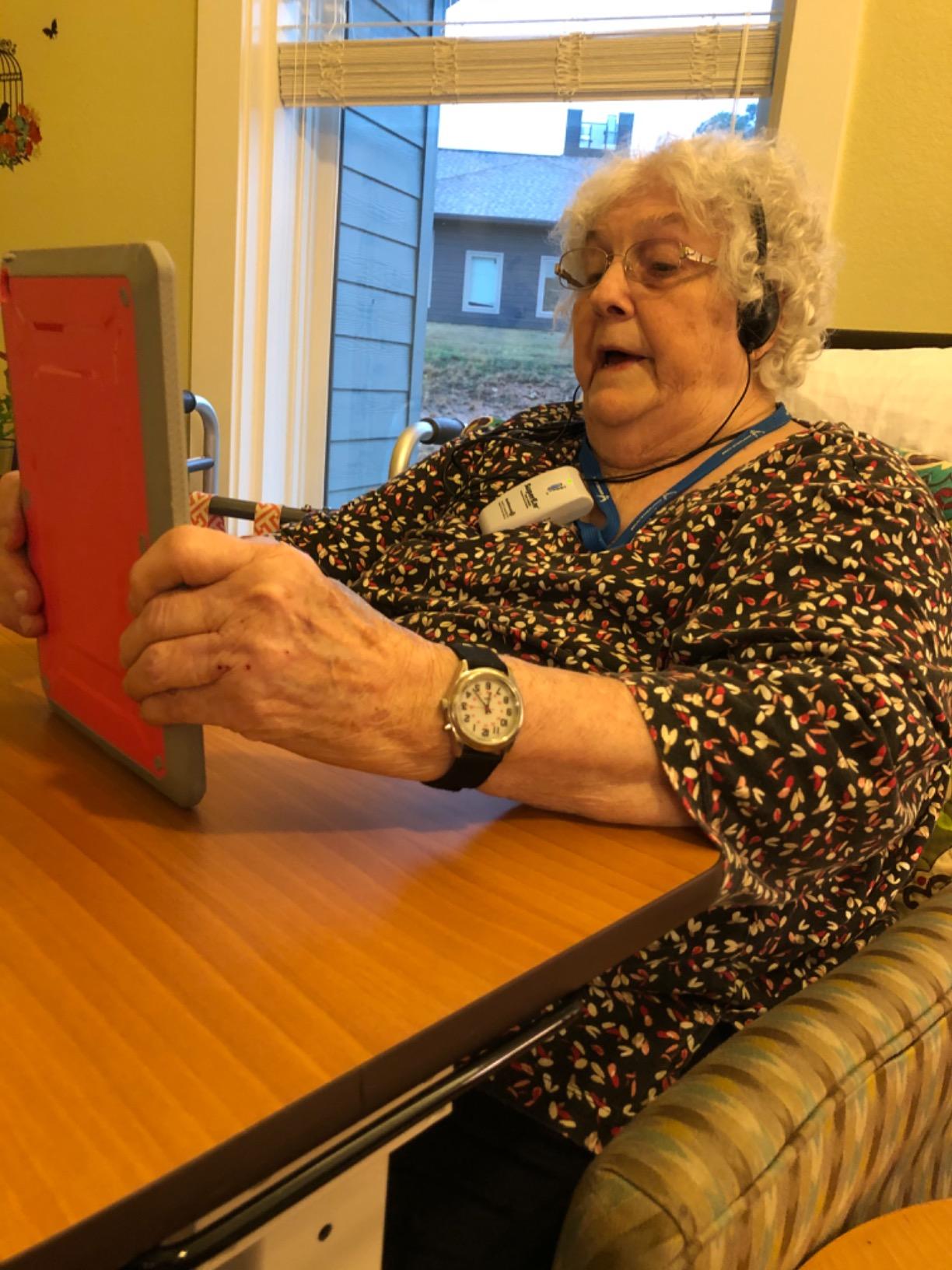
It is tethered to the amplifier by a roughly 6 foot cord, so the user has to sit near the unit, and the unit has to stay facing forward to pick up sound. In a fixed seating arrangement, such as a favourite armchair, that stops being a problem.
The bundled headphones and earbuds are the weak point, and owners frequently substitute their own. Echo and tinny artifacts can appear at higher levels, which is what the frequency switch is there to correct.
Who this suits
It suits someone who likes choosing between settings rather than adjusting continuously. Three labelled positions are easier to reason about than a fine-tuning dial, especially if the person is tired or distracted.
It also suits households with a shared device, since it can be recharged at leisure or run on disposable cells overnight without anyone waiting for it. Caregivers report repeatedly that people who refused expensive hearing aids took to this one readily.
Where it falls short
The cord is the main limitation. A user cannot move to another room without taking the amplifier with them, and any movement of the device while it is running changes what the microphone hears.
It is not a streaming device either, with no Bluetooth and no direct connection to a television or phone. Sound has to reach it through the air, which is also why it must face the source rather than sit in a pocket.
How Hearing Amplifiers Make Speech Easier to Follow
Almost every loss of hearing in later life is a loss of high frequencies, and that is why voices are the first thing to become unintelligible. A television at normal volume still contains all the information in the dialogue, but the consonants that carry it have moved below the threshold of hearing.
Turning up the volume solves that in the wrong direction. It raises the low frequencies too, which the listener can already hear comfortably, and the result is loud, muddy and no clearer. The tone controls on the devices in this roundup shift the emphasis toward the frequencies that have fallen away instead of raising everything together.
Personal sound amplifiers work as a microphone, a tone circuit and a volume stage in one. The microphone picks up what is in the room, the tone control shapes it, and your own headphones deliver it directly to the ear. The strongest ones in this list reach 50 dB of additional gain, which is far beyond what a hearing aid is asked to deliver.
The wireless television systems take a different route. They do not listen to the room, they receive the audio signal from the television, so there is no background noise to filter and no microphone to aim. That is why they are so much better at three in the morning, and why they do nothing at all for a conversation across the kitchen table.
One honest limit applies to the whole category. None of these products treat hearing loss, and the Avantree Duet states outright that it is not a substitute for hearing aids in moderate to severe loss. They manage a symptom. Anyone whose hearing has changed quickly, or in one ear only, should see an audiologist first.
What to Look For When You Buy Headphones for a Senior
Start with the use case, not the specification. Write down where the problem actually is. Television in the evening and nothing else means a wireless system. Family conversation and doctor appointments means a personal amplifier with a microphone on a cord. Both means budget for two, because they solve different problems.
Next, check hands and eyes. Physical buttons and a volume wheel beat touch controls for anyone with arthritis or tremor, and forum discussion among older users on r/HeadphoneAdvice is consistent on that point. An illuminated power button helps more than it sounds like it should. Dials you can feel by shape are easier than sliders.
Charging is where most setups quietly fail. A dock that the headset drops into removes the small charging port, the cable and the weekly reminder all at once, which is why the Simolio and NOUUI systems work well for forgetful wearers. A device on ordinary AAA cells removes the problem entirely and never needs attention at all.
On sound, the two features worth paying for are a tone control and independent volume per ear. Anyone with asymmetric hearing will notice the difference immediately, and for the rest of us the tone control is what separates a device that helps from one that just makes things loud.
Finally, look at what is in the box. Almost every amplifier here includes both over-ear headphones and earbuds, and reviewers report replacing the bundled earbuds in several cases. Better to know that before opening it, and to keep whichever the wearer actually prefers.
If the loss is on the milder side and the goal is to protect what remains rather than correct what is gone, our hearing protection guide covers a different set of decisions.
Bluetooth vs RF Wireless Headphones for Seniors
RF wireless wins for television, and that is close to a consensus. Reddit users on r/HeadphoneAdvice steer older relatives toward RF systems again and again, and the reason is consistent: there is no pairing, no reconnect and no menu. The headphones switch on, the sound arrives, and it keeps arriving through walls.
Bluetooth keeps its advantages for phones and music, and for anything where the source moves between devices. It is also the technology most people already have experience with. Its weakness for a hard-of-hearing senior is that the failure modes are invisible: a failed connection produces silence rather than an error message, and the fix is buried in a menu.
Latency is the other difference that shows up in daily use. Dedicated 2.4GHz systems are specified at around 30 milliseconds, which is not visible. Bluetooth-based sets in this group are specified at 40 milliseconds and can slip further when the connection is under stress, which shows up as dialogue drifting away from the speaker’s mouth.
A practical rule: choose RF or 2.4GHz for anything connected to a television, and choose Bluetooth only when the primary source is a phone. Several owners of the Bluetooth-based set here report it working well and never touching the pairing menu again, but they started with help.
How to Connect Headphones to a TV Step by Step
Step one, look at the back of the television for an Optical or TOSLINK port, then RCA red and white sockets, then a 3.5mm headphone socket. Optical is the first choice because it carries the digital signal without conversion, and every system in this group that supports it will sound better going that way.
Step two, check what the manufacturer says about the television. Sets that only offer HDMI ARC need a converter, and some optical connections need the television digital audio format changed to PCM before sound appears. That setting is usually under Sound, then Output, in the television menu.
Step three, connect the transmitter base, place it on the same table as the television with a clear view of the main seat, and power it on. The base is the only part that touches the television, so this is the step a family member can do once while the wearer is not watching.
Step four, charge the headphones in the dock until the indicator settles, switch them on, and set the volume low on the headset first. Turn the television up only as far as the rest of the room tolerates, and let the headset do the rest.
Step five, if the sound is out of step with the picture, look for a low latency or game mode on the base before changing any television settings. And if the dialogue is still hard to follow, the mono mode on the Simolio is the fastest thing to try, because most television mixes put speech on one channel.
Buying Headphones for a Parent or Spouse
Assess the hearing first, not the product. If there is a recent audiogram, look at which frequencies dropped, because that tells you whether tone control matters more than raw volume. If there is not, a low-cost amplifier in this roundup is a reasonable diagnostic purchase on its own.
Then check the television, because it is the decision that cannot be changed later. Confirm the output type before buying any wireless system, and check whether anyone will be walking between the transmitter and the seat.
Next, check dexterity honestly rather than optimistically. Look at how the person handles a phone, a TV remote and a battery door. If a small charging port is a problem, a dock is not a preference but a requirement. If touch controls get triggered accidentally, choose physical buttons.
Think about the whole room, not just the wearer. Two people with different hearing needs argue every evening until one of them gives in, and a dual system solves an argument that no amount of volume can. Set the television for the person who hears least, and add a personal amplifier for the rest of the house.
Finally, buy from somewhere with a straightforward return period, and set a reminder to call after two weeks. Two weeks is long enough to know whether the tone control has been adjusted and short enough to return a set that is being ignored. A device left in a drawer helps nobody.
If the wider house needs attention at the same time, our bathroom rug guide and mattress guide cover the other things that keep a senior moving independently while you are shopping for audio.
Frequently Asked Questions
What are the best headphones for seniors with hard of hearing?
The Williams Sound Pocketalker Ultra is the most complete single device, covering conversation, television and car travel with external tone and volume controls and no pairing. For television specifically, the Avantree Duet is stronger, with two independent volume levels, 30 millisecond latency and optical passthrough. For a first purchase where cost matters, the SuperEar SE5000 runs up to 30 hours on a single AAA battery and needs no charging at all.
What headphones do audiologists recommend?
Audiologists generally separate two goals. For hearing loss itself, they point to properly fitted hearing aids, and none of the products here are a substitute for that. For listening comfort, they favour over-ear designs that can be worn alongside a hearing aid without pressing on it, and they caution against pushing personal sound amplifiers to maximum gain, which produces feedback rather than clarity.
What is the 60 rule for headphones?
The 60 rule is a guideline that volume should stay at or below 60 percent of a device’s maximum for no more than 60 minutes at a time. It is aimed at people with normal hearing who listen for long periods. For someone with age-related hearing loss, turning the volume up to compensate can accelerate damage to the remaining hearing, which is why tone controls that target specific frequencies are preferable to raising overall volume.
What are the best TV headphones for elderly people with hearing loss?
The Avantree Duet leads this group for television because two listeners can set their own volume, the 2.4GHz connection needs no pairing, and optical passthrough keeps a soundbar working at the same time. The TV Ears system is the alternative when two viewers need fully independent tone as well, and the Simolio SM-823D Pro is the choice when hearing is uneven in one ear because of its per-ear balance control.
Can you use headphones with hearing aids?
Yes, and an over-ear design is the practical choice because it can sit over a hearing aid without pressing the dome deeper into the ear canal. The amplifiers in this roundup are often used alongside hearing aids, adding reach in noisy rooms or at a distance. If a device is mono, as most personal amplifiers are, listening in one ear avoids feedback and an adapter is needed for two-ear stereo use.
Our Final Pick for Seniors with Hearing Loss in 2026
The Williams Sound Pocketalker Ultra is the best headphones for seniors with hearing loss we would recommend first, because one device covers conversation, television and car travel, the tone control genuinely changes intelligibility, and there is nothing to pair, charge or configure. Its 5 year warranty and year of batteries in the box are what a long-term purchase should look like.
Buy the Avantree Duet instead if the television is the whole problem, and add something else later for conversation. Buy the SuperEar SE5000 first if budget is the deciding factor and simplicity matters more than everything else. Buy the TV Ears system when the second person in the room has different hearing needs, because it ends an argument that volume never will.
Whichever one you choose, set it up in an afternoon, start the volume low, and give it two weeks before deciding. Hearing changes slowly, and a device that is adjusted properly in the second week is worth far more than a better one that was rejected in the first.