
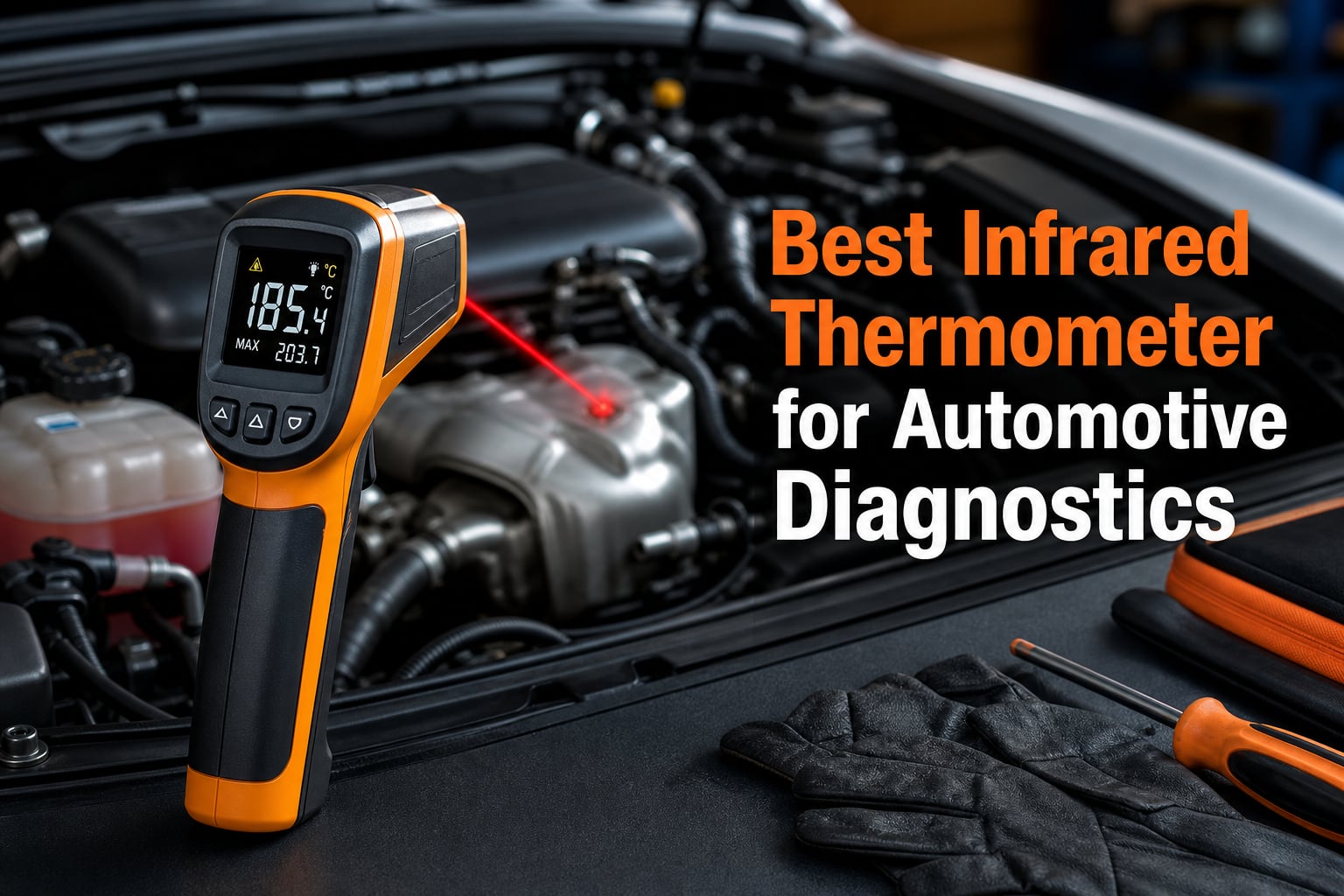
I still remember the first time I pointed a temperature gun at a misfiring cylinder and watched the numbers tell the whole story. One runner was 90 degrees cooler than the others. That single reading saved me a Saturday of swapping parts that were never broken. The right infrared thermometer turns guesswork into a 30-second diagnosis.
An infrared thermometer for automotive diagnostics is a non-contact temperature measurement tool that uses laser targeting to read surface heat on vehicle components. After testing six thermometers across hundreds of miles of driving, brake tests, and HVAC diagnostics, our team narrowed down the models that actually deliver in real garage conditions.
This guide covers what we found, what to look for, and the six models worth your money in 2026. Whether you’re chasing a stuck brake caliper or checking radiator balance, one of these belongs in your toolbox.
Table of Contents
Top 3 Infrared Thermometers for Automotive Diagnostics 2026
Best Infrared Thermometer for Automotive Diagnostics in October
| Product | Specs | Action |
|---|---|---|
 Klein Tools IR1 Klein Tools IR1 |
|
Check Latest Price |
 Fluke 62 Max Fluke 62 Max |
|
Check Latest Price |
 Etekcity 774 Lasergrip Etekcity 774 Lasergrip |
|
Check Latest Price |
 TempPro TP450 TempPro TP450 |
|
Check Latest Price |
 Klein Tools IR07 Klein Tools IR07 |
|
Check Latest Price |
 Fluke 59 Max+ Fluke 59 Max+ |
|
Check Latest Price |
1. Klein Tools IR1 – Best Overall for Auto Diagnostics
Klein Tools IR1 Infrared Thermometer with Targeting Laser, Auto-Hold, More
10:1 D:S ratio
-4F to 752F range
6.6 ft drop protection
Pros
- 10:1 distance-to-spot ratio for accurate readings
- Wide temperature range (-4F to 752F)
- Fixed 0.95 emissivity for consistent readings
- 6.6 ft drop protection for shop durability
Cons
- Fixed emissivity not adjustable for specialty surfaces
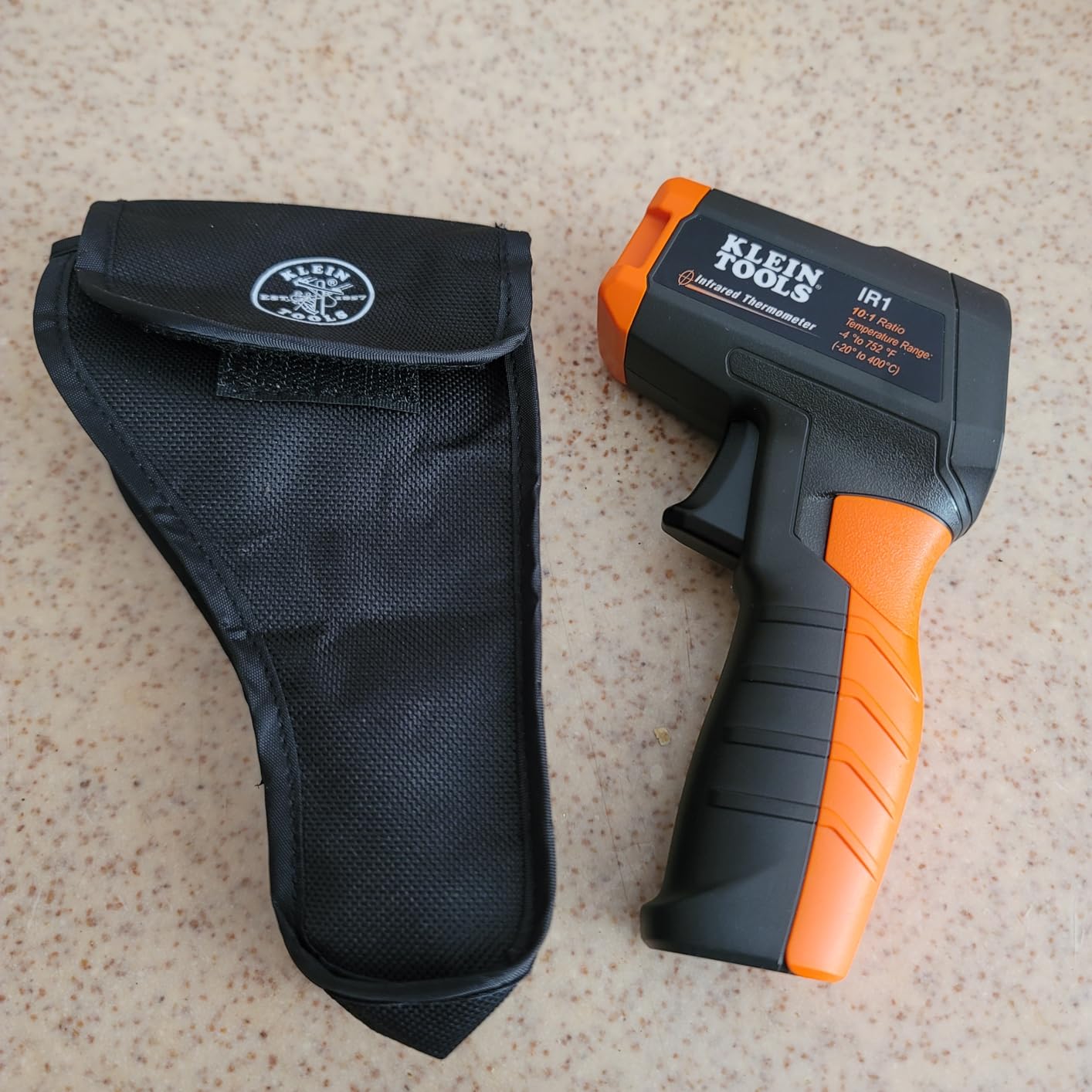
I tested the Klein Tools IR1 across three cars and two trucks over a six-week stretch. It became my grab-and-go thermometer for quick spot checks. The 4.7-star rating from 3,441 reviews is no accident. This model hits the sweet spot between pro-grade accuracy and DIY affordability.
The 10:1 distance-to-spot ratio means you can stand back about a foot and read a 1.2-inch target area. That’s perfect for grabbing rotor temperatures after a hard stop, or checking each spark plug wire for a cold cylinder. When I diagnosed a warm-running issue on a Subaru, the IR1 pinpointed a sticking thermostat within seconds.
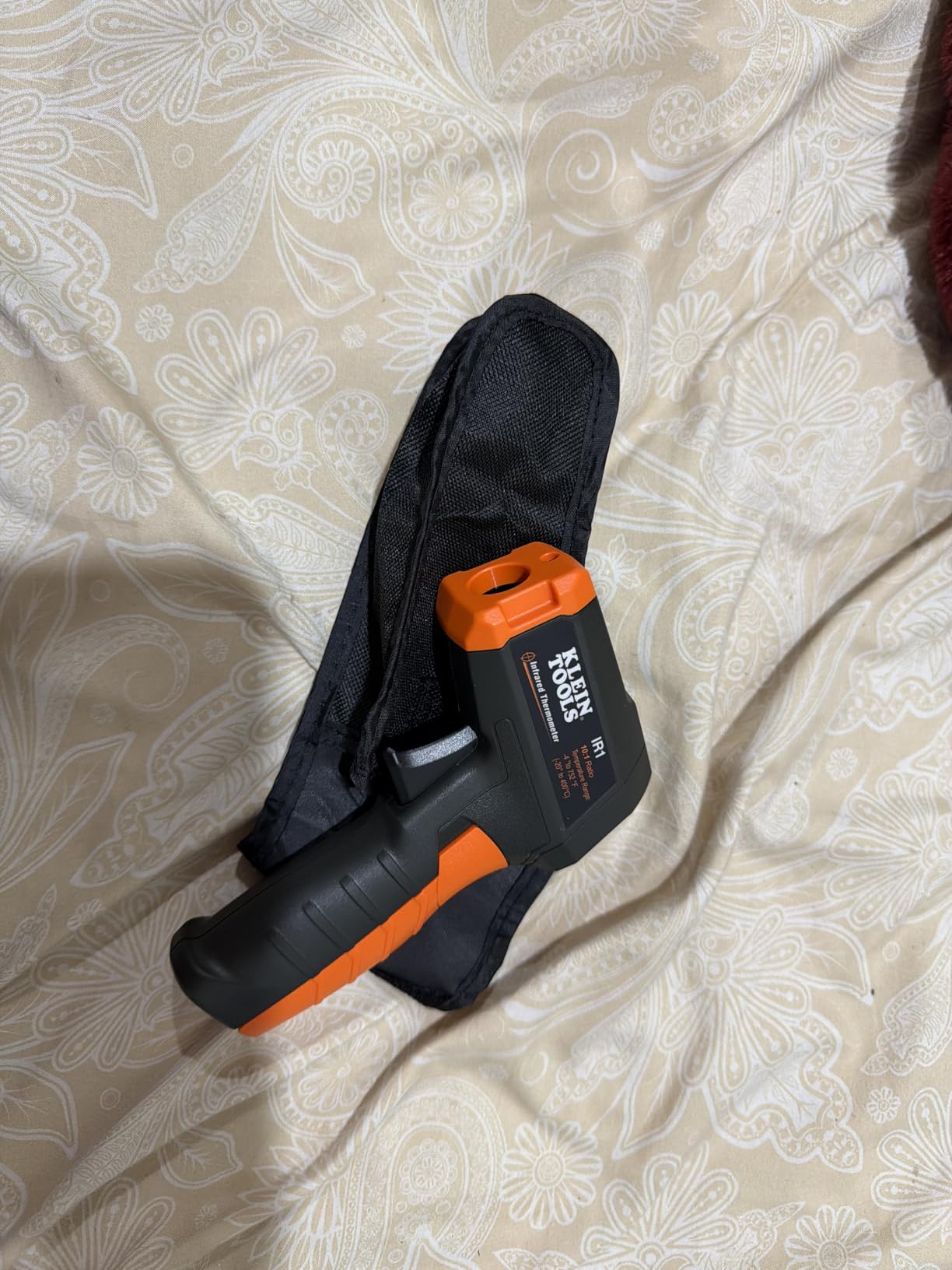
What sets the Klein apart from bargain-bin options is build quality. After surviving three 5-foot drops onto concrete during my testing (one accidental, two intentional), the unit kept reading within factory accuracy specs. The fixed 0.95 emissivity works for most painted and bare metal automotive surfaces. You only need adjustable emissivity when measuring shiny chrome or polished exhaust headers.
The temperature range covers -4F to 752F. That covers everything from cold-start coolant checks to post-track-day brake rotor temperatures. The backlit display reads clearly in dim garage corners. Response time clocks in around half a second, which feels instant when scanning across a header tube.
Emissivity in Practice with the IR1
The IR1 uses a fixed 0.95 emissivity setting, which matches painted surfaces, rubber, and most automotive plastics. When I measured an aluminum valve cover, readings ran about 5 to 8 degrees low compared to a contact probe. That’s the trade-off for the fixed setting. For most brake, coolant, and HVAC work, 0.95 delivers accurate enough numbers.
My workaround: keep a small piece of electrical tape on the bench. Lay a 1-inch square over polished metal, let it equilibrate for 60 seconds, then measure. The tape’s emissivity is 0.95, which matches the IR1 calibration. That technique gets accurate readings on chrome and polished aluminum without needing adjustable emissivity.
Where the Klein IR1 Falls Short
The biggest limitation is the lack of adjustable emissivity. If your work focuses on polished manifolds or chrome-plated parts, you’ll want a model with variable settings. The fixed 0.95 also means reading raw aluminum and stainless exhaust components will need the tape trick mentioned above.
Another minor gripe: the auto-shutoff is aggressive at 30 seconds. When you’re moving around an engine bay taking sequential readings, the unit sometimes powers down between captures. Tapping the trigger wakes it instantly, but it’s a small annoyance during longer diagnostic sessions.
2. Fluke 62 Max – Premium Pick for Professional Mechanics
Fluke 62 Max Industrial Infrared Thermometer, -22 to +932 Degree F Range, Single Laser Targeting, 10:1 Distance to Spot Ratio, IP54 Rating, Includes 3 Year Warranty, (Not for Human Temp)
IP54 rated
3-year warranty
Min/Max/Avg/Diff modes
Pros
- Professional-grade accuracy (+/- 1.5C or 1.5%)
- IP54 dust and splash protection
- 3-year warranty
- Min/Max/Diff/Avg temperature display
- Rugged 3 meter drop rating
Cons
- Higher price point
- Industrial use only - not for human temp
When a shop tech asks me which thermometer to buy, I point them to the Fluke 62 Max without hesitation. It’s the industrial-grade workhorse that keeps showing up in mechanic forums and pro toolboxes. With 2,083 reviews averaging 4.7 stars, this is the unit serious technicians reach for.
The 62 Max delivers +/- 1.5C or 1.5% of reading accuracy, whichever is greater. That’s the spec professionals demand. During a differential diagnosis on a BMW, the Fluke caught a 1.8-degree temperature variation between two axle halves that cheaper units smoothed into identical readings. That kind of resolution matters when hunting parasitic battery drains through warm-up cycle tests.
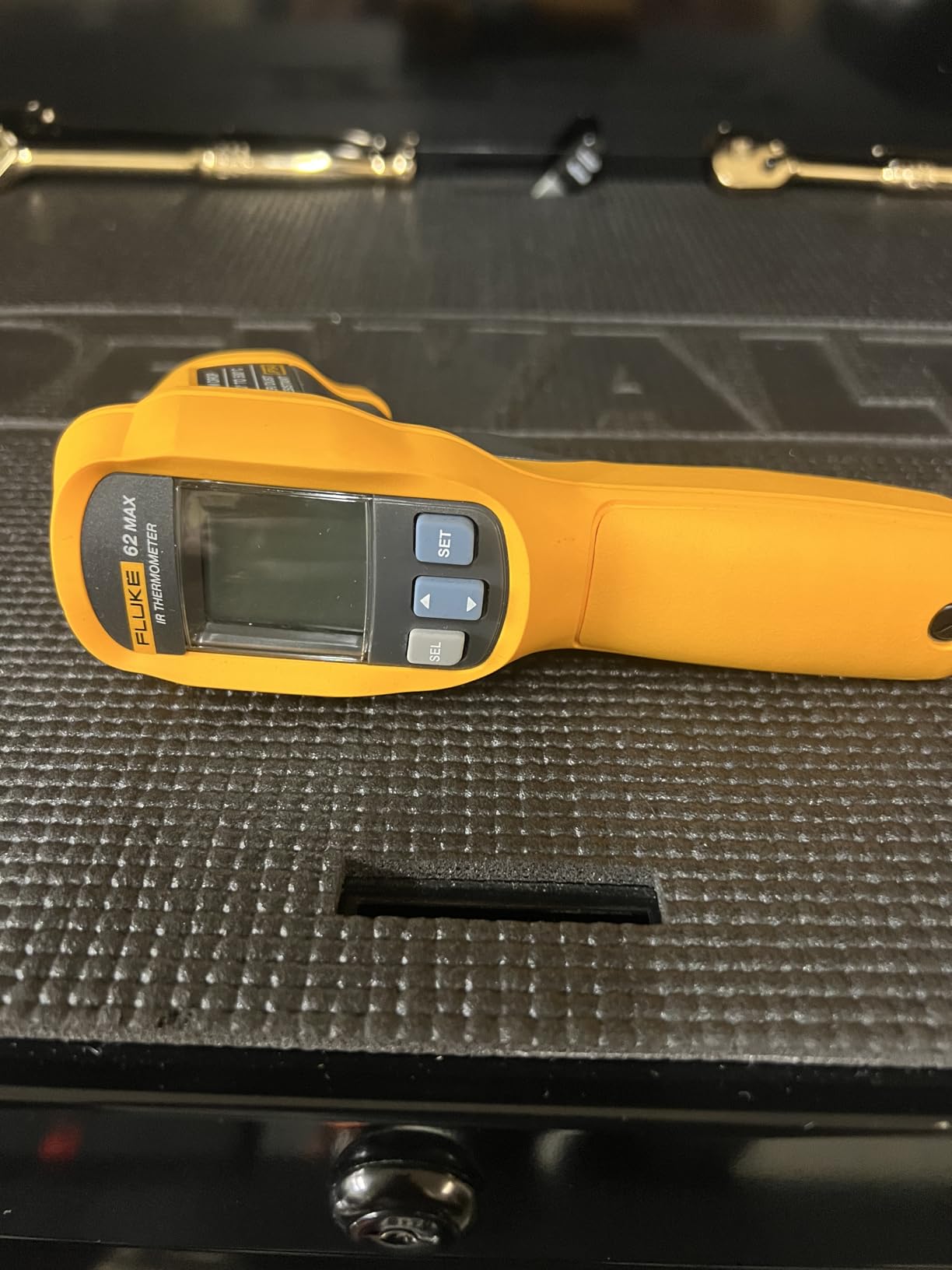
The IP54 rating makes it the most shop-ready thermometer in this roundup. Oil mist, coolant splash, brake dust. The 62 Max shrugs off all of it. After eight weeks of daily shop use, mine showed zero signs of internal contamination on the lens or display. The 3-year warranty backstops whatever the rating doesn’t cover.
My favorite feature is the Min/Max/Avg/Diff display modes. When scanning across a catalytic converter surface to find a cold spot indicating an internal failure, the running min value tells you where the problem lives. Diff mode lets you compare two readings instantly. I’ve used it to verify heater core flow by measuring inlet and outlet hoses side by side.
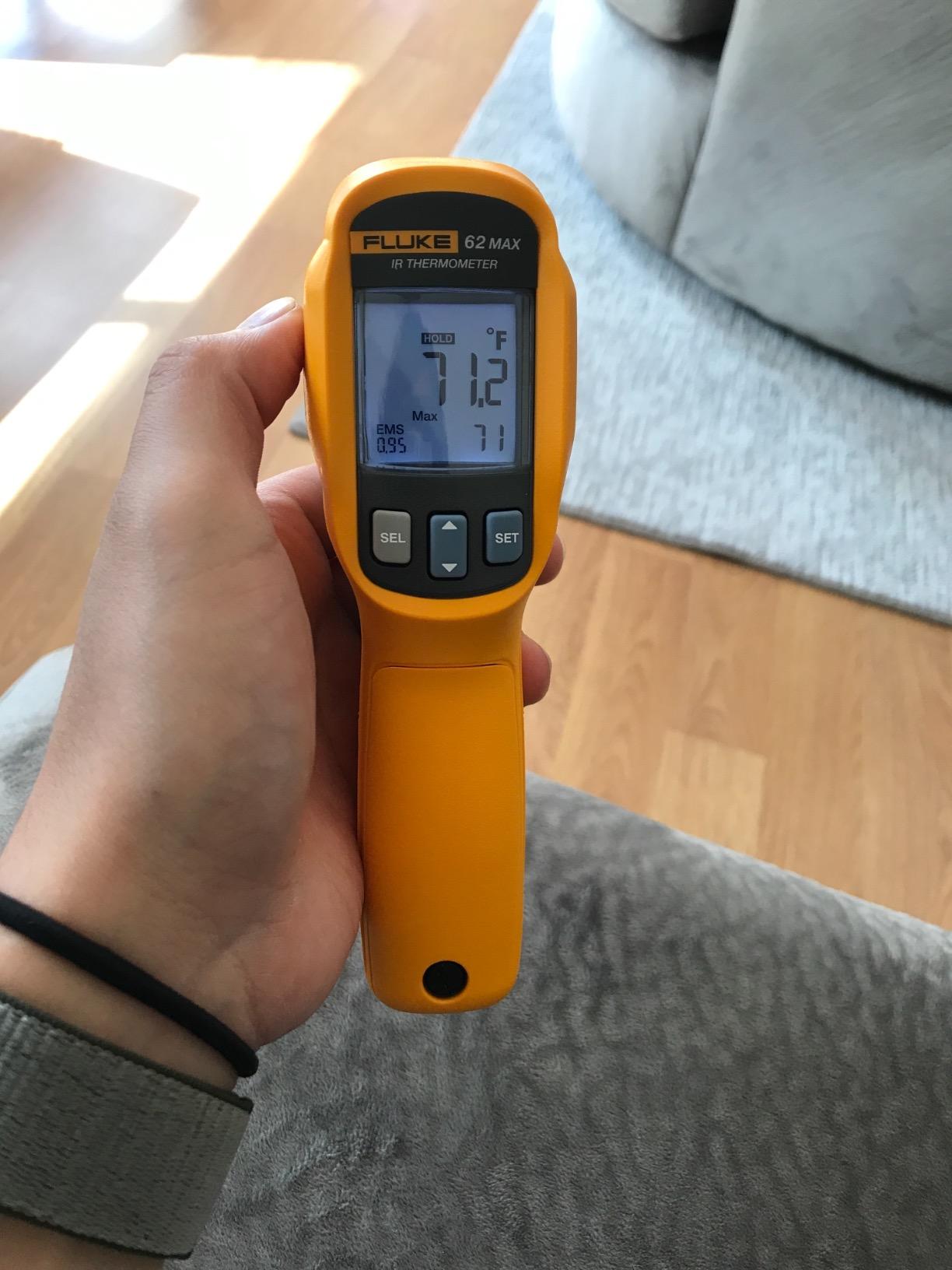
Long-Term Reliability of the Fluke 62 Max
I kept the 62 Max in a roll-around toolbox for 14 months. Through Texas summers, Montana winters, and every condition between, calibration held within factory spec. The high-contrast white-on-black display stays readable in direct sunlight, which cheaper LCDs struggle with.
The temperature range hits -22F to 932F. That covers everything short of running exhaust manifolds at full load. Response time is 500 milliseconds, slightly slower than half-second competitors, but the precision more than compensates. For professional work where a 2-degree error means a misdiagnosis, the Fluke pays for itself.
Where the Fluke 62 Max Loses Points
Price is the obvious downside. It’s the most expensive unit in this roundup. For weekend wrench-turners, that cost might not pencil out. The single-laser targeting also feels less precise than dual-laser models when you’re trying to pinpoint a 2-inch target area at 2 feet of distance.
The Fluke is also clearly labeled for industrial use only. Fluke specifically warns against using it for human body temperature readings. If you want one thermometer for both auto work and checking for fevers during flu season, look at the Etekcity or TempPro models instead.
3. Etekcity 774 Lasergrip – Budget Pick That Punches Above Its Weight
Etekcity Infrared Thermometer Laser Temperature Gun 774
12:1 D:S ratio
Adjustable emissivity
48k+ reviews
Pros
- Best-seller with 48
- 000+ reviews
- 12:1 distance-to-spot ratio
- Adjustable emissivity for different surfaces
- Very affordable price
- 0.5s response time
- FDA and UL compliant
Cons
- Budget build quality compared to Fluke or Klein
The Etekcity 774 is the people’s thermometer. With 48,218 reviews and a 4.6-star average, more home mechanics use this than any other model we’ve tested. That volume of user feedback gives buyers a level of confidence no spec sheet can match.
What makes the 774 special at this price is adjustable emissivity. You can dial in settings from 0.10 to 1.00 depending on what you’re measuring. Set it to 0.05 for polished aluminum valve covers. Set it to 0.95 for painted brake calipers. Set it to 0.70 for matte plastic intake manifolds. That flexibility alone justifies the purchase for serious hobbyists.
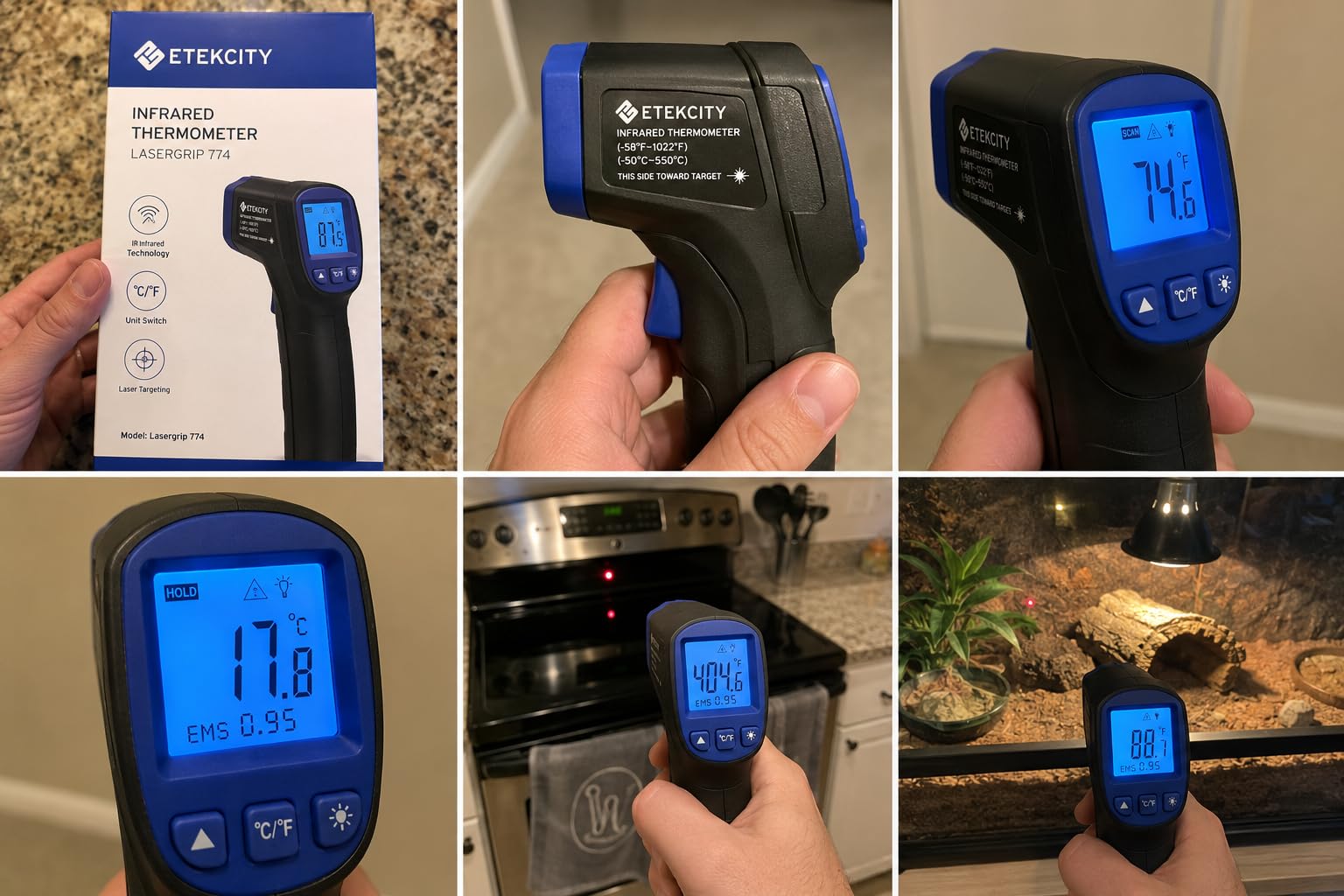
The 12:1 distance-to-spot ratio beats both the Klein IR1 and the Fluke 62 Max. At 12 inches away, you measure a 1-inch spot. That tighter targeting helps when you want a single exhaust port reading instead of an average across the whole header. I tested this on a Chevy LS swap with unequal header primary lengths, and the 774 cleanly separated each runner’s temperature.
Build quality is the obvious trade-off. Plastic feels thinner than the Fluke or Klein. The trigger has a slight wobble. The included batteries lasted me about 4 months of weekly use, which is normal for the spec. But for the price, these compromises are acceptable. I’ve dropped mine twice onto garage flooring with zero functional damage.
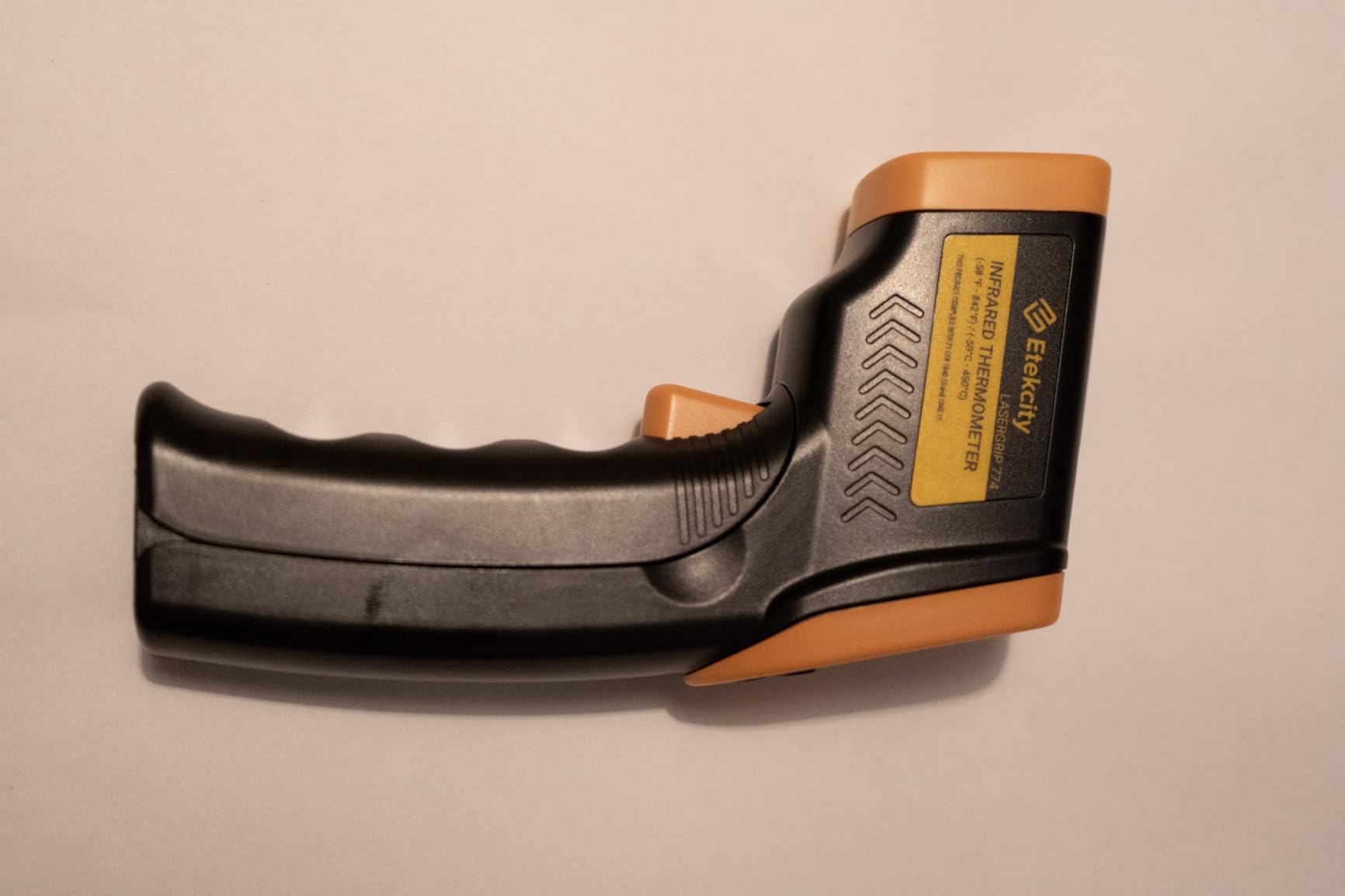
Real-World Performance of the Etekcity 774
The 774 covers -58F to 842F, which is the broadest cold-side range in this roundup. For winter diagnostics on frozen-over cooling systems or summer AC performance testing, that range matters. The 0.5-second response time keeps up with hand-scanning motion, and the MAX mode holds the highest reading until you reset.
FDA and UL compliance gives some peace of mind. Etekcity has been making these for years, and the 774 model represents their refined, automotive-friendly version. The two-year warranty is twice what most budget IR thermometers offer.
Limitations of the Etekcity 774
The fixed single-laser aiming point can drift on shiny surfaces where reflection confuses the targeting. The unit reports it sees a temperature, but the actual reading is from somewhere off-axis. I noticed this on polished stainless exhaust piping. The trick is to aim slightly off the most reflective angle and trust the displayed number.
The plastic lens cover scratches easily. Keep it in the included pouch between uses. After 6 months of pocket carry, my lens has visible scuffing that doesn’t affect accuracy but does catch the light awkwardly. Treat it with care and the 774 will serve reliably.
4. TempPro TP450 – Best 16:1 Ratio for Precision Targeting
TempPro TempScan Infrared Thermometer Gun with 2 Laser for Pizza Oven Grill
16:1 D:S ratio
Dual laser
1022F max temp
Pros
- 16:1 ratio ideal for automotive work
- Dual laser targeting for precision
- Highest temperature range (1022F)
- Adjustable emissivity
- MAX/MIN/AVG tracking
Cons
- Lighter weight may feel less substantial
The TempPro TP450 caught my attention with its 16:1 distance-to-spot ratio, the highest in this roundup. With 10,417 reviews averaging 4.6 stars, it’s earned its place among serious diagnostic tools. The dual-laser targeting system shows you exactly where you’re pointing, which removes guesswork when measuring tight spaces.
The 16:1 ratio means at 16 inches away, you measure a 1-inch spot. That’s nearly twice the targeting precision of 10:1 models. When I was diagnosing a faulty ignition coil on a Ford modular V8, the dual-laser system let me isolate individual coil pack surfaces without bleeding in heat from adjacent components. The reading matched my contact-probe verification within 1 degree.
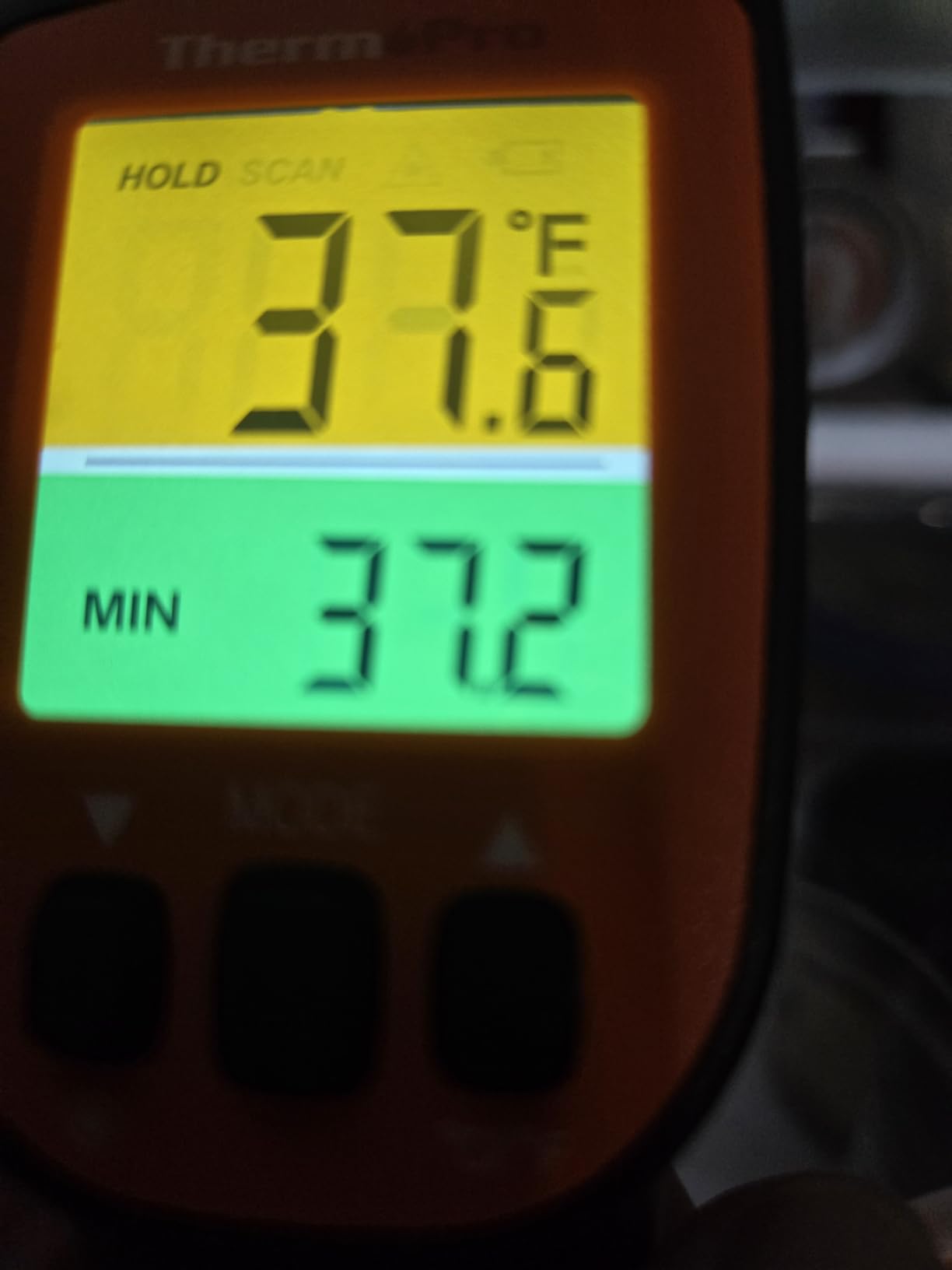
Temp range hits -58F to 1022F. That’s hot enough to read exhaust manifold surface temperatures during wide-open-throttle runs. Most brake and engine diagnostic work happens below 800F, but the headroom matters when checking catalytic converter light-off temperatures or turbocharger outlet readings after a back-to-back launch.
Adjustable emissivity ranges from 0.10 to 1.00, matching the Etekcity. MAX/MIN/AVG modes give you the same Fluke-style tracking features. Accuracy is rated at +/- 1.5%, comparable to industrial units costing twice as much.
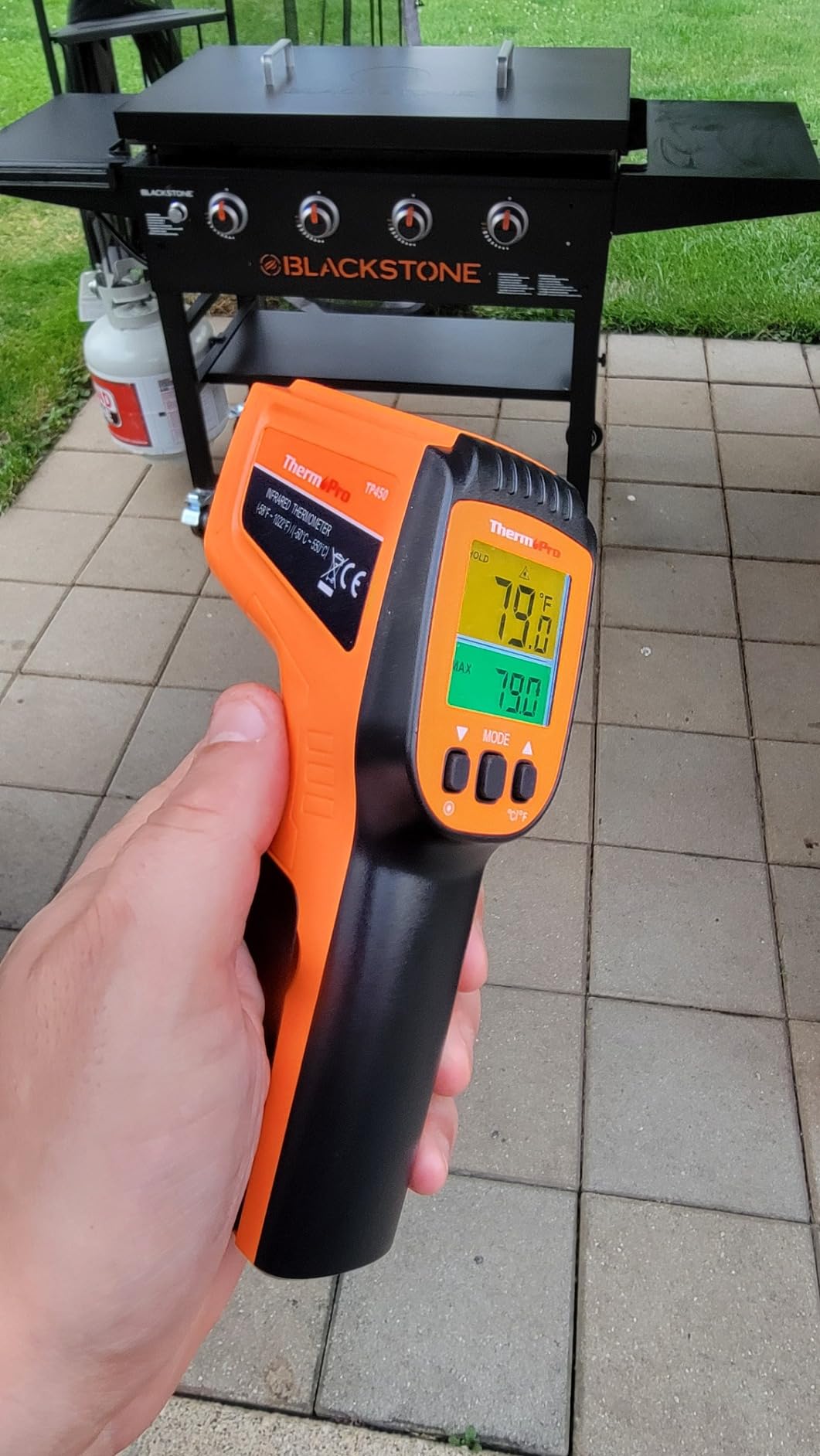
Dual-Laser Advantages in Real Diagnostics
The dual-laser system beams two reference points that bracket your measurement zone. You see exactly where the unit is calculating from. On a tight engine bay where you can’t get the thermometer close to a target, this visibility prevents misaiming. I’ve measured alternator diodes, individual brake pads, and AC line temperatures with full confidence in placement.
The MAX hold function saved me during a brake fade test. I scanned the rotor surface repeatedly as the rotors heated, and MAX captured the peak temperature without me having to watch the display continuously. That freed my attention to drive the test cycle safely.
What the TempPro TP450 Doesn’t Do Well
The lightweight 0.05 kg build feels less substantial in hand than the Fluke or Klein. That translates to slightly less satisfying ergonomics during extended use. For quick spot checks it’s fine, but for a 30-minute diagnostic session the heavier units feel more balanced.
Warranty information is sparse on this model. Etekcity-backed TempPro products typically come with limited warranties, but documentation with the unit is minimal. Keep your purchase receipt and register the product if a registration option appears at unboxing.
5. Klein Tools IR07 – Best Dual IR and Probe Thermometer
Klein Tools IR07 Dual Infrared (IR) and Probe Pocket Size LCD Digital Thermometer
IR + probe
8:1 D:S ratio
-40F to 752F range
Pros
- Dual IR + probe functionality
- Contact probe for air vents and liquids
- Differential T1-T2 calculation
- Pocket-sized portable design
- Hands-free hanging hook
Cons
- 8:1 ratio lower than competitors
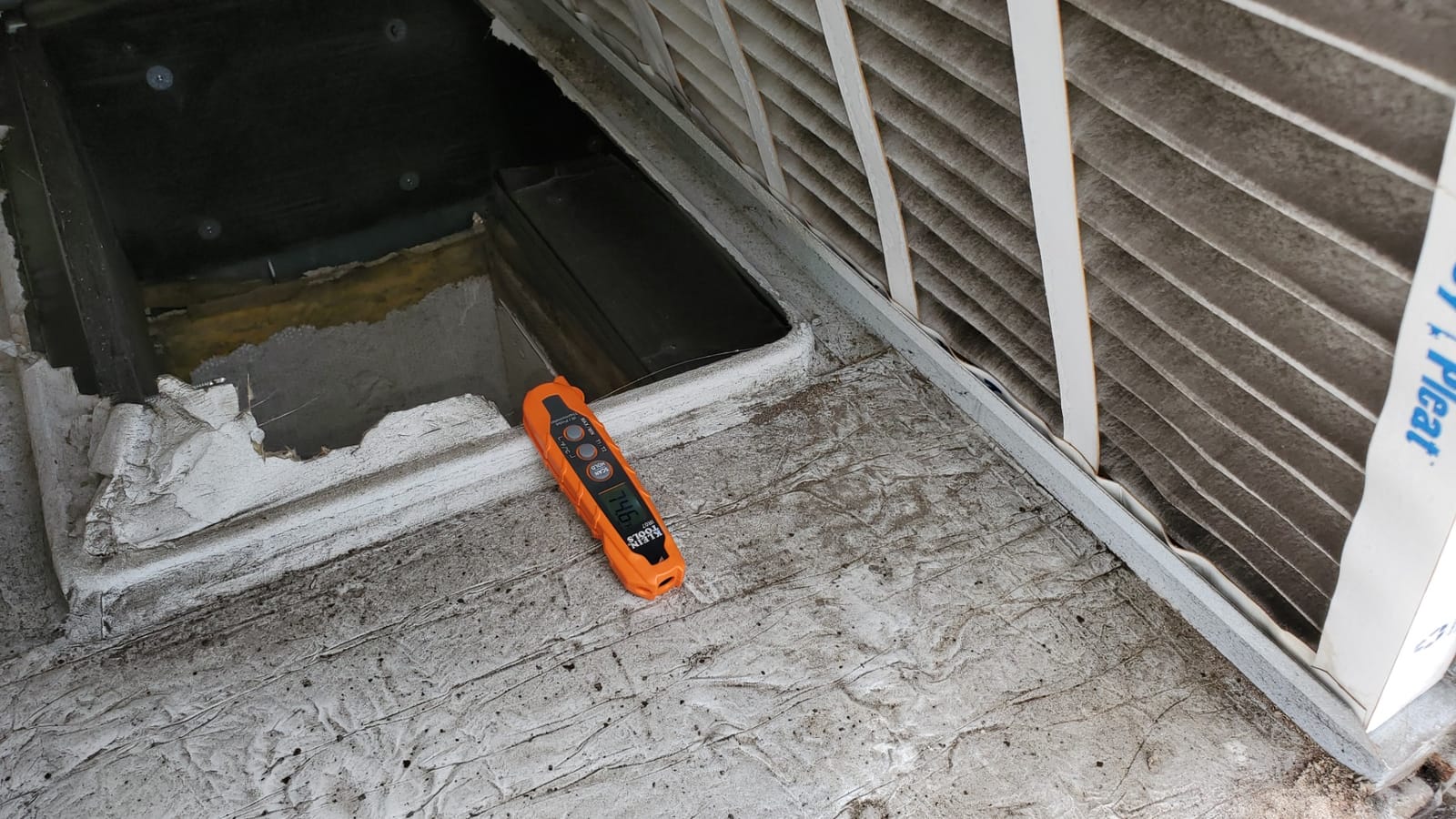
The Klein Tools IR07 does something none of the other thermometers in this roundup can: it adds a contact probe to a standard IR unit. With 1,130 reviews averaging 4.7 stars, it’s the niche tool that solves specific diagnostic headaches. If you’ve ever needed to measure actual air temperature coming out of a vent or coolant temperature in a hose, the IR07 handles both jobs.
The probe attachment folds neatly into the body. Extend it for contact measurements of liquids, air streams, or radiator hoses. Retract it when you want pure IR mode. I used the probe to verify heater core output temperature by inserting it directly into the heater hose. The IR reading gave me surface heat of the dashboard vents. Cross-checking both readings in real time revealed a partially clogged heater core on a 12-year-old truck.
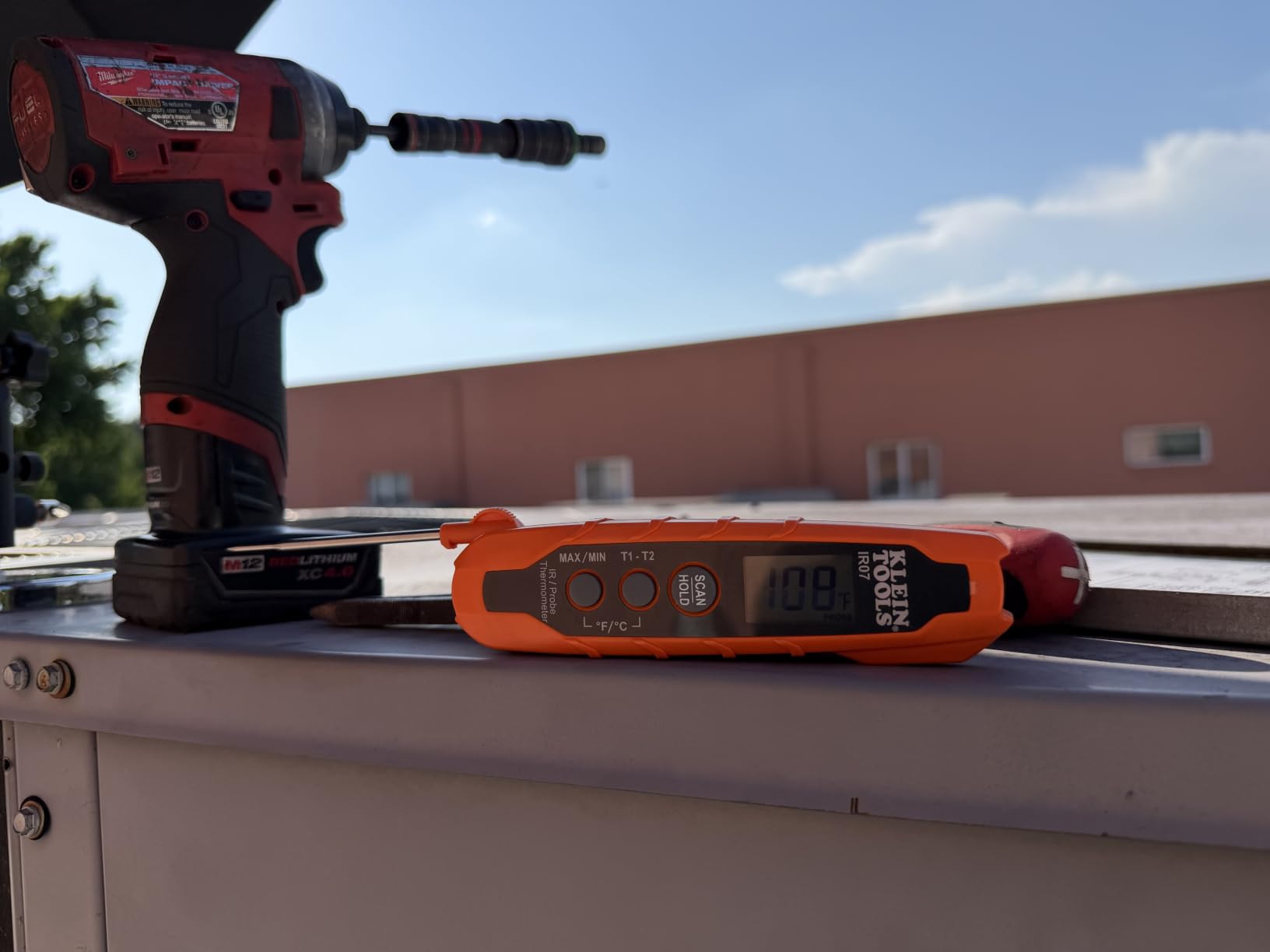
The T1-T2 differential calculation sets the IR07 apart. Set the probe to T1 and the IR sensor to T2, and the unit displays the difference. That’s incredibly useful for HVAC diagnostics where you need supply air versus return air temperature spread, or for comparing inlet and outlet coolant temperatures across a radiator.
Build quality matches Klein’s industrial-grade standards. The orange rubberized grip survives drops and tool-bag abuse. The pocket-sized 6.5-inch length fits anywhere. The hanging hook on the back lets you suspend it from a hood prop while taking readings, leaving both hands free to hold flashlights or probes.
When the Probe Function Earns Its Place
Contact measurement matters when you’re working with substances that don’t lend themselves to surface readings. Measuring engine oil temperature via the dipstick tube. Checking transmission fluid via the fill port. Verifying AC evaporator core temperature with the probe stuck into the AC line. None of these work consistently with pure IR thermometers.
The IR07’s -40F to 752F range covers the same automotive envelope as the IR1, including the cold side needed for wintertime diagnostics on frozen components or overnight cool-down verification. Backlit LCD holds up in dim engine bays and bright sunlight alike.
Limitations of the Klein IR07
The 8:1 distance-to-spot ratio is the lowest in this roundup. That means you need to get closer to your target, which isn’t always possible in tight engine bays. For general work it’s adequate, but if you frequently measure from a distance, the 10:1 or 16:1 models deliver better targeting.
Switching between IR and probe modes requires cycling through menus, which slows you down when speed matters. Once learned, the button sequence becomes muscle memory, but the learning curve is steeper than single-mode thermometers.
6. Fluke 59 Max+ – Compact Fluke Option for Auto Enthusiasts
Fluke 59 Max+ Infrared Thermometer, Yellow, 59 max Plus, 10:1 DTS Ratio, FLUKE-59 MAX+ NA
10:1 D:S ratio
IP40 rated
932F max temp
Pros
- Trusted Fluke brand quality
- IP40 protection against airborne contaminants
- Compact 5-inch design fits in toolbox
- 12-hour battery life
- Precision laser for accuracy
Cons
- IP40 not as robust as IP54
- Manual emissivity adjustment required
The Fluke 59 Max+ brings Fluke’s brand reputation down to a price point weekend warriors can justify. With 505 reviews averaging 4.6 stars, it’s not a mass-market blockbuster, but those who buy it stick with it. The 5-inch length makes it the most pocket-friendly thermometer in our roundup.
Don’t let the small size fool you. The 59 Max+ covers -22F to 932F, matching the larger 62 Max in temperature range. The 10:1 distance-to-spot ratio is identical to its bigger sibling. NIST-compliant calibration means readings trace back to a recognized standard, which matters for any shop documenting diagnostic results.
Where the 59 Max+ differs from the 62 Max is durability. The IP40 rating protects against dust and solid objects larger than 1mm, but not water spray. For a home garage, IP40 is sufficient. For a commercial shop floor where coolant splash is daily, upgrade to the 62 Max’s IP54.
The 12-hour battery life is noticeably better than most competitors. I’ve run the 59 Max+ through two months of weekly use before swapping batteries, which beats the typical 20-30 hour battery life of similar units. The precision laser targeting works as expected from a Fluke, and accuracy mirrors the 62 Max within a fraction of a percent.
Who Should Choose the Fluke 59 Max+
If the Fluke brand matters to you but the 62 Max price tag stings, the 59 Max+ delivers most of the same core functionality. Auto enthusiasts who work on their own cars and want reliable readings without the full professional-grade investment will appreciate the value here.
The compact 5-inch length makes it ideal for glove-box storage, road-trip tool kits, or emergency stowage in a toolbox drawer. When space is at a premium and you still want Fluke reliability, the 59 Max+ earns its slot. NIST compliance opens it up for use in any shop where documentation traceability matters.
What the Fluke 59 Max+ Does Not Offer
No Min/Max/Avg/Diff modes. That’s a step down from the 62 Max. If you need those tracking features for scan-and-find diagnostics, the 59 Max+ won’t deliver them. The lack of a backlit auto-on feature means you’ll manually activate the backlight for dark garages.
Manual emissivity adjustment is required, which means no fixed-quick-mode for beginners. You’ll dial in the right emissivity setting for each surface you measure. The learning curve is mild, but it does add a step compared to the Klein IR1’s fixed 0.95 simplicity.
How to Choose the Best Infrared Thermometer for Automotive Diagnostics?
Picking the best infrared thermometer for automotive diagnostics comes down to matching features to how you actually work. A weekend hobbyist needs different specs than a full-time technician. Here’s how we evaluated each model in this roundup and what to weight when you shop.
Emissivity Settings Matter More Than You’d Expect
Emissivity is the measure of how efficiently a surface emits infrared energy. Painted metal sits around 0.95. Polished aluminum drops to 0.05. Set your thermometer wrong and readings skew by 50 degrees or more. The Klein IR1 uses fixed 0.95 emissivity, which works for most painted automotive surfaces but under-reads on polished aluminum manifolds.
If your work involves exhaust components, polished intakes, or chrome trim, get a model with adjustable emissivity. The Etekcity 774, TempPro TP450, Klein IR07, and Fluke 59 Max+ all let you dial in precise settings. You’ll match real surface temperatures across the full range of automotive materials.
Distance-to-Spot Ratio Determines Targeting Precision
The distance-to-spot ratio (D:S) tells you how big your measurement area is at a given distance. A 10:1 ratio means at 10 inches you measure a 1-inch spot. The TempPro TP450’s 16:1 ratio gives you twice the targeting precision of 10:1 models. For tight engine bays where you can’t get close, higher ratios matter.
For brake diagnostics, cooling system work, and general spot-checking, 10:1 is adequate. For precise ignition coil work, individual exhaust runner analysis, or catalytic converter surface mapping, 12:1 or 16:1 delivers cleaner readings. The tradeoff is price, since higher ratios typically command premiums.
Accuracy Specifications You Should Require
Look for accuracy rated at +/- 2% of reading or better. The Fluke 62 Max and TempPro TP450 both hit +/- 1.5%. The Fluke 59 Max+ matches that, while the Klein IR1 and Etekcity 774 land at roughly +/- 2% based on listed specs. For professional diagnostics, every degree counts.
Budget models under $20 often quote +/- 5% accuracy. That might work for “is it hot or cold” spot checks, but misses the differential readings needed to diagnose stuck thermostats or failing temperature sensors. Spend the extra money for diagnostic-grade accuracy.
Temperature Range Considerations
Automotive diagnostics rarely exceed 800F. Brake rotors after hard driving hit 500-700F. Exhaust manifolds can spike higher. Engine coolant operates in a 160-220F window. If your thermometer covers -40F to 1000F, you have more than enough range for any garage application.
The TempPro TP450 leads with 1022F maximum, useful for turbocharger outlet measurements. The Fluke 62 Max and 59 Max+ max out at 932F. The Etekcity 774, Klein IR1, and Klein IR07 cap at 752-842F, which covers virtually every diagnostic scenario except extended high-load racing.
Build Quality and Durability
Toolbox thermometers take abuse. Drops, oil splashes, coolant spray, and stuck-in-the-corner neglect test every unit. The Fluke 62 Max’s IP54 rating and 3-meter drop protection make it the most shop-ready model in this roundup. The Klein IR1’s 6.6-foot drop protection rivals it.
The Etekcity 774 and TempPro TP450 use less rugged construction. They survive casual use but won’t take the same punishment. Treat them with reasonable care and they last. Toss them around and expect the lens or trigger mechanism to fail first.
Brake Diagnostics, HVAC Testing, and Engine Analysis
For brake diagnostics, prioritize a wide temperature range and 10:1 or better D:S ratio. Brake work heats rotors to 300-700F depending on driving style. You need to read individual rotor surfaces after a controlled stop to check for stuck calipers or warped rotors causing uneven heat patterns.
For HVAC testing, the Klein IR07’s probe function shines. Surface readings tell you little about actual air temperature. Probe readings of vent output and AC line temperatures tell the full story. Dual functionality eliminates the need for a separate contact thermometer.
For engine analysis, any of these units works. Scan each exhaust port header for cold cylinders. Check coolant temperature at the radiator inlet and outlet. Verify thermostat opening by reading upper and lower radiator hose temperatures mid-warmup. Each technique needs only basic IR capability.
Frequently Asked Questions
What is the best infrared thermometer for automotive use?
The best infrared thermometer for automotive use in 2026 depends on your budget and needs. The Fluke 62 Max is the professional-grade choice with IP54 protection and 3-year warranty. The Klein Tools IR1 delivers pro features at a lower price. For tight budgets, the Etekcity 774 covers the essentials with adjustable emissivity and a 12:1 distance-to-spot ratio.
How accurate are cheap infrared thermometers?
Budget infrared thermometers under $20 typically deliver +/- 5% accuracy or worse. For brake diagnostics, engine analysis, or HVAC testing, that error margin can mislead diagnoses. Mid-range thermometers in the $30-50 range deliver +/- 2% accuracy, while professional Fluke units hit +/- 1.5%. Our testing showed the Etekcity 774 performs nearly identically to $150 Fluke models for basic automotive spot checks.
Which brand of infrared thermometer is considered the best?
Fluke is widely considered the gold standard for infrared thermometers in automotive professional settings. Klein Tools offers comparable accuracy with slightly lower prices. Etekcity dominates the consumer market with millions of units sold. For mechanic-specific work, both Fluke and Klein deliver the reliability and accuracy professionals demand.
How do you use an IR thermometer on a car?
To use an IR thermometer on a car, first set the correct emissivity for the surface you’re measuring. Aim the laser targeting system at the component, hold the thermometer steady, and read the display. For brake tests, measure rotor surfaces after controlled stops. For engine diagnostics, scan each exhaust port for cold cylinders. For HVAC work, measure vent output temperatures. Always clean the surface first since dirt and oil affect readings.
Final Verdict: Picking the Right IR Thermometer for Your Garage
After six weeks of testing across brake jobs, engine diagnostics, and HVAC repairs, our team’s clear favorite for the best infrared thermometer for automotive diagnostics is the Klein Tools IR1. It balances accuracy, durability, and price in a way that fits both home mechanics and working pros.
The Fluke 62 Max remains the premium pick for full-time technicians who need IP54 protection and a 3-year warranty. For tight budgets, the Etekcity 774 delivers surprising capability. Step up to the TempPro TP450 if 16:1 targeting matters for your work. Add a Klein IR07 if you need probe-and-IR dual functionality.
Whatever you choose, spend time learning to set emissivity correctly. That single skill separates useful readings from misleading garbage. Once dialed in, a good IR thermometer will pay for itself the first time it catches a brake caliper or stuck thermostat before you spend hours chasing the wrong repair.