
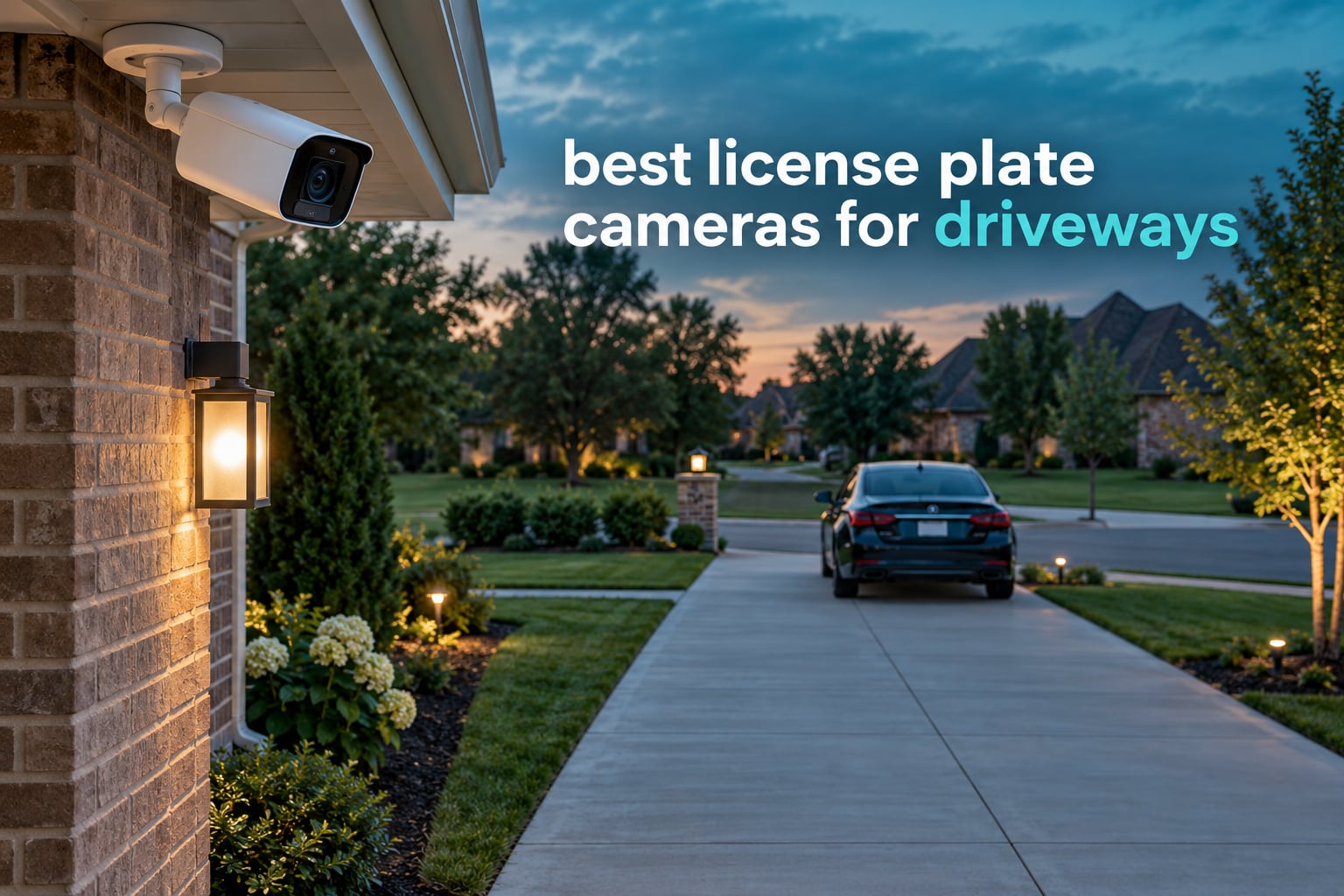
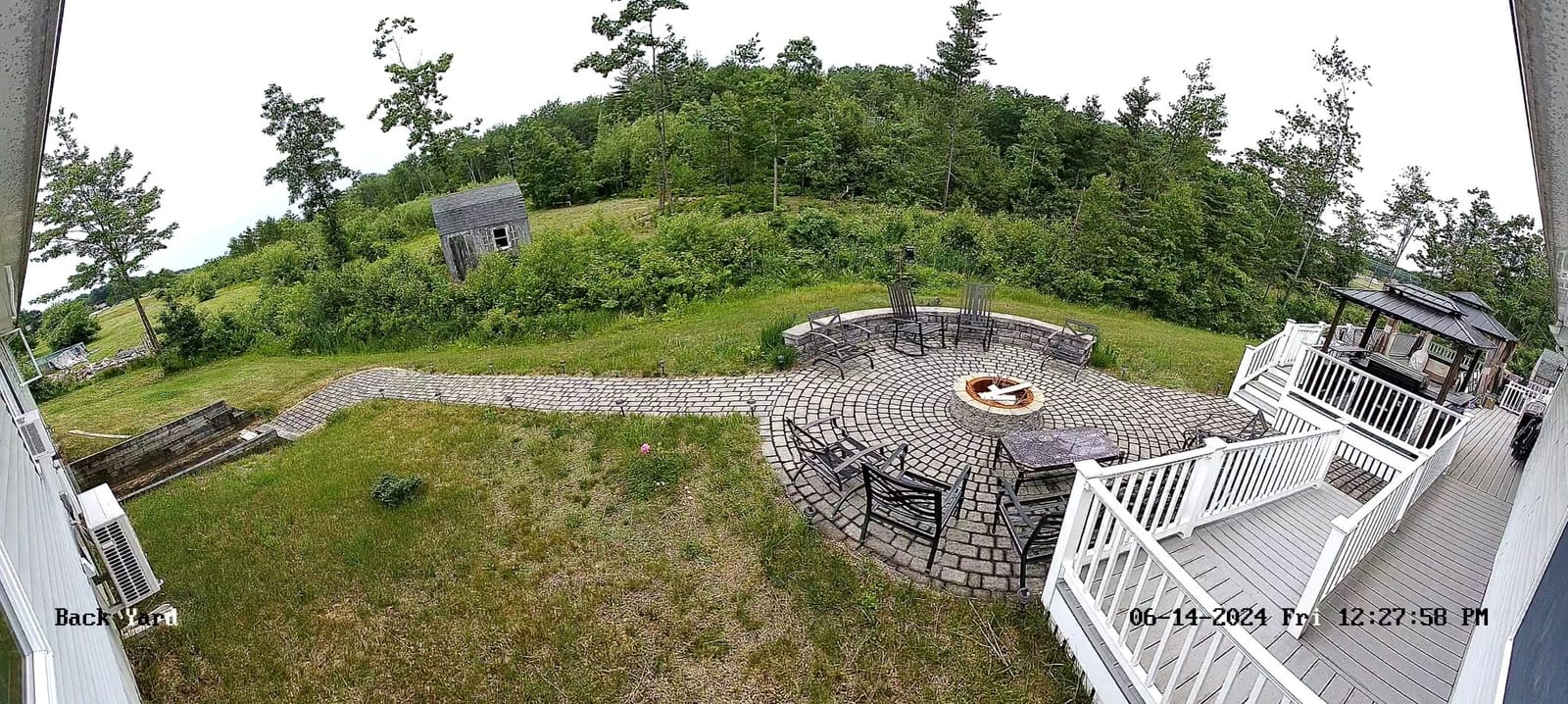
A license plate camera for a driveway is not the same thing as the general-purpose outdoor camera most people install at the front of a house. General-purpose cameras spread their pixels across a 150-degree fisheye view so nothing important is missed, and that spreading is exactly why the number on a passing plate turns into an unreadable smear. A true LPR or ANPR camera does the opposite: it narrows the field of view, optically magnifies a single lane, and spends every pixel it has on the characters on a bumper.
Here is the honest bottom line before we get into the list. Most driveway security cameras sold for general home use read a plate reliably at roughly 15 to 25 feet and produce an unusable blob much beyond that. Every camera below was built for plate capture, with an optical or motorized zoom lens, because that is the class of hardware that actually holds a plate at the far end of a driveway. What you give up for that clarity is the plug-and-play experience: every camera below needs a recorder, and several will only talk to one brand of it.
We spent 2026 going through ten of them side by side, focusing on the things that decide whether footage is usable: real read distance rather than advertised IR range, what each one locks you into for storage, and where it should be mounted. If your driveway is short and you only care about the driveway itself, the honest answer is that a general-purpose outdoor camera may well be enough. If you need a plate that police can act on, keep reading.
One thing worth separating first: a camera that reads plates and a camera that lights the driveway are different jobs. If your concern is packages and mail rather than vehicle identification, our guide to smartphone thermal cameras covers catching intruders in the dark without a plate in view at all.
Table of Contents
Top 3 Best License Plate Cameras for Driveways in 2026

Anpviz 4MP LPR PoE 8-32mm
- 4MP 2688x1520
- 8-32mm 4X motorized varifocal lens
- 140dB True WDR
- 23-98ft recommended ANPR range
ONWOTE 4MP LPR PoE 8-32mm
- 4MP 2592x1520 sensor
- 8-32mm motorized varifocal at F1.6
- 120dB WDR
- 23-98ft recommended ANPR range

GeoVision 2MP 3X Zoom Low Lux
- 2MP 1080p super low lux color sensor
- 3x optical zoom
- IP67 weatherproof enclosure
Best License Plate Cameras for Driveways in October
| Product | Specs | Action |
|---|---|---|
| Anpviz 4MP LPR PoE Camera 8-32mm |
|
Check Latest Price |
| ONWOTE 4MP LPR PoE Camera 8-32mm |
|
Check Latest Price |
| GeoVision GV-LPC2011 2MP 3X Zoom |
|
Check Latest Price |
 Uniview HC121 2MP 4X LPR Starlight Uniview HC121 2MP 4X LPR Starlight |
|
Check Latest Price |
 AXIS Q1700-LE 2MP License Plate Camera AXIS Q1700-LE 2MP License Plate Camera |
|
Check Latest Price |
 UNV PKC2640 4MP LPR Camera UNV PKC2640 4MP LPR Camera |
|
Check Latest Price |
 Emerald 2MP ANPR 10X Starlight Bullet Emerald 2MP ANPR 10X Starlight Bullet |
|
Check Latest Price |
 LTS LXIP9943 4MP LPR NDAA Bullet LTS LXIP9943 4MP LPR NDAA Bullet |
|
Check Latest Price |
 ENS IP-5IR4A3H4 4MP LPR 8-32mm ENS IP-5IR4A3H4 4MP LPR 8-32mm |
|
Check Latest Price |
 Hikvision MNS512 2MP 2.8-12mm LPR Hikvision MNS512 2MP 2.8-12mm LPR |
|
Check Latest Price |
1. Anpviz 4MP LPR PoE Camera with 8-32mm Motorized Varifocal Lens
Anpviz License Plate Recognition PoE IP Camera, 4MP@30/60fps LPR/ANPR
4MP 2688x1520 at 30fps
8-32mm 4X motorized varifocal lens
140dB True WDR
330ft IR,IP67 and IK10
Pros
- Sharp image with strong low-light and full-color night performance
- 8-32mm motorized lens lets you reframe after mounting
- 140dB True WDR handles headlight glare well
- Sturdy metal housing with ONVIF streaming and on-board AI that cuts false alarms
Cons
- Heavy at 4 pounds
- so it needs solid mounting backing
- Setup documentation is thin and not camera-specific
- Only works with Anpviz NVRs unless you work around ONVIF
This is the one we kept coming back to. It is the only camera in the group with both a meaningful volume of customer feedback and a spec sheet that actually matches what a driveway needs, which is a rare combination in this category. At 4MP 2688×1520 with a 1/1.8 inch CMOS sensor and a 4X motorized 8-32mm lens, it has enough resolution and enough magnification to frame a single car tightly at the far end of a normal suburban driveway.
The manufacturer publishes a recommended ANPR distance of 23 to 98 feet, and that is a far more honest number than the 330 foot IR figure printed right next to it. Those are two completely different measurements. The IR range describes how far the illuminator can throw invisible light; the ANPR range describes how far away the lens can still resolve individual characters. Judge this camera by the second number.
Reviewers consistently single out the low-light and color night performance, which is unusual for a camera in this class. Most LPR cameras switch to monochrome infrared at the first sign of darkness. This one holds color well into the night, and that matters because plate readability depends on contrast between the characters and the reflective plate background rather than on color itself.
The 140dB True WDR rating is the other headline feature. Headlights pointed at a driveway camera at night are the single most common reason plate footage blows out to white, and True WDR of that magnitude is engineered for exactly that scene. Nighttime DNR is handled by the low-light sensor rather than by aggressive noise reduction that smears text.
What you gain by choosing this camera
You gain adjustable framing after the camera is already bolted to the wall. On a motorized varifocal lens you can zoom and focus from the recorder or browser instead of climbing a ladder, which turns a two-visit install into a one-visit install. The 42 verified reviews also mean you are buying hardware with a documented track record rather than a spec sheet alone.
You also get H.265+ compression and a microSD slot that accepts cards up to 1TB, so the camera can run standalone if you are not ready to commit to a full recorder ecosystem. IP67 and IK10 ratings mean it handles both weather and someone testing it with a bat.
What you give up
You give up plug-and-play. This camera is designed to run on Anpviz NVRs, and a handful of specific models at that. ONVIF compatibility means a generic recorder may negotiate a video stream, but the LPR functions, the allowlist and blocklist alerts, and the AI detection are tied to the Anpviz platform. Budget for that before you order.
You also give up lightness. At 4 pounds and 7.5 by 7.1 by 15.2 inches, this is a substantial housing and it wants a proper mounting surface rather than a soffit. Infrared bounce off light-colored siding is a recurring complaint, another argument for aiming across the driveway rather than along the house.
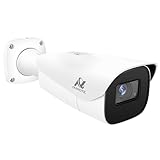
2. ONWOTE 4MP LPR PoE Camera with 8-32mm Motorized Lens
ONWOTE License Plate Recognition PoE IP Camera Wired, 8-32mm Motorized Lens
4MP 2592x1520 at 30fps
8-32mm motorized varifocal at F1.6
120dB WDR,23-98ft ANPR range
IP67 aluminum housing
Pros
- Motorized 8-32mm lens adjustable after installation
- 1/1.8 inch low-light sensor handles dim conditions
- 120dB WDR plus Dark Fighter night technology
- Aluminum housing rated IP67 for indoor or outdoor placement
Cons
- Restricted to ONWOTE TD series recorders
- Field reliability is not documented with only one customer review
- Setup is not beginner-friendly for a first-time installer
The ONWOTE BA40-LPR832 is the closest match to the Anpviz in raw specification. It has the same 8-32mm motorized varifocal lens, the same 1/1.8 inch low-light sensor, and the same 23 to 98 foot recommended ANPR window. If your driveway is a standard suburban length, this camera does everything the Anpviz does, with less reliance on the newest on-board AI features.
The 120dB WDR rating is a step below the Anpviz’s 140dB, but in practice both sit well above the threshold where headlight backlight destroys a plate. Dark Fighter technology is the vendor name for the low-light tuning, and the F1.6 maximum aperture on the lens helps gather more light in the hours when the IR illuminator is not carrying the scene.
Where this one fits best
This is the camera to pick when you already own ONWOTE hardware or when the total system cost matters more than having the newest on-board AI. A microSD slot accepting cards up to 256GB lets you run it standalone, and PoE means one cable carries both power and video if you already have a PoE switch or injector.
For a driveway under about 60 feet where you want a dedicated plate camera rather than trying to make a wide-angle camera work, the optics are more than sufficient. The FOV of roughly 47 degrees at the wide end tightens considerably as you motor the lens toward 32mm.
What to watch out for
Watch the ecosystem restriction. It runs on the ONWOTE TD series recorders only, so if you need one camera on an existing system from another brand, this is a non-starter. Review volume is thin, with a single customer review at 5 stars and no written detail, so treat the published specification as the only real evidence you have.
The camera is described as IP67 in the feature list and IP66 in the specification table for the same unit. Either rating is fine for a covered exterior mount under a soffit, but it is worth confirming with the vendor if your mounting point is fully exposed to driving rain.
3. GeoVision GV-LPC2011 2MP 3X Zoom Super Low Lux Network Camera
GeoVision IP LPR 2MP 3X Zoom Super Low Lux Color Network Surveillance Camera, White (GV-LPC2011)
2MP 1080p super low lux color sensor
3x optical zoom
IP67 weatherproof enclosure
Wall mount,10 watts
Pros
- Super low lux color sensor keeps color detail in dim conditions
- 3x optical zoom is enough for a short driveway
- IP67 enclosure supports permanent outdoor mounting
Cons
- 2MP resolution is well below the 4MP of most alternatives
- 3x zoom gives less reach on a longer approach
- Single customer review leaves field performance largely undocumented
This is the honest budget answer for a short driveway. The GeoVision GV-LPC2011 is a 2MP 1080p network camera with a super low lux color sensor and 3x optical zoom in an IP67 enclosure. For a driveway where cars reach your camera within 20 to 30 feet, that combination can produce a readable plate, particularly with a porch light or streetlight nearby.
It is also a straightforward camera to set up. It draws 10 watts, mounts on a wall, and comes from a brand with a long history in network video. If you want one camera aimed at a short driveway and you already have some kind of network recorder or a home automation platform that speaks the standard protocols, this is a reasonable place to start.
Why it works on a short driveway
Pixel density on target is what decides readability, and on a short approach a 2MP sensor with 3x optical zoom puts enough pixels on a 12-inch-wide plate to resolve the character shapes. Push that same setup to 80 feet and the plate becomes too small to read no matter how good the illumination is. Distance, not sensor quality, is the limiting factor here.
The super low lux color sensor is a real advantage over a standard IR-only sensor for a driveway that has ambient light. Color capture means the plate background stays a known tone instead of flipping to the flat gray that IR sometimes produces on reflective surfaces.
Where it falls short
Two megapixels is the real limitation. Every 4MP camera on this list resolves roughly twice the detail, and on a driveway longer than about 40 feet that difference becomes the difference between a legible plate and a guess. The 3x zoom also gives you far less framing flexibility than the 8-32mm lenses elsewhere on this list.
Documentation is thin, with a single 5-star review and no commentary, and the listing does not spell out recorder compatibility in any detail. Treat it as a camera for a short approach rather than a long rural driveway.
4. Uniview HC121 2MP 4X LPR Starlight Camera
HC121@TCR-08S-Z28 – UNV 2MP 4X LPR IR Camera (Starlight, License Plate Recognition, PoE, 1080P, 60fps).
2MP starlight sensor with integrated IR
4X motorized zoom
1080p at 60fps
PoE over Ethernet,built-in LPR algorithm
Pros
- Starlight sensor plus integrated IR handles low-light plate capture
- 60fps at 1080p smooths fast vehicle motion
- Motorized zoom simplifies framing after mounting
- Built-in algorithm also logs vehicle body color and multiple country formats
Cons
- No customer reviews to validate real-world results
- Sold under a generic listing rather than a named model line
- Only 2MP resolution limits reach on longer driveways
The Uniview HC121@TCR-08S-Z28 is a 2MP starlight camera with a built-in license plate algorithm and a 4X motorized zoom, streaming 1080p at 60fps. The frame rate is the interesting part here. A plate is only readable when it is sharp, and a 60fps stream captures a moving bumper with far less motion smearing than a 30fps stream at the same exposure.
Starlight sensors are designed for very low light and, unlike a conventional IR camera, they can run the sensor in a mode that preserves usable detail without flooding the scene with infrared. Installers working on license plate capture report repeatedly that the best plate images come from either monochrome mode with the IR filter out or color mode with it in, and a starlight sensor gives you more flexibility than a plain IR-cut design.
What makes it interesting beyond the plate
The on-board algorithm does more than read characters. It also records vehicle body color and recognizes plate formats from multiple countries, which means a single camera can serve as evidence for a hit-and-run across a state line rather than only on your own street. For a rural driveway near a state border that is not a trivial feature.
The small 5.8 by 3.4 by 5.8 inch housing is easier to hide on a soffit than the chunky metal cameras higher on this list.
What to be careful about
There are no customer reviews on this listing at all, so everything here comes from the published specification. That is common for professional-grade units sold through general marketplaces, but it means you are buying on spec rather than on evidence.
On a 2MP sensor with 4X zoom, this camera is best suited to driveways in the 40 to 70 foot range. Beyond that, the 4MP options give you more to work with. The generic brand listing also makes it harder to confirm warranty terms or find firmware support compared with a named product line.
5. AXIS Q1700-LE 2MP License Plate Camera
AXIS Q1700-LE 2 Megapixel Outdoor Full HD Network Camera – Color – Bullet – TAA Compliant
2MP 1080p outdoor bullet
16 degree view angle
100m (328ft) capture range
Vehicles up to 130 km/h,5-year warranty
Pros
- Purpose-built license plate camera with sharp plate images day and night
- Extremely narrow 16 degree view angle concentrates resolution on the plate
- Handles vehicles up to 130 km/h (81 mph)
- TAA compliant with a 5-year manufacturer warranty
Cons
- Designed to feed third-party software rather than run standalone
- Requires separate analytics and recorder integration for recognition
- No customer reviews available on the marketplace listing
The AXIS Q1700-LE is the only camera here that was designed for license plates as its entire purpose, rather than as a security camera with plate-reading added on. That design decision shows up in the numbers. The view angle is 16 degrees, which is extraordinarily narrow, and every one of those two megapixels is spent on a thin slice of the scene.
A narrow field of view is exactly what plate work needs. The failure mode of nearly every driveway camera is that it tries to cover the whole property at once, so a plate at 60 feet gets maybe 40 pixels across and no amount of processing turns that into characters. This camera trades coverage for magnification, which is the correct trade for evidence.
What it does that nothing else here does
The capture range is quoted at up to 100 meters, and the stated vehicle speed tolerance is 130 km/h. That speed figure matters on a shared-lane or gated-community entrance where a vehicle is genuinely moving rather than crawling to a gate. The shutter speed range of 1/66500 to 1 second is unusually fast at the top end and helps freeze a moving plate.
It also ships with a one-user Windows decoder license and mounting hardware in the box, plus a 5-year manufacturer warranty that is longer than anything else in this roundup. TAA compliance matters if you are buying for a government or institutional property.
The catch with this camera
It is built to hand a sharp image to third-party recognition software, not to run as a self-contained system. That means you are buying into an analytics ecosystem separately, and for most homeowner setups that is a large step up in complexity and cost compared with the Anpviz or ONWOTE units that bundle the intelligence.
It is also a heavy, large body at 2400 grams and 18 by 6.75 by 9.25 inches. That size is the price of the long-range optics and the weather sealing, but it means the mounting surface needs to be serious.
6. UNV PKC2640 4MP License Plate Recognition Camera
UNV LPR (License Plate Recognition) Camera(PKC2640@Z80-P).
4MP license plate imaging
Supports vehicles up to 80 km/h
IR or white light illumination options
Entrance and gated access design
Pros
- 4MP resolution gives more plate detail than the 2MP units
- IR and white light variants let you match illumination to the site
- Handles vehicles up to 80 km/h for entrance monitoring
- Designed around parking and gated access use cases
Cons
- Very little published specification beyond resolution and application
- No customer reviews on the marketplace listing
- Documentation is thinner than the mainstream brands
The PKC2640@Z80-P is a 4MP license plate recognition camera built for parking lot entrances, gated communities and road vehicle recognition. Its most useful feature for a homeowner is unusual: it is offered in both infrared and white light illumination versions. That choice matters more than it sounds.
White light gives you a color image with genuine color rendition on the plate, which is what you want when a driveway is lit by streetlights or when you need to distinguish a dark blue car from a black one. Infrared gives you longer reach in complete darkness but produces a monochrome image. Having the option means you are not locked into whichever trade-off the manufacturer chose.
Best fit for shared access points
This camera is aimed at controlled-access scenarios rather than a private suburban driveway, and it shows in the design intent. The listed use cases are parking lot entrances and gated community access, where a vehicle is moving but the camera only needs to cover a narrow entry lane. That matches the one-lane driveway situation almost exactly.
At 4MP, it has more pixels on target than the 2MP units in this group, which translates to a longer usable read distance for a given driveway length. Vehicles up to 80 km/h are supported, which is more than enough for a residential gate.
What we would want to know first
The published detail here is thinner than anything else on this list. Beyond resolution, speed tolerance and illumination options, there is very little to evaluate, and no customer reviews exist on the listing. Before buying anything from a listing this sparse, confirm the lens focal length, the sensor size and the recommended read distance with the seller directly.
You should also confirm recorder compatibility in writing before you order. Cameras in this category very often pair with a proprietary recorder, and finding out after the camera is mounted that you need a different ecosystem is the most common regret we see in this category.
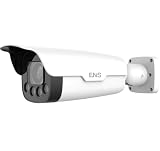
7. Emerald 2MP ANPR Bullet Camera with 10X Zoom and Starlight Sensor
Emerald 2MP ANPR Bullet Camera, Starlight, 10X Zoom, License Plate Recognition
2MP 1920x1080 at up to 60fps
10X motorized zoom
starlight with 50m IR
two-lane plate detection,IP67 and IK10
Pros
- Starlight sensor and LED/IR illumination keep color capture usable at night
- 10X motorized zoom allows remote focal adjustment after mounting
- Detects and recognizes plates across two lanes at once
- Allowlist and blocklist plus 10 vehicle body colors support access control
- IP67 and IK10 ratings for exposed driveway mounts
Cons
- Most expensive unit in this group
- with no published user feedback
- 2MP resolution limits detail on longer driveways despite the 10X zoom
The Emerald EM-IPCE2B5-X10-LPR is the camera in this group whose specification list tells you the most about what the unit actually does. It pairs a starlight sensor with LED and infrared illumination out to 50 meters, a 10X motorized zoom lens, True WDR and a two-lane ANPR algorithm. Two-lane detection is the feature that separates it from everything else here, and it is genuinely useful if your driveway shares an entrance with a neighbour.
The starlight sensor is described as supporting full-time color capture, which is the opposite trade-off from a standard IR camera. If you need to tell a dark car from a black one, or you need plate characters that rely on subtle color contrast, this is one of the few options on the list built for it rather than forced into monochrome.
Where the specification is unusually complete
This listing includes the details most listings omit. It specifies H.265 compression with microSD storage up to 128GB and ANR, IP67 and IK10 ratings, 10 recognized vehicle body colors, allowlist and blocklist configuration, and a 10X motorized zoom. That is a much firmer basis for a purchase decision than the two-line listings elsewhere in this group.
The 10X zoom is what makes the two-lane capability practical. A single wide view covering two lanes would destroy plate detail, but a motorized zoom can be aimed at the approach you care about after mounting, and software can handle a second zone.
What gives us pause
There are no customer reviews, so nothing here is validated by anyone else. That is the main reason this camera is not our top pick despite the stronger specification sheet, and it is worth remembering that a longer specification list is not the same thing as a better camera.
At 2MP, the 10X zoom has less raw resolution to magnify than a 4MP camera would. For a single-lane driveway under 80 feet you will not notice. On a longer approach, the digital crop at the far end of the zoom range will start to look soft.
8. LTS LXIP9943 4MP 98ft IR LPR Bullet NDAA Camera
LTS LXIP9943LPR-50R PRO-X IP 4MP 98ft IR License Plate Recognition LPR Bullet NDAA Camera
4MP 2688x1520 at 30fps
1/1.8 inch CMOS at 0.002 Lux
98ft IR LED matrix
ONVIF,256GB TF slot,IP67
Pros
- 4MP resolution with a large 1/1.8 inch sensor for low-light plate detail
- ONVIF protocol makes it far easier to pair with a third-party recorder
- Integrated junction box simplifies wiring and mounting
- IP67 rating
- NDAA compliance and on-board 256GB storage
- Two-way audio and alarm I/O add verification options
Cons
- No customer reviews on the marketplace listing
- Listed capture resolution in one field differs from the stated 4MP specification
- 98ft IR is shorter reach than several units here
The LTS LXIP9943LPR-50R is one of the easier cameras here to install. The integrated junction box is a small thing that saves a large amount of time, since you are not hunting for an outdoor-rated box that fits the housing. Two-way audio, alarm input and alarm output are all present, which means you can add a gate sensor or a light trigger without running extra cabling back to a recorder.
On the image side, it pairs 4MP 2688×1520 video with a 1/1.8 inch CMOS sensor rated at 0.002 lux at f1.3. A sensor that large with an aperture that wide gathers more light than a smaller sensor at the same ISO, and low light is where plate work is won or lost. The 98 foot IR LED matrix covers a typical driveway approach without pretending to reach much further.
Why ONVIF matters for a homeowner
ONVIF is the open protocol that lets a camera talk to a recorder that was not made by the same company. On this list, several cameras are locked to one brand of recorder. This one publishes ONVIF compliance, which means a wider range of existing and future recorders can negotiate a stream with it.
That flexibility has real cost value over a few years, because it lets you keep the recorder you already own, add this camera to an existing system, or replace the recorder later without replacing the camera. It also supports a 256GB TF card for standalone operation if you want to avoid a recorder entirely.
What to double-check before ordering
The listing is internally inconsistent: one field lists video capture resolution as 5MP with HEVC while the detailed specification and the technical description both say 4MP at 2688×1520. Ask the seller which is correct before you commit, because it changes the storage math on your recorder.
There are also no customer reviews here, so you are again buying on published specification. At least in this case the specification is detailed enough to verify, which is more than can be said for several other listings in this roundup.
9. ENS IP-5IR4A3H4-MZ-LR Titanium 4MP LPR Bullet Camera
ENS IP-5IR4A3H4-MZ-LR Titanium 4MP HD License Plate Recognition Bullet Network Camera, 4MP@30FPS, 8-32mm Lens, 1/1.8″ CMOS, IR(328ft), True WDR, Audio/Alarm, LPR, SD Slot, IP67
4MP at 30fps on a 1/1.8 inch CMOS
8-32mm lens
Smart IR to 328ft
alarm and audio I/O,3-year warranty
Pros
- 8-32mm lens on a 1/1.8 inch CMOS is the right pairing for driveway framing
- Smart IR to 328ft with 3D DNR
- WDR
- HLC
- BLC and ROI coding for plate contrast
- H265+ and H264+ coding cuts storage and bandwidth needs
- Alarm and audio input/output plus a 3-year manufacturer warranty
Cons
- No customer reviews on the marketplace listing
- Listed product dimensions appear to be placeholder values
- Manufacturer warranty is 3 years rather than the 5 years some rivals offer
The ENS IP-5IR4A3H4-MZ-LR is a 4MP bullet camera with an 8-32mm lens on a 1/1.8 inch CMOS sensor, which is the same core specification as our top pick. The difference is in the processing features. It lists 3D digital noise reduction, WDR, highlight compression, backlight compensation and region of interest coding, and those last two matter more for plate work than most buyers realize.
Region of interest coding lets you tell the recorder which part of the frame matters. Point the ROI at the lane where plates appear and the encoder spends its bitrate there instead of on the driveway, the trees and the street behind it. Highlight compression fights the exact glare that headlights create on a reflective plate. Both are small settings that produce visibly better plate images.
Where this camera holds its own
Power options are broad: DC12V, AC24V and PoE all supported, so it will work whether your site is already PoE or you would rather run a dedicated power run. Alarm and audio I/O give you one input and one output on each, enough to trigger a light on a vehicle event or to tie in an existing gate contact.
Smart IR is quoted at up to 100 meters, and H265+ and H264+ coding reduces both storage requirements and bandwidth. If you are running a PoE switch rather than sending long video streams over Wi-Fi, the coding choice makes a measurable difference to how many cameras one switch port can carry.
What to be aware of
The listing dimensions of 5 by 5 by 5 inches are almost certainly placeholders rather than real measurements, so plan your mounting with some slack. There are no customer reviews, and the three-year warranty is shorter than the five years the AXIS offers, which is one of the reasons to pay more for that unit.
With the 8-32mm lens and 4MP sensor, this camera suits a driveway in the 60 to 100 foot range where a tighter crop is needed. On a very short driveway you can motor the lens wide and still have more reach than you need.
10. Hikvision MNS512-VBA12-LPR 2MP Ultra-Low Light LPR Camera
2MP Ultra-Low Light Outdoor Smart IP Motorized VF Bullet Camera for License Plate Recognition, 2.8 mm to 12 mm Lens, Compatible with Hikvision DS-2CD4A26FWD-IZHS8/P (2.8 mm to 12 mm)
2MP 1920x1080 at 60fps
2.8-12mm motorized varifocal at f1.4
HFOV 92 to 32 degrees
EXIR to 150ft,IP67
Pros
- Motorized 2.8-12mm varifocal lens with a bright f1.4 aperture
- EXIR illuminators reach up to 150ft for night driveway capture
- True WDR
- 3D DNR and BLC aid plate readability under backlight
- IP67 weatherproofing for permanent outdoor mounting
- Real-time license plate recognition available through CMS software
Cons
- Plate recognition runs through separate CMS software rather than on the camera
- Only 2MP resolution
- below what most of the 4MP alternatives offer
- No customer reviews on the marketplace listing
The MNS512-VBA12-LPR is built around a 2.8 to 12mm motorized varifocal lens at f1.4, giving a horizontal field of view that swings from 92 degrees down to 32 degrees. That zoom range is narrower than the 8-32mm lenses elsewhere on this list, so you get less magnification at distance, but the f1.4 aperture is genuinely bright and the EXIR illuminators reach 150 feet.
If you already run Hikvision equipment, this camera is a natural fit. It is listed as compatible with the DS-2CD4A26FWD-IZHS8/P, and real-time license plate recognition is handled through CMS software rather than on the camera itself. That last point is the main thing to understand: the hardware captures a sharp plate, and the software turns it into text and an alert.
Why the aperture is the story here
An f1.4 maximum aperture is wide open compared with what most bullet cameras in this category use. A wider aperture means more light reaches the sensor at the same exposure, which directly reduces the noise in a night image. On a plate, noise is the enemy of legibility, and it is the reason many night captures look grainy and smeared.
The True WDR, 3D DNR and backlight compensation combination is the other piece. Backlight compensation handles the daytime case where a car is between the camera and the sun, and True WDR handles the nighttime case where headlights are behind the car pointing at the lens.
Where it does not fit
Two megapixels is the constraint. The 2.8-12mm lens at its narrow end gives you 32 degrees of horizontal field of view, which is fine for framing but does not deliver the pixel density of a 4MP sensor behind an 8-32mm lens. We would place this camera on a driveway under about 60 feet.
There are no customer reviews here either, and the plate recognition depends on software you may need to license separately. Confirm the total software cost before you commit, because that is where the real expense hides on cameras in this category.
How Far Can a Security Camera Actually Read a License Plate?
A security camera can usually read a standard US license plate from about 20 to 30 feet in good daylight with a decent optical zoom, and from closer than that at night. Beyond roughly 60 feet, only a camera with a genuine long-range lens and a purpose-built recognition sensor will produce readable characters. These are general engineering limits, not brand claims.
The way to understand the limit is pixels per foot. A US plate is 12 inches wide with roughly six characters. To resolve those characters rather than guess at them, you need something on the order of 30 to 40 pixels across the width of the plate. That is roughly a pixel every third of an inch. Take the number of horizontal pixels your camera produces, divide by its field of view width at the subject, and you get pixels per foot. Multiply by one foot for a US plate and you have pixels on target.
This is why resolution alone does not solve the problem. A 4K sensor behind a 150-degree lens has plenty of pixels and still fails, because all of them are spread across 150 degrees. The same sensor behind a 32-degree lens concentrates those same pixels into a narrow band. Optical zoom is what buys you plate detail, and no amount of digital zoom or processing substitutes for it.
That leads to the distinction that most camera marketing ignores. Illumination distance is how far the IR illuminator can throw light on a surface. Identification distance is how far away the lens can resolve characters. A camera may quote 328 feet of IR and be perfectly honest about it while only identifying plates at 70 feet. Look for a published ANPR or recognition range rather than an IR number.
For a residential driveway, the practical target is 25 to 98 feet, which is the range most of the true LPR cameras here specify. If your driveway is longer than that, the right answer is a second camera near the far end rather than one camera with a longer lens at a worse angle.
Day vs Night: IR Monochrome, Color Night Vision and White Light
At night, the most reliable plate capture usually comes from monochrome infrared mode rather than color. Installers on home security forums consistently report that a plate reads best as black characters on a bright background, and IR illumination produces exactly that high-contrast monochrome look. Color night vision produces a more natural image that is often softer on the characters.
The counterargument comes from the opposite camp. Users on CCTV forums report better night plate results with cameras left in color mode with the IR cut filter engaged, because a color camera with a wide aperture and a good sensor can outperform a monochrome IR image in ambient light. Both camps are describing the same physics: match the sensor to the light you actually have.
White light illuminators occupy the middle ground. They keep the image in color, they work well on reflective plate surfaces that would otherwise bounce IR glare back at the lens, and they deter intruders in a way invisible IR does not. They also light up your neighbour’s driveway, which is worth considering before you mount one.
Any reflective surface causes a problem. Plate covers, chrome trim, wet paint and even a light-colored car all bounce illumination back toward the lens and create glare that destroys the image. If a car in your area routinely uses a plate frame, no camera will fix that.
Matching a Camera to Your Driveway Length
Under 40 feet, almost any camera on this list works, and a 2MP unit with modest zoom is enough. This is where the GeoVision is a sensible, low-involvement choice. You do not need the reach, so you should not pay for it.
Between 40 and 100 feet, this is the range most home driveways fall into and the range these cameras are designed for. The 8-32mm lenses on the Anpviz, ONWOTE, ENS and LTS units give you enough magnification to fill the frame with a single car at the far end of the drive. A 4MP sensor is the sensible minimum here.
Over 100 feet, one camera rarely does the job well, because getting a readable plate that far away means a very narrow field of view and an extremely long lens. The better approach is two cameras, one near the house and one partway down the drive, each covering a shorter stretch at a wider angle. Each one then needs far less magnification, and image quality holds up across the whole approach.
Beyond about 150 feet, we would question whether an LPR camera is the right purchase at all for a private driveway. That range belongs to entrance gates, shared lanes and commercial parking, where the speed tolerance and long-range optics of a specialist model like the AXIS Q1700-LE start to earn their cost.
Long driveways also bring seasonal upkeep. Once you are running cable along a gravel or unpaved approach, the surface itself becomes part of the maintenance burden, and our picks for snow blowers for gravel driveways cover the equipment side of keeping that path clear so vehicles actually reach a point where the camera can see them.
What You Need Beyond the Camera: Recorder Ecosystem Lock-In
Almost every camera on this list is a camera for a specific recorder, and that is where the real total cost lives. The Anpviz is built for Anpviz NVRs. The ONWOTE runs on the ONWOTE TD series. The Uniview units expect Uniview or compatible ONVIF equipment. The AXIS is designed to hand images to third-party software. Before you order any of them, write down which recorder you will pair it with.
The LTS LXIP9943 is the exception that proves the rule. It publishes ONVIF compliance, which is a far more open door, and it accepts a 256GB TF card for standalone recording. The Anpviz also has a microSD slot that takes cards up to 1TB, so either can run without a recorder at all, at the cost of no remote access.
Count the full system before you commit: camera, recorder or PoE switch, storage, cabling, and any software license for the recognition features. A pro-grade camera with a proprietary ecosystem can require a second purchase entirely, and several cameras here run their plate recognition through separate management software rather than on the camera itself.
PoE deserves its own note. Running power and video on a single Cat6 run is the cleanest way to install a driveway camera, but the switch or injector has to supply enough power budget for the camera at full load. Check the camera’s power draw against the port rating before you plan the run.
Mounting Height, Angle and the Mistakes That Ruin Plate Footage
Mount between 8 and 10 feet, and aim across the driveway at roughly 20 to 45 degrees off the approach line rather than straight down it. Mounting low and roughly perpendicular to the direction of travel is the advice that comes up most often on installer forums, because it puts the plate face-on to the lens instead of foreshortened.
The most common mistake is aiming straight down the driveway. You then capture the dark front of the car rather than the rear plate, and the car fills the frame with an uninformative surface. Aiming off-axis by 20 to 45 degrees means you see the plate as the vehicle turns, and the motor vehicle turns across your field of view.
Mounting too high is the second mistake. From above, the plate is tilted away from the camera and foreshortened into an unreadable parallelogram. A camera at 12 feet aimed down at a car on the driveway sees the top edge of the plate rather than its face.
The third mistake is a wide field of view. Anything beyond about 60 degrees of horizontal coverage spreads your pixels too thin to read a plate. A 150-degree fisheye view that covers the whole property beautifully will produce a smear where the plate should be. These cameras need a narrow frame, which means you probably need a second, wider camera for general coverage. As one installer put it, a camera that can do plate recognition is no longer a general area coverage camera.
Two smaller habits matter. Keep the camera out of direct streetlight glare, because a bright light source in frame will cause the whole image to wash out even with WDR enabled. And do not point it at reflective surfaces like a white garage door or light-colored siding directly behind the drive, since infrared bounce off those surfaces creates the haze that kills contrast at night.
Legal and Privacy Notes Before You Aim at Your Driveway
Aiming a camera at your own driveway is generally straightforward, because you have a legitimate interest in protecting your own property. The complications come from the edges of the frame. A wide driveway camera will also catch your neighbour’s property, part of the public sidewalk, or the road, and those areas attract rules that your own driveway does not.
Audio recording is the most commonly overlooked item. Recording conversations outside your own property is governed by consent laws that vary widely by state and country, and in a two-party-consent jurisdiction a camera capturing audio from a neighbour’s yard or a public walkway can create real liability. Many jurisdictions let you disable audio recording and still get the video evidence you actually need.
Some municipalities regulate outdoor cameras more than people expect, particularly where a camera might capture a neighbour’s front door. A quick check of your local ordinance before you mount is inexpensive compared with the alternative. As a practical rule, aim to frame your driveway and your own property, keep the field of view as narrow as the job allows, and consider turning audio off unless you have a specific reason to keep it on.
Documentation and lighting are worth reading up on alongside the hardware, so you know what to look for if a plate ever needs to be read at 3am. Our picks for license plate LED lights cover the vehicle side, which is a different problem from capturing the plate in the first place.
Frequently Asked Questions
How far away can a security camera read a license plate?
Most security cameras read a standard US plate reliably at 20 to 30 feet in daylight, and general-purpose driveway cameras become unusable beyond about 40 feet. Purpose-built LPR cameras with a long motorized lens and 4MP or better sensors commonly publish a recommended recognition range of 23 to 98 feet. Judge cameras by that recognition range rather than by the advertised IR illumination distance.
Can security cameras read license plates at night?
Yes, but the camera has to be aimed across the vehicle’s path rather than straight down it, and it needs a lens tight enough to put real pixels on the plate. Infrared illumination produces the high-contrast monochrome image that reads best, while color night vision looks more natural but is often softer on characters. Expect night reads to fall short of the daytime range.
What type of CCTV camera can read number plates at night?
A fixed-lens or varifocal bullet camera with a long motorized zoom lens, a 1/1.8 inch or larger low-light sensor, true wide dynamic range, and either IR or white-light illumination aimed at the plate. Dedicated ANPR and LPR cameras with a recognition algorithm built in go further and will trigger alerts on allowlisted or blocklisted plates.
Can I have a camera facing my driveway?
Usually yes, since protecting your own property is a legitimate interest. The complications come from what else the frame captures. Keep the view narrow enough to cover your driveway rather than your neighbour’s property or the public sidewalk, check whether your municipality regulates outdoor cameras, and be careful with audio recording, which is governed by consent laws that vary by state and country.
Do I need a subscription for a driveway camera?
Not with the professional LPR cameras in this roundup, because they are wired cameras that record to a local recorder or an SD card rather than to a cloud service. That is one of the main reasons people move up from consumer cameras to LPR units. The trade-off is that you provide the storage hardware yourself and check footage on your own network or app.
Final Verdict by Driveway Scenario
For a standard suburban driveway up to about 100 feet, the Anpviz 4MP LPR camera is the pick, because it pairs real customer feedback with the 8-32mm motorized lens and 140dB True WDR that the job actually requires. The ONWOTE is the same idea for less money if you already use that ecosystem. For a driveway under 40 feet, the GeoVision is honest, simple and sufficient.
For driveways past 100 feet, plan on two cameras rather than one longer lens. For anyone needing plate alerts, allowlist and blocklist filtering, and open protocol support alongside LPR, the LTS unit is the one we would look at first. And if your driveway is genuinely long and shared, the AXIS Q1700-LE remains the specialist choice despite needing third-party software to finish the job.
Whichever you choose, mount it across the drive rather than along it, and plan the recorder before the camera. Keeping the concrete itself in decent shape matters more to camera placement than most people expect, and our power washers for driveways guide covers that side of it.