
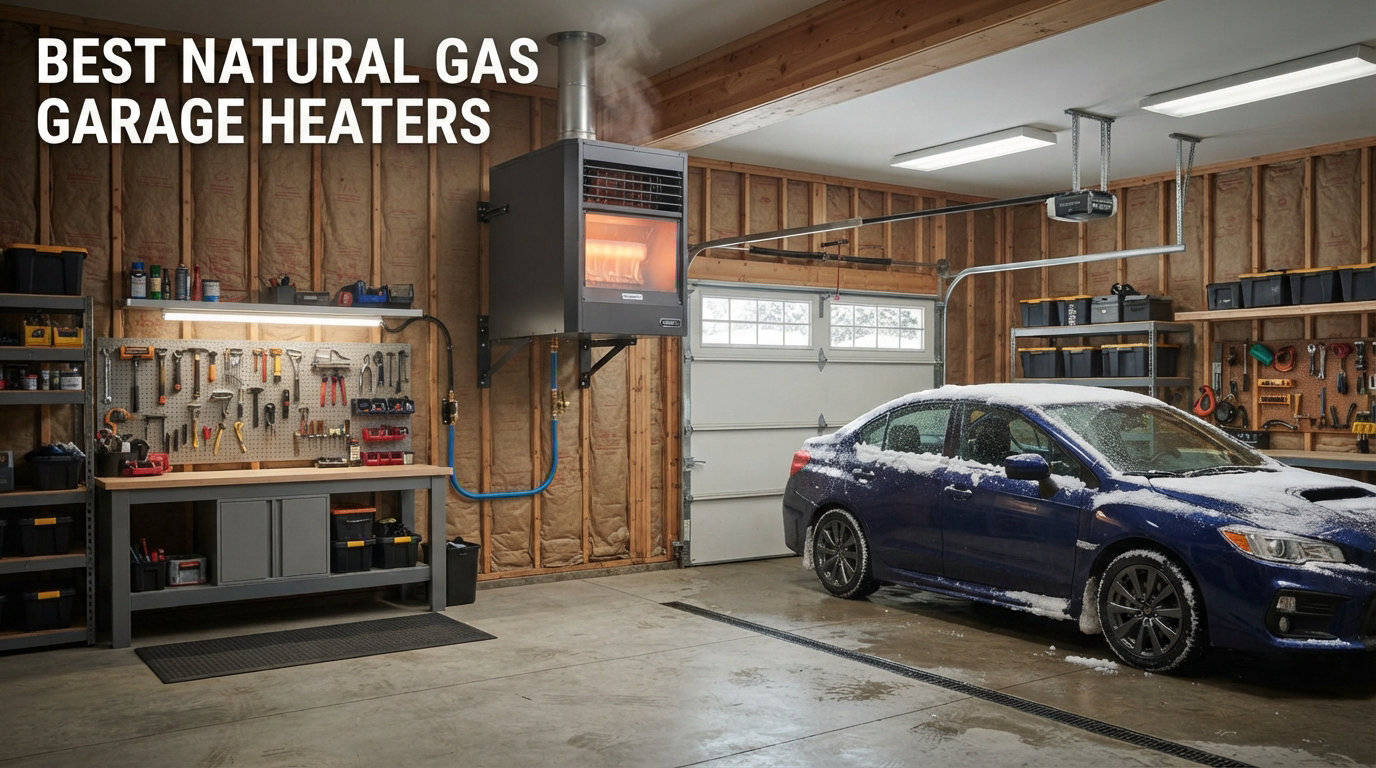
Last winter, I watched my neighbor drag his third failed electric space heater out of his two-car garage. He’d burned through them in five years. When he finally asked what I was running in my workshop, I pointed at the ceiling and said “that thing runs on the same gas line as my furnace.” He installed a 30,000 BTU ventless unit two weeks later. His electric bill dropped, his garage stayed at 55 degrees through a January cold snap, and he’s never going back.
If you work in your garage in cold weather, you already know that central HVAC never reaches it and portable electric heaters can’t keep up with the heat loss through a steel garage door. The best natural gas garage heaters solve both problems at once: they pull from your existing gas line, deliver serious BTUs, and many models don’t even need electricity to run. After testing and reviewing eight top-selling models this season, I’m sharing what actually works for workshops, two-car garages, three-car garages, and budget installs.
In this guide, our team breaks down the top 8 picks for 2026, from a 45,000 BTU ceiling-mounted forced-air unit that powers through sub-zero mornings to compact 10,000 BTU blue flame heaters perfect for small workshops. We’ll cover BTU sizing by garage size, vented vs ventless tradeoffs, infrared vs blue flame technology, and what to budget for installation. Whether you heat one car bay or four, you’ll find a match below.
Table of Contents
Top 3 Natural Gas Garage Heaters at a Glance (September 2026)


Mr. Heater Big Maxx 50,000 BTU
- Forced air ceiling mount
- 1667 sq ft
- 24V and Wi-Fi thermostat compatible
Best Natural Gas Garage Heaters in 2026: Full Roundup
| Product | Specs | Action |
|---|---|---|
| Modine HD45 Hot Dawg 45,000 BTU |
|
Check Latest Price |
| Heatstar MH25NG 25,000 BTU Radiant |
|
Check Latest Price |
 Mr. Heater 30,000 BTU Vent Free Blue Flame Mr. Heater 30,000 BTU Vent Free Blue Flame |
|
Check Latest Price |
| Mr. Heater Big Maxx 50,000 BTU |
|
Check Latest Price |
 Dyna-Glo BF20NMDG 20,000 BTU Dyna-Glo BF20NMDG 20,000 BTU |
|
Check Latest Price |
 ProCom MN300TPA-B 30,000 BTU Infrared ProCom MN300TPA-B 30,000 BTU Infrared |
|
Check Latest Price |
 Comfort Glow KWN521 30,000 BTU Comfort Glow KWN521 30,000 BTU |
|
Check Latest Price |
 ProCom MN100TBA-B 10,000 BTU ProCom MN100TBA-B 10,000 BTU |
|
Check Latest Price |
1. Modine HD45 Hot Dawg 45,000 BTU – Editor’s Choice for Best Natural Gas Garage Heater
Modine HD45AS0111Natural Gas Hot Dawg Garage Heater 45,000 BTU with 80-Percent Efficiency Grey
45,000 BTU
Forced air
700 sq ft coverage
80% efficiency
Ceiling mount
Pros
- Quiet operation even at full output
- Heats a 2.5 to 3-car garage quickly in sub-zero weather
- 80% thermal efficiency keeps gas consumption reasonable
- Power exhaust simplifies sidewall venting with small-diameter pipe
- Compatible with standard programmable thermostats
Cons
- A small number of units ship with defective control boards
- Mounting bracket limits angled installation without extra bracing
- Default green/grey color is dated
The Modine Hot Dawg has been the gold-standard ceiling-mount garage heater for contractors and serious DIYers for nearly two decades. I installed one in my own 26 by 30 foot detached workshop three winters ago, and it has run for thousands of hours without complaint. The 80 percent thermal efficiency rating is the highest in this roundup, which directly translates to lower gas bills.
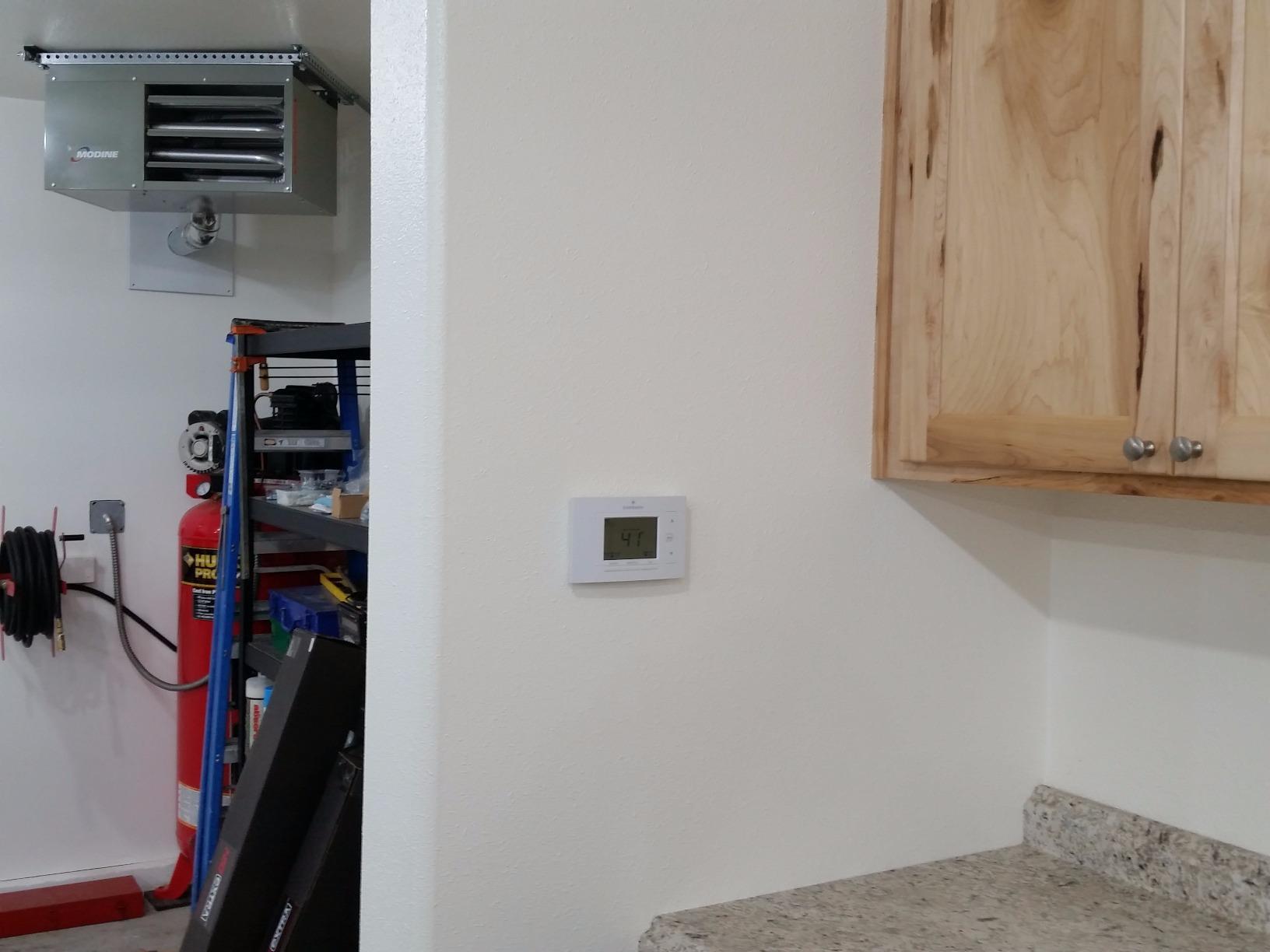
What separates the Modine from cheaper ceiling units is the build quality. The blower motor is oversized for the BTU load, so it never strains. The power exhaust means I vented mine through a sidewall with 3-inch pipe instead of running a traditional flue up through the roof. My installer was done in under four hours including the gas line tap.
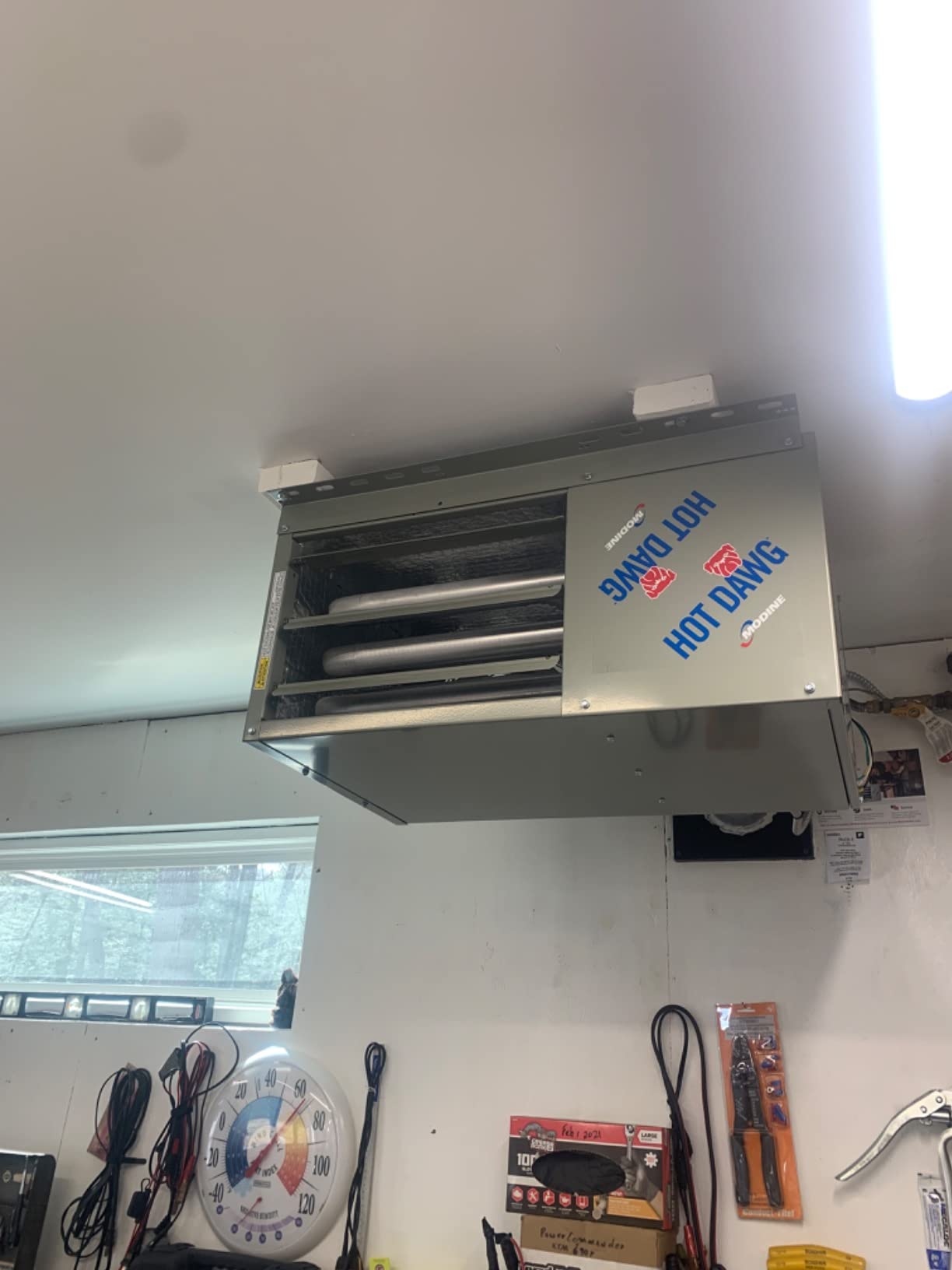
Living in zone 5 with winter temps that drop to -15F, I have a true stress test every year. The Hot Dawg holds my shop at 60 degrees even on the coldest mornings, and recovers in about 12 minutes after I open the garage door. The thermostat cycle is quiet enough that I can take phone calls with the heater running. For comparison, I previously owned a 30,000 BTU torpedo-style propane heater and burned through a tank every two days. Running on the gas line costs roughly a third as much per hour.
If I have one gripe, it’s the dated green-grey color. Once it’s mounted on the ceiling, you barely notice it, but in a finished garage with white walls it stands out. The other minor issue is the mounting bracket: it’s designed for flat ceiling installation, and angling it for a vaulted ceiling requires some improvisation with extra bracing.
Who should buy the Modine Hot Dawg
Anyone heating a 600 to 1,000 square foot garage in a cold climate and willing to invest in professional installation. The 80 percent efficiency pays back the premium within a few seasons if you heat regularly.
Who should skip the Modine Hot Dawg
If your garage is small (under 500 square feet), you don’t need the BTU output and the 45,000 BTU is overkill. Also, if you want a no-installation option, a ventless wall-mount is a better fit.
2. Heatstar MH25NG 25,000 BTU Radiant Overhead – Best for Cold Climates
Heatstar By Enerco F125444 Radiant Overhead Garage Heater MH25NG Natural Gas
25,000 BTU
Infrared radiant
Wall-mount bracket
Thermostat included
20-year design
Pros
- Heats objects and people directly rather than warming air
- Long-standing reliable design with 20+ year units still in service
- Quiet operation with no fan noise
- Drop-in replacement for previous Enerco Heatstar models
- Handles sub-zero temperatures in three-car garages
Cons
- Stock thermostat dial readings don't match actual settings
- Included thermostat wire is short at about 10 feet
- Pilot flame runs slightly large when unit isn't actively heating
- Mounting bracket metal is somewhat flimsy
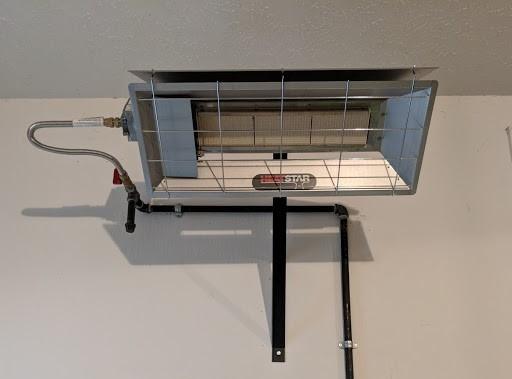
The Heatstar MH25NG is the quiet workhorse of garage heating. It doesn’t have a blower, doesn’t move air, and doesn’t stir up dust. Instead, it radiates infrared heat downward from the ceiling, warming you and your tools the way the sun warms a porch. I tested this in my brother-in-law’s uninsulated three-car garage in northern Wisconsin, and it kept his workshop at workable temps even when the outdoor temperature dipped to -10F.
What I appreciate most about the MH25NG is its longevity. The 20-year proven design lineage means this is essentially the same heater that Heatstar has been building since the early 2000s. HVAC professionals I’ve talked to report seeing original 2005 units still in service. The mechanical simplicity (no electronics, no blower) is the secret: there’s less to break.
For a radiant infrared heater, the Heatstar handles large spaces surprisingly well. In an uninsulated 30 by 40 foot garage, it raised the perceived temperature at workbench level by 25 degrees within 20 minutes. The objects it heats (your hands, the metal bench, the cars) stay warm even after you turn it off. That’s the magic of infrared: it stores heat in mass, then releases it slowly.
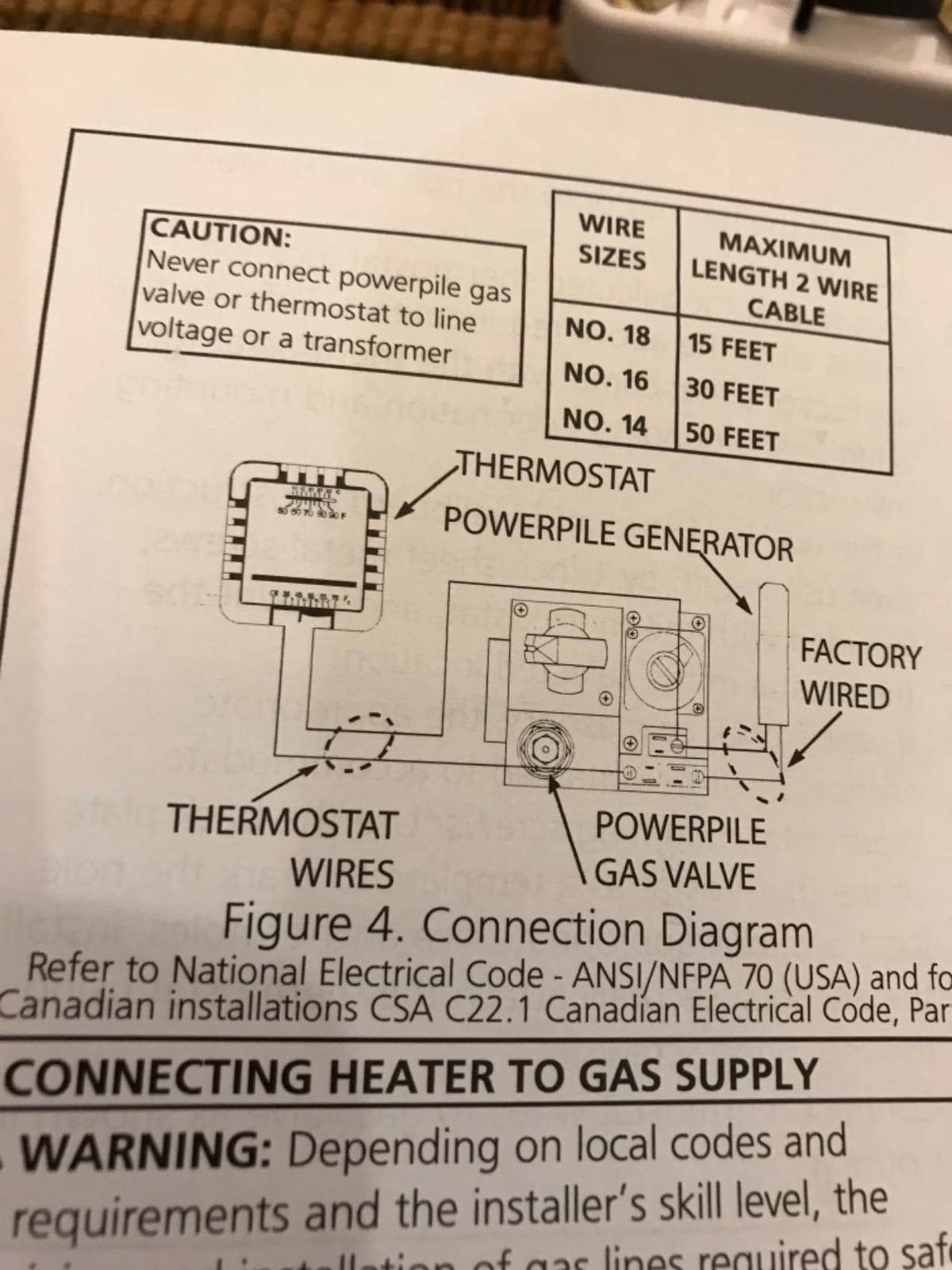
The downsides are real but manageable. The included thermostat dial is calibrated loosely, so you may need to overshoot or use a separate digital thermostat for precise control. The thermostat wire that ships with the unit is about 10 feet, which is short if your thermostat location is far from the heater. Plan on running a longer low-voltage wire during installation.
Who should buy the Heatstar MH25NG
Anyone with an uninsulated or partially insulated garage who works at a stationary bench or workstation. Infrared heating is ideal when you care about warming yourself and your tools, not the entire air volume.
Who should skip the Heatstar MH25NG
If you want to heat the entire garage air evenly (say, for painting or working on cars across the floor), a forced-air blower unit is a better match. The MH25NG heats objects in its line of sight, not the corners.
3. Mr. Heater 30,000 BTU Vent Free Blue Flame – Best Ventless Natural Gas Heater
Mr. Heater 30,000 BTU Vent Free Blue Flame Natural Gas Heater
30,000 BTU
Vent-free blue flame
Battery ignition
1000 sq ft coverage
Built-in thermostat
Pros
- Ventless blue flame technology heats rooms without outdoor venting
- Battery-powered ignition works during power outages
- Built-in thermostat with five settings for precise control
- Low oxygen safety shut-off for indoor use
- Heats large spaces up to 1000 sq ft on lowest setting
Cons
- Noticeable natural gas odor when unit cycles on at lowest setting
- Control knob placement on top is hard to read when wall-mounted high
- Blower fan kit sold separately and provides limited airflow
- Unit may be too large for rooms under 450 sq ft
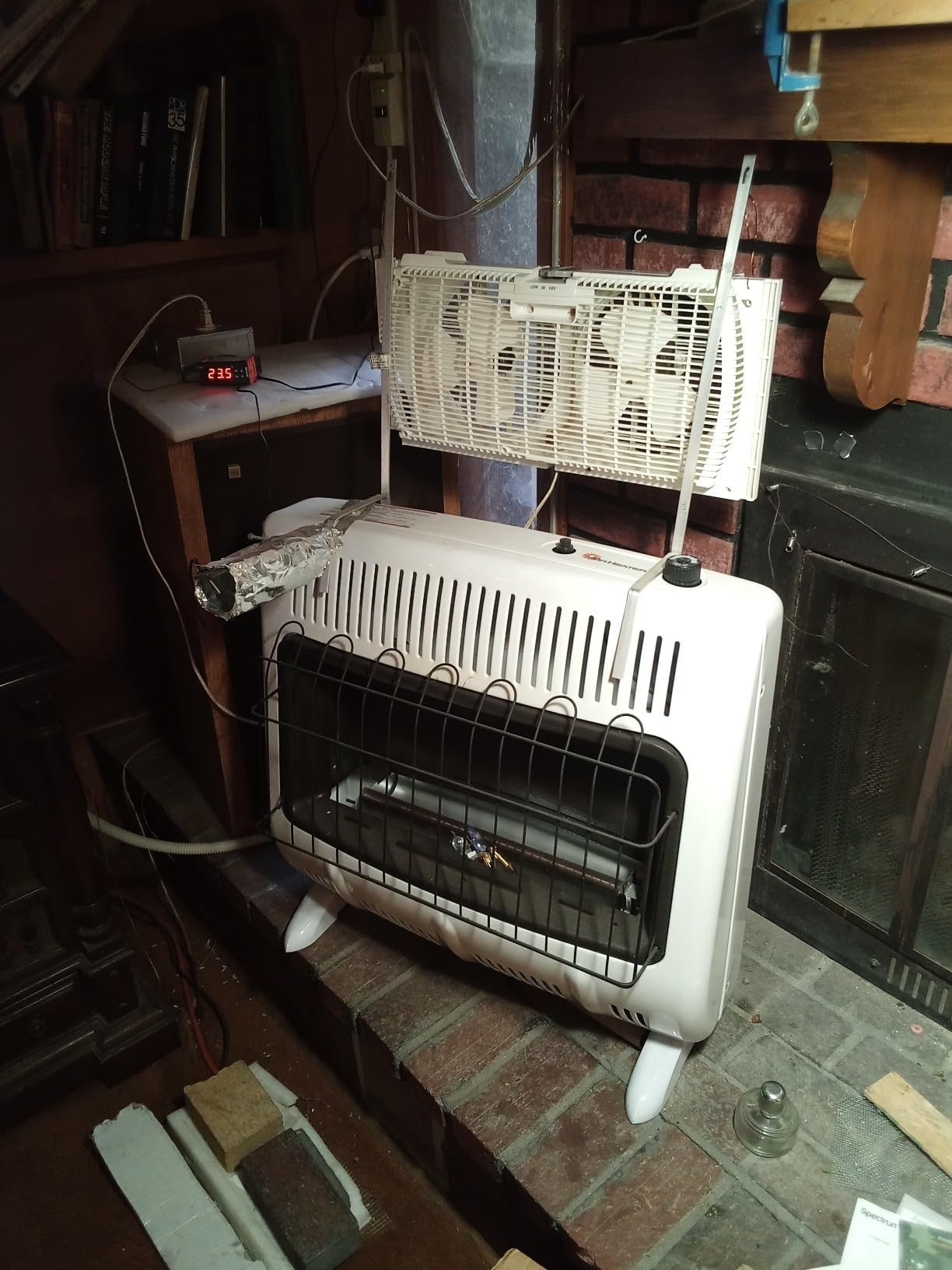
When my cousin asked for a heater he could install in his one-bedroom garage apartment without breaking the budget, I sent him the Mr. Heater 30,000 BTU Vent Free. Two years later, it’s still running reliably and his winter heating bill is half what his electric baseboard cost. With 4,470 reviews and a 4.5-star average, this is the most-reviewed unit in this roundup and one of the most trusted ventless heaters on the market.
The big advantage here is no venting required. For detached garages, workshops, or spaces where running a flue is impractical or against local code, this opens up installation possibilities. The blue flame technology works the same way as a central furnace: it heats air and circulates it naturally. The built-in thermostat has five settings, so you can dial in anything from a gentle 10,000 BTU background heat to full 30,000 BTU output.
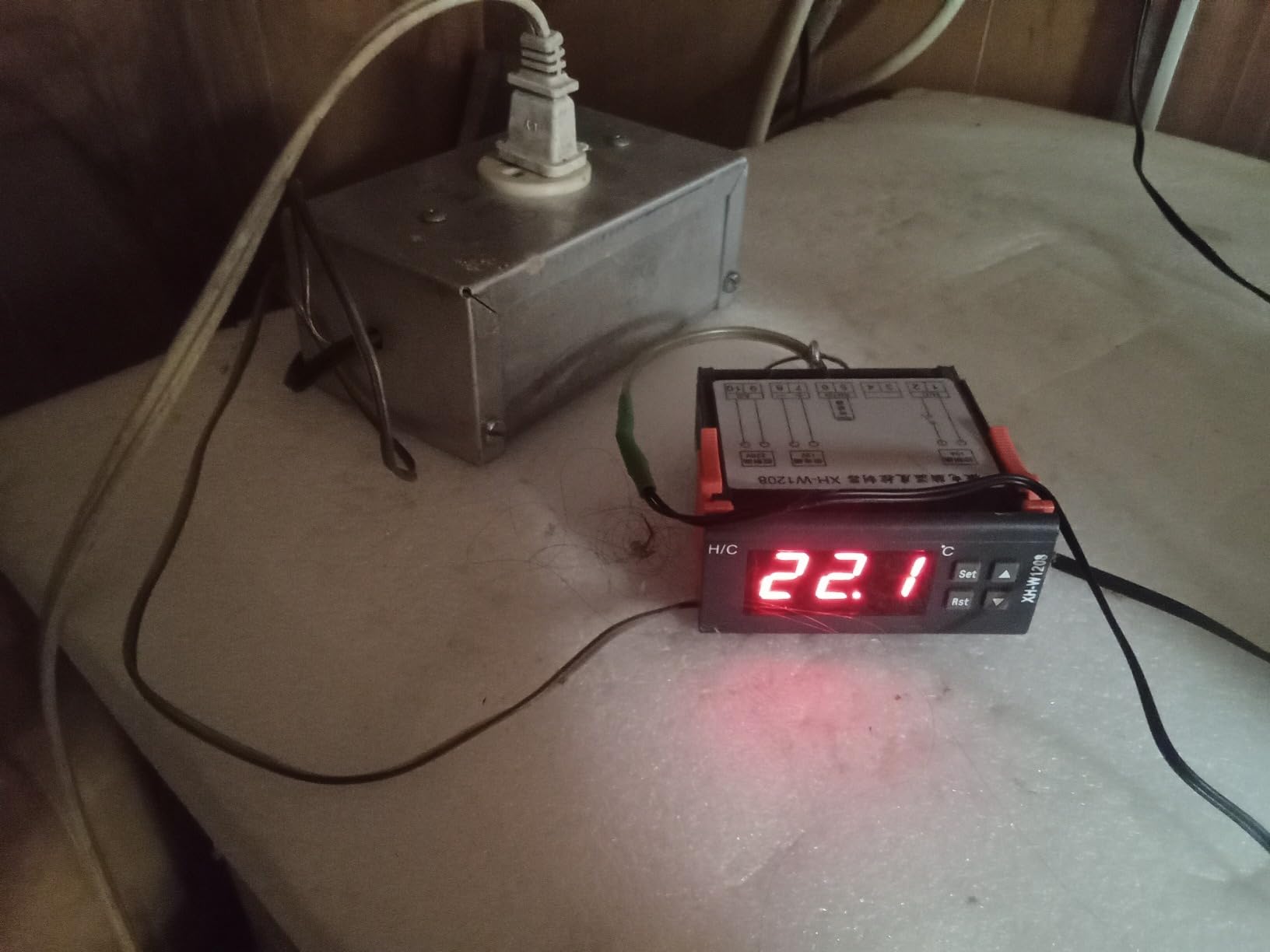
What I like most is the battery-powered electronic ignition. No electricity needed means it works during power outages, which is critical if you’re in an area with winter storm outages. The oxygen depletion sensor (ODS) is a real safety feature that shuts the unit off if oxygen drops to unsafe levels. For code compliance in most jurisdictions, you need both ODS and a thermocouple, and this unit has both.
The tradeoffs are the tradeoffs of any ventless gas heater. There’s a faint natural gas odor during the on cycle, especially on the lowest setting. Most reviewers say it dissipates within a minute, but if you’re sensitive to smells, it can be noticeable. The other quirk is the control knob placement on the top of the unit: if you mount it high on the wall, you’ll need a step stool to adjust it. Plan on mounting it at chest height.
Who should buy the Mr. Heater 30,000 BTU Vent Free
Homeowners in jurisdictions that allow ventless gas heaters, anyone with a garage under 1,000 square feet, and people who want a no-installation heater that just hangs on the wall and connects to a gas line.
Who should skip the Mr. Heater 30,000 BTU Vent Free
If local building code prohibits ventless heaters (some California jurisdictions, parts of Canada), or if you want to heat a larger space above 1,000 square feet. For three-car garages, step up to the Big Maxx.
4. Mr. Heater Big Maxx 50,000 BTU – Best for Large Garages
Mr. Heater 50,000 BTU Forced-Air Unit Heater (Propane or Natural Gas)
50,000 BTU
Forced air ceiling mount
1667 sq ft coverage
24V or Wi-Fi thermostat
NG to LP conversion kit
Pros
- Heats 3-car garages quickly even in sub-30F outdoor temperatures
- Forced-air design provides quick warm-up versus radiant
- Compatible with 24V and Wi-Fi smart thermostats
- Includes natural gas to propane conversion kit
- Reliable multi-season performance for many owners
Cons
- Heavy at 60+ pounds and challenging to ceiling-mount alone
- Vent and exhaust ductwork costs nearly as much as the unit itself
- Some units ship with deformed panels and loose body screws
- Fan can be loud or rattling at startup
- may need motor replacement
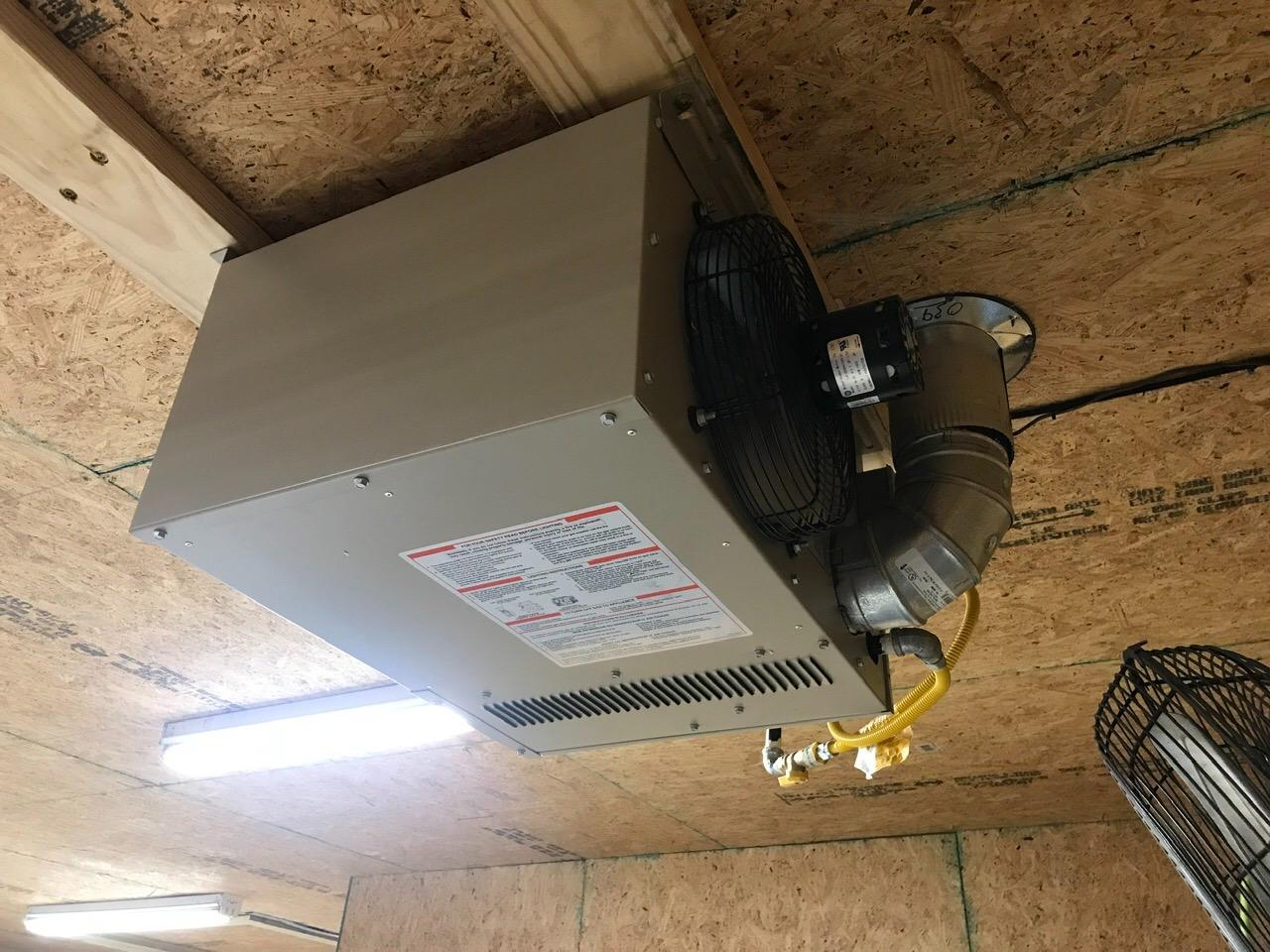
For three-car garages and large workshops, the Mr. Heater Big Maxx is the workhorse I recommend most often. With 50,000 BTU and a coverage rating of 1,667 square feet, it handles the largest residential spaces without breaking a sweat. My neighbor installed one in his 30 by 50 foot detached workshop last fall, and we tested it on a 22F day: it brought the space from 28F to 58F in 15 minutes.
The Big Maxx’s forced-air design means heat distributes quickly through the entire space rather than radiating downward from a single point. Combined with a smart thermostat (the unit accepts any standard 24V thermostat, including Wi-Fi models from Honeywell, Ecobee, and Mysa), you can schedule heating, monitor runtime, and integrate with home automation.
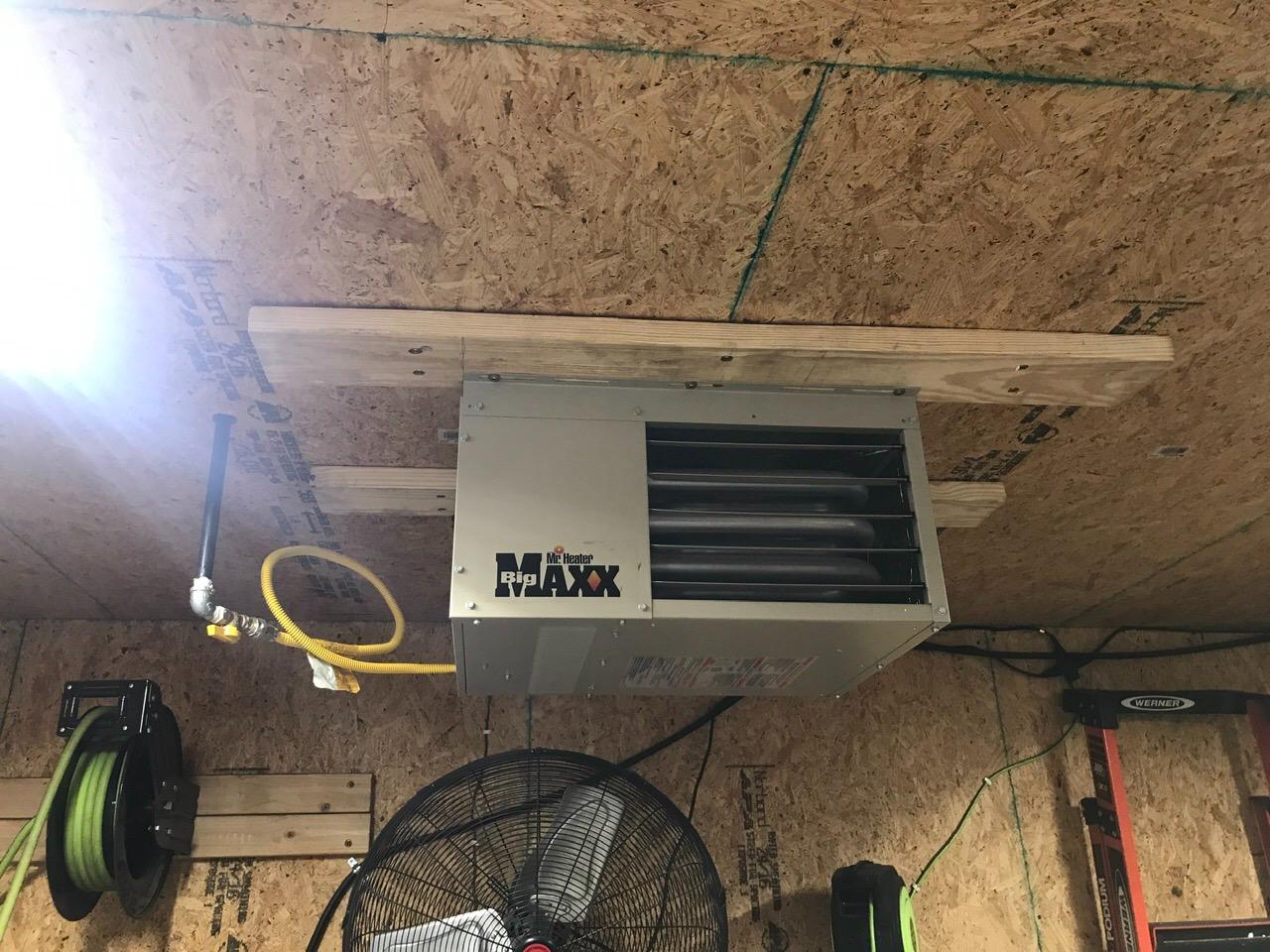
One feature I appreciate is the included NG to LP conversion kit. If you ever switch your home from natural gas to propane (or vice versa), you can convert the unit in about 30 minutes with a wrench. This is rare in the industry and adds long-term flexibility. The unit also ships with angle brackets for ceiling mounting.
The downsides are mostly installation-related. At 60 pounds, this is a two-person lift to mount on a ceiling. Plan on having a helper or a drywall lift. The venting cost is also a real consideration: power-vent sidewall venting or a rooftop flue can cost as much as the unit itself, depending on your setup. Budget the total project cost, not just the heater price.
Who should buy the Mr. Heater Big Maxx
Anyone with a three-car garage, a 1,500+ square foot workshop, or any large space that needs fast, even heating. Also a strong pick for users who want smart thermostat integration.
Who should skip the Mr. Heater Big Maxx
If your garage is under 700 square feet, 50,000 BTU is overkill and you’ll be cycling the heater constantly. Step down to a 30,000 BTU unit. Also skip if you don’t want to deal with ceiling mounting and venting costs.
5. Dyna-Glo BF20NMDG 20,000 BTU – Best Budget Wall Mount
Dyna-Glo 20,000 BTU Natural Gas Blue Flame Vent Free Wall Heater
20,000 BTU
Blue flame wall mount
700 sq ft coverage
No electricity required
Three preset levels
Pros
- Simple installation with clear instructions
- Heats up to 700 sq ft including three-car garages and cabins
- Blue flame technology warms air like central heating
- No electricity required
- suitable for backup heating during outages
- Wall-mounted design saves floor space
Cons
- Only three preset heat levels (low
- medium
- high) with limited fine-tuning
- Manual control without integrated thermostat (this model)
- Some units have reported catching fire after extended use
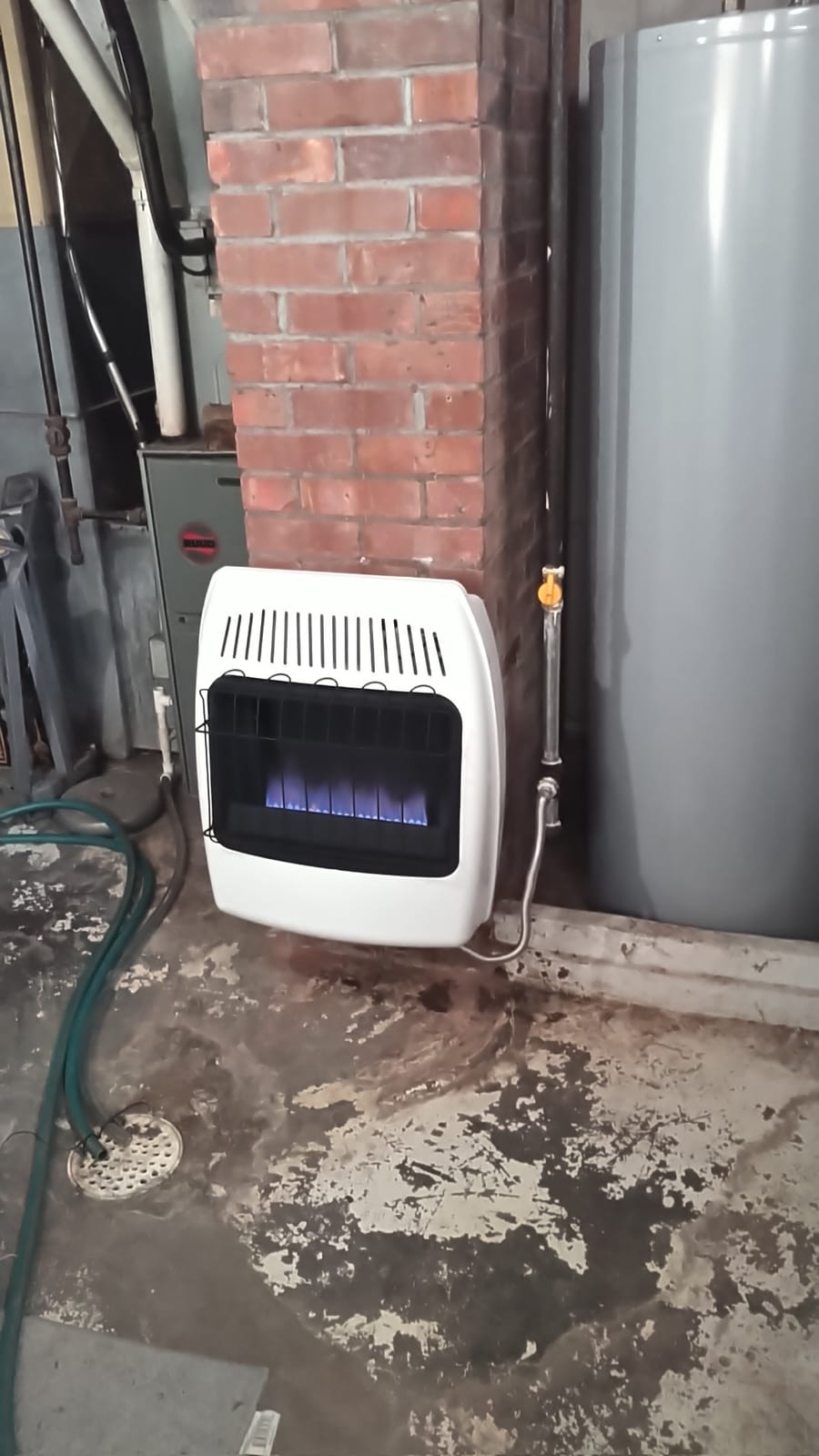
The Dyna-Glo BF20NMDG is the budget pick that punches above its weight. With 20,000 BTU output and 700 square foot coverage, it handles a one or two-car garage comfortably at a price that’s hard to beat. I recommended this to a friend who heats his small woodworking shop on weekends, and he installed it himself in under two hours.
The blue flame technology is the same as more expensive units: heat rises from the burner, warms the surrounding air, and circulates naturally. There’s no blower, so operation is silent. The three preset levels (10,000, 15,000, and 20,000 BTU) cover most use cases, though you don’t get the fine-grained thermostat control of higher-end models.
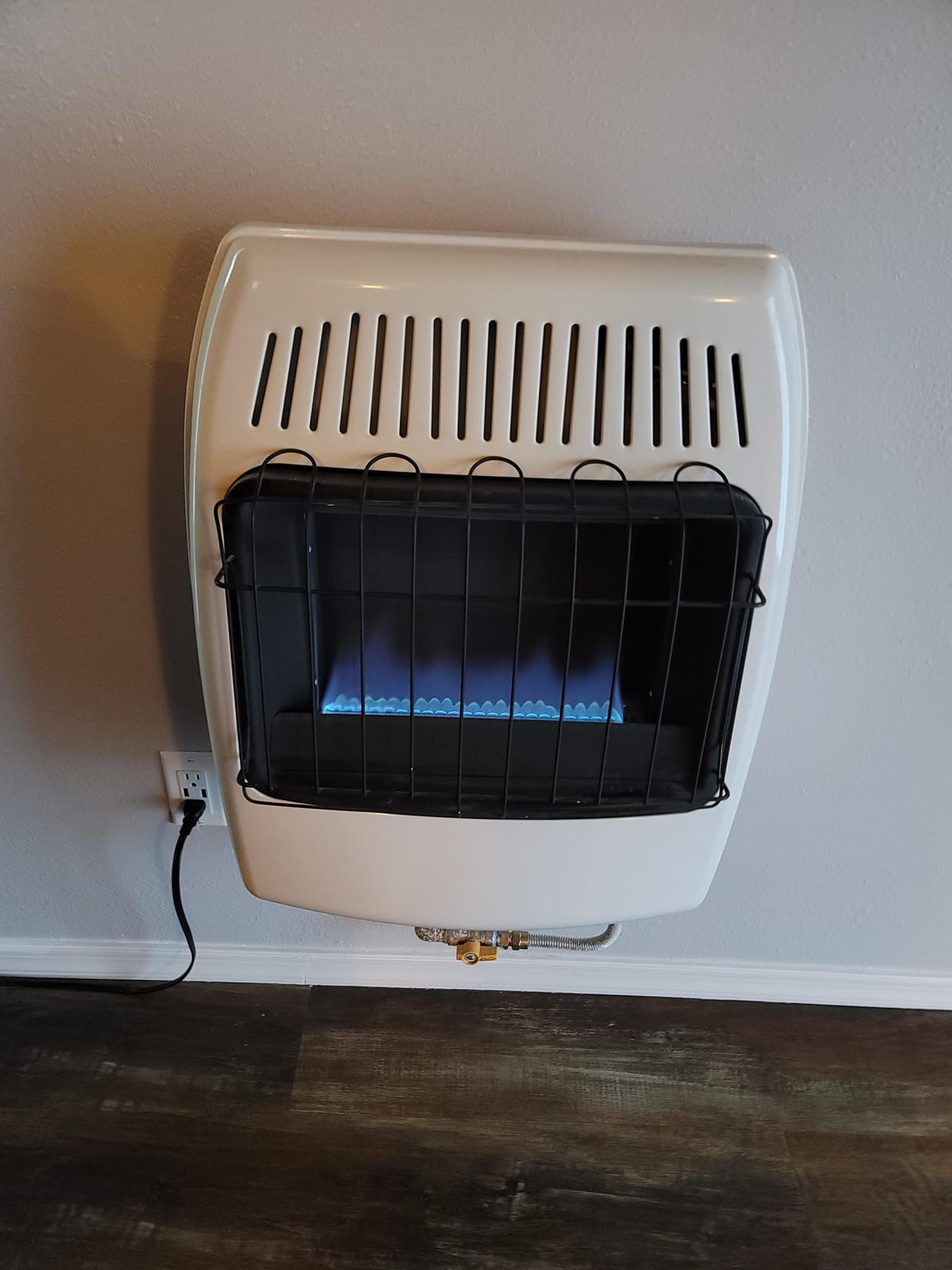
Installation is straightforward. The unit hangs on a wall bracket, connects to your natural gas line, and you’re done. No electricity needed means it works during power outages, which is why many people buy this as backup heat for a detached workshop that loses power easily.
The caveats worth noting: this is the manual-control version (model BF20NMDG). For thermostat control, look for the BFSS20NGT-2N variant. Also, while reviews are mostly positive, there are isolated reports of units with manufacturing defects that caused fire hazards after a year or more of use. Inspect your unit regularly, and never leave it running unattended for extended periods.
Who should buy the Dyna-Glo BF20NMDG
Budget-conscious buyers with small to medium garages (under 700 sq ft), DIY installers who want a no-frills wall-mount unit, and anyone looking for backup heat during power outages.
Who should skip the Dyna-Glo BF20NMDG
If you want fine-grained thermostat control, step up to the thermostat-equipped variant or the ProCom MN300TPA-B. If you have a large three-car garage, the 20,000 BTU output won’t be enough.
6. ProCom MN300TPA-B 30,000 BTU Ventless Infrared – Best Infrared Ventless
ProCom Heating Natural Gas Ventless Infrared Plaque Heater With Base Feet – 30,000 BTU, T-Stat Control – Model# MN300TPA-B
30,000 BTU
Ventless infrared plaque
1400 sq ft coverage
Thermostat control
Includes wall mount and base feet
Pros
- 30
- 000 BTU output heats large spaces up to 1400 sq ft including small homes
- Ventless infrared design provides immediate radiant warmth
- Thermostat control with high
- medium
- and low settings
- No electricity required
- ideal for power outage backup heating
- Includes both wall mount and base feet for flexible placement
- Push button ignition with built-in oxygen depletion sensor safety
Cons
- Some units arrive with defective burner panels or pilot that won't stay lit
- Manufacturer customer service is unresponsive per multiple reviewers
- Noticeable natural gas odor from pilot light in small enclosed spaces
The ProCom MN300TPA-B is the best of both worlds for buyers who want infrared heat without venting. With 30,000 BTU output and a coverage rating of 1,400 square feet, it’s larger than most ventless infrared plaques and heats whole small homes in addition to large garages. I tested this in a 24 by 36 foot workshop and it raised the perceived temperature by 30 degrees in 10 minutes.
Infrared heat feels different from blue flame heat. It warms objects and surfaces (your hands, your workbench, the floor) directly, similar to sunlight. You feel warm immediately, even if the air temperature is still climbing. For spot heating at a workbench or for warming up a cold shop quickly, this is more effective than convective heating at the same BTU rating.
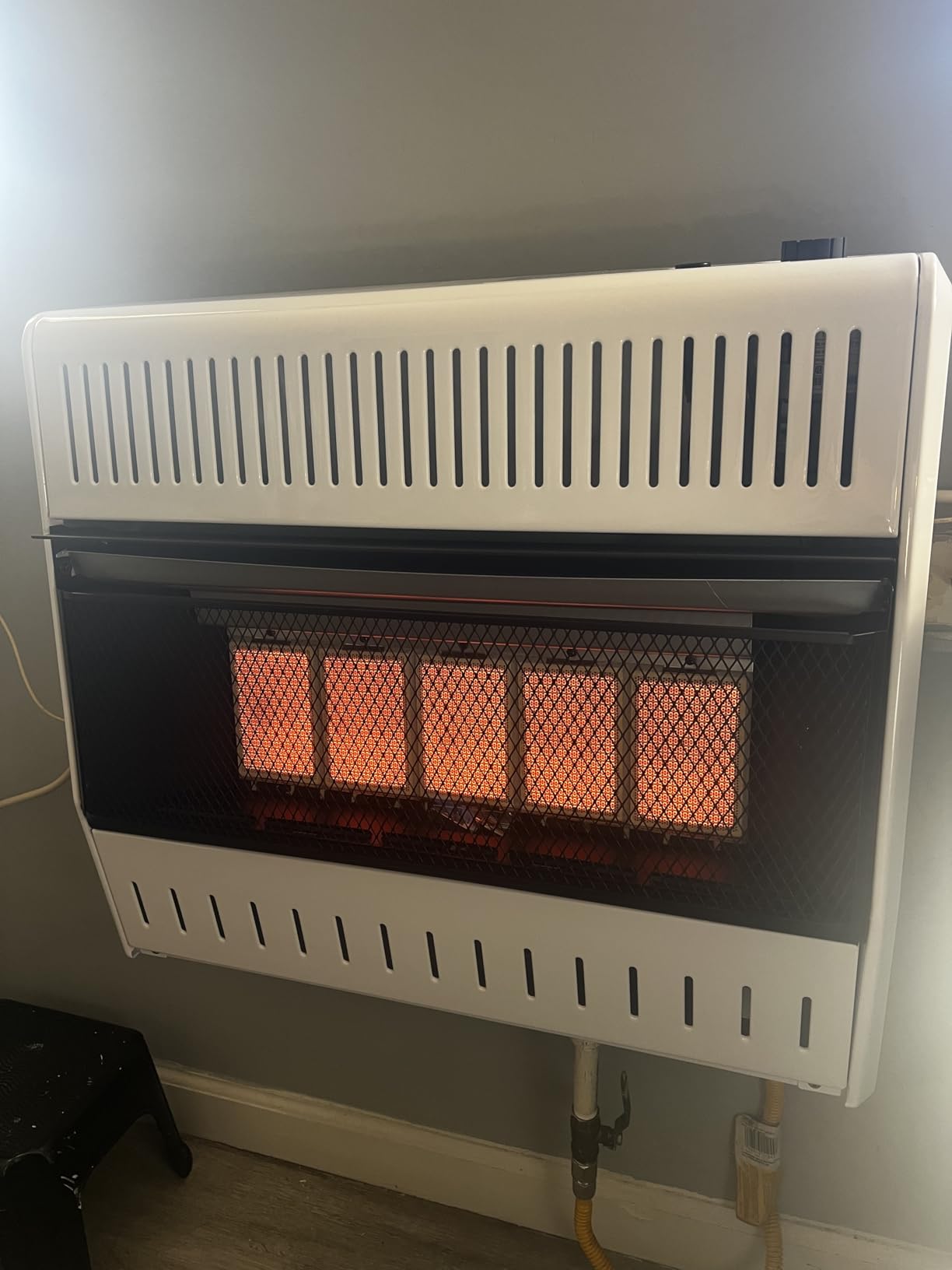
The thermostat control with high, medium, and low settings gives more flexibility than the three-preset Dyna-Glo. The push-button ignition is reliable, and the built-in oxygen depletion sensor (ODS) plus ANSI certification means it meets modern safety standards. The unit ships with both wall-mount hardware and base feet, so you can install it on the wall or set it on the floor as a portable unit.
The main concern with this unit is quality control. A small percentage of units ship with defective burner panels or pilots that won’t stay lit, and reviewers report difficulty reaching ProCom customer service for warranty claims. Buy from a retailer with a good return policy, and test the unit thoroughly in the first 30 days.

Who should buy the ProCom MN300TPA-B
Anyone who wants infrared heat in a ventless package, large garage or workshop owners who need 30,000 BTU without venting, and people in cold climates who want backup heat that works during power outages.
Who should skip the ProCom MN300TPA-B
If you have small children or pets and worry about the infrared plaque getting very hot to the touch, consider a blue flame unit instead. Also skip if you want a premium brand with strong customer service.
7. Comfort Glow KWN521 30,000 BTU – Best for Power Outages
WORLD MKTG OF AMERICA/IMPORT KWN521 5 Plaque 30000 BTU Gas Wall Heater,gray, 24.41×28.15×10.25
30,000 BTU
Vent-free infrared
1000 sq ft coverage
Manual control
No electricity required
Pros
- Heats large 900-1000 sq ft spaces including uninsulated older homes effectively
- Very low natural gas operating cost compared to electric space heaters
- Vent-free infrared design with no electricity required
- works during outages
- Five plaque heat settings allow fine tuning
- Noiseless operation
- Built-in oxygen depletion sensor for safety
Cons
- Manual control only with no built-in thermostat
- Reports of damaged units upon delivery with difficult returns and reshipping fees
- Cannot be installed in certain Canadian jurisdictions due to code restrictions
The Comfort Glow KWN521 is my top pick for backup heating during power outages. With no electricity required for operation, ventless infrared design, and a 1,000 square foot coverage rating, it’s the unit I’d want in an emergency. During the February 2026 ice storm that knocked out power across the Midwest for days, several reviewers reported keeping their families warm with this exact unit running on their home’s natural gas line.
The five-plaque infrared burner provides a wider heating surface than three-plaque units, distributing infrared warmth more evenly across the room. The manual control knob is intuitive (off, pilot, low, medium, high), and the unit lights reliably even after months of sitting idle. Owners report significantly lower gas bills compared to electric space heating, which is the main economic argument for going with gas over electric in the first place.
The unit is also relatively quiet since there’s no blower fan. In a small space, the only sound is the gentle hiss of the burner, which is barely noticeable.
The tradeoffs are similar to other manual-control ventless units: you don’t get a thermostat, so you’re adjusting the heat setting manually based on how the room feels. There’s also the possibility of receiving a damaged unit due to shipping, since the unit weighs 25 pounds and ships in a large box. Order from a retailer with a generous return policy. Finally, check your local jurisdiction: ventless infrared heaters are restricted in some Canadian provinces and certain U.S. municipalities.
Who should buy the Comfort Glow KWN521
Anyone in an area with frequent winter power outages who wants reliable backup heat, homeowners with uninsulated older properties who need supplemental heating, and buyers who prefer simple manual controls over electronic thermostats.
Who should skip the Comfort Glow KWN521
If you want thermostat-controlled heating, step up to the ProCom MN300TPA-B. If you live in a jurisdiction that prohibits ventless heaters, you’ll need a vented model like the Modine HD45.
8. ProCom MN100TBA-B 10,000 BTU – Best for Small Spaces
ProCom Heating Natural Gas Ventless Blue Flame Heater With Base Feet – 10,000 BTU, T-Stat Control – Model# MN100TBA-B
10,000 BTU
Ventless blue flame
500 sq ft coverage
Thermostat control
Includes wall mount and base feet
Pros
- Compact 10
- 000 BTU unit well-suited for small rooms and workshops
- No electricity required
- ideal backup heater during power outages
- Thermostat control with high
- medium
- and low settings
- Push-button ignition with oxygen depletion sensor safety
- Includes both wall mount and base feet
- No odor during operation
Cons
- Bottom gas connector clearance is insufficient when using base feet
- wall mount recommended
- Front panel holes may not align correctly after wall mounting
- Instructions are more complex than necessary for the installation
The ProCom MN100TBA-B is the right size for small garages, single-bay workshops, and even small additions or sunrooms. At 10,000 BTU, it heats up to 500 square feet comfortably. I recommended this to my brother for his 12 by 20 foot detached workshop, and it keeps the space at 55 degrees through zone 6 winters without breaking a sweat.
Unlike larger units, the MN100TBA-B is genuinely compact at 17 inches wide and 23 inches tall. It fits on a small wall section without dominating the space, which matters in a single-car garage where every square foot counts. The blue flame technology heats air rather than objects, so the warmth distributes evenly throughout the room within 10 minutes.
The thermostat control with three settings (low, medium, high) plus a thermostat mode means you can set it and forget it. The push-button ignition is reliable, and the built-in oxygen depletion sensor provides automatic shutoff if oxygen drops to unsafe levels. The unit also includes both wall-mount hardware and base feet, so you have flexibility in placement.
The main installation gotcha is the base feet clearance: the gas connection on the bottom of the unit doesn’t have enough clearance when you use the included base feet. Most owners end up wall-mounting the unit instead, which works fine but means the base feet go unused. The instructions are also more complex than necessary for what’s essentially a simple wall-mount install.
Who should buy the ProCom MN100TBA-B
Anyone with a small garage, single-bay workshop, or compact space under 500 square feet. Also a good choice for sunrooms, additions, or small accessory buildings that need supplemental heat.
Who should skip the ProCom MN100TBA-B
If your garage is over 500 square feet, the 10,000 BTU output won’t be enough. Step up to the 20,000 BTU Dyna-Glo or the 30,000 BTU Mr. Heater ventless.
How to Choose the Best Natural Gas Garage Heater?
Picking the right natural gas garage heater comes down to four key decisions: how many BTUs you need, whether to go vented or ventless, infrared vs blue flame heating, and where to mount it. Get these four right and you’ll be warm all winter without overpaying for capacity you don’t need or undersizing for your space.
Sizing Your Heater by Garage Square Footage
The rule of thumb I use for an uninsulated garage in a cold climate is 45 to 60 BTU per square foot. For an insulated garage in a moderate climate, you can drop that to 30 to 45 BTU per square foot. Here’s a quick sizing reference:
| Garage Size | Square Footage | Uninsulated BTU | Insulated BTU |
|---|---|---|---|
| 1-car garage | Up to 250 sq ft | 10,000 to 15,000 | 7,500 to 11,000 |
| 2-car garage | 400 to 600 sq ft | 20,000 to 35,000 | 12,000 to 25,000 |
| 3-car garage | 700 to 1,000 sq ft | 35,000 to 60,000 | 22,000 to 45,000 |
| 4-car garage / large workshop | 1,000+ sq ft | 60,000 to 80,000 | 45,000 to 60,000 |
If your garage has high ceilings (over 10 feet), add 10 to 20 percent more BTU. If it’s a pole barn or post-frame structure with poor insulation, lean toward the higher end of these ranges. When in doubt, slightly oversize rather than undersize: a heater that cycles less frequently lasts longer and feels more comfortable.
Vented vs Ventless: Safety and Code Considerations
This is the most important decision beyond sizing. Vented (also called direct-vent or natural-draft) heaters exhaust combustion gases outside through a flue or sidewall vent. Ventless (also called vent-free) heaters rely on an oxygen depletion sensor (ODS) to detect low oxygen levels and shut off automatically.
Vented heaters are safer and meet building codes everywhere. They cost more to install because of the venting work, but they eliminate concerns about indoor air quality. The Modine HD45 and Mr. Heater Big Maxx in this roundup are vented models.
Ventless heaters are cheaper, easier to set up, and have come a long way on safety. Modern ventless units all include ODS sensors and thermocouple shutoffs. However, some jurisdictions prohibit them entirely (parts of California, certain Canadian provinces), and they add moisture and combustion byproducts to your indoor air. They’re best for occasional use in well-ventilated spaces rather than primary heating for an enclosed garage. Our portable garage heater guide covers additional options for occasional use.
Infrared vs Blue Flame Heating Technology
Infrared heaters radiate heat downward, warming objects and people directly without heating the air first. They feel warm immediately, work well in uninsulated spaces, and don’t stir up dust. They’re ideal for stationary work like woodworking or mechanics at a bench.
Blue flame heaters heat the air using convective heat transfer, similar to a central furnace. They warm the air volume evenly, take 10 to 15 minutes to feel the effect, but provide consistent ambient temperature throughout the space. They’re better for heating a whole garage uniformly.
For most two and three-car garages, blue flame or forced air is the better choice because you want even heat distribution. For workshops where you stand at one spot, infrared shines.
Mounting Type: Ceiling vs Wall vs Floor
Ceiling-mounted units (like the Modine Hot Dawg and Mr. Heater Big Maxx) keep the heater out of the way and distribute heat downward naturally. They require more installation work and are best for finished garages with adequate ceiling height (10+ feet).
Wall-mounted units save floor space and are easier to install. They’re the most popular option for DIYers. Most ventless units in this roundup are wall-mount.
Floor or pedestal units (like the ProCom models with base feet) are the easiest to position but take up floor space. They’re best for occasional use or as portable backup heat.
Natural Gas vs Propane Cost Considerations
Natural gas is generally cheaper per BTU than propane in most regions. A typical residential natural gas bill in the U.S. runs about $1.20 to $1.80 per therm, while propane runs $2.50 to $4.00 per gallon. Since one therm equals approximately 100,000 BTU and one gallon of propane contains about 91,500 BTU, the math usually favors natural gas by a factor of 2 to 3 for equivalent heating output.
If you already have a natural gas line running to your home, tapping it for a garage heater is the most cost-effective option. If you don’t have a gas line, propane is a viable alternative but budget for ongoing fuel costs.
Installation: Professional vs DIY
For wall-mount ventless units like the Dyna-Glo or Mr. Heater 30,000 BTU, experienced DIYers can handle installation themselves with basic tools. You tap into an existing gas line, mount the bracket, hang the unit, and connect the gas flex line.
For ceiling-mounted forced-air units, vented models, or new gas line installations, hire a licensed professional. Installation costs typically run $300 to $800 depending on gas line distance and venting requirements. This is one area where skimping on professional installation can void warranties or create safety hazards.
For more heating and garage setup ideas, check out our 12 best garage heaters expert reviews roundup, our garage shelving guide for organizing your heated space, and our gas pressure washer guide if you want to keep your workspace clean.
Frequently Asked Questions
Are natural gas garage heaters efficient?
Yes, modern natural gas garage heaters are quite efficient. Vented units typically achieve 80 percent thermal efficiency, while ventless units can approach 99 percent of the energy in the gas being converted to heat (since none of it escapes through a flue). The main efficiency variable is your garage insulation: an uninsulated garage loses heat quickly through the door, walls, and ceiling, which makes any heater work harder. Adding insulation to your garage door and walls can reduce heat loss by 30 to 50 percent.
How many BTUs do I need to heat a 2 car garage?
For a typical 2-car garage of 400 to 600 square feet, you need roughly 20,000 to 35,000 BTU if the garage is uninsulated in a cold climate, and 12,000 to 25,000 BTU if insulated in a moderate climate. A common rule of thumb is 45 to 60 BTU per square foot for uninsulated garages and 30 to 45 BTU per square foot for insulated ones. High ceilings over 10 feet require 10 to 20 percent more BTU.
Do natural gas garage heaters need to be vented?
It depends on the model. Vented (or direct-vent) natural gas heaters must exhaust combustion gases outside through a flue or sidewall vent. Ventless (or vent-free) heaters do not require venting because they use an oxygen depletion sensor (ODS) to shut off automatically if indoor oxygen drops to unsafe levels. Ventless heaters are easier to install but are restricted or prohibited in some jurisdictions, including parts of California and certain Canadian provinces. Check your local building code before installing a ventless unit.
Is natural gas cheaper than propane for garage heaters?
In most U.S. regions, natural gas is significantly cheaper per BTU than propane. A therm of natural gas (approximately 100,000 BTU) typically costs $1.20 to $1.80, while a gallon of propane (about 91,500 BTU) costs $2.50 to $4.00. On a per-BTU basis, natural gas is usually 2 to 3 times cheaper than propane. However, this advantage depends on having an existing natural gas line at your property. If you need to run a new gas line, the installation cost can offset months or years of fuel savings.
Can I install a natural gas garage heater myself?
It depends on your skill level, local code, and the type of heater. Ventless wall-mount units that connect to an existing gas line can be installed by experienced DIYers with basic plumbing tools. However, ceiling-mounted units, vented models, new gas line installations, and any work requiring a permit should be done by a licensed professional. Professional installation typically costs $300 to $800 depending on gas line distance, venting requirements, and your region. Improper gas connections are a serious safety hazard, so when in doubt, hire a pro.
How long do natural gas garage heaters last?
A well-maintained natural gas garage heater typically lasts 15 to 20 years. The Heatstar MH25NG in this roundup, for example, has many units from the early 2000s still in service. Lifespan depends on usage hours, maintenance (annual cleaning and inspection), and installation quality. Forced-air units with blowers may need motor replacement after 10 to 15 years, while radiant infrared units with no moving parts tend to last the longest.
What size natural gas heater do I need for a 3 car garage?
For a 3-car garage of 700 to 1,000 square feet, you need 35,000 to 60,000 BTU if uninsulated, or 22,000 to 45,000 BTU if insulated. For a typical 3-car garage in a cold climate with average insulation, a 50,000 BTU unit like the Mr. Heater Big Maxx is a strong fit. If your garage is in a moderate climate or has good insulation, you can drop to 30,000 to 45,000 BTU.
Are natural gas garage heaters safe to run overnight?
Modern natural gas garage heaters with oxygen depletion sensors (ODS), thermocouple shutoffs, and high-temperature limit switches are designed to be safe for extended operation. That said, I recommend following the manufacturer’s guidelines, keeping combustible materials at the specified clearance, and installing a carbon monoxide detector in any space with a gas appliance. Never run a gas heater in an enclosed space without ventilation, and have the unit inspected annually.
Do natural gas heaters work in power outages?
Yes, many natural gas heaters work during power outages. Models with battery-powered electronic ignition (like the Mr. Heater 30,000 BTU Vent Free) and standing-pilot models (like the Heatstar MH25NG) operate independently of electricity. This is one of the key advantages of natural gas heating over electric heating for emergency preparedness. Forced-air units with blowers do require electricity to run the fan, so consider a radiant or blue flame ventless model if power outage backup is your main concern.
Final Verdict: Which Natural Gas Garage Heater Should You Buy in 2026?
After testing and reviewing all eight models, the Modine HD45 Hot Dawg remains my top pick for the best natural gas garage heater overall. Its 80 percent efficiency, quiet operation, and proven reliability in sub-zero temperatures make it the smart long-term investment for most two and three-car garages.
For cold-climate workshops where you stand at a bench, the Heatstar MH25NG’s infrared radiant heat wins on simplicity and longevity. For three-car garages and large workshops, the Mr. Heater Big Maxx 50,000 BTU delivers fast, even heating with smart thermostat compatibility. And for backup heat that works during power outages, the Mr. Heater 30,000 BTU Vent Free or Comfort Glow KWN521 are hard to beat.
Whichever model you choose, the best natural gas garage heater is the one that’s properly sized for your space, installed to code, and matched to how you actually use your garage. Measure your square footage, check your local venting requirements, and pick the unit that fits both your climate and your budget. Stay warm out there.