
Last updated: September 2026
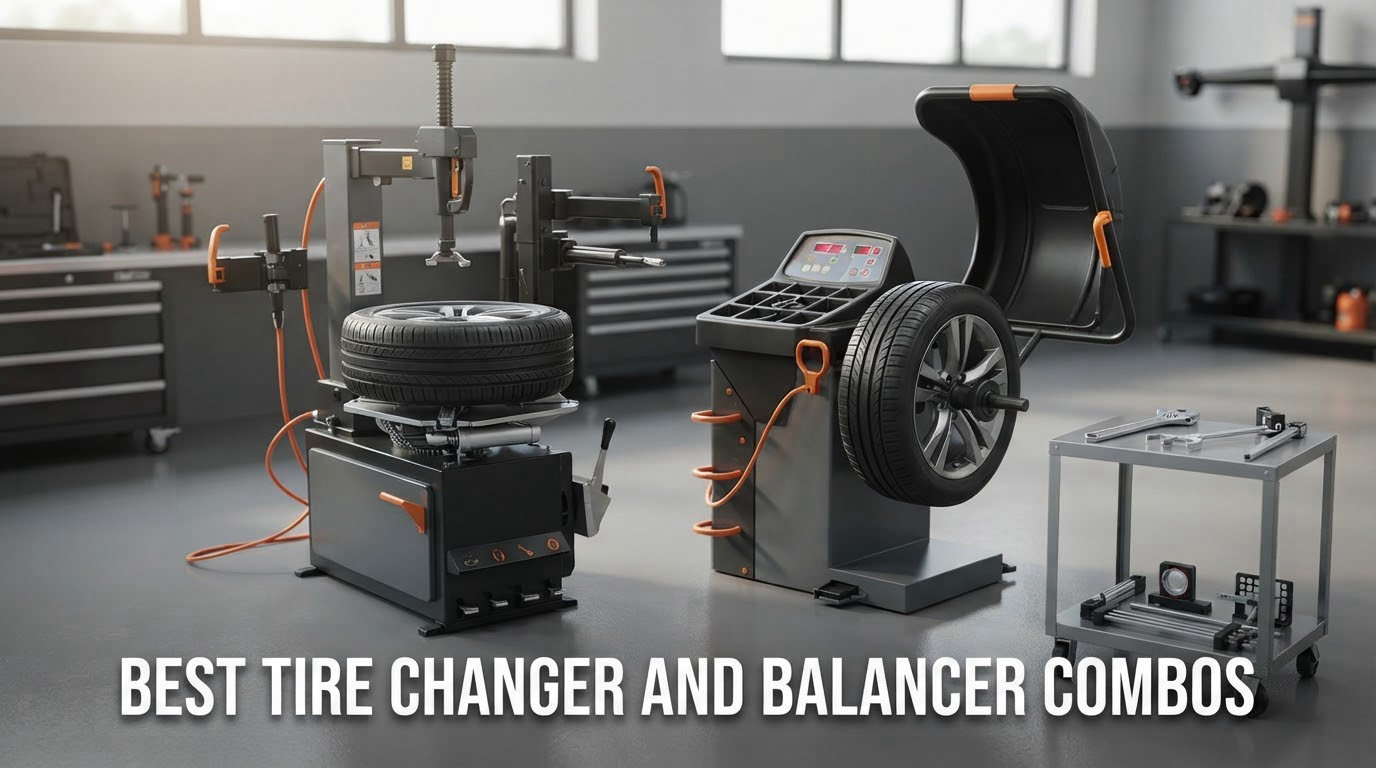
A tire changer and balancer combo is two machines in one order: a tire-changing machine that breaks the bead and mounts rubber, and a wheel balancer that spins the rim and tells you where the weight goes. Buyers fall into three very different groups, and the honest answer changes completely between them. A home garage needs a compact 110V swing-arm package that will not swallow the bay. A small independent shop running about five tire jobs a day needs a capable mid-tier pair with assist arms. A high-volume shop needs clamping range and cycle time. We covered all three.
Over the last few months our team worked through eight of the most-reviewed tire changer and balancer combos on the market, read the specification sheets line by line, and cross-checked them against owner reports on tire forums. This is the roundup: eight packages, each with a clear verdict, an honest list of drawbacks, and a plain statement of who should buy it and who should walk past it.
If your situation is a single car and a seasonal swap, read our home garage tire changer guide first, because a full combo is often more machine than one household needs. Everything below assumes you are either opening a service bay, running a small shop, or committing real bay space to your own vehicles.
Table of Contents
Top 3 Best Tire Changer and Balancer Combos in 2026
Our first pass through the field produced a lot of near-identical machines with shuffled model numbers, so we narrowed the shortlist by evidence volume rather than by spec sheet. The three below cover the three tiers a real buyer actually chooses between, and between them they handle everything from a family sedan to a full-size pickup on 35-inch tires.

XK 988-690 Combo
- 2.0 HP 110V changer with bead blaster
- 12-20 in outside clamping
- 690 balancer with 1 gram accuracy
- 41 in max tire diameter

XK 960-690 Combo
- 5600 lb bead breaker
- Professional assist arm
- 690 balancer with ALU 1-3 modes
- 37 in tire capacity

BILT HARD Swing Arm Combo
- 2.0 HP 110V changer
- 12-24 in rim range
- Balancer to 28 in rims
- 4 ALU modes
Two of the three are XK machines, and that is not favoritism. Those two packages have the deepest owner histories in the group, which is the closest thing this category has to a reliability record. The BILT HARD set is in the list because the entry point matters, not because we would hand it to a busy shop.
Every Combo at a Glance (October 2026)
This is the single view we wanted and could not find anywhere else on the search results: all eight packages side by side with the numbers that decide a purchase. Read the changer line and the balancer line as a pair, because a bundle is only as good as the weaker half.
| Product | Specs | Action |
|---|---|---|
| XK 988-690 Combo |
|
Check Latest Price |
 Mayflower 980 and 800 Combo Mayflower 980 and 800 Combo |
|
Check Latest Price |
 KATOOL KT-T830 and KT-B700 Combo KATOOL KT-T830 and KT-B700 Combo |
|
Check Latest Price |
 KATOOL ME-T500 and ME-B620 Combo KATOOL ME-T500 and ME-B620 Combo |
|
Check Latest Price |
 KATOOL KT-T835 and KT-B750 Combo KATOOL KT-T835 and KT-B750 Combo |
|
Check Latest Price |
| BILT HARD Swing Arm Combo |
|
Check Latest Price |
 TRIUMPH NTC-950 and NTB-550 Combo TRIUMPH NTC-950 and NTB-550 Combo |
|
Check Latest Price |
| XK 960-690 Combo |
|
Check Latest Price |
1. XK 988-690 Combo – the Most Owner History of Any Pick
XK Tire Changers Machine and Wheel Balancer Combo,110V,988-690
2.0 HP 110V changer
Bead blaster included
12-20 in outside clamp
1 gram balancer accuracy
Pros
- Deepest owner history in the group at 118 reviews
- Dual assist arms take the fight out of low-profile tires
- Bead breaker works cleanly on standard passenger tires
- Support sends replacement parts at no charge
Cons
- Bead blaster tank fitting is hard to seal airtight
- Thin instructions mean outside video tutorials are needed
- High air draw so the compressor must be large
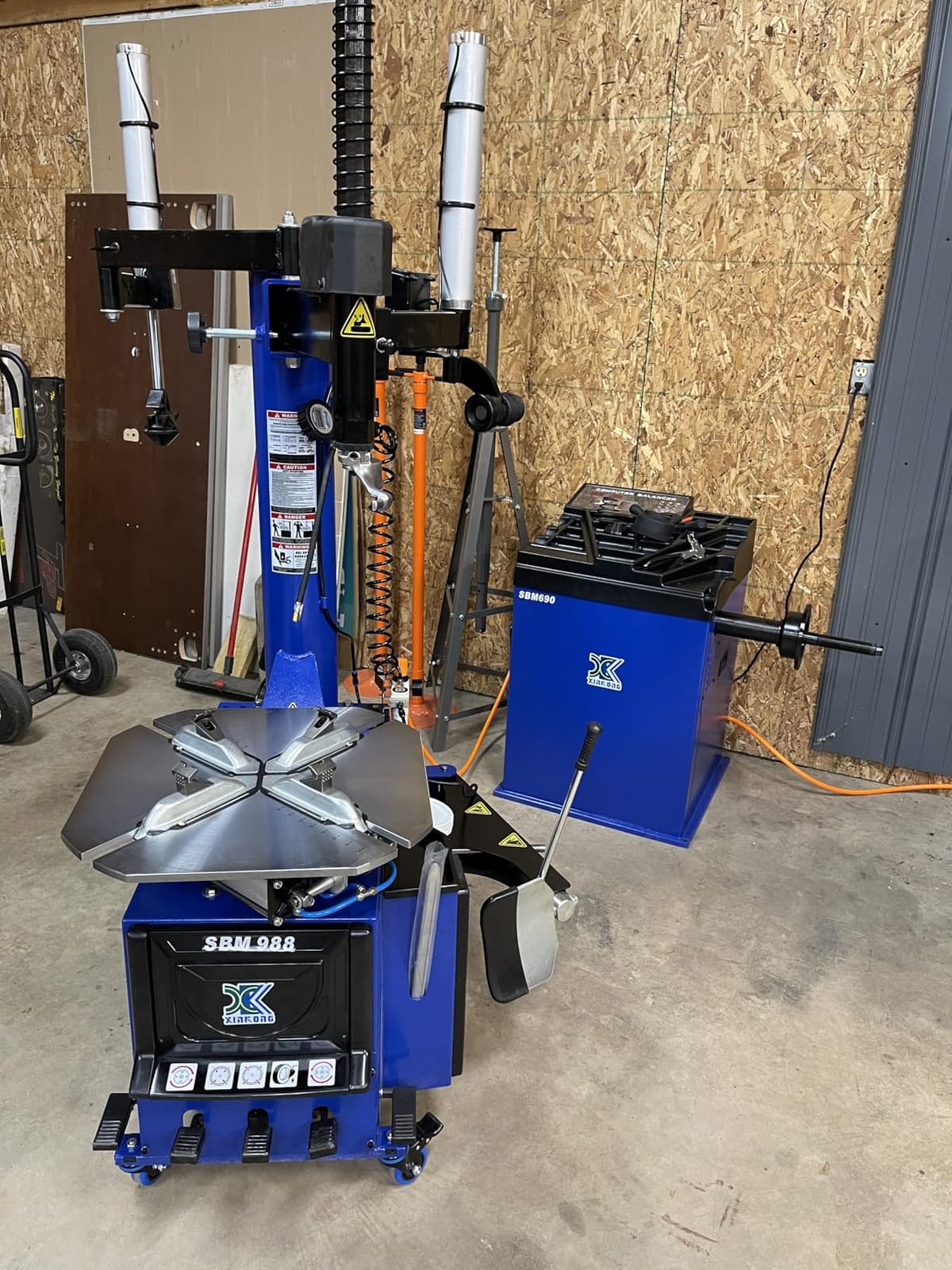
This is the machine we kept coming back to. The XK 988-690 carries more owner reports than any other package in this roundup, and when we read through them the tone is remarkably consistent: the machines do the job, the seller answers, and the weak points are all consumable or documentation related. That is exactly the profile you want from a machine you will own for a decade.
The changer runs a 2.0 HP motor on 110V and clamps from 12 to 20 inches on the outside and 12 to 24 inches inside, with a stated 41-inch maximum tire diameter and 2500 kgf bead-breaking force. The bead blaster is supplied from the machine’s own power supply rather than sold as a bolt-on, which matters more than it sounds: on many cheaper packages the blaster arrives as an afterthought with a fitting nobody stocked.
The 690 balancer is where this package quietly outclasses the entry tier. It measures to minus 1 gram to plus 1 gram, spins a full cycle in four to seven seconds, handles rims from 10 to 24 inches and widths from 1.5 to 20 inches, and carries dynamic, static, ALU 1-3 and motorcycle modes. Owners mention calibrating it quickly once they understand it wants a steel wheel for the calibration pass.
Two things to plan for before this machine lands in your bay. The air consumption is genuinely high, so a small compressor will leave you waiting on every tire, and the duck head is a wear item that some owners replace within a couple of years. Neither is a dealbreaker; both are cheaper to plan for than to discover.
When this combo makes sense
It makes sense when you want one purchase to cover a wide mix of wheel sizes and you value replacement parts over polish. The dual assist arms are repeatedly credited with taking the effort out of low-profile and stretched fitments, and the accuracy is fine enough to confirm a vibration belongs to the vehicle rather than the wheel. Owners running seasonal swaps on work trucks report the payback quickly.
When you should pick something else
Pick something else if your tire mix is dominated by 20-inch-plus custom wheels and you care deeply about finish quality, or if your air supply is marginal. The clamping range tops out at 20 inches outside, so a large-diameter wheel is outside this machine’s comfort zone. The instructions are also poor enough that budget a day of setup and calibration work before you plan your first paying job.
2. Mayflower 980 and 800 Combo – Built for Oversize Tire Capacity
Mayflower – 1.5 HP Tire Changer Wheel Changers Balancer Machine Combo 980 800 Red Edition / 1 Year Full Warranty
49 in max tire diameter
13 in max wheel width
13-24 in outside clamping
800 balancer to 155 lb
Pros
- Handles 49 inch tires and 13 inch widths without struggle
- Build quality compares well against far pricier brands
- Crate and pallet packaging survives freight
- Handles wide rear tires on modified cars
Cons
- Assist arm is a separate purchase
- Non-standard 1/4 NPT air fitting needs modification
- Balancer instructions are confusing
- Phone support often reaches only a recording
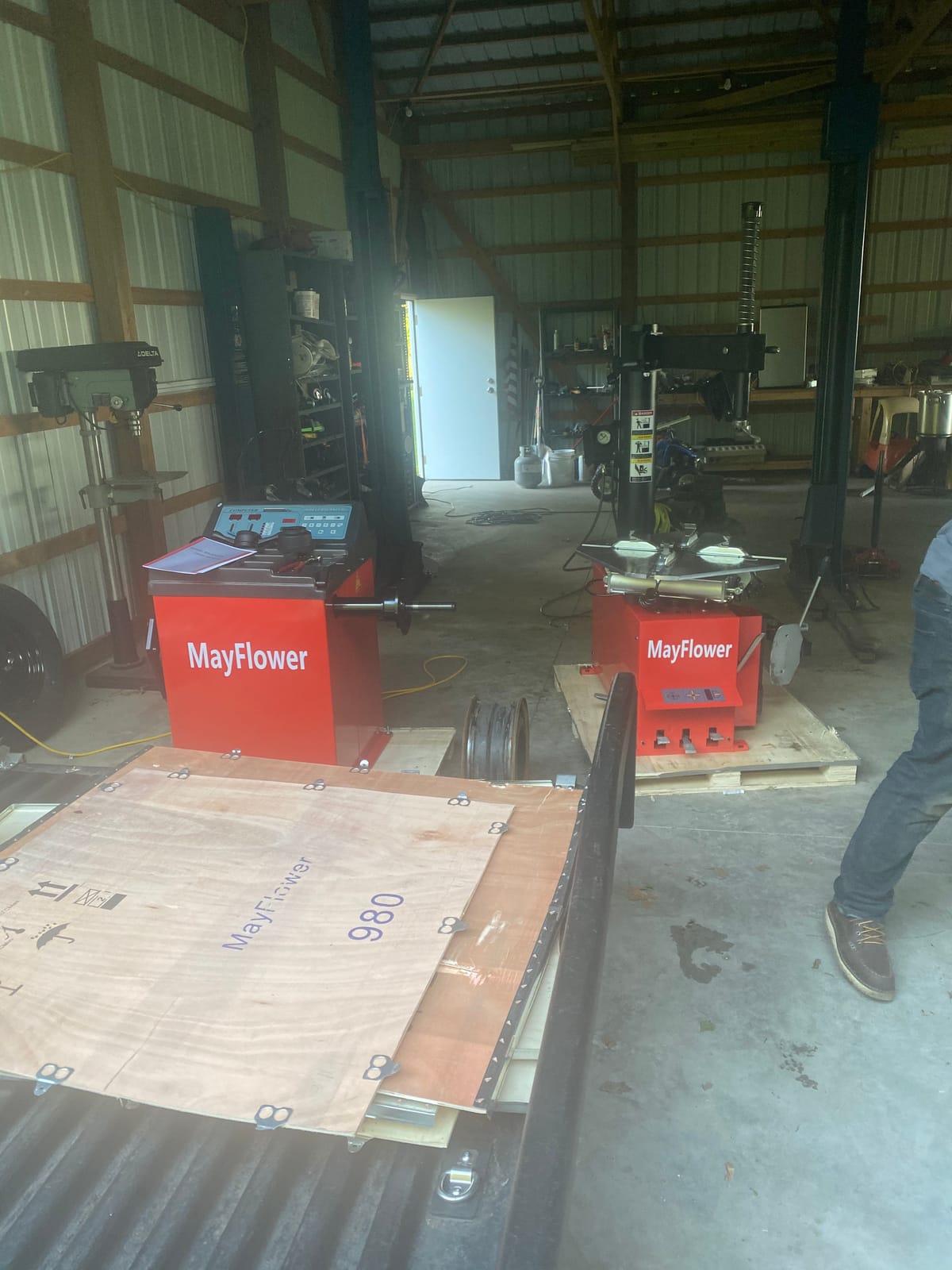
The Mayflower pair is the capacity outlier in this list. The 980 changer states a 49-inch maximum tire diameter, a 13-inch maximum wheel width and inside clamping out to 28 inches, and that is headroom nothing else here approaches. If your work involves tall sidewalls, big rear rubber or anything that would strain a 41-inch ceiling, this is the machine built for it.
Owners with shop experience repeatedly compare the build favorably against far more expensive brands, and the 800 balancer covering 10 to 24 inch rims at up to 155 pounds is a sensible match. One enthusiast with wide rear tires on a drag car reports it handles them without drama, which is precisely the use case that separates this from the rest.
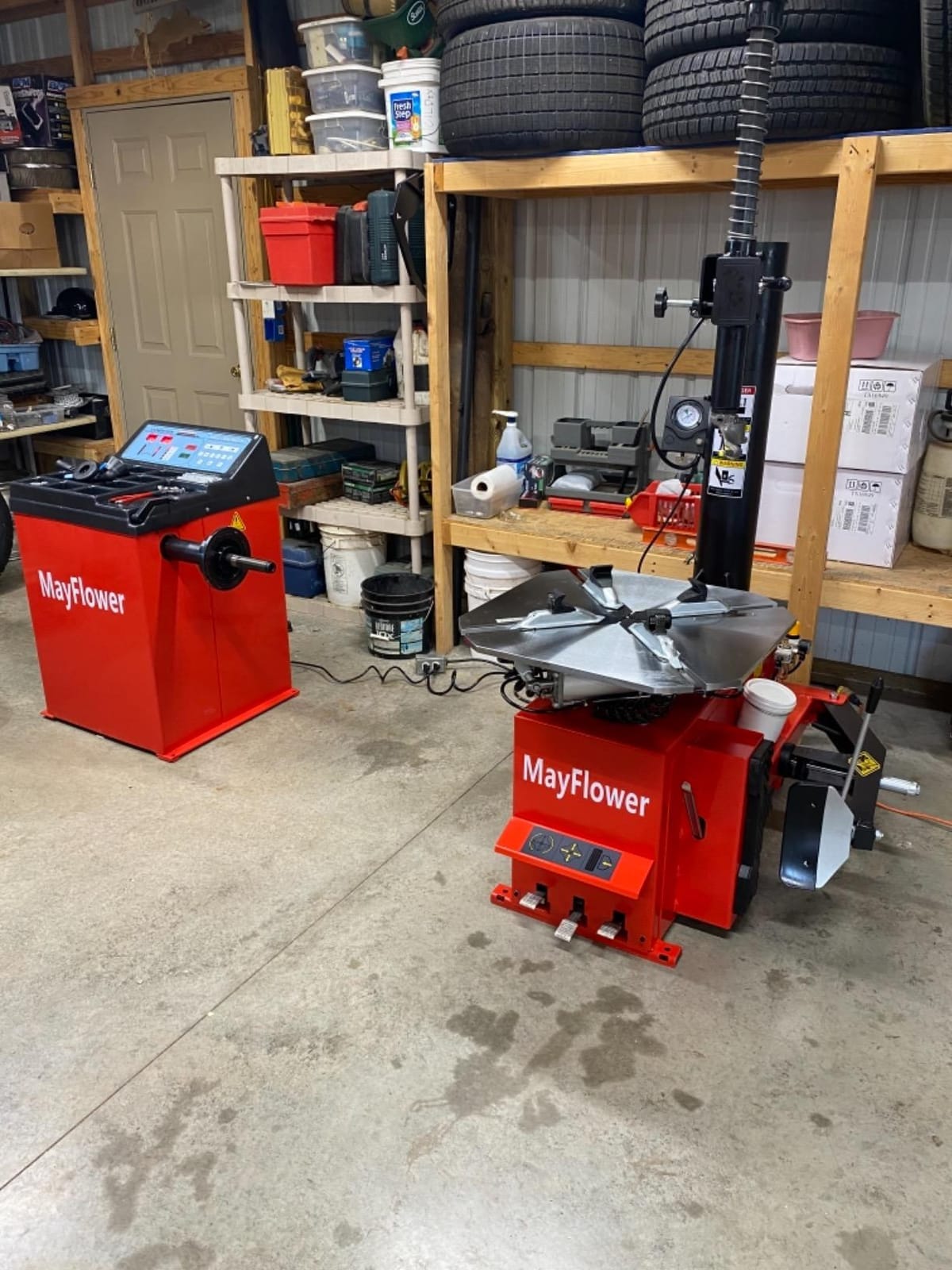
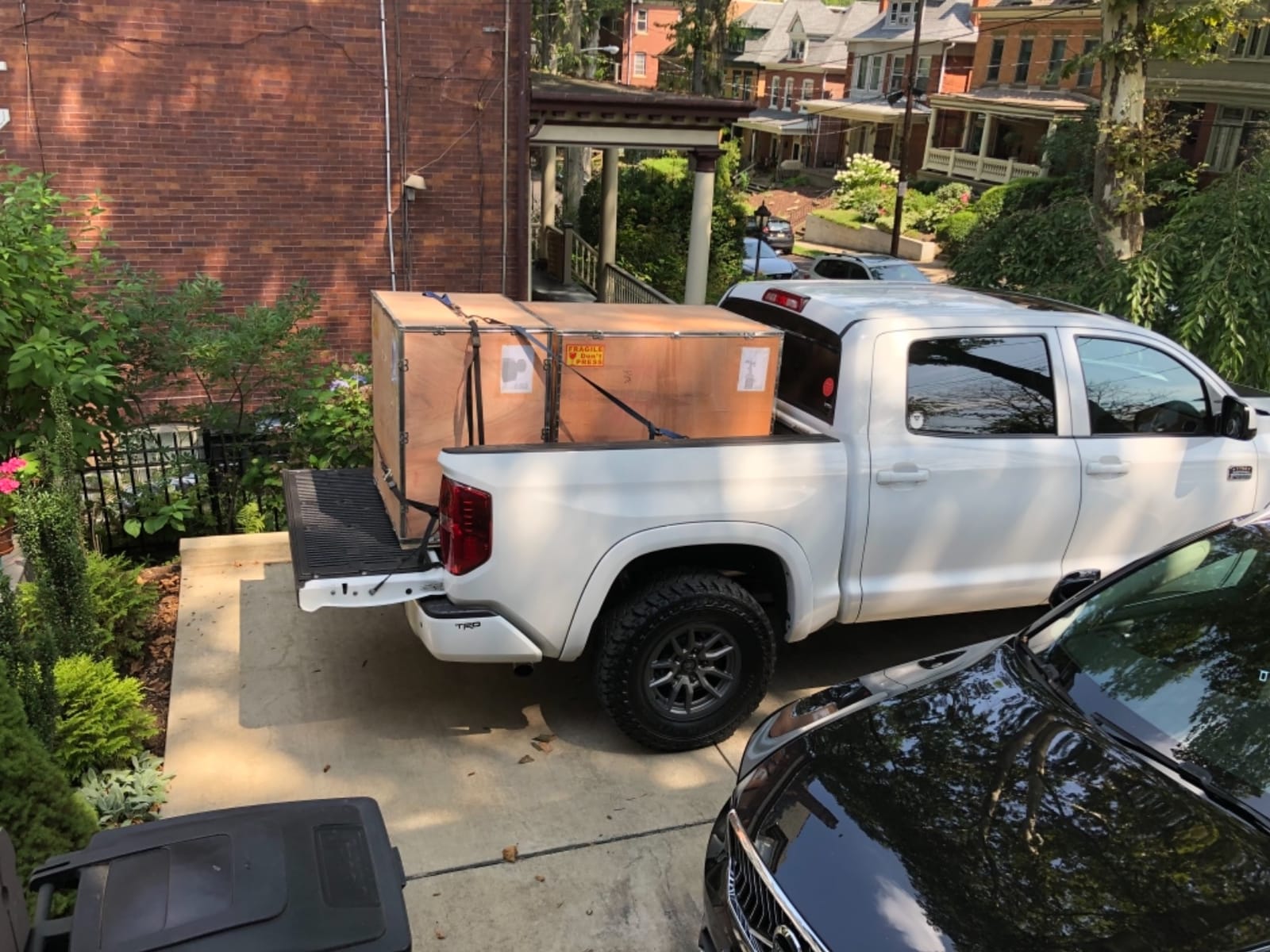
Shipping is handled better than most. Crate and pallet packaging protects both machines, and carriers deliver into the garage with a lift gate at no charge. That matters more than it sounds for a pair weighing roughly 500 pounds for the changer and 250 pounds for the balancer, and it is the detail that separates a supplier who ships machines from one who ships freight.
The frustration point is the assist arm, which is not in the box and costs more when added later than it would have if included up front. Budget for it in your planning, along with a small air fitting change, because the supplied 1/4 NPT size is non-standard for automotive work.
Where this package earns its keep
It is the pick for a small independent shop that also handles trucks, trailers and modified street cars. The 49-inch capacity means you are not declining work because the tire will not fit, and the 4.5 rating across 49 reviews is the second-strongest in the set. A tire shop doing about five jobs a day, the profile owners on r/mechanics describe, would feel this machine’s limits least.
Where it falls short
The gap is support and ergonomics rather than capability. The assist arm being an add-on is a real ergonomic hit, and a customer service line that only reaches a recording makes a diagnosis of a strange balancer behavior harder than it needs to be. If you work alone on low-profile tires all day, factor in the missing arm and the poor documentation before you commit.
3. KATOOL KT-T830 and KT-B700 Combo – Twin Assist Arms for Low-Profile Work
KATOOL 2.0HP Tire Changer Bead Blaster Wheel Balancer Machine Combo KT-T830+KT-B700 Tire Changer Machine Tire Machine, Outside clamp 12-24″ Inside clamp14–26″ with φ8 Inch Cylinder
Twin hydraulic assist arms
12-24 in outside and 14-26 in inside clamping
Carburized alloy jaws
Closed body design
Pros
- Twin hydraulic assist arms make run-flats manageable
- Covers 10 inch stretched to 22 inch and 35 inch truck work
- Rigidity comparable to far costlier name brands
- Lift gate delivery arranged by the seller
Cons
- Almost no assembly documentation
- No reachable support line if a machine arrives damaged
- Industrial air regulator fitting may need swapping
If your day is spent on low-profile and run-flat rubber, the assist arms decide everything, and this is the package where they are standard rather than an accessory. Twin hydraulic assist arms take the vertical force out of the mounting head, which is exactly the force that breaks beads and tires when a machine has to be leaned on.
The changer clamps 12 to 24 inches on the outside and 14 to 26 inches inside, and the jaw treatment is unusually thoughtful for this tier: alloy steel with 0.8 to 1.1 mm carburized and fully quenched interfaces, plus soft jaw covers specifically to protect alloy and custom rims. The stainless steel mounting head carries a protective plastic cover, and the fully closed body keeps shop grit out of the moving parts.
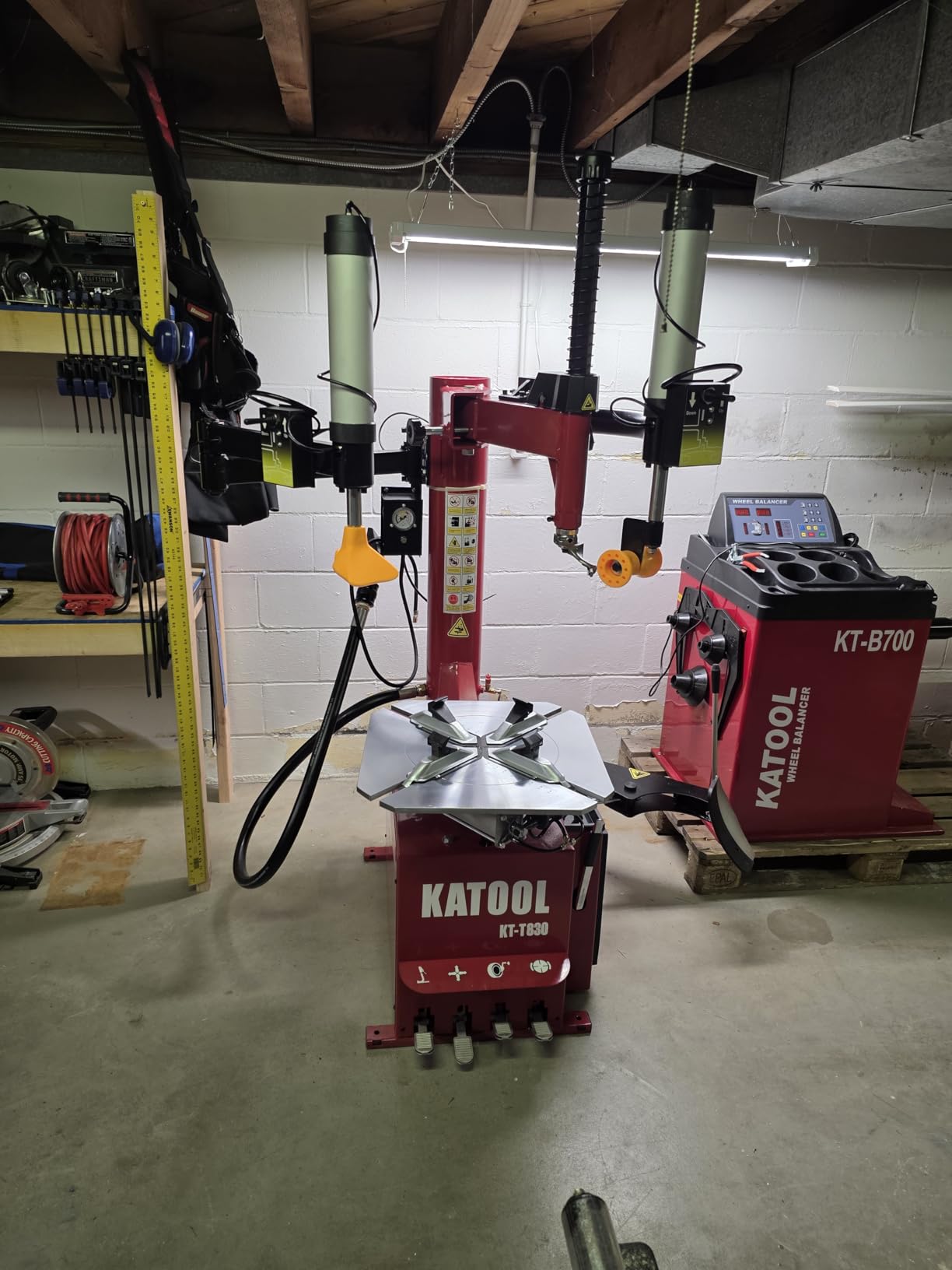
Owners report mounting and balancing everything from 10-inch stretched wheels through 22-inch rims to 35-inch truck tires without leaving vibration, and several say the accuracy was good enough to prove a road-test shimmy was the vehicle rather than the wheel. That is a meaningful claim, because most complaints about cheap balancers are really complaints about resolution.
The weak spot is ownership experience rather than performance. Assembly documentation is essentially absent, so plan on working from walkthrough videos, and there is no technical support line if something arrives damaged. Tighten the regulator fitting for your compressor before first use and you will avoid the other common complaint.
Who this combo suits
It suits a working shop whose reputation depends on not damaging customer wheels. The soft jaw covers, the protected mounting head and the assist arms are the trio that separates a machine you can point at an expensive alloy from one you would never dare. Several owners describe it paying for itself within weeks, which is a reasonable expectation for a shop doing steady low-profile volume.
Who should look elsewhere
Look elsewhere if you are buying for a home garage and cannot justify the effort of learning a hydraulic-assist machine, or if you need a support line that a human answers. The video-based assembly process is a poor fit for a first-time owner working alone, and the documentation gap means your first service call has no reference material to consult.
4. KATOOL ME-T500 and ME-B620 Combo – the Simplest Shop Setup
KATOOL ME-T500 2.0HP Tire Changer Machine with 24”Turn Table and ME-B620 Wheel Balancer Machine Tire Repair Wheel Changers Combo Garage Equipment (ME-T500 & ME-B620)
24 in turn table
12-22 in outside clamping
Self-calibrating balancer
Three cast steel pedals
Pros
- 2.0 HP motor mounts and dismounts without stalling
- Turn table gives generous working clearance
- Balancer self-calibrates with double-sided calibration
- Very strong value at the entry point
Cons
- No bead blaster on the changer
- Low-profile and mud-terrain removal hits wheel size limits
- Balancer documentation is hard to follow
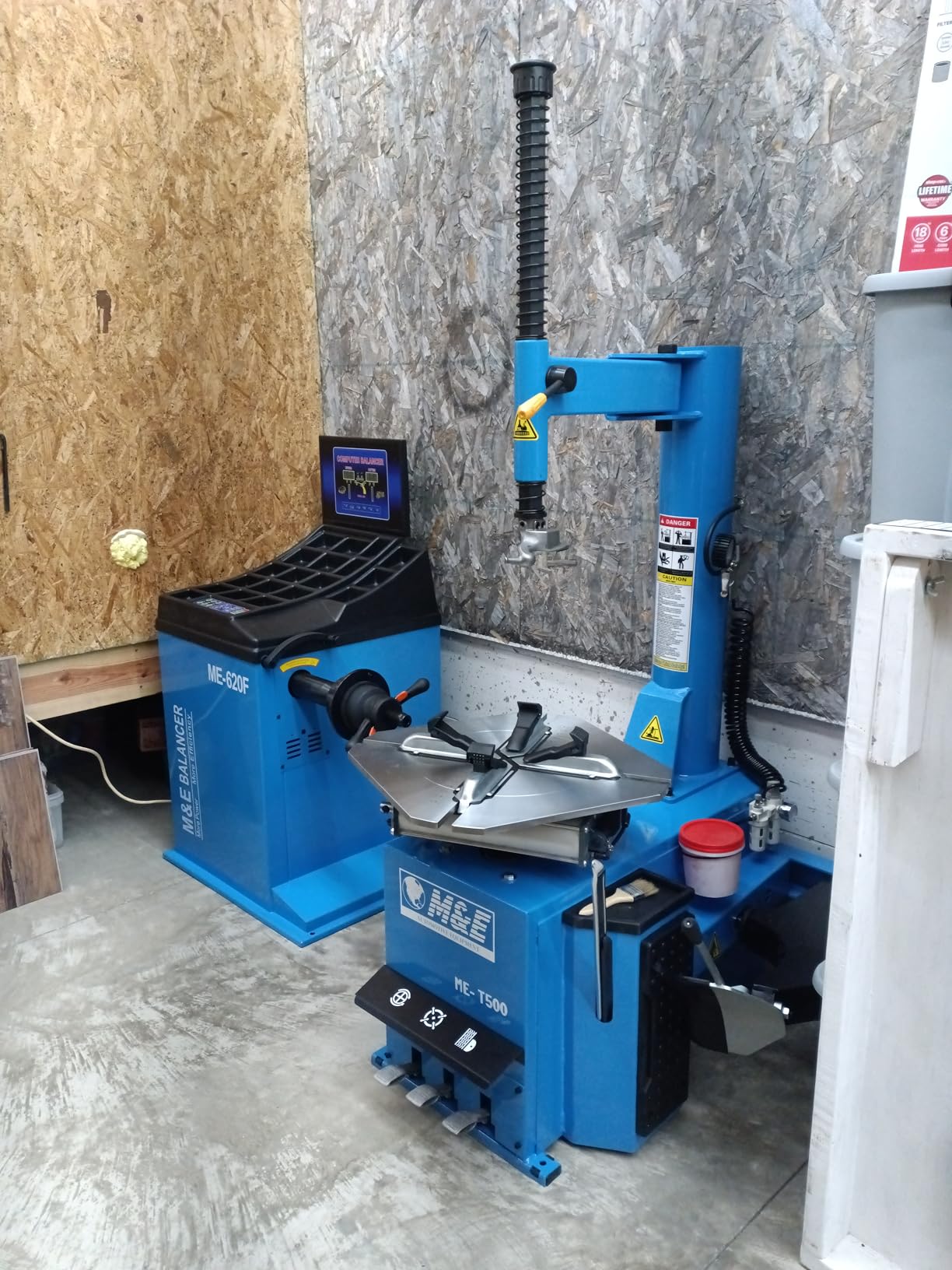
This is the least complicated package here, and for a first-time shop owner that simplicity is the whole point. The ME-T500 uses a 24-inch turn table, which is larger than most machines in this price bracket, and the center auxiliary arm design creates extra clearance in front of the machine so you are not working around the structure.
The ME-B620 balancer is worth calling out for one specific feature: built-in fault diagnosis and self-calibration, with double-sided calibration that removes the need to memorize parameters. For an operator who has never balanced before, that is a bigger deal than raw gram resolution, because the machine walks you through it.
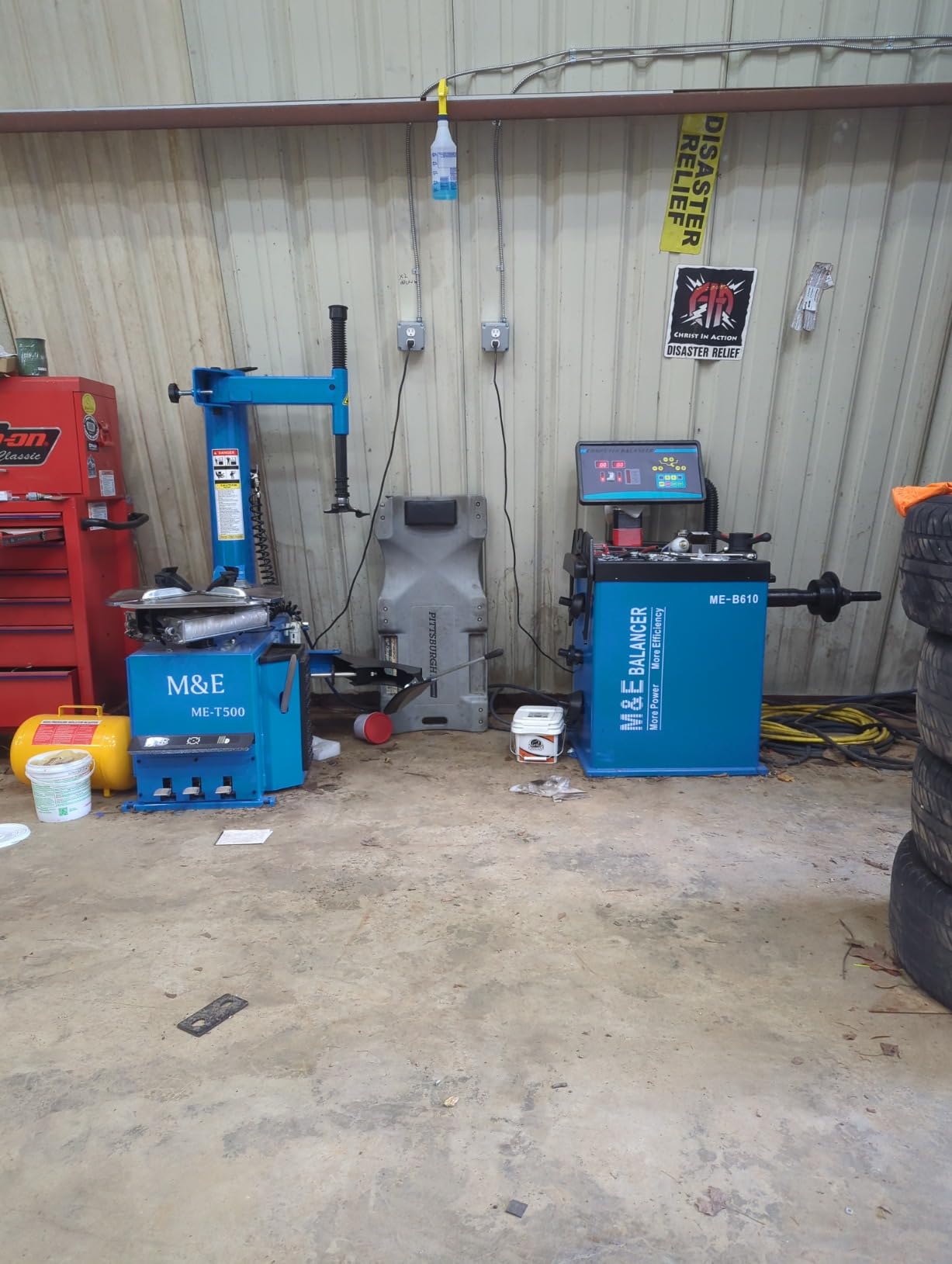
Three cast steel pedals and a 2.0 HP motor make for a durable combination, and owners report the motor having ample power to mount and dismount without stalling. Experienced operators get 22-inch rims and tires up to 38 inches handled, and the balancer covers 10 to 24 inch rims at 1.5 to 20 inch widths.
Know the limits before you buy. There is no bead blaster on the changer, so you are relying on the tire’s own stiffness and a bead breaker alone. Owners also report the wheel size limits can block removal of low-profile and mud-terrain tires without risking damage, and the 4.1 rating reflects real complaints about build quality sitting alongside enthusiastic repeat-shop reviews.
Best fit for a new shop
This suits a shop that wants a reliable, uncomplicated second bay and works mostly on standard passenger fitments. The turn table clearance and the self-calibrating balancer reduce both physical strain and learning time, and the value at the entry point is hard to argue with. A hobbyist moving from manual balance-and-rotate appointments to a proper machine gets the most from it.
Where it will frustrate you
It will frustrate you the moment your tire mix shifts toward 40-series and larger, or off-road mud-terrain rubber where the bead is hard to break and the rim edge is easy to scar. Without a bead blaster you are doing that work on tire stiffness alone. For a shop that already handles run-flats, step up to the twin-assist package instead.
5. KATOOL KT-T835 and KT-B750 Combo – Laser-Guided Balancing
KATOOL KT-T835 Tire Changer Machine 2.0HP Bead Blaster and KT-B750 Wheel Balancer Machine Automatic Measurement Ruler Laser Guide Tire Repair Wheel Changers Combo
2.0 HP changer with bead blaster
Double-side assist arms
Laser guide balancer
12 month parts warranty
Pros
- Bead blaster and double-side assist arms in the base package
- Laser guide speeds up weight placement on alloy wheels
- Automatic measurement ruler cuts setup time
- Pull-type pedal system is simple to service
Cons
- Balancer hood will not close on 20 inch wheels
- Effective wheel diameter is smaller than stated
- Very thin review base for a size claim
The KT-T835 and KT-B750 pair is the one in this roundup where the balancer gets real attention rather than a cameo. The automatic measurement ruler and laser guide speed up the two slowest parts of balancing, which are measuring the rim by hand and working out where the weight actually goes. On a busy afternoon that difference compounds.
The changer is not a step down, either. It runs a 2.0 HP motor with a bead blaster built around a stainless steel bead breaker cylinder and post tank, double-side assist arms, and a pedal-controlled inflation gauge with a spade cover that sits between the tool and the rim. The closed body design shields internals, and the pull-type pedal system is straightforward to maintain.
The warranty is the strongest written commitment in this group: 12 months on all parts for both machines, rather than a single blanket year. Published weight is 661 pounds with package dimensions of 46 by 34 by 33 inches, which is useful when you are checking whether it fits the bay before the pallet arrives.
There is one documented fitment problem, and it is worth taking seriously. Owners report the balancer hood does not fully close on 20-inch wheels despite the stated maximum diameter, so the effective ceiling on the hooded balancer is lower than the box claims. If large-diameter balancing is central to your work, size up before you commit.
When the laser guide pays for itself
It pays for itself on alloy and multi-spoke wheels where hidden weight placement is required anyway. Owners using the ALU-style workflow report that the ruler and laser cut the measurement and placement steps considerably, and for a shop that balances many styled wheels a day this is the feature that reduces labor rather than adding capability. The assist arms and bead blaster in the changer make the pair a coherent set.
When the evidence is too thin
Only a handful of owner reports exist for this set, so treat the 4.5 rating as promising rather than proven. The 20-inch hood issue is the concrete caution, and it is the kind of fitment limit that would be expensive to discover after installation. If you have a heavy custom-wheel workload, a machine with a confirmed large-diameter envelope is the safer buy.
6. BILT HARD 2.0 HP Swing Arm Combo – the Lowest Entry Point
BILT Hard 110V 2.0HP Tire Changer Machine and Wheel Balancer Combo Rim Clamp, Tire Changer with Swing Arm and Tire Balancing Machine for Shop, Garage
2.0 HP 110V changer
12-24 in rim range
Balancer to 28 in rims
4 ALU modes
Pros
- Widest balancer rim coverage in the group at 10-28 inches
- Both machines run on standard 110V outlets
- Crated packaging arrives intact
- Support described as responsive and attentive
Cons
- Duck head plastic inserts do not stay on
- Swing arm flexes into rims on larger tires
- Bead breaker arm is too short for big fitments
- Setup advice from support was unhelpful
The BILT HARD combo exists for one reason, and it does that reason well: it is the point of entry. Both machines run on standard 110V at 60Hz, the changer is a 2.0 HP swing-arm design handling 12 to 24 inch rims and tires up to 39.4 inches, and the setup is straightforward enough that a first-time owner can get a working bay in a weekend.
Its balancer is genuinely overspecced for the tier. It covers 10 to 28 inch rim diameters and 1.5 to 18 inch widths, runs a 250W motor rated at 70 dB, and offers four ALU modes alongside dynamic and static balancing with manual A and D value entry. Wider alloy coverage than machines costing several times more is not a marketing trick here; the spec sheet holds up.
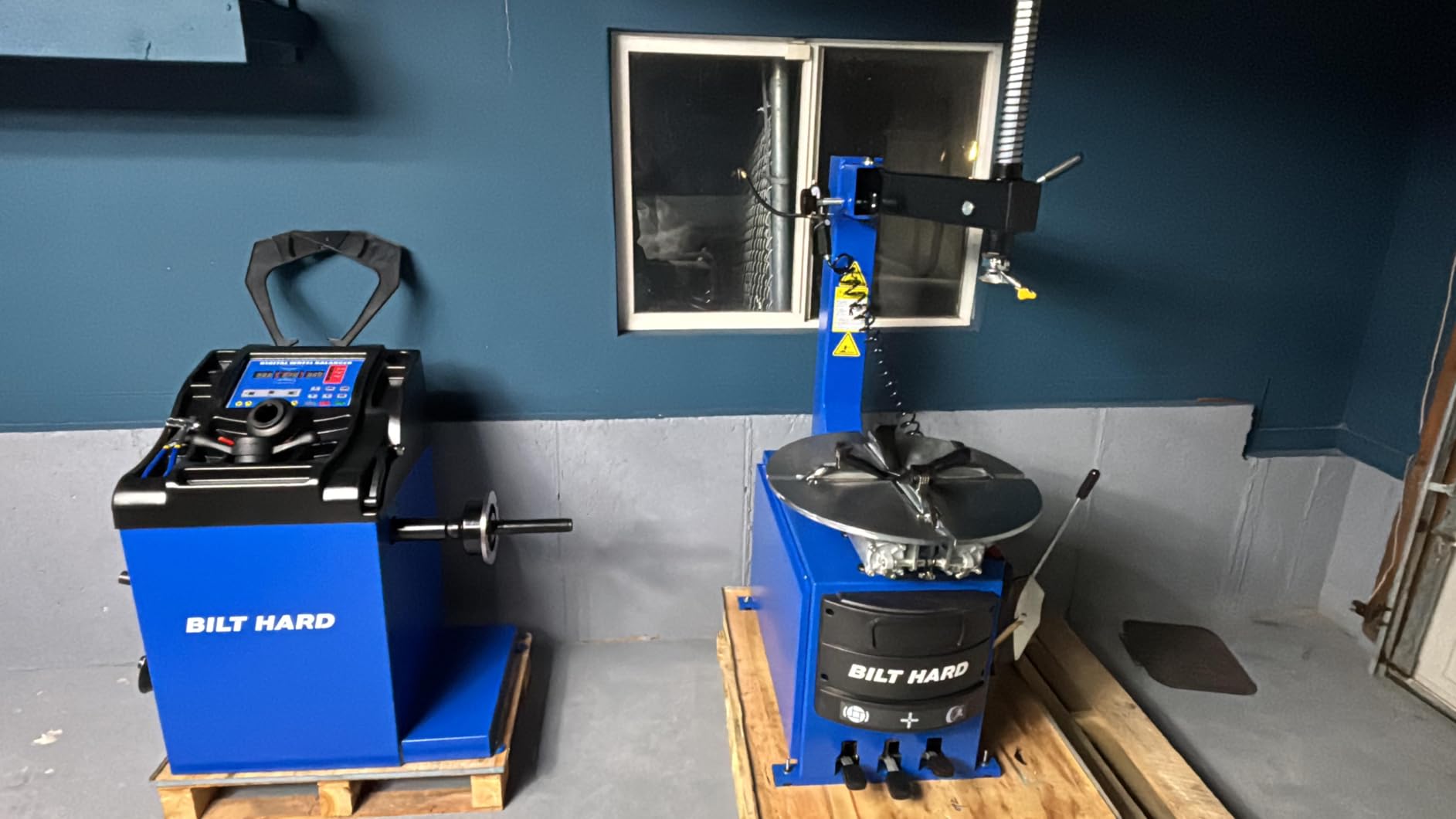
Owners like the delivery. Crated packaging arrives undamaged, the protected mount and demount head helps guard rims, and support is described as responsive and attentive. For anyone who has spent years hauling tires to a shop, the convenience of owning the pair is the real payoff and several report it paying back quickly.
The criticisms are all about the cheap end of the machine, and they are consistent. The duck head plastic inserts do not stay on, the swing arm flexes into rims on larger tires, and the bead breaker arm is short for big fitments with no extendable arm option available. Small tires are fine. Big and stiff tires are where the flex shows.
Who this package is for
It is for a homeowner or a very small shop working standard passenger tires and alloy wheels up to the mid-20s. The 110V draw on both machines means you do not need an electrician, the balancer’s ALU modes handle hidden weights on styled rims, and the 10 bar bead break covers everyday mounting. It is a sensible first machine rather than a final one.
Why a shop should size up
A working shop should move up because rigidity is the failure mode that shows up as damaged rims, and a flexing swing arm on a 22-inch tire is exactly the situation where a customer notices. If your work is volume-based rather than hobby-based, spend the difference on a machine with assist arms and a rigid arm structure. The support experience, unfortunately, is the other reason to look elsewhere.
7. TRIUMPH NTC-950 and NTB-550 Combo – the Widest Clamping Range
TRIUMPH NTC-950 and NTB-550 Tire Changer Wheel Balancer Combo Package
13-26 in outside clamping
15-28 in inside clamping
15 in max wheel width
43 in max tire diameter
Pros
- Widest clamping range of any pick in the roundup
- Handles 43 inch tires and 15 inch wheel widths
- Balancer accepts 1.5 to 20 inch rim widths
- Highest average rating in the set with no low ratings
Cons
- Thin owner feedback for the size of the machine
- Highest cost in the roundup
The TRIUMPH bundle is the one to look at if the word truck appears anywhere in your job description. Inside clamping runs 15 to 28 inches and outside clamping 13 to 26 inches, with a 15-inch maximum wheel width and 43-inch maximum tire diameter. Nothing else in this roundup combines a tall tire ceiling with a genuinely wide wheel.
It also carries the strongest review profile we found: a 4.8 average with no one-star or two-star ratings reported at all, roughly 84 percent five-star and 16 percent four-star. That is not a substitute for a long owner record, but in a category where high-end machines often show no ratings whatsoever, a clean sheet is worth something.
Why the range matters more than the rating
The capacity is the real argument. A shop that runs pickups and light-truck fitments on a daily basis will spend its life inside a machine’s limits on lesser packages, and every out-of-scope tire is a declined job or a workaround. The balancer accepting 1.5 to 20 inch rim widths matches that truck emphasis rather than leaning toward passenger-car widths.
What the evidence does not tell you
Only 36 reviews exist, so the capacity specifications are doing nearly all the evaluating here and owner commentary is thin. The package also sits at the top of this roundup’s cost range with no published weight or footprint, which makes bay planning harder. Ask for the dimensions and the circuit requirement before you commit, because a 43-inch tire machine is not a compact purchase.
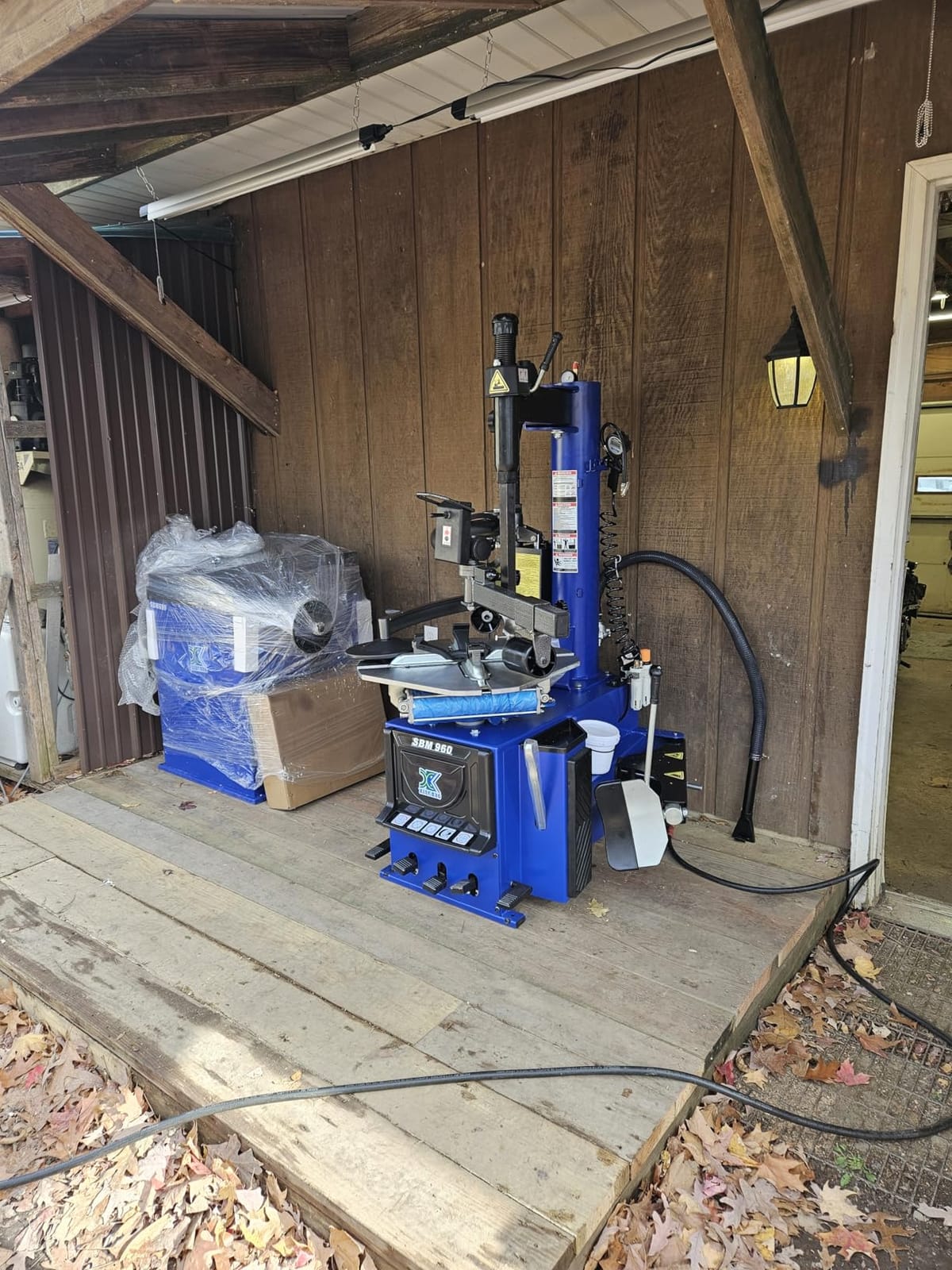
8. XK 960-690 Combo – 5,600 lb Bead Breaking for Truck Tires
XK Tire Machine and Balancer Combo 37 in,110V,2.0HP,960-690
5,600 lb pneumatic bead break
Professional assist arm
1 gram balancer accuracy
110V operation
Pros
- Experienced shop owners call it the best value in the discount category
- Handles 37 inch class and F550 tow truck tires
- Assist arms hold large tires securely
- Assembles simply with easy delivery scheduling
Cons
- Supplied air hose and gauge are low quality
- Table rotation is stiff when new
- No assembly instructions included
- Balancer calibration needs a steel rim
The XK 960-690 is our value pick because it does the one thing the cheaper packages in this roundup mostly avoid, which is real bead-breaking force. The pneumatic piston breaker is rated at 5,600 pounds and runs at 8 to 10 bar, and the assist arms are described as professional-grade rather than as a convenience add-on.
That combination is why owners with shop experience keep calling it the best value in the discount tire machine category. It has worked on 37-inch-class tires and F550 tow truck rubber without trouble, and one shop reports steady weekly use with no failures. The 690 balancer again delivers minus 1 gram to plus 1 gram accuracy with dynamic, static, ALU 1-3 and motorcycle modes and three centering cones.
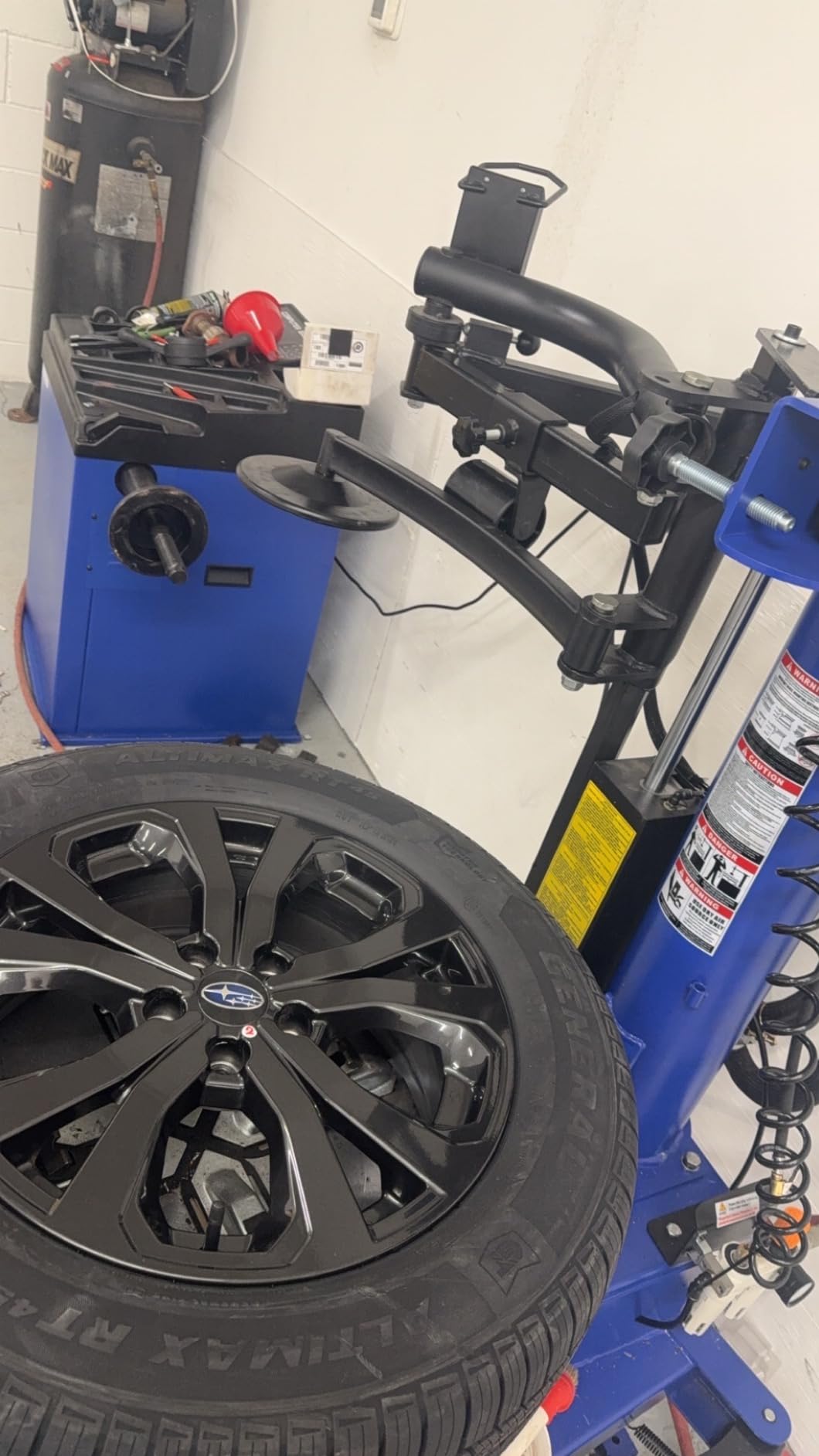
Assembly is simpler than most in this class and delivery scheduling is straightforward. A heavy package of roughly 880 pounds arrives on casters and moves with two people, so plan the route into the bay before it shows up rather than after. The clamp coverage is 10 to 20 inches outside and 12 to 24 inches inside, which is narrower than the TRIUMPH at the top end.
The accessories are where the money was saved. The supplied air hose and digital gauge are cheap and the gauge reads a few psi off, and the table rotation is stiff on arrival until it is worked in. Calibration of the balancer needs a steel rim and an understanding of the calibration weight process, so buy a scrap steel wheel before the first week ends.
Where the value argument holds
It holds when the alternative is a machine with a plastic duck head and no assist arms. For a shop or a serious hobbyist that regularly mounts stiff, tall or load-range tires, the assist arms plus 5,600 pounds of break force is the difference between a fight and a job. A 4.4 average across 51 owner reports is also the second-deepest evidence base here.
Where you trade away something
You trade away refinement and support. There are no assembly instructions, so you will be documenting your own build, and the air accessories that come in the box are the first things to replace. The clamping range also stops at 20 inches outside, so a shop leaning heavily on 21-inch-plus wheels should look at the wider-clamping packages instead.
How to Choose a Tire Changer and Balancer Combo
Most buyers pick the wrong machine by choosing on motor horsepower alone. Horsepower tells you whether the changer will stall; it says nothing about whether it will damage the rim, whether your tires fit, or whether your bay can power it. Work through the seven questions below in order and the product choice makes itself.
Swing arm or tilt back: the geometry decision that drives everything else
A swing-arm changer swings the mounting head in from the side, and the arm’s rigidity is what keeps the tool from deflecting into a wide rim. A tilt-back machine lays the wheel flat and swings the whole arm assembly back, which frees up horizontal space and tends to be gentler on wide fitments because the head approaches the bead at a better angle. Every machine in this roundup is a swing-arm design with a rim clamp, so you are choosing within one geometry, and the differentiator becomes arm stiffness. That is exactly where the BILT HARD set draws its critical reviews.
Rim clamping range and tire capacity
Clamping range is stated as two numbers, outside and inside, and they mean different things. Outside clamping is where the tire is held from the rim’s outer face, inside clamping holds from the inner face; a machine with a narrow outside range cannot safely handle the wide, stiff tires that need it most. Read the tire diameter and wheel width figures too, because a changer with a 12 to 20 inch outside range is a passenger-car machine even when the tire diameter sounds large. For mixed truck work, the widest inside range in this group is 15 to 28 inches.
Balancer accuracy tiers and balance modes
Entry balancers measure in ounces, mid tiers measure in grams, and the machines here run from roughly minus 1 gram to plus 1 gram up to plus 10 grams. A 1-gram machine is not overkill for a home user; it is simply what separates a vibration caused by the wheel from one caused by the vehicle. Modes matter as much as resolution: dynamic mode handles road imbalance, static mode corrects residual imbalance, and ALU modes let you place weights inside a rim where the spoke openings hide them. Motorcycle mode is worth having if you service bikes. One caveat worth naming: if the vibration you are chasing sits in the driveline rather than the wheel, no balancer will fix it, and the specialists we looked at for harmonic balancer installation handle that different fault entirely.
Bead blaster, assist arms and bead-seal safety
A bead blaster fires a burst of air at the tire bead to break it away from the rim, and a tire without one depends on the tire’s own stiffness and a long lever. That works for conventional passenger tires and fails on run-flats and stiff sidewalls. Assist arms take the vertical load off the mounting head, which is the other half of bead-seal safety: most tire damage comes from a tool being forced rather than a breaker being underpowered. TPMS break and reseal capability is worth asking about separately, because a professional shop cannot skip it.
Power, air supply and bay footprint
Every machine here runs on single-phase power, and most are 110V at 60Hz, which removes the electrician from the decision. Air supply is the requirement people underestimate. The XK 988 draws heavily enough that owners recommend a compressor of roughly 60 gallons or more, and several packages ship an industrial regulator fitting that needs swapping for an automotive-style connection. Check package dimensions before ordering, not after, and leave working clearance in front of the changer.
Warranty, parts support and total cost of ownership
Warranty length in this category is a weak signal; one year is common and only one package here offers 12 months on all parts. Parts support matters far more over a ten-year life, and the one product in this roundup whose owners describe replacement parts being sent out at no cost is also the one with the deepest review history. Total cost of ownership runs through tape and clip weights, calibration steel wheels, duck heads, air accessories and eventual resale, and a machine with a dealer network keeps more of its value.
New, used or imported: which one suits your situation
New is right when you will use the machine weekly and cannot absorb downtime, because a failed component on a two-year-old imported unit can end the machine’s life with no recourse. Used is defensible for a home shop learning on standard passenger tires, and inspection is straightforward: check the duck head and mounting head for wear, verify the table rotates smoothly in both directions, confirm the bead breaker holds pressure, and make sure the balancer calibrates to a known weight. Import marketplaces are the risky end, and the anxiety owners voice on tire forums about a single dead component ending the machine’s life is not hypothetical. Freight damage is real too, and machine orders are heavy enough that crated, palletized delivery is worth paying for.
Who should skip the combo entirely
If you already own a changer and it performs, a standalone balancer is the sensible purchase, and you may find a better machine for the same money. If you balance only a handful of wheels a year, a portable wheel balancer for a home shop is a fraction of the commitment. And if you buy tires from a retailer that balances and rotates for free, the arithmetic changes completely. The forum consensus on all three points is that owning equipment is about control and turnaround time, not about saving money per tire.
Frequently Asked Questions
What is the best tire changer and balancer combo for the money?
For most buyers the XK 988-690 is the strongest overall package in our testing: a 2.0 HP 110V changer with dual assist arms and an included bead blaster paired with a 690 balancer that measures to minus 1 gram to plus 1 gram across dynamic, static, ALU 1-3 and motorcycle modes. It also has the deepest owner history of any pick, with 118 reviews. If your tire mix includes tall truck rubber, the Mayflower 980 and 800 pair offers far more tire capacity. If you are working strictly on standard passenger wheels and want the lowest entry point, the BILT HARD set covers 10 to 28 inch rims on the balancer for less.
Is the Harbor Freight tire changer any good?
None of the eight packages we analyzed is sold under that name, so we cannot give you owner data for it. What we can say is that the budget end of this category is genuinely crowded, and the closest equivalent in our testing is the BILT HARD 2.0 HP swing-arm combo, which runs on 110V and covers a wide balancer rim range. Its documented weaknesses are a cheaply made duck head and a swing arm that flexes into rims on larger tires, which is the reason we recommend sizing up for anything bigger than standard passenger fitments.
What are the top brands of tire changers?
At the professional end you will see names like Coats, Dunlop, Hofmann and Hunter Tuxedo, and those machines carry the cycle times and after-sales networks that high-volume shops depend on. In the mid tier, Atlas, Apex, Torin Jacks, BendPak, JA Auto Tech and KATOOL cover most of the practical range and account for most of the packages on the current search results. At the budget tier you will find BILT HARD, Bilt Hard bundles, generic XK units and the assorted import-marketplace machines, where parts support is the real question rather than price.
What type of tire balancer provides the best ride quality?
Ride quality comes down to two things: measurement resolution and correct correction for the wheel you are balancing. A machine that measures to about 1 gram, offers static and dynamic modes, and includes ALU modes for hiding weights inside alloy rims will produce smoother results than a coarse entry-level unit. The three XK packages and the KATOOL laser-guided balancer in this roundup all meet that bar, with cycle times between four and nine seconds.
What is the best tire changing machine?
There is no single answer, because the right machine depends on your volume and your wheel mix. A home garage doing seasonal swaps is well served by a 110V swing-arm machine with assist arms and a bead blaster. A small shop doing about five tire jobs a day needs the same assist arms plus a wider clamping range for trucks. A high-volume shop needs cycle time and cycle reliability above all. If most of your work is low-profile or run-flat rubber, put assist arms at the top of the list before anything else.
Do Centramatic balancers really work?
They do, with one important limitation. Centramatic balancing uses a non-contact sensor to detect imbalance as the wheel spins, which is fast and accurate on common passenger wheels and avoids the calibration steel wheel that many digital balancers require. What it cannot correct is runout caused by a bent rim or a tire that is out of round, because the machine measures the wheel and not the geometry defect. None of the eight combos in this roundup uses a centramatic sensor, so if that is a feature you want you are shopping outside this list.
Do all four tires need to be balanced?
Ideally yes, and at minimum the two front tires on a front-wheel-drive vehicle. An unbalanced wheel produces a vibration that transmits through the steering and seat, and repeated imbalance drives uneven wear across the tread. Because a wheel is only balanced as a set with the tire mounted, balancing one wheel on a machine and then swapping tires without rechecking is a common shortcut that leaves the problem in place.
Should I use a torque wrench to change tires?
Yes. Clamping lug nuts by impact gun alone gives you a torque reading that is both too high and inconsistent, and it hides the fact that a wheel may not be seated correctly against the hub. Torque to the vehicle specification in a cross pattern, then re-check after a short drive because alloy wheels can lose clamp load as they bed in. This pairs naturally with TPMS handling, since a sensor that is damaged during mounting shows up as a warning light rather than a flat.
The Verdict on Tire Changer and Balancer Combos in 2026
The XK 988-690 is the tire changer and balancer combo we would put in most bays, because it pairs a proven changer with a 1-gram balancer and has more real owner history than anything else in the group. The Mayflower 980 and 800 pair is the answer when tire capacity is your constraint, and the KATOOL KT-T830 with KT-B700 is the one to buy if low-profile and run-flat work is your problem to solve. The BILT HARD set is the honest floor: genuinely capable on standard passenger wheels, and the first thing to replace once you outgrow it.
Our tie-break rule is simple. Buy assist arms and bead-breaking force if you work on stiff tires, buy clamping range if you work on big wheels, and buy balancer resolution only after those two are settled. Get that order right and the combo takes care of itself.
Before you commit, check the package dimensions against your bay, confirm your compressor can keep up with the air demand, and buy a scrap steel wheel for balancer calibration before the first week ends.