
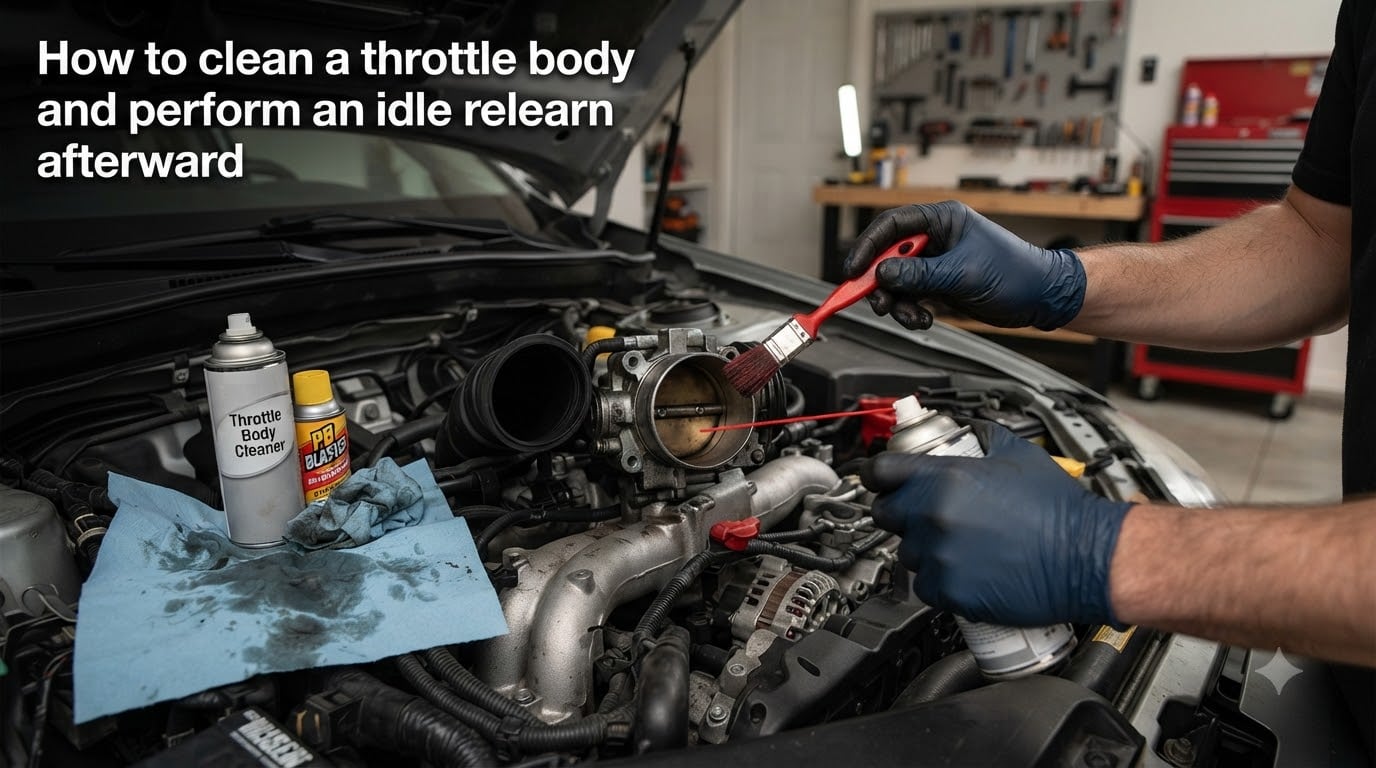
If your engine idles rough, hesitates when you press the gas, or stalls at a stoplight, a dirty throttle body is one of the most common culprits. Cleaning the throttle plate and bore takes about 45 minutes with basic tools, and it almost always fixes the symptoms. What catches most DIYers off guard is the second half of the job: learning how to clean a throttle body and perform an idle relearn afterward is two procedures, not one. Skip the relearn and you can end up with a higher idle than you started with.
I have walked a handful of friends through this on everything from a 2002 Toyota Camry to a 2018 Nissan Versa, and the pattern is the same. The clean itself is straightforward. The relearn is where people lose patience, skip a step, or think it failed. This guide walks you through the whole process in one place, with timing for both manual and scanner-based relearns, plus the post-cleaning symptoms that mean you need to dig deeper.
By the end, you will know how to clean the throttle body safely, how to idle relearn it in your driveway, and what to do if the idle still misbehaves after the relearn finishes.
Table of Contents
Signs Your Throttle Body Needs Cleaning
Before you pull the intake duct off, confirm the symptoms match a dirty throttle body. Carbon buildup inside the bore creates a very specific set of complaints.
Rough idle that comes and goes, often worse when the engine is warm
Stalling at idle when you put the transmission in Drive or Reverse
High idle RPM (1100 to 1500 instead of 700 to 900) after the engine warms up
Hesitation or stumble when you press the gas from a stop
Poor fuel economy that crept up over several months
Check engine light with codes like P0120, P0220, P0506, P0507, or P2101
Rev hang where RPM stays high for a second after you lift off the gas
If two or more of these match your car, cleaning the throttle body is a good first move. If only the check engine light is on and you have no drivability issues, scan the codes first. A sensor fault will not be solved by cleaning.
What Is a Throttle Body and Why Does It Get Dirty?
The throttle body sits between the air filter box and the intake manifold. Inside it is a butterfly valve (the throttle plate) that opens and closes to control how much air enters the engine. When you press the accelerator, the ECU commands the throttle to open. The more air, the more fuel the injectors spray, and the engine makes more power.
Modern cars use drive-by-wire, meaning there is no cable. The pedal is a sensor, and an electric motor moves the throttle plate. Older vehicles use a cable-operated throttle with an idle air control valve to manage idle speed.
Both designs get dirty for the same reason. The PCV system recirculates oil vapor back into the intake, and blow-by gases carry fuel residue past the rings. Over time, that oil and fuel bakes onto the back of the throttle plate and the bore wall. A 1 mm ridge of carbon can cut airflow by 5 to 10 percent, which the ECU has to compensate for. When the compensation hits its limit, you feel it.
Tools and Materials You Will Need
You do not need a full toolbox for this job. A clean work surface, a few rags, and the right cleaner will get you 90 percent of the way there.
Throttle body cleaner spray — CRC Throttle Body Cleaner, Gumout Jet Spray, or Berryman B-12. These are specifically formulated to dissolve carbon without harming sensors.
Shop rags or microfiber towels — Old t-shirts work, but lint-free is better. You will use 4 to 6.
Soft-bristle brush or toothbrush — For scrubbing the plate edges and bore wall. Do not use a wire brush.
Screwdriver or nut driver set — Usually 8 mm, 10 mm, and Phillips for the intake clamps and throttle body bolts.
Safety glasses and nitrile gloves — Throttle cleaner is aggressive. Skin contact dries your hands out fast.
OBD-II scanner (optional but recommended) — A $30 to $60 scan tool lets you read codes, clear codes, and run the idle relearn in the ECU menu.
Battery tender or jumper pack (recommended) — The relearn requires you to sit in accessory mode for 10 to 15 minutes. A weak battery will throw the procedure off.
What to avoid: Do not use carburetor cleaner on cars with a mass airflow (MAF) sensor mounted to the throttle body, since some carb cleaners leave a residue that skews MAF readings. Do not use brake cleaner, contact cleaner, or any solvent not labeled for throttle bodies. They can damage the anti-friction coating on modern throttle plates.
How to Clean a Throttle Body and Perform an Idle Relearn Afterward: Step-by-Step
The cleaning process is the same whether you remove the throttle body or clean it in place. Most cars allow in-place cleaning, which saves you from dealing with a new gasket and a coolant bleed on some models.
Step 1: Prep the Engine Bay
Park on a level surface, shift to Park, and turn the engine off. Open the hood and let the engine cool for at least 30 minutes. A hot throttle body will flash the cleaner off before it can dissolve the carbon. Disconnect the negative battery terminal if you plan to remove the throttle body or work near the MAF sensor wiring.
Step 2: Remove the Intake Duct
Loosen the clamp at the air filter box and the clamp at the throttle body. Pull the duct off and set it aside. Cover the open air filter box with a rag so nothing falls into it. If you have a MAF sensor mounted in the duct, handle it gently and do not touch the hot wire element.
Step 3: Inspect the Throttle Plate
Look inside the bore with a flashlight. You should see a black or brown ring of carbon on the back of the throttle plate and the leading edge of the bore. If the plate and walls look bright and clean, your problem is elsewhere.
Step 4: Spray and Soak
Hold the can of throttle body cleaner 4 to 6 inches from the plate. Saturate the visible carbon and the bore walls around it. Let it soak for 30 to 60 seconds. The deposits will start to run down and dissolve.
Step 5: Scrub the Stubborn Spots
Use a soft brush to work on the edges of the plate and the seat line where the plate closes. Rotate the plate open manually by pushing it with your finger (electronic throttle) or having a helper press the gas pedal slightly with the battery still connected if you skipped disconnection. Do not pry the plate open forcefully on a drive-by-wire throttle. The motor has limits.
Step 6: Wipe and Repeat
Wipe out the bore with a clean rag. The first pass will be black. Spray again, scrub, and wipe until the rag comes out mostly clean. Two to three cycles usually gets a heavily carboned throttle body back to bare metal.
Step 7: Clean the Edges of the Plate
The leading and trailing edges of the plate are where most of the buildup hides. Lift the plate carefully and run a rag soaked in cleaner along both edges. Any ridge left here will cause an idle surge even after a perfect relearn.
Step 8: Reassemble
Wipe the mating surface dry. Reattach the intake duct and tighten both clamps. Reconnect any wiring connectors you removed. Reconnect the negative battery terminal if you disconnected it.
You are now ready for the second half of the job: relearning the idle.
How to Perform an Idle Relearn After Cleaning
The idle relearn resets the ECU’s throttle position values. The ECU learned how much voltage corresponds to a closed throttle and a wide-open throttle based on the dirty plate. Now that the plate is clean, those voltages mean something different. The relearn teaches the ECU the new positions.
There are two methods: manual (no scanner) and scanner-based. Manual works on most cars from the mid-2000s onward. Some vehicles, especially European models like VW, Audi, and BMW, require a scanner for the adaptation reset.
Manual Idle Relearn Procedure
This is the most common method and works on Honda, Toyota, Ford, GM, Nissan, Hyundai, and Kia vehicles. Total time is about 15 to 20 minutes.
Start with a fully charged battery. Voltage should be above 12.4 V. A weak battery will cause the relearn to abort or produce an incorrect idle.
Turn the key to ON (not Start) and wait 2 to 3 seconds. You should see the dash lights come on but the engine does not crank.
Turn the key OFF for 10 seconds.
Repeat steps 2 and 3 two more times. So three ON cycles total, each followed by 10 seconds off.
Start the engine and let it idle without touching the gas pedal for 10 minutes. Keep all accessories off — no headlights, no A/C, no fan. Idle should drop from high to normal within 3 to 5 minutes.
After 10 minutes, turn on the headlights and the A/C (on high). Let it idle another 5 minutes. The ECU is now learning idle with electrical load.
Turn everything off and let it idle one more minute. Then shut the engine off.
Take it for a 15 to 20 minute drive with varied throttle inputs. Highway, stop-and-go, and a few gentle accelerations. This finalizes the throttle map.
If the idle does not drop during step 5, you have left carbon on the plate edge. Stop and clean again.
Scanner-Based Idle Relearn
Some vehicles expose an idle relearn function in the ECU menu. A basic OBD-II scanner with bidirectional capability (or a make-specific tool like a Honda HDS or Ford IDS) lets you trigger it directly.
Plug the scanner into the OBD-II port, usually under the dash on the driver’s side.
Turn the ignition to ON and follow the scanner menu to “Special Functions,” “Throttle Body Relearn,” or “Idle Air Relearn.” On Ford, this may be under “KAM Reset.” On VW, it is “Throttle Body Adaptation.”
Follow the on-screen prompts. Most scanners will tell you to press the brake, release the throttle, and wait.
Confirm the success message and clear any stored codes from the cleaning process.
Start the engine and let it idle for 5 minutes, then drive for 15 minutes.
Scanner-based relearns are faster and more reliable on vehicles that require them. If the manual method does not work after two attempts and your car is a VW, Audi, BMW, or Mercedes, a scanner is the next move.
The Honda Pedal Dance
Honda vehicles from the early 2000s have a manual relearn that requires you to operate the accelerator pedal in a specific sequence. With the ignition OFF, press the pedal slowly to the floor and release. Repeat five times. Then turn the key to ON and wait for the idle to settle. This is sometimes called the “pedal dance” on Honda forums.
First Start-Up: What to Expect After Cleaning
The first start after a clean is usually a bit rough. The engine may surge between 1100 and 1500 RPM for the first minute or two. This is normal. The ECU is hunting for the new closed-throttle voltage.
Within 3 to 5 minutes, idle should settle between 700 and 900 RPM (or 750 to 850 for most four-cylinders). If it does not settle by the 10-minute mark of the relearn, shut the engine off and recheck your work. Common culprits are a leftover carbon ridge on the plate edge, a loose intake clamp letting unmetered air in, or a vacuum hose you forgot to reconnect.
A mild idle surge during the first drive cycle is also normal. The ECU is relearning throttle response across the entire pedal range. By the second drive cycle, throttle response should feel noticeably crisper than before the cleaning.
Common Mistakes to Avoid
Most failed relearns come from one of these five errors.
Spraying cleaner directly on the MAF sensor. Even short exposure can skew the hot-wire readings and force the ECU to overcompensate.
Forcing the throttle plate open on a drive-by-wire throttle. The electric motor has physical stops. Prying past them bends the plate or damages the motor.
Leaving carbon on the plate edges. The leading and trailing edges are what idle quality depends on. Clean them thoroughly.
Skipping the relearn drive cycle. The idle relearn sets the closed-throttle position. The drive cycle sets the rest of the throttle map. You need both.
Doing the relearn with a weak battery. Voltage drops during the ON cycles can corrupt the relearn values.
Troubleshooting After Cleaning Your Throttle Body
If you have completed the clean and the relearn and the idle is still off, work through these checks before assuming the throttle body is bad.
Idle still high after relearn? Check for vacuum leaks around the intake manifold, PCV valve, and brake booster line. Unmetered air makes the ECU hold the throttle open to maintain idle.
Engine stalls when you put it in gear? Look at the idle air control valve (cable throttles) or the throttle plate for remaining carbon. A sticking plate will not close fully.
Check engine light came back? Re-scan the codes. P2101, P2111, and P2135 are throttle-related and often mean the relearn failed or the throttle position sensor is damaged.
Rev hang persists? This is usually a clutch delay valve or a learned driving style in the ECU. Cleaning will not fix it; the relearn often helps within a week of driving.
Rough idle only when warm? Could be a sticky idle air control valve or a failing coolant temperature sensor. Cleaning will not help either of these.
If two relearn attempts fail and there are no vacuum leaks, the throttle body itself may be worn. Most electronic throttle bodies last 80,000 to 150,000 miles. A replacement at that point is usually the most cost-effective move.
Vehicle-Specific Relearn Notes
Different makes and models have quirks in the relearn process. This section covers the common ones our readers run into.
Honda and Acura
Manual relearn works on most 2003 and newer models. The pedal dance described above is the first step. If it fails, a scanner with Honda HDS or a generic tool that supports Honda special functions will reset the throttle body and idle air control separately.
Toyota and Lexus
Manual relearn is reliable. The 10-minute idle plus 5-minute loaded idle plus drive cycle covers almost every Toyota. If the idle stays high, the issue is often the throttle body coolant passages clogging, not the relearn.
Ford and Lincoln
Manual relearn works on most models, but the Ford Focus, Fiesta, and some Fusions with electronic throttle require a scanner for the KAM (Keep Alive Memory) reset. Without it, idle will hover around 1100 to 1300 RPM indefinitely.
GM and Chevrolet
Manual relearn works on most trucks and SUVs from the mid-2000s onward. Some 2010 and newer vehicles with active fuel management need a scanner to relearn the throttle body. The relearn will fail silently without it.
VW, Audi, BMW, and Mercedes
Manual relearn will not work. These vehicles require a scan tool with VCDS, ISTA, or a compatible aftermarket tool (like OBDeleven for VW) to run the throttle body adaptation reset. Plan on this if you own one of these brands.
Nissan and Infiniti
Manual relearn works on most models, including the 2018 Versa mentioned earlier in the forums. The key is letting the engine idle a full 10 minutes without touching the gas pedal. Rushing it is the most common failure.
Cable-Operated Throttles (Pre-2000 Most Models)
Cable throttles do not require a relearn in the modern sense. They use an idle air control valve that you can clean separately. Disconnect the IAC, remove it, spray it with throttle body cleaner, and reinstall. Idle should return to normal within a minute of starting the engine.
FAQs
Do I need to idle relearn after replacing my throttle body?
Yes. Any time the throttle body is removed, replaced, or cleaned in a way that changes the plate’s resting position, the ECU needs to relearn the new closed-throttle and wide-open-throttle voltages. Without the relearn, the ECU uses old values and you will see rough idle, high idle, or stalling.
How long does it take for a throttle body to relearn?
The idle relearn itself takes 10 to 15 minutes for most vehicles. A full throttle map relearn, including drive cycles, takes a few days of normal driving. Some vehicles, like a 2002 Toyota Camry, can take a week of mixed driving for the idle to fully settle.
How long to let car idle after cleaning throttle body?
Let the engine idle for 10 minutes without touching the gas pedal and with all accessories off. Then idle another 5 minutes with the headlights and A/C on to teach the ECU idle under load. After that, drive for 15 to 20 minutes with varied throttle inputs.
How do you reset the ECU after cleaning the throttle body?
The most reliable method is the manual relearn: three ignition ON cycles of 2 to 3 seconds each, separated by 10 seconds OFF, then idle for 10 minutes without accessories, then 5 minutes with accessories on, then drive for 15 minutes. Some vehicles require a scanner-based reset through the OBD-II port.
Can you clean a throttle body without removing it?
Yes. Most cars allow in-place cleaning. Remove the air intake duct to access the throttle plate, spray cleaner into the bore, scrub with a soft brush, and wipe with rags. Removal is only needed if the carbon is severe or the gasket is leaking.
What happens if you don’t do a throttle body relearn?
The ECU continues to use the old throttle position values. You will likely see rough idle, high idle (1100 to 1500 RPM), hesitation, or stalling. In some cases the check engine light comes on with codes like P0506 or P0507 for idle control system malfunction.
Wrapping Up
Knowing how to clean a throttle body and perform an idle relearn afterward turns a $200 to $400 shop job into a $15 to $30 DIY afternoon. The cleaning itself is mechanical and forgiving. The relearn is where patience matters. Give the ECU the full 10 minutes of unloaded idle, then 5 minutes with accessories, then a real drive cycle. Skipping any of those three will leave the throttle map incomplete.
If your idle does not settle after two clean-and-relearn attempts and you have confirmed no vacuum leaks, the throttle body itself is likely worn out. At that point, a replacement is the most reliable fix. For most drivers, though, a single thorough clean plus a proper relearn will restore the smooth idle, crisp throttle response, and steady fuel economy the car had when it was new.