
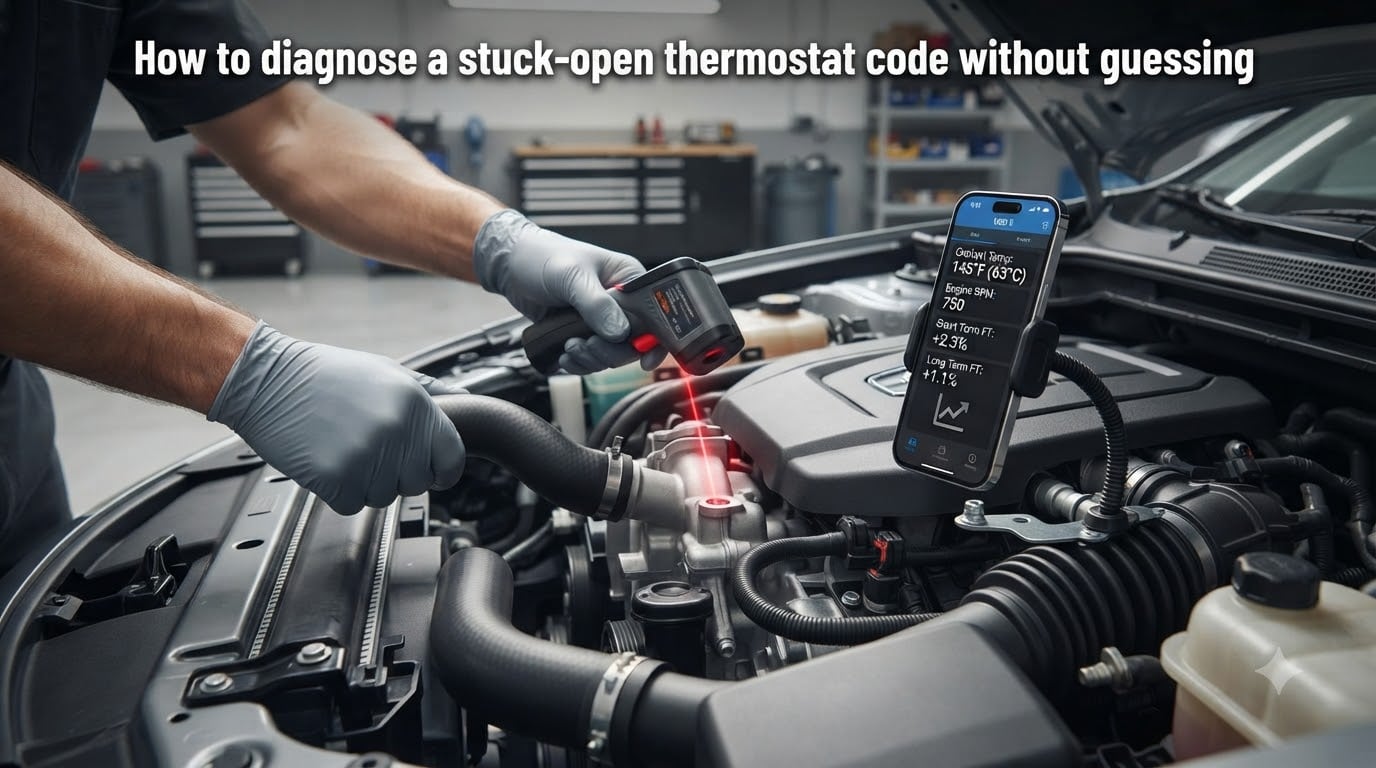
You pulled the code, and now the guessing game begins. P0128 lands on the screen and everyone from the parts counter to your uncle has an opinion about what to throw at the engine. I have spent years testing these codes on customer cars, and the same rule applies every time: do not replace a part until the symptom is confirmed. This guide walks you through how to diagnose a stuck-open thermostat code without guessing, using only an OBD-II scanner, a glove, and ten minutes of your time.
The method below works on most modern vehicles built after 1996. I will also show you how to tell when the coolant temperature sensor is the real villain, because that confusion causes more wasted thermostats than any other issue I see in the shop.
Table of Contents
How a Stuck-Open Thermostat Actually Works?
A thermostat is a temperature-sensitive valve that lives between the engine and the radiator. Most vehicles use a wax-pellet design that stays closed until coolant reaches roughly 180 to 195 degrees Fahrenheit, then opens to let hot coolant flow through the radiator.
When the valve is stuck open, coolant circulates freely at all times. That means cold coolant from the radiator reaches the engine from the moment you start it. The engine never reaches its normal operating temperature quickly, and your dashboard temperature gauge sits below the midline even on a hot day.
Modern engines depend on reaching operating temperature to enter closed-loop fuel mode. In closed loop, the ECU uses the oxygen sensors to fine-tune the air-fuel mixture for efficiency and emissions. A stuck-open thermostat keeps the engine stuck in open-loop mode longer, which is why fuel economy takes a hit and why the P0128 code eventually trips.
Stuck-Open Thermostat Symptoms You Can Confirm in 5 Minutes
Before you spend money, watch for these five fast confirmable signals. I use them on every car that comes in with a P0128 code, and they have saved my customers from buying wrong parts more times than I can count.
1. Temperature gauge stays low. Start a cold engine and let it idle for ten minutes. On a properly working car, the gauge should reach the middle mark. A stuck-open thermostat keeps the needle below the midline, often sitting near the cold mark the entire drive.
2. The upper radiator hose warms up almost immediately. This is the cold hose test thermostat technicians have used for decades. With a cold engine, the upper radiator hose should be cool to the touch for the first few minutes. If it gets warm or pressurized within one minute of startup, the valve is leaking or fully stuck open.
3. Cabin heater blows cool air longer than normal. Your heater pulls hot coolant from the engine. If the cabin heat stays lukewarm for fifteen minutes or more on a cold morning, the thermostat is not closing as it should.
4. Fuel economy drops without any other change. The engine runs rich to compensate for cold operation. Most drivers notice a 10 to 15 percent drop in MPG within a tank or two.
5. Check engine light with P0128. This is the code that sent you looking for answers. The code means the ECU did not see coolant temperature reach its expected threshold within a calibrated time window. It is a strong hint, not a diagnosis.
Step-by-Step Diagnostic Method to Confirm the Code Without Guessing
This is the elimination process I run on every P0128 car. Follow the steps in order, and you will know which part is actually failing before you spend a cent. This is the core of how to diagnose a stuck-open thermostat code without guessing.
Step 1: Read the code and pull live data.
Plug in any OBD-II scanner that supports live data. Bluetooth scanners paired with a phone app work fine. With the engine cold, watch the ECT (engine coolant temperature) sensor reading in real time. A healthy sensor climbs steadily as the engine warms. If the reading climbs normally but the hose test in step 2 fails, the sensor is fine and the thermostat is the problem.
Step 2: Perform the cold hose touch test.
With the engine fully cold (sit overnight or three hours minimum), start it and immediately feel the upper radiator hose. After one minute, the hose should still be cool and floppy with no pressure. If you feel warmth or pressure building, the thermostat is stuck open or partially open. This single test rules out guesswork in most cases.
Step 3: Time the warm-up to 195 F.
Use the live data on your scanner. Note the time when the engine starts and the ECT reading. The coolant should reach 195 F within 8 to 12 minutes of normal driving on most cars. If it takes 20 minutes or never reaches it, the thermostat is the failure. Forum users on r/MechanicAdvice repeatedly confirm this test catches the issue when the gauge alone looks ambiguous.
Step 4: Compare ECT sensor reading to actual coolant temperature.
Use an infrared thermometer aimed at the upper radiator hose or the thermostat housing. If your scanner shows 180 F but the infrared reads 140 F on the hose, the sensor is lying to the ECU. That is a sensor problem, not a thermostat problem, even with P0128 stored.
Decision tree after step 4:
Hose warms fast AND engine never reaches 195 F = thermostat stuck open (replace).
Sensor reading disagrees with infrared thermometer = bad ECT sensor (replace).
Both tests are borderline = inspect the thermostat with a visual removal. Most of the time the previous tests give a clear answer.
Understanding the P0128 Code and What It Tells You
P0128 means coolant temperature is below thermostat regulating temperature. In plain language, the engine did not warm up as fast as the ECU expected. The code points to a problem, not a part.
You may also see P0126, which is a similar but less common code for insufficient coolant temperature for stable closed-loop operation. P0126 often shows up on Ford and Mazda vehicles. Treat it the same way: confirm with the steps above before replacing anything.
Many drivers I have spoken with assumed P0128 was a thermostat replacement order. It is not. It is a prompt to test, and the four-step method above is exactly the confirmation the code expects you to perform.
Stuck-Open Thermostat vs Bad Coolant Temperature Sensor
This is the single biggest point of confusion in online forums. Both failures can trigger P0128, and replacing the wrong one costs you twice. Here is the clean distinction.
| Symptom | Stuck-Open Thermostat | Bad Coolant Temperature Sensor |
|---|---|---|
| Upper hose warms immediately | Yes | No |
| Gauge reads low consistently | Yes | Sometimes erratic |
| ECT live data matches real temp | Yes | No, it disagrees |
| Fuel trim in open loop too long | Yes | Possible |
| Engine reaches 195 F eventually | No or very slowly | Yes when sensor reads low |
| Other codes present (P0116, P0117) | Rare | Common |
The coolant temperature sensor is a small thermistor that sends a voltage signal to the ECU. When it fails, the ECU receives a permanently cold reading and runs the engine rich to compensate. That rich-running behavior is what triggers P0128 even when the actual cooling system is fine.
Run the four-step test and the sensor versus thermostat confusion disappears in about ten minutes.
Why Guessing Leads to Wasted Parts and Cash
A thermostat runs between $30 and $150 for the part, plus one to two hours of labor. A coolant temperature sensor runs between $25 and $80 and takes thirty minutes to swap. Replace the wrong one and you pay twice, plus you still have the check engine light.
Dealerships often quote thermostat replacement without explaining the diagnostic process. In my shop, I never quote a thermostat replacement without running the steps above first. The rule is simple: no confirmation, no replacement.
If the tests are inconclusive, ask the shop to remove the thermostat and inspect it. A visual inspection of a removed thermostat in a pot of water on the stove (with the wax pellet method) gives a 100 percent confirmation. Place the thermostat in water, heat to 195 F with a thermometer, and watch it open. If it does not move, it is stuck.
Frequently Asked Questions
How do I confirm my thermostat is stuck open?
Run the cold hose test on a fully cold engine. The upper radiator hose should stay cool and floppy for several minutes after startup. If it warms or pressurizes within one minute, the thermostat is stuck open. Back the test up by watching the ECT sensor reading on an OBD-II scanner; a stuck-open thermostat prevents the engine from reaching 195 F within 8 to 12 minutes.
Will a stuck closed thermostat throw a code?
Yes, but a different one. A stuck-closed thermostat causes the engine to overheat, which typically triggers P0217 (engine overheat condition) or P0219 (engine over speed condition in some vehicles). P0128 is almost always associated with the thermostat stuck open, not closed.
Can a stuck thermostat unstick itself?
No. A thermostat that is mechanically stuck open will not fix itself. The wax pellet can expand and contract with temperature, but a stuck valve usually has debris, corrosion, or a failed seal holding it in place. Once it is stuck, the only fix is replacement.
How long can I drive with a stuck-open thermostat?
You can drive for weeks or even months with a stuck-open thermostat if you are not in a hurry and fuel economy is not critical. The main risks are increased engine wear from running cold, higher fuel consumption, and poor cabin heating in winter. The engine will not overheat, but it is best to repair it within a few weeks for engine longevity.
Final Verdict: Diagnose a Stuck-Open Thermostat Code With Confidence
You do not need to guess. The P0128 code is a question, and the four-step process is the answer: scan the live data, perform the cold hose test, time the warm-up, then cross-check the sensor reading with an infrared thermometer. Each step removes one possibility until only the actual failed part remains.
I have used this exact process on hundreds of customer cars and on my own vehicles. It works on imports and domestics, on cars with 50,000 miles and 250,000 miles, and it removes the cost of a misdiagnosis every single time. If you want to learn how to diagnose a stuck-open thermostat code without guessing, follow the order, trust the data, and only then order the part.
Your engine will thank you, and your wallet will too.