
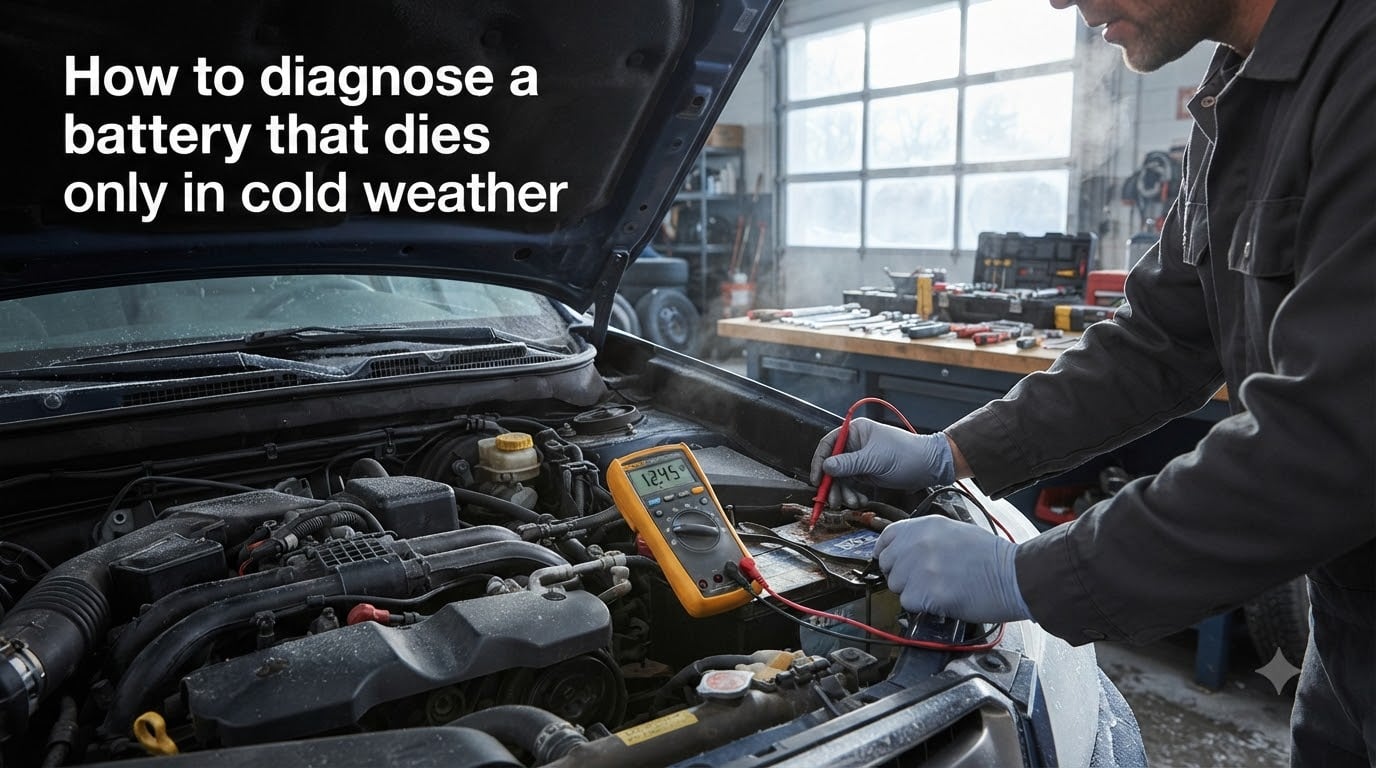
Last January, I watched a customer’s three-year-old battery crank his pickup truck perfectly at noon, then fail to turn the engine over at 7 a.m. when the temperature dropped to 14°F. The same battery. Same truck. Same day. He had already replaced it once the previous winter, and yes, it tested “good” at the auto parts store.
That experience is exactly why I’m writing this guide. If you’re trying to diagnose a battery that dies only in cold weather, you’re dealing with a sneaky problem that hides behind passing voltage tests and intermittent failures. The good news: you can chase it down at home with a $20 multimeter and about 30 minutes of patience.
Below, I’ll walk you through the science of why cold weather kills batteries, the diagnostic flowchart that separates battery failure from alternator problems or parasitic drain, and the exact voltage readings you should be looking for. By the end, you’ll know whether to replace the battery, fix the charging system, or hunt down whatever is draining it overnight.
Table of Contents
Why Cold Weather Specifically Kills Car Batteries?
Cold weather kills car batteries because it slows the chemical reaction inside lead-acid cells, cutting cranking power by up to 60% at freezing temperatures. According to AAA, a battery at 0°F produces only about 40% of the cranking amps it makes at 80°F, while the engine itself demands more power to turn over thanks to thicker oil and stiffer internal components.
It’s the double whammy that breaks weak batteries. The chemical reaction that generates electricity needs heat to move quickly. Cold slows the ions down. Meanwhile, the starter motor has to push through thicker engine oil, which can double the load on the battery during those first few critical cranks.
Most car batteries are rated in Cold Cranking Amps (CCA), which is the power they deliver at 0°F for 30 seconds while maintaining at least 7.2 volts. A healthy 600 CCA battery still produces only about 240 effective cranking amps at 0°F. That sounds like a lot, until you factor in a hard-working starter motor on a January morning.
The temperature threshold that starts causing problems is 32°F. Below that, capacity drops noticeably. At -22°F, capacity is reduced by roughly half, which is why batteries that seem fine in November can suddenly fail in January.
The Paradox: Why a Battery Tests Good But Dies in the Cold
Here’s the frustration I hear from readers every winter: the battery tests “good” at the shop, but it still dies when temperatures drop. This isn’t a tester error. It’s a specific weakness that standard tests can miss.
Three things cause a battery to fail in cold despite passing a basic voltage test. First, internal resistance increases dramatically with age and cold, meaning the battery can hold voltage but cannot deliver the high current spikes the starter needs. Second, one or two weak cells in a six-cell battery can drag the entire pack down under heavy load – something a no-load voltage test will never catch. Third, the battery may be just barely above the failure threshold in summer, but that 10-15% margin disappears the moment cold weather hits.
If your battery is more than three years old, it gets worse. A battery at 80% of its original capacity can still pass every standard test, but it has no reserve left when cold weather demands 40% more from it. That’s why so many forum users report new batteries failing after just 1-2 years in cold climates – the battery wasn’t actually new enough.
Step-by-Step Diagnostic Procedure: How to Diagnose a Battery That Dies Only in Cold Weather
Diagnosing a battery that dies only in cold weather requires four sequential tests: visual inspection, no-load voltage test, load test, and parasitic drain check. Run them in this order because each test confirms or rules out the next possibility.
Step 1: Visual inspection. Pop the hood and look at the battery. Check for corrosion on the terminals (a white or bluish powder), cracked case, loose cable connections, and low electrolyte level if your battery has removable caps. Corrosion alone can drop cranking voltage by 1-2 volts. Clean it with a wire brush and a baking soda-water paste if you find any.
Step 2: No-load voltage test. With the car off and resting for at least an hour, set your multimeter to DC volts and touch the red probe to the positive terminal, black to negative. A fully charged battery reads 12.6-12.8V. 12.4V is about 75% charged. 12.2V is 50%. Anything below 12.0V means the battery is discharged or damaged.
Step 3: Load test (the one that matters in cold weather). A standard voltage test won’t catch the cold-weather culprit. You need a load test, which simulates the starter’s current draw. Most auto parts stores will do this free in about 5 minutes. The test applies a load equal to half the battery’s CCA rating for 15 seconds. Voltage should stay above 9.6V at 70°F. If it drops below 9.6V, the battery is failing under load and will leave you stranded in cold weather.
Step 4: Parasitic drain check. If the battery passes the load test but still dies overnight, something is drawing power when the car is off. Turn everything off, close the doors, wait 20 minutes for modules to sleep, then disconnect the negative terminal and connect your multimeter (set to mA) in series between the cable and the post. Anything over 50mA is suspicious. Normal parasitic draw is 25-50mA on most modern cars.
The Diagnostic Flowchart You Should Follow
When walking through diagnosis, follow this order: if the no-load voltage is below 12.4V, charge the battery first and retest before going further. If the load test fails, replace the battery. If the load test passes but parasitic draw is over 50mA, start pulling fuses one at a time to find the circuit draining the battery. If both tests pass, suspect the alternator – test it by measuring voltage at the battery with the engine running (should be 13.7-14.7V).
Battery vs Alternator vs Parasitic Drain: Spotting the Real Cause
Misdiagnosing a failing alternator as a bad battery is one of the most common mistakes I see. It costs people money on batteries they didn’t need. Here’s how to tell them apart.
A bad battery shows up first thing in the morning. The car either cranks slowly or just clicks. If you jump it, it runs fine all day. The problem repeats after sitting overnight.
A failing alternator shows up while driving. The battery warning light comes on, lights dim while idling, or the car dies while running. The battery reads fine after a jump because the alternator just isn’t recharging it. Jump-starting is always temporary.
A parasitic drain masquerades as a bad battery. The car starts fine after jump-starting, runs all day, but is dead again next morning. The battery itself is healthy – something is draining it.
The simple test: charge the battery fully, disconnect the negative terminal overnight, then reconnect in the morning. If it starts right up, you have a parasitic drain. If it’s dead again, the battery is failing under load and needs replacement.
How to Test a Car Battery at Home With a Multimeter
You can do meaningful battery testing at home with a basic digital multimeter. Set it to 20V DC. Touch red to positive, black to negative. Read the voltage.
A reading of 12.6V or higher means a fully charged battery. 12.4V means about 75% charged – still functional but worth topping up. 12.2V means 50% charged – borderline. Anything below 12.0V means the battery is deeply discharged or has a dead cell.
For the most accurate reading, test the battery after the car has been sitting for at least an hour, not right after driving. Surface charge from the alternator can give you a falsely high reading.
If you want to do a basic load test at home without a dedicated load tester, turn on the headlights for 15 minutes with the engine off, then measure voltage. If it drops below 11.8V, the battery is weak. This isn’t as accurate as a commercial load test, but it catches the obvious failures.
Common Symptoms of Cold-Weather Battery Failure
Slow engine crank is the classic first sign. The starter turns over the engine more slowly than usual, especially on cold mornings. A single click followed by silence means the battery doesn’t have enough power to engage the starter at all.
Dim or flickering headlights, especially at idle, point to either a weak battery or a tired alternator. Electrical glitches like flickering dashboard lights, weak power window operation, or a sluggish infotainment system can also indicate low voltage.
The battery warning light staying on after the engine starts usually means the alternator isn’t charging properly. If it only shows up in cold weather, the alternator may be on its way out and the cold is just exposing a marginal charging system.
Prevention: How to Stop Your Battery From Dying in the Cold
Park in a garage whenever possible. Even an unheated garage stays 10-20°F warmer than outside, which can be the difference between a battery that starts and one that doesn’t. If you don’t have a garage, a battery blanket or insulated battery cover helps. These wrap around the battery and use a small heating element to keep it above freezing.
Use a trickle charger or battery maintainer if the car sits for more than a few days in cold weather. A fully charged battery won’t freeze until around -76°F, but a discharged battery can freeze at 32°F because the electrolyte is mostly water. Keeping the battery fully charged prevents both freezing damage and the slow capacity loss that comes from sitting at low charge.
Avoid stacking short trips in winter. Each short trip starts the car, uses a lot of battery power to crank, then only runs for a few minutes before the alternator barely tops off the charge. Over weeks, the battery’s state of charge creeps downward. Take a 15-20 minute drive at least once a week in cold weather to let the alternator fully recharge the battery.
Have the battery tested before the first hard freeze every fall. Auto parts stores do this free. If the load test is marginal, replace the battery on your schedule rather than being stranded in a parking lot at 5 a.m. with a dead battery.
FAQs
How do I figure out why my battery is dying in cold weather?
Run four tests in order: visual inspection, no-load voltage test, load test, and parasitic drain check. A no-load voltage below 12.4V means the battery needs charging. A load test below 9.6V at 70°F means the battery is failing under load. Parasitic draw over 50mA means something is draining the battery while the car is off. Testing against all four possibilities is the fastest way to diagnose a battery that dies only in cold weather.
Why is my car battery dead in cold weather?
Cold slows the chemical reaction inside lead-acid batteries, reducing cranking power by up to 60% at freezing temperatures. At the same time, the engine demands more power to start because thicker engine oil increases the starter’s load. A battery that was marginal in summer has no reserve when cold weather hits, which is why the same battery that worked fine in November can fail in January.
How cold is too cold for a battery?
Battery capacity starts dropping noticeably at 32°F. At 0°F, a typical battery produces only about 40% of its rated cranking amps. At -22°F, capacity is reduced by roughly half. Any temperature below freezing is a stress test for a weak battery, and sustained temperatures below 0°F will expose even batteries that were passing tests in warmer weather.
Is it common for a battery to not work in the cold?
Yes, this is one of the most common winter car problems. AAA reports hundreds of thousands of cold-weather battery calls each year in cold regions. Any battery over three years old is at risk, especially in climates where temperatures regularly drop below freezing. New batteries can also fail in extreme cold if they have marginal cells or are undersized for the vehicle.
Will my battery recover after being jump-started in cold weather?
A jump-start gets the car running, but the alternator needs at least 30 minutes of driving to put meaningful charge back into the battery. If the underlying problem is a failing battery, the car will likely die again after sitting overnight. If the cause was just a deeply discharged battery from leaving the lights on, the alternator will recharge it fully over a long drive. The only way to know for sure is to load-test the battery after jump-starting and driving for at least 30 minutes.
Final Thoughts on Diagnosing Cold-Weather Battery Failure
Diagnosing a battery that dies only in cold weather comes down to running the four tests in order: visual inspection, voltage test, load test, and parasitic drain check. The voltage test is the easy one – any multimeter handles it. The load test is the one that catches the cold-weather failures that hide behind passing voltage readings.
If your battery is more than three years old and showing symptoms, replace it before winter hits. If a fresh battery is failing, your problem is parasitic drain or a tired alternator. Test the system now, not the morning your car won’t start in a frozen parking lot.