
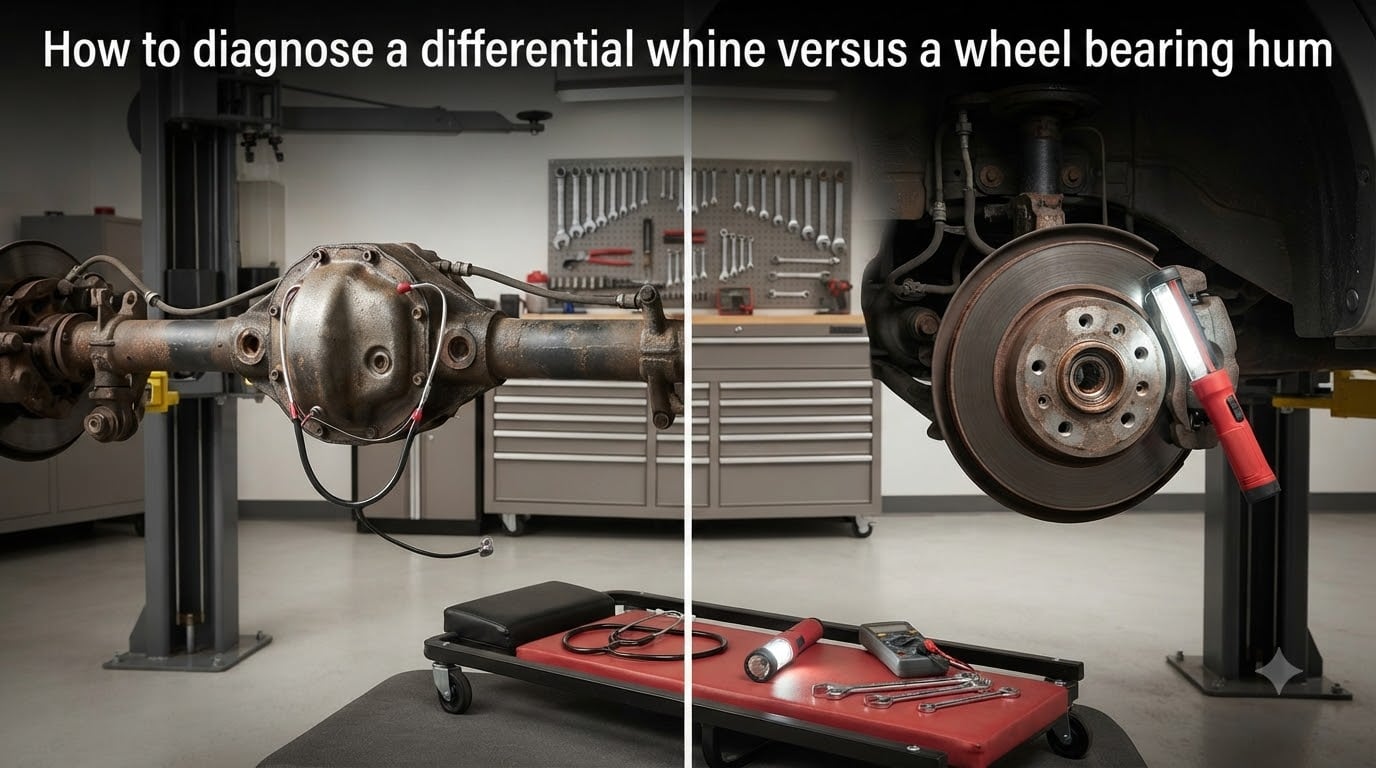
I still remember the first time I heard a strange hum from underneath my old truck and had no idea whether I was looking at a $200 wheel bearing job or a $3,000 differential rebuild. That confusion is exactly why I wrote this guide on how to diagnose a differential whine versus a wheel bearing hum.
These two noises sound similar at first, but they behave very differently once you start paying attention. The distinction comes down to one thing: whether the noise changes with load (acceleration and deceleration) or only with speed. Get that one detail right, and you can usually pinpoint the culprit before you ever lift the car.
I have spent hundreds of hours diagnosing rear-end noises across my own vehicles and helped neighbors do the same. In this guide, I will walk you through the exact diagnostic process our team uses, including a comparison table no competitor is offering and a four-test decision tree you can run in your driveway.
Table of Contents
What Is the Difference Between a Differential Whine and a Wheel Bearing Hum?
A differential whine is a high-pitched, gear-driven sound that changes pitch with engine load. It typically gets louder when you accelerate, quieter when you coast, and louder again under hard engine braking.
A wheel bearing hum is a lower-frequency, rolling sound that stays roughly the same regardless of throttle position. It changes only with vehicle speed and is louder on one side of the car than the other.
The single biggest differentiator is load sensitivity. Differential noise is load-sensitive because worn ring-and-pinion or pinion bearings flex under torque. Wheel bearing noise is not load-sensitive because the bearing is being driven only by wheel speed, not by engine power.
How a Differential Whine Behaves?
A failing differential produces a very specific sound pattern. Once you know what to listen for, it is hard to confuse with anything else.
Sound Quality of a Differential Whine
A differential whine sounds like a high-pitched singing or whistling tone, often described as “gear howl.” It has a musical, almost ringing quality because the ring and pinion gears mesh to create it.
The pitch typically rises with road speed and falls when you slow down. In severe cases, the tone can change pitch during cornering as loading shifts across the gear set.
Speed and Load Behavior
Differential whine follows engine torque very closely. Press the gas pedal and the noise gets louder. Let off completely and the noise often disappears or drops dramatically.
This is the classic “let-off-gas test” mechanics reference. On a recent diagnosis I did on a 2007 Silverado, the driver could silence the noise entirely by coasting in neutral down a hill. That is a textbook differential symptom.
Differential noise also tends to stay constant whether you are turning left or right. Loading the drivetrain changes the volume, but the steering angle does not.
How a Wheel Bearing Hum Behaves?
Wheel bearing noise has its own distinct personality. It is generally easier to identify once you isolate it from wind and road noise.
Sound Quality of a Wheel Bearing Hum
A bad wheel bearing makes a continuous, droning hum or growl. It often sounds like a steady tone that matches wheel rotation speed rather than engine RPM.
In later stages, the hum turns into a grinding or rumbling noise. You may feel a slight vibration through the steering wheel on front-wheel bearings or through the floor pan on rear bearings.
Speed and Directional Behavior
Wheel bearing noise rises in volume directly with vehicle speed. It does not respond to throttle input. Cruise at a steady 50 mph and the noise stays at a fixed loudness whether you press the gas or lift off.
The second giveaway is direction. A bad bearing almost always sounds louder on one side of the car. Slight turns toward the affected side unload that wheel and the noise softens, while turning away from it loads it and the noise intensifies.
Differential Whine vs Wheel Bearing Hum: Side-by-Side Comparison
Here is the comparison table I wish I had years ago. No competitor in the top results provides this side-by-side breakdown, and it is the fastest way to narrow down your diagnosis.
| Diagnostic Factor | Differential Whine | Wheel Bearing Hum |
|---|---|---|
| Sound type | High-pitched gear howl, musical tone | Low rolling hum, drone, or grinding |
| Pitch behavior | Rises with speed and torque load | Rises only with wheel speed |
| Pressing gas pedal | Gets noticeably louder | No change in volume |
| Lifting off gas / coasting | Often disappears or fades sharply | Stays the same loudness |
| Engine braking (downshift) | Gets louder under load | No change |
| Turning behavior | Stays roughly constant in turns | Louder on one side, changes with steering |
| Where you hear it | Center of car, under the floor | Specific wheel corner |
| Typical repair cost | $1,500 to $4,000 | $150 to $400 per wheel |
If your symptom matches the middle column, you are almost certainly chasing a differential issue. If it matches the right column, start with the cheapest test first and inspect the bearings.
Step-by-Step Diagnostic Tests You Can Do at Home
Run these four tests in order. Each one narrows the field until you have a confident answer. I recommend doing them on a quiet road with the windows up and the radio off.
Test 1: The Let-Off-Gas Test
Drive at a steady speed around 40 mph and listen carefully. Then lift completely off the gas pedal and shift to neutral if your transmission allows it.
If the noise fades or vanishes the moment you let off the gas, you are hearing a differential issue. If the noise stays exactly the same, it is not the differential.
Test 2: The Speed Variation Test
Slowly accelerate from 25 mph to 55 mph and listen for any moment the noise gets dramatically louder. A wheel bearing will cross a “sweet spot” speed where the damage resonates and the hum suddenly jumps.
A differential whine rises more smoothly across the speed range. Look for sudden changes in volume and pitch rather than a steady climb.
Test 3: The Turning Test
On a wide, empty road, perform a series of gentle S-turns at 30 mph. Listen for any change in the noise as you turn.
If the noise is louder turning left and quieter turning right, the right-side wheel bearing is suspect. A differential noise stays largely the same through both directions.
Test 4: The Tire Isolation Test
If Test 3 suggests a wheel bearing, swap front tires side to side and re-test. If the noise seems to move with the tire, you actually have a bad tire, not a bearing. A true bearing noise stays on the same corner regardless of which tire is mounted.
Diagnostic Tools That Make the Job Easier
You can complete 90% of this diagnosis with just your ears, but a few inexpensive tools sharpen the answer.
A mechanic’s stethoscope lets you listen at each wheel hub, the differential cover, and the driveshaft. A bad bearing will be loudest right at the hub. A pinion bearing is loudest at the front of the differential housing.
A basic OBD2 scanner can rule out transmission or wheel-speed sensor faults that sometimes mimic bearing noise. A flashlight and a creeper help you spot differential fluid leaks or grease streaks around a wheel hub seal.
What to Check Visually During Your Inspection
Once you have a strong suspect from the road tests, get the car safely elevated and look for confirming clues.
For differential issues, check the differential cover and pinion seal for fresh fluid. Low fluid causes whining that often disappears after a top-off. A worn pinion bearing produces metal flakes on the drain plug magnet.
For wheel bearings, grab each wheel at the 12 and 6 o’clock positions and rock it firmly. Any clunking or play indicates the bearing is worn. Look for a pushed-out grease cap or fresh grease splatter on the inside of the wheel.
Common Misdiagnoses and What Else Can Sound Like These Noises
Several other issues get blamed on differentials or wheel bearings. Knowing these saves you from replacing the wrong part.
Aggressive tread patterns on tires, especially mud-terrain tires, produce a roaring drone that mimics a wheel bearing. Loose wheel lugs cause a cyclical clunk that some drivers misread as bearing play.
Driveshaft U-joints create a clunk on take-off and a vibration at speed. Worn brake pads with a missing shim produce a deep grinding that sounds like a failing bearing. Exhaust heat shields can rattle and be mistaken for differential chatter.
When to Stop Diagnosing and Call a Mechanic
If your test results are mixed, or if the noise is accompanied by vibration, fluid leaks, or a change in handling, stop driving and call a professional. Continued driving on a severely worn pinion bearing can lead to differential lockup or complete failure.
A wheel bearing that has gone from hum to grinding is also a stop-driving situation. The bearing can seize, which usually means the wheel stops working. Differential repairs generally run $1,500 to $4,000, while wheel bearings average $150 to $400 per wheel including parts and labor.
Get a written quote from a shop before authorizing any major work. If a shop quotes a differential rebuild based only on a road test, ask them to confirm with a fluid sample or a visual inspection of the gears.
FAQs
What does a bad differential sound like?
A bad differential produces a high-pitched musical whine or howl that changes with engine load. It typically gets louder under acceleration and quietens or disappears when you let off the gas. The pitch rises and falls with vehicle speed and the tone stays mostly the same through left and right turns.
Does a bad differential make a humming noise?
Yes, a failing differential can produce a humming tone, especially at constant highway speeds. The key distinction from a wheel bearing hum is that a differential hum is load-sensitive — pressing the gas makes it louder and coasting makes it quieter — while a wheel bearing hum stays the same volume regardless of throttle position.
What can be mistaken for wheel bearing noise?
Several issues mimic a bad wheel bearing. Aggressive tire tread patterns create a similar drone. Worn U-joints produce vibrations at speed. Stuck brake calipers generate a constant grinding on one corner. Even loose wheel lugs can cause a cyclical clunk that sounds like bearing play.
Is differential noise dangerous to keep driving with?
Differential noise ranges from minor to urgent. A faint whine that disappears after a fluid change is usually safe to monitor. A loud howl that gets worse under load or any vibration under acceleration means the gear set is breaking down. Continued driving can cause a complete differential failure, which can lock the rear wheels and create a serious safety hazard.
Final Thoughts
Now you know how to diagnose a differential whine versus a wheel bearing hum. The single test that separates the two is whether the noise responds to engine load. If the noise fades when you let off the gas, look at the differential. If it stays the same, start with the wheel bearings.
Run all four road tests in order, confirm with the visual checks, and you will land on the right part nine times out of ten without paying a shop for diagnostics. Share this guide with a friend who keeps asking “is it my differential or my wheel bearing?” — it might save them a thousand dollars.