
That shudder at 45 mph or the engine revving without the car moving faster, those moments make any driver’s stomach drop. You start wondering whether you are looking at a $700 fix or a $3,000 rebuild, and the answer hinges on one question: is it the torque converter or the transmission?
Learning how to diagnose automatic transmission slipping versus a torque converter issue can save you from a costly misdiagnosis. The two components sit right next to each other, share the same fluid, and produce overlapping symptoms that trip up even experienced shade-tree mechanics.
I have spent years reading through thousands of forum threads on r/MechanicAdvice and r/AskMechanics, and the same confusion comes up over and over. Drivers report shuddering at 40 to 60 mph, slipping that only appears when the transmission is hot, or a sudden loss of fourth gear, and nobody can tell which part is to blame.
This guide breaks down exactly what each component does, the specific symptoms that separate them, and the step-by-step diagnostic tests you can perform at home. By the end, you will have a clear picture of which part is failing and what your next move should be.
Table of Contents
Torque Converter vs Transmission: What Each Part Does
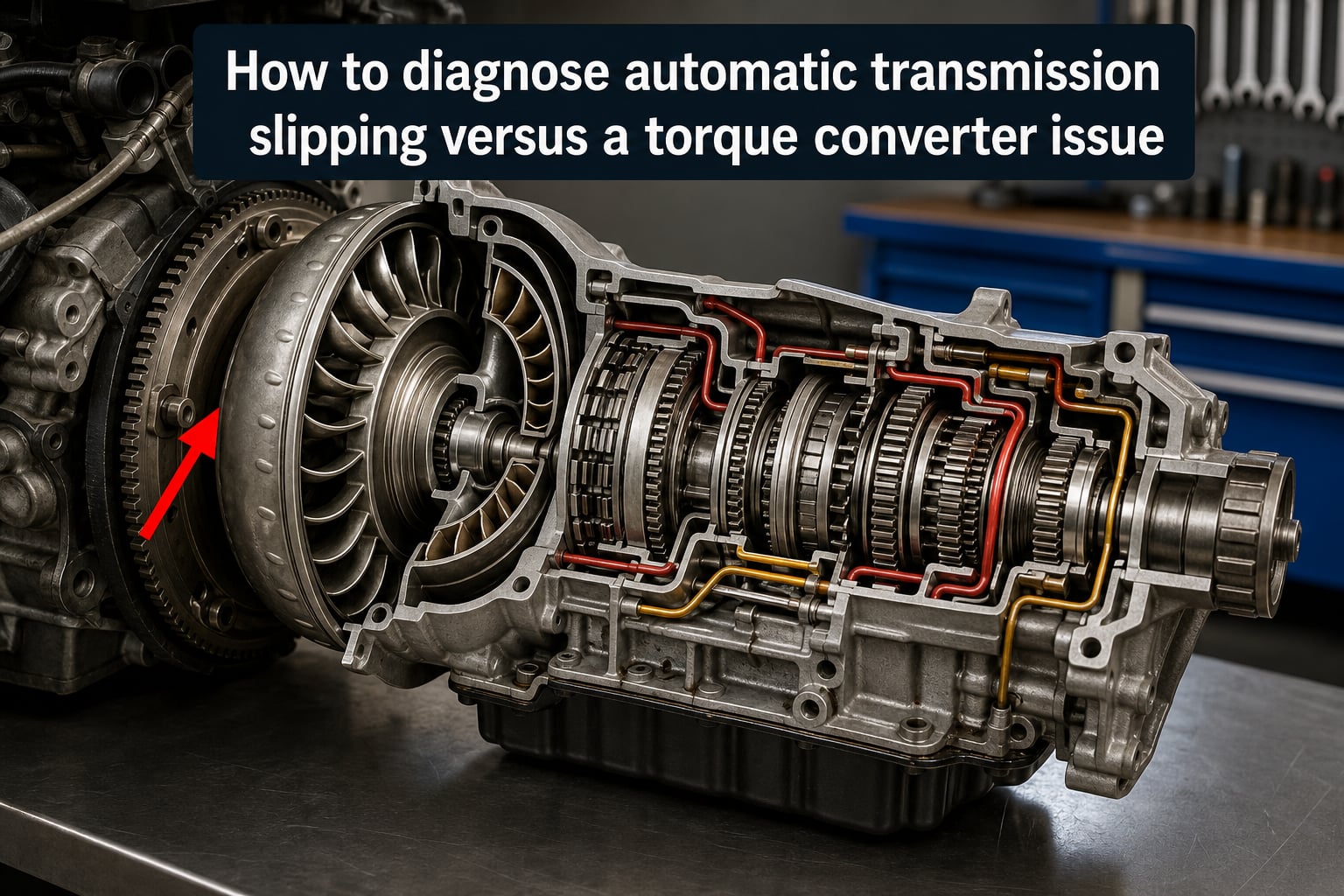
The torque converter is a fluid-filled, doughnut-shaped component bolted between the engine’s flexplate and the front of the transmission. It replaces the manual clutch and uses transmission fluid, centrifugal force, and internal curved blades to transfer engine power into the transmission input shaft.
Think of two fans facing each other. Turn one on, and the airflow spins the second fan even though nothing physically connects them. That is essentially how a torque converter works, except it uses hydraulic fluid instead of air. Inside are three main elements: the impeller (driven by the engine), the turbine (connected to the transmission), and the stator (which multiplies torque at low speeds).
Most modern torque converters also contain a lockup clutch, often called the torque converter clutch or TCC. This clutch physically locks the engine to the transmission at highway speeds, eliminating slippage and improving fuel efficiency. When the TCC malfunctions, it produces some of the most confusing symptoms drivers encounter.
The automatic transmission itself sits behind the converter and contains the gear sets, clutch packs, bands, valve body, and solenoids that actually change gear ratios. It relies on hydraulic pressure routed through the valve body to apply and release clutches at the right time. Without adequate fluid pressure or clean fluid, the clutches slip and gears fail to engage properly.
Here is the key relationship: the torque converter feeds power and hydraulic pressure into the transmission. If the converter fails, the transmission starves for input. If the transmission fails internally, the converter has nowhere to send its power. That interdependence is exactly why the symptoms overlap so heavily.
Symptoms of a Bad Torque Converter
Torque converter problems tend to show up at specific speeds and under specific load conditions rather than across all driving scenarios. Here are the signs I see reported most consistently across forums and repair shops:
1. Shuddering at 30 to 50 mph. This is the classic torque converter clutch symptom. The lockup clutch engages and disengages rapidly, creating a vibration that feels like driving over rumble strips. It typically appears right when the TCC locks up, usually between 30 and 50 mph under light throttle.
2. Slipping or loss of power under acceleration. The engine revs climb but the vehicle does not accelerate proportionally. This happens when the converter cannot transfer torque efficiently, often due to worn internal fins or degraded fluid.
3. Strange noises. A failing torque converter can produce a whining, growling, or buzzing sound that changes with engine speed. A rattling noise at idle that disappears when in gear may point to broken internal components.
4. Overheating transmission fluid. A bad converter generates excessive heat because it slips more than it should. If your transmission temperature gauge climbs higher than normal, the converter is a prime suspect.
5. Higher than normal stall speed. If the engine revs higher than expected before the vehicle starts moving from a stop, the converter’s internal stator may be failing. A healthy converter stalls at a predictable RPM based on its design.
6. Contaminated fluid with metal shavings. When the converter’s bushings or thrust washers wear out, they shed metal directly into the fluid. Pull the dipstick and you may see a silvery or sparkly sheen.
7. Engine stalling when coming to a stop. If the lockup clutch stays engaged when it should release, the engine stalls just like letting out the clutch on a manual without giving gas. This is a strong TCC indicator.
Symptoms of a Slipping Automatic Transmission
Transmission slipping produces a different pattern. Instead of speed-specific shudder, you get gear-related problems that happen across a wider range of driving conditions. Watch for these signs:
1. Delayed engagement. You shift from park to drive or reverse, and the car takes two, three, or more seconds before it actually moves. This points to low line pressure, worn clutch packs, or a failing pump inside the transmission.
2. Gears slipping out under load. The transmission drops out of gear while driving, especially under acceleration or climbing a hill. The engine flares up, then the gear catches again with a harsh thump.
3. Harsh or rough shifting. Instead of smooth gear changes, you feel hard clunks or jerks between gears. Worn clutches, faulty solenoids, or a sticking valve body all cause this.
4. RPM flare between gears. The tachometer jumps 500 to 1,000 RPM during a shift before settling back down. That flare means the clutches are not holding during the handoff between gears.
5. Fluid leaks underneath the vehicle. Red or brown puddles under the transmission pan, cooler lines, or output shaft seals indicate fluid loss. Low fluid causes slipping and accelerates internal wear.
6. Slipping only when hot. Many transmission problems appear only after the fluid reaches operating temperature, because heat thins the fluid and reduces hydraulic pressure. This is a common complaint in forum threads.
7. Loss of a specific gear. Losing overdrive or fourth gear alone is a frequent symptom. One Reddit user reported their transmission would not grab fourth gear at all once it warmed up, a classic sign of a burned overdrive clutch pack rather than a converter problem.
8. Check engine light with transmission codes. A scan tool reveals codes like P0730 (incorrect gear ratio) or P0750 through P0799 (solenoid circuit faults). These codes point directly to the transmission, not the converter.
How to Diagnose Automatic Transmission Slipping Versus a Torque Converter Issue?
Now for the core process. These diagnostic steps progress from the simplest checks to more advanced tests. Work through them in order and document what you find at each step.
Step 1: Check the Transmission Fluid
Warm up the vehicle, park on level ground, and pull the dipstick with the engine running in park or neutral (check your owner’s manual for the correct procedure). The fluid should be bright red or pink and smell slightly sweet. Dark brown or black fluid that smells burnt means the clutches are overheating inside the transmission. A milky appearance means coolant has mixed in through the transmission cooler.
Low fluid causes both converter and transmission problems, so top it off first and see if symptoms improve. If metal shavings glitter in the fluid, the damage is already done and internal components are failing.
Step 2: Scan for Trouble Codes
Plug in an OBD-II scan tool that reads transmission-specific codes, not just engine codes. TCC-related codes (P0740, P0741, P2769, P2770) point to the torque converter clutch circuit. Gear ratio codes (P0730 through P0736) and solenoid codes (P0750 through P0799) point to the transmission itself.
If you have a P0741 (TCC stuck off), the torque converter lockup clutch is the prime suspect. If you see P0730 (incorrect gear ratio), the transmission clutches are slipping and the converter is likely fine.
Step 3: Perform the Stall Speed Test
This test measures how high the engine revs before the converter stalls against the transmission. With the engine warm, apply the brake firmly, shift to drive, and floor the accelerator for no more than 3 to 5 seconds. Note the maximum RPM reached.
Compare your reading to the factory stall speed specification for your vehicle, typically between 2,000 and 2,500 RPM for stock converters. A stall speed significantly lower than spec suggests a worn or damaged converter. A stall speed far higher than spec indicates the converter is slipping excessively.
Warning: Do not hold the throttle wide open for more than 5 seconds. This test generates extreme heat. Let the transmission cool for at least two minutes between attempts, and never perform this test more than three times in one session.
Step 4: Road Test for Speed-Specific Symptoms
Drive at a steady 40 to 50 mph on a flat road with light throttle. Pay attention to whether a shudder or vibration appears at that speed and disappears when you accelerate or decelerate. That pattern is the signature of a TCC shudder problem in the torque converter.
Next, test hard acceleration from a stop. If the engine revs freely but the car barely accelerates, the converter may be failing to transfer torque. If the transmission shifts but slips between specific gears, the problem is inside the transmission.
Step 5: Test Hot vs Cold Behavior
Drive the vehicle cold and note how it behaves. Then drive for 20 minutes to fully warm the transmission and repeat the same route. If symptoms only appear when hot, the problem is likely internal transmission wear that worsens as fluid thins. Torque converter TCC shudder, by contrast, often appears once the transmission reaches operating temperature and the lockup clutch engages.
Step 6: Isolate the TCC
If you suspect the TCC, lightly touch the brake pedal while cruising at lockup speed (without actually braking enough to slow down). Most vehicles unlock the TCC when the brake is applied. If the shudder instantly disappears when you tap the brake, the torque converter clutch is your culprit, not the transmission gears.
Step 7: Check Line Pressure
This step requires a pressure gauge connected to the transmission’s test port. Low line pressure across all gears points to a worn pump or internal leakage inside the transmission. Normal pressure confirms the transmission hydraulics are healthy, shifting suspicion toward the converter.
If you reach this step and the results are still ambiguous, a professional shop can perform a more detailed pressure test and inspect the converter directly once the transmission pan is dropped.
Common Misdiagnoses to Avoid
Several other problems mimic torque converter or transmission symptoms and lead to unnecessary repairs. Before you commit to a diagnosis, rule out these lookalikes.
Engine misfires mistaken for TCC shudder. A misfire under light load at 45 mph feels remarkably similar to torque converter clutch shudder. The difference is that a misfire often triggers a check engine light with cylinder-specific codes (P0300 through P0308). Always scan for engine codes first before blaming the drivetrain.
Bad engine or transmission mounts. Worn mounts cause vibrations that resonate through the cabin at specific speeds. If the vibration disappears when you rev the engine in neutral, mounts are more likely than the converter.
Failing U-joints or CV axles. A worn U-joint produces a clunk when shifting from reverse to drive and a vibration under acceleration. Check for play in the driveshaft before assuming transmission trouble.
Low tire pressure or tire balance issues. A tire out of balance vibrates at highway speeds and is often mistaken for TCC shudder. The tell is that a tire vibration changes with road speed regardless of gear, while TCC shudder appears and disappears with converter lockup.
Contaminated or wrong transmission fluid. Using the wrong fluid type or fluid degraded past its service interval causes harsh shifting and slipping that mimics internal damage. A simple fluid and filter change resolves symptoms in many cases.
Repair Cost Comparison: Torque Converter vs Transmission
Cost is where the diagnosis matters most. Forum users consistently cite repair anxiety as their biggest pain point, and understanding the price range helps you make an informed decision.
Torque converter replacement typically runs $600 to $1,200 including parts and labor. The converter itself costs $150 to $500, and labor adds 4 to 8 hours at shop rates. However, many shops recommend replacing the front pump seal and flushing the transmission cooler at the same time, which adds $200 to $400.
Transmission rebuild ranges from $1,800 to $3,500 for most passenger vehicles. Heavy-duty trucks and luxury vehicles can reach $4,000 to $8,000 or more. A full transmission replacement with a new or factory remanufactured unit costs $3,000 to $8,000 installed.
Here is the catch: to replace the torque converter, the transmission must be removed from the vehicle. Many shops recommend rebuilding the transmission at the same time since labor is the bulk of the cost and the unit is already out. That is why a “just replace the converter” quote often turns into a full rebuild recommendation.
If a shop quotes $2,500 or more and you have confirmed TCC-specific codes with otherwise healthy transmission behavior, get a second opinion. The converter may be the only problem.
Preventive Maintenance to Protect Both Components
The number one killer of automatic transmissions is heat from degraded fluid. Fresh fluid maintains proper viscosity, carries away heat, and keeps hydraulic pressure where it needs to be. Follow these maintenance practices to extend the life of both your converter and transmission.
Change the fluid on schedule. Most manufacturers recommend fluid service every 30,000 to 60,000 miles for severe service (towing, city driving, hot climates) and up to 100,000 miles for light duty. Check your owner’s manual for the exact interval. If the fluid is dark or burnt, do not wait.
Use the correct fluid type. Modern transmissions require specific fluid formulations (Dexron, Mercon, ATF+4, CVT fluid, and others). Using the wrong fluid damages seals and causes clutch shudder within hundreds of miles.
Flush the cooler. Whenever the transmission is serviced or replaced, flush the cooler and lines. Debris trapped in the cooler flows right back into a new or rebuilt transmission and destroys it quickly.
Avoid towing in overdrive. Towing heavy loads in overdrive lugs the engine and stresses the TCC. Shift out of overdrive when towing near your vehicle’s capacity limit to reduce converter heat.
Let the vehicle warm up. Cold, thick fluid does not lubricate properly. Give the transmission 30 to 60 seconds to circulate fluid before driving hard, especially in winter.
Address leaks immediately. A small leak becomes a big problem fast. Low fluid causes the pump to cavitate, starves the converter, and burns clutches in a matter of miles.
When to Stop Diagnosing and Call a Mechanic
If you have checked the fluid, scanned for codes, and performed the road tests but the symptoms persist without a clear answer, it is time to involve a professional. A transmission shop can perform internal pressure testing, inspect the valve body, and evaluate the converter directly.
Stop driving immediately if you experience any of these red flags: the transmission will not move at all, you smell burning fluid, the vehicle lurches unexpectedly, or the check engine light flashes. Continued driving with severe slippage destroys hard parts and turns a repairable problem into a full replacement.
FAQs
How to tell if torque converter or transmission is slipping?
The fastest way to tell is by when symptoms appear. Torque converter problems usually cause shudder at 30-50 mph when the lockup clutch engages, while transmission slipping happens during gear shifts or under acceleration at various speeds. Scan for TCC codes (P0740-P0741) to confirm converter issues, or gear ratio codes (P0730) for transmission problems.
What can be mistaken for a bad torque converter?
Engine misfires, worn engine or transmission mounts, failing U-joints, tire balance problems, and contaminated transmission fluid can all mimic torque converter symptoms. Always scan for engine misfire codes and check fluid condition before concluding the torque converter is bad.
What can be mistaken for a slipping transmission?
Low transmission fluid, wrong fluid type, a sticking transmission solenoid, a faulty TCC, and even vacuum leaks on older vehicles can produce symptoms that look like internal transmission slipping. Start with a fluid check and code scan before assuming internal damage.
Can you fix a slipping torque converter?
In most cases, no. Torque converters are sealed units that cannot be rebuilt at home. A shop can sometimes add a friction modifier to the fluid to reduce TCC shudder temporarily, but a truly slipping converter requires replacement, which costs $600 to $1,200 including labor.
What is the number one killer of transmissions?
Heat from degraded or low transmission fluid is the number one killer of automatic transmissions. Fluid breaks down over time, loses its ability to carry heat and maintain hydraulic pressure, and allows clutches to burn. Regular fluid changes every 30,000 to 60,000 miles are the single most effective way to prevent transmission failure.
Conclusion
Diagnosing automatic transmission slipping versus a torque converter issue comes down to pattern recognition. Torque converter problems cluster around specific speeds (30 to 50 mph shudder, stall speed changes, TCC-related stalling), while transmission slipping shows up across gears, under load, and often worsens with heat.
Start with the basics: check fluid level and condition, scan for codes, and road-test at the speeds where symptoms appear. The brake-tap test for TCC shudder and the stall speed test are your most powerful DIY tools. If the results are ambiguous or the symptoms are severe, a professional transmission shop can take the diagnosis further.
Remember that a misdiagnosis here can cost thousands. Take the time to work through each step, document your findings, and get a second opinion before approving any major repair. Your wallet will thank you.