
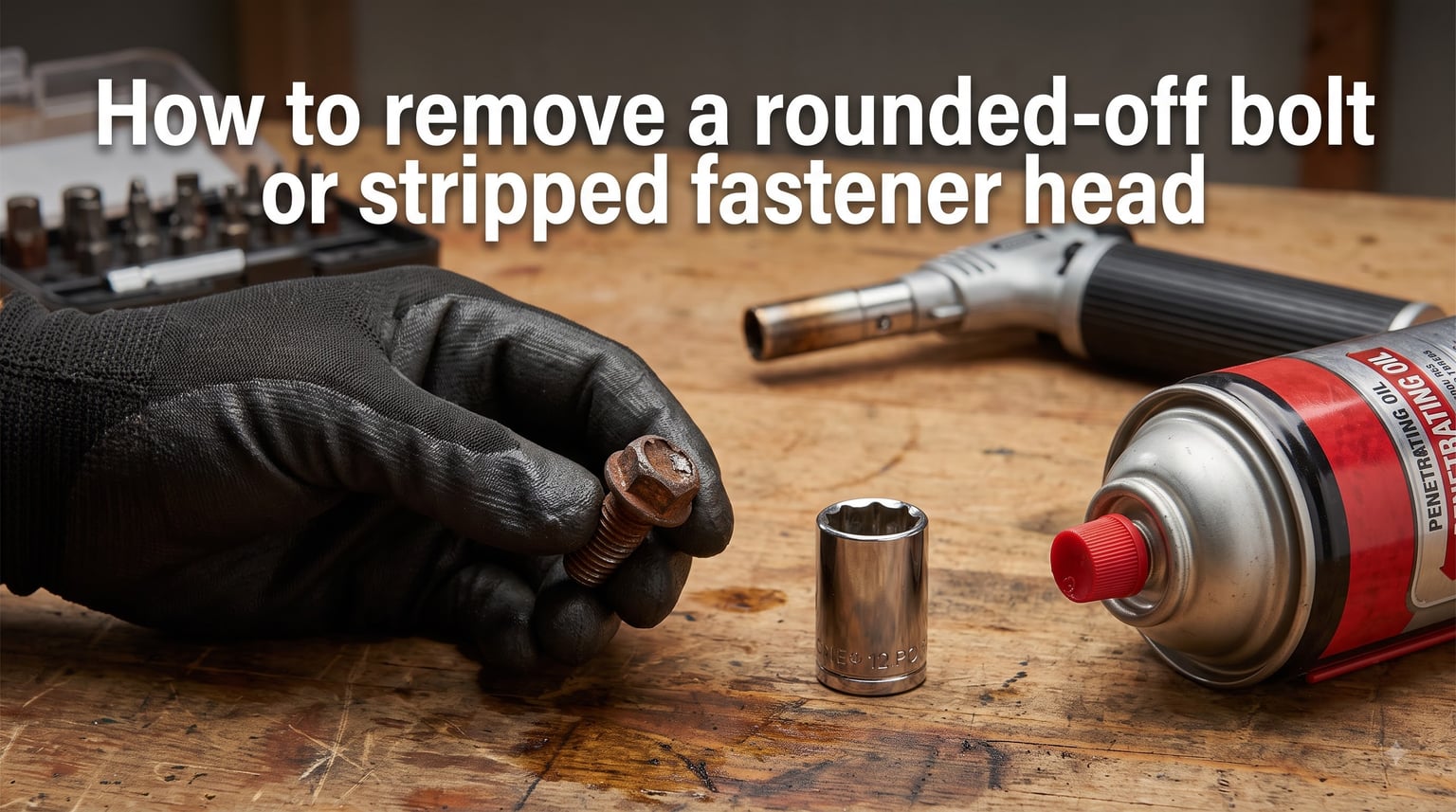
I’ve been there. You reach for a wrench, twist with confidence, and the tool just spins uselessly inside the bolt head. That sinking feeling is the universal signal of a rounded-off bolt, and it can turn a 10-minute job into an all-day headache.
This guide on how to remove a rounded-off bolt or stripped fastener head walks you through the seven techniques I rely on most, from simple penetrating oil tricks to drilling and welding. I’ll also cover the terminology that mechanics use, the tools that actually work, and the prevention habits that save you from this exact problem on the next job.
Table of Contents
What Is a Rounded-Off Bolt and Why Does It Happen?
A rounded-off bolt is a fastener whose driving interface (hex socket, Phillips head, Torx, or external hex) has been worn into a smooth, useless shape. The tool can’t grip, so it slips and rounds the head further with every attempt.
The most common trigger is cam-out. Cam-out happens when the tool tip rides up and out of the recess under torque, chewing the corners of the bolt head. Phillips and Allen bolts are especially prone to it. Force, the wrong size tool, or corrosion make it worse.
Stripped bolts often show up after years of exposure. Galvanic corrosion happens when two dissimilar metals (like aluminum and steel) sit together in the presence of moisture, slowly welding themselves into one crusty mass. Thread galling is similar but mechanical: stainless steel threads under friction cold-weld together, locking the fastener in place. Both conditions make extraction far harder than a simple “rounded” head.
Essential Tools You’ll Need Before You Start
I’ve learned to gather everything before I start. Hunting for a tool mid-job is how you lose a stripped bolt to gravity in the worst possible spot.
Penetrating oil (PB Blaster, Kroil, or Liquid Wrench)
Breaker bar or long-handled ratchet
Socket set (both standard and impact)
12-point sockets in one size smaller than the bolt
Bolt extractor kit (spiral or straight flute)
Left-hand drill bit set
Vice grips and locking pliers
Propane or MAPP gas torch
Safety glasses and gloves
7 Proven Methods to Remove a Rounded-Off Bolt or Stripped Fastener Head
I’ll move from the easiest, least destructive methods to the nuclear options. Try the early methods first because once you cut or drill, you can’t undo the damage.
Method 1: Apply Penetrating Oil and Heat
Penetrating oil is the cheapest first move. Soak the bolt head thoroughly and let it work for at least 15 minutes. I’ve found overnight soaking can break loose bolts that fought me for hours.
Heat is the secret weapon. A propane torch on the bolt head causes the metal to expand slightly, breaking the corrosion bond. Always heat the bolt head, not the surrounding part, because you want the fastener to expand more than the material it’s threaded into. After heating, immediately try to turn the bolt out.
Method 2: Use a Smaller Socket or Wrench
This trick caught me off guard the first time I saw it. A socket one size smaller than the bolt can sometimes bite into the rounded shoulders where the original tool could not. Tap the socket onto the bolt with a hammer so it deforms slightly into the damaged shape.
Once the smaller socket is seated, use a breaker bar for extra leverage. The slight interference fit provides grip that no correctly sized tool could ever achieve.
Method 3: Hammer a 12-Point Socket Onto the Head
A 12-point socket has more positions to choose from and slightly thinner walls than a 6-point socket. Pick a socket that almost fits, set it on the bolt, and strike it firmly with a hammer. The socket cold-forms around the rounded edges and locks into place.
I’ve recovered brake caliper bolts and suspension fasteners with this method when nothing else would grip. The key is striking it straight on so the socket doesn’t mushroom crooked.
Method 4: Use a Bolt Extractor Kit
A bolt extractor is a reverse-threaded tapered tool that bites into a pre-drilled hole and pulls the bolt out as you turn counterclockwise. Spiral flute extractors are aggressive and remove material as they bite. Straight flute extractors are gentler and last longer.
Drill a pilot hole using the size specified by your extractor kit, typically about half the bolt’s diameter. Don’t drill too deep. Apply penetrating oil, then insert the extractor and turn counterclockwise with steady pressure. The reverse threads will jam into the metal and walk the bolt out.
Method 5: Drill It Out with a Left-Hand Drill Bit
This is the technique the forums swear by, and for good reason. A left-hand drill bit spins counterclockwise, so the moment the bit catches, it tries to unscrew the bolt at the same time it’s drilling. Many rounded bolts come out during this step without ever needing an extractor.
Start with a bit smaller than the bolt’s inner diameter. Use slow, steady pressure and back the bit out frequently to clear chips. If the bolt doesn’t back out, switch to a slightly larger bit and finish the drilling, then move to Method 4 with an extractor.
Method 6: Weld a Nut On Top of the Bolt
When nothing grips, you build a new grip. Weld a nut directly onto the top of the rounded bolt head. The weld metal fills in the damaged area and gives you a fresh, intact hex to grab with a socket.
You need a welder and basic skill for this method. Clean the bolt head and surrounding area first, then build a small weld puddle around a sized-up nut. Once it cools, attach a socket and turn the bolt out. This is the method mechanics reach for on brake caliper bolts that have been rounded by previous owners.
Method 7: Use Vice Grips with a Breaker Bar
Vice grips can grab what’s left of the bolt head, especially if there’s any exposed shoulder or even a slight nick. Lock them on as tightly as possible, then attach the breaker bar to the vice grip handles for extra torque.
The Reddit mechanics community swears by this combination for stubborn fasteners. Don’t use a regular ratchet on the vice grips; you’ll twist the grips. A breaker bar lets you stand on the handle if needed.
| Method | Difficulty | Tools Needed | Best Use Case |
|---|---|---|---|
| Penetrating Oil and Heat | Easy | Oil, torch | Corroded, seized bolts |
| Smaller Socket | Easy | Socket, hammer | Slightly rounded heads |
| 12-Point Socket Hammered | Easy | 12-point socket, hammer | External hex bolts |
| Bolt Extractor Kit | Medium | Drill, extractor set | Stubborn damaged fasteners |
| Left-Hand Drill Bit | Medium | Drill, left-hand bits | Severely rounded bolts |
| Weld a Nut On | Hard | Welder, nut | Last resort before drilling |
| Vice Grips and Breaker Bar | Medium | Vice grips, breaker bar | Accessible bolts with shoulder |
Tight Space Solutions When No Tool Can Reach
Brake caliper bolts, derailleur limit screws, and stem bolts share one evil trait: they hide behind other components with almost no swing room. A regular ratchet won’t fit, and a breaker bar is impossible.
Start with a low-profile ratchet or a swivel socket. Impact-style wobbly sockets flex up to 45 degrees and often save the day. A right-angle drill attachment lets you drill straight when the bolt is in a tight recess.
For really impossible cases, cut a slot across the bolt head with a Dremel and use a flathead screwdriver. It’s rough on the bolt, but it works when nothing else will reach. I’ve had to do this on vintage car engine bay bolts squeezed between the firewall and the engine.
How to Prevent Rounded Bolts in the First Place
I’ve removed thousands of bolts over the years, and the ones that come out clean share one thing: someone cared for them before they got stuck.
Use the right tool every time. Match the Allen key or Torx bit specifically to the bolt size. Improvised tools are the fastest path to a rounded head. Apply anti-seize compound to threads, especially on stainless steel fasteners, before installation. Anti-seize prevents thread galling and lets you break the bolt loose years later.
Torque to spec. Overtightening is the prime cause of stripped heads. A torque wrench costs less than a single extraction job. Clean threads before assembly so grit and debris don’t change the friction that throws off your torque readings.
When to Stop and Call a Professional?
I’ve pushed my luck on bolts I shouldn’t have. Some jobs deserve a mechanic. If you feel the bolt starting to twist off and snap, stop. Breaking a bolt below the surface is a much bigger repair than the original problem.
If the bolt is in a critical safety component like a brake caliper, suspension arm, or steering knuckle, the extraction cost is higher than the part cost. If you don’t have a welder for the nut method, leave it to a shop. If the bolt sits in a position where a slip will damage wiring, fuel lines, or sensors, the risk is not worth saving a service fee.
Most mechanics charge an hour or two for stripped bolt extraction. They have air tools, welders, and experience that make a 30-minute job. Compare that to the cost of a damaged component or a broken bolt that needs drilling and re-tapping.
FAQs
How to get a bolt out that has a stripped head?
Start by applying penetrating oil and letting it soak for at least 15 minutes. Then try a smaller socket hammered onto the head, or use a bolt extractor kit. For severe cases, drill with a left-hand drill bit which often backs the bolt out as it bites. Move to welding a nut on top only if simpler methods fail.
How to get a rounded bolt out without an extractor?
Use a 12-point socket one size smaller than the bolt, hammered firmly onto the rounded head. Vice grips with a breaker bar also work if any shoulder remains. Heat from a propane torch on the bolt head expands the metal and breaks corrosion bonds, often freeing the bolt without specialty tools.
Can I remove a stripped bolt without a tool?
No specialty tool is required for lighter cases. Penetrating oil, a smaller socket, hammer, and a propane torch are common household items that handle most rounded bolts. Heat alone often loosens seized fasteners. For bolts with no usable grip left, a drill is the minimum tool needed.
How to get a rounded cap head bolt out?
Cap head or Allen bolts round easily when the wrong size hex key is used. Start with the correct size Allen key stuck into the rounded socket, then apply firm pressure and strike the end with a hammer to seat it. If that fails, drill a small hole and use a stripped bolt extractor, or weld a nut to the bolt head for a fresh grip.
Final Thoughts on Removing a Rounded-Off Bolt
Stripped bolts are frustrating, but rarely impossible. Move from gentle methods to aggressive ones, and keep penetrating oil and heat nearby for every step. Most fasteners will surrender to persistence and the right tool.
Once the bolt is out, take 30 seconds to clean the threads, apply anti-seize, and torque to spec. That small habit is the difference between a job you finish and a job you finish twice. With these techniques on how to remove a rounded-off bolt or stripped fastener head, you’ll rarely lose a fastener again.