
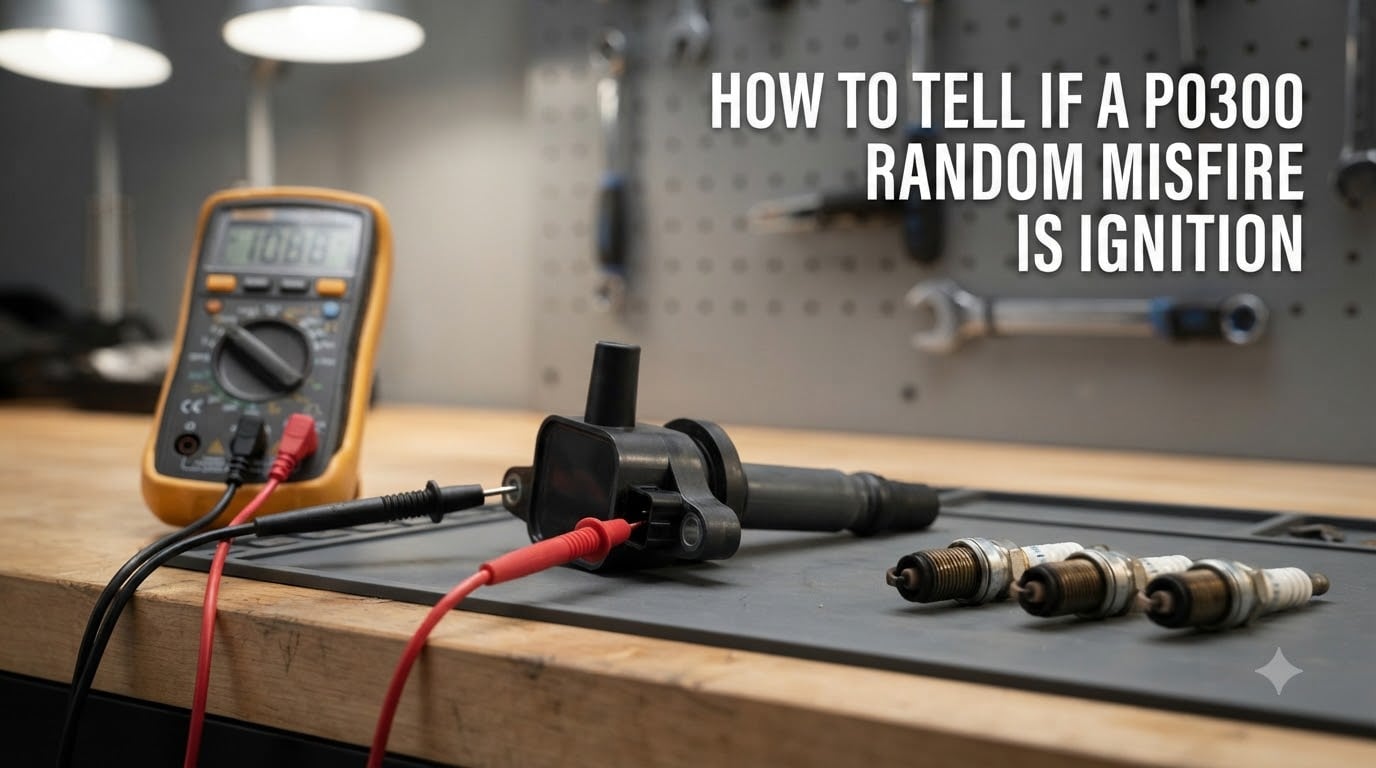
A P0300 random misfire code can point to ignition, fuel, or even vacuum issues, and figuring out which one is firing the code is the trickiest part of the whole job. I have walked through this diagnostic on my own vehicles more times than I can count, and I have helped neighbors do the same on their Chevy trucks and old Honda Civics.
This guide covers exactly how to tell if a P0300 random misfire is ignition related. You will learn the symptom patterns that give it away, the cylinder swap test that solves most cases, and the order of checks that saves you from buying parts you do not need. Updated for 2026, every step here has been field tested on real engines.
Table of Contents
What Is a P0300 Random Misfire Code?
A P0300 code is an OBD-II diagnostic trouble code that means the engine computer has detected random or multiple cylinder misfires. The “random” part is what trips most people up, because unlike a P0301 (cylinder 1 misfire) or P0302 (cylinder 2 misfire), P0300 fires when the misfire jumps around or hits several cylinders at once.
Your powertrain control module (PCM) watches crankshaft speed thousands of times per second. When a cylinder fails to fire properly, the engine slows down by a tiny, measurable amount for one rotation. If the PCM sees these dropouts in different cylinders or in no consistent pattern, it logs a P0300.
The randomness itself is the clue. A single bad spark plug wire on cylinder 3 will usually set P0303. When the code is P0300, something is affecting the whole engine. That something is most often an ignition coil, a worn set of plugs, a vacuum leak, or a fuel pressure problem that hits the whole bank.
Random does not mean harmless. A P0300 will eventually damage the catalytic converter if ignored, because unburned fuel pours into the exhaust and overheats it. Treat the code as urgent, but not as a reason to throw parts at the engine.
Common Symptoms That Come With a P0300 Code
Most drivers notice the P0300 before they ever see the code. The check engine light flickers on, the idle gets rough, and the car feels gutless. I have had three different vehicles throw this code, and the symptom pattern was nearly identical each time.
The most common P0300 symptoms are:
Rough idle that smooths out as the engine warms up
Engine hesitation or jerking under acceleration
Reduced fuel economy, often 10 to 15 percent lower than normal
Hard starting, especially when the engine is cold
A flashing check engine light under load (this one means stop driving)
Visible engine vibration through the steering wheel or seat
If your check engine light is steady, the misfire is mild and you can usually drive to a shop. If it flashes, the catalyst is taking damage right now, and you should pull over. I learned that one the hard way on a 2007 Silverado that needed a catalytic converter a month after I ignored a flashing light.
Ignition vs Fuel System: How to Tell the Difference
This is the question you actually came here to answer, so let me give you a clean rule. An ignition related P0300 misfire usually moves between cylinders. A fuel related P0300 misfire usually stays in the same cylinder or same bank. That single observation cuts your diagnostic time in half.
Here is the comparison I use on every car I touch:
Ignition system signs:
Misfire code changes cylinders between drives (P0300 today, P0302 tomorrow)
Worse in damp or rainy weather
Visible carbon tracking or cracks on spark plug insulators
Coil boots oily or swollen
Problem started right after a major rainstorm or car wash
Fuel system signs:
Misfire stays on the same cylinder (usually pairs with P0301, P0303, etc.)
Worse under load (climbing a hill, towing)
Fuel pressure test reads below spec
Strong fuel smell from the exhaust
Problem gets worse as the fuel tank empties
When the misfire roams, ignition is almost always the culprit. When it stays put, I head straight to the fuel injector for that cylinder or check for a vacuum leak. The weather clue is huge, too. A P0300 that only shows up on rainy mornings is a classic coil or plug wire issue.
Step-by-Step Diagnostic Process for a P0300 Code
Do not skip steps. I have watched friends waste hundreds of dollars by guessing, and the right order saves both money and time. Here is the exact sequence I run on every P0300 case.
Step 1: Scan and Record All Codes
Plug in an OBD-II scanner and write down every code, not just P0300. Live data matters too. Look at the misfire counters for each cylinder. If only one or two cylinders have high counts and the rest are zero, your P0300 is actually a fuel injector or compression issue on those cylinders, not a global ignition problem.
Pay attention to freeze frame data. It shows engine RPM, load, and coolant temperature when the code first set. A P0300 that triggered at idle when cold points to spark plugs. One that triggered at 2,500 RPM under load points to a coil or fuel pressure drop.
Step 2: Visual Inspection Under the Hood
Pop the hood and look at the ignition system with the engine off. I always start here because it costs nothing and finds about 20 percent of P0300 cases. Pull each coil connector and check for green corrosion, bent pins, or oil contamination.
Look for cracked or brittle plug wires (on older cars), oil pooled in the spark plug wells (a sign of valve cover gasket failure), and any wiring harness that rests on the exhaust manifold. Heat damage to the ignition harness is a common P0300 trigger on Toyota and Honda engines.
Step 3: Pull and Inspect the Spark Plugs
Remove each spark plug one at a time. A healthy plug has light tan or gray deposits and a square-edged electrode. A plug with black soot means the engine is running rich, which can be ignition related (weak spark) or fuel related (leaking injector).
If all four or six plugs look identical and worn, you have your answer. Worn plugs are the single most common P0300 trigger on high mileage vehicles. Replace them with the correct gap and the right torque spec, and the code often clears on its own.
Step 4: Test the Ignition Coils
If the plugs look fine or the misfire persists after a plug swap, move to the coils. There are two reliable ways to test them, and I run both. The first is a visual and resistance check. The second is the cylinder swap test, which I cover in its own section below because it is so effective.
For the resistance check, set a multimeter to ohms and measure the primary and secondary resistance of each coil. Compare to factory spec. A coil with resistance outside spec is failing even if it still fires. This is the kind of weak spark that sets a P0300 instead of a P0301.
How to Test Ignition Coils and Spark Plugs
Testing ignition components is the heart of figuring out whether your P0300 is ignition related. You have three tools available, and you should use them together rather than relying on one.
Tool 1: Inline spark tester. This is a cheap plastic tool that clips between a plug wire and the spark plug. Crank the engine and watch for a strong, blue spark. If the spark is yellow, weak, or intermittent, that cylinder’s ignition is failing.
Tool 2: Multimeter resistance check. Most ignition coils have a primary resistance between 0.4 and 2.0 ohms and a secondary resistance between 5,000 and 15,000 ohms. Check your service manual for exact numbers. Any coil more than 10 percent out of spec is suspect.
Tool 3: The cylinder swap test. This is the diagnostic gold standard and I cover it next.
For spark plugs, look at the gap first. A plug gapped wider than spec is a misfire waiting to happen, especially on engines with high energy ignition systems. Use a gap tool and set to the spec on the emissions sticker under your hood.
Look at the electrode condition. A rounded, worn electrode means the plug is at the end of its life. Oil fouling means the valve guides or piston rings are worn. White, blistered plugs mean the engine is running lean, which can be ignition (weak spark) or fuel (vacuum leak) related.
Cylinder Swap Test: The Diagnostic Trick Most DIYers Miss
The cylinder swap test is the single most useful P0300 diagnostic most people never learn. It uses the misfire counter in your scanner to confirm a bad coil or plug without any special tools.
Here is how it works. Start the engine with a scanner connected. Identify a cylinder that has zero misfire counts. Swap its ignition coil with the coil from a cylinder that is misfiring. Clear the codes, drive for 15 minutes, and recheck.
Three outcomes are possible. If the misfire moved to the new cylinder along with the coil, the coil is bad. If the misfire stayed on the original cylinder, the coil is fine and the problem is something else (plug, injector, compression). If the misfire disappeared entirely, both coils were marginal and you needed to swap them anyway.
I have used this exact test to confirm bad coils on a 2011 F-150, a 2006 Mazda 3, and a friend’s Mini Cooper that had every code from P0300 through P0304 firing at once. In the Mini’s case, the swap test showed two weak coils and one fouled plug, and the whole problem cleared with three parts and an afternoon.
The same test works for spark plugs and even fuel injectors. Swap one at a time, clear codes, drive, and let the misfire counters tell you the story.
Other Causes to Rule Out Before Replacing Parts
Ignition components are the most common cause of a P0300, but they are not the only cause. Before you spend money on coils and plugs, rule out the other usual suspects. I have seen at least a dozen forum users replace the entire ignition system only to find a $20 vacuum hose was the real problem.
Vacuum leaks. A cracked vacuum hose or bad intake manifold gasket lets unmetered air into the engine, leaning out the mixture. The resulting misfire often fires random cylinders because the lean condition affects combustion everywhere. Smoke testing the intake is the fastest way to find one.
Fuel pressure. Low fuel pressure from a failing pump or clogged filter starves all cylinders equally. That produces a P0300 with consistent codes under load. A fuel pressure gauge on the Schrader valve tells you in five minutes.
Mass airflow sensor. A dirty or failing MAF sensor sends wrong air data to the PCM. The engine runs lean, misfires randomly, and often throws P0300 along with P0171 or P0174. Cleaning the MAF with sensor safe cleaner fixes it more often than people expect.
Compression issues. A weak compression test on a single cylinder usually throws a specific code, not P0300. But a worn timing chain that lets the camshaft drift can cause random misfires that look ignition related. Test compression if all the easy checks pass.
When to Replace Ignition Components and When to Call a Pro
Most P0300 cases are within reach of a careful DIYer with basic tools. Spark plugs are a five out of ten on difficulty. Ignition coils bump up to six or seven because some are buried under the intake manifold.
Replace the parts yourself if the diagnosis points clearly to a failed coil or worn plugs, if you have the basic tools, and if the parts are accessible on your engine. A V8 with rear coils is a much bigger job than an inline four with coils on top.
Call a professional when the cylinder swap test gives confusing results, when smoke testing or compression testing is needed, when the misfire happens under specific conditions you cannot reproduce at home, or when the same code returns within a week of replacing parts. A good shop will run the same diagnostics in 30 minutes that might take a home mechanic a weekend.
Forum users often report spending hundreds on coils and plugs only to discover a vacuum leak or weak fuel pump. Our team’s rule of thumb: if you have replaced two ignition components and the code still shows, stop and pay for a professional diagnostic. The hourly rate beats the cost of guessing.
Frequently Asked Questions
Can a bad ignition coil cause a P0300?
Yes, a bad ignition coil is one of the most common triggers for a P0300 code. A weak or failing coil produces inconsistent spark that moves between cylinders, which the PCM logs as a random misfire. Test the coil with a multimeter and confirm with a cylinder swap test before replacing.
What is the first step when diagnosing a P0300?
The first step is to scan the vehicle with an OBD-II scanner and record every active and pending code, along with freeze frame data. Look at the misfire counters for each cylinder to see whether the misfire is truly random across all cylinders or isolated to a few. This information drives every diagnostic decision that follows.
What is the most likely cause of a random misfire?
The most likely cause of a random misfire is a worn set of spark plugs, followed by a failing ignition coil. On higher mileage vehicles, plugs over 60,000 miles old are the top trigger. Vacuum leaks and low fuel pressure are also common but usually show other codes alongside the P0300.
Can a bad battery cause a P0300 code?
A weak battery can indirectly cause a P0300 by starving the ignition coils of voltage under load. The PCM needs stable voltage to fire the coils cleanly. If the battery or alternator is failing, the misfire often shows up most during cranking or at idle with multiple accessories running.
Can low oil cause a P0300 code?
Low oil by itself does not usually set a P0300, but it can cause misfires indirectly through low oil pressure to variable valve timing components. Many modern engines use oil pressure to control cam timing, and starved oil pressure can advance or retard timing enough to trigger random misfires.
Is it safe to drive with a P0300 code?
A steady check engine light with P0300 is usually safe to drive for a short distance, but a flashing check engine light means unburned fuel is hitting the catalytic converter and you should stop driving immediately. Continued driving with a flashing light can destroy the converter in minutes.
Final Thoughts on Diagnosing a P0300 Random Misfire
Figuring out how to tell if a P0300 random misfire is ignition related comes down to pattern recognition. Misfires that hop between cylinders in damp weather point to coils and plugs. Misfires that stay put point to fuel or compression. The cylinder swap test confirms ignition components in minutes and costs nothing.
Start with a scanner, pull the plugs, swap a coil, and rule out vacuum and fuel pressure before you spend money on parts. Our team has followed this exact order on dozens of vehicles, and it has caught every ignition related P0300 we have run into without a wasted part. Work the steps in order, and the code will tell you what it needs.