
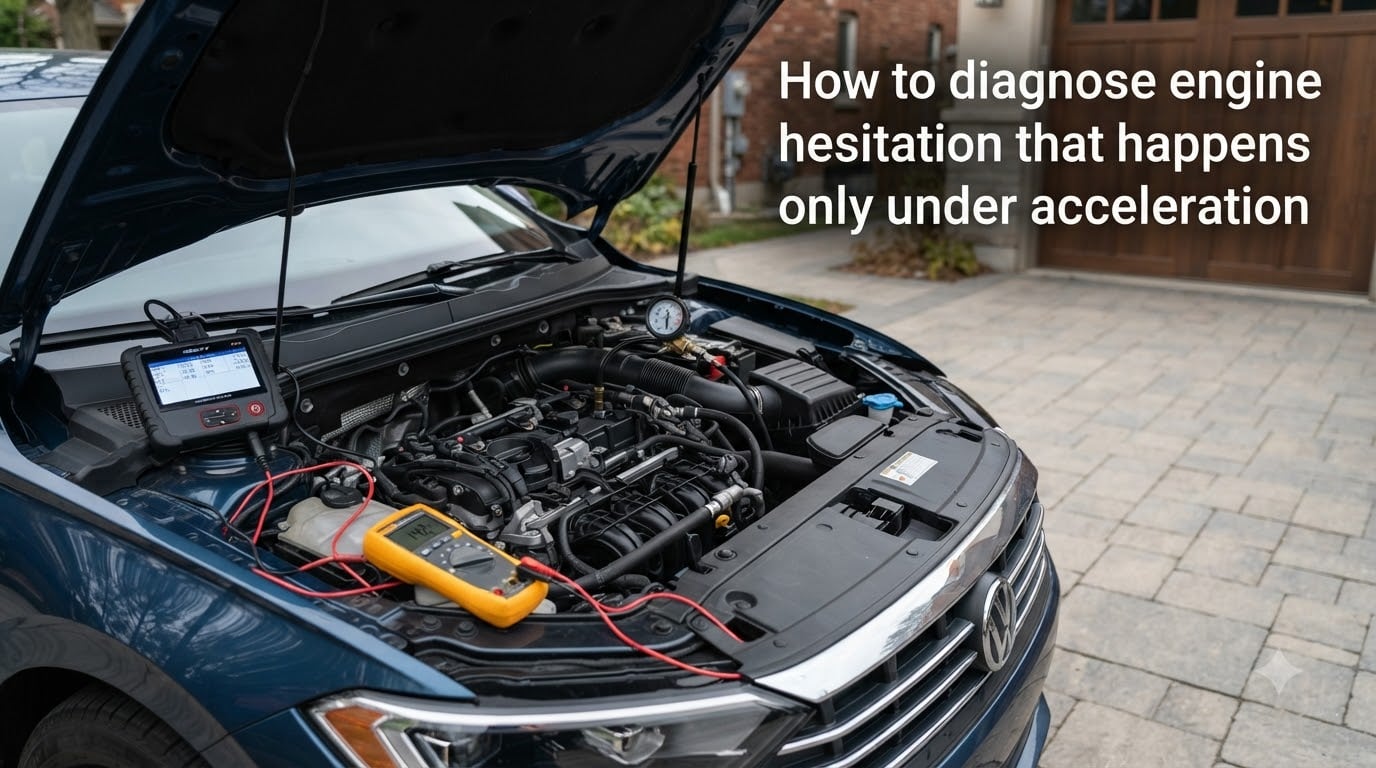
Engine hesitation under acceleration is one of the most frustrating problems a driver can experience. You press the gas pedal, and instead of smooth power delivery, the car stumbles, jerks, or feels like it is gasping for breath. When this hesitation only happens under acceleration and your engine idles perfectly fine, the diagnosis changes significantly.
In this guide, I will walk you through exactly how to diagnose engine hesitation that happens only under acceleration. We will cover fuel system causes, ignition failures, sensor problems, vacuum leaks, and a step-by-step diagnostic procedure you can follow yourself. Whether you drive a Honda Ridgeline that hesitates between 25 and 50 mph or a Nissan that stutters after an hour of driving, the methods below will help you isolate the root cause.
Acceleration-only hesitation is different from general rough running because it points to systems that only fail under load. Fuel demand spikes, ignition voltage requirements increase, and sensors must respond faster. Understanding this difference is the key to finding the problem quickly.
Table of Contents
What Engine Hesitation Under Acceleration Feels Like?
Engine hesitation under acceleration feels like a brief loss of power when you press the gas pedal. The car may jerk forward in short bursts, sputter, or stumble before eventually picking up speed. Some drivers describe it as a flat spot in the throttle response.
The sensation can range from a subtle lag to violent bucking that feels like the engine is about to stall. You might notice a single hiccup when you first step on the gas, or continuous stuttering all the way through the acceleration range. Sputtering sounds from the exhaust often accompany the jerking motion.
What makes this specific is that the engine runs smoothly at idle and during steady cruising. The problem only appears when you demand more power. That distinction eliminates a whole category of causes and narrows your search to systems that are stressed under load.
Why Hesitation Only Under Acceleration Is Different?
Acceleration places the engine under load, which dramatically increases the demand for fuel, air, and spark. At idle, the engine needs only a small amount of each. When you accelerate, fuel pressure must rise, injectors must deliver more fuel, ignition coils must produce higher voltage, and sensors must adjust the air-fuel mixture in milliseconds.
This means a component that works fine at idle can completely fail under acceleration. A fuel pump delivering 40 psi at idle might drop to 30 psi under load, causing lean misfires. An ignition coil with hairline cracks can fire normally at low RPM but break down when cylinder pressure increases. A MAF sensor that reads slightly off at idle gets badly out of range when airflow doubles.
Understanding this load-dependent behavior is why you should never assume the problem is gone just because the engine idles smoothly. The fault is hiding in a system that only breaks under stress.
Fuel System Causes
The fuel system is one of the most common sources of acceleration-only hesitation. When fuel delivery cannot keep up with engine demand, the mixture goes lean and the engine stumbles.
Clogged Fuel Injectors
Dirty or clogged fuel injectors are a leading cause of hesitation during acceleration. Carbon deposits build up on injector nozzles over time, restricting the spray pattern and reducing fuel flow. When you accelerate, the engine needs more fuel than the restricted injectors can deliver.
Symptoms include rough running under load, reduced fuel economy, and a noticeable flat spot when you step on the gas. Forum users on r/MechanicAdvice frequently report that hesitation from dirty injectors starts gradually and worsens over thousands of miles.
Running a quality fuel system cleaner through the tank can sometimes resolve minor deposits. If the hesitation persists after treatment, the injectors may need professional ultrasonic cleaning or replacement.
Weak Fuel Pump
A failing fuel pump is another common culprit. The pump may deliver adequate pressure at idle but cannot maintain that pressure when the engine demands maximum fuel flow during acceleration.
You can identify a weak pump by connecting a fuel pressure gauge and watching the reading while a helper revs the engine. If pressure drops significantly under load, the pump is failing. A healthy fuel pump should maintain steady pressure within the manufacturer’s specified range at all RPM levels.
Clogged Fuel Filter
A restricted fuel filter produces symptoms nearly identical to a weak fuel pump. The filter traps debris over tens of thousands of miles, and eventually the restriction starves the engine of fuel under load.
If your vehicle has an external, serviceable fuel filter, replacing it is an inexpensive first step. Many modern vehicles have the filter integrated into the pump assembly inside the tank, making it harder to service.
Fuel Pressure Regulator
The fuel pressure regulator maintains correct fuel pressure across all operating conditions. A stuck or leaking regulator can cause pressure to drop during acceleration, producing the same hesitation as a weak pump.
Some regulators have vacuum lines that can crack or split. A leaking vacuum line to the regulator will cause rich running at idle and lean stumbling under acceleration.
Ignition System Causes
The ignition system must produce a spark powerful enough to ignite the air-fuel mixture under high cylinder pressure. During acceleration, compression pressures rise and the spark needs more voltage to jump the plug gap.
Worn Spark Plugs
Worn or fouled spark plugs are one of the most common causes of acceleration hesitation. As electrode material erodes over time, the plug gap widens and the spark weakens. Under load, the weakened spark cannot reliably ignite the mixture, causing misfires that feel like hesitation or jerking.
If your spark plugs have more than 30,000 miles on copper plugs or 60,000 miles on iridium plugs, they are due for inspection. Look for excessive gap, carbon fouling, oil fouling, or cracked insulators.
Failing Ignition Coils
Ignition coils convert low battery voltage into the thousands of volts needed to fire the spark plug. Coils with internal winding damage or hairline cracks in the housing can fail intermittently under load.
A coil that works fine at idle may break down when cylinder pressure peaks during acceleration. This is one of the trickiest problems to diagnose because the failure is not constant. Using an OBD-II scan tool to check for specific cylinder misfire codes (P0301 through P0312) can pinpoint the failing coil.
Spark Plug Wire and Boot Issues
On older vehicles with distributor-based ignition, spark plug wires can develop cracks or carbon tracking. Moisture intrusion in the boots causes arcing that worsens under load. Inspect wires for visible damage and check resistance with a multimeter.
Sensor and Air Intake Causes
Engine sensors tell the computer exactly how much air and fuel to deliver. A sensor that reports incorrect data under acceleration will cause the computer to miscalculate the mixture, producing hesitation.
Dirty MAF Sensor
The mass airflow (MAF) sensor measures the volume of air entering the engine. A dirty MAF sensor underreports airflow, causing the computer to deliver too little fuel and creating a lean condition that triggers hesitation during acceleration.
This is one of the most frequently mentioned causes on automotive forums. The fix is often simple: remove the MAF sensor and clean the sensing element with specialized MAF cleaner spray. Never touch the sensing wire with your fingers or use generic cleaners, as both can destroy the sensor.
After cleaning, disconnect the battery for 10 minutes to reset the learned fuel trims. Many drivers report the hesitation disappears immediately after this procedure.
Throttle Position Sensor
The throttle position sensor (TPS) tells the computer how far the gas pedal is pressed. A failing TPS can develop dead spots that cause momentary signal dropouts when the throttle opens during acceleration.
You can test the TPS with a multimeter by slowly opening the throttle and watching for smooth voltage changes. Any sudden jumps or drops in the reading indicate a worn sensor that needs replacement.
Oxygen Sensor
A sluggish oxygen sensor can cause the computer to make slow fuel adjustments. During acceleration, the engine transitions through different operating modes rapidly, and a slow O2 sensor cannot keep up.
OBD-II codes like P0130 through P0167 point to oxygen sensor circuit problems. If your check engine light is on and you have O2 sensor codes alongside hesitation, the sensor is a likely contributor.
Dirty Air Filter
A severely clogged air filter restricts airflow into the engine, reducing power and causing sluggish acceleration. This is the easiest cause to check and fix. Hold the filter up to a light source. If you cannot see light through the element, replace it.
Throttle Body Carbon Buildup
Carbon deposits accumulate around the throttle plate over time, especially on direct-injection engines. This buildup restricts airflow at low throttle angles and can cause stumbling when the throttle first opens during acceleration.
Cleaning the throttle body with throttle body cleaner and a soft rag often resolves low-speed hesitation. After cleaning, the idle may need to relearn, which typically happens automatically after a few minutes of driving.
Vacuum Leaks and Acceleration Hesitation
A vacuum leak introduces unmetered air into the intake manifold, leaning out the air-fuel mixture. At idle, the computer can often compensate by adding fuel trims. Under acceleration, the leak becomes a larger percentage of total airflow and overwhelms the computer’s ability to adjust.
Vacuum leaks are a common culprit that forum users on r/autorepair report frequently. Leaks often worsen as the engine warms up, because heat expands rubber hoses and cracks open further. This explains why many drivers experience hesitation only after the engine reaches operating temperature.
Common leak sources include cracked vacuum hoses, failed intake manifold gaskets, leaking PCV valves, and cracked brake booster lines. A smoke test is the most reliable way to find vacuum leaks. A smoke machine pressurizes the intake system and reveals escaping smoke at the leak point.
Without a smoke machine, you can use a propane torch (unlit) or carburetor cleaner to spray around suspected leak areas while the engine idles. If the idle speed changes, you have found a leak. Use this method with caution around hot exhaust components.
How to Diagnose Engine Hesitation Under Acceleration: Step-by-Step
Follow this diagnostic procedure in order. Each step builds on the previous one, starting with the easiest and most common checks.
Step 1: Scan for OBD-II codes. Plug in an OBD-II scanner even if the check engine light is off. Pending codes often exist without triggering the light. Look for misfire codes (P0300 series), lean condition codes (P0171, P0174), MAF codes (P0100 series), and oxygen sensor codes. These codes immediately narrow your search.
Step 2: Check the air filter. Remove and inspect the air filter element. Replace it if it is dark, clogged, or oil-soaked. This takes two minutes and rules out the simplest cause.
Step 3: Clean the MAF sensor. Remove the MAF sensor from the intake tube and spray the sensing element with MAF cleaner. Let it dry completely before reinstalling. Reset fuel trims by disconnecting the battery for 10 minutes.
Step 4: Inspect ignition components. Remove spark plugs and check gap, electrode wear, and fouling. Inspect ignition coils for cracks and carbon tracking. Swap coils between cylinders to see if a misfire code follows the coil, confirming a failure.
Step 5: Test fuel pressure. Connect a fuel pressure gauge to the fuel rail test port. Note the pressure at idle, then have a helper rev the engine. Compare readings to the manufacturer’s specification. Pressure that drops under load indicates a pump, filter, or regulator problem.
Step 6: Perform a vacuum leak test. Use a smoke machine if available. Alternatively, spray carburetor cleaner around intake gaskets, vacuum hoses, and the throttle body while the engine idles. Listen for RPM changes that indicate a leak.
Step 7: Inspect the throttle body. Remove the intake tube and examine the throttle plate for carbon buildup. Clean deposits with throttle body cleaner and a soft cloth. Reconnect and allow the idle to relearn.
Step 8: Check fuel injector operation. Listen to each injector with a mechanic’s stethoscope while the engine runs. A clicking sound means the injector is firing. No clicking or a muffled sound suggests a clogged or dead injector.
Step 9: Test-drive with a scan tool connected. Monitor live data during acceleration. Watch fuel trims, MAF readings, throttle position, and oxygen sensor voltage. Fuel trims that max out positive under load confirm a lean condition. A MAF reading that does not rise proportionally with RPM confirms a sensor issue.
Step 10: Evaluate transmission if engine checks pass. If all engine systems test normally, the hesitation may be transmission-related. A failing torque converter, worn clutch packs, or a faulty shift solenoid can mimic engine hesitation. Forum users frequently note that transmission problems are misdiagnosed as engine issues.
Temperature-Related Hesitation Patterns
The temperature at which hesitation occurs provides valuable diagnostic clues. Cold engine hesitation that smooths out as the engine warms typically points to a faulty engine coolant temperature sensor or a rich-running condition from leaking injectors.
Hesitation that appears only after warm-up is more common and usually indicates a component that fails when hot. Ignition coils, crankshaft position sensors, and fuel pump modules are notorious for heat-related failures. Vacuum leaks also worsen with heat because rubber hoses expand and crack.
Drivers on r/cars frequently report hesitation after highway driving that disappears after a cooldown period. This pattern almost always points to an ignition component or fuel pump failing under sustained thermal load.
Common Misdiagnosis Pitfalls
Many DIYers throw parts at the problem without proper testing. Replacing all spark plugs and coils without scanning for codes wastes money and may not fix the issue. Always start with an OBD-II scan, even if the check engine light is off.
Another pitfall is confusing transmission shudder with engine hesitation. A torque converter shudder feels similar but occurs at specific speeds, typically between 30 and 50 mph under light throttle. If the hesitation feels like a vibration rather than a stumble, suspect the transmission.
Ignoring fuel pressure testing is a third common mistake. Many assume the fuel pump is fine because the engine starts and idles. Only a pressure test under load confirms whether the pump can meet demand during acceleration.
When to Call a Professional
If you have completed the diagnostic steps above and the hesitation persists, it is time to consult a professional mechanic. Intermittent electrical failures, internal engine problems, and transmission issues often require specialized equipment and experience to diagnose accurately.
A professional shop can perform compression tests, use advanced scan tools to monitor data in real time, and conduct load testing on a dynamometer. These capabilities go beyond what most DIYers have in a home garage.
Do not ignore persistent acceleration hesitation. Driving with a lean condition or active misfires can damage the catalytic converter and, in severe cases, cause internal engine damage that costs far more than the original repair.
FAQs
Why does my car hesitate a little when accelerating?
Your car hesitates when accelerating because the engine is not receiving the correct mixture of fuel, air, and spark under load. The most common causes are dirty fuel injectors, worn spark plugs, a dirty MAF sensor, a weak fuel pump, or a vacuum leak. Start by scanning for OBD-II codes and checking the air filter and MAF sensor.
Why does my car stutter a little when I accelerate?
Stuttering during acceleration is typically caused by intermittent misfires. The spark plug fails to ignite the fuel mixture under increased cylinder pressure. Worn spark plugs, failing ignition coils, and clogged fuel injectors are the usual suspects. An OBD-II scanner can identify which cylinder is misfiring.
What are the common triggers for hesitation?
The most common triggers for engine hesitation under acceleration are clogged fuel injectors, worn spark plugs, a dirty MAF sensor, a failing fuel pump, vacuum leaks, a faulty throttle position sensor, and carbon buildup in the throttle body. Hesitation that worsens with engine temperature often points to ignition coils or vacuum hose cracks.
Can a vacuum leak cause hesitation?
Yes, a vacuum leak can cause hesitation, especially under acceleration. The leak allows unmetered air into the intake manifold, creating a lean mixture that the engine computer cannot fully compensate for under load. Vacuum leaks often worsen as the engine heats up, which is why hesitation may appear only after warm-up.
Conclusion
Diagnosing engine hesitation that happens only under acceleration requires a systematic approach that respects how engine load changes the demands on every system. Start with an OBD-II scan, then work through the fuel system, ignition components, sensors, and vacuum integrity in a logical order.
The key insight is that acceleration-only hesitation means something is failing under stress that works fine at idle. Fuel pumps drop pressure, ignition coils break down under compression, and vacuum leaks become a larger fraction of total airflow. By following the step-by-step procedure in this guide, you can isolate the cause and avoid the common pitfall of replacing parts without proper testing.
If your diagnostic efforts point to a problem beyond your tools or expertise, do not hesitate to bring in a professional. Catching the issue early prevents catalytic converter damage and keeps repair costs manageable.