
You are cruising down the highway at 70 mph when the steering wheel starts shaking in your hands. The vibration creeps through the seat, the floor, the pedals. Your mind jumps to the worst-case scenarios, but the reality is usually one of two things: a simple balance issue or a bent rim.
Learning how to tell if a wheel vibration is a balance problem or a bent rim can save you hundreds of dollars and a lot of unnecessary anxiety. Balance problems cost around $15 to $40 per wheel to fix. A bent rim might need $100 to $200 in straightening or $300 to $800 for replacement.
The diagnostic challenge is that both issues produce similar symptoms. A shaking steering wheel, a buzzing floorboard, an unsettling wobble at speed. Many drivers pay for a balance job when the real problem is a bent wheel, only to have the vibration return within weeks.
In this guide, I will walk you through the key differences in how each problem feels, what to look for during a visual inspection, and DIY road tests you can perform in your own neighborhood. By the end, you will have a clear picture of which issue you are dealing with before you spend a dime at the shop.
Table of Contents
Bent Rim vs Balance Problem: Quick Comparison
The fastest way to narrow down your issue is to compare symptoms side by side. Both bent rims and unbalanced tires cause vibration, but the character of that vibration tells very different stories.
Here is a breakdown of the most common symptoms and how they differ between the two conditions:
| Symptom | Balance Problem | Bent Rim |
|---|---|---|
| Vibration feel | Smooth, high-speed buzz or hum | Harsh thump, wobble, or shudder |
| Speed range | Specific speed, usually 55 to 70 mph | Present at many speeds, often from 40 mph up |
| Onset | Gradual over weeks or months | Sudden, often right after an impact |
| Where you feel it | Steering wheel (front) or seat (rear) | Same, but harsher and more pronounced |
| Changes with speed | Comes and goes at specific speeds | Gets progressively worse as speed increases |
| After a pothole or curb hit | Unlikely cause unless a weight fell off | Most common trigger |
| Tire wear | Cupping or scalloped wear over time | Localized flat spots or rapid wear at bend |
| Visible damage | Missing wheel weight, no visible rim damage | Visible bend, crack, or deformation on rim lip |
| Sound | Quiet hum or buzzing | Thumping, slapping, or clicking noise |
| Fix cost | $15 to $40 per wheel | $100 to $800+ depending on repair or replace |
The key takeaway from this table is the onset pattern. If your vibration appeared gradually over time, balance is the likely culprit. If it showed up right after you hit a pothole or scraped a curb, suspect a bent rim first.
Balance Problem Symptoms: What an Unbalanced Tire Feels Like
An unbalanced tire creates a very specific type of vibration that most experienced drivers can learn to recognize. The feeling is best described as a smooth, rhythmic buzz rather than a harsh shake.
The vibration typically appears in a narrow speed range. You might feel nothing at 50 mph, a noticeable buzz at 60 to 65 mph, and then it smooths out again above 70 mph. This speed-specific behavior is a hallmark of a balance issue.
If the problem is on a front wheel, you will feel it primarily in the steering wheel. Your hands will pick up a rapid, fluttering sensation. A rear wheel balance problem sends the vibration through the seat and floor instead.
Balance problems develop gradually. As wheel weights slowly fall off or tire wear changes the weight distribution, the vibration creeps in over weeks or months. You might not even notice it until it reaches a certain threshold.
Another tell is that the vibration stays consistent once it starts. It does not get dramatically worse the faster you go. It peaks at a specific speed and then either holds steady or fades.
Check your wheels for missing weights. Most alloy wheels have small clip-on or stick-on weights on the inner lip. If one is gone, that alone could explain your vibration.
Bent Rim Symptoms: What a Bent Wheel Feels Like
A bent rim produces a noticeably different driving experience. The vibration is harsher, more physical, and harder to ignore. Drivers on forums consistently describe it as a thump or a wobble rather than a buzz.
Unlike a balance issue, a bent rim often causes vibration across a wide range of speeds. You might feel a subtle shake at 40 mph that intensifies steadily as you accelerate. It does not come and go at specific speeds the way a balance problem does.
The onset is usually sudden and traceable to a specific event. Hitting a deep pothole, slamming into a curb, or clipping something on the road are the most common triggers. If your vibration started immediately after one of these impacts, a bent rim is the leading suspect.
Bent rims also produce sounds that balance issues do not. You may hear a rhythmic thumping that matches your speed, a clicking from the wheel area, or a slapping noise from the tire.
Over time, a bent rim causes uneven tire wear at the location of the bend. The tire develops a flat spot or wears through much faster in one area. If you catch this early, the tire may be salvageable. If left unchecked, you will need both a wheel repair and a new tire.
One subtle sign many drivers miss is that the vibration may feel slightly different when turning versus going straight. A bent rim changes how the tire contacts the road, so cornering forces can alter the vibration pattern.
How to Visually Inspect Your Wheels for Damage?
Visual inspection is your first line of defense and requires zero tools. Here is a step-by-step process I recommend doing in your driveway or garage.
Step 1: Check the Rim Lip
Jack up the car or turn the steering wheel to full lock for easier access. Run your fingers along the inner and outer lip of the rim. A bent lip will feel raised, uneven, or rough compared to the smooth machined finish of an undamaged section.
Look for visible deformations. Even a slight wobble in the lip that you can see or feel is a strong indicator. Pay extra attention to the inner barrel of the wheel, where bends from potholes are most common and hardest to spot.
Step 2: Spin the Wheel
With the car jacked up and that wheel off the ground, spin the tire by hand. Watch the edge of the rim against a fixed reference point like a brake caliper or a piece of tape stuck to the fender. If the gap between the rim and your reference point changes as the wheel rotates, the rim has lateral runout, meaning it is bent sideways.
Step 3: Look for Missing Wheel Weights
Check both the outer lip and the inner barrel for weight marks. If you see adhesive residue but no weight, a stick-on weight has fallen off. This alone can cause a balance vibration and is a simple fix.
Step 4: Inspect the Tire
Look for cupping, which appears as scooped-out wear patches around the circumference of the tire. Also check for any bulges or bubbles in the sidewall, which indicate internal tire damage that often accompanies a rim bend.
Step 5: Check for Cracks
Hairline cracks can form alongside bends, especially on alloy wheels. Run a flashlight along the spoke junctions and the barrel. Any crack means the wheel needs professional evaluation immediately, as it could fail under load.
DIY Road Feel Tests You Can Do Today
Road feel tests are where the diagnosis gets practical. These are the same tests mechanics use during a test drive, and you can do them yourself on a quiet stretch of road.
The Speed Sweep Test
Find a smooth, flat road with no traffic. Accelerate gradually from 40 to 80 mph while paying close attention to when the vibration starts, peaks, and fades. Note the exact speeds. A balance problem will show a clear vibration band, say 58 to 68 mph. A bent rim will produce vibration that steadily intensifies with no clear in-and-out pattern.
Front vs Rear Identification
Pay attention to where the vibration is most noticeable. Steering wheel shake points to a front wheel issue. Seat and floor vibration points to a rear wheel. This narrows down which wheel to inspect first and can save diagnostic time at the shop.
The Light Grip Test
Drive at the speed where vibration is worst and hold the steering wheel with just your fingertips. Balance vibration feels like a fast, light flutter. A bent rim feels like a heavier, more forceful pulse pushing and pulling your hands.
The Braking Test
Gently apply the brakes at speed. If the vibration changes significantly or gets worse under braking, you may have a warped brake rotor in addition to or instead of a wheel issue. A pure balance or bent rim problem will feel the same whether you are braking or not.
The Neutral Coast Test
Shift into neutral (in an automatic) or pull the clutch in (in a manual) at the vibration speed. If the vibration persists, it is wheel-related. If it disappears, the problem could be in the drivetrain or engine mounts instead.
Understanding Runout: The Definitive Diagnostic
Runout is the term mechanics use for how much a wheel deviates from a perfect circle or perfect flatness as it rotates. It is the most reliable way to confirm a bent rim versus a balance issue.
What Is Radial Runout?
Radial runout measures up-and-down variation. Imagine looking at a wheel from the side. If the rim is bent so that it is slightly egg-shaped rather than perfectly round, that is radial runout. Even a few thousandths of an inch can cause noticeable vibration.
Think of it like a bicycle wheel that wobbles up and down as it spins. On a car, this creates a bouncing effect that translates into vibration at speed.
What Is Lateral Runout?
Lateral runout measures side-to-side variation. Imagine looking at the wheel from the front. If the rim wobbles left and right as it spins, that is lateral runout. This type of bend often results from curb impacts rather than potholes.
Both types of runout can exist on the same wheel. A severe pothole hit can bend the rim both out of round and sideways simultaneously.
How Shops Measure Runout
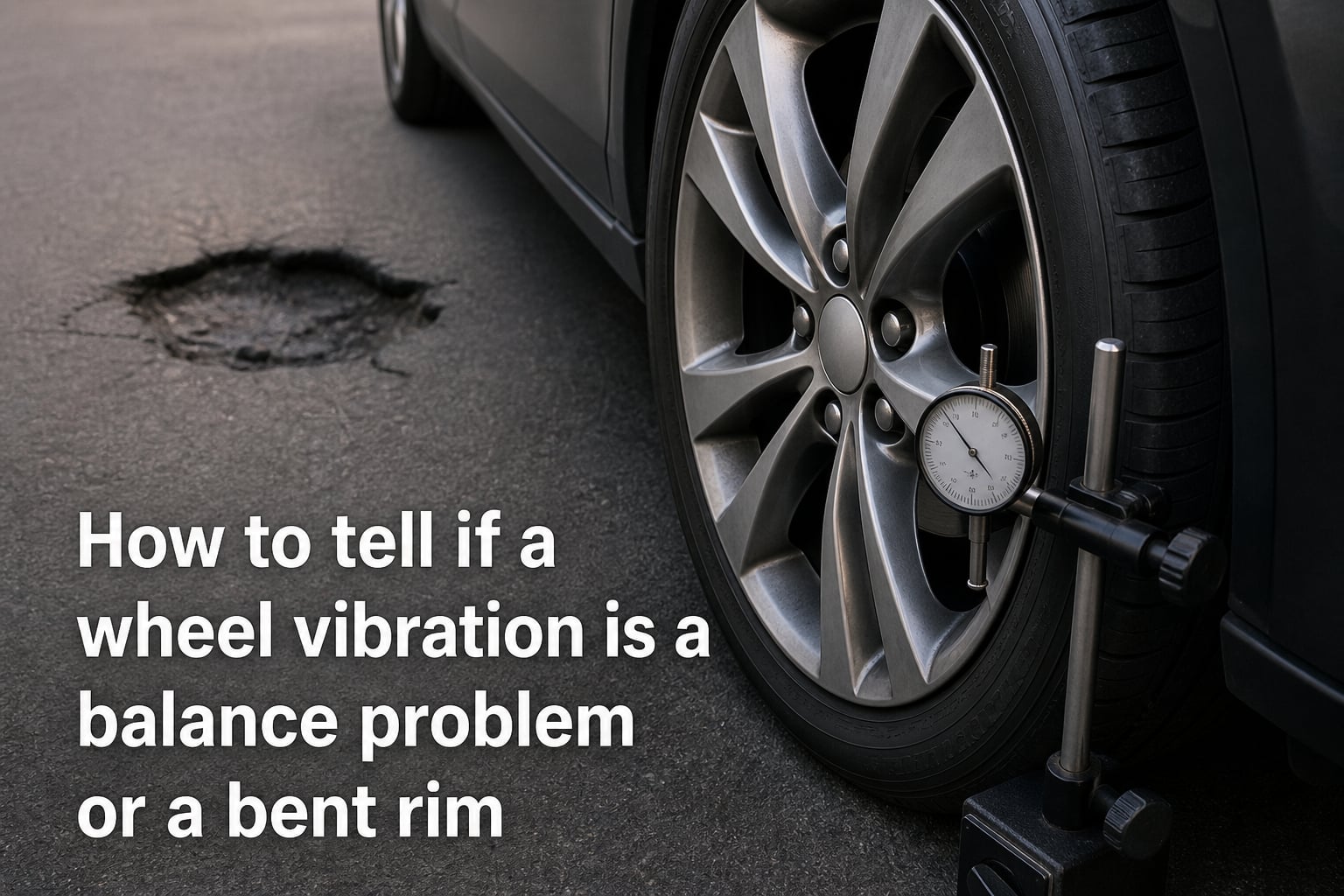
Professional shops use a dial indicator mounted against the rim barrel. The wheel is rotated slowly, and the gauge shows exactly how much deviation exists. Tolerances are typically under 0.030 inch for most passenger car wheels. Anything above that confirms a bend.
The DIY Approximation
Without a dial indicator, you can approximate the test using the spin method from the visual inspection section. Prop a screwdriver or similar object close to the rim edge as a reference point and rotate the wheel by hand. Any visible gap change indicates runout worth investigating professionally.
When to Seek Professional Diagnosis?
DIY testing can get you most of the way, but certain situations call for a shop visit without delay.
If you see a crack in the wheel, stop driving on it and have it towed or trailered to a shop. Cracked wheels can fail catastrophically under load and are a serious safety risk.
If the vibration appeared after a hard impact and is severe enough to make the car difficult to control, do not attempt long drives. The wheel could have hidden structural damage beyond the visible bend.
A tire losing air pressure after an impact is another red flag. A slow leak near the bead area often means the rim is bent enough to break the seal with the tire.
When you visit a shop, ask them to perform a road force variation test. This goes beyond simple balancing and measures how much force variation the tire and wheel assembly transmits. It can identify problems that basic balancing misses.
Expect to pay $25 to $50 for a diagnostic inspection and road force balance. Full runout measurement may be included or may cost extra depending on the shop.
Can a Bent Rim Be Balanced? (The Honest Answer)
This is one of the most common questions in mechanic forums, and the honest answer is: sometimes, but it is a band-aid, not a fix.
A shop can add extra weights to partially compensate for a slight bend. The vibration may reduce or disappear temporarily. But the wheel is still physically out of round, which means it is not rolling smoothly and will cause uneven tire wear at the bend location.
Many reputable shops will refuse to balance a clearly bent wheel. They know the fix will not last and that continuing to drive on it will destroy the tire over time. If a shop tells you they will not balance your bent rim, that is a sign of honesty, not laziness.
If you are selling the car soon or need a short-term fix while you save for a replacement wheel, temporary balancing might get you by. But for any long-term driving, fix or replace the bent wheel.
Repair vs Replace: Making the Right Call
Once you have confirmed a bent rim, the next decision is whether to straighten it or replace it. Several factors come into play.
Straightening makes sense for minor bends on quality wheels. If the bend is on the outer lip and is less than a few millimeters, a professional wheel repair shop can often restore it to spec for $100 to $150 per wheel. Heavier forged or OEM alloy wheels are usually good candidates.
Replacement is the safer call if the wheel has a crack, if the bend is severe, or if the wheel is a cheap aftermarket unit where repair cost approaches replacement cost. A new OEM wheel might run $300 to $800, while quality aftermarket alternatives can be $150 to $400.
Consider the age and value of your wheels. If you are running expensive forged alloys on a performance car, repair is usually worth it. If you have budget cast wheels that are several years old, replacement may be the more reliable choice.
Always have the tire rebalanced after any wheel repair or replacement. The repair process changes the wheel’s weight distribution, and a fresh balance ensures everything runs smooth.
FAQs
Can a slightly bent rim cause vibration?
Yes, even a slight bend can cause noticeable vibration. A rim that is out of round by just a few thousandths of an inch creates an up-and-down motion as it rotates, which translates into vibration felt through the steering wheel or seat. The vibration from a bent rim tends to be harsher and more constant than the smooth buzz of a balance issue.
Can a slightly bent rim be balanced?
A slightly bent rim can sometimes be temporarily balanced to reduce vibration, but this is not a proper fix. The wheel is still physically out of round, so it will cause uneven tire wear at the bend location over time. Many reputable shops refuse to balance a bent wheel because the fix will not hold and the underlying problem will damage the tire. For long-term reliability, repair or replace the bent rim instead.
How to tell if a rim is slightly bent?
Jack up the car and spin the wheel by hand while watching the rim edge against a fixed reference point like a brake caliper. If the gap between the rim and reference point changes as the wheel rotates, the rim has runout and is bent. You can also run your fingers along the inner and outer rim lip feeling for raised or rough sections. A dial indicator test at a shop provides the most accurate measurement.
Can a bad wheel balance cause vibration?
Yes, an unbalanced wheel is one of the most common causes of highway-speed vibration. The vibration from a balance issue typically feels like a smooth buzz and appears in a specific speed range, usually between 55 and 70 mph. It is often most noticeable in the steering wheel for front wheels or through the seat for rear wheels. Rebalancing the affected wheel resolves the vibration immediately.
Is a slightly bent rim dangerous?
A slightly bent rim is not immediately dangerous in the way a cracked wheel is, but it can become dangerous over time. The bend causes uneven tire wear which can lead to a blowout. It also stresses suspension components and wheel bearings. If the bend is causing air leakage or the vibration is severe, have it inspected promptly rather than continuing to drive on it.
Can a bent rim cause vibration when braking?
A bent rim itself does not directly cause vibration when braking. If you feel vibration specifically during braking, the most likely cause is a warped brake rotor. However, a bent rim can make general vibration worse at all speeds including during deceleration. If the vibration only appears when you press the brake pedal, suspect the brakes first rather than the wheels.
Conclusion
Knowing how to tell if a wheel vibration is a balance problem or a bent rim comes down to three key clues: how the vibration feels, when it started, and how it behaves across different speeds.
Here is the quick decision tree. If the vibration feels like a smooth buzz in a specific speed range and came on gradually, it is almost certainly a balance issue. Get a rebalance for $15 to $40 per wheel and you are done.
If the vibration is a harsh thump or wobble that appeared right after hitting a pothole or curb and gets worse with speed, you likely have a bent rim. Start with a visual inspection, try the spin test at home, and take it to a shop for a runout measurement to confirm.
Do not ignore either problem. Balance issues cause premature tire wear and an uncomfortable ride. Bent rims can destroy tires, stress suspension components, and in severe cases create safety risks. The sooner you diagnose correctly, the less you will spend on the fix.