
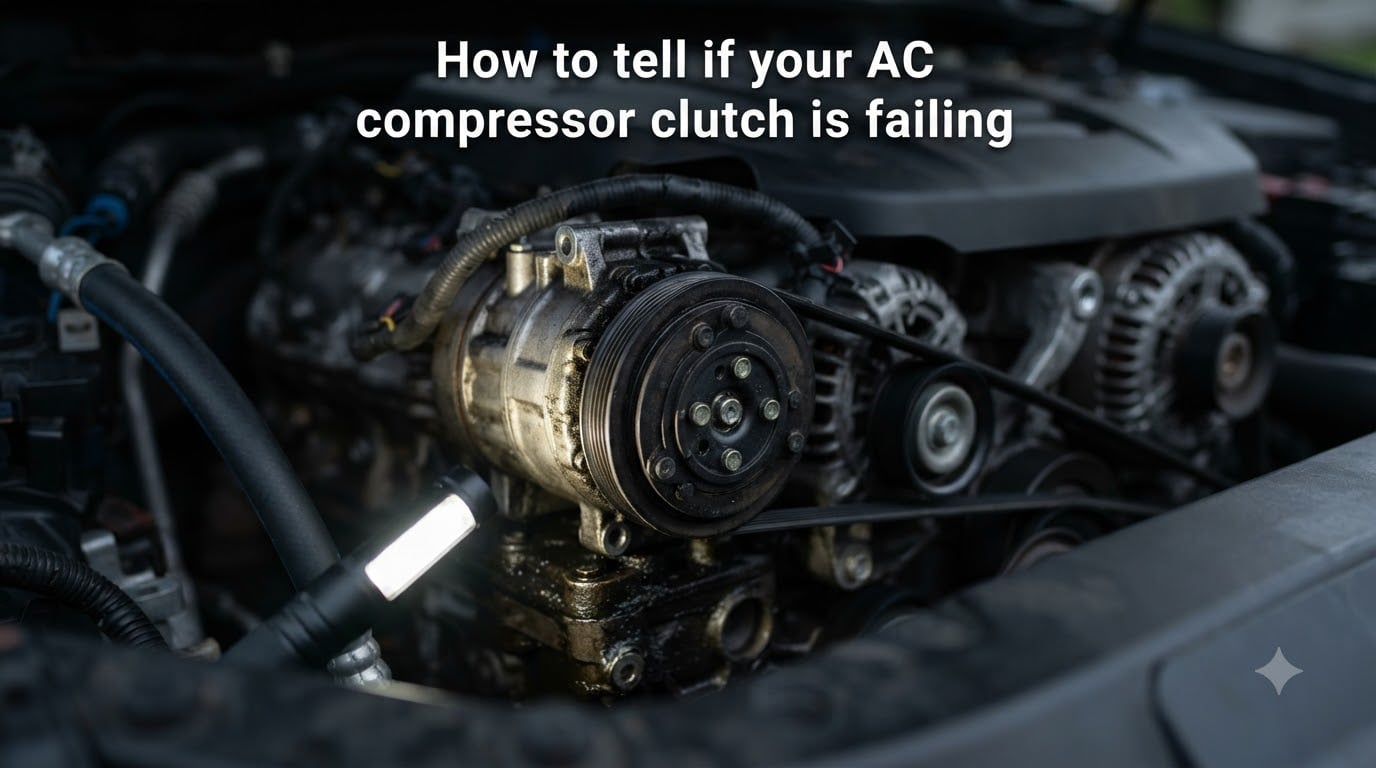
You turn on your car’s AC on a 95-degree afternoon, and instead of that welcome blast of cold air, you get lukewarm wind from the vents. We have been there, and it is miserable. In most cases, the culprit is not the entire air conditioning system. It is a small electromagnetic component called the AC compressor clutch, and learning how to tell if your AC compressor clutch is failing can save you hundreds of dollars in unnecessary repairs.
The compressor clutch acts as the on/off switch for your entire AC system. When it starts going bad, it sends clear warning signals long before total failure. The problem is that many drivers confuse these signals with low refrigerant or a bad compressor, leading to misdiagnosis and wasted money.
Our team has compiled this guide from real-world diagnostic experience and mechanic forum discussions to walk you through every symptom, every test you can do at home, and every decision point for repair. By the end, you will know exactly what is wrong with your AC before you talk to a mechanic.
Quick answer: Your AC compressor clutch is likely failing if you notice any of these signs:
AC blows warm air or no cold air at all
No clicking sound when you turn on the AC (clutch not engaging)
Squealing, screeching, or grinding noises from the compressor
Rapid on/off cycling of the AC compressor
Intermittent cooling (works sometimes, not others)
Visible burning marks or melted wiring near the clutch
Clutch plate stuck in one position (never engages or never releases)
Engine RPM drops significantly or idle gets rough when AC turns on
Burning smell from the engine bay when AC is running
Table of Contents
What Is an AC Compressor Clutch?
An AC compressor clutch is an electromagnetic coupling that connects and disconnects the compressor from your engine’s serpentine belt. Think of it as a mechanical switch that decides when the compressor should pump refrigerant and when it should sit idle.
The clutch has three main components working together. The pulley spins constantly whenever the engine is running, driven by the serpentine belt. The clutch plate sits right in front of the pulley and connects directly to the compressor shaft. The electromagnetic coil sits behind the pulley and creates the magnetic force that locks the plate and pulley together.
When you switch on the AC, the coil energizes with 12 volts of electricity and pulls the clutch plate against the spinning pulley. You hear a distinct click as they lock together, and the compressor starts pumping refrigerant. Turn the AC off, and the coil de-energizes, the plate releases, and the compressor stops while the pulley keeps spinning freely.
This design matters for two big reasons. First, it saves fuel because the engine does not have to constantly power the compressor. Second, it extends compressor life by letting it rest between cooling cycles. Without a working clutch, your AC either runs nonstop until the compressor burns out, or it never runs at all.
How to Tell If Your AC Compressor Clutch Is Failing: 9 Warning Signs?
Learning how to tell if your AC compressor clutch is failing starts with paying attention to what your car is telling you. The nine signs below progress from early warnings to complete failure symptoms. If you catch the problem early, you can often replace just the clutch instead of the entire compressor.
1. Your AC Blows Warm Air
This is the most common and obvious symptom. When the clutch fails to engage, the compressor never starts pumping refrigerant, so the air coming through your vents stays at ambient temperature. You might notice the air starts cool for a few seconds (from residual cold in the ducts) and then quickly turns warm.
The key difference here is that warm air from a bad clutch happens suddenly and consistently. Low refrigerant, by contrast, usually causes a gradual decline in cooling performance over weeks or months. If your AC was blowing cold yesterday and warm today, suspect the clutch.
2. No Clicking Sound When AC Turns On
That distinctive click you hear when pressing the AC button is the clutch plate snapping against the pulley. No click means the clutch is not engaging. This could point to a failed electromagnetic coil, a blown fuse, a bad relay, or a wiring issue.
Have a friend turn the AC on and off while you stand near the front of the car with the hood open. You should hear and see the clutch plate move. If the pulley spins but the plate stays still every time, the clutch is not engaging.
3. Squealing or Screeching Noise
A high-pitched squeal when the AC kicks on usually means the clutch plate is slipping against the pulley instead of locking firmly. This happens when the friction material on the plate wears down or when the air gap between the plate and pulley grows too large.
Forum users on r/MechanicAdvice frequently report this symptom worsening over time. What starts as a brief squeal lasting one second stretches to several seconds before the clutch finally grabs. Eventually, it will not grab at all.
4. Grinding Noise
Grinding is worse than squealing. It usually means the pulley bearing is failing or has already failed. The bearing allows the pulley to spin smoothly on the compressor housing, and when it goes bad, metal grinds against metal.
This is a serious issue. A seized bearing can lock the pulley, which snaps or throws the serpentine belt. Since that belt also drives your alternator, power steering, and water pump, losing it means you are stranded. If you hear grinding, stop using the AC immediately and get it checked.
5. Rapid On/Off Cycling
If your compressor turns on for three seconds, shuts off for five seconds, and repeats this pattern constantly, the clutch is cycling too rapidly. This is different from normal AC cycling, which typically runs for 15 to 30 seconds before taking a break.
Rapid cycling can be caused by several things, including low refrigerant, a faulty pressure switch, or an electrical problem in the clutch coil. The clutch is working overtime, and this shortens its lifespan significantly. It also puts extra strain on the compressor.
6. Intermittent Cooling
Does your AC blow cold for ten minutes, then warm for five, then cold again? This intermittent behavior is one of the most frustrating symptoms to diagnose because the clutch works sometimes. The coil may have an internal short that only fails when it heats up, or the clutch plate may have worn unevenly.
Many Reddit users in r/AutoMechanics describe this exact scenario. They report that the AC works fine on short trips but stops cooling after 20 minutes of highway driving. That heat-related failure pattern strongly points to a clutch coil going bad.
7. Visible Damage or Burning Smell
Pop the hood and look at the compressor clutch with a flashlight. You are checking for dark burn marks on the clutch plate, melted plastic around the coil connector, or oil leaking from the compressor body. Any of these visible signs means the clutch has been overheating.
A burning electrical smell confirms what the visual inspection suggests. The coil is drawing too much current and cooking itself. This smell is distinct from coolant or oil smells and tends to be sharper, like burning wire insulation.
8. Stuck Clutch Plate
In some cases the clutch plate gets stuck engaged, meaning the compressor runs continuously even when the AC is turned off. You will notice the compressor keeps spinning no matter what. This puts constant load on the engine, reduces fuel economy, and will eventually destroy the compressor.
In other cases, the plate gets stuck disengaged. The pulley spins freely, but the plate never locks in, so the compressor never runs. Either way, a stuck clutch needs immediate attention.
9. Engine Idle Drops When AC Turns On
When the clutch engages and the compressor kicks on, a slight RPM dip is normal. But if your engine nearly stalls, shakes violently, or the idle drops by more than 200 RPM, the clutch may be dragging or seizing. The engine is fighting excessive resistance from the compressor.
This symptom often accompanies a failing bearing or a clutch that is partially seized. It can feel like a misfire, but it only happens the moment the AC engages. If turning off the AC immediately smooths out the idle, you have isolated the problem to the compressor clutch system.
How to Test Your AC Compressor Clutch (Step-by-Step)?
Once you suspect the clutch is failing, these five tests will help you confirm the diagnosis. Most of these require no special tools beyond a multimeter, which costs about $20 at any auto parts store.
Test 1: Visual Inspection
Start with the engine off and the hood open. Locate the compressor (it is the pump driven by the serpentine belt, usually at the front of the engine). Shine a flashlight at the front of the pulley assembly. Look for burn marks, melted wires, oil seepage, or physical damage to the clutch plate. Spin the pulley by hand. It should turn smoothly and quietly. Any roughness, grinding, or wobble means the bearing is bad.
Test 2: The Listening Test
Start the engine and have someone turn the AC on and off while you listen near the compressor. You should hear a clear click each time the AC turns on. Watch the front of the clutch plate. The plate should snap forward and spin with the pulley when the AC is on, then release and stop when the AC is off. If the plate never moves, the clutch is not engaging.
Test 3: Battery Jumper Test
This test bypasses all the car’s AC control systems and sends power directly to the clutch. Disconnect the electrical connector at the compressor clutch. Run a jumper wire from the battery positive terminal to the clutch terminal. The clutch should click and engage instantly.
If the clutch engages with direct power, the clutch itself works, and your problem is elsewhere (fuse, relay, pressure switch, or wiring). If it does not engage even with direct battery power, the clutch coil is dead and needs replacement.
Safety note: Do not leave direct power connected for more than a few seconds. Extended direct powering can overheat the coil and create a fire risk.
Test 4: Multimeter Test (Coil Resistance)
Set your multimeter to measure resistance in ohms. Disconnect the clutch connector and probe the two terminals on the clutch side. A healthy clutch coil typically reads between 3 and 5 ohms.
If the reading is significantly higher than 5 ohms, the coil has internal resistance problems and is failing. If the reading shows infinite resistance or open line (OL), the coil has a broken wire inside and is completely dead. A reading under 3 ohms suggests an internal short.
Test 5: Air Gap Measurement
The air gap is the space between the clutch plate and the pulley face when the clutch is disengaged. This gap is critical. Too large, and the electromagnet cannot pull the plate in. Too small, and the plate drags against the pulley even when disengaged.
Use a feeler gauge to measure the gap. Most manufacturers specify an air gap between 0.3 mm and 0.6 mm (about 0.012 to 0.024 inches). If the gap exceeds 0.6 mm, the clutch plate has worn down or shifted, and the clutch will eventually fail to engage. You can sometimes shim the clutch plate to restore proper gap, but replacement is often the better long-term fix.
What Causes AC Compressor Clutch Failure?
Understanding the root cause helps you fix the problem once instead of replacing parts repeatedly. Clutch failure rarely happens without a reason.
Low or Overcharged Refrigerant
Both too little and too much refrigerant cause problems. Low refrigerant drops system pressure below the threshold needed for the pressure switch to allow the clutch to engage. This is actually a safety feature protecting the compressor from running dry. Overcharged systems create excessive pressure that overworks the clutch and can cause it to slip and burn out.
Reddit users frequently discover that their clutch was fine all along and the real issue was an overfilled system from a DIY recharge kit. Always check refrigerant pressure before condemning the clutch.
Electrical Failures
The clutch needs a clean 12-volt signal to engage. Blown fuses, corroded connectors, broken wires, and failed relays all interrupt that signal. The AC compressor relay is a particularly common failure point. Before replacing the clutch, swap the AC relay with an identical one from another circuit (like the horn) and test again.
Worn Clutch Plate and Increased Air Gap
Every time the clutch engages, the friction material on the plate wears a microscopic amount. Over tens of thousands of cycles, that wear adds up. The air gap grows, the magnet has to work harder, and eventually it cannot pull the plate in at all. This is the most common mechanical cause of clutch failure and happens naturally with age.
Bearing Wear
The pulley bearing spins constantly whenever the engine runs, regardless of whether the AC is on. After years of use, the bearing’s internal races and balls wear down. The first sign is usually a humming or growling noise that changes with engine speed. Left alone, the bearing eventually seizes and destroys the belt.
Contamination and Debris
Oil leaks, coolant spills, road debris, and dirt can all contaminate the clutch surfaces. Oil on the clutch plate reduces friction, causing slipping and accelerated wear. Forum users have reported clutch issues following antifreeze spills onto the compressor from a nearby leak. If you notice fluid near the compressor, clean it off and address the source leak.
Clutch-Only Replacement vs Full Compressor Replacement
One of the most common questions in mechanic forums is whether you can replace just the clutch or need to buy a whole new compressor. The answer depends on the condition of the compressor itself.
Replace just the clutch when:
The compressor still spins smoothly and quietly
The system was cooling properly before the clutch failed
There is no metal debris in the refrigerant
The compressor has no internal noise or leakage
Your vehicle has enough clearance to access the clutch (some require removing the compressor)
Replace the entire compressor when:
The compressor makes grinding, knocking, or rattling sounds
Metal shavings are present in the refrigerant lines
The compressor body is leaking oil
The system has been run without lubrication
The clutch failed because the compressor seized
A clutch-only kit typically costs far less than a full compressor, but some vehicles require removing the compressor to access the clutch, which adds significant labor. If labor costs approach the price difference, replacing the entire unit may be the better long-term choice, especially on older vehicles.
Can You Drive With a Bad AC Compressor Clutch?
Short answer: it depends on what exactly is wrong, but driving with a known bad clutch is risky.
If the clutch simply will not engage, you can drive the car indefinitely without AC. The pulley still spins freely on its bearing, and the compressor just sits idle. You will be uncomfortable in hot weather, but the car is mechanically safe.
If the clutch bearing is making noise, the situation is different. A failing bearing can seize without warning. When it seizes, the pulley locks up, the serpentine belt snaps, and you lose your alternator, power steering, and water pump all at once. This typically happens at the worst possible moment and can cause engine overheating.
If the clutch is stuck engaged, the compressor runs constantly. This burns out the compressor in a matter of days or weeks, turning a clutch-only repair into a full system replacement.
Our recommendation: if you hear grinding, feel the belt slipping, or smell burning, stop driving and get it towed. If the clutch just will not turn on and the pulley spins quietly, you can drive carefully to a repair shop.
How to Prevent AC Compressor Clutch Failure?
While no component lasts forever, several habits can significantly extend your compressor clutch’s lifespan.
Run the AC regularly. Even in winter, turn on the AC for at least 10 minutes every week. The clutch mechanism needs periodic cycling to keep the seals lubricated and the bearing surfaces coated. Many drivers only discover clutch failure in spring because the AC sat unused for months and the bearing corroded or the seals dried out.
Maintain proper refrigerant charge. Have your AC system pressure checked annually. Both undercharged and overcharged systems stress the clutch. If you use DIY recharge kits, follow the pressure gauge instructions carefully and do not overfill.
Address noises immediately. A squeal on startup or a hum from the compressor is your early warning system. The difference between a $150 clutch bearing replacement and a $1,200 full compressor job is often just a few weeks of ignoring that noise.
Keep the compressor area clean. Oil leaks from the compressor or valve cover gaskets can contaminate the clutch surfaces. If you notice oil pooling near the compressor, have the leak repaired before it damages the clutch friction material.
AC Compressor Clutch Replacement Cost
Cost is the question on every vehicle owner’s mind, and for good reason. Prices vary widely based on your vehicle, location, and whether you choose DIY or professional installation.
Clutch-only replacement by a professional shop typically ranges from $300 to $750. The clutch kit itself costs $80 to $250 depending on the vehicle. Labor adds $200 to $500 because accessing the clutch often requires removing other components.
Full compressor replacement runs $500 to $1,200 for most vehicles. Luxury vehicles and those with hard-to-access compressors can reach $1,500 to $2,500. This includes the compressor, receiver drier, expansion valve, refrigerant recharge, and labor.
DIY clutch replacement costs just the parts ($80 to $250) plus your time. You need a clutch removal tool (about $25), basic hand tools, and patience. Some vehicles have enough clearance to do this without removing the compressor. Others require evacuating the refrigerant and pulling the compressor, which means a trip to a shop for evacuation and recharge anyway.
Forum users consistently recommend getting at least three quotes. Prices between shops can vary by 40 percent or more for the exact same job. Independent shops often charge significantly less than dealerships for this repair.
FAQs
How to test an AC compressor clutch?
Start with a visual inspection for burn marks or damage. Then run a jumper wire from the battery positive to the clutch terminal. If it clicks and engages, the clutch works and the problem is elsewhere. If it does not engage, use a multimeter to check coil resistance (should read 3 to 5 ohms). No engagement and out-of-spec resistance means the clutch coil is bad.
What are the first signs of clutch failure?
The earliest signs are usually a faint squeal when the AC first turns on, slightly warmer air from the vents, and occasional failure of the clutch to engage on the first try. You may also notice the AC taking longer than usual to start cooling. These symptoms appear intermittently before becoming constant.
What happens if an AC compressor clutch fails?
Your air conditioning stops working entirely. The compressor will not pump refrigerant, so no cold air reaches the cabin. If the clutch bearing also fails, it can seize the pulley and snap the serpentine belt, which disables the alternator, power steering, and water pump.
How to reset AC compressor clutch?
There is no true reset procedure for a clutch. Some vehicles have an AC control module that can be reset by disconnecting the battery for 10 minutes. However, if the clutch is mechanically or electrically failed, resetting will not fix it. If the clutch stopped working after a refrigerant overcharge, correcting the charge level may restore normal operation.
Why is my AC compressor clutch not engaging?
Common causes include a blown fuse, a failed AC relay, low refrigerant triggering the pressure switch, a broken wire or corroded connector, a dead electromagnetic coil, or an air gap that has grown too large. Start by checking the fuse and relay, then test refrigerant pressure before condemning the clutch itself.
Can I replace just the AC compressor clutch?
Yes, in many cases. If the compressor itself is in good condition, spins smoothly, and shows no signs of internal damage or contamination, you can replace just the clutch assembly. This costs significantly less than a full compressor replacement. However, if the compressor is making noise or leaking, you need the whole unit.
What does AC compressor clutch failure sound like?
A failing clutch typically produces a squealing or screeching sound when the AC turns on, caused by the clutch plate slipping against the pulley. A grinding or growling noise indicates a failing pulley bearing. A rapid clicking sound can mean the clutch is trying to engage but cannot hold. Each sound points to a different component of the clutch assembly.
How long does an AC compressor clutch last?
Most AC compressor clutches last between 80,000 and 150,000 miles under normal use. Frequent short trips, lack of regular AC use during winter, and contaminated components can shorten this lifespan. Running the AC for at least 10 minutes weekly helps extend clutch life by keeping seals and bearings lubricated.
The Bottom Line
Knowing how to tell if your AC compressor clutch is failing gives you control over the repair process. You can run the five diagnostic tests at home, distinguish between clutch failure and simpler issues like blown fuses or low refrigerant, and walk into a repair shop with confidence instead of guesswork.
Here is our simple framework: if the clutch engages with direct battery power, the clutch works and your problem is electrical or refrigerant-related. If it does not engage and the multimeter reads outside the 3 to 5 ohm range, the clutch coil is dead. If you hear grinding from the pulley, replace the bearing before it seizes and destroys your serpentine belt.
For DIYers with basic tools, clutch-only replacement is a practical weekend project that costs a fraction of a shop visit. For drivers who suspect deeper compressor issues, professional diagnosis is worth the money. Either way, addressing clutch problems early saves you from a much bigger repair bill down the road.