
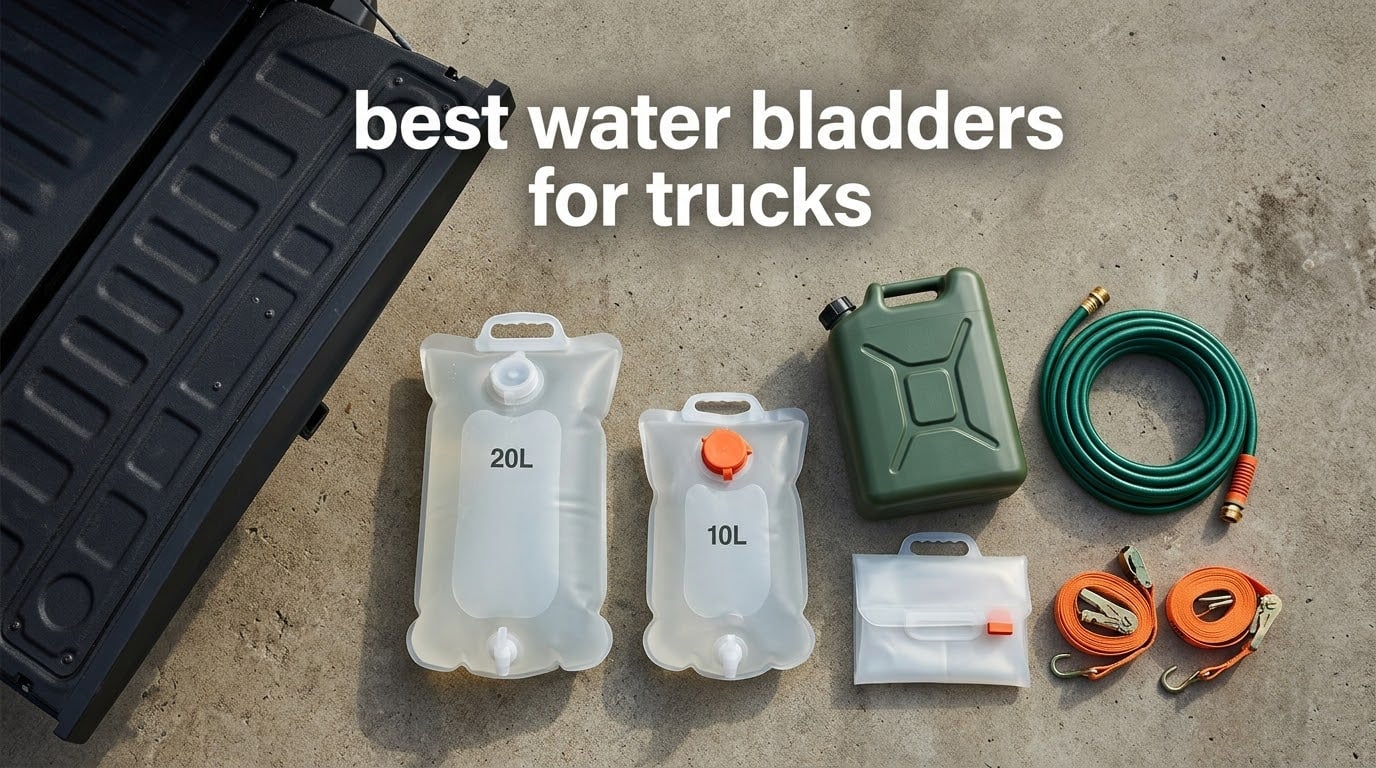
A truck bed water bladder is a collapsible, soft-sided water storage tank that lies flat in a pickup bed, on a bed rack, or in a trailer, holds anywhere from 5 to 264 gallons, and folds down to the size of a folded jacket when it is empty. It is the cheapest way to carry serious water in a truck without bolting a steel tank to the frame, and for most buyers it is the only water storage option that survives being hauled over dirt roads every weekend.
The reason to care is weight, and the number is not subtle. One US gallon of water weighs 8.34 lb, so a 20 gallon bladder adds 167 lb to your payload the moment you close the tailgate, and a 60 gallon unit adds more than 500 lb. Water is heavier than anything else most pickups carry, and the failure mode is usually not the bladder splitting. It is the bladder shifting, toppling or getting punctured by the ladder you threw in the same bed.
That failure mode is exactly what a truck camper on r/TruckCampers described: their plan was a 5 gallon jug held down with bungee cords, and after a couple of U-turns the bed was wet. The thread that followed turned into the most useful research we found anywhere on this topic. An Expedition Portal poster asked for something low and flat that will not tumble all over the place and can handle freezing. Nobody in that thread answered the freeze question, and nobody did the weight math. So we did.
We compared ten of the highest-reviewed water bladders for trucks currently on the market, working through the capacity, empty weight, material, temperature rating, fittings and real complaint patterns in the reviews. What follows is the best water bladders for trucks roundup for 2026, organised by how much water you actually need and how rough the haul is. If you also need to move diesel around, our transfer tank roundup covers the rigid side of the bed.
Table of Contents
Top 3 Picks for Best Water Bladders for Trucks (October 2026)

MXQMKL 100 Gal PVC Bladder
- 100 gallon capacity
- 7.5 lb empty weight
- 0.9 mm double-sided PVC mesh
- Rated from -50 to 60 Celsius

VEVOR 264 Gal Bladder
- 264.2 gallon capacity
- 1000D double-layer PVC
- Full accessory kit with faucet and patches
- Four pull-rings for strapping
AQUATANK2 60 Gal Food-Grade
- 60 gallon capacity
- 100% food-grade TPU inner lining
- BPA-free and phthalate-free
- Folds to binder size when empty
Every Pick in This Roundup at a Glance In 2026
The full lineup, with the numbers that decide most purchases. Every bladder below is soft-sided and collapsible, so the differences come down to capacity, fabric weight, fittings and temperature range.
| Product | Specs | Action |
|---|---|---|
| MXQMKL 100 Gallon Water Bladder |
|
Check Latest Price |
| VEVOR 264 Gallon Water Bladder |
|
Check Latest Price |
| AQUATANK2 60 Gallon Food-Grade Bladder |
|
Check Latest Price |
 LOFTANK 65 Gallon Water Bladder LOFTANK 65 Gallon Water Bladder |
|
Check Latest Price |
 Rodelna 65 Gallon Water Bladder Rodelna 65 Gallon Water Bladder |
|
Check Latest Price |
 ZXZYHFTY 29 Gallon Water Bladder ZXZYHFTY 29 Gallon Water Bladder |
|
Check Latest Price |
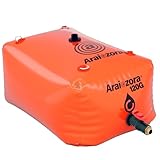 Araiozora 120 Gallon Water Bladder Araiozora 120 Gallon Water Bladder |
|
Check Latest Price |
 VIVOSUN 30 Gallon Water Bladder VIVOSUN 30 Gallon Water Bladder |
|
Check Latest Price |
 Budiwati 105.7 Gallon Water Bladder Budiwati 105.7 Gallon Water Bladder |
|
Check Latest Price |
 HZYOUMU 260 Gallon Water Bladder HZYOUMU 260 Gallon Water Bladder |
|
Check Latest Price |
One thing this table cannot show is how the empties feel in your hands. Empty weight matters more than buyers expect, because a 7.5 lb empty bladder is a one-person lift while a 13.5 lb one is a two-person job that slides around while you try to position it. We have noted empty weight for every pick below.
1. MXQMKL 100 Gallon Water Bladder – Our Top Pick
400 L/100 gal Water Bladder Storage Containers,Foldable Portable Water Tank
100 gal
7.5 lb empty
0.9 mm double-sided PVC mesh
39.4 x 31.5 x 19.7 in
Pros
- Largest review base of any bladder we tested
- Capacity-to-size ratio is hard to argue with
- Survives being dropped full per owners
- Width range of sizes in the same family
Cons
- Included valve threads and adapters reported loose
- Delivered volume reported under label
- Plastic odour in some units
This is the one we kept coming back to. The MXQMKL 100 gallon is a double-sided PVC mesh with a high-density coating on both faces, 0.9 mm thick, with high-frequency welded seams and a reinforcing rib around the port. It weighs 7.5 lb empty and measures 39.4 by 31.5 by 19.7 inches when full, which is a shape that fits neatly behind a standard short bed against the tailgate.
What separates it from the rest is the 1279 review count. That is more than double the next highest in this group, and the pattern in those reviews is consistent: people like the way a large volume collapses into a small package, and several owners report dropping a filled unit without a rupture. Owners also use it for pressure washer feed and as a replacement for a leaking RV freshwater tank, which is exactly the mixed-duty role most truck buyers need.
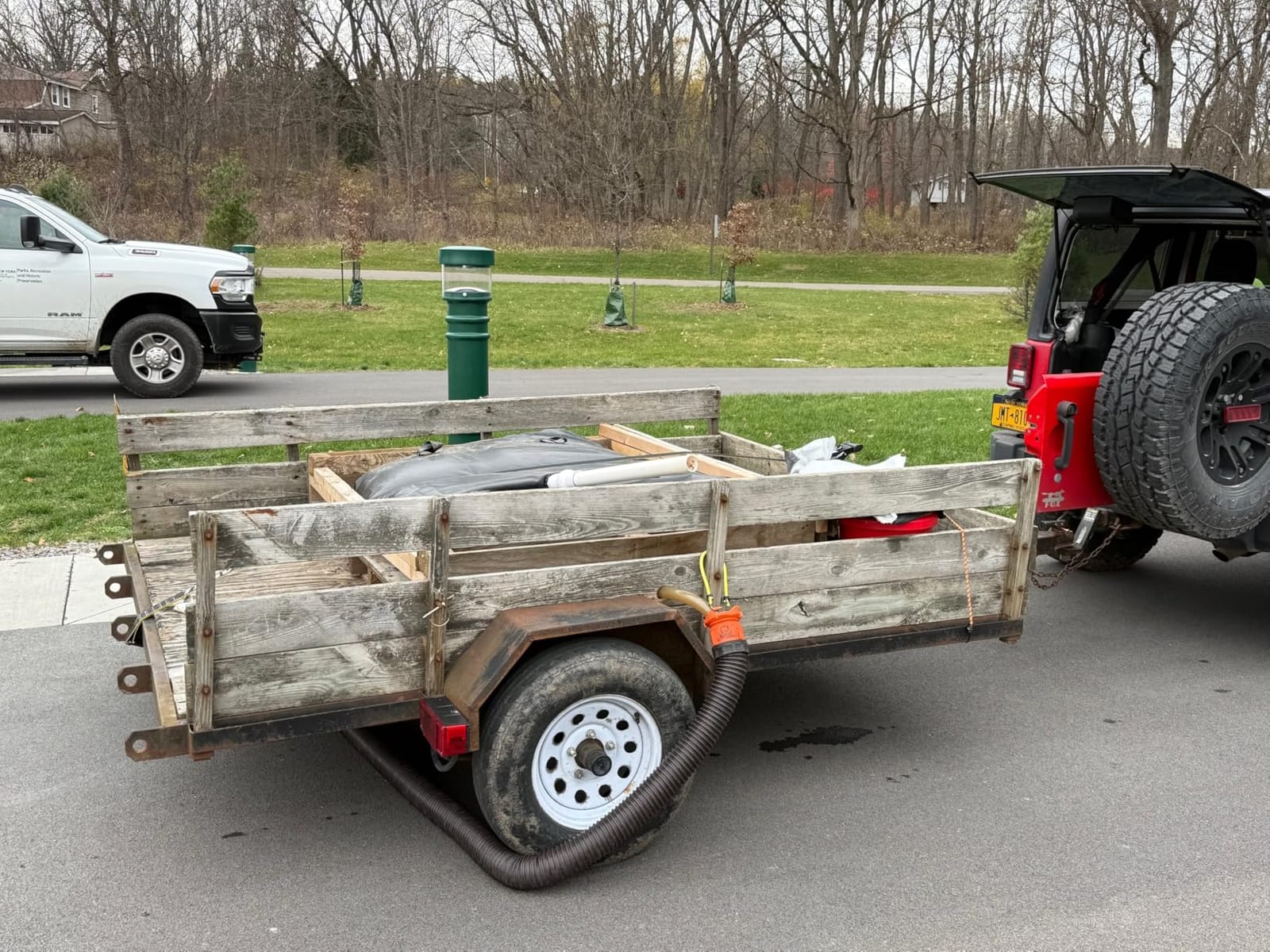
The build quality is good where it counts. The welded sealing structure with reinforcing rib sealing around the port is a better design than a basic glued fitting, and the stated service life of roughly 8 to 10 years is a spec you rarely see printed on a cheap bladder. The environmental adaptation range of -50 to +60 Celsius is one of the widest in the group and matters for anyone storing a filled tank through a northern winter.
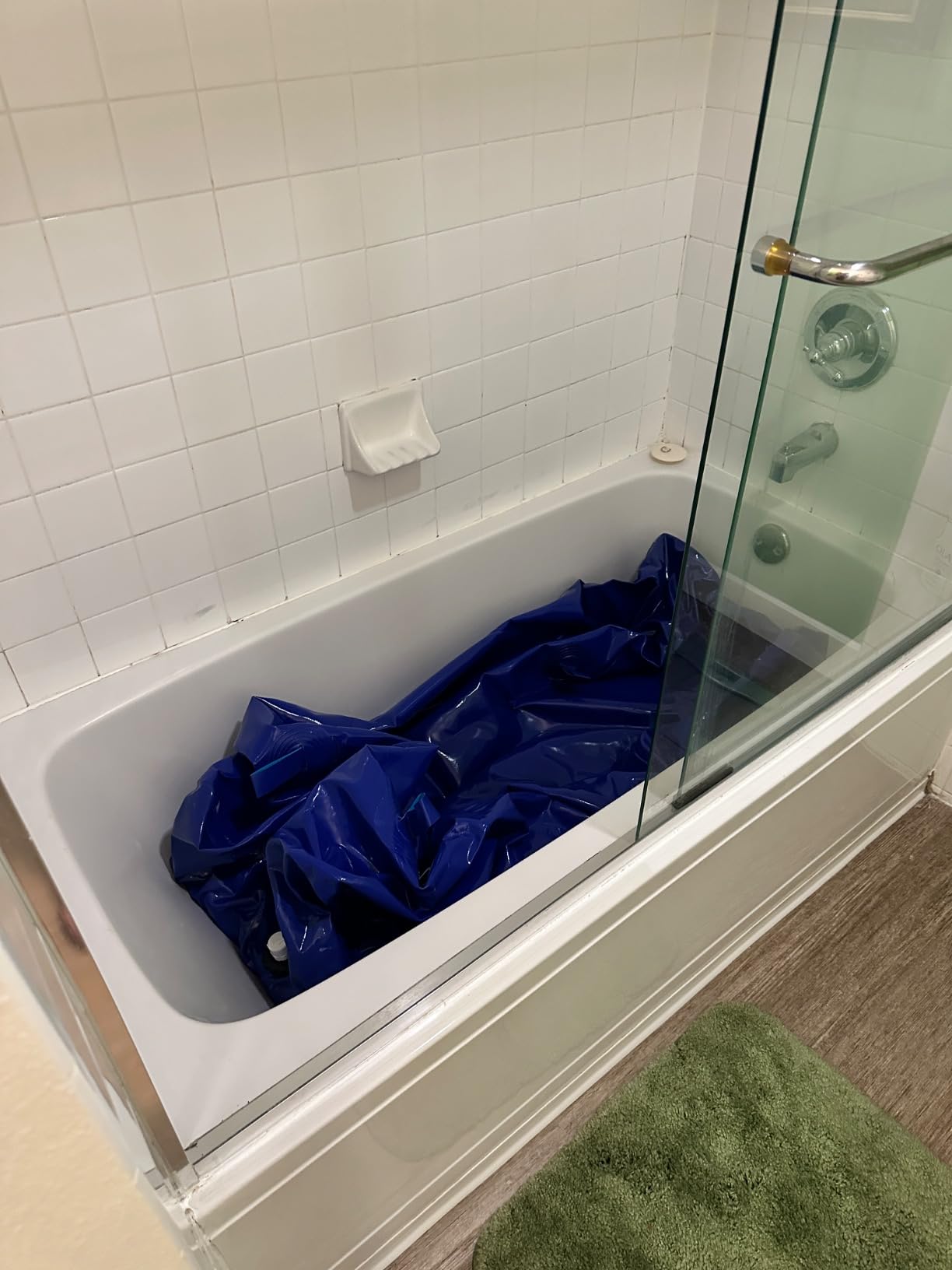
The complaints are consistent too, and you can plan around them. Valve threads and adapters are the most common gripe, with several owners swapping in a replacement 3/4 ball valve, which takes minutes and a wrench. Others report that actual delivered volume runs below the label, and one unit ruptured at the fill valve and needed reinforcement. A plastic odour in some batches is worth noting if you plan to drink from it, which you should not, since this is non-potable rated.
What 100 Gallons Does to Your Payload
Full, this bladder holds 834 lb of water, and that number is the single most important fact about it. On a half-ton truck with a typical payload in the 1500 lb range, this takes more than half your remaining capacity in one object sitting where your cargo should be. The trailer, the dirt bikes, the generator and the water cannot all come on the same trip.
For most people the fix is to run it partly full. Fifty gallons is 417 lb, which is a realistic weekend load for two campers, and the bladder still lies flat and still folds away. Check your door jamb payload sticker before you fill it, and subtract your tongue and trailer weight from the same number if you are towing.
Where It Falls Short
Two situations rule it out. If you want to drink from the water, the PVC construction is the wrong material, and you want a food-grade TPU liner instead. If you carry ladders, post-hole diggers or firewood in the same bed, an unfilled-capacity soft bag is a puncture risk that no amount of strapping fixes, so frame it in a crate or keep it in a separate compartment.
The odour complaint is worth taking seriously. If you plan to use the water for washing, dishes or a camp shower rather than irrigation, rinse it thoroughly and let it air for a day or two after unpacking. If the smell persists, that is a strong signal to return it rather than work around it.
2. VEVOR 264 Gallon Water Bladder – The Accessory Kit King
VEVOR Water Storage Bladder 264.2 Gallon Large Capacity Water Bag, Portable & Collapsible Soft Waters Container, Leakproof & Tear-Resistant PVC Emergency Waters Storage Tank for RV Truck & Outdoor Use
264.2 gal
13.5 lb empty
1000D double-layer PVC
78.7 x 39.8 x 20.1 in
Pros
- 4.5 star average with only 5 percent one-star ratings
- Complete kit with faucet
- connectors and repair patches
- Reinforced 1000D double-layer PVC
- Four pull-rings for transport
Cons
- Largest and heaviest unit here
- Soft build must be restrained to stop shifting
The VEVOR 264.2 gallon is the biggest bladder in the roundup, and it carries a 4.5 average across more than 400 reviews, tied with the 29 gallon unit for the highest rating in this group. Owners on Expedition Portal describe this style of VEVOR 1000D PVC bag as rugged and heavy duty, and one poster specifically called out that the same bags come in 5 gallon sizes, which is the practical version for most truck beds. This is the giant end of that family.
What we like most is what arrives in the box. You get the faucet valve, a 3/4 inch connector, a fitting, repair patches, PTFE tape and a spare sealing ring, so a first leak does not become a return shipment. The 1000D double-layer PVC has a mesh middle layer and a coating on both sides, and the seams are high-temperature welded with dual-layer hot-melt sealed ports. The inlet is DN25 and the outlet DN20, both pre-installed.
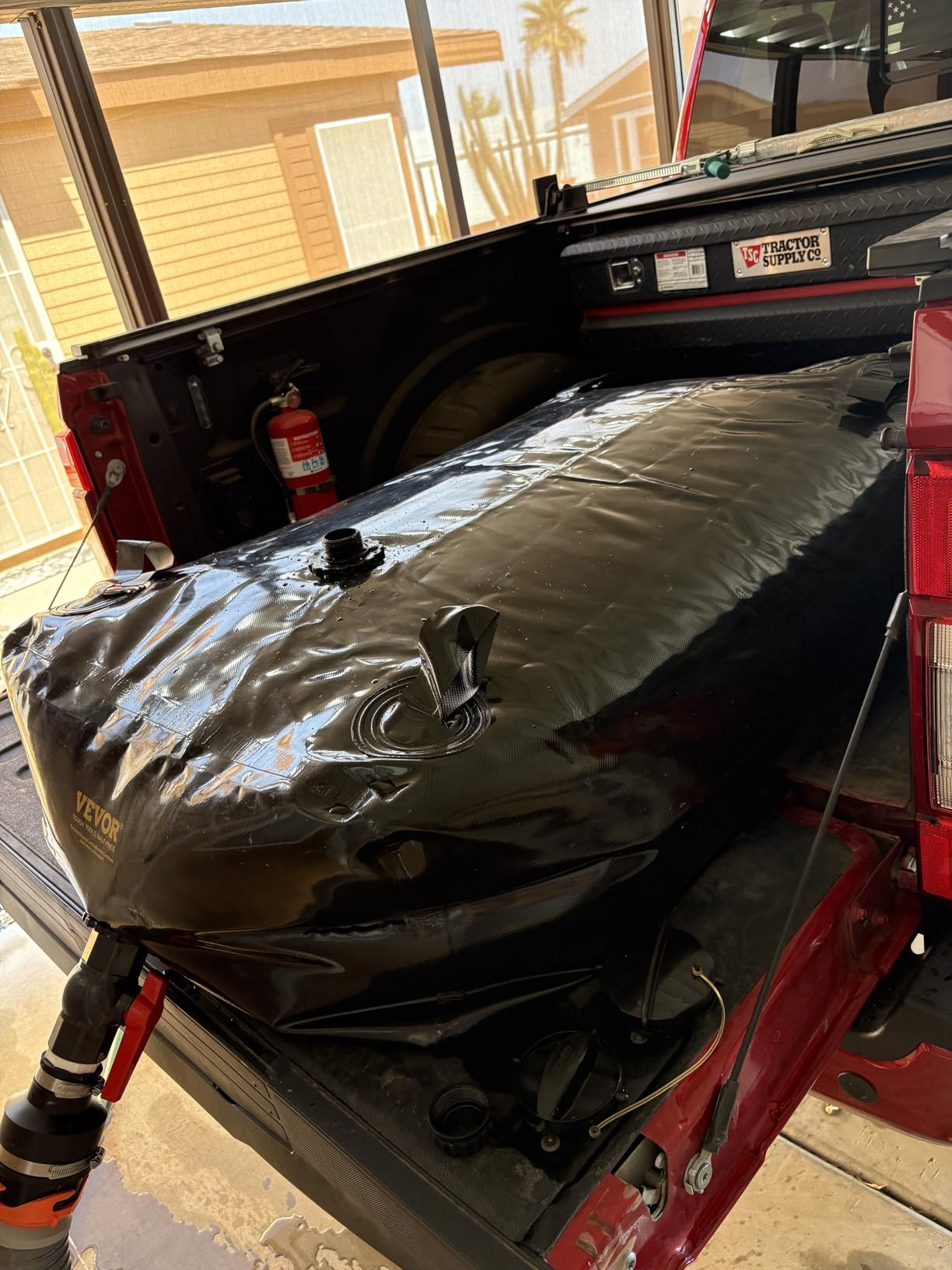
The temperature tolerance is listed as 5 to 167 Fahrenheit, which is narrower at the cold end than the MXQMKL and the LOFTANK. If you are storing a filled bladder in a truck through a hard freeze, this is the spec to pay attention to. The four pull-rings are there specifically for strapping into a pickup bed, SUV or rooftop, which tells you the intended use is transport rather than static storage.
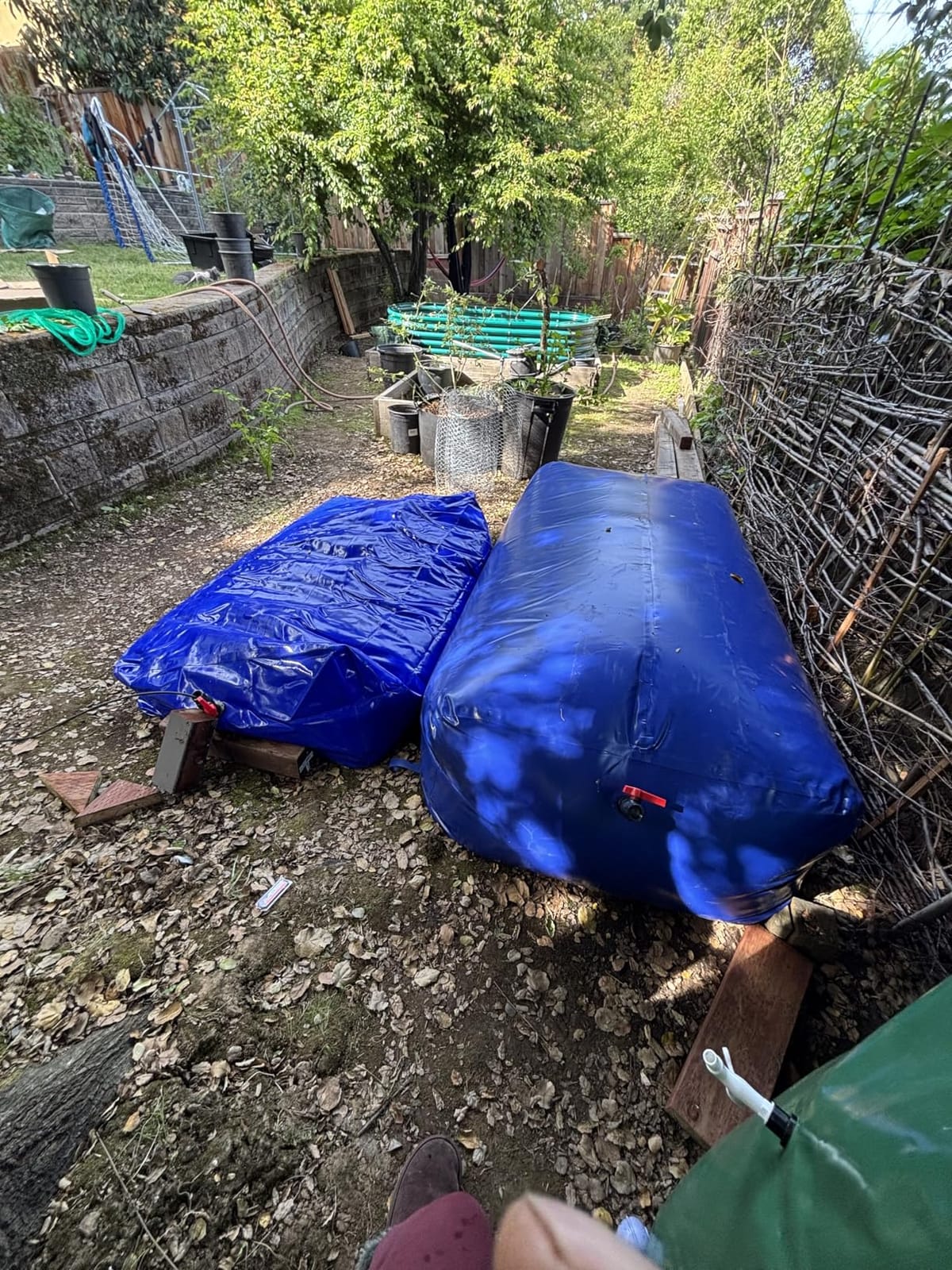
The catch is scale. Filled, this holds more than 2200 lb of water, which is more than most half-ton trucks can legally carry, and the empty unit itself is 13.5 lb of awkward fabric. Realistically this lives in a duffel truck, a flatbed or a trailer, and it exists for people hauling water to livestock, filling a stock tank, or carrying fire suppression water to remote property. In a pickup bed it is a two-person lift that must be laid out flat before you try to fill it.
Is 264 Gallons Ever the Right Call
Yes, when the water is the cargo. Filling livestock water troughs on a remote property, wetting down a haul road for dust suppression, or staging water ahead of a fire season are all cases where moving 264 gallons once beats moving 30 gallons eight times. Owners report using bladders of this class for pressure washer supply, which is a genuinely high-draw application.
No, if the truck is also carrying people and gear. Once filled, this unit effectively removes the bed from the vehicle, and the moment you need to haul a load of lumber or a dirt bike the bladder has to come out. If that is a frequent trade in your week, look at the 29 gallon or 30 gallon options later in this list instead.
Watch the Cold End of the Rating
The 5 Fahrenheit floor is the practical limit for storage, not for use. A bladder left full in a truck bed at 10 below will have water that freezes solid, and frozen water expands enough to stress seams and fittings no matter how good the weld. Our advice is the same for every bladder here: drain it fully in winter, or accept that you are gambling a 5 percent one-star share of buyers apparently are not.
The soft construction is the other real limitation. With 264 gallons inside, the bag reshapes under acceleration, so it needs to be restrained across more than one axis, not just at the tailgate. Owners with mixed beds report putting the bladder on a flat surface first, then strapping it, and that habit prevents most of the shifting complaints in this category.
3. AQUATANK2 60 Gallon Bladder – The One You Can Drink From
Water Storage Tank – Bladder – Bag – AQUATANK2 Stores Water For Your Emergency Water Supply – It Is a Light-Weight and Portable Water Container, Food-Grade Material, no BPAs (60 Gallon)
60 gal
Food-grade TPU liner
Nylon outer shell
Folds to binder size
Pros
- Food-grade TPU liner leaves no plastic taste
- Proven durability over years of boondocking use
- Folds to about a 1 inch binder when empty
- Inlet and outlet tubes included
Cons
- Highest price point in this roundup
- Moves like a bag of jelly when full
- Made for static storage so keep it away from sharp edges
If the water is going into your mouth, this is the one to buy, and the reason is the liner. The AQUATANK2 60 gallon has an inner lining of 100 percent food-grade TPU polyurethane with a durable nylon outer shell, and it is BPA-free and phthalate-free. No other bladder in this roundup carries a food-grade liner, and that difference is not marketing. It is the difference between water that tastes like water and water that tastes like plastic.
This is also a genuinely old product, available for well over a decade, and that longevity shows in the reviews. Owners report years of boondocking use with no failure, which is a durability claim you almost never see on the newer budget imports. It folds to roughly the size of a 1 inch binder when empty, so it lives in a cab or a garage shelf between trips rather than occupying permanent bed space.
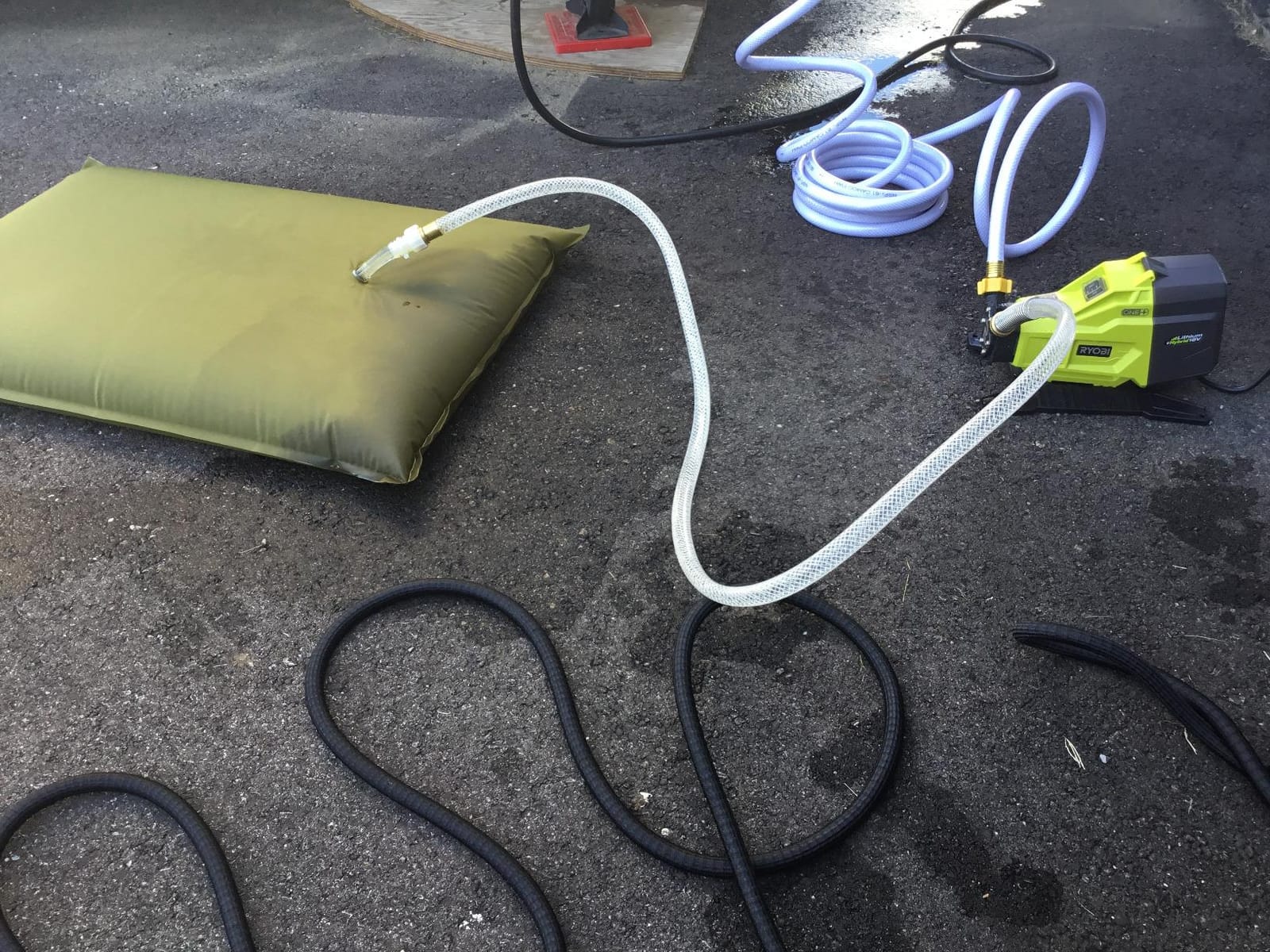
One detail we liked: it includes a material sample you can stress-test before opening the bladder. If the TPU liner feels flimsy, you have found out before you have committed to filling 60 gallons. The inlet and outlet tubes make filling and dispensing straightforward, and the whole thing is designed around static water storage, which is how most campers actually use it.
The criticism is consistent. It is the most expensive bladder here, and full it behaves like a bag of jelly that has to be physically restrained in a truck bed, which is the same complaint every soft container generates. It is also not designed to be stabbed by a shovel, so it needs its own corner of the bed. A few units arrived with pinhole leaks, and one reviewer reported a restocking fee dispute on a warranty return, so buy from a seller who handles that cleanly.
Food Grade Is the Whole Point Here
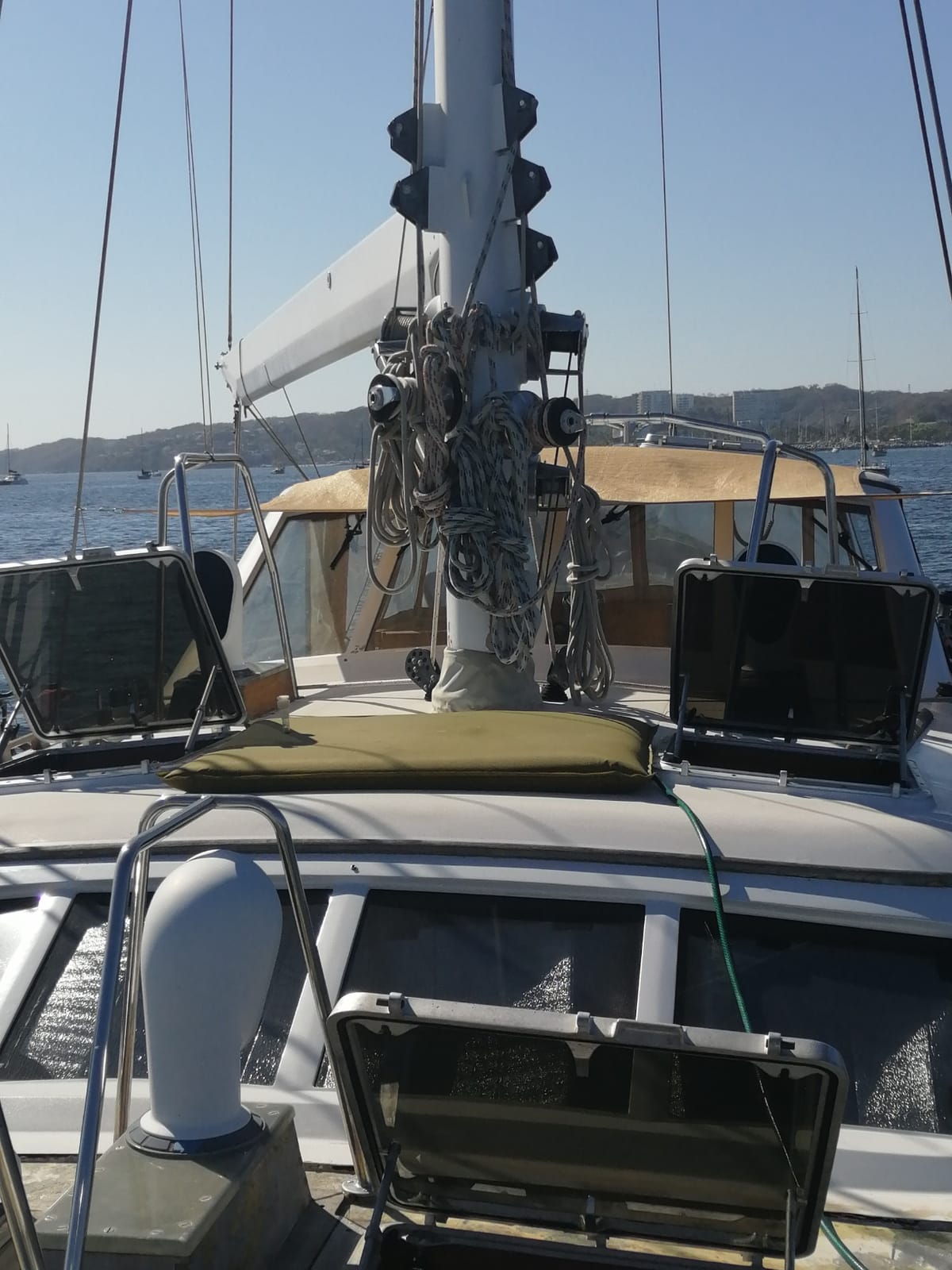
Segregating potable from non-potable is the rule in our buying guide, and this is the bladder that lets you keep it. A user on Expedition Portal put it plainly, saying once a container has held non-potable water it can never be used for drinking water, and that is the correct position. Buy two bladders, one for drinking and cooking and one for everything else, and never let them share a spigot without a full sanitation cycle in between.
The practical routine is simple. Keep drinking water in the AQUATANK2, draw it through the dedicated outlet tube, and keep the fill, drain and any hose used with it reserved for potable work. If you want to use it for a camp shower or dishwashing on a trip, draw from a second container, because a shower mixin with soap and shampoo will strip the taste out of any liner in a week.
Where It Falls Short
Cost is the first limitation, and it is a real one for anyone who just needs water for a livestock trough or a washdown. Sixty gallons is 500 lb full, so you are still paying a significant share of your payload for a container you cannot tip on its side or push through brush, because the shape is a flat pillow rather than a can.
Static storage is the second. The manufacturer is explicit that this is for static water storage, and that means it is a poor choice for a bed where you also carry tools. A MOLLE panel or a dedicated crate that keeps shovel handles and ladder ends away from the fabric is not optional with this bladder, it is the whole installation.
4. LOFTANK 65 Gallon Water Bladder – Our Budget Cold-Weather Pick
LOFTANK 65 Gallon Portable Water Storage Tank, Large Bladder Container With 3/4″ PVC Spigot Overflow Kit for Camping, Garden, Emergency – Black
65 gal
1000D PVC mesh
Stainless steel outlet valve
-35 to 80 Celsius
Pros
- Handles freezing winter use without damage
- Stainless steel outlet valve
- Collapses flat for cab or behind-seat storage
- Seals well for most owners
Cons
- Wiggles and shifts like a waterbed when full
- Seam pinholes reported after limited use
- Some sizes deliver well under the label
The LOFTANK 65 gallon is the budget answer to the freeze question that nobody in the forum threads answered. It is rated from -35 to +80 Celsius, which is the second-widest range in this group, and owners specifically call out that it handles freezing winter use without damage. If you store a filled bladder in a truck through the cold season, that rating matters more than any other spec on the label.
Construction is 1/20 inch thick high-density coated PVC mesh on both sides, with reinforced seams using high-frequency welded and embossed bonding. The fill opening is a generous 1.5 inches wide, the outlet is a 3/4 inch spout valve in stainless steel, and the pull ring design is upgraded for transport and securing. At 39.4 by 28 by 13.8 inches it lays flat across a short bed without dominating the space.
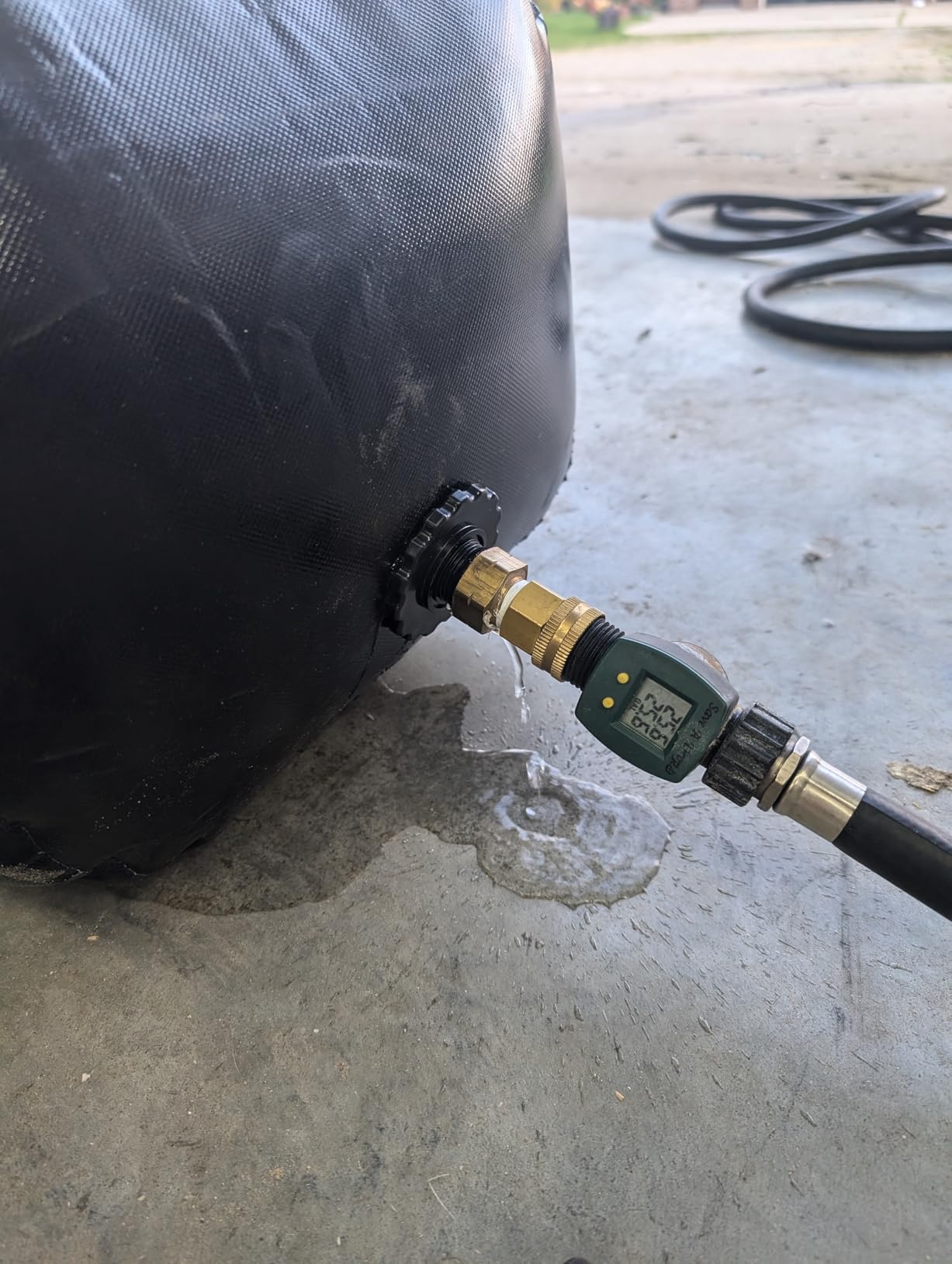
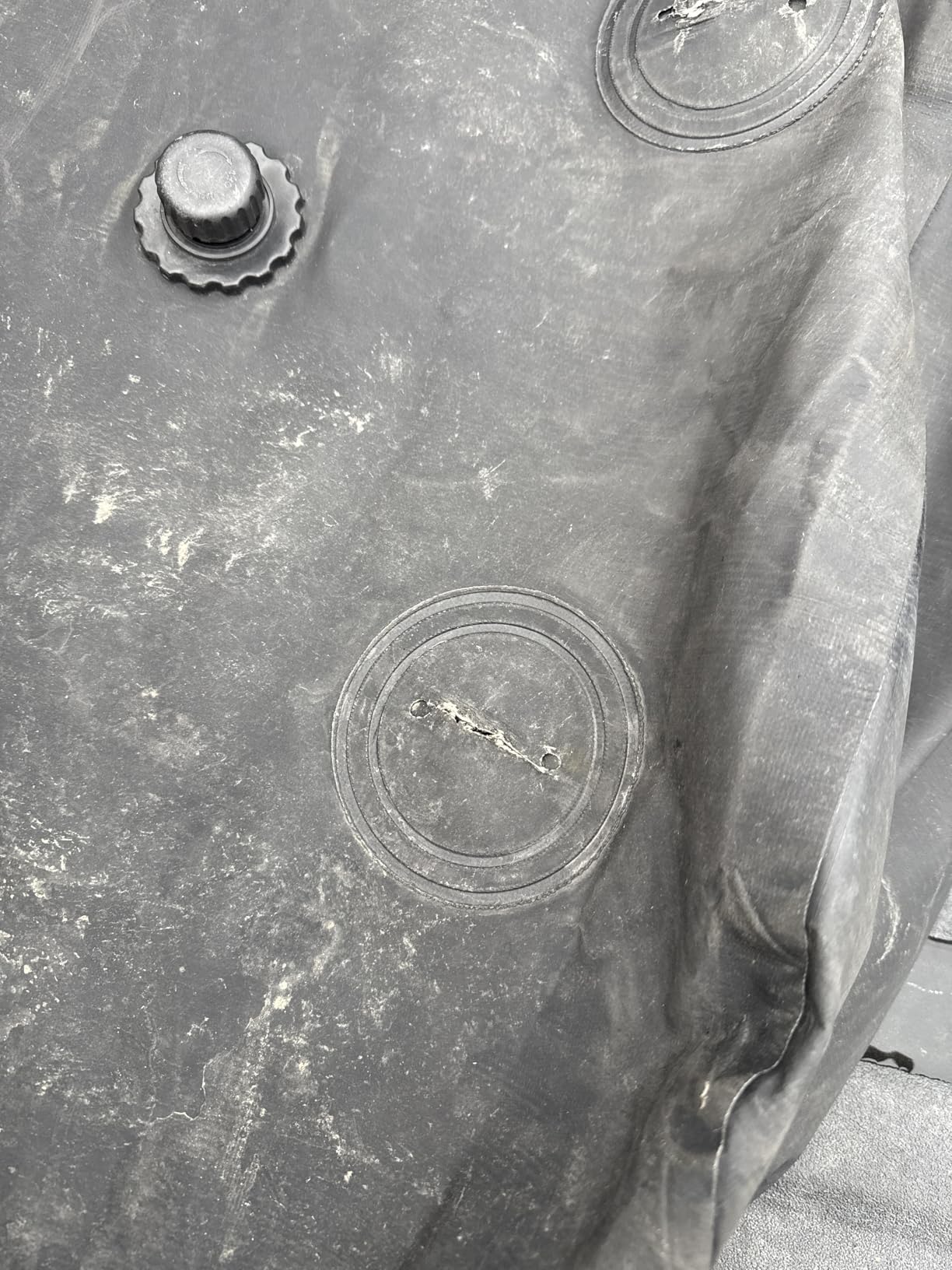
Owners like that it folds flat and tucks behind a truck seat or in the cab when not in use, and that connectors seal well with no leaks reported by most buyers. The stainless steel outlet valve is a step up from the cheap plastic sleeves some competitors ship, and that is the part that usually fails first on a budget tank.
The honest weakness is movement. Owners describe it wiggling and shifting like a waterbed when full unless it is built into a frame, which is the most common complaint in the reviews and the reason it is not our top pick. A related note: some sizes deliver well under the advertised capacity, with a 30 gallon unit actually holding about 20, so verify volume with a graduated container if the number matters to you.
Why the Temperature Range Decides This One
Compare the two budget-feeling options in this roundup. The LOFTANK is rated to -35 Celsius, the Rodelna to -30, and the VEVOR to 5 Fahrenheit, which is roughly -15 Celsius. If your truck lives outdoors in winter or you camp above freezing, that spread decides which bladder you can leave full and which you have to drain.
Even with a wide rating, we do not advise leaving any bladder full through a hard freeze. The rating covers the material. What it does not cover is the seam stress of water expanding as it turns to ice, and the most common one-star reviews across this whole category are puncture and split complaints rather than anything about cold cracking. Drain it, stand it on end in the bed, and cap it dry.
Framing It Solves the Main Complaint
The waterbed wobble is a frame problem, not a bladder problem. Build or buy a simple plywood or aluminium tray sized a few inches larger than the bladder, drop it in, and strap the tray to the bed rails. Owners who frame a soft tank report that the shifting complaints disappear almost entirely, and the same frame is what protects it from the tools in your bed.
If you would rather not build anything, the alternative is a smaller unit. The 29 gallon and 30 gallon bladders later in this list weigh a fraction of this one and can be repositioned by hand after every stop, which solves the same complaint without a workshop project. The trade is capacity, and that is a decision only you can make.
5. Rodelna 65 Gallon Water Bladder – Best for Garden and Rainwater Work
Rodelna Water Storage Bladder, Water Tank 65 Gallon Foldable Portable Water Storage, Large Water Storage Containers with 3/4″ PVC Spigot and Overflow Kit for Camping, Garden, Emergency Water Storage
65 gal
250L model
1/20 inch PVC mesh
Includes spigot and overflow kit
Pros
- Includes a 3/4 inch spigot and overflow kit
- Holds water for days with no leaking
- Collapses easily for compact storage
- Built-in handles make it easy to move
Cons
- No standard garden hose adapter included
- Supplied plastic discharge sleeve strips easily
- Fill opening is tight and awkward
The Rodelna 65 gallon is the only bladder here that includes an overflow kit, and for anyone collecting rainwater off a truck cap or a cabin roof that is the feature that matters. Run the overflow line away from the vehicle, and you have a working catchment system rather than a tank that stops being useful when it is full.
Otherwise it is a competent budget build. One twentieth inch thick high-density coated PVC mesh on both sides with added sealing strips, high-frequency welded and embossed bonding, a 3/4 inch spout stainless steel outlet valve, and a temperature range of -30 to +70 Celsius. It is 250L, measures 31.5 by 17 by 13.5 inches, and weighs 2.24 kg empty.
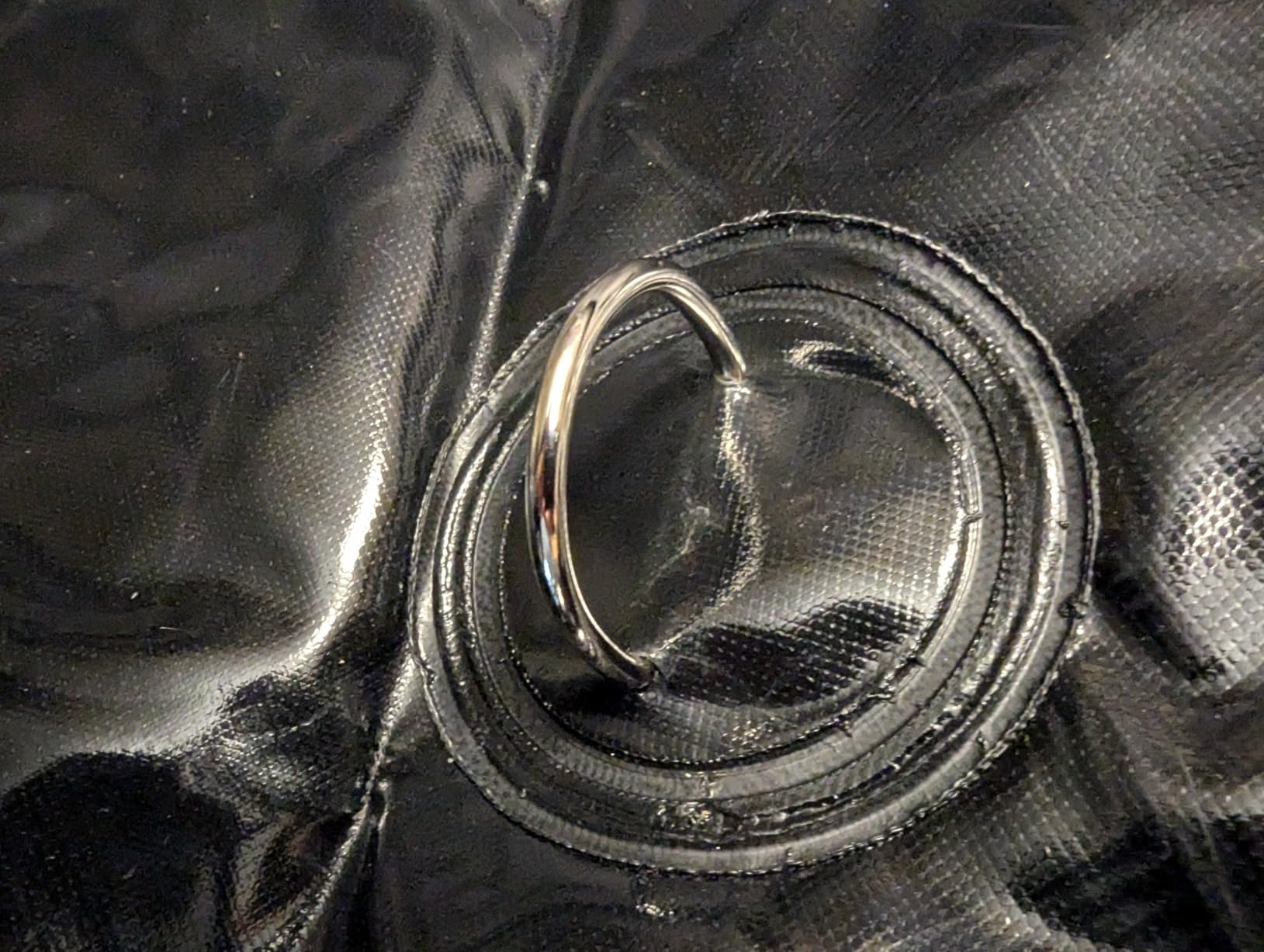
Owners report that it holds water for days with no leaking, collapses easily for compact storage, and has durable material and well-made seams for the price. The built-in handles are the detail that shows up in real use, because a 65 gallon bladder full weighs 542 lb and you will be moving it more often than you think.
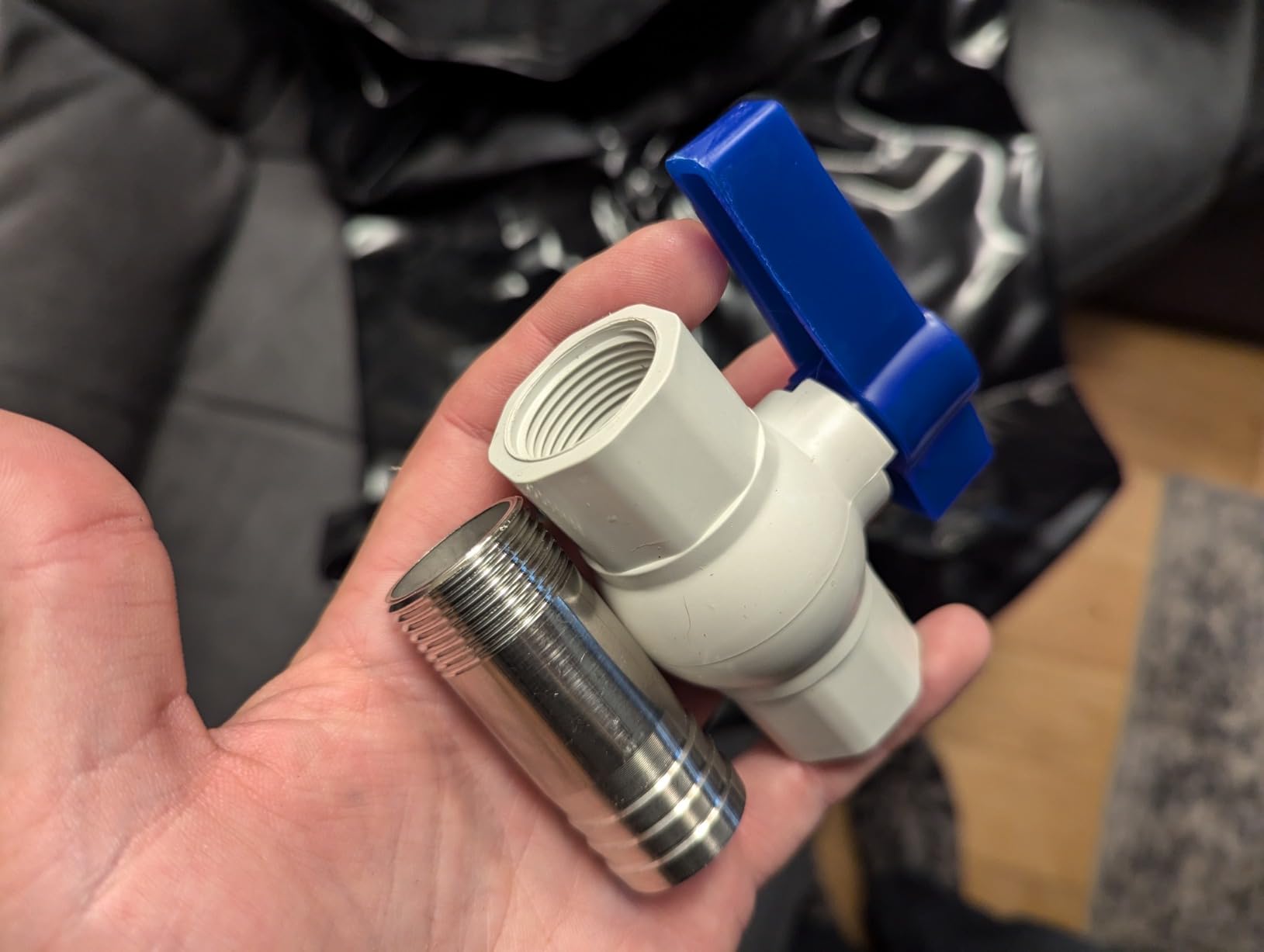
Three complaints recur. It does not come with standard garden hose adapters, so you will need to buy a 3/4 inch adapter separately. The supplied plastic discharge sleeve is thin and strips easily or slips off under pressure, so budget a replacement or upgrade to a braided hose. And the fill opening is tight, which makes the last few gallons awkward to get in without a funnel.
When This One Earns Its Place
Water that never touches a person does not need a food-grade liner, which is exactly why this tier exists. Irrigation, garden watering, wildlife feeders, livestock troughs, dust suppression and firefighting are all non-potable jobs where capacity per pound of empty weight is the only number that matters. At 65 gallons this fills a stock trough or a raised bed in one trip.
It also ranks high for the RV top-up job, where you are moving water from a spigot at a campground into a vehicle. Because it is non-potable rated, you can use it for grey water, wash water or top-up reserve without any cross-contamination worry, which keeps the potable side of your system simple and separate.
The Adapter Gap Is Real
Buy the adapter before you fill it, not after. The outlet is a 3/4 inch spigot and most garden hoses, pressure washer inlets and camp shower fittings expect a standard 3/4 inch female garden thread, which is a part you can pick up at any hardware store in about a minute. Add a roll of PTFE tape while you are there, and the same roll fixes the stripping sleeve complaint on day one.
Our other reservation is fill convenience. A tight opening means slow filling from a hose and slower topping up from a jug, and on a 65 gallon unit that difference adds up. If you fill often, choose a bladder with a wider opening and accept a smaller capacity rather than fighting the port every weekend.
6. ZXZYHFTY 29 Gallon Water Bladder – Best for Compact Bed Hauling
110L/29 Gallon Water Bladder Tank, Portable Water Storage Bladder, Blue
29 gal / 110 L
2000D PVC-coated polyester
1.68 kg empty
Shut-off outlet valve
Pros
- Heaviest-duty fabric here at 2000D
- Light at 1.68 kg and folds small
- 4.5 star average with only 3 percent one-star ratings
- Suits a pickup bed as a non-permanent water source
Cons
- No pump included for pressure applications
- Non-potable water only
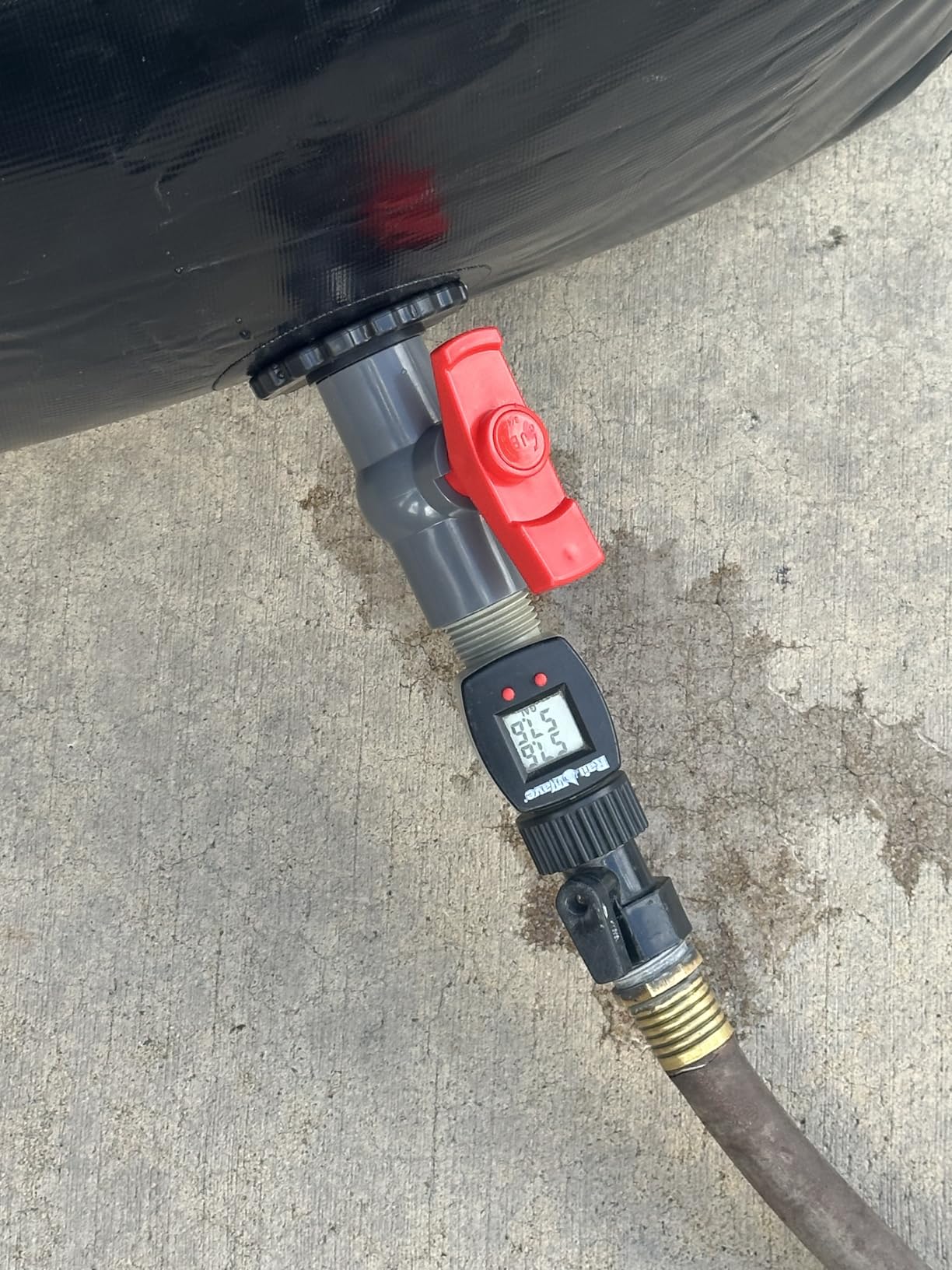
This is the one we recommend if you also use the bed for something else. At 29 gallons it weighs 242 lb full and the empty bag is 1.68 kg, so one person can lift, position and reposition it between loads without a second set of hands. Every other bladder in this roundup past 60 gallons needs a plan, a frame or a second person.
The fabric is the standout. It is 2000D PVC-coated polyester, which is a genuinely heavier cloth than the 1000D used by most of the budget tanks here, and it is combined with a large filling inlet and a shut-off outlet valve for controlled dispensing. Discharge is gravity-assisted, and the manufacturer is upfront that an external pump can be added for pressure applications but is not included.
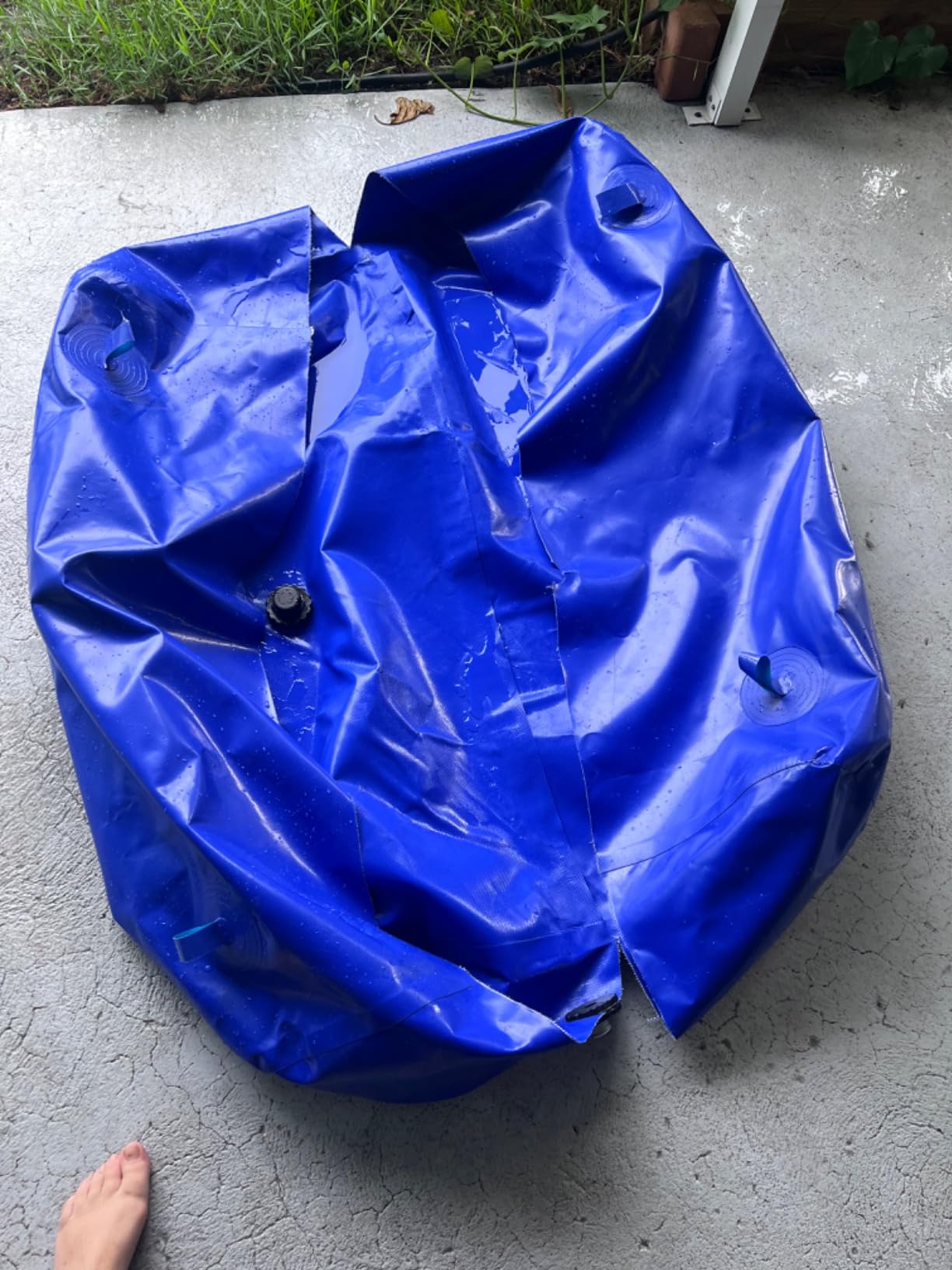
It folds down for storage, which matters when your truck is a work truck on Monday and a camping truck on Saturday. Owners describe it as well suited to a pickup bed as a non-permanent water source, and the 4.5 star average comes with only 3 percent one-star ratings, the cleanest rating distribution in the group.
Two limitations are on the label rather than in the reviews. It is rated for non-potable water only, so it is out for drinking. And there is no pump, so anything beyond a trickle, including a camp shower, requires buying a 12 volt pump and a pressure-rated hose separately. Plan for that as a second purchase, not an afterthought.
29 Gallons Is the Sweet Spot for Mixed Use
Here is the math that makes this size work. Two people washing, cooking and drinking over a weekend use somewhere in the neighbourhood of 5 to 8 gallons a day, so 29 gallons covers three days of genuine self-sufficiency without touching your payload budget. Full, it adds 242 lb, which most pickups carry without noticing.
It also matches the low-and-flat request from the Expedition Portal thread better than anything else in this list. A 29 gallon pillow tank sits low enough to stay put, is light enough to reposition by hand after every stop, and does not roll under braking. If you camp out of a truck and work out of the same truck, this is the configuration we would build.
Budgeting for a Pump and a Spigot
The gravity feed works fine for filling bottles, rinsing gear or topping up a trough. For anything pressurised, add a 12 volt pump rated above 30 psi, a braided hose and a shut-off at the outlet. Many owners running this size pair it with a simple shower wand, and it is a ten minute install with a single adapter.
Because it is non-potable only, the other change you should make is a labelling habit. Mark the bladder itself, not just the box, and keep a separate potable container for drinking. Forum users treat that separation as a hard rule, and following it costs you nothing and removes an entire category of risk.
7. Araiozora 120 Gallon Water Bladder – Best for Property Work
Araiozora Foldable Water Bladder Tank,120 Gal/480L Portable Large Capacity Soft Water Bag Storage Container
120 gal / 480 L
1000D PVC fabric
Solid brass 3/4 inch connector
Four stainless steel handles
Pros
- Thick fabric with no leaks reported under load
- Solid brass connector hooks straight to a garden hose
- Stainless steel handles for grip and tie-down
- Used for trailer ballast and tree-bag irrigation
Cons
- D-ring tie-down points ripped out after a couple of uses
- Supplied discharge hose is cheap and flimssy
- Fill spout sits flush with the bag
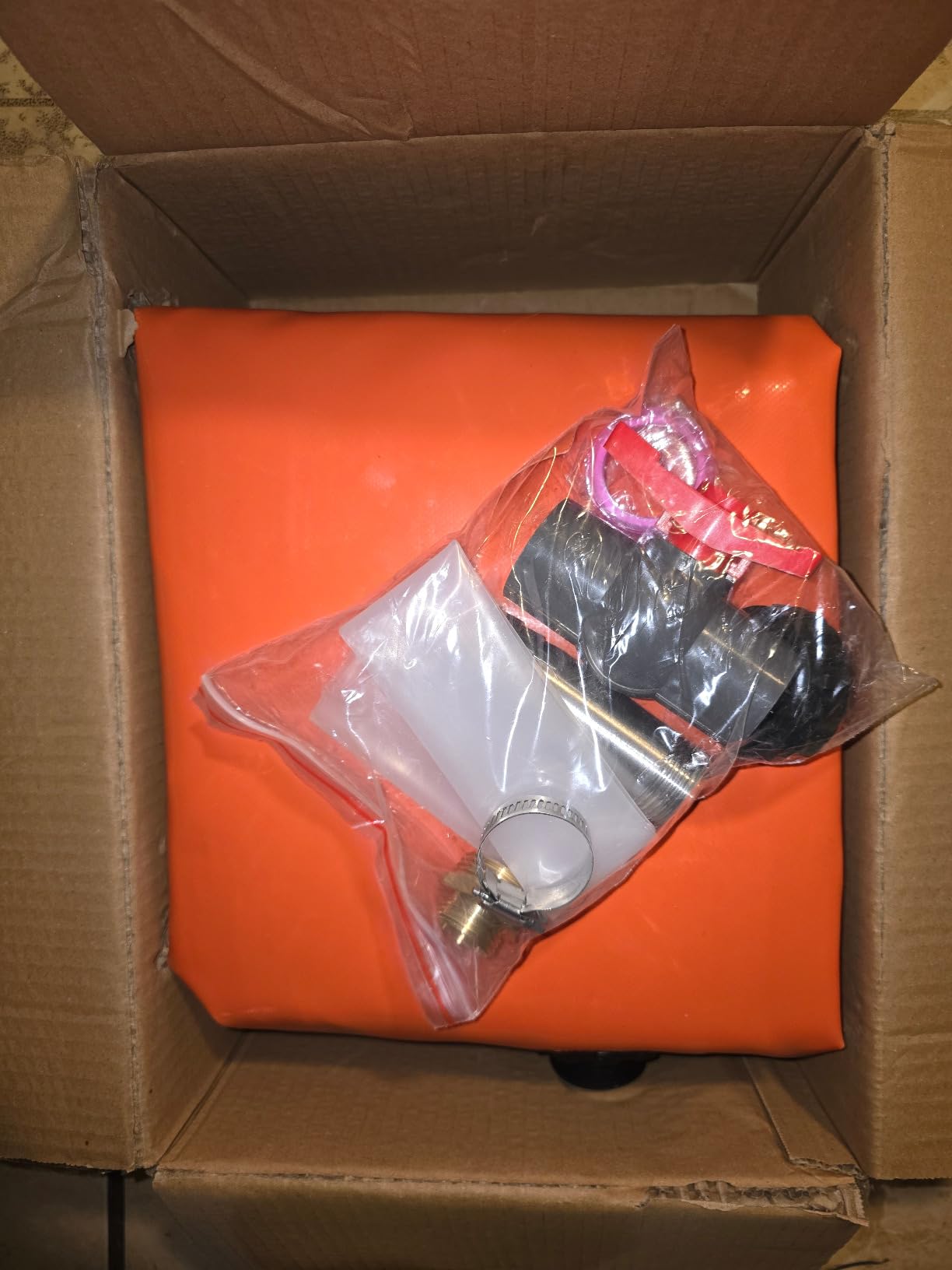
The Araiozora 120 gallon sits in the awkward middle of this roundup, large enough to be genuinely useful on a property and small enough to still fit behind a cab. It is 480L of 1000D waterproof PVC, weighs 4.81 kg empty, and the fittings are a step above the budget tier: a solid brass 3/4 inch external threaded connector for direct garden hose connection, plus four stainless steel handles for grip and tie-down.
Owners report thick, heavy-duty fabric with no leaks even under load and over rough roads, and the 4.4 average sits near the top of the group. It has been used as trailer ballast and for tree-bag irrigation on a large property, which tells you something useful about how people actually employ a tank this size when they are not camping.
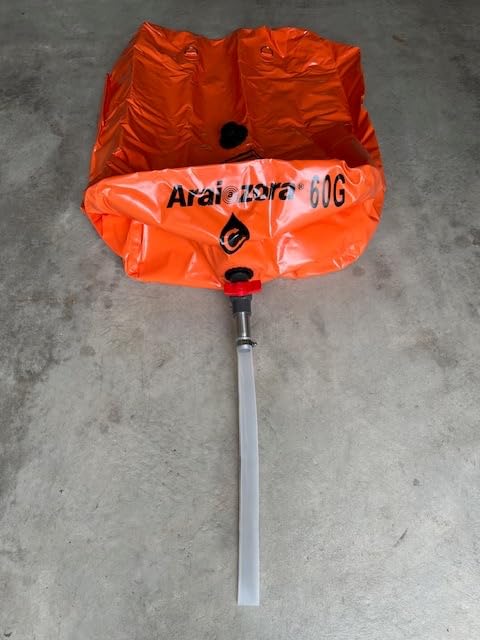
The reviews also contain a specific warning worth knowing before you buy. Several owners had the D-ring tie-down points rip out of the fabric after a couple of uses, which is exactly the failure you cannot afford if the bag is carrying 1000 lb. Strap it through the stainless steel handles instead of the D-rings, or build the frame we described earlier.
Two other gripes: the supplied discharge hose is described as cheap and flimssy, and the fill spout sits close to the bladder surface, making the final gallons hard to get in as the bag fills and tightens around the port. Neither is a dealbreaker, but both are reasons to keep a funnel and a spare hose on hand.
Best Fit Is Property and Livestock Work
A hundred and twenty gallons is 1000 lb of water, which puts it in serious payload territory. It makes sense on a property truck that spends its week at a gate or a barn, where one trip to fill three livestock troughs beats three trips with a 29 gallon bladder. It also works as a trailer ballast unit if you are running a heavy trailer that needs the tongue weight dialled in.
For camping it is borderline. Two people can easily drink and wash for a week from 120 gallons, but you are dedicating a third of a payload budget to water, and on a half-ton that is a real trade against gear. Measure your need before you commit.
Strap It Through the Handles
That D-ring failure is worth taking seriously because it is a load-bearing problem rather than a comfort problem. Route your ratchet straps through the four stainless steel handles, cross them over the top of the bag, and anchor to the bed rails or to a frame. Owners using that method report holding full loads over rough surfaces without the fabric letting go.
Replace the discharge hose before the first trip rather than after the first split. A braided or reinforced hose that fits the brass connector costs very little and removes the flimsy-plastic failure mode entirely. On a tank this size the discharge hose is the part that gets handled every single time.
8. VIVOSUN 30 Gallon Water Bladder – Best for Tracking What Is Left
VIVOSUN 110 L/30 Gal Water Storage Bladder, Water Tank, Water Storage Bag
30 gal / 110 L
Double-sided PVC coated mesh
Graduation scale
1.81 kg empty
Pros
- Graduation scale shows volume in real time
- Four pull rings make carrying easier
- Light at 1.81 kg and folds flat
- Coating is reusable and abrasion resistant
Cons
- Not approved for potable
- drinking or fuel water
- One-star share runs higher than the leading picks
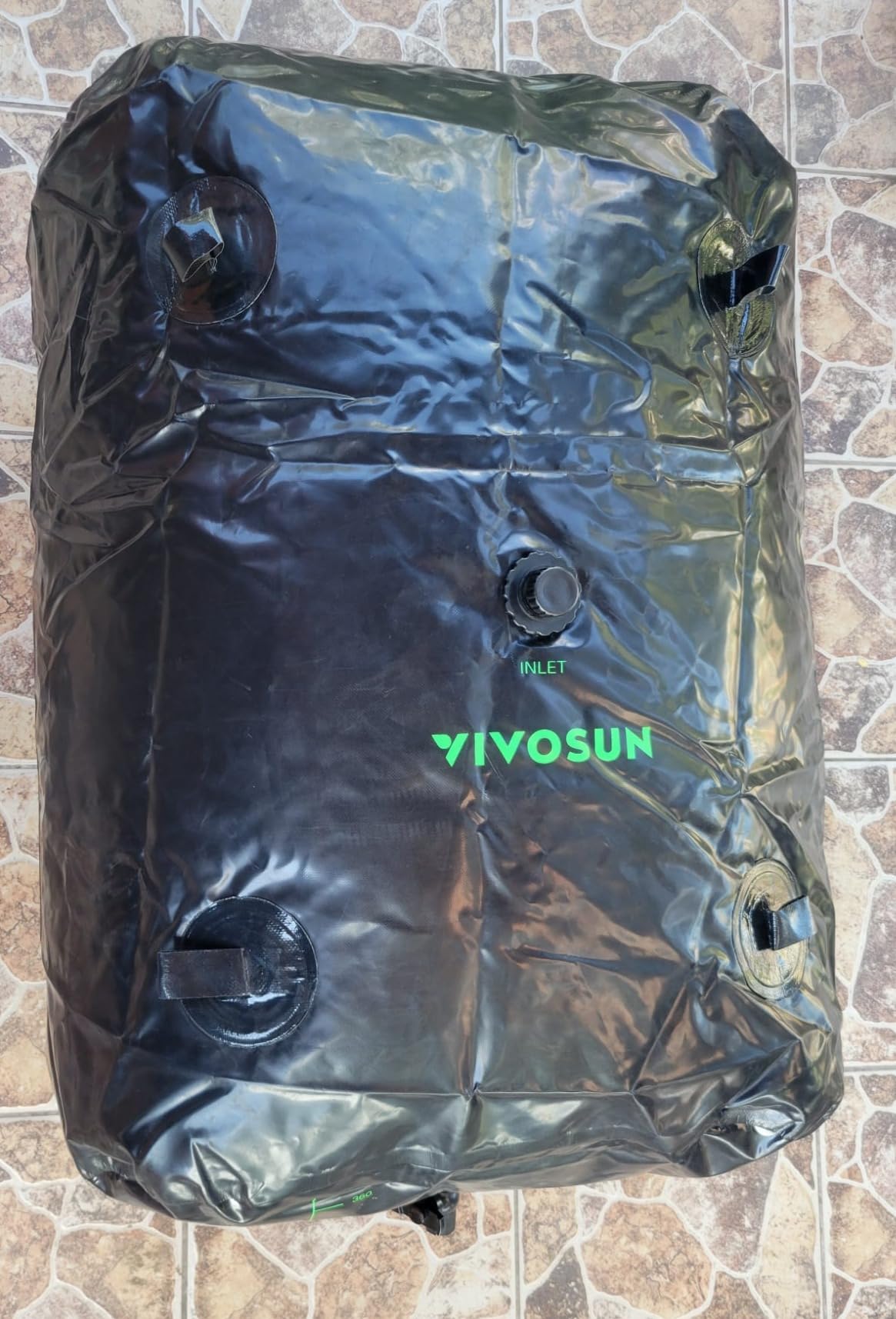
The feature that separates this 110L bladder from the others in its size class is the graduation scale printed on the body, so you can see how much water is left without lifting, guessing or filling a jug to measure. For anyone rationing water on a long trip, that is worth more than a large capacity number, and owners call it out as a standout.
Construction is mesh fabric with a double-sided PVC coating, described as leakproof, waterproof, abrasion- and tear-resistant. There are four pull rings for transport, a cap-style fill opening, an outlet faucet for dispensing, and a collapsible design for space-saving storage. Empty it weighs 1.81 kg, so it is in the same repositionable category as the 29 gallon unit.
Because the coating is double-sided and reusable, this bladder holds up over repeated seasons rather than degrading after a summer, and owners report using it for camping, garden watering, irrigation, rainwater collection and firefighting. The 4.2 average with 140 reviews reflects a product that does what it says without drama.
The manufacturer is explicit that it is not suitable for alcohol, gasoline, diesel or drinking water, so it belongs firmly on the non-potable side of your system. It also has a lower one-star share of the options at this size, mostly from seam and fitting issues common to the category. Nothing here is unique to this model.
Why a Volume Scale Changes How You Pack
Once you can see the level, you plan differently. Rather than guessing and running dry on day four, you can ration showers, wash water and drinking stock against what is actually in the bag, and top up at the next reliable source instead of overfilling at the first one. That single feature converts guessing into arithmetic.
It is also the bladder we would pair with a smaller food-grade container for a two-tank setup. A 30 gallon graduated non-potable unit for washing, plus a smaller food-grade container for drinking, is a setup forum users describe repeatedly. You get separate potable and non-potable storage, you can see the wash water level, and the whole thing is repositionable by one person.
Plan on Non-Potable Use Only
Take the restriction seriously rather than treating it as fine print. Drinking water stored in a bag that has held wash water is a real contamination pathway, and a bag with a plastic coating is not going to improve with time. If you need potable capacity, the only food-grade liner option in this roundup is the AQUATANK2 reviewed earlier.
The other thing to plan is fittings. The outlet is a faucet style, and if you want a shower or a pressure washer feed you will need a pump and an adapter, exactly as with the 29 gallon unit. For gravity use, for topping up troughs or for garden irrigation, it works as it comes out of the box.
9. Budiwati 105.7 Gallon Water Bladder – Best for Pressure Washer Feed
Budiwati 400 L/105.7 Gallon Water Storage Bladder, Foldable Portable Water Bladder Tank, Large Capacity Water Bag Container for Camping, Truck, RV, Emergency, Outdoor
105.7 gal
1000D PVC mesh, 0.7 mm
1 inch inlet and 1.25 inch outlet
Pros
- High capacity for a soft bladder
- Four stainless steel handles for transport
- Anti-leak threaded outlet with PTFE tape
- Used for pressure-washer feed and tree watering
Cons
- Weak seams reported leaking out of the box
- Pinholes developed after a few months
- D-ring sections pulled away under full loads
The Budiwati 105.7 gallon is one of the most capacity-forward options in this roundup, and owners confirm why they keep buying it. Reviewers use it for pressure-washer feed, tree watering and boat ballast, which are exactly the jobs where the water is consumed in bulk and no one is tasting it. If that is your use, the cost per gallon is hard to argue with.
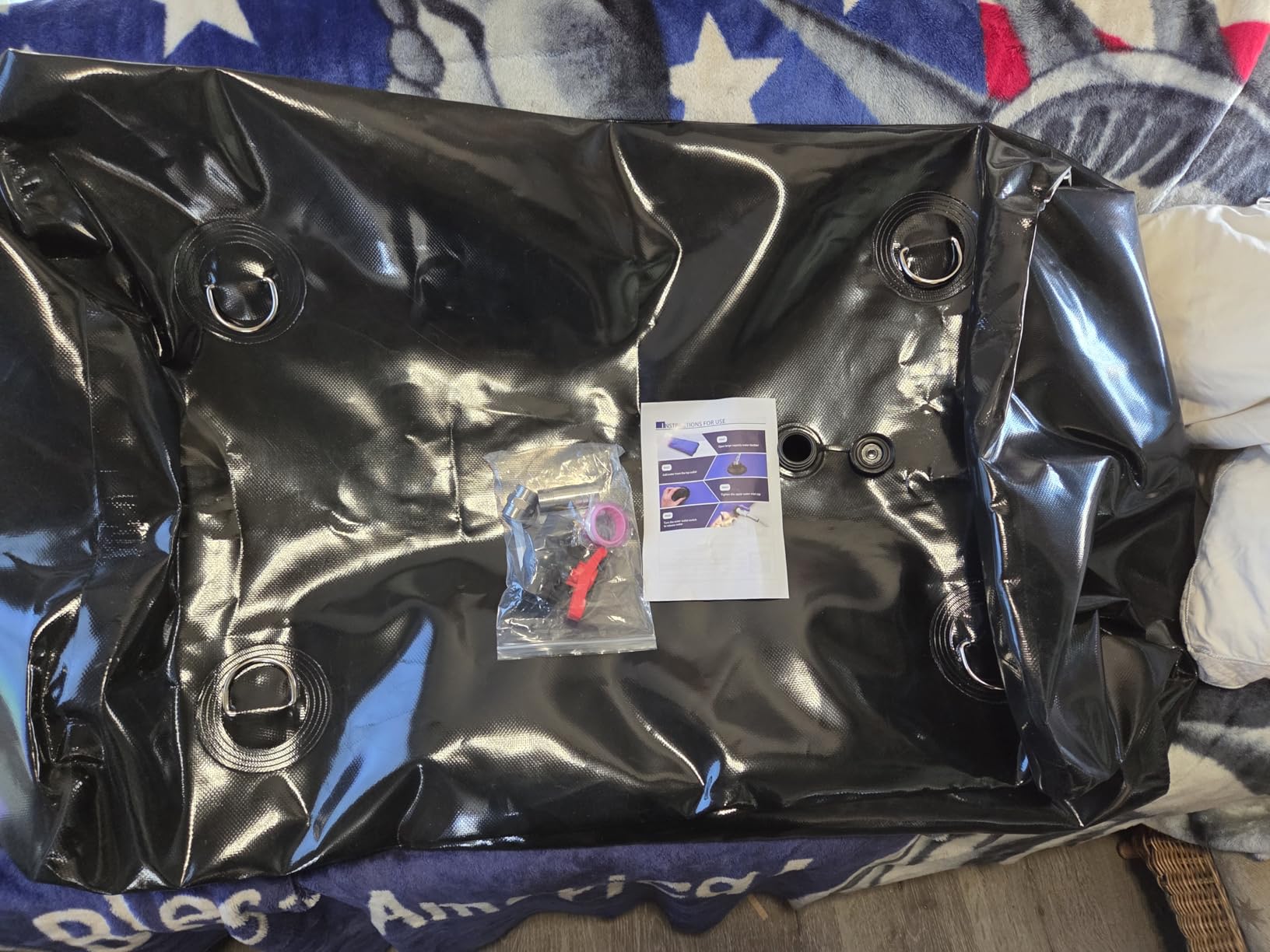
The build is double-layered 1000D PVC mesh at 0.7 mm thickness with reinforced welded seams, and the fitting sizes are unusually generous. You get a 1 inch inlet and a 1.25 inch outlet with rust-proof valves, four upgraded stainless steel carrying handles, an anti-leak threaded outlet, and PTFE tape in the kit for extra sealing.
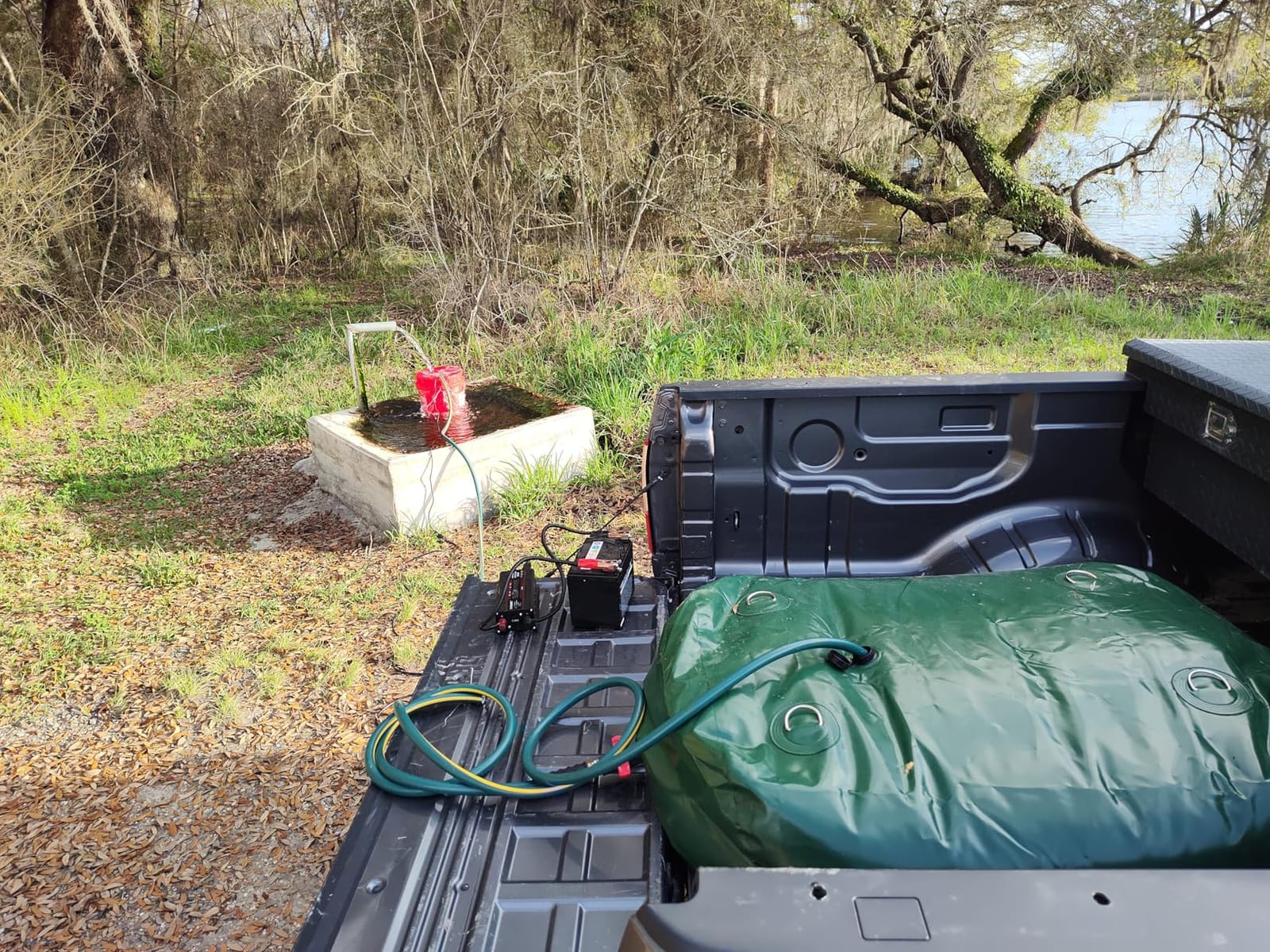
We want to be direct about the quality picture, because it is the reason this one is not higher. The average rating is 4.0 with 15 percent one-star reviews, the weakest distribution in the group. The recurring complaints are seam leakage straight out of the box, small pinholes that developed after a few months, and D-ring sections near the spout pulling away under full-load tie-downs.
Those are all fixable, but they are three separate interventions. Inspect the seams before the first fill, keep a repair patch habit rather than a repair emergency, and strap through the stainless steel handles instead of the D-rings. Budget an afternoon for setup and inspect it monthly if it lives in a work truck permanently.
Where a High Flow Outlet Actually Pays Off
The 1.25 inch outlet is the reason to pick this for pressure-washer duty. A larger outlet moves water faster at gravity and, more importantly, does not become the restriction point when you attach a pump and a feed hose. Fewer fittings means fewer leak points, and this tank ships with the threaded parts and tape you need to get sealed on the first attempt.
If you are washing trucks, soaking fence lines or watering large numbers of trees, the sheer volume is the argument. Owners report using it for pressure-washer feed and tree watering by name, and the stainless handles make the 100 plus pound empty lift a two-person job rather than a wrestling match.
Inspect Before You Fill It
With a tank this size, a seam leak discovered on the driveway costs an afternoon. Before the first fill, run soapy water along every welded seam and around the inlet and outlet, dry it off, and look for a bubble. Do it again after the first road trip, because pinholes typically announce themselves early under load.
Also check the outlet valve threads by hand before you trust them with 880 lb of water. PTFE tape is included, use it properly, and re-tension the straps after the first 50 miles. Treated that way, owners run these for pressure washing and irrigation for seasons. Skipped, it becomes the least reliable bladder here.
10. HZYOUMU 260 Gallon Water Bladder – Best for Bulk Storage
HZYOUMU 1000L/260 Gal Water Storage Bladder for Outdoor Water Storage
260 gal / 1000 L
1000D PVC fabric
Solid brass 3/4 inch connector
59 x 39.37 x 17.7 in
Pros
- 260 gallon bulk capacity
- Solid brass connector hooks straight to a garden hose
- 1000D fabric built for tear and puncture resistance
- Stainless handles ease securing in a bed
Cons
- At 260 gallons you need a large flat bed to lay it out
- 5.44 kg empty weight is a two-person lift
The HZYOUMU 260 gallon is among the largest units in this roundup at 1000L, and the 4.3 rating across more than 100 reviews is solid for a tank in that class. It uses the same 1000D waterproof PVC as several picks higher up the list, with the same solid brass 3/4 inch external threaded connector that hooks straight to a garden hose and four stainless steel handles for grip and tie-down.
Owners favour it for bulk storage, the brass connector and easy folding, and the rating distribution is strongly positive with only 9 percent one-star reviews. It folds flat when empty, and the same family is available in 63, 100 and 130 gallon variants if the 260 gallon version is more than you need.
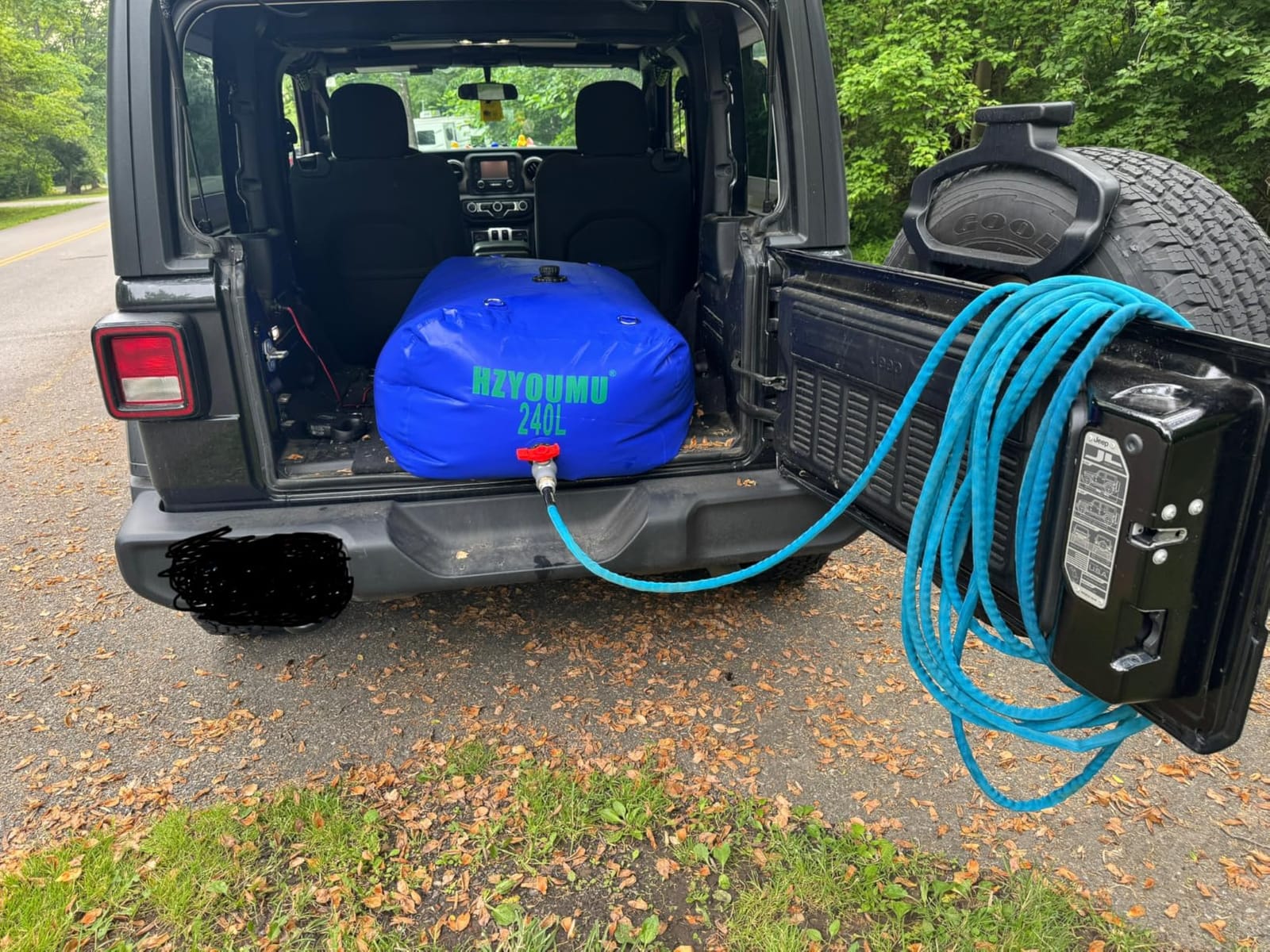
Its stated uses are pickup truck beds, irrigation, fire suppression and emergency reserves, and those last two are where a thousand litres genuinely earns its place. Staging fire suppression water, or holding a bulk reserve ahead of a dry season, is a job no 60 gallon bladder can do in one load.
Be realistic about handling. Filled it is more than 2100 lb of water, and empty it still weighs 5.44 kg of fabric that behaves like a sail if you try to lift it alone in a breeze. The stainless handles help, but treat this as a two-person or mounted lift rather than something you reposition between stops.
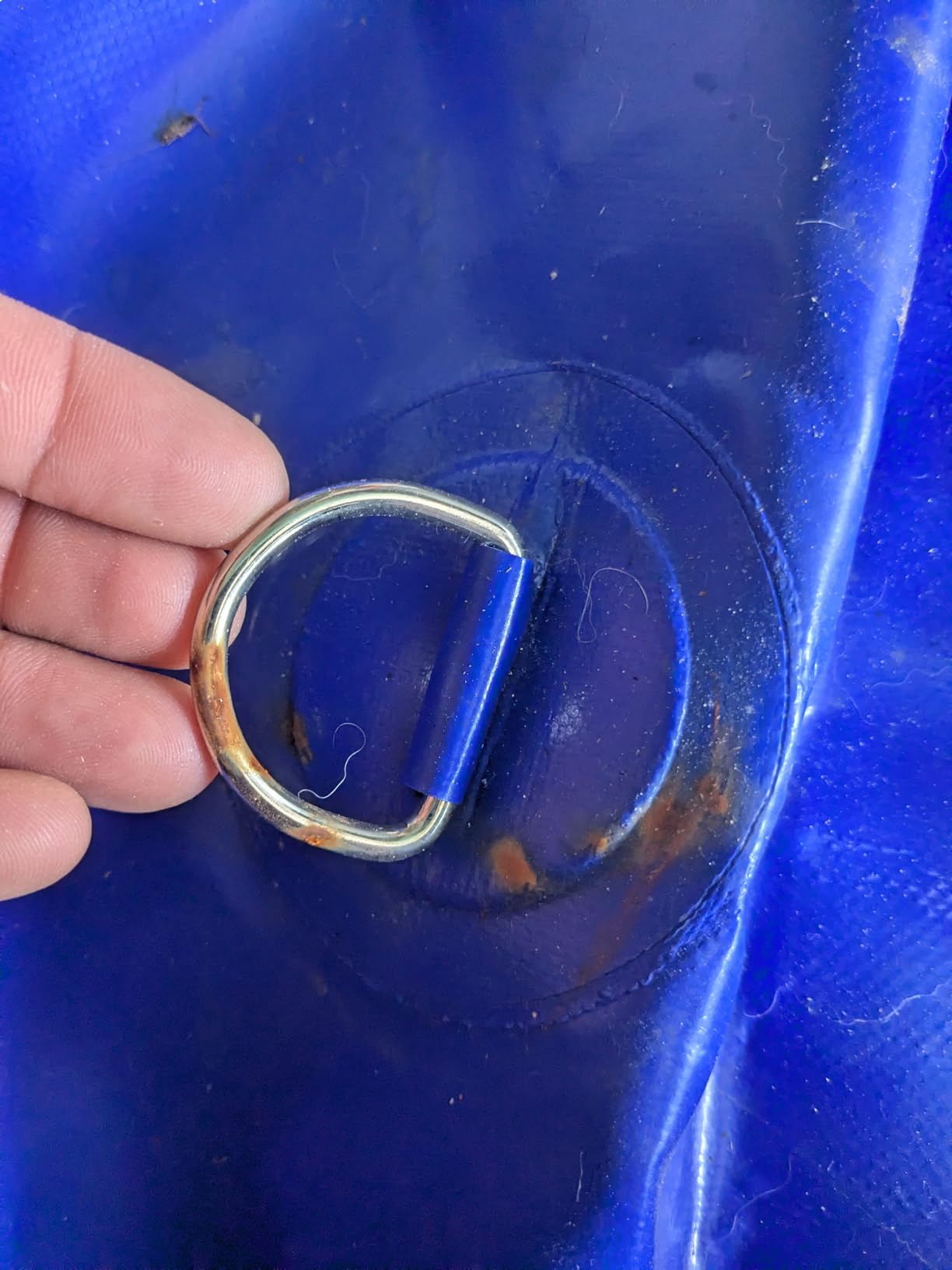
Pick the 100 Gallon Variant Instead
If your interest in a big tank is a truck bed rather than a flatbed or trailer, the 100 gallon version is the one that makes more sense. It holds 834 lb rather than 2100 lb, it fits across a short bed in one layer, and it still gives you more than a weekend of water for two people plus a shower.
Capacity above 100 gallons in a pickup stops being about water and starts being about logistics. You are now constrained by payload, by a flat surface large enough to lay the bag out, and by the fact that a filled bag cannot be moved without a second person. Pick the size that matches the space you can actually dedicate.
Drain, Dry and Store It Properly
At this volume you will not dry it in a weekend. Roll the outlet low, drain it fully, then lay it open and dry in the sun before folding, because a folded wet PVC bag holds moisture against the coating and eventually grows biofilm. Store it somewhere rodent-free, and a cardboard box or a dedicated tote keeps the fabric away from the dust of a garage floor.
For fire suppression and emergency reserve duty, treat the fill and sanitation routine as a scheduled task rather than something you do in a hurry. That habit is what separates a reserve tank that is usable when you need it from one you find full of sediment and smells. Every other pick in this list shares the same routine, just at a size you can handle alone.
How Many Gallons of Water Fit in a Truck Bed?
The honest answer depends on the bed, not on the bladder. Water weighs 8.34 lb per US gallon, so a short bed with about 64 cubic feet of space between the wheel wells and the tailgate holds roughly 480 gallons geometrically, and a long bed with about 90 cubic feet holds closer to 675. Those are theoretical ceilings, and they ignore the payload limit, which is almost always the real constraint.
Here is the useful version of the math. A standard short bed gives you roughly 55 to 60 gallons of usable bladder space once you account for wheel-well intrusion and leave room to strap around the edges. A long bed gives you roughly 75 to 80 gallons in the same conditions. Both figures assume the bladder is the only cargo. A flatbed with a bulkhead gives you far more.
Now the number that actually decides it: 60 gallons of water is 500 lb, and 80 gallons is 667 lb. Before you fill anything, read the payload sticker on your door jamb, subtract passengers, the trailer tongue weight and your other cargo, and you will have your actual answer. Many owners who ignored this step learned it the hard way, and it is the single most common surprise for first-time bladder buyers.
That load adds up across a working truck as well. If the vehicle is already running hard with a full bed every week, our alternators for diesel trucks guide covers the charging side of a heavy-duty setup, because a marginal charging system is one of the first things to struggle when payload climbs.
For sizing, multiply your daily water use by the number of days off-grid. Two people camping typically use 5 to 8 gallons a day for drinking, cooking and washing, so a 29 or 30 gallon bladder covers three or four days and a 60 gallon unit covers a full week. A traveller who showers every morning should budget closer to 12 gallons a day, which puts a 60 gallon bladder at five days and a 120 gallon unit at a comfortable ten.
One more practical limit. Soft bladders need to lie flat when full, so vertical stacking does not work the way it does with rigid cans. A 60 gallon pillow tank laid in a bed occupies more floor area than three 20 gallon cans stood on end, and it needs a foot of clearance above it to get the fill port in and out. Plan the flat space before you plan the capacity.
Bladder Material: PVC, TPU and What You Can Actually Drink
Most bladders in this roundup are 1000D PVC mesh with a coating on both sides, and two use heavier cloth. That fabric is the workhorse of the category: cheap, tear-resistant, weldable and repairable, which is why every budget pick here is made of it. It is also not a drinking water material, and that is the first thing to sort out before you buy anything.
There are three material families you will meet. PVC coated mesh is the cheapest and most common, and the number after it, 1000D or 2000D, describes the weave density. TPU with a nylon outer shell is the food-grade option, and the AQUATANK2 is the only one here. Rigid polyethylene is what a jug or a can is made from, and it is not a bladder material at all, but it is the right choice for stacking and for containers you will leave in a truck permanently.
Potable versus non-potable is a hard line, not a preference. Only buy a food-grade lined bladder for drinking water, and treat the rest as wash water, irrigation, livestock, dust suppression and fire reserve. Forum users take this further, as one Expedition Portal user put it, once a container has held non-potable water it can never be used for drinking water. Buy two, keep the spigots separate, and never bridge the two systems with the same hose.
One warning that connects material to durability. Several owners of the PVC tanks in this roundup report a strong plastic odour in new units. Rinse, air out for a day or two, and if it does not clear, that is your return signal rather than something to work around. Odour that will not leave the plastic will not leave the water either, and that is exactly the argument for paying more for a food-grade liner when the water is going into your body.
If you plan to drink from a bladder, also skip the ones that carry an explicit non-potable warning on the label, including the VIVOSUN in this roundup, which names drinking water among the excluded uses. Accuracy in a spec sheet is a good sign, but the exclusion is a hard stop.
Mounting and Retention: How to Stop It Moving
This is the most asked question in every forum thread we found, and the answer has not changed in years. The most cited failure in the SERP is the same: a jug held with bungee cords, a couple of U-turns, and a wet bed. Bungee cords stretch under sustained load. Ratchet straps do not.
Start with the frame, because it solves three problems at once. A shallow plywood or aluminium tray sized a few inches larger than the bladder, bolted or screwed to the bed rails, gives the bag a flat base, a hard edge to strap against and a physical barrier between your water and every shovel, ladder and tool in the bed. Owners who frame a soft tank report the shifting complaints disappear almost entirely.
Strap over the frame, not over the bag. Use at least two ratchet straps crossing the long axis, and if the bladder is over 100 gallons add two more across the short axis. For bladder tie-down points specifically, route through stainless steel handles rather than D-rings, because D-ring failure under load is a documented complaint on more than one model in this roundup.
For a rigid container instead of a soft bag, the advice changes. A user on Expedition Portal suggested a MOLLE panel holding a Rotopax-style container, and that is a good approach for 1 to 5 gallon units where you want the water inside the cab with the passengers. Another user in the same thread recommended 2 to 4 litre dromedary bags plus a spigoted bag and bottled water, which is a layered system rather than one big container, and it works because a small failure costs you a bottle rather than a bed.
Whatever you mount, armour the bladder. A layer of moving blankets, a piece of carpet, or a fitted cover between the bag and the load costs almost nothing and prevents the puncture that ends the trip. We could not find a single forum answer on puncture resistance, which is odd given how many people carry ladders in the same bed, so treat it as a solved problem with plywood rather than an open question.
Finally, check the straps after the first 50 miles and after any hard off-road section. Soft water changes shape as it sloshes and the bag relaxes, so tension drops even when the strap has not moved. A ten second check at every fuel stop is the whole retention strategy.
Baffled vs. Unbaffled, Pumps and Winter Storage
Baffled versus unbaffled is the term that only shows up on manufacturer pages, so here is the plain version. A baffled bladder has internal welded baffles that split the water into compartments, which slows the front-to-back slosh when you brake hard or turn. An unbaffled bladder holds one open volume of water, which moves as a single wave and pushes the bag around in the bed. For a stationary tank, unbaffled is fine. For a loaded truck bed, baffled is meaningfully calmer.
None of the ten bladders in this roundup is described as baffled, because the category is built for general-purpose water storage rather than for off-road slosh control. The practical workaround is geometric: keep the bladder low, strap it on more than one axis, and accept that a 260 gallon bag full of water is going to reshape when you stand on the brakes. If you routinely drive technical terrain with a full tank, framed and tightly strapped is the closest you will get to a baffled solution.
For pressure, plan on an external pump. Gravity feed from a low outlet gives you a trickle, which is fine for bottles, troughs and irrigation. A camp shower, a sink or a pressure washer needs a 12 volt pump rated above the pressure you intend to run, a braided hose, and a shut-off at the tank. The ZXZYHFTY 29 gallon and VIVOSUN 30 gallon are both designed to accept a pump, though neither includes one.
Winter storage is where most of the damage happens, and the forum evidence is that nobody has a good answer. Our advice is simple and it costs nothing. Drain the bladder fully, leave the outlet open, and store it dry rather than full, because freezing water expands enough to stress welded seams regardless of the material temperature rating. Check the spec sheet for the material range, but treat it as a storage rating for the fabric, not a licence to leave a gallon of ice inside the bag.
Winter is also when a tired starter matters, because draining and folding a bladder on a frozen driveway at six in the morning is not the first job anyone wants. Our starters for trucks guide covers that side of cold-weather prep, and the electrical checklist items around it are worth a look before the season.
Sanitation is the other skipped step. For a non-potable bladder, rinse, drain and dry after every use, and do not store it folded while damp. For a food-grade bladder, sanitise on a schedule with a food-safe sanitiser, let it air dry fully open, and never let it share a spigot with a non-potable system. Biofilm grows in a folded damp bag faster than most people expect, and once it sets in it is very hard to shift.
One last piece of forum wisdom worth repeating. A user on Expedition Portal noted that Scepter jugs can be found used in good condition for a couple of dollars, and immediately raised the counter-argument: you cannot know what was in a used jug. That is the right instinct. If you buy a used container, it stays on the non-potable side of the system permanently, no matter how clean it looks.
Frequently Asked Questions
What is the best water tank for overlanding?
For most overlanders the best choice is a collapsible 1000D or 2000D PVC bladder in the 29 to 65 gallon range, because it folds flat, weighs little empty and is affordable. Choose a food-grade TPU lined model if you plan to drink from it, and add a frame plus ratchet straps so it cannot slide. Capacity beyond 100 gallons suits property, livestock and emergency reserve work rather than camping.
How many gallons of water can fit in a truck bed?
A short bed gives you roughly 55 to 60 gallons of usable bladder space once wheel-well intrusion and strap clearance are accounted for, and a long bed gives about 75 to 80 gallons. Payload is the real limit: 60 gallons of water weighs 500 lb, so check the payload sticker on your door jamb and subtract passengers, tongue weight and other cargo first.
Which is better, a bladder or a rigid water can?
A soft bladder wins on capacity, weight when empty and price, and it fills flat areas of a bed that a rigid can cannot. A rigid can wins on stacking, puncture resistance, easy cleaning and the ability to sit in a bed full of tools. Many owners run both, using rigid cans for drinking and a bladder for wash water, livestock and dust suppression.
Can a water bladder stay full in freezing weather?
Drain it. Freezing water expands enough to stress welded seams and fittings regardless of the fabric temperature rating, and the most common complaints across this category are splits and pinholes rather than cold cracking. If you must store water through a freeze, use a rigid container rated for it and keep the bladder empty, open and dry.
Are PVC water bladders safe for drinking water?
Not unless the manufacturer says so. Most collapsible PVC mesh bladders are sold for non-potable use, irrigation, livestock, wash water and fire reserve, and some explicitly exclude drinking water. If you need potable capacity, choose a bladder with a food-grade TPU inner lining that is BPA-free and phthalate-free, and keep its fill, drain and hose separate from any non-potable system.
How do I keep a water bladder from sliding around in my truck bed?
Build a shallow tray or crate a few inches larger than the bladder, mount it to the bed rails, and ratchet strap the frame down on at least two axes. Route straps through stainless steel handles rather than D-rings, which are the most common tie-down failure. Add a blanket or board between the bladder and your tools, and re-tension the straps after the first 50 miles.
The Verdict on the Best Water Bladders for Trucks
Ten bladders, one clear winner. The MXQMKL 100 gallon takes our editors’ choice because it pairs a 7.5 lb empty weight with a 0.9 mm double-sided PVC mesh, a welded port design and more than 1200 reviews, which is far more evidence of long-term behaviour than anything else in the category. It is the bladder we would build a two-week trip around, and it is the strongest all-round balance of the ten we tested.
The VEVOR 264 gallon is the volume king and ships with the most complete accessory kit in the roundup, while the AQUATANK2 60 gallon is the only food-grade TPU lined option and the only one we would drink from. If you want one smaller bladder you can reposition by hand after every stop, the 29 gallon and 30 gallon units do that job better than anything larger.
Whatever you choose, do the two things that decide whether it works. Check your payload sticker before you fill it, because water at 8.34 lb a gallon will surprise you, and build a frame with ratchet straps before the first heavy cornering, because that is the failure everybody in the forums reported. If you are also upgrading the rest of the bed, our diesel battery guide covers the other piece of overland prep that gets skipped.
These picks are updated for 2026 as new models land, and we will keep the ratings and review counts current as they change.