
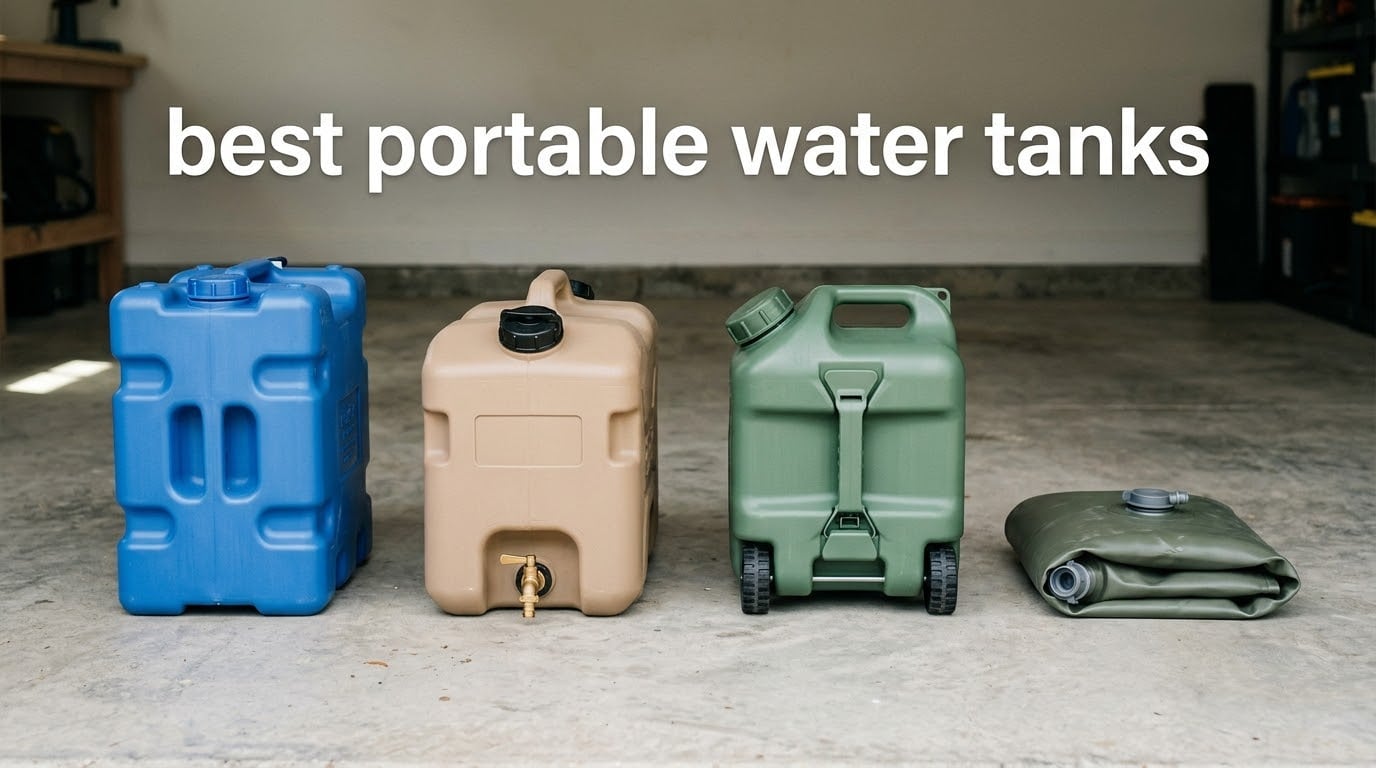
If you have ever lifted a supposedly portable water tank and wondered who designed it, you are not alone. Most of the surprise comes down to one fact: water weighs 8.34 pounds per gallon, so a 50-gallon tank is more than 400 pounds once it is full. The best portable water tanks solve that weight problem with wheels, folding walls, or a shape that lets two people share the load, and they solve the food-safety problem with a documented certification rather than the phrase BPA-free on its own.
We compared 12 tanks across rigid polyethylene, collapsible bladder, rolling jug and bathtub-liner designs, checking capacity, empty weight, material, fittings and outlet type against real owner feedback. Our picks cover four jobs: hauling water in a truck bed, camping and car camping, emergency and household backup, and garden, farm and rainwater work. The right answer for a 55-gallon bulk reserve looks nothing like the right answer for a weekend in the backcountry.
We updated this guide for 2026, and every capacity, weight and dimension below comes from the manufacturer’s listed specification rather than a listing headline. Where a tank is not certified for drinking water, we say so plainly.
Before we get into the picks, it helps to know what separates the categories.
The transfer tank guide covers the fuel side of hauling, which has its own venting and bonding rules, and our RV waste tank picks go deeper on the disposal side than we do here.
Table of Contents
Top 3 Best Portable Water Tanks in 2026

Camco Rhino 36-Gallon Tote…
- 36 gallon capacity
- 45 lb empty
- UV-stabilized HDPE
- No-flat wheels and tow adapter

waterBOB Bathtub Emergency…
- Up to 100 gallon capacity
- 1.3 lb empty
- Food-grade LLDPE liner
- Includes hand pump
WaterPrepared 55 Gallon…
- 55 gallon capacity
- Polyethylene construction
- Brass garden-hose spigot
- Fits through a standard doorway
All 12 Portable Water Tanks Compared Side by Side (October 2026)
The table below is the fastest way to narrow the field. Every row lists the capacity, the material, the outlet and the job the tank is actually good at, so you can eliminate the wrong shapes before you read the full write-up.
| Product | Specs | Action |
|---|---|---|
| Camco Rhino 36-Gallon Tote Tank |
|
Check Latest Price |
 RomoTech 50 Gallon Square Poly Tank RomoTech 50 Gallon Square Poly Tank |
|
Check Latest Price |
| WaterPrepared 55 Gallon Stackable Tank |
|
Check Latest Price |
 COOZMENT 3.2 Gallon Water Container COOZMENT 3.2 Gallon Water Container |
|
Check Latest Price |
 YOSN 5 Gallon Water Jug YOSN 5 Gallon Water Jug |
|
Check Latest Price |
 GIGYES 7.4 Gallon Jug with Wheels GIGYES 7.4 Gallon Jug with Wheels |
|
Check Latest Price |
 MXQMKL 240 Liter Foldable Water Bladder MXQMKL 240 Liter Foldable Water Bladder |
|
Check Latest Price |
| waterBOB Bathtub Emergency Bladder |
|
Check Latest Price |
 Augason Farms 55 Gallon Storage Barrel Augason Farms 55 Gallon Storage Barrel |
|
Check Latest Price |
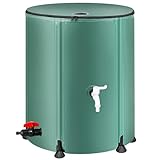 Laspeiraux 53 Gallon Collapsible Rain Barrel Laspeiraux 53 Gallon Collapsible Rain Barrel |
|
Check Latest Price |
 Chapin 25 Gallon Utility Water Tank Chapin 25 Gallon Utility Water Tank |
|
Check Latest Price |
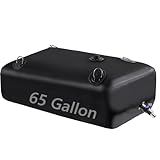 Rodelna 65 Gallon Foldable Water Bladder Rodelna 65 Gallon Foldable Water Bladder |
|
Check Latest Price |
How We Evaluated and Ranked These 12 Tanks
Every tank in this list was scored against the same five criteria, in this order.
1. Capacity against a real daily need. A 3-gallon jug and a 55-gallon drum are not competing products. We asked whether the capacity matches a documented need such as a weekend of car camping or a two-week household reserve, and we penalised tanks whose real usable volume falls short of the printed number.
2. Empty weight and full weight. We used the 8.34 pounds-per-gallon constant to work out the filled weight, then asked the only question that matters in practice: can one person lift it, or does it need two?
3. Material and certification. We separated food-grade and potable claims from the much weaker BPA-free claim, and we preferred rotomolded polyethylene over thin-wall or multi-piece construction when the tank stays outdoors.
4. Fittings and outlet. Lid opening size, bung thread standard, whether the outlet mates with a common hose, and whether the fill mouth is wide enough to scrub out all matter here. A tank you cannot clean is a tank you stop using.
5. Durability and value. We weighted long-term owner reports on leaks, seam failure and UV degradation, and we treated repeated complaints about the same part, usually a spigot, as a serious design flaw rather than bad luck.
Best Portable Water Tanks for Truck Beds, Trailers and Hauling
For hauling, the deciding factors are weight management, tie-down points and how the tank behaves once it is full. A 400-pound tank that slides on a wet bed on a curve is worse than a smaller one you can secure, so we look hard at molded channels, handles and wheels before anything else.
1. Camco Rhino 36-Gallon Tote Tank – Best for Moving Heavy Liquid Without Moving the Rig
Camco Rhino 36-Gallon RV Tote Tank, (39006)
36 gallon capacity
45 lb empty
UV-stabilized blow-molded HDPE
No-flat wheels and tow adapter
Pros
- No-flat wheels and oversized handle make a full tote easy to move over rough ground
- UV-stabilized HDPE body holds up to sun exposure without leaking
- Removable steel tow adapter pulls behind a truck or golf cart
- Includes tank rinser
- ladder hook and gate valve
Cons
- Main handle has a ribbed backside that gets uncomfortable when full
- Bulky to store and very heavy at capacity
- Some variants ship without the front wheels buyers expect
One thing to clear up before anything else: this is a waste tote, not a drinking water vessel. Its listed use is moving waste from an RV black water tank to a dump station, and its category listing is RV black water tanks. It ranks first here on build quality and transport design, not on potability.
What impressed me most is the transport hardware. Two oversized no-flat wheels and an oversized handle let you roll a full tote across gravel, grass or a campground loop without dragging it, and the removable steel tow adapter means one person can hook it behind a truck and move several hundred pounds without lifting.
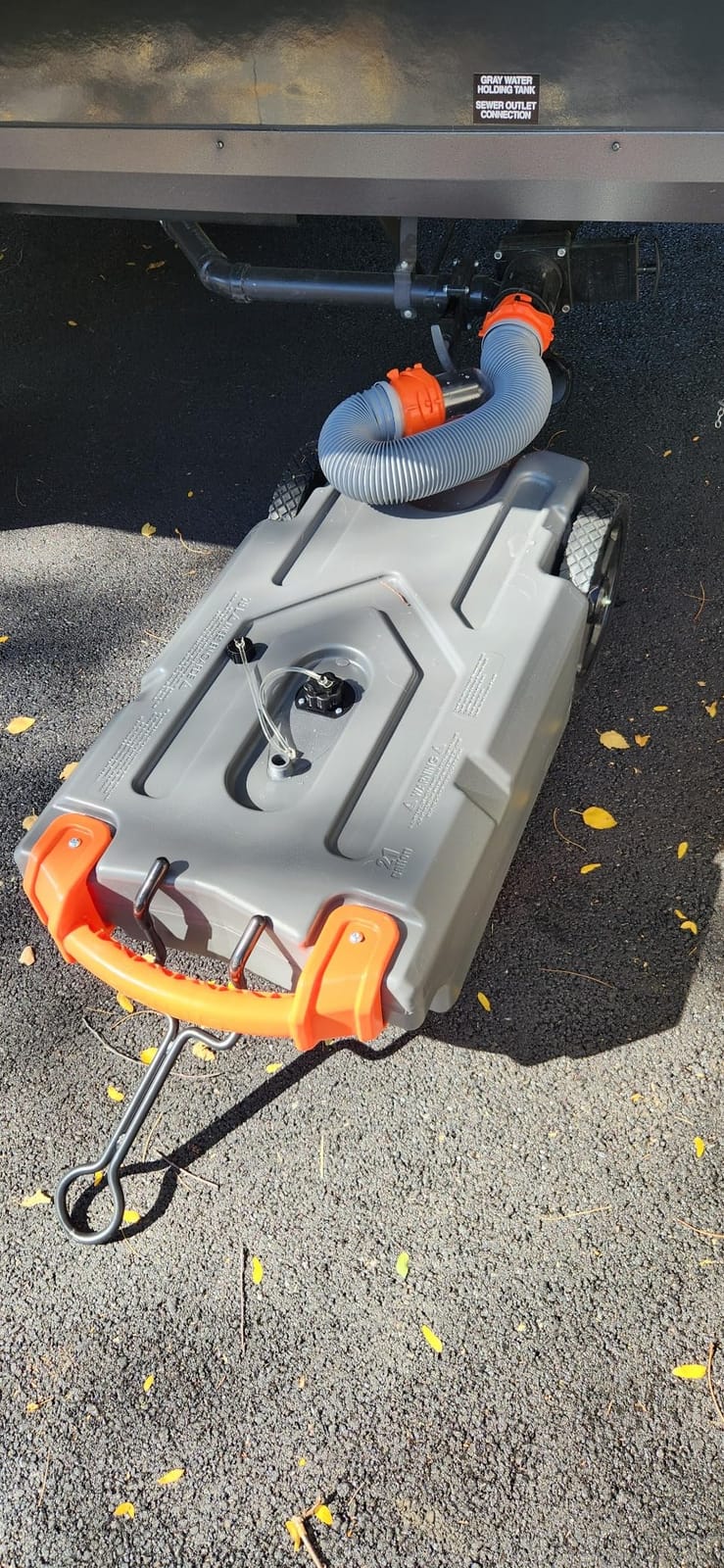
The body is blow-molded, UV-stabilized HDPE at 45 pounds empty and 43.38 by 43.38 by 25.3 inches, and it carries a two-year limited warranty from Camco. At 4.7 stars across more than 27,000 ratings, this is the most heavily reviewed tank in our set by a wide margin, and the recurring praise matches the specification sheet: it does not leak and it moves.
The honest complaint is the handle. When the tote is near 36 gallons, the ribbed hollow backside of the main handle digs into your palm, and owners consistently suggest using the tow adapter instead. At full capacity this is a two-person lift at best, and the rectangular footprint is genuinely awkward in a small garage.
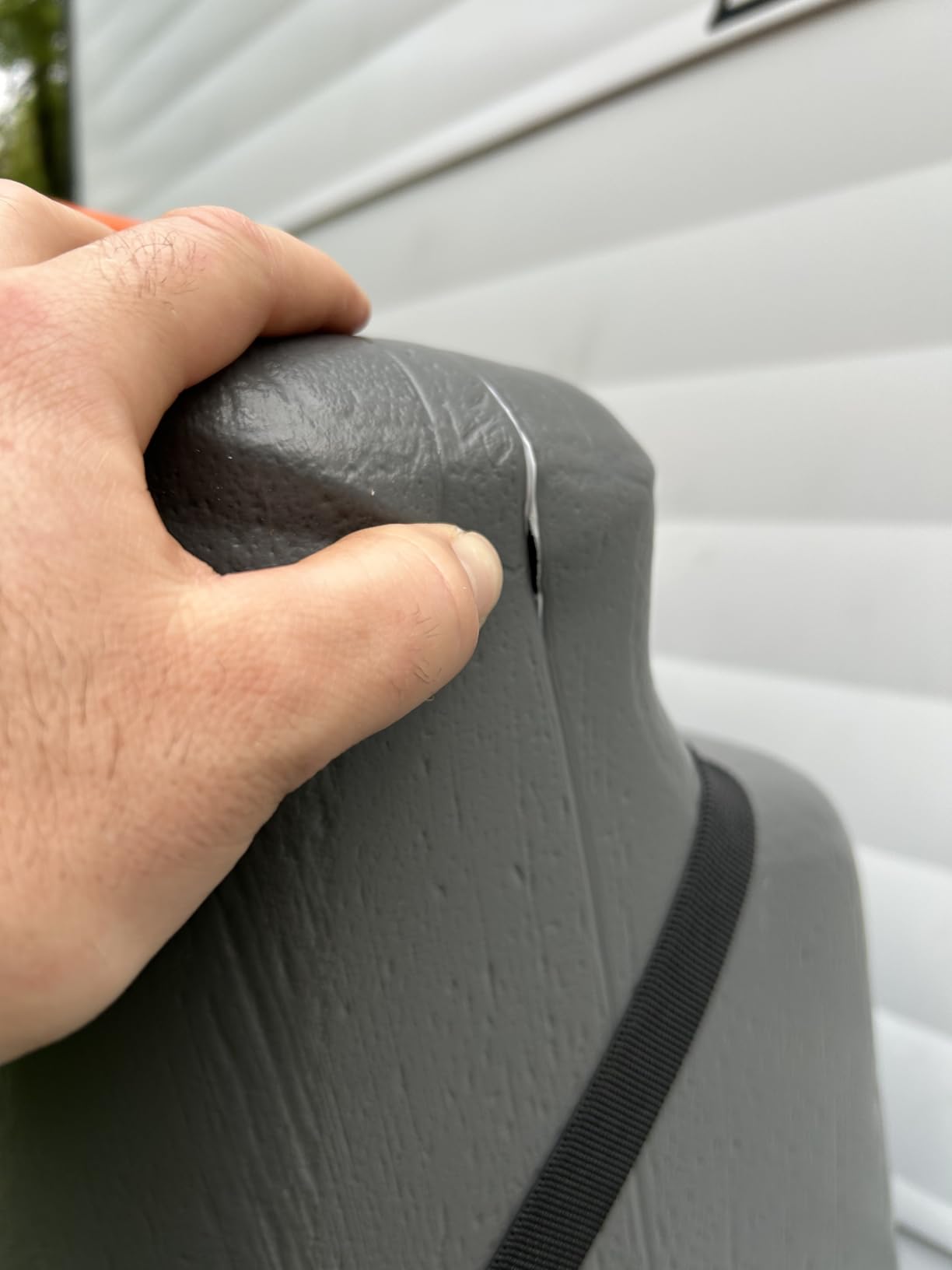
Check the wheel configuration before you commit
Several buyers report receiving units without the front wheels they expected, which pushes you back to a manual lift. The listing imagery is the only reliable guide, so confirm the wheel set in the product photos before ordering rather than assuming both wheels are included.
Camco’s tote range also comes in a larger size, so if your holding tank is bigger than 36 gallons, check the sibling listing rather than making two trips with a smaller tote, because loading and dumping is where the time goes.
Who should skip this tank
Skip it if you intend to drink from it. It is not certified for potable use, and no amount of cleaning changes that. It is also the wrong choice if you need something you can carry alone up a set of stairs, or if garage floor space is tight.
For household drinking water, jump to the emergency group further down, where every pick carries a food-grade or potable claim you can verify.
2. RomoTech 50 Gallon Square Poly Tank – Best for Level Checks and Long-Term Outdoor Service
RomoTech 82123919 50 Gallon Square Polyethylene Water Storage Tank
50 gallon capacity
25 lb empty
Rotomolded UV-stabilized polyethylene
3/4 inch NPT bulkhead outlet
Pros
- Rotomolded polyethylene resists rust
- corrosion and UV degradation
- Translucent walls with molded gallon and liter graduations
- 5 inch fill opening makes cleaning straightforward
- Molded tie-down channels for truck beds and trailers
Cons
- 3/4 inch female NPT outlet needs an adapter for common fittings
- About 2 inches of water stays trapped in the sump after draining
- Some units report a bottom fitting that is not water-tight
The RomoTech is the tank we would put in a truck bed behind a camper that lives outdoors year round. It is rotationally molded medium-density polyethylene, so there is no seam to fail and no rust to worry about, and the UV stabilisation is what keeps the walls from going brittle after a season of direct sun.
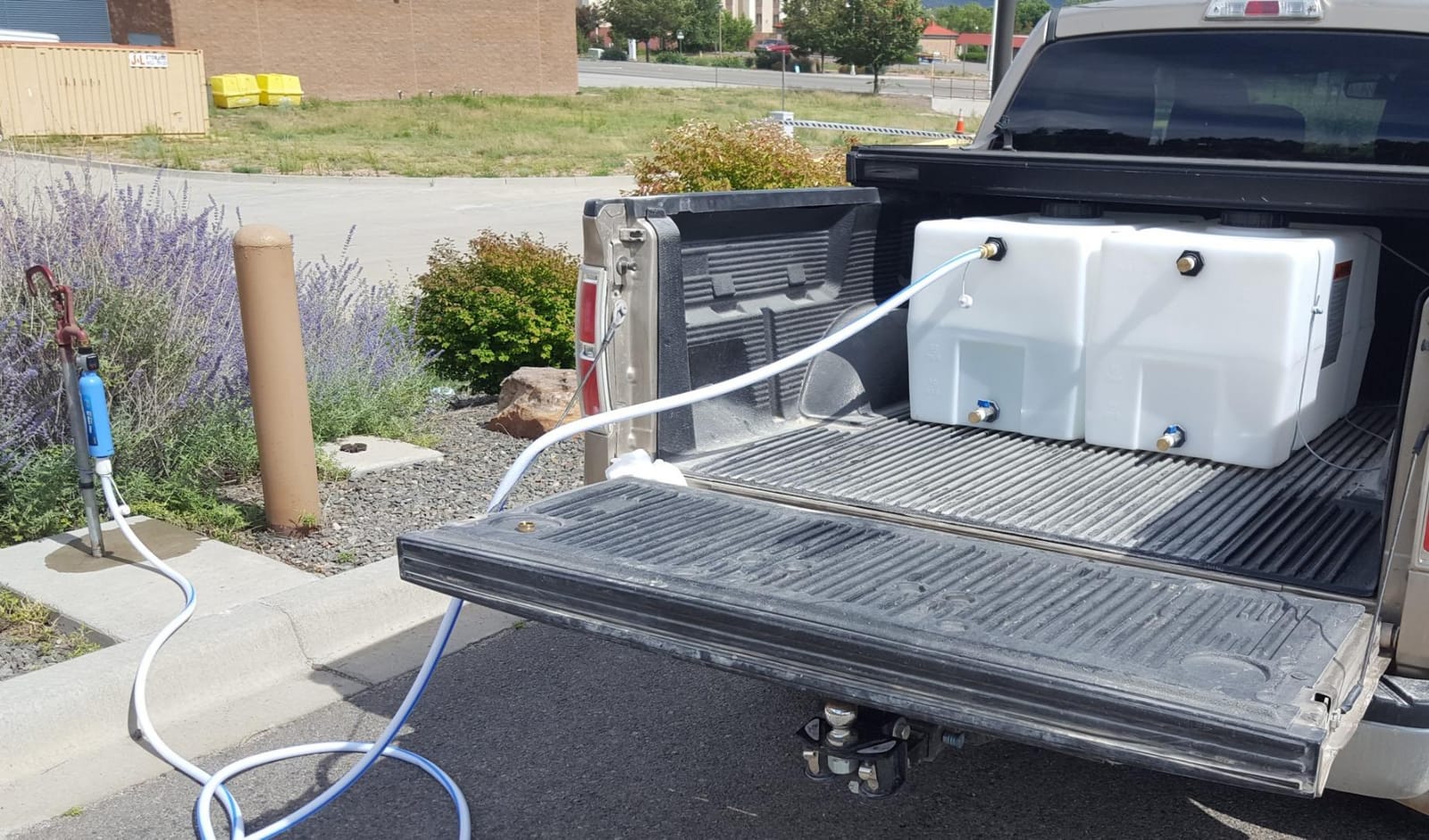
Two details set it apart from cheaper utility tanks. The translucent walls carry molded gallon and liter graduations, so you can check the level from outside without opening the 5-1/2 inch lid, and molded tie-down channels run around the body so a saddle strap has something to grip. At 36 by 19 by 22 inches and 25 pounds empty, it is a manageable shape to secure in a bed or trailer.
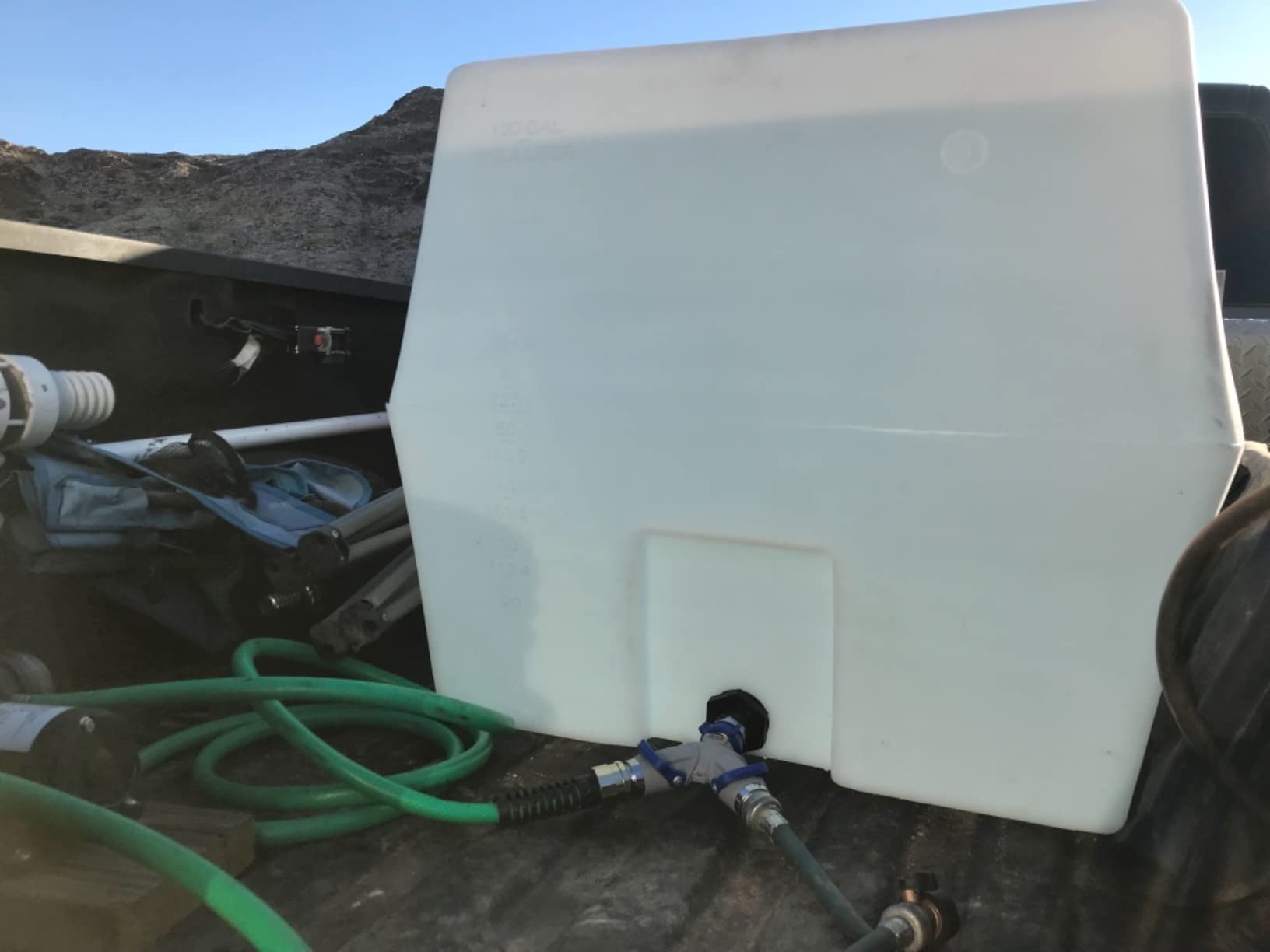
It handles liquid up to 140 degrees Fahrenheit and is rated for non-flammable liquids only. That is broad enough for potable water, irrigation supply, a pressure-washer buffer or a grey-water holding tank, which is why it appears so often on small farms and off-grid properties.
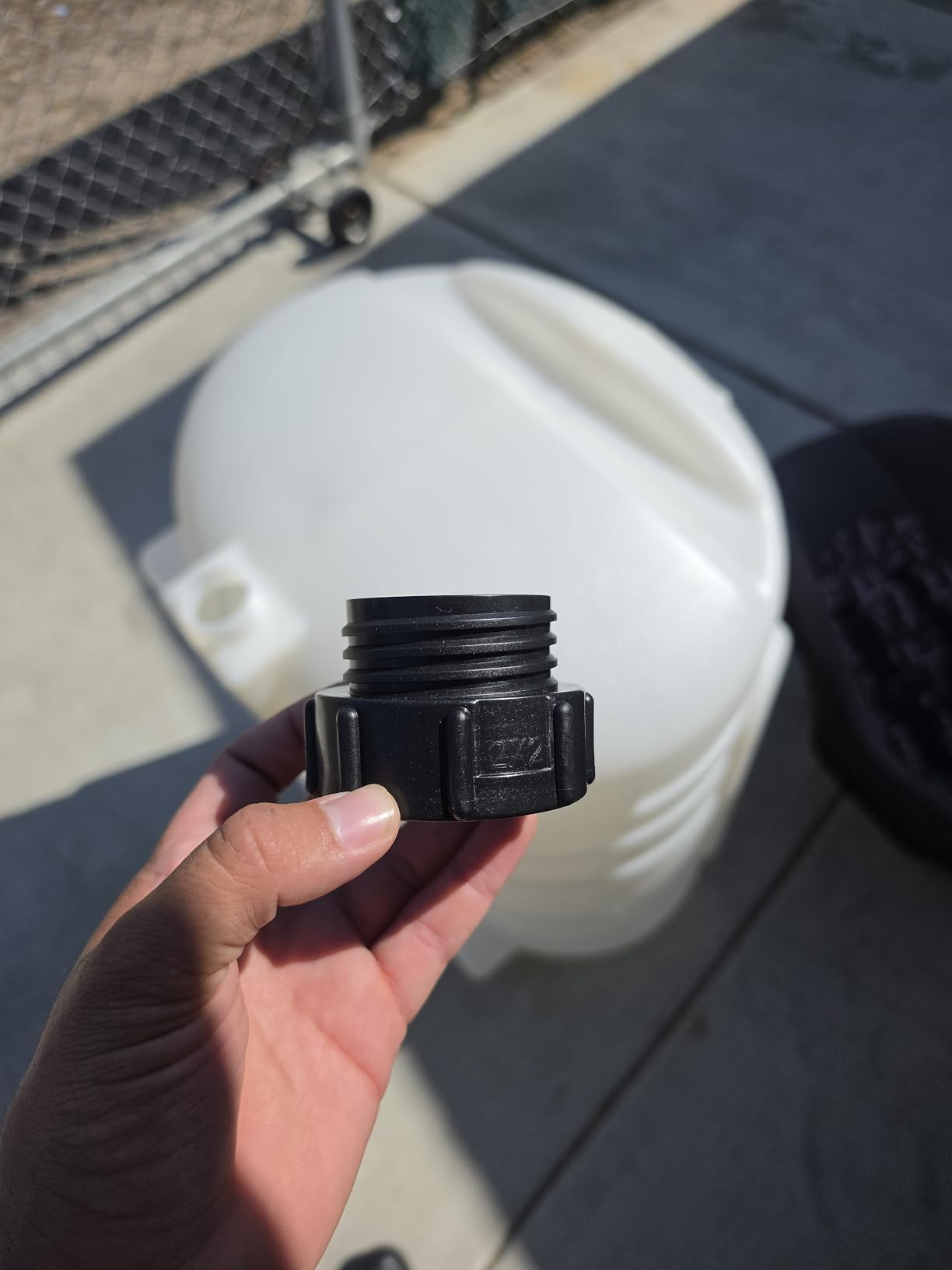
The outlet is where people get caught. It is a 3/4 inch female NPT bulkhead fitting, and because the thread is female, many common 3/4 inch male fittings will not mate without a short adapter. Budget for a brass adapter and a 3/4 inch ball valve the day it arrives.
Buy the adapter before the tank
Thread compatibility is the single most common complaint on this tank, and it is entirely avoidable. A 3/4 inch NPT to 3/4 inch garden hose male adapter solves it, and keeping one in the box means you are not improvising a connection the first time you need to drain.
The second issue is residual water. The outlet sits above the lowest point, so roughly 2 inches of water remains after draining, which matters if you are storing the tank for winter or freezing conditions.
Who should skip this tank
Skip it if you need to move it alone. Full, it is over 400 pounds, so this is a two-person lift every time. It is also the wrong shape under a low-profile truck bed cover, because the cap stands proud of the body.
If you want a similar tank that fits through a doorway and stacks, the WaterPrepared below is built around exactly that problem.
3. WaterPrepared 55 Gallon Stackable Tank – Best for Small Footprints and Doorways
WaterPrepared 55 Gallon Unique Stackable Utility Water Tank, Blue
55 gallon capacity
Polyethylene HDPE body
UV-resistant with brass spigot
Stackable oval design
Pros
- Stackable oval design uses far less floor space than a horizontal drum
- Brass spigot connects directly to standard garden hoses
- FDA-approved material considered safe for potable water
- Narrow enough to pass through a standard doorway
Cons
- Heavy when full and hard to reposition
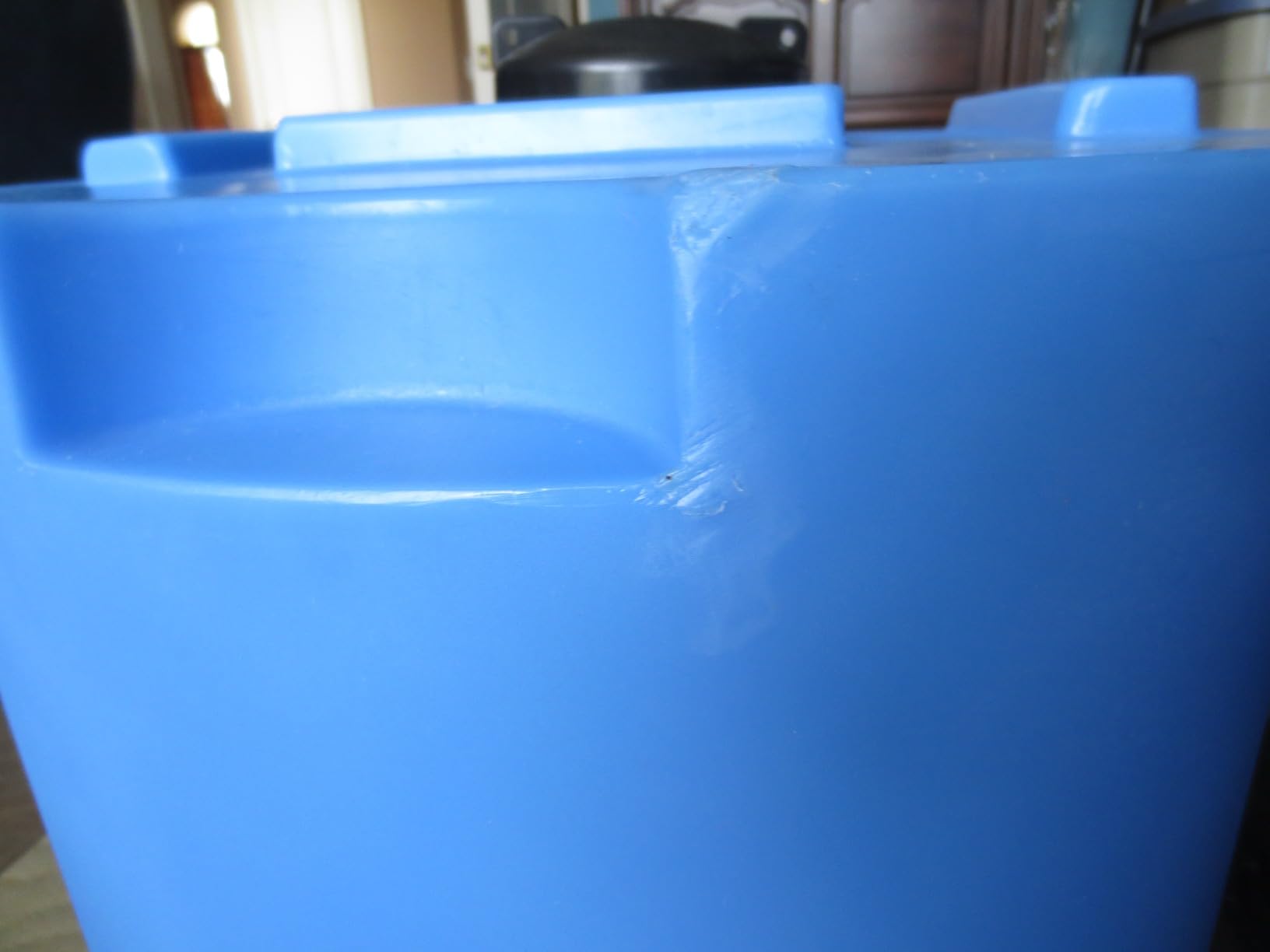
- Mouth can arrive with plastic shavings that need cleaning out
- Spigot sits low so a riser is usually needed
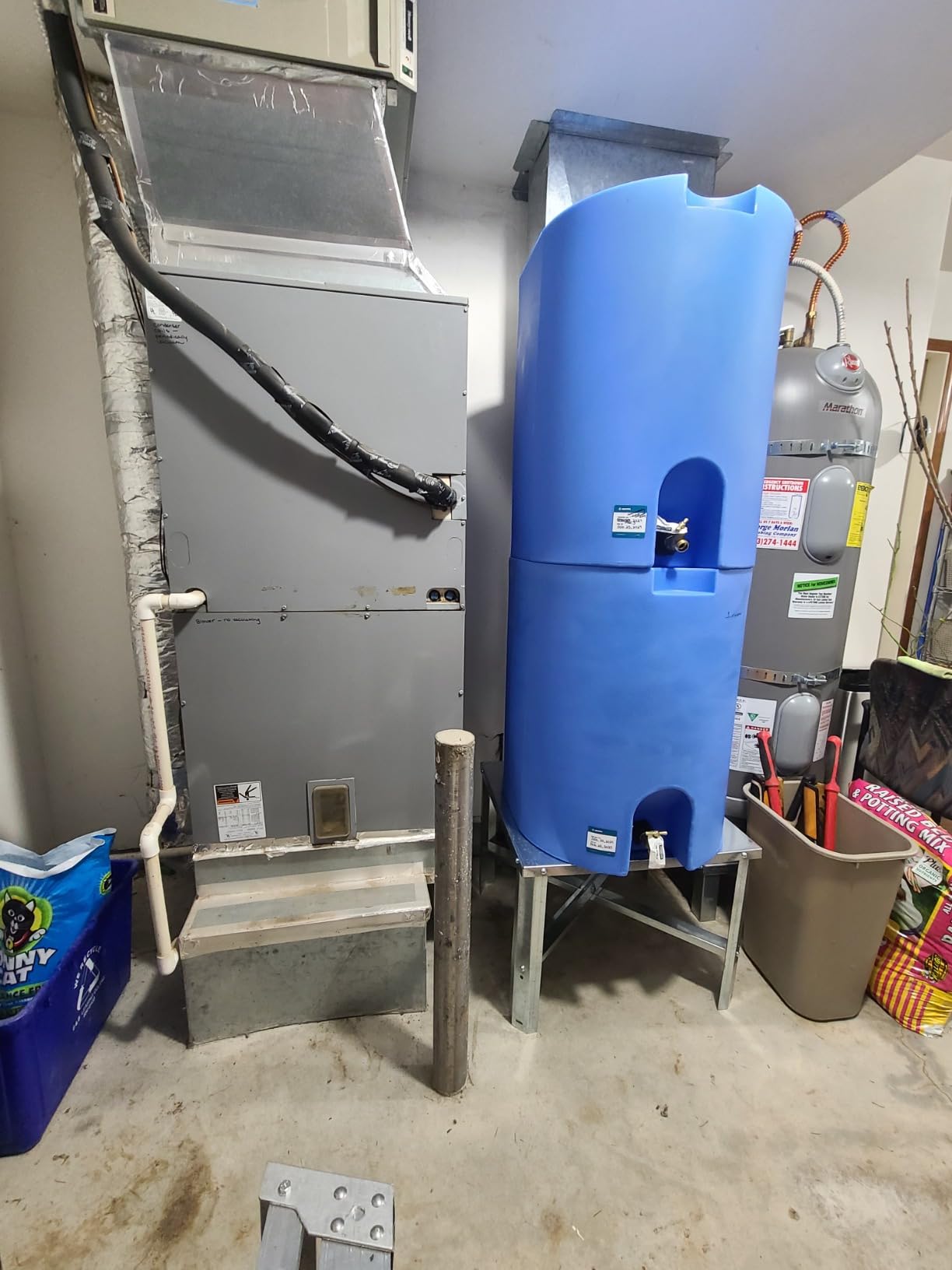
The WaterPrepared solves the problem the RomoTech cannot: where to put 55 gallons in a garage that already has things in it. The oval body is designed to stack, so two units occupy the footprint of roughly one, and at 22 to 23 inches wide it passes through a standard doorway without a renovation.
It is made from high-density polyethylene with UV-resistant blending, carries a large cap for filling, and comes with a brass spigot that screws straight onto a standard garden hose with no adapter. That brass detail matters more than it sounds, because plastic spigots are the most common failure point across this whole category.
Owners on wells and in areas with frequent outages report no leaks, including on units that stayed filled year-round, and the material is described by the manufacturer as FDA-approved for potable water. At 4.6 stars across 783 ratings, that consistency is what convinced us the seals hold up under static pressure.
Two practical notes. The spigot sits close to the ground, so most owners set the tank on a riser or a platform, and if you stack units the platform has to be rated for the combined weight, not just one tank.
Plan the riser before the tank arrives
A low spigot means you are filling buckets instead of running a hose, which defeats the purpose of buying a 55-gallon tank with a brass outlet. A simple cinder-block or timber riser solves it in a few minutes, and it also improves drainage when the tank is full.
Give the tank a rinse before first fill. Owners occasionally receive units with a few plastic chips or shavings inside from the moulding process, and catching it now takes two minutes rather than after you have stored water in it.
Who should skip this tank
Skip it if you need to move it regularly. Full, it is over 450 pounds, and the shape is not designed to be rolled or carried. It is a set-and-forget tank for a fixed location, not a hauling tank.
If you need a tank that genuinely moves, the wheels-and-handle design lower down in the camping group is a better fit for one person.
Best Portable Water Tanks for Camping and Car Camping
The best portable water container for camping is the one you will actually lift with cold hands at dawn. That means weight under 45 pounds when full, a wide mouth you can scrub out, and a spigot that gives you a trickle instead of a torrent. Anything larger belongs in the vehicle as a reserve, not on your shoulder.
4. COOZMENT 3.2 Gallon Water Container – Best for Car Camping on a Small Budget
COOZMENT 3.2 Gallon (12L) Portable Water Containers with Spigot, BPA Free Water Jug, Military Green Water Tank, Multifunction Water Storage Containers for Camping Outdoor Hiking,Emergency Storage
3.2 gallon capacity
1.9 lb empty
Food-grade PE with silicone-sealed lid
Press-to-pour spigot
Pros
- Press-to-pour spigot controls flow without unscrewing a heavy lid
- 4 inch mouth is easy to fill and scrub clean
- Tall narrow shape packs better in a car than a cube jug
- Two carrying handles spread the load
Cons
- Corners are the thinnest moulded area and can flex under pressure
- Included brush and spigot extender feel cheaply made
- New units can carry a noticeable plastic smell
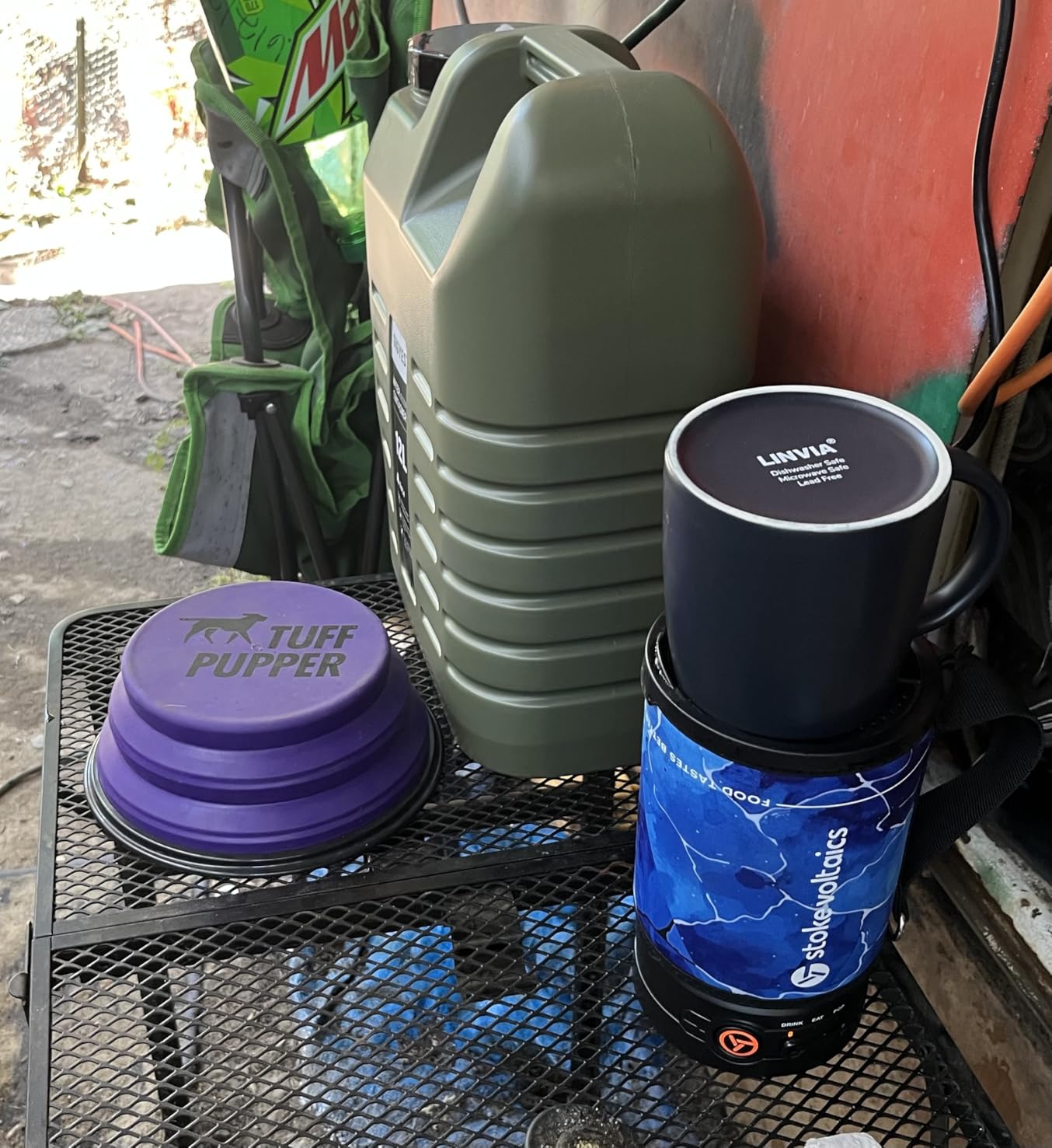
At 3.2 gallons and 1.9 pounds empty, it is about the largest container you can lift one-handed and still carry comfortably to a picnic table. Full it comes to about 27 pounds, which is manageable, and the two handles spread that weight across your palm rather than pinching one grip point.
The design decisions are all aimed at repeated use rather than display. The 4-inch mouth is wide enough to get a hand and the included brush inside, the press-to-pour spigot lets you control flow without wrestling a lid off, and the silicone-sealed food-grade lid keeps the jug odour-free. The tall 7.5 by 13.7 inch shape also slides into a footwell better than a cube-shaped jug would.
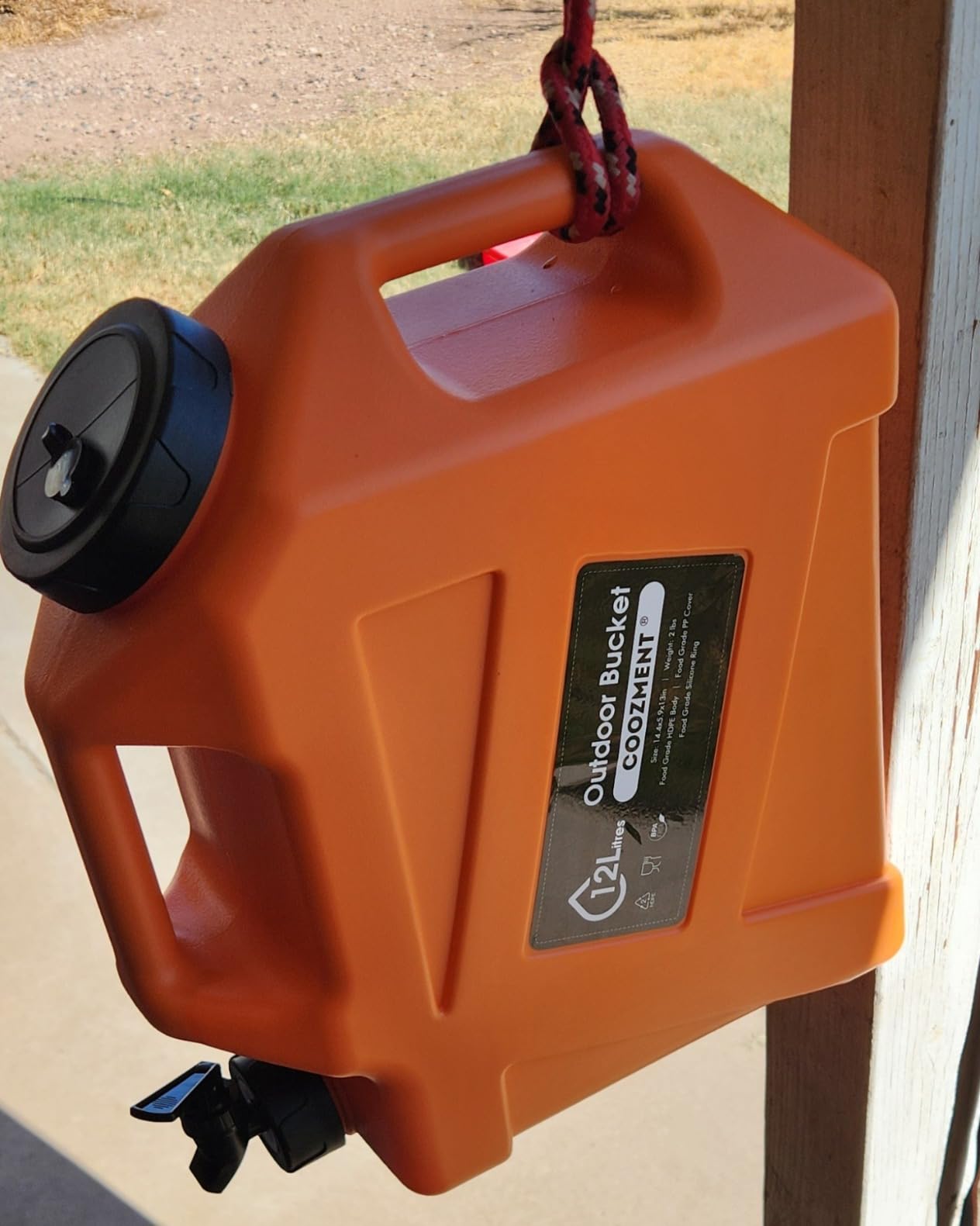
Buyers frequently report buying it to replace a leaking competitor jug, which tells you the spigot and lid seal are the parts that matter. It is also used for aquarium water changes and outage storage, where a controlled pour is more useful than a wide mouth.
The body is polyethylene, which is thinner than the HDPE used on heavier tanks, and the corners are where that shows. Press them and you can feel flex, and on some units you can see light. That is fine for car camping; it is not what you want in a tank that lives in a truck bed.
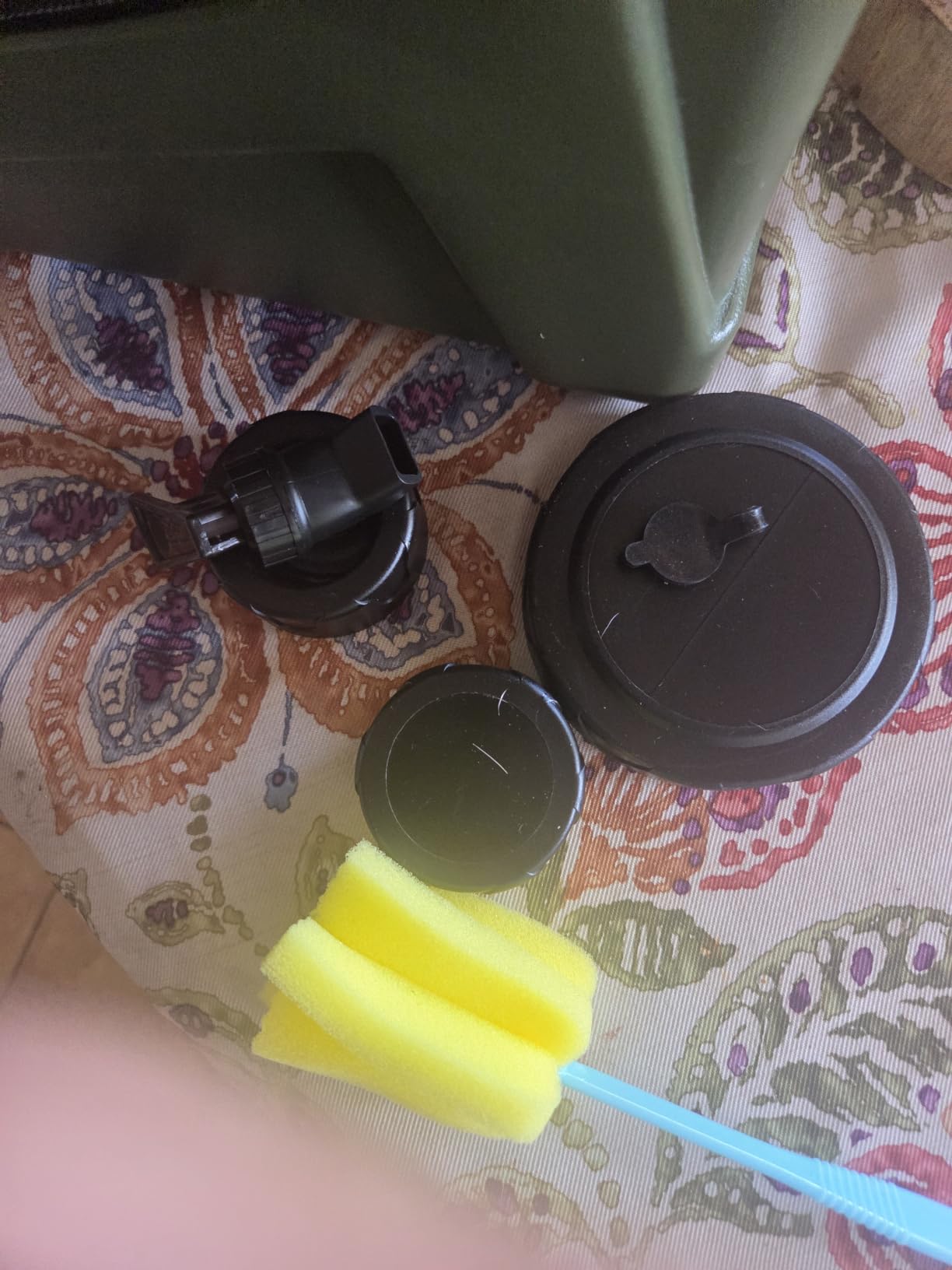
Wash it twice before the first fill
New polyethylene jugs frequently arrive with a noticeable plastic smell, and putting drinking water in an unwashed jug is how you end up with water that tastes of nothing but plastic. Two washes with hot water and dish soap, then a full day draining open, fixes it in almost every case.
Keep the wide mouth in mind when you buy accessories. A jug you cannot reach inside will develop biofilm at the seam, and a jug with biofilm will not be used a second time.
Who should skip this container
Skip it if you need more than a few days of water for two people. At 3.2 gallons it is a weekend container, not a base camp supply, and you would be refilling it constantly.
Skip it if it will live in a vehicle permanently. The thin corners and included hardware are fine for a season of use, not for years of vibration and sun.
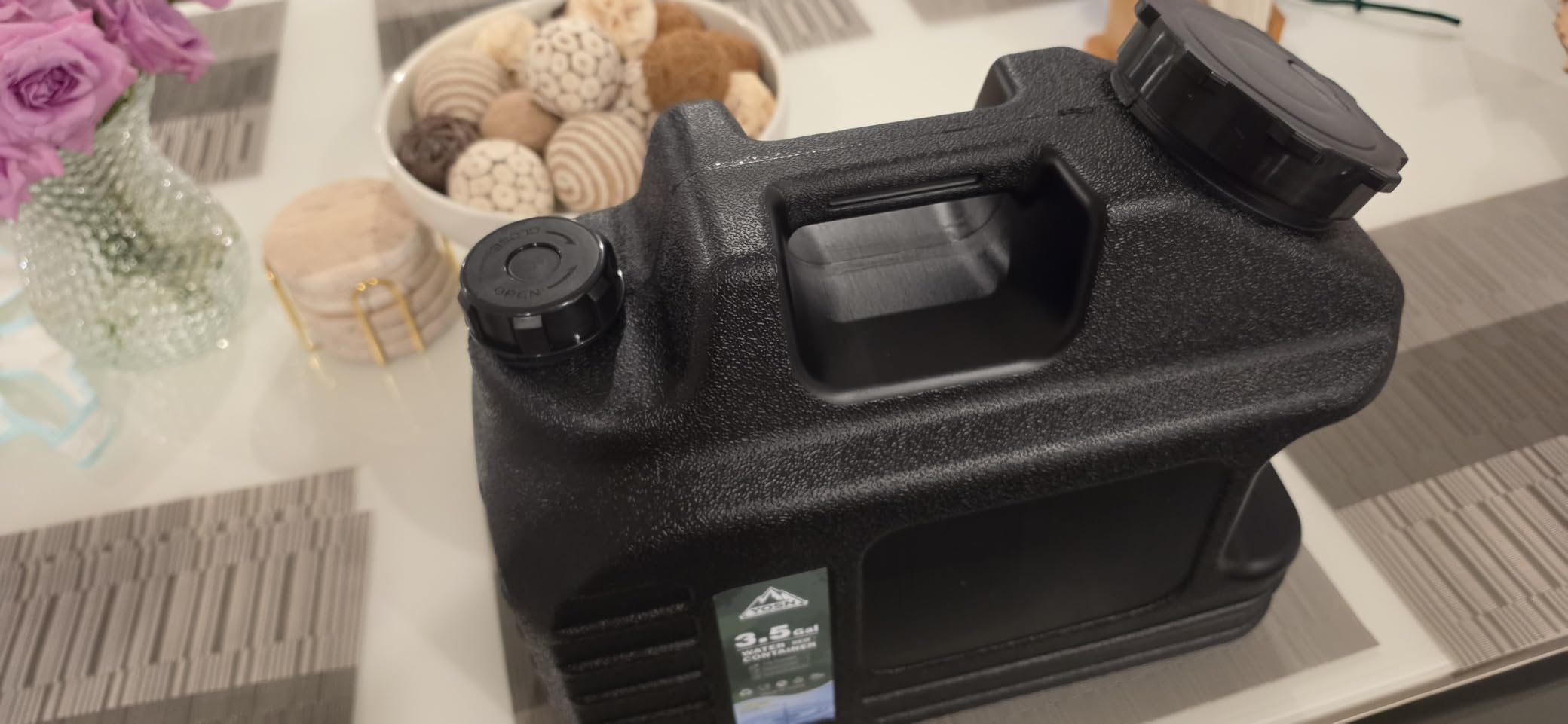
5. YOSN 5 Gallon Water Jug – Best for Light Carrying and Off-Grid Cabins
YOSN 5 Gallon Water Jug, Camping Water Container, BPA Free Portable Water Dispenser with Spigot, Leak-Proof Large Camping Water Jug for Emergency Storage,Outdoor,Hiking
5 gallon capacity
2.2 lb empty, 41 lb full
Food-grade PE, no BPA PVC or DEHP
3.6 inch mouth
Pros
- Light at about 2.2 pounds empty while holding a full 5 gallons
- Reinforced lid and spigot have held up on bumpy roads with no leaks
- Dual ergonomic handles spread the weight across the carry
- Accessories clip to the body so nothing gets lost
Cons
- Some units arrive with plastic shavings inside that need cleaning
- Shape resembles a fuel container
- About 41 lb full is a two-hand carry for some users
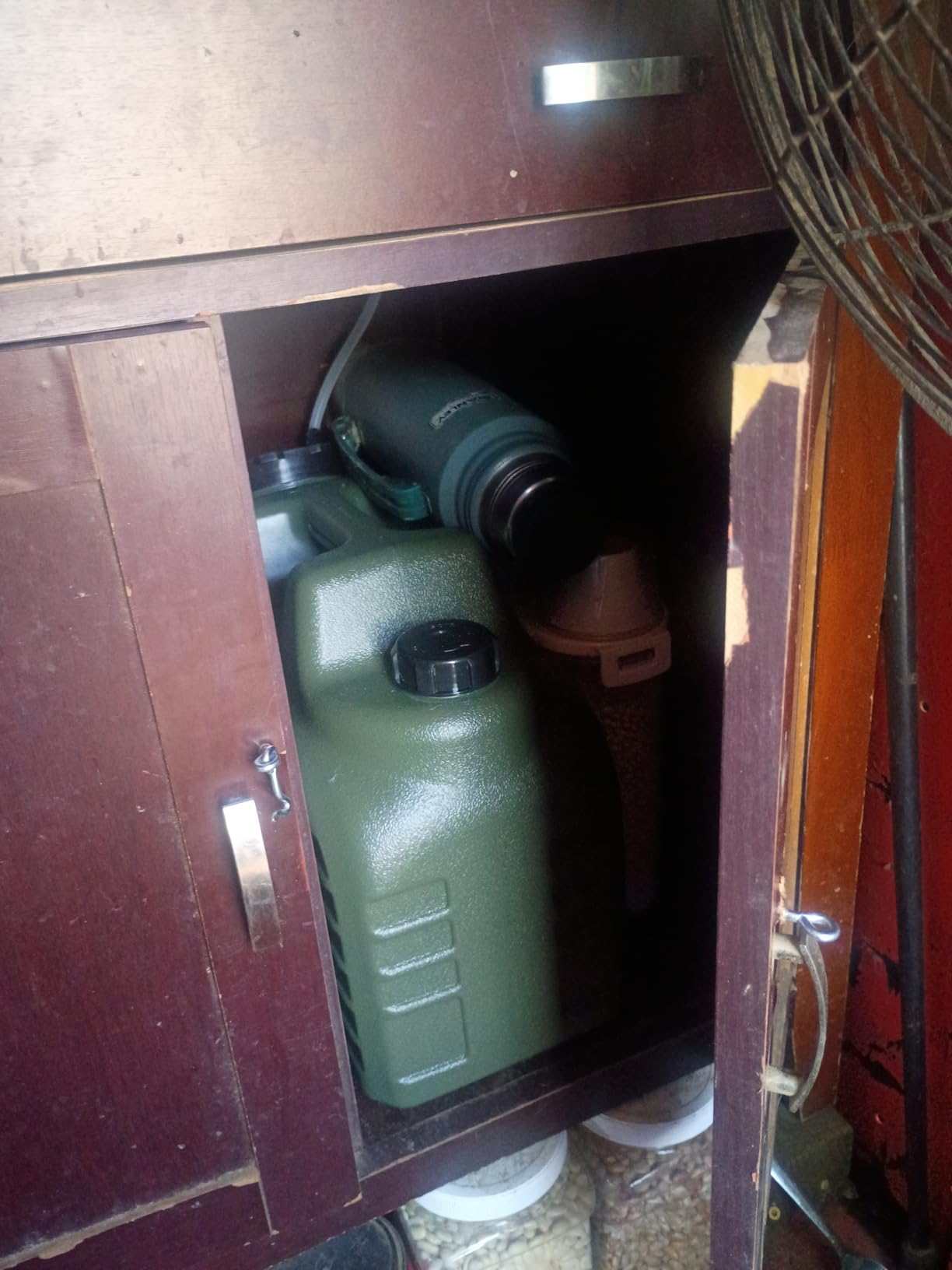
This is the balance pick: more capacity than the 3.2-gallon jug without tipping into the weight range where one person starts struggling. The manufacturer lists 2.2 pounds empty and about 41 pounds full, and the material is thick food-grade polyethylene free of BPA, PVC and DEHP.
Full weight of 41 pounds is a real consideration, so the dual ergonomic handles matter. They let you carry it in front or at your side and distribute the load rather than pinching one set of fingers, which is the difference between a usable jug and one that ends up sitting in the tent.
The included kit is unusually complete for this category: a cleaning brush, an adjustable spigot, an extension tube that reaches up to 6 inches, a stickable storage bag and a 1.3 gallon collapsible bag. Everything clips to the container, so it all travels together instead of disappearing into a pack.
Owners across camping, off-grid cabins and garden use rate it highly, and repeated confirmation that it does not leak in transit is the key signal. At 4.6 stars across 301 ratings it holds a strong score in a fairly thin review pool, so treat it as promising rather than proven.
Know what you are carrying it around
The military green shape reads as a fuel can to anyone who does not know it holds water, and owners specifically mention labelling it so nobody in the group makes a mistake. A strip of coloured tape on the handle solves this in ten seconds.
Rinse it out before first use. The most consistent complaint is plastic shavings inside a new unit, which is a moulding artefact rather than a defect, but it is a five-minute job that removes any doubt about what you are drinking.
Who should skip this jug
Skip it if you plan to walk more than a short distance with a full jug. 41 pounds is a car-camping and cabin weight, not a hiking weight, and the 5-gallon format has no realistic backpacking use.
If you need something you can roll rather than lift, the wheels-and-handle jug below is designed for exactly that.
6. GIGYES 7.4 Gallon Jug with Wheels – Best for Rolling Water Instead of Carrying It
GIGYES 7.4 Gallon Water Jug with Wheels & Folding Handle
7.4 gallon capacity
2.16 kg empty
BPA-free food-grade HDPE
Wheels with folding handle
Pros
- Wheels and folding handle let you roll a full jug instead of lifting it
- Large opening takes a filling hose and an arm with a brush
- Sturdy HDPE that resists denting and cracking
- Side spigot gives controlled flow for washing or filling bottles
Cons
- Fill lid does not always seal and can leak slightly
- Must be stored upright or water escapes the top
- Spigot knob turns well past closed so it takes practice
The wheels are the whole point. A 7.4-gallon jug full sits around 66 pounds, which is beyond a comfortable one-person lift over gravel or a wet campsite path, and this one rolls instead. The folding handle lets you pull it behind you with one hand while carrying other gear.
Body-wise it is sturdy BPA-free food-grade HDPE, rectangular at 13.98 by 9.84 inches, with a large opening that accepts a filling hose and takes an arm and the included brush for cleaning. Owners report the wheels and seal holding up even on a boat in rough water.
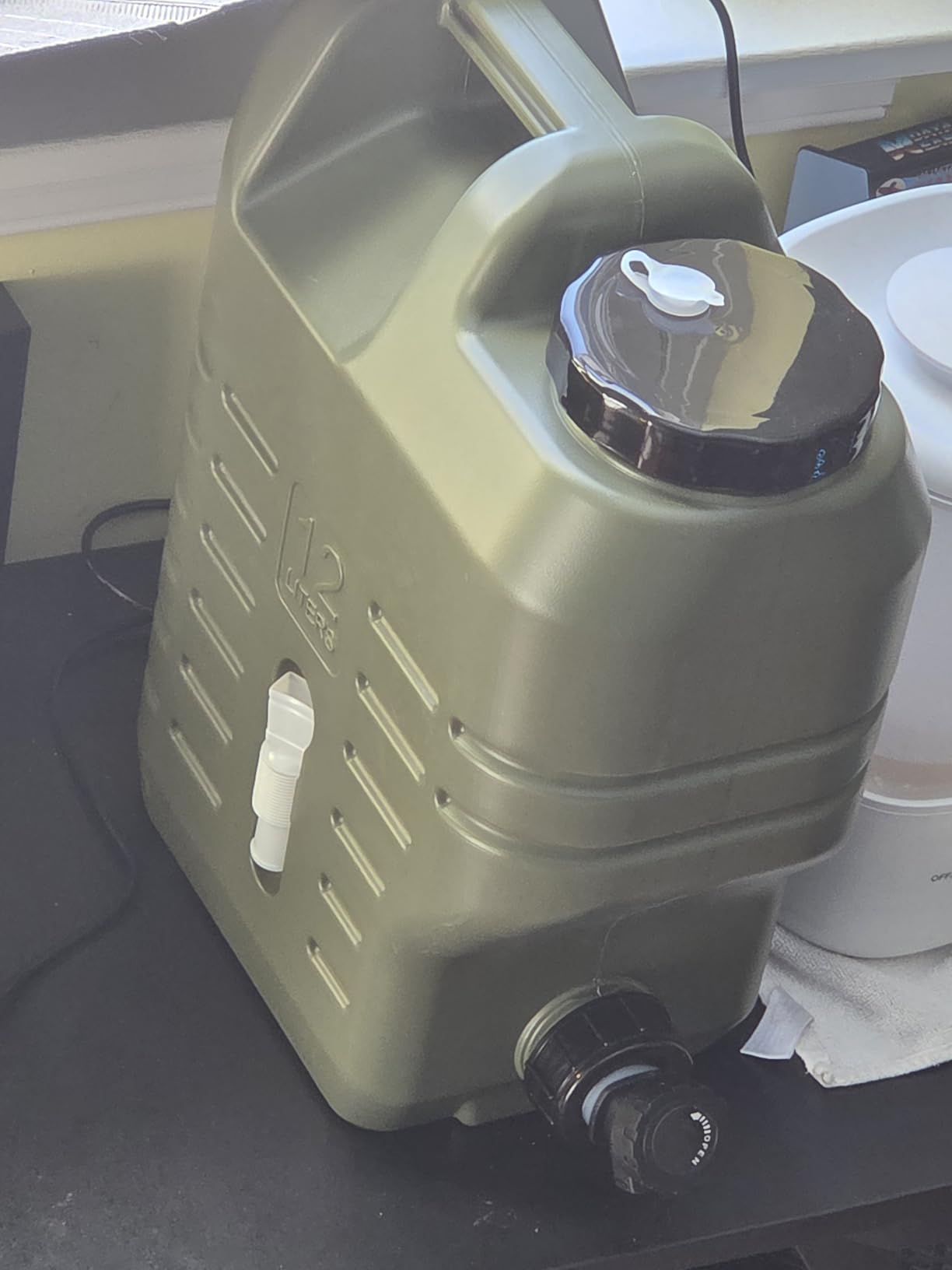
Reviews split almost evenly on the fill lid. Some buyers report it not sealing, leaking slightly, or needing the inner nut tightened from inside, while others found no problem once adjusted. That split is why this sits below the 5-gallon jug despite the larger capacity.
There is one rule that catches people out: store it upright. Laid on its side, water escapes through the top opening, and no amount of tightening fully solves it.
Test the lid seal the day it arrives
Fill it with a gallon of water, put it on your side on a dry surface, and check for seepage. If it weeps, the inner nut usually needs tightening from inside, which takes two minutes with the lid off and resolves the problem for most owners.
Learn where the spigot knob closes. It turns well past the closed position, and owners who expect a firm stop tend to overtighten it and strip the thread.
Who should skip this jug
Skip it if your storage space is a shelf rather than a floor. Wheels and a handle take room, and it cannot be laid down, so it needs a permanent upright spot.
Skip it if you need a tank for more than a few days. At 7.4 gallons it is a weekend tank, and roughly 66 pounds full is heavy enough that you will want to leave it near where you use it.
7. MXQMKL 240 Liter Foldable Water Bladder – Best for Stowing Bulk Water in a Trunk
240 L/63 gal Water Bladder Storage Containers,Foldable Portable Water Tank
63 gallon capacity
5.7 lb empty
0.9 mm double-sided PVC mesh
Welded seams with sleeved ports
Pros
- Packs down to a small bundle when empty so it stores in a trunk
- Sleeved water pipe ports accept standard pipe for quick hookup
- Large range of capacities available for different jobs
- Weighs 5.7 pounds empty at 63 gallons of capacity
Cons
- Included valve threads are often loose or the wrong size
- Some units leak at a seam or the fill port on first fill
- Strong plastic odour can persist through several rinses
Bladders solve a problem rigid tanks cannot: storage. A 63-gallon rigid tank occupies its full volume all year, whereas this folds down to roughly the size of a rolled sleeping bag and weighs 5.7 pounds empty. If your water is seasonal, that is the entire argument.
The construction is 0.9 mm double-sided PVC mesh with high-frequency welded seams, rated from minus 50 to plus 61 degrees Celsius with a stated lifespan of 8 to 10 years. It fills through a 1-inch sleeved port and drains through a 3/4-inch sleeved valve, so it can be plumbed to a hose rather than carried by hand.
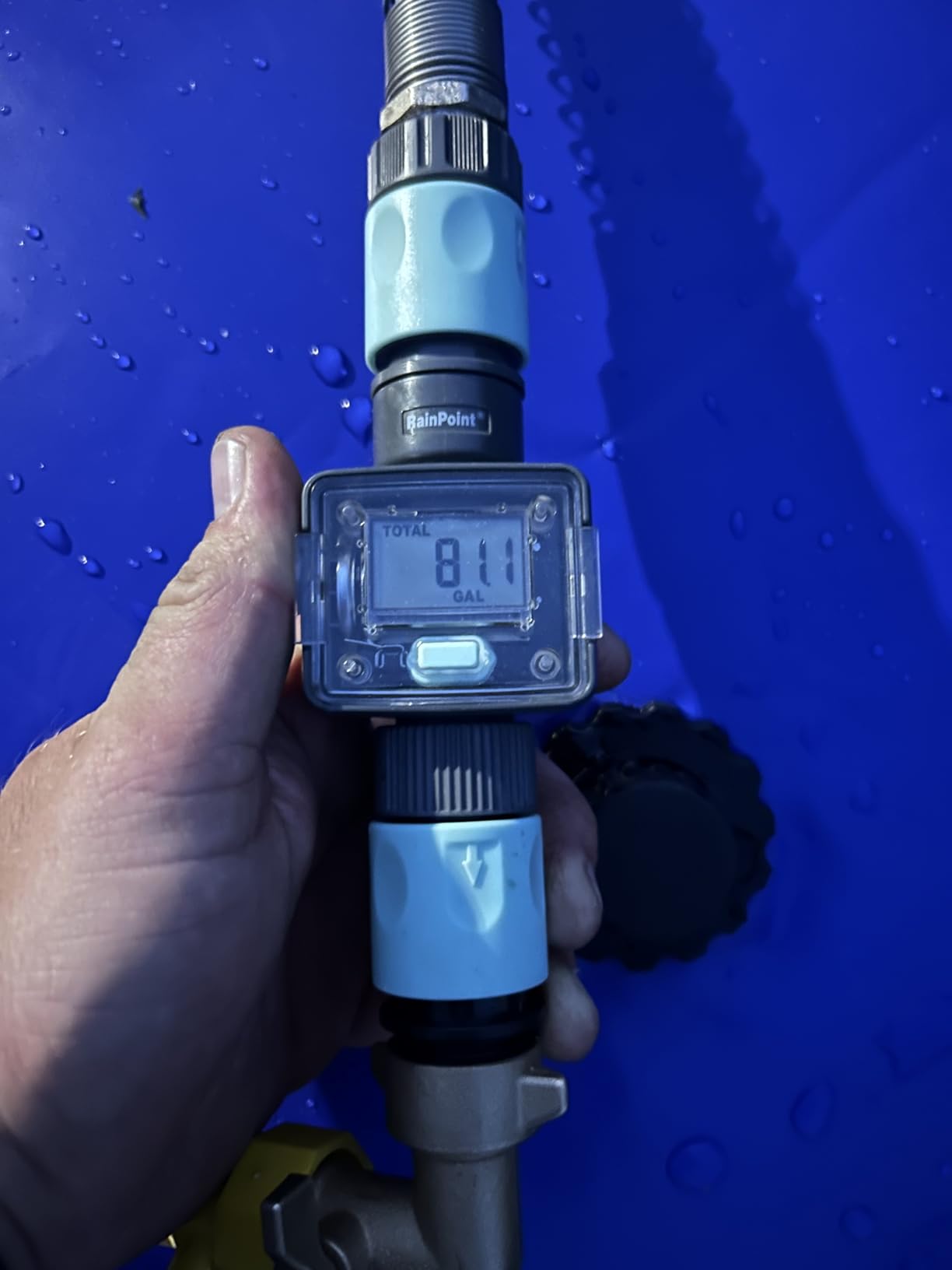
Owners use it for garden and livestock watering, pressure-washer supply and job-site water hauling, where the capacity-to-weight ratio is the deciding factor. At 4.3 stars across more than 1,200 ratings, the capacity is consistently praised even when the hardware is not.
And the hardware is the problem. The included valve threads are frequently reported as loose or the wrong size, and some buyers replace them outright with a 3/4-inch ball valve. If you are storing water you intend to drink, also factor in the plastic odour, which several owners say persists through multiple rinses.
Plan a replacement valve from day one
Treat the supplied valve as a placeholder and fit a 3/4-inch ball valve before the first fill. Loose threads under more than 500 pounds of water are a slow leak at best, and the failure mode nobody plans for is a wet vehicle interior.
Check the actual usable volume after the first fill. Owners report usable capacity running under the advertised figure, so measure before you depend on a specific number for an irrigation schedule.
Who should skip this bladder
Skip it for drinking water unless you are prepared to deal with odour first. A rigid food-grade tank has no taste issue at all, and that matters more for potable use than any capacity advantage.
Also skip it if you need puncture resistance. 0.9 mm PVC mesh with welded seams resists abrasion but not a fork, a tool or a sharp rock in a pickup bed.
Best Portable Water Tanks for Emergency Preparedness and Household Backup
For household backup, the best water storage tanks for home use are the ones you can fill before the outage rather than during it. Preparedness guidance in the communities we followed consistently recommends at least 15 gallons per person for two weeks, and a single 55-gallon tank covers a four-person household for that period with nothing to spare.
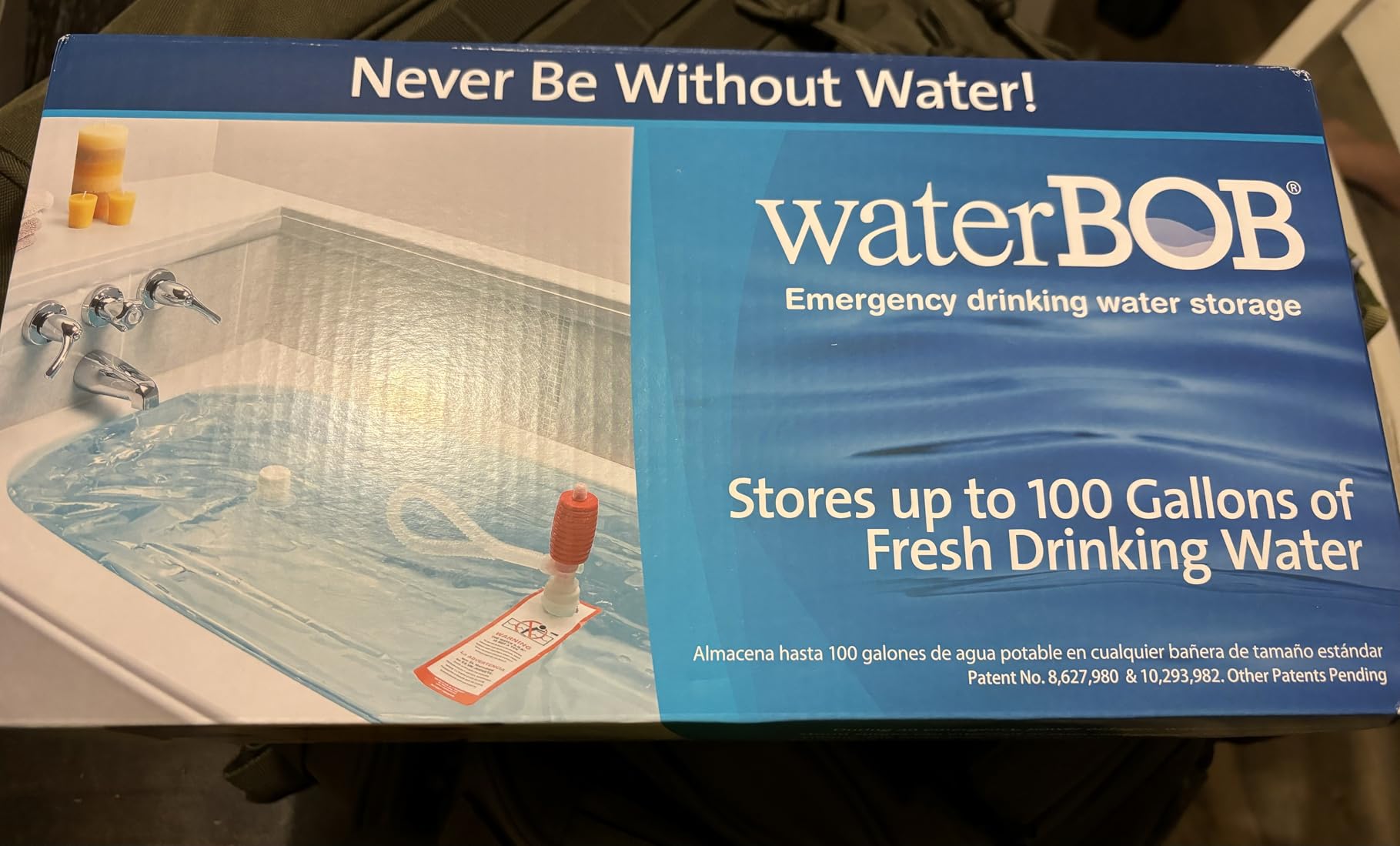
8. waterBOB Bathtub Emergency Bladder – Best Value for a Household Reserve
waterBOB Bathtub Emergency Water Storage Bladder Up To 100 Gallon Capacity – Food Grade Liner with Hand Pump for Hurricane and Disaster Preparedness – BPA Free Drinking Water Container
Up to 100 gallon capacity
1.3 lb empty
Food-grade LLDPE liner for a standard tub
Hand pump included
Pros
- Turns an existing bathtub into up to 100 gallons of storage
- Food-grade BPA-free liner seals water off from dirt and soap film
- Collapses to roughly shoe-box size when empty for off-season storage
- Sets up in about 20 minutes with no tools
Cons
- Essentially a single-use liner that is hard to dry out completely
- Thin material can be punctured so patches are worth keeping
- Fill sock must be held or taped to the faucet while filling
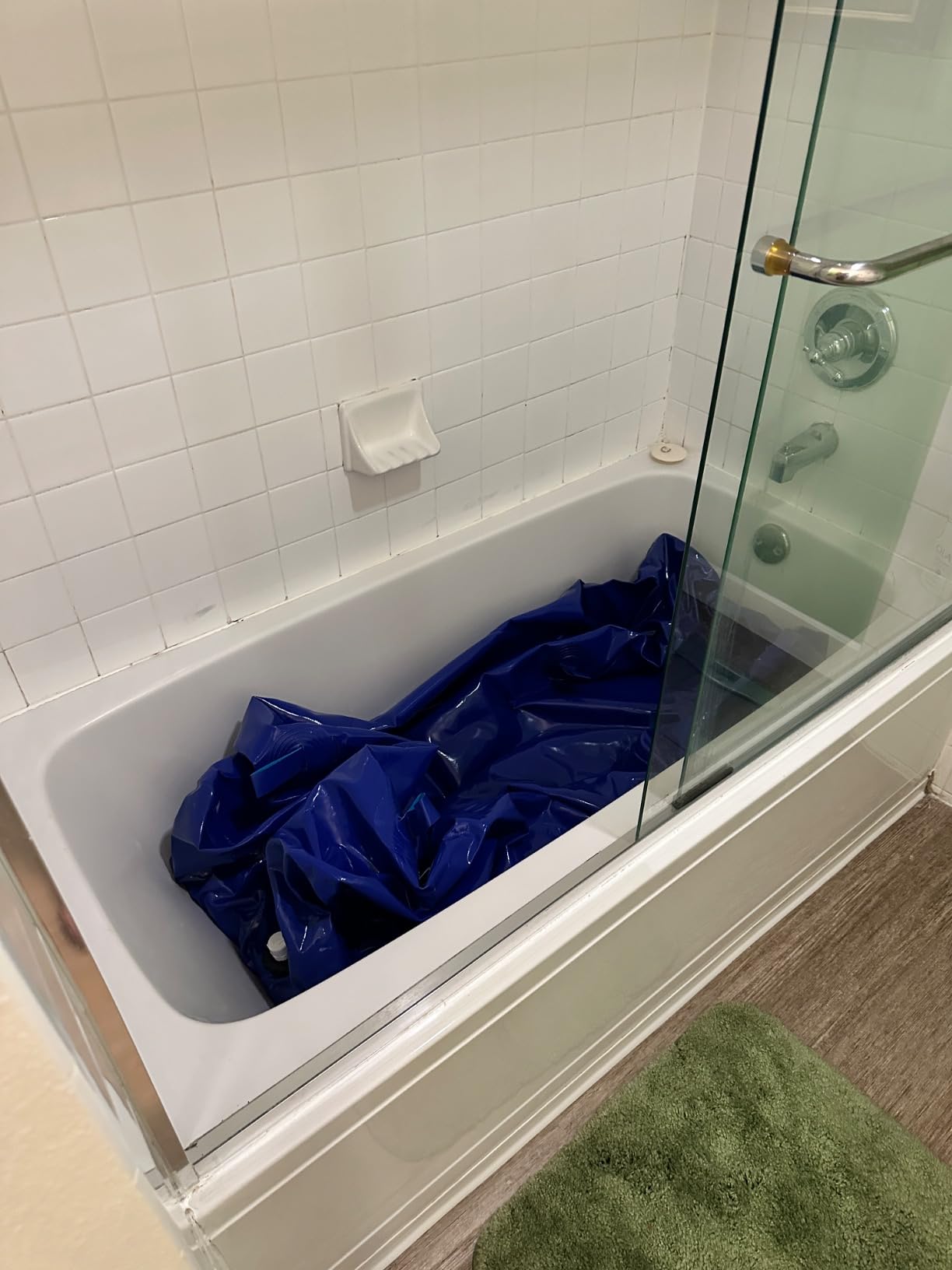
This is the smartest answer to a problem most people do not know they have. If you want more than 55 gallons in reserve and you do not want a rigid tank standing in your garage all year, this fits a standard bathtub and turns dead floor space into capacity. Set up takes about 20 minutes, with no tools.
The liner is food-grade LLDPE meeting US FDA food-grade guidelines, and the manufacturer states it keeps stored drinking water fresh for up to 16 weeks. It includes a hand pump so you can dispense into jugs and pitchers without lifting anything heavy or spilling it across the floor.
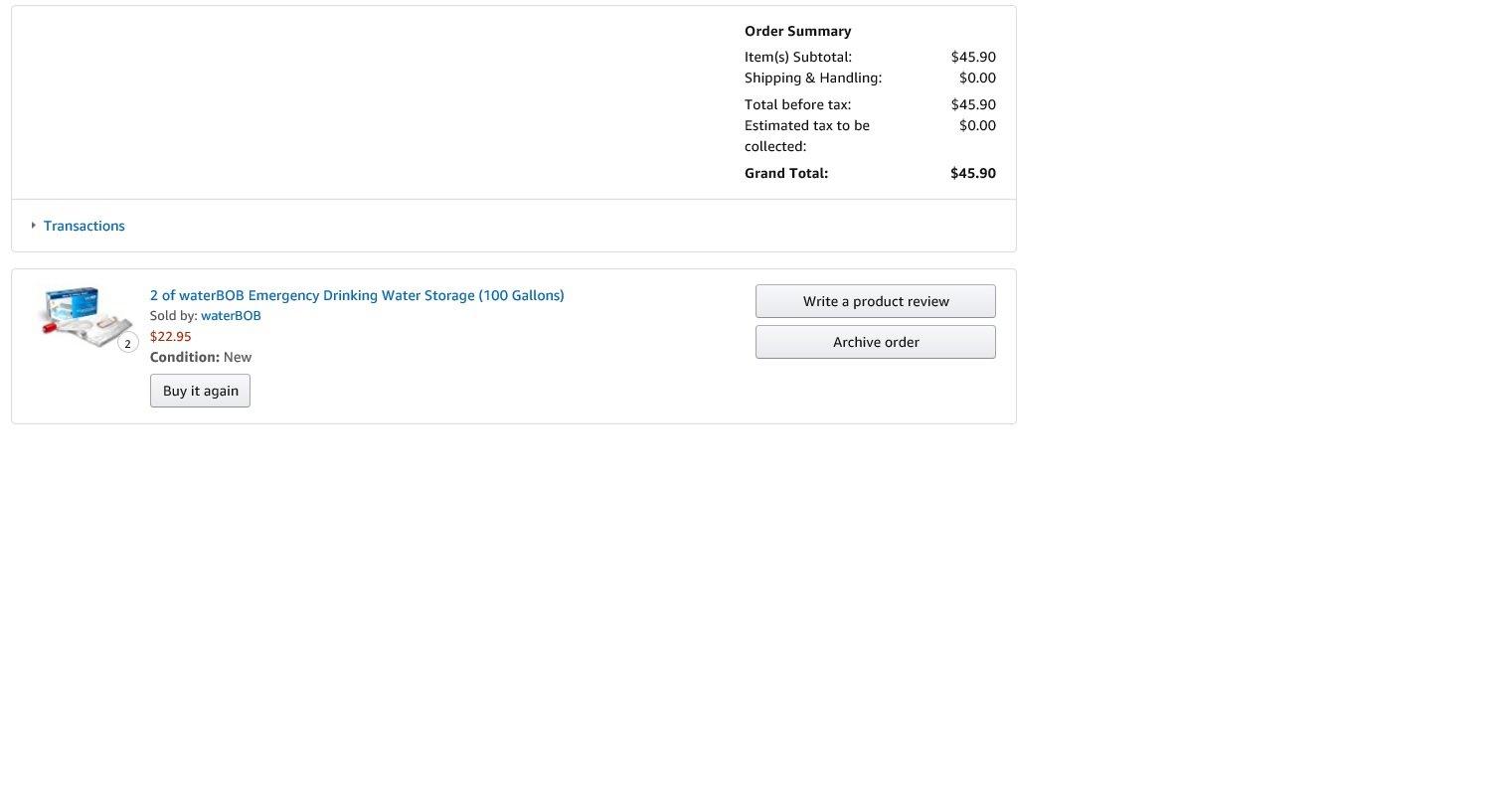
At 1.3 pounds empty and up to 100 gallons of capacity, owners treat it as hurricane and outage preparation rather than a camping product, and they point to the gallons-per-pound of storage you give up for nothing. At 4.7 stars across more than 5,400 ratings, it carries a deep well of feedback for a product of this type.
The dominant drawback is reuse. The liner is very difficult to dry out completely after draining, so a second fill risks mould and mildew, and owners generally buy a fresh liner rather than risk it. Treat it as single-use, and store the folded liner flat until you need it.
Tape the fill sock and do not walk away
The fill sock has to stay connected to the faucet for the whole twenty minutes, and it is not self-supporting. Secure it with tape before you start, or plan to hold it in place, because a half-filled tub liner has to be lifted and repositioned otherwise.
Keep duct tape or a patch kit nearby. The liner is thin, and a puncture in a tub liner holding several hundred pounds of water is a genuinely unpleasant clean-up job.
Who should skip this bladder
Skip it if you want a permanent installation. It is a temporary liner, not a plumbed tank, and it is not appropriate for anyone who needs water every single day for years.
Skip it if you have nowhere to fill a bathtub during an outage, because the whole value of the design depends on a household water supply at setup time.
9. Augason Farms 55 Gallon Storage Barrel – Best for Long-Term Household Storage
Augason Farms lon Water Storage Barrel – BPA-Free Plastic Barrel 55-Gallon
55 gallon capacity
18 lb empty
Food-grade BPA-free poly
Sealed top with two plug access ports
Pros
- Food-grade BPA-free construction keeps water free of plastic smell
- Sealed top with only two access holes adds contamination security
- Light at 18 pounds empty and easy to reposition
- Round 55-gallon shape is a long-established preparedness standard
Cons
- Sealed top cannot be fully opened only accessed through two small holes
- Internal lip prevents complete draining and makes cleaning difficult
- No spigot or siphon hose included so water is drawn off manually
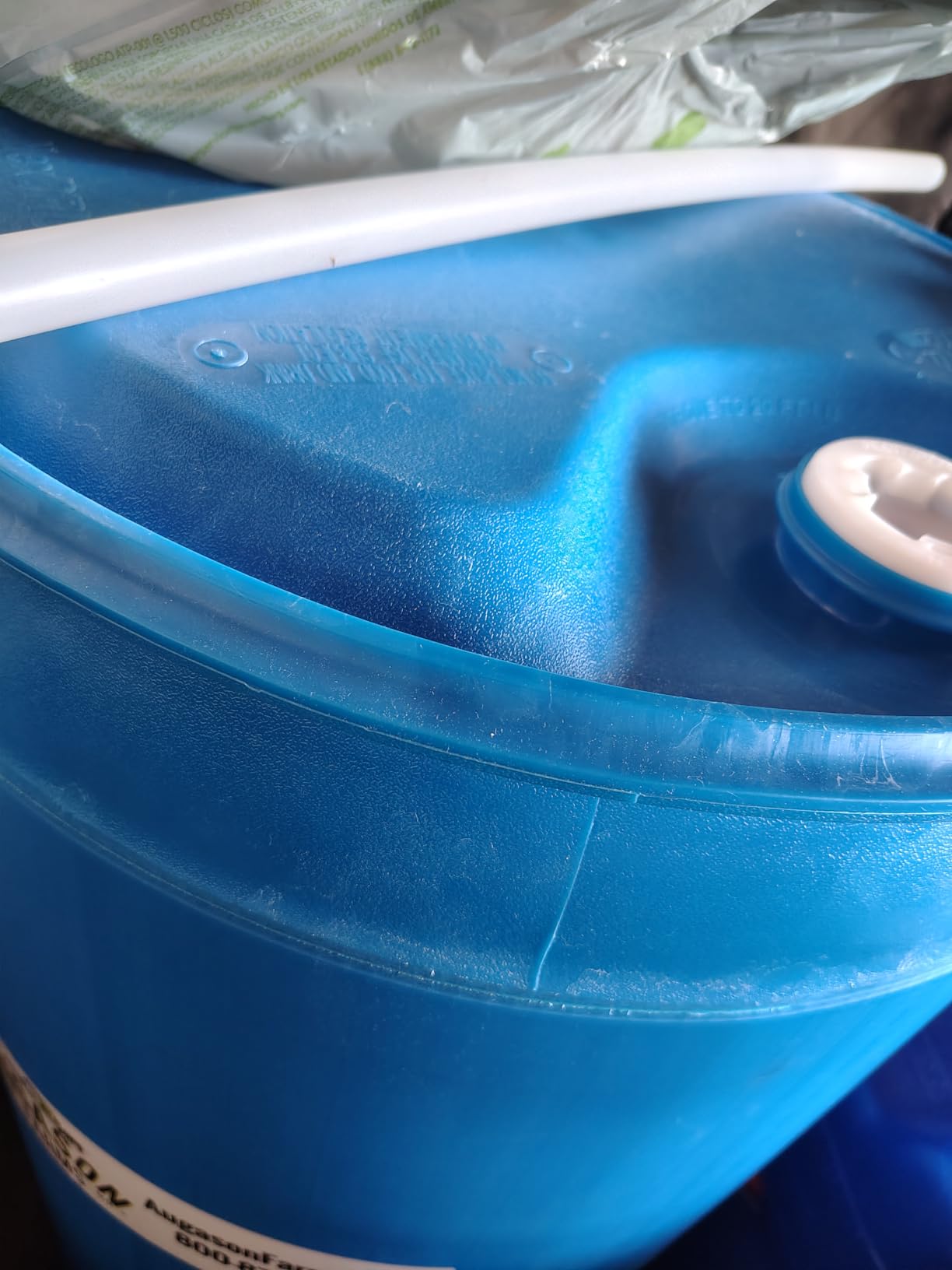
The Augason barrel is the traditional preparedness choice, and the reason is the spec sheet rather than the styling. It is 55 gallons of food-grade, BPA-free polyethylene at 18 pounds empty and 22.95 by 22.95 by 35.13 inches, which is light for a full-size drum and easy to move when empty.
At 4.6 stars across 689 ratings, owners describe it as dependable and no-frills, with a tight lid and no plastic odour. That is exactly what you want from a container whose job is to sit untouched for a year and then be correct when the water goes off.
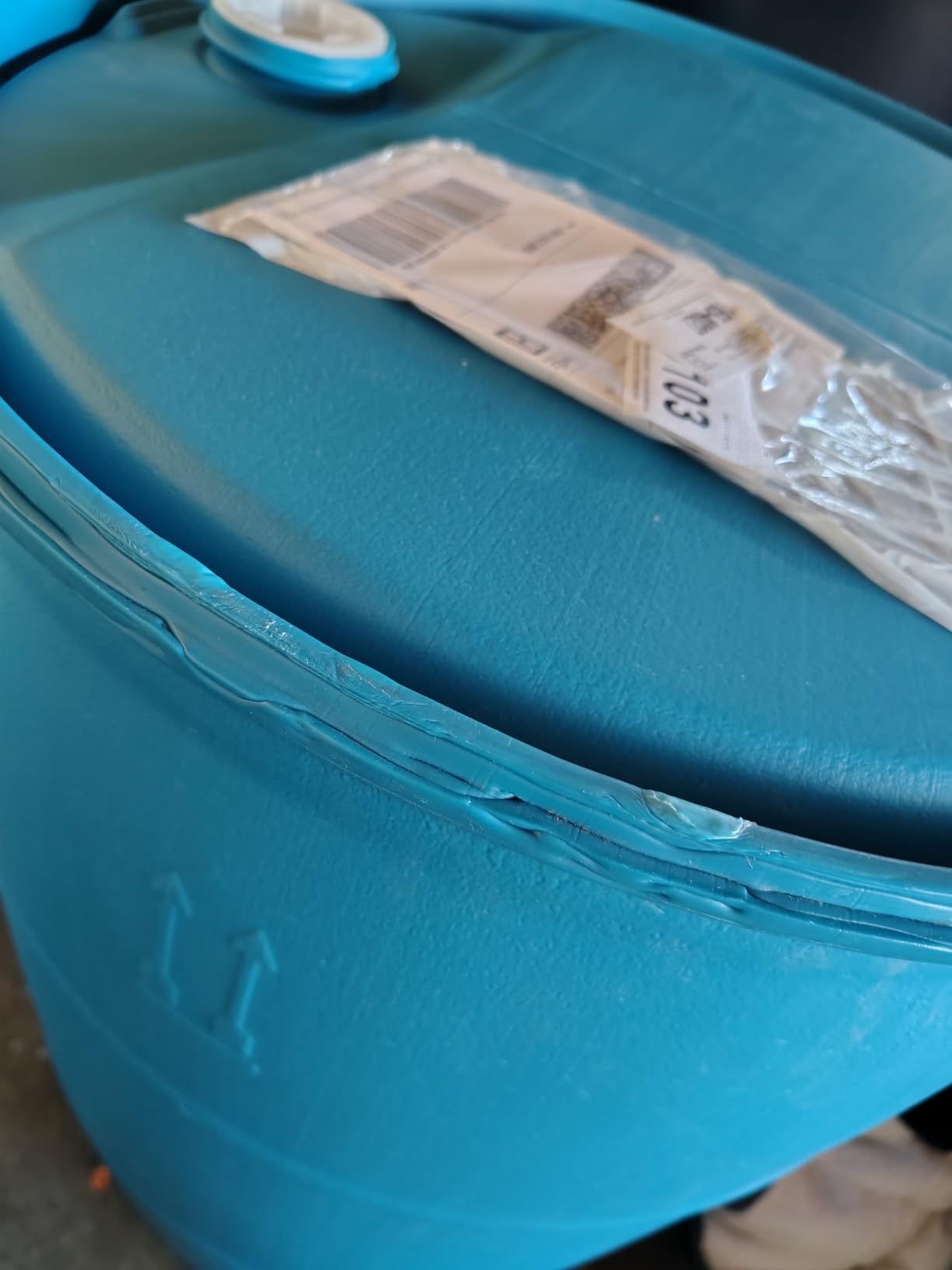
The trade-off is access. The sealed top cannot be fully opened, so cleaning happens through two small plug ports, and an internal lip means the barrel will not drain completely. There is no spigot or siphon hose included, so you draw water off manually unless you add your own siphon.
One supply-chain note that comes up repeatedly: barrels shipped bare can arrive missing a plug. Check the plugs on arrival and note the model number before you need a replacement, because this is a moulded part rather than a standard fitting.
Add a siphon before you need one
Because no spigot or siphon is included, plan on buying a food-safe siphon and testing it through one of the two ports while the barrel is still empty. Manually bailing 55 gallons by cup is not a plan anyone wants to discover during an outage.
Brace it if you are in a cold climate. Owners report the bottom ballooning outward in very cold weather, which is a known behaviour of an empty moulded drum as the air inside contracts.
Who should skip this barrel
Skip it if you want to attach a hose. The sealed top and internal lip make it a storage vessel, not a dispensing tank, and adding fittings is more involved than it is worth.
Skip it if you want to sanitise by hand. A tank you cannot reach inside fully is a tank where biofilm eventually forms, so this is not the right choice for a container that gets used and drained every month.
10. Laspeiraux 53 Gallon Collapsible Rain Barrel – Most Versatile for Rainwater Collection
Collapsible Rain Barrel Water Storage Containers 53 Gallon
53 gallon capacity
Three-layer PVC
Mesh screen and overflow kit
Folds flat for storage
Pros
- Folds flat for off-season storage and can be moved around the garden
- Integrated screw-in faucet removes loose parts and leak points
- Mesh screen keeps out leaves and debris while the overflow kit handles heavy rain
- Sets up under a downspout with no special tools
Cons
- Plastic spigots have no reinforcing plate and flex out of alignment
- Light feet for a barrel holding roughly 440 pounds of water
- Bottom seam can weep at the outlet
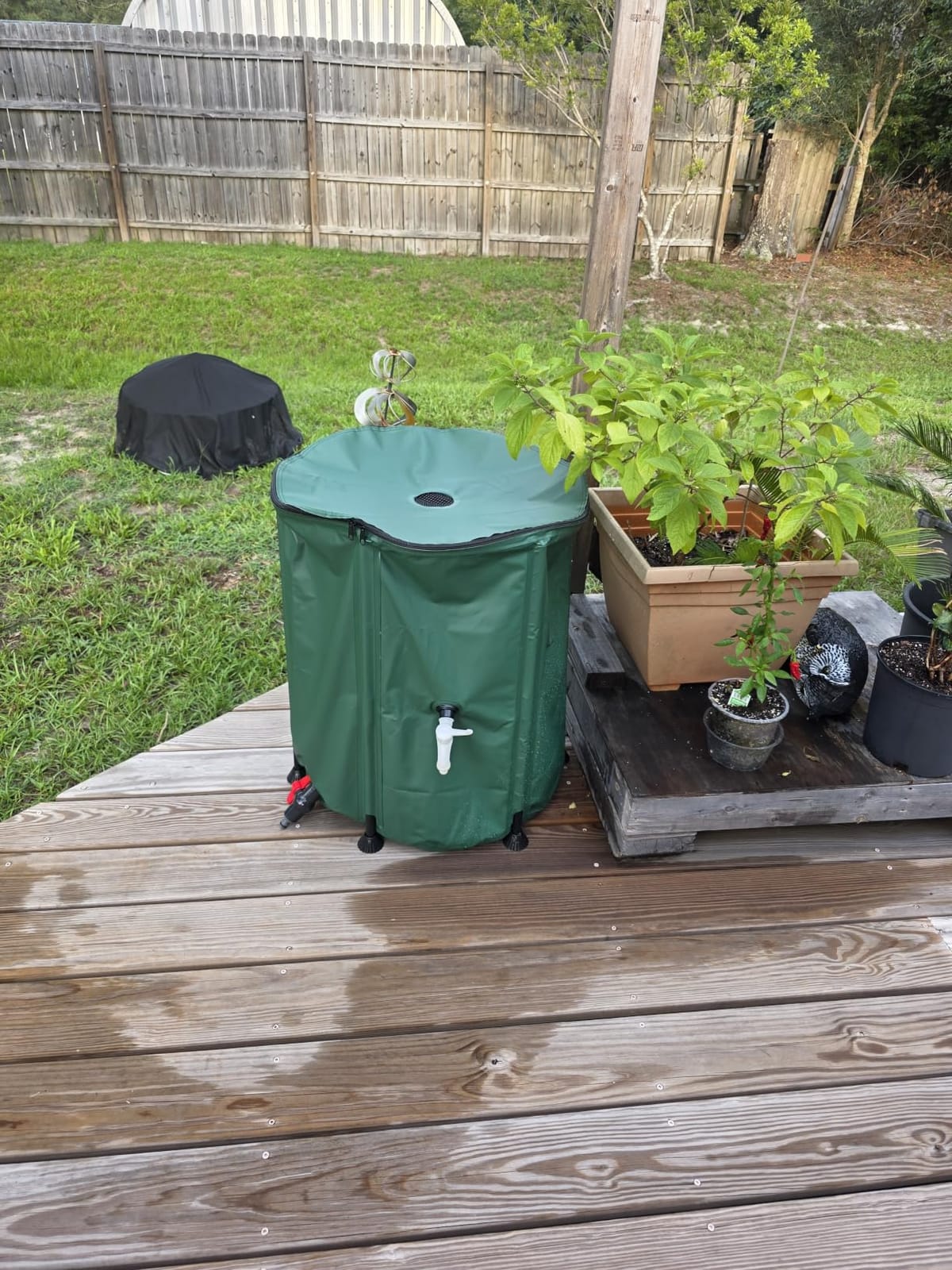
Rainwater collection is the use case where a collapsible barrel makes the most sense, because the tank is only needed for part of the year. This one folds flat, sets up under a downspout without tools, and comes with the mesh screen and overflow kit that make it actually usable rather than decorative.
It is made from three-layer PVC with circular footpads to stop wobbling, and the integrated screw-in faucet is a genuine improvement over assembling a loose tap. Owners report it holds pressure well enough to run a hose or a simple solar timer watering device, which is the usual goal for garden use.
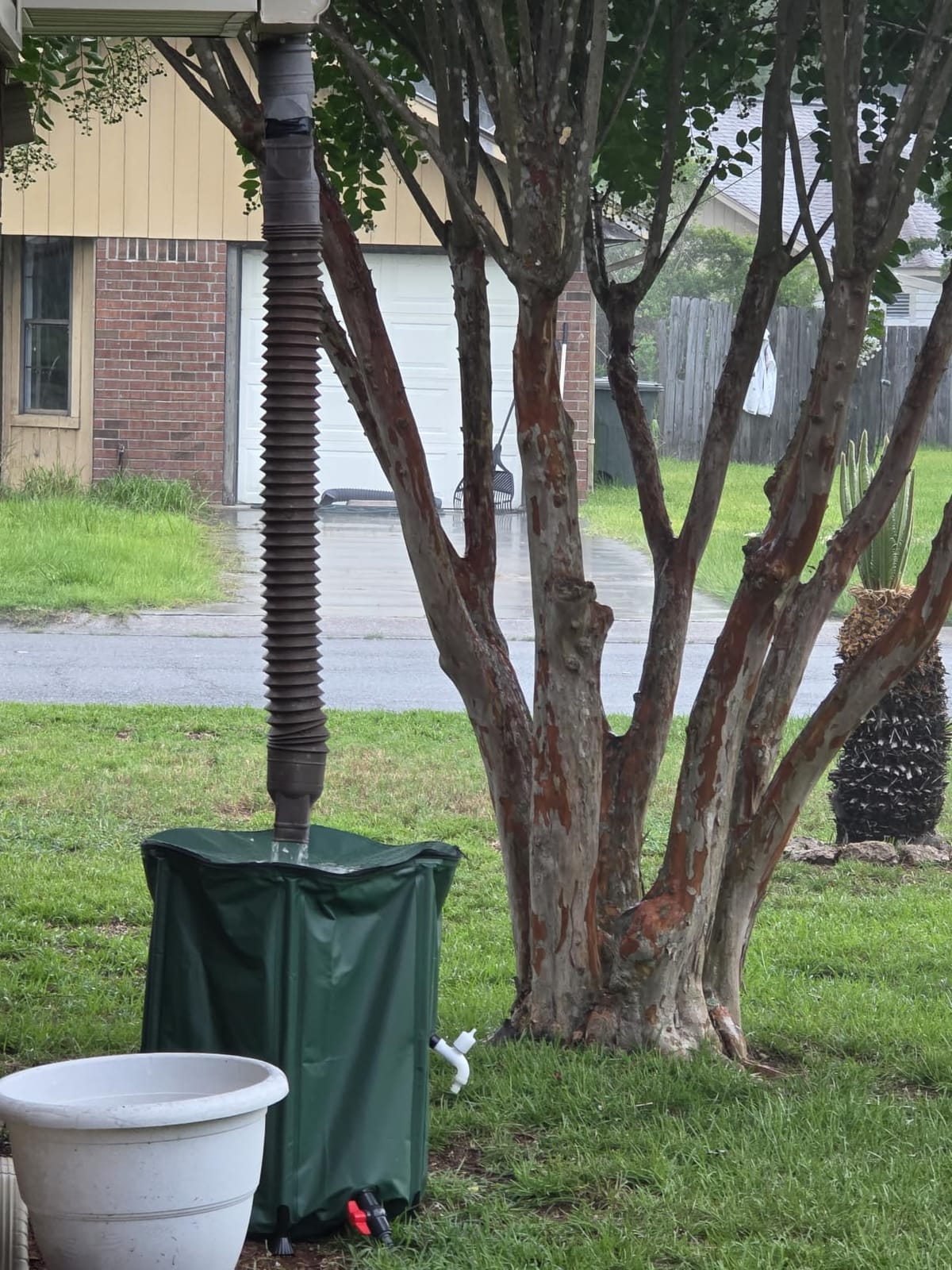
At 4.2 stars across 459 ratings, the score sits below several picks in this group, and the gap comes almost entirely down to the faucet and the seam. The plastic spigots have no internal reinforcing plate, so they flex out of alignment when you operate them, and the bottom seam can weep at the outlet.
Set it on a solid, level base. The footpads feel light for a vessel that holds roughly 440 pounds of water, and a barrel that rocks on an uneven patio puts stress on exactly the seam owners report weeping.
Budget for a replacement faucet
Most owners who hit a problem replace the supplied plastic tap with a sturdier fitting, and plenty run the tank without a tap at all and siphon from the top. Either way, expect to buy a firmer fitting before the system is finished, and check it is rated for the pressure a hose will put on it.
Check the seams after the first storm. Long-term seam durability is still unproven after a single season, so a quick look each spring tells you whether the barrel is still fit for the next rainy season.
Who should skip this barrel
Skip it if you are storing water to drink. Nothing in the listed specification establishes a potable certification, and rainwater barrels are difficult to sanitise fully because of the folded seams.
Skip it for irrigation with a pump or a pressure washer. A soft-sided vessel with a light faucet is not built to take suction or sustained pressure.
Best Portable Water Tanks for Gardens, Farms and Rainwater
For gardens and small farms, capacity matters less than durability in sunlight and how easily you can see the water level. Nobody is drinking from these, so the questions shift to UV resistance, drain access and whether one person can move it to where the water is needed.
11. Chapin 25 Gallon Utility Tank – Best for Farms, Acreage and Orchards
Chapin 97005: 25 Gallon Water Storage Tank, Utility Water Tank, Water Supply, for Farms, Acreage, Gardens, Orchards, Translucent White
25 gallon capacity
19 lb empty
Translucent UV and fade-resistant poly
6 inch cap with 1 inch drain
Pros
- Translucent walls let you check the water level without opening the cap
- 6 inch cap makes filling and cleaning straightforward
- Chemical-resistant UV and fade-resistant poly with nitrile seals
- Made in the USA with US support and a 1-year limited warranty
Cons
- Bulky and heavy at 19 pounds empty so it is awkward to move when full
- Drain plug fitting reported by some buyers to leak or be hard to seat
- Shape and weight make it impractical for one person to reposition
The Chapin is a working utility tank rather than a premium one, and for a garden, orchard or small acreage that is exactly what you want. At 25 gallons it is big enough to run a hose for a few minutes and small enough to reposition, which is the balance larger farm tanks lose.
Its best feature is translucency. The poly walls are see-through, so you check the level without opening the cap, and the 6-inch cap is wide enough to fill from a hose and to get a brush inside. The body is chemical-resistant with UV and fade-resistant protection, and the nitrile seals are specified for water service.
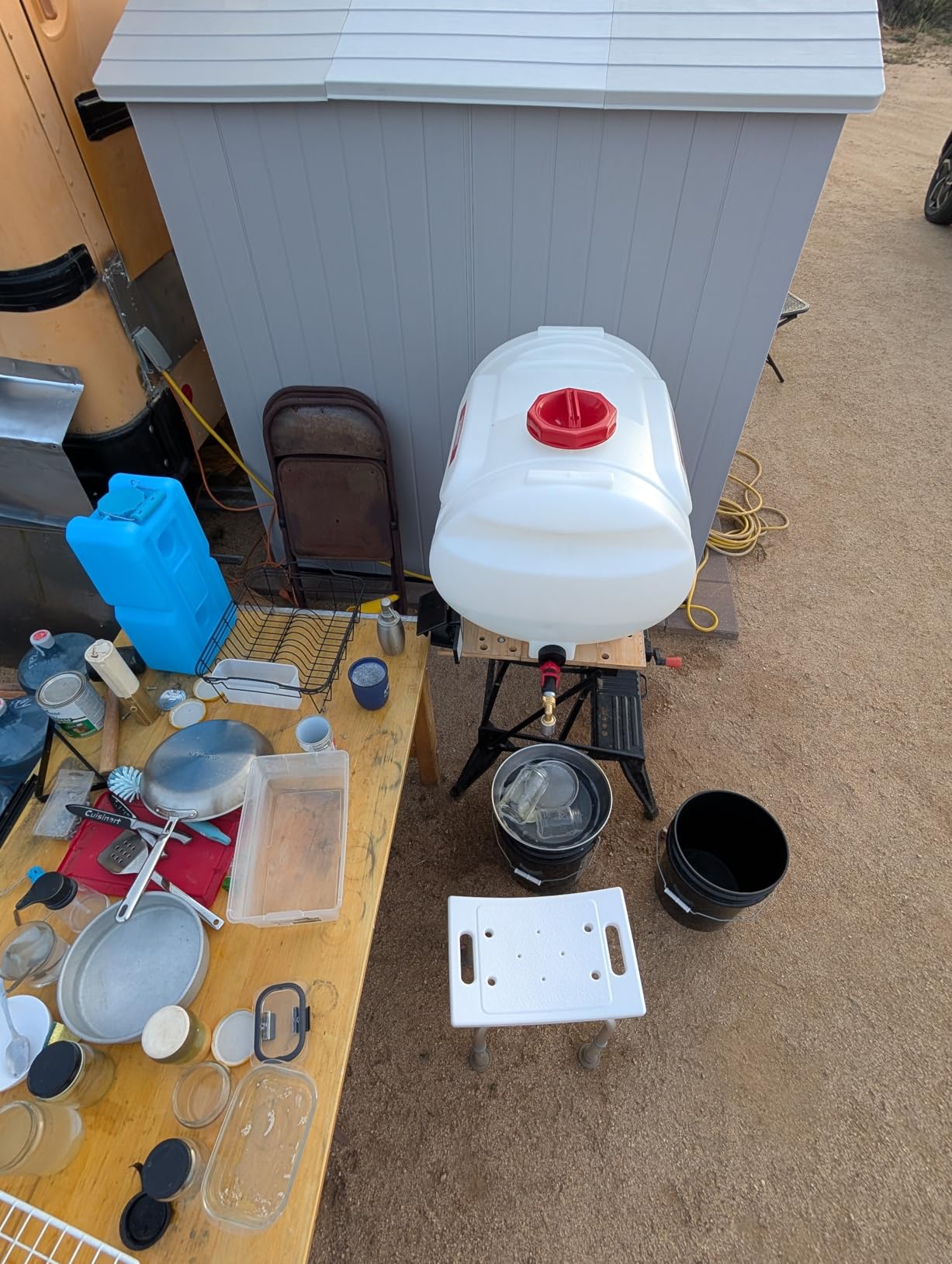
It is made in the USA and carries a 1-year limited warranty with US-based technical support. Buyers on farms and gardens consistently point to the visible level and the wide cap as the reasons they bought it.
At 4.1 stars across 661 ratings, the low score is about handling rather than quality. Nineteen pounds empty and roughly 209 pounds full means one person cannot reposition it, and the drain plug is the part that draws repeat complaints about seating and leaking.
Set it where the water falls, not where you want it
Because it is impractical to reposition full, place the tank next to the row or trough it serves rather than moving it later. If it must move, drain it first, because a 25-gallon tank at 19 pounds empty is already at the limit of a comfortable solo lift.
Seat the drain plug with a little food-grade silicone and recheck it after the first week. Most reported leaks on this tank trace back to a plug that was not fully seated, not to a failed component.
Who should skip this tank
Skip it if you need to see the level while it is full. The translucency works, but the cylinder still sits heavy, and there is no handle designed for a loaded lift.
Skip it if you need drinking water certification. The listed specification does not establish a potable rating, so use it for irrigation, livestock and cleanup instead.
12. Rodelna 65 Gallon Foldable Water Bladder – Best for Light-Duty Irrigation and Remote Water
Rodelna Water Storage Bladder, Water Tank 65 Gallon Foldable Portable Water Storage, Large Water Storage Containers with 3/4″ PVC Spigot and Overflow Kit for Camping, Garden, Emergency Water Storage
65 gallon capacity
2.24 kg empty
1000D PVC mesh, welded seams
Stainless steel outlet valve
Pros
- Folds down small for storage yet holds a large volume when set up
- Stainless steel outlet valve is more durable than plastic fittings
- Welded seams have held water for days with no issues
- Works well in the bed of an SUV or side-by-side for remote water
Cons
- Fill opening is too narrow for a standard hose and no adapters are included
- Supplied plastic outlet sleeve collapses and falls off causing water loss
- Plastic hose connection strips easily with repeated use
The Rodelna is for a specific job: getting a meaningful amount of water to somewhere remote, then folding it up for the drive home. At 65 gallons and 2.24 kg empty, it carries more than most rigid tanks of similar size while occupying almost no space in a vehicle when folded.
Construction is 1000D PVC mesh, 1/20 inch thick, with high-frequency welded seams and additional sealing strips, rated from minus 30 to plus 70. The outlet is a 3/4-inch stainless steel valve rather than plastic, which is the spec choice that separates it from cheaper bladders.
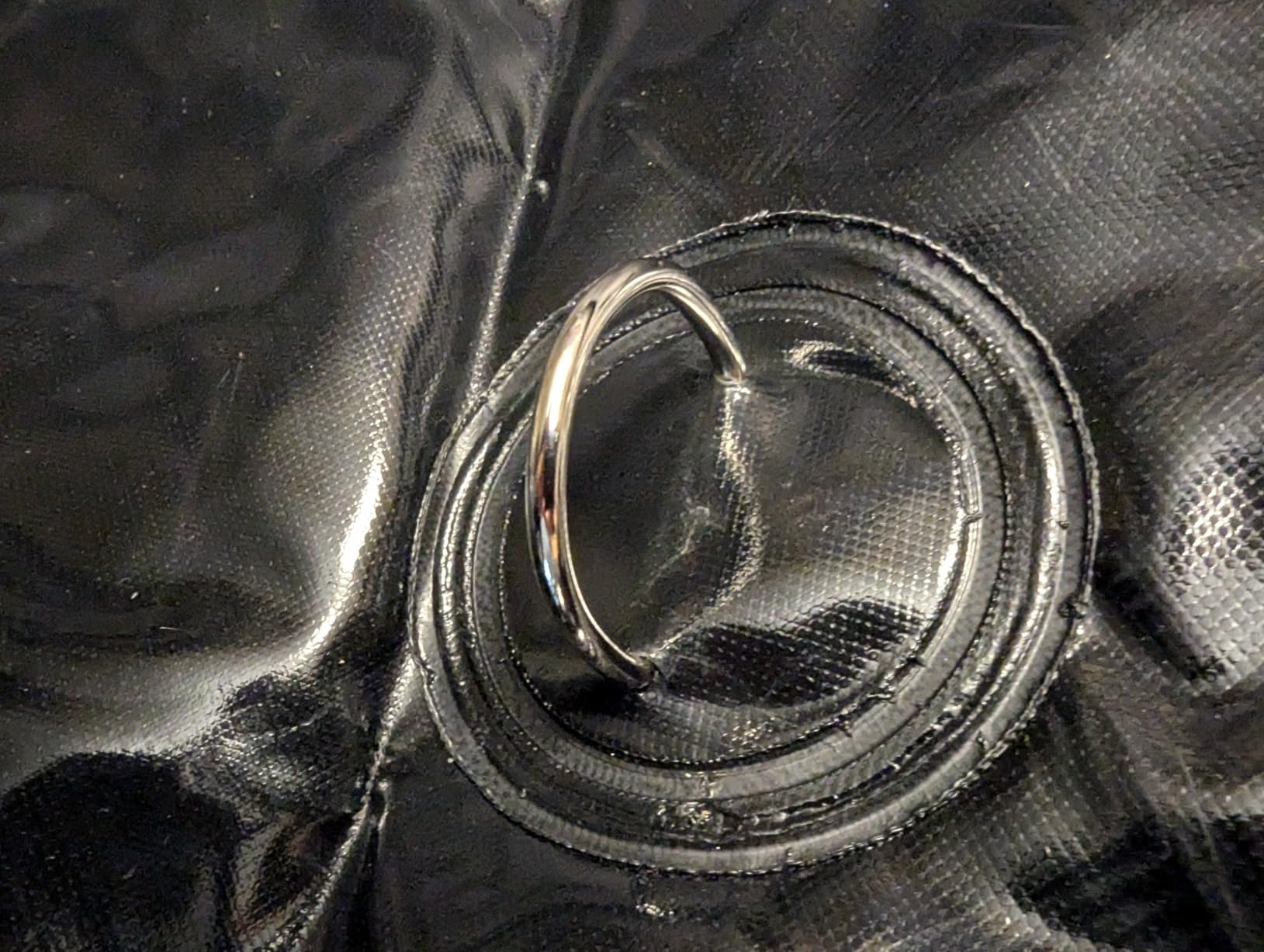
Owners report genuinely leak-free performance over several days of storage, which is the main thing you need from a temporary water vessel. It works well carried in the bed of a side-by-side or an SUV, and the overflow kit is a sensible inclusion for filling on site.
The recurring problem is the connection hardware, not the bag. The supplied plastic outlet sleeve collapses and falls off, causing both water and pressure loss, and the plastic hose connection strips with repeated use even though the valve itself is stainless.
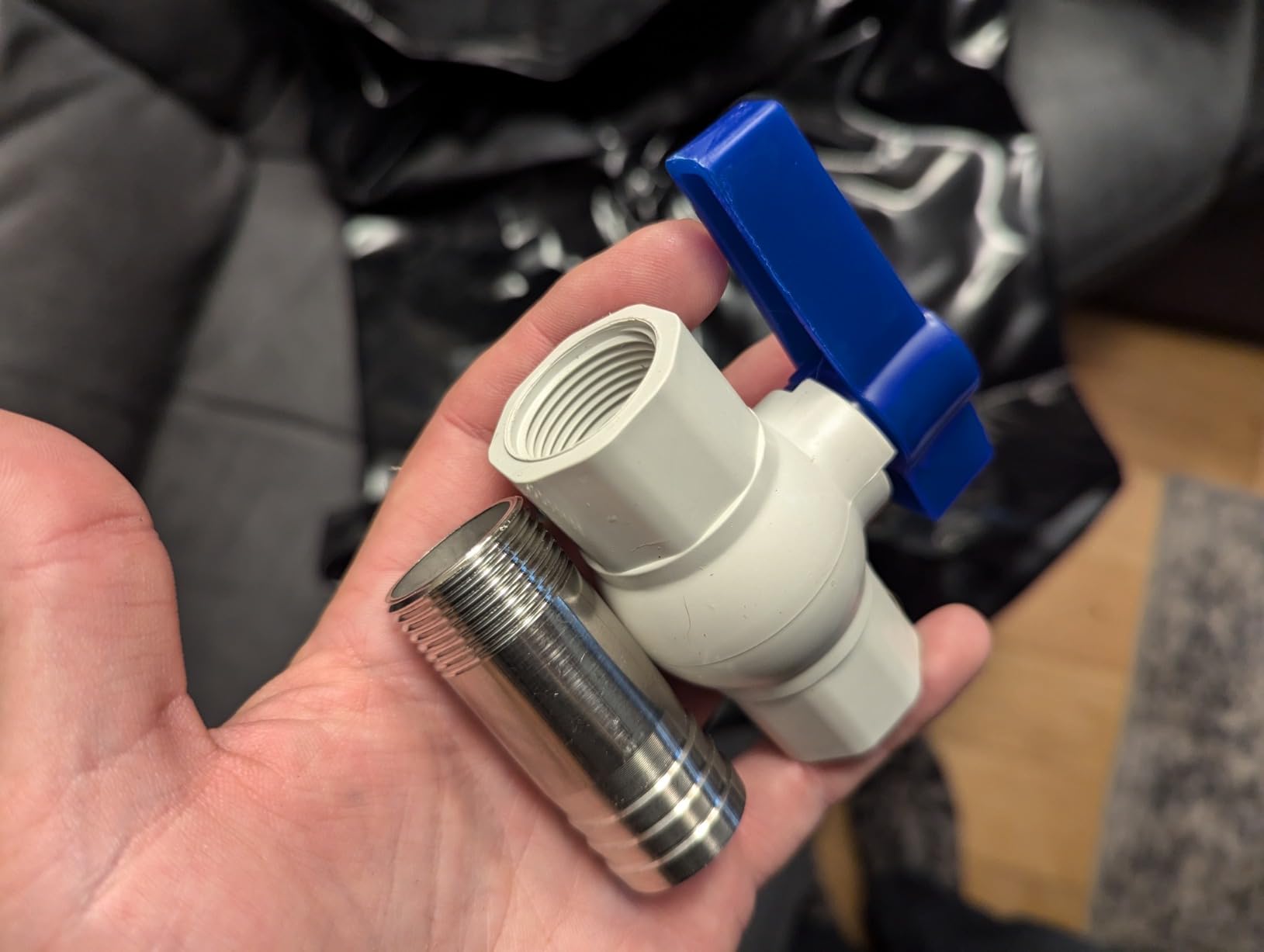
Plan a proper 3/4-inch connection
No hose adapters are included and the 1.5-inch fill opening will not accept a standard garden hose, so bring your own fittings. A short length of 3/4-inch hose clamped to a 3/4-inch barb adapter is the fix most owners arrive at, and it costs very little.
Do not move the bag once it is full. The manufacturer’s own guidance is to fill it where it will be used, because a 65-gallon bladder has enough sloshing mass to damage the fill port.
Who should skip this bladder
Skip it for drinking water. There is no stated potable certification, and the PVC mesh plus welded seams is difficult to sanitise by hand compared with a rigid food-grade tank.
Skip it for pressure-washer supply, where suction will pull the bladder out of shape and stress the seams. Rigid tanks exist for that reason, and our fuel storage tank guide covers the related venting and transport rules.
How to Choose a Portable Water Tank Without Regretting It
The wrong tank is rarely a bad tank. It is a 55-gallon drum in a one-car garage, a 7-gallon jug at the back of a long trail day, or a non-potable utility tank someone filled with drinking water by mistake. Answering five questions before you buy prevents all three.
Capacity: match gallons to a real daily need
Work from a daily figure rather than a wish. Emergency planning guidance we followed puts basic needs at roughly 1 gallon per person per day, camping sits between 2 and 4 gallons per person per day depending on whether you are showering, and a small household during a multi-day outage can run far higher.
That means a couple camping for a weekend wants roughly 12 to 25 gallons, a family of four covering two weeks wants a 55-gallon tank at minimum, and irrigation or livestock demand should be measured in gallons per day rather than estimated. If your answer exceeds 30 gallons, plan on a two-person lift or on wheels.
Weight: the 8.34 pound reality check
Water weighs 8.34 pounds per gallon, which is worth internalising before you shop. A 5-gallon jug is about 42 pounds full, a 25-gallon tank is about 209 pounds, a 50-gallon tank is about 417 pounds, and a 55-gallon barrel is about 459 pounds.
That is the single biggest reason people are caught off guard. If you cannot recruit a second person, cap yourself at roughly 7 gallons, or choose a design with wheels, or a collapsible bladder that stores 63 gallons while weighing 5.7 pounds empty.
Potable, food grade and BPA-free are not the same thing
BPA-free describes one specific chemical. It says nothing about the rest of the polymer, about ultraviolet degradation, or about whether the tank was ever tested against drinking-water standards. A tank can be completely BPA-free and still not be certified to hold water you will drink.
Food-grade is a broader material claim, and potable certification is stronger still, typically meaning the material was tested against NSF, IAPMO or FDA requirements for potable water contact. If you plan to drink from a tank, look for that specific language on the listing, not for the absence of BPA. Our emergency picks are the ones where that claim is stated, and we have flagged where it is not.
Rigid polyethylene, collapsible bladder or rolling jug
These three designs trade off differently, and the decision is about how often you move the tank. Rigid rotomolded polyethylene is the most durable, best certified and most UV-resistant option, and it holds its shape when empty, which means it always takes up the same space.
Collapsible bladders and liners store flat and weigh very little empty, which is transformative for seasonal or remote use, but they are harder to sanitise, less puncture-resistant and less pleasant to store water in. Rolling jugs with wheels sit in between, trading some capacity for genuine one-person handling.
Outlet, lid and fittings decide how often you use it
The fitting details are where tanks fail and where tanks get abandoned. Check the thread standard on the outlet, which may be 3/4 inch female NPT and therefore not compatible with common male hose fittings, and check whether the spigot is brass or plastic, since plastic taps flex and crack first.
Then check the lid. A wide opening, ideally 4 inches or more, is what makes it possible to reach inside with a brush, and a tank you cannot clean is a tank that develops biofilm and stops being used. A moulded tie-down channel matters for anything going in a truck bed, where shifting load is a safety issue, not just an annoyance.
Where to buy and what to check on arrival
Most of these tanks are straightforward to buy online, and the big-name general retailers carry the mainstream rigid tanks. Specialist tank retailers and farm suppliers carry the larger sizes and fittings, and second-hand marketplaces carry tanks whose seal condition you cannot verify.
Whatever the source, inspect on arrival: run water over every seam, turn the spigot through its full travel, check the bungs and plugs are present and seated, and look inside for plastic shavings. Most of the complaints we read about cracking seams and leaking plugs trace back to unverified arrival condition rather than a design fault.
Worth knowing if you already own related gear: the portable air tank guide covers the transport side of carrying pressure vessels, and the L-shaped transfer tank picks cover shapes that fit tight bed and garage layouts.
How to Treat and Store Water Long-Term in a Portable Tank
Tap water stored in a clean plastic container will not stay indefinitely safe, which is the most common question in the preparedness communities we followed. Chlorine dosing, a rotation schedule and a proper cleaning routine between uses together extend the shelf life to about a year without any specialist equipment.
1. Start with a tank you can sanitise. Wash it with hot water and unscented dish soap, then sanitise it with a solution of one tablespoon of unscented household bleach per gallon of water, filled to the top and left for 24 hours. Rinse thoroughly with clean water afterwards and let it dry fully before filling.
2. Dose the water you are storing. Add unscented liquid chlorine bleach at roughly 8 drops per gallon, or about 1/8 teaspoon per 5 gallons, and stir it through. Calcium hypochlorite works too if you prefer a dry product. The goal is a faintly chlorinated taste, not a swimming pool.
3. Seal and store it dark and cool. Cap the tank, keep it out of direct sunlight, and store it where temperatures stay moderate. Heat and light both accelerate chlorine breakdown and plastic degradation, and UV exposure on a clear or translucent tank shortens usable life.
4. Rotate on a schedule. Replace the contents every six months, or at minimum once a year, and write the fill date on the tank with a permanent marker. Water that has been treated properly and kept cool is generally considered good for about a year, and a date on the side removes the guesswork when you need it.
5. Clean between every use, not just every rotation. After a camping trip, drain the tank, scrub it with soap and a bottle brush, rinse, and let it dry open. Tanks with narrow fill mouths, such as sealed-top barrels, are much harder to clean properly, which is a real argument for choosing a wide-mouth design.
Safety note: Never drink water stored in a tank that is not certified for potable use, including waste totes, general utility tanks, rainwater bladders and any tank with a chemical cleaning history. A tank that held antifreeze, fuel, cleaning solution or waste is permanently unsuitable for drinking water, no matter how well it is rinsed. If you cannot confirm the certification, use a separate food-grade container for anything you intend to drink.
Frequently Asked Questions
Which water tank brand is the best?
It depends on the job rather than the brand. For bulk outdoor storage, rotomolded polyethylene tanks from RomoTech, WaterPrepared and Augason Farms are the most proven. For moving liquid, the Camco Rhino tote has the best transport hardware. For hand-carry camping water, the YOSN and COOZMENT jugs balance weight and capacity. The brand matters far less than matching the construction to the use: rigid rotomolded poly for fixed or haul-heavy jobs, and collapsible bladders for seasonal storage.
What is the best water tank to buy for home use?
For household backup, a 55-gallon food-grade polyethylene tank is the sweet spot for most families. It covers four people for about two weeks at one gallon per person per day, moves reasonably when empty, and fits through a standard doorway. If you need considerably more than that and want it to disappear when not in use, a bathtub liner such as the waterBOB gives you up to 100 gallons of capacity with almost no stored footprint.
What is a good portable water tank to fill a camper with?
For a camper or RV, a rigid 25 to 50 gallon tank with a wide screw lid and a bulkhead outlet is the right shape, because it can be filled from a hose and drained into the fresh water system. To fill it without a hookup, run a food-grade hose from a fresh source or use a portable pump, and never use a garden hose that has seen fertiliser, oil or chemicals.
How long will water stay drinkable in a plastic container?
Clean, correctly chlorinated tap water in a food-grade plastic container, kept cool and out of sunlight, is generally considered usable for about a year, with many households rotating on a six-month schedule. Over-chlorination is worse than short storage, so dose conservatively and label the tank with the fill date. The container must be certified for potable water contact, otherwise the answer is never.
How long will 5 gallons of water last camping?
A 5-gallon container comfortably covers two people for a two-night trip at typical camping use of roughly 2 to 3 gallons per person per day. It will not cover two people for a week, because washing, cooking and drinking add up quickly. For longer trips, carry two 5-gallon containers rather than one large jug, so a single puncture does not end the trip.
Which water tanks last the longest?
Rotationally molded polyethylene tanks generally outlast thin-wall and multi-piece construction, because there is no welded seam to fail and no rust to form. In practice, the biggest cause of failure is not the tank body but the fittings: plastic spigots, loose valve threads and bung plugs that were never fully seated. Choose a tank with a brass or stainless outlet and inspect the fittings on arrival.
Final Verdict: Which Portable Water Tank Should You Buy?
Pick the Camco Rhino if you need to move heavy liquid and do not care what is in it, because the wheels, tow adapter and 27,000-plus ratings make it the most proven hauling tank in this guide. Pick the WaterPrepared 55-gallon for a fixed household reserve you can stack and connect to a garden hose, or the waterBOB if you want maximum capacity in almost no floor space.
For camping, the YOSN 5-gallon jug is the one we would buy, and for one-person garden and farm work the Chapin 25-gallon does the job without becoming a two-person lift. Whichever you choose, buy the adapter and the siphon at the same time, and confirm the potable certification before anything comes near water you plan to drink.
We re-checked every specification on this page for 2026, and we will keep updating it as tanks change.