
Last updated: October 2026
Most people arrive at a wheel balancer machine the same way I did: a steering wheel that starts shaking somewhere around 55 mph, a set of tires that chewed through the inside edge in 15,000 miles, and a shop bill that made more sense to avoid than to pay. If you have ever mounted your own tires, you already know the shop charges a fee per wheel to add a few ounces of weight. This roundup covers the machines that let you do that job yourself.
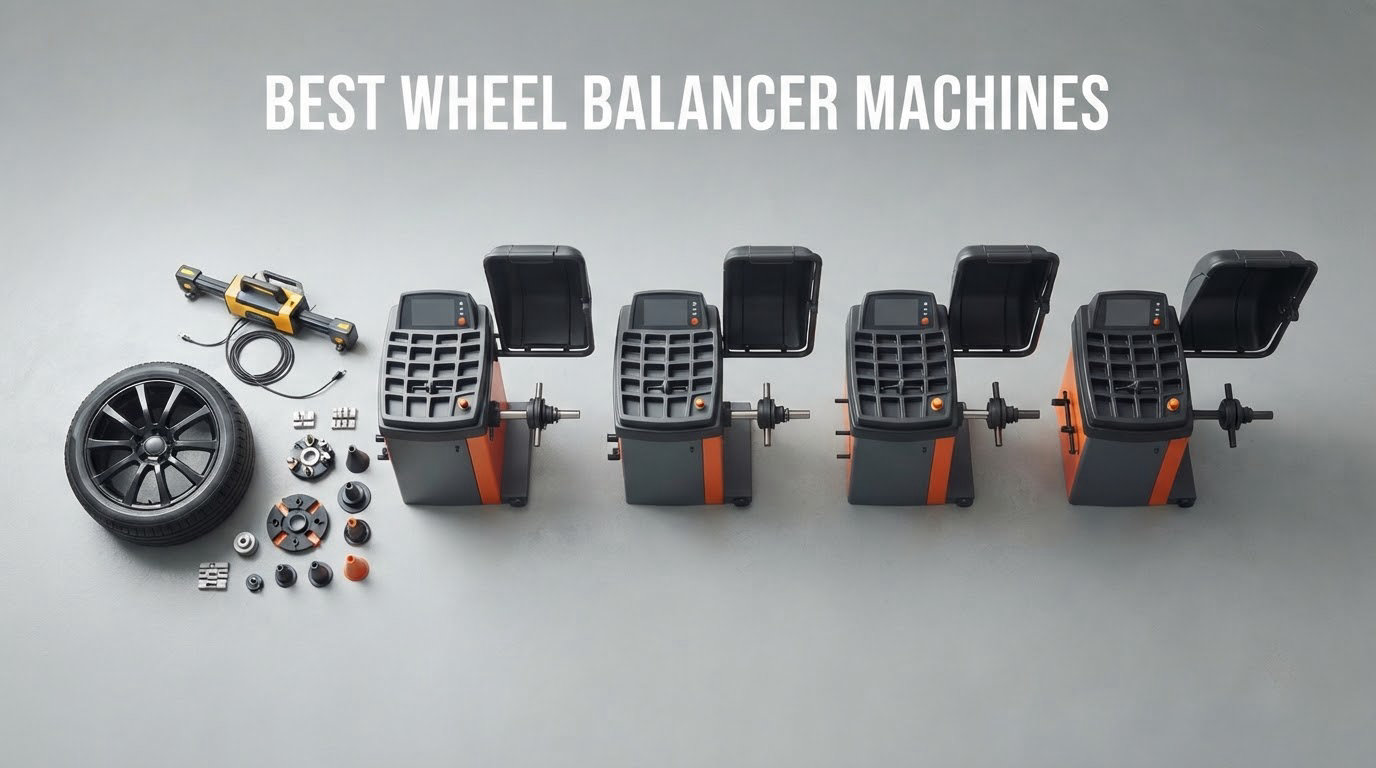
The best wheel balancer machines fall into a few very different families, and picking the wrong one wastes money. A portable bubble balancer handles a trailer wheel or a vintage steel rim for almost nothing. A computerized spin balancer gives you two-plane dynamic correction and a readout in grams, which is what removes steering-wheel shake on a modern car. A tire changer and balancer combo handles both jobs in one footprint. And on-board units like the Centramatic take a different route entirely, correcting imbalance inside the hub as you drive.
Three questions route you to the right tier before you read a single spec: how many wheels do you plan to balance in a year, what power do you have available, and what is the largest rim you need to handle. Four wheels a year on a daily driver, forty tires a month for a small shop, and a 28-inch truck rim are three entirely different purchases. We worked through all ten machines in this list on those three axes, plus repeatability, because a machine that gives you a different reading twice in a row is not worth owning no matter what the spec sheet says. If you are still narrowing it down, our guide to portable wheel balancers for a home shop narrows the field to the small-footprint options first.
Table of Contents
What Is the Best Type of Wheel Balancing?
Dynamic two-plane balancing on a computerized spin machine is the best type of wheel balancing for anything you drive on the highway. Static single-plane balancing on a portable bubble balancer is only adequate for trailers, ATVs, lawn equipment, and low-speed use.
The difference shows up as vibration. An out-of-balance wheel creates a force that changes with every rotation, and your suspension absorbs it. Correct only one plane and you remove the up-and-down hop, which is what a bubble balancer can do by letting gravity roll the heavy spot to the bottom and reading the tilt on a small bull’s eye level. Correct both planes and you also remove the side-to-side shimmy, which is the one that turns into a steering wheel shake at highway speed. Static correction is a single point where the weight balances out, and it cannot cancel two imbalances at two different depths on the rim at the same time.
That is also why every tire shop uses a spin balancer, and why a bubble balancer is not a downgrade for a car. It is a different tool. On a trailer axle at 35 mph, static is plenty. On a pickup at 65 mph with 30-inch tires, you want dynamic.
Top 3 Picks for the Best Wheel Balancer Machines in 2026

Centramatic 800-822
- On-board balancing that self-corrects at speed
- Two balancing pods per set
- Sealed and maintenance-free
- 5-year unlimited mileage warranty

ATPEAM Portable Bubble…
- Static balancing with a bull's eye level
- Handles 1.5 to 4 inch hub bores
- About 11 pounds and folds down for storage
- Needs a pivot fix out of the box

DASBET Portable Bubble…
- Works correctly out of the box
- 1.5 to 4 inch hub capacity
- About 12 pounds
- Best for vintage and classic wheels
The Centramatic leads on the strength of the owner record: 4.7 stars across 300 reviews, the largest verified sample in this list. The ATPEAM and DASBET are the two portable bubble balancers worth owning, and the difference between them is one of out-of-box behavior rather than price.
Best Wheel Balancer Machines at a Glance (October 2026)
| Product | Specs | Action |
|---|---|---|
| Centramatic 800-822 |
|
Check Latest Price |
 XK 988-690 Tire Changer and Balancer Combo XK 988-690 Tire Changer and Balancer Combo |
|
Check Latest Price |
 KATOOL KT-T830 and KT-B700 Combo KATOOL KT-T830 and KT-B700 Combo |
|
Check Latest Price |
 Mayflower 800 Red Wheel Balancer Mayflower 800 Red Wheel Balancer |
|
Check Latest Price |
 KATOOL ME-T500 and ME-B620 Combo KATOOL ME-T500 and ME-B620 Combo |
|
Check Latest Price |
 BILT HARD Changer and Balancer Combo BILT HARD Changer and Balancer Combo |
|
Check Latest Price |
 WEIZE 110V Changer and Balancer Combo WEIZE 110V Changer and Balancer Combo |
|
Check Latest Price |
 KATOOL KT-T800 and KT-B700 Combo KATOOL KT-T800 and KT-B700 Combo |
|
Check Latest Price |
| ATPEAM Portable Bubble Wheel Balancer |
|
Check Latest Price |
| DASBET Portable Bubble Wheel Balancer |
|
Check Latest Price |
One of these is not a bench-top machine at all. The Centramatic is an on-board unit that lives inside the hub, and it is the only pick here with a five-year warranty and no power connection at all. The other eight split cleanly into portable static balancers and 110V floor machines with a changer attached.
1. Centramatic 800-822: Best On-Board Balancer for Trucks and Trailers
Centramatic 800-822
On-board balancing pods for steer and drive hubs
2 per set
10.28 lb each
5-year unlimited mileage warranty
Pros
- Users report noticeably reduced steering-wheel shake and vibration after installation
- Easy installation on common brake-drum and disc-brake setups such as 16.5-inch steer axles
- Users report more even tire wear and a smoother ride
- No maintenance required once fitted
- Made in Texas with a 5-year unlimited mileage warranty
Cons
- Correcting part number for the hub size is essential; wrong part numbers will not fit
- Benefits accrue progressively at highway speeds rather than at low speed
The Centramatic does not spin your wheel. It sits inside the hub and adjusts itself as you drive, which makes it a genuinely different answer to the balancing question rather than another machine to buy. Two sealed balancing pods are supplied per set, so you can address a steer axle and a drive axle on the same vehicle.
What convinced me to put it first is the owner record. 300 reviews at a 4.7 average is the deepest verified sample in this roundup, and the pattern in those reviews is consistent: owners fit them before new steer tires and report the vibration, the droning road noise, and the uneven wear disappearing on trucks, RVs, and 4x4s. The listed operating correction speed is roughly 35 mph, which is also where the benefit accrues rather than instantly.
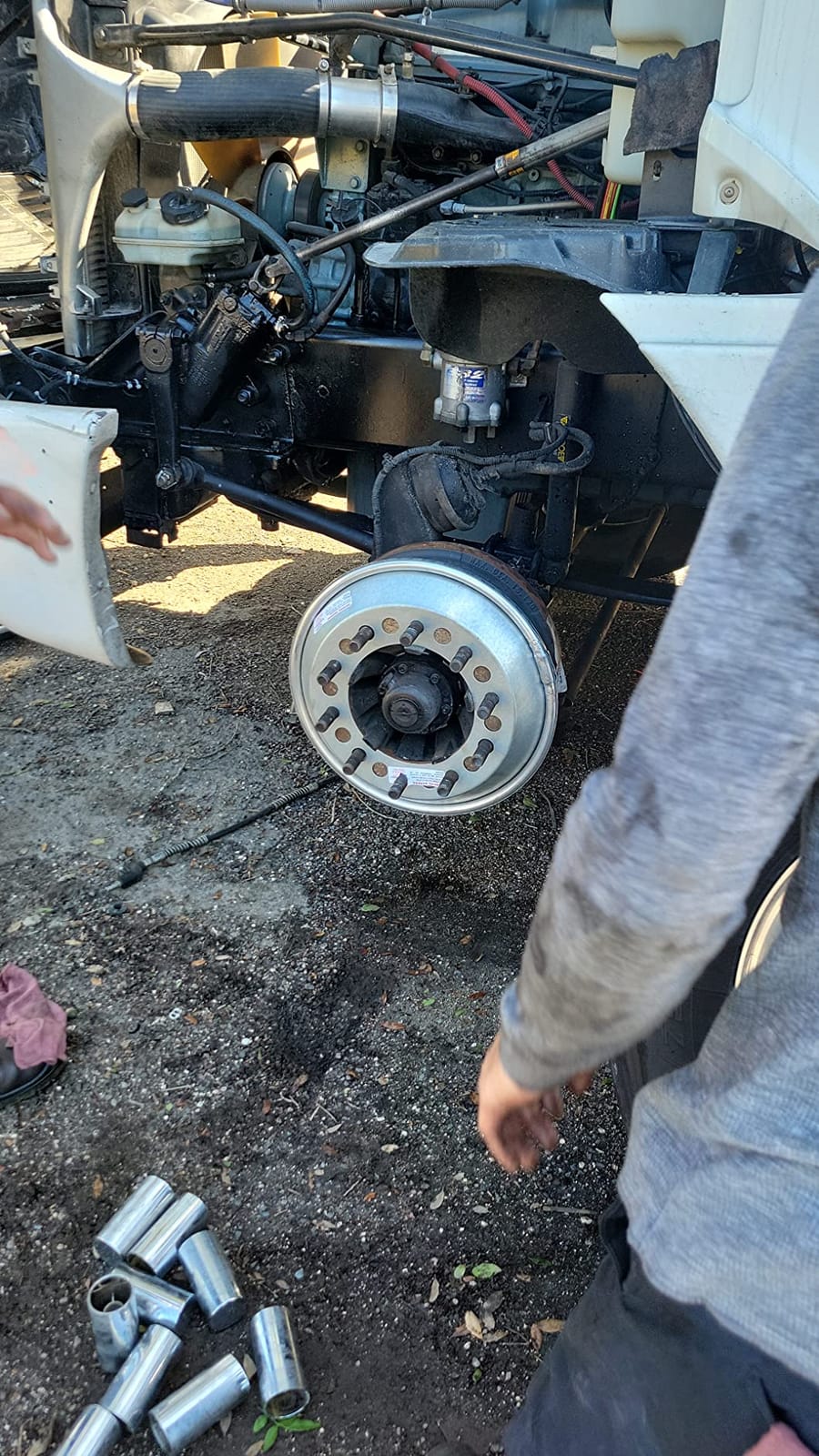
Construction is aluminum and steel, and the system is fully sealed, so there is no pivot to grease, no calibration cycle, and no cone to keep clean. That maintenance-free property is why it is the choice for anyone who only balances a few wheels a year.
The fitment caveat is real and it is the only one: the part number has to match your hub size, and a wrong part number simply will not fit. Owners repeatedly stress ordering the correct number, and the set is listed as fitting common setups such as 16.5-inch steer axles on both brake drum and disc brakes.
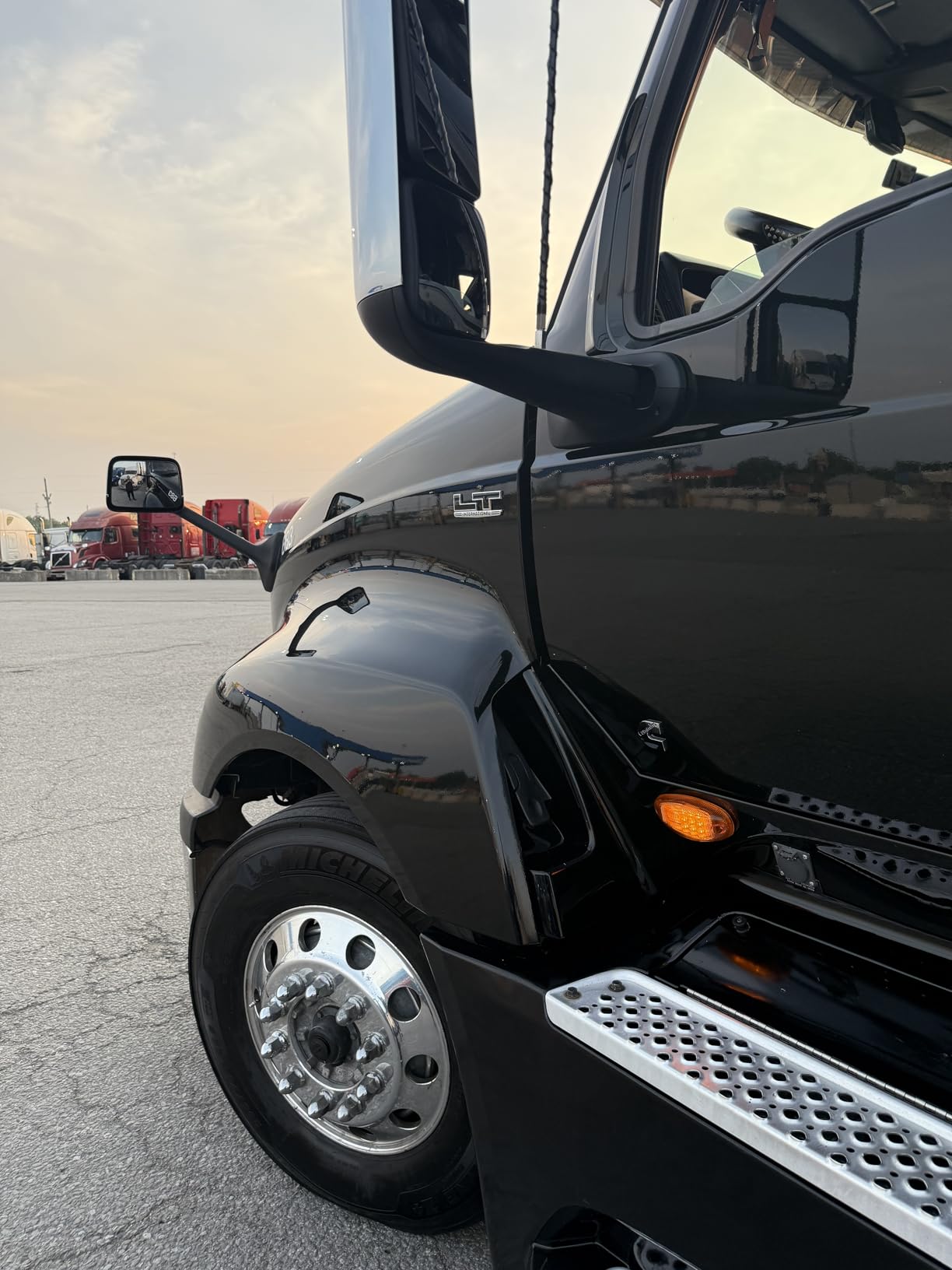
What on-board balancing actually fixes
On-board balancing puts fluid and steel shot inside the drum or hub. As the wheel spins, the heavy components migrate outward, shift to balance, and migrate back, continuously and automatically. The mechanism is entirely mechanical and runs off road speed, so there is nothing to calibrate and nothing to plug in.
It is a supplement to a proper dynamic balance at mount time, not a replacement for one. A wheel with a real two-plane imbalance will still shake cold, and the shot does not act on the spot. You need to drive it before the correction shows up.
Who should skip the Centramatic
Skip it if you drive a passenger car on 15-inch steel wheels. The cost per pod makes no sense against a shop fee you would pay four times, and the whole premise assumes a heavy hub that runs long stretches at highway speed.
Also skip it if you need a verified gram reading for track setup or maximum ride quality. On-board units correct within a broader tolerance than a calibrated spin machine, so if you want a printed number you can repeat, this is the wrong tool.
2. XK 988-690 Tire Changer and Balancer Combo: The Most Detailed Spec Sheet Here
XK Tire Changers Machine and Wheel Balancer Combo,110V,988-690
110V changer and balancer in one cabinet
Balancer takes 10-24 inch rims
Accuracy -1g to +1g
4-7 second cycle time
840 lb
Pros
- Dual assist helper arms make low-profile and wide reverse-lip tires far easier to mount
- Balancer calibrates quickly and balances accurately once calibrated with a steel reference wheel
- Owners running small businesses report years of trouble-free daily use
- Seller support is repeatedly described as responsive with free replacement parts shipped
- Good value compared with American-made shop equipment
Cons
- Written instructions are widely criticized as poor; users rely on videos for setup and calibration
- Bead blaster fittings and air connections on some machines leak and are hard to seal
- Consumes considerable air and effectively needs a large compressor
- 840 lb makes solo installation difficult without casters and a second person
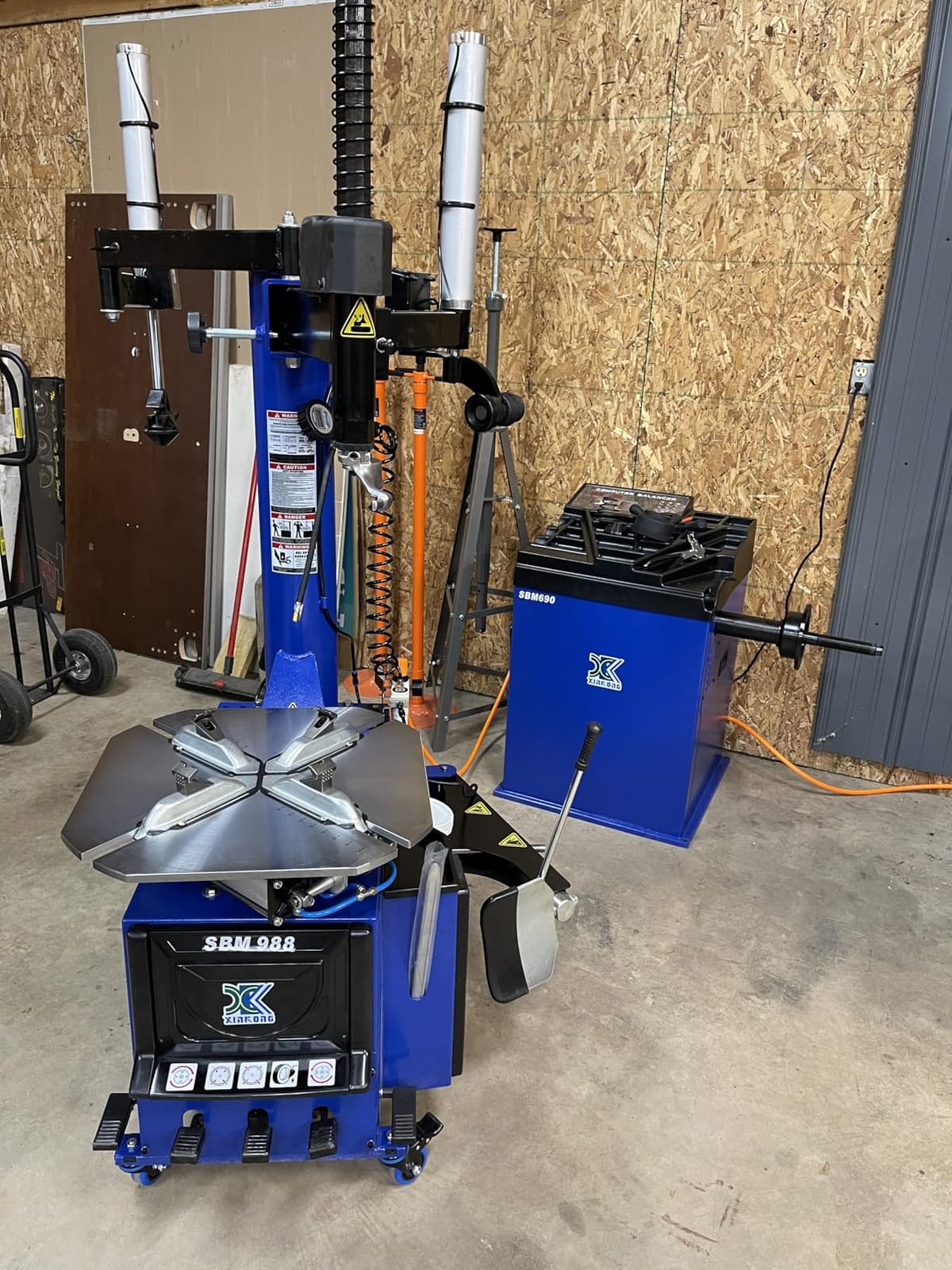
The XK 988-690 publishes a very complete balancer specification, and that is the main reason it ranks here. The balancer is stated as 10 to 24 inch rim diameter, 1.5 to 20 inch rim width, 44 inch max wheel diameter, and 155 lb max wheel weight, with accuracy of minus 1 gram to plus 1 gram and a cycle time of 4 to 7 seconds. Very few machines at any level print numbers that precise.
The changer side is 110V with a 2.0 hp motor, outside clamp 12 to 20 inch, inside clamp 12 to 24 inch, 41 inch max wheel diameter, 12.5 inch max wheel width, and a bead breaker force of 2500 kgf at 6 to 8 bar operating pressure. Balancing modes cover dynamic, static, ALU 1 through 3, and motorcycle, and four centering cones are included.
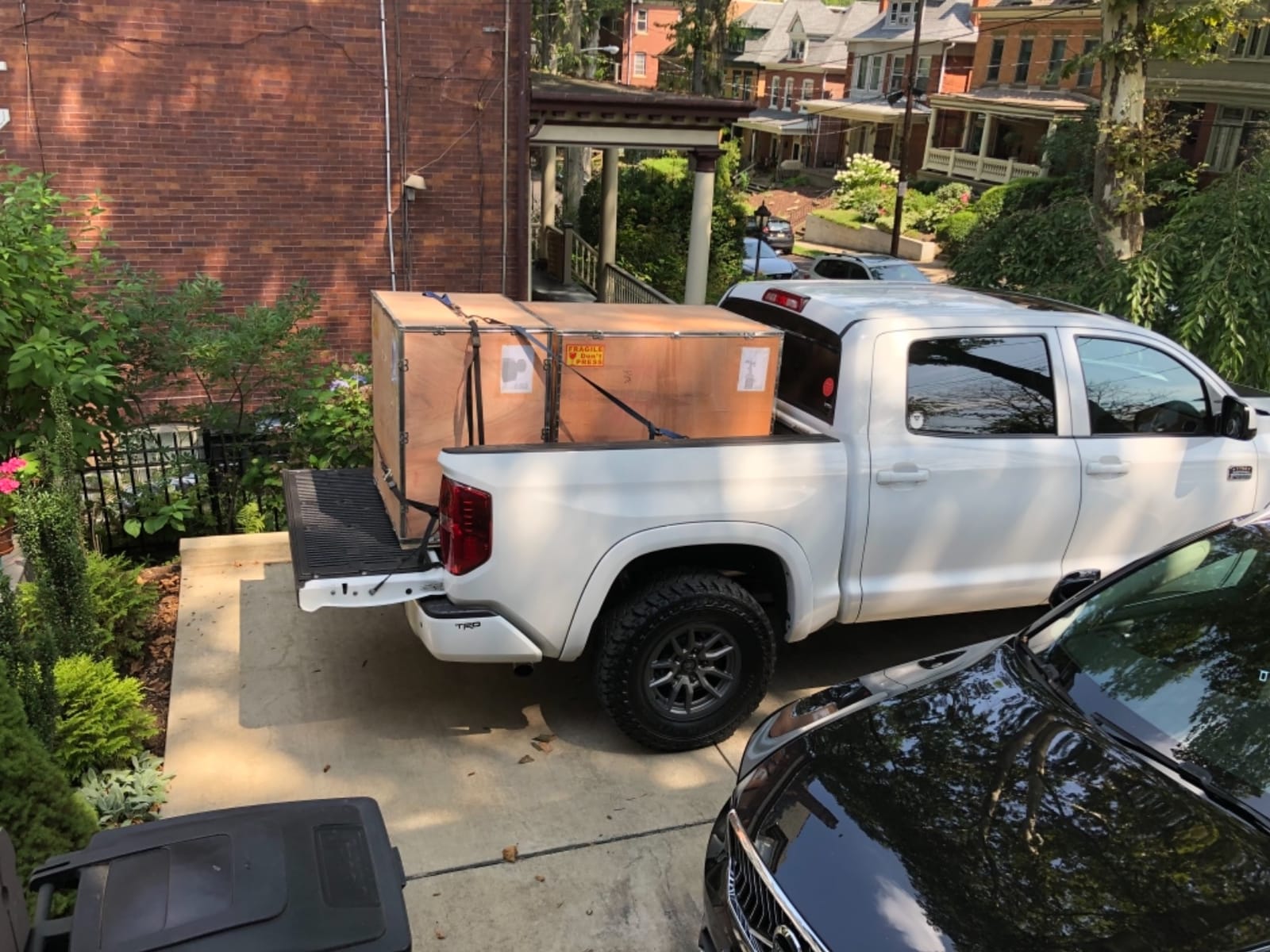
Owners running small businesses report years of trouble-free daily use, which is a stronger durability claim than anything the entry-level portable units earn. The dual assist helper arms get specific praise for low-profile and wide reverse-lip fitments, the exact tires that defeat a basic swing-arm machine.
The pattern in negative reviews is not about performance. It clusters on documentation, air fittings, and logistics: written instructions are widely criticized, so setup and calibration end up being a video tutorial, and bead blaster fittings on some machines leak and are hard to seal.
What the air and power requirements mean for a garage
This machine runs on 110/220V 50/60Hz and pulls 180 to 250W on the balancer, which is fine on a normal household circuit. The changer side is the demanding part. At 2500 kgf bead break and 6 to 8 bar, owner reports describe it as consuming considerable air, effectively needing a large compressor to keep up with repeated work.
Budget for logistics before you budget for floor space. At 840 lb and 47 x 39 x 34.6 inches, moving it into place realistically takes casters and a second person.
Who should skip the XK 988-690
Skip it if you are doing four wheels a year. You are buying a tire changer to go with a balancer, the documentation will still be the weak point, and a standalone computerized balancer is a smaller and easier thing to own.
Skip it if your garage cannot hold a large compressor and a dedicated outlet. The air demand is the practical blocker, not the electrical one.
3. KATOOL KT-T830 and KT-B700 Combo: Inside Clamping to 26 Inches
KATOOL 2.0HP Tire Changer Bead Blaster Wheel Balancer Machine Combo KT-T830+KT-B700 Tire Changer Machine Tire Machine, Outside clamp 12-24″ Inside clamp14–26″ with φ8 Inch Cylinder
Outside clamp 12-24 inch, inside clamp 14-26 inch
Solution-treated stainless steel body
Carburized and quenched alloy steel jaws
Hydraulic assist arms
Pros
- Build quality is repeatedly compared favorably to much more expensive name brands
- Users report mounting low-profile
- stretched and large 22-inch tire setups without difficulty
- Additional hydraulic assist arms make dismounting and mounting much faster
- Balancer held accuracy at highway speeds with zero vibration after road testing
- Arrives well packaged with no missing pieces
Cons
- Assembly documentation is essentially absent; users assemble from photos and videos
- One report of transit damage with no reachable technical support
- Calibration required creative workarounds when no steel reference wheel was available
What sets this KATOOL apart is clamping range and material specification. The outside clamp fits 12 to 24 inch and the inside clamp fits 14 to 26 inch, a wider inside range than the other changers here specify. The body is solution-treated stainless steel with polished interfaces, and the jaws are alloy steel, carburized to 0.8 to 1.1 mm with full quenching.
The fully closed body is a practical design choice rather than a marketing line. It protects internal components from dirt, grease, and debris, which matters in a garage where the machine is exposed to that same debris. Soft jaw covers protect alloy and custom rims during mounting.
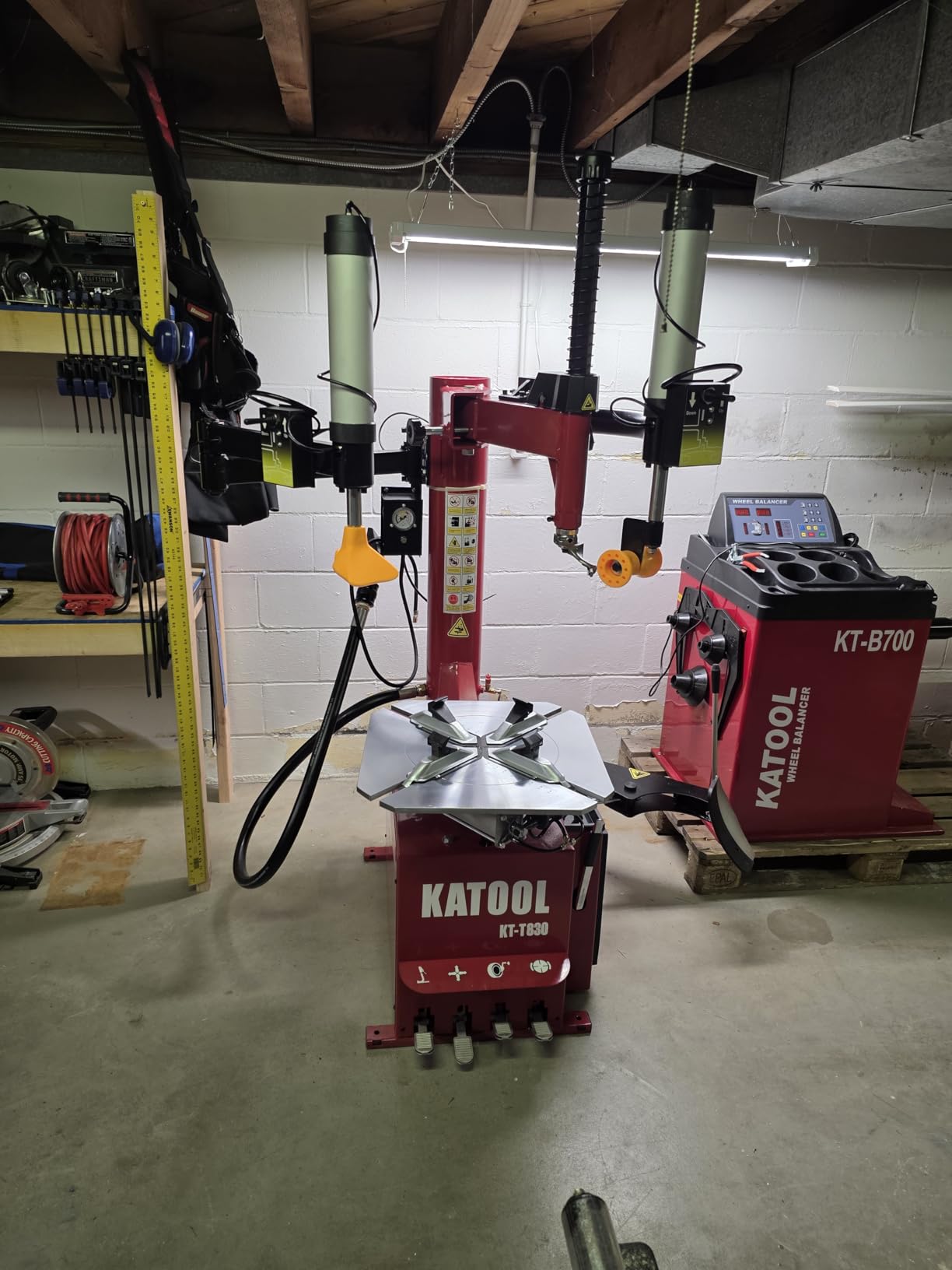
Owners mounting low-profile, stretched, and large 22-inch tire setups report handling them without difficulty, and the additional hydraulic assist arms make dismounting and mounting faster with less operator strain. One owner road tested a balanced wheel assembly and reported the balancer held accuracy at highway speeds with zero vibration.
Build quality is the most repeated theme, described favorably against machines costing substantially more. It also arrives well packaged with nothing missing, which is more than you can assume from any imported combo.
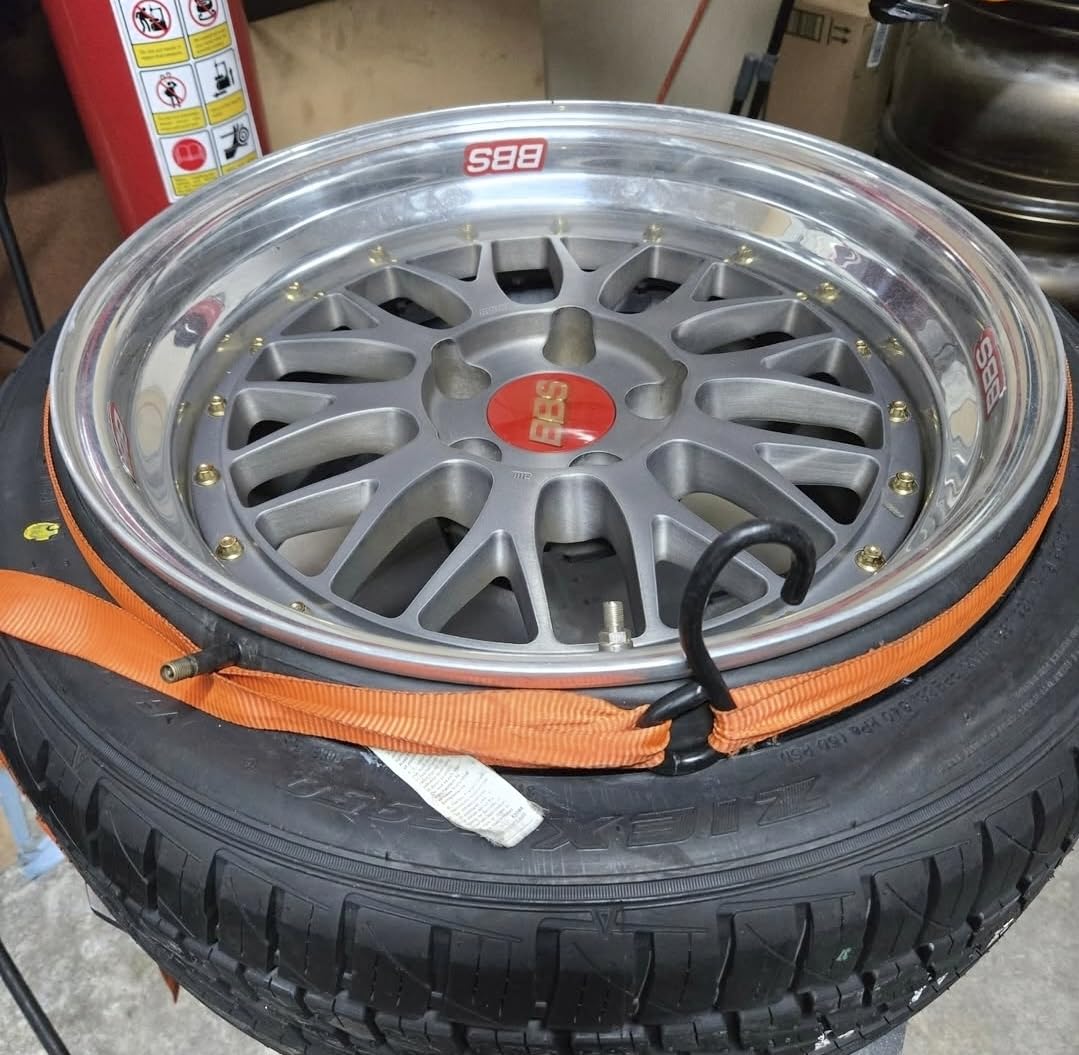
When a 26-inch inside clamp actually matters
Inside clamping range is the number people underweight. A machine rated to 22 inch inside cannot hold a 24-inch or 26-inch rim without the tire sitting off-center, and off-center mounting produces exactly the kind of sidewall imbalance you paid to remove. If your largest wheel is a 22-inch or larger truck or performance rim, this is the spec that decides the purchase.
The tradeoff is that this package does not publish a gram-level accuracy figure for the KT-B700 balancer. You are buying clamping range and construction quality rather than a stated tolerance.
Who should skip the KATOOL KT-T830
Skip it if you need a written calibration procedure you can follow from a manual, because the documentation is essentially absent and owners assemble from photos and videos. If you are comfortable with that, the machine itself performs.
Also skip it if a small review base makes you uneasy. At 44 reviews with one report of transit damage and no reachable technical support, support is the risk, not the hardware.
4. Mayflower 800 Red: Best Standalone Computerized Balancer for a Home Garage
Mayflower – Heavy Duty Wheel Balancer Tire Balancers Tire Machine 800 Red Edition / 1 Year Full Warranty
Standalone 110V computerized balancer
10-24 inch rim diameter
1.5-20 inch rim width
Dynamic, static, ALU and motorcycle modes
Pros
- Long-term owners report balancing well over 100 tires with no problems
- Plug-and-play setup: mount to floor
- calibrate
- balance
- Repeatable and accurate readings once calibrated
- Build quality reported as much higher than expected for the price
Cons
- Several buyers report calibration failures and incorrect balance readings within months
- The machine sometimes asks for double the weight after a spin cycle and leaves vibration unresolved
- Requires permanent floor mounting
The Mayflower 800 is the one computerized balancer in this roundup that arrives without a tire changer attached, and that is exactly why it is worth considering. At 110V with a rim capacity of 10 to 24 inch and 1.5 to 20 inch rim width, it covers the same wheel range as the balancer half of every combo here, in a fraction of the floor space and without a compressor.
It offers dynamic, static, ALU 1 through 3, and motorcycle balancing modes, preset to American standard measurements, with centering cones and a quick release wing nut listed among its special features. That mode set is the same breadth the more expensive combos advertise.
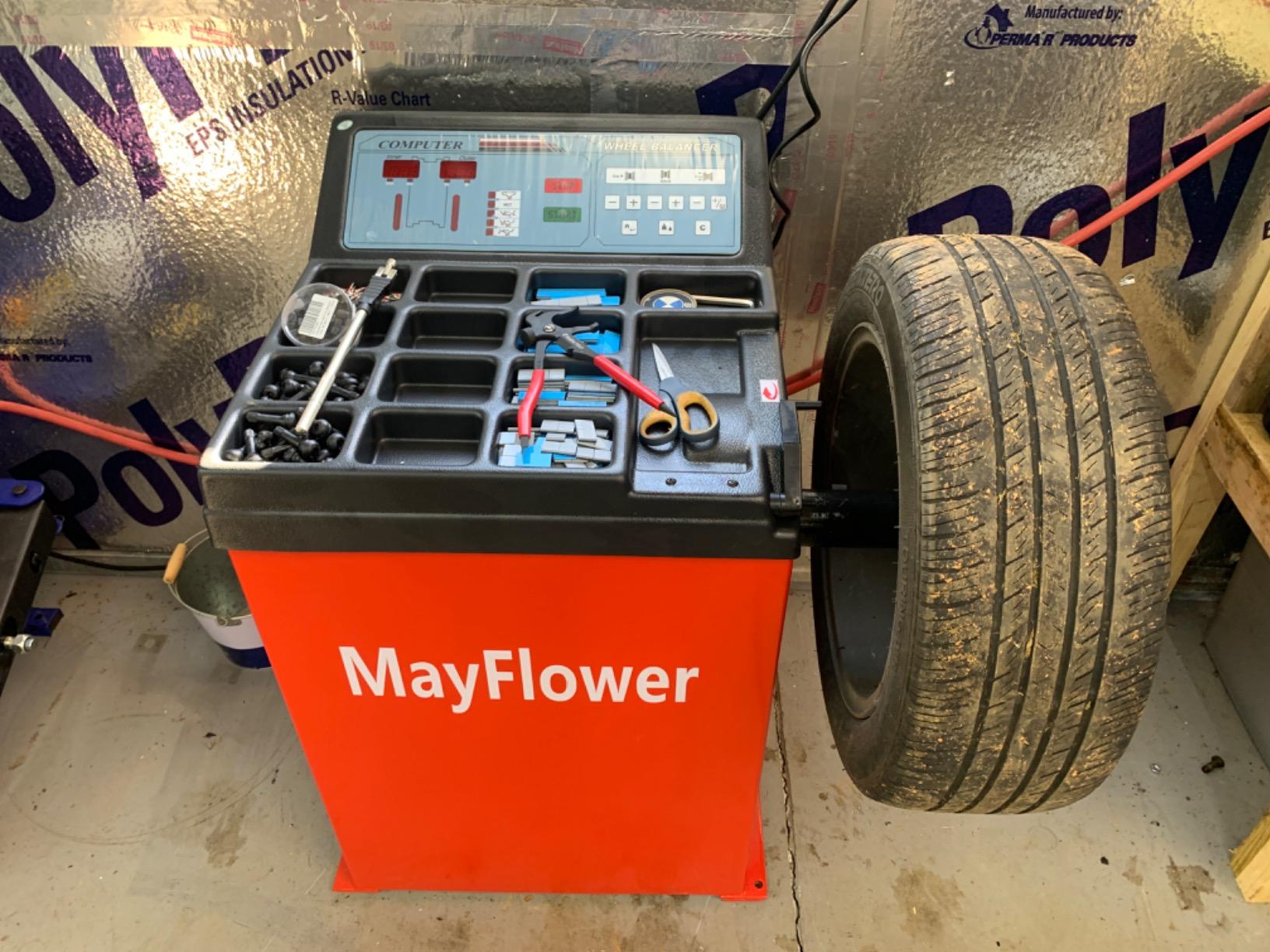
Setup is described as genuinely plug-and-play: mount it to the floor, calibrate, and balance. Long-term owners report working through well over 100 tires with no problems, and repeatable and accurate readings once calibrated, which is the behavior that matters most.
Other owners are less happy, and the split here is sharp enough to state plainly. Several buyers report calibration failures and incorrect balance readings within months, and some describe the machine asking for double the correct weight after a spin cycle, which leaves the vibration unresolved.
The floor mounting requirement and why it matters
This machine requires permanent floor mounting, and that is a real constraint in a residential garage where you may want the space back in the spring. A machine that can shift under a heavy wheel assembly produces readings that drift between spins, so bolting it down is not optional for this design.
Anchor it on level concrete where you can reach it with a car, and check the level before every session. A bull’s eye bubble that reads centered once will drift as the floor settles.
Who should skip the Mayflower 800
Skip it if vibration reliability is non-negotiable for you. With 28 reviews split sharply between dependable long-term users and units that stopped calibrating correctly, this is the least proven computerized machine here, and the sample is small enough that it should temper confidence.
Skip it if you also need to mount tires. It balances only, and pairing it with a changer means two separate machines to move and power.
5. KATOOL ME-T500 and ME-B620 Combo: The Set Owners with Shop Experience Rate as Good Value
KATOOL ME-T500 2.0HP Tire Changer Machine with 24”Turn Table and ME-B620 Wheel Balancer Machine Tire Repair Wheel Changers Combo Garage Equipment (ME-T500 & ME-B620)
ME-T500 changer with a 24 inch turn table
ME-B620 balancer, 10-24 inch rims
Self-calibration with fault diagnosis
Cast steel three-pedal design
Pros
- 2.0 hp motor has ample power for mounting and dismounting without stalling
- Basic and intuitive balancer controls that experienced users find easy to learn
- Accurate balancing reported for rims up to 22 inch and tires up to 38 inch
- Owners with decades of tire-shop experience rate the set as good value
- Handles run-flat tires effectively
Cons
- No built-in bead blaster on the ME-T500
- Instructions for the balancer are poorly written and hard to follow
- Limited on low-profile and very tall-sidewall tires since the duck head can struggle to seat a new tire
- One buyer reports it stopped responding after roughly nine months of shop use
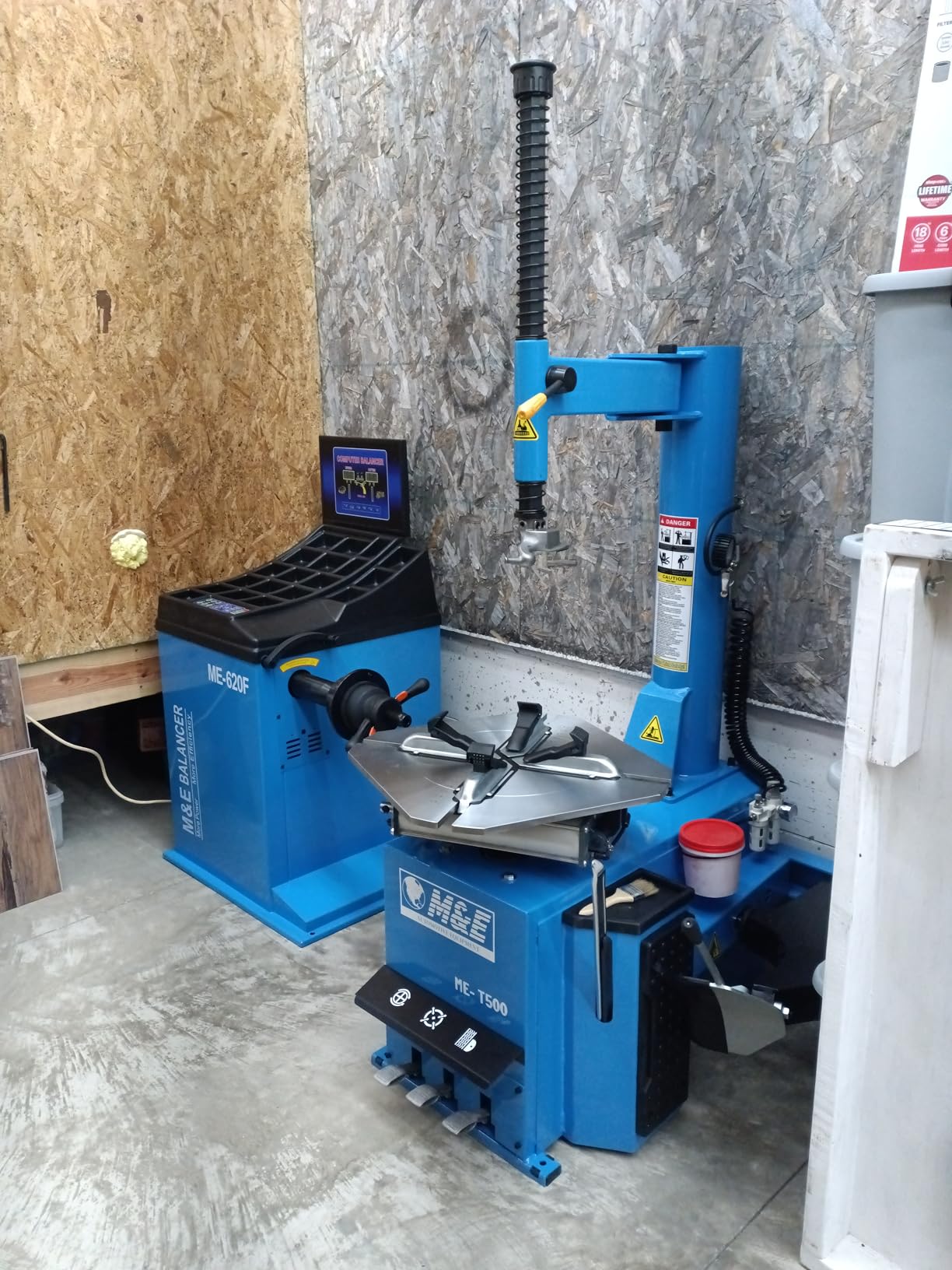
This is a traditional-style machine pair, and its strongest review is written by owners with decades of tire-shop experience who rate the set as good value. The ME-T500 changer clamps 12 to 22 inch outside and 14 to 24 inch inside, uses a 2.0 hp motor, and sits on a 24 inch turn table with three cast steel pedals and a center auxiliary arm design with extra clearance.
The ME-B620 balancer covers 10 to 24 inch rim diameter and 1.5 to 20 inch rim width, with built-in fault diagnosis and self-calibration with double-sided calibration. That self-calibration routine matters more than it sounds, because it is the difference between a two-minute setup and a half hour of manual calibration every time you change a wheel type.
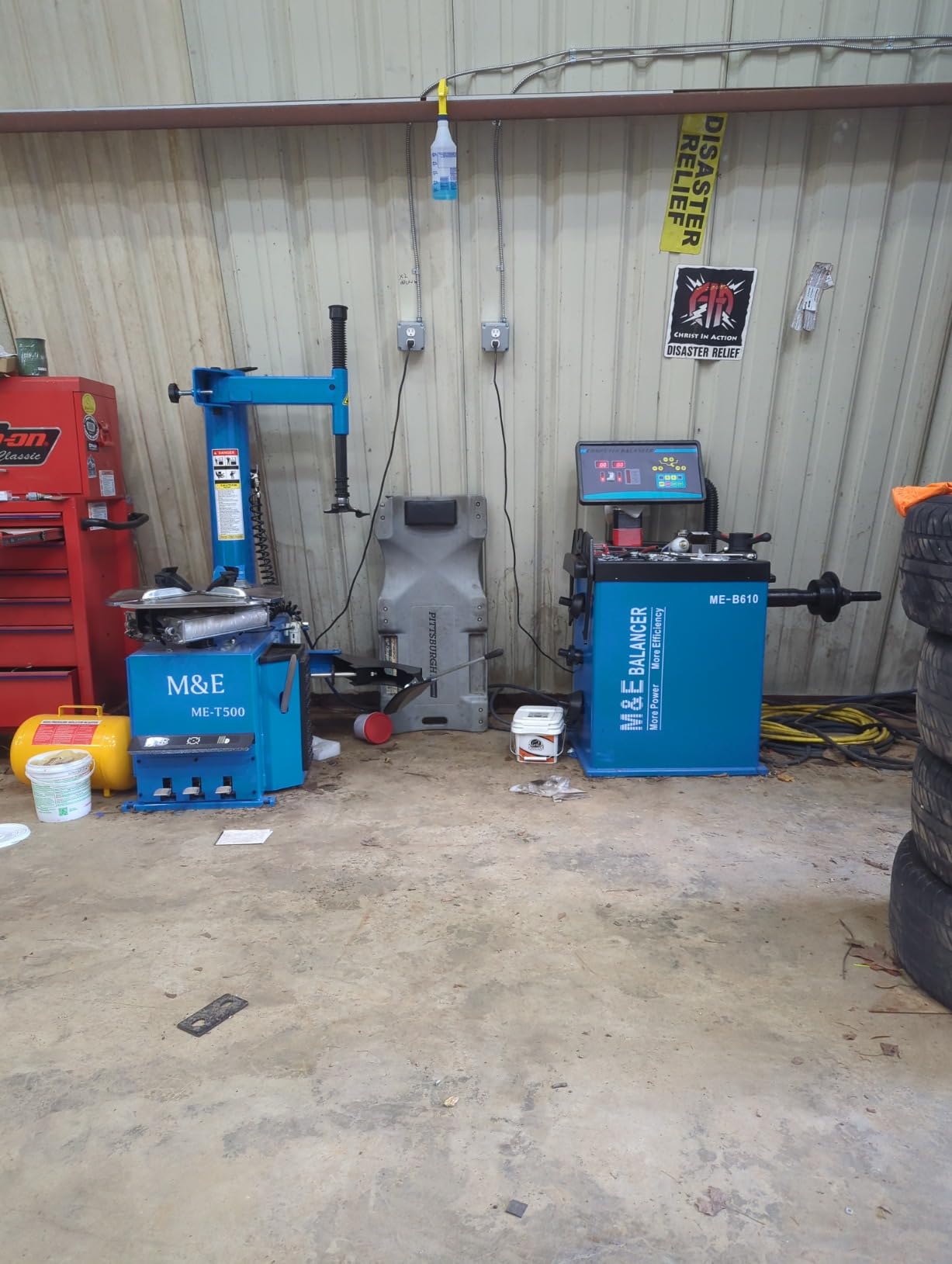
Run-flat handling is the distinguishing report. Owners say it handles run-flat tires effectively, and that is meaningful because run-flats are stiff enough to challenge a basic swing arm and a soft duck head. Accurate balancing is reported for rims up to 22 inch and tires up to 38 inch.
Controls are described as basic and intuitive, which experienced operators read as a compliment. Learnable in an afternoon, with nothing hidden behind a menu system.
Self-calibration versus technician calibration
Self-calibration means the machine walks itself through a reference measurement so the gram readout is trustworthy. A manual cycle means you check a known steel wheel, and if you do not own one, calibration becomes a guessing game. Owners of budget combos without self-calibration report resorting to creative workarounds when no steel reference wheel was available.
The honest limit here: double-sided self-calibration only works with a proper reference wheel on hand. Buy a known-balanced steel wheel once and the feature pays for itself immediately.
Who should skip the ME-T500 and ME-B620
Skip it if low-profile work is your main event. The duck head can struggle to seat a new tire, and there is no built-in bead blaster on the ME-T500, so tough beads are a manual fight.
Skip it if your business depends on the machine. At 26 reviews, with one reported failure after roughly nine months of shop use and a 4.1 average, this is the lowest-rated machine in the roundup and the thinnest safety margin for daily commercial work.
6. BILT HARD Changer and Balancer Combo: For the Largest Rims in the List
BILT Hard 110V 2.0HP Tire Changer Machine and Wheel Balancer Combo Rim Clamp, Tire Changer with Swing Arm and Tire Balancing Machine for Shop, Garage
Balancer fits 10-28 inch rims and 1.5-18 inch widths
Changer handles 12-24 inch rims
Tires up to 39.4 inch
110V/60Hz for both machines
Pros
- Owners report the machines work well and pay for themselves over time
- Crated packaging arrives in excellent condition with no damage
- Setup and operation described as straightforward
- Customer support is described as responsive and attentive
- Handles a broad range of rim and tire sizes for the price
Cons
- The duck head is reported as cheaply made with plastic inserts that do not stay in place
- On larger tires the swing arm flexes and can contact rims
- The bead breaker arm is short and has no extension option for bigger tires
The BILT HARD pair is the machine to look at if your wheels are bigger than anything else here. The balancer fits 10 to 28 inch rims at 1.5 to 18 inch width, reaching well past what the other balancers in this roundup cover, and the changer handles 12 to 24 inch rims with tires up to 39.4 inch.
Mechanically, the changer runs a 2.0 hp motor and the balancer a 250W motor at 70 dB, with 10 bar bead breaking force. Both machines run on 110V/60Hz, so one ordinary garage circuit covers the pair. Balancing modes include four ALU modes for hidden weight placement behind spokes, plus dynamic and static.
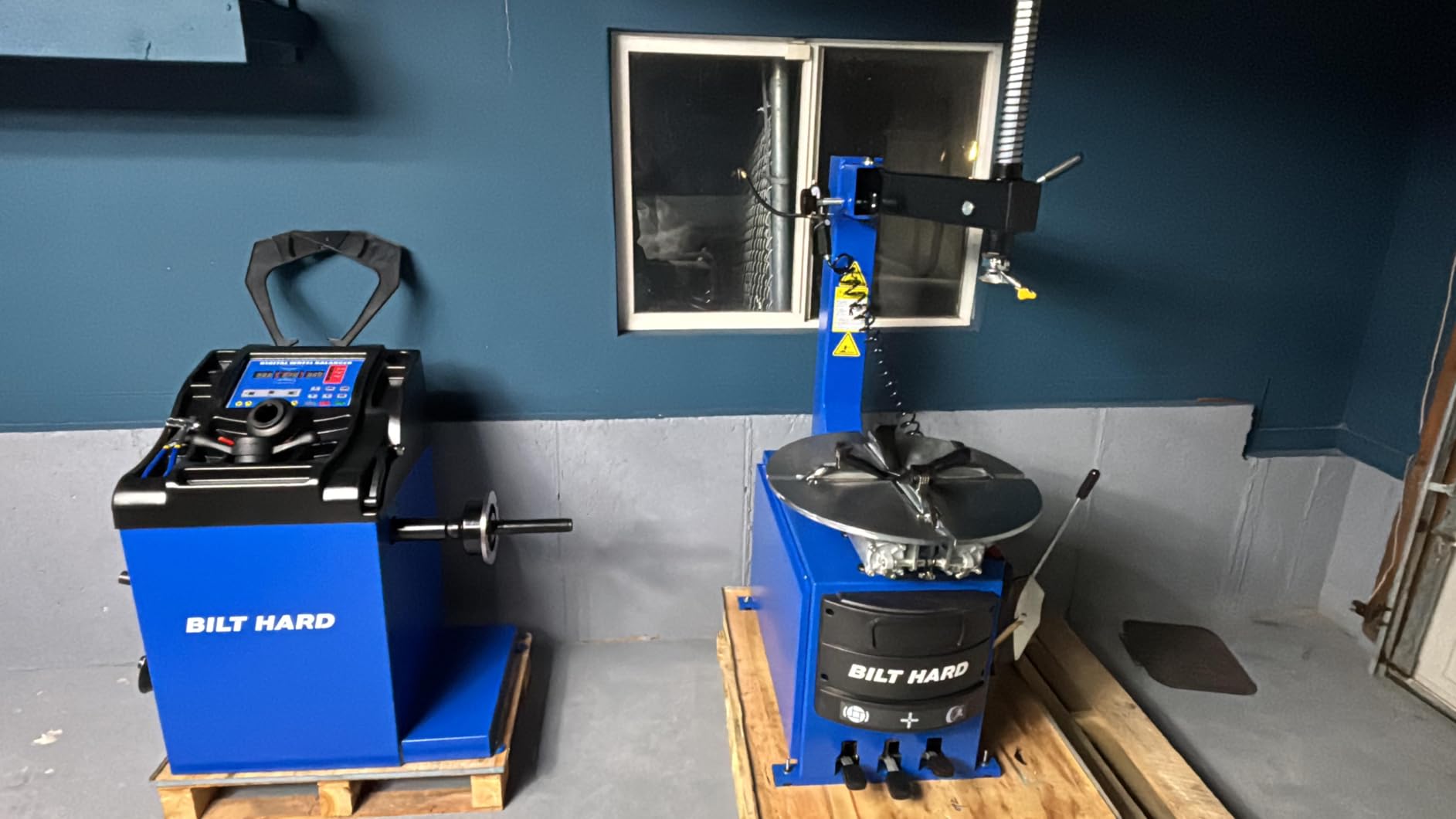
Owners describe the machines as working well and paying for themselves over time, with the crated packaging arriving in excellent condition and no damage, which is a real differentiator for a machine that arrives in two heavy crates. Setup and operation are described as straightforward, and customer support is called responsive and attentive.
The single detailed negative review is worth reading before you commit, and it is about rigidity rather than function: the duck head is reportedly cheaply made with plastic inserts that do not stay in place, the swing arm flexes and can contact rims on larger tires, and the bead breaker arm is short with no extension option.
What 28 inches of balancer capacity unlocks
That headline number covers the wheels most home balancers cannot touch: 26-inch and 28-inch truck rims, plus performance fitments where the bead seat is far outboard. A balancer that tops out at 20 or 22 inch cannot correctly measure those wheels, and measuring them on the wrong machine produces a reading that feels right and fixes nothing. Very wide fitments will fit on the shaft and still need the ALU mode selected for hidden weights behind spokes.
Who should skip the BILT HARD combo
Skip it for heavy work on oversized tires. Arm flex and a short bead breaker arm are exactly the components that degrade under repeated large-tire cycles, and the fix is not a parts swap you can do in a residential garage.
Also weigh the 11 reviews carefully. The feedback is largely positive, but there is not enough long-term data to judge durability, and this listing is newer than most of the roundup.
7. WEIZE 110V Changer and Balancer Combo: Bead Blaster and Dual Assist Arms Standard
WEIZE 110V 2.0 HP Tire Changer and Wheel Balancer Combo,10”-24” Rim Air Bead Blaster Tire Changer Machine with Dual Assist Arms, for Tire Changing, Tire Mounting and Balancing
Integrated bead blaster with reserve tank
Robo-Roller dual assist arms
Automatic rim measuring ruler
Balancer under 70 dB
Pros
- Dual assist arms are described as valuable for run-flat and low-profile tires
- Integrated bead blaster with reserve tank speeds seating tough beads
- Automatic rim measuring ruler simplifies setup on the balancer
- Quiet balancer operation under 70 dB
- Reinforced clamps
- corrosion-resistant coatings and sealed bearings for durability
Cons
- Only a handful of reviews so far
- so long-term reliability is not yet established
The WEIZE package is unusually well equipped for its tier, and the integrated bead blaster is the reason. It blasts at 8 to 10 bar for up to 2700 kg of break force, has an integrated air reserve tank so it does not starve between tires, and includes an adjustable 3.5 bar inflation limit.
Clamping is 10 to 22 inch external and 12 to 24 inch internal, handling tire widths up to 16 inch (406 mm) and diameters up to 41 inch (1040 mm), driven by a 2 hp motor. The Robo-Roller dual assist arm system holds the bead down during mounting, which owners single out for run-flat and low-profile tires.
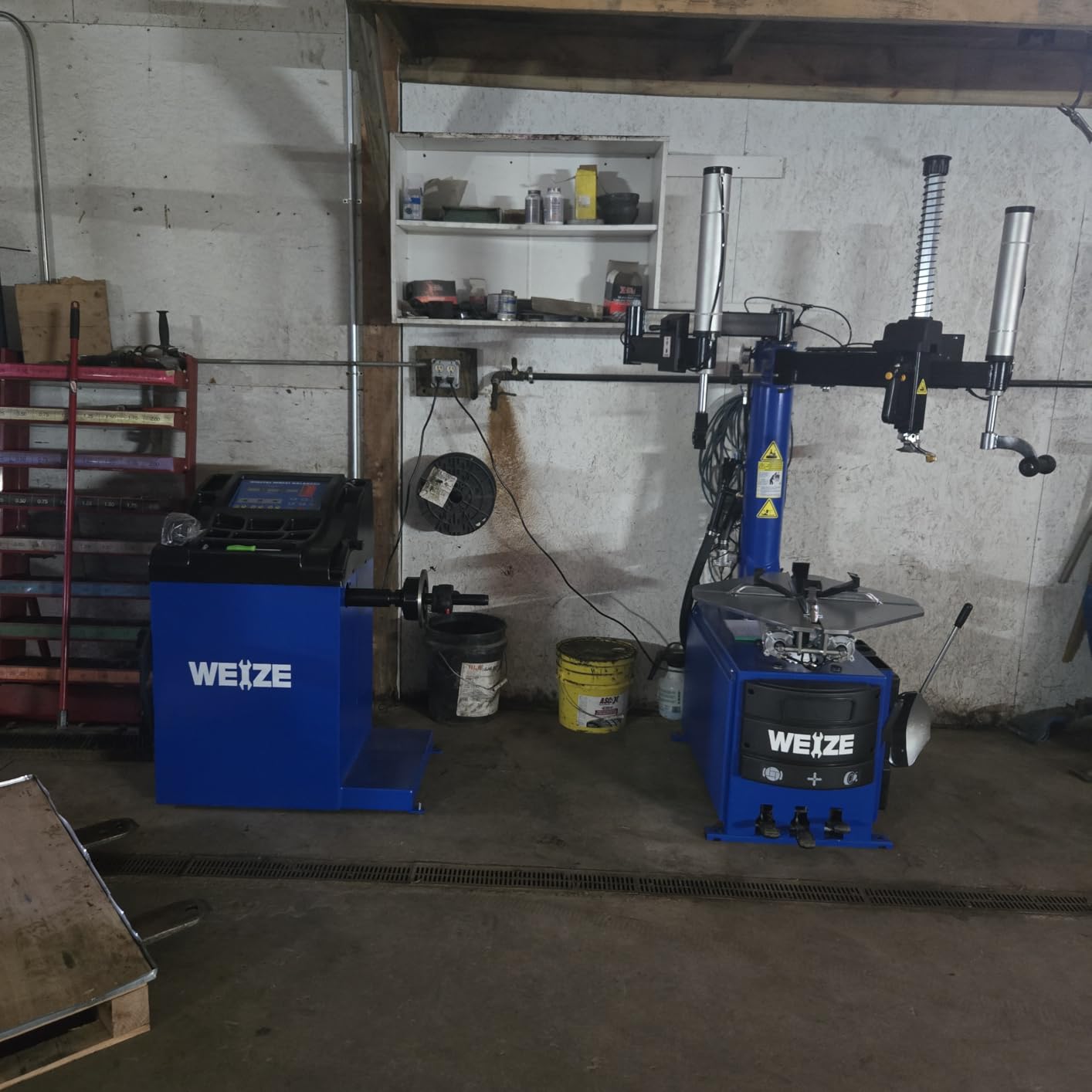
The balancer is genuinely thoughtful. It has an automatic rim measuring ruler, so the machine measures the rim and enters the diameter for you instead of you dialing it in, a 250W motor, a 10 to 28 inch rim range, and operation under 70 dB. That noise figure is the one that decides whether a machine is usable in a residential garage attached to a bedroom wall.
Construction details are listed as reinforced clamps, corrosion-resistant coatings, and sealed bearings. At 795 lb, the pair still needs a planned move, but the reserve tank and assist arms mean it can be run off a smaller compressor than the specs suggest.
Why the automatic measuring ruler saves real time
On a manual machine, every wheel change means measuring rim width and diameter and entering two numbers correctly before the readout means anything. Enter the diameter one inch high and the machine will confidently tell you to add weight in the wrong place. The automatic ruler removes the most common source of a bad balance that is not actually the machine’s fault.
For a shop running volume, that is worth more than a spec-sheet line. For four wheels a year, it is a nicety.
Who should skip the WEIZE combo
Skip it if you want an established reliability record. With 5 reviews, all scoring 5, the perfect average reflects a brand-new listing rather than a long track record, and long-term durability is not yet established.
Skip it if you need a large-wheel balancer more than a large-wheel changer. The 12 to 24 inch internal clamping is narrower than the KATOOL pair, so the changer, not the balancer, is the limit here.
8. KATOOL KT-T800 and KT-B700 Combo: The Heavy-Duty Changer Pair
KATOOL KT-T800/B700 Tire Changer and Wheel Balancer Combo Machine Garage Shop Equipment for Tire Repair and Wheel Balancing
KT-T800 changer with a spade rim cover
B700 balancer with multiple balance modes
Integrated pressure sensor design
12-month parts warranty
Pros
- Changer is described as strong
- powerful and genuinely heavy duty
- Easy setup and simple operation once the owner gets the feel of it
- Owners report real cost savings after working through the learning curve
- Seller communication is strong and missing parts were replaced promptly
- Handles low-profile tires on a Corvette with some effort
Cons
- Instructions are minimal so owners rely on outside videos for balancer operation
- Low-profile tire work requires extra care and effort
- No review yet confirms long-term balancer performance
Where the previous KATOOL pair is built around clamping range, this one is built around the changer itself. Owners describe the KT-T800 as strong, powerful and genuinely heavy duty, which is consistent with a spade cover designed to protect rims during mounting and dismounting, plus a pull type pedal control system.
The KT-B700 balancer is specified with multiple balancing modes for different rim types and an all-in-one pressure sensor support design. Coverage is 12 months of full parts warranty, and it is one of only two warranty terms stated anywhere in this roundup.
All 12 reviews are positive, and they cluster on the changer. Setup is easy and operation simple once the owner gets the feel of it, and owners report real cost savings after working through the learning curve. Low-profile work is possible, including on a Corvette, with some effort. Seller communication is described as strong, with missing parts replaced promptly.
What the spade cover and pedal control change
A spade cover is a full-width guard that sits against the rim face while the tire is being mounted and dismounted. It matters most on split-spoke and high-offset alloy wheels, where a conventional machine can gouge the face on the first pass. The pull type pedal layout gives more direct throttle control than a throttle-cable machine, which is what makes the duck head easier to feather on a stiff sidewall.
None of that is about the balancer, and that is the honest limit of this pick.
Who should skip the KT-T800 and KT-B700
Skip it if balancing is your main reason for buying. Every review in this listing is about the changer, and no review yet confirms long-term balancer performance, so you are taking the balancer on specification alone.
Skip it if you want written instructions. The documentation is minimal, and owners rely on outside videos for balancer operation, so budget time for self-teaching on both machines.
9. ATPEAM Portable Bubble Balancer: Best Static Balancer Once You Fix the Pivot
ATPEAM Portable Bubble Wheel Balancer Heavy Duty Tire Balancing Machine
Static balancing with a bull's eye bubble level
24 inch tall, 11.5 inch base diameter
Center rod 0.813 inch, hub 1.495 inch
About 11 lb
Pros
- Very inexpensive way to balance at home or in a small shop
- Easy to assemble and level out on uneven ground
- Owners with several vehicles report it works on 38-42 inch tires and 16 inch wheels
- Compact and easy to store between jobs
- Vintage car owners value it because old disc-brake wheels cannot be balanced on modern dynamic balancers
Cons
- The pivot seat hole is drilled wrong out of the box so the head rocks and results are not repeatable without modification
- Cast aluminum quality is basic and accuracy suffers when the hub is not perfectly centered
- Accuracy depends heavily on operator patience with repeated heavy and light spots common
- The spindle does not fit motorcycle wheels without removing the bearing
The ATPEAM is a static bubble balancer, and it earns its place here on volume of owner evidence: 258 reviews, second only to the Centramatic. The design is unchanged and widely copied. An aluminum alloy base with an anti-rust enamel finish, four chrome-plated blackened rods and springs, a center rod of 0.813 inch diameter, a hub of 1.495 inch, and a 24 inch tall frame on an 11.5 inch base.
It is a legitimately useful tool for a specific job. Owners with several vehicles report it handling 38 to 42 inch tires on 16 inch wheels, and vintage car owners value it specifically because old disc-brake wheels cannot be balanced on modern dynamic balancers at all.
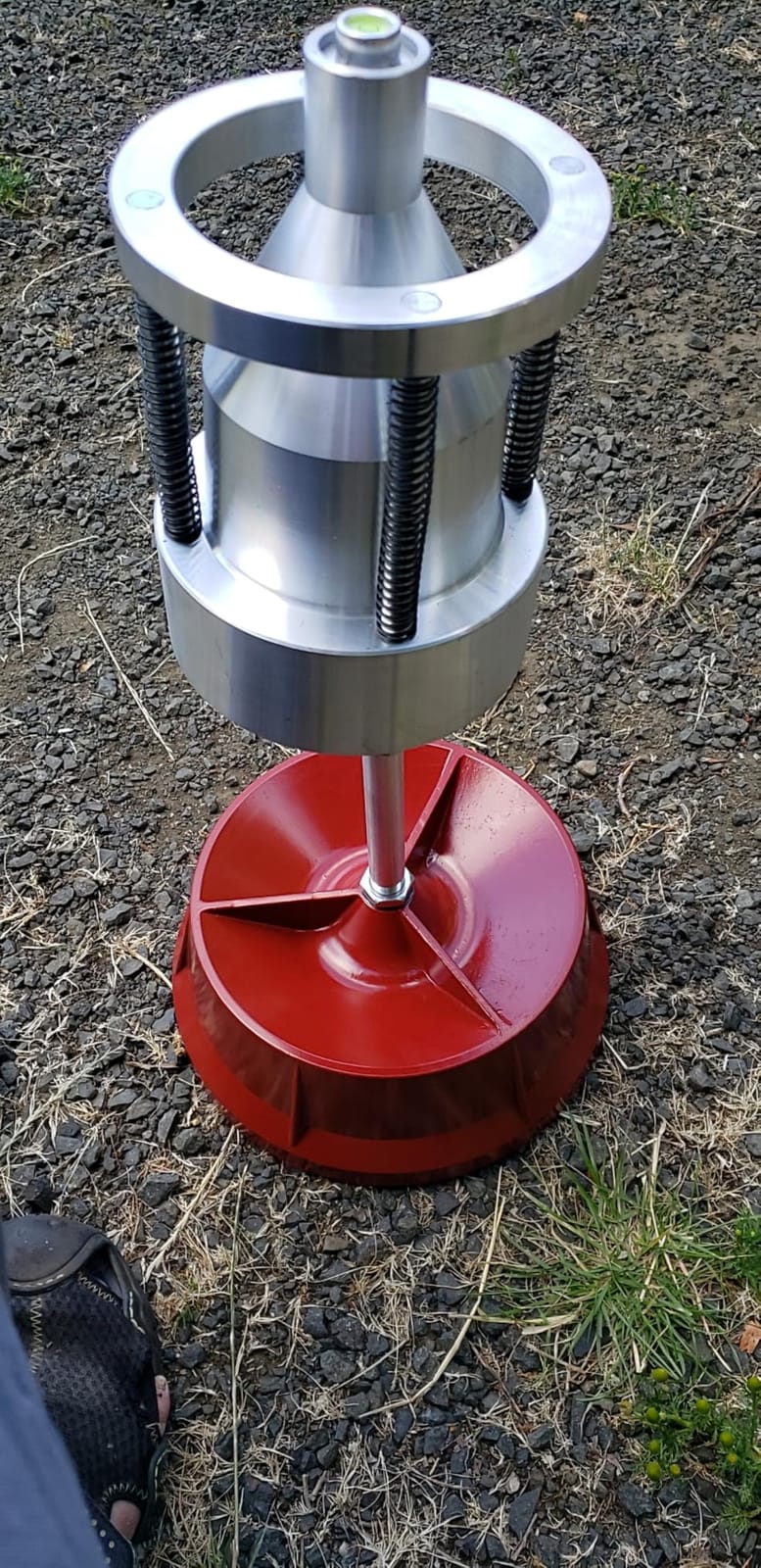
It is also easy to assemble and level out on uneven ground, and at about 11 pounds it stores between jobs without thinking about it.
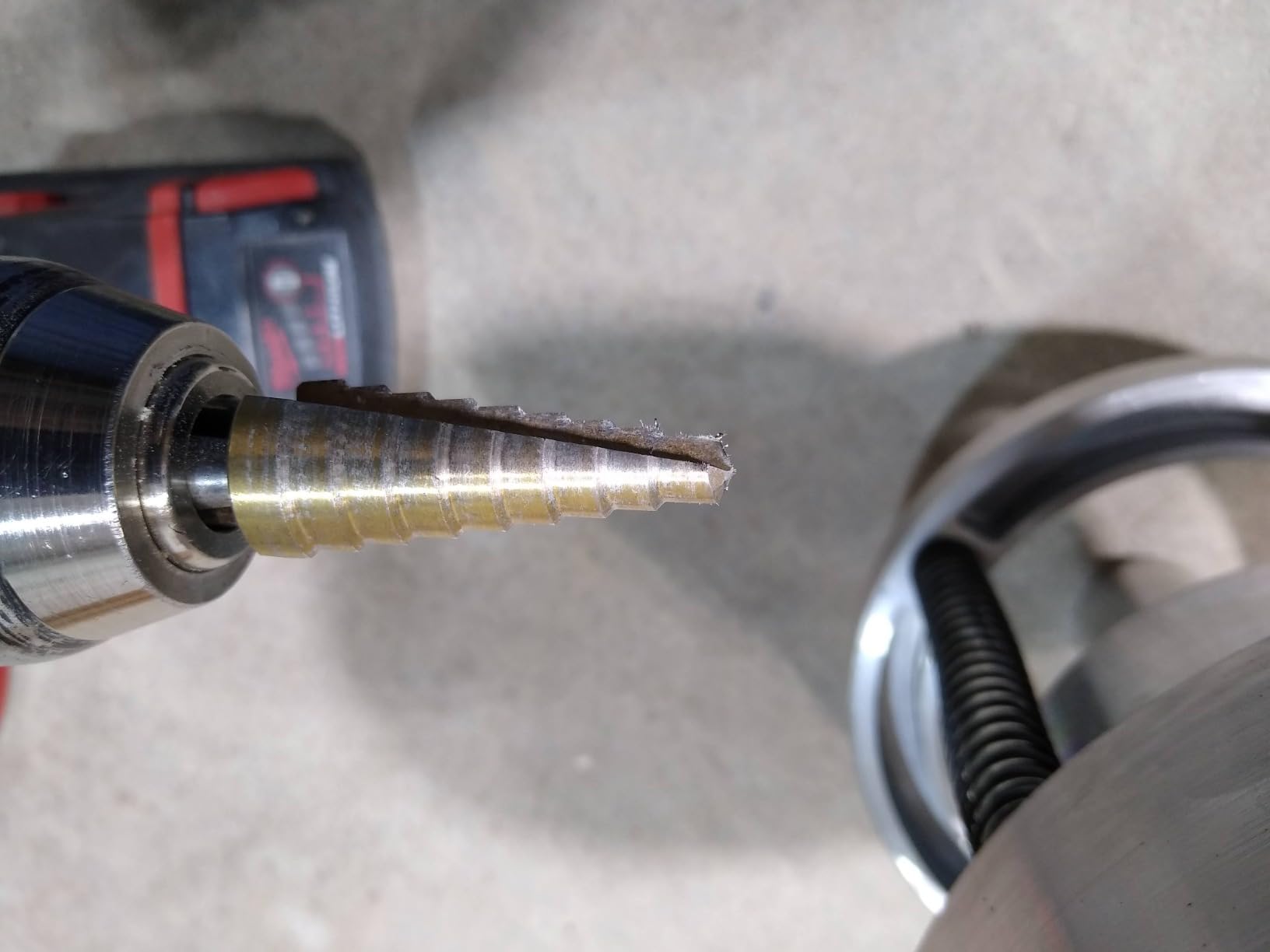
Here is the flaw, and you need to know it before you buy. The pivot seat hole is drilled wrong out of the box, so the balancing head rocks on the edges of the hole and the results are not repeatable until you modify it. That single fault is the difference between a machine that works and a machine that frustrates you every time.
Fixing the pivot hole, and why friction biases every reading
Enlarge the pivot seat hole so the balancing head sits centered on it instead of resting on two edges of a too-small hole. With a rocking pivot, friction acts at a slightly different point on every swing, so the heavy spot never settles at exactly six o’clock. The bull’s eye level then reads a tilt that is partly real imbalance and partly pivot drag, and you end up chasing a number that moves.
Then grease the pivot pin. This is the single most repeated owner instruction for budget bubble balancers, and the effect is a smooth, repeatable spin. A dry or tight pivot is the number one reason a cheap balancer looks broken. With the hole fixed and the pin greased, owners report satisfying results for a tiny outlay, and that modified state is what the reviews are actually describing.
Who should skip the ATPEAM
Skip it for a modern passenger car driven at highway speed. Static balancing cannot cancel two-plane imbalance, so the steering-wheel shake that brought you here may survive a correct static balance.
Skip it if you have no patience for the process. Accuracy depends heavily on operator patience, repeated heavy and light spots are common, and the spindle does not fit motorcycle wheels without removing the bearing.
10. DASBET Portable Bubble Balancer: The Budget Pick That Works Out of the Box
DASBET Portable Bubble Wheel Balancer Tire Balancer with Bubble Level
Static balancing with a bubble level
24 inch tall, 11.5 inch base diameter
Center rod 0.813 inch, hub 1.495 inch
1.5 to 4 inch hub capacity
Pros
- Users report it works well out of the box with no modification needed
- Ballast weights and trim weights let you dial in balance at very low cost
- Portable
- light and compact with easy assembly
- Popular with vintage and classic car owners whose wheels modern balancers cannot handle
- Good value for occasional home balancing
Cons
- Not suitable for very large tires
- The bubble level is small and hard to read for older users or poor eyesight
- Static bubble balancing requires patience and repeated weight adjustments
The DASBET is the same 24 inch tall, 11.5 inch base format as the ATPEAM, with an aluminum body and rust-resistant enamel finish, a machine steel head, plated steel guide rods, and zinc support springs. The center rod is 0.813 inch, the hub is 1.495 inch, and hub capacity runs 1.5 to 4 inch at about 11 lb.
What separates it is behavior out of the box. Users report it works well with no modification needed, which is the exact complaint we have to make about every other budget bubble design. The 4.4 average across 198 reviews is higher than the ATPEAM’s for that reason.
Owners like that ballast weights and trim weights let them dial in a balance at very low cost, and the whole thing is portable, light, and compact with easy two-step assembly. It is popular with vintage and classic car owners whose wheels modern balancers cannot handle.
Reading the bubble level on a small machine
The recurring practical tip for machines this size is that the bull’s eye bubble is small and hard to read, especially for older users or anyone with poor eyesight. The workaround owners use is to prop a phone level app on the base for a larger, clearer reference. Level the base once on the floor before every session.
Static balancing also means repeated weight adjustments. You add a ballast weight, spin, watch the bubble, and move or trim the weight until the bubble sits centered. That takes longer per wheel than a computerized readout, and it is the honest cost of a machine at this level.
Who should skip the DASBET
Skip it for large tires. It is not suitable for very large tires, and there is no width or diameter figure to argue around. This is a small-wheel, low-speed tool.
Skip it if you want a printed number you can re-check later. There is no readout, so the only record of your balance is the memory of where you left the weights.
How to Choose a Wheel Balancer Machine: Buying Guide for 2026
Static versus dynamic: which one your vehicle actually needs
Static balancing corrects weight in a single plane and stops the wheel bouncing up and down. Dynamic balancing corrects two planes, both the hop and the side-to-side shimmy, and that second plane is what eliminates steering-wheel shake at 55 to 70 mph. Every tire shop uses a spin balancer for exactly this reason, and no bubble balancer does the job it does not claim to do.
Match the type to the vehicle. Trailers, ATVs, lawn equipment, and vintage steel wheels with old disc brakes are static jobs, where a portable bubble balancer is the right tool and a computerized machine is overkill. Passenger cars, light trucks, performance fitments, and anything that sees highway speed need dynamic. Motorcycles need their own mode, since the wheel geometry and weight distribution are nothing like a car.
The four types of wheel balancer machines
Bubble or portable cone balancers are the simplest. Gravity rolls the heavy spot to the bottom, a small level shows the tilt, and you add weights until it centers. They are cheap, light, and store anywhere, and they do static correction only.
Computerized spin balancers mount the wheel on a spindle, spin it under power, and use sensors to measure imbalance on the inner and outer planes separately, then display a weight amount and clock position for each. Accuracy claims on machines like these run to about 1 gram. The Mayflower 800 in this list is the stand-alone example, and the balancer half of every combo here is this type.
Tire changer and balancer combos put a changer and a spin balancer in one cabinet. You get both jobs in a single footprint and a single power connection, at the cost of moving a heavy machine and running a compressor. Road-force balancers add a load roller that presses the tire against the road while it spins, measuring the force in pounds needed to null the assembly imbalance.
On-board systems like the Centramatic take the completely different route described in pick 1, correcting imbalance inside the hub as you drive.
The specs that matter, and the ones that do not
Rim diameter and hub bore are the two capacity numbers people confuse most, and they are not the same thing. Rim diameter is the outside measurement of the wheel, from bead to bead across the outer lip. Hub bore is the hole in the center that fits over the spindle, given as a diameter or a range such as 1.5 to 4 inch. A machine can handle a 24 inch rim and still not fit your hub, and vice versa.
Max wheel weight is the third number to check, listed on this roundup’s XK at 155 lb. A wheel assembly is tire plus rim plus any extra weight, and a machine at its limit will read inaccurately rather than refuse to work.
Shaft size is worth knowing about. 36 mm and 40 mm are both common in this category, and cones and adapters are sold per shaft, so buying a used machine with a different shaft means buying a new cone kit. Accuracy claims are mostly marketing until you test them: computerized machines state roughly 1 gram, budget bubble balancers state nothing because they have no readout.
110V versus 220V, and where the machine goes
The Centramatic is the exception: it needs no power at all. Every machine here that states a voltage is 110V, which is what makes this category possible in a residential garage. The XK 988-690 is listed as 110/220V 50/60Hz, so it can go either way. 220V-only machines are shop-only and require a dedicated circuit you probably do not have.
The real constraint is not electrical. It is air, weight, and floor. A combo changer with a 2500 kgf bead breaker effectively needs a large compressor, and the combos that publish a weight come in at 795 lb and 840 lb, which means a lift-gate and at least two people to move them. Budget the floor space, a dedicated outlet, and anchoring to concrete before the machine arrives. Anchoring is not optional on a design that requires permanent floor mounting, because a machine that shifts under a heavy wheel produces readings that drift between spins.
Before you start, make sure the car can be safely supported at the correct working height. Our wheel chock comparison covers the first half of a safe setup, and the lifting half matters more.
Calibration: when and how often
Calibrate at installation, then roughly every six months or every 500 tires, whichever comes first. Calibrate again after any impact, after changing a cone or adapter, and whenever two spins of the same wheel stop giving the same answer. That last trigger is the most reliable one, and it is why repeatability is the behavior owners trust most.
A self-calibration routine walks the machine through a reference measurement, which is convenient. It still needs a known steel reference wheel to be useful, and first-time buyers frequently do not own one. Budget for a known-balanced steel wheel as part of the purchase, not as an afterthought. On a bubble balancer, calibration is grease on the pivot pin and a level base, nothing more.
How accurate are wheel balancers, realistically?
Budget bubble balancers are effectively static with no readout, so accuracy is in the hands of the operator and depends on a centered hub and a free-spinning pivot. Computerized dynamic machines claim about 1 gram, and the XK 988-690 is stated at minus 1 gram to plus 1 gram. Road-force machines add force measurement in pounds of force on top of the weight figure.
Owners verify results the only way that matters: against a laser level or a known-good professionally balanced wheel, and they find budget static readings consistent once the machine is set up properly. That is the standard we would hold any of these machines to before trusting its numbers.
Balancing versus alignment versus tire changing
The shake-and-pull rule separates these three jobs in about five seconds. A vibration in the seat or steering wheel that appears at highway speed and fades below about 35 mph is a balance problem. A car that pulls to one side, or a steering wheel that sits off-center, is an alignment problem. A tire that will not seat, or a bead that will not break, is a tire changing problem.
Also remember the mounting position rule, which no roundup covers and every owner learns the hard way: if you rotate the same wheel to a different position on the studs, you have changed its weight distribution and lost the balance. Re-balance it, or put it back where it was.
And if a wheel still vibrates after a correct balance, the cause is rarely the weighting. Look at a bent rim, tire conicity, radial runout, or a worn wheel bearing. Balance the wheel and still feel vibration, and you have a component problem, not a machine problem. One component people forget is the crank harmonic damper, which mimics imbalance beautifully; if the shake only shows up under load at highway speed, our harmonic balancer installer comparison is the next thing to read.
Buying a used balancer: the pre-purchase checklist
Start with power-up. Watch it complete a full self-test with no error codes, and treat an error code on arrival as the end of the inspection rather than a starting point. Confirm it passes a calibration cycle with a known reference weight before any money changes hands, and a machine that will not calibrate will not read correctly for you.
Then check repeatability. Balance the same wheel twice. If you get two different answers, the spindle, cone, or sensor is worn and the machine is not worth the asking price. Inspect the shaft and cones for run and scoring, and check the cones and wing nut are included, because replacements are cheap individually and annoying to order. On a bubble balancer, inspect the pivot pin and the pivot seat hole for wear, since that is the part that determines whether a static machine is honest.
Forums are full of owners weighing a used Coats, Hunter, or Hofmann machine against a new budget unit, and the recurring conclusion is that a used commercial machine with a clean calibration is worth more than a new one that has never been verified. Older shop owners regard the Coats M76 bubble balancer as the last and best bubble machine Coats made before moving entirely to spin balancers, which is useful context on what you are actually buying in a used bubble machine.
Used-machine shopping usually means used tooling too, and a proper harmonic balancer puller kit set is the most common thing missing from a garage that has been doing its own work for a decade. Budget for one alongside the balancer rather than discovering the gap mid-job.
Accessories worth budgeting for
Buy weights before you buy anything else. A set of clip-on and stick-on weights in assorted amounts, plus a weight hammer and pliers, is what turns a balancer into a working tool. Trim weights let you correct a small residual without replacing the whole weight, which is the difference between a 15-minute and a 45-minute job on a bubble balancer.
Then add a centering cone and adapter kit matched to your hub bores, a tire bead lubricant, and rim cleaning supplies. Stick-on weights need a clean, warm rim to bond properly, and cold or dirty rims are the usual reason a stick-on weight falls off within a month. If you rotate seasonally, balancing beads are worth understanding as an alternative, though they suit trailer, RV, and rarely-balanced applications far better than a car driven at highway speed.
If your work eventually moves from wheels to dampers, a dedicated harmonic balancer puller is the right dedicated tool, and it is a different job from balancing entirely.
How to Balance a Wheel: Six Steps
On a computerized spin balancer, the workflow is the same six steps every time. Budget 20 to 30 minutes per set of four, which is where the saving against a shop fee comes from.
Mount the wheel on the correct centering cone and tighten the wing nut. The cone must seat fully against the hub bore or the reading is wrong.
Enter or measure the data. On a manual machine, measure rim width and diameter and enter both. On a machine with an automatic measuring ruler, let it measure.
Select the balancing mode. Dynamic for a car, ALU for hidden stick-on weights behind spokes, motorcycle for a bike.
Spin the wheel. The machine measures inner and outer plane imbalance separately and displays a weight amount and clock position for each.
Apply the weights. Tap clip-on weights on with the hammer, or press stick-on weights on to a clean, warm rim at the indicated clock position.
Re-spin to verify. Both planes should read zero. If they do not, the imbalance was beyond what weights can correct, and you have a tire, rim, or bearing problem rather than a weighting one.
Two habits separate a good result from a mediocre one. Write down the clock position and the weight amount before you spin again, so a repeat reading is a genuine verification rather than a guess. And keep the same wheel in the same position on the studs, because rotating it changes the weight distribution.
Frequently Asked Questions
What is the best type of wheel balancing?
Dynamic two-plane balancing on a computerized spin machine is best for anything driven at highway speed, because it corrects both the up-and-down hop and the side-to-side shimmy that causes steering-wheel shake. Static single-plane balancing on a portable bubble balancer is only adequate for trailers, ATVs, lawn equipment and low-speed use. Every tire shop uses a spin balancer for cars for that reason.
What is the best tire balancing machine?
It depends on volume, power and wheel size. For a home garage, the DASBET or ATPEAM portable bubble balancers handle vintage wheels and small tires for almost nothing. For a car you drive at highway speed, a computerized spin balancer such as the Mayflower 800 gives you a two-plane readout in grams. For mounting and balancing, a 110V combo such as the XK 988-690 handles both jobs in one footprint.
How often should you calibrate a wheel balancer?
Calibrate at installation, then roughly every six months or every 500 tires, whichever comes first. Calibrate again after any impact, after changing a cone or adapter, and whenever two spins of the same wheel stop giving the same answer. Self-calibrating machines walk you through a reference measurement, but they still need a known steel reference wheel to be useful.
What is the average lifespan of a wheel balancing machine?
Commercial-grade machines commonly last a decade or more with periodic service. Budget units tend to degrade on consumable parts rather than electronics: a worn pivot pin and pivot seat on a bubble balancer, cones, springs and adapters on a spin machine. On-board systems such as the Centramatic carry a 5-year unlimited mileage warranty, while the imported combo machines typically carry 1-year or 12-month parts terms.
Do Centramatic balancers really work?
Yes, for RVs, trailers, dually trucks and long-haul use. Internal fluid and steel shot rebalance the assembly continuously as you drive, and owners report vibration, road noise and uneven wear disappearing after installation. They are a supplement to, not a replacement for, a proper dynamic balance at mount time, and they need driving to activate, so a cold-tire vibration is not fixed on the spot.
Which is better, balancing beads or weights?
Beads sit inside the tire and shift as it runs, which suits trailers, RVs and rarely-balanced applications but cannot respond to a condition discovered at the shop. Clip-on weights suit steel wheels and are the only option many vintage rims accept. Stick-on weights suit alloys, handle hidden positions behind spokes, and need a clean, warm rim to bond. Weights beat beads on any car driven at highway speed.
Final Verdict: Which Wheel Balancer Machine Should You Buy?
For a truck, RV or trailer that lives on the highway, the Centramatic 800-822 is the pick. It carries the deepest owner record in this roundup at 4.7 stars across 300 reviews, needs no power, no calibration and no maintenance, and comes with a 5-year unlimited mileage warranty. Get the part number right for your hub and it does the job no bench machine can.
For a car you drive every day, a computerized spin balancer is the only real answer, and the Mayflower 800 is the standalone way to get one, while the XK 988-690 is the pick with the most detailed specification if you also need to mount tires. For vintage wheels, old disc-brake steel, or a trailer, the DASBET is the pick that works correctly out of the box, and the ATPEAM is the pick that works once you enlarge the pivot hole and grease the pin.
Decide with the three questions we opened with: wheels per year, available power, and largest rim. Everything else on this page is detail on top of those three answers. We checked all ten machines in 2026, and whichever tier you land in, buy a known-balanced reference wheel at the same time, because a machine you cannot verify is just an expensive guess.