
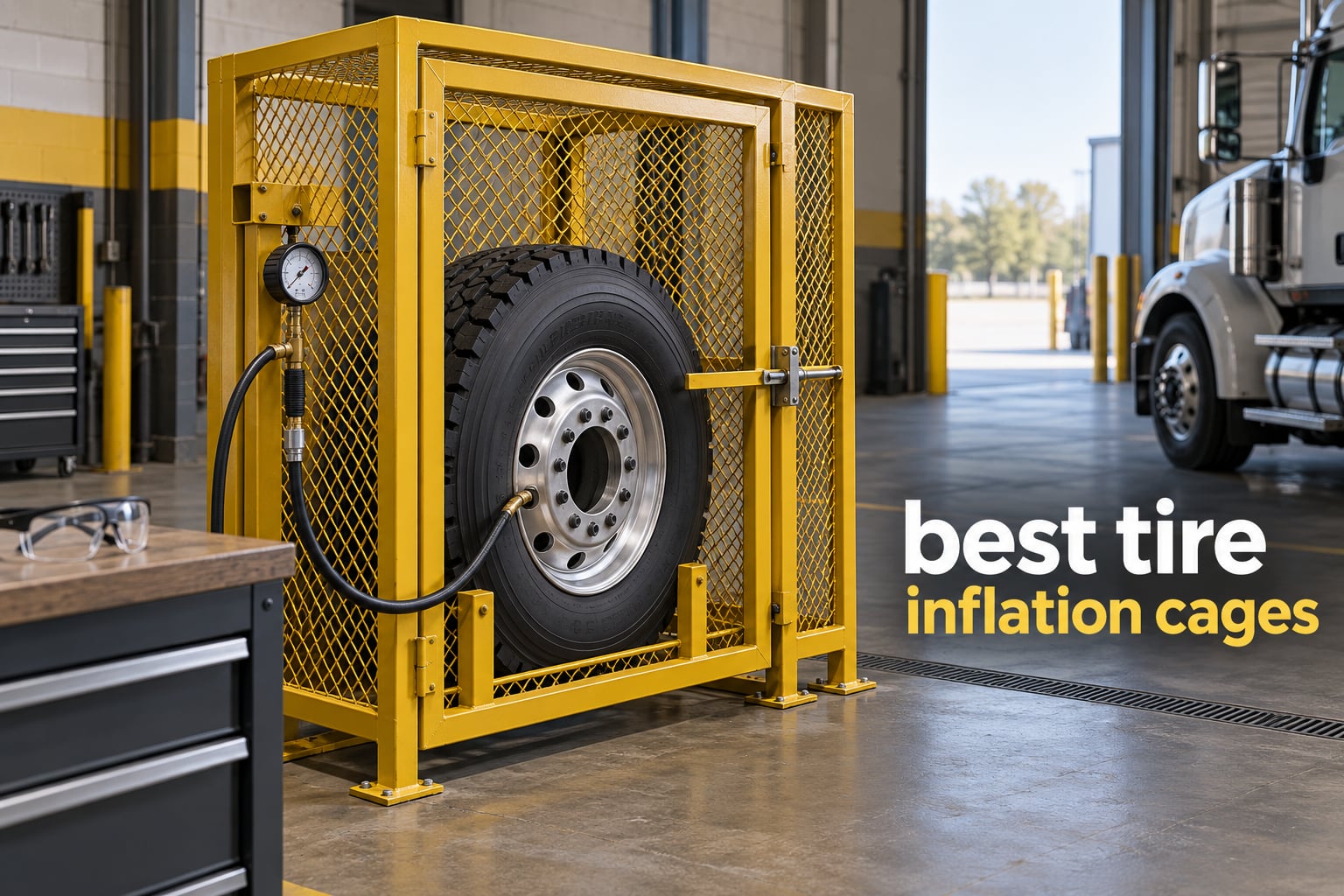
A tire inflation cage is a steel containment enclosure that holds a mounted tire or wheel assembly upright while it is inflated, so that if the casing fails catastrophically under pressure the expanding force and the flying debris are directed into the cage instead of at the technician standing next to it. That is the whole idea, and it is the reason these enclosures became standard equipment in truck tire bays rather than an optional accessory.
Most pages ranking for the best tire inflation cages are single-product catalog listings. A spec block, a price, a compliance claim, an add-to-cart button. We went through the category spec by spec instead, comparing bar ratings, tire capacity, weight, and documented compliance across the cages available, so you can match an enclosure to the tires you actually work on. Our shortlist below covers six options across the portable and fixed formats, the light-vehicle and commercial ends of the range, and both ends of the pressure spectrum.
Before you start comparing, make sure you can read the tire itself. Our guide to reading tire sidewall codes and sizing gives you the outside diameter, section width, and load range you need to check a cage against. If you are still working out how to keep air in the tire in the first place, our picks for the best 12V tire inflators and the best cordless tire inflators cover that side of the job, which is a different category of product entirely.
Everything in this roundup was selected on published specification data, manufacturer compliance language, and aggregated review patterns, then filtered for whether the cage plausibly fits a real inflation task. Updated for 2026.
Table of Contents
Top 3 Tire Inflation Cages (October 2026)

Ken-Tool 36001 Portable…
- Portable 2-bar format
- 50 lb weight
- 53 in folded footprint
- Instruction guide included
Martins Industries MIC-2
- Portable 2-bar cage
- About 69 lb
- Narrow 21.5 in cross-section
- Guards an open bay

Ken-Tool 36002 4-Bar Cage
- 4-bar pressure rating
- 146 lb fixed install
- 52 x 32 in footprint
- Commercial truck sizing
The three above are the picks we would put in front of most readers. The Ken-Tool 36001 wins on handling, the MIC-2 wins on service-truck fit, and the Ken-Tool 36002 wins on pressure headroom. Keep reading for the wide-base, OSHA-documented, and light-vehicle options.
What Is a Tire Inflation Cage?
A tire inflation cage is a welded steel box, usually with mesh or expanded-metal walls, a hinged or removable front panel, and a base that a mounted tire is rolled into and centered against. The wheel is held off the ground or against a back plate, the panel is closed, and the tire is inflated. A tire that has been run flat, overinflated, or damaged can separate from its rim without warning, and the stored energy in a large truck tire is enough to throw rim fragments and casing sections across a service bay. The cage does not prevent the failure. It contains it.
Use one whenever:
You inflate light-truck, heavy-truck, bus, trailer, super-single, or off-road tires.
You seat a tire bead on a wheel that has been run at low pressure.
You work somewhere with other people, vehicles, or glass within the blast radius of a mounted tire.
You inflate tires off the vehicle, roadside, where there is no bay wall to hide behind.
Your insurer, your safety program, or a customer audit expects a documented protective device.
One honest caveat. Practitioners on specialist vehicle forums have argued for years that a badly engineered cage can make a bad inflation worse, because it can fragment the casing and add structure to the debris field. That criticism is fair in principle and is the reason the build details in our buying guide matter more than the badge on the front.
The Best Tire Inflation Cages in 2026 at a Glance
| Product | Specs | Action |
|---|---|---|
| Ken-Tool 36001 Portable Tire Cage |
|
Check Latest Price |
| Martins Industries MIC-2 |
|
Check Latest Price |
| Ken-Tool 36002 4-Bar Tire Safety Cage |
|
Check Latest Price |
 AME INTL 24440 4-Bar Cage AME INTL 24440 4-Bar Cage |
|
Check Latest Price |
 Martins Industries MIC-2WB Wide-Base Martins Industries MIC-2WB Wide-Base |
|
Check Latest Price |
 Martins Industries PCR Cage Martins Industries PCR Cage |
|
Check Latest Price |
1. Ken-Tool 36001 Portable Tire Cage – The One You Can Actually Carry
Ken-Tool (36001 Portable Tire Cage, One Size
Portable 2-bar inflation cage
50 lb weight
53 x 22 x 7.5 in folded
Instruction guide included
Pros
- Lightest handling weight in this roundup at 50 lb
- Portable 2-bar format fits a service truck bed
- Shields workers and nearby property from blowout debris
- Owners report it works exactly as described
Cons
- Listed 50 lb weight is heavier than a bare-frame portable cage
- Only a 2-bar rating so high-pressure truck tires are out of scope
- 53 in folded footprint limits in-vehicle stowage
This is the cage we kept coming back to. Ken-Tool has been building tire equipment for a long time, and the 36001 shows it in a simple way: a 2-bar portable frame that weighs 50 pounds and folds down to a 53 by 22 by 7.5 inch slab. That is the lowest handling weight of anything in this roundup, and it is the number that actually decides whether a cage gets used in the field or sits in the corner of the shop.
Owner feedback on this listing is unusually clean. All eight ratings are 5 stars, and the recurring themes are that it is light enough to carry by hand without strain and that it does the one job it exists for, which is keeping blowout debris away from people working nearby. There are no reported functional failures, and the assembly story is described as straightforward. With a review history going back to the original listing, it is also the longest-documented cage we evaluated.
The tradeoff is the pressure ceiling. A 2-bar class enclosure is a light-truck and passenger-adjacent tool, not a 150 PSI truck-tire instrument. If your work is mostly roadside work on LT tires, service pickups, and car-and-SUV fitments, this is the right tool. If you are running commercial fleets at full rated pressure, you need a 4-bar class cage and you need to read section three before you buy either one.
One specification note. The listing carries two different weight figures, with a 50 lb item weight and a 25.015 kg package weight that works out to about 55 lb. Plan for the heavier of the two when you are working out whether one person can lift it safely and often enough to be practical.
Check these details before you commit
Confirm the folded footprint against the space you actually have. At 53 inches long, this needs a real length of bed or shelf space, and a cage that lives in the shop because it will not fit in the truck is a cage you will not use roadside.
Check the 2-bar class against your tire list. If any tire you regularly inflate carries a working pressure above roughly 80 PSI, move up a class rather than hoping.
Where it falls short
It is a containment frame, not a restraint system, and it does not clamp or deflate anything. A tire that has been run flat and will not seat is a problem the cage cannot solve, only a problem the cage can contain once it lets go.
The category’s thinnest part is customer data, and eight reviews is more than most but still a small sample for equipment that a shop depends on daily. Treat the rating as reassurance about workmanship, not as a durability study.
2. Martins Industries MIC-2 – Built for the Service Truck Bed
Martins 2-Bar Portable Tire Inflation Cage, Perfect for Service Truck, Only 69 lb.
Portable 2-bar inflation cage
About 69 lb
21.5 x 16.75 x 51 in
Narrow service-truck profile
Pros
- About 69 lb so one technician can load and unload it
- Narrow 21.5 in cross-section fits a service truck bed
- Turns an open bay into a guarded inflation station
- Reviewers rate it a great product
Cons
- 2-bar limit excludes high-PSI truck and trailer work
- Only 3 reviews so long-term durability is undocumented
The MIC-2 solves a different problem from the Ken-Tool 36001, and for a lot of shops it is the more important one. Its cross-section is 21.5 by 16.75 inches with a 51 inch height, which is a genuinely narrow package, and at roughly 69 lb it is still within the range a single technician can handle without a lift. That combination of narrow profile and manageable weight is what makes it a service-truck cage rather than a shop cage that occasionally gets carried outside.
Martins Industries builds this as a portable 2-bar enclosure intended to turn an improvised inflation spot, a driveway, a job site, or the back of a truck into a guarded station. The review record is small, all three ratings are 5 stars, and the written feedback is brief and positive with no defects reported. This listing is also newer, first available in 2023, which explains the short history as much as anything.
Our read is that the 69 lb figure is the specification to plan around rather than the marketing language. A cage that a single technician can set up at a roadside call is one that will get set up. A cage that takes two people and a forklift gets used only when someone has time, and time is exactly what a roadside call does not have.
The pressure ceiling is the same story as the first pick. Two-bar class suits light-truck and lower-pressure commercial work, and it will not cover a trailer tire at full rated pressure. Match it to the tire population you service, not to the biggest tire you occasionally see.
Check these details before you commit
Measure the narrow dimension, not the height. At 21.5 inches, the cage fits behind a service-truck bulkhead or inside a trailer body far more readily than most fixed cages of comparable capacity.
Confirm that 69 lb is a one-person lift in your operation, and if it is not, plan a ramp or a second pair of hands before the first roadside call rather than after it.
Where it falls short
Two-bar pressure capability is a real ceiling, and any shop that inflates heavy truck or trailer tires at full pressure will outgrow this cage quickly.
Three reviews is not a reliability record. If your decision hinges on long-term shop durability, the documented options in sections three and four carry more published information.
3. Ken-Tool 36002 4-Bar Tire Safety Cage – Pressure Headroom for Truck Fleets
Ken-Tool (36002 4 Bar Tire Safety Cage, One Size
4-bar inflation safety cage
146 lb weight
52 x 32 x 26 in footprint
Commercial truck tire sizing
Pros
- 4-bar rating covers commercial truck and bus tire work
- Handles higher pressures than any 2-bar cage here
- Fixed footprint suits a permanent bay
- Owners say it was exactly what they were looking for
Cons
- 146 lb weight means two people or a lift to move
- 52 x 32 in footprint demands dedicated floor space
- Only 2 reviews so field data is thin
This is the pressure answer. Where the two portable cages cap out at 2-bar class, the Ken-Tool 36002 is a 4-bar enclosure, which puts it in the range where commercial truck and bus tires at full rated pressure are realistic. For a fleet shop, a dealership service department, or a truck repair bay that inflates tires every day, that rating is the whole reason to own one.
The cost of that headroom is permanence. At 146 pounds and a 52 by 32 by 26 inch footprint, this is a fixed installation, and the specification sheet treats it that way. Owners describe it as exactly what they were looking for, and the fixed format is genuinely the right call in a bay where the cage will be used dozens of times a day and never needs to go anywhere.
One thing to know before you order: the packaging data on this listing reports a 15.82 lb package weight against a 146 lb item weight. That is a carton or a component, not the cage. Plan your floor space and your moving method around 146 pounds, and do not let the packaging figure fool you into thinking this is a portable unit.
Because it is a fixed bay enclosure, anchoring deserves a decision rather than an assumption. A cage that cannot shift is worth more than one that can, and we cover the anchoring question in the buying guide and the FAQ.
Check these details before you commit
Confirm the bar class against the highest working pressure in your tire population, and leave margin above the tire’s rated pressure rather than matching it exactly.
Check the 52 by 32 inch footprint against your bay layout, including clearance for the door, the air line, and a second person working nearby.
Where it falls short
There is no mobility here. If your work happens at the roadside rather than in a bay, a fixed 146 lb cage is the wrong product and the two portable options above are the right ones.
Two reviews means very little published field data. The spec sheet is the strongest part of this listing, so buy it on the rating and the dimensions.
4. AME INTL 24440 4-Bar Cage – The One With the OSHA Claim on the Spec Sheet
AME INTL (24440 4-Bar Tire Inflation Cage, Yellow
4-bar inflation safety cage
Meets OSHA 29 CFR 1910.177
Heavy gauge steel welded base
110 lb weight
Pros
- OSHA 29 CFR 1910.177 stated directly on the spec sheet
- Heavy gauge steel welded to a steel base
- 57 in vertical design contains sideward debris
- 4-bar rating for high-pressure truck inflation
Cons
- 110 lb weight means a fixed install rather than a carried cage
- Documented compliance is the main feature beyond the 4-bar rating
- Only 2 reviews and no written feedback
The AME 24440 is the pick for anyone who has to answer a compliance question, not just an insurance renewal or a customer audit. The published specification states that it meets OSHA regulation 29 CFR 1910.177, and having the compliance language in the manufacturer’s own documentation rather than in a dealer’s sales pitch is worth a lot when a safety program is being reviewed.
Construction is the second argument. The listing describes heavy gauge steel welded to a steel base, and the cage stands 57 inches tall at a 32 by 26 inch footprint with a 110 pound weight. That vertical proportion is deliberate. Blowout energy from a mounted wheel goes outward and upward, and a tall narrow frame with a welded base gives the debris more surface to be redirected into rather than past.
At 110 pounds this is a fixed install rather than a carried cage, and the 4-bar rating places it in the same commercial pressure class as the Ken-Tool 36002. Where AME differentiates is documentation and finish. It comes painted yellow, which is a shop-visibility feature that genuinely matters when you are trying to keep a bay organized and want the safety equipment to be obvious to a new hire.
The honest limitation is that the category is thin on written customer feedback, and this listing is thinner than most. Both ratings are 5 stars with no written text, so the case for this cage rests on its specification and compliance language rather than on customer reports.
Check these details before you commit
Ask for the compliance documentation before purchase and keep it on file. A claim printed on a listing page is useful, a manual or certificate in your safety binder is what an auditor will actually ask to see.
Check the 32 by 26 inch footprint and the 57 inch height against your ceiling clearance and your working space, since the taller the cage the more you need to think about overhead hazards.
Where it falls short
At 110 lb it is immovable without help, and the same fixed footprint demands the same dedicated floor space as any other bay cage.
There is no written customer feedback to learn from here, and the pressure rating does not extend into the 5-bar and 6-bar class that super-heavy and OTR work requires.
5. Martins Industries MIC-2WB – Wide-Base Clearance for Commercial Fitments
Martins Industries MIC-2WB 2-Bar Wide-Base Portable Tire Inflation Cage
Portable 2-bar wide-base cage
Extra chamber width
147 lb weight
59 x 32 x 26 in package
Pros
- Wide-base chamber gives clearance for wide commercial tires
- Portable 2-bar format works with standard service-truck compressors
- Steel-framed chamber shields during seating and inflation
- Sized for mobile service truck use
Cons
- 2-bar limit excludes high-PSI fleets and super-single work
- 147 lb weight is at the heavy end of the portable class
- Only 1 review and no written customer feedback
Width is the differentiator here. The MIC-2WB uses a wide-base chamber rather than the standard profile, which gives clearance for the wider commercial fitments that will not sit square in a narrow cage. If your work involves wide tires and you have been fighting a tire that will not center in a standard enclosure, this is the specification that solves it.
The tradeoff is weight. At 147 pounds this sits at the heavy end of what we would call a portable class enclosure, with a 59 by 32 by 26 inch package for transport. It is portable in the sense that it can be moved to different work locations with equipment and a couple of people, but it is not a one-person roadside cage. Plan the deployment method before the first job rather than during it.
The 2-bar pressure rating is consistent with the other portable options here, and it is the same limitation: high-PSI fleet work and super-single service sit outside what this enclosure is rated for. The rating is a pressure class, not a suggestion, and exceeding it is the fastest way to turn a safety device into a liability.
Customer feedback is thin, with a single 5-star rating and no written text. There is not enough buyer commentary to characterize long-term durability or setup time, so this pick rests on the wide-base fit and the pressure class rather than on reported experience.
Check these details before you commit
Measure your widest tire section width, not your average. A wide-base chamber solves clearance problems, and it does nothing for a pressure ceiling you have outgrown.
Work out the two-person or mechanical deployment plan now. At 147 lb, the deciding question is not whether the cage can be moved but whether it gets moved on the days you need it.
Where it falls short
Two-bar class keeps it out of high-pressure commercial work, and a 147 lb weight undercuts the portability that otherwise makes a Martins cage attractive for mobile work.
A single rating is an absence of evidence rather than evidence of a problem, but it does mean you are buying this on specification alone.
6. Martins Industries PCR Cage – The 130 PSI Certified Light-Vehicle Option
Martins Industries PCR Tire Inflation Safety Cage
Certified to 130 PSI
Fits tires to 35 in OD by 12.5 in wide
Foam wheel cushions
1 year warranty
Pros
- Certified to 130 PSI
- the highest pressure rating in this roundup
- Foam cushions prevent scratches and damage on the wheel
- Alloy steel construction in orange
- Handles passenger car and SUV tires in one chamber
Cons
- 35 in OD and 12.5 in width exclude commercial truck fitments
- Single 4-star review
- the lowest rating in this group
- Fixed format adds nothing if mobility is the goal
This is the odd one out in the category, and for some shops that makes it the right one. Every other cage here is a 2-bar or 4-bar class unit. The Martins PCR is instead certified to inflate tires up to 130 PSI, which is a pressure figure rather than a class label, and it is built in alloy steel with a stated one year warranty from the vendor.
Capacity is where you need to read carefully. The cage fits tires up to 35 inches in outside diameter by 12.5 inches wide, which covers passenger cars, SUVs, and light-truck fitments. It does not cover commercial truck tires in any reasonable configuration, and a 35 inch tire pushed past a cage’s stated capacity is exactly the misuse the cage exists to prevent.
The foam cushions are the detail that separates it from the rest. Most cages treat the wheel as sacrificial, and a steel frame or a hinge will happily mark an alloy or painted wheel every time it is loaded. Foam cushions in the contact area prevent scratches and damage, which is the difference between a cage your customer notices and a cage your customer complains about.
Its rating is 4 stars from a single review, the lowest number in this group. With one reviewer that carries essentially no statistical weight, and the number tells you far less than the 130 PSI certification and the wheel protection do.
Check these details before you commit
Verify the 35 inch OD and 12.5 inch width against the largest tire you intend to inflate, and do not stretch the fit. Exceeding the stated capacity voids the entire premise of the enclosure.
Check whether you need wheel protection. If your work involves alloys or finished wheels, the foam cushions are the feature that keeps a good customer relationship intact.
Where it falls short
The size ceiling is hard. This is a light-vehicle cage, and no amount of care makes it suitable for a commercial truck or trailer tire.
It is a fixed 93 lb enclosure, so if your motivation is roadside or mobile inflation rather than a light-vehicle bay, the portable options in sections one and two fit the use case better.
How to Choose a Tire Inflation Cage
The category is genuinely confusing from the outside, because every listing shouts a number and none of them explain it. Here is what actually matters, in the order we would work through it.
First, the bar rating. A number like 2-bar or 4-bar is a product class label that manufacturers use to sort cages by the tires they serve. It is not a pressure reading in PSI, and reading it as one is the most common mistake in this category. What the class actually tells you is the tire population the enclosure was designed to contain, and the higher the class the heavier and more expensive the steel gets, because containing a large high-pressure tire takes a different structure than containing a small one.
So match the class to the tire, not to ambition. Two-bar class units serve light-truck, service-truck, and lower-pressure commercial work. Four-bar class units cover commercial truck and bus tires at full rated pressure. Five and six-bar units exist for super-single, wide-base, and OTR work, and none of them appear in this roundup because the reviewed set did not include one. If you run OTR or mining tires, the class you need is above everything here and you should be looking at manufacturer catalogs directly rather than a general roundup.
Second, tire capacity, which comes as two numbers and both of them matter. Outside diameter is how big the wheel is, and section width is how wide the tire is. A cage with enough diameter but not enough width will not let the tire sit square, and a tire that will not sit square is a tire that will not center. Our read on the set is that most shops guess correctly on diameter and guess wrong on width, especially with commercial fitments.
Third, the pressure ceiling. Read the stated maximum and compare it against the highest working pressure in your tire population, then leave margin above it. The Martins PCR in section six is the clearest example of why a stated number matters, since it publishes 130 PSI rather than a class label and you can check it directly against your tire placard.
Fourth, portable versus fixed. This is the decision most shop owners actually face and almost nobody explains properly. A portable cage is chosen for deployment time and independence, not for capacity. If your inflation work happens at the roadside, in a yard, or on more than one site, a portable cage that one person can set up in under a minute will be used. If your work happens in one bay, a fixed cage is stronger, heavier, and permanently in position, and you will stop resenting the weight within a week. A cage that is too heavy to deploy is a cage that is not used, and an unused cage is an insurance policy you never collected on.
Fifth, anchoring. Free-standing cages are genuinely common and genuinely adequate for most service-truck work, where the cage is placed in a controlled area and the ground is level. Fixed bay cages are a different situation, because a fixed cage that can be shoved or tipped during an inflation event is a cage whose whole argument weakens. If you install a cage in a bay, anchor it according to the manufacturer instructions, on a level surface, with the door swing clear. Practitioners genuinely disagree about this in the field, and the honest answer is that the manufacturer’s instructions plus your own risk assessment beat any general rule, including ours.
Sixth, build quality. Look for welded steel rather than bolted sheet, a base that is part of the structure rather than an add-on, a warranty on the mechanical parts, and a downloadable manual. These are cheap signals and they separate real equipment from the flimsier end of the market. A cage is a structure that is supposed to absorb violent force, so the weld and the steel gauge matter more than the paint.
Seventh, one category clarification. A portable tire inflator and a tire inflation cage are different products that solve different halves of the same job. An inflator delivers air. A cage contains the consequences of a failure. If you are choosing between them, the answer is that you generally need both, and neither substitutes for the other. Our guides to the best pancake compressor for tire inflation and the best cordless tire inflators cover the air side of that equation. Any comparison that pits a cage against a 12V inflator is comparing a safety structure to a pump.
OSHA 29 CFR 1910.177 and the Inflation Limit Rules
OSHA 29 CFR 1910.177 is the standard most of these listings cite, and almost none of them explain what it actually requires. In plain language, the standard addresses the hazard of inflating tires where a tire failure could strike a person, and it requires a protective device plus trained personnel when tires larger than LT sizes are involved.
What that means in practice for a shop is a short list. Have a protective device, which is the cage, present for the tire work you do. Train the people doing the work on the procedure rather than assuming they know it. Inflate from behind a barrier or from a position of safety rather than standing in the line of the tire. Apply reasonable inflation limits rather than pushing a tire to a placard maximum as a target. And document the procedure, because an unwritten procedure does not exist during an inspection.
Two inflation rules come up constantly and are frequently misstated, so here they are as we understand them. The three PSI rule concerns tire pressure drop: a tire that has lost roughly three PSI or more from its recommended inflation should be inspected before it is returned to service, because that much pressure loss is a signal about what is happening inside the tire. The five PSI rule concerns overinflation beyond the recommended pressure, and the point of the limit is that exceeding the recommended inflation pressure introduces risk that the tire is not designed to carry. Both rules are reasons to check the tire, not just the air in it, and both are reasons to inflate deliberately rather than to the sound of a hose.
Cage selection ties directly into both. A cage rated below the pressure you intend to inflate to is not a slower or slightly less safe tool, it is the wrong tool, and the published rating on each listing exists precisely so you can check that before the tire goes in.
Safe Inflation Procedure Inside a Cage
Ownership is the easy part. This is the sequence we would put in a shop’s written procedure.
Inspect the tire before it goes in. Look at the sidewall, the tread, and the bead area for cuts, cracking, bulges, or visible cord exposure. A tire you would not drive on is a tire you do not want to inflate unsupervised.
Confirm the tire fits the cage within its stated OD and width limits before you commit to the lift.
Load and center the assembly so the weight sits square against the back of the cage. A tire that sits off-center changes where the energy goes.
Close and latch the panel fully, and confirm nothing is caught in the door or hinge.
Move to the side of the cage, out of the line of the wheel, before you inflate. Never stand in front of a mounted tire and never crouch beside it.
Inflate in stages. Add pressure gradually and stop at each stage to check seating, rather than going to the target pressure in one pass.
Stop at the tire’s recommended pressure, not above it, and confirm the final pressure against the sidewall placard rather than from memory.
Wear eye protection and steel-toe footwear for every inflation. If the tire does burst, stay behind the cage, let the pressure release, and do not approach the wheel until it is fully deflated. Nobody has ever been injured by waiting ten extra seconds.
Frequently Asked Questions
When should you use a tire cage?
Use a tire inflation cage whenever you inflate light-truck, heavy-truck, bus, trailer, super-single, or off-road tires, when you seat a bead on a wheel that has been run at low pressure, when other people or property sit within the blast radius, and whenever you inflate away from a bay wall such as at the roadside. The cage does not prevent a tire failure, it contains the rim and casing debris that a failure throws outward.
Do tire cages need to be bolted down?
Not always. Free-standing cages are genuinely common and work well where the cage is placed on level ground in a controlled area, which covers most service-truck and mobile work. For a cage installed permanently in a bay, anchoring according to the manufacturer instructions on a level surface is the stronger choice, because a cage that can shift during an inflation event gives up part of the protection you installed it for. Manufacturer instructions plus your own risk assessment beat any general rule.
What are the requirements for a tire inflation cage?
Under OSHA 29 CFR 1910.177, a protective device is required when inflating tires larger than LT sizes, together with trained personnel. Practically that means a cage matched to the tire class, a written inflation procedure, inflation limits respected rather than exceeded, and inflation carried out from behind the cage or from a guarded position. Keep the compliance documentation and the training records on file, since those are what an inspection actually asks to see.
What equipment is necessary for an OSHA compliant truck tire inflation device?
Four things. A protective cage rated for the tire class you inflate, an air source with a gauge you can read accurately and a regulator you can control, a remote or guarded inflation method so you are never in the line of the wheel, and a written procedure with training records. An automatic inflator with a remote hose or shutoff adds a layer of control that a manual chuck does not, which is why the equipment manufacturers offer cage-and-inflator packages.
What is the 5 PSI rule?
The five PSI rule concerns overinflation: it treats going roughly five PSI or more above the recommended inflation pressure as a risk condition rather than a harmless margin. Overinflation raises the working load on the casing and the bead, and it reduces the margin a tire has before a defect becomes a failure. The practical response is to inflate to the sidewall placard pressure and treat any need to go above it as a reason to inspect the tire, not as a routine step.
At what PSI do tires become unsafe?
There is no single number, because the limit belongs to the tire rather than to a rule. A tire is unsafe above its recommended inflation pressure, and a tire that has lost roughly three PSI or more from its recommended pressure needs to be inspected before it goes back into service. The recommended pressure is on the sidewall, and the cage you use has a published pressure class or a stated PSI ceiling. Confirm the tire is within its placard pressure and the tire is within the cage rating before you inflate.
Are portable tire inflators worth it?
They are worth it for a different job than a cage. An inflator delivers air, whether from a 12V plug, a cordless battery, or a pancake compressor, and it makes roadside and after-hours work possible. A cage contains the consequences of a failure. Neither replaces the other, and a shop that has inflators but no cage has solved the convenient half of the problem. If you are building a service truck, plan for both.
Final Verdict on the Best Tire Inflation Cages
The best tire inflation cages for 2026 split cleanly by job. The Ken-Tool 36001 is our overall pick, because a 50 pound portable frame that one person can deploy is worth more in practice than a heavier cage with a longer feature list. For a service truck, the Martins MIC-2 is the better-shaped answer, and for commercial truck pressure work the Ken-Tool 36002 and the AME 24440 both bring 4-bar capability, with the AME option carrying the clearer compliance documentation.
Match the class to the tires, measure the width as carefully as the diameter, and decide portable versus fixed based on where the inflation actually happens. If you are still building out a service bay, our portable tire changer picks cover the other half of a mobile tire operation.