
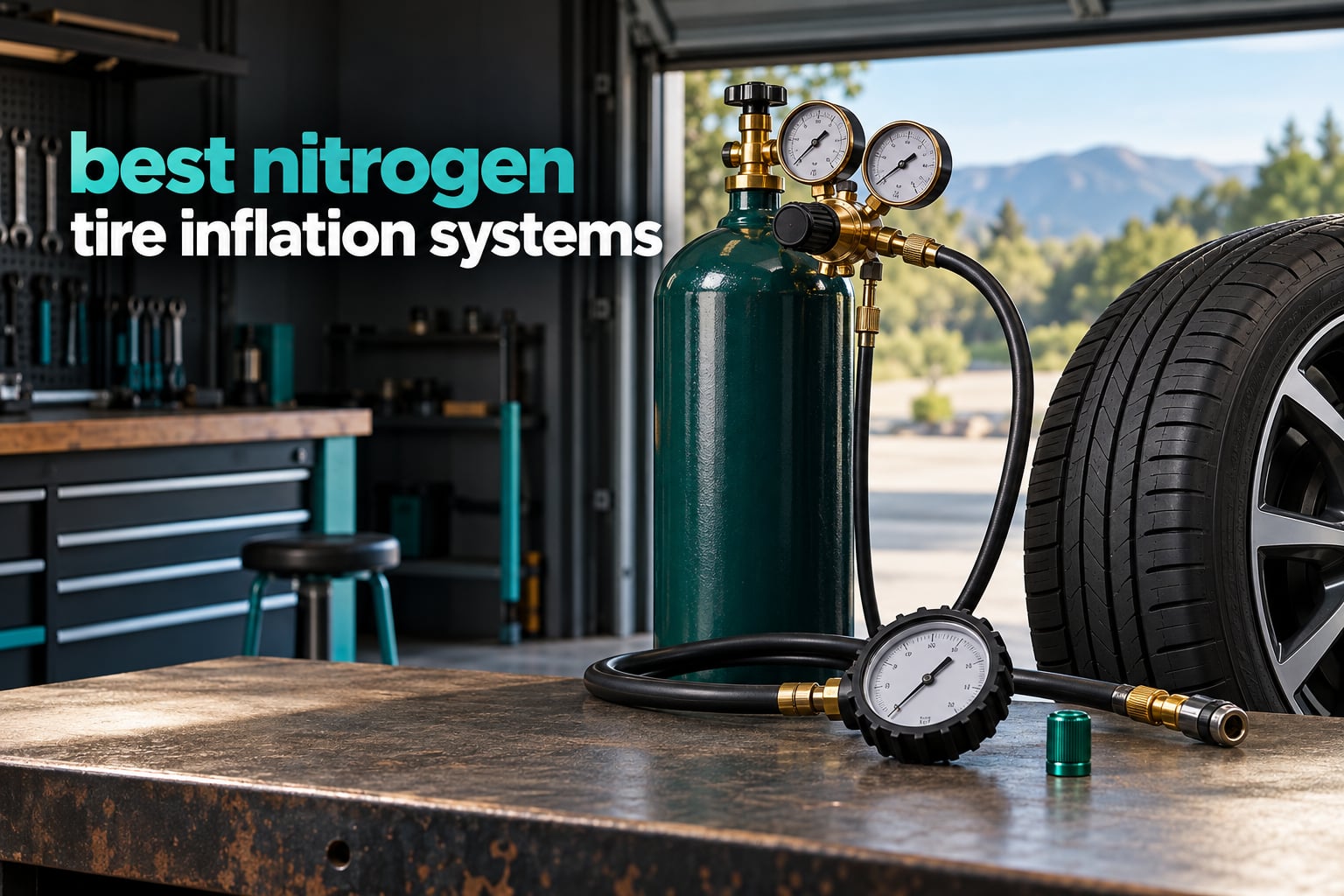
Nitrogen tire inflation systems come in two very different forms, and almost every confusing purchase on this market starts with mixing them up. One family is the shop machine: a membrane or PSA generator cabinet, priced in the thousands, that separates nitrogen out of ordinary air and fills four tires at once. The other family is the pre-filled nitrogen bottle and regulator kit, the kind you can hold in one hand and carry to a driveway.
Every pick in this roundup belongs to that second family. We compared 12 cylinders and regulators based on the published specifications, the volume of verified buyer feedback behind each one, and the details that decide whether a kit actually works for tire service rather than for a brewery or a welding bench. That distinction matters, because a lot of nitrogen cylinders sold online are not tire products at all, and the gas inside them is supplied by whoever fills the bottle.
Our honest read, after working through the specs: nitrogen is a real but narrow win. It holds cold pressure steadier because there is no water vapor in it, and that single fact is why it became standard in aviation, racing, and heavy hauling. For a daily car driven short distances in mild weather, the gain is small. We explain exactly where the line sits in the section below, before any product recommendation.
Before you buy anything, note that nitrogen filling only works if the gas is already in the bottle. You will also need an air compressor to purge a tire and a way to check pressure cold, which is why we start with pancake compressor picks and tire pressure monitoring picks in most of our setups. Our comparisons and testing notes reflect 2026 availability and what buyers were reporting at that time.
Table of Contents
Are Nitrogen-Filled Tires Actually Worth It?
Yes, in three specific situations, and no for most daily drivers. Nitrogen is genuinely worth it when you run high tire pressures on a heavy vehicle, when you drive in sustained high heat where tire temperature climbs, or when pressure stability is critical for racing or aviation work. In a mild climate on short commutes, the honest answer is that it does not justify the extra cost and the extra trips to a fill house.
Here is the mechanism, because the marketing never explains it properly. Compressed air is roughly 78% nitrogen and 21% oxygen, with a small amount of water vapor. The water vapor is the problem: it condenses inside the tire as the tire cools overnight, so a tire filled warm in the afternoon can lose a pound or two by morning even with no leak. A nitrogen fill from a proper supply source is dry gas, so the pressure you set cold is the pressure you read cold weeks later.
One RV owner on the iRV2 forums reported cold PSI holding steady for five months with only one to two PSI of drift from a 32 PSI set point, and tires that did not feel hot after several hundred miles. That is the benefit in plain numbers, and it lines up with how the gas behaves rather than with any fuel economy claim.
Now the downsides nobody prints on the box:
Recurring fill cost at a service station or dealer, forever, for a benefit that shrinks as the vehicle gets lighter.
Very few shops still offer nitrogen fills, so finding a top-up is harder every year. Owners on the Tesla, Mazda3, and Challenger forums describe nitrogen for normal road use as close to a scam, with the fairest summary being that it does no harm if it is free.
Confusion over target PSI. Owners over-inflate because a nitrogen-filled tire does not climb in pressure the way an air-filled tire does after a drive.
Nitrogen displaces oxygen. Releasing a large amount in a sealed storage bay is a genuine asphyxiation risk, and it matters for RV owners who work in enclosed garages.
No shop can verify your tires are still nitrogen-filled. Green valve caps are the only external signal, and they are easy to fake.
If you drive a normal car on mild-weather roads and mostly top off at the same shop every few months, skip the whole category. If you tow, run a motorhome, or keep a vehicle in a hot climate, the stability argument is real and the rest of this guide is for you.
Top 3 Nitrogen Bottle and Regulator Picks for 2026
Our three highest-confidence setups pair a cylinder that fills houses will actually service with a regulator that holds a steady reading. They are the three picks we would put in our own garage first.
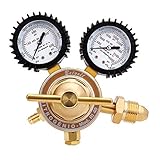
BETOOLL 0-600 PSI Regulator
- 0-600 PSI delivery
- 0-4000 PSI inlet
- CGA580 and 1/4 inch flare
- 2-inch dual gauges

RX WELD Nitrogen Regulator
- 5 ft hose included
- 0-450 PSI output
- CGA580 inlet
- Brass piston diaphragm

80 cu ft Steel CGA580 Cylinder
- 80 cu ft capacity
- 2015 PSI service pressure
- CGA580 valve
- Cap and collar included
Best Nitrogen Tire Inflation Systems Compared Side by Side (October 2026)
All 12 picks appear below with the specs that actually decide whether a kit suits tire work. Read the type column first: cylinders without a regulator need one, and regulators without a cylinder are useless on their own. We pair them in the buying guide.
| Product | Specs | Action |
|---|---|---|
| BETOOLL Nitrogen Regulator 0-600 PSI |
|
Check Latest Price |
| RX WELD Nitrogen Regulator with 5 ft Hose |
|
Check Latest Price |
| 80 cu ft Steel Inert Gas Cylinder CGA580 |
|
Check Latest Price |
 VEVOR 20 cu ft Aluminum DOT Cylinder VEVOR 20 cu ft Aluminum DOT Cylinder |
|
Check Latest Price |
 20 cu ft Steel Nitrogen Cylinder CGA580 20 cu ft Steel Nitrogen Cylinder CGA580 |
|
Check Latest Price |
 Gancowise 40 cu ft DOT Steel Nitrogen Cylinder Gancowise 40 cu ft DOT Steel Nitrogen Cylinder |
|
Check Latest Price |
 YESWELDER Nitrogen Regulator with 6.56 ft Hose YESWELDER Nitrogen Regulator with 6.56 ft Hose |
|
Check Latest Price |
 Kegco 33 cu ft Aluminum Nitrogen Tank Kegco 33 cu ft Aluminum Nitrogen Tank |
|
Check Latest Price |
 Beaiguna Nitrogen Regulator 0-800 PSI Beaiguna Nitrogen Regulator 0-800 PSI |
|
Check Latest Price |
 Siasky Nitrogen Regulator with 5 ft Hose Siasky Nitrogen Regulator with 5 ft Hose |
|
Check Latest Price |
 Mastercool 53010-AUT Nitrogen Test Kit Mastercool 53010-AUT Nitrogen Test Kit |
|
Check Latest Price |
 Uniweld 40040 Sludge Sucker and Blaster Kit Uniweld 40040 Sludge Sucker and Blaster Kit |
|
Check Latest Price |
1. BETOOLL Nitrogen Regulator 0-600 PSI – Most Verified Feedback in the Group
BETOOLL Nitrogen Regulator with 0-600 PSI Delivery Pressure Equipment Brass Inlet Outlet Connection Gauges
0-600 PSI delivery
0-4000 PSI inlet
CGA580 inlet and 1/4 inch flare
2-inch dual gauges
Pros
- Largest review base in the group with more than 1500 ratings
- Accurate and easy to read 2-inch gauges
- Standard 1/4 inch flare outlet fits common charging hoses
- Brass piston diaphragm with self re-seating relief valve
Cons
- Some units stop regulating around 300 PSI
- Occasional pieces arrive with bent or low quality gauges
- CGA580 thread can run slightly oversize on some cylinders
Out of everything we compared, this is the one with the deepest buyer record: more than 1500 ratings averaging 4.4, with 70% of those ratings at five stars. That sample size matters more here than almost any spec, because the recurring complaint across cheap regulators is a failure mode that shows up months later rather than on day one.
The regulator takes a CGA580 cylinder inlet and delivers through a 1/4 inch male flare outlet, which is the connection type used on most common charging hoses. Delivery pressure is adjustable from zero to 600 PSI with an inlet rated to 4000 PSI, comfortably above the 120 to 150 PSI range passenger and light truck tires need.
Our own decision rule for regulators came down to two questions: does the needle hold steady, and does the relief valve reopen at the right point. Owners using it for air conditioning nitrogen leak tests, shock charging, and air suspension work report accurate gauges and a body that holds set pressure, and a standard 1/4 inch flare outlet that means no adapter hunting at the van.
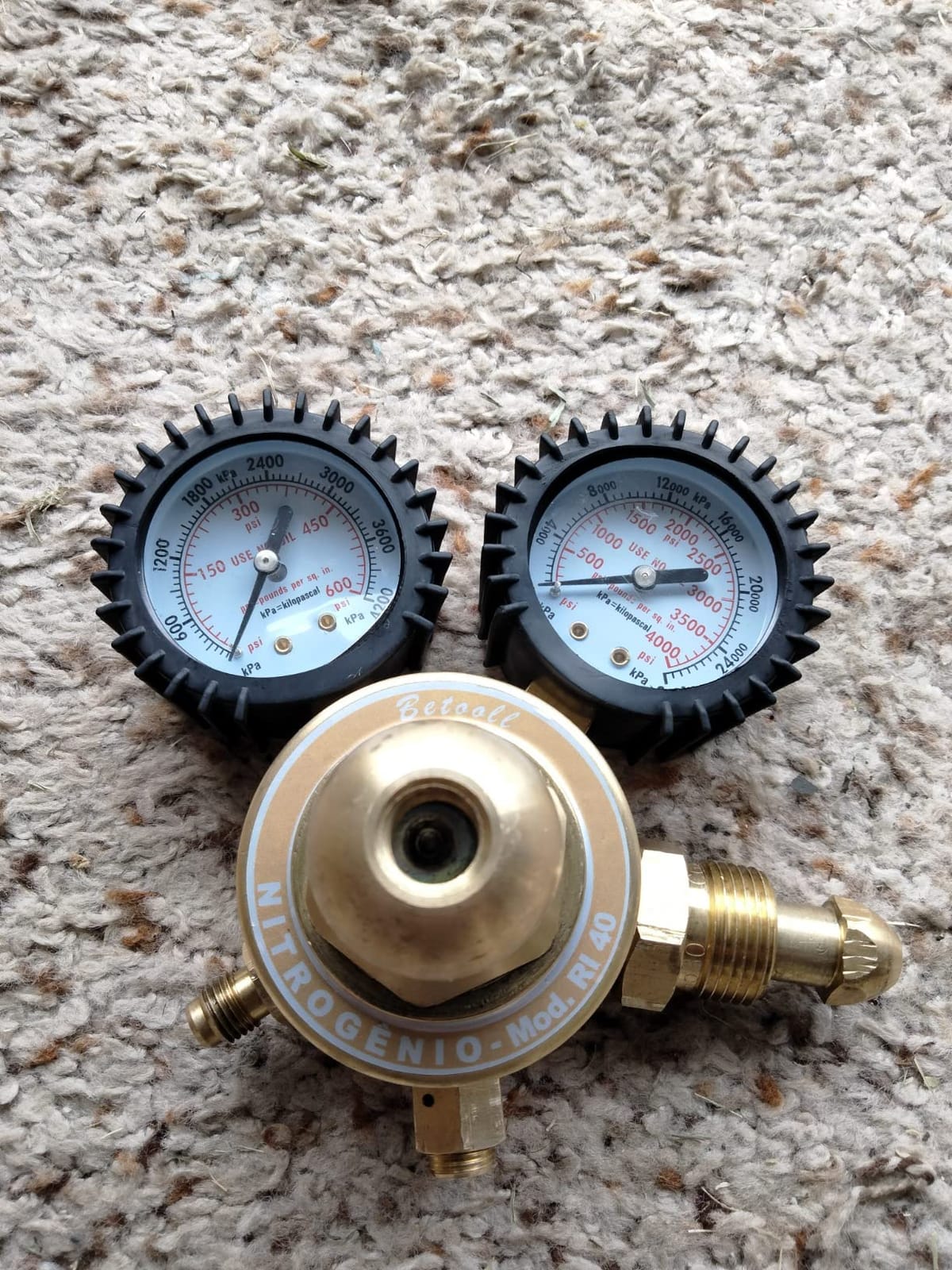
The weaknesses are consistent enough to plan around. The most common report is a unit that stops regulating around 300 PSI instead of running to its advertised range, which is fine for a car tire at 35 PSI and useless if you are charging air springs. A smaller number of buyers received gauges with bent needles or noticeably low build quality, so inspect the gauge glass the day it arrives.
There is also a fit note worth knowing: the CGA580 thread can run a couple of millimeters oversize on some regional cylinders, so if the connection feels wrong, do not force it. Buy a thread adapter rather than fighting the seat.
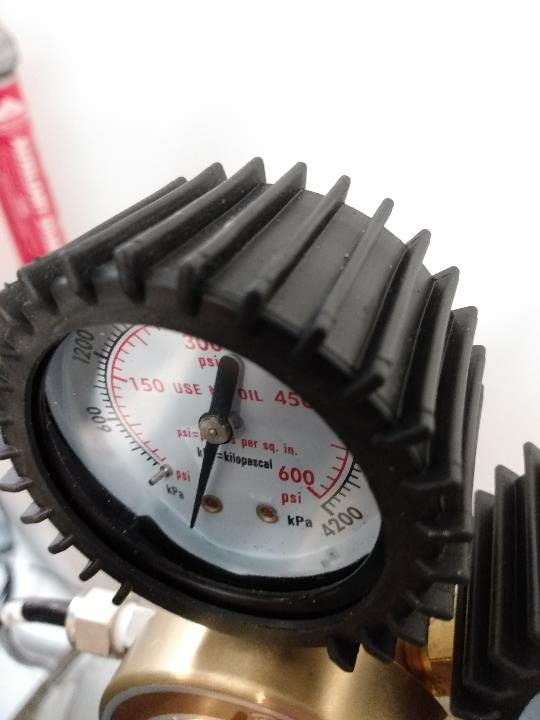
What it handles well for tire work
A 0-600 PSI delivery range with a 1/4 inch flare outlet covers essentially every tire job in a home garage, from a bicycle-style low-pressure fill to a pickup at max load. The self re-seating relief valve is the safety feature that matters most when you are working alone in a driveway with a high-pressure cylinder on the ground beside you.
Where it falls short
It is a general purpose regulator, not a precision instrument, and a few buyers report it cannot hold a set pressure above roughly 300 PSI. If your plan involves air suspension, shock charging, or a commercial dually fill at working pressure, move up to a higher-capacity model and expect to pay for the privilege.
2. RX WELD Nitrogen Regulator with 5 ft Hose – Best Value Complete Kit
RX WELD Nitrogen Regulator, 0-600 PSI, CGA580 Inlet, 1/4″ Flare Outlet
0-450 PSI adjustable output
5 ft hose included
CGA580 inlet and 1/4 inch flare
2-inch booted gauges
Pros
- Includes a 5 ft hose so it is usable straight out of the box
- Dual color-coded metric and SAE gauge scales
- Brass piston diaphragm with self re-seating relief valve
- Large tee handle with anti-galling adjusting screw
Cons
- Tee handle is stiff above roughly 300-500 PSI
- Some pieces arrived without the adjustment handle
- General purpose rather than precision work
This is the kit we recommend to anyone who wants a working setup tonight without hunting for a separate hose. The 5 ft charging hose is in the box, the CGA580 inlet matches standard nitrogen cylinders, and the 1/4 inch flare outlet matches the fittings most tire service tools already carry.
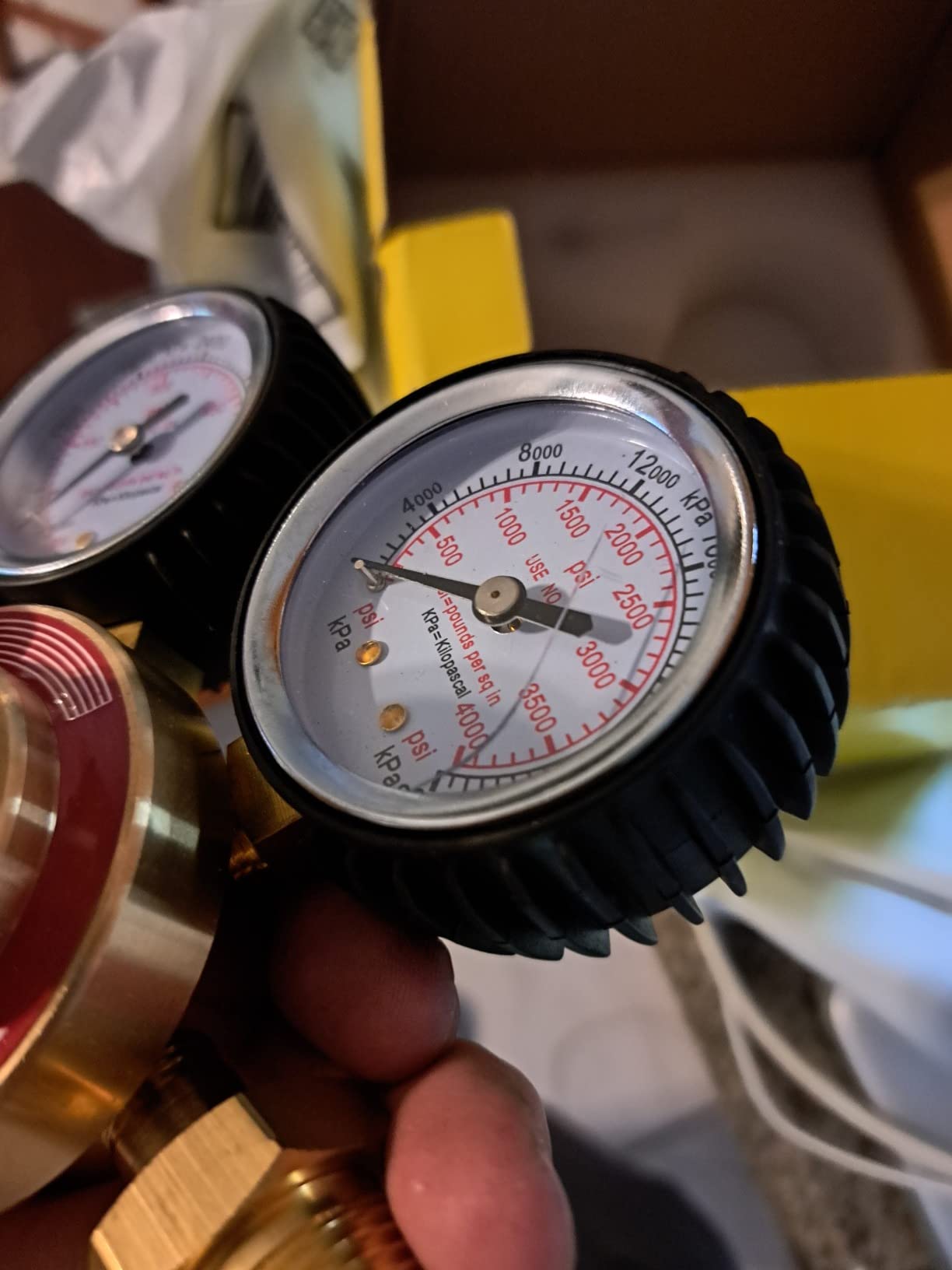
Buyer feedback is strong at 542 ratings averaging 4.6. Owners doing mini-split nitrogen pressure tests and leak checks point to readable two-inch gauges with rubber boots, a brass piston-style diaphragm, and a self re-seating relief valve as the reasons it holds up in daily service.
Output adjusts from 0 to 450 PSI from a 0-4000 PSI inlet, with gauges that read to 600 PSI. That leaves plenty of headroom for tire work, where you are working at a fraction of the delivery range, and it means the gauge resolution where you actually operate is good.
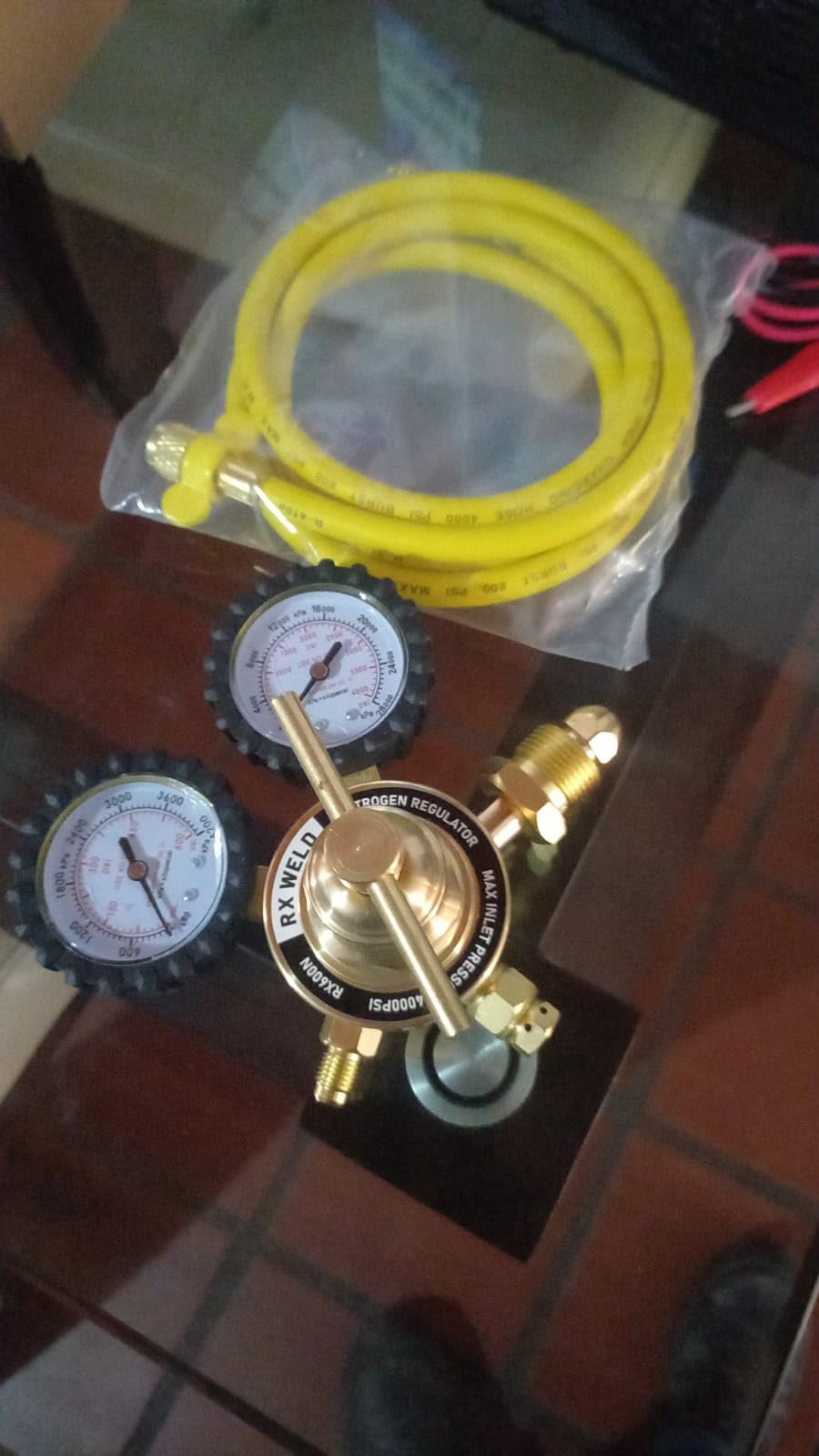
The complaint that comes up most is the tee handle. Once you are above roughly 300 to 500 PSI, the adjustment gets genuinely stiff, which makes slow fine-tuning of a set pressure frustrating. A smaller number of buyers reported receiving a regulator with no adjustment handle at all, so check the parts list on arrival.
Why it beats cheaper regulators
The color-coded dual scales on the gauges are the quiet advantage. Metric and SAE readings sit side by side, so if you are reading a placard in one unit and setting a gauge in the other, you are not doing mental arithmetic in a driveway. Combined with the included hose, it removes the two most common reasons a budget kit gets returned.
Where you will notice the limits
Buyers consistently describe it as a general purpose regulator rather than a precision one. That is exactly the right register for tire fills, and exactly the wrong one if you plan to use it for high-precision refrigerant work where a half PSI matters.
3. 80 cu ft Steel Inert Gas Cylinder with CGA580 Valve – Best for RVs and Dually Trucks
80 cu ft Steel Inert Gas Cylinder – CGA580 Valve – DOT Approved – Nitrogen Argon Helium Compatible
80 cu ft capacity
2015 PSI service pressure
CGA580 valve and 3/4 inch NGT
Cap and collar included
Pros
- 80 cu ft handles dually and RV tire sets in one fill
- Fresh DOT stamped cylinder with a new tested CGA580 valve
- Fill houses exchange it readily so you avoid lease fees
- 2015 PSI service pressure for long fill runs
Cons
- Heaviest piece in the group at 47 lb
- Cylinder color is not selectable and varies between batches
- Arrives empty and needs a fill house visit
Capacity is the reason this one earns its place on heavy vehicles. A single Class A motorhome or a dually pickup carries a lot of air volume, and with a 20 or 33 cu ft bottle you are making repeated trips to the fill house in the middle of a job. At 80 cu ft you fill the whole set in one pass.
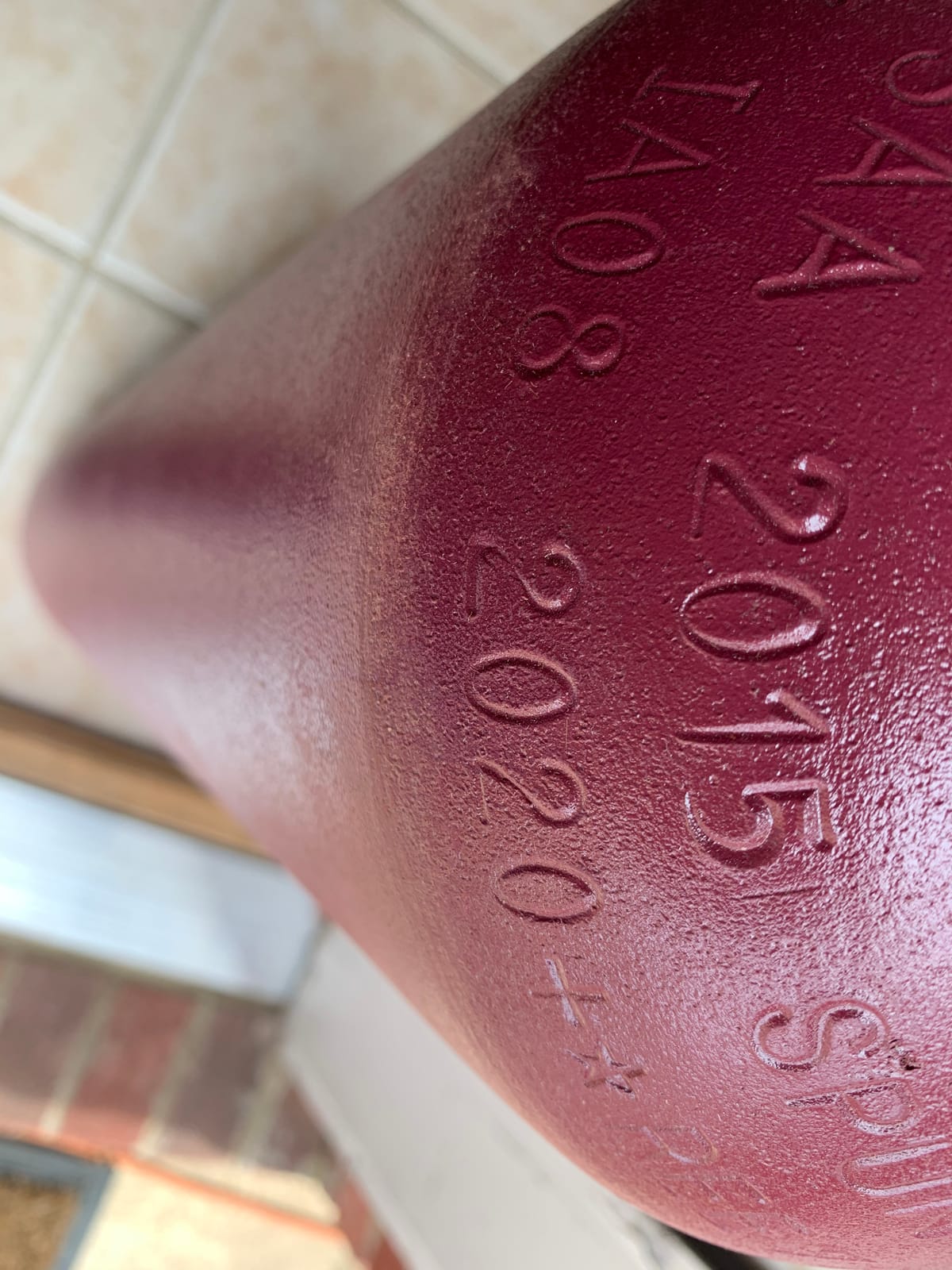
The technical details are conventional and correct: 2015 PSI service pressure, standard 3/4 inch NGT threading with a Q letter designation, a tested CGA580 valve that accepts nitrogen, argon, helium, neon, and mixes, and a 7 inch diameter by 31 inch body with a 47 lb tare weight. The cap and collar are included, which matters more than it sounds when a filler asks about transport.
At 4.6 across 141 ratings, the feedback is consistent: owners confirm the DOT stamp, the working valve, and painless exchange at local compressed gas suppliers. That exchange point is the real reason to buy your own cylinder rather than renting a filler tank, because lease fees add up faster than the tank does.
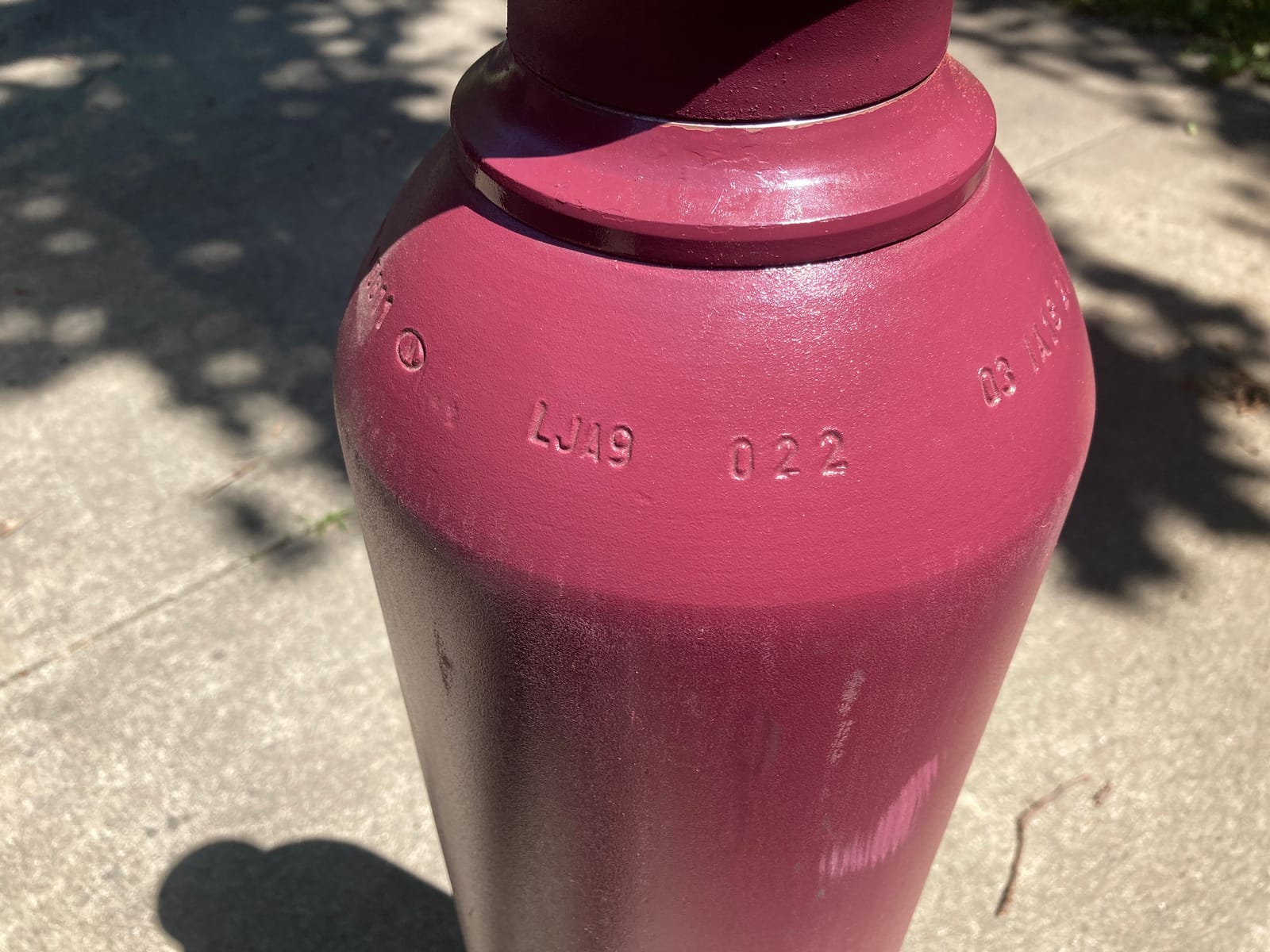
The 47 lb tare weight is the cost of that capacity. It is not a bottle you sling over a shoulder, so plan on a cart or a vehicle-mounted bracket. The finish color is not something you pick, and the same model has arrived in cranberry, grey, and black, so do not build a color scheme around it.
One recurring practical note: some filler houses will question an ISO-marked cap, and a few have declined the bottle on that basis. If your local supplier is fussy, ask before you buy, and keep the collar in place when you transport it.
What it handles well for tire work
One 80 cu ft charge comfortably covers a motorhome steer and drive set or a dually truck, and the 2015 PSI service pressure gives the fill speed you want when four tires are taking air at once. Combined with a regulator from the top of this list, it is a genuine one-trip nitrogen service kit.
Where it falls short
It is steel, so it is heavy, and it is a large bottle that needs somewhere secure to live when it is not in use. For a single car or a light truck where you only fill four tires every few months, the capacity is wasted weight and the storage footprint is a hassle.
4. VEVOR 20 cu ft Aluminum DOT Cylinder – Best Lightweight Portable Bottle
VEVOR 20 Cu. Ft DOT Nitrogen Cylinder Aluminum Alloy Air Tank (Ships Empty)
20 cu ft 6061-T6 aluminum
0-600 PSI valve adjustment
650 PSI relief valve
10.4 lb body weight
Pros
- Lightweight 6061-T6 aluminum body that will not rust
- Only 10.4 lb for a 20 cu ft tank
- CGA580 connection accepted by local fill houses
- 650 PSI relief valve and dual seals reduce backflow
Cons
- Arrives empty and must be filled at a local supplier
- 20 cu ft capacity is short for full four-tire sets
- Built as a general inert gas bottle rather than a tire product
This is the pick if the storage location is a small garage corner or a truck bed and steel is not an option. At 10.4 lb for 20 cu ft, it is roughly a quarter of the weight of a comparable steel bottle, and 6061-T6 aluminum will not rust in a damp shed or spill salt on it all winter.
The valve is a CGA580 unit with stepless adjustment from 0 to 600 PSI and a 650 PSI relief valve, plus a one-way check structure with dual seals to reduce backflow when the regulator is disconnected. The body measures 5.24 by 5.24 by 20.67 inches, so it stands upright in a corner without a cradle.
Owners rate it 4.7 across 74 ratings, with 86% five stars. The recurring theme is straightforward: light, rust-free, standard connection, easy local filling. The same theme names the drawback, because it arrives empty and needs a visit to a compressed gas supplier before it does anything.
Be clear about what this is. The manufacturer positions it for nitro beer, cold brew, welding shielding, and laboratory inert gas use, and it does that job well. For tires it works as part of a kit with a regulator and a fill hose, and nothing more, so do not expect tire-specific features like a long dually hose or a pressure preset.
Capacity is the other limit. Twenty cubic feet will fill four passenger tires, but you will be back at the fill house more often than with a 40 or 80 cu ft bottle. For a car on a monthly top-off cycle that is fine, and for a busy RV it is not.
Why the aluminum body matters outdoors
Steel cylinders corrode from the outside in, and a bottle that lives in a damp garage or a truck bed ages faster than one that does not. The protective coating on this body resists everyday wear, and reviewers consistently name weight and rust resistance as the reasons to choose it over a steel equivalent.
Where it falls short
It is a general purpose bottle. If your goal is steady tire pressure rather than a supply of inert gas for a beverage line, you still need a regulator, a charging hose, and a way to purge the tire properly before the first fill.
5. Generic 20 cu ft Steel Nitrogen and Mix Gas Cylinder – Most Versatile for Small Sets
20 cu ft Steel Nitrogen and Mix Gas Cylinder – CGA580 Valve – DOT Approved
20 cu ft DOT approved steel
CGA580 valve installed
2015 PSI service pressure
13.67 lb tare weight
Pros
- Compact 18 inch height fits under most bars and benches
- Low tare weight of 13.67 lb for a steel cylinder
- Valve installed and tested so any CGA580 regulator fits
- Reasonable choice for filling four car tires
Cons
- Arrives empty and needs a local fill before use
- 20 cu ft means frequent refills for high volume work
- Cylinder color is not selectable
When you want the smallest sensible steel bottle, this is the one. It measures 5.25 inches across by 18 inches tall, so it disappears under a workbench, which is where tire service gear actually lives. The CGA580 valve is already installed and tested, so any standard nitrogen regulator drops straight on.
Specification-wise it is a conventional DOT approved steel cylinder rated to 2015 PSI service pressure with standard 3/4 inch NGT threading. Owners rate it 4.5 across 97 ratings with 82% five stars, citing the compact footprint, the clean finish, and the fact that the valve was ready to go.
At 13.67 lb tare weight it is easier to move than the larger steel bottles in this guide, which matters more than the capacity difference suggests when you are carrying it from a garage to a vehicle in the dark.
The honest limitation is capacity. Twenty cubic feet is a four-car-tire load, so a four-tire rotation or a first fill on a set of wheels takes one full bottle, and any top-off work means a return trip. If you are filling one vehicle at a time on a slow cycle, that is a feature. If you are servicing several vehicles, it is an inconvenience you will feel every month.
It also arrives empty, which is true of nearly every bottle in this roundup. Budget for a fill house visit in both time and money before you decide this is the last step of the setup.
Best fit for a small garage setup
If you are setting up a home nitrogen station for a car or a light truck, this is the least cabinet space you can get away with. Pair it with one of the mid-range regulators above and you have a working kit that stores in a corner and fills a set of tires in a single pass.
Where it falls short
Nothing about it is weak, and that is the point, but nothing is built for volume either. Dealers and fleet operations should step up a size or two, and anyone running an RV or dually should look at the 40 and 80 cu ft bottles in this guide instead.
6. Gancowise 40 cu ft DOT Approved Steel Nitrogen Cylinder – Best High-Capacity Step Up
40 Cubic Foot DOT Approved Steel Nitrogen Cylinder with CGA580 Valve(Empty)
40 cu ft DOT-3AA steel
Female CGA-580 valve
2015 PSI service pressure
29.1 lb body weight
Pros
- DOT-3AA approved with a fresh production date on each
- Female CGA-580 thread matches standard regulators directly
- One-year manufacturer warranty
- Local supply houses accepted it for swap and fill
Cons
- One buyer reported incomplete stamp markings that fillers refused
- Arrives empty and needs a gas supplier visit
- 29.1 lb needs two hands to reposition
The 40 cu ft bottle is the compromise point of this roundup: twice the capacity of the small steel bottles, less than two-thirds the weight of the 80 cu ft one. It sits at 29.1 lb and stands 7 inches across by 23 inches tall including the valve, which is still a manageable two-hand lift.
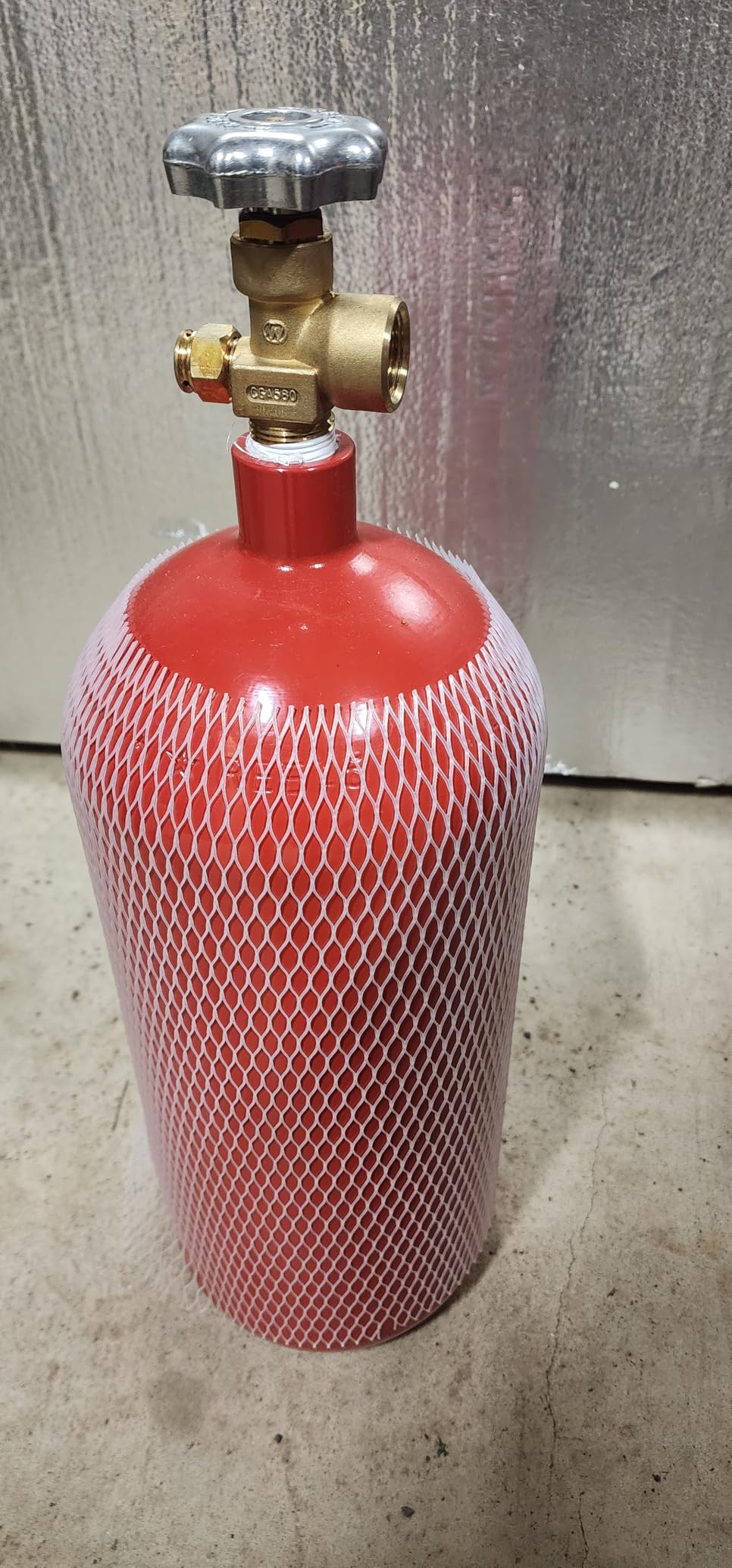
The certification details are the reason to look at this one carefully. It is DOT-3AA approved with US DOT markings stamped on each cylinder, carries a female-threaded CGA-580 valve that fits standard nitrogen regulators directly, and is rated to 2015 PSI service with a 3359 PSI test pressure. There is also a one-year manufacturer warranty.
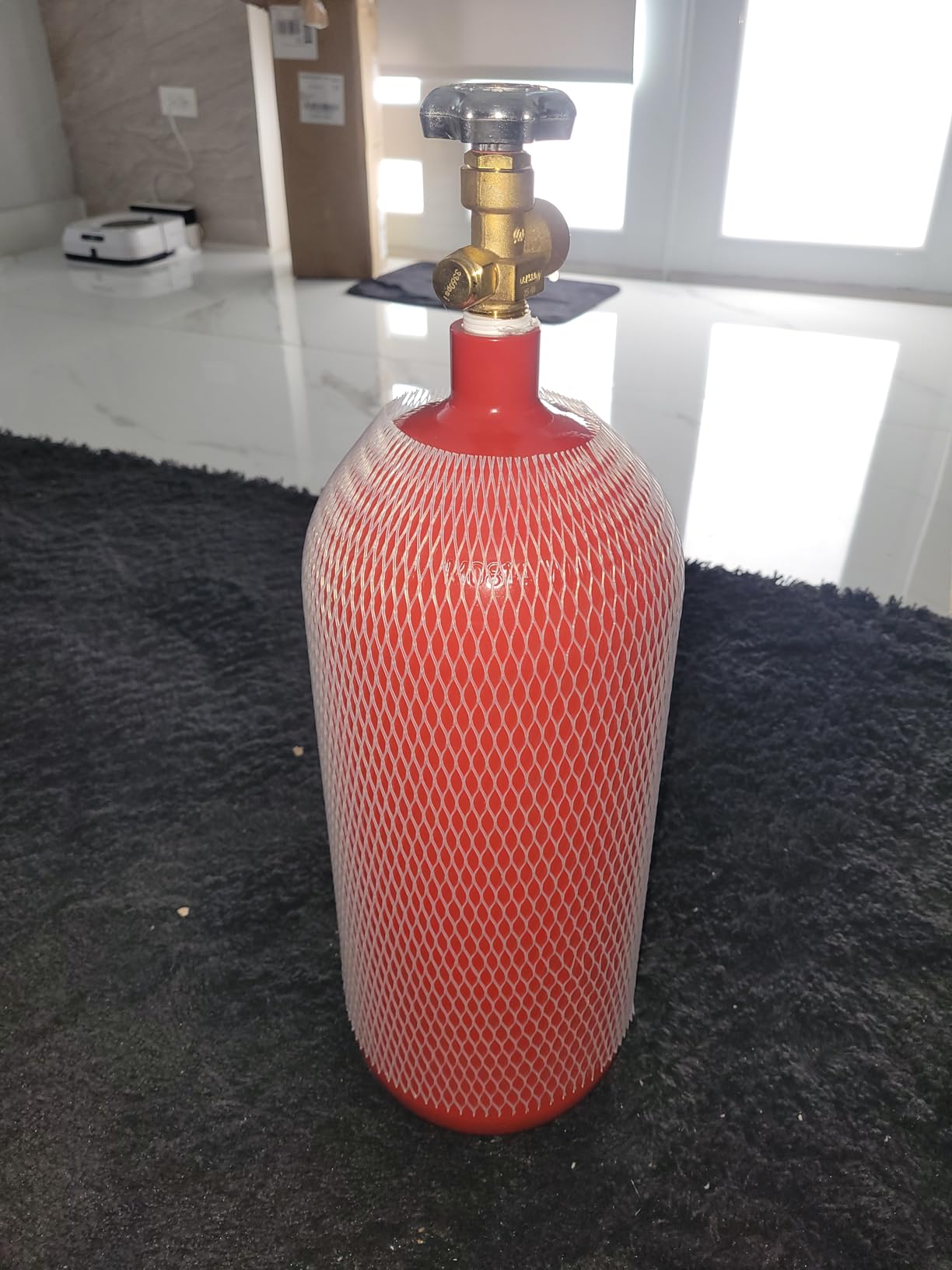
At 4.5 across 52 ratings with 83% five stars, most owners report successful nitrogen swaps and fills, and they specifically mention the fresh date stamp and the glossy red finish. Local supply houses accepted it for exchange and filling for the majority of buyers.
One detailed complaint stands out and is worth taking seriously: a buyer reported that the certification stamp markings were incomplete and reputable fillers refused to fill the tank. That is a single report, not a pattern, but it is also the kind of problem that strands you at the counter with a cylinder full of nothing. When it arrives, check the stamped markings with a flashlight before you take it anywhere.
The other practical note is the weight. Just under 30 lb is a two-hand lift, and it is the size at which a small hand truck stops being optional.
What it handles well for tire work
Forty cubic feet covers four tires with room to spare, which means one bottle handles a full set plus a second vehicle’s worth of top-offs. For a family with an RV and a truck, or a small shop doing weekend service, that is the capacity sweet spot.
Where it falls short
It is a bottle, not a system, so it still needs a regulator, a hose, and a compressor to purge tires. And the certification complaint above is the one failure mode you cannot fix after purchase, so inspect the stamps on arrival.
7. YESWELDER Nitrogen Regulator with Hose – Best Complete Starter Regulator
YESWELDER Nitrogen Regulator with Hose, 0-600 PSI and 0-4000PSI Output
0-600 PSI outlet
6.56 ft hose included
CGA580 inlet and 1/4 inch flare
Brass body with T-handle
Pros
- Complete package with a 6.56 ft hose so nothing else is needed
- Regulator body holds a steady set pressure
- Good value against welding supply shop pricing
- 0-4000 PSI inlet gauge gives clear working range
Cons
- Included hose can leak at the crimp and gaskets may need replacing
- Cylinder nut can weep on first use until threads are cleaned
- A small number of pieces stopped regulating
If you want a regulator and a hose as one purchase, this is the cleanest version of that. The package includes a 6.56 ft gas hose, a CGA580 inlet, and a 1/4 inch male flare outlet, so it connects a standard cylinder to most common tire charging hardware without an extra shopping trip.
Rated working pressure is 450 PSI with a maximum adjustment of 600 PSI, and the dual gauges read 0-4000 PSI on the inlet and 0-600 PSI on the outlet. Those ranges matter for tire work because they leave the useful working pressures spread across the readable part of the dial.
At 4.4 across 310 ratings with 74% five stars, owners value the complete package, the included hose, and the price relative to local welding supply stores. Several use it for air suspension and nitrogen bottle work, which is a reasonable proxy for what it does on a tire.
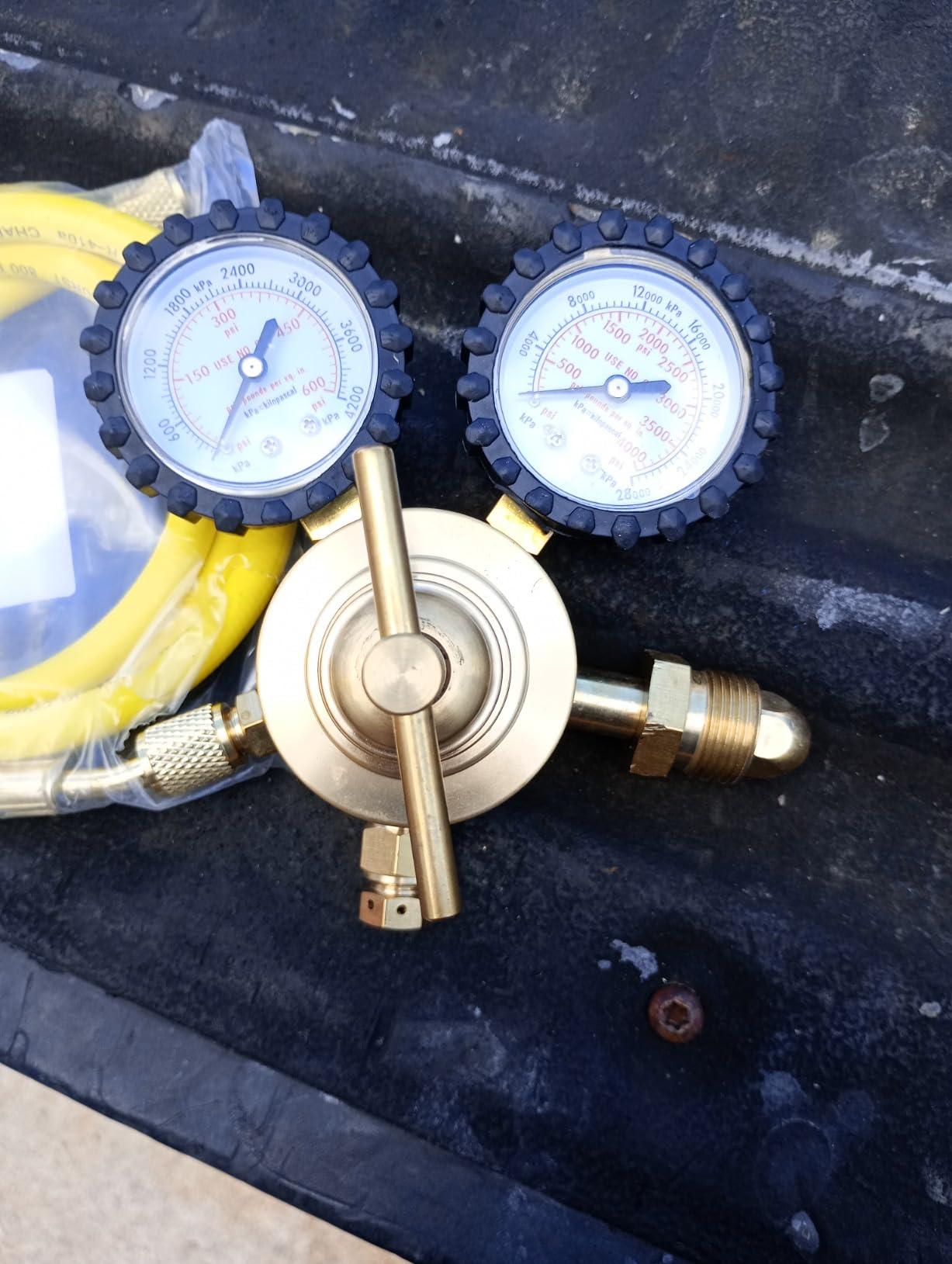
Two quality notes deserve attention before you rely on it. The included hose can leak at the crimp, and reviewers say the gaskets may need replacing, so keep a spare charging hose in mind for long-term use. Separately, the cylinder nut can weep on first use until the threads are cleaned, which is normal settling rather than a defect, but it should stop.
There is also a small number of reports of units that stopped regulating and would not shut off. That is a small share of 310 ratings, but it is the failure mode that matters most with a pressure vessel, so test the shutoff away from a tire the first time you use it.
Why the included hose changes the deal
On a bottle-and-regulator kit, the hose is where most of the cost of a complete setup quietly hides. Including a 6.56 ft hose removes the compatibility guesswork and the second order, which is why this package appeals to first-time buyers building a kit one piece at a time.
Where it falls short
The crimp quality on the supplied hose is the weak link, and the occasional regulating failure means you should verify shutoff behavior before you connect it to anything pressurized. Owners who treated it as a shop-grade component were disappointed; owners who treated it as a value starter kit were not.
8. Kegco 33 cu ft Aluminum Nitrogen Tank – Best for Truck Beds and Outdoor Storage
Kegco 33 Cu. Ft. Nitrogen Air Tank – Aluminum Gas Cylinder (empty)
33 cu ft 6061-T6 aluminum
2216 PSI service pressure
DOT and TC stamped
CGA580 female valve
Pros
- Aluminum body is rust-free and light at 17.46 lb
- 2216 PSI service pressure exceeds tire requirements
- CGA-approved 580 female valve accepts standard regulators
- Protective coating resists scratches and everyday wear
Cons
- Arrives empty and requires a local gas supplier fill
- 33 cu ft sits between the smaller and larger steel bottles
- No regulator or hose included
Kegco fills a gap the other bottles leave open: more capacity than the 20 cu ft aluminum option, less weight than the steel equivalents, and a pressure rating with real headroom. The body is 6061-T6 aluminum rated to 2216 PSI service and hydrostatically tested to 3694 PSI.
It is DOT and TC stamped, and the CGA-approved 580 female-threaded valve accepts standard nitrogen regulators directly. The protective coating is designed to resist corrosion, scratches, and wear, and at 17.46 lb it is light enough to lift into a truck bed without a ramp.
Owners give it 4.4 across 73 ratings with 70% five stars, highlighting the light rust-free construction, the high pressure rating, and the standard valve. As with every cylinder here, buyers note it arrives empty and needs a local fill.
Thirty-three cubic feet is an awkward middle number, and that is the only real drawback. It is more than you need for a car and less than a heavy vehicle set wants, so you are either topping off regularly or finishing a fill with a partial bottle.
It is a bare cylinder, so a regulator and hose are separate purchases. The pressure rating is genuinely impressive for tire work, but you will never approach it, so do not let that number drive the decision and let capacity and weight do that instead.
Where it earns its place
A truck bed or an outdoor storage box is where this bottle makes sense. The aluminum body and the scratch-resistant coating are the reason it survives that environment, and 2216 PSI service pressure means fill speed is never the limiting factor on a warm day.
Where it falls short
If your storage is a small garage and your tire set is four passenger tires, this is more bottle than you need. If your tire set is an RV or a dually, it is not quite enough capacity to finish the job without a second fill.
9. Beaiguna Nitrogen Regulator 0-800 PSI – Best Budget Regulator with a Relief Valve
Beaiguna Nitrogen Regulator, 0-800PSI Nitrogen Regulator HVAC with CGA580 Inlet, 1/4″ Male Flare Outlet Connection, Nitrogen Tank Regulator for HVAC Purging, Leak Checking, Pressure Testing, Welding
0-600 PSI adjustable output
3000 PSI max input
Relief valve near 600 PSI
Solid brass body
Pros
- Lowest cost regulator in the group with solid brass construction
- Built-in relief valve activates near 600 PSI
- CGA580 and 1/4 inch flare fittings cover most standard setups
- Large T-style handle for coarse pressure setting
Cons
- No hose included so a charging hose must be added
- One reviewer reported the adjustment failed to regulate safely
- Gauge ranges are wider than tire pressures so readings sit low on the dial
This is the cheapest way into the category and the specification sheet is better than the price suggests. Maximum input is 3000 PSI with adjustable output from 0 to 600 PSI, a built-in relief valve that activates near 600 PSI, and a solid brass body with a precision-machined piston and diaphragm.
At 4.4 across 88 ratings with 72% five stars, owners call it good value with clear gauges and a comfortable adjustment handle, using it for HVAC purging, leak checks, and welding shielding. The fittings are standard: CGA580 inlet and a 1/4 inch SAE male flare outlet.
The included-components list is short, and that is the whole catch. No hose is included, so you will need a charging hose before this touches a tire, which erodes the saving more than the sticker gap suggests.
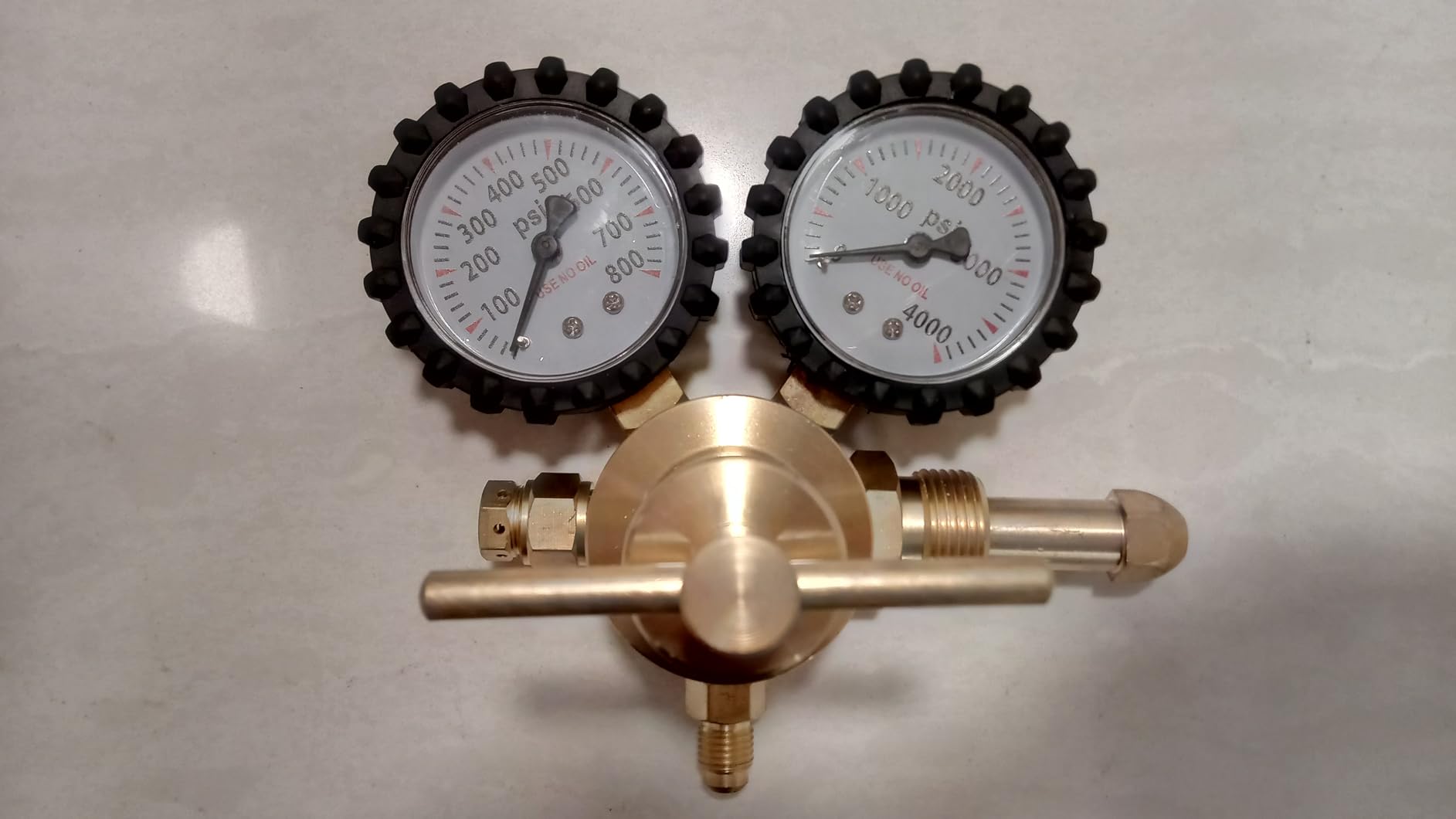
Two things to know. First, the gauges are marked 4000 PSI input and 800 PSI output, so a 35 PSI tire reading sits in the first sliver of the dial. You will squint more than you would with a tighter regulator, and on a nitrogenerator application that is a genuine usability issue.
Second, one reviewer reported that the adjustment failed to regulate safely. That is a single report out of 88 ratings, but with a relief valve set near 600 PSI and a high-pressure cylinder on the other end, test the shutoff away from anything you care about before trusting it.
What it is genuinely good for
Sweeping and purging lines with a large volume of gas at low pressure is exactly where a wide-range output and a big handle earn their keep. For nitrogen tire service, it is a perfectly adequate filler for normal driving pressures as long as you can read the gauge.
Where it falls short
No hose, coarse gauge resolution at tire pressures, and one report of unsafe regulation behavior. If you are new to this and want fewer things to check, the two kits above that ship with a hose are the better first purchase.
10. Siasky Nitrogen Regulator with 5 ft Hose – Best for Mini-Split Leak Checks
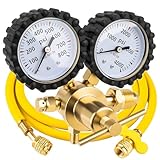
Siasky Nitrogen Regulator with 1/4-Inch Male Flare Outlet, 0-800 PSI Delivery Pressure, 5FT Hose – Brass CGA580 Inlet, HVAC Nitrogen Tank Regulator Kit for AC Pressure Testing
0-800 PSI delivery pressure
5 ft hose included
CGA580 inlet and 1/4 inch flare
0-4000 PSI high gauge
Pros
- Includes a 5 ft hose and works for nitrogen sweeps and leak checks
- Solid brass body holds steady output from 50 to 500 PSI
- One owner pulled the hose down to 380 microns on a vacuum pump
- Lightweight at 3 lb and small enough to live in a tool bag
Cons
- T-handle is extremely hard to turn above 300 PSI
- Low pressure gauge resolution is coarse and can stick as pressure drops
- Some buyers found the build less durable and returned it
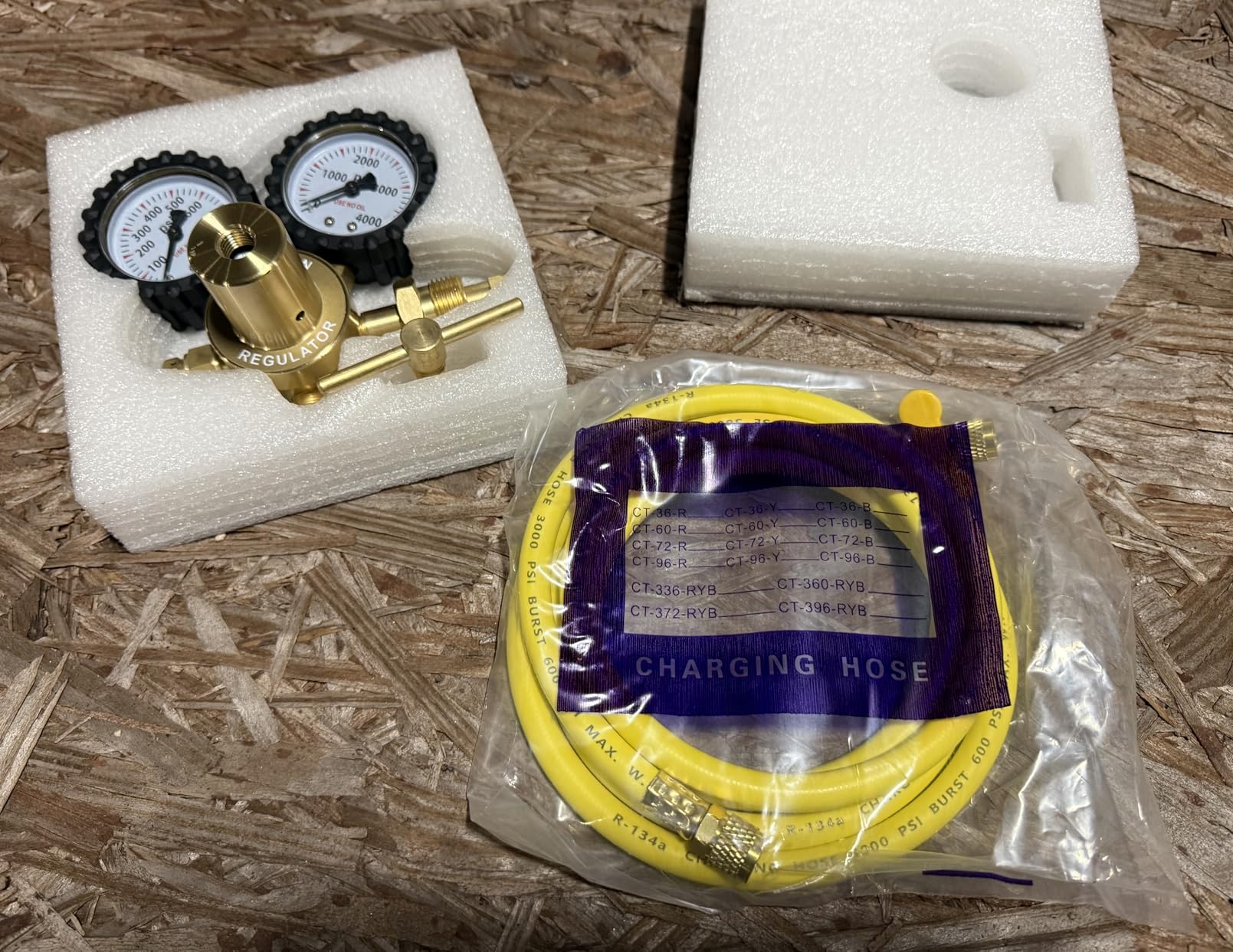
Like the RX WELD above, this one ships as a complete kit with a 5 ft hose, which makes it usable without a second order. The delivery gauge reads 0-800 PSI and the high pressure gauge reads 0-4000 PSI, with a CGA580 brass inlet and a 1/4 inch male flare outlet.
It is 3 lb and measures 7 by 7 by 5.6 inches, so it lives in a tool bag rather than a wall mount. Owners confirm it handles mini-split nitrogen sweeps, high pressure leak checks, and vacuum work, and one reported pulling the hose down to 380 microns on a vacuum pump.
This is the lowest-rated pick in the roundup at 4.2 across 107 ratings, with 65% five stars. The gap from the top of the list is not about features, it is about feel and finish, and that is worth knowing before you buy.
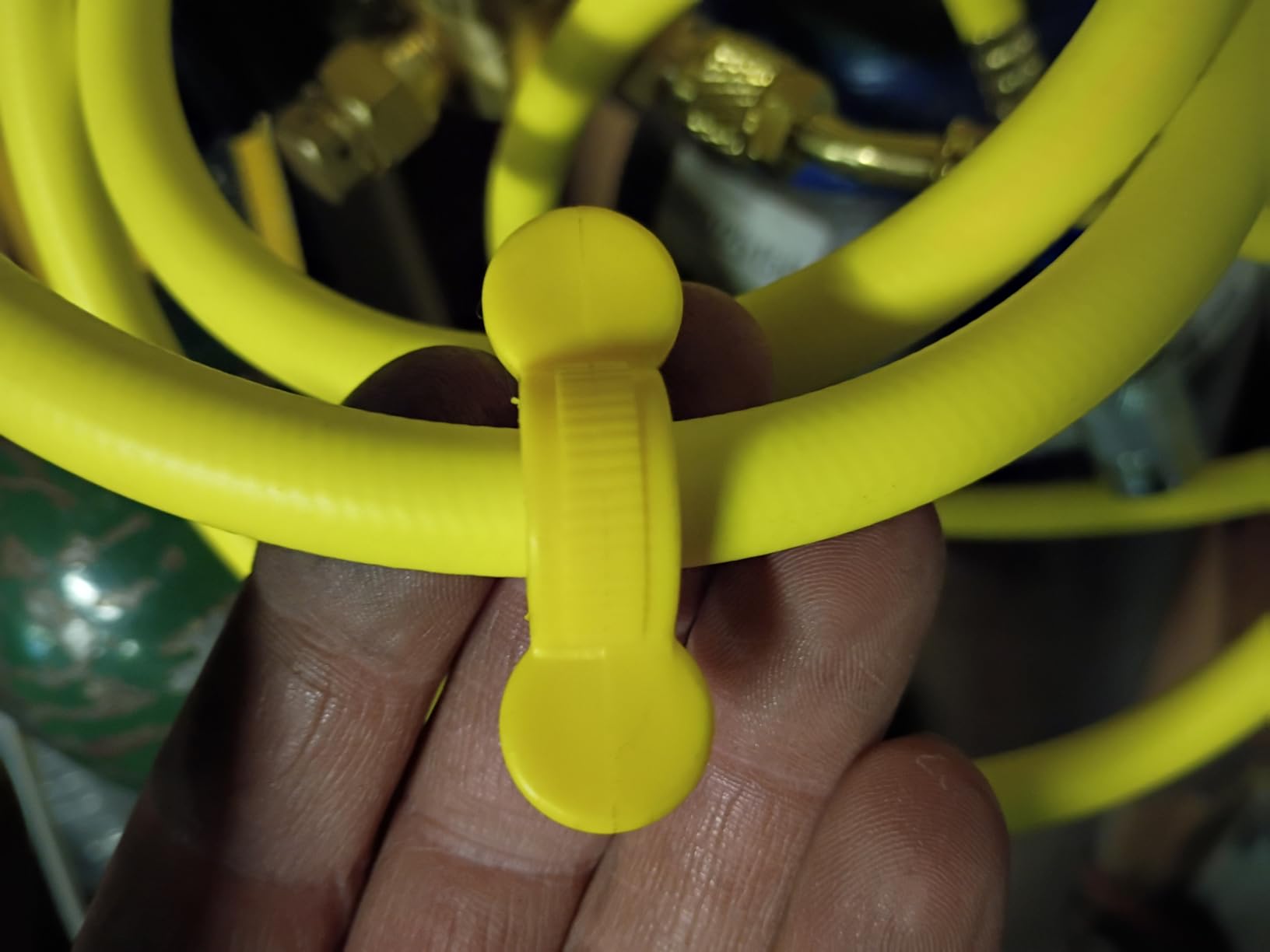
The most cited weakness is the T-handle, which reviewers describe as extremely hard to turn, especially above 300 PSI. Fine adjustment of a set pressure is slow going, and on a long fill you will feel every turn of it. The low pressure gauge resolution is coarse and can stick as pressure drops, which matters when you are reading a value in the low range.
Some buyers also found the overall build less durable and returned the regulator. At 3 lb with brass construction, the weight is not the problem, so treat the complaints as finish and component quality rather than weight.
What it handles well
HVAC work, plainly. The combination of a 5 ft hose, a delivery range to 800 PSI, and a body that holds steady output between 50 and 500 PSI covers pressure tests and leak detection on small systems, which is where most buyers put it.
Where it falls short
It is the weakest-rated pick here at 4.2, with a stiff handle and coarse gauges, and that combination makes it a frustrating choice for precise tire pressures even though it will physically get the job done. Choose the RX WELD or YESWELDER kits instead if the handle bothers you at all.
11. Mastercool 53010-AUT Nitrogen Pressure Test Kit – Most Compact for Professional Diagnostics
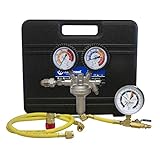
Mastercool 53010-AUT Automotive Nitrogen Pressure Test Kit
4400 psig high gauge
1000 psig low gauge
38 inch charging hose
Blow-molded case
Pros
- Best rated pick here at 4.7 with 83 percent of ratings at five stars
- Complete kit with regulator hose adapters and case
- Professional grade build from an established tool brand
- High and low pressure gauges give precise control
Cons
- Built for automotive A/C nitrogen testing rather than tire service
- Heaviest piece in the group at 7.3 lb
- Regulator uses a 1/4-18 NPT thread rather than a CGA580 tire hookup
Be clear about what this kit is. The Mastercool 53010-AUT is a pressure test kit for automotive air conditioning systems, with a high side R134a coupler and a leak testing adapter, not a tire filling kit. It is included here because it is one of the highest-rated nitrogen-handling products in the group and it tells you something useful about where a nitrogen tire setup differs.
The regulator is rated to a 4400 psig inlet and comes with a 4400 psig high pressure gauge plus a 1000 psig low pressure gauge, a 38 inch charging hose, the leak testing adapter, and a blow-molded carrying case. Everything is stainless steel and the kit is 13 by 11 by 3 inches.
At 4.7 across 127 ratings with 83% five stars, this is the highest-rated pick in the roundup. Owners cite the complete contents, accurate dual gauges, and professional build quality, and the tool brand has a long track record in refrigerant tools.
The limitation is stated plainly in the reviews: the package is oriented to automotive air conditioning diagnostics rather than tire service, and it is the heaviest item in the group at 7.3 lb. The 1/4-18 NPT thread style also means it will not directly mate with a CGA580 nitrogen cylinder, so it needs an adapter to join a tire setup.
So buy it for what it is. If you service air conditioning and also want accurate nitrogen pressure measurement on the side, the dual gauges and the case make it a strong kit. If you only want to fill tires, a CGA580 regulator from earlier in this list is the correct purchase.
Why the gauge quality matters for tires
The lesson transfers even if the kit does not. A dedicated high and low gauge pair gives readable resolution at the pressures you actually work at, which is exactly the problem we flagged on the wider-scale budget regulators. Accurate readout is the difference between setting a tire to 35 PSI and guessing near 35.
Where it falls short
It does not fill tires without an adapter, it weighs 7.3 lb, and it is a 1/4-18 NPT fitting rather than a CGA580 cylinder connection. For a pure tire setup, this is a professional diagnostics tool that happens to handle nitrogen, not an inflation kit.
12. Uniweld 40040 Sludge Sucker and Blaster Kit – Best Complete Service Kit for Pros
Uniweld 40040 Nitrogen Sludge Sucker and Blaster Kit with Metal Carrying Stand for 40 Cubic Feet Nitrogen Tank
400 PSI delivery regulator
Sludge sucker and blaster
2 ft and 5 ft service hoses
Metal carrying stand
Pros
- Complete service kit with regulator both hoses sucker and blaster
- 400 PSI regulator is adequate for line-set and component tests
- Metal stand keeps the kit organized in a service van
- Purpose-built for low pressure nitrogen purging of copper lines
Cons
- Nitrogen tank is not included and sold separately
- One-star reviews sit at 15 percent of all ratings
- Some components reported not performing to spec
The Uniweld 40040 is a technician kit rather than a tire kit, and we include it because it is the most complete single package in the roundup. You get a nitrogen regulator with protective rubber gauge boots rated to 400 PSI delivery, a 2 ft and a 5 ft service hose, a sludge sucker, a sludge blaster, and a metal carrying stand.
The intended work is low pressure nitrogen purging of copper lines to displace oxygen and prevent oxidation and scale, pressure testing a system before evacuation, and cleaning condensate drain lines. The tank is not included, which is the single most important thing to know before ordering.
At 4.2 across 66 ratings, the split is notable: 70% five stars but 15% one star, the highest one-star share of anything in this guide. Technicians value the all-in-one packaging and the stand, while a smaller group reports fitting, gauge, and durability problems.
The 400 PSI delivery rating is fine for line-set and component pressure tests, and it is more than a tire fill needs. But 15% one-star ratings is a real signal about component consistency, and the pack of separate hoses, stand, and tools means there are more joints that can disappoint than a single regulator does.
It is 11 by 9 by 22.5 inches and 8.53 lb, so the metal stand is doing genuine work keeping it organized in a van. If you are not doing refrigerant work, this is an expensive way to buy a mediocre tire regulator, so choose one of the dedicated regulators earlier in this list instead.
What it is genuinely good at
Nothing about it is filler. This is a service kit for technicians who purge and test lines, and the combination of two hose lengths, a regulator, and both drain tools means one case covers a full service call without hunting for parts in the van.
Where it falls short
It comes with no tank, its 400 PSI delivery ceiling is modest for anything beyond line testing, and the 15% one-star share on component quality is the highest in this roundup. Tire-only buyers should pass on it.
How to Choose a Nitrogen Tire Inflation System
Pick your family first, because everything else follows from it. A pre-filled bottle and regulator kit gives you dry nitrogen from a supply house with no machine to maintain, and the purity you get depends on the gas supplier rather than on any spec printed on the bottle. A membrane or PSA generator separates nitrogen from ordinary air on site, produces a known purity figure, and fills four tires at once, but it costs far more, needs an air compressor and a dedicated power source, and requires filter and membrane service on a schedule.
Choose the bottle and regulator route if you are filling one vehicle on a monthly cycle, if you have limited space, and if you want zero maintenance. Choose the generator route if you are a dealer, an independent shop, or a fleet operator where throughput and a documented purity number are the whole point of the purchase.
Match capacity to the tire set. Twenty cubic feet covers four passenger tires in one pass. Thirty-three cubic feet gives one set plus top-offs. Forty cubic feet covers one set comfortably or a second vehicle partially. Eighty cubic feet covers a motorhome or dually set in a single fill, as we noted in the RV pick above.
Then match the regulator to the job, not the price. A 0-600 PSI delivery regulator with a 1/4 inch flare outlet and a CGA580 inlet covers passenger and light truck work entirely. For air springs, shocks, or commercial dually fill pressures, step up to a higher capacity unit, because several of the budget regulators in this roundup are reported to stop regulating around 300 PSI.
Check the accuracy question, because that is what separates a good system from a mediocre one. Gauge resolution where you actually work is the real differentiator, not brand. A wide-range 4000 and 800 PSI dial puts a 35 PSI tire reading in the first sliver of the scale, while a tighter 0-4000 and 0-600 pair gives you readable numbers. Automatic shutoff and a self re-seating relief valve matter more for a high-pressure cylinder in a driveway than any feature on the box.
Understand the accessories you will need regardless. A charging hose is the most common omission, and two of the picks here ship without one. A dually extension hose matters if you fill a truck with inner and outer rear wheels. A nitrogen-rated gauge and a purge tool complete the kit, and you will also want a way to monitor pressure between fills, which is where our RV tire pressure monitoring picks become relevant for motorhome owners.
For the target pressure, keep it simple: fill cold to the PSI on the door jamb placard. Owners on the iRV2 forum debate adding PSI to compensate for a nitrogen tire not climbing after a drive, and the answer is that the placard number is the design cold pressure regardless of what is inside. If you are unsure what your tire is rated for, our guide to reading tire sidewall codes will help, and it is a different number from the placard anyway.
Purge and refill properly, every time. Step one, check pressure cold and record it. Step two, fully deflate the tire by removing the core or unscrewing the valve stem, because a top-off mixes gases rather than replacing them. Step three, set the regulator to your cold target PSI. Step four, fill in short bursts and recheck cold, because nitrogen molecules move through a leak slower than you expect. Step five, reinstall the core and check again after ten minutes.
Consider a portable electric inflator only as a top-off tool, never for purging, and remember that a cordless unit is not a nitrogen system. If you want a comparison of those for a top-off kit, our cordless inflator picks cover that category properly.
Finally, think about safety and storage, because a compressed gas cylinder in an enclosed space is a real consideration. Ventilate any area where you vent a cylinder, never vent nitrogen in a sealed garage or an enclosed RV storage bay, and secure the bottle upright so it cannot tip onto its valve. Keep it out of direct sun and away from heat, and check the pressure relief device is not obstructed in storage.
Frequently Asked Questions
Is nitrogen tire inflation worth it?
Yes for heavy vehicles running high pressures, sustained high-heat driving, and racing or aviation work, where dry gas holds cold pressure far steadier than compressed air. For a daily car driven short distances in mild weather, the stability gain is small and rarely justifies the recurring fill cost and the shrinking availability of shops that offer it.
Can I add regular air to tires filled with nitrogen?
Yes, you can, and a small amount of air will not meaningfully change anything. A large top-off does dilute purity: adding air equal to roughly one tenth of the tire volume to a 95 percent nitrogen tire pulls the overall purity down by about five points. The tire is still safer and more stable than an air-filled tire, so do not worry about a quarterly check.
What PSI should I use with nitrogen tires?
Fill cold to the PSI on the door jamb placard, exactly as you would with air. Nitrogen tires do not climb in pressure after a drive the way air-filled tires do, which is what creates the temptation to add extra, and over-inflating reduces ride quality, increases the center wear on the tread, and is the most common error we see in nitrogen tire advice.
Do nitrogen tires need special valve caps?
No, a nitrogen-filled tire runs on a standard brass valve stem and does not require a special cap. Green nitrogen valve caps and green valve stems are a visual convention rather than a requirement, and dealers themselves admit they have no way to verify a tire is still nitrogen-filled, so treat the caps as a hint rather than proof.
How do I know my tires are actually nitrogen-filled?
Look for green valve caps or green valve stems, check whether the tire holds cold pressure unusually well over several weeks, and ask the shop for a printed purity reading at fill time. The first two are only hints, because caps can be swapped in seconds, so the only real verification is a purity measurement taken while the gas is going in.
Is nitrogen safe to use in an enclosed garage?
Nitrogen displaces oxygen, and a large release in a sealed space is a genuine asphyxiation risk. Run any nitrogen generator or cylinder fill in a space with real ventilation, never vent a cylinder inside a closed garage or an enclosed RV storage bay, and keep the bottle upright and secured so it cannot fall onto its valve.
How often do I need to purge and refill nitrogen tires?
Check cold pressure monthly or before every long trip, the same interval you would use with air. Nitrogen loses pressure more slowly, so most owners find a full purge and refill is only needed when pressure drops noticeably, typically every few months, rather than at every routine check.
Our Final Picks for Nitrogen Tire Inflation Systems in 2026
Start with the BETOOLL 0-600 PSI regulator, our top pick, because it carries by far the deepest verified feedback in the group and its CGA580 inlet and 1/4 inch flare outlet fit standard cylinders and hoses. If you want one box that includes a hose, take the RX WELD kit instead, which holds a higher rating and ships with 5 ft of hose already attached. For RVs, dually trucks, and any job where you want to fill the whole set in one trip, the 80 cu ft steel CGA580 cylinder is the one to buy.
Pair a 20 to 40 cu ft cylinder with any of the three regulators above and you have a working nitrogen tire inflation system for a home garage. Fill cold to the placard PSI, purge fully rather than topping off, and remember that the benefit is pressure stability, not fuel economy. If your driving is mostly short trips in mild weather, spend the money on tires and a cordless top-off inflator instead, and you will not miss nitrogen at all.