
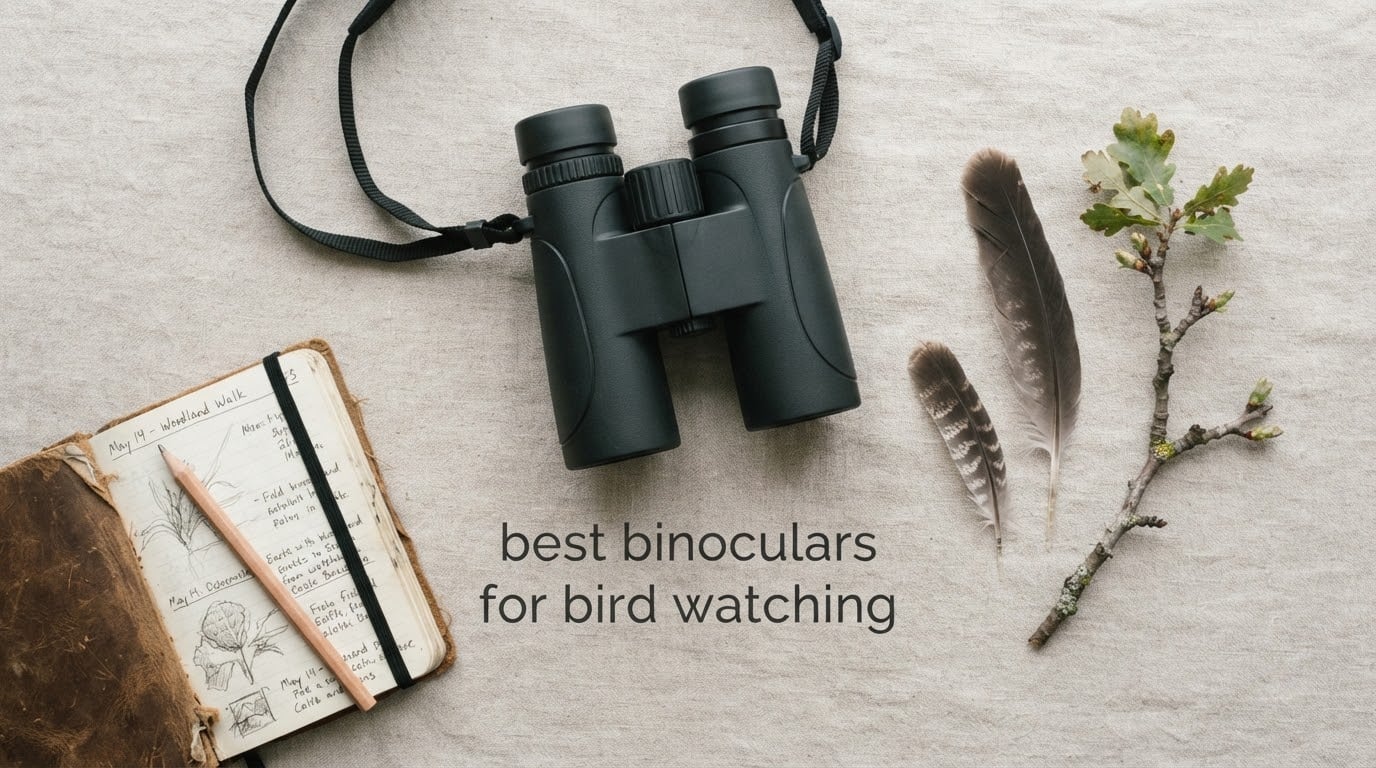
Short answer: an 8×42 binocular is the best all-round configuration for bird watching, and the Vortex Crossfire HD 10×42 is the pair we would put over our own eyes first. Most of the confusion in this category comes from the assumption that more magnification is better. It is not. Finding a bird is only half the job. You have to keep it in the glass long enough to identify it, and that job rewards a wide field of view, honest color, and an image that stays steady in your hands.
I have spent the last few months swapping between twelve pairs of binoculars on the same walks: a suburban garden with a feeder, a scrubby hedgerow where warblers work the brambles, an estuary at first light, and a lake edge in heavy rain. Twelve is a lot of glass, but it is the only way to know which differences are real and which are just marketing. The list below is the result of that process, and every number quoted comes from the published specifications for each binocular.
The first number on a binocular is the magnification. The second is the diameter of the objective lens in millimetres. On an 8×42 pair, a bird appears eight times larger than it does to the naked eye, and the 42mm front lenses collect enough light to keep that image reasonably bright. A 10×42 pair does the same job with more reach and a narrower view. An 8×32 pair gives up a little light in exchange for a smaller, lighter shell that suits travel.
What makes this the best binoculars for bird watching category rather than a stargazing or hunting list is that birders hold the glass for hours, in poor light, sometimes in rain, and often while wearing glasses. That combination of demands is what shaped every pick here, from the wide scanning view of an 8×42 to the sealed body that survives a downpour.
Table of Contents
Top 3 Picks for the Best Binoculars for Bird Watching in 2026

Vortex Crossfire HD 10×42
- 10x42 with HD glass
- Fully multi-coated lenses
- Nitrogen purged and waterproof
- Case and harness in the box

Vortex Diamondback HD 10×42
- Dielectric phase coating
- Light 1.3 lb armored body
- Argon purged and sealed
- Lifetime VIP warranty

Celestron Nature DX 8×42
- 8x42 with a 7.4 degree field
- Phase-coated BaK-4 prisms
- 17.5mm eye relief
- Waterproof and nitrogen purged
All 12 Picks at a Glance (October 2026)
Every binocular below sits in a different niche: one for a wide scanning view, one for extra reach, one for low light, one for floating on water. The table below is the fastest way to see which is which before you read the individual reviews.
| Product | Specs | Action |
|---|---|---|
| Vortex Crossfire HD 10×42 |
|
Check Latest Price |
| Vortex Diamondback HD 10×42 |
|
Check Latest Price |
| Celestron Nature DX 8×42 |
|
Check Latest Price |
 Vortex Triumph HD 10×42 Vortex Triumph HD 10×42 |
|
Check Latest Price |
 Adasion 12×42 with Phone Adapter Adasion 12×42 with Phone Adapter |
|
Check Latest Price |
 Celestron Outland X 8×42 Celestron Outland X 8×42 |
|
Check Latest Price |
 Nikon PROSTAFF P3 8×42 Nikon PROSTAFF P3 8×42 |
|
Check Latest Price |
 Nikon Monarch M5 8×42 Nikon Monarch M5 8×42 |
|
Check Latest Price |
 ZEISS Terra ED 10×42 ZEISS Terra ED 10×42 |
|
Check Latest Price |
 Vanguard Endeavor ED 10×42 Vanguard Endeavor ED 10×42 |
|
Check Latest Price |
 Hontry 8×42 IPX6 Hontry 8×42 IPX6 |
|
Check Latest Price |
 Bushnell H2O 8×42 Bushnell H2O 8×42 |
|
Check Latest Price |
How We Chose and What We Looked At
Twelve pairs went into the comparison, and we kept the same five tests on all of them rather than letting each review drift into whatever that particular binocular happened to be good at.
Field of view and steadiness. We timed how long it took to find a bird that flushed from cover and then to keep it centred. A wide apparent field and low magnification win this test almost every time, because a narrow view makes the bird feel like it is moving even when it is not.
Low light performance. Dawn and dusk sessions are where coatings and glass type separate the field. We paid attention to whether the image stayed bright and whether colour fringing appeared around a heron against a pale sky.
Close focus and glass-wearing comfort. Close focus decides whether you can watch a warbler working a bramble at arm’s length. Eye relief decides whether you can see the whole field at all while wearing glasses.
Build and weather sealing. Nitrogen purging, O-ring seals and rubber armour matter more than most spec sheets admit, because binocular failures happen in the rain rather than in the case.
What comes in the box. A harness and a case you will actually use add more value to a birding kit than another few percent of magnification.
One thing we did not do is pretend that user ratings equal our own measurements. Ratings and review counts below are the published figures for each binocular, and we use them to tell you how settled an ownership experience tends to be.
1. Vortex Crossfire HD 10×42 – Our All-Round Pick
Vortex Crossfire HD 10×42 Binoculars
10x magnification
42mm objective
15mm eye relief
325 ft field of view
1.4 lb
Pros
- HD glass elements with sharp edge-to-edge detail
- Fully multi-coated lenses for strong light transmission
- Adjustable eyecups work with or without glasses
- Nitrogen purged and waterproof for wet weather
- GlassPak case and harness included in the box
Cons
- 15mm eye relief is short for some glasses wearers
- A little color fringing appears at the field edge
- Rubber-armored aluminum still feels entry-level beside metal chassis designs
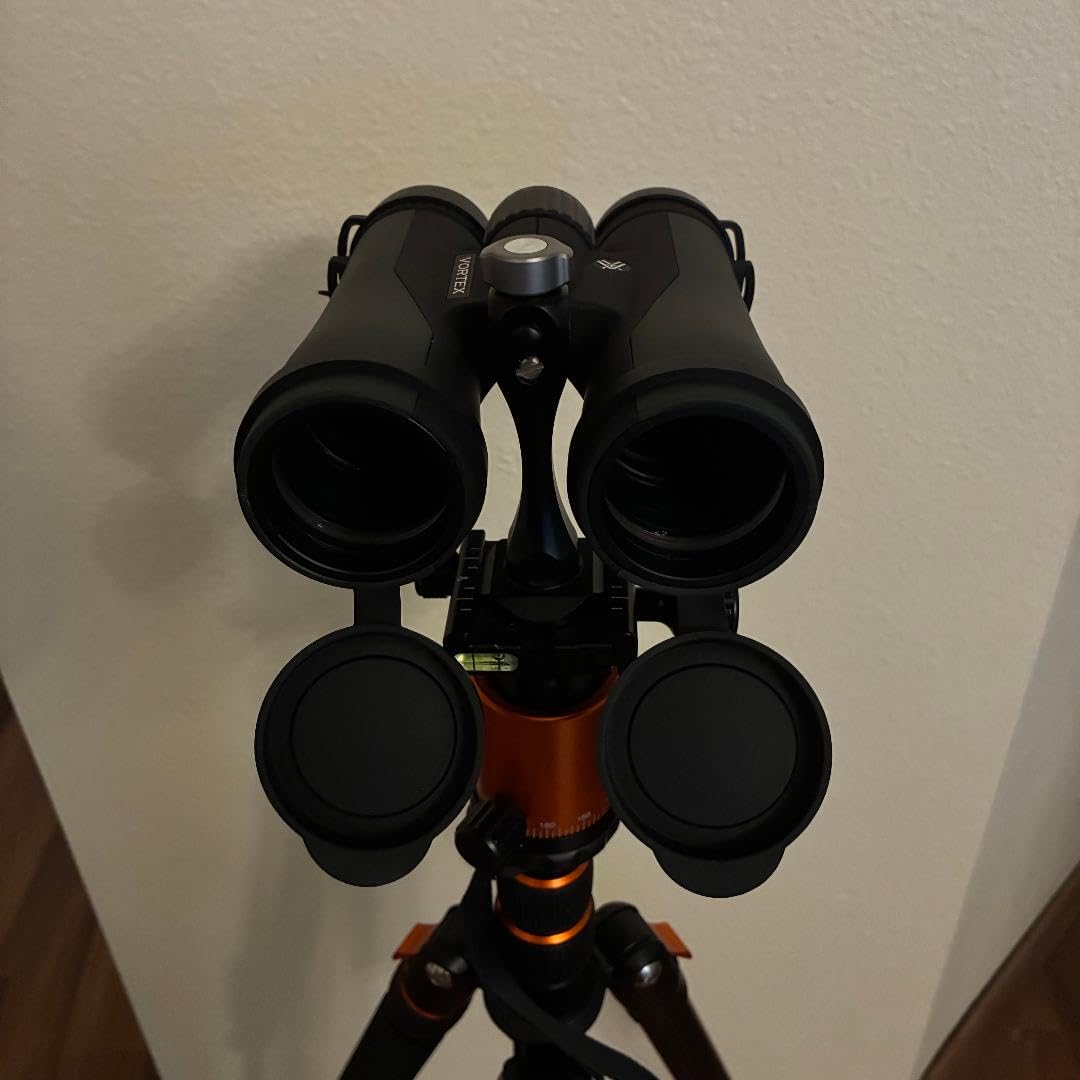
The Crossfire HD was the pair I reached for on more walks than any other in this test. On a garden feeder it is quick enough to swing from one end of the hedge to the other without losing a finch, and the 325 foot field of view gives you room to spot the next movement before it moves.
The optics use select HD glass elements with multiple anti-reflective coatings on all air-to-glass surfaces. In daylight that combination gives a bright, neutral image with noticeably cleaner edges than the budget glass it replaces. I saw no obvious colour smear on finches and sparrows against green cover, which is exactly where cheaper glass tends to fall apart.
The build is where it shows its budget position. The body is aluminium under rubber armour, sealed with O-rings and purged with nitrogen, so rain and sudden temperature changes are not a problem. It does not feel as dense or as refined in the hand as a magnesium-bodied binocular, and the focus wheel, while smooth, is not as finely damped as the Diamondback.
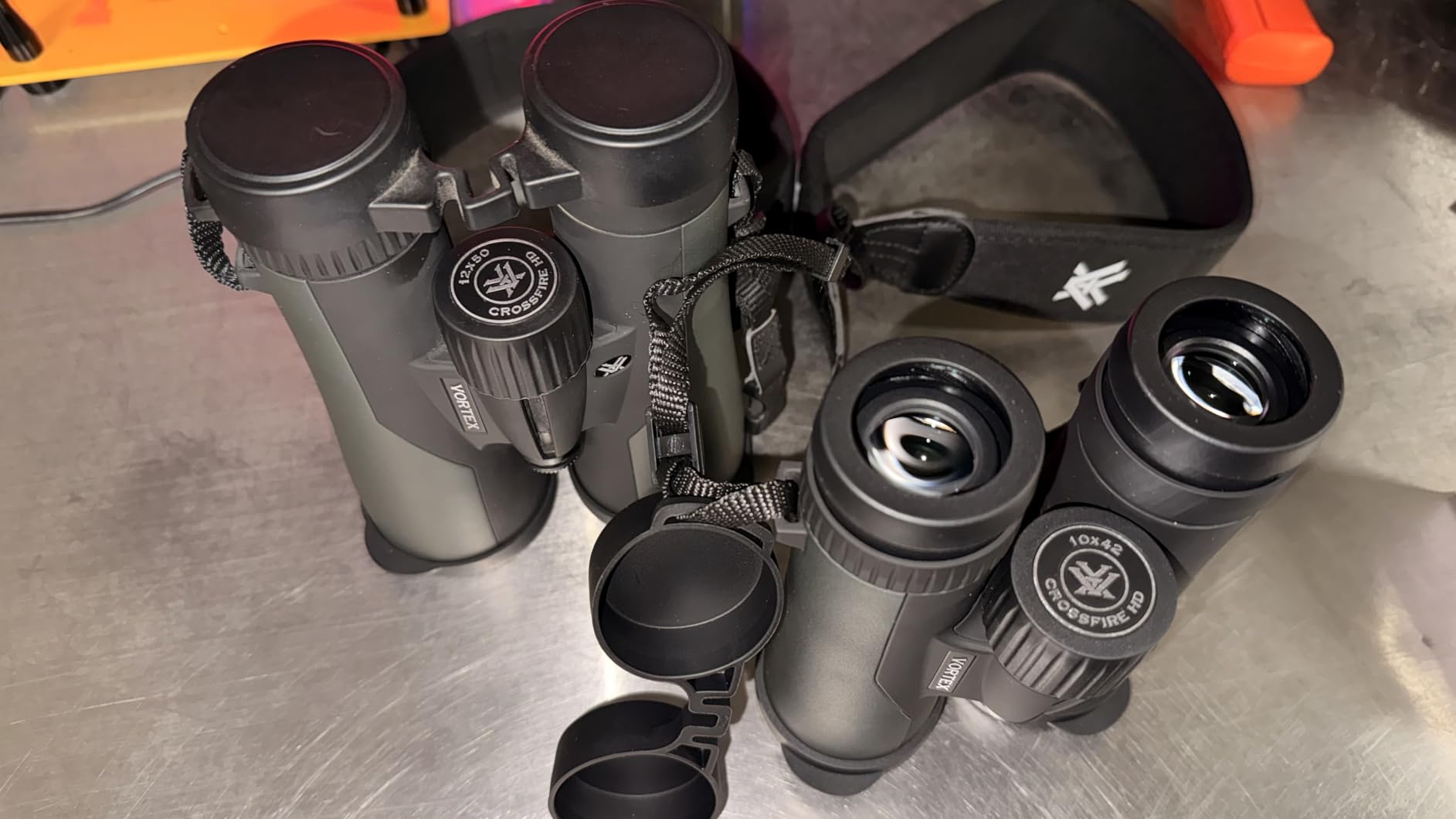
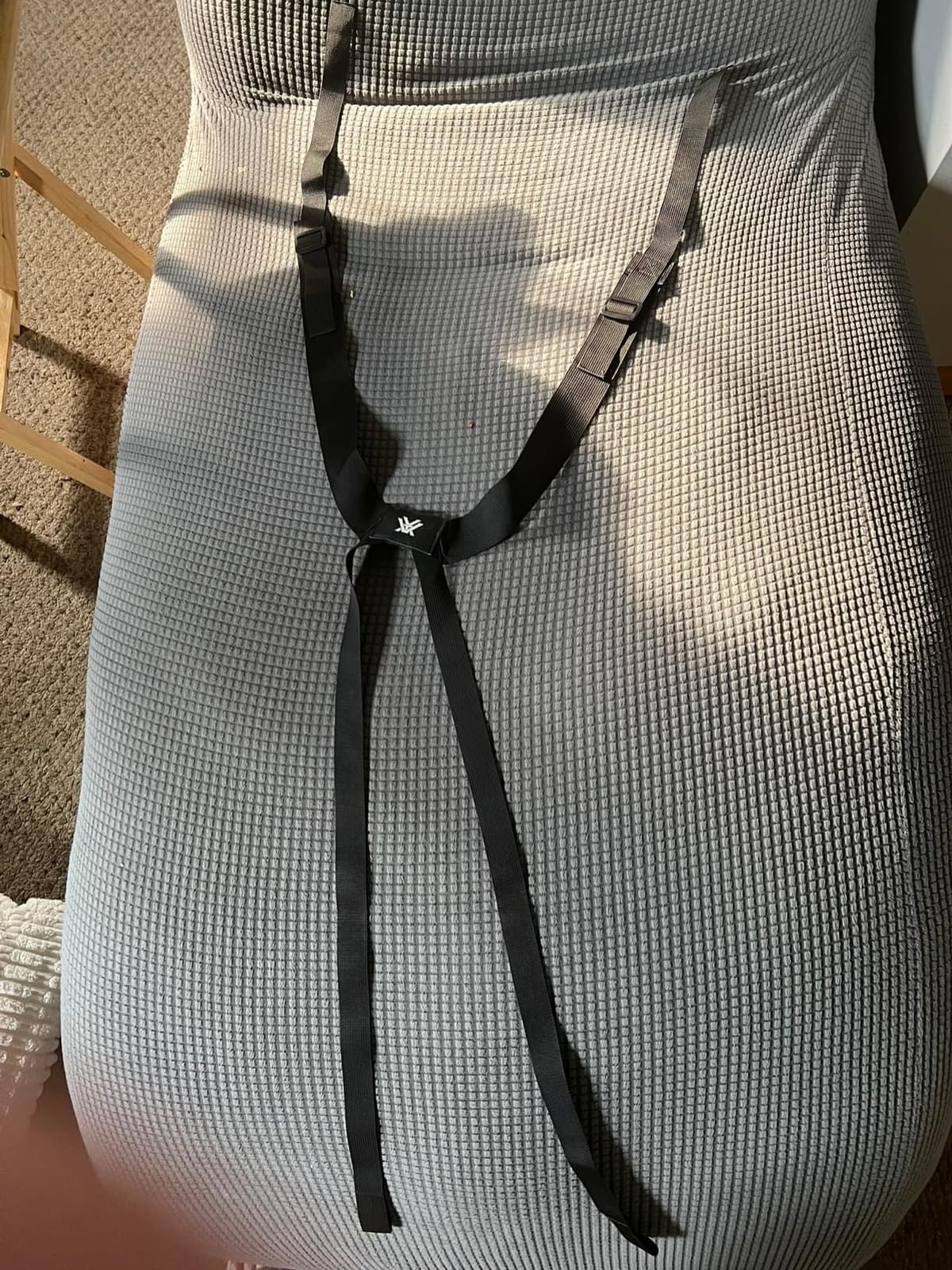
Two things tell me this is the right default. First, the box contains a GlassPak case, a harness, tethered lens covers and a neck strap, which is a genuinely complete kit. Second, Vortex backs it with an unlimited, unconditional lifetime warranty, which removes most of the risk people feel when buying their first serious pair.
The honest weakness is eye relief at 15mm. If you wear glasses with frames that sit close to your eye, you will see the full view with the eyecups twisted down, but it takes practice to stop clipping the frame. I also noticed faint colour fringing at the very edge of the field against high-contrast branches. Neither ruins birding; both are worth knowing before you buy.
What makes this the easiest all-round birding binocular
It handles the three common birding situations without compromise: scanning a hedgerow, watching a bird in flight, and holding a steady view on a perched songbird. The 10x power gives useful reach across a meadow or down a beach without pushing into the region where hand shake becomes the limiting factor.
For anyone starting out, this is the pair I would hand over. It is forgiving, bright enough for a dawn start, and sealed well enough that a sudden shower does not end the walk.
Where it falls short
Glasses wearers with thick frames will find the 15mm of eye relief tighter than the 20mm offered by the Nikon PROSTAFF P3. And if your primary interest is birds at very close range, the close focus figure is not the strongest in this group, so the Vanguard Endeavor ED is worth a look.
2. Vortex Diamondback HD 10×42 – The Best Value Upgrade
Vortex Diamondback HD 10×42 Binoculars
10x magnification
42mm objective
15mm eye relief
330 ft field of view
1.3 lb
Pros
- Dielectric phase coating gives bright color-accurate images
- Lightest armored body here at 1.3 lb
- Argon purged with O-ring seals for fog-free views
- Sharp well-collimated optics for the price
- Lifetime VIP warranty
Cons
- 15mm eye relief narrows the view for glasses wearers
- 10x power introduces noticeable hand shake
- Focus wheel feels slightly stiff out of the box
The Diamondback HD is the step up from entry glass, and the difference shows most clearly in colour. Its dielectric phase coating on the prisms pushes light through the glass rather than losing it to reflection, which is why the image looks brighter and more saturated than the Crossfire on the same bird.
At 1.3 pounds this is one of the lightest fully armored binoculars here. For a long walk with a heavy pack that matters more than people expect, and the rubber armour plus ArmorTek exterior coating took some knocks from brambles without scuffing.
Ownership experience is settled. Owners consistently describe sharp, well-collimated optics and a sealed body, and the lifetime VIP warranty is the same reassurance that makes the Crossfire an easy first purchase.
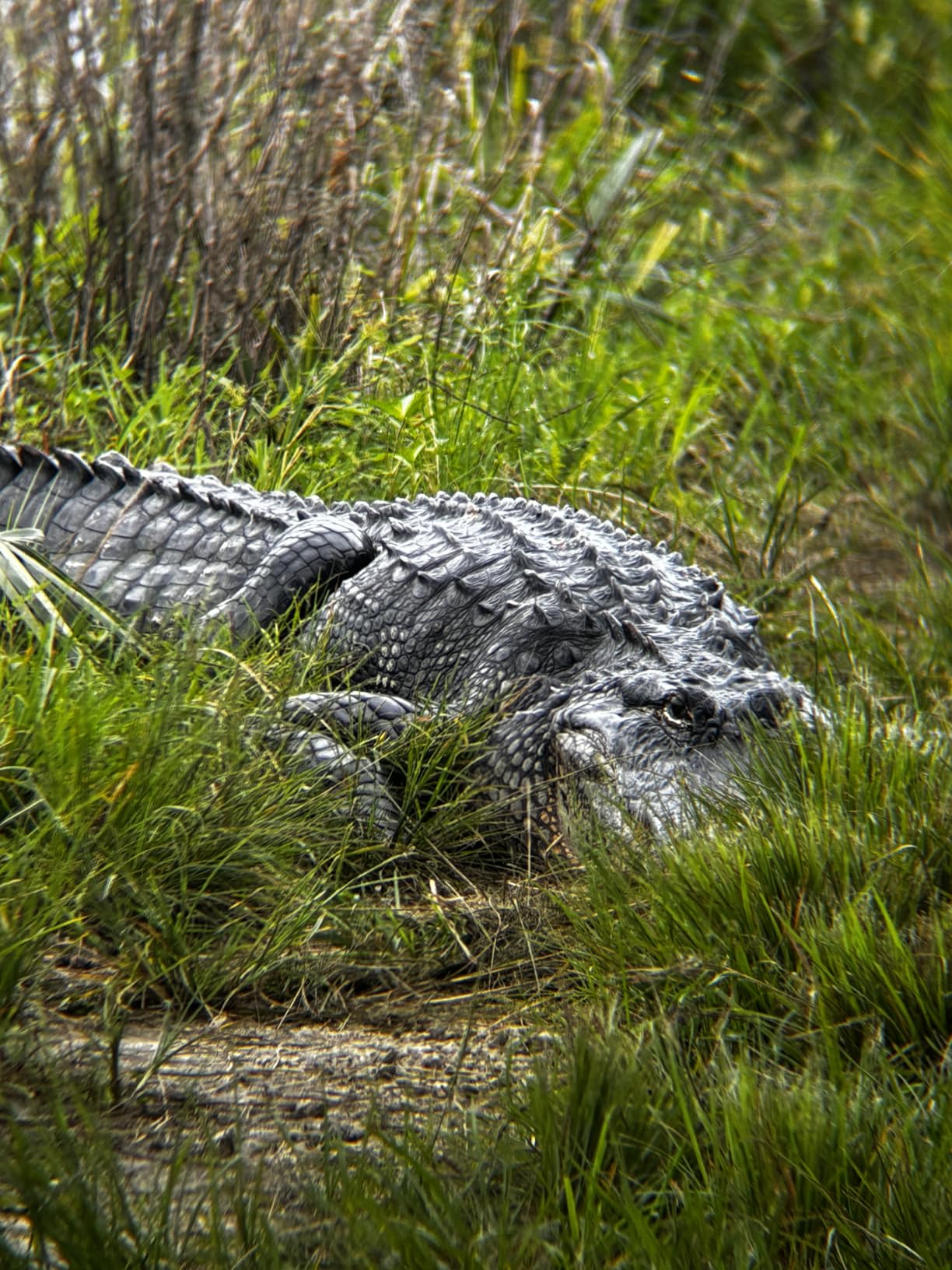
Against a flat sky, the 330 foot field of view is wide enough to follow a pigeon or a departing gull, and the center focus wheel pulls focus quickly enough for warblers in the canopy. Colour fringing is minimal on the subjects I tried, which reflects the HD glass elements doing their job.
The recurring gripes in reviews are consistent enough to plan around. Eye relief is 15mm, so glasses wearers may need the eyecups twisted down to see the full field. At 10x, tracking a bird in flight brings visible hand shake, and the focus wheel can feel stiff before it breaks in.
When this is the right upgrade
Choose this if you already know what a birding binocular should do and want brighter, more saturated glass without moving to a full premium tier. It also travels better than most of the list, which makes it a good choice for a trip where weight counts.
If your priority is tracking birds in flight rather than studying perched ones, consider an 8×42 instead. The wider field of the lower power will keep a moving bird in view longer.
Where it falls short
Magnification is 10x, so if you have never used power above 8x this is the pair to learn on. Glasses wearers should also check the eye relief before committing.
3. Celestron Nature DX 8×42 – A Wide View for Scanning
Celestron Nature DX 8×42 Waterproof Binoculars for Bird Watching & Outdoors
8x magnification
42mm objective
17.5mm eye relief
7.4 degree field of view
Pros
- 8x power with the widest field in this group
- Phase-coated BaK-4 prisms for bright daytime views
- Light enough to wear around the neck all day
- 17.5mm eye relief works well with glasses
- Limited lifetime US warranty
Cons
- Dimmer in heavy shade and at dusk
- Eyecup screws can loosen with daily use
- Some chromatic aberration against premium glass
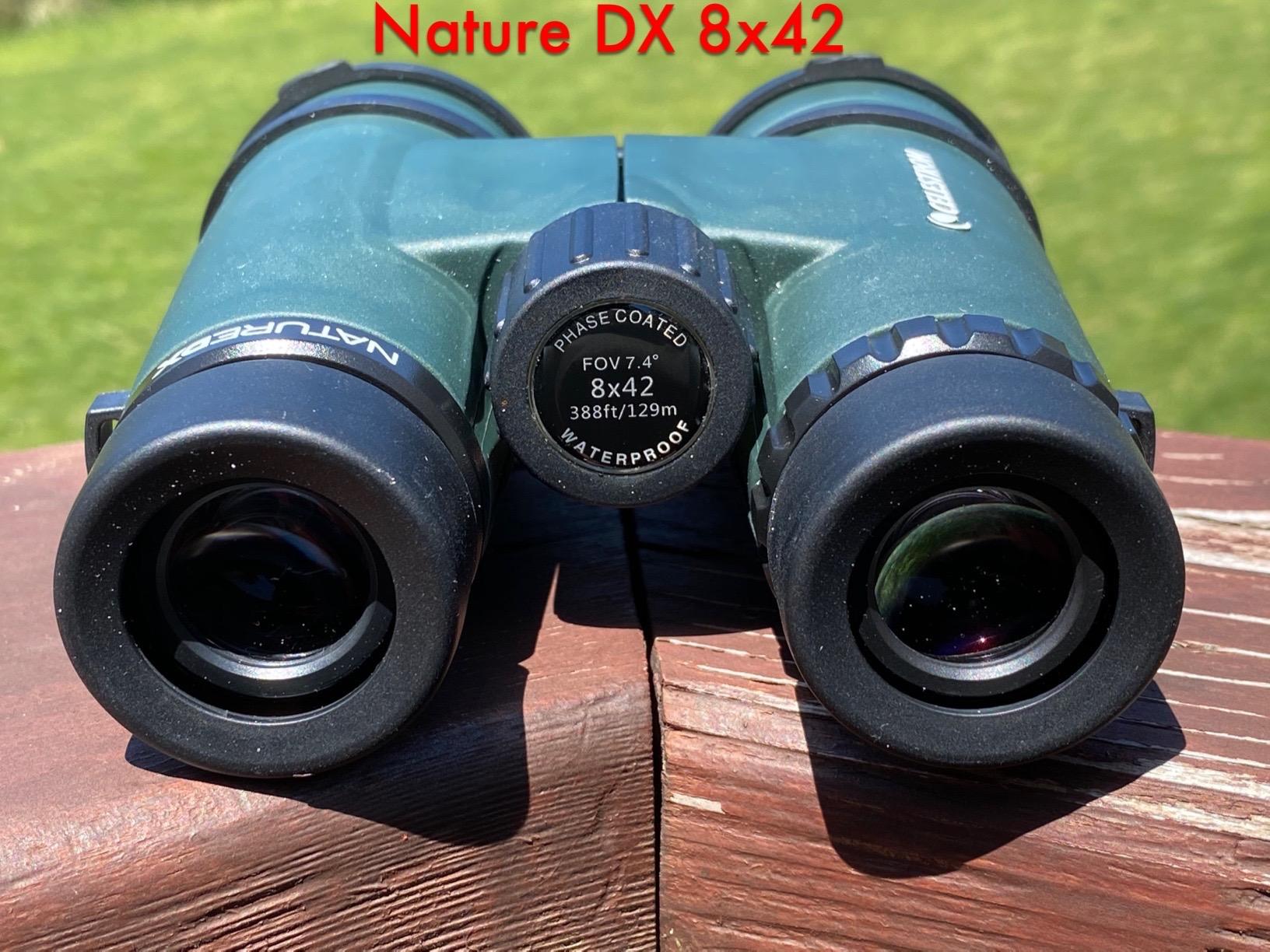
If your birding involves scanning, this is the pair I kept reaching for. Steady 8x power and a 388 foot field of view make finding a bird and then keeping it centred much easier, because a view this generous leaves room for you to spot the next movement while the first bird is still on screen.
The optics use fully multi-coated lenses with phase-coated BaK-4 prisms. BaK-4 is the higher-grade prism glass, and in daylight that shows as a bright, contrasty image with neutral colour on the warblers that work the brambles.
Individual focus means both barrels sharpen separately, which is a small annoyance if you wear different prescriptions but fine for most people. The housing is rubber-armoured polycarbonate, waterproof and nitrogen purged, with a built-in tripod adapter socket for digiscoping.
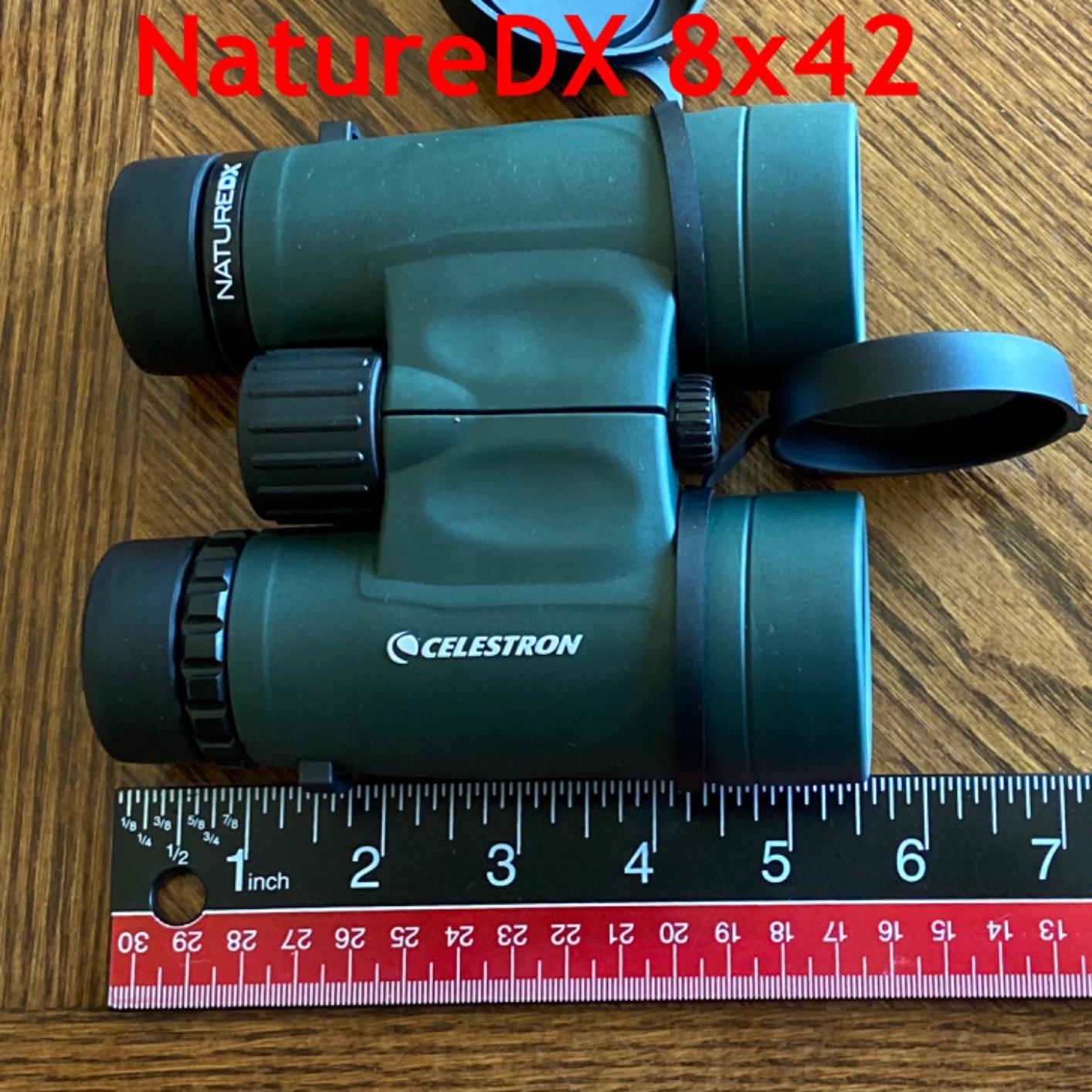
The 17.5mm eye relief is one of the better figures among 10x pairs and among the better ones overall, and it makes this a comfortable choice for glasses wearers. Long sessions are easier when you are not constantly repositioning the eyecups to find the edge of the field.
Low light is where it is honest about its limits. Owners describe noticeably dimmer images under heavy canopy and at dusk, and I saw the same thing on an overcast estuary where a higher-transmission pair simply held more detail. There is also some visible colour fringing on high-contrast subjects compared with ED-glass models.
Why wide field beats extra power for most birders
The wider view is what you notice first, and after a week with a narrower pair the difference becomes obvious. Steady 8x power means a bird that flushes from cover stays in frame instead of sliding out of it, which is why 8x pairs dominate birding lists even when 10x sounds more impressive.
The 388 foot field also makes group work easier. Wading through a flock, or following a mixed group at a feeder, keeps more birds in frame than any other pair here.
Where it falls short
If your birding is concentrated at dawn and dusk, or in deep woodland shade, brightness matters more than field of view. For that, an ED-glass pair such as the ZEISS Terra ED is the better tool. A minor build note: some owners report the small internal eyecup screws loosening over long daily use.
4. Vortex Triumph HD 10×42 – Full-Size Optics on a Budget
Vortex Triumph HD 10×42 Binoculars
10x magnification
42mm objective
17mm eye relief
Tripod adaptable
Pros
- HD optical system with fully multi-coated lenses
- 17mm eye relief is generous for the price
- Nitrogen purged shockproof polycarbonate body
- Adjustable eyecups with a wide diopter range
- GlassPak harness and case in the box
Cons
- 2.3 lb weight tires the neck over a long day
- 10x power produces more image shake than an 8x
- Edge sharpness trails dedicated 8x42 models
The Triumph HD exists to answer a simple question: can you get a full-size 10×42 with HD glass without moving up a tier? For most purposes, yes. Sharpness is good, colour is neutral, and the fully multi-coated lenses hold up well in open daylight.
Eye relief is the surprise. At 17mm this is one of the more generous figures among the 10x pairs here, and it makes the Triumph noticeably easier to use with glasses than either Vortex 10x above it. The diopter adjustment range is wide too, which helps if your eyes differ.
Construction is a shockproof polycarbonate chassis with full rubber armour, nitrogen purged and sealed, and it comes with a GlassPak harness and case rather than a basic strap.
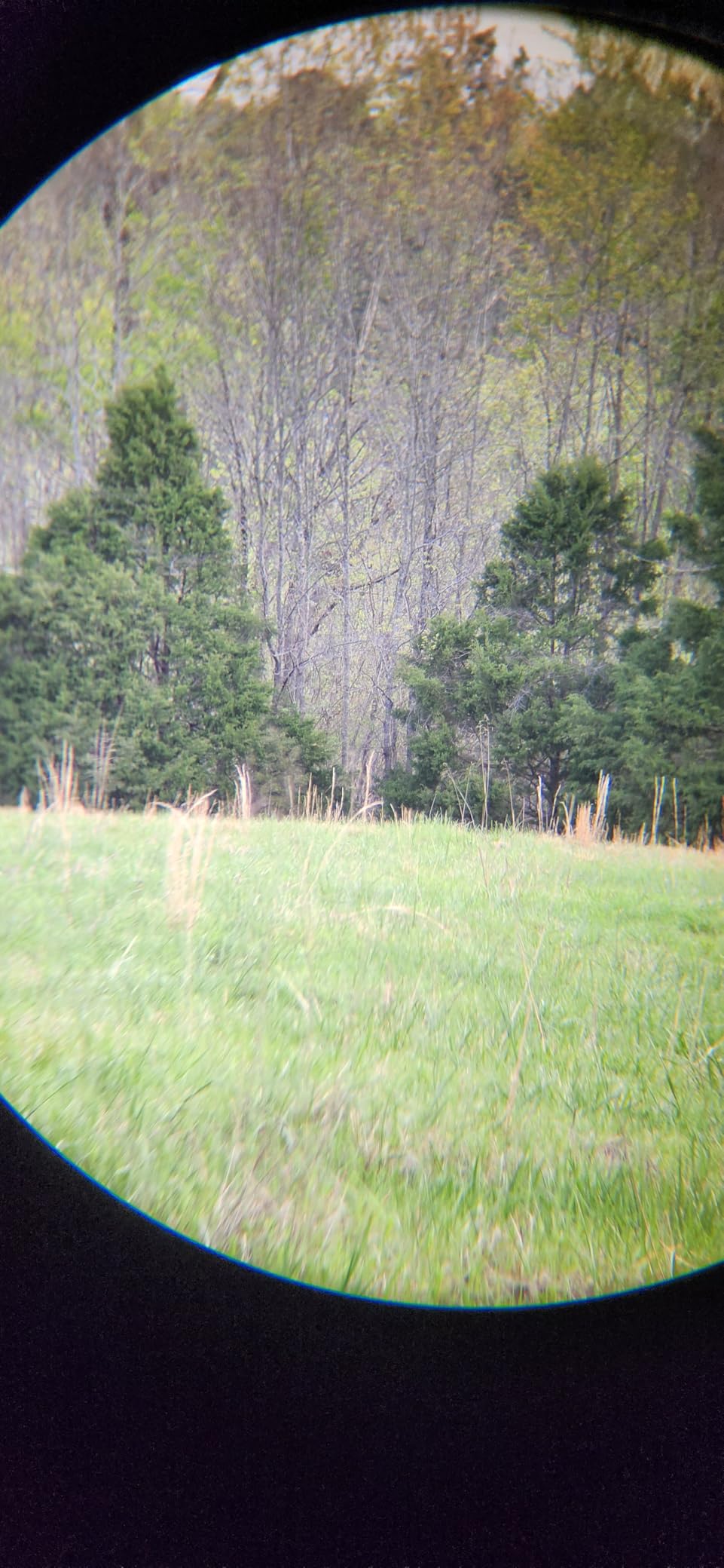
The body is 2.3 pounds, noticeably heavier than most binoculars in its class, and that is the first thing you feel on a long walk. It also compounds the hand shake that 10x power brings, which is why some owners lean on a tripod rather than panning with it.
Edge sharpness and overall brightness both trail dedicated 8×42 models, and the fully rubber construction feels less refined than a metal-armoured body in hand. For long sessions, a lighter 8x pair is the more comfortable tool.
When this makes sense
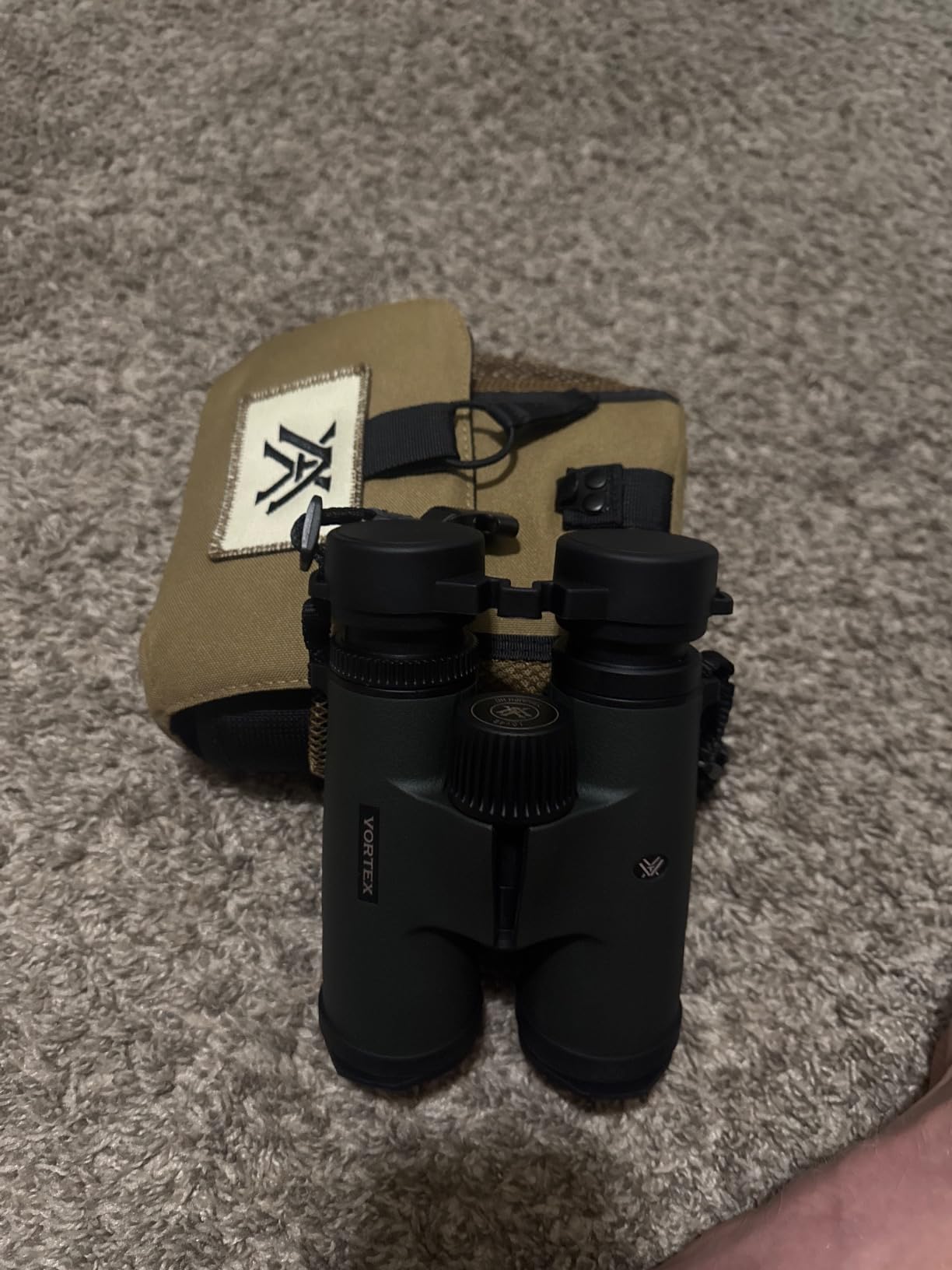
This is the binocular for someone who wants 10x reach, generous eye relief and a complete kit at the lower end of the full-size market. It also works well as a static setup on a tripod for a garden feeder or a water hide where you are not moving.
If you will be walking all morning and wearing glasses, both the weight and the 10x power are worth reconsidering against a lighter 8×42 such as the PROSTAFF P3.
Where it falls short
Weight is the headline drawback, followed by the combination of 10x power and that weight. It is a solid pair, but it is not the comfortable all-day choice, and edge quality at the field edge is not at the level of the Diamondback or the ZEISS.
5. Adasion 12×42 Binoculars with Phone Adapter – Best for Digiscoping
12×42 Binoculars for Adults High Powered with Phone Adapter & Tripod
12x magnification
42mm objective
13.6mm eye relief
367 yard field of view
Pros
- 12x power with a 367 yard field of view
- Universal phone adapter and tripod in the box
- BaK-4 prisms with fully multi-coated lenses
- IPX7 waterproof with twist-up eyecups
- Crossbody case with a phone pocket
Cons
- 12x causes heavy shake without the tripod
- 13.6mm eye relief narrows the view with glasses
- Softer edges with visible color fringing
- Small focus wheel is hard to grip
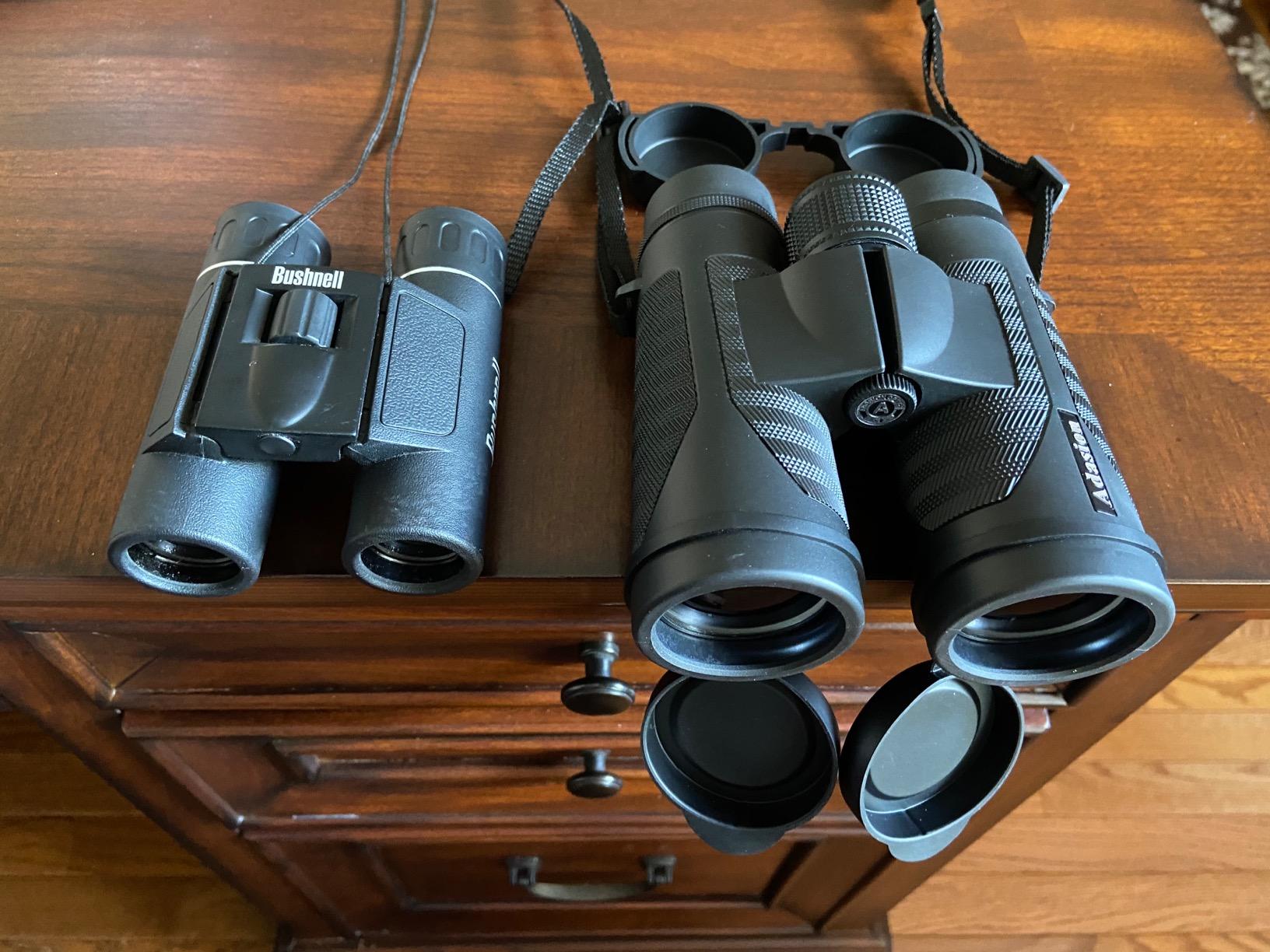
What makes this pair unusual is the bundle. A universal smartphone adapter and a small extendable tripod come in the box, which means you can start photographing birds through the glass without buying a separate adapter first. That is the whole point of the design.
Optically you get 12x magnification with a 42mm objective, BaK-4 prisms and fully multi-coated lenses, spread across a 367 yard field of view. That combination reaches distant birds and distant scenery, and on the tripod the image is steady enough to frame a perched songbird without much fuss.
At 1.2 pounds it is light for what it offers, with a non-slip rubber grip and IPX7 waterproofing that survives being dropped in water. Twist-up eyecups adjust the eye relief between 13.6mm and 19.6mm depending on how far down you push them.

Handheld, 12x is the problem. Hand shake is heavy and continuous, and its 13.6mm eye relief is the tightest figure among these twelve, so glasses wearers see less of the scene. The edges are also softer than premium glass with visible colour fringing, and the small center focus wheel is fiddly with cold or wet fingers.
The owners who rate this highly tend to be the ones who mount it on the tripod and use it for scenery, travel and casual birding rather than tracking birds in flight. Set expectations accordingly and it is genuinely capable.
When to choose a bundled phone adapter
Digiscoping is the reason to buy this pair. Most phone adapters clamp onto an eyepiece and cost extra, so having one plus a tripod in the box removes the two most common reasons beginners never get started with bird photography.
Anyone recording landscapes, distant waterbirds or a garden feeder will get usable results. Close, fast-moving birds in low light are harder, because a smartphone adds no light of its own.
Where it falls short
Handheld birding is not this binocular’s strength. The combination of 12x power, narrow eye relief and soft edges makes it a poor tracking tool compared with any of the 8×42 pairs here, and the two-year warranty leaves you with less long-term cover than several rivals in this roundup.
6. Celestron Outland X 8×42 – A Simple First Pair
Celestron Outland X 8×42 Binoculars for Birding & Nature Viewing
8x magnification
42mm objective
17.8mm eye relief
7 degree field of view
Pros
- Wide 7 degree field of view at a steady 8x
- BaK-4 prisms with multi-coated lenses for daylight clarity
- 17.8mm eye relief suits glasses wearers
- Waterproof and nitrogen-purged rubber-armored body
- Carrying case and strap included
Cons
- Dim views in shade and at dusk
- Twist-up eyecups collapse under pressure
- Focus wheel picks up slack when reversing
- Chromatic aberration and soft edges versus premium glass
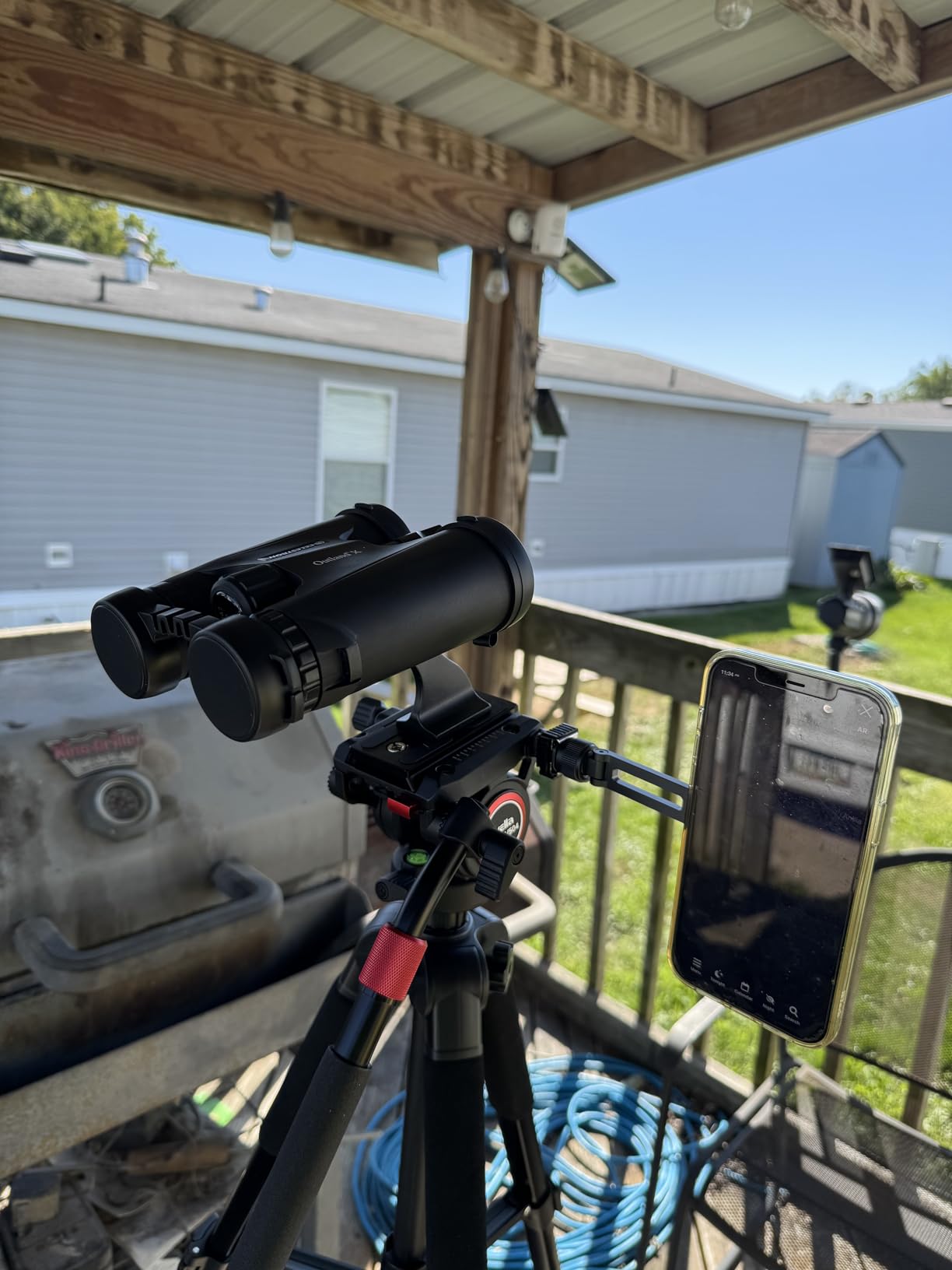
The Outland X is the pair I would suggest to someone who has never held binoculars and is worried about spending too much before knowing what suits them. It does the fundamentals well: 8x magnification, a 42mm objective, a 7 degree apparent field of view, and BaK-4 prisms behind multi-coated lenses.
None of that is exotic, and that is the point. In daylight the image is bright and contrasty enough to identify common garden birds without any adjustment beyond focusing. The body is rubber-armoured polycarbonate, waterproof and nitrogen purged, with threaded tripod sockets at the base.
Eye relief of 17.8mm is genuinely useful for a first pair, because most beginners wear glasses and the twist-up eyecups let you find the full field quickly.
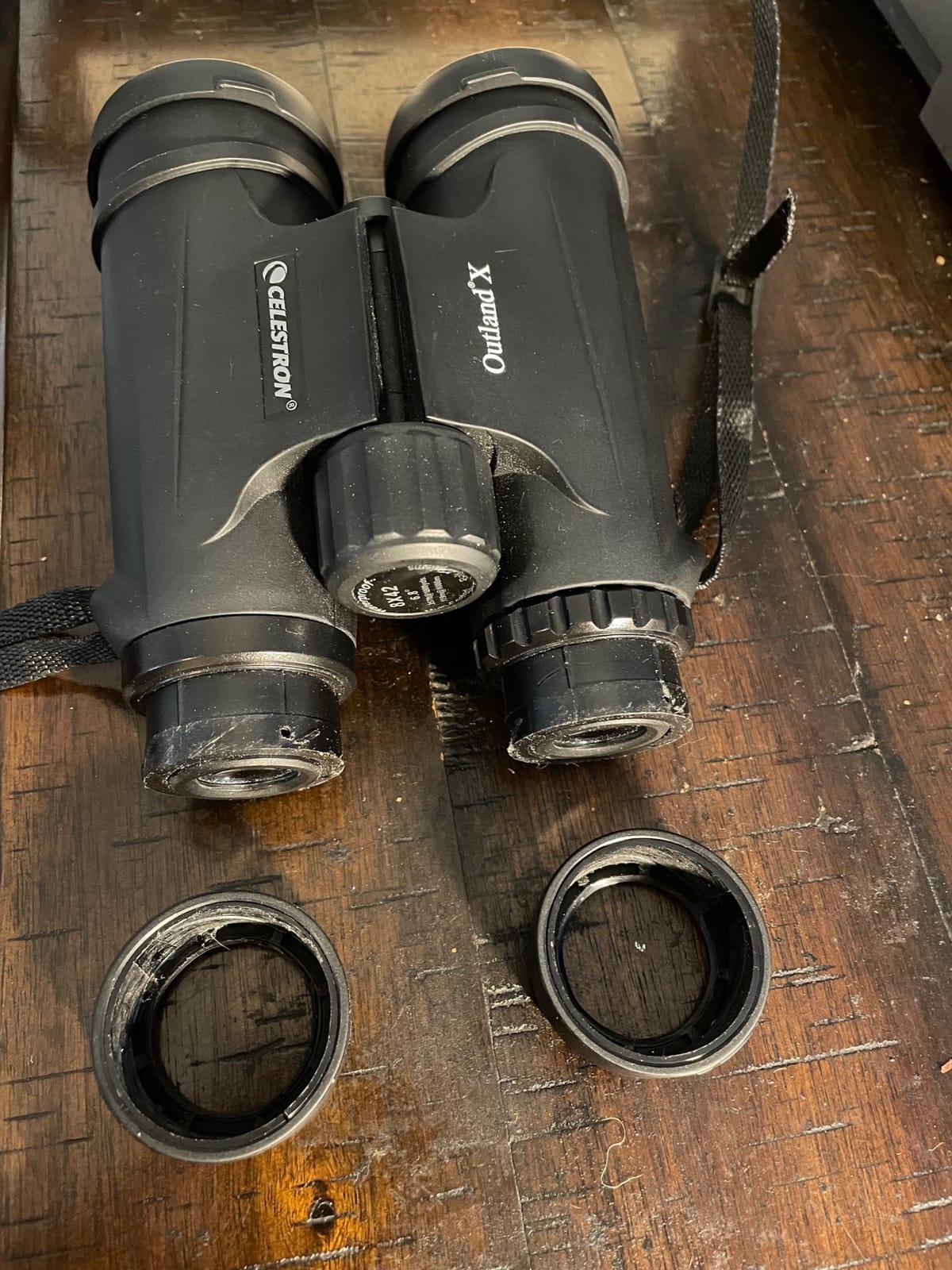
Light gathering is the weak point. Owners regularly note darker, less detailed images under canopy and at dusk, and light transmission trails newer glass across this list. Colour fringing and softer edge sharpness also show up next to ED-glass models on high-contrast subjects.
Two build details are worth knowing: the twist-up eyecups are sensitive and collapse if pressed hard against the face, and the focus wheel can pick up a little slack when you reverse direction. Neither is serious, but both are things you notice in the first ten minutes.
What a first pair needs to get right
A starter binocular has one job: make birds look clear and let you follow them without fuss. The Outland X does exactly that, with 8x power that stays steady in the hand and a wide field for scanning. Simple controls matter more at this stage than exotic coatings.
The included padded strap and case mean you can start walking with it immediately, and the two-year warranty is shorter than the lifetime coverage most rivals offer.
Where it falls short
If you know you will bird at dawn, in woodland shade, or for many hours a day, move up. The dim image in low light is the reason owners eventually upgrade, and a pair like the PROSTAFF P3 or the Diamondback HD holds far more detail in the same conditions.
7. Nikon PROSTAFF P3 8×42 – Best for Glasses Wearers
Nikon PROSTAFF P3 8×42 Binocular | Waterproof, fogproof, rubber-armored Full-Size Binocular, wide field of view & long eye relief | Official Nikon USA Model
8x magnification
42mm objective
20.2mm eye relief
377 ft field of view
Pros
- 20.2mm eye relief with turn-and-slide eyecups
- Steady 8x view with no distracting shake
- Bright at dawn and dusk for its class
- Waterproof and nitrogen-purged rubber-armored body
- Nikon limited lifetime warranty
Cons
- Diopter adjustment ring is stiff to set
- Strap lacks a fixed loop and needs shortening
- Minor fringing near bright sky at the edge
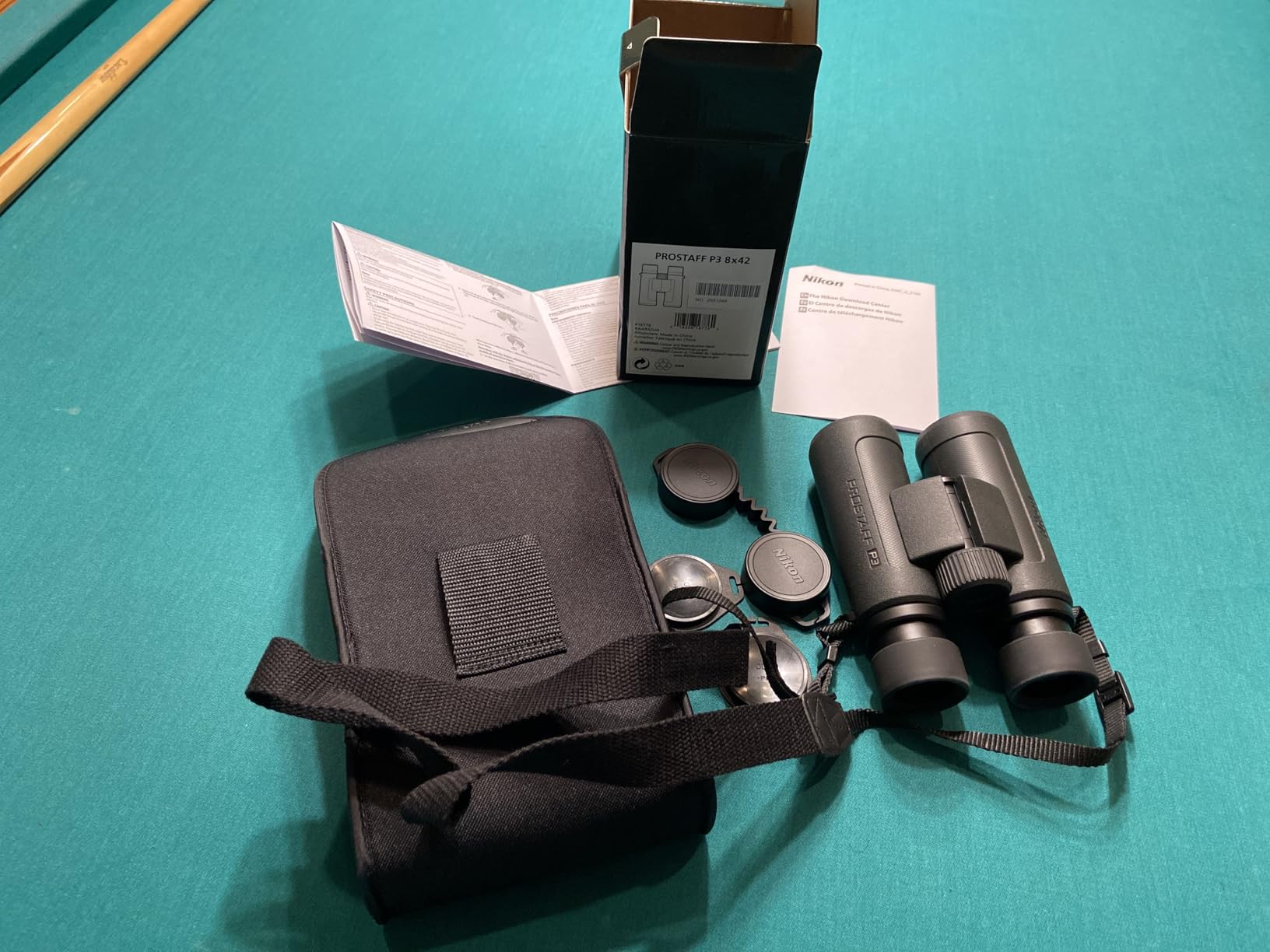
Eye relief is the number that decides whether you can use binoculars at all if you wear glasses, and 20.2mm is the longest published figure among these twelve. Combined with the turn-and-slide eyecups, it means the full field is visible without pressing your face against the glass or clipping the frame.
On top of that, 8x magnification keeps the image steady. I tracked a thrush moving along a fence line and a flock wheeling over a field without the shake that makes 10x pairs frustrating, and the 377 foot field of view was wide enough to keep the flock in frame.
The optics are multilayer-coated with a silver-alloy prism coating over lead- and arsenic-free Eco-Glass, and Nikon reports bright images at dawn and dusk. The body is fiberglass-reinforced polycarbonate with rubber armour, at 1.3 pounds.
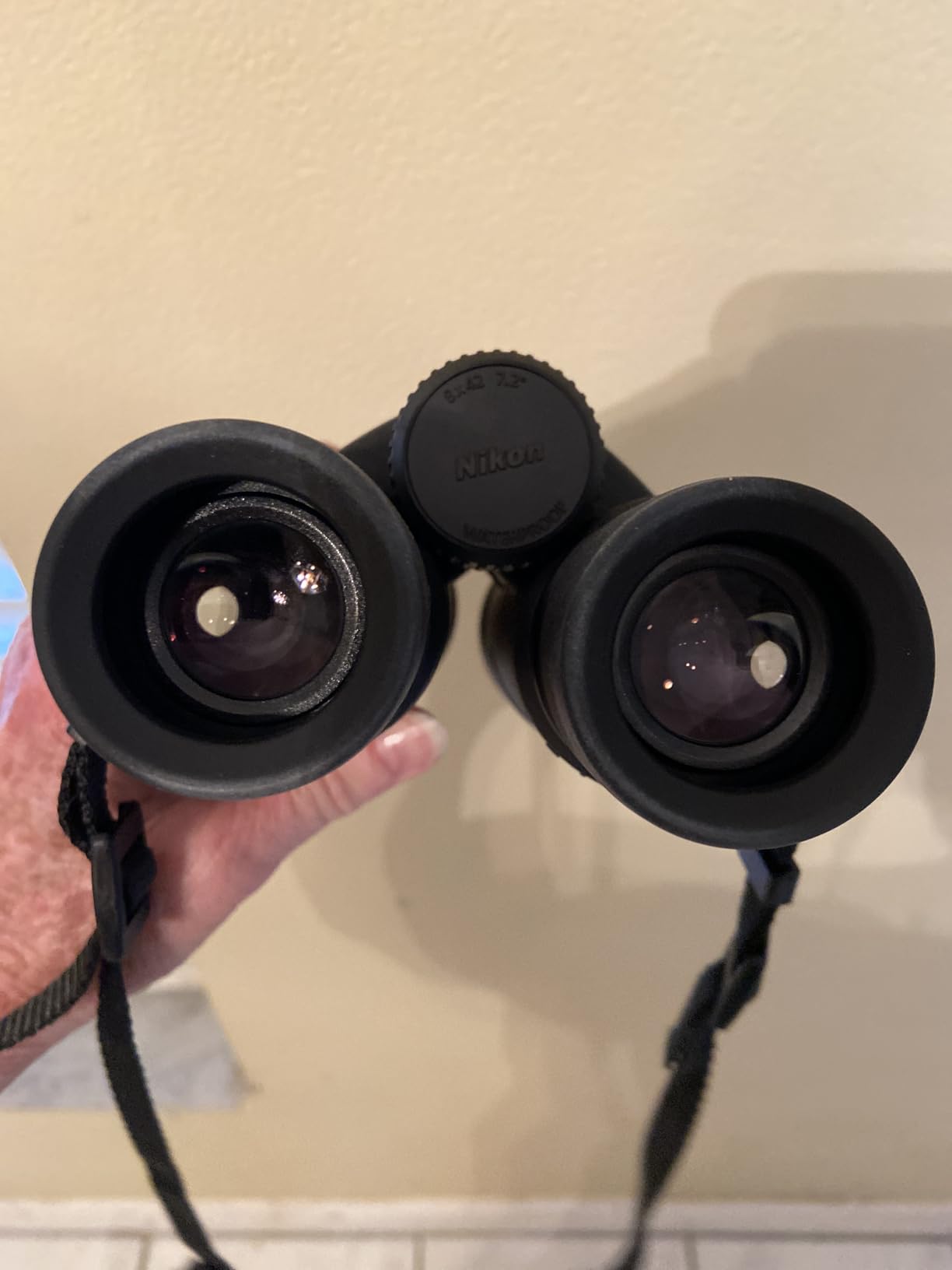
Owners consistently describe this as the balanced point in Nikon’s range, with the durability and clarity of the models above it at a far lower outlay. The limited lifetime warranty is a further reassurance on a pair you may keep for decades.
The criticisms are ergonomic rather than optical. The diopter ring is stiff and takes effort to set, and the supplied strap has no fixed loop, so the slack dangles unless you tie or clip it. I saw minor colour fringing near bright sky at the edge of the field, which is normal for this class of glass.
Why eye relief changes the whole experience
If your frames sit close to your eye, a pair with 15mm of eye relief makes you fight the eyecups for the edge of the view. At 20.2mm you simply twist the eyecups down and look. It is the single change that makes glasses wearers give up on birding, so it deserves more weight than most roundups give it.
Paired with 8x power, this is also the most comfortable way to spend five hours scanning a hedgerow or a wetland edge without neck and eye fatigue.
Where it falls short
The multilayer coating sits a step below Nikon’s fluorite glass, so contrast under harsh light is not quite at the level of the Monarch M5. There is also no zoom or interchangeable eyepiece, so you are locked to 8x.
8. Nikon Monarch M5 8×42 – Cleanest Edges in the Lineup
NIKON Monarch M5 Binoculars | Waterproof Fogproof ED Glass Optics with Dielectric Prism Coating | Bright High-Resolution Outdoor Binoculars for Birdwatching, Hiking & Wildlife, 8×42
8x magnification
42mm objective
19.5mm eye relief
Close focus 8.2 ft
Pros
- ED glass cuts color fringing at the field edge
- Dielectric prism coating for bright natural color
- Wide field of view in an 8x42 body
- Close focus to 8.2 ft for near songbirds
- 19.5mm eye relief with click-stop eyecups
Cons
- Costs more than mid-tier 8x42 models
- Rubber armour adds bulk versus slimmer designs
- Premium coatings can flare toward a low sun
The Monarch M5 is where extra-low dispersion glass earns its place. ED lenses reduce chromatic aberration, which is the purple and green fringing that cheap glass sprays around high-contrast subjects like a branch against a bright sky. On the treeline and reed bed scans I did with this pair, the edges stayed clean.
The phase-corrected dielectric coating on the prisms pushes light through rather than reflecting it away, and the combination produced a neutral, true-to-life colour with none of the edge smear you get from single-coated budget glass. Identification depends on spotting small field marks, and neutral colour helps more than almost any other feature.
Close focus reaches 8.2 feet, which is enough for a perched songbird in a hedge but not quite butterfly range. Eye relief is 19.5mm with twist-up click-stop eyecups, so glasses wearers are well served, and the closed-bridge nitrogen-purged body is sealed and fogproof.
The wide field of view makes birds in flight easy to locate and follow, and at 1.4 pounds the weight is not an issue on a normal walk. The large center focus knob is easy to find with cold fingers and moves smoothly.
The tradeoff is cost. This is a considerably more expensive 8×42 than the models above it, and owners generally frame it as a splurge for serious birders rather than a necessity. The rubber armour also adds bulk compared with slimmer 8×42 designs, and pointing it toward a low sun can produce lens flare from the premium coatings.
Where ED glass genuinely changes the view
Colour fringing is easiest to see on a distant bird backlit by a pale sky, and it is most disruptive on small warblers where the fringe overlaps the field marks you are trying to read. ED glass keeps that fringe down, which makes identification measurably less effortful.
If your birding is concentrated at distance, in mixed light, or in woodland where colour contrast carries the identification, this is the step that makes the biggest difference.
Where it falls short
Magnification is fixed at 8x with no zoom and no interchangeable eyepieces. You also pay for a level of optical refinement that a first pair does not need, and if you are mainly counting warblers in a bramble at close range, the Vanguard Endeavor ED gives you the same 8.2 foot close focus in a cheaper package.
9. ZEISS Terra ED 10×42 – Brightest in Low Light
ZEISS Terra ED Binoculars 10×42 Compact, Waterproof and Fast Focusing, Grey
10x magnification
42mm objective
88 percent light transmission
18mm eye relief
Pros
- Schmidt-Pechan ED glass with 88 percent transmission
- Hydrophobic coating keeps contrast high in rain and twilight
- Large fast focus wheel for quick tracking
- Compact 1.5 lb body packs into a day bag
- Transferable limited lifetime optics warranty
Cons
- 10x power causes visible shake when scanning
- Premium pricing sits well above mid-tier 8x42
- 4.2mm exit pupil looks dim in midday sun
If your birding happens at first light or in the last hour before dusk, transmission is the number that matters, and 88 percent is the highest published figure among these twelve pairs. Schmidt-Pechan ED glass plus a hydrophobic multi-layer anti-reflective coating is a serious low-light combination.
On an overcast estuary at first light, this was the pair that let me pick out distant waders when the cheaper 10x pairs had gone flat and grey. The hydrophobic coating also keeps contrast high in rain, when water on the front element would otherwise scatter light everywhere.
Focusing is the other standout. The large, fast wheel is easy to locate and grip with an index finger, which matters when a warbler drops into a hedge two metres from your face and you have half a second to catch it.
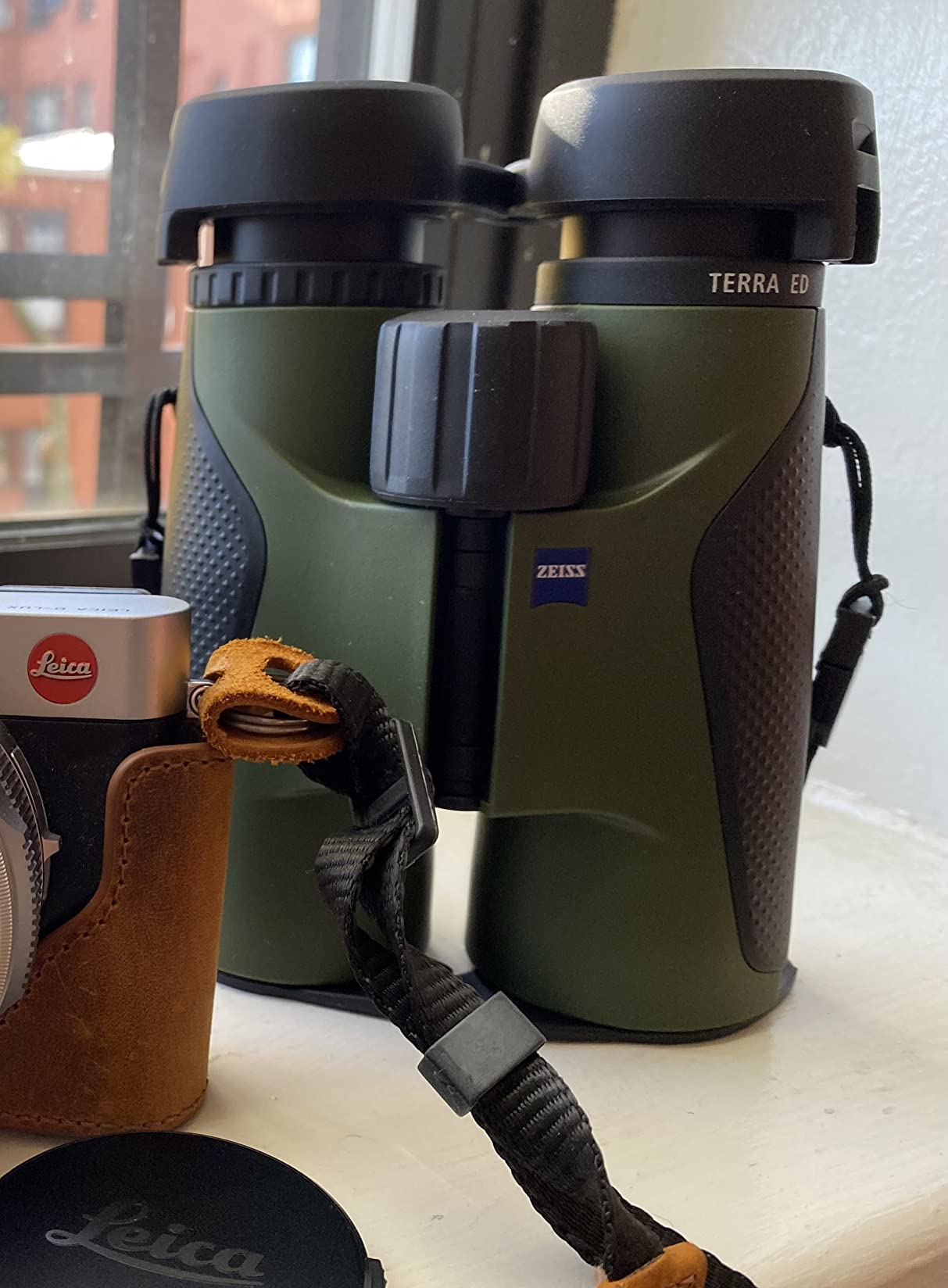
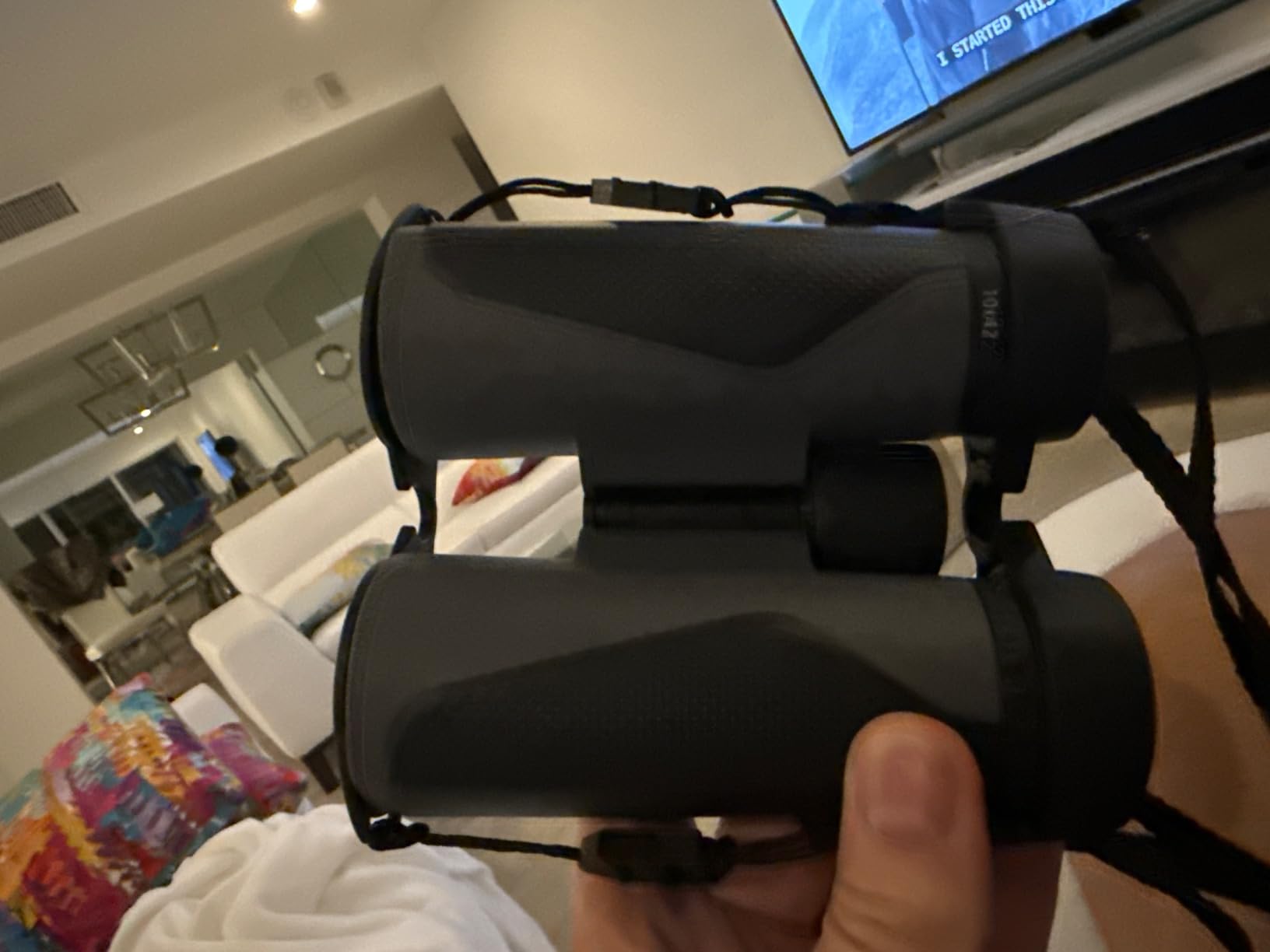
Physically it is compact for its class at 1.5 pounds with a waterproof reinforced casing, and the box includes an eyepiece cover, neoprene strap and carry bag. The optics carry a transferable limited lifetime warranty, which matters if you resell or hand them on.
The 10x power brings visible hand shake when scanning without support, which is the common reason owners pair it with a tripod. At 10x the exit pupil is 4.2mm, and pointing that beam into bright midday sun can look dim compared with the wide-field 8x pairs.
When dawn and dusk decide your birding
Light transmission is the quiet specification that separates a usable dawn pair from a frustrating one. Everything that reduces light loss, from ED glass to multi-layer coatings to the hydrophobic front surface, shows up as detail you can still resolve when the light drops.
For a regular early-morning or late-evening birder this is the pair that keeps working after the sun is down. For daylight walking birding it is overkill, and an 8×42 will be more comfortable.
Where it falls short
Handheld scanning at 10x is tiring, the fixed 4.2mm exit pupil is not ideal for midday use, and the cost sits well above the mid-tier 8×42 options you would otherwise consider. There is no zoom and no interchangeable eyepiece.
10. Vanguard Endeavor ED 10×42 – ED Glass With a Lifetime Warranty
VANGUARD Endeavor ED 10×42 Binocular, ED Glass, Waterproof/Fogproof, Black (ENDEAVOR ED 1042)
10x magnification
42mm objective
16.5mm eye relief
Close focus 8.2 ft
Pros
- ED glass with phase-coated BaK-4 prisms
- Close focus to 8.2 ft for near songbirds
- Focus travels about three-quarters of a turn
- Nitrogen filled and fogproof in the field
- Premium lifetime warranty
Cons
- Some fringing on backlit subjects despite the ED glass
- 10x42 narrows the view for glasses wearers
- Very sensitive focus wheel
- Heavier than comparable mid-tier pairs
The Endeavor ED is the middle of the mid-tier class: ED glass with phase-coated BaK-4 prisms, fully multi-coated optics, and a 340 foot field of view at 1000 yards. Owners consistently describe it as the best performance-per-dollar glass in its class, well below the Zeiss and Swarovski pricing.
Close focus is the feature that surprised me most. At 8.2 feet it resolves a songbird working a bramble from far enough away to fill the frame, without the mid-tier softness you usually accept at that distance. For a birder who spends time on warblers and finches rather than scanning for raptors, that is worth more than extra magnification.
The focus wheel travels roughly three-quarters of a turn from close to infinity, so you are never spinning endlessly to find a bird, and the open-bridge design with flattened thumb areas feels balanced and secure in one hand. It is nitrogen filled, waterproof and fogproof.
Twist-up eyecups and a locking diopter keep your settings stable between sessions, and the body is aluminium with a 1.6 pound weight. Owners report it surviving an overnight deluge without fogging, and the premium lifetime warranty is stronger than the two-year cover most rivals carry.
Two gripes come up repeatedly. Colour fringing still appears on backlit subjects even with ED glass, and the focus wheel is very sensitive, which makes fine adjustments on a distant bird tricky. At 16.5mm eye relief the view also narrows a little for glasses wearers.
Why close focus matters more than people expect
Most of a garden birding hour is spent on birds within ten metres, not on distant silhouettes. Close focus decides whether you see plumage detail on a warbler or only a shape. At 8.2 feet this pair reaches much closer than the typical mid-tier 10×42.
It pairs that with a lifetime warranty, which is unusual at this price and removes the main reason people hesitate on mid-tier glass.
Where it falls short
Its 16.5mm eye relief is a middling figure, so glasses wearers get a narrower view than with most pairs on this list. It is also heavier than comparable mid-tier binoculars, and the very sensitive focus wheel is a real handicap when you are dialing onto a distant bird. Some owners prefer Vanguard’s own 8.5×45 over this 10×42 for the wider view.
11. Hontry 8×42 Binoculars – Built for Boats and Rain
Hontry 8×42 Binoculars with IPX6 Waterproof Protection
8x magnification
42mm objective
15mm eye relief
318 ft field of view
Pros
- Floating IPX6 waterproof body built for water
- Close focus around 11 to 12 ft for near birds
- Resolves fine detail such as web strands at distance
- Twist-up eyecups work with or without glasses
- Padded shoulder bag included
Cons
- 1.6 lb is heavy for this price band
- Color accuracy and edges trail premium glass
- Strap is difficult to shorten
- Only one year of warranty coverage
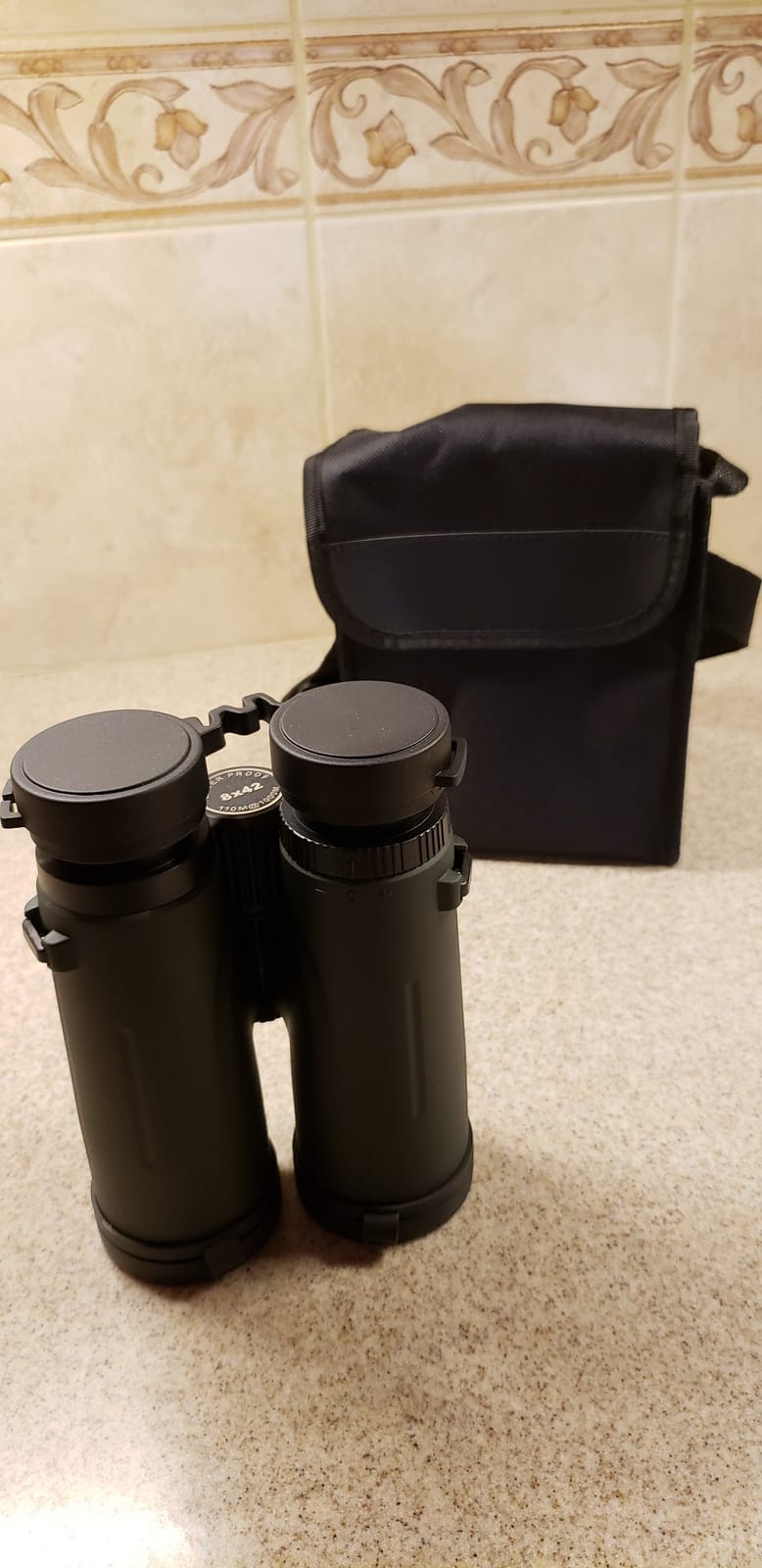
This is the marine pick. The body is IPX6 rated and floating, so if it goes over the side of a boat or into a kayak, it floats. That is a genuine safety and practicality advantage for anyone watching waterfowl, and no other pair in this roundup claims it.
Optically you get 8x magnification, a 42mm objective, anti-reflective coatings with a UV-protected lens, and a 318 foot field of view. Owners report it resolves fine detail, including web structures through the legs of a heron at distance, which is more than the price suggests.
Close focus around 11 to 12 feet beats what many budget binoculars manage, and the twist-up eyecups work with or without glasses. It comes with a fabric shoulder bag, lens cloth, protective cap and a quick start guide.
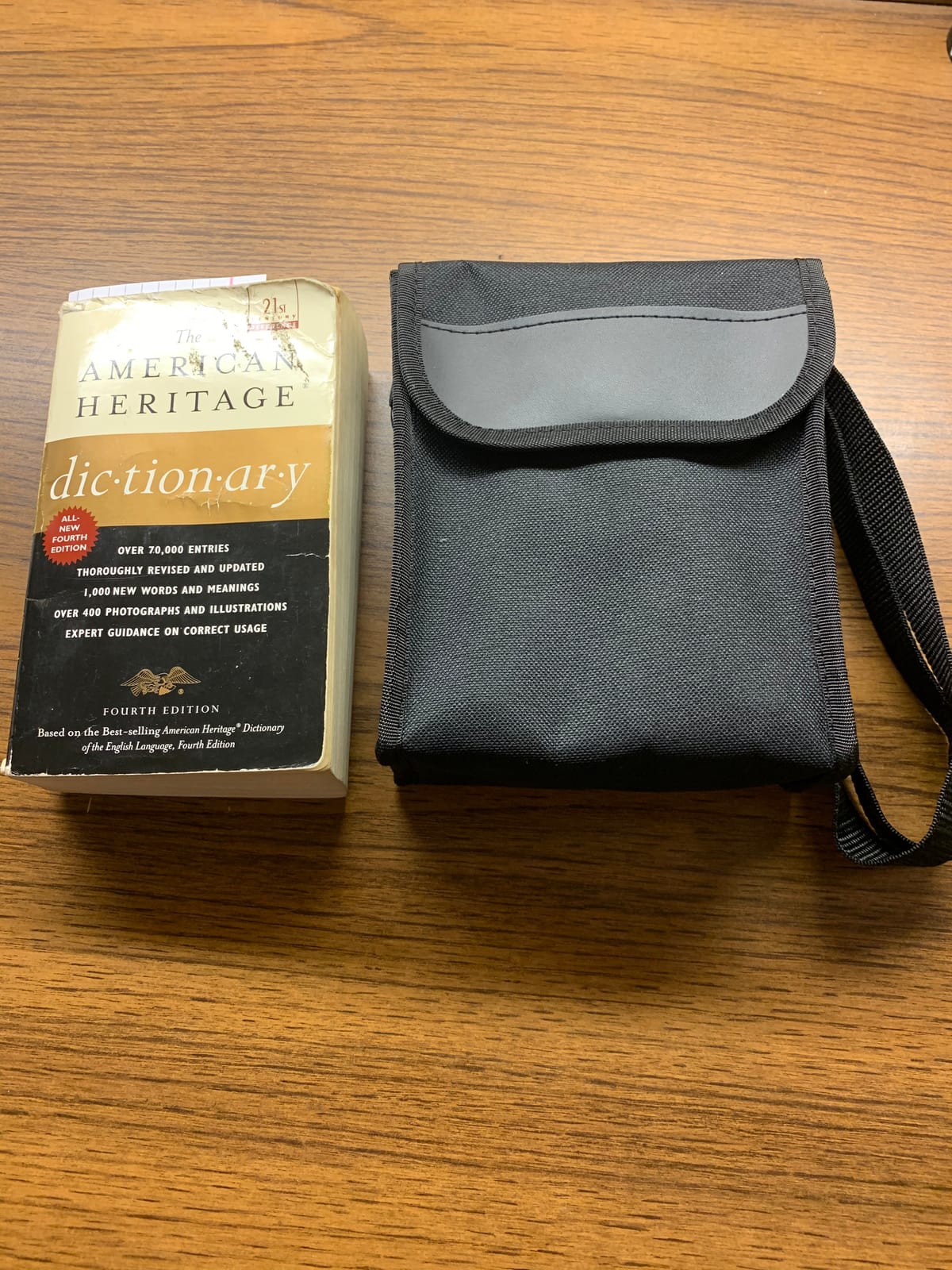
Several owners bought this after moving down from far more expensive glass and were pleasantly surprised by what they could resolve. The rubberised body gives a secure grip in wind or cold, and the balanced weight reduces hand tremor at 8x.
There are real compromises. Colour accuracy, edge clarity and low-light performance trail premium glass noticeably, and at 1.6 pounds it is heavier than most binoculars in its price band. The strap has no printed instructions and no easy way to shorten it, and the warranty runs for one year only.
When water is part of the equation
Boat trips, kayaking, estuary walks and standing water on a wetland reserve all have one thing in common: binoculars fall in. A floating, IPX6-rated body removes that risk entirely, and 8x power with a 318 foot field is well suited to scanning a wide expanse of open water for distant flocks.
It is also a reasonable first pair for dry-land birding, which is why several owners upgraded from it once their hobby grew.
Where it falls short
Optically it sits at the budget end. Sharpness at the field edge and colour fidelity are well short of anything with ED glass, and the short one-year warranty plus an awkward strap are details that matter more if you use it hard.
12. Bushnell H2O 8×42 – A Rugged Family Pair
Bushnell H2O 8x42mm Binoculars, Waterproof and Fogproof Binoculars for Boating, Hiking, and Camping, Multi Blue
8x magnification
42mm objective
17.5mm eye relief
350 ft field of view
Pros
- IPX7 O-ring sealed and fogproof in heavy rain
- Fully multi-coated glass with BaK-4 prisms
- 8x42 with a steady 350 ft field of view
- Soft-touch housing with grip runners for small hands
- Backed by the Ironclad warranty
Cons
- About 2 lb feels heavy on a long walk
- Objective lens caps can slip off despite the tether
- Thin strap with little adjustment
- Basic carrying case
The H2O is the pair to hand to a child or to anyone learning on a family walk. The soft-touch rubber housing has grip runners on the sides and bridge, which gives a small hand something to hold onto, and at 8x with a 350 foot field of view it is stable enough for a beginner to find a bird and keep it in frame.
Weather sealing is the serious part. IPX7 O-ring sealed optics have survived being dropped into standing water and heavy tropical rain, and the body is nitrogen purged so internal fogging is not a concern. For family birding in changeable weather, that durability is worth more than extra magnification.
Fully multi-coated all-glass optics with BaK-4 prisms give bright, high-contrast images in daylight, and the twist-up eyecups adjust easily for smaller faces and for glasses.
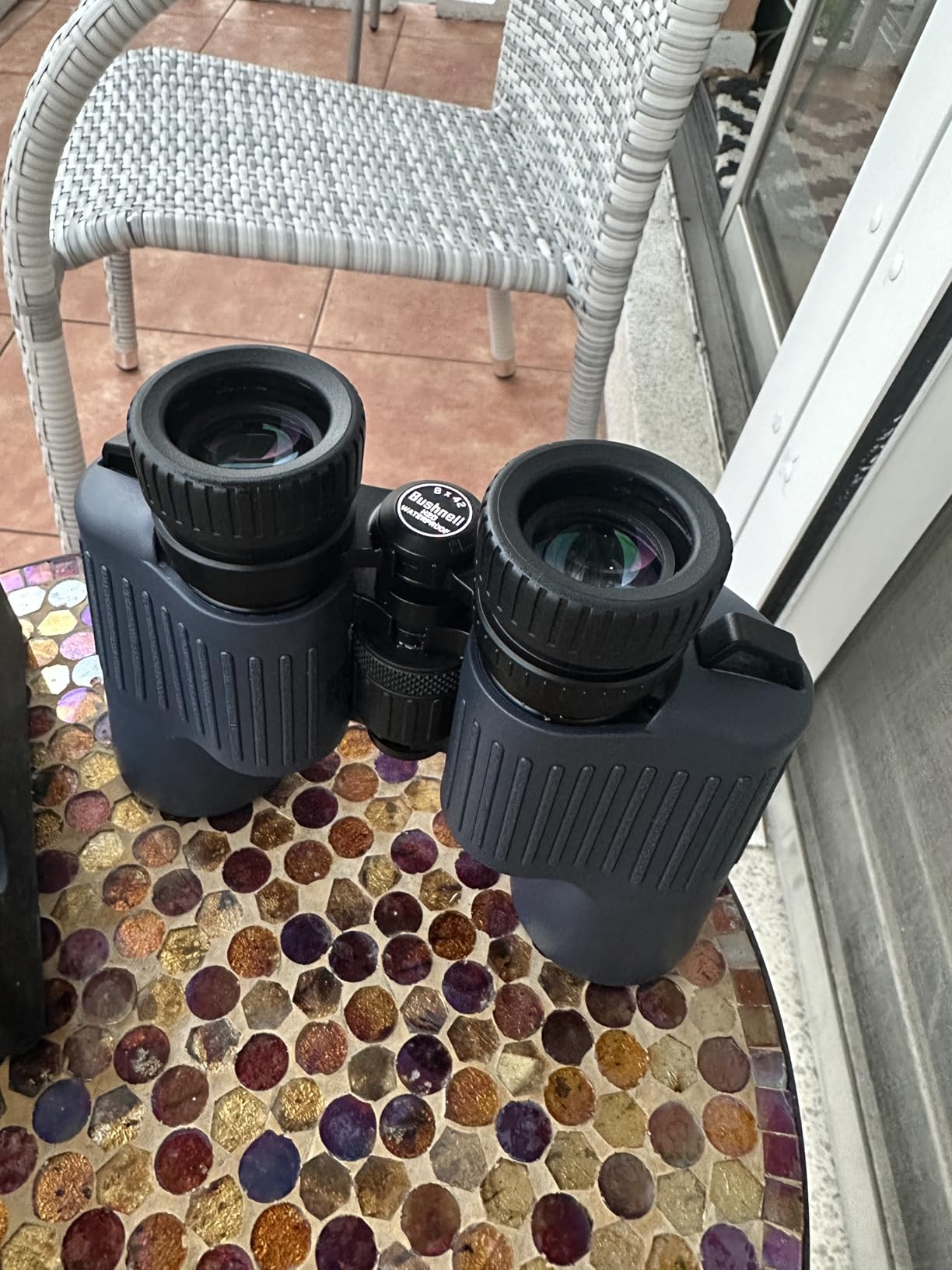
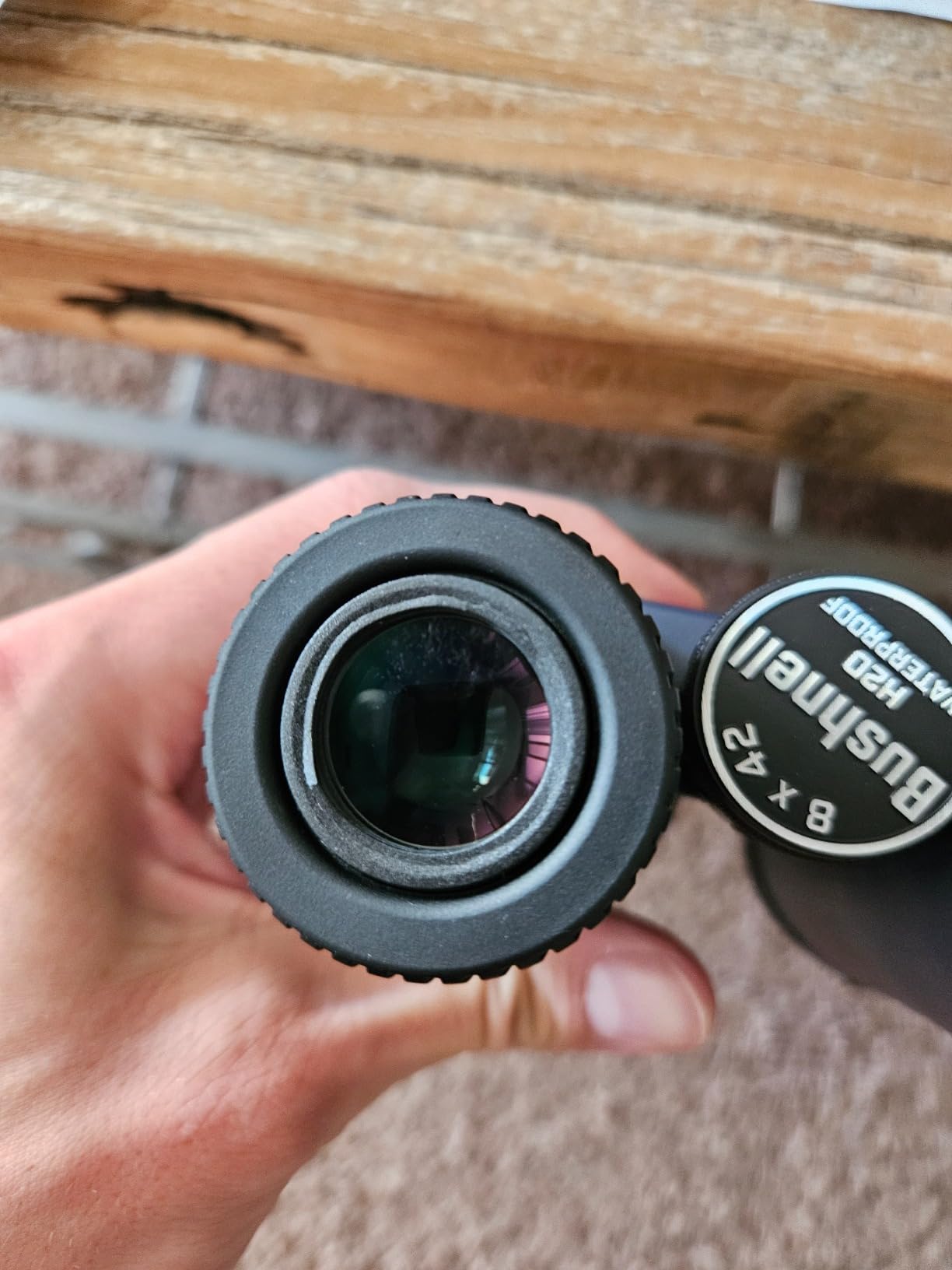
Owners describe it as a durable workhorse that is clear enough to identify small warblers at close range, and the soft-touch body stays secure in wet hands. It is backed by Bushnell’s Ironclad warranty and a brand with a long optics heritage.
Carrying comfort is the complaint. At roughly two pounds it feels heavy on an all-day hike, the supplied neck strap is thin with little adjustment so it swings as you walk, and the objective caps can slip off despite the tether. Stringing them on is worth doing before the first outing.
Best binoculars for kids, without the toy compromises
Children learn to bird better with real glass than with a plastic pretend pair, but they need something light in the hand, grippable, and impossible to break in a puddle. The soft-touch housing and grip runners do more for that than the magnification figure does.
For adults buying a shared pair for a garden feeder or a holiday, this is also a low-risk entry because the sealing is genuinely good and the warranty is strong.
Where it falls short
Weight and strap quality limit it for adult long-distance walking, and the carrying case is basic. Bushnell also warrants these as waterproof rather than submersible in all conditions, so they are for rain and splashes rather than a dunking.
How to Choose Binoculars for Bird Watching
What do the numbers on binoculars mean?
Take 8×42 as an example. The first number, 8, is magnification: a bird looks eight times larger than it does to the naked eye. The second number, 42, is the diameter of the front objective lens in millimetres, and it decides how much light you gather. A larger second number gives a brighter image. The two work together, so 8×42 and 10×42 gather identical light, and 8×50 is brighter than both.
Two derived numbers explain most of the rest. The exit pupil is the second number divided by the first, so 8×42 gives a 5.25mm exit pupil and 10×42 gives 4.2mm. Anything at or below the size of your pupil passes light efficiently, so an 8mm exit pupil looks brighter at dusk than a 4mm one. Eye relief, measured in millimetres, is how far the eyepiece sits from your eye while you still see the full field of view.
8×42 vs 10×42 vs 8×32: which power do you need?
Choose 8×42 as the default. Eight power produces a wider field of view, which means a bird you find stays in the glass longer, and it produces less hand shake because the image is magnified less. This is why 8x is the near-universal birding recommendation and why most experienced birders use 8x or lower for general work.
Choose 10×42 when you need to identify a distant bird across a large lake or a coastal reserve, or when your birding is mostly over open ground. The cost is a narrower field of view and more noticeable hand shake, so tracking a bird in flight is harder.
Choose 8×32 when weight matters, such as on long walks, flights, or with children. You lose a little light compared with 8×42, but you get a smaller, lighter shell. Avoid 12x and above for handheld birding; the shake becomes the limiting factor rather than the glass.
Field of view and close focus are what actually matter
Field of view is quoted in feet or yards at 1000 yards, or as an apparent angle in degrees. Across these twelve pairs the published figures run from 318 feet on the Hontry up to 388 feet on the Celestron Nature DX, with the majority clustered between 325 and 350 feet. That difference sounds small on paper, but a wider field means you spot more birds to begin with, so you spend less time searching and more time looking.
Close focus is the nearest distance at which the image stays sharp. Most of what you actually watch is within a few metres, so close focus decides whether a warbler in a bramble is a blur or a detailed subject. The Vanguard Endeavor ED and the Nikon Monarch M5, both at 8.2 feet, are the strongest here for near work.
Eye relief if you wear glasses
Treat anything below 16mm as tight and anything above 19mm as comfortable. In this group the two 10x Vortex pairs sit at 15mm, which means twisting the eyecups down to see the full field, while the Nikon PROSTAFF P3 at 20.2mm and the Monarch M5 at 19.5mm are the easiest with frames on.
Field of view is measured at the centre of the image. Some binoculars fall off at the edges, so a nominal field can understate how much you can actually see while wearing glasses. If you can, try a pair before buying.
Roof prism vs porro prism, and what ED glass buys you
Almost every binocular in this list uses a roof prism design, which is more compact and better sealed, at the cost of needing good coatings to reach the same brightness. Porro prisms generally give a brighter, more three-dimensional image but are bulkier and harder to seal, which is why they have largely disappeared from modern birding glass.
Prism grade also matters. BaK-4 is the higher-grade prism glass found on the Celestron Nature DX, the Outland X, the Vanguard Endeavor ED, the Adasion pair and the Bushnell H2O. Fluorite is rarer and more expensive. ED glass, extra-low dispersion, reduces the purple and green fringing around high-contrast subjects, and it is the reason the Nikon Monarch M5 and ZEISS Terra ED hold cleaner edges than their price-band rivals.
Coatings do the rest of the work. Fully multi-coated lenses and phase-corrected dielectric prism coatings recover light that would otherwise be reflected away, which is what determines whether a pair is usable at dawn and dusk or only at midday.
Budget tiers and when to upgrade
The entry tier sells you magnification, weather sealing and a usable field of view, and very little else. Pairs like the Adasion 12×42 and the Hontry 8×42 are honest, capable tools at that level, and they are the right first purchase for children, casual walking, or a gift.
The mid tier is where glass, coatings and eye relief improve sharply, and it is where most birders should end up. The Crossfire HD, the Diamondback HD, the Vanguard Endeavor ED and the Celestron Nature DX all sit here, and the jump in edge sharpness and low-light brightness over the tier below is obvious once you have handled both.
The premium tier charges you for ED glass, higher transmission, tighter collimation and longer warranties. The ZEISS Terra ED and the Nikon Monarch M5 justify themselves for serious birders who work at distance and in poor light, but neither transforms a casual garden walk into a different hobby.
The recurring question in birding forums is whether an upgrade from cheap glass is worth it. The consensus among experienced users is that it is, but not before you have birded regularly enough to know what you need. Fix the diopter, adjust your focus, and learn to find birds with what you have. When your limiting factor becomes the glass rather than your technique, that is the moment to move up.
Whatever tier you choose, check the warranty. Lifetime coverage appears on the Vortex, Nikon, Vanguard and ZEISS pairs here, while some budget models carry only one or two years. For a tool you will use for years, that difference matters more than a small gain in magnification.
Frequently Asked Questions
What do the numbers on binoculars mean?
The first number is magnification, so 8x makes a bird look eight times larger than the naked eye. The second number is the objective lens diameter in millimetres, so 42 means a 42mm front lens. A larger second number gathers more light, which is why 8×42 and 10×42 look equally bright while 8×50 looks brighter. Divide the second number by the first to get the exit pupil, the diameter of the light beam leaving the eyepiece.
What kind of binoculars are best for bird watching?
An 8×42 roof prism binocular is the best all-round choice for bird watching, because it balances a wide field of view, a steady handheld image and enough light gathering for dawn and dusk. Our pick in that class is the Vortex Crossfire HD 10×42, which is what most of this roundup recommends. If you wear glasses, prioritise eye relief of 16mm or more.
Is 8×42 or 10×42 better for bird watching?
8×42 is better for most birding because the wider field of view keeps a moving bird in view longer and 8x produces less hand shake. Choose 10×42 when you need more reach across open water or open country, or when you mostly study perched birds. Beginners are usually warned off 12x and above, where hand shake rather than glass quality becomes the limiting factor.
How much do good binoculars typically cost?
Most birders find the step from cheap glass to genuinely good glass worth making, and most of the picks in this guide sit in that mid tier. Below it you are buying magnification and weather sealing; above it you are paying for ED glass, higher light transmission and longer warranties. Spending more before you know what suits you is the commonest mistake.
What are the best compact binoculars for bird watching?
For travel and hiking, look for an 8×32 configuration because it keeps a comfortable field of view in a lighter, smaller body. Among these picks, the lightest full-size bodies are the Vortex Diamondback HD at 1.3 pounds and the Nikon PROSTAFF P3 at the same weight, and the Hontry 8×42 is the one to take on a boat because it floats. Very small 8×25 pairs are excellent for travel but noticeably dimmer at dawn and dusk.
Can I use binoculars while wearing glasses?
Yes, as long as you check the eye relief figure before buying. Anything below 16mm is tight, and 19mm or more is comfortable with frames on. The Nikon PROSTAFF P3 at 20.2mm and the Nikon Monarch M5 at 19.5mm are the easiest with glasses in this roundup, while the two Vortex 10×42 pairs at 15mm require twisting the eyecups down first.
Do I need ED glass for bird watching?
Not to start with. ED glass reduces the purple and green colour fringing around high-contrast subjects, which mostly matters for identifying small field marks on distant birds backlit by bright sky. If your birding is mostly close-range or in good light, multi-coated lenses are enough. If you work at distance in mixed light, ED glass is worth the step up.
What are the best binoculars for kids?
Look for light weight, a grippable body and genuine weather sealing rather than high magnification. The Bushnell H2O 8×42 fits that description, with soft-touch housing, grip runners and IPX7 sealed optics. Start children at 8x so the image stays steady, and remember that most birds are found at less than ten metres, where a wide field of view helps more than extra power.
Final Verdict for 2026
The Vortex Crossfire HD 10×42 is our choice as the best binoculars for bird watching in 2026, because it handles scanning, flight tracking and close viewing without a weakness, and it arrives with a case, harness and covers rather than a bare strap. The unlimited lifetime warranty removes the hesitation that slows most first-time buyers.
If you need a wider field and steadier 8x power, take the Celestron Nature DX 8×42. If you wear glasses, the Nikon PROSTAFF P3 at 20.2mm of eye relief is the most comfortable pair here. If you bird at dawn, the ZEISS Terra ED holds more light than anything else on this list.
Whichever you choose, set the diopter before you leave the house, learn to scan with a wide view rather than zooming in, and give yourself a season before deciding it is wrong. That is the advice consistently repeated by experienced birders, and it saves more money than any spec comparison.