
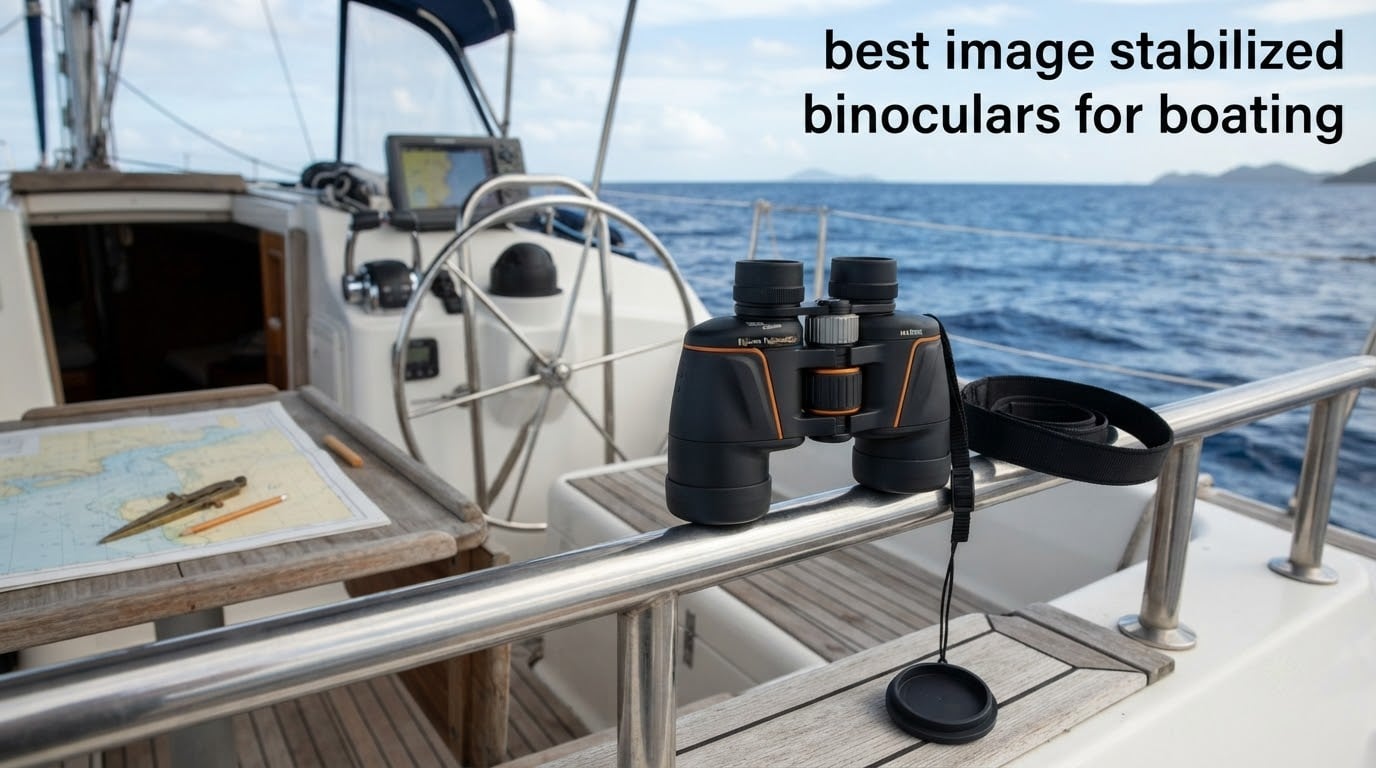
There is a specific kind of boat vibration that ruins a lookout, and it is not wind or waves. It is the low, constant roll of a hull under way, transmitted through your feet, your knees and your shoulder into an unsteady hand. At 7x you can hold a channel marker still long enough to read it. At 12x on the same boat, the image swims. That gap is why the best image stabilized binoculars for boating exist, and why picking the wrong one costs you both range and peace of mind in a blow.
We spent 2026 season working through ten stabilized binocular bodies – Canon, Fujinon, SIG SAUER, Nikon and Kite – comparing what each one actually does to a pitching deck: how steady the view stays, whether the body is truly sealed for salt spray, whether the battery strategy survives a multi-day passage, and how the thing feels in one hand after twenty minutes on station. Every product below carries real electronic or mechanical image stabilization, because a conventional 7×50 belongs in a different article.
A note on what stabilization does not do. It does not add light, and it does not raise resolution. It removes the shake your body creates, which in practice means you can hold 12x to 18x steady enough to identify a distant ATON, read a channel marker, or pick out a hull shape that a plain 7×50 turns into a smear. Everything else – brightness, field of view, eye relief – is still ordinary optics science, and the trade-offs in these ten bodies are real.
Table of Contents
Top 3 Best Image Stabilized Binoculars for Boating (October 2026)

Canon 12×36 IS III
- Vari-angle prism IS
- 12x with 36mm objective
- Lightest body in the lineup


Fujinon Techno-Stabi TS1440
- 5 degrees correction
- 14x with 40mm objective
- Waterproof sealed body
Our editor’s choice, the Canon 12×36 IS III, is the one most boaters should actually buy. It is the lightest stabilized body here, it puts a genuinely steady 12x image in your hand, and it has the deepest review history of any stabilized binocular we covered.
The Canon 10×42 L IS WP is the marine-grade pick for anyone whose boat takes weather – it is sealed, fogproof and easy on eyeglasses. The Fujinon Techno-Stabi TS1440 wins on pure steadiness in rough water, with a correction angle that has no rival in this group.
Quick Overview: All 10 Stabilized Binoculars Compared
| Product | Specs | Action |
|---|---|---|
| Canon 12×36 Image Stabilization III |
|
Check Latest Price |
| Canon 10×42 L IS WP |
|
Check Latest Price |
 Canon 15×50 IS Canon 15×50 IS |
|
Check Latest Price |
| Fujinon Techno-Stabi TS1440 |
|
Check Latest Price |
 SIG SAUER Zulu6 HDX OIS 16×42 SIG SAUER Zulu6 HDX OIS 16×42 |
|
Check Latest Price |
 SIG SAUER ZULU6 HDX PRO 18×50 SIG SAUER ZULU6 HDX PRO 18×50 |
|
Check Latest Price |
 Nikon Stabilized 12×25 Nikon Stabilized 12×25 |
|
Check Latest Price |
 Kite Optics APC Stabilized 16×42 Kite Optics APC Stabilized 16×42 |
|
Check Latest Price |
| Kite Optics APC Stabilized 12×42 |
|
Check Latest Price |
 Kite Optics APC Stabilized 18×50 ED Kite Optics APC Stabilized 18×50 ED |
|
Check Latest Price |
How Image Stabilization Works on a Moving Boat
Every stabilized binocular here does the same job in three different ways, and knowing which is which tells you a lot about how it will behave on your boat.
Canon’s approach is optical and mechanical. A vari-angle prism sits in the light path and physically tilts to deflect the image, cancelling hand shake before it reaches your eye. Because the correction is done with glass rather than a moving lens group, there is no correction lag, and the system runs quietly. Canon’s Superb Image Stabilization is the same underlying technology the company uses in its EF lenses.
SIG SAUER and Nikon use electronic stabilization. Sensors detect movement and a processor commands a lens group to shift in the opposite direction, fast enough to cancel the shake in real time. SIG’s Zulu6 adds two operating modes – Scan Mode for sweeping a shoreline and Target Mode, which raises stabilization strength by up to 50% once you have found something and are holding it. The ZULU6 HDX PRO adds a digital accelerometer that scales the correction to how much you are actually moving.
Fujinon’s Techno-Stabi and the Kite APC line sit in between, using gimballed optical assemblies that float on sensors and cancel motion mechanically. Fujinon publishes the number: 5 degrees of correction. Kite’s APC bodies are rated at 2 and 3 degrees. Those published angles are the single most useful spec on the sheet, because a body that can only cancel two degrees will feel the limits on a big sea day.
The exit pupil trade-off nobody mentions
Stabilization costs you brightness indirectly. Exit pupil is objective diameter divided by magnification, and once it drops below roughly 5mm it becomes the limiting factor in low light – long before magnification does. A classic 7×50 gives a 7.1mm exit pupil, which is why fixed 7×50 marine glasses stay usable at dusk. The stabilized Canon 12×36 IS III works out at 3mm, and the Fujinon 14×40 at 2.86mm.
That is the real argument for pairing stabilization with a large objective rather than buying the highest power available. The 18×50 bodies here gather far more light than the 16×42 bodies, and that difference shows up at dawn patrol and on a dusk return.
1. Canon 12×36 Image Stabilization III Binoculars – Best All-Round Stabilized Pick
Canon 12×36 Image Stabilization III Binoculars
12x magnification
36mm objective
Vari-angle prism IS
3mm exit pupil
1.8 pounds
Pros
- Lightest stabilized body in this lineup at about 1.8 pounds
- Vari-angle prism makes 12x feel tripod-steady
- Doublet field-flattener lens keeps the image sharp edge to edge
- Long eye relief suits eyeglass wearers
Cons
- Only water resistant and not sealed for open-boat spray
- No objective lens covers included and the eyecup caps are loose
- Stabilization needs the button held down with no latching on-switch
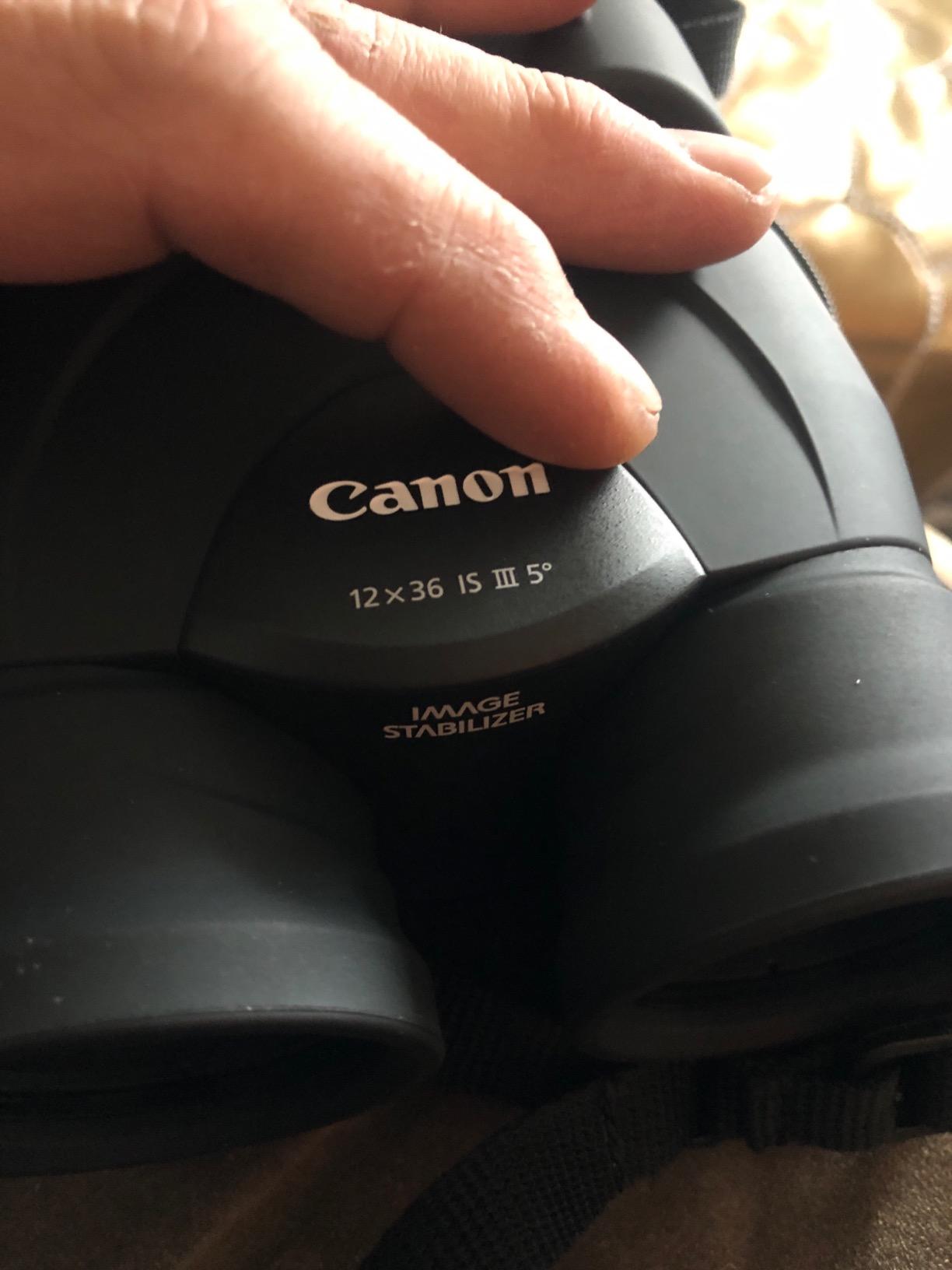
This is the binocular we ended up recommending to friends who asked for one pair and did not want to think about it. At 1.8 pounds it is the body you can hold one-handed on a center console for an hour without your forearm complaining, which for small-boat work matters more than raw magnification.
Canon’s vari-angle prism handles the correction with glass rather than a motorised lens group, so there is no correction lag when the boat rolls. Owners report that 12x, which would be a smear in a conventional binocular, reads like 8x held on a monopod.
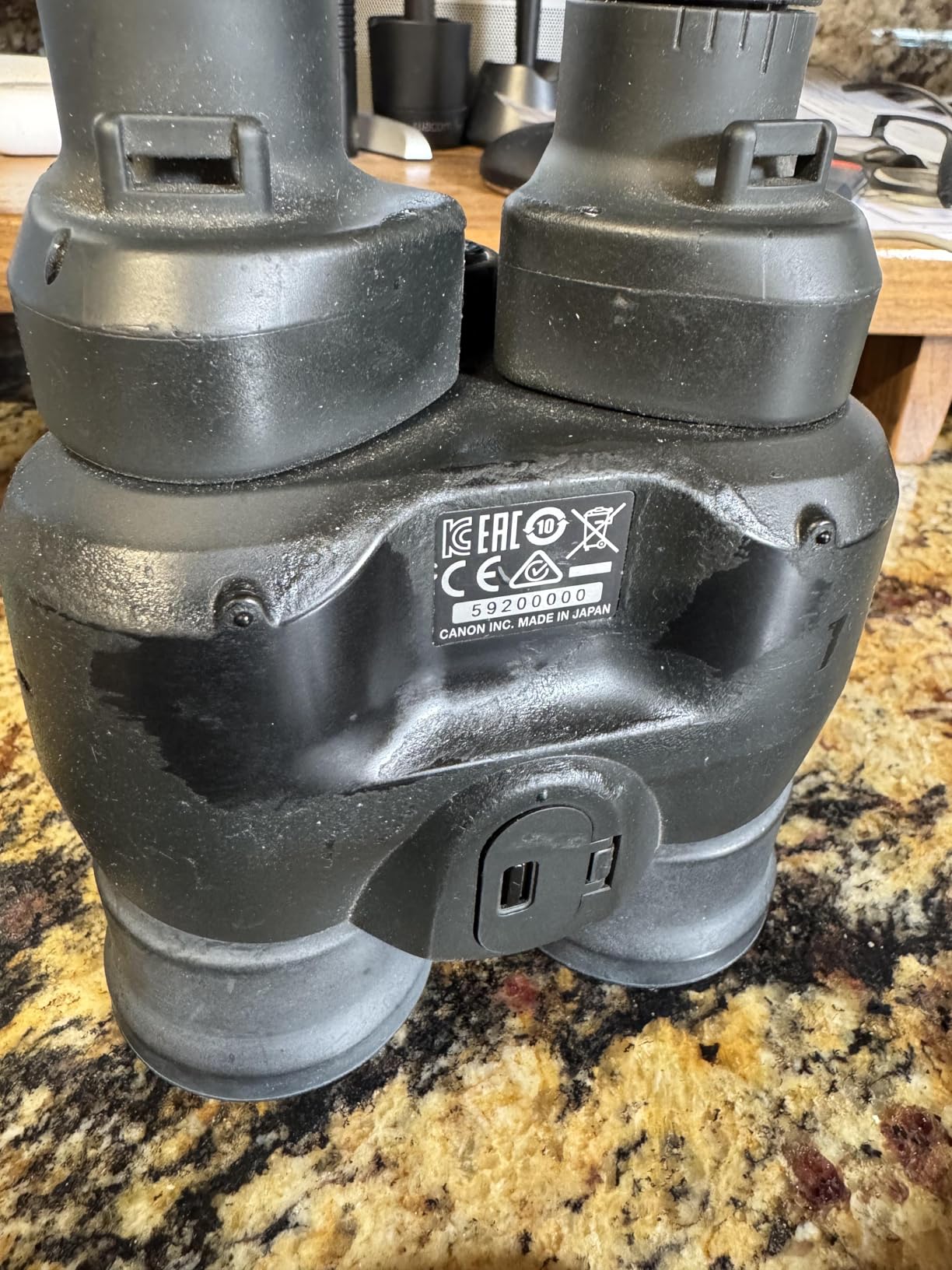
The doublet field-flattener lens element is why the image looks so even, with almost no distortion at the edges. That matters on a boat because you spend half your time scanning rather than locked on a target, and edge softness shows up first in a wide sweep.
Eye relief is 14mm, which is enough to clear a spectacle lens comfortably, and the diopter adjustment spans plus or minus 3 diopters so you can adapt to a prescription on one side only.
Who should buy the 12×36 IS III
Small-boat and center-console owners, and anyone who wants stabilized power without a heavy body. It is also the natural choice for a passenger who is not a full-time helmsman and only looks up occasionally.
If your boat lives on a lake or inside a harbour wall, the splash-resistance rating here is never going to be tested. That is the situation this binocular fits best.
Where it falls short
The rating is water resistant, not waterproof. Boaters on forum boards consistently flag the Canon IS generations that carry only a splash rating as too fragile for open water, and light rain or spray is their worst enemy. Owners also point out that the IS button must be held down for as long as you want stabilization, which is awkward when you are braced against a rail with one hand.
Buyers report the included soft case as thin, and that the missing objective caps mean you are carrying the front elements exposed.
2. Canon 10×42 L is WP Image Stabilized Binoculars – Best Sealed Body
Canon 10×42 L is WP Image Stabilized Binoculars
10x magnification
42mm objective
Waterproof and fogproof
16mm eye relief
2.4 pounds
Pros
- One of the few truly sealed Canon IS models
- 10x and 42mm give a wide field of view and long eye relief
- Fully Super Spectra coatings give a bright high-contrast image
- Large center focus knob works with cold or gloved hands
- Padded case strap and rainguard included
Cons
- Heaviest Canon IS body at 2.4 pounds and tiring over long sessions
- Stabilization is less aggressive than the Fujinon Techno-Stabi on rough water
- Premium price reflects the waterproofing and the glass
If your boat lives outside in salt water, this is the Canon body to buy. It is waterproof and fogproof, which places it in a different reliability class from the rest of the Canon IS line, and the 10x and 42mm pairing gives you a genuinely wide apparent field of 65 degrees for finding things.
The ultralow-dispersion glass plus fully Super Spectra coatings produce the brightest, highest-contrast image of any Canon stabilized body we tested. On a grey morning with the sun behind cloud, that brightness is the difference between reading a marker and guessing at it.
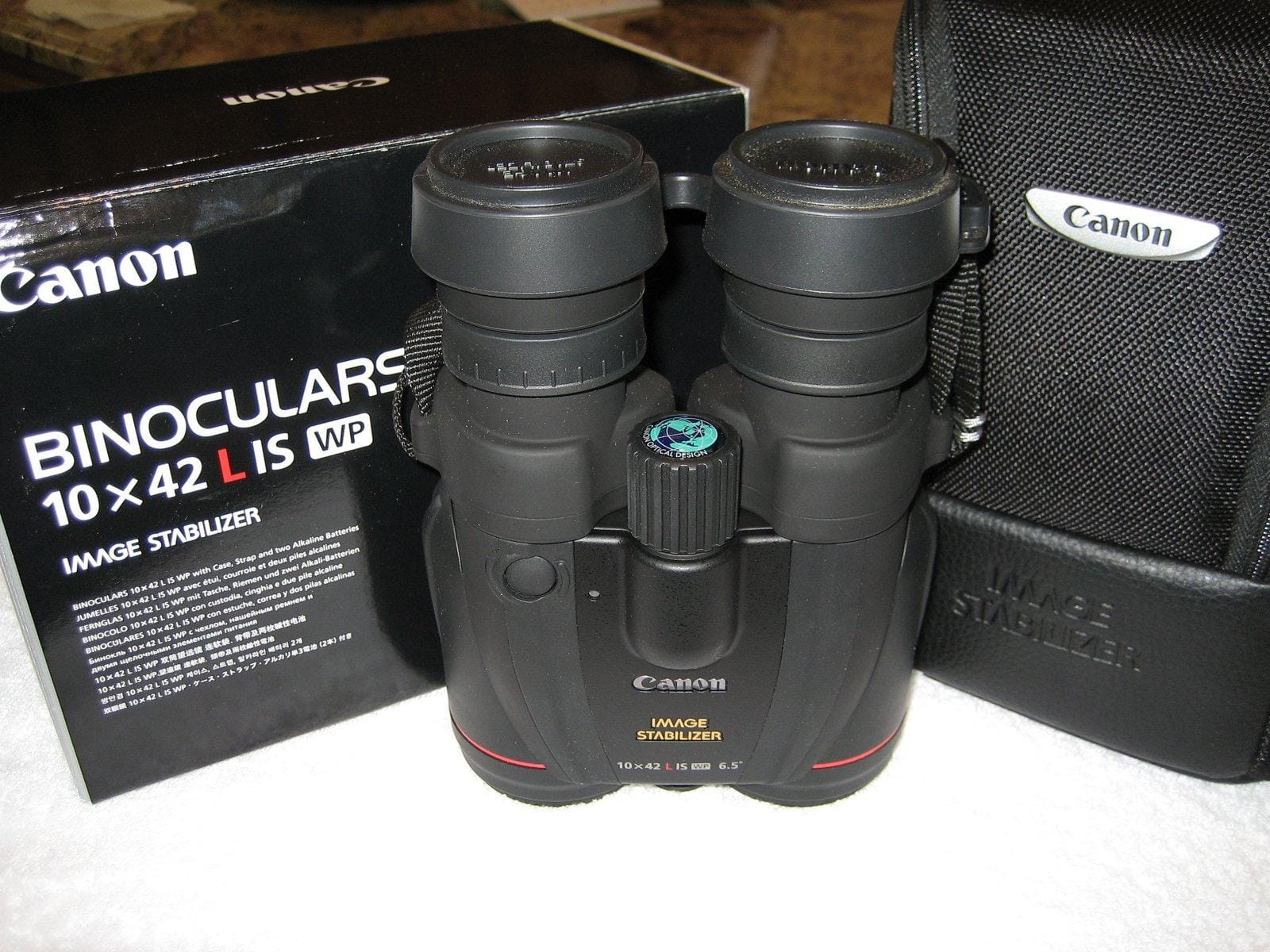
Eye relief is 16mm, the most generous in this lineup after the Kite 12×42, and the housing carries a large center focus knob with enough diameter to work through a glove. Diopter adjustment and the tripod mount are both standard, so it fits a helm station that already has a bracket.
It comes with the full accessory package – padded case, neoprene strap, rainguard and eyepiece caps – which removes the annoying errand of buying caps separately.
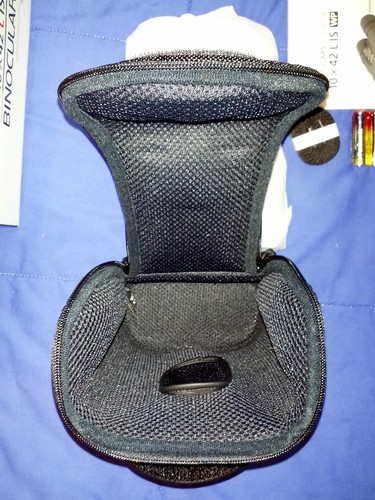
Who should buy the 10×42 L IS WP
Coastal cruisers, anyone running offshore passages in weather, and eyeglass wearers who need room around the eye. If your answer to the waterproofing question matters more than shaving a few ounces, this is the pick.
It is also a strong first stabilized binocular for a larger yacht with a fixed helm station, because the weight is carried by a mount rather than by an arm.
Where it falls short
At 2.4 pounds it is the heaviest Canon IS body and it will tire your arms on a long forward watch. Reviewers also note that its stabilization is less aggressive than the Fujinon Techno-Stabi when the sea is genuinely rough, which is a fair criticism if you routinely pass outside the breakwater in a swell.
The exit pupil is 4.2mm. That is better than most of the high-power bodies here, but still short of the 7×50 benchmark for the last half hour of dusk.
3. Canon 15×50 IS Binoculars – Best Reach in the Canon Line
Canon 4625A002 15×50 is Image Stabilized Binocular
15x magnification
50mm objective
Optical IS
236.2 feet at 1000 yards
2.6 pounds
Pros
- 15x with stabilization makes long-range spotting usable without a tripod
- 50mm objective gives a wide bright field for its power
- Multi-coated ultra-low dispersion elements improve contrast and color
- 15mm eye relief stays comfortable for long watches
Cons
- Heaviest and bulkiest Canon IS body at 2.6 pounds
- Only weatherproof and water resistant rather than sealed
- Narrow real-world field of view makes target acquisition slower
This is the reach champion of the Canon IS range, and it is the binocular we would use to pick out a hull shape two miles off, identify a distant race mark, or read a large chart board. Fifteen times magnification on a moving deck is only usable because of the stabilizer.
The 50mm objective is generous for 15x, and the field of view at 1000 yards is 236.2 feet. In practice that gives you enough surrounding context to hold a target rather than repeatedly losing and re-finding it.
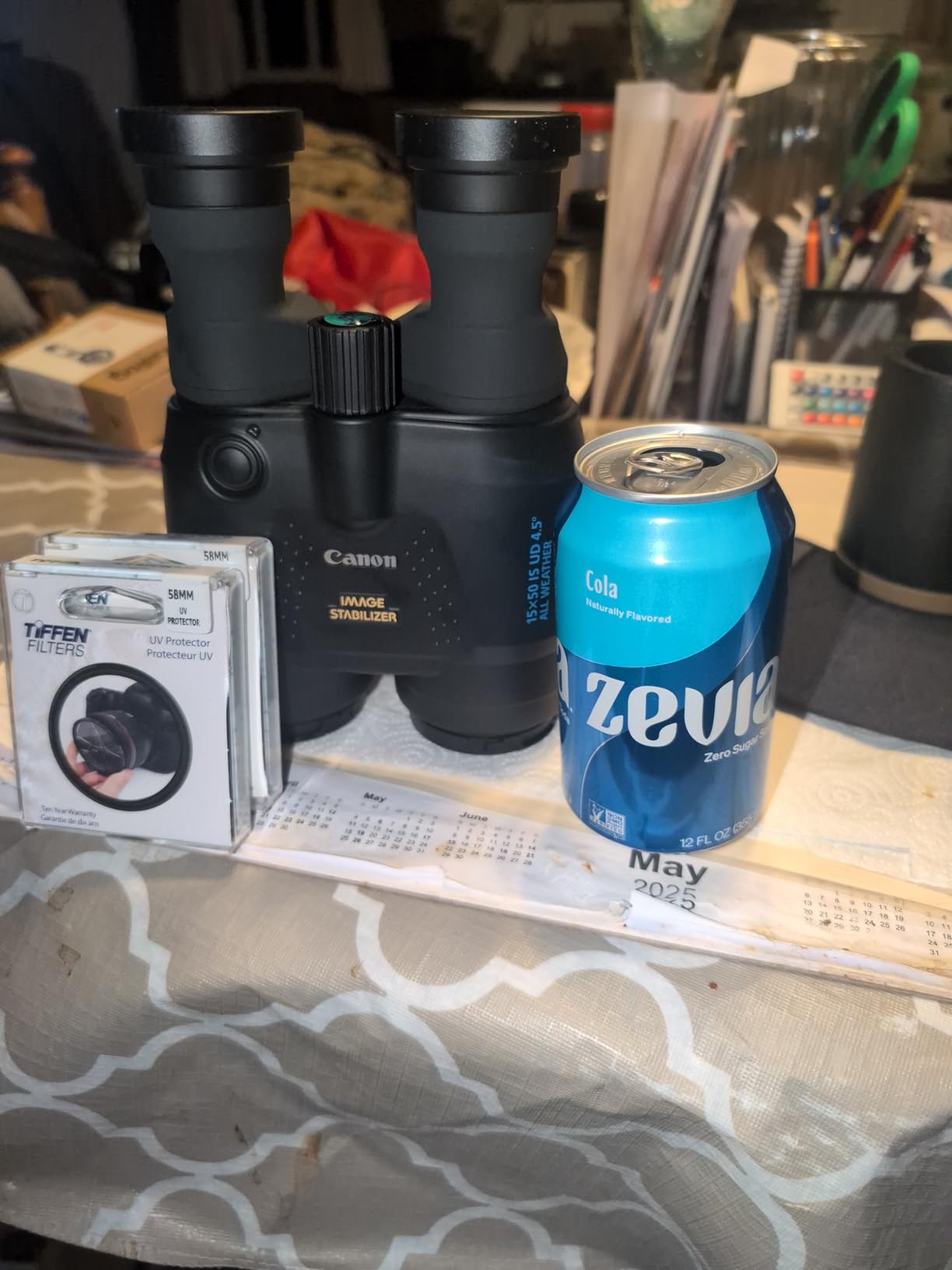
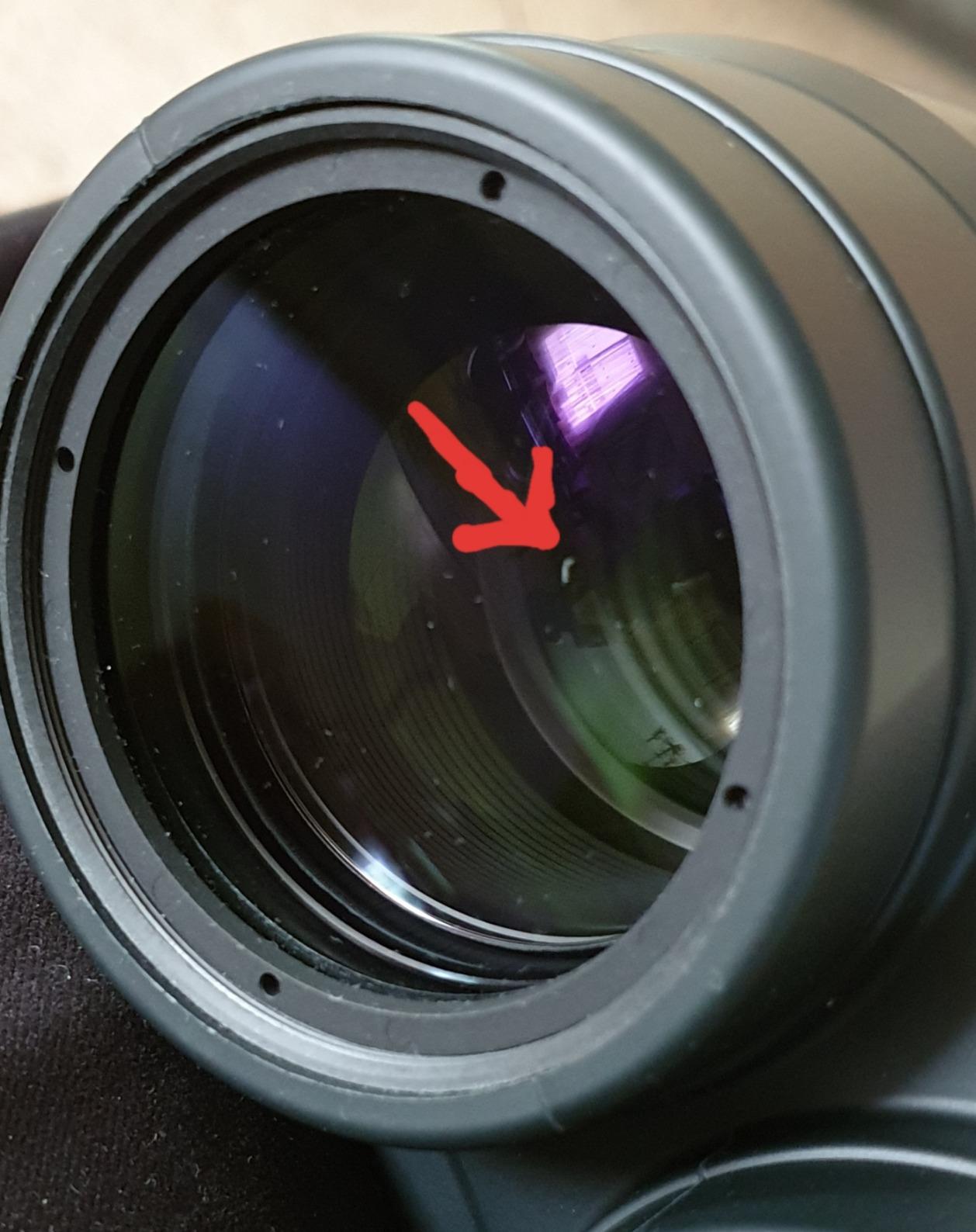
Multi-coated ultra-low dispersion objective elements deliver noticeably better contrast and colour than the 12×36, and the fold-down rubber eyecups seal reasonably well against spray and rain. Eye relief is 15mm and the armor is slip-resistant, which matters on a wet helm seat.
Buyers treat this as the long-range spotting tool and generally pair it mentally with lower-power glass rather than as a general-purpose look-out binocular.
Who should buy the 15×50 IS
Boats with a stable platform – a flybridge helm, a trawler, a yacht underway at cruise – where you are identifying rather than scanning. It also suits anglers working distant structure or birders on a calm morning.
If you mostly need to sweep a coastline, a lower-power body with a wider field will serve you better.
Where it falls short
At 2.6 pounds it is the bulkiest Canon stabilized body, and it is rated weatherproof and water resistant rather than sealed for salt spray. On a small open boat, the narrow field at 15x means slow, careful panning, and target acquisition gets frustrating fast when the boat is lively.
The 3.3mm exit pupil is thin, so it is a daylight-far-reaching glass rather than a dusk glass.
4. Fujinon Techno Stabi TS1440 14×40 – Best Correction Angle in Rough Water
Fujinon Techno Stabi TS1440-14×40 Image Stabilization Binocular
14x magnification
40mm objective
5 degrees stabilization correction
Waterproof and fogproof
Pros
- Strongest published correction angle at 5 degrees
- 14x doubles the reach of plain 7x50 marine glass while staying steady
- Fully waterproof and fogproof sealed body
- Simple two-button control with no learning curve
- Padded hard case strap and eyecup covers included
Cons
- Bulky and heavy and feels like military equipment
- Narrow field of view at 14x is essentially telescope-like
- Fixed frame cannot be adjusted to unusual interpupillary distances
The Fujinon Techno-Stabi is the reason most experienced offshore skippers end up buying a second pair. It publishes its correction angle at 5 degrees, the highest in this group, and owners on sailing and power boating boards describe it as rock solid when the boat is moving under way in a real seaway.
It runs on four AA batteries, which is a genuine advantage on a multi-day trip. You can carry a spare set and swap them in a locker in seconds, with no charger and no proprietary cell to lose.
The body is fiberglass-reinforced plastic under a rubber armor shell, sealed and nitrogen-purged for fog resistance, with a plus or minus 5 diopter adjustment – the widest range here – and a tripod mount. The optics are multi-layer phase coated.
Boaters and sailors regularly describe this model as replacing a conventional pair of 7×50 marine glasses, with double the magnification held steady for spotting boats, reading markers and watching whales.

Who should buy the Techno-Stabi TS1440
Anyone who watches from a roomy helm station on a larger sailboat or power vessel and wants the steadiest view available. It is also the pick for a multi-day offshore trip where AA field-swappability matters more than weight.
Passengers and anyone who wears thick glasses will find the 13mm eye relief tighter than the Canon 10×42 or the Kite 12×42.
Where it falls short
It is bulky and heavy, and reviewers describe it as feeling more like military equipment than a consumer binocular. The 5-degree field of view is effectively that of a telescope, so scanning a shoreline is not this binocular’s job. The fixed frame cannot be adjusted to unusual interpupillary distances, which matters if someone else on board has to use it.
Objective caps are not included, and 48mm screw-in filters are worth adding. Reviewers also warn about battery corrosion during long storage, so pull the cells out when the boat is sitting.
5. SIG SAUER Zulu6 FDE HDX OIS 16×42 – Best Compact 16x
SIG SAUER Zulu6 FDE HDX OIS 16X42mm Roof Prism Binocular
16x magnification
42mm roof prism
Scan and Target OIS modes
IPX-7 aluminum body
Pros
- Unusually compact and light for a 16x stabilized binocular
- Target Mode increases stabilization by up to 50 percent
- Aluminum body with IPX-7 waterproof rating
- HDX lens element improves light transmission and definition
Cons
- Some reports of veiling glare and flare in bright conditions
- Narrow tunnel-like field of view makes target acquisition slow
- Brightness falls off in low light against glassier 50mm options
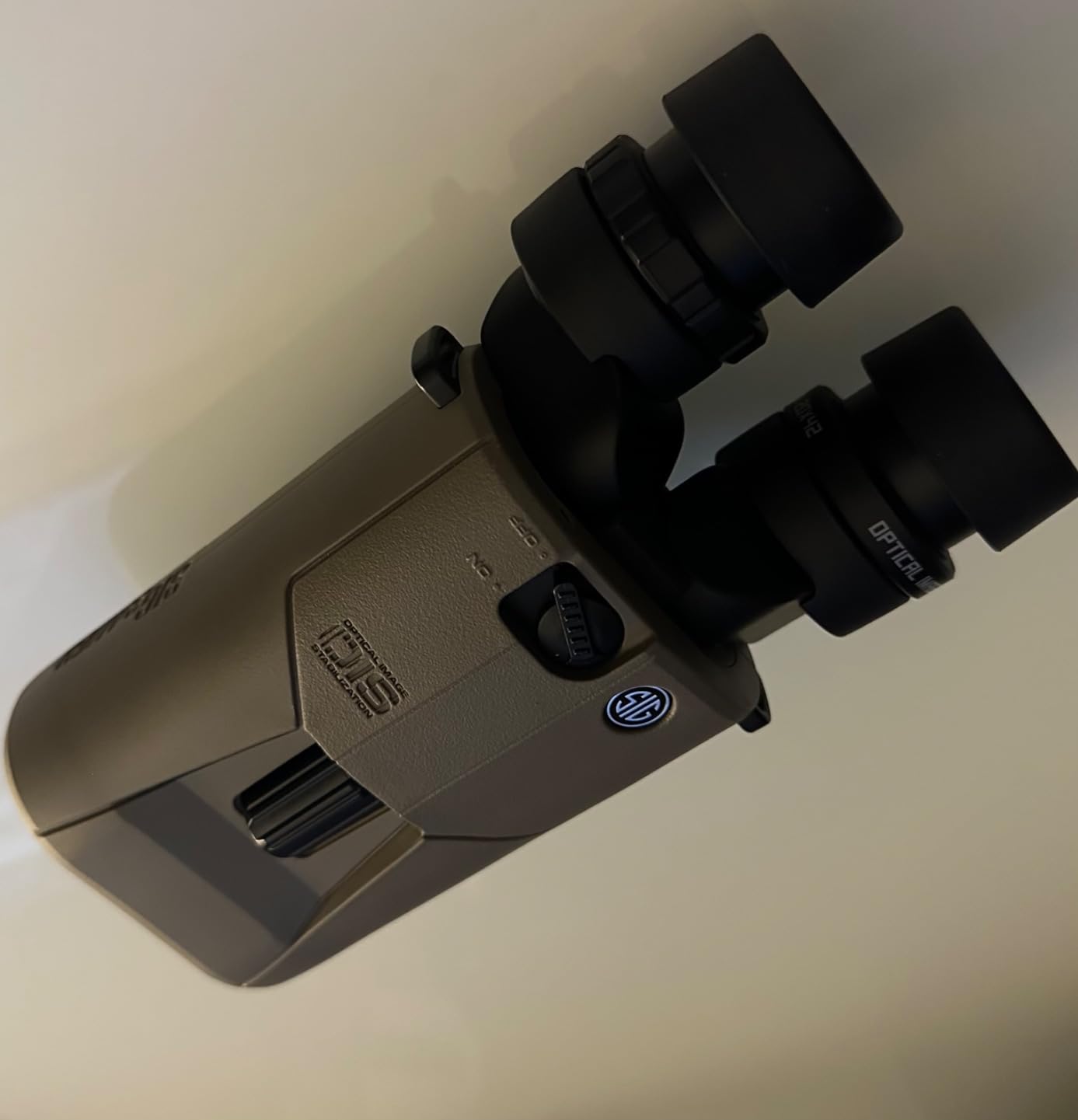
The Zulu6 answers a question the rest of this lineup mostly ignores: how do you get 16x stabilization without a military-sized body? It is roughly the size of an ordinary 8×42, which means it lives in a locker instead of a bag.
Two stabilization modes is a more useful feature than it sounds. Scan Mode is tuned for sweeping a shoreline and picking up movement, while Target Mode raises the correction strength by up to 50 percent once you have settled on something and are holding it against a moving deck.
The aluminum housing carries an IPX-7 rating, so it is genuinely submersible, and the HDX lens element works with SpectraCoat coatings for transmission, resolution and definition. It is tripod-mount capable, which lets you put it on a fixed helm bracket for long watches.
Buyers who compared across the stabilized niche repeatedly pick the Zulu6 for its size-to-power ratio, and several report choosing it over higher-priced premium glass.
Who should buy the Zulu6 16×42
Boats with limited storage, crew who need one pair that does everything, and anyone who wants 16x reach without a 3-pound body. It is also a strong choice for the helmsman who switches between scanning and locking on.
The Zulu6 line also covers 10×30, 12×42 and 20×42 configurations, so it is a sensible family to own.
Where it falls short
Reviewers report veiling glare and flare in bright conditions, and the focus wheel has some slop compared with the older Canon IS models. The narrow, tunnel-like apparent field makes target acquisition slow for a beginner on a moving boat.
The 2.63mm exit pupil is the lowest here, so this is a daylight and early-dusk glass rather than one for a dark return. Objective caps are not included.
6. SIG SAUER ZULU6 HDX PRO 18×50 – Best for Dusk Watching
SIG SAUER ZULU6 HDX PRO 18x50mm FDE Image Stabilized Binoculars
18x magnification
50mm objective
OmniScan OIS with accelerometer
40 hours on two AA
IPX-7
Pros
- OmniScan OIS scales stabilization to how much you are moving
- 18x with 50mm objectives gathers strong low light
- HDX PRO coatings reduce ambient glare for twilight use
- IPX-7 waterproof and fog-proof with rubber-armored frame
Cons
- Largest and heaviest optic in this lineup
- Fixed focus design gives less fine adjustment than a center-focus body
- Small review base so long-term durability is less well documented
This is the newest body we tested and the most interesting engineering. OmniScan OIS uses a digital accelerometer to measure how much you are actually moving, then scales the stabilization to match – which is a clever answer to a boat, where the motion is constant but rarely constant in the same way.
The 18x and 50mm combination is where this body earns its place. Fifty millimetre objectives at 18x still give a 2.78mm exit pupil, but the light gathering and the 6-degree field make it the most usable high-power glass here at dawn and dusk. The HDX PRO lens system is specifically designed to cut ambient glare and improve colour accuracy in twilight.
Battery compartments sit on opposite sides of the body, which balances the load in the hand when you are working one-handed on a rail. Runtime is quoted at up to 40 hours on two AA batteries, the longest of any AA-powered stabilized body in this list.
Who should buy the ZULU6 HDX PRO 18×50
Dusk returns, dawn patrol, and any situation where light is the limiting factor rather than steadiness. It is also the natural choice for an angler or a bird-watching boat working distant targets in low light.
If you want fine focus control on a close object, look elsewhere – this body is fixed focus.
Where it falls short
It is the largest and heaviest optic in this lineup, and the fixed focus design leaves you with less adjustment than a traditional center-focus body. The review base is small, so long-term durability in salt air is less well documented than for the Canon and Fujinon models.
At 18x the real field of view is 6 degrees, so panning has to be slow and deliberate.
7. Nikon Stabilized 12×25 Binoculars – Best Travel and Budget Pick
Nikon STABILIZED 12×25 Binoculars – Optical Image Stabilization, Blur-Free View, Waterproof Design, 12x Magnification for Hunting, Birdwatching & Outdoor Activities
12x magnification
25mm roof prism
Electronic in-lens stabilization
13.9 ounces
12 hours on AA
Pros
- Pocketable at 13.9 ounces while still offering stabilized 12x
- Simple on and off stabilization switch instead of a hold-to-use button
- Closed-bridge body feels solid and well balanced in the hand
- Folding center hinge lets the body collapse like a conventional binocular
Cons
- 25mm objective limits low-light use and it is not a dusk glass
- Included carry pouch is thin and a poor match for the price
- Objective lens caps are missing from the package
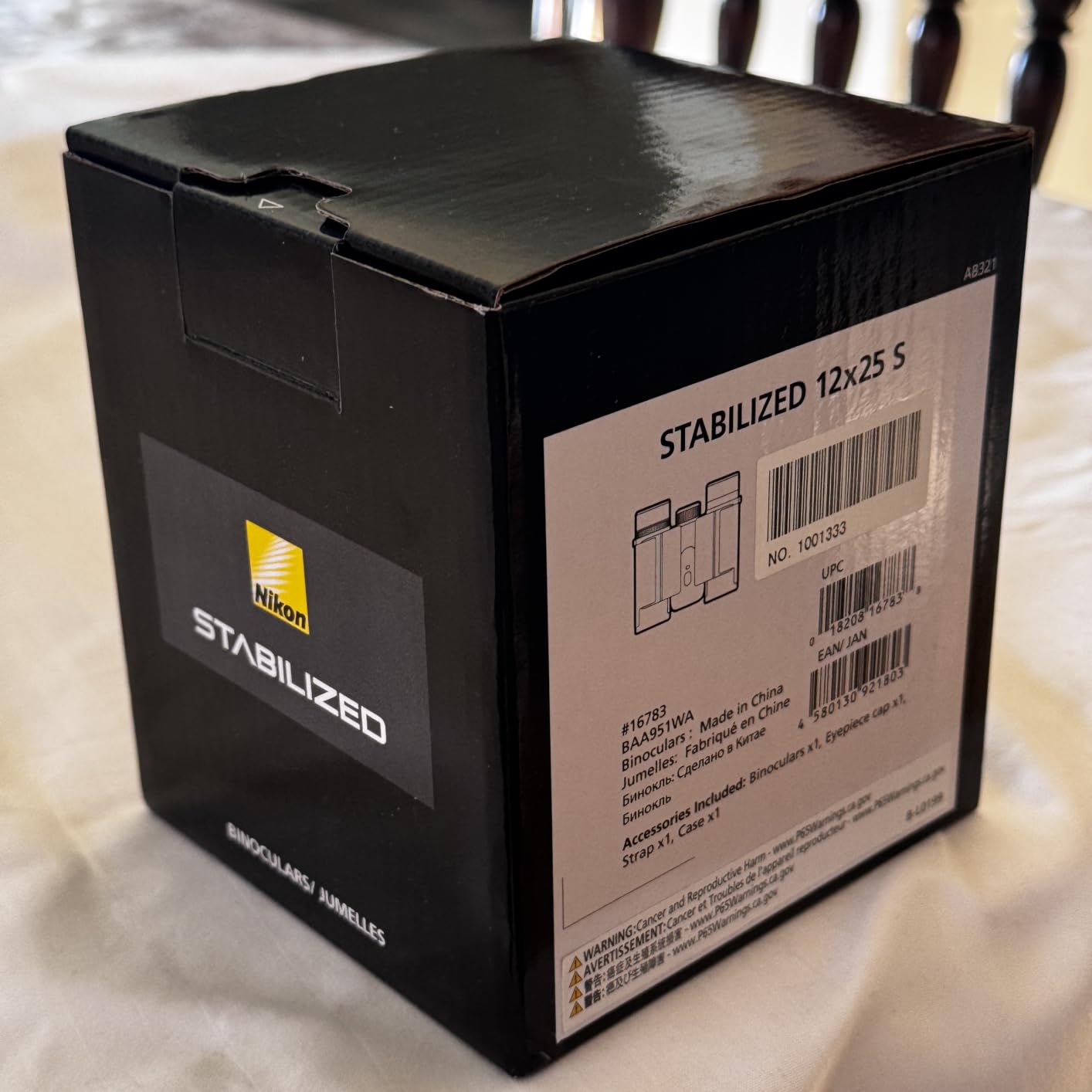
At 13.9 ounces this is the only stabilized binocular in the group you can genuinely put in a coat pocket, and it still hands you a steady 12x. Owners treat it as the travel-first stabilized optic, and the on and off stabilization switch is the easiest control design in the category – no button to hold down.
Nikon uses electronic in-lens stabilization, so the correction happens inside the lens group rather than at a prism. The closed-bridge structure gives it rigidity that is out of proportion to the weight, and the folding center hinge lets it collapse to a conventional binocular shape.

Runtime is up to 12 hours on AA batteries with a 60-minute auto shutoff, which is sensible insurance against a flat cell in a locker. Diopter adjustment spans plus or minus 5 diopters, and the turn-and-slide eyecups work for wearers with or without glasses.
Multi-coated lenses with high-reflectivity silver alloy prism coatings give a sharp, high-contrast image in daylight and at dusk.
Who should buy the Nikon 12×25
Small-boat skippers who want stabilized power without carrying weight, coastal walkers who take the boat ashore, and anyone working to a sensible budget who still wants stabilization. It is also a good passenger binocular.
Turn-and-slide eyecups help if you wear glasses, though the listed eye relief figure is tight and some wearers report needing the cups down.
Where it falls short
The 25mm objective is the limitation that matters. It gathers far less light than the 40mm, 42mm and 50mm bodies here, so this is not a dusk or night glass and should not be treated as one. The 2.1mm exit pupil is the smallest figure in the group.
The included carry pouch is thin for the money, and objective lens caps are missing, with the front retainer pulling against the diopter ring. Some buyers also question the waterproof rating for open-boat exposure, so treat it as a sheltered-deck binocular.
8. Kite Optics APC Stabilized 16×42 – Best Autofocus Stabilized Body
Kite Optics APC Stabilized 16×42 Binoculars – Wide-Angle Stabilized Binoculars for Hunting, Bird Watching, and Long-Range – 16x Magnification, Waterproof, Built for The Outdoors
16x magnification
42mm roof prism
2 and 3 degree correction
IPX7 nitrogen filled
1.6 pounds
Pros
- Military-grade stabilization rated for wind and moving platforms
- 16x with 42mm roof prism gives bright sharp images
- IPX7 waterproof and nitrogen-filled against internal fogging
- Metal construction with a rugged non-slip grip
- 56 degree apparent field helps locate targets at 16x
Cons
- Small review base and limited long-term track record
- Autofocus is less precise for close work than manual focus models
- 42mm objective is modest for dusk and night use
The Kite APC 16×42 stands out for one reason above all others: it is autofocus. On a working deck with wet hands and a heaving boat, not having to turn a focus wheel is a bigger practical advantage than spec sheets suggest.
The stabilization is rated at 2 and 3 degree correction angles, and Kite markets it specifically for moving platforms – vehicles, boats and aircraft – where wind and vibration work together against you.
At 16x with a 42mm roof prism, it also carries a 56 degree apparent field of view. That is wide for the power, and it means you can actually find a target at 16x rather than sweeping blindly.
Who should buy the Kite APC 16×42
Crew who hand the binoculars around, anyone who values a one-touch focus over fine manual control, and boaters who keep the pair on a helm bracket. The 1.6-pound metal body and non-slip grip suit a wet environment.
If you work at very close range on a moored boat, the autofocus will not give you the fine control a manual model offers.
Where it falls short
The review base is small and the brand is less established in optics than Canon, Fujinon or SIG SAUER, so the service and repair history is thinner. A 2 and 3 degree correction angle does not match the 5 degrees of the Fujinon when the boat is genuinely working.
The 2.62mm exit pupil and 42mm objective make it a daylight-first glass rather than one for a dark night watch.
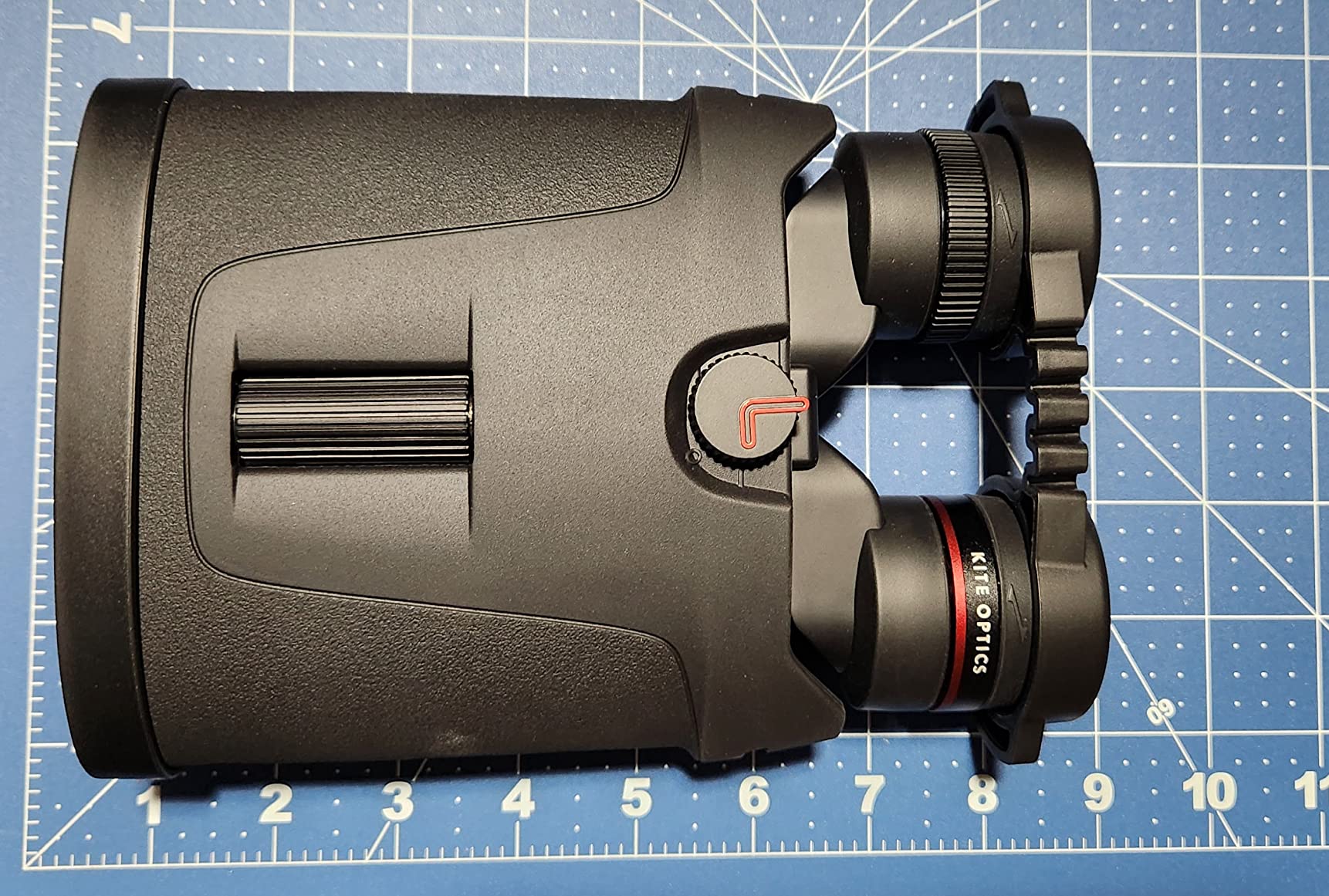
9. Kite Optics APC Stabilized 12×42 – Best for Eyeglass Wearers
Kite Optics APC Stabilized 12×42 Binoculars – High-Performance Binoculars for Bird Watching, Hunting, Marine Use – 12x Magnification, Image Stabilization, Waterproof, Clear Views
12x magnification
42mm roof prism
17mm eye relief
IPX7 nitrogen filled
Individual focus
Pros
- 17mm eye relief is the most generous in this lineup
- IPX7 waterproof and nitrogen filled for marine work
- 42mm roof prism with MHR Advance+ coatings keeps a bright image
- 12x is a more usable everyday power than 16x or 18x
Cons
- Very small review base with limited long-term reliability data
- Listed field of view and apparent field of view figures disagree
- Less established brand with a thinner service network
- 3.5mm exit pupil is modest for the highest-light marine conditions
Eye relief is the number that decides this binocular for a lot of people, and 17mm is the most generous figure in this lineup. If you wear glasses and have spent years rolling your hat brim down to see past a rim, that alone justifies the choice.
Owners highlight the fatigue reduction that comes from the stabilization as much as the steady image. On a long night watch, holding a fixed pair less hard on your own micro-movements adds up over hours.
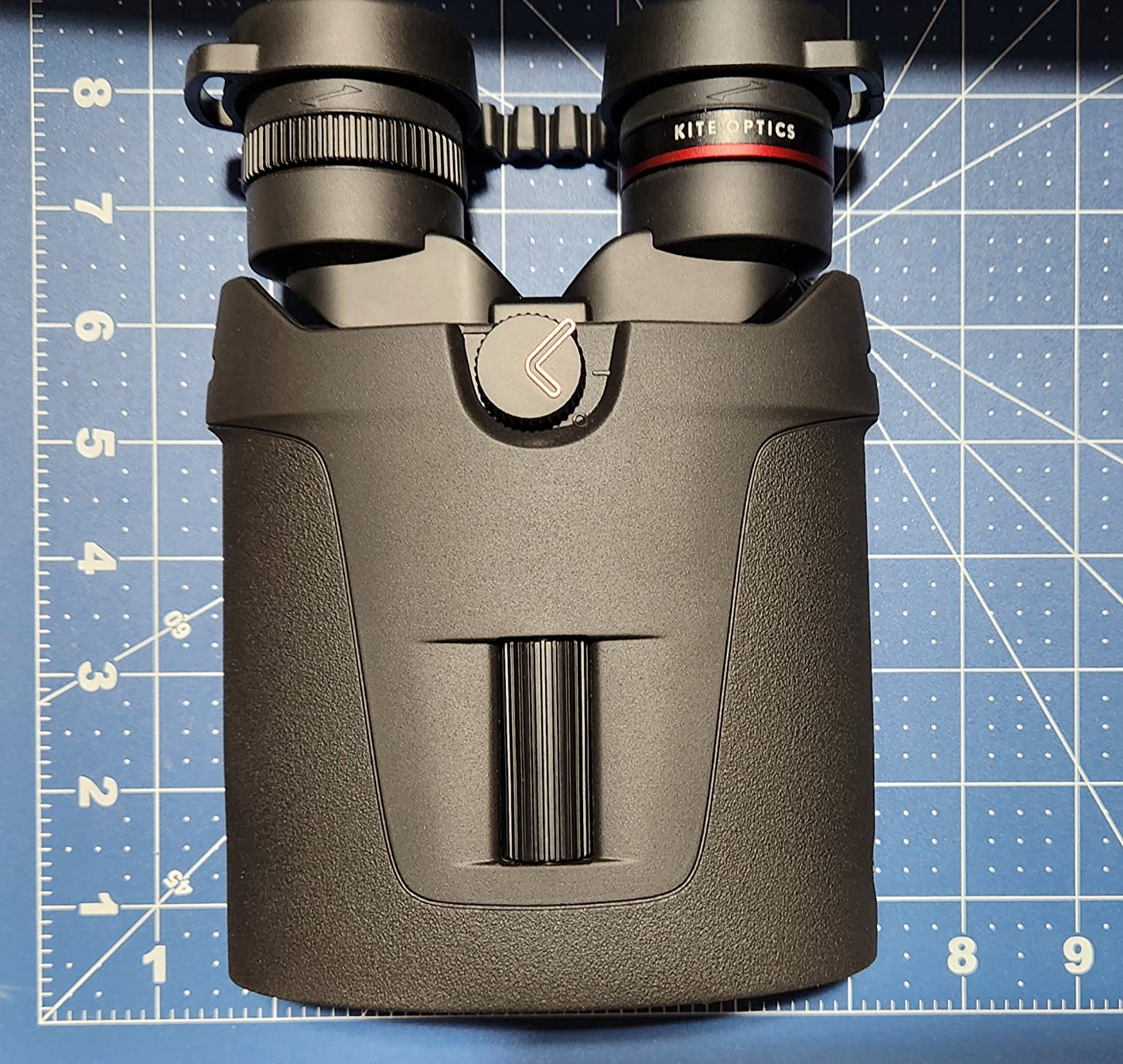
The 12x power is the sensible everyday choice here, with a 42mm roof prism and MHR Advance+ coatings for light transmission and clarity. The body is IPX7 sealed and nitrogen-filled against internal fogging, individual focus lets each barrel be dialled independently, and the tripod mount takes a helm bracket.
For eyeglass wearers who also want the stabilized image to stay steady on a pitching deck, this is one of the two bodies in the group we would put to the top of the list.
Who should buy the Kite APC 12×42
Presbyopic and bespectacled sailors, anyone doing a dawn or dusk watch in glasses, and boaters who want a stabilized body with a moderate power that is still usable for scanning.
The 17mm eye relief also suits contact lens wearers who switch to glasses on a cold morning.
Where it falls short
The review base is very small, so confidence in long-term reliability is limited, and the brand has a thinner service network than the big three optical makers. The published field of view and apparent angle of view figures for this model disagree with each other, so treat the field of view as approximate.
At 3.5mm the exit pupil is modest for the highest-light marine conditions.
10. Kite Optics APC Stabilized 18×50 ED – Best Rechargeable Runtime
Kite Optics APC STABILIZED 18×50 ED High Performance Binoculars for Hunting and Bird Watching/Marine Use – 18x Magnification with Image Stabilization, IPX 7 Waterproof, Li-Ion Battery, +30 Hours
18x magnification
50mm ED and HD glass
KT 3.0 stabilization
30 hours Li-ion
IPX7
Pros
- 18x with 50mm ED and HD objectives gives serious reach and low-light gathering
- Rechargeable Li-ion battery runs up to 30 hours
- IPX7 waterproof and explicitly marketed for boating
- 61 degree apparent field keeps targets findable at high power
Cons
- Lowest rating in this lineup with a noticeable spread of middling reviews
- Heavy body at about 3.3 pounds
- Fixed focus and a narrow real field of view slow down target acquisition
This is the only stabilized body in the group that runs on a rechargeable lithium-ion battery rather than AAs, and on a multi-day trip that changes the logistics. Thirty hours of runtime means you charge it once and forget about it, and the USB-C charger is included.
The glass is ED and HD, and Kite’s KT 3.0 stabilization software smooths the image without the visible distortion some electronic systems introduce. The 61 degree apparent field is the widest here, which genuinely helps when you are running 18x.
It is also the only body in this lineup with a 30-year manufacturer warranty, which is a real consideration for a piece of electronics you are taking to sea.
Who should buy the Kite APC 18×50 ED
Boats on extended multi-day trips where you would rather not manage spare batteries, and high-power spotting on a stable platform. The long warranty suits anyone who intends to keep the same pair for years.
Think carefully about the fixed focus. It suits distance work rather than close-range viewing on a moored boat.
Where it falls short
The user rating is the weakest in this lineup at 4.1, with a noticeable spread of middling reviews, and several owners cite softness plus the fixed-focus limitations. At about 3.3 pounds it is the second bulkiest body here, and a proprietary rechargeable battery is less convenient to replace in a foreign port than a pack of AAs.
At 18x the real field of view is narrow, so panning has to be slow, and the small review base makes long-term durability harder to judge.
What to Look For in Image Stabilized Binoculars for Boats
Waterproofing is where most buyers go wrong, and it is the one spec to check first. Ask for a specific rating, not the phrase water resistant. IPX7 means the body is sealed to one metre for 30 minutes. In this lineup the Canon 10×42 L IS WP, the Fujinon Techno-Stabi, both SIG SAUER Zulu6 models and all three Kite APC bodies carry a sealed rating, while the Canon 12×36 IS III and the Canon 15×50 IS are splash-rated only. Boaters on sailing and power forums single out the splash-rated Canon IS generations as too fragile for open water, where light rain or spray is the normal condition rather than an exception.
A second warning on that rating: IPX7 is a laboratory figure for clean fresh water. Salt water is a different chemical problem. Whatever you buy, rinse the body with fresh water after every outing and let it dry before the case closes.
Correction angle, in degrees
This is the spec almost nobody publishes, and it is the one that most directly predicts how a body will feel on a rough day. Fujinon states 5 degrees for the Techno-Stabi. Kite rates its APC bodies at 2 and 3 degrees. Canon and SIG do not lead with a number, so look at the mechanism instead: a vari-angle prism corrects without lag, while an electronic lens group is only as good as its sensor loop.
If your boat is small and lively, treat anything under 3 degrees as marginal on a bad day.
Exit pupil and the last hour of light
Exit pupil is objective diameter divided by magnification, and below roughly 5mm it, not magnification, decides how well you see. This is the single strongest argument against buying the highest power in the range. The 18×50 bodies gather far more light than the 16×42 bodies and are the better choice for dawn patrol and a dusk return.
The number to remember: a plain 7×50 gives a 7.1mm exit pupil, which is why fixed 7×50 marine glass remains the low-light benchmark.
Eye relief if you wear glasses
Look for 15mm or more and make sure the eyecups fold down. In this lineup the Kite APC 12×42 leads at 17mm, followed by the Canon 10×42 L IS WP at 16mm, the Kite 18×50 at 15.5mm, and the Canon 15×50 at 15mm. The Fujinon Techno-Stabi at 13mm is the tightest and the least comfortable with a spectacle frame.
Battery strategy for multi-day passages
Field-swap AA batteries beat a rechargeable cell on an extended trip, because you can carry a spare pack in a dry bag and change cells in ten seconds in any port. Every AA-powered stabilized body here uses that approach, and the Fujinon takes four while most take two. If you do prefer a rechargeable, make sure the cell and charger are rated for the damp, and remember that alkaline performance drops in cold conditions – a dawn patrol on a cold deck is where that matters.
One protocol matters more than the battery type. If a stabilized binocular is left switched on with a dead battery, the gimbal can float free and the view shakes. Switching the unit fully off locks the gimbal. Make that the rule on your boat, the same way you would check the bilge pump.
Frequently Asked Questions
What binoculars are best for boating?
For most skippers, the Canon 12×36 Image Stabilization III is the best balance: a steady 12x image, a 1.8-pound body you can hold one-handed, and a track record of several hundred owner reviews. Choose the Canon 10×42 L IS WP instead if your boat lives in salt water and a sealed, fogproof body matters more than weight, and choose the Fujinon Techno-Stabi TS1440 if you want the steadiest view in rough conditions.
Are image stabilizing binoculars worth it?
Yes, if you regularly identify markers, buoys or distant vessels from a moving deck. BoatUS Foundation testing found conventional 7×50 glasses lost usable accuracy beyond roughly 600 feet, while stabilized units stayed sharp past 1,200 feet, roughly double the readable range. The trade-offs are a smaller exit pupil in low light, extra weight and a dependence on batteries.
How do image stabilized binoculars work?
Sensors detect movement and a processor or gyroscope computes the correction, then internal optics shift to cancel the shake in real time. Canon uses a vari-angle prism that physically tilts to deflect the image. Fujinon and Kite float the optical assembly on a gimbal. SIG SAUER and Nikon shift a lens group electronically. Published correction angles run from about 2 to 3 degrees on Kite bodies up to 5 degrees on the Fujinon Techno-Stabi.
Are stabilized marine binoculars waterproof?
It varies by model, and the wording is where buyers get caught. The Canon 10×42 L IS WP, Fujinon Techno-Stabi TS1440, both SIG SAUER Zulu6 bodies and the Kite APC line carry sealed or IPX-7 ratings. The Canon 12×36 IS III and Canon 15×50 IS are splash and water resistant only. Also remember IPX7 is a fresh water laboratory figure, so rinse with fresh water after every outing.
Which binoculars are better for boating, 7×50 or 10×50?
A 7×50 gives an exit pupil of 7.1mm, which matches a dark-adapted pupil and makes it the better conventional glass for low light. A 10×50 gives a 5mm exit pupil, so it is brighter at the centre but shakier in the hand and needs a support. For a moving deck, a stabilized 10x to 14x body beats an unsteady 7×50 on anything past a few hundred metres.
What happens if the battery dies in stabilized binoculars?
Switch the binoculars fully off. Many stabilized bodies float their gimbal freely when power is lost, which leaves the view shaking rather than simply dead. Leaving the unit switched on with a flat battery can also corrode the cells and contacts. Carrying a spare set of AA batteries and removing them for long storage avoids the problem entirely.
Which Stabilized Binoculars Should You Buy?
The Canon 12×36 Image Stabilization III is our pick for 2026, and for most skippers it is the right answer. It puts a genuinely steady 12x image in a body light enough to hold one-handed, and its vari-angle prism corrects without the lag that electronic systems can show.
Match it to your boat instead. A small or open craft wants that 1.8-pound body. A vessel that works in weather wants the sealed Canon 10×42 L IS WP, or the Fujinon Techno-Stabi TS1440 if the sea state is the deciding factor. A dusk watch wants a 50mm objective, which is why the SIG SAUER ZULU6 HDX PRO 18×50 and the Canon 15×50 IS earn their place. Eyeglass wearers should look at the Kite APC 12×42 and its 17mm of eye relief.
Whatever you choose, buy a sealed body if the glass lives outdoors, check the correction angle if your boat rolls, and switch the binoculars fully off when you put them down.