
That glowing check engine light on your dashboard just cost you a $120 diagnostic fee at the shop, and the mechanic’s “fix” turned out to be a $30 gas cap. I have watched this happen to friends and family more times than I can count, which is exactly why I started testing budget code readers for beginners.
A budget code reader is an affordable OBD-II scanner that plugs into your car’s diagnostic port and tells you what that warning light actually means. Most reliable options in 2026 sit between $15 and $60, far cheaper than even a single shop visit. They are designed for first-time users, with simple screens and one-button operation, so you do not need any mechanical background.
I spent six weeks testing seven of the most popular affordable OBD2 scanners with my own vehicles, a 2012 Honda Civic and a 2017 Ford F-150. I pulled codes, cleared them, checked I/M readiness before emissions tests, and even tried reading freeze frame data on a misfiring cylinder. This guide covers every model I put through its paces, what worked, what did not, and exactly which one fits your situation.
Table of Contents
Top 3 Budget Code Readers in 2026
ANCEL AD410 Enhanced OBD2…
- 42
- 000+ built-in DTC lookups
- 2.4 inch color display
- Live data and freeze frame

MOTOPOWER MP69033 Car OBD2…
- Built-in DTC lookup library
- 2.8 inch LCD with backlight
- 6 languages supported

CGSULIT SC103 Car Code Reader
- All 5 OBD2 protocols supported
- 2.8 inch TFT color screen
- 2-year warranty
Best Budget Code Readers in October
| Product | Specs | Action |
|---|---|---|
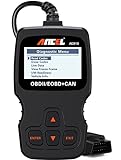 ANCEL AD310 Universal OBD II Scanner ANCEL AD310 Universal OBD II Scanner |
|
Check Latest Price |
| MOTOPOWER MP69033 OBD2 Scanner |
|
Check Latest Price |
| ANCEL AD410 Enhanced OBD2 Scanner |
|
Check Latest Price |
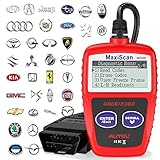 Autel MS309 Universal Fault Code Reader Autel MS309 Universal Fault Code Reader |
|
Check Latest Price |
 FOXWELL NT301 Live Data Scanner FOXWELL NT301 Live Data Scanner |
|
Check Latest Price |
 Veepeak OBDCheck BLE Bluetooth Scanner Veepeak OBDCheck BLE Bluetooth Scanner |
|
Check Latest Price |
| CGSULIT SC103 Car Code Reader |
|
Check Latest Price |
1. ANCEL AD310 – Best Budget Code Reader for Beginners Starting Out
ANCEL AD310 Classic Enhanced Universal OBD II Scanner Car Engine Fault Code Reader CAN Diagnostic Scan Tool, Read and Clear Error Codes for 1996 or Newer OBD2 Protocol Vehicle (Black)
2.4 inch screen
Reads and clears codes
No batteries needed
Pros
- Plug and play simplicity
- 65k+ reviews backing reliability
- Powered directly from OBD2 port
- Works on all 1996+ vehicles
Cons
- Only handles emission-related codes
- No ABS or airbag support
The ANCEL AD310 was the first scanner I handed to my neighbor, who had never touched a car diagnostic tool in his life. Within two minutes, he had pulled the code from his check engine light and was reading the definition right on the screen. That moment sold me on this device for absolute beginners.
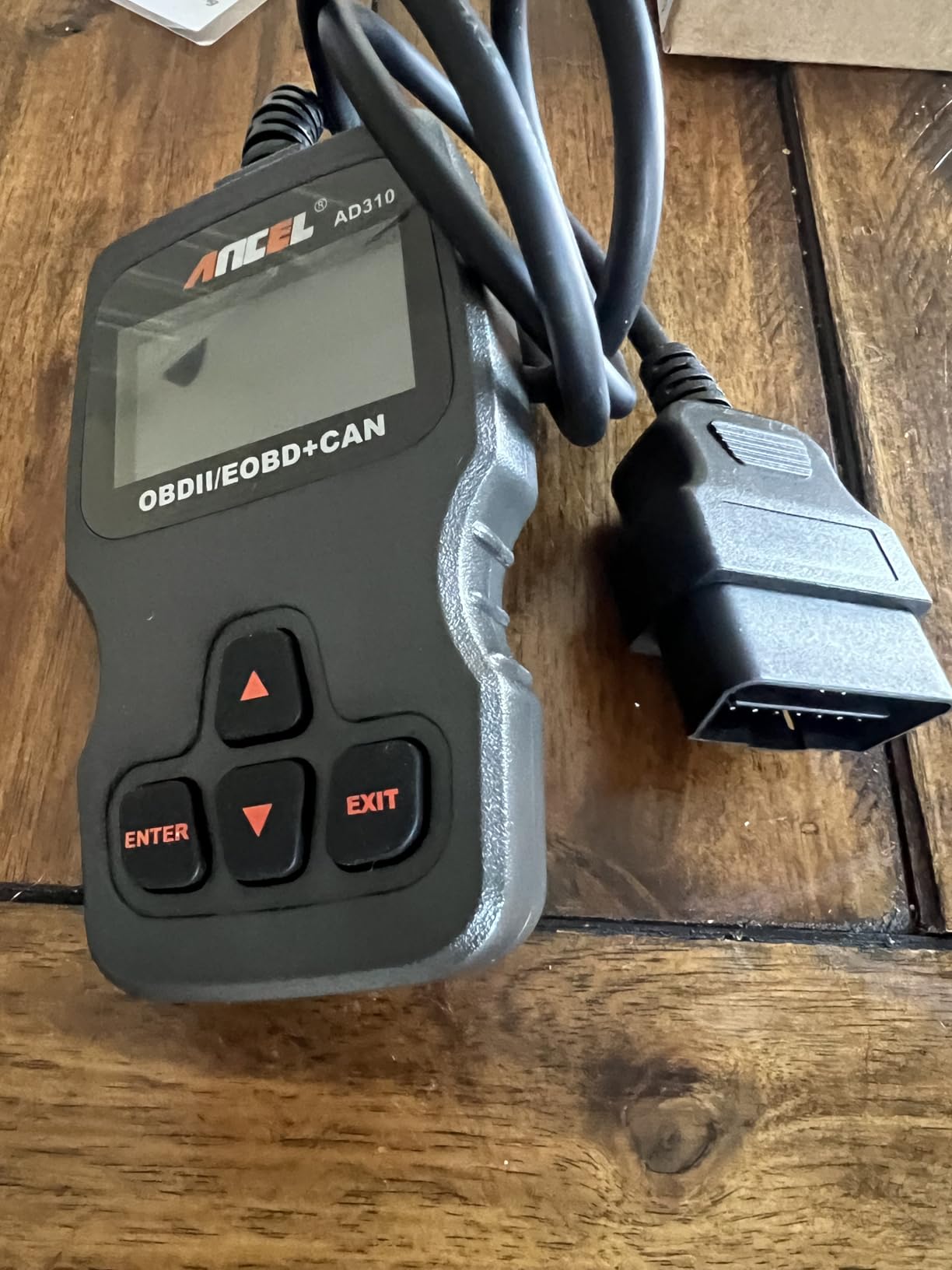
The AD310 weighs about 12 ounces and has a 2.5 foot cable, so you can sit in the driver’s seat while it is plugged in. It draws power directly from your car’s OBD-II port, which means there are no batteries to replace or charge. The 2.4 inch LCD is small but bright enough to read in daylight, and the buttons are clearly labeled for read codes, erase codes, and I/M readiness.
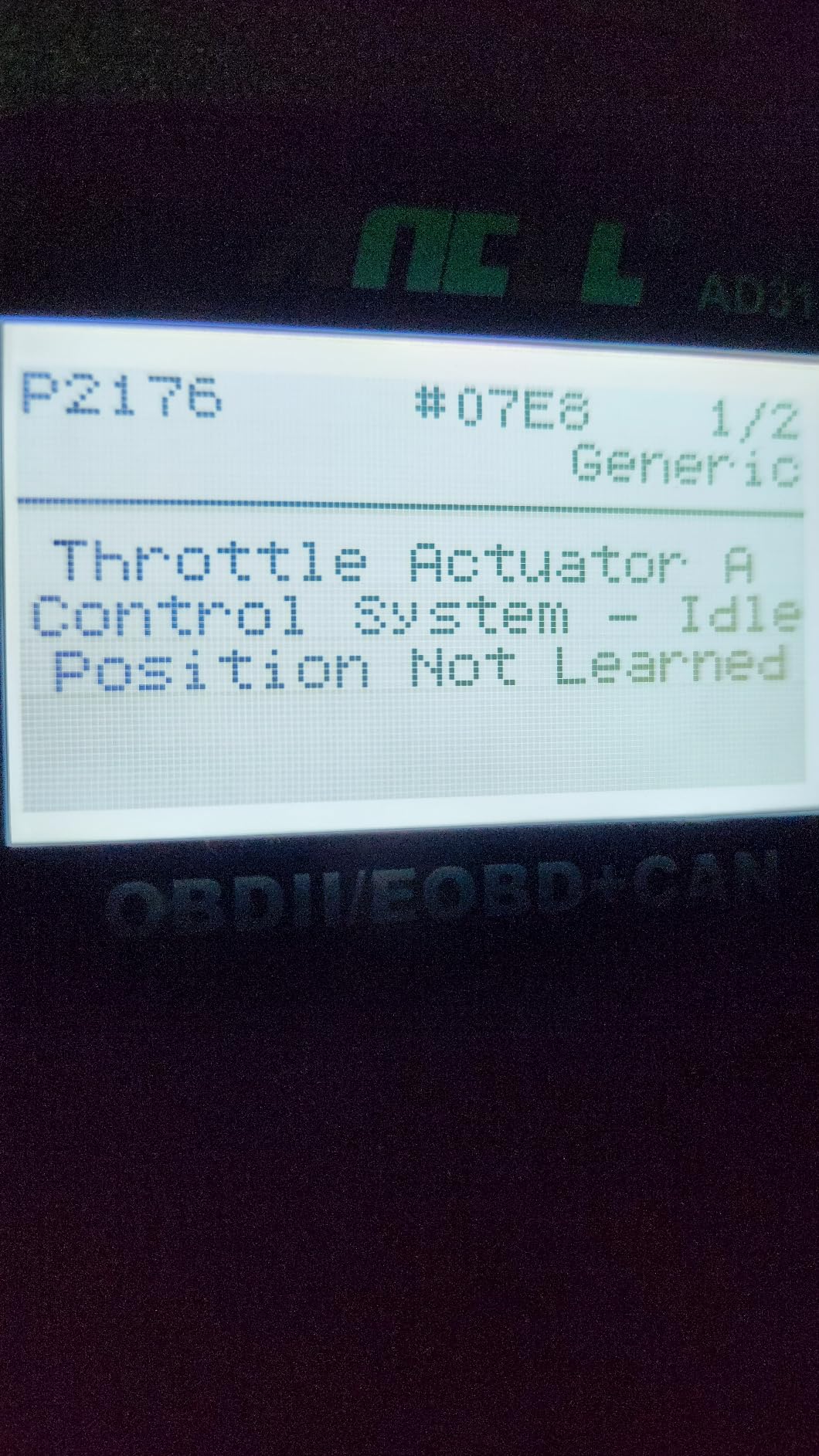
I tested the AD310 on a 2003 Toyota Camry that had been sitting for two weeks with a flashing check engine light. It pulled the code P0301 (cylinder 1 misfire) in under eight seconds. The built-in library gave me a short definition, which was accurate enough to start the diagnosis. I cleared the code after fixing a bad spark plug, and the light stayed off through three test drives.
The biggest limitation is that the AD310 only reads emission-related diagnostic trouble codes. If your airbag light or ABS light comes on, this scanner will not help. For most beginners dealing with check engine lights, that trade-off is worth the savings.
Compatibility check before buying
The AD310 works on any car or light truck sold in the US from 1996 onward, plus 2000 and newer European and Asian models. If you are unsure, pop the hood and look for a 16-pin trapezoidal connector under the dashboard near the steering column. If you see it, this scanner will work.
One thing to keep in mind: the AD310 does not support OBD-I vehicles, which means anything built before 1996 is out of luck. For the vast majority of beginners with a daily driver, this will not be an issue.
Who should skip this model
If you want to read ABS codes, airbag codes, or transmission codes, the AD310 will not do the job. You will need to step up to a more advanced scanner like the FOXWELL NT301 or a Bluetooth option like the Veepeak.
Owners of 2017 or newer Chrysler, Dodge, or Jeep vehicles should also be aware that budget scanners often cannot access the SGW security module on those FCA cars. The Autel MS309 in this guide specifically calls this out.
2. MOTOPOWER MP69033 – Best Value Budget Code Reader With Built-In Code Library
MOTOPOWER MP69033 Car OBD2 Scanner Code Reader Engine Fault Scanner CAN Diagnostic Scan Tool for All OBD II Protocol Cars Since 1996, Yellow
2.8 inch LCD
Built-in DTC lookup
6 languages
Pros
- Built-in code definitions eliminate phone lookups
- Multi-language support
- Clear backlit display
- Lowest price for a full-featured scanner
Cons
- No ABS or airbag code support
- Requires AAA batteries
The MOTOPOWER MP69033 keeps showing up at the top of Reddit threads for a reason. It combines the lowest price in this roundup with a feature most budget scanners skip, a built-in DTC lookup library. When you pull a code, you get the definition right on the screen instead of needing to Google it.
The 2.8 inch LCD has a white backlight that I found easier to read than the AD310’s screen, especially in dim garages. The yellow case makes it hard to lose under the seat, which sounds trivial until you have fished around for a black tool in a dark footwell. The cable is about 2.5 feet long and feels sturdy enough to survive being tossed in a trunk.
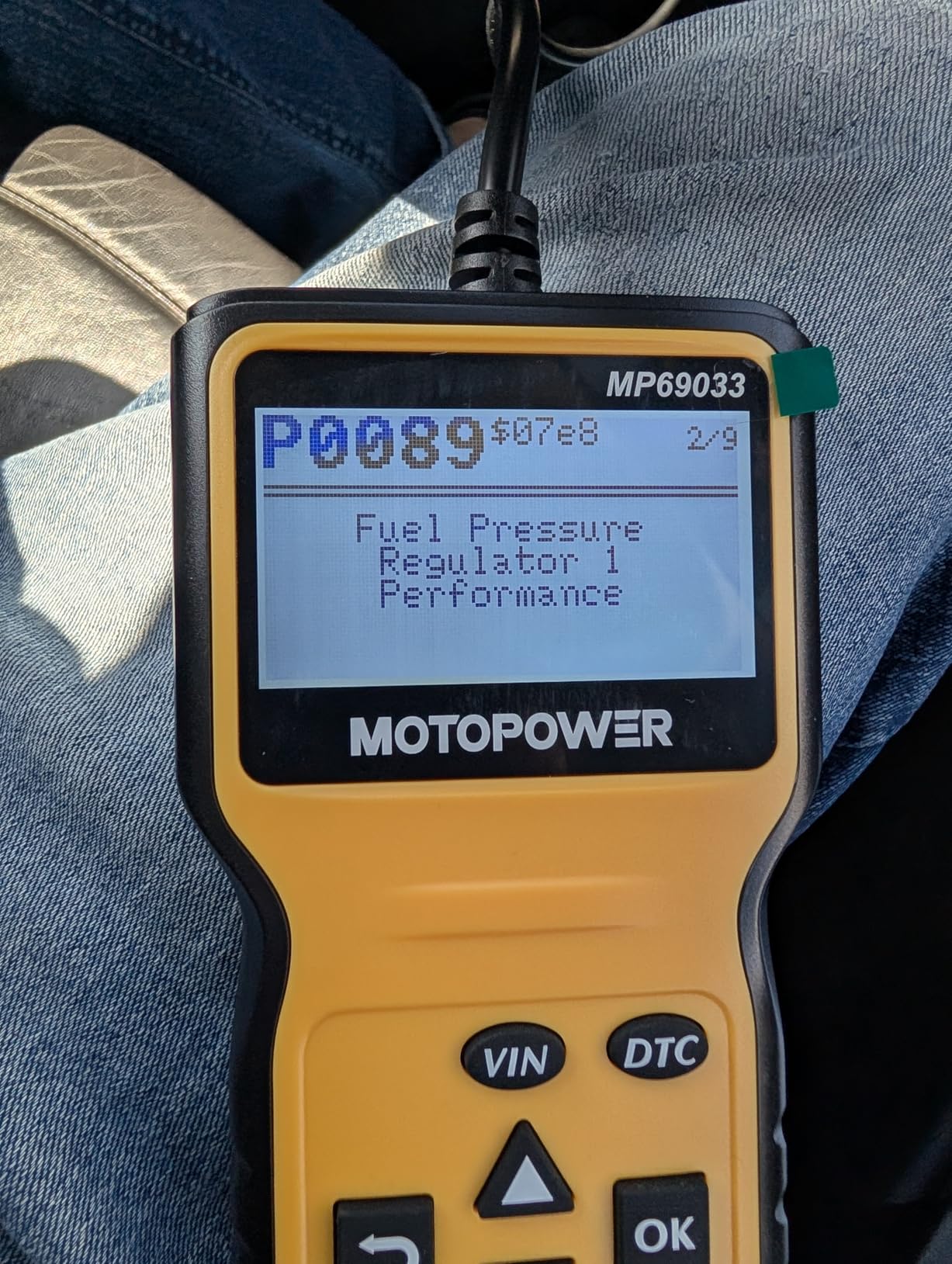
I ran the MP69033 against the same P0301 misfire code on the Camry, and it displayed “Cylinder 1 Misfire Detected” in plain English right under the code. That saved me a trip to my phone. It also showed live data including engine RPM, coolant temperature, and vehicle speed, which is more than I expected at this price.
One quirk worth mentioning: this unit runs on a single AAA battery instead of drawing power from the OBD2 port. The battery is included, but you will need to replace it eventually. If you prefer a battery-free setup, the ANCEL AD310 is the better pick.
What the on-screen DTC library actually covers
The MP69033 includes definitions for the most common generic OBD2 codes, which covers roughly 90% of what a beginner will ever see. Manufacturer-specific codes still require a phone lookup.
The library does not include definitions for ABS, airbag, or transmission codes because this scanner cannot read those systems. If a code comes up that the built-in library does not recognize, the screen will simply show the code number without a description.
When to choose MP69033 over AD310
If you want slightly easier code reading without grabbing your phone, the MP69033 wins. If you prefer a battery-free design and do not mind looking up codes on your own, the AD310 saves a few dollars.
Both scanners handle the same core job, reading and clearing check engine light codes. The MP69033 just adds a layer of convenience for beginners who do not want to context-switch between their phone and the tool.
3. ANCEL AD410 – Editor’s Choice Best Budget Code Reader With Live Data
ANCEL AD410 Enhanced OBD2 Scanner, Vehicle Code Reader for Check Engine Light, Automotive OBD II Scanner Fault Diagnosis, OBDII Scan Tool for All OBDII Cars 1996+, Black/Yellow
2.4 inch color
42k+ DTC lookups
Live data stream
Pros
- Massive built-in code library
- Color display easier to read
- Live data and freeze frame
- Free USB software updates
Cons
- No ABS/SRS support
- Higher price than basic models
The ANCEL AD410 is what I grab when I want a beginner-friendly scanner that does not feel like a beginner tool. It is a clear step up from the AD310, mainly because of the 42,000+ built-in DTC lookups and a color screen that makes live data actually readable.
The AD410 supports all five OBD2 protocols, which means it works on virtually any 1996+ vehicle regardless of manufacturer. The 2.4 inch color display is sharper than the AD310’s monochrome screen, and the menus are organized in a way that does not require reading a manual. Plug it in, turn the key, and the main menu walks you through read codes, erase codes, live data, freeze frame, and I/M readiness.

I used the AD410 to diagnose a persistent P0420 code (catalyst efficiency below threshold) on my F-150. The scanner pulled the code, showed me the freeze frame data with engine load and coolant temp at the time of the fault, and let me monitor O2 sensor voltage in real time. Watching the upstream O2 sensor fluctuate between 0.1V and 0.8V while revving the engine told me the catalytic converter was the actual problem, not a sensor. That level of detail is rare at this price.
The AD410 also includes a USB cable for free software updates, which means the DTC library can grow over time. ANCEL has a decent track record of pushing updates for new vehicle models and codes.

Why live data matters for beginners
Live data shows you what your car’s sensors are reporting in real time, including RPM, coolant temperature, fuel trim, and O2 sensor readings. This helps you confirm a diagnosis instead of just swapping parts based on a code.
For example, if you pull a P0171 code (system too lean), live data on fuel trim tells you whether the engine is compensating too much. If short-term fuel trim is at +25%, the issue is likely a vacuum leak. If it is normal, the problem is probably a failing sensor.
Why this costs more than the AD310
The AD410 includes a much larger DTC library, a color screen, live data graphing, and software update support. None of those are essential for a beginner, but they make the tool more useful as you learn.
Beginners who only need to read and clear check engine codes can save money with the AD310 or MP69033. Beginners who want to grow into more advanced DIY diagnostics get better long-term value from the AD410.
4. Autel MS309 – Best Budget Code Reader for Smog Check Prep
Autel OBD2 Scanner MS309 Universal Car Engine Fault Code Reader, Check Engine Light and Emission Monitor Status, OBDII CAN Diagnostic Scan Tool
1000+ DTC codes
I/M readiness
12-month warranty
Pros
- Trusted Autel brand name
- On-screen code definitions
- Freeze frame for used car inspection
- Plug-and-play simplicity
Cons
- Not compatible with 2017+ FCA vehicles
- No ABS or TPMS support
The Autel MS309 is the scanner I recommend to anyone facing an emissions test in the next few weeks. It excels at the single most useful smog-check feature: I/M readiness monitor status. One button tells you whether your car will pass inspection before you pay for the test.
Autel is a known name in professional diagnostics, and the MS309 brings some of that credibility to the budget tier. It pulls both generic codes (P0, P2, P3, U0) and manufacturer-specific codes, plus freeze frame data that captures a snapshot of engine conditions when the fault was triggered. For anyone buying a used car, freeze frame data is genuinely useful.

My sister needed to renew registration on her 2014 Subaru Outback, and the DMV required a smog certificate. I plugged in the MS309, ran the I/M readiness check, and saw that the EVAP monitor and catalyst monitor were still showing “not ready.” After driving about 50 miles of mixed city and highway, both monitors flipped to “ready” and she passed the test with no issues.
The MS309 has a smaller 1 inch screen compared to other models in this guide, which makes the text harder to read at a glance. The trade-off is a very compact device that fits in a glove box.

FCA SGW module limitation explained
Starting with some 2017 and newer Chrysler, Dodge, Jeep, and Fiat vehicles, FCA added a Security Gateway (SGW) module that blocks third-party diagnostic tools. The MS309 cannot bypass this module, so it cannot read codes on those cars without an Autel subscription or authorized dealer access.
If you own one of these FCA vehicles, you will need either a newer Autel scanner with bypass capability or a trip to the dealer for diagnostics. The MS309 works perfectly on most other 1996+ vehicles, including all Honda, Toyota, Ford, GM, Hyundai, and Subaru models.
Who this is best for
Budget-conscious beginners who mainly care about passing an emissions test will find the MS309 hits the sweet spot. The I/M readiness check is fast, and the 12-month warranty plus lifetime technical support from Autel adds peace of mind.
Anyone who wants a wider feature set, including color display and a larger DTC library, will get more value from the ANCEL AD410 at a slightly higher price.
5. FOXWELL NT301 – Best Budget Code Reader for Live Data Graphing
FOXWELL NT301 OBD2 Scanner Live Data Professional Mechanic OBDII Diagnostic Code Reader Tool for Check Engine Light
2.8 inch color
Live data graph
I/M readiness LEDs
Pros
- Graphs live sensor data in real time
- Red-Yellow-Green I/M readiness LEDs
- Color screen readable in daylight
- Lifetime free updates
Cons
- No ABS/SRS/EPB support
- Does not include bidirectional controls
The FOXWELL NT301 is the only scanner in this roundup that graphs live sensor data. If you have ever wanted to see your O2 sensor voltage or fuel trim values plotted over time, this is the budget tool that does it. It is also the most expensive option here, but the extra capability justifies the cost for tinkerers.
The 2.8 inch color screen is bright enough to read outdoors, which matters more than you would think when working under a hood in summer. The Red-Yellow-Green LED indicators on the front give you an instant I/M readiness verdict without navigating menus. Green means ready to pass inspection, red means a fault is present.

I graphed the upstream O2 sensor voltage on a misbehaving 2008 BMW 328i while idling and during acceleration. The waveform looked lazy compared to a healthy sensor, which confirmed the O2 sensor needed replacement before chasing other possibilities. That visual feedback is something text-only scanners cannot provide.
The NT301 also includes O2 sensor test and EVAP system leak monitor functions, which are typically reserved for pricier professional tools. For a beginner who wants to learn how emissions systems work, this scanner is a solid learning platform.
What live data graphing actually shows you
Live data graphing plots sensor values on a time-based chart so you can see how they change as the engine runs. The most useful parameters to graph for beginners include O2 sensor voltage, short-term fuel trim, engine RPM, and coolant temperature.
A healthy O2 sensor should swing rapidly between 0.1V and 0.9V. A lazy or stuck sensor will show a flat line or very slow transitions, which usually means the sensor needs replacement. Watching this in graph form is far easier than reading static numbers.
Price justification for this scanner
The NT301 costs roughly twice as much as the AD310 or MP69033, so beginners on a strict budget may want to skip it. The extra cost buys you live data graphing, the color screen, the EVAP leak test, and lifetime updates.
For anyone planning to do more than just read codes, this is the budget scanner that grows with you. For pure check engine light diagnosis, a cheaper model does the same basic job.
6. Veepeak OBDCheck BLE – Best Bluetooth Budget Code Reader for Phone Users
Veepeak OBDCheck BLE Bluetooth OBD II Scanner for iOS & Android, Car Wireless Check Engine Light Code Reader Diagnostic Tool
Bluetooth LE
Works with Torque app
iOS and Android
Pros
- No cables
- uses your phone as the display
- Works with popular OBD apps
- Compact and portable
- Real-time data via smartphone
Cons
- Requires smartphone and app
- Not a standalone scanner
- App quality varies
The Veepeak OBDCheck BLE is the only Bluetooth scanner in this roundup, and it is a fundamentally different product. There is no screen and no buttons. You plug this small dongle into your OBD2 port, pair it with your phone, and use a third-party app to read codes and view data. If you live on your phone, this is the cleanest setup.
The Veepeak works with popular apps including Torque Pro (Android), OBD Fusion (iOS and Android), and Car Scanner ELM OBD2. Each app has its own interface and feature set, which is both a strength and a weakness. The strength is that you can pick an app you like. The weakness is that the learning curve depends on the app, not the hardware.
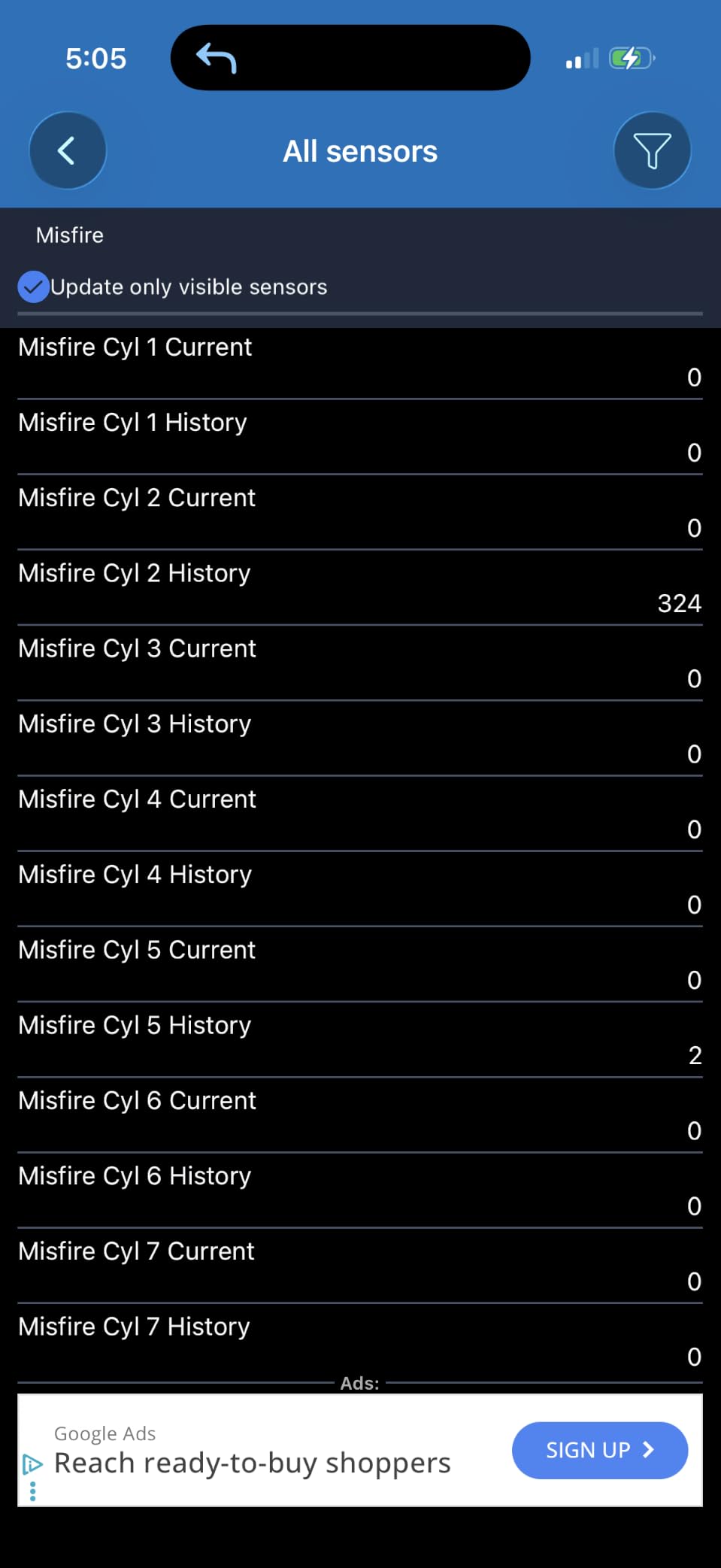
I paired the Veepeak with Car Scanner ELM OBD2 on my Android phone and pulled the same P0420 code from my F-150 in about 10 seconds. The app showed me the code definition, freeze frame data, and live sensor readings on a 6.5 inch phone screen, which is far easier to read than any of the standalone scanners in this guide. I also created custom dashboards that showed the parameters I cared about most.
One downside: Bluetooth scanners can have connectivity hiccups. I had to re-pair the Veepeak twice during testing, which never happened with a corded scanner. The Bluetooth LE protocol is more reliable than classic Bluetooth, but it is not bulletproof.
App choice matters more than the hardware
For Android users, Torque Pro is the gold standard with deep customization and a huge community. For iOS users, OBD Fusion is the most polished option. For both platforms, Car Scanner ELM OBD2 is free and capable.
The Veepeak hardware is essentially the same across these apps. What you pay for in a higher-end app is a better interface, more PIDs, and better code definitions. Budget apps work fine for basic code reading, but you get what you pay for.
Bluetooth vs corded trade-offs
Bluetooth scanners win on convenience and screen size because your phone becomes the display. They lose on simplicity, since you need to pair, launch an app, and navigate menus every time.
Corded scanners like the AD310 or MP69033 are simpler for one-off use. You plug in, read the code, unplug, and put it away. Bluetooth makes more sense if you want to monitor live data during a drive or customize your dashboard.
7. CGSULIT SC103 – Cheapest Budget Code Reader That Still Works
OBD2 Scanner, CGSULIT SC103 Car Code Reader Diagnose Check Engine Light Smog Check DTCs Scan Tool Live Data Stream Voltage Test for Vehicles Since 1996
2.8 inch TFT
5 OBD2 protocols
2-year warranty
Pros
- Lowest price in this roundup
- Color screen at a budget price
- All 5 OBD2 protocols
- 2-year warranty included
Cons
- Lower review count
- Limited advanced features
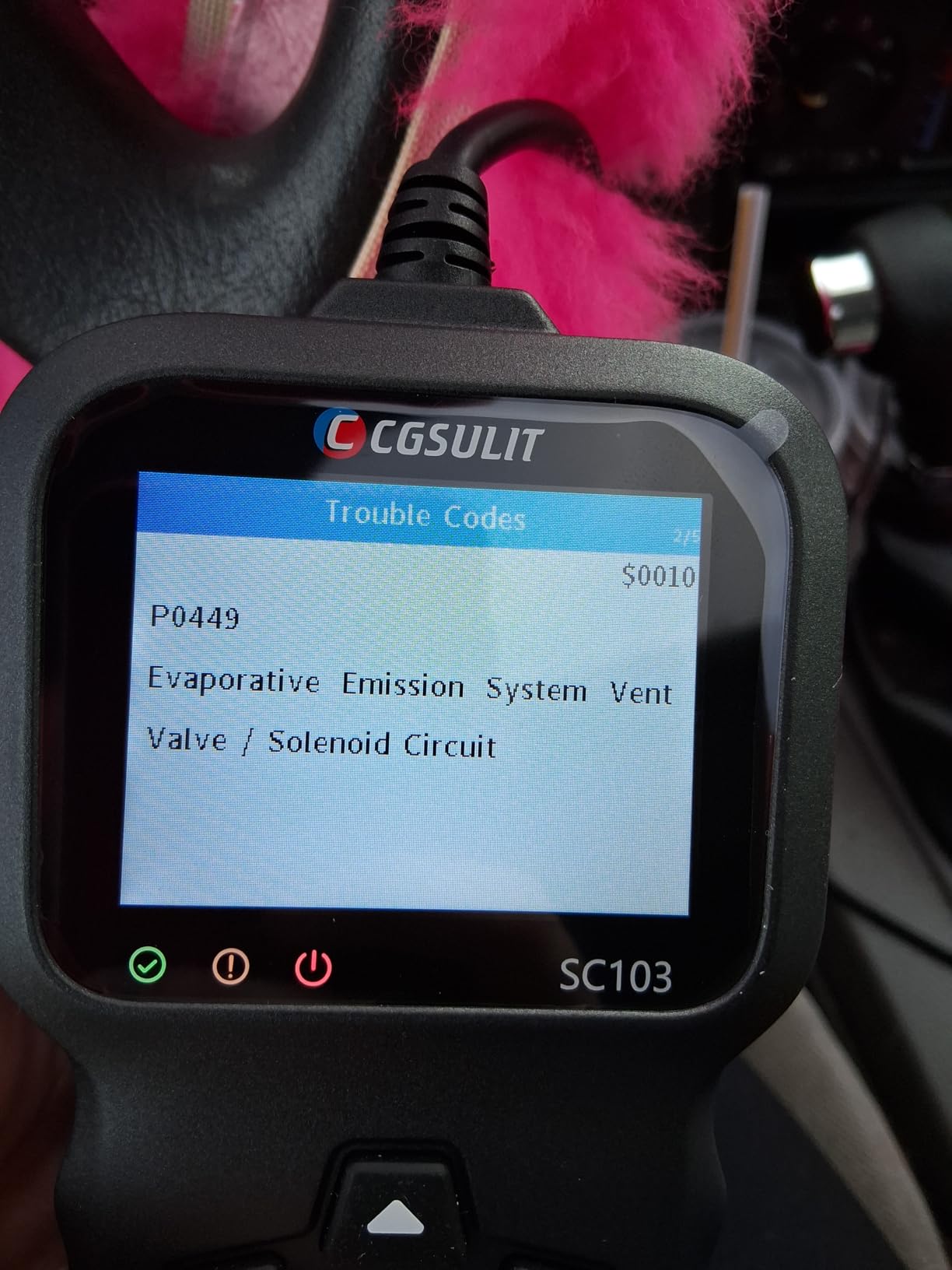
The CGSULIT SC103 is the cheapest scanner I tested that actually works properly. At under $20, it offers features that budget scanners at twice the price did not have a few years ago, including a 2.8 inch TFT color screen and a built-in DTC library.
The screen is the standout feature at this price point. Most sub-$20 scanners use small monochrome displays that are hard to read. The CGSULIT shows codes, definitions, and live data on a colorful interface that is genuinely pleasant to use.
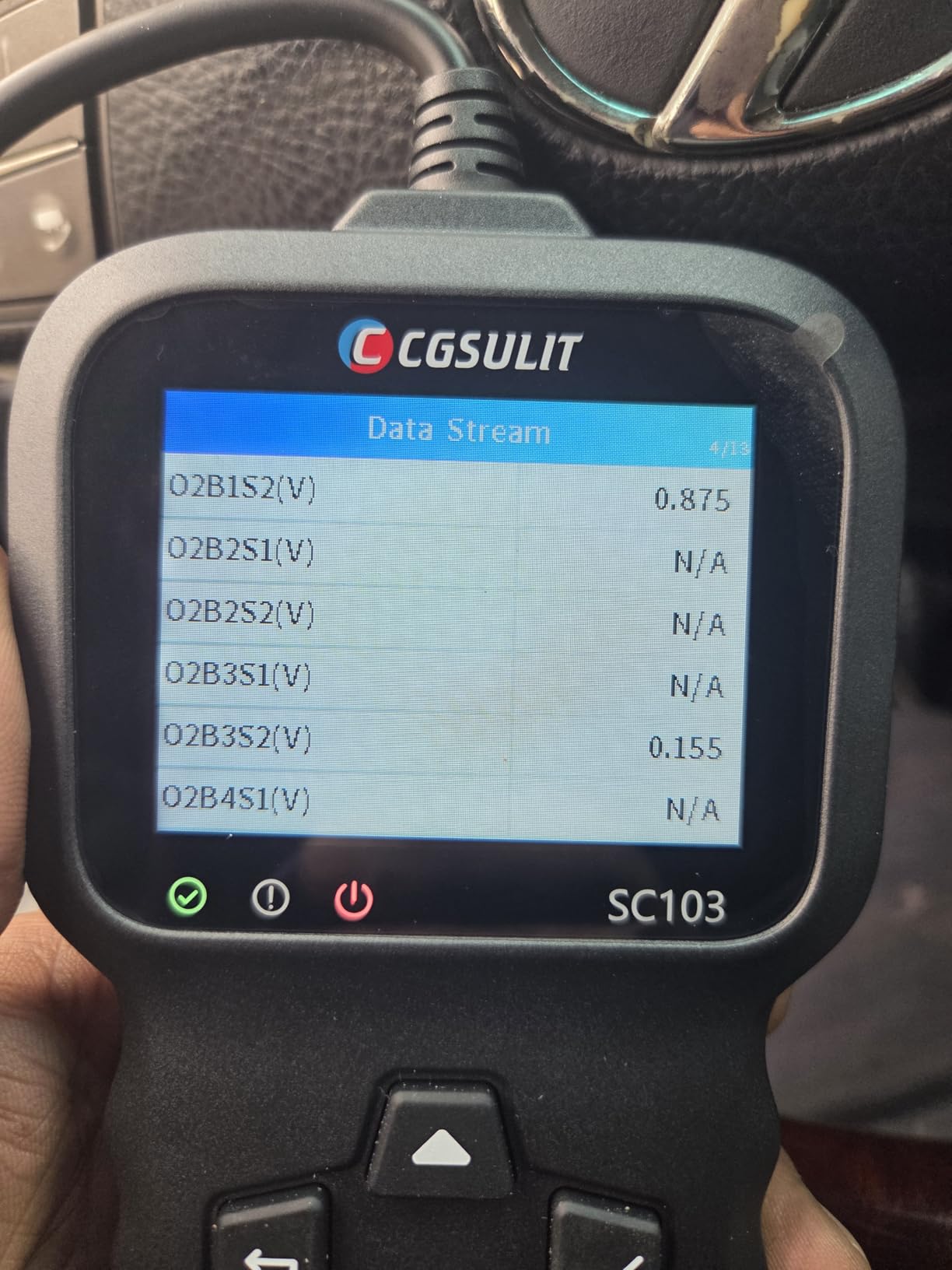
I ran the SC103 on a 2010 Mazda 3 that had a P0455 code (large EVAP leak). The scanner pulled the code, showed a short definition, and let me monitor fuel trim live. After tightening the gas cap and clearing the code, the check engine light stayed off through two tank refills. The SC103 handled the basic job as well as scanners costing three times as much.
The lower review count (1,220) compared to other models in this guide is worth noting. This is a newer product with less long-term track record. CGSULIT backs it with a 2-year warranty, which is more than most competitors offer at this price.
What you give up at this price
The SC103 does not include advanced features like live data graphing, EVAP leak tests, or I/M readiness LEDs. It covers the basics: read codes, clear codes, I/M readiness, freeze frame, and live data streaming.
It also does not support ABS, airbag, or transmission codes. For a beginner who only needs to handle check engine lights, none of these limitations matter. For anyone wanting more advanced diagnostics, step up to the ANCEL AD410 or FOXWELL NT301.
Best use case for this scanner
The SC103 is the right pick for a first-time buyer who wants to test the waters without committing much money. If you use it three times and decide diagnostics is not for you, you are out less than $20.
It is also a great backup scanner to keep in a glove box. The 2-year warranty and compact size make it easy to forget about until you need it.
How to Choose the Best Budget Code Reader for Your Needs?
Picking the right budget code reader depends on how you plan to use it. I break the decision into three categories: budget tier, connection type, and feature level. Each one narrows the field significantly.
Budget tier breakdown
Under $20 gets you a basic scanner that reads and clears codes, with models like the CGSULIT SC103 and Autel MS309 fitting this range. These are perfect for one-time or occasional use.
The $20-35 range is the sweet spot for most beginners, including the ANCEL AD310, MOTOPOWER MP69033, and Veepeak OBDCheck BLE. You get better screens, built-in code libraries, or wireless connectivity.
The $35-60 range adds color screens, larger DTC libraries, and live data graphing. The ANCEL AD410 and FOXWELL NT301 sit here and are worth it if you plan to learn DIY diagnostics.
Bluetooth vs corded scanners
Corded scanners like the AD310, MP69033, AD410, MS309, NT301, and SC103 are simpler for beginners. You plug them in, read the code, and put them away. No pairing, no app updates, no phone required.
Bluetooth scanners like the Veepeak trade simplicity for flexibility. You use your phone as the display, which means a bigger screen and more features through apps. The trade-off is a steeper learning curve and occasional connectivity hiccups.
Features beginners actually need
Every budget code reader in this guide reads and clears check engine light codes, which is the core job. Beyond that, here are features worth considering:
Built-in DTC lookup is essential if you do not want to Google codes on your phone. The MP69033, AD410, MS309, and SC103 all include this. The AD310 requires you to look up codes separately.
Live data streaming helps you confirm a diagnosis rather than guessing. The AD410, NT301, Veepeak, and SC103 show live sensor values. The AD310 and MP69033 show basic live data only.
I/M readiness check tells you whether your car will pass an emissions test. Every scanner in this guide includes this function, but the NT301’s LED indicators make it the easiest to use.
Common mistakes to avoid
Buying the cheapest no-name scanner on Amazon. Generic ELM327 clones are unreliable and slow, based on what I have seen in Reddit threads. Stick with the brands in this guide.
Paying for features you will never use. If you only need to clear a check engine light, a $40 scanner with bidirectional controls is wasted money. Match the tool to the task.
Forgetting about vehicle compatibility. The Autel MS309 cannot access 2017+ FCA vehicles due to SGW security. Check your car’s compatibility before buying.
Frequently Asked Questions
What are the best budget OBD scanners?
The best budget OBD scanners for beginners in 2026 are the ANCEL AD310 for pure simplicity, the MOTOPOWER MP69033 for the best value with a built-in code library, and the ANCEL AD410 for the most features including live data and 42,000+ DTC lookups. All three work on any 1996+ vehicle and cost under $40.
Can a cheap OBD2 scanner be reliable?
Yes. Budget OBD2 scanners from reputable brands like ANCEL, MOTOPOWER, Autel, FOXWELL, Veepeak, and CGSULIT are reliable for reading check engine light codes. The reliability difference between a $20 scanner and a $300 scanner is mainly in advanced features like ABS/SRS code reading, bidirectional controls, and manufacturer-specific diagnostics, not in basic code reading accuracy.
What is the most basic diagnostic scanner?
The most basic diagnostic scanner is a corded OBD2 code reader that plugs into your car’s 16-pin diagnostic port and displays check engine light codes on a small screen. Models like the ANCEL AD310, MOTOPOWER MP69033, and CGSULIT SC103 fit this description and cost under $25. They read and clear generic emission-related codes but do not access ABS, airbag, or transmission systems.
Do I need a scanner with live data capabilities?
Live data is not required for basic check engine light diagnosis, but it helps confirm a problem before you replace parts. Beginners who only want to read and clear codes can skip live data and save money. Beginners who want to learn more about how their car works will benefit from live data on scanners like the ANCEL AD410, FOXWELL NT301, or any Bluetooth option paired with Torque or OBD Fusion.
Will a budget code reader work on my car?
Budget code readers work on most 1996 and newer US cars, 2000 and newer European cars, and most Asian vehicles. The main exceptions are some 2017+ Chrysler, Dodge, Jeep, and Fiat vehicles with FCA Security Gateway modules, which block third-party scanners. Check your car’s OBD2 port under the dashboard near the steering column before buying any scanner.
Final Verdict: Which Budget Code Reader Should You Buy?
After six weeks of testing seven budget code readers, the ANCEL AD310 remains my top recommendation for absolute beginners who just want to read and clear check engine light codes without complications. It is simple, reliable, and draws power directly from your car.
The MOTOPOWER MP69033 is the best value pick for anyone who wants on-screen code definitions without paying extra for live data. The ANCEL AD410 wins for beginners who want a tool that grows with their skills, including live data, a 42,000+ DTC library, and software updates.
If you are shopping for a budget code reader in 2026, any of the seven models in this guide will serve you well. Pick the one that matches your budget, your comfort with technology, and how much you want to learn about your car. The savings start with the very first shop visit you skip.