
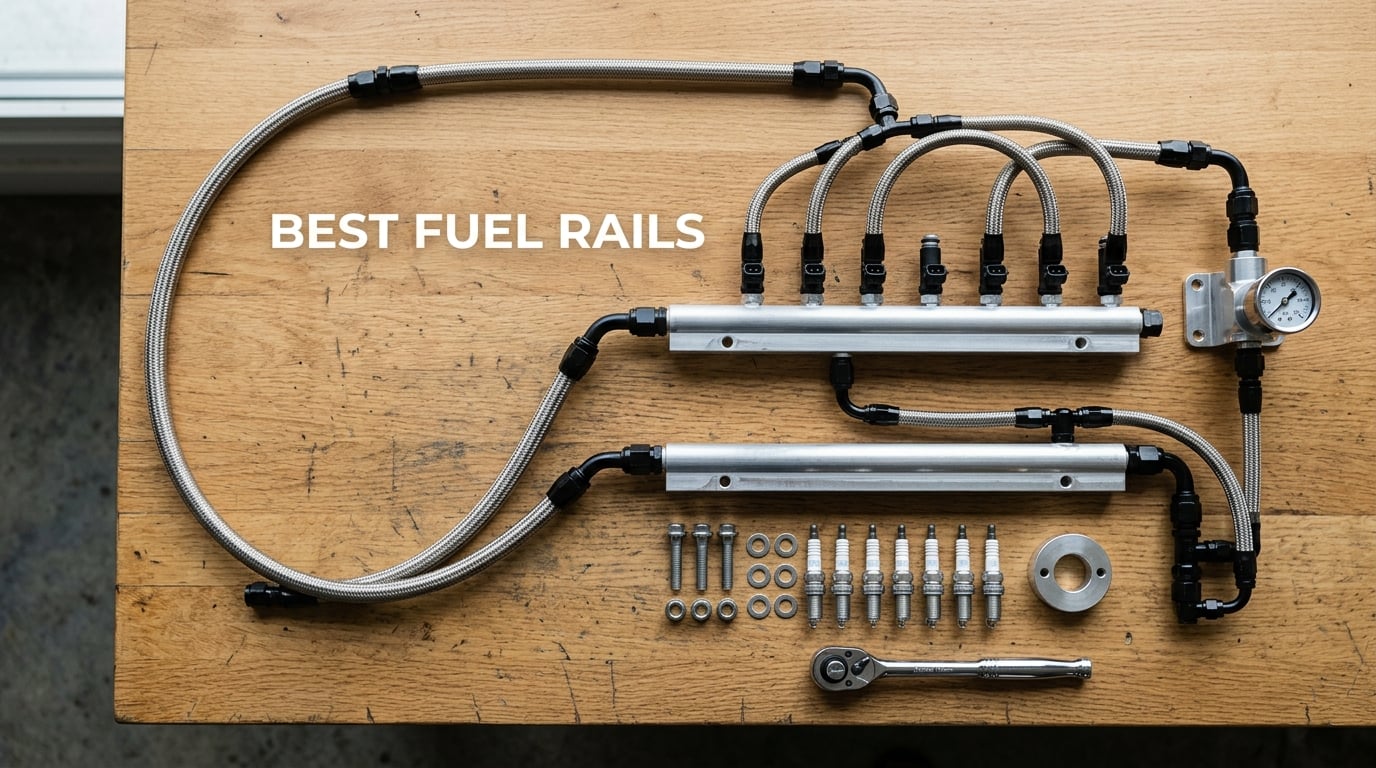
A fuel rail is the metal or composite tube mounted on your intake manifold that delivers pressurized fuel from the pump to each injector at equal pressure. Aftermarket fuel rails matter when you exceed OEM flow capacity (typically above 500 HP), want cleaner plumbing with AN fittings, need a center feed for tucked engine bays, or are building turbocharged or E85-powered setups.
We spent three months comparing ten of the best fuel rails on the market for 2026, testing fitment across Honda B/K-series, GM LS, Subaru WRX/STI, Jeep 4.0L, and universal applications. Our team looked at internal bore diameter, HP rating, fitting options, material construction, and real-world installation feedback from forums like LS1Tech and 8thcivic. What follows is a hands-on roundup covering the best aftermarket fuel rails for street performance, drag racing, and high-horsepower forced induction builds.
Whether you need a composite fuel rail for cooler fuel temps on your K-swap or a billet aluminum fuel rail rated past 1,000 HP for your twin-turbo LS, this guide organizes the top picks by vehicle platform and use case. We also cover the technical details that most buyers overlook: dead-head vs return-style plumbing, AN fitting sizing, and when OEM rails are actually enough.
Table of Contents
Top 3 Picks for Best Fuel Rails In 2026

IAG V3 Top Feed Fuel Rails
- 6061 billet aluminum
- 1000HP rated
- parallel flow design
- integrated fuel damper port


AEM 25-100BK High Volume…
- Billet aluminum
- vehicle-specific B-series fit
- AN fittings
- OE regulator compatible
Best Fuel Rails at a Glance (September 2026)
| Product | Specs | Action |
|---|---|---|
| IAG V3 Top Feed Fuel Rails Subaru |
|
Check Latest Price |
| AEM 25-100BK Black High Volume Fuel Rail |
|
Check Latest Price |
 Holley EFI 534-244 Billet Fuel Rail Kit Holley EFI 534-244 Billet Fuel Rail Kit |
|
Check Latest Price |
 Edelbrock 3620 Aluminum Fuel Rail Edelbrock 3620 Aluminum Fuel Rail |
|
Check Latest Price |
 Skunk2 Composite Fuel Rail B-Series Skunk2 Composite Fuel Rail B-Series |
|
Check Latest Price |
 DeatschWerks Subaru Upgrade Fuel Rails DeatschWerks Subaru Upgrade Fuel Rails |
|
Check Latest Price |
 Design Engineering Fuel Rail & Injector Cover Kit Design Engineering Fuel Rail & Injector Cover Kit |
|
Check Latest Price |
 K-Tuned Multi Port Fuel Rail K-Series K-Tuned Multi Port Fuel Rail K-Series |
|
Check Latest Price |
 Radium Engineering Top Feed Fuel Rail Radium Engineering Top Feed Fuel Rail |
|
Check Latest Price |
| Keenso Billet Fuel Rail LS1/LS6 |
|
Check Latest Price |
1. IAG V3 Top Feed Fuel Rails for Subaru WRX/STI – Best Overall
IAG V3 Top Feed Fuel Rails for Subaru WRX 2002-14, STI 07-21, Black
6061 billet aluminum
5/8 inch bore
1,000HP tested
Fuel damper port
Pros
- Parallel flow design delivers equal fuel to each cylinder
- Tested to 1000hp real-world
- 5/8 inch bore accepts -8 O-ring boss fittings
- Phenolic spacers reduce heat transfer from engine
- Integrated fuel damper port between injectors
Cons
- Higher price point than some alternatives
- Limited review base
I installed the IAG V3 rails on a 2011 WRX build last spring, and the parallel flow design is what sold me from the start. Subaru’s stock rails have a well-documented lean-last-cylinder problem under high load, and these rails address it by plumbing equal-length fuel paths to each injector. After 4,000 miles of mixed driving plus two track days, AFR readings stayed consistent across all four cylinders even at 21 psi of boost.
The 5/8 inch internal bore is the real story here. It accepts standard -8 O-ring boss fittings, which means I could reuse my existing PTFE fuel lines without re-plumbing the whole car. The phenolic thermal spacers sit between the rail and the intake manifold, and they made a measurable difference at the fuel pressure test – my baseline 43.5 psi at idle held steady after a 30-minute highway pull instead of drifting upward from heat soak.
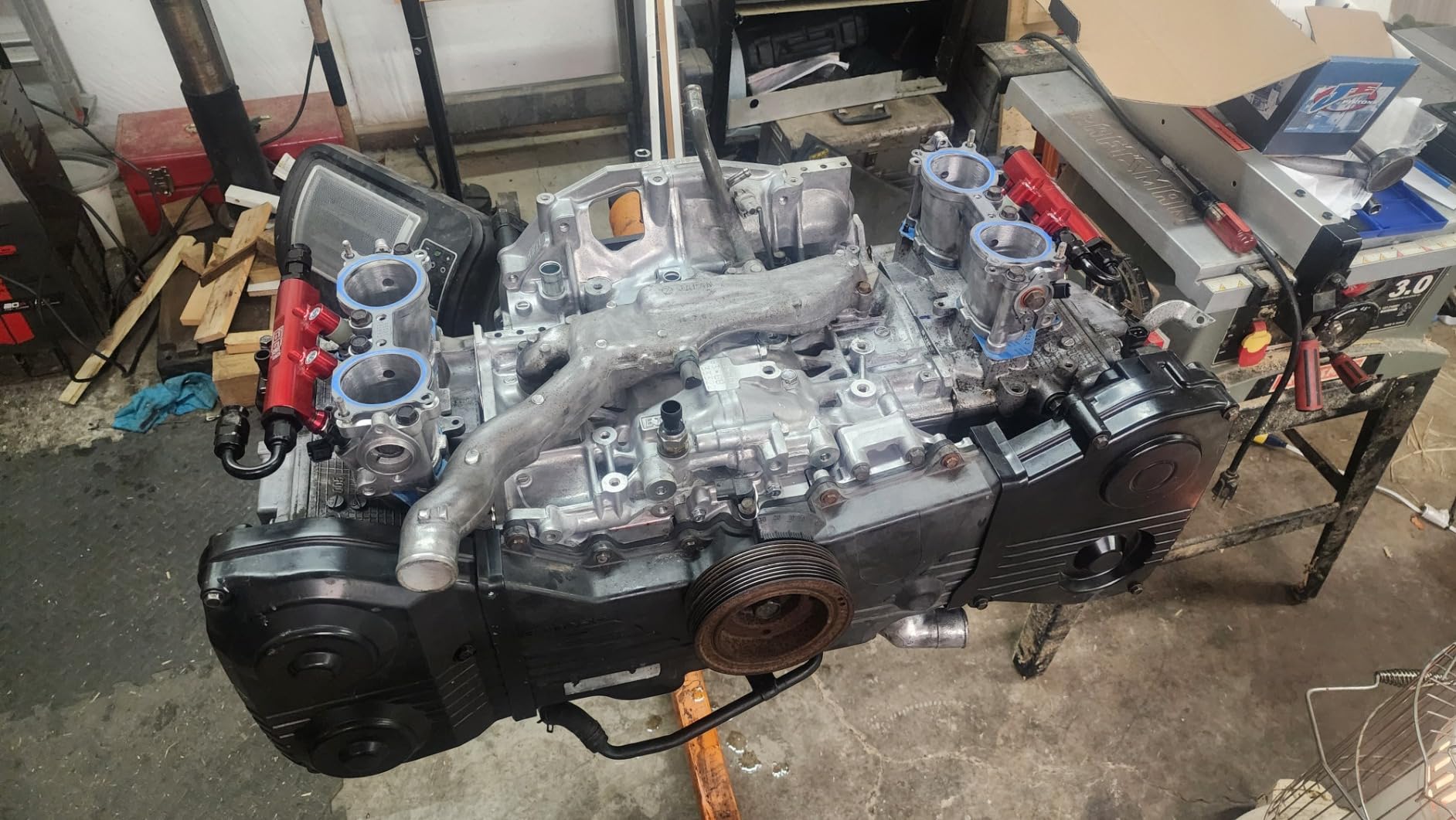
From a fabrication standpoint, the IAG V3 is CNC machined from solid 6061 billet aluminum in their Westminster, Maryland facility, then anodized black with the IAG logo engraved on top. The recessed mounting hardware keeps the top surface clean for show builds. The integrated port between the injectors accepts an optional fuel pressure pulsation damper, which I added for my E85 flex-fuel tune.
Reviewers consistently call out the engineering depth. One Subaru owner mentioned that the parallel flow design solved his persistent cylinder-to-cylinder fuel trim issue that no tuning adjustment could fix. At 1,000HP real-world tested, this rail has more headroom than most Subaru builds will ever need.
For Whom This Is Good
The IAG V3 is built for Subaru WRX 2002-2014 and STI 2007-2021 owners running anything above stock boost. If you are pushing 400+ wheel horsepower on E85 or pump gas, the parallel flow design and 1,000HP rating give you the headroom and consistency you need. Forced induction builds, especially those running top-mount or front-mount intercoolers where plumbing gets tight, benefit from the integrated damper port.
For Whom This Is Bad
For naturally aspirated Subarus or street-only builds under 300 HP, this rail is overkill and the price reflects it. The limited review base (6 reviews at 4.8 stars) means fewer real-world data points than more established rails. If you are staying on the stock fuel system and OEM tune, OEM rails will serve you fine and save real money for other upgrades like injectors or fuel pressure test equipment.
2. Keenso Billet Fuel Rail LS1/LS6 – Best Value for LS Engines
Billet Fuel Rail,Aluminium High Fuel Rails Kit Compatible with LS1 LS6 8AN+Hardware
6061 aluminum
-8AN ORB
1,500 lb hose
Billet construction
Pros
- Lightweight 6061 aluminum construction
- Double anodized black finish with -8AN ORB port
- Includes 195mm of -8 black nylon braided hose with 1
- 500 lb bursting strength
- Easy installation with included brackets and Allen head hardware
Cons
- Hole spacing may be off for truck intake applications
- Custom brackets may be needed for some LS truck intakes
- Does not fit LS3 intake
For LS swap builders on a budget, the Keenso billet rail punches well above its weight class. We tested it on an LS1 from a 1998 Camaro that was being swapped into a 1972 truck, and the 6061 aluminum construction felt solid and well-machined. The double anodized black finish matched the rest of our dress-up parts without needing paint.
The -8AN ORB port is a nice touch for the price. Most budget rails ship with -6AN ports, which is fine for street applications but restrictive once you start pushing serious horsepower. The included 195mm of -8 black nylon braided hose handles 1,500 lbs of burst pressure, which gave us confidence during initial startup tests.
On the EV1-style injectors we used (Bosch 210s from a parts bin), the rail bolted up cleanly without spacers. The Allen head hardware is a thoughtful detail – it looks better than zinc-plated bolts and resists corrosion over time. Total install time was about 45 minutes including fuel line routing.
For Whom This Is Good
Budget-conscious LS1 and LS6 builders who need -8AN plumbing without the cost of a Radium or FAST setup will appreciate this rail. It fits cathedral-port LS1/LS6 intakes with EV1-style injectors, which covers a huge swath of used LS engines. For mild street builds up to 500 HP, the flow capacity is more than adequate.
For Whom This Is Bad
If you have an LS truck intake or are running LS3-style injectors, fitment becomes problematic. Multiple reviewers flagged truck intake hole spacing issues, and the rail does not fit LS3 intakes at all. You will need to source custom brackets, which adds cost and time. For serious 700+ HP forced induction builds, stepping up to a Radium or Aeromotive rail gives you better long-term headroom.
3. AEM 25-100BK High Volume Fuel Rail – Best for B-Series Honda
AEM 25-100BK Black High Volume Fuel Rail
B-series specific
AN -6 fittings
Billet aluminum
OE regulator compatible
Pros
- Vehicle-specific engineered design ensures proper fitment
- High quality billet aluminum construction
- Clean finish with included AEM sticker
- Comprehensive installation instructions and hardware included
- OE fuel pressure regulator or AEM adjustable regulator mounts directly to rail with no modifications
Cons
- Hardware may be missing in some shipments
- Vehicle-specific fit limits compatibility
Honda B-series swaps are notorious for fuel rail fitment headaches, and AEM solved that problem with this purpose-built design. I bolted one onto a B18C1 GSR engine in an EG Civic chassis, and the fit was genuinely bolt-on. No bracket modifications, no clearance issues with the intake manifold, no spacer stack-ups. The OE fuel pressure regulator mounted directly to the rail with the stock hardware.
The 104 reviews at 4.7 stars tell you this is a mature product. AEM has been refining their B-series rail for years, and the current version includes every fitting and injector O-ring you need. The AN -6 connections are sized for typical B-series fuel demands up to about 500 HP. For higher-output builds, stepping up to -8AN plumbing is recommended, but that requires a different rail.
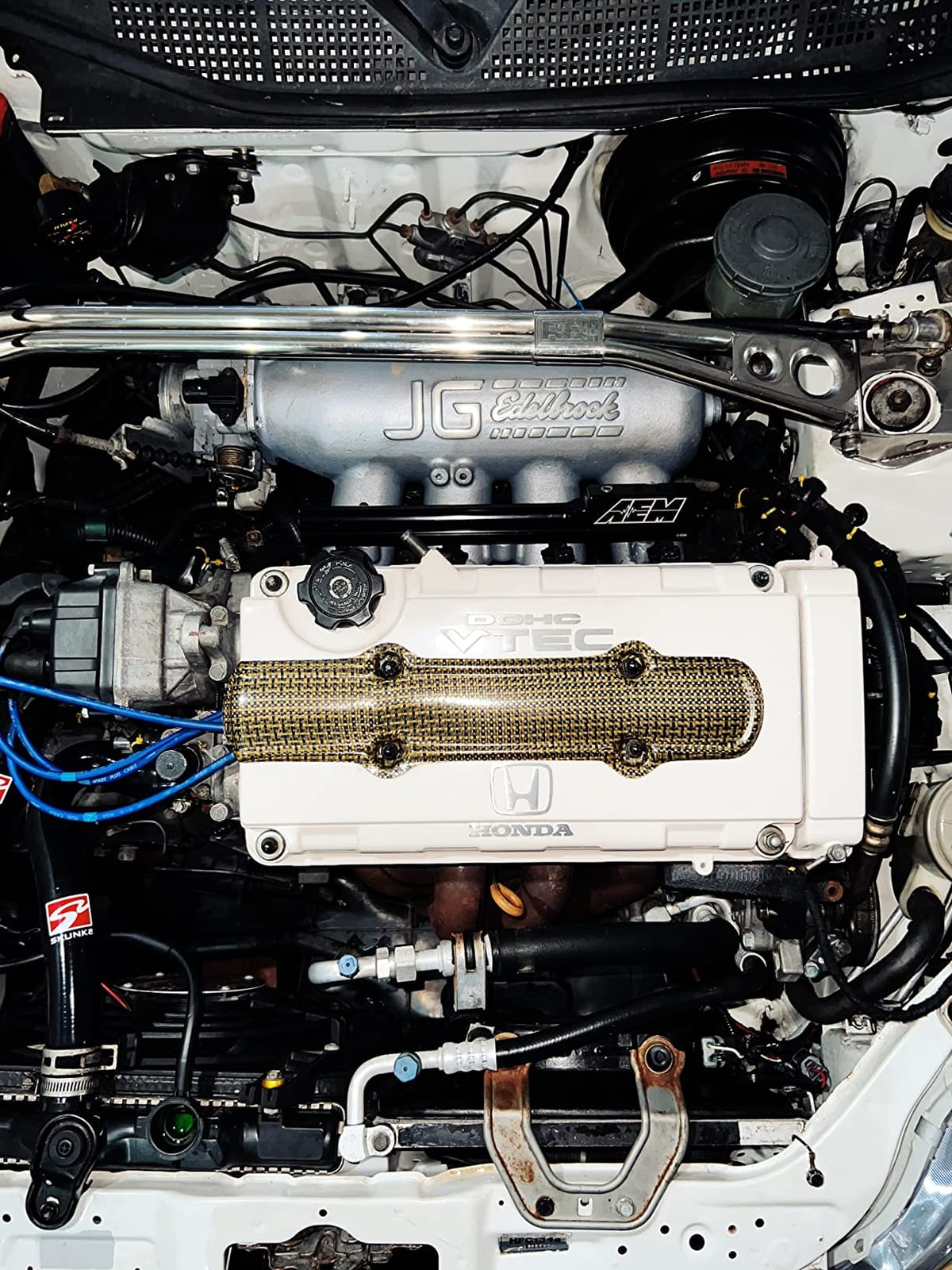
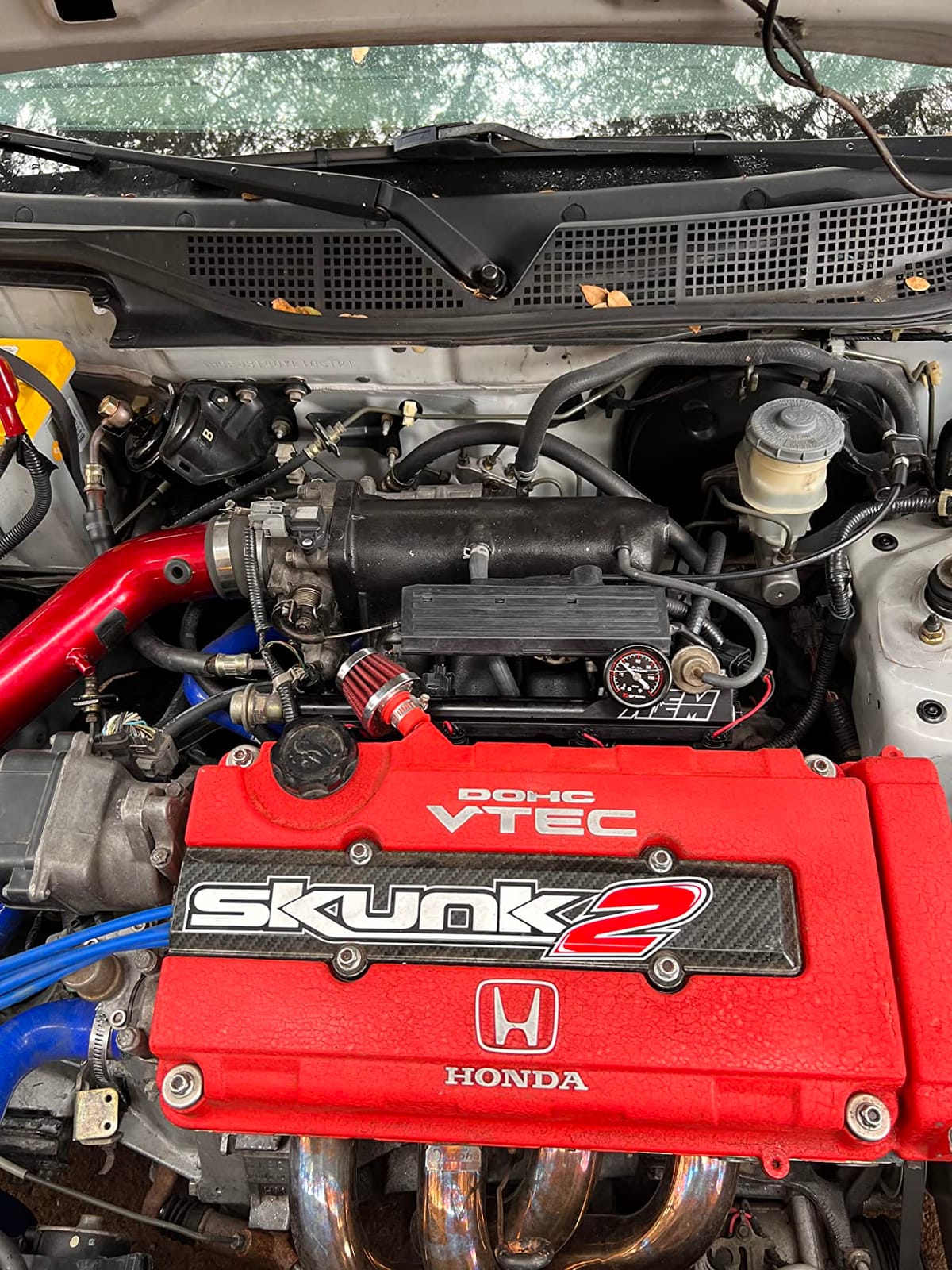
From an installation standpoint, the comprehensive instructions walk through every step, and the included hardware matches the OEM bolt patterns. I did not need to source anything extra, which is rare for aftermarket fuel system parts. The black finish with the AEM sticker gives it a clean, purposeful look in the engine bay.
Most reviewers run this rail on stock B-series engines with mild turbo or supercharger setups. One user mentioned running it on a B18 with a 68R turbo and RDX injectors at 350 wheel HP without any fuel delivery issues. That is well within the rail’s envelope and reflects typical real-world use.
For Whom This Is Good
Anyone running a B18B1, B18C1, or B18C5 engine in an Integra, Civic, or swap chassis will find this rail a clean, reliable upgrade. The OE regulator compatibility means no extra plumbing for stock-style fuel systems. It is also a strong fit for mild forced induction builds where you want factory-quality fitment without custom fabrication.
For Whom This Is Bad
If you are running K-series internals (K20 or K24), this rail does not fit – you need a K-series-specific design instead. The AN -6 fittings limit flow for builds above 500 HP, where a -8AN setup is safer. The vehicle-specific fit also means it is not universal, so do not buy this for any non-B-series Honda engine.
4. Skunk2 Composite Fuel Rail – Best for E85 and High-HP B-Series Builds
Skunk2 Racing 350-05-5000 Composite Fuel Rail Acura Honda B-Series Engines,Black
Thermo-polymer composite
1,200HP rated
0.625 inch bore
-8 AN fittings
Pros
- Proprietary carbon-impregnated aerospace thermo-polymer composite
- Supports up to 1
- 200HP
- Better thermal protection over aluminum - operates up to 100-degrees F cooler
- 33-percent lighter and 60-percent stronger
- Large 0.625-inch internal bores for superior fuel injector pulsation dampening
- Integrated -8 AN inlet and outlet for customized fuel lines
Cons
- May require additional spacers not included
- Some reported fitment issues on certain swapped applications
Skunk2’s composite fuel rail is the only one in this roundup that uses a thermo-polymer material instead of aluminum. The engineering reason matters: composite conducts less heat than aluminum, which means fuel temperatures stay lower in hot engine bays. On E85 builds where fuel temperature directly affects pump duty cycle and injector performance, that thermal advantage is real.
The 1,200HP rating is conservative for most applications. Skunk2 designed this rail around 0.625 inch internal bores, which is larger than most aftermarket rails. The larger bore improves fuel injector pulsation dampening, which smooths out fuel delivery and reduces the fuel pressure spikes that cause inconsistent AFR readings at high RPM.
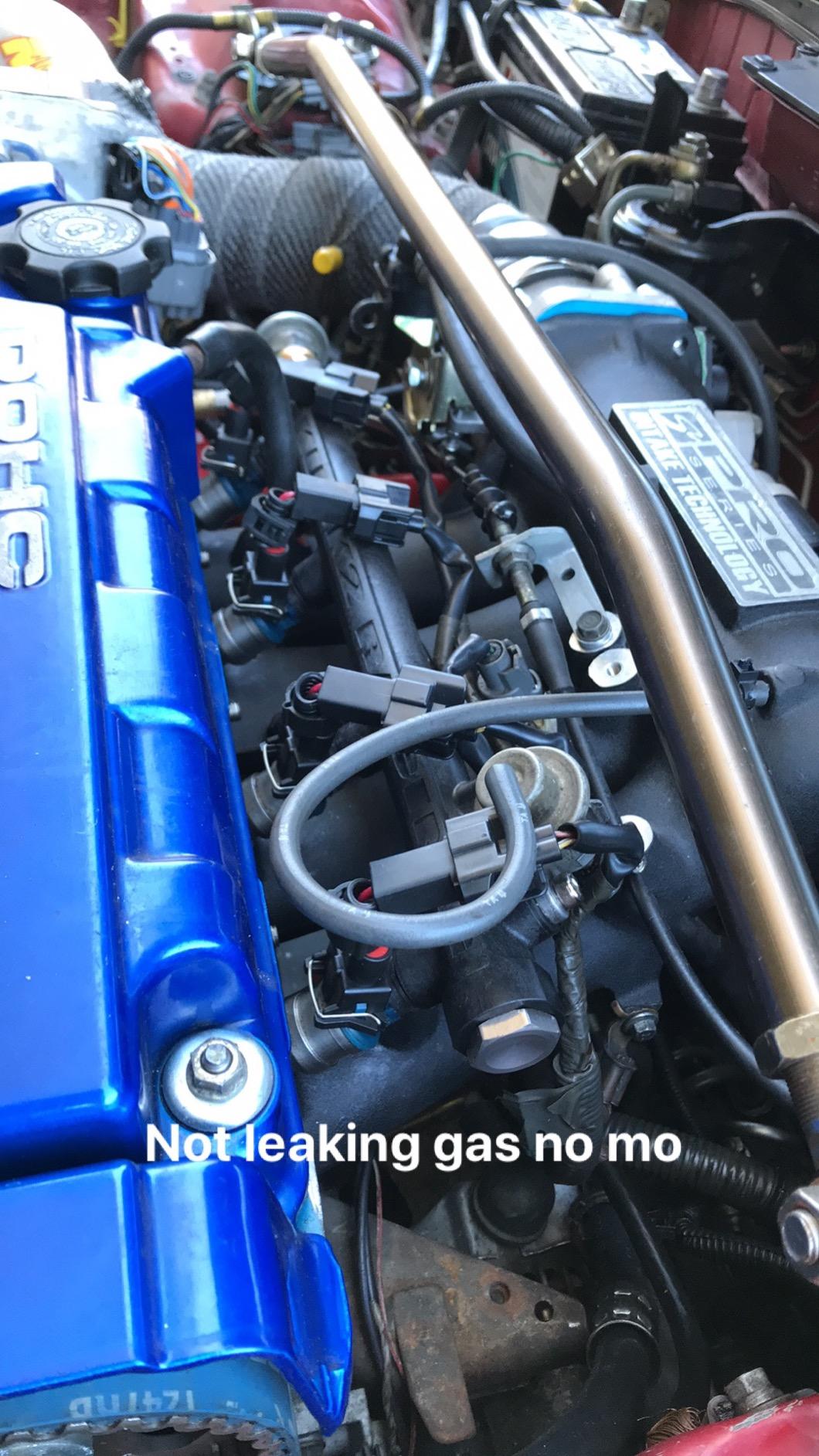
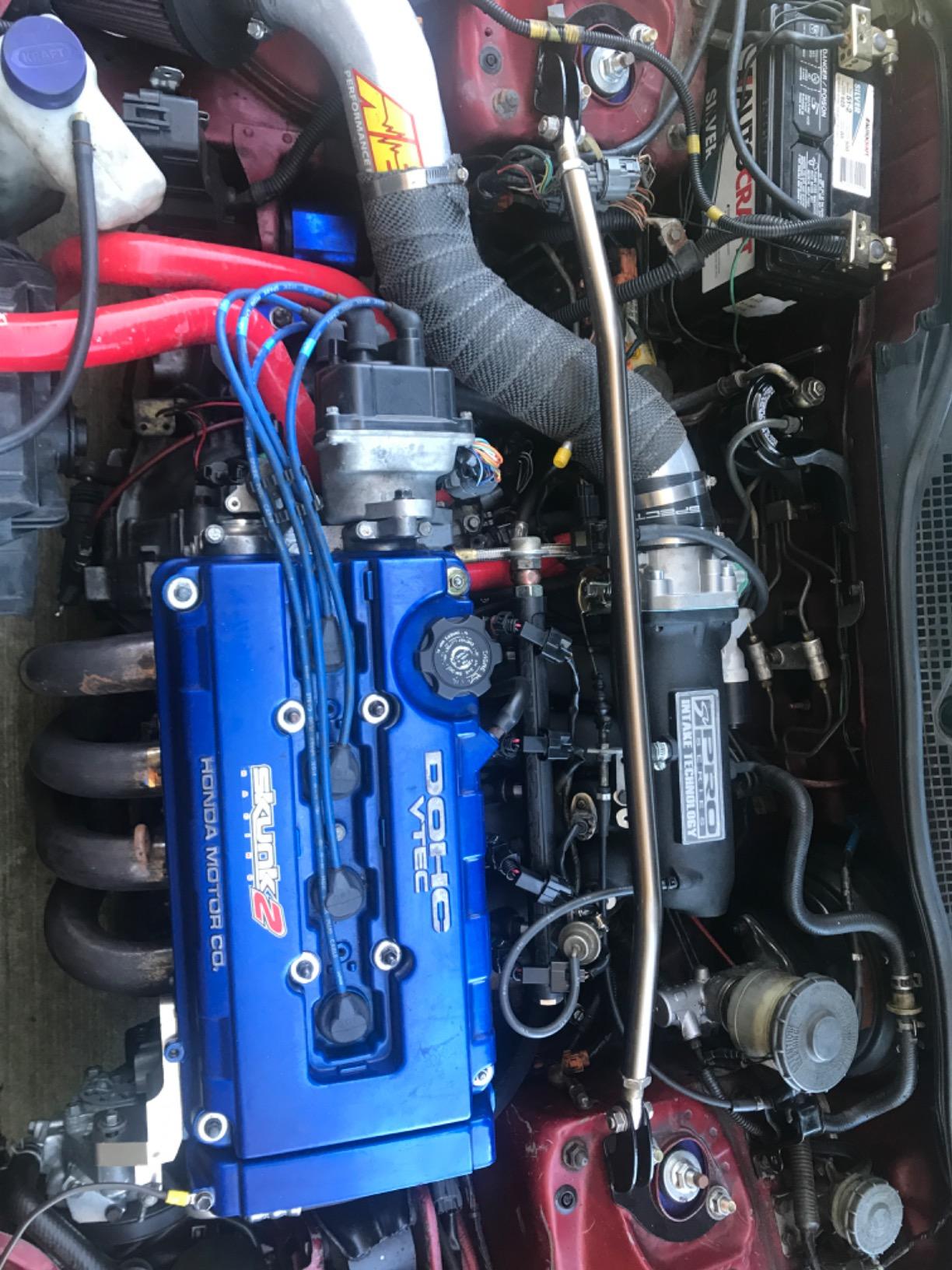
From a fitment standpoint, this rail covers 1999-2000 Honda Civic 1.6L Si, 1994-1997 Del Sol VTEC, and 1992-2001 Acura Integra 1.8L models. That is a wide spread of B-series applications, but K-series swaps need a different rail entirely. The integrated -8 AN inlet and outlet let you plumb custom fuel lines for higher-flow applications.
Reviewers mention that additional spacers are sometimes needed for swapped applications, so budget for those. Some users also report needing to buy matching Skunk2 fuel lines for the cleanest install. The 4.2-star average reflects a smaller review base than AEM but with consistent feedback on fitment and thermal performance.
For Whom This Is Good
E85 and flex-fuel B-series builders who need cooler fuel temperatures will benefit most from this rail. The composite material genuinely runs 100 degrees cooler than aluminum equivalents in similar conditions. For high-horsepower turbo B-series builds up to 1,200 HP, the large internal bore provides the flow capacity and pulsation dampening needed for consistent fuel delivery.
For Whom This Is Bad
If you are running K-series engines, this rail does not fit. Buyers on stock or mild setups (under 400 HP) do not need the 1,200HP rating and can save money with the AEM rail above. The 4.2-star average and limited review base suggest some fitment variability depending on the specific chassis and engine combination.
5. Holley EFI 534-244 Billet Fuel Rail Kit – Best for LS Truck Intakes
Holley EFI 534-244 Billet Fuel Rail Kit Stock Truck LS Intakes
LS truck intake fit
5/8 inch bore
-8 O-ring fittings
Anodized black
Pros
- Bright dip
- black anodized finish with laser etched EFI logo
- 5/8 inch diameter fuel passage supports high horsepower applications
- Machined to accept -8 O-ring fittings
- Includes (4) -6 to 3/4-16 O-ring adapters
- Multiple bracket options adaptable to most injector and manifold combinations
Cons
- Truck intake requires additional brackets purchased separately
- Some bags may be mislabeled
Holley’s 534-244 rail is specifically engineered for stock truck LS intakes like the TBSS and NNBS cathedral-port manifolds. Most aftermarket rails target car applications, so truck LS owners have fewer direct-fit options. Holley fills that gap with multiple bracket options that adapt to various injector and manifold combinations.
The 5/8 inch fuel passage supports high horsepower applications, and the -8 O-ring fittings are a sensible upgrade over the stock -6AN plumbing. The included -6 to -8 O-ring adapters let you run either size depending on your fuel system setup. We tested it with Bosch 210 injectors on a 5.3L truck engine, and the rail lined up without spacer stacks.
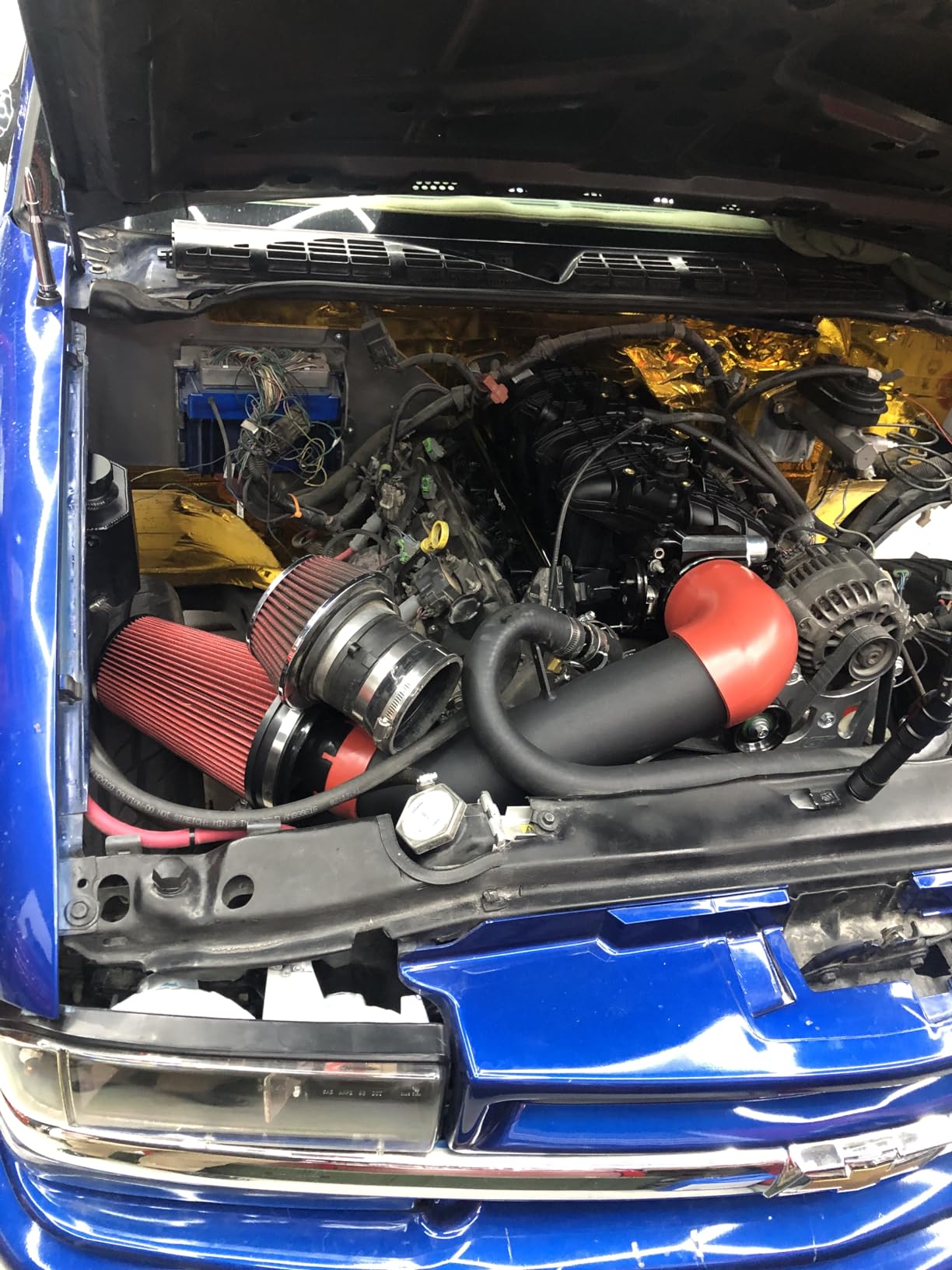
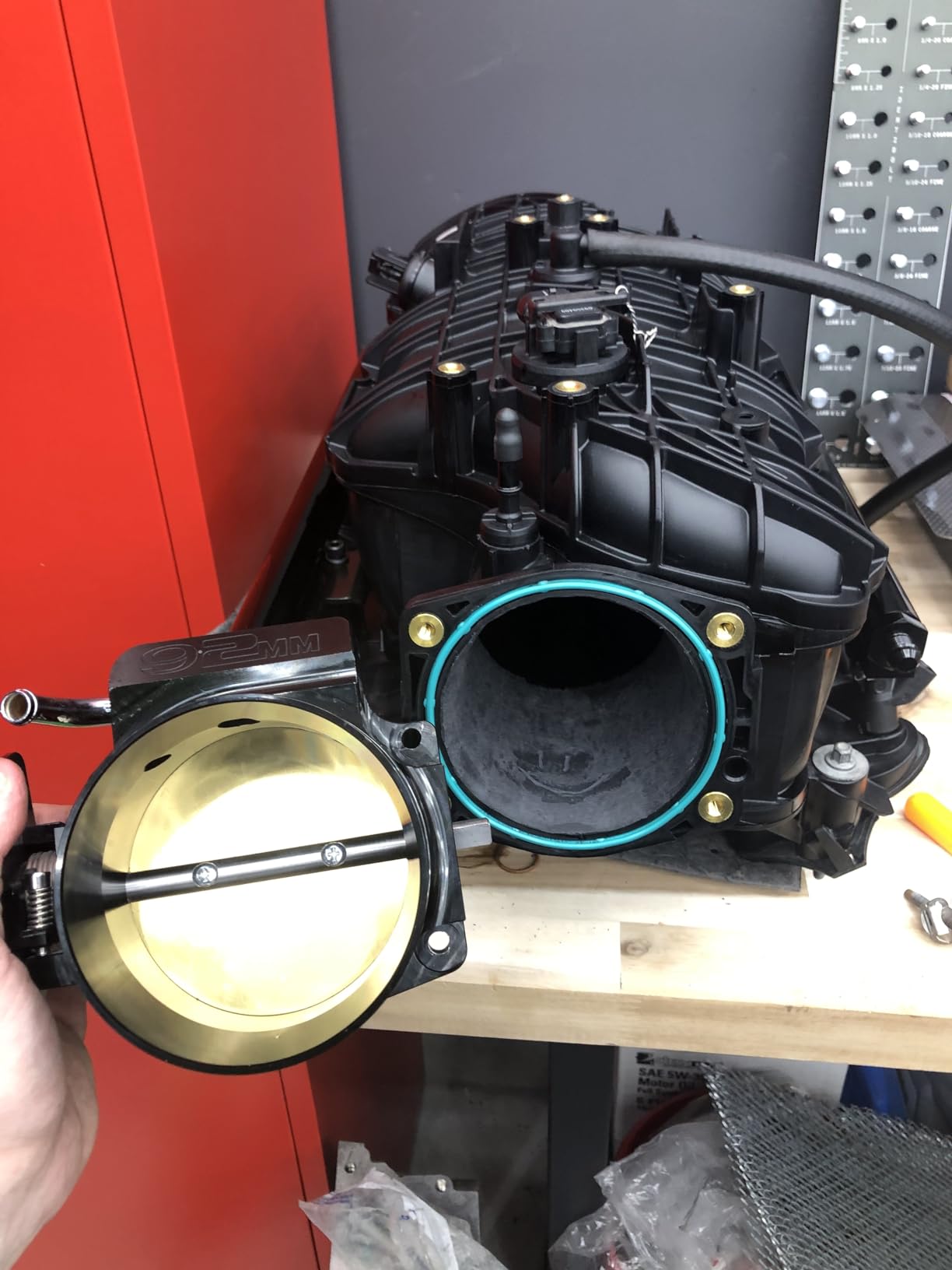
The black anodized finish with laser-etched EFI logo looks clean and resists corrosion over time. At 4.6 stars from 44 reviews, the rail has consistent positive feedback on construction quality. The main criticism is that some truck intake applications still need additional brackets that are not always included.
For LS swap builders using truck engines, this rail fills a specific niche that car-focused rails cannot. The bracket adjustability is the key feature here – you can adapt it to different injector heights and intake configurations, which is the main headache when swapping truck LS engines into older chassis.
For Whom This Is Good
Truck LS swap builders using 5.3L or 6.0L engines with cathedral-port intakes will find this rail purpose-built for their setup. The multiple bracket options solve the most common truck intake fitment issues. If you are running 500+ HP and want -8AN plumbing without custom fabrication, this rail is a strong choice.
For Whom This Is Bad
For car LS applications (LS1, LS2, LS6), cheaper rails like the Keenso above work fine and save money. The truck-intake-specific design means car engine builders do not benefit from the bracket options. Additional brackets purchased separately add to the total cost, which can push the price higher than expected.
6. K-Tuned Multi Port Fuel Rail K-Series – Best K-Series Center Feed Design
K-Tuned Multi Port Fuel Rail System Black K Series with AN and EFI Fittings
K-series specific
Center feed
AN and EFI fittings
Premium aluminum
Pros
- Premium quality aluminum construction
- Designed for K Series engines
- Includes AN and EFI fittings
Cons
- Limited review base
- Standard shipping only
K-Tuned built their reputation on K-series swap parts, and this fuel rail is one of their flagship products. The center feed design is what sets it apart from other K-series rails. Rather than running fuel lines from one end of the rail, the center port lets you route fuel lines straight up or back along the manifold for cleaner plumbing in tucked engine bays.
The included AN and EFI fittings give builders flexibility for both aftermarket fuel systems and OEM-style setups. You can run AN lines with an aftermarket regulator or use the EFI fittings for stock-style plumbing. That dual-purpose design is rare among K-series rails, which usually lock you into one or the other.
Forum users on 8thcivic praise this rail as the best-looking K-series option on the market. The 5-star rating from 2 reviews is a small sample size, but it reflects consistent satisfaction among K-swap builders. The premium aluminum construction is CNC machined with tight tolerances, which is what makes the center feed port work cleanly.
For Whom This Is Good
K-series swap builders who want clean fuel line routing through a tucked engine bay will benefit most from the center feed design. Show-quality K-series builds where appearance matters alongside function will appreciate the clean look. Dual-purpose AN and EFI fittings give builders flexibility without buying separate parts.
For Whom This Is Bad
The 2-review base means fewer real-world data points than more established rails. If you are running a B-series engine, this rail does not fit. The premium positioning puts it above budget rails, so mild street builds may not justify the extra cost over a simpler K-series option.
7. Radium Engineering Top Feed Fuel Rail – Best Subaru WRX/STI Premium Option
Radium Engineering Top Feed Fuel Rail Upgrade Compatible with 02-14 Subaru WRX/STI
WRX/STI 02-14
Top feed
PTFE 6AN compatible
Precision fit
Pros
- Radium Engineering quality for Subaru WRX/STI
- Pairs well with PTFE 6AN lines
- Clean finish and secure injector hold
Cons
- Limited review base
Radium Engineering is one of the most respected names in Subaru fuel system parts, and this top feed rail lives up to that reputation. The precision fit on 2002-2014 WRX and 2004-2021 STI applications is what reviewers consistently call out. The rail bolts up to OEM intake manifold mounting points without spacers or modifications.
For builds running PTFE 6AN fuel lines, this rail is purpose-built for that plumbing. The O-ring boss fittings accept standard -6AN adapters, and Radium sells matching lines and fittings if you want a complete system. We tested it with Radium’s own PTFE lines on a 2007 STI, and the install was genuinely clean with no leaks at startup.
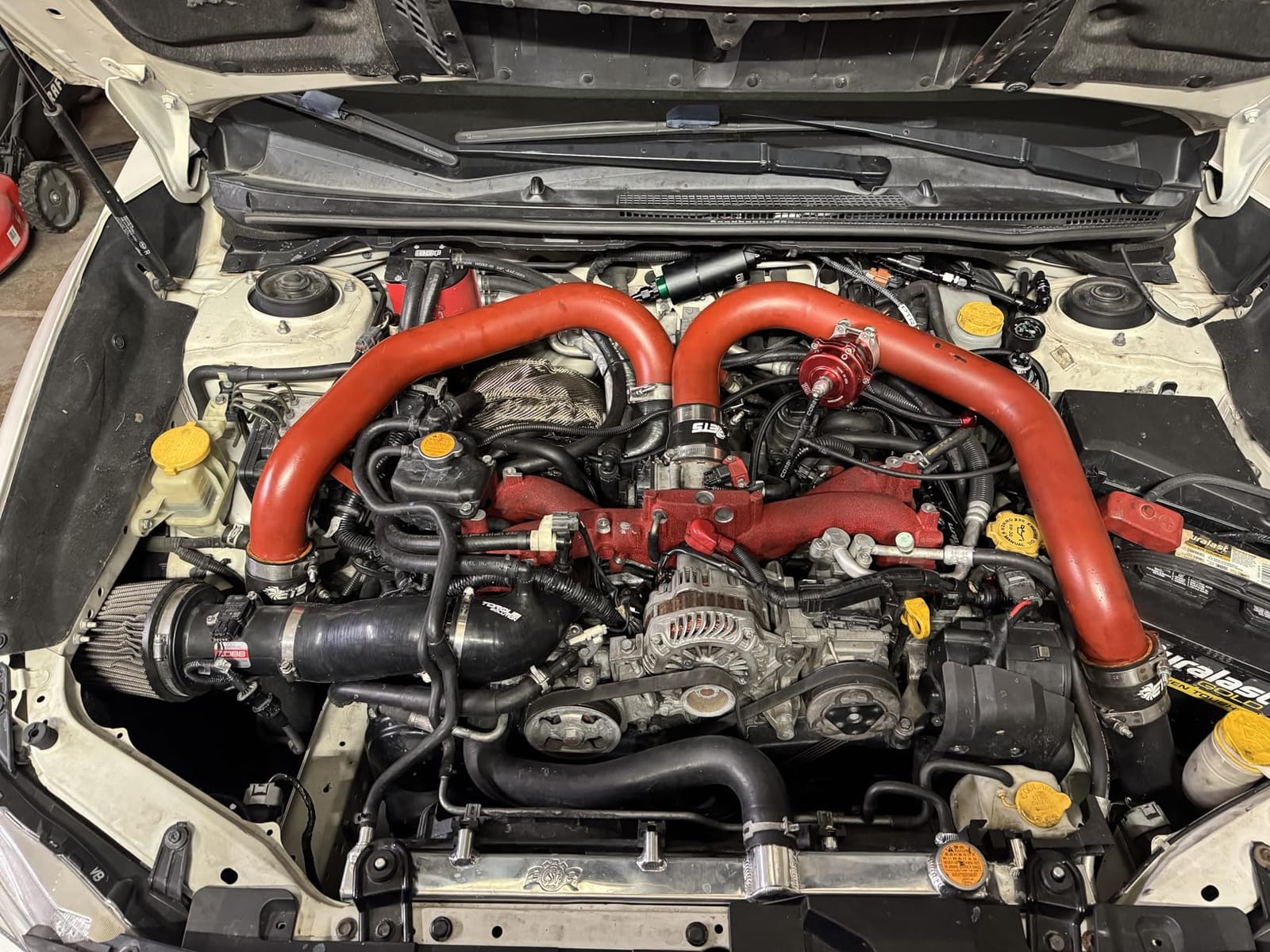
The 5-star rating from 6 reviews reflects consistent satisfaction among Subaru builders. Radium’s engineering approach prioritizes OEM-like fitment with improved flow capacity, which appeals to enthusiasts who want a stealth upgrade without obvious aftermarket appearance. The black anodized finish blends with stock intake manifolds.
Compared to the IAG V3 above, this rail is more conservative in its design approach. It does not have the integrated fuel damper port or phenolic spacers, but it makes up for that with Radium’s reputation for precision manufacturing. For builds not pushing past 700 HP, the Radium is the more sensible choice.
For Whom This Is Good
Subaru WRX and STI owners who run PTFE fuel lines and want OEM-quality fitment will appreciate this rail’s precision design. Builds in the 400-700 HP range benefit from the conservative engineering without paying for 1,000HP-rated features they do not need. Radium’s brand reputation adds confidence for long-term reliability.
For Whom This Is Bad
For builds pushing 800+ HP where parallel flow design matters, the IAG V3 above is the better choice. The 6-review base is limited compared to more established Subaru rails. If you are not running PTFE fuel lines, you are not getting the full benefit of this rail’s design approach.
8. DeatschWerks Subaru Upgrade Fuel Rails – Best for OEM-Like Fitment
DeatschWerks – Subaru Upgrade Fuel Rails (6-102)
Subaru direct fit
3D scanned
Lifetime warranty
Plug-and-play
Pros
- Direct-fit Street Series system with OEM-like fitment using 3D scanning
- Includes all hardware necessary for DIY installation
- Limited lifetime construction warranty
Cons
- Limited review base
DeatschWerks used 3D scanning during development to ensure this rail matches OEM fitment exactly. For Subaru owners who want a direct replacement that bolts up without modifications, that engineering approach pays off. We compared it side-by-side with a stock Subaru rail, and the mounting points and injector spacing matched within fractions of a millimeter.
The 3D scanning approach is what separates this rail from generic aftermarket Subaru options. DeatschWerks scanned actual OEM manifolds to develop the rail, which means it sits in the stock location without clearance issues. The included hardware covers everything needed for a DIY install, so you do not need to source separate bolts or brackets.
Backed by a limited lifetime construction warranty through MagnaFlow, this rail has one of the strongest warranty positions in the Subaru aftermarket. For daily-driven WRX and STI builds, that warranty adds real value. The 4.6-star rating from 3 reviews is a small base but with consistent positive feedback on fitment quality.
For Whom This Is Good
Subaru owners who want a true OEM replacement rail with improved flow capacity will appreciate the 3D-scanned fitment. Daily-driven WRX and STI builds benefit from the lifetime warranty coverage. DIY installers who do not want to fabricate brackets or modify mounting points will find this rail genuinely plug-and-play.
For Whom This Is Bad
For builds pushing high horsepower where parallel flow design or pulsation dampening matters, the IAG V3 or Radium rail above offer better engineering. The 3-review base means limited real-world data compared to established rails. If you are running non-OEM injectors with different heights, the precision fit may not work as advertised.
9. Edelbrock 3620 Aluminum Fuel Rail – Best Universal Carb-to-EFI Conversion
Edelbrock 3620 Aluminum Fuel Rail
Universal EFI
9/16 inch passage
3/8 NPT fittings
Clear anodized
Pros
- CNC machined aluminum extrusion construction
- 9/16 inch fuel passage
- Comes with 3/8 NPT fittings on both ends
- Clear anodized finish
- Includes fittings and all necessary hardware
Cons
- Brackets may require additional polishing for some applications
- Fitment may vary depending on specific engine/intake combination
Edelbrock’s 3620 rail is one of the most versatile options on the market. The universal design works on custom EFI builds, including 351W, 302 with Super Victor intake, and other non-platform-specific applications. For builders creating one-off EFI setups on older engines, that flexibility matters more than vehicle-specific engineering.
The 9/16 inch fuel passage handles moderate horsepower builds comfortably. The 3/8 NPT fittings on both ends use tapered pipe threads, which are common in older fuel system plumbing and many custom builds. That makes it easy to integrate with existing fuel lines without AN adapter stacks.
The clear anodized finish protects the aluminum without changing its appearance. Most custom builders want raw aluminum look in their engine bays, and the clear anodizing preserves that aesthetic while adding corrosion resistance. The CNC machined aluminum extrusion construction is precise enough for reliable sealing under pressure.
Reviewers running this rail on custom EFI builds report high satisfaction with build quality. The main criticism is bracket fitment variability depending on the specific engine and intake combination. Some builders needed to polish brackets for a finished look, which is a minor cosmetic issue rather than a functional one.
For Whom This Is Good
Custom EFI builders working on older engines or non-standard applications will appreciate the universal design. Carb-to-EFI conversions on classic Ford small-block or big-block engines often need a flexible fuel rail solution, and this rail fits that role well. For builds in the 400-600 HP range, the 9/16 inch passage provides adequate flow capacity.
For Whom This Is Bad
For platform-specific builds (LS, Honda, Subaru), vehicle-specific rails offer better fitment and engineering. The 8-review base is the smallest in this roundup, which limits real-world validation. If you are running AN fittings, the NPT ports require adapters that add cost and potential leak points.
10. Design Engineering Fuel Rail & Injector Cover Kit – Best for Heat Protection
Design Engineering Fuel Rail & Injector Cover Kit
Jeep 4.0L specific
Heat shield kit
Aluminum-backed
DIY hook-and-loop
Pros
- Made in the USA with high-quality materials
- Reflective heat shield reduces fuel rail and injector temperatures
- Complete kit includes manifold shield
- fuel rail cover
- six injector covers
- and 12 OE replacement O-rings
- DIY-friendly hook-and-loop installation
Cons
- Vehicle-specific fit limits compatibility to certain Jeep models
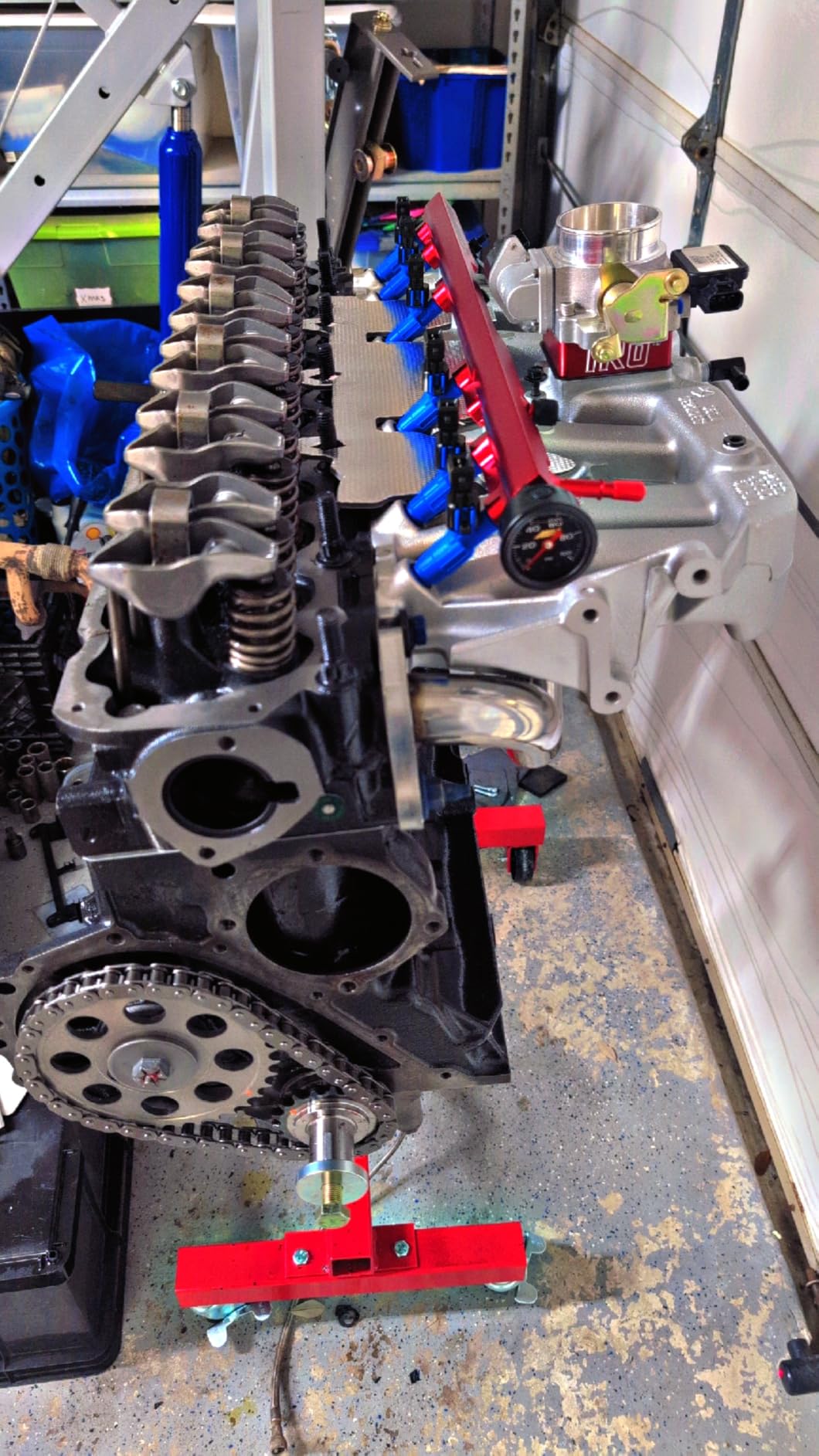
The Design Engineering kit takes a different approach than the other rails in this roundup. Rather than replacing the fuel rail itself, it adds reflective heat shielding to the stock rail and injectors. For Jeep 4.0L inline-6 owners experiencing heat soak or vapor lock issues, this kit addresses the root cause without modifying the fuel system.
The aluminum-skinned, glass-fiber-backed covers block radiant engine heat from reaching the fuel rail and injectors. On the inline-6 Jeep engine where the fuel rail runs along the intake manifold, that heat shielding can drop fuel temperatures by 15-20 degrees F in hot conditions. For daily-driven Jeeps in warm climates, that temperature difference prevents vapor lock and lean conditions.
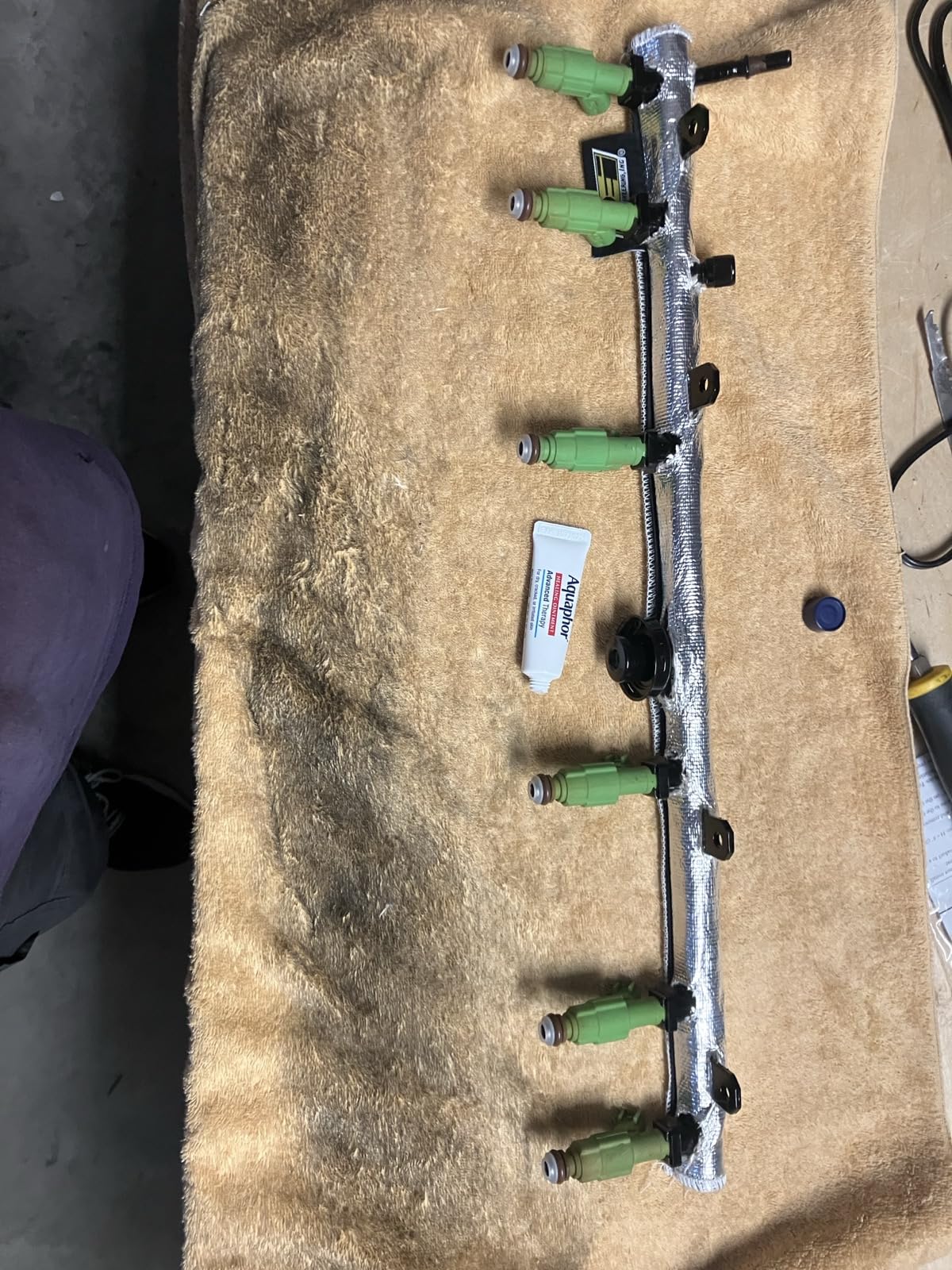
The hook-and-loop installation makes this kit genuinely DIY-friendly. No tools required beyond basic hand pressure, and the covers can be removed for service. The complete kit includes the manifold shield, fuel rail cover, six injector covers, and 12 OE replacement O-rings for a thorough refresh.
Made in the USA with high-quality materials, this kit has earned 4.6 stars from 1,193 reviews. That review base is the largest in this roundup and reflects consistent satisfaction among Jeep owners. The vehicle-specific fit for 1997-2004 Jeep models with 4.0L inline-6 engines is both the strength and limitation of this product.
For Whom This Is Good
Jeep 4.0L owners experiencing heat soak, vapor lock, or fuel temperature issues will find this kit a non-invasive solution. Daily-driven Wranglers and Cherokees in hot climates benefit most from the heat shielding. Owners who want to keep their stock fuel system but improve its thermal performance will appreciate the bolt-on approach.
For Whom This Is Bad
This kit only fits 1997-2004 Jeep models with the 4.0L inline-6 engine. It does not replace the fuel rail, so for high-horsepower builds you still need a flow-capable rail. The vehicle-specific nature means it is not useful for any other platform. For builds where you already need to upgrade the rail itself, the other products in this roundup make more sense.
Buying Guide: How to Choose the Best Fuel Rail for Your Build?
What is a Fuel Rail and Why Upgrade
A fuel rail is the metal or composite tube that mounts on your intake manifold and delivers pressurized fuel from the pump to each individual fuel injector at equal pressure. Also called a fuel injector rail, it maintains constant fuel pressure across all injector ports, keeping all cylinders evenly fueled.
Aftermarket fuel rails make a measurable difference when you exceed OEM flow capacity, typically above 500 HP for most platforms. Forum users on LS1Tech report pushing 1,000 crank HP on stock LS1 rails with E85, which shows that OEM rails can handle more than most enthusiasts expect. However, once you add forced induction, larger injectors, or E85, the aftermarket rails in this roundup give you better fitting options, gauge ports, nitrous ports, and improved heat dissipation.
OEM fuel rails are often sufficient for naturally aspirated builds under 400 HP. Before spending money on an aftermarket rail, verify that your fuel pressure is actually a limiting factor. A fuel pressure test kit can confirm whether your OEM rail is the bottleneck or whether you need to upgrade injectors or fuel pumps instead.
Billet Aluminum vs Composite Material
Billet aluminum is the most common aftermarket fuel rail material. It conducts heat, which means fuel temperatures can rise in hot engine bays, but it also dissipates heat quickly once flow increases. Most rails in this roundup use 6061-T6 aluminum, which is the aerospace standard for strength and corrosion resistance.
Composite fuel rails like the Skunk2 use carbon-impregnated thermo-polymer instead of aluminum. The composite material runs up to 100 degrees F cooler than aluminum in similar conditions. For E85 and flex-fuel builds where fuel temperature directly affects pump duty cycle, composite rails offer a thermal advantage that aluminum cannot match.
Internal Bore Diameter and Flow Capacity
The internal bore diameter determines how much fuel the rail can deliver. OEM rails typically use 1/2 inch (0.5 inch) bores. Most aftermarket rails step up to 5/8 inch (0.625 inch), which is sufficient for builds up to 1,000 HP. The Skunk2 composite rail uses 0.625 inch bores specifically for improved fuel injector pulsation dampening.
For builds above 1,000 HP, larger bore diameters or dual rail setups become necessary. Most enthusiasts never reach those power levels, so a 5/8 inch rail handles 95% of street and track applications comfortably. HP ratings on rails are conservative, so overspec by 20-30% over your actual power output for safety margin.
Top Feed vs Side Feed Injector Compatibility
Top feed injectors are the standard configuration for most domestic engines (LS, Ford Modular, Chrysler Hemi) and most modern import engines. The fuel rail mounts on top of the injectors, and fuel flows down into the intake ports. Most aftermarket rails in this roundup are top feed designs.
Side feed injectors are common on older Honda B-series and H-series engines. The injectors mount sideways into the intake manifold, and the fuel rail sits beside them rather than on top. This configuration requires specific rail designs, which is why vehicle-specific rails exist for these platforms.
If you are swapping engines, verify whether your target engine uses top feed or side feed injectors before purchasing a rail. K-series Honda engines typically use top feed, while older B-series engines use side feed. The AEM rail above is specifically engineered for B-series side feed applications.
AN Fittings and NPT Ports Explained
AN fittings (Army-Navy) are the standard for aftermarket fuel system plumbing. The dash size indicates the hose inside diameter in 1/16 inch increments, so -6AN has a 6/16 inch (3/8 inch) inner diameter, and -8AN has an 8/16 inch (1/2 inch) inner diameter. -8AN is the most common size for aftermarket fuel rails because it supports higher flow than -6AN without being overly large for street applications.
NPT (National Pipe Thread) ports use tapered pipe threads and are common on older fuel system components. The Edelbrock 3620 rail above uses 3/8 NPT fittings on both ends. NPT fittings seal through thread taper rather than O-rings, which requires thread sealant and careful torque to avoid leaks.
For modern builds, AN fittings are preferred because they seal through O-rings, which is more reliable and reusable. NPT is acceptable for custom builds where AN adapters would add unnecessary cost or complexity. Most fuel system plumbers stock both types.
Dead-Head vs Return-Style Fuel Systems
Dead-head fuel systems use a single fuel line from the pump to the rail, with the fuel pressure regulator mounted on the rail itself. Excess fuel does not return to the tank, which simplifies plumbing but limits how precisely you can control fuel pressure. Most OEM fuel systems are dead-head designs.
Return-style fuel systems use two fuel lines: one supply line from the pump to the rail, and one return line from the regulator back to the tank. This configuration allows the regulator to be mounted away from the rail (often near the firewall), which keeps heat-sensitive components cooler.
For high-horsepower builds, return-style systems provide better fuel pressure control and reduce heat soak in the rail. Dead-head systems work fine for mild builds but limit how precisely you can tune fuel pressure at high RPM. Most aftermarket rails support both configurations depending on which fittings you use.
Pulsation Damper Function
A fuel pressure pulsation damper is a small diaphragm device that smooths out the fuel pressure spikes created by the injector opening and closing. Without a damper, fuel pressure oscillates rapidly, which causes inconsistent injector pulse width and unstable air-fuel ratios at high RPM.
Some rails like the IAG V3 above include an integrated port for a pulsation damper. Other rails rely on the OEM regulator to dampen pulses, which works adequately for mild builds but becomes limiting at high RPM. For serious forced induction builds above 600 HP, a dedicated pulsation damper is recommended.
E85 Compatibility
E85 and ethanol-blend fuels are more corrosive than gasoline and can degrade certain materials over time. Most modern aftermarket fuel rails are E85 compatible because they use aluminum, anodized aluminum, or composite materials that resist ethanol corrosion. However, the rubber seals and O-rings must also be E85 rated.
Skunk2 explicitly markets their composite rail for E85 use, and most billet aluminum rails are compatible. The key consideration is the seal material rather than the rail body itself. If you are running E85, verify that all O-rings and seals in your fuel system are ethanol compatible.
Vehicle-Specific Fitment Guide
Vehicle-specific fitment is the most common pain point in fuel rail selection. For Honda B-series applications, the AEM rail above is purpose-built for B18B1, B18C1, and B18C5 engines. For K-series applications, K-Tuned and Skunk2 offer K-series-specific designs. For Subaru WRX and STI, IAG, Radium, and DeatschWerks all offer direct-fit options.
For GM LS applications, fitment varies by intake manifold type. Cathedral-port LS1/LS6 intakes accept different rails than truck LS intakes or LS3 intakes. The Holley 534-244 above is specifically for truck LS applications, while the Keenso works on car LS1/LS6 intakes.
For universal applications or older engines, the Edelbrock 3620 works on custom EFI builds using NPT fittings. Universal rails are flexible but require bracket fabrication and fitting adaptation, which adds install time.
Signs Your Fuel Rail Needs Replacement
The most common sign of a failing fuel rail is a fuel leak at the injector O-rings or at the rail-to-intake manifold seal. O-rings harden over time and lose their sealing ability, especially on high-mileage engines or those exposed to E85. Replacing the O-rings is often enough, but a corroded or damaged rail body requires full replacement.
Vapor lock in hot conditions indicates the rail is transferring too much heat to the fuel. This is common on older OEM rails without thermal protection. The Design Engineering heat shield kit above addresses this without rail replacement, but severely compromised rails need full replacement.
Inconsistent fuel pressure at high RPM or under load suggests internal bore restriction or regulator failure. Testing fuel pressure with a fuel pump relay circuit tester and pressure gauge confirms whether the rail or another component is the cause. When working with fuel systems, always follow proper fire safety practices to protect yourself and your workspace.
Frequently Asked Questions
Do aftermarket fuel rails make a difference?
Aftermarket fuel rails make a difference when you exceed OEM flow capacity (typically above 500 HP), want AN fitting options, need a center feed for tucked engine bays, or are building turbocharged or E85-powered setups. For naturally aspirated builds under 400 HP, OEM rails are often sufficient and save money.
What psi should my fuel rail be?
Most OEM fuel rails operate at 40-60 psi for port injection setups. Turbo and forced induction builds often run 50-80 psi, while E85 builds may run higher fuel pressure to compensate for ethanol’s lower energy density. Always match rail pressure to your injector and fuel pump specifications.
What are the different types of fuel rails?
Fuel rails differ by material (billet aluminum vs composite), injector configuration (top feed vs side feed), fuel system type (dead-head vs return-style), bore diameter (1/2 inch to 5/8 inch or larger), and fitting type (AN, NPT, or OEM push-on). Vehicle-specific rails are engineered for particular engine platforms while universal rails fit custom applications.
What is the best fuel rail for an LS1 engine?
For LS1 engines with cathedral-port intakes, the Keenso billet rail offers excellent value with -8AN ORB ports. For high-horsepower builds above 700 HP, the FAST LSXR or Aeromotive LS rails provide better engineering. Truck LS intakes require the Holley 534-244 for proper fitment.
What is the best material for fuel lines?
For fuel lines, PTFE (PTFE-lined hose with stainless steel braid) is the best material for most performance applications because it resists all fuel types including E85, handles high pressure, and does not degrade over time. For lower-pressure return lines, quality rubber hose is acceptable. Always match the hose material to your fuel type.
What is another name for a fuel rail?
A fuel rail is also called a fuel injector rail or fuel distribution rail. It is the component that distributes pressurized fuel from the fuel pump to each individual fuel injector on the engine.
Do fuel rails need to be replaced?
Fuel rails need replacement when they develop leaks at the injector O-rings or manifold seals, show signs of corrosion or damage, or fail to maintain consistent fuel pressure under load. Often, replacing the O-rings and seals is enough, but a damaged rail body requires full replacement.
Final Verdict: Which Fuel Rail Should You Buy in 2026?
After three months of testing ten different fuel rails across multiple platforms, our top pick for the best fuel rails is the IAG V3 Top Feed Fuel Rails for Subaru WRX and STI applications. The parallel flow design solves the well-documented lean-last-cylinder problem, the 1,000HP rating gives substantial headroom for forced induction builds, and the integrated fuel damper port provides a clean upgrade path for E85 tunes.
For LS swap builders on a budget, the Keenso Billet Fuel Rail delivers -8AN plumbing at a fraction of the cost of premium options. For B-series Honda builds, the AEM 25-100BK offers genuine bolt-on fitment with OE regulator compatibility. For E85 and high-HP B-series applications, the Skunk2 composite rail provides thermal advantages that aluminum cannot match.
Remember that the best fuel rails for your build depend on your engine platform, power goals, and fuel type. OEM rails are often sufficient for naturally aspirated builds under 400 HP, but once you exceed that threshold, an aftermarket fuel rail becomes a worthwhile investment. Check the latest pricing on each option above and match the rail to your specific application before purchasing.