
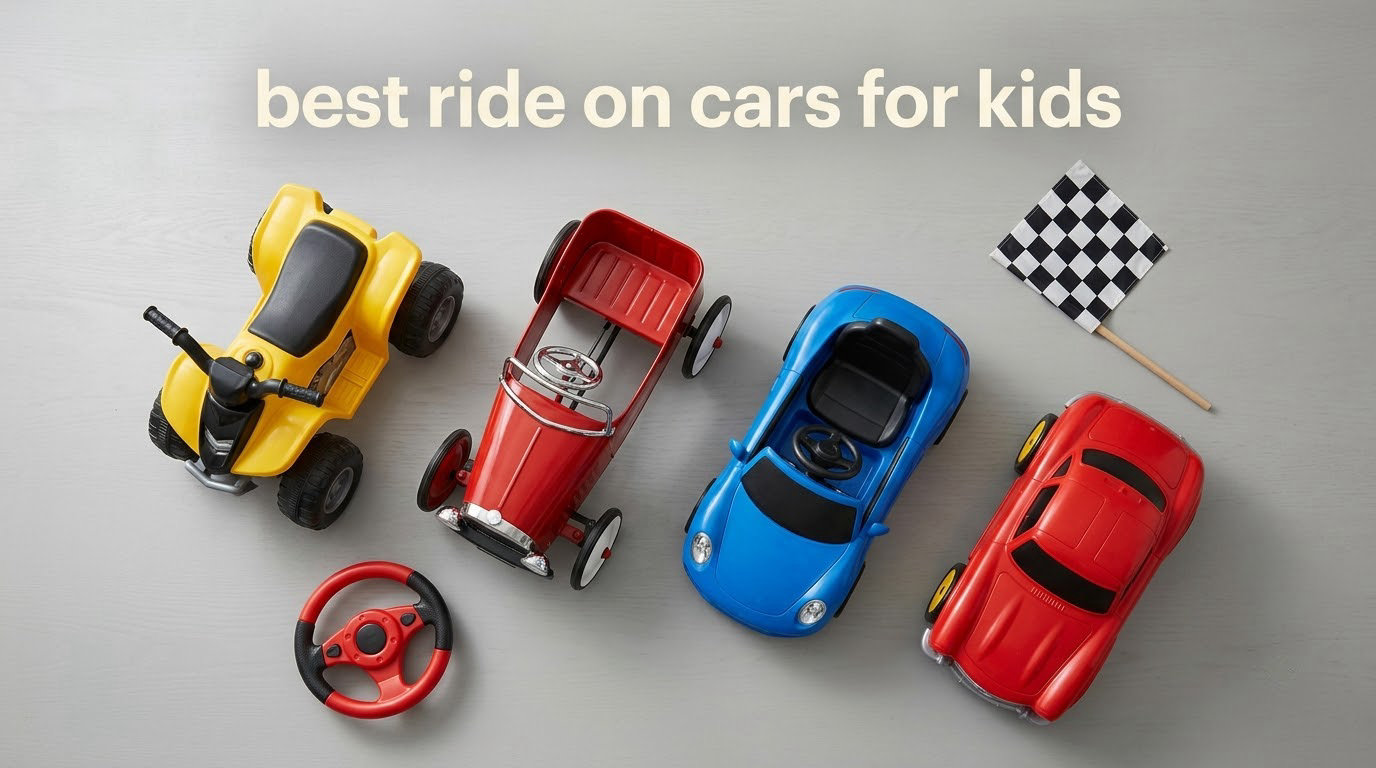
The best ride on cars for kids fall into three clear groups. For most families the Best Choice Products 12V Kids Electric Ride-On Car is the one to buy, because it handles a driveway, a lawn and a gentle slope without complaint. Under-threes get the Little Tikes Cozy Coupe, which needs no battery at all. Bigger kids who want speed and a second seat get the First Ride On 24V Ford Bronco Raptor two-seater.
Everything else in this guide sits around those three. We went through 12 ride-ons, checked the battery pack, motor output, stated weight capacity, top speed and charge time for each one, then sorted them by the three things that actually decide whether a child keeps using the car: age fit, terrain, and whether the thing starts when they want it to.
A note on what you are not going to find here. We do not put prices in this article, because they move every day and a number written down in September is wrong by Christmas. The buttons below each review go straight to the current listing.
How we picked these twelve: each car had to be a current listing with a real review base, so we could read complaints rather than marketing copy. For each one we pulled the battery pack voltage and amp-hour rating, motor count and wattage, stated weight capacity, top speed, charge time and included accessories, then read the reviews for failure patterns. Cars that scored well on paper but had repeated reports of dead motors, brittle wheels or weak remotes were dropped in favour of ones with a consistent record.
We also grouped by age band, because a ride-on is a fit question before it is a shopping question. A toddler, a preschooler and a seven-year-old have almost nothing in common in terms of what they can physically manage, and the single most common mistake we see is buying for the child in the photograph rather than the child in the driveway.
Table of Contents
Top 3 Picks: Best Ride-On Cars for Kids (October 2026)

Best Choice Products 12V…
- 12V with parent remote
- Spring suspension
- Never-flat plastic wheels
- 2.8 mph max speed

Little Tikes Cozy Coupe
- Push or foot-powered modes
- Working doors and horn
- 360-degree front wheels
- 50 lb capacity

FanttikRide N7 Pro Wiggle Car
- 2-in-1 electric and manual
- Up to 4 mph with low mode
- Anti-rollover chassis
- 150 lb capacity
Those three cover the widest spread of ages in the whole list. One is a proper 12V car with a remote override, one is a push-and-pedal toy for a toddler, and one is a wiggle car that a five-year-old can still be proud of.
Best Ride-On Cars for Kids in 2026: The At-a-Glance Table
| Product | Specs | Action |
|---|---|---|
| Best Choice Products 12V Kids Electric Ride-On Car |
|
Check Latest Price |
| Little Tikes Cozy Coupe |
|
Check Latest Price |
 ANPABO 12V Mercedes-Benz G63 ANPABO 12V Mercedes-Benz G63 |
|
Check Latest Price |
| FanttikRide N7 Pro Electric Wiggle Car |
|
Check Latest Price |
 Bobike 12V Ride-On Car with 2.4G Remote Bobike 12V Ride-On Car with 2.4G Remote |
|
Check Latest Price |
 Winado 12V Mercedes-Benz AMG GTR Winado 12V Mercedes-Benz AMG GTR |
|
Check Latest Price |
 First Ride On 24V Ford Bronco Raptor Two-Seater First Ride On 24V Ford Bronco Raptor Two-Seater |
|
Check Latest Price |
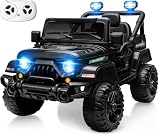 Miniature Motors 12V Electric Ride-On Truck Miniature Motors 12V Electric Ride-On Truck |
|
Check Latest Price |
 Best Choice Products 12V Chevrolet Silverado Best Choice Products 12V Chevrolet Silverado |
|
Check Latest Price |
 Best Choice Products 12V Ford Mustang Best Choice Products 12V Ford Mustang |
|
Check Latest Price |
 ARBELI 24V 4WD Two-Seater ARBELI 24V 4WD Two-Seater |
|
Check Latest Price |
 ARBELI 12V Toddler First Car ARBELI 12V Toddler First Car |
|
Check Latest Price |
Read the table for the shape of the category, not the winner. Nine of these twelve are 12V single-seaters, which is where most families land. Two are 24V two-seaters for bigger kids and rough ground. One is a push car with no electronics at all.
Two columns deserve a second look. Weight capacity ranges from 50 lb at the bottom to 133 lb at the top, which is the difference between a toy that lasts two years and one that lasts five. Top speed ranges from 3 km/h to 4.5 mph, and the reason a wiggle car at 4 mph is not automatically the fastest-feeling car in the list is that it has no steering wheel to react with.
1. Best Choice Products 12V Kids Electric Ride-On Car: Best Overall
Best Choice Products 12V Kids Electric Vehicle Toy Ride On Car with Parent Remote Control for Toddlers, Seat Harness, 61 lbs Weight Capacity, Locking Doors, Spring Suspension, Bluetooth – Black
12V battery
Parental remote control
Spring suspension
61 lb capacity
2.8 mph max speed
Pros
- More than 21k ratings
- the widest review base here
- Parent remote with forward and reverse
- Never-deflate plastic wheels need no air
- Lockable doors
- seat belt and LED headlights
- AUX outlet for your own music
Cons
- 2.8 mph is slow once a child is over 5
- 61 lb capacity is modest for a 12V car
- Assembly takes real time for a first-time build
This is the car we keep coming back to. More than 21k ratings sit behind it, which means almost any failure mode you are worried about has already been reported by someone else, and the fixes are known. That matters more than it sounds when you are about to hand a plastic vehicle with a lead-acid pack to a four-year-old on a sloped driveway.
Under the skin it is a straightforward 12V single-seater rated for 61 lb, with spring suspension, traction tires and plastic wheels that will never go flat. Top speed is 2.8 mph. That number is not a mistake. It is the speed at which a child can misjudge a driveway edge and still stop in time.
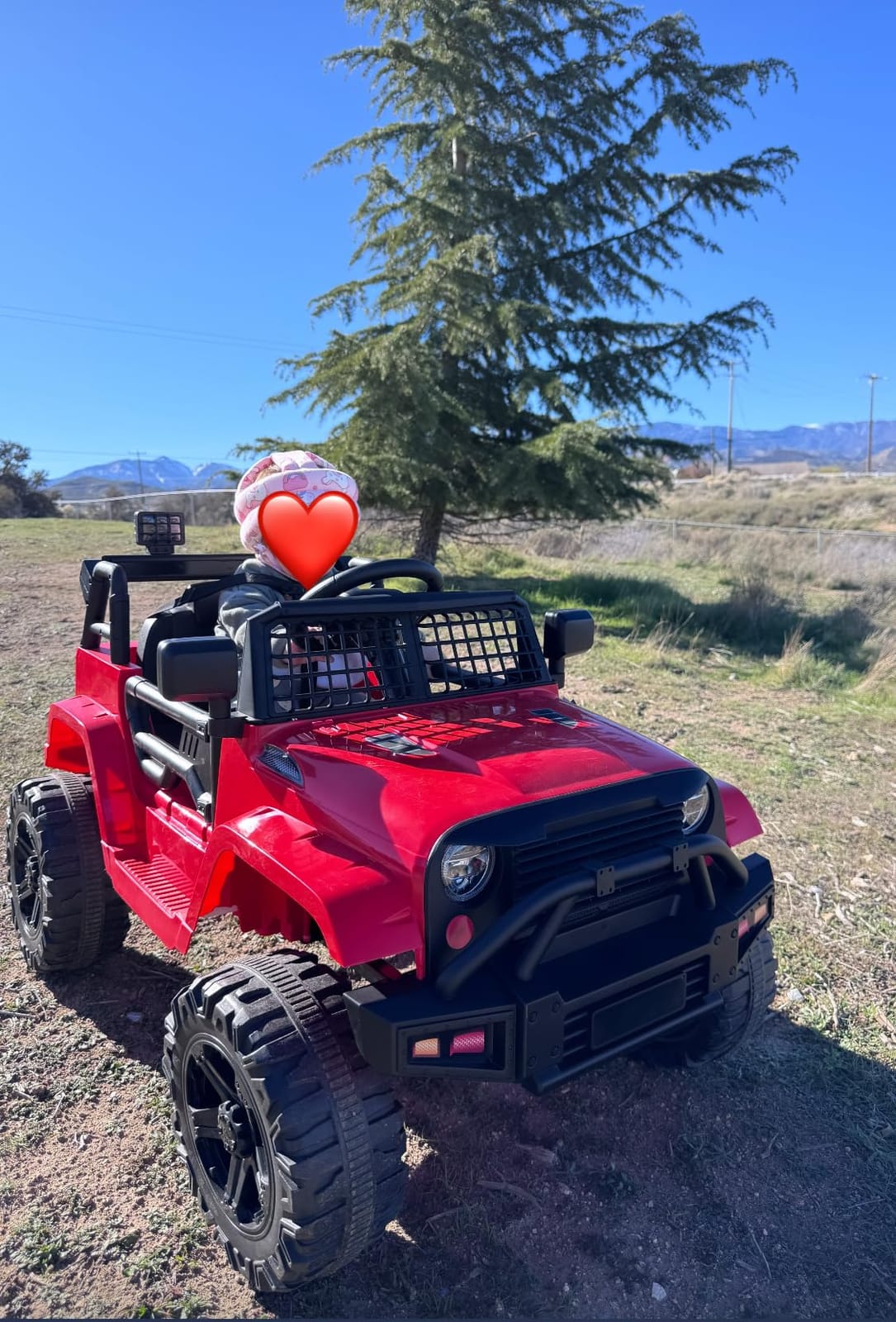
The dual control is the part that sells it. Your child can drive with the steering wheel and foot pedal, or you can take over with the handheld remote and steer them out of a hedge, up a bank, or back into the garage. Reviewers describe the remote as the feature that lets them relax, because the failure they fear is not speed, it is a small child reversing into the road.
Lockable doors, an adjustable seat belt and a grid windshield do the containment work. The AUX outlet is a small touch that gets used constantly, since it lets a phone play audio instead of relying on the toy.
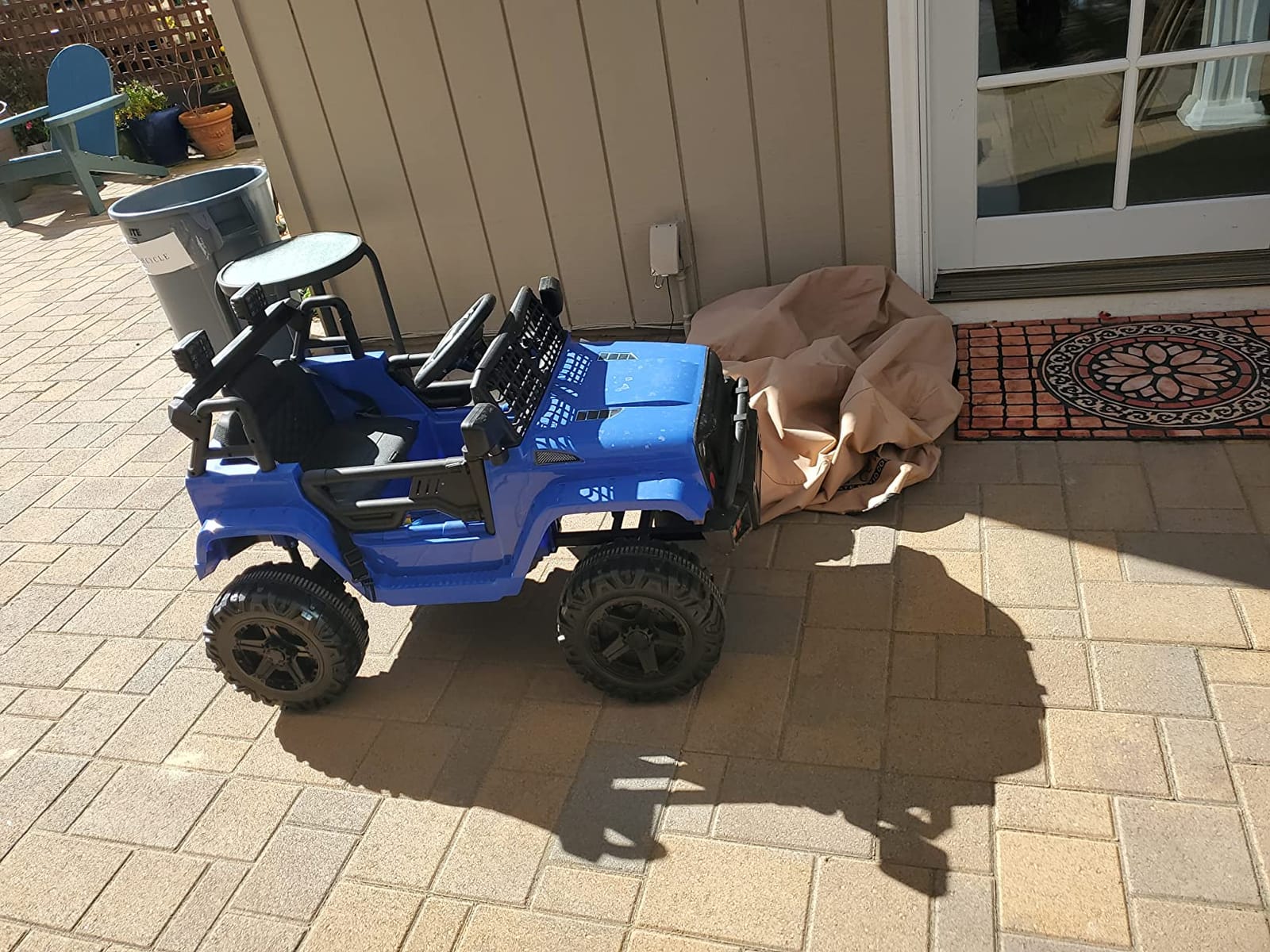
What 61 lb of capacity means for your child
The 61 lb limit is the number to check first. It is honest, but it is on the low side for the 12V category, and it is the reason we do not recommend this car to a family with a five-year-old already close to 50 lb. Measure your child rather than guessing from birthday cards.
As a general rule, a child who is going to be riding this within two years should get a car rated higher than their current weight, with room to spare.
Where it struggles and where it is at its best
It is at its best on pavement, sidewalks and firm driveways, and it keeps moving on a gentle lawn slope. On loose gravel or deep grass it will move, but it will not climb, and the plastic wheels offer less shock absorption than EVA rubber.
The plastic wheels are a genuine trade-off. You will never deal with a flat tire, ever. You also never get the cushioned ride of a rubber tire, and downhill stops can feel abrupt.
2. Little Tikes Cozy Coupe: Budget Pick for Under-Threes
Little Tikes Cozy Coupe
No battery needed
Removable floorboard
50 lb capacity
Ages 18 months to 5 years
17.7 lb
Pros
- Grows from pushed riding to self-powered in one part
- Number one ranked in push ride-ons
- Easy for one adult to push and store
- Indoor and outdoor tires
- Themed details kids recognise immediately
Cons
- Stiff plastic that can take two adults to assemble
- Decorative stickers peel and leave residue
- Steering wheel is not linked to the front wheels
- Loud rolling noise on hard sidewalks
If your child is between 18 months and 3 years, the question is not which battery to buy. It is whether the child can reach a pedal, and the answer at that age is no. The Cozy Coupe solves this with one part: pull the floorboard out and you push it from behind, put it back and they power it with their feet.
That single design decision stretches the useful life of the toy across the whole toddler stage. It is also why it sits at number one in push ride-ons and holds a 4.6 average across more than 17k ratings.
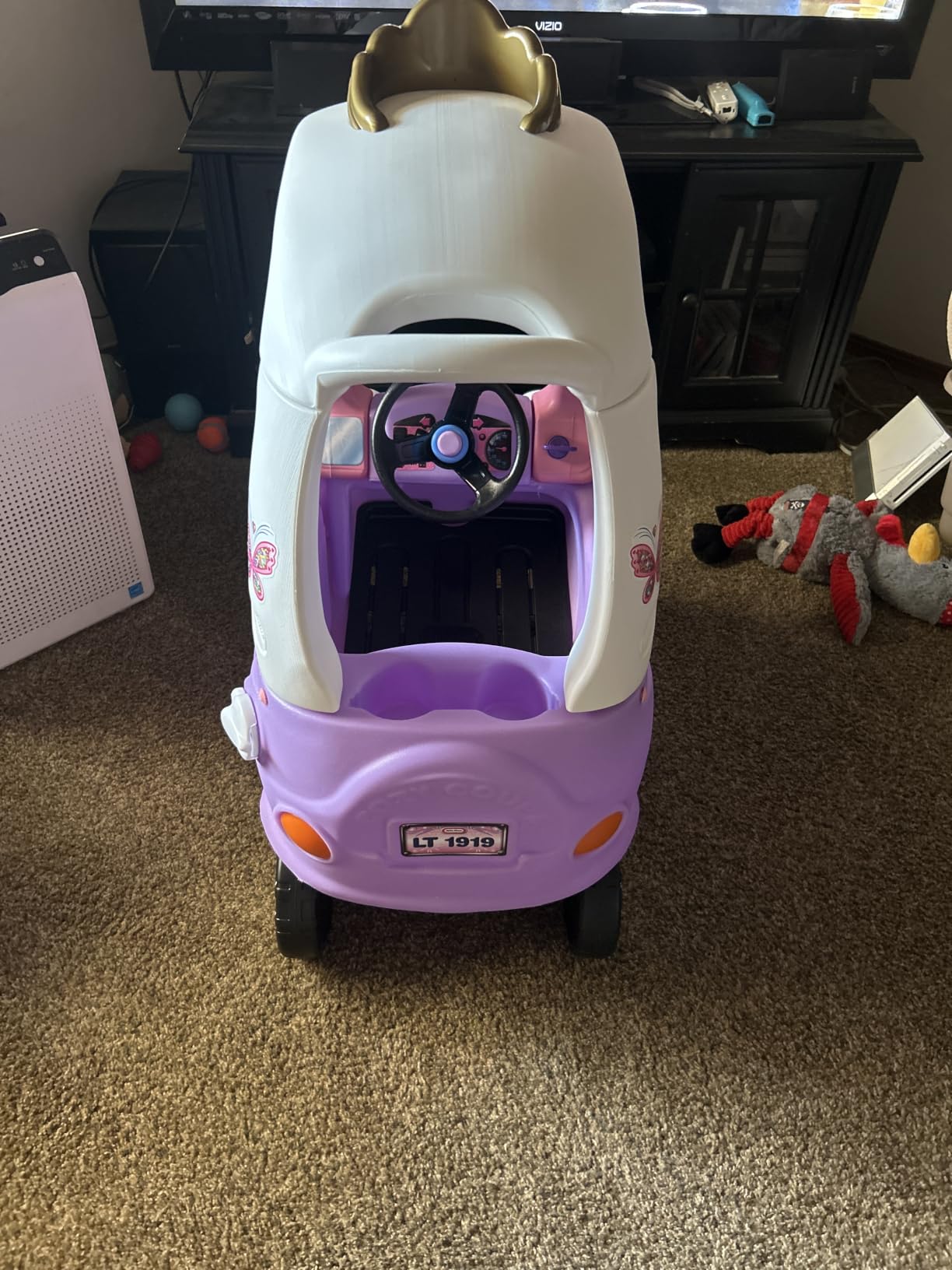
At 17.7 lb it is far lighter than the electric cars in this roundup, many of which weigh 26 lb or more. That means you can carry it up steps, move it out of the way of a car in the driveway, and store it against a wall without thinking about it. The trunk and cup holders get used as a tea tray more often than as storage.
The build is tough plastic and it holds up to daily use over a long ownership period. Working doors with a latch, a horn, an ignition switch and an opening gas cap give a two-year-old something to do with their hands.
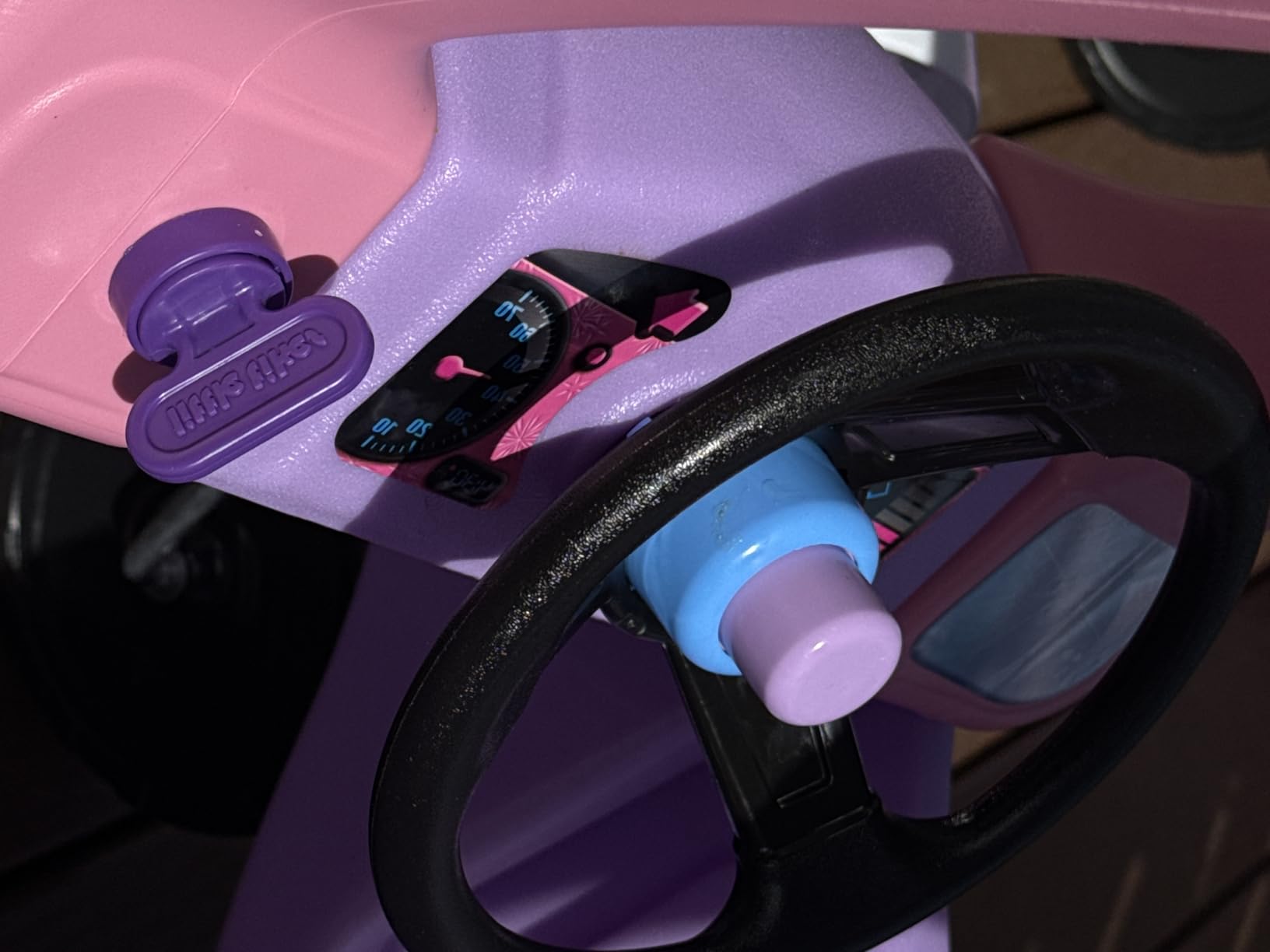
The removable floorboard is the whole point
Test the mechanism before you commit. A toddler who has only ever been pushed will need a few sessions of scooting before they push off hard enough to move the car. That is a normal week, not a fault.
Once they get it, the 360-degree front wheels let them steer properly, which is the part that separates this from basic pedal cars.
What to know before you buy it
Assembly is stiff. Reviewers regularly describe needing two adults for the first five minutes, particularly on the doors and the seat. Budget for that rather than assuming the box opens into a rideable toy.
Beyond that, the honest limitations are cosmetic and acoustic. The stickers peel, and the rolling noise on a hard sidewalk is loud enough that neighbours will hear it.
3. ANPABO 12V Mercedes-Benz G63: Best Power Per Amp-Hour
ANPABO 12V 7AH Licensed Mercedes-Benz G63 Electric Car for Kids, White
12V 7AH battery
Twin 35W motors
Up to 3 mph
66 lb capacity
44 inches long
Pros
- 7AH pack and twin motors outperform smaller-battery 12V rivals
- Officially licensed Mercedes-Benz G63 styling
- Remote has an emergency stop as well as manual mode
- Soft start and safety belt reduce abrupt launches
- Treaded wheels grip dense grass
Cons
- 36.2 lb is a heavy lift to reposition
- Remote needs AAA batteries that are not included
- 3 mph top speed is modest for older children
Many 12V cars in this class run a single motor on a smaller pack. This one has a 7 amp-hour pack and two 35W motors, and that gap is where the extra climbing ability comes from. If your driveway tilts or your lawn is patchy, that difference is the thing you actually feel.
It is a licensed Mercedes-Benz G63, complete with the signature grille, and that matters more than it sounds. A recognizable shape gets a child interested on the first drive instead of the fifth.
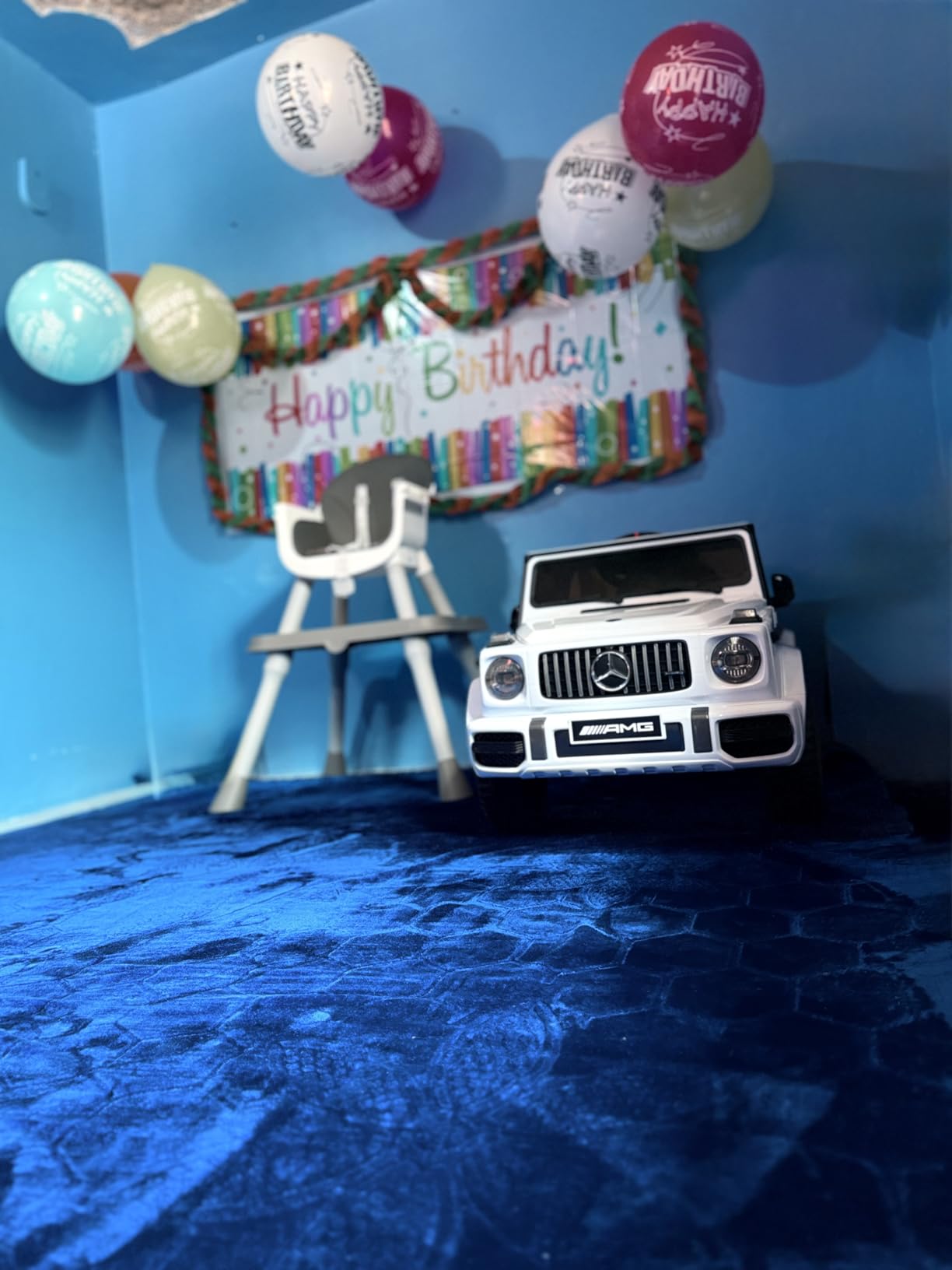
The safety package is well judged. Soft-start acceleration, a safety belt, a power switch that prevents accidental startup, and a remote with an emergency stop. Four separate layers between a three-year-old and a moving 36 lb of plastic.
Audio is handled with built-in songs plus USB and Bluetooth, and there are headlights, a horn and engine sounds. A 4.5 average across 1,572 reviews reflects a car that does everything it claims.

Why the battery size matters more than the voltage label
Voltage tells you the speed class. Amp-hours tell you how long the car moves and how hard it can push before the voltage sags. The 7AH pack is why this car climbs where a smaller single-motor pack in the same class bogs down.
If your child outgrows the power before the seat feels small, you can swap in a second pack later. Check that the replacement uses the same connector before you buy either.
Where the size becomes a problem
At 44 inches long and 36.2 lb, this is not a toy you pick up one-handed. Moving it to a garage, over a threshold or up a step takes two people, and that is worth knowing before delivery day.
For a child over 6, the 3 mph ceiling starts to feel slow. Consider the Miniature Motors truck reviewed later if speed is the priority.
4. FanttikRide N7 Pro Electric Wiggle Car: Best Budget Buy
FanttikRide N7 Pro Electric Wiggle Car, Flashing Wheels, for Ages 3+, Blue
2-in-1 electric and manual
12V 45W motor
Up to 4 mph
150 lb capacity
13.8 lb
Pros
- Works as an electric swing car and a foot-propelled wiggle car
- Anti-tip chassis and rear anti-tip wheels cut rollover risk
- Flashing PU wheels roll quietly indoors without scratching floors
- Two speeds including a plug-in 1.9 mph low mode
- 150 lb capacity suits a wide range of children
Cons
- Riding style requires leaning
- not steering-wheel driving
- Less intuitive for very young children
- Needs charge cycles planned around
This one runs up to 4 mph on a 12V pack, and at 13.8 lb it is also the lightest in the roundup. Those two facts are not a coincidence. It is a wiggle car rather than a pedal car, so it weighs almost nothing and carries almost anything.
The 2-in-1 setup means it works with the 12V pack switched on, and it works as a plain foot-propelled wiggle car when the battery is flat or the child is not ready for electric. The manual mode is what keeps it usable between ages.
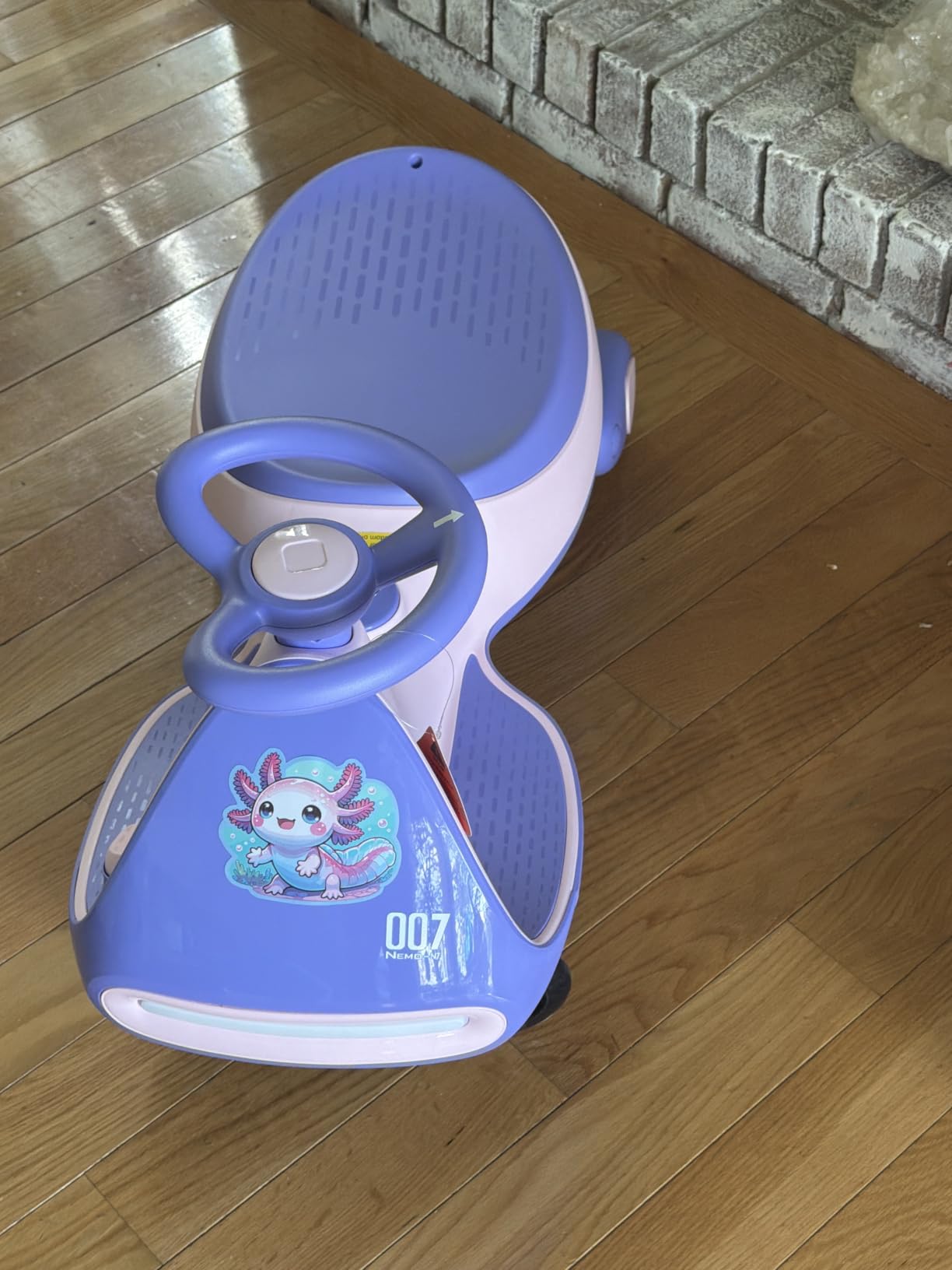
Rolling around indoors is the quiet win here. The PU magnetic wheels light up as they spin and they roll softly enough to use on a hard floor, which makes it one of the few in this list that works in a flat apartment as well as outside.
The anti-rollover engineering is the part that separates it from cheaper wiggle cars. A pyramid-style double-triangular chassis, upgraded anti-tip rear wheels and spring shocks work together to stop a lean from becoming a flip.

How to decide if a wiggle car fits your child
A wiggle car is steered by leaning and twisting rather than by a wheel. Children pick it up quickly, usually inside a week, but a child who strongly wants a car with a steering wheel and a pedal will be disappointed no matter how good the toy is.
Check the seat. An extra-large seat and a 150 lb limit cover a far wider age span than most single-seat 12V cars, which top out around 55 to 66 lb.
Where it will disappoint you
The 1.75 hours of stated battery life is at the shorter end of this roundup, and the two speed settings are selected by a plug-in mode rather than a switch, which takes a little practice to get used to.
If you want a conventional pedal car with a parental remote, this is the wrong shape of toy. Look at the Bobike or the Miniature Motors truck instead.
5. Bobike 12V Ride-On Car with 2.4G Remote: Best for Dual Control
12V Kids Ride On Car with 2.4G Remote Control,Battery Powered Electric Car Ride On Vehicle Double Doors, Safety Belt,LED Light (SC-Black)
12V dual motors
3 km/h top speed
2.4GHz remote with emergency stop
15-inch wheels
Double doors
Pros
- Remote with an emergency stop gives a real parent cutoff
- Dual motors and 15-inch anti-bump wheels handle grass and dirt
- Double doors
- side handrails and adjustable seat belt
- LED headlights make dusk rides safer
- Built-in music
- USB port
- horn and engine sounds
Cons
- Low top speed is deliberately conservative
- Generic off-road styling rather than a licensed vehicle
- Warranty and brand support less established than the big names
The thing that sets this car apart is the emergency stop on the 2.4GHz remote. Most remotes let you slow down or reverse. This one lets you cut power, which is a meaningfully different tool when a child is heading toward a kerb.
It runs at 3 km/h, which is roughly walking pace. That is slow, and it is a deliberate choice by the manufacturer rather than an oversight.

The 15-inch anti-bump wheels handle grass, dirt and uneven sidewalk, and they are the first feature reviewers name.
For a 4.4 average across 1,271 reviews, the buying experience is solid. Music, a USB port, horn, engine sounds and functional LED headlights are all present.

Why slow is a feature for a first electric car
Top speed in this category is really a function of how much time a child has to react. At walking pace, a child who misjudges a step has time to correct before it matters. At 4 mph that margin shrinks fast.
If your child is new to electric riding or your space is tight and shared, the conservative speed is worth more than the extra power.
When to skip this one
It is a generic off-road design rather than a licensed vehicle, so a child motivated by a specific make and model will not find it exciting. The brand also has a thinner support record than the established names in this list.
Age is stated as 3 to 8, but the 3 km/h limit makes it feel more like a 3 to 6 toy.
6. Winado 12V Mercedes-Benz AMG GTR: Best for Audio and Low Weight
Winado 12V Licensed Mercedes Benz AMG GTR Kids Ride on Electric Car, Black
Licensed AMG GTR design
3-speed remote
20.5 lb
3 mph top speed
55 lb capacity
Pros
- Officially licensed AMG GTR styling with openable doors
- 3-speed remote plus 2-speed manual with smooth start
- USB
- AUX and TF card slot for your own music
- Lightest full-size 12V car here at 20.5 lb
- Wide seat fits toddlers and preschoolers
Cons
- 55 lb capacity suits only the youngest riders
- 8 to 12 hour charge time is very long
- Seat belt reported to break after a few months
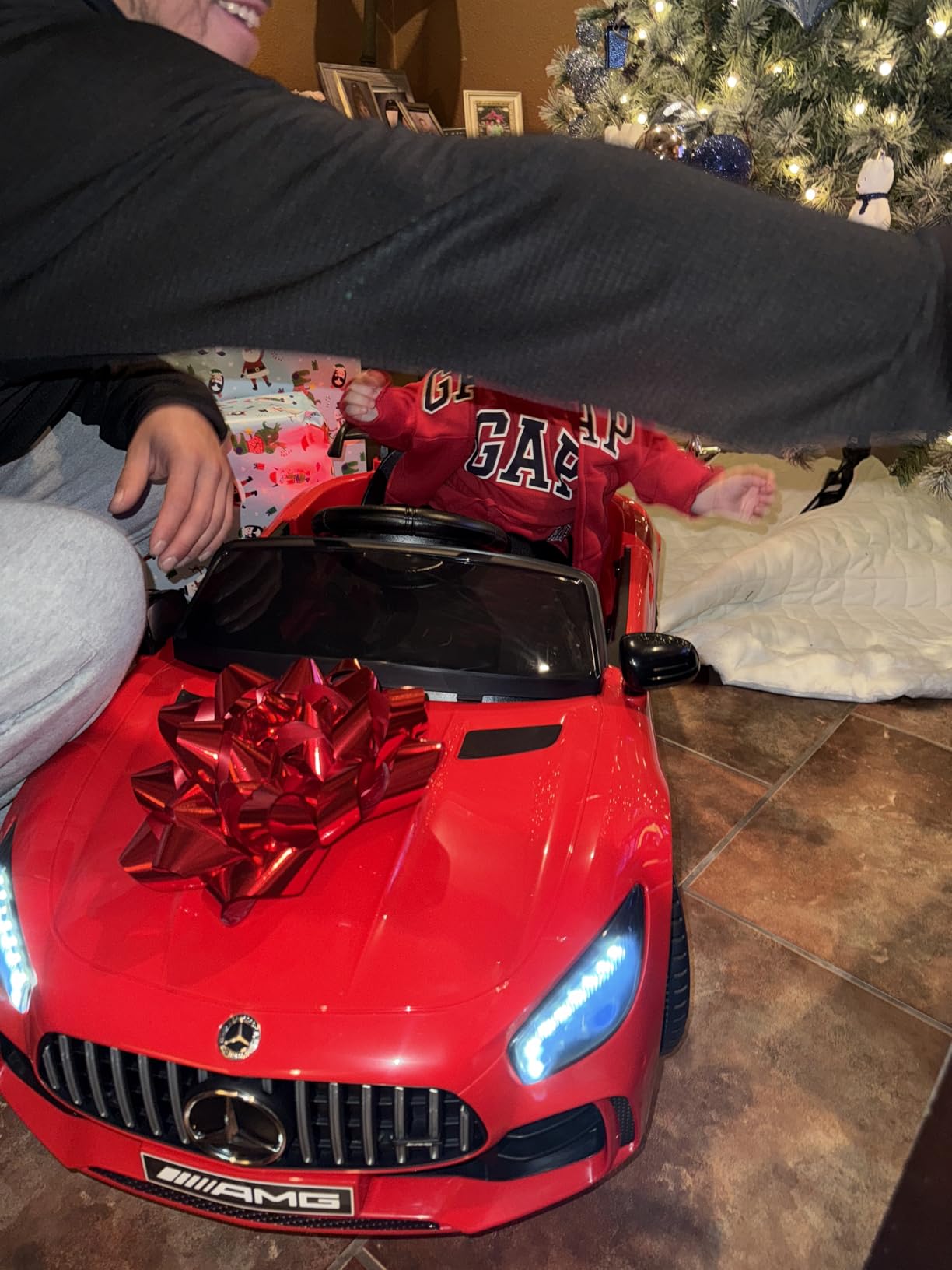
At 20.5 lb this is the lightest full-size 12V car in the roundup, where the heavier electric models run from 26 lb to nearly 37 lb. If you need to move the car between rooms, carry it up steps, or live somewhere without a garage, that is the deciding number.
The audio options are unusually flexible. USB, AUX and a TF card slot mean a child can play their own music rather than cycling through whatever the toy shipped with, and there is a volume control on the dash.

Control is flexible: a 3-speed 2.4G remote for the parent, and 2-speed manual operation for the child, with a smooth-start design so launches are not abrupt. Doors open, the headlights and taillights are realistic, and there is a voltage display so you can see when the pack needs charging.
It holds a 4.5 average across 1,014 reviews, with 82% five-star. The licensed AMG styling is a reason mentioned often in reviews.
The charge time is the real trade-off here
Eight to twelve hours is long. Plan it as an overnight charge, not a top-up between outings, and keep a mental note of where you parked it because you will not want to move it in a hurry.
Runtime is stated at 1 to 2 hours depending on use, which lines up with what owners report for this class.
Check the capacity before you commit
At 55 lb, this is a low limit. Only the two toddler-tier cars in this roundup sit below it, which is fine for a 3-to-5-year-old and wrong for a child who is nearly 6. Measure before you order.
There is also a recurring report of the seat belt failing after a few months. If your child rides daily, check the strap every couple of weeks.
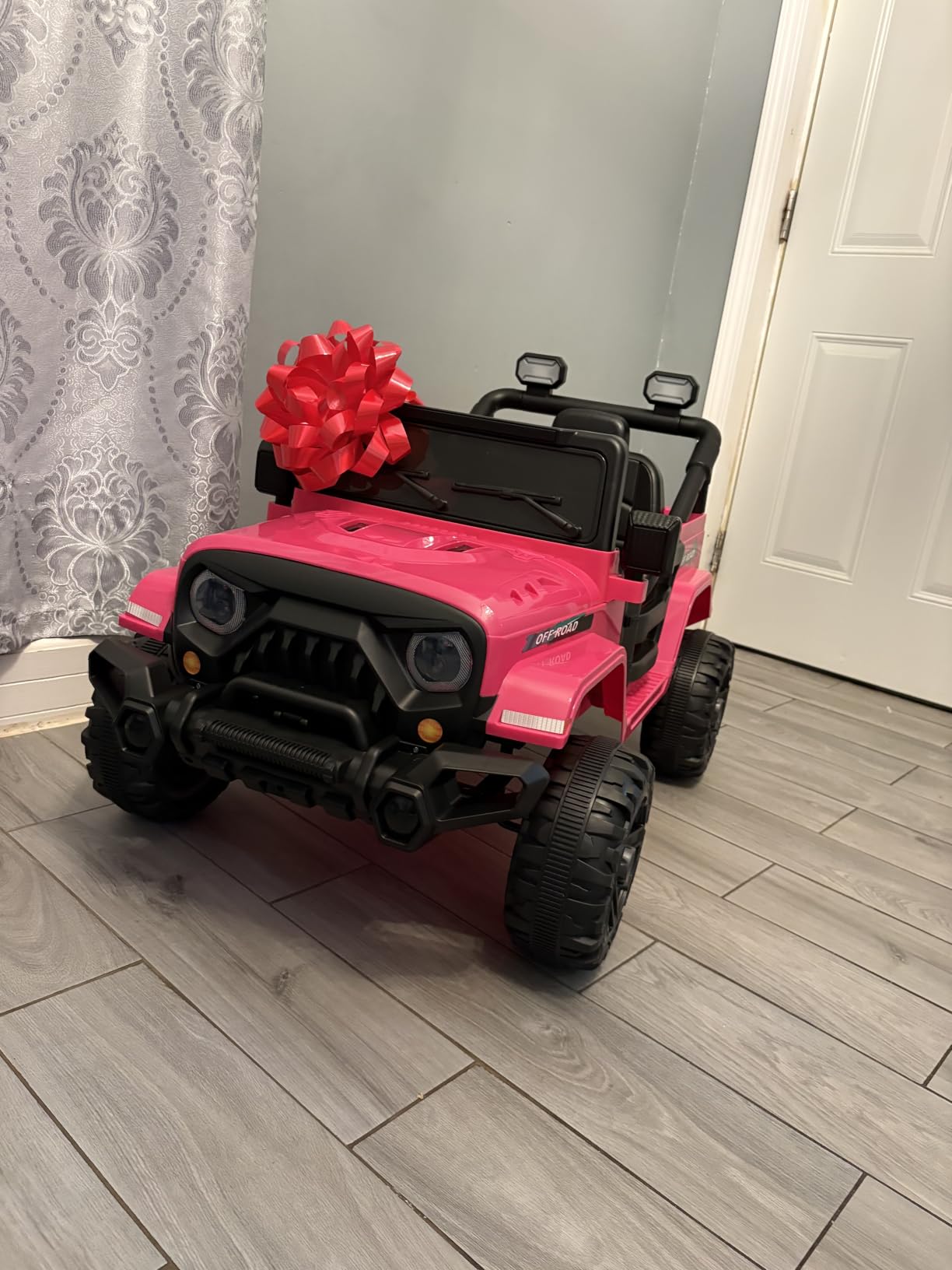
7. First Ride On 24V Ford Bronco Raptor Two-Seater: Best for Big Kids
First Ride On 24V Ride on Toys for Big Kids, Licensed Ford Bronco Raptor 2 Seater Ride on Cars with Remote Control, Ride on Truck w/ 4-Wheeler Suspension, 3 Speeds, Led Lights, Bluetooth (24V, Pink)
24V dual drive
Three speeds up to 4.3 mph
21-inch two-seat cabin
132 lb capacity
98 ft remote range
Pros
- Two 21-inch seats with individual 3-point belts solve sibling sharing
- 132 lb capacity carries kids well past the preschool years
- Three speed settings plus a 98 ft remote range
- Licensed Ford Bronco Raptor styling
- Soft start
- anti-slip seats and rear shocks
Cons
- Very wide and heavy
- so storage and maneuvering are real issues
- Assembly can exceed an hour for one adult
- Hard plastic wheels wear and can slip on downhill stops
- Awkward charging connector
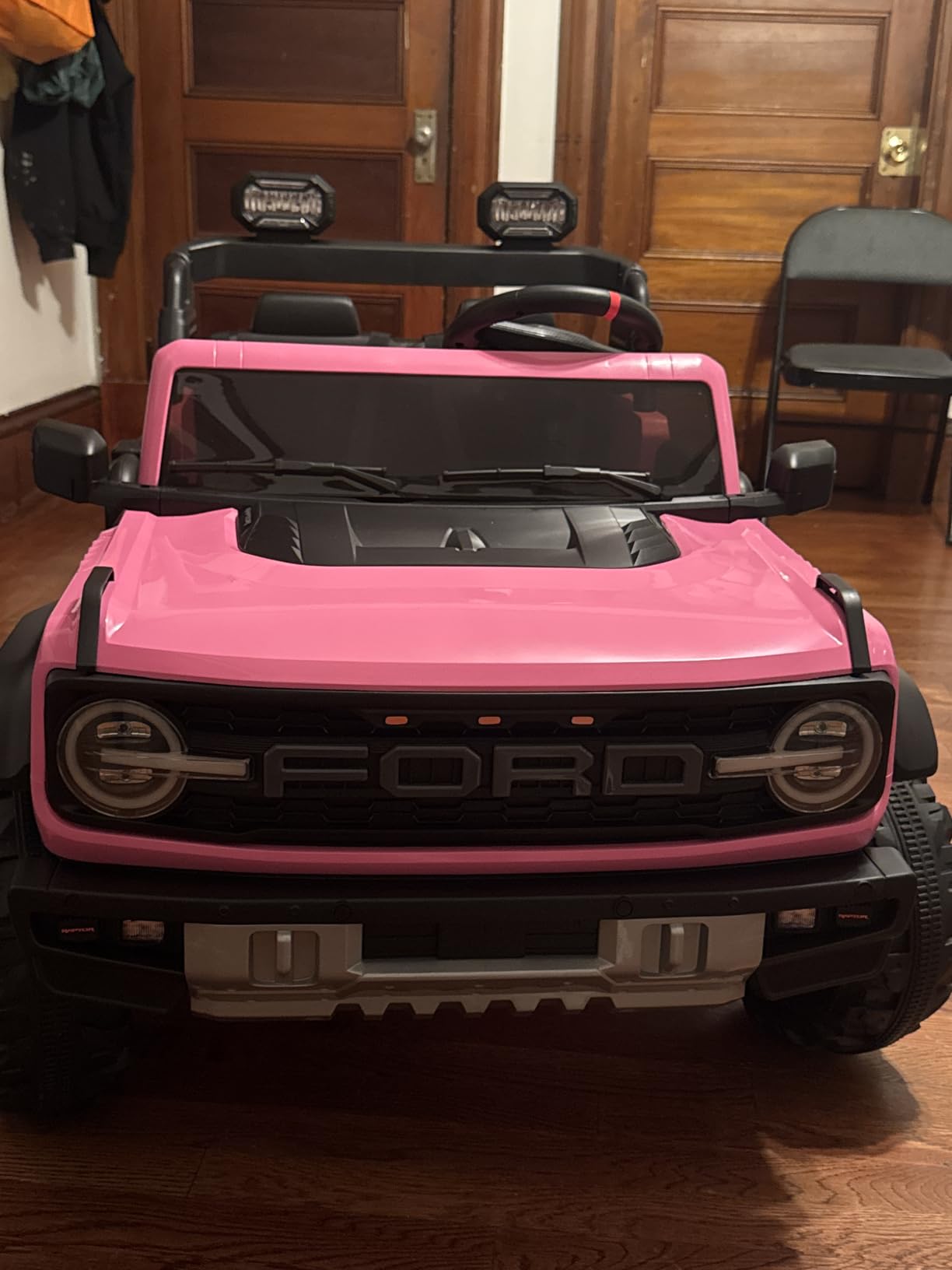
This is the clearest answer to the sibling problem. A 21-inch two-seat cabin with individual 3-point belts means two children ride at once, each properly restrained, rather than one riding on a lap.
Three speeds, at 2.0, 2.7 and 4.3 mph, with a remote that reaches 98 feet. That reach is what makes it usable in a cul-de-sac or at the bottom of a sloped driveway, where a shorter-range remote leaves you guessing.
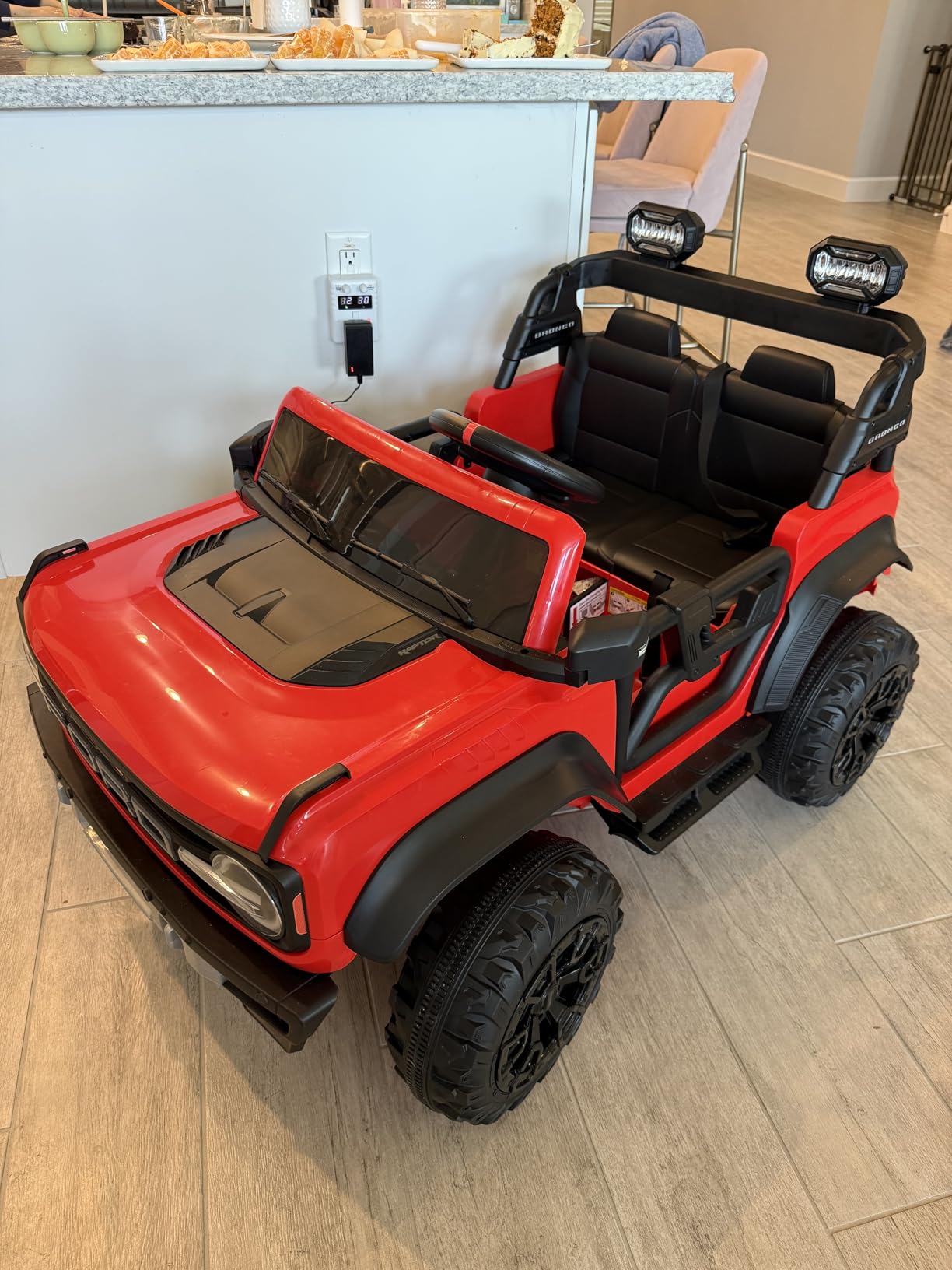
The 132 lb capacity is the number that changes the maths. A 55 or 61 lb car is done at age 5 or 6. This one is rated well beyond that, which is why it stays useful for a 5-to-8-year-old rather than being retired at the preschool stage.
Rated 4.5 across 982 reviews, with 80% five-star. The licensed Bronco Raptor shape, the two-seat layout, the 3-speed remote and the Bluetooth music are the recurring positives.
What a two-seater actually solves
It solves the fight, not the driving. Two children can share rather than negotiating, and a parent with a younger child can put a small passenger in the second seat under a real belt instead of carrying them.
Check the width of your garage or gate before you buy. This is a 44-inch-long, 31.7-inch-wide vehicle, and turning space matters more than the dimensions suggest.
The things that annoy owners
Assembly can take more than an hour solo, and the charging connector is awkward to disconnect. Runtime is stated at 50 minutes to 2 hours depending on how it is used, and the 8-to-12-hour charge cycle matches the pattern across this category.
The plastic wheels are the weakest mechanical point. Owners report wear and slipping on downhill stops, so keep speed low on slopes.
8. Miniature Motors 12V Electric Ride-On Truck: Best 12V Speed and Power
MINIATURE MOTORS 12V Kids Electric Ride on Truck Car Remote Control, Twin 35W Motors 3.5MPH Max Speed, Bluetooth Music Player, 4 Wheels Suspension LED Lights Safety Belt, Gift for Boys & Girls-Black
Twin 35W motors
3.5 mph top speed
40-60 minutes per charge
3-speed remote
26.4 lb
Pros
- 3.5 mph is the highest top speed among the pedal 12V cars here
- Twin motors give more pulling power than single-motor trucks
- Three-speed remote with manual override
- Bluetooth speaker streams a phone
- Spring suspension on all four wheels
- ASTM and CPSIA certified
Cons
- Arrives unassembled and requires building
- Manual-mode speed is fixed
- 40-60 minute runtime is short
Among the pedal-and-steering-wheel 12V cars, this one is the quickest at 3.5 mph, and it pairs that with twin 35W motors rather than a single unit. If a child is 5 or 6 and the car feels slow, the usual cause is a single small motor, and this is the fix that stays within the 12V class.
Spring suspension sits at all four wheels rather than just the rear, which is a real difference on a cracked driveway or a lawn with roots.
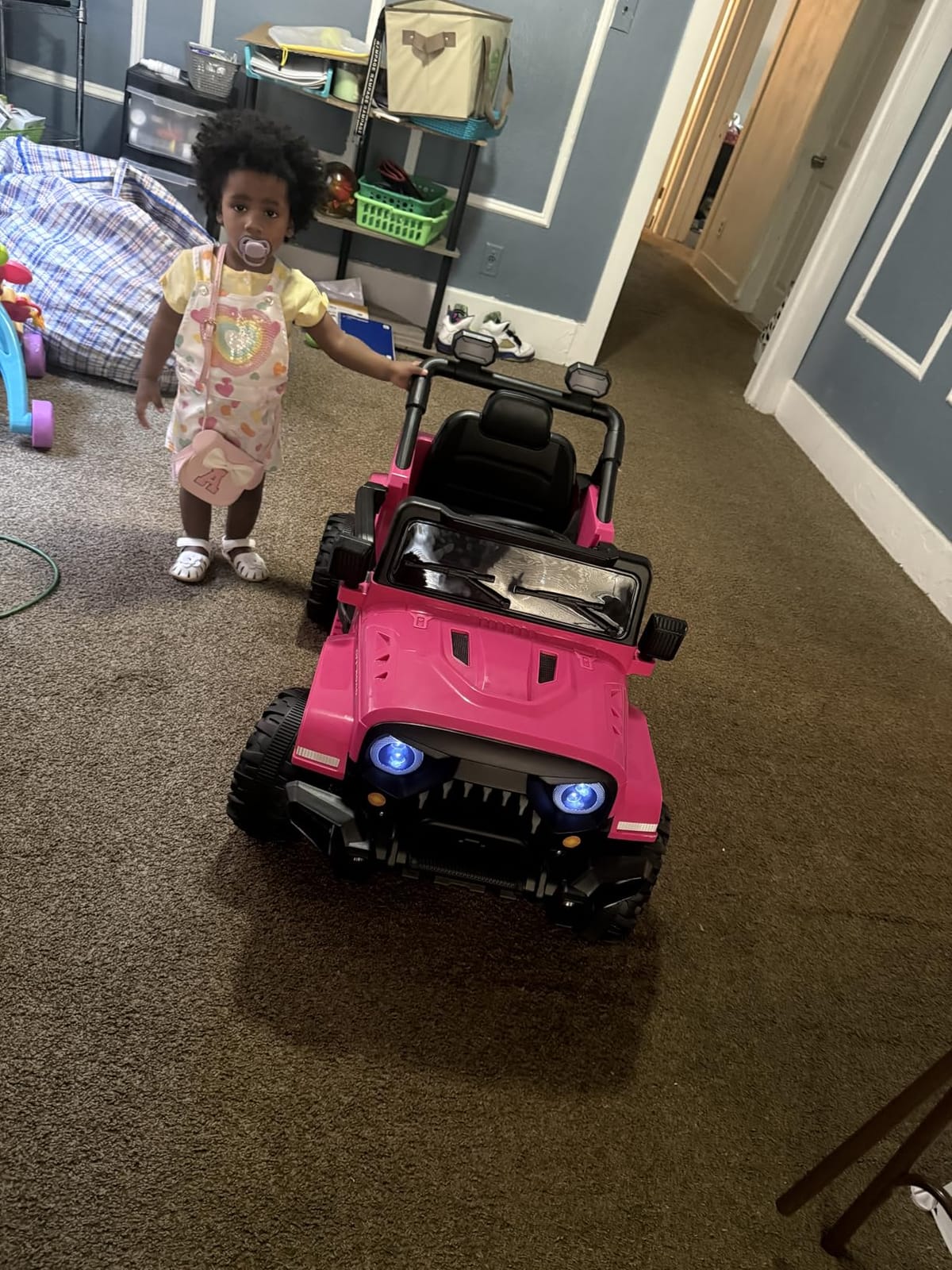
The box includes the charger, the parent remote and a pair of spanners, which saves a separate trip for tools. It carries ASTM and CPSIA certification, which is worth having on file for a toy with a rechargeable lead-acid pack.
A 4.5 average across 905 reviews, with reviewers consistently naming twin-motor power, the 3.5 mph speed and the Bluetooth speaker as the standouts.
Runtime and why it is short
Forty to 60 minutes is at the shorter end for a 12V car with this much motor output. Twin 35W motors draw more current than a single motor, and the pack is not oversized to compensate.
Treat it as one solid session per charge rather than an all-afternoon vehicle. A second pack is the usual answer.
Assembly is part of the purchase
It arrives unassembled, so have the tools out and set aside an evening. In manual mode the speed is fixed at 3.5 mph with no adjustment, which is a limitation for younger drivers.
The 66 lb capacity suits ages 4 to 7 more than it does a 3-year-old.
9. Best Choice Products 12V Chevrolet Silverado: Best for Hauling and Storage
Best Choice Products 12V Licensed Chevrolet Silverado Ride On Truck, Electric Car Toy w/Parent Remote Control, Truck Bed Storage, Bluetooth Speaker, LED Lights, 2.5 MPH Max Speed – Black
Licensed Silverado styling
12V battery
Truck bed storage
2.5 mph max speed
66 lb capacity
Pros
- Accurate licensed Silverado replica down to badges and mirrors
- Truck bed doubles as storage for toys and stuffed animals
- Roomy enough for a 1-year-old and a 3-year-old
- Remote can stop or reverse a runaway driver
- Locking doors and seat harness
- Handles grass
- snow and ice on the higher setting
Cons
- Assembly instructions do not identify which screws go where
- Low and high speeds are hard to tell apart
- 36.7 lb is bulky to store
- Door latch is on the inside only
The truck bed is what separates this from the other single-seat cars in the roundup. It is a real, usable compartment, and owners describe hauling toys, leaves and garden debris in it. Reviewers treat a bed or trailer as a genuine utility rather than a gimmick, and this is the most practical car here for that job.
It is also roomy enough inside for two small children, one of whom can ride as a passenger rather than a lap passenger.
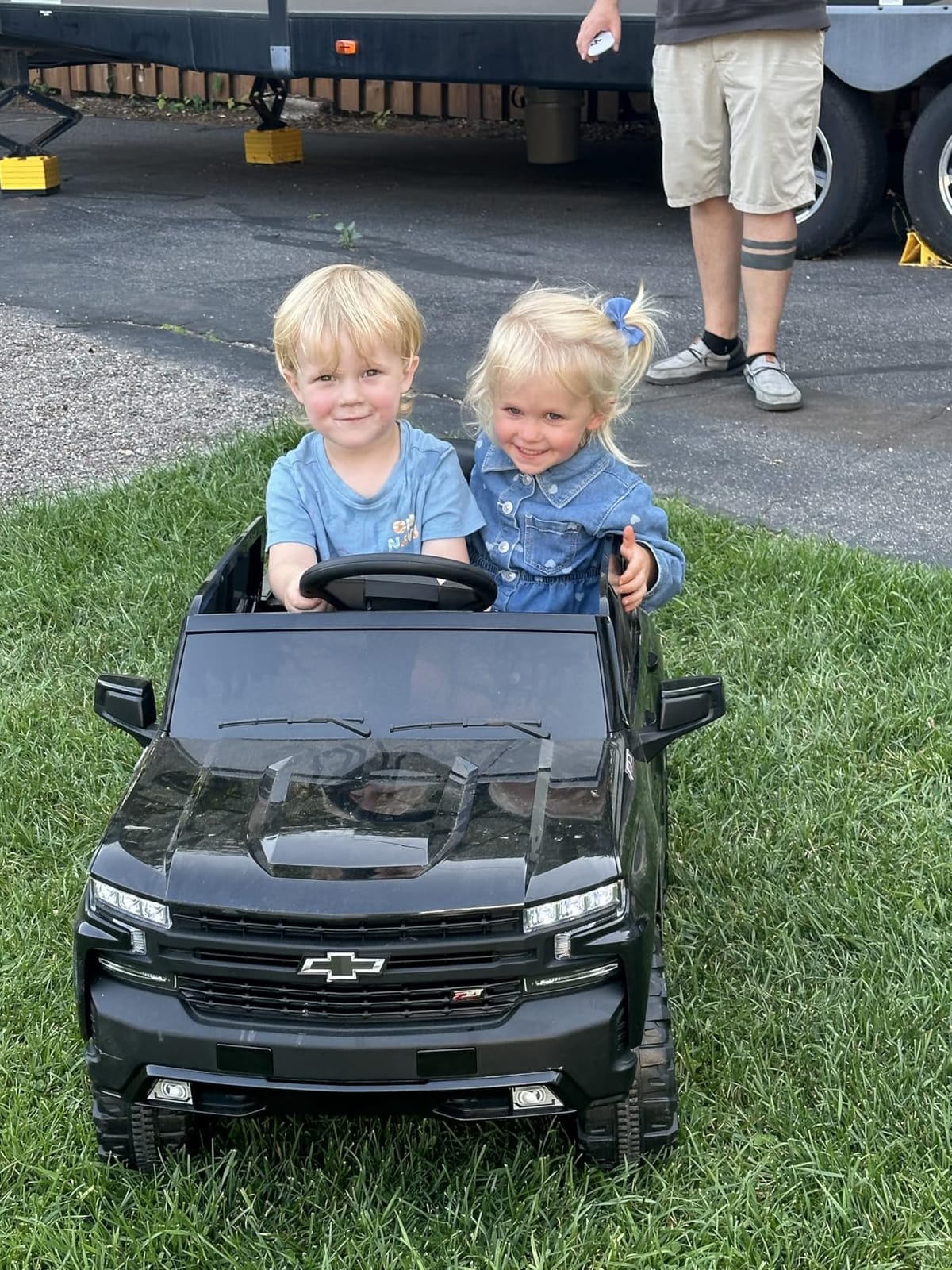
Licensed Chevrolet Silverado styling is accurate down to the badges and mirrors, and it is the reason a lot of these get chosen over generic designs. The steering wheel is battery-powered, the doors lock, and the headlights function.
It holds 4.6 across 622 reviews, with 84% five-star. Reviewers return again to the accuracy of the replica, the roomy fit and the bed.
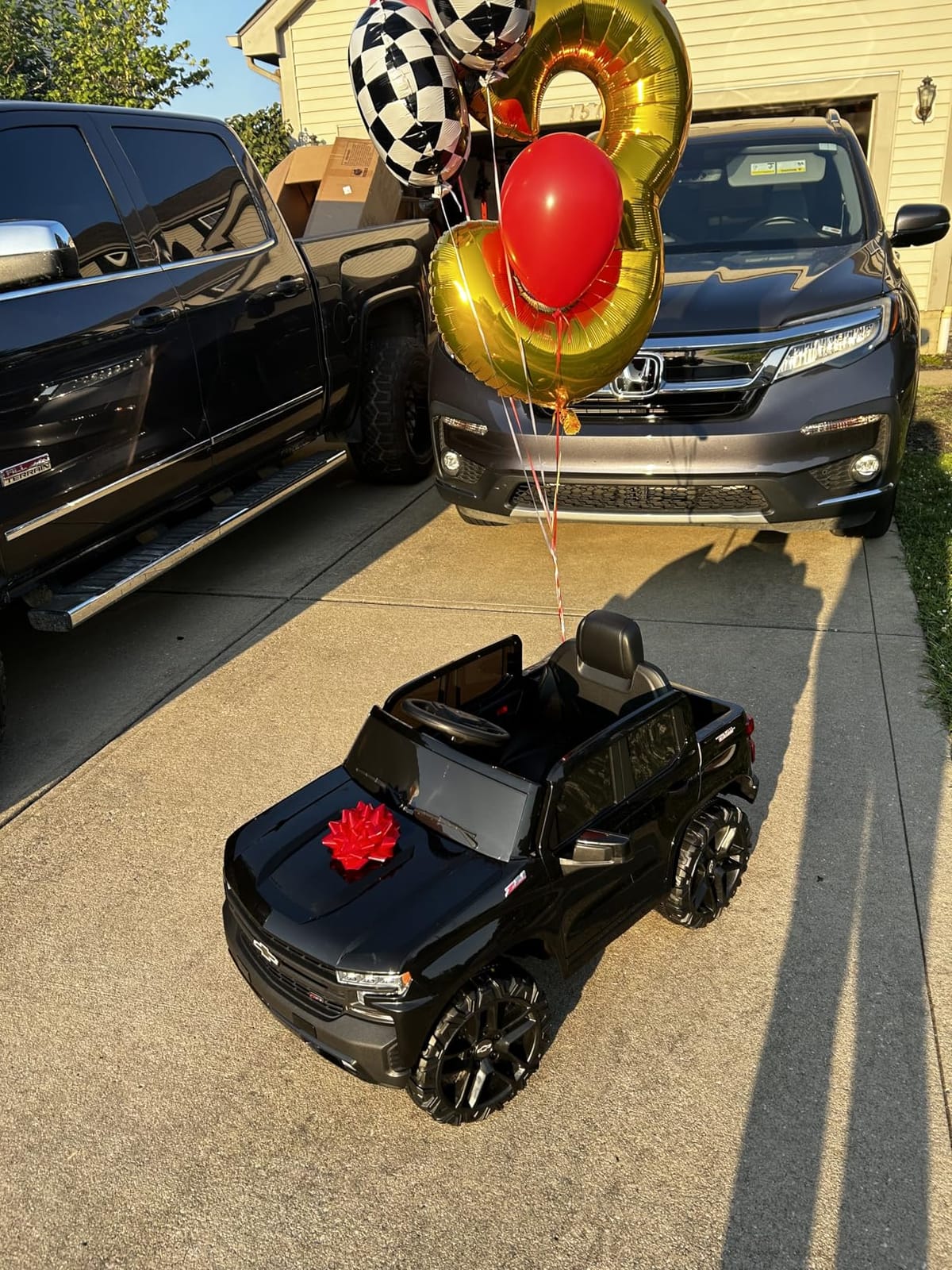
How the truck bed gets used
It carries stuffed animals, riding toys, garden tools and leaves. On a gravel or grass surface, keep the load light. A heavy payload on loose ground puts strain on the rear drive and shortens the climb.
Do not exceed the 66 lb rating, and do not let a child climb into the bed to ride.
Two things to fix on day one
Assembly is the weak point. Reviewers report the instructions do not identify which screws go where, so budget extra time and keep the hardware sorted into piles. If it is not obvious, look at a photo of a finished unit before tightening anything.
Low and high speed are hard to distinguish, and the door latch is on the inside, so a small child cannot get out alone from the outside. Plan to unlock it for them from the parent seat.
10. Best Choice Products 12V Ford Mustang: Best for Style
Best Choice Products Kids 12V Electric Ride On Car Officially Licensed Ford Mustang w/Parent Control, LED Lights, 2 Speeds, Bluetooth – Black
Licensed Ford Mustang design
25W motors with 4-wheel drive
Up to 3.1 mph
60 minutes run time
66 lb capacity
Pros
- Highest rated car in the roundup at 4.7 with 89% five-star
- Licensed Mustang styling children recognise immediately
- 25W motors with full 4-wheel drive
- Up to 60 minutes of run time
- Remote control plus two preset speeds
- Seat harness
- treaded wheels and LED headlights
Cons
- 28 lb is heavier than most 12V cars its size
- Only two speed presets
- Single seat so no sibling sharing
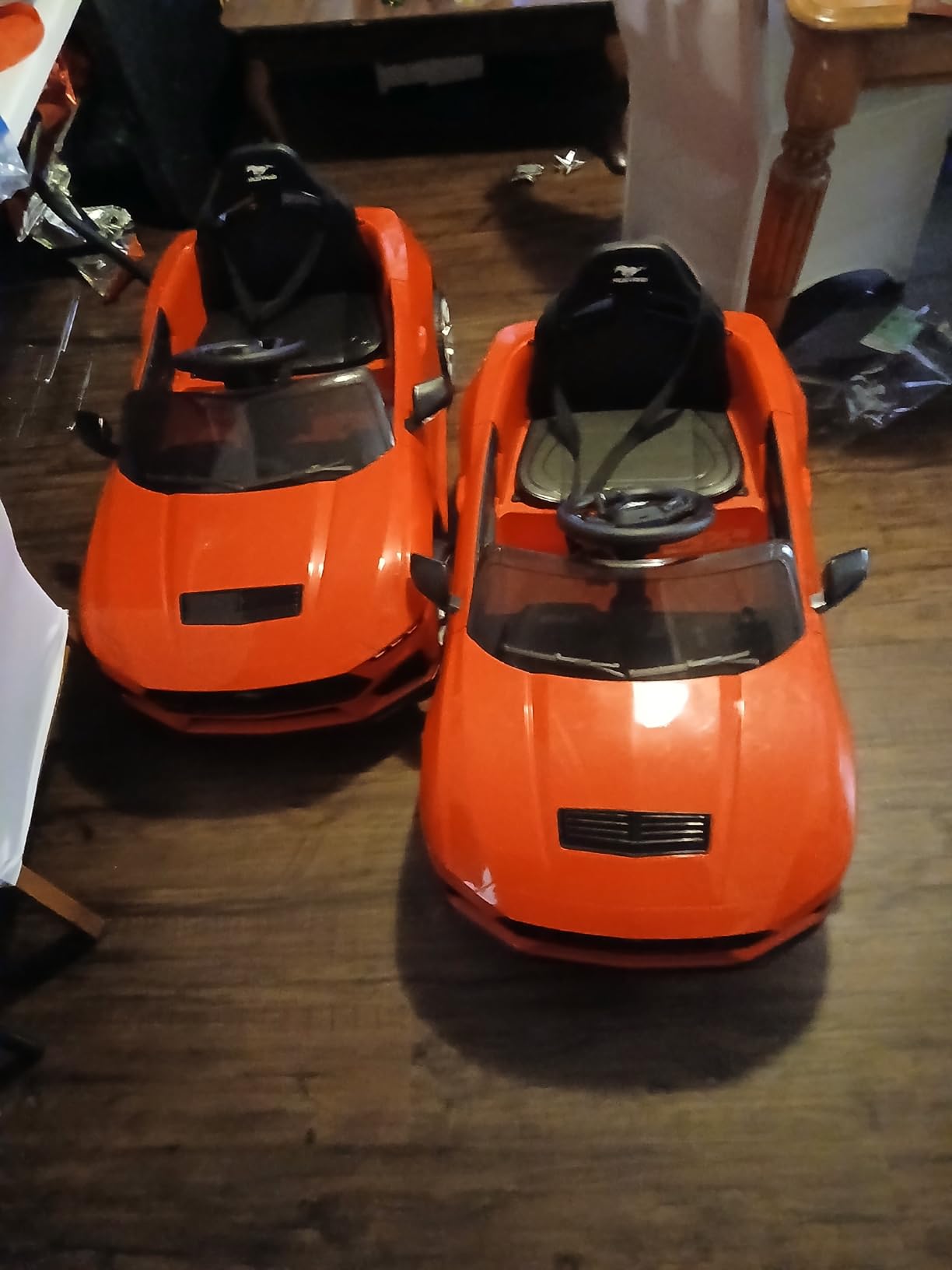
This is the highest-rated car in the entire roundup at 4.7, with 89% five-star and only 3% one-star. Across 533 reviews that is a very consistent signal, and it is why this one stands out even though its review count is lower than some rivals.
Full 4-wheel drive from 25W motors is a genuine step up from a rear-drive car, and at up to 3.1 mph it is quicker than most of the 12V field without reaching wiggle-car speed.
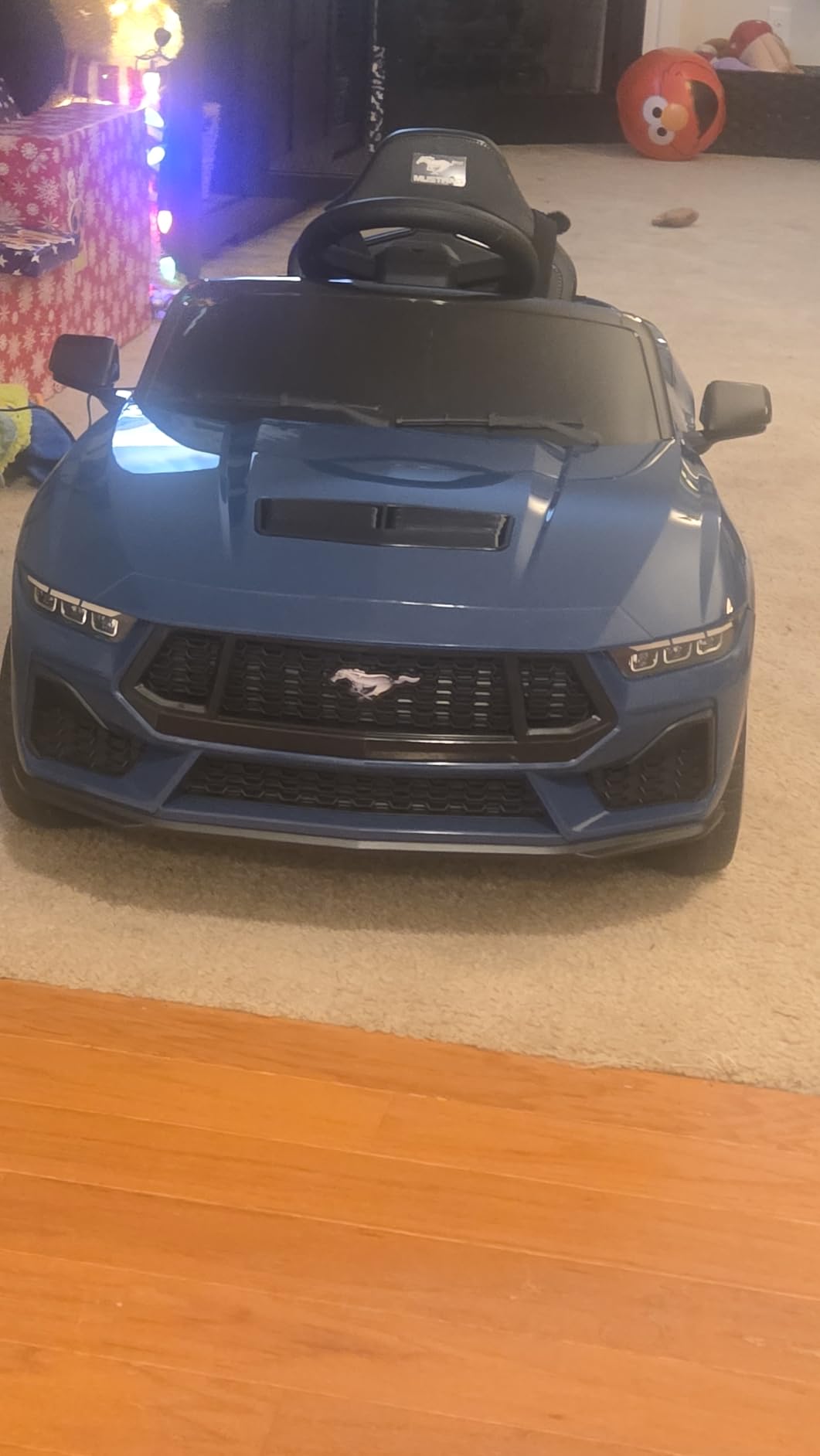
Bluetooth audio, LED headlights, an adjustable seat harness and treaded plastic wheels cover the daily-use list. Runtime is stated at up to 60 minutes, which is at the good end for this class.
The Mustang shape does the persuading. Owners describe children recognising it immediately, which shortens the time between delivery and it being used.
Why a 4.7 average still is not a guarantee
Review count matters when you read a rating. 533 reviews is a smaller sample than 21,000, so a single early component failure hits the average harder and gets read by fewer people.
Look at what the reviews actually praise: the styling, the remote, the runtime. The complaints are consistent and narrow, which is a good sign.
What to consider before buying
It is a single seat, so it does nothing for a sibling pair. There are only two speed presets, so a parent wanting fine-grained control is better served by a 3-speed remote.
At 28 lb it is not a lightweight carry, and the 66 lb limit is a mid-range number that suits ages 3 to 6.
11. ARBELI 24V 4WD Two-Seater: Best for Hills and Rough Ground
ARBELI 24V 4WD 2 Seater Ride on Toy Car for Kids 3-8, EVA Tires, Pink
24V with 4x200W motors
Up to 4.5 mph
Switchable 2WD and 4WD
133 lb capacity
60.6 lb
Pros
- 800W of power handles grass
- gravel and inclines
- Genuinely wide 20-inch two-seater bench
- EVA rubber tires ride far better than hard plastic
- Switchable 2WD and 4WD lets a beginner start gentle
- 133 lb capacity lasts well past age 8
- Remote emergency stop
- lockable doors and handrails
Cons
- Weighs 60.6 lb
- which makes it hard to move or store
- Longest footprint here at 47.6 inches
- Remote needs AAA batteries that are not included
- 9% one-star share is high for this roundup
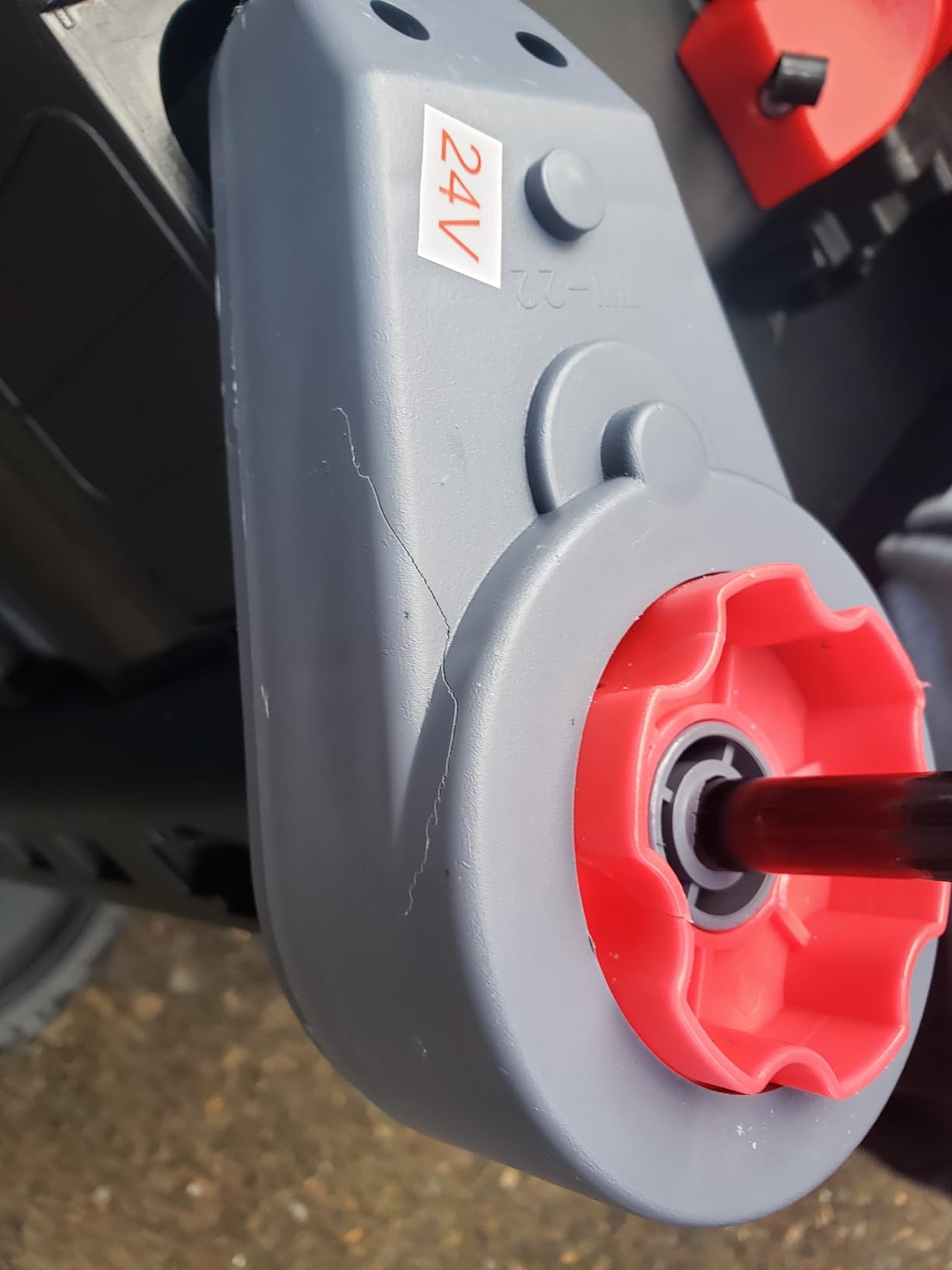
This is the most capable machine in the roundup, and it is the right answer for a genuinely difficult property. Four 200W motors for 800W total, switchable between 2WD and 4WD, rated by the manufacturer for inclines of 15 to 20 degrees. No other vehicle in this roundup carries that incline rating.
The EVA rubber tires are the other headline. Parents and reviewers alike single out hard plastic wheels as the reason cheaper ride-ons feel harsh over uneven sidewalks, and EVA rubber is the direct answer to that complaint.
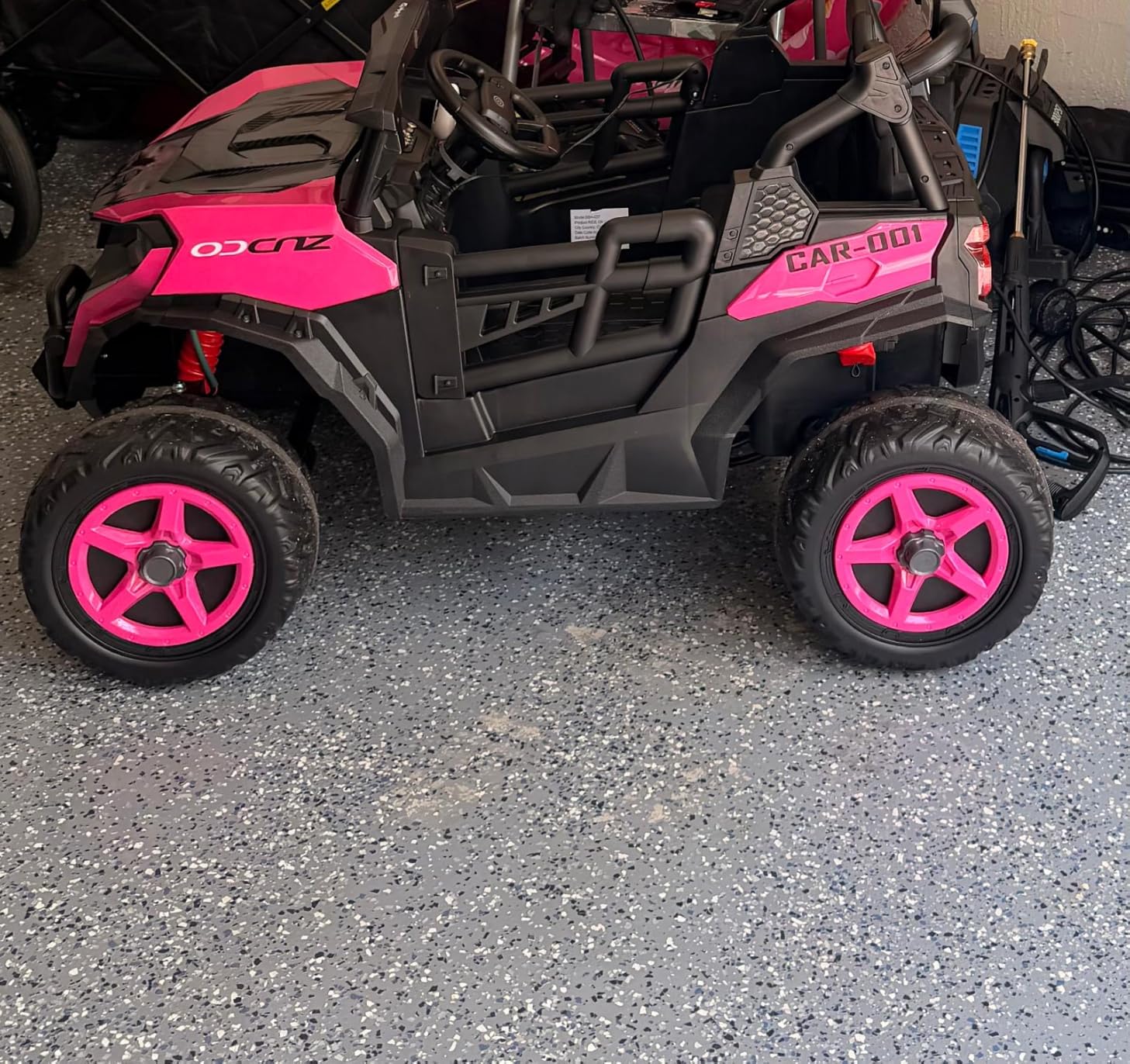
The 20-inch two-seater bench is properly wide, wide enough for a big kid plus two toddlers, with two adjustable seat belts. Dual rear springs and a soft-start system smooth the launch and the ride.
A 4.4 average across 466 reviews, with 76% five-star. The motor package, the two-seat width and the switchable drivetrain are the recurring positives.
Why the 2WD and 4WD switch matters
4WD is great on grass and hills and poor for a beginner who just wants to cruise a driveway. Leaving it in 2WD lowers the power and makes the car more manageable, then you switch up when the terrain demands it.
For most suburban driveways you will live in 2WD. Keep 4WD for the lawn and the slope.
The cost of all that power
At 60.6 lb and 47.6 inches long, this is the hardest item in the roundup to move and store. Parents who bought large 24V two-seaters regularly cite the garage footprint as their biggest regret.
It also carries a 9% one-star share, the highest in this list, and the remote needs AAA batteries that are not included. Measure your storage space before committing.
12. ARBELI 12V Toddler First Car: Best for a Two-Year-Old
ARBELI 12V Electric Ride On Car, Toddler First Car, Blue
Dual 35W motors
3.1 mph with soft start
3-speed remote with override brake
50 lb capacity
30 lb
Pros
- Soft start
- remote override brake and lockable doors are a strong safety package
- Dual 35W motors handle rough driveways and debris
- Easy to assemble with an accessible charge port
- Large-button MP3 panel with a battery level bar
- 3-speed remote matches pace to the child
- ASTM F963 and CPSIA certified
Cons
- 50 lb capacity is low and a bigger child outgrows it
- Lap belt only
- no 3-point harness
- Rear-wheel drive only despite 4x4-style decals
- Mirrors are decals rather than real reflective plastic
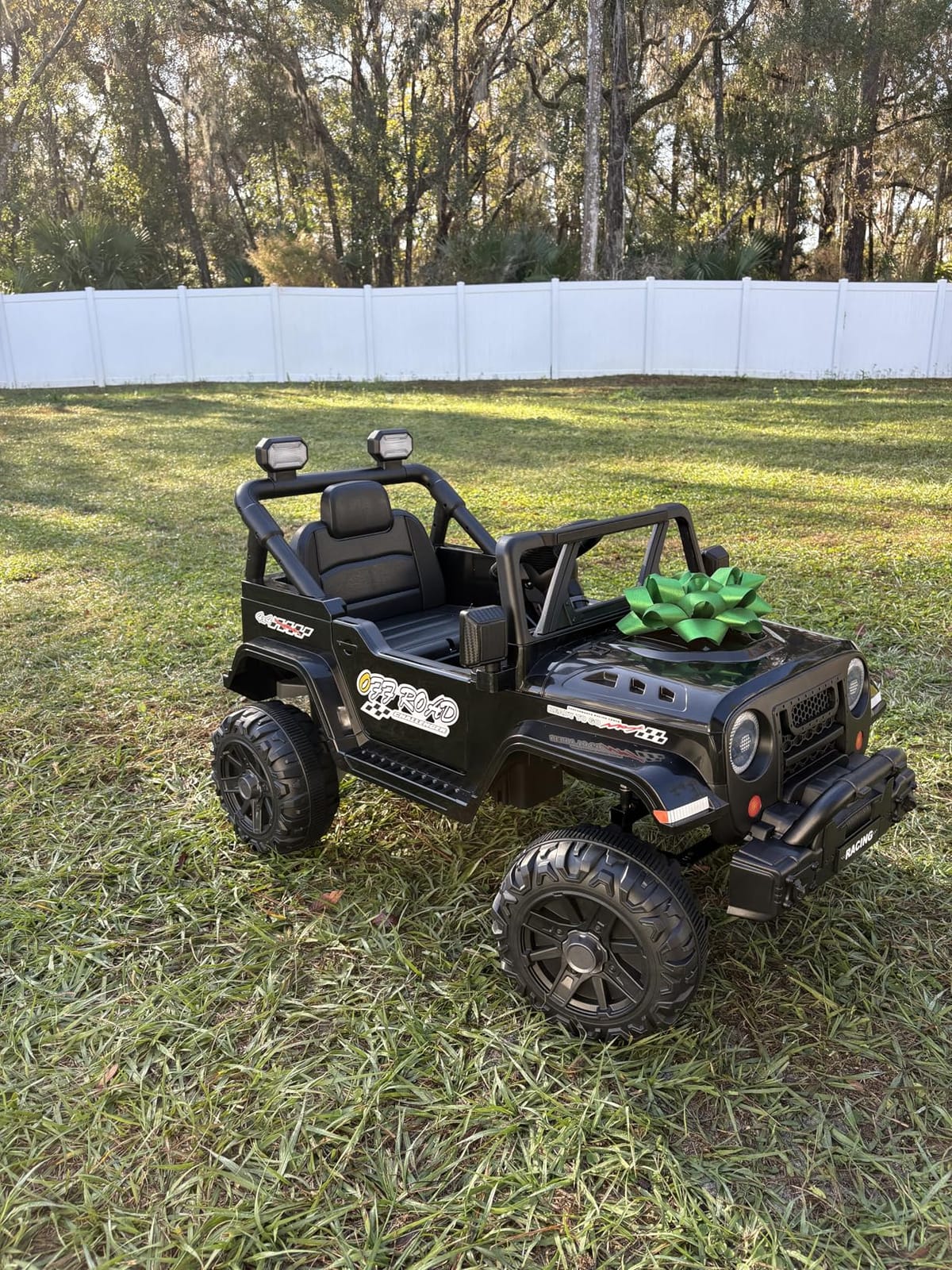
If your child is two, the whole buying decision is about control layers rather than speed. This car stacks them: a soft-start system so the car does not lurch, a power switch preventing accidental startup, a 3-speed parent remote with an override brake, and lockable double doors.
Dual 35W motors are unusual in this bracket and they are why reviewers report it handling pine needles, branches and rough driveways rather than bogging down.
The audio panel is unusually well designed for a two-year-old: large buttons, a rotary volume knob and a battery level bar so a child can see how much charge is left. Wireless phone connection is there too.
It is ASTM F963 and CPSIA certified, which matters for a product in this age bracket, and it holds 4.5 across 451 reviews.
What fits a two-year-old and what does not
The 50 lb limit is the hard stop. A two-year-old fits comfortably; a five-year-old does not. Buy this for the first electric ride and expect to move up around age 5.
The belt is a lap belt rather than a 3-point harness. That is acceptable at this size, but it is the reason to plan a first car at two and a proper two-seater at seven rather than trying to buy one toy that lasts a decade.
Details worth knowing
It is rear-wheel drive despite the 4×4-style decals, and the mirrors are stickers rather than reflective plastic. Neither affects safety, but both are worth knowing before delivery.
Replacing the rear wheel assembly means disconnecting pre-assembled connectors, which is a minor irritation to keep in mind for a flat.
12V vs 24V: Which Voltage Does Your Child Actually Need?
The short answer: 12V is right for almost every child under 6 on flat or gently sloped ground, and 24V only earns its place when you have a real incline, a big child, or two children who need to share.
Voltage is a proxy for torque. A 12V pack has less of it, which means less climbing power, a lower top speed and shorter run time, but also a wider reaction margin for a small child. A 24V pack doubles the power and the speed, which older kids find thrilling and younger kids find hard to control.
Here is the decision framework we use.
Under 3 years old: buy no electronics at all. A push car or pedal car teaches the steering and gives parents physical control, with nothing to charge. A 12V car with a 2.8 mph limit will overwhelm a child who cannot yet judge distance.
Ages 3 to 5 on a flat driveway: 12V is the sweet spot. Look for a parent remote with an emergency stop, a soft start, and lockable doors. Top speed between 2.5 and 3.1 mph is right.
Ages 3 to 5 with a sloped driveway or a patchy lawn: stay at 12V but move up to twin motors and a 7 amp-hour pack. The Miniature Motors truck and the ANPABO G63 are the two in this roundup that fit that brief.
Ages 5 to 8: either a 12V car with a 66 lb capacity and 3 mph or more, or a 24V two-seater. The 12V option is smaller, lighter and easier to store. The 24V option lasts longer and solves sibling sharing.
Ages 8 and up, or steep terrain: 24V with switchable 4WD. The ARBELI 4WD two-seater is the only vehicle in this roundup rated for 15-to-20-degree inclines.
One safety note that comes up constantly in parent discussions. Parents ask whether 12V is safer than 24V for a toddler, and the honest answer is that the voltage is not the main risk. A 2.8 mph car and a 4.3 mph car are both slow; the risks are runaway on a slope, an unattended child on a driveway, and failure to check the car before the first ride of the season. Those are supervision problems, not voltage problems.
How to Choose a Ride-On Car by Age and Terrain
Start with the weight, not the age. Every manufacturer quotes an age range and every one of them is optimistic. Weigh your child, add a margin for growth, and only then look at cars whose stated capacity clears that number comfortably.
Next, look at the terrain. Flat pavement and a level driveway are the easiest case, and almost every car here handles them. A sustained slope, gravel or deep grass is what separates them, and the specs that matter are motor count and wattage, tire material, and whether there are switchable drive modes.
Then check the terrain against the power. Hard plastic wheels never need inflating, which removes a maintenance task entirely, but they transmit every crack and root straight into the chassis. EVA rubber tires cost more and ride far better. If your child rides on anything other than smooth pavement, rubber is worth paying for.
Suspension is the part most listings describe loosely, so learn the words. Springs on the rear wheels only is the cheapest and most common setup. Springs or shocks at all four corners, as on the Miniature Motors truck, cost more and take the rattle out of a bad driveway. Adjustable rear shocks on the 24V Bronco Raptor sit in between. The same distinction matters on full-size vehicles, where our guides to struts and shocks for a smooth ride and how alternators and starters compare explain the equivalent parts, while choosing the right starter motor covers what to replace when a car will not turn over.
Measure your space next. The largest car in this roundup is 47.6 inches long and weighs 60.6 lb. The lightest is 13.8 lb. That spread decides whether the toy lives in a garage or gets shoved against a wall, and storage is a genuine purchase blocker that most parents discover after delivery.
Finally, think about the upgrade path. A child at two will outgrow a 50 lb car by five, and a 50 lb car at five means buying again at six. Buying a 12V car with a 66 lb capacity now can cover ages 3 to 6 in one purchase. A 24V two-seater with a 132 lb capacity can cover ages 4 to 9 in one purchase, if you can store it.
Brands are worth a short note too. The names you will see most in this category split into two groups. Licensed models from brands such as Best Choice Products, ANPABO, Winado, First Ride On and ARBELI cover most of this roundup, and they are where you find 12V, 24V, two-seaters and licensed truck bodies. Established plastic-toy makers such as Little Tikes cover the push and pedal tier that comes before any of that.
Generic listings without a licensing deal sit in between, usually cheaper and usually with less accurate bodywork. The Bobike car reviewed above is one example, and it is a perfectly reasonable buy if the off-road styling is what your child wants. Check the warranty and the seller response record before buying a lesser-known name, because support matters when a charger fails a year in.
And consider the spare battery as a second gift. It is the single most useful accessory, because it converts a one-hour toy into a two-hour toy without any modification. Check the connector type matches before you buy the car, and keep the second pack off charge whenever the car is being stored.
Battery Life and Charging: Advertised Runtime vs Real Runtime
Manufacturers quote the optimistic end. The stated figures in this roundup run from 40 to 60 minutes on the 12V trucks, up to 2 hours on the larger packs, and 50 minutes to 2 hours on the 24V two-seater.
Real-world ownership reports land lower and closer together. A family that ran three different models for three months reported roughly 60 minutes from a 12V UTV with a trailer, about an hour per charge from a 12V Chevrolet Silverado, and close to the full advertised 90 minutes from a 24V Ford Lightning. The pattern is consistent: 12V cars give you about an hour, and 24V cars give you considerably more, but not twice what the voltage suggests.
Here is what each figure in this roundup actually means.
The FanttikRide N7 Pro states about 1.75 hours on a single 45W motor, so that number is plausible. The Miniature Motors truck states 40 to 60 minutes with twin 35W motors, and owners report the low end of that range. The Ford Mustang and the ARBELI 12V both state up to an hour, and both land near it.
The Winado AMG states 1 to 2 hours and carries a 55 lb limit, so it is built for smaller riders and lighter use. The 24V Ford Bronco Raptor states 50 minutes to 2 hours depending on use, which is the widest spread in the group and reflects three speed settings plus a second seat.
Charge time is the more frustrating number. Eight to twelve hours appears on both the Winado and the Bronco Raptor, with a warning never to exceed 20 hours on the latter. Plan every one of these as an overnight charge.
Two charging habits make a measurable difference. Charge on a flat, hard surface away from combustible material rather than on carpet or a bed, and do not leave a car plugged in indefinitely. If the car will sit for more than a week between uses, disconnect it.
Two more protect the pack long term. Store the car partly charged rather than flat, because a lead-acid pack that sits empty for months is the one most likely to refuse to take a charge in the spring. And if you buy a spare pack, alternate between them rather than running both to empty, which roughly doubles the time between full charges on a car that lives outside.
Wheels are the other consumable. Every plastic-wheel car here will need replacement eventually, and reviews across this category name worn wheels as the most common mechanical complaint after batteries. Pneumatic and EVA tire upgrades exist for most of these models, and swapping them changes the ride more than any other single mod.
On cold-weather performance, the same pattern comes up every year. Cold nights cut available power noticeably, and a car that manages a slope in September may not in January. If you ride through winter, keep the car in a garage overnight and let it warm up before the first run.
Why 24V Ride-Ons Rate Lower Than 12V Ride-Ons
Look at the ratings across this roundup and a pattern appears. The highest-rated car here is a 12V model at 4.7. The two 24V cars sit at 4.5 and 4.4, and the ARBELI 4WD carries a 9% one-star share.
That is not a power problem. It is an expectation gap, and it comes down to four things that hit 24V cars specifically.
Physical size and weight. The 24V two-seaters are 44 and 47.6 inches long and weigh 25.4 kg and 60.6 lb. Buyers who expected a car and got something closer in size to a small ATV rate it down in their own words, citing storage and handling.
Assembly time. Bigger cars take longer to build, and the Bronco Raptor is regularly reported at more than an hour for one adult. Assembly friction depresses ratings more than any other factor in this category.
Long charge cycles. A buyer who expects a weekend-long battery gets an overnight charge instead. The disappointment shows up in reviews.
Single-point failures. In a two-seater, one failed motor or one broken belt takes the whole vehicle out of service, where a single-seat car is simply retired earlier. The ARBELI 4WD has the largest sample of these reports.
None of that means a 24V car is bad. It means a 24V car is a different purchase with different expectations, aimed at a specific set of problems. If you have a flat driveway and one child under 5, a 12V car is the better buy and will make you happier.
Safety Checklist Before the First Ride
Run through this before the first outing, and again at the start of each season.
1. Fit check. Weigh the child against the stated capacity. Leave margin. A child at the limit will still outgrow the car within months.
2. Belt check. Every car in this roundup has a belt. Adjust it so it sits correctly on a small child, and inspect it monthly. Seat belt failures are reported in this category, particularly on lower-cost models.
3. Helmet. None of these cars includes a helmet. For the faster 24V models, a properly fitted helmet is worth adding before the first run.
4. Learn the remote first. Before the child drives, you should be able to stop, reverse and turn that car with the controller in under three seconds. Practise in the garage, not on the first outdoor run.
5. Choose the ground. Start on level pavement. Do not let a new driver near a slope, a driveway that meets a road, or a pool area.
6. Keep the car off the road. Ride-on cars are for private land. The single most serious accident pattern in this category is a child entering a street.
7. Charge safely. Use the supplied charger on a hard floor, away from bedding and carpet. Do not leave it charging overnight on a soft surface, and unplug it once the charge completes.
8. Supervise the first drive of every season. Check the tires, the belt, the remote and the steering before the first run in 2026. Batteries sitting unused for months lose charge and connections corrode.
9. Check the doors. Several cars here have an inside-only latch. Know which side yours opens from and unlock it for your child from the parent seat.
10. Plan storage before delivery. Measure the footprint, and check where the charge port sits. An awkward port on a heavy car turns a quick top-up into a two-person job.
None of these cars is designed for a street, a car park or a public playground. They are private-land toys, and the fastest ones are the least forgiving of an inattentive parent.
Frequently Asked Questions
Which is better for my child, 12V or 24V ride-on toys?
For children under 6 on flat or gently sloped ground, 12V is the better choice. It is easier for a small child to control, has a wider reaction margin at low top speed, and covers most driveways without trouble. Choose 24V only when you have a sustained incline, a child aged 7 or over, or two children who need to share one vehicle. The extra power is real, but so are the size, weight and storage demands that come with it.
What is a good ride-on car for a 4-year-old?
A 12V single-seater with a parent remote, soft-start acceleration and lockable doors is the right shape for a 4-year-old. Look for a top speed of 2.5 to 3.1 mph and a weight capacity of 55 lb or more so the car lasts beyond the preschool years. The Best Choice Products 12V Ride-On Car and the ARBELI 12V Toddler First Car both fit this brief well.
Are kids ride-on cars worth it?
Yes, when you buy to the child’s size and the terrain. A ride-on that matches the age, has working suspension, never-flat or good tires and a remote override tends to get used for two to three years. The ones that disappoint are bought too small, with a capacity the child outgrows in months, or chosen for styling when the terrain needs more power.
How long does a 24V battery last on a kids car?
Expect roughly 90 minutes of real use from a healthy 24V pack, and considerably more than a comparable 12V car, though not double it. The two 24V cars in this roundup are rated at 50 minutes to 2 hours depending on use and speed setting. Charge time is the bigger constraint: 8 to 12 hours, planned as an overnight charge, never leaving it plugged in past 20 hours.
What is a good electric ride-on car for a 10-year-old?
At 10, a single-seat 12V car is usually too small on speed and capacity. Look at a 24V two-seater rated to 130 lb or more, with switchable 4WD if you have hills or rough ground, and a remote with a long range. The First Ride On 24V Ford Bronco Raptor and the ARBELI 24V 4WD two-seater are the two that fit that age and terrain.
Can two kids ride in one ride-on car?
Only in a two-seater. The 24V Ford Bronco Raptor has a 21-inch two-seat cabin with individual 3-point belts, and the ARBELI 24V 4WD has a 20-inch bench with two adjustable belts. Some 12V trucks are roomy enough for a small passenger sitting in front, but they are not designed to carry two children with restraints.
The Bottom Line on the Best Ride-On Cars for Kids
For most families the Best Choice Products 12V Kids Electric Ride-On Car is the pick: a remote you can trust, spring suspension, wheels that never go flat and enough reviews to know what goes wrong. Under-threes get the Little Tikes Cozy Coupe, which converts from pushed to self-powered with one part. Big kids, siblings or steep driveways point at the First Ride On 24V Ford Bronco Raptor and the ARBELI 24V 4WD two-seater.
Whichever you choose, weigh the child against the capacity before you order, measure the storage space, and treat a helmet, a working belt and close supervision as part of the purchase rather than an afterthought. The best ride on cars for kids are the ones still being used in year three.