

A bedroom is the one room where a ceiling fan is judged almost entirely on sound. In a kitchen, a hum disappears under the range hood. At 2am in a quiet room, every tick of a blade, every wobble, and every low-speed rattle carries straight to the pillow. That is why picking the best smart ceiling fans for bedrooms is not the same job as picking a smart fan for a living room.
Add the smart layer and the decision gets harder, not easier. Voice control is only useful if the motor is quiet enough to run while you sleep. App control is only useful if the app connects on the first try and still connects in six months. And the light matters more here than anywhere else, because a 6000K ceiling lamp in a bedroom at 11pm is the opposite of a wind-down cue.
We compared ten of the most widely reviewed smart ceiling fans in this category, weighing each on low-speed noise, airflow against blade span, how it behaves at low ceiling height, how the light behaves at bedtime, and whether the app and voice ecosystem are actually dependable. The list below spans 20-inch flush-mount models for low ceilings up to 52-inch models that move serious air, and it includes one clear winner.
Last updated October 2026. If you are still choosing between a tower fan and a ceiling unit, our radiator fan guide covers the winter side of the equation, and our industrial floor fan picks cover high-output airflow for large rooms.
Table of Contents
How We Picked: Five Criteria That Matter in a Bedroom
Most roundups rank ceiling fans on diameter and price. That does not work for bedrooms, so we scored every model against five things instead.
Noise at low speed. The published decibel figure matters, and so does how the fan behaves on its lowest setting. A fan that is silent on speed 6 but thumps on speed 1 keeps you awake.
Airflow against blade span. A 52-inch fan moving 5500 CFM and a 20-inch fan moving far less are not interchangeable. Small bedrooms need less air, not a smaller fan by default.
Mount type against ceiling height. Flush mounts fit ceilings at or below 8 feet. Downrod models need height to hang properly, and a 10-foot ceiling wants a longer downrod than the 4-inch one that ships in the box.
Light behaviour at bedtime. Warm colour temperature, dimming that goes genuinely low, and a separate control path for fan and light so you can kill the lamp without stopping the airflow.
Ecosystem and app reliability. Whether the fan works with the assistant you already own, whether it needs a 2.4GHz network, and whether reviewers report the app holding up over time.
We also kept hardware and software scores separate. A fan can be mechanically excellent and have a frustrating app, and reviews that blur the two are less useful to you than reviews that separate them.
Top 3 Best Smart Ceiling Fans for Bedrooms in 2026
These three cover the widest range of bedrooms. One is the all-rounder, one is the quietest, and one is the easiest to fold into an existing smart home.

Sofucor 52 Inch Smart Ceili…
- 30dB brushless DC motor
- 5500 CFM airflow
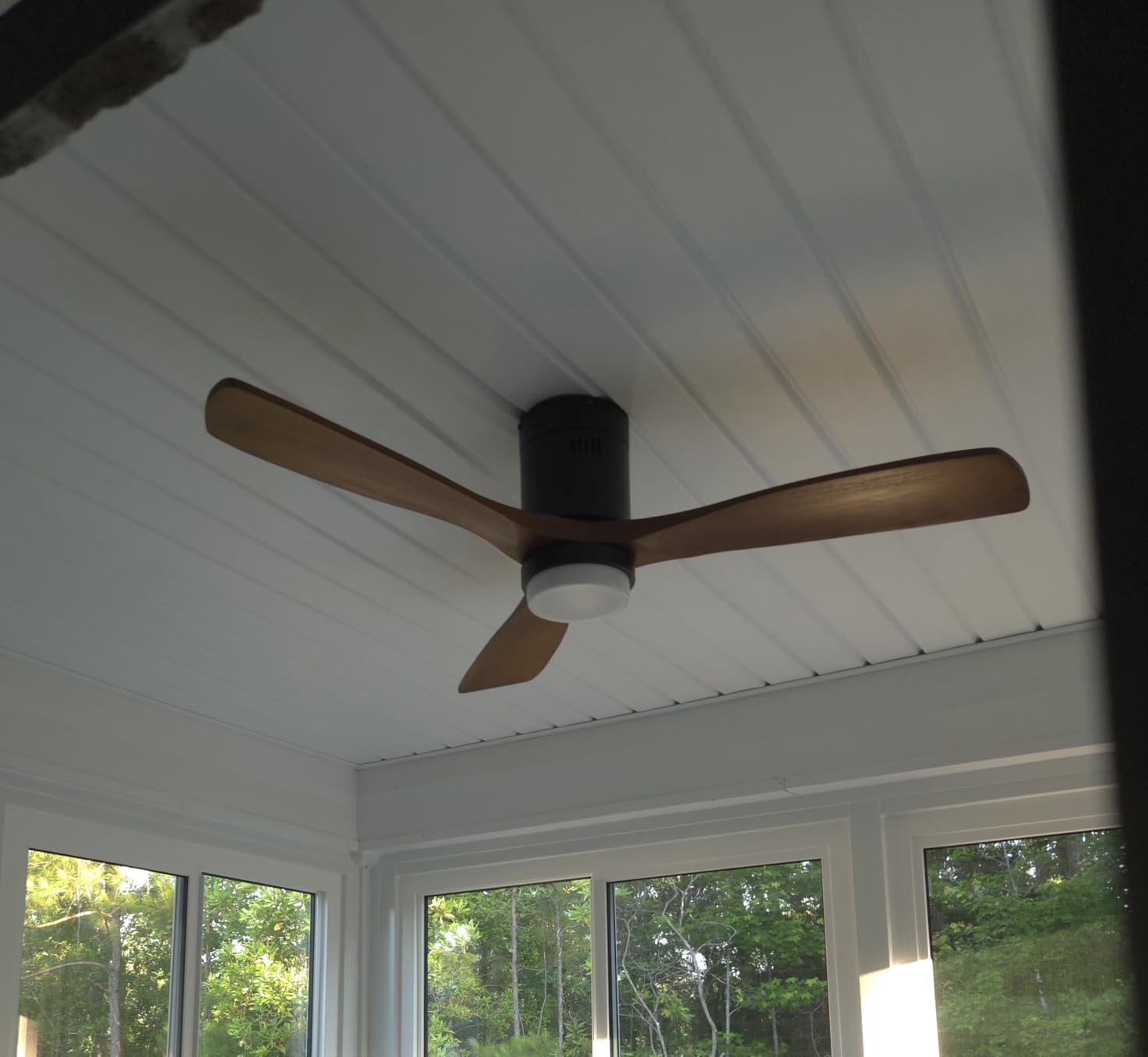
- Flush mount with solid wood blades
- 6 speeds with app and voice control

DREO 52 Inch 12-Speed Smart…
- 22dB brushless DC motor
- 5673 CFM
- 12 speeds and 3 wind modes
- Stepless 2700K-6500K dimming

TALOYA 52 Inch Low Profile…
- Reversible DC motor under 35dB
- Works with Home Assistant and Alexa
- Tuya app with 2.4GHz only
- Slim all-white flush profile
All 10 Smart Ceiling Fans Compared Side by Side in October
This table is the fastest way to narrow the field. Match the blade span to your room, then check the noise figure and the ecosystem against the voice assistant you already use.
| Product | Specs | Action |
|---|---|---|
| Sofucor 52 Inch Smart Ceiling Fan, Flush Mount |
|
Check Latest Price |
| DREO 52 Inch Smart Ceiling Fan, 12 Speeds |
|
Check Latest Price |
| TALOYA 52 Inch Low Profile Smart Ceiling Fan |
|
Check Latest Price |
 DREO 42 Inch Smart Bedroom Ceiling Fan DREO 42 Inch Smart Bedroom Ceiling Fan |
|
Check Latest Price |
 FancyMay 20 Inch Low Profile Smart Ceiling Fan FancyMay 20 Inch Low Profile Smart Ceiling Fan |
|
Check Latest Price |
 Lumary Smart WiFi Ceiling Fan with Lights Lumary Smart WiFi Ceiling Fan with Lights |
|
Check Latest Price |
 BAYSQUIRREL Alexa WiFi Low Profile Ceiling Fan BAYSQUIRREL Alexa WiFi Low Profile Ceiling Fan |
|
Check Latest Price |
 Govee 52 Inch RGBIC Smart Ceiling Fan Govee 52 Inch RGBIC Smart Ceiling Fan |
|
Check Latest Price |
 DIAMONDFORGE 20 Inch Smart Ceiling Fan with RGB DIAMONDFORGE 20 Inch Smart Ceiling Fan with RGB |
|
Check Latest Price |
 DREO 44 Inch RGBIC Flush Mount Smart Ceiling Fan DREO 44 Inch RGBIC Flush Mount Smart Ceiling Fan |
|
Check Latest Price |
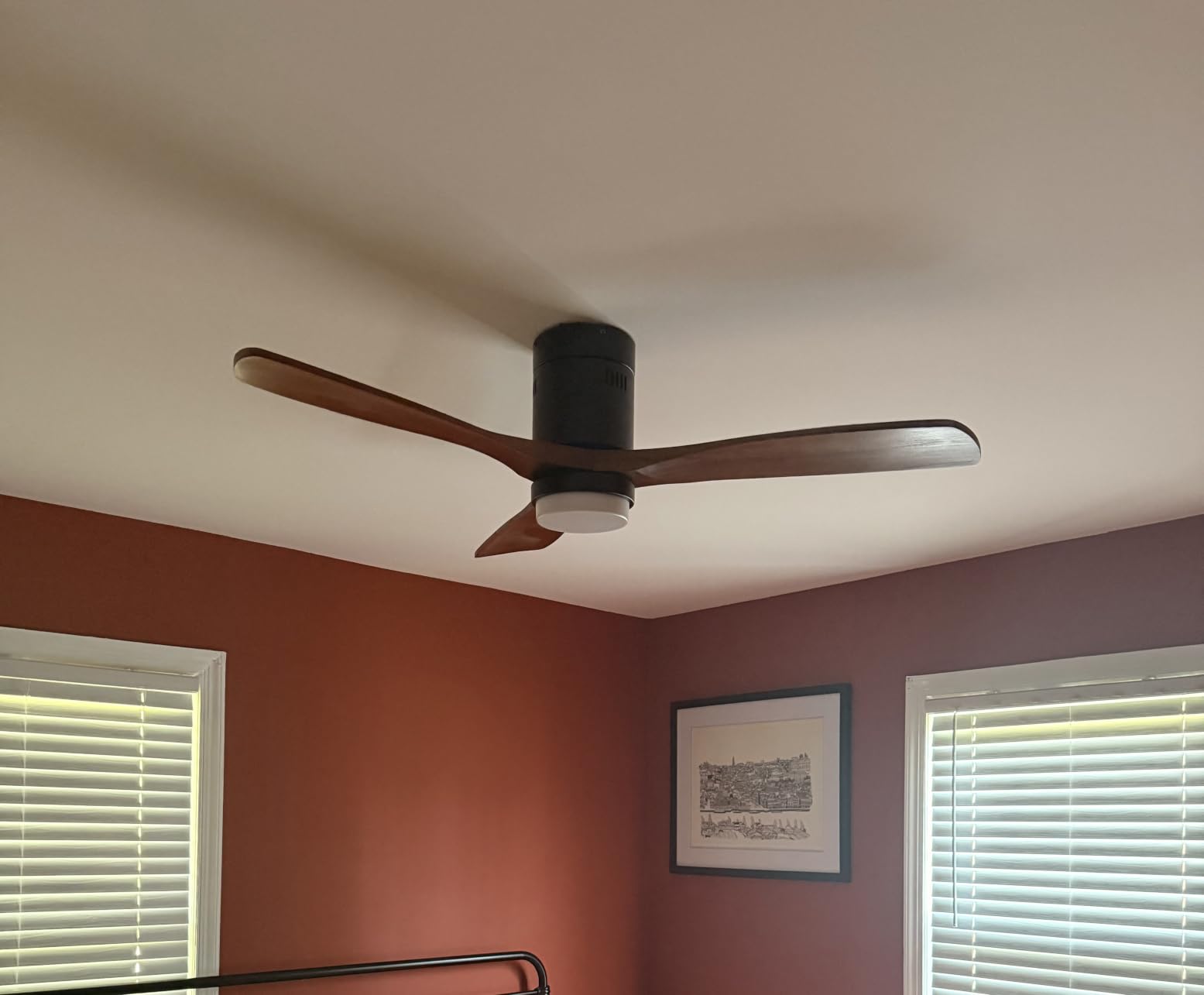
1. Sofucor 52 Inch Smart Ceiling Fan with Light, Low Profile Flush Mount
Sofucor 52 Inch Smart Ceiling Fans with Lights, Low Profile Flush Mount
30dB brushless DC motor
5500 CFM
52 inch flush mount
Solid wood blades
Pros
- Quiet brushless DC motor with no vibration on higher settings
- Solid wood blades in a flush-mount body
- Three light colours with brightness memory
- 1/4/8-hour timer plus 1 to 540 minute app timer
- Straightforward installation
Cons
- Lowest speed is not very low
- No separate off for the fan without cutting the light
- Remote feels inexpensive
The Sofucor 52 inch is our pick for most bedrooms, and the reason is simple: it does the two things a bedroom fan cannot compromise on. It pairs the lowest published noise figure in this group that still moves serious air, and it puts that performance in a flush-mount body that suits an 8-foot ceiling without a downrod.
The motor is a brushless DC unit rated at 30 dB, driving 5500 CFM across 6 speeds on 3 solid wood blades. That is a large airflow figure for a bedroom fan, which matters if you are relying on it to let the air conditioning run less. Reviewers consistently report no audible vibration even on the upper settings, which is where cheaper DC motors tend to develop a buzz.
Control runs three ways: a physical remote, the app, and voice. It works with Google Assistant, and the app adds a 1 to 540 minute timer on top of the 1/4/8-hour sleep timers on the remote. The light offers three colour temperatures at 3000K, 4000K and 6000K with brightness memory, so it returns to the level you left rather than snapping to full.
Warranty coverage is worth noting here. The motor carries a lifetime maintenance warranty and the accessories are covered for 2 years, which is stronger than most of the field. The unit is ETL and FCC certified, and it is rated for indoor and covered patio use, so it works in a sunroom bedroom as well.
Two limitations are real. The lowest speed is not a true trickle, so if you want gentle circulation without a noticeable breeze, this is not it. There is also no separate off for the fan alone, so stopping the fan also cuts the light unless you use the app.
Why the Sofucor 52 inch works in most bedrooms
It solves the awkward middle of the size range. A 42-inch fan under-moves air in a room over about 120 square feet, and a 20-inch fan never will. At 52 inches with 5500 CFM, this covers a typical 10×10 to 14×14 bedroom with headroom, and the flush-mount profile means you are not dropping a downrod into a low ceiling.
The wood blades also matter visually. Most low-profile smart fans at this size are moulded plastic with a visible seam. Solid wood reads as furniture rather than electronics, which is often the deciding factor in a bedroom.
Who the Sofucor 52 inch is not for
If you are a very light sleeper who wants the fan on speed 1 all night, look at a model with a genuinely low bottom speed or a dedicated sleep mode. The 5500 CFM here is more air than some people want at midnight.
It is also not the choice for anyone who needs Apple HomeKit. This fan works with Google Assistant and its own app, and reviewers do not report HomeKit support. If Home is your only smart home platform, check the compatibility section further down before you commit.
2. DREO 52 Inch Smart Ceiling Fan with Lights, 12 Speeds, 22dB DC Motor
DREO Smart Ceiling Fan with Lights, 52 Inch, 12 Speeds & 3 Fan Modes, Stepless, Dimmable LED Light, Timer, 22dB Quiet DC Motor, Remote/APP/Alexa Control, Black Ceiling Fans Indoor, 2026 Upgraded
22dB brushless DC motor
5673 CFM
12 speeds and 3 wind modes
24W stepless LED
Pros
- Lowest published noise figure in this group
- Strong airflow for a 52 inch fan
- Stepless 1 to 100 percent dimming with 2700K-6500K
- Works with Alexa and Google Home plus Siri Shortcuts
Cons
- Remote dimming is stepped and lowest step stays bright
- Junction box screws may not be included
- Light cover can resonate at one mid speed
The DREO 52 inch is the quietest fan we found, with a published minimum of 22 dB, and it pairs that with the highest airflow figure here at 5673 CFM. That combination is unusual: most quiet fans sacrifice air movement, and most powerful fans are not quiet. For a bedroom where you want the fan running all night on a low setting, that is exactly what you want.
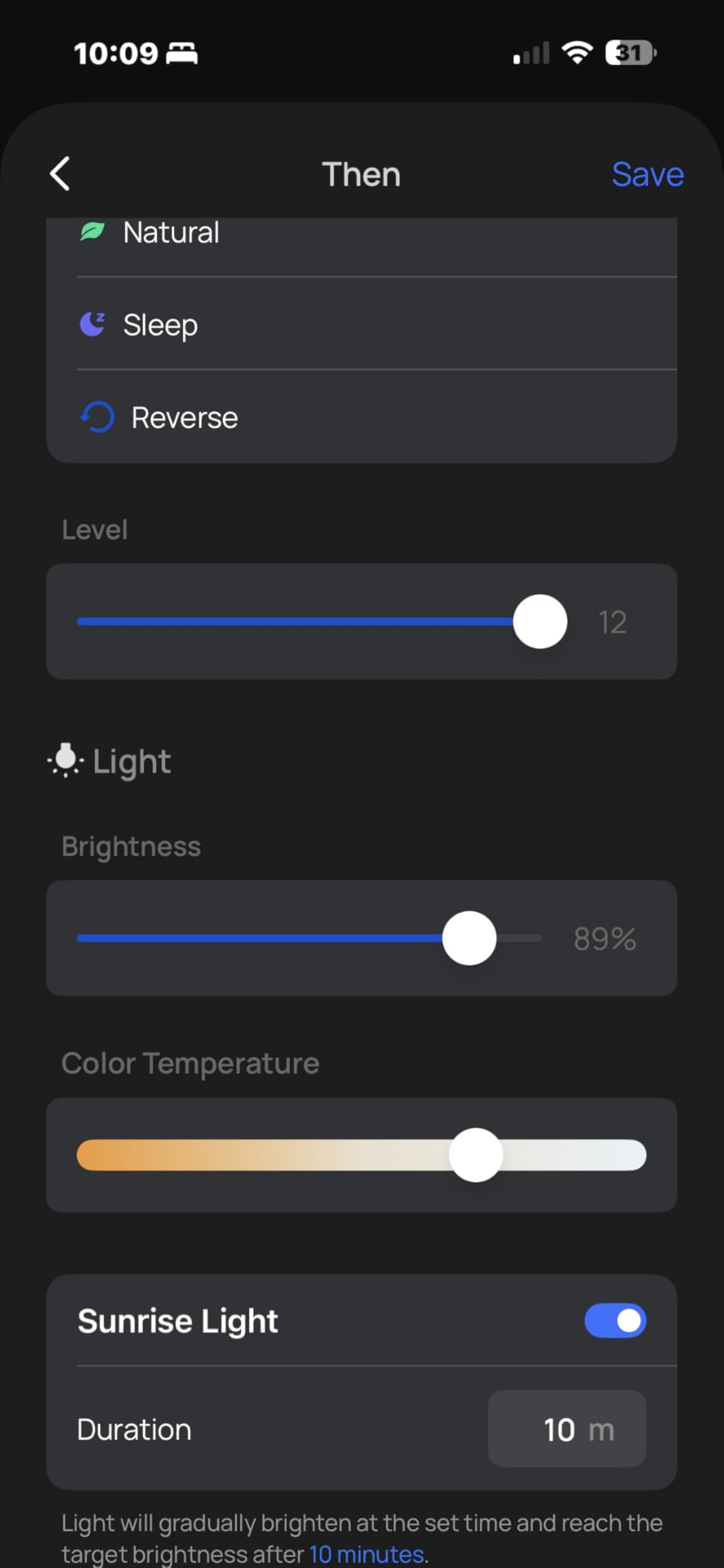
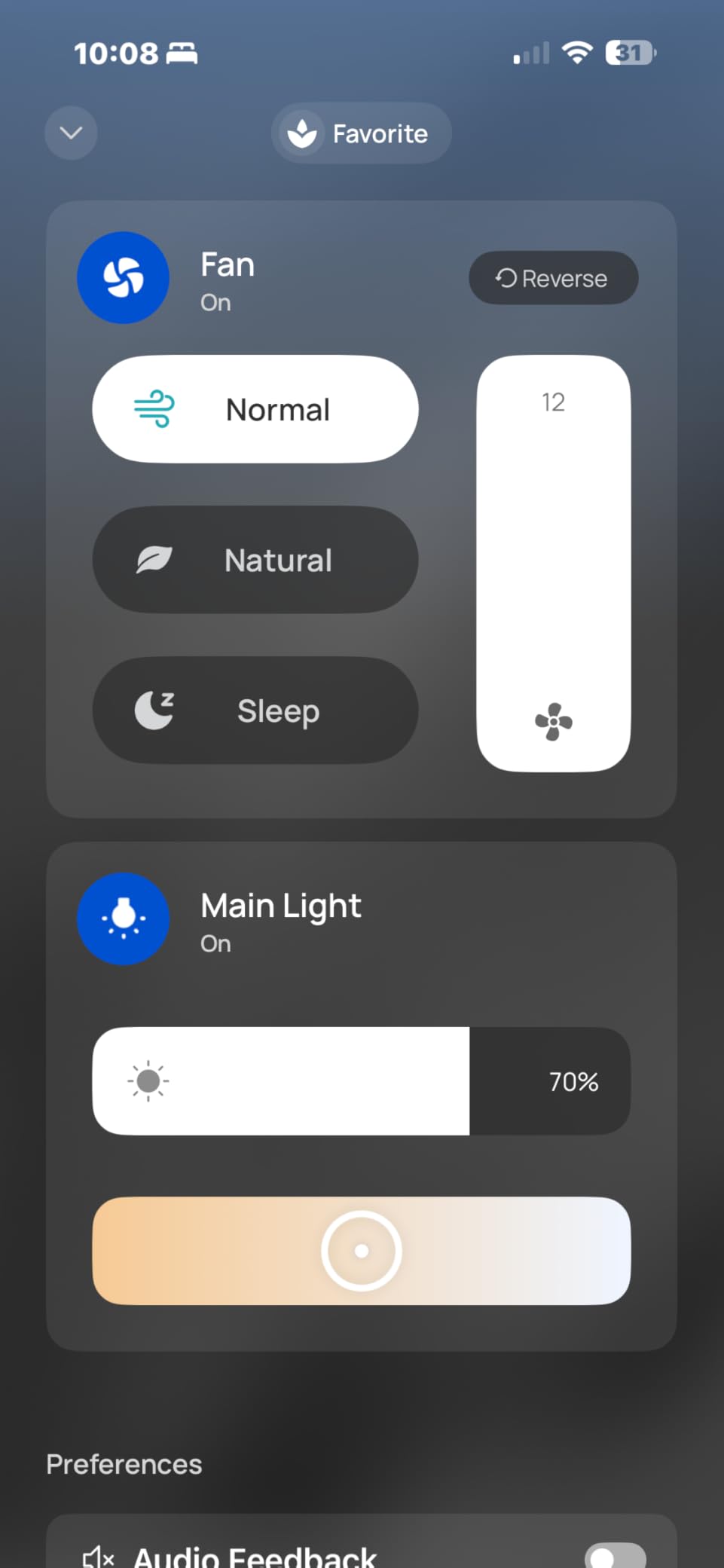
Speed control is the standout feature. There are 12 levels in the app, and three wind modes: Natural, Normal and Sleep. Sleep mode is the one to look at if noise is your priority, because it ramps the speed rather than dropping straight to a fixed low. Reviewers report essentially no sound above the airflow, which is how a fan should sound in a quiet room.
The light is a 24W integrated LED with stepless brightness from 1 to 100 percent and colour temperature from 2700K to 6500K through the app. The warm end at 2700K is the right setting for a bedroom, and stepless dimming means you can take it down to a level that reads as nightlight rather than as a lamp you switched off reluctantly.
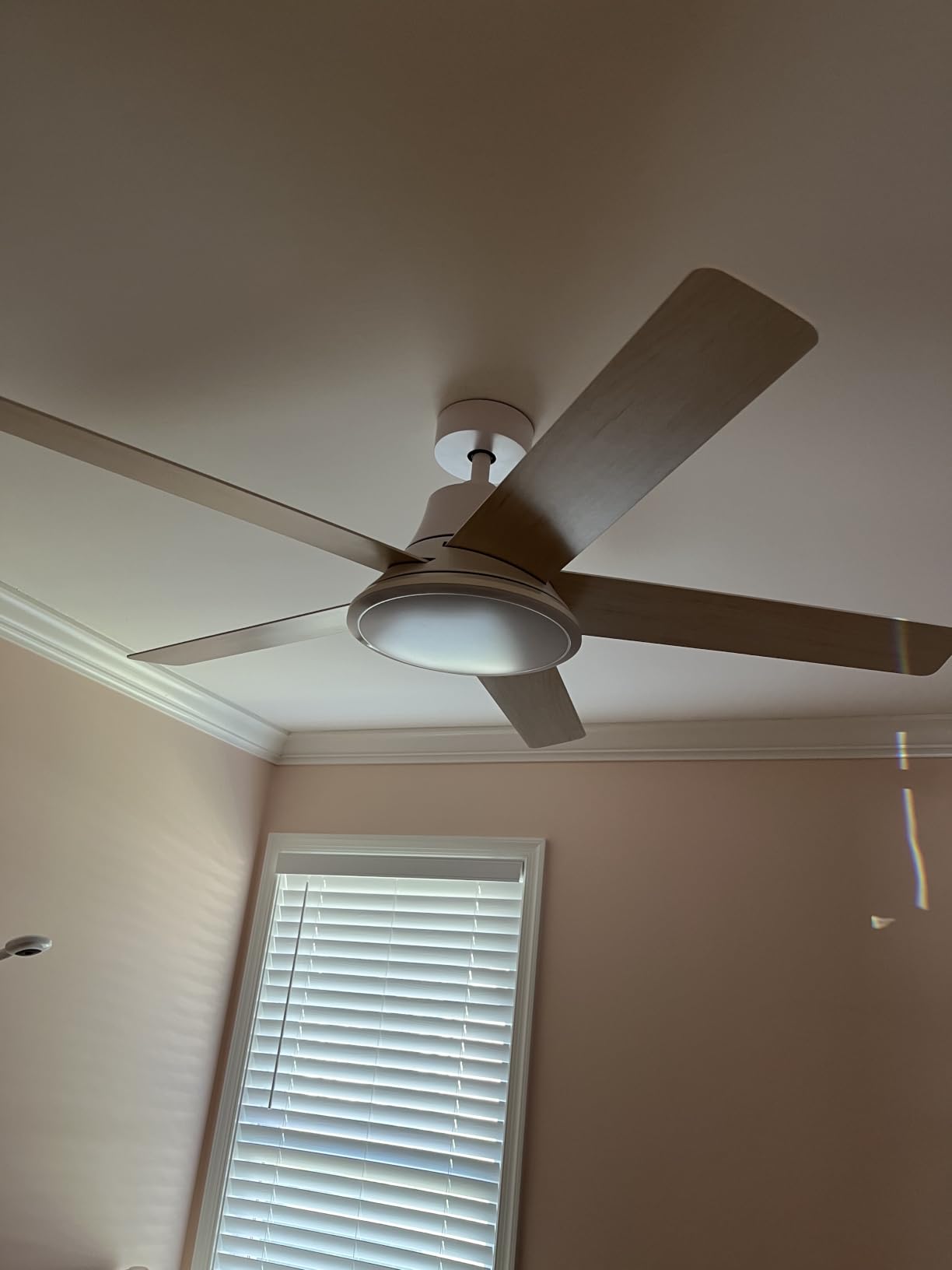
It installs as a ceiling mount with 4-inch and 6-inch downrods included, so it adapts to an 8-foot or 9-foot ceiling without a separate purchase. Control runs through the DREO app, Alexa, Google Home and Siri Shortcuts, and the app supports preset scenes and routines. It is DOE, ETL and FCC certified, with a 12-month limited warranty.
The honest weakness is the remote. Dimming and brightness on the remote are stepped rather than continuous, and reviewers note the lowest step is still fairly bright. If you plan to control the light from bed, do it in the app, not the handset. Junction box screws are also not included, so you may need the screws from your existing fan.
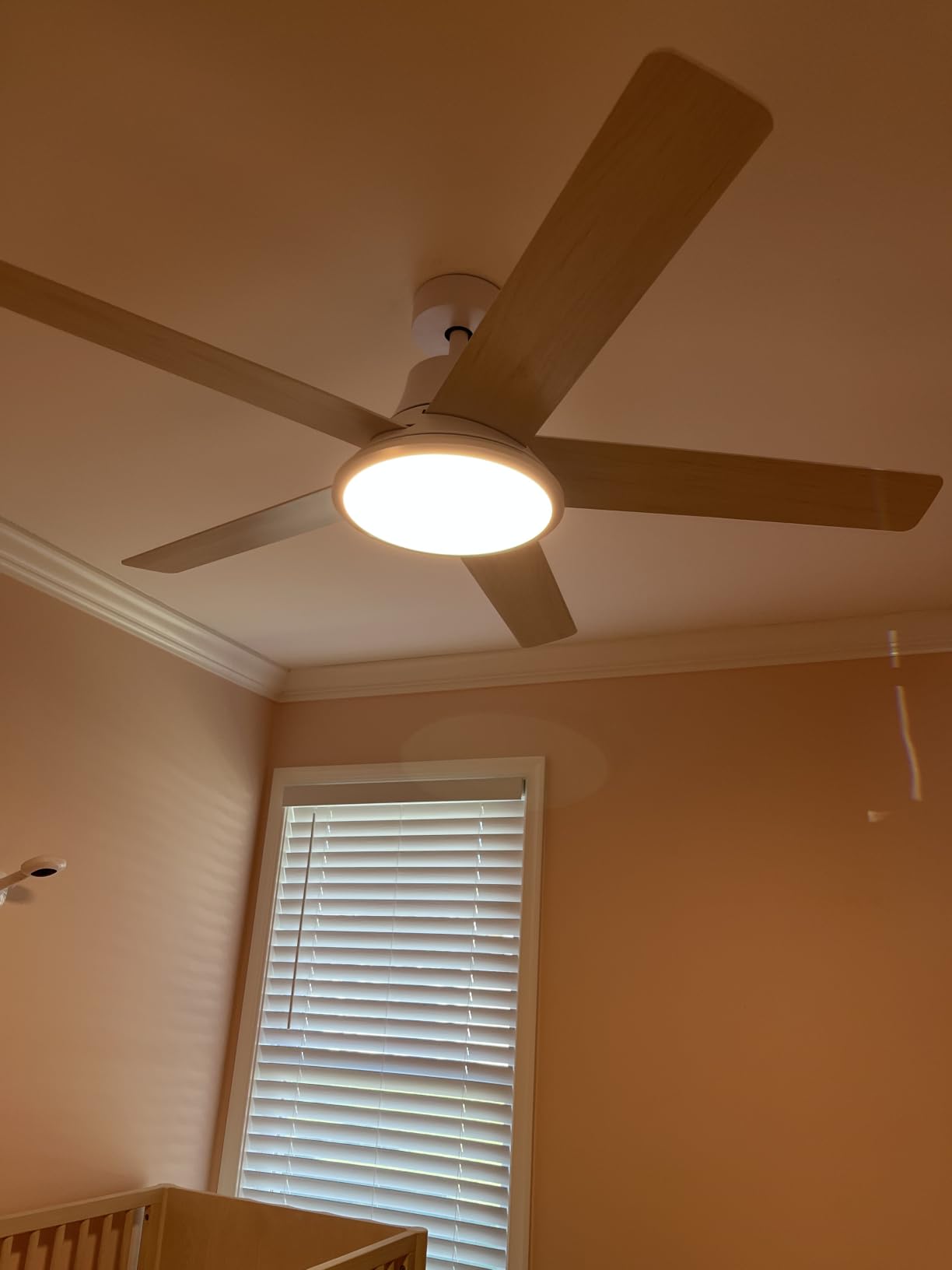
Why the 22dB figure changes the decision in a bedroom
Decibels and bedrooms are a poor match unless you know which speed the number came from. Manufacturers quote the minimum, and a minimum at speed 1 tells you very little about speed 4. What matters is that a low minimum means you have usable low speeds, and this fan has twelve of them, with a sleep mode that steps through them gradually.
At 15.2 pounds this is also a solidly weighted fan, which helps against wobble. Wobble is a repeated complaint in homeowner forums about smart fans, and it usually traces back to a light motor assembly or an uneven bracket rather than blade weight.
Who the DREO 52 inch is not for
If your ceiling is at or below 8 feet, the included downrods will not work well and you would be looking at a flush model instead. This is a downrod fan, not a low-profile one.
It is also not the right pick if you need Apple HomeKit. Siri Shortcuts work without a HomeKit integration, which is a different thing, and reviewers do not report native HomeKit support. It also draws 54 watts, so it is not the most efficient model here despite the DC motor.
3. TALOYA 52 Inch Low Profile Smart Ceiling Fan with Light and Remote
TALOYA 52 inch Smart Ceiling Fan,Low Profile Ceiling Fan with Light and Remote/App Control,Flush Mount, Quiet Reversible Motor for Living Room Bedroom Patio White
Reversible DC motor under 35dB
52 inch flush mount
Tuya and 2.4GHz only
Home Assistant support
Pros
- Reversible DC motor under 35dB
- Works with Home Assistant and Alexa
- Local control possible through LocalTuya
- Built-in button to silence the control beep
Cons
- 2.4GHz WiFi only
- Remote pairs to a single fan
- Small integrated light some buyers find bright
The TALOYA 52 inch is the pick if you are not tied to one brand’s cloud. It is one of the few fans in this roundup that reviewers confirm works with Home Assistant, and because it runs on the Tuya platform you can often get local control without depending on a server that may disappear in a few years. For anyone running Home Assistant or SmartThings as the hub, that is a meaningful difference.
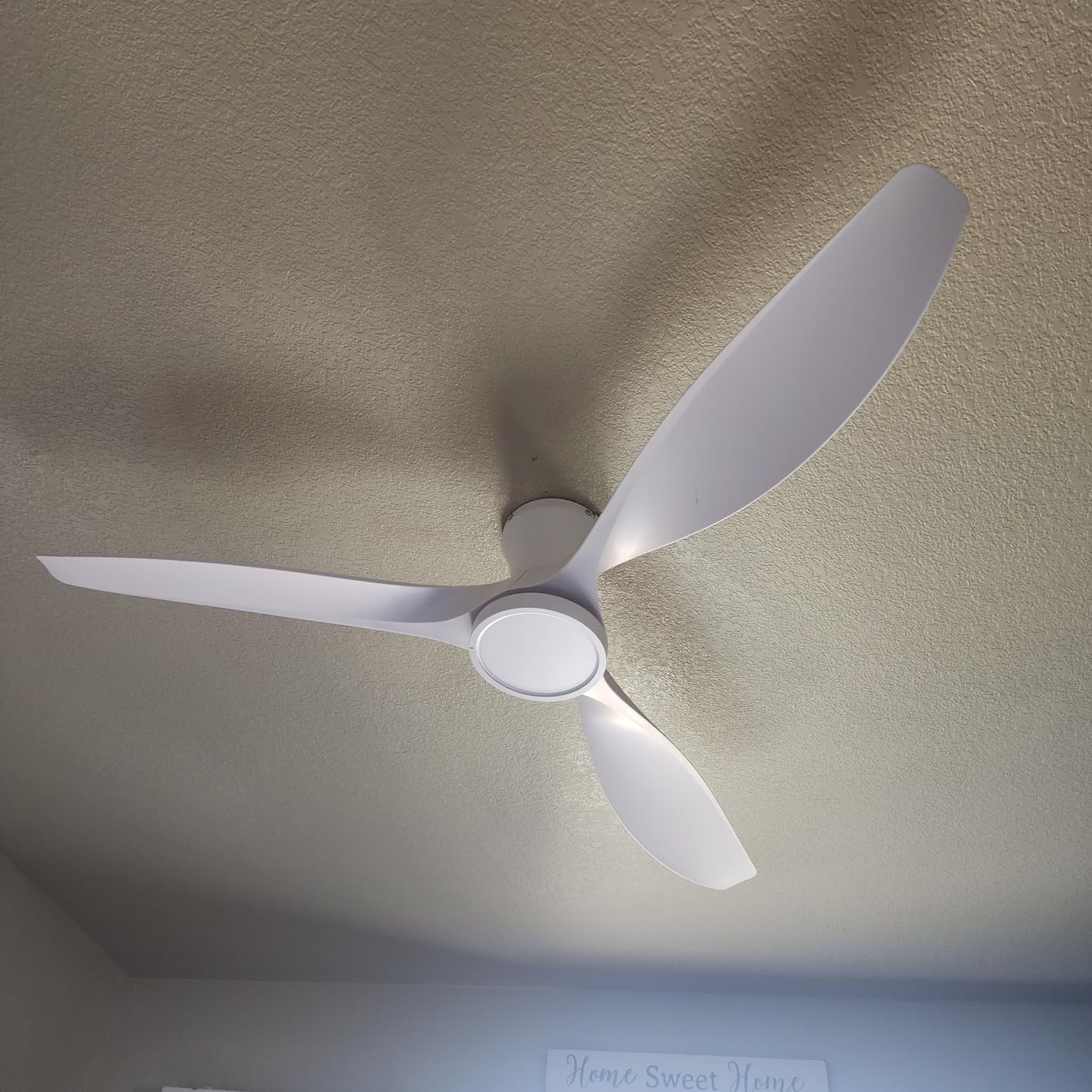
Physically it is a slim white flush-mount with a reversible DC motor rated under 35 dB across 6 speeds, with forward and reverse for summer downdraft and winter updraft. Reviewers like the combination of a quiet motor that still produces a strong breeze on high, with no wobble and no ticking. The ABS blades are thick and corrosion resistant, which suits a humid room or a covered patio.
One detail is genuinely thoughtful for bedrooms: a built-in button that silences the control beep. Most fans announce every remote press with a chirp, and that chirp is exactly what wakes a partner at 1am.
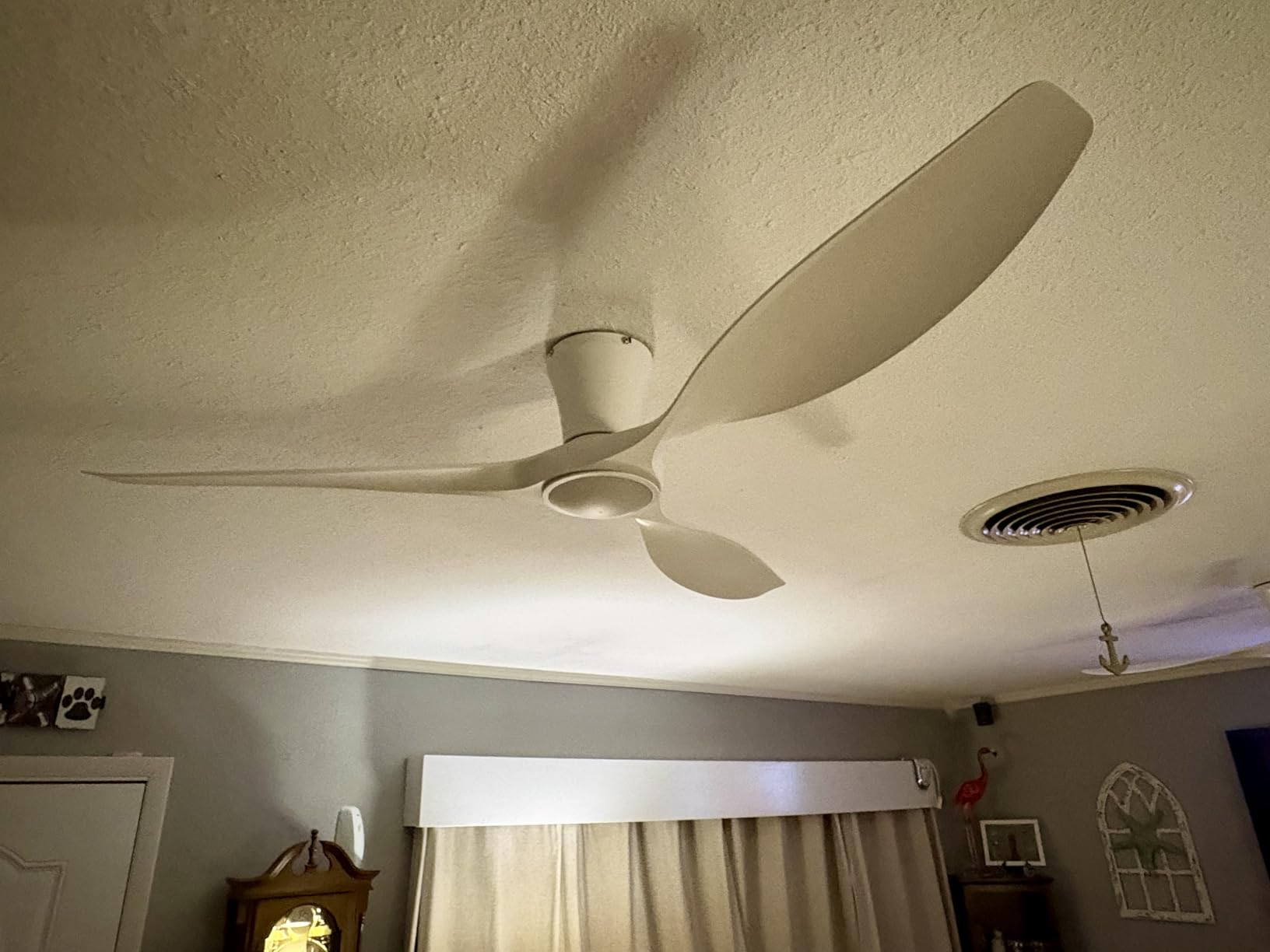
The app supports three colour temperatures at 3000K, 4000K and 5000K with adjustable brightness, and the light kit and remote are both in the box. The remote takes two AAA batteries, which are not included. Instructions ship as a detailed paper guide with a video.
The constraint to know before you buy is network-related. This fan is 2.4GHz WiFi only. If your home network is 5GHz, or a single band, you will need to split your network or add a 2.4GHz access point. That is the single most common setup failure in this category and it is not a fault of the fan.
Why the Tuya platform matters more than usual now
Every budget smart fan in this category has a cloud dependency, and cloud services for small brands are the least durable part of the whole product. The TALOYA runs on Tuya, which is a large shared platform rather than a single small company, and that improves both the odds of long-term app support and the chance of local control.
Assembly quality accounts for most of the critical reviews here. Some owners need shimming at the mounting bracket to stop wobble, and the canopy-to-bracket screws can be a tight fit. If you are comfortable with basic tools and a step ladder, that is a fifteen minute job. If you are not, budget for an electrician.
Who the TALOYA 52 inch is not for
It is not for a 5GHz-only or dual-band-disabled network, and it is not the freshest-looking option if you want the fan to disappear into a modern bedroom. The all-white plastic body is clean and neutral, but it is plainly plastic rather than metal or wood.
It is also not ideal if you want one remote to control several fans. One remote pairs to one fan, so a two-fan bedroom means two remotes unless you control everything from the app.
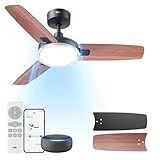
4. DREO 42 Inch Smart Bedroom Ceiling Fan with Lights and Remote
DREO Bedroom Ceiling Fans with Lights and Remote, Smart Ceiling Fan 42 Inch
42 inch span
Under 31dB DC motor
2400lm stepless light
6-inch downrod included
Pros
- 42 inch span suits small bedrooms without dominating the room
- Under 31dB from a DC motor
- 2400lm light with 5 to 100 percent stepless dimming
- Sunrise and sunset scenes in the app
- Light at 8.6 pounds
Cons
- 3400 CFM is modest for rooms over 120 square feet
- Smaller span means circulation rather than strong cooling
The DREO 42 inch is the correct answer for a small bedroom where a 52-inch fan would feel like furniture blocking the room. A 10×10 or 12×12 bedroom typically sits between 100 and 144 square feet, and this is the size that matches it without overhanging the bed or the dresser.
The motor is a DC unit running under 31 dB across 6 speeds on the remote, with 12 speeds and Normal, Auto and Sleep modes in the app. That means a genuine sleep mode on a small fan, which is rare. Reviewers rate it highly for bedroom use specifically, citing quiet operation and dependable app and voice control.
The light is where this fan is quietly over-specified for the job. A 2400-lumen output with stepless brightness from 5 to 100 percent and colour temperature from 2700K to 6500K, plus scheduled sunrise and sunset scenes, is more control than most bedroom lights have. Setting the sunrise scene to warm output as your alarm is a better morning routine than an app chime.
The styling is more decorative than most in this roundup. It has two-colour reversible blades, one side black and one side wood grain, so you can flip them for the season, and a crystal light cover that catches the low output nicely at night. The whole thing weighs 8.6 pounds, which is genuinely light and helpful on a single-person install.
Airflow is the trade-off. The rating is 3400 CFM with an average of 2247, which is real air movement but noticeably less than the 52-inch models. In a room over about 120 square feet you will feel it more as circulation than as cooling, and most buyers use it alongside an air conditioner rather than instead of one.
Why 42 inches is the size most bedrooms actually need
Sizing rules of thumb exist for a reason. A fan that is too small has to spin faster to move the same air, which is louder. A fan that is too large creates a wake the room does not absorb, which is why an oversized fan in a small bedroom sounds like a storm even at low speed. The 42-inch span is the middle of the range most bedrooms fall into.
It also ships with a 6-inch downrod and a full install kit including ceiling bracket, remote receiver, canopy, yoke cover, blades and the light cover. That completeness matters because the missing-screw complaints that show up on cheaper models do not appear here, and the unit carries ETL certification.
Who the DREO 42 inch is not for
It is not for a large primary bedroom. Push past about 175 square feet and the airflow rating becomes the limiting factor, not the noise level. In that case, step up to a 52-inch model.
It is also not the right pick if you have no downrod clearance. A 6-inch downrod sets a floor on ceiling height, and the 13.2-inch listed height includes the light kit. If your ceiling is under about 8 feet, use a flush-mount instead.
5. FancyMay 20 Inch Low Profile Smart Ceiling Fan with Light
FancyMay Smart Ceiling Fans with Light and Remote,20″ Low Profile Ceiling Fan with 6-Speed & Dimmable LED, Alexa/APP Home Voice Control, App, Reversible Airflow, App Timer, for Bedroom(White)
20 inch profile at 5.1 inches
7 enclosed blades
4800-lumen LED
Alexa and app control
Pros
- Extremely compact 20 inch body
- 7 fully enclosed blades safe for kids rooms
- 4800-lumen high-CRI LED with 10 to 100 percent dimming
- Scheduling down to the second in the app
- Only 4.8 pounds
Cons
- 20 inch span limits airflow volume
- 2.4GHz WiFi only for app and voice
- A small share of one-star reviews about setup
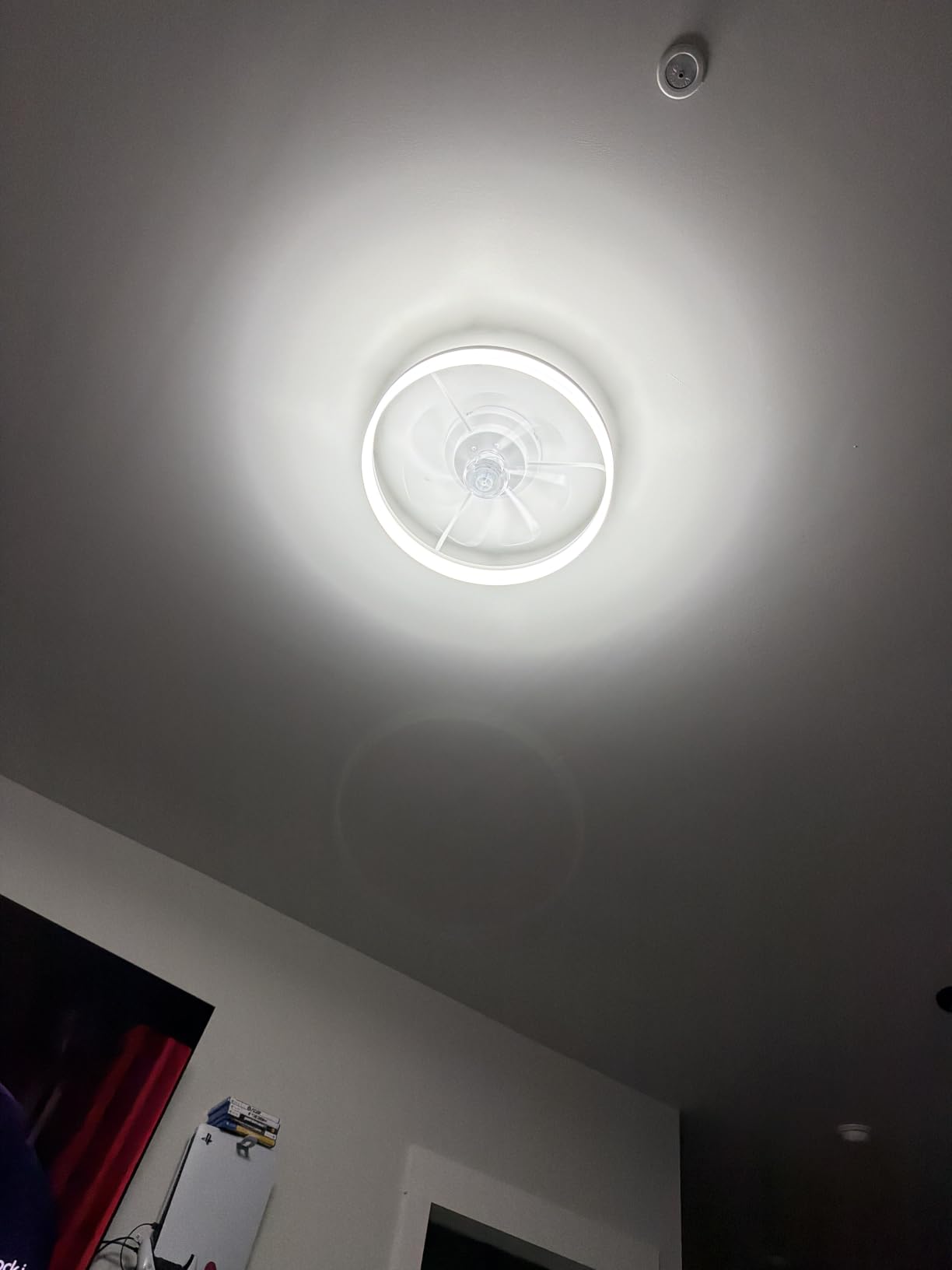
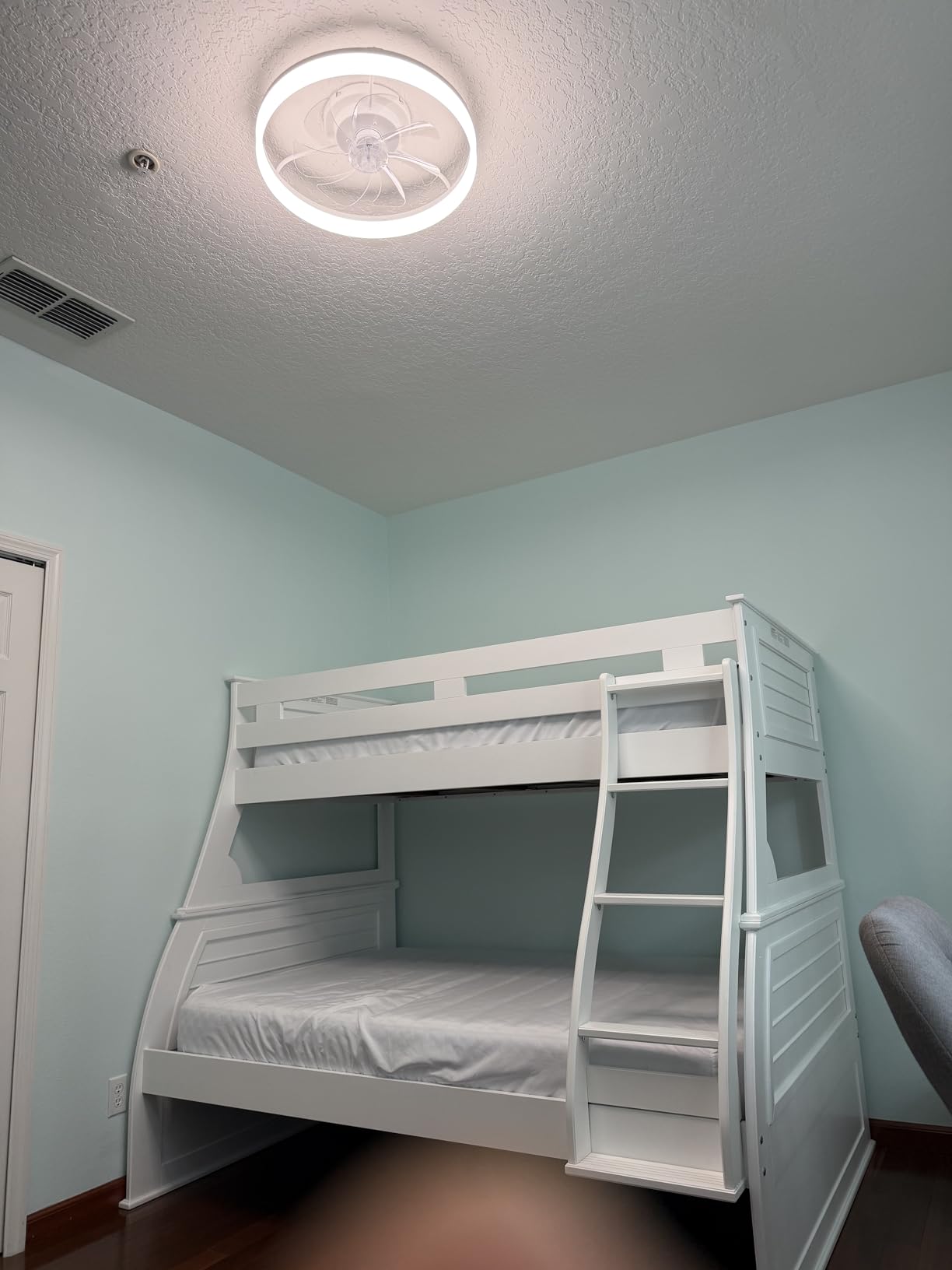
The FancyMay 20 inch is built for the room most ceiling fans should never have entered: a nursery or a small kid’s room. At 5.1 inches tall with fully enclosed blades, there is nothing to reach for and nothing to catch on a blanket. The profile means it clears a low ceiling where a downrod model simply cannot go.
The light is unusually strong for the size. A 4800-lumen high-CRI LED with brightness from 10 to 100 percent and three colour temperatures means it can double as the main light in a room where a ceiling fixture is impractical. Reviewers value that brightness along with the range of control methods, which include app, remote, touchpad on the housing, and Alexa voice.
The app scheduling is the sleeper feature. Beyond the 1-hour and 4-hour timers on the remote, you can set custom timings in the app down to the second, with a memory function that restores brightness and colour temperature. That is the level of control you need for a room where the light should dim itself as the night goes on.
It runs 6 speeds with reversible airflow for winter circulation, comes with a remote and hardware accessories, and carries a 2-year manufacturer warranty. The whole unit is 4.8 pounds, so a single person can handle it.
Be realistic about the airflow. A 20-inch span simply cannot move bedroom-scale air, and reviewers treat this as an accepted trade-off for the footprint rather than a defect. It circulates. It does not cool a room on its own, and it is not going to replace an air conditioner in summer.
Why enclosed blades change the safety conversation
The reason 20-inch models like this exist at all is blade clearance. A standard ceiling fan has 52 inches of spinning edge roughly 8 feet above the floor, which is fine in an adult bedroom and not fine in a room where someone is lying on a floor. Enclosed blades remove the exposed edge entirely.
The trade is aerodynamic. Enclosing blades costs efficiency, which is why a 20-inch fan does not match the CFM of a 42-inch one despite the enclosed design looking more substantial. In a small room the difference rarely registers.
Who the FancyMay 20 inch is not for
It is not for anyone who wants fan noise low and air movement high. It is also not for a 5GHz-only network, since app and voice control require a 2.4GHz connection, and a small share of reviews are one-star with setup and durability complaints, so allow for the possibility of a support call.
It is not the right pick if your ceiling is tall. At 5.1 inches this is built for low ceilings, and in a room with 10-foot ceilings you would be leaving a lot of unused vertical space.
6. Lumary Smart WiFi Ceiling Fan with Lights, Low Profile Flush Mount
Lumary Smart WiFi Ceiling Fans with Lights, Low Profile Flush Mount White
RGBAI colour plus CCT white light
Up to 4500 lumens
38dB brushless DC
Six speeds and pre-assembled
Pros
- Metal body rather than plastic
- RGBAI colour lighting plus a bright CCT white lamp
- Pre-assembled for a 4-step install
- Some owners finish in about 15 minutes
Cons
- Alexa speed and RGB control reported unreliable
- Some voice scenes need a paid subscription
- Very small printed manual
- Mounting bracket can let the unit slide
The Lumary is the pick if the light matters more than the fan. It is the only model here with RGBAI colour capability, which means a full 16 million colours on an ambient ring, plus a separate CCT white lamp up to 4500 lumens with brightness from 0 to 100 percent and colour temperature from 2700K to 6500K. The two layers are independently controlled, so you can run a warm white reading light with a soft colour wash behind it.
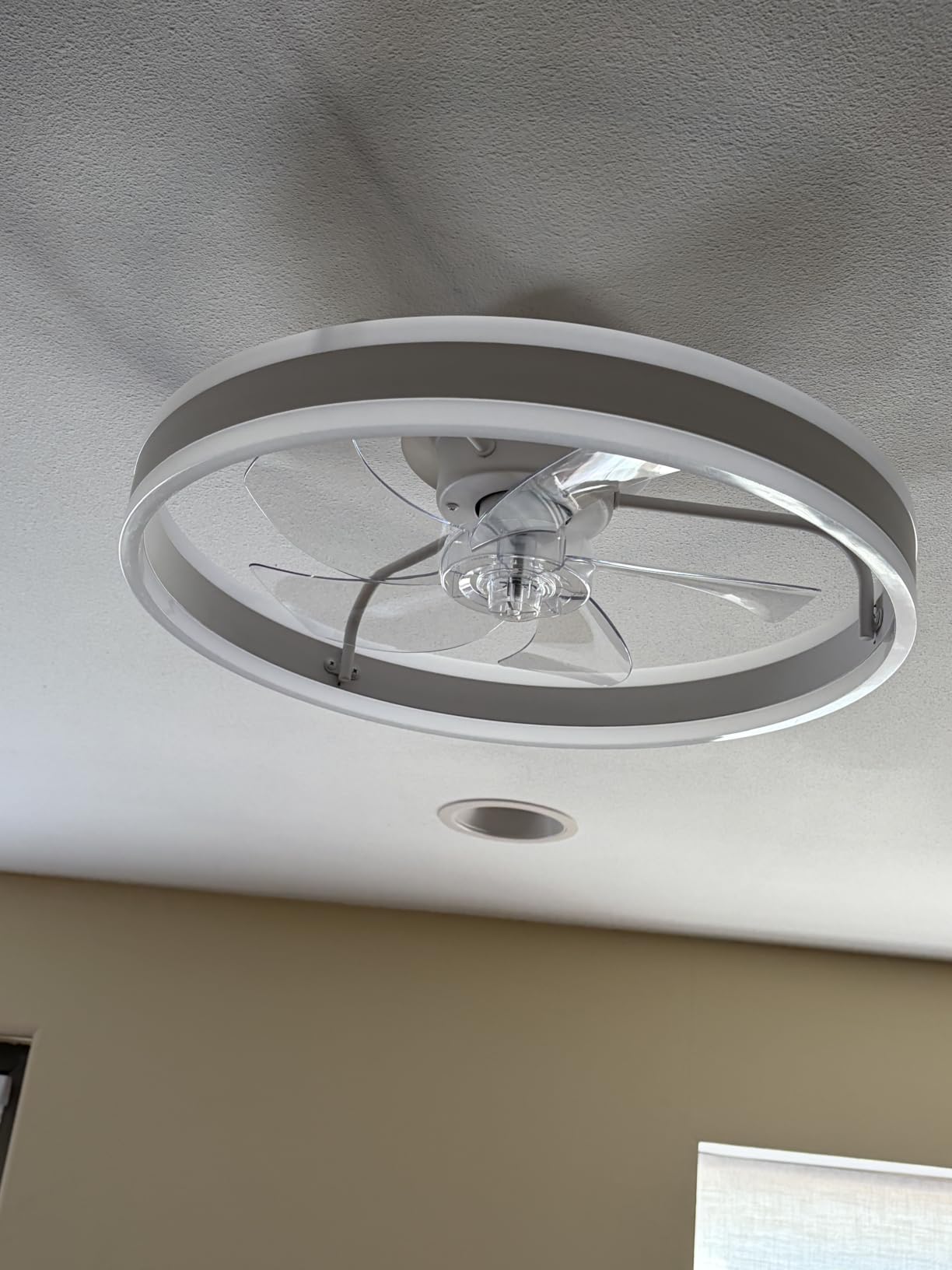
As hardware it is well made. The body is metal rather than plastic, it weighs 5.9 pounds, and it arrives largely pre-assembled. Reviewers report finishing installation in around 15 minutes, and the motor is a brushless DC unit running at up to 1000 RPM across 6 speeds at 38 dB, which is quiet on low and medium settings.
It includes flush mount or the supplied downrods, and ships with a Bluetooth remote alongside the app. Alexa and Google Home voice control runs through the Lumary app on a 2.4GHz-only network. An adaptive memory function restores your last speed, colour and brightness after a power cut, which is convenient in a bedroom where the switch gets flipped.
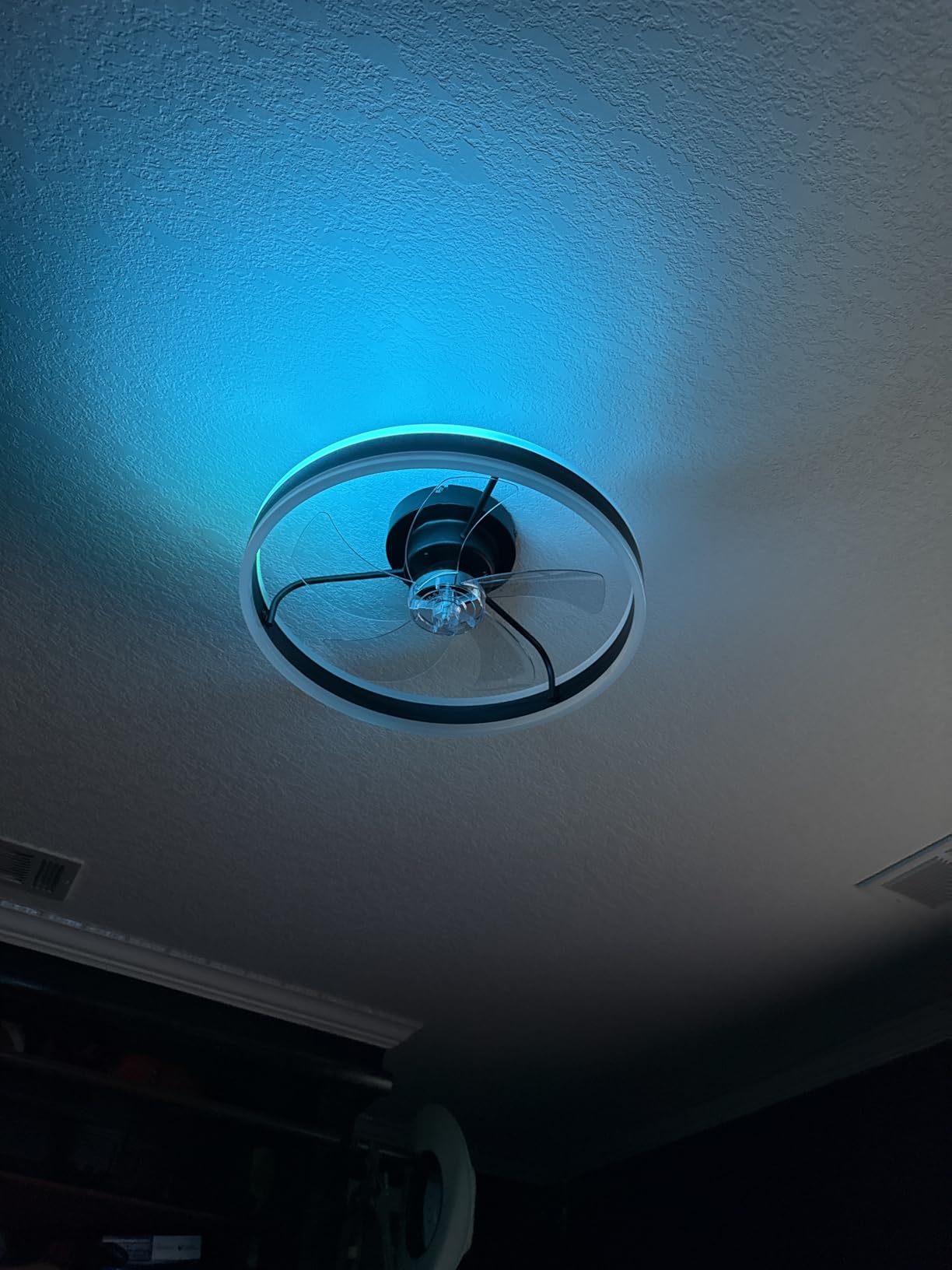
The problem is the smart layer, and it is worth being blunt. Multiple reviews report that app and remote control work reliably while Alexa commands for fan speed and RGB scenes fail or return errors. Some voice-activated scenes are also gated behind a paid subscription, which is the pattern most likely to make you resent a bedroom fixture.
Two smaller issues. The instructions are printed on a tiny card roughly 2 by 4 inches, which makes pairing genuinely confusing. And the L-bracket mounting design is reported to let the unit slide off in some installs, so the bracket screws need to be properly torqued.
Who should buy the Lumary and who should skip it
Buy it if you are a lighting person who wants colour effects in a bedroom, a media room or a gaming space, and you are content to drive the fan from the remote or app. The hardware quality and the pre-assembled install make it pleasant to own, and the light output is among the strongest here.
Skip it if your entire reason for buying a smart fan is voice control. That is the one function reviewers report as unreliable, and it is the function a smart fan is supposed to add. The 38 dB figure is also the second highest among the quieter models here, so it is not a top choice for a very light sleeper.
What to check before installing
This fan is not compatible with a standard wall dimmer switch, which trips up people who assume every LED is dimmer-compatible. The dimming is done in the app. The remote also takes AAA batteries, which are not included, and the network must be 2.4GHz.
Also note the listed dimensions in some listings do not match the physical product, so measure the ceiling housing area rather than trusting the spec sheet before you order a replacement bracket.
7. BAYSQUIRREL Alexa WiFi Low Profile Ceiling Fan with Bluetooth Speaker
BAYSQUIRREL Alexa WiFi Low Profile Ceiling Fan with Light,Flush Mount Ceiling Fan with Google Assistant/App Control,6 Speed Dimmable LED-RGB Lights,Black
Enclosed bladeless design
6 speeds with RGB LED
Built-in Bluetooth speaker
Alexa and Google Assistant
Pros
- Fully enclosed bladeless design for low ceilings and kids rooms
- Bluetooth speaker pairs separately and sounds better than expected
- Most parts pre-assembled for a 15 minute install
- Bright light with many RGB colors and timer functions
Cons
- Pairing instructions are inaccurate
- The documented app often fails to connect
- Build quality feels cheap
- Listed dimensions are inaccurate
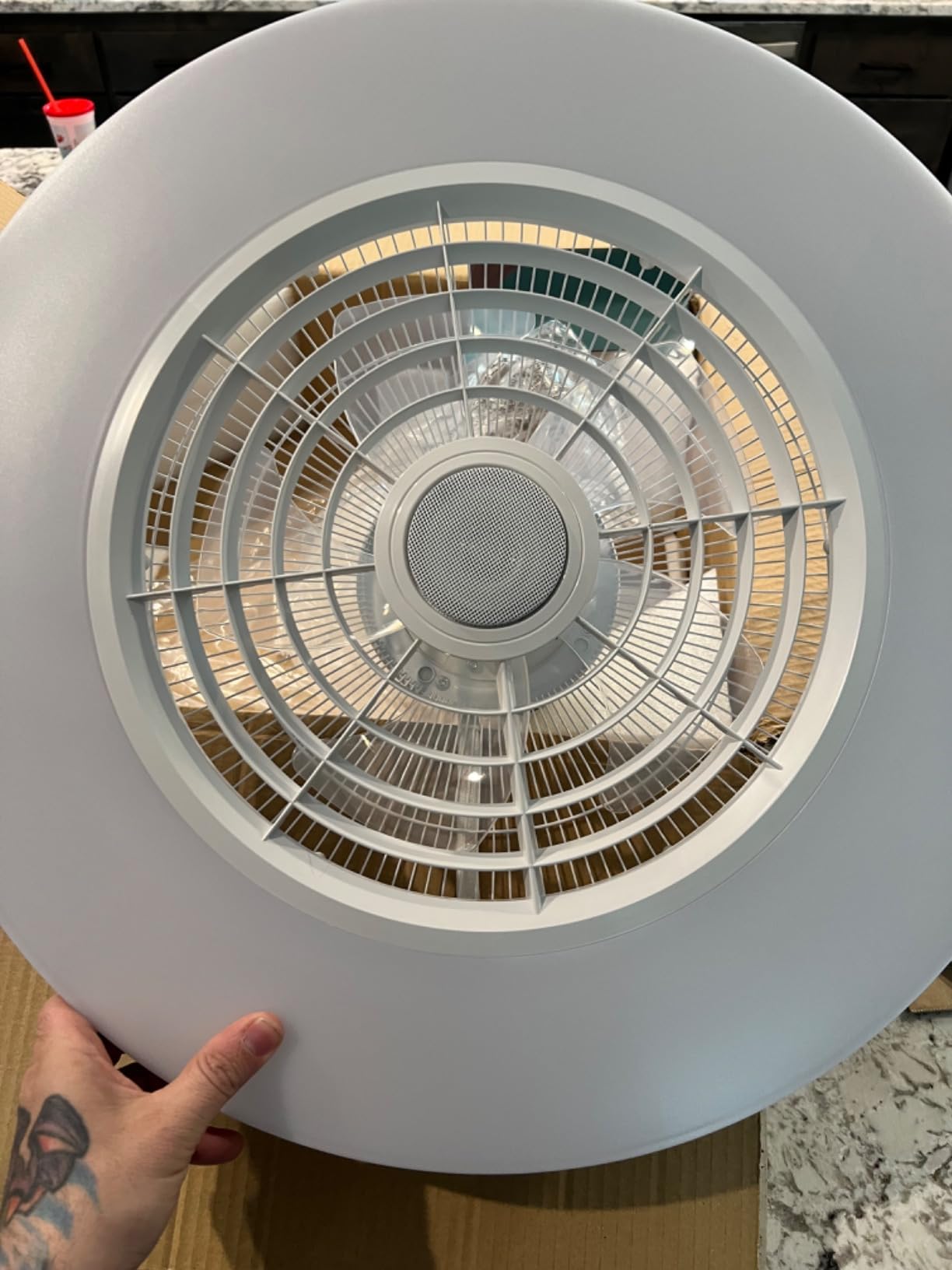
The BAYSQUIRREL is the only fan in this roundup with a speaker in it, and that changes what a bedroom ceiling fan can be. The built-in Bluetooth speaker pairs separately from the Wi-Fi connection, so you can stream music or white noise from a phone without touching the network the fan runs on. Reviewers say it sounds better than its size suggests.
Physically it is a fully enclosed bladeless design, which makes it safe for low ceilings and for rooms where an exposed blade edge is a concern. It offers 6 wind speeds with stepless dimmable LED across three light colours plus full RGB, and the RGB can pulse to the beat of what the speaker is playing. The housing is metal with a GU24 bulb base and it draws 36 watts.
Connectivity is Bluetooth and Wi-Fi, and it works with Alexa, Google Assistant and the Smart Life app. Only wiring and ceiling mounting are required since most parts arrive pre-assembled, and the remote is included with mounting accessories and a manual.
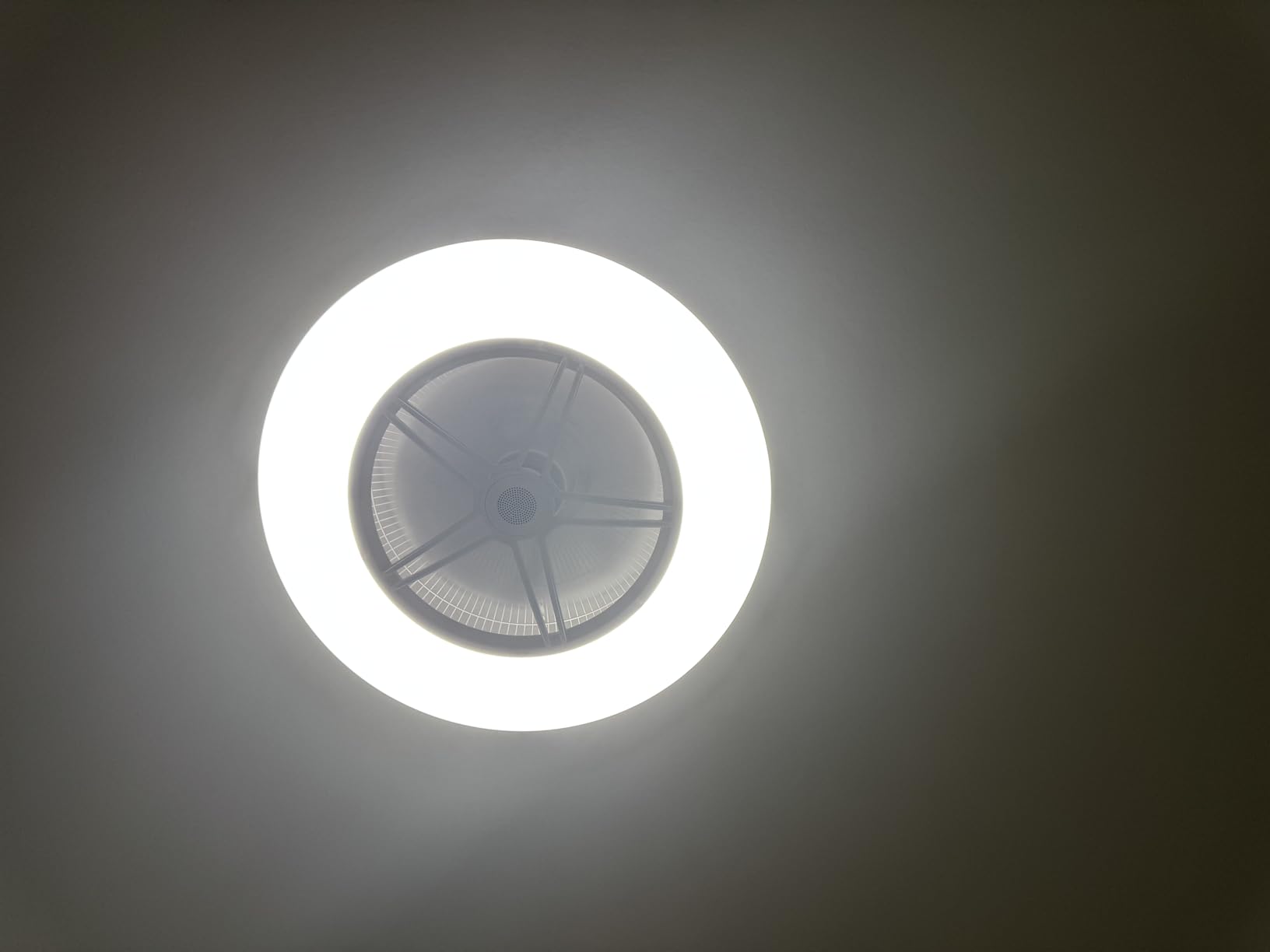
Here is the honest part. The app pairing instructions shipped with this fan are wrong. Power has to be cycled at the circuit breaker, and the Smart Life app has to be used rather than the app named in the listing. Several buyers also report the documented app simply failing to connect, which limits third-party home automation integration to remote-only control.
Build quality is the other soft spot. The housing feels cheap, and the listed dimensions are inaccurate enough that reviewers note the unit is roughly two feet across rather than the larger figure on the listing. Judge it on the physical unit, not the spec.
Why the built-in speaker is a bedroom feature, not a gimmick
A bedroom is the easiest room to fill with sound and the hardest to fill with speakers without adding furniture or wiring. A speaker in the ceiling solves both. It reaches both sides of the bed, it has no visible cable, and because the fan already has a light and a motor hum, white noise from it masks motor noise rather than competing with it.
That last point is the underrated benefit. Reviews of budget smart fans repeatedly mention rhythmic ticking at night on DC motors, and a steady low-frequency audio bed is a practical counter to that complaint.
Who the BAYSQUIRREL is not for
It is not for anyone who needs a dependable app as the primary control path, because the pairing instructions and app connection are the main weakness. If your smart home runs on Home Assistant, SmartThings or Apple HomeKit, plan on the remote doing the work.
It is also not for airflow expectations. It is quiet with plenty of airflow according to reviewers, but the smaller-than-expected diameter means it circulates rather than cools. Budget for an air conditioner in summer.
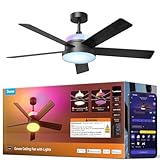
8. Govee 52 Inch RGBIC Smart Flush Mount Ceiling Fan with Lights
Govee Ceiling Fans with Lights and Remote, RGBIC Smart 52” flush mount
Matter certified
5000 CFM
30dB reversible DC motor
RGBWW main light plus ambient
Pros
- Matter certified for whole-home smart home integration
- Dual-layer lighting with independent main and ambient zones
- 5000 CFM from a motor as quiet as 30dB
- LuminBlend+ 16-bit color processing
- Reversible for winter circulation
Cons
- Draws the most power in the group at 72 watts
- Occasional app communication error alerts
- Smaller pool of reviews than the leaders
The Govee is the smart home pick, and the reason is Matter certification. Almost every other fan here talks to Alexa and Google Assistant through a brand app that can change or disappear. This one is Matter certified, so it is the most likely of the group to still be controllable in five years without a firmware rescue, and it works with SmartThings through the Govee Home app as well.
The lighting is genuinely different. Rather than one strip, you get an independent RGBWW main light up to 2800 lumens with colour temperature from 1000K to 10000K, plus an RGBICWW ambient backlight as a second layer. LuminBlend+ 16-bit processing gives smoother gradients and more accurate colour than standard RGB, and the two layers can be driven independently for effects a single fixture cannot produce.
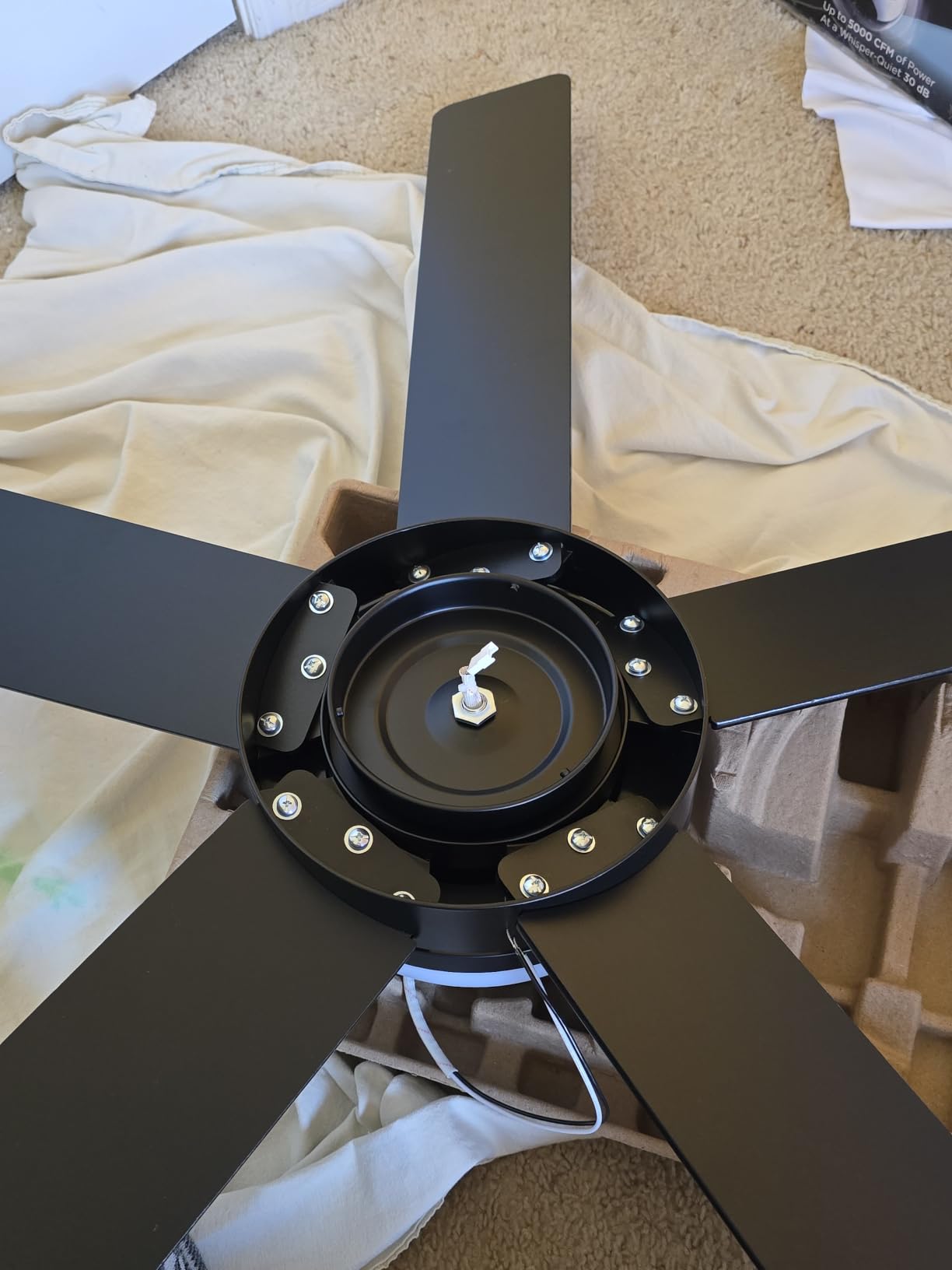
Airflow is 5000 CFM from a reversible DC motor that runs as low as 30 dB across 6 speeds, with 5 blades. Despite the flush-mount marketing, the package includes 6-inch and 4-inch downrods, so it works at ceiling heights from about 8 feet upward. It is CE, FCC, RoHS and TUV certified with an 18-month warranty.
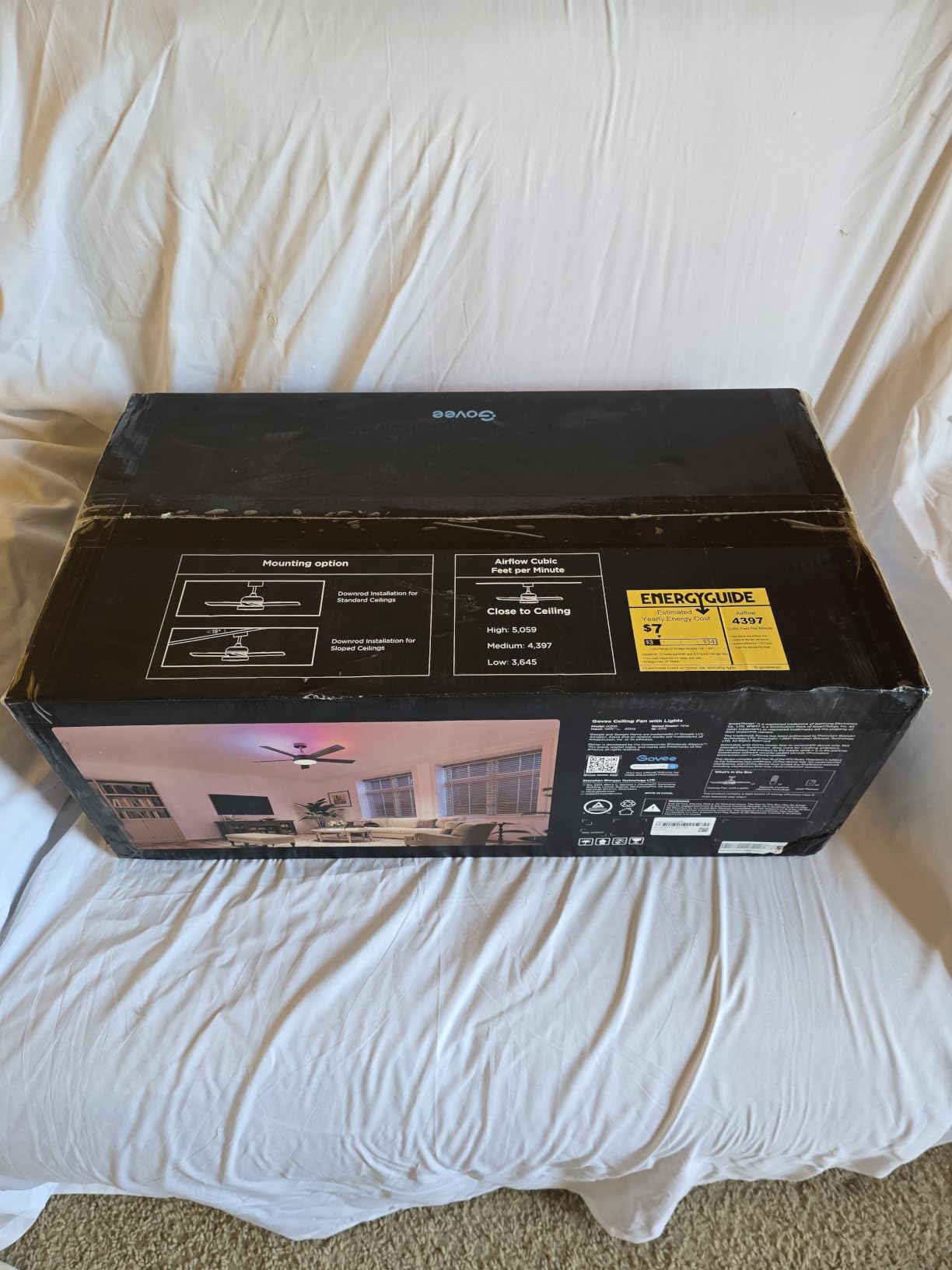
Two caveats. It draws 72 watts, the highest in this roundup, which over years of nightly use is a real difference against the 26-watt models here even though DC motors are efficient in absolute terms. And some users see occasional communication error alerts in the app, though reviewers report the fan and lighting functions stay stable through them.
The review pool is also smaller than the leaders here at just over 200 ratings, which is a newer product in this category. That is worth weighing against the Matter and SmartThings support, which is the reason to buy it.
Why Matter changes the long-term maths
Buying a smart device for a bedroom is a ten-year commitment. A ceiling fan is a fixture you install once and expect to keep. When a manufacturer ends cloud support, the fan keeps working on its remote, but you lose the app and the voice control, which is most of why you paid the premium over a non-smart fan.
Matter is the industry’s attempt to stop that from happening. A Matter-certified device is controllable through any Matter controller regardless of brand, so a future replacement assistant does not strand your fan. Very few budget smart fans have it, which makes this one a different kind of value purchase.
Who the Govee 52 inch is not for
It is not for a bedroom where you need the light dimmed to near nothing. The colour temperature range runs to 10000K, which is the opposite end of a sleep-friendly range, though you can sit at the warm end manually.
It is also not the right pick if you are on a tight power budget, or if you are replacing a fan in a room under about 120 square feet where 5000 CFM is far more than the room can use.
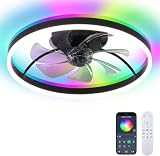
9. DIAMONDFORGE 20 Inch Smart Ceiling Fan with RGB Light and Remote
DIAMONDFORGE Smart Ceiling Fans with RGB Lights Remote – 20” Flush Mount Low Profile Modern Ceiling Fans for Bedroom – Stepless Color Temperature and 6 Speeds
4320 lumens at CRI Ra 95
20 inch and 4.9 inch profile
11 RGB colors
App and remote with memory
Pros
- Entry-level way to get app control with RGB light and a remote
- CRI Ra over 95 with 4320 lumens and flicker-free output
- 4.9 inch profile suits low ceilings
- Detachable wind deflector makes cleaning easy
Cons
- 20 inch diameter means modest airflow
- Feature depth trails the higher-rated models
- Short two-hour timer
The DIAMONDFORGE 20 inch is the value entry into smart ceiling fans, and for light quality it punches well above the price tier it occupies. A 4320-lumen output at CRI Ra over 95 means colours render accurately and the output is flicker free, which matters more in a bedroom than the raw lumen number suggests because you are looking at it for hours.
Colour temperature runs from 3000K to 6500K with brightness from 10 to 100 percent, and there are 11 RGB colours selectable from the app or the remote. Fan and light are operated independently, so you can run airflow with the light off entirely, and a memory function recalls your last fan and lighting settings after a power cut.
The motor is a reversible DC unit with 6 speed levels and a 2-hour timer. It is a low-profile 2-in-1 enclosed design at 4.9 inches tall, partially pre-assembled, and it includes a detachable wind deflector that comes off for cleaning without taking the fan down. It is UL and FCC certified with a 2-year warranty, and weighs 5.5 pounds.
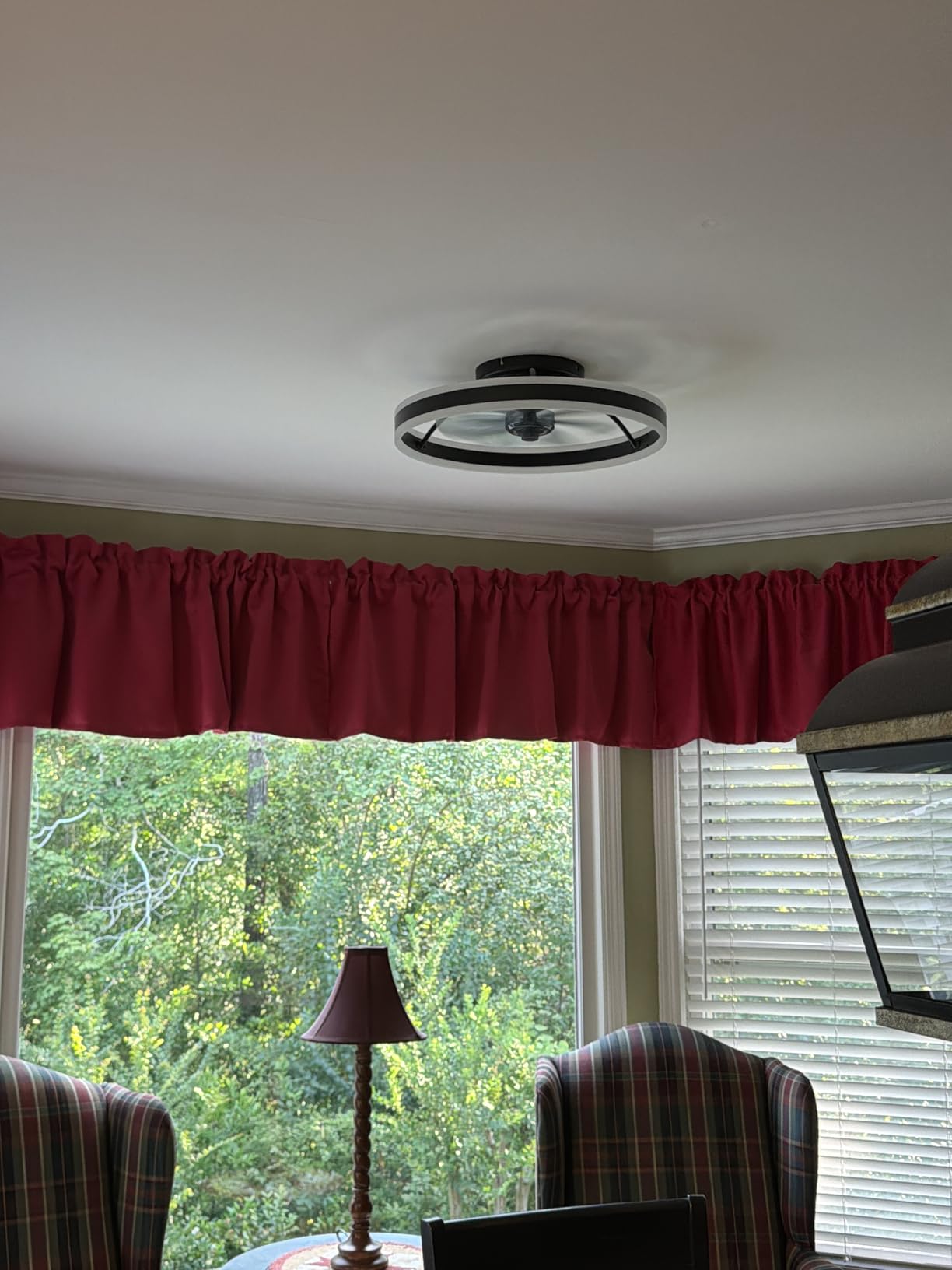
Be clear about what you are trading. A 20-inch diameter moves modest air, and owners treat that as an accepted trade-off for the footprint rather than a complaint. The upgraded 7-blade enclosed design is genuinely low noise and low power at 40 watts, but it is a circulator, not a cooling fan.
Feature depth also trails the models above it. The timer is 2 hours rather than the 4 and 8 hour options elsewhere, and roughly 13 percent of reviews sit at 4 stars, which points to a ceiling on how much the motor delivers rather than to a specific fault.
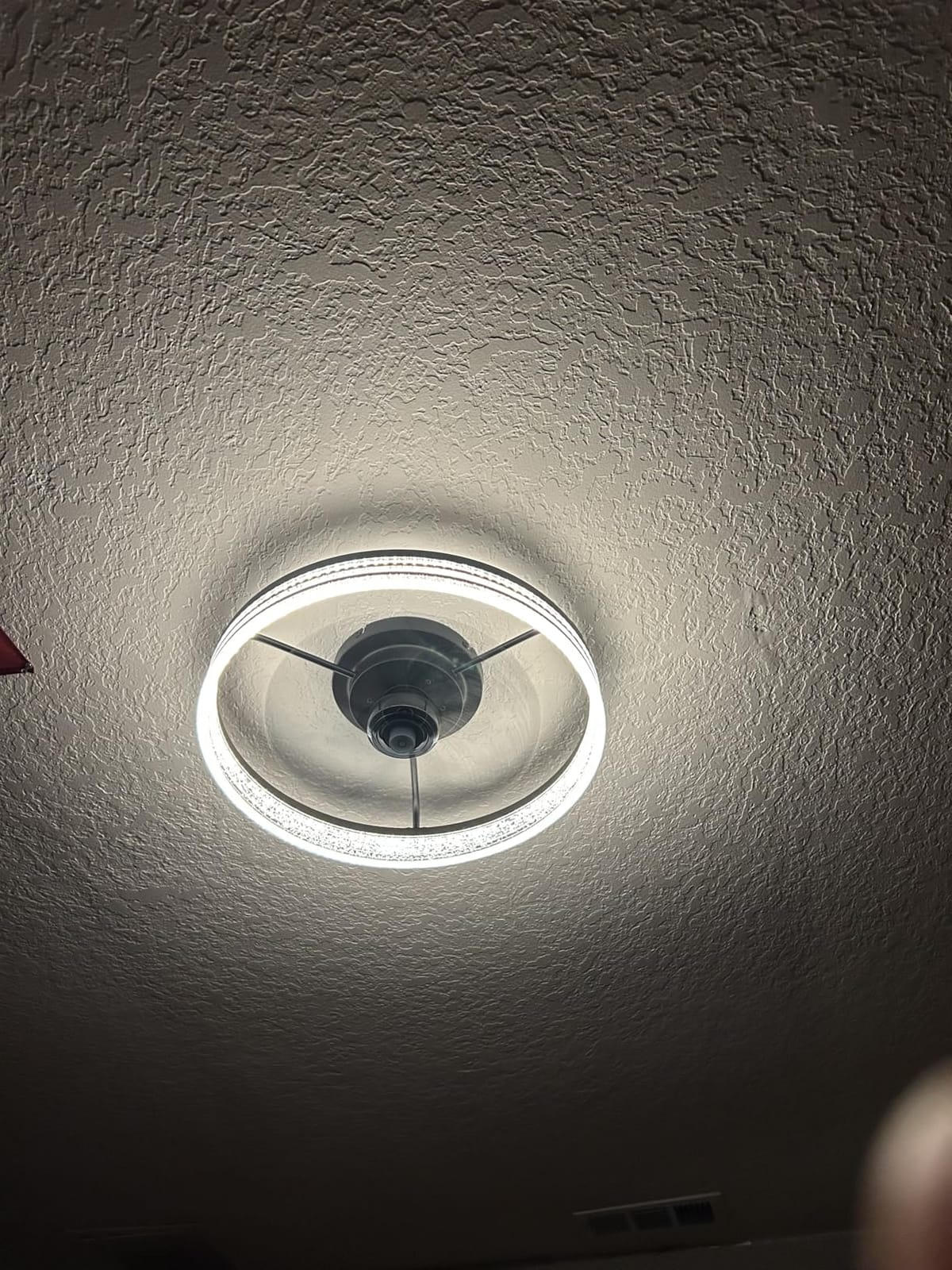
Why light quality is the reason to buy this one
A high CRI figure means the colours under the lamp look like the colours of the objects in the room. Low-CRI LEDs in a bedroom distort skin tones and make fabrics look flat, which is exactly the kind of thing that makes a room feel wrong without anyone being able to say why. At Ra over 95, this is one of the best light specs in the group.
Combined with 4320 lumens from a 4.9-inch body, it can carry a small bedroom or a hallway on its own. If you were planning to add a second fixture for light and only wanted the fan for air, this collapses that into one install.
Who the DIAMONDFORGE 20 inch is not for
It is not for anyone who wants the fan to cool a bedroom in summer, and it is not for a room over about 100 square feet if air movement is the point. Choose a 42-inch or 52-inch model and keep this one for low ceilings and lighting.
It is also not the right pick if you need long scheduling or multiple fans on one remote. Two hours of timer and single-fan remote pairing are the limits of this design.
10. DREO 44 Inch RGBIC Flush Mount Smart Ceiling Fan
DREO Ceiling Fans with Lights, 44”, RGBIC Flush Mount Smart Ceiling Fan
3528 CFM across 12 speeds
RGBIC ambient lighting
App timers from 1 to 12 hours
44 inch flush mount
Pros
- 44 inch flush mount fits low ceilings while moving 3528 CFM
- RGBIC ambient lighting with Constant and Breath and Circle modes
- App timers from 1 to 12 hours with schedules
- Pre-assembled parts and free bracket cover replacement
Cons
- Listed 40dB is higher than the sub-30dB models
- 3528 CFM is modest for larger rooms
- Costs more than most comparable 52-inch models
The DREO 44 inch is the pick if scheduling is the feature you actually care about. The app supports timers from 1 to 12 hours, which is far longer than the 2, 4 or 8 hour limits on most remotes, plus full scheduling and scene control. In a bedroom, a fan that ramps itself down through the night without a command is the difference between smart control you use and smart control you set up once and abandon.
The frame is a 44-inch flush mount at 9.67 inches tall with 4 blades, moving 3528 CFM across 12 speeds on a brushless DC motor. That is a genuinely useful size for a bedroom between 120 and 175 square feet, where a 42-inch model is a little short and a 52-inch model crowds the room.
Lighting is RGBIC ambient with Constant, Breath and Circle modes, stepless brightness and colour temperature from 2700K to 6500K, up to 2400 lumens. The remote handles 1/4/8-hour timers while the app covers the long schedules. It is DOE, ETL and FCC certified, parts arrive pre-assembled, and DREO includes free bracket cover replacement, which quietly fixes one of the most common installation complaints.
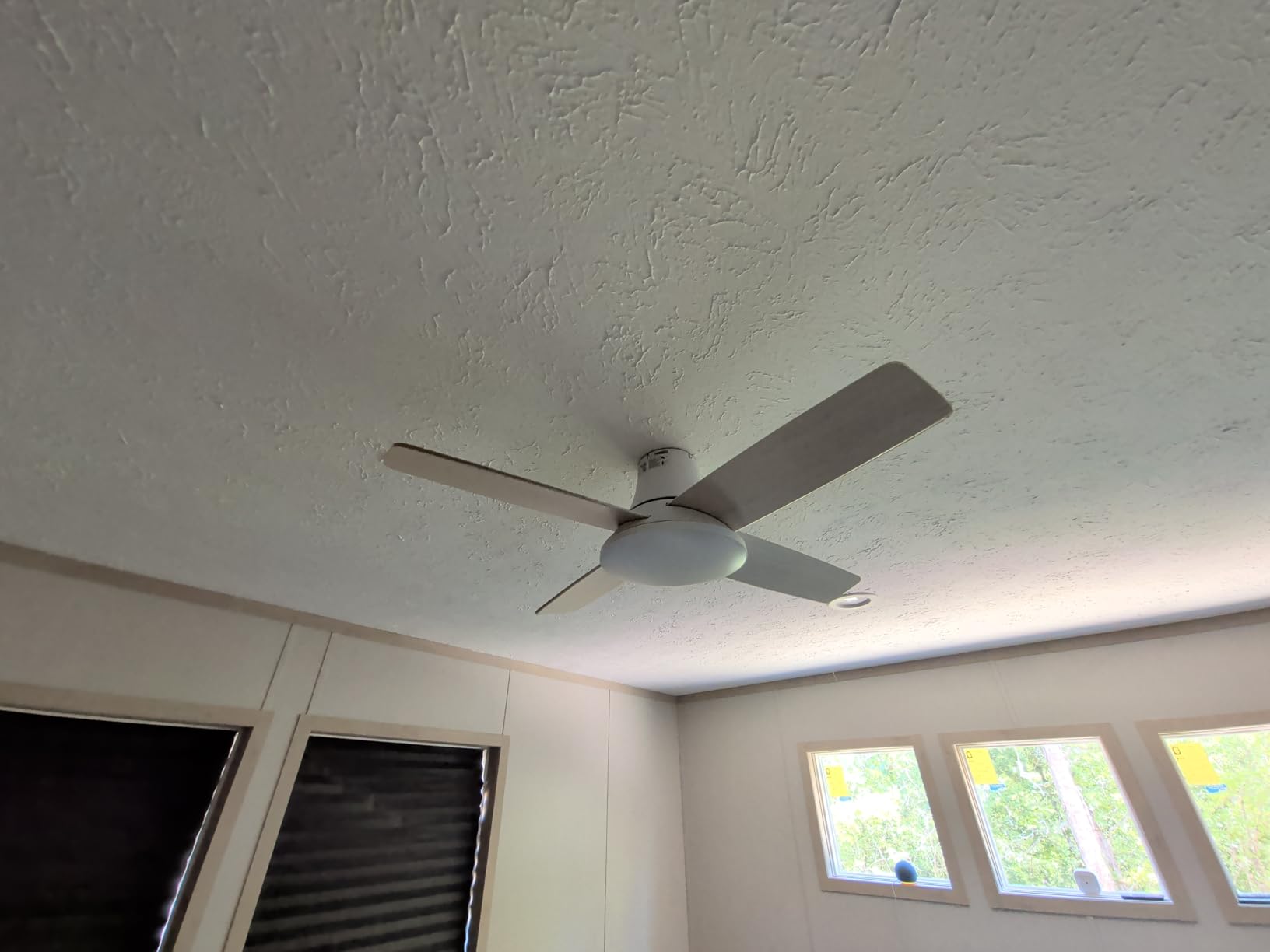
The honest drawback is sound. The listed noise level is 40 dB, the highest of the quiet DC models in this group, so it is not the right fan for a very light sleeper even though the marketing calls it below a whisper. At speed 1 the difference between 22 dB and 40 dB is the difference between a fan you stop noticing and one you still hear.
At 3528 CFM it is also firmly a bedroom fan. In a room over about 175 square feet you will want more air movement than this delivers, and at 36 watts it is efficient but not the strongest mover in the roundup.
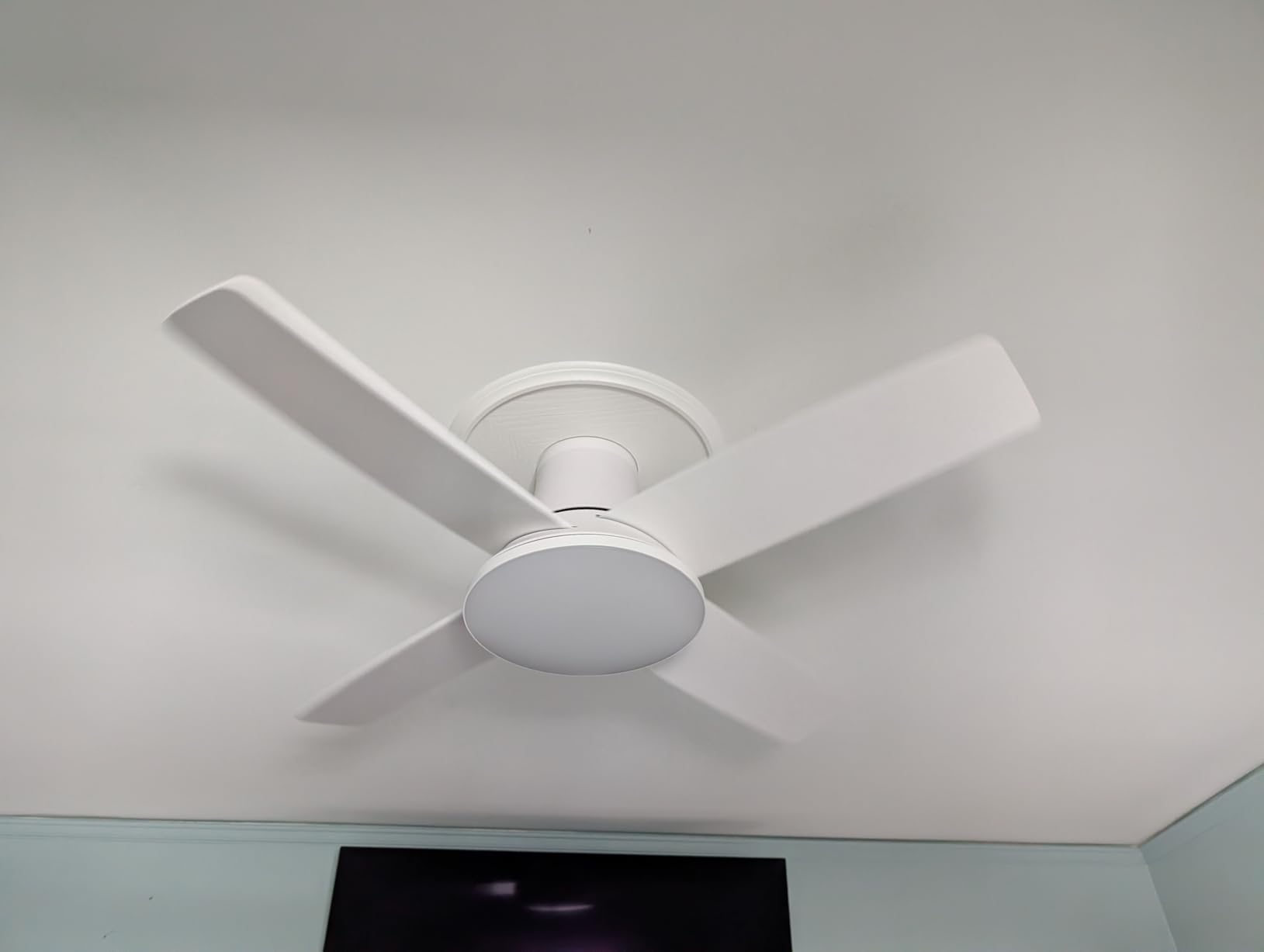
Why the 12-hour app timer beats a remote timer
Remote timers are for demos. A 4-hour timer on a remote is set once and then forgotten, and the failure mode is a fan still running at 4am. App scheduling lets you build an evening routine once: light to 2700K at 10pm, fan to speed 3 at 10:30, off at 6am, every night.
That matters most with a flush-mount fan in a bedroom because the light is part of the same routine. Constant, Breath and Circle RGBIC modes give you ambient options that do not wake anyone, and a 12-hour ceiling on the timer means the schedule can cover a full night without being rebuilt.
Who the DREO 44 inch is not for
It is not for light sleepers or for anyone who runs the fan on low all night. If silence at speed 1 is your first requirement, choose one of the sub-31dB models in this roundup instead.
It is also not the value option. It costs more than several 52-inch fans in this list, and the 3528 CFM rating will feel modest in a room over 175 square feet. You are paying for the app experience and the lighting, not for airflow.
Bedroom Smart Ceiling Fan Buying Guide
Everything below narrows a 40-model category down to the two or three fans that will actually work in your room. Start with the height of your ceiling and the size of your bed, then work down to ecosystem and light.
DC motors are the only real answer for a bedroom
An AC motor, the older style, uses a capacitor and a heavier construction. It is cheaper to make and it is louder at every speed, with a hum that is most noticeable on low settings. A brushless DC motor, sometimes called a brushless motor, has no commutator and no capacitor, which is why every fan in this roundup uses one.
The practical difference for a bedroom is the lowest speed. On an AC motor, speed 1 is often the loudest setting relative to the air it moves. On a DC motor, low speed is genuinely low. Every quiet fan in this group pairs a DC motor with a published minimum below 35 dB, and that number is the single most useful figure in the whole category for sleep.
Match the blade span to the room, not to the room’s style
The sizing guidance for bedrooms is narrower than for living rooms. A bedroom under 100 square feet, such as a 10×10, wants a 36 to 42 inch span. Between 100 and 175 square feet, which covers most primary bedrooms, 42 to 48 inches is the right range. Above 175 square feet, step up to 52 inches.
Going oversized is not a neutral choice. A fan that is too large for the room creates a downdraft that never mixes, so it feels like a cold spot rather than circulation, and you end up running it lower than you meant to. Our rule is to size down rather than up when you are between two sizes and the ceiling is low.
Flush mount, hugger or downrod is decided by ceiling height
At or below 8 feet, use a flush mount. A flush-mount fan hangs directly off the canopy with no downrod, so the total drop is only a few inches. Between 8 and 9 feet, a 4-inch downrod works. At 9 feet and above, a 6-inch or 12-inch downrod gives the fan the vertical separation it needs to push air properly.
The consequence of getting this wrong is performance, not comfort. A flush mount pushed high in the room circulates air without creating the pressure differential that moves air across your body. If your bedroom ceiling is tall, a downrod model is a better buy than a cheaper flush option.
Light for sleeping is a colour temperature problem first
Any bedroom ceiling fan with a light can be an evening wind-down, or it can be the thing that keeps you awake. The difference is colour temperature. Aim for 2700K at night, which is the warm end of warm white, and avoid 4000K and above after dark. Daylight-balanced light at 5000K or higher suppresses the sense that the day is over.
Second is dimming range. A light that dims in 20 percent steps still jumps from a low reading level to a bright one, and you end up turning it off entirely. Stepless dimming, which the DREO 52 inch and the DREO 44 inch both offer in the app, is the feature that lets a light sit at 3 percent instead of 20.
Third, check that the fan and light have independent controls. Being able to kill the lamp while leaving the airflow on is what lets you run the fan all night with the light off.
Smart ecosystem: check the assistant before the fan
The most common smart-fan regret is buying a good fan that does not talk to the platform already running the house. Alexa and Google Assistant support is close to standard in this category. Apple HomeKit is rare. SmartThings appears on a handful. Home Assistant support is rarer still and usually a bonus of running on the Tuya platform.
So decide the platform first, then read the compatibility list below. If you run HomeKit, your realistic options here are narrow, and you may be better served retrofitting an existing fan with a smart controller than replacing a working one.
App quality is a separate score from build quality
Reviewers rate these fans in one combined number, which hides the most useful signal. A fan can have a good motor, good blades, and a frustrating app, and the combined score will drag a good product down. In this roundup the Lumary is the clearest example: the hardware draws praise and the voice layer draws complaints.
Ask three questions of any app you are about to commit a bedroom to. Does it need a 2.4GHz network? Does it continue working when the cloud service is down? Does it let you rename the device, so that your voice assistant hears a name you can actually say? If the answer to any of those is no, the remote is your fallback and should be tested first.
For a wider look at moving air in other rooms, our high velocity fan guide covers the opposite end of the noise and output spectrum.
Smart Home Ecosystem Compatibility for These 10 Fans
Here is what actually works with what, based on the platforms these fans run on. This is the check to do before anything else, because a fan you cannot control the way you want is a fan you will stop using.
Sofucor 52 inch: Google Assistant, manufacturer app, remote. No HomeKit support reported.
DREO 52 inch 12-speed: Alexa, Google Home, Siri Shortcuts, DREO app, remote.
TALOYA 52 inch: Alexa, Google Home, Smart Life and Home Assistant, with local control through LocalTuya. 2.4GHz only.
DREO 42 inch: Alexa, Google Home, DREO app, remote.
FancyMay 20 inch: Alexa, app, remote, touchpad. 2.4GHz only.
Lumary: Alexa and Google Home through the Lumary app, Bluetooth remote. Voice reliability reported as inconsistent.
BAYSQUIRREL: Alexa, Google Assistant, Smart Life app, remote, plus a paired Bluetooth speaker. The app is a Smart Life app and pairing is the weak point.
Govee 52 inch RGBIC: Matter certified, plus Alexa, Google Assistant and SmartThings through the Govee Home app. The most future-proof option here.
DIAMONDFORGE 20 inch: app and remote, Bluetooth. No voice assistant support reported.
DREO 44 inch RGBIC: Alexa, Google Home, DREO app, remote, with 1 to 12 hour app timers.
Two patterns are worth noticing. First, not one of these ten has native Apple HomeKit support, which is a genuine limitation for anyone running a HomeKit-only house. Second, three of them need a 2.4GHz network for the app and voice features, so check your router settings before ordering.
If you need fan control in a garage, workshop or utility space as well, our garage ventilation fan picks cover that side of the house.
How to Set Up a Smart Ceiling Fan in 2026
Almost every setup failure in this category comes down to the same two things: the wrong Wi-Fi band and the wrong sequence. Ten minutes of preparation removes most of them.
Check your ceiling box and wiring first. Confirm the box is fan rated and that a fan brace is present if the bracket is not a fan-rated model. Confirm a wall switch reaches the fan without a wall dimmer, since most smart fans are not dimmer compatible.
Make sure a 2.4GHz network is available. Three of these fans are 2.4GHz only, and the rest are easier to pair on 2.4GHz even if they also support 5GHz. On a dual-band router, separate the bands or add a 2.4GHz access point. Do this before the fan is mounted, not after.
Download the manufacturer’s app and sign in. Create the account and add the room before you power the fan. The app usually needs the fan on a stable network to register it.
Put the fan into pairing mode. Most models do this by pulling the remote’s fan speed to the highest setting and holding it for three to five seconds until the receiver beeps. On several models the pairing button is on the receiver itself, which means pulling the canopy down. Check the manual for the exact combination before you start.
Cycle power at the breaker if the app cannot find the fan. This is the documented step that the BAYSQUIRREL instructions get wrong. Turn the breaker off for 10 seconds and back on with the fan already in pairing mode, then run the app search.
Rename the device in the app before adding it to your assistant. A name like Bedroom Fan or Downstairs Bedroom is easier to say out loud than a model number, and voice recognition improves with familiar words.
Set the sleep schedule while you are in the app. The most common use of a smart ceiling fan in a bedroom is not voice control. It is a schedule that dims the light to 2700K and drops the fan to a low speed at bedtime, and then turns both off in the morning.
Test the remote before you close the canopy. Every fan here keeps working on its physical remote even if the app or cloud service fails, and that is the difference between a smart fan you can still use in five years and one that becomes an expensive ceiling ornament.
Already Own a Non-Smart Fan? Add Smart Control Without Replacing It
If your current fan works fine, replacing it to get voice control is a lot of wiring for a small gain. There is a shorter path, and it is the one regular smart-home users take.
A fan-rated smart wall switch replaces the existing wall switch and controls fan speed and light without any change to the fan itself. The important word is fan-rated: a generic smart switch is not safe on a motor load and will fail. One user in a smart home community solved a bedroom light and fan problem exactly this way, pulling the pull chain to high one last time so the switch had full speed control from then on.
The second option is a ceiling fan controller that goes in the canopy, replacing the receiver and keeping the existing blades and motor. These connect to Wi-Fi and appear in the app like a smart fan would. This is the route forum users recommend when the existing fan is a good unit with a bad light kit, or when the motor is an AC model worth keeping for its heft.
Neither path gives you the light improvements of a modern smart fan, particularly if your current fan has a fixed non-replaceable LED. A recurring complaint in homeowner forums is exactly that: a fan you cannot change a bulb in, tied to a driver that fails in a few years. If your light kit is already failing, that changes the calculation and a full replacement makes more sense.
Whichever route you take, budget for the receiver part specifically. Adding a controller to a fan means opening the canopy and rewiring the receiver, which is straightforward if you have done it before and an electrician’s visit if you have not.
Frequently Asked Questions
What is the best smart ceiling fan for a bedroom?
The Sofucor 52 Inch Smart Ceiling Fan is the best all-round choice for a bedroom, pairing a 30 dB brushless DC motor with 5500 CFM airflow in a flush-mount body that fits an 8-foot ceiling without a downrod. It works with Google Assistant, its own app and a remote, and its three light colours and sleep timers cover the bedtime routine. If silence matters more than airflow, the DREO 52 inch runs at a published 22 dB.
What is the best super quiet ceiling fan for bedrooms?
Look first at the published minimum noise figure, because most bedrooms run the fan on speed 1 all night. The DREO 52 inch has the lowest published minimum in this group at 22 dB, with 12 speeds and a dedicated sleep mode that steps down gradually. The Sofucor 52 inch follows at 30 dB and the DREO 42 inch at under 31 dB. Avoid the models listed at 38 dB and above if you are a light sleeper.
How big should a ceiling fan be for a bedroom?
Under 100 square feet, such as a 10×10 room, use a 36 to 42 inch span. Between 100 and 175 square feet, which covers most primary bedrooms, 42 to 48 inches is the right range. Above 175 square feet, step up to 52 inches. Sizing down rather than up is usually the better mistake, because an oversized fan creates a downdraft the room cannot mix.
How do I put a smart ceiling fan into pairing mode?
On most models, pull the fan speed on the remote to the highest setting and hold it for three to five seconds until the receiver beeps. On some fans the pairing control is on the receiver inside the canopy instead. Make sure a 2.4GHz Wi-Fi network is available first, because three of these fans will not connect on 5GHz. If the app cannot find the fan, cycle the breaker off for 10 seconds with the fan already in pairing mode.
Do smart ceiling fans work with Alexa and Google Home?
Most of them do. Nine of the ten fans in this roundup list Alexa, Google Assistant or both, and the BAYSQUIRREL adds a Bluetooth speaker. Two caveats matter: the Lumary has unreliable voice control for fan speed and colour scenes according to reviewers, and the DIAMONDFORGE has no voice assistant support at all. None of these ten has native Apple HomeKit, which is worth checking before you buy.
Is there an app to control my ceiling fan?
Yes, and it is worth having even if you never use voice control. Every fan here ships with a manufacturer app that handles speed, timers, light colour temperature and schedules, and the app is where stepless dimming and long sleep timers live. The practical difference between a good and a poor app is whether it needs a 2.4GHz network and whether it keeps working when the cloud service has an outage, so test the remote before you close up the ceiling.
Conclusion: The Best Smart Ceiling Fans for Bedrooms
For most bedrooms in 2026, the Sofucor 52 Inch Smart Ceiling Fan is the buy. It is quiet at 30 dB, moves 5500 CFM, mounts flush against an 8-foot ceiling and carries a lifetime motor warranty. If your top priority is silence on the lowest speed, take the DREO 52 inch at 22 dB instead. For a Home Assistant house, the TALOYA 52 inch is the one that plays well with the rest of your system.
Below that: the DREO 42 inch for small rooms, the FancyMay 20 inch and DIAMONDFORGE 20 inch for low ceilings and light quality, the Lumary for ambient colour lighting, the BAYSQUIRREL if you want a speaker in the ceiling, the Govee for Matter and SmartThings, and the DREO 44 inch for long app schedules. Check your ecosystem first, confirm you have a 2.4GHz network, and test the remote before you close the canopy.