
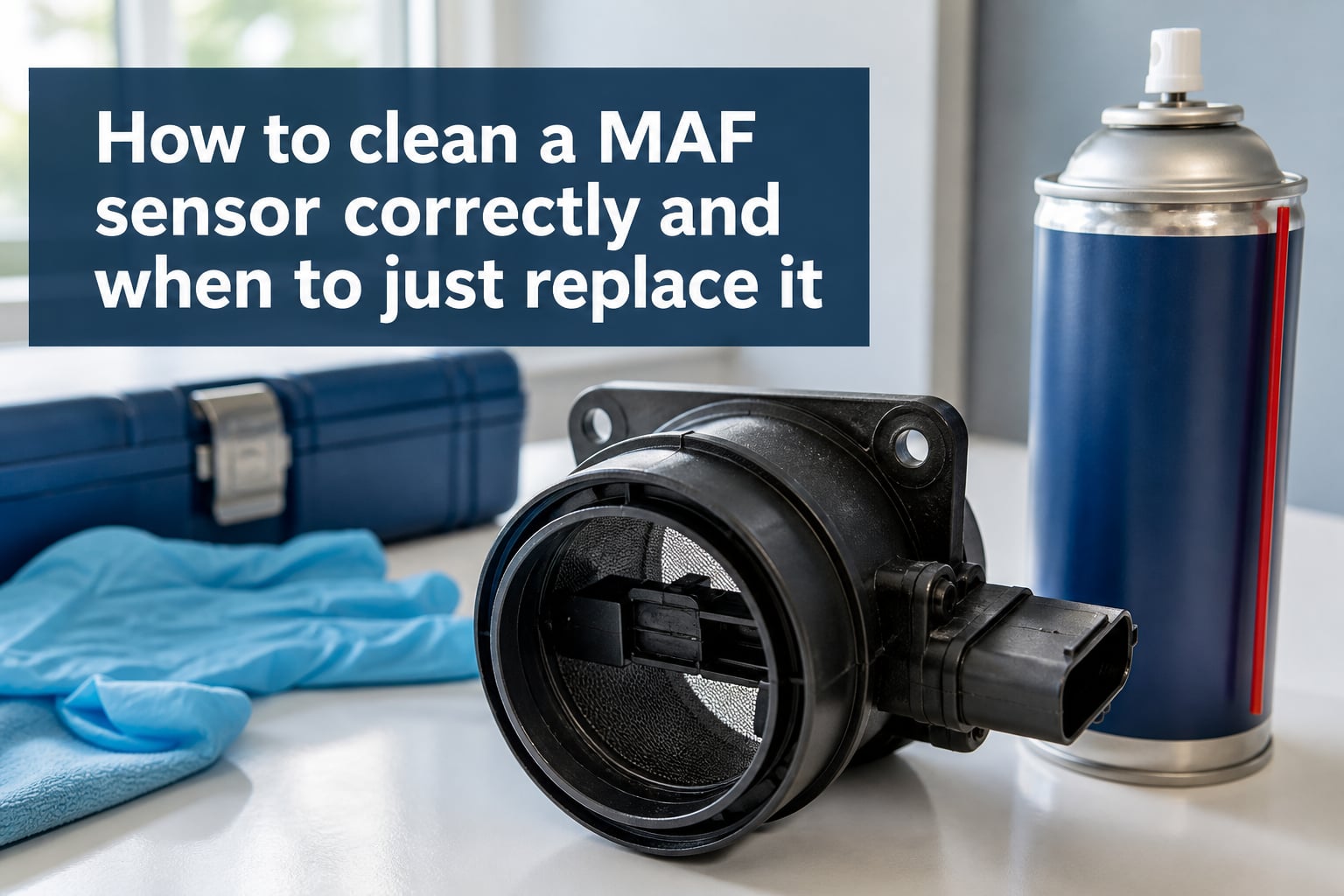
Your check engine light flicked on, the idle has been shaky for a week, and your fuel economy just dropped by three miles per gallon. Before you spend money on a new part, the fix might be simpler than you think. Knowing how to clean a MAF sensor correctly can save you a trip to the shop and get your car running right again.
I have cleaned and replaced dozens of mass airflow sensors over the years, on everything from a 9th-gen Civic to a Subaru WRX with 112k miles. In this guide, I will walk you through exactly how to do the job the right way, what products to use, what mistakes will ruin your sensor, and when cleaning is a waste of time and you should just replace it.
Table of Contents
What Is a MAF Sensor and How Does It Work?
A MAF (mass air flow) sensor measures the exact amount of air entering your engine and sends that data to your car’s computer, the ECM or ECU. The computer uses that number to calculate how much fuel to inject, keeping your air-fuel mixture at the ideal stoichiometric ratio of 14.7 parts air to 1 part fuel.
If the MAF sensor reads even slightly off, your engine runs too rich or too lean. That is why a dirty or faulty sensor causes so many different driveability problems at once.
Hot Wire vs Hot Film MAF Sensors
Most modern cars use one of two designs. A hot wire MAF sensor uses a tiny platinum wire that the ECM heats to a set temperature. As incoming air flows past the wire, it cools down, and the ECM measures how much current is needed to keep the wire hot. That current is directly related to air mass.
A hot film MAF sensor works on the same principle but uses a thin film element instead of a wire. Both types are extremely sensitive to contamination, and both clean the same way. If your car is from the mid-1990s or later, you almost certainly have one of these two designs.
Why Accurate MAF Readings Matter
Your ECM cannot guess airflow. It relies on the MAF sensor to make fueling decisions every single second the engine runs. A sensor that reads 10% low will dump 10% more fuel than needed, killing your gas mileage and fouling your spark plugs. A sensor that reads 10% high will lean out the mixture, which over time can damage your catalytic converter.
Symptoms of a Dirty or Failing MAF Sensor
A dirty MAF sensor rarely causes just one symptom. It usually causes a combination of driveability issues that get worse over time. Here is what I tell friends to look for before they touch the sensor.
The Most Common Symptoms Drivers Notice
Rough idle is the biggest giveaway. If your RPMs hunt up and down at a stop, or the engine almost stalls when you put it in drive, suspect the MAF before anything else.
Poor fuel economy is the next clue. If you suddenly need to fill up more often and nothing else has changed, the MAF is reading low and dumping extra fuel.
Other symptoms include hesitation or stumbling during acceleration, hard starting especially when the engine is warm, occasional misfires, and a general lack of power. One Reddit user summed it up perfectly when they posted “this is a maf sensor does it need cleaning or should i just replace,” and the consensus in the thread was symptoms plus mileage over 100k usually means replace.
What the Check Engine Light Tells You
A check engine light on its own does not prove a MAF problem, but certain codes point right at it. P0101 is a MAF sensor performance issue. P0102 means the MAF signal is low, often due to contamination. P0103 means the signal is high.
If you scan the car and see one of these codes combined with the driveability symptoms above, cleaning the MAF sensor is a logical first move before buying a new one.
Tools and Materials You Need to Clean a MAF Sensor
You only need a few items, and using the wrong one is the fastest way to destroy a perfectly good sensor.
CRC MAF Sensor Cleaner (or any cleaner specifically labeled for mass airflow sensors)
10mm wrench or socket, depending on your vehicle
Screwdriver set for hose clamps
Clean lint-free microfiber towels
Nitrile gloves to keep skin oils off the sensor element
Optional: OBD-II scanner for testing before and after
Do not use brake cleaner, carburetor cleaner, WD-40, throttle body cleaner that contains harsh solvents, or rubbing alcohol on most modern MAF sensors. Forum posts are full of people who tried it and watched their sensor stop working. CRC MAF cleaner is the industry standard and is what professional shops use.
How to Clean a MAF Sensor Step by Step
Here is the exact procedure I use, which matches the AI overview format and the CRC Industries official guide. Following these steps should take about 20 minutes total, with most of that being drying time.
Step 1: Disconnect the battery. Pop the negative terminal and move it aside. This prevents any accidental shorts and resets the ECM later.
Step 2: Locate the MAF sensor. It sits between the air filter box and the throttle body, mounted in the intake tubing. Follow the big rubber intake hose from the airbox toward the engine.
Step 3: Unplug the electrical connector. Press the release tab and pull the connector straight off. Do not yank on the wires.
Step 4: Remove the MAF sensor. Most are held in with two screws or two hose clamps. Take out the screws and gently slide the sensor out of the housing.
Step 5: Inspect the sensor element. Look at the hot wire or hot film through the opening. If it is caked with dark residue, that is contamination from unfiltered air or oil from an aftermarket air filter.
Step 6: Spray the MAF cleaner. Hold the sensor so the opening points downward. Spray the element generously with CRC MAF cleaner until the dirt runs off. The downward angle lets the dirty solvent drip out instead of pooling on the element.
Step 7: Let it dry completely. This step is critical and is one of the most common PAA questions. The sensor needs at least 10 to 15 minutes to air dry, and I prefer to wait 20 to be safe. Any leftover solvent will affect readings on the first start.
Step 8: Reinstall and reconnect. Slide the sensor back into the housing, tighten the screws to snug, plug in the connector, and reconnect the battery. Start the engine and let it idle for a minute. The idle may be rough at first while the ECM relearns.
How Long to Let a MAF Sensor Dry After Cleaning?
Most manufacturers and CRC themselves recommend letting the sensor air dry for at least 10 to 15 minutes before reinstallation. Do not use compressed air to speed this up, since high-pressure air can snap the delicate hot wire. Just let it sit on a clean towel in a dust-free area. If you have time, 30 minutes is even better.
Mistakes to Avoid When Cleaning a MAF Sensor
These are the most common mistakes I see in forum threads, and they all end with the same result: a new sensor purchase that could have been avoided.
Do not touch the sensor element with your fingers or any cloth. The oils on your skin coat the hot wire and throw off readings permanently.
Do not use brake cleaner, carburetor cleaner, or WD-40. They leave residues that damage the delicate wire or film element. Only use a cleaner specifically designed for MAF sensors.
Do not submerge the sensor in any liquid. Soaking is tempting but risks getting solvent into the electronics and damaging the connector.
Do not skip the drying step. Reinstalling wet solvent will cause rough running and a possible check engine light.
Do not use compressed air. A strong blast can break the hot wire element.
Finally, be honest about your air filter setup. If you are running an oiled cotton gauze filter like a K&N, that oil is the most common reason your MAF got dirty in the first place. The oil migrates up the intake tube and coats the sensor. Switching to a dry filter often prevents the problem from coming back.
Testing Your MAF Sensor With a Scan Tool
Before and after cleaning, I like to plug in a basic OBD-II scanner and look at live data. This is the part most guides skip, and it is what separates a guess from a real fix.
Open the live data stream and watch two values: MAF (g/s) and Calculated Engine Load (CALC Load). With the engine idling at operating temperature, MAF should read between 3 and 7 g/s on most 4-cylinder engines, scaling up for larger engines. If it reads 0 or wildly outside that range, the sensor has failed.
CALC Load at idle should sit between 18% and 25% on a healthy engine. If it is reading 35% to 50% with no accessories on, your MAF is likely under-reporting airflow, which is causing the ECM to add more fuel to compensate.
After cleaning, drive the car normally for 10 to 15 minutes and recheck. Numbers should move toward the normal range. If they do not, you have a sensor that is past cleaning and needs replacement.
When to Clean vs Replace Your MAF Sensor?
This is the question everyone wants answered, so I will give you a clear decision tree I use with my own cars and recommend to friends.
Clean the MAF sensor when: The car is under 80,000 miles, contamination is visible, driveability symptoms are mild, no check engine light is on, or the symptom just started in the last few weeks. Cleaning is also smart when you have just installed an oiled air filter and the symptoms appeared shortly after.
Replace the MAF sensor when: The car is over 100,000 miles, the MAF has been cleaned once already without lasting improvement, you are getting persistent codes like P0101 after cleaning, fuel trims stay above plus or minus 10% even after cleaning, or the hot wire is visibly corroded or broken. Replacement is also the right call if you cannot remember the last time the sensor was serviced.
The forum wisdom on this is consistent. One WRX owner with 112k miles cleaned his MAF, saw no improvement, swapped in a known-good backup sensor, and watched his fuel trims snap back to normal. Old sensors simply degrade, and no amount of cleaner brings back lost sensitivity.
How Often to Clean Your MAF Sensor
For most vehicles, every 50,000 miles is a reasonable preventive interval, or every time you replace the air filter if you drive in dusty conditions. If you use a dry paper air filter and keep it clean, you may never need to clean the MAF at all.
If you run an oiled aftermarket filter, plan on cleaning the MAF every 20,000 to 30,000 miles, or consider switching to a dry filter to avoid the problem entirely.
FAQs
Should I try cleaning the MAF sensor before replacing it?
Yes. Cleaning is the right first move in most cases, especially on vehicles under 80,000 miles with mild symptoms. A can of MAF-specific cleaner costs a fraction of a new sensor and takes about 20 minutes. If cleaning does not restore normal fuel trims or symptoms return within a few weeks, replacement becomes the smarter choice.
Can you just clean a MAF sensor?
Yes, you can clean a MAF sensor using CRC MAF cleaner or any cleaner specifically labeled for mass airflow sensors. Remove the sensor, hold it opening-side down, spray the element until dirt runs off, and let it air dry for 10 to 15 minutes before reinstalling. Do not use brake cleaner, carburetor cleaner, or WD-40, as they damage the hot wire element.
How long should I wait for the MAF sensor to dry after cleaning?
Wait at least 10 to 15 minutes for the sensor to air dry completely. The solvent in MAF cleaner evaporates quickly, but any residue left on the hot wire will cause rough idle and false readings on the first startup. Letting it sit for 20 to 30 minutes is even safer. Do not use compressed air to speed drying, as it can break the delicate sensor element.
How do I know if my MAF sensor needs to be cleaned or replaced?
Clean it if the car is under 80k miles, contamination is visible on the element, symptoms are mild, and there is no check engine light. Replace it if the vehicle is over 100k miles, cleaning did not restore normal fuel trims, persistent codes like P0101 keep returning, or the hot wire shows corrosion or physical damage. A scan tool showing MAF outside 3 to 7 g/s at idle on a typical 4-cylinder is another strong sign the sensor is past cleaning.
Final Thoughts
Knowing how to clean a MAF sensor correctly is one of the cheapest maintenance wins in car care. A 20-minute job with a 10-dollar can of cleaner often restores lost fuel economy and fixes a check engine light without any new parts. The trick is using the right product, avoiding contact with the hot wire, letting it dry fully, and being honest about whether cleaning is enough.
Start by scanning for codes, confirm the symptoms match a MAF issue, and clean it using the steps above. If the symptoms return or never go away, that is your signal to stop cleaning and start shopping for a replacement.