
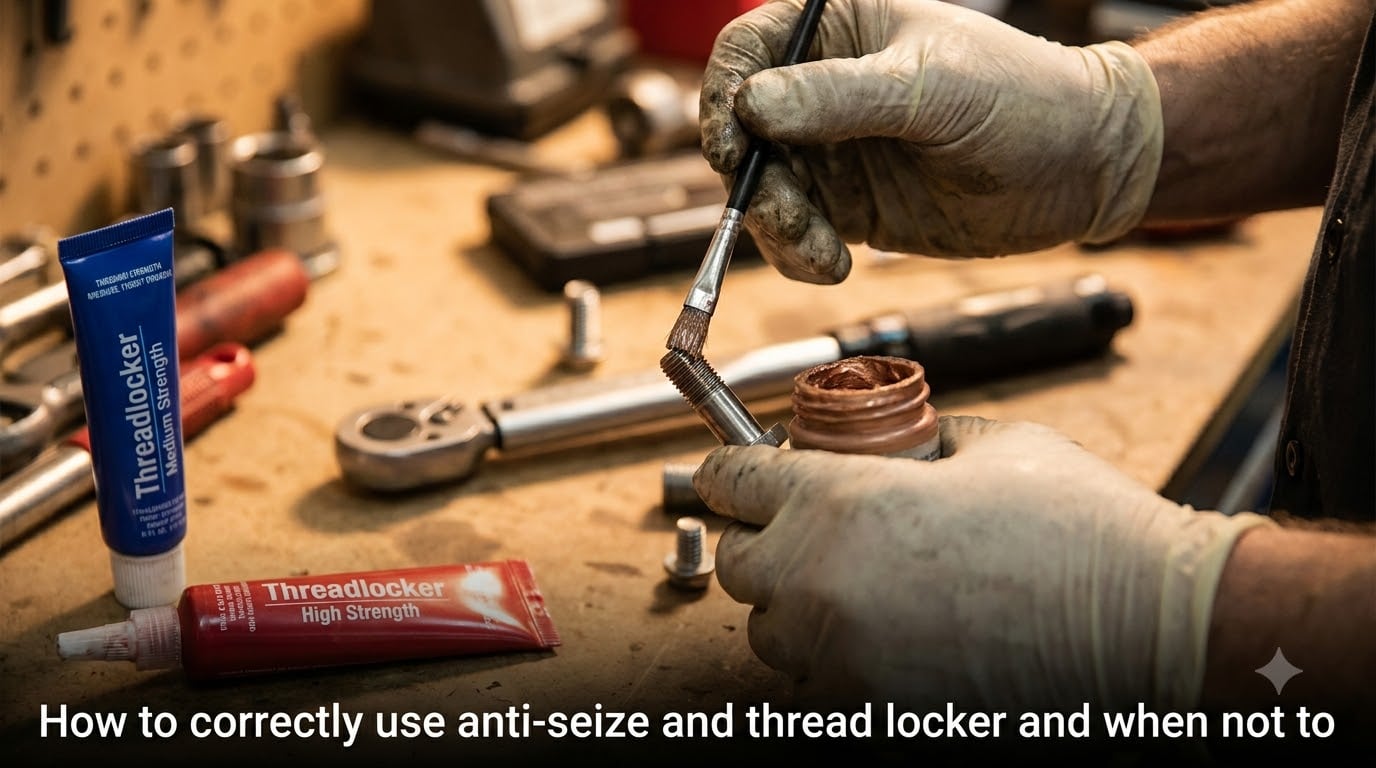
Two of the most misused products in any garage are anti-seize and thread locker. Mechanics reach for them in almost every repair, but most people use them wrong, swap them, or apply them in places where they cause real damage. I have seen both products destroy fasteners, lock wheels solid, and even cause brake failures. None of that has to happen to you.
In this guide, I will walk you through how to correctly use anti-seize and thread locker, show you the clear differences between them, and call out the exact situations where each one is dangerous. By the end, you will know which product to grab for every fastener on your car, motorcycle, or home project, and you will know when to skip both entirely.
Table of Contents
What Is Anti-Seize and How Does It Work?
Anti-seize is a lubricating compound made from fine metal flakes (usually copper, aluminum, nickel, or graphite) suspended in a grease carrier. Its job is simple: stop fasteners from seizing, galling, or welding themselves to the threads when exposed to heat, corrosion, or dissimilar metals. The metal flakes create a barrier between the two threaded surfaces, so even when conditions get brutal, the bolt can still come loose later.
You reach for anti-seize when a bolt lives in a hot, rusty, or vibration-heavy environment. Common examples include spark plug threads in aluminum cylinder heads, exhaust manifold studs, wheel hub bolts on steel hubs, and any stainless steel fastener going into a mild steel or aluminum part. The product also acts as a corrosion barrier, which is why marine and outdoor equipment mechanics use it on nearly everything that has to come apart someday.
What Is Thread Locker and How Does It Work?
Thread locker is an anaerobic adhesive, meaning it stays liquid until it is trapped between two metal surfaces with no air. Once you tighten a bolt coated in thread locker, the air is squeezed out, the adhesive cures, and the threads are bonded together. The bond resists vibration, prevents loosening, and adds real holding power beyond what torque alone provides.
Thread locker comes in three common strengths. Blue (low to medium strength, like Loctite 243) is the everyday shop choice and can be removed with hand tools when needed. Red (high strength, like Loctite 271) is permanent and usually requires heat to break free. Green (wicking grade) is for pre-assembled fasteners that need sealing without disassembly. Each color is a tool, and choosing the wrong one is a common mistake I will cover in detail below.
Anti-Seize vs Thread Locker: Key Differences at a Glance
The single biggest source of confusion is that both products come in small tubes and get smeared on threads. They are not interchangeable. Here is the direct comparison you need:
Primary purpose: Anti-seize prevents fasteners from getting stuck. Thread locker prevents fasteners from coming loose.
How it works: Anti-seize is a metal-flecked lubricant. Thread locker is an anaerobic adhesive that hardens.
Disassembly: Anti-seize makes future removal easier. Thread locker makes future removal harder (sometimes impossible without heat).
Best for: Anti-seize for exhaust, spark plugs, dissimilar metals, and high heat. Thread locker for engine covers, sensor bolts, and anything that vibrates loose.
Never use on: Anti-seize on brake caliper bolts where torque must be exact. Thread locker on suspension bolts, brake hardware, or any fastener you need to remove for service.
The simple rule I follow in our shop: use thread locker on parts you want to stay together, and use anti-seize on parts you know you will want to take apart someday.
When to Use Thread Locker
Thread locker shines anywhere vibration works a bolt loose over time. On every vehicle we service, we apply medium-strength blue thread locker to engine cover bolts, alternator brackets, intake manifold hardware, sensor bolts, and small fasteners under the hood that are notorious for backing out. It is also the right call for pedal assemblies, hardware inside door panels, and bolts on equipment that sees constant vibration, like pressure washers or commercial lawn equipment.
For critical fasteners, use red high-strength thread locker. Examples include cylinder head studs (where called for by the manufacturer), press-fit hardware, and structural bolts that absolutely cannot back out. Just remember that red is permanent for practical purposes, so do not use it unless you really mean it.
For factory-assembled fasteners that have already come loose, reach for the green wicking grade. It flows into existing threads and locks them in place without full disassembly. It is a great save when you cannot take something apart but need it to stop moving.
When to Use Anti-Seize?
Anti-seize is the right call whenever heat, corrosion, or galvanic reaction threatens to weld two threaded parts together. I use it on every spark plug going into an aluminum head, every exhaust manifold stud, every oxygen sensor thread, and every wheel bolt that goes into a steel hub. The product also makes future service dramatically easier; a spark plug that has been treated with anti-seize since day one will usually come out by hand, even after 100k miles.
Stainless steel fasteners are a special case. Stainless steel is famous for galling, which means the threads literally cold-weld to whatever they touch. Always pre-coat stainless steel bolts with anti-seize, especially when threading into aluminum. Marine applications, agricultural equipment, and anything that lives outdoors also benefit from a thin coat of anti-seize on every critical fastener at install time.
For high-temperature locations above 500 degrees Fahrenheit, use a copper or nickel-based anti-seize. Standard aluminum anti-seize breaks down at sustained high heat and can actually become abrasive. Copper is rated higher and is what we use on turbo studs and exhaust work.
When NOT to Use Thread Locker (Critical Safety Information)
This is the section that prevents injuries and expensive damage. Thread locker is fantastic in its place, but in the wrong place it is dangerous.
Never use thread locker on brake caliper bolts or guide pins. The bolts that hold your brake caliper must remain free to slide so the pads can retract properly. If thread locker bonds them solid, the pads drag, the rotors overheat, and you can lose braking. This is a real-world failure mode, and I have personally seen cars towed in with warped rotors because someone applied thread locker to caliper hardware.
Avoid thread locker on suspension bushings, ball joints, and tie rod ends. These parts are designed to move slightly within their range. Thread locker turns a controlled flex into a rigid joint, which adds stress to other components and can cause fatigue failures.
Skip thread locker on any fastener the manufacturer calls a torque-to-yield (TTY) bolt. These bolts are designed to stretch a precise amount during installation. Adding thread locker changes the torque-vs-clamp-load relationship and can result in either an under-clamped or over-clamped joint.
Do not use thread locker where you need frequent service. Oil drain plugs, oil pan bolts, valve cover bolts, and similar service items will become a nightmare if bonded. Each removal will strip more material, and eventually the fastener will fail.
When NOT to Use Anti-Seize (Critical Safety Information)?
Anti-seize has its own list of places it does not belong, and most home mechanics miss these entirely.
Never apply anti-seize to brake caliper bolts or suspension pivot bolts. Anti-seize reduces friction, which means your torque wrench reading will be wrong. You will think you have tightened to spec, but the actual clamp load will be far higher than designed. Over-tightened brake and suspension bolts can stretch, fatigue, and snap. The danger is silent and the failure is sudden.
Skip anti-seize on critical structural bolts that require precise torque. Connecting rod bolts, main cap bolts, and other critical fasteners need predictable friction. Anti-seize changes that, and you will over-torque the joint even with a calibrated wrench.
Do not use anti-seize on plastic or composite fasteners. The metal flakes can chew up soft threads and cause premature failure. Use a non-metallic thread lubricant designed for plastics instead.
Do not use standard anti-seize on oxygen sensor threads in some vehicles. Some manufacturers use a special anti-seize or no anti-seize at all on oxygen sensors because the compound can contaminate the sensor element. Always check the service manual for that specific application.
Can You Use Anti-Seize and Thread Locker Together?
This is the most common question I see on forums, and the short answer is no, not on the same fastener. Anti-seize is a lubricant, and thread locker needs clean, oil-free, properly bonded metal to cure into a strong adhesive. When you mix them, you are asking the thread locker to bond through a layer of grease, and it will fail under vibration.
However, there is one narrow exception some factory procedures use. You can apply anti-seize to the bolt head and washer face while leaving the threads themselves clean for thread locker. This stops the bolt from seizing in the socket while letting the threads lock properly. It is an advanced technique, and I only recommend it for specific OEM procedures.
For 99 percent of repairs, pick one product per fastener. If you do not know which to use, default to none. A clean, dry bolt installed to the correct torque is often the safest option.
How to Apply Thread Locker Correctly: Step-by-Step?
Follow these steps every time you use thread locker to get the strongest, most reliable bond.
Step 1: Clean the threads. Wipe both the male and female threads with brake cleaner or acetone. Any oil, dirt, or old thread locker residue will weaken the bond.
Step 2: Choose the right strength. Blue for general maintenance, red for permanent joints, green for pre-assembled fasteners.
Step 3: Apply a small amount. Place one or two drops of thread locker on the bolt threads, covering roughly the middle third of the threaded length. Do not flood the threads.
Step 4: Assemble promptly. Thread locker starts to cure as soon as air is excluded. Install the bolt within a minute or two for best results.
Step 5: Torque to specification. Use a calibrated torque wrench and tighten to the manufacturer value. Thread locker does not change torque settings for standard fasteners.
Step 6: Wait before stressing the joint. Blue reaches handling strength in about 10 minutes and full strength in 24 hours. Red takes up to 24 hours for full cure.
How to Apply Anti-Seize Correctly: Step-by-Step
Anti-seize is forgiving, but a sloppy application creates waste and can attract dirt. Here is how to do it cleanly.
Step 1: Clean the threads. Wire brush the male threads if they are dirty or corroded. Wipe everything with a rag.
Step 2: Apply a thin, even coat. Use a small brush or your finger to spread a thin film of anti-seize on the threads. Less is more here. A heavy coat just falls off and contaminates surrounding areas.
Step 3: Adjust torque if needed. Anti-seize reduces friction, so you typically torque to about 75 percent of the dry torque value. Check the fastener spec sheet for any instructions specific to that bolt.
Step 4: Assemble promptly. Anti-seize does not cure. Install the bolt right after applying so debris does not stick to the wet film.
Step 5: Wipe excess. Clean any squeeze-out with a rag before it spreads to painted or rubber surfaces.
Common Mistakes That Ruin Fasteners
After years of fixing other people’s repairs, I see the same handful of errors again and again. The first is mixing the two products on a single fastener because someone thought more protection equals better. It does not. The two chemistries actively fight each other.
The second mistake is using the wrong strength. Many people reach for red because it feels stronger, then discover they cannot remove the bolt for a routine repair. Match the strength to the job. Blue covers most maintenance; red should be reserved for specific applications.
The third mistake is ignoring torque values. Anti-seize especially changes how a torque wrench reads. Slapping anti-seize on a critical bolt and then torquing to the standard spec will over-tighten the joint. Always account for the reduced friction.
The fourth mistake is reusing bolts with leftover thread locker or anti-seize. Old thread locker crumbles and prevents the new bond from forming. Old anti-seize picks up dirt. Always clean threads back to bare metal before reassembly.
The fifth mistake is using these products on plastic, rubber, or composite fasteners. The compounds were designed for metal on metal. On softer materials, they cause stripping and premature wear.
Quick Reference Checklist
Use thread locker on fasteners that vibrate loose and need to stay put.
Use anti-seize on fasteners exposed to heat, corrosion, or dissimilar metals.
Use blue thread locker for general service, red for permanent, green for wicking.
Use copper or nickel anti-seize above 500 degrees Fahrenheit.
Never use either product on brake caliper hardware.
Never use either product on suspension pivot bolts or ball joints.
Never mix the two products on the same fastener threads.
Always clean threads before applying either product.
Adjust torque values when using anti-seize.
When in doubt, leave the fastener clean and dry.
Frequently Asked Questions
Can you use Loctite and Anti-Seize together?
No, not on the same threaded joint. Anti-seize is a lubricant that prevents thread locker from forming a proper anaerobic bond. The thread locker will cure weakly or not at all, and the fastener will loosen under vibration. The only exception is some OEM procedures that allow anti-seize on the bolt head while leaving the threads clean for thread locker.
When should anti-seize not be used?
Do not use anti-seize on brake caliper bolts, suspension pivot bolts, ball joints, tie rod ends, or any fastener that requires precise torque to control clamp load. It reduces friction, which means a standard torque reading will over-tighten the joint. Also avoid anti-seize on plastic fasteners, composite hardware, and oxygen sensors in vehicles where the manufacturer specifies against it.
When and when not to use Loctite?
Use Loctite thread locker on fasteners that vibrate loose, like engine covers, sensor bolts, and intake hardware. Use blue (243) for general maintenance and red (271) only for permanent joints. Do not use thread locker on brake caliper hardware, suspension bushings, ball joints, oil drain plugs, or any fastener you need to remove frequently for service.
When to use anti-seize vs thread locker?
Use anti-seize when you want the fastener to come apart easily later, especially in high-heat, high-corrosion, or dissimilar-metal applications like spark plugs, exhaust studs, and stainless steel hardware. Use thread locker when you want the fastener to stay put under vibration, like engine covers, brackets, and sensor bolts. They serve opposite purposes.
Is anti-seize safe for brake caliper bolts?
No. Anti-seize on brake caliper bolts reduces friction and causes over-torquing. It can also allow the guide pins to move when they should be locked. Use a high-temperature brake-specific lubricant on slide pins, and never apply any anti-seize or thread locker to the caliper mounting bolts themselves unless the manufacturer specifically calls for it.
What happens if you use the wrong thread locker strength?
Using red high-strength thread locker where blue was appropriate makes future repairs extremely difficult. You will usually need to apply heat above 450 degrees Fahrenheit to break the bond. Using low-strength thread locker where high strength is required allows the fastener to loosen under heavy vibration, which can cause component damage or safety failures. Always match the strength to the application and the manufacturer’s specifications.
Final Thoughts
Anti-seize and thread locker are both incredible tools, but only when you reach for the right one in the right place. Anti-seize makes future disassembly easier and protects against heat and corrosion. Thread locker keeps fasteners from vibrating loose and adds holding power. Using them in the wrong spot, especially on brake or suspension hardware, can lead to real safety hazards and expensive damage.
Next time you grab a tube from your toolbox, pause and ask whether you want the bolt to come apart later or stay together no matter what. That single question will steer you to the right product nearly every time. And when you are working on brake or suspension fasteners, leave the tubes on the bench until you have checked the service manual. Your future self, and everyone who rides or drives with you, will thank you.