
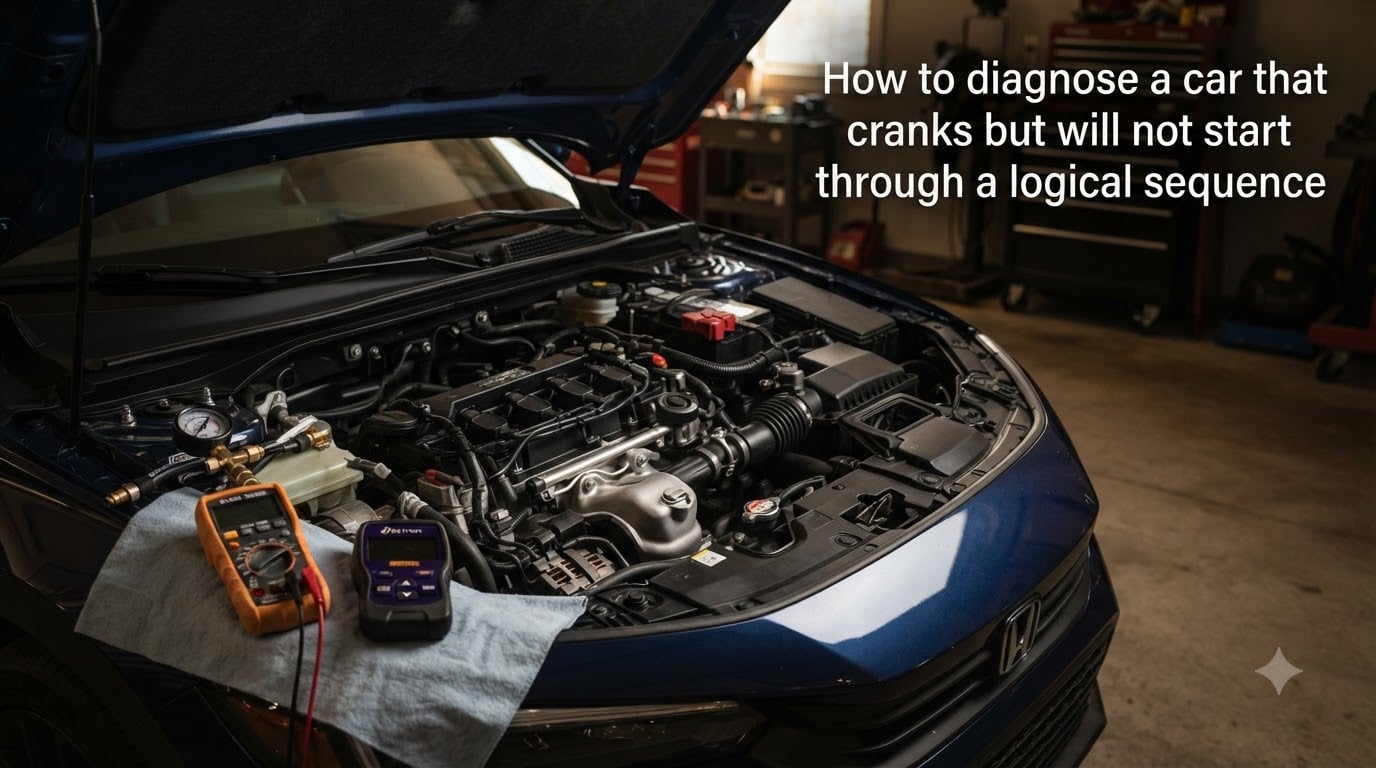
When your car cranks but won’t start, the engine turns over steadily when you turn the key, but it never catches and runs. This specific symptom is different from a dead battery (where nothing happens at all) or a clicking starter (where the engine barely moves). It tells you the starter and battery are doing their job, but something else is preventing combustion. This guide walks you through a car cranks but won’t start diagnosis using a logical sequence that saves you money and prevents wasted part replacements.
I have run through this exact sequence on multiple vehicles in our shop over the years, and the order matters. Start with the cheapest, fastest checks and work toward the deeper mechanical failures. Most crank-no-start conditions come down to fuel, spark, or a sensor, not a blown engine.
Table of Contents
The 30-Second Quick Diagnostic Checklist
Before pulling out any tools, work through this fast triage to narrow down where the problem lives. This is the same starting point professional technicians use.
Listen to the crank. A fast, healthy-sounding crank suggests good battery and starter. A slow, labored crank points back to the battery even if voltage looks okay on a meter.
Watch the dashboard. If the immobilizer or security light stays on or flashes, the anti-theft system may be blocking the start.
Smell for fuel. A strong gasoline smell after cranking means the engine is flooded – stop cranking and try the gas pedal to the floor technique.
Check the obvious. Empty fuel tank, dead key fob battery, or a gear selector that is not fully in Park or Neutral can all cause a no-start.
Remember the engine only needs three things to run: spark, fuel, and compression. Your entire diagnostic plan is finding out which one is missing.
Step 1: Confirm the Battery and Starter Are Not the Problem
Even though the engine is cranking, a weak battery can cause a no-start by starving the fuel pump and ignition coils of voltage. I have seen brand-new cars with a borderline battery crank happily but never fire because the fuel pump could not pressurize.
Test the battery voltage with the engine off. A reading below 12.4 volts means it is undercharged. With the engine cranking, voltage should stay above 10 volts. If it drops into the 8s, charge or replace the battery before going further.
Inspect the battery terminals for corrosion or looseness. A green or white crust on the posts adds resistance and can mimic a no-start. A quick clean with a wire brush and a wiggle of the cables often solves a mystery no-start for free.
Listen to the starter. A clean, steady cranking sound at normal speed confirms the starter is fine. If the engine barely turns over and you hear a fast clicking, return to the battery – that is the starter solenoid not getting enough voltage.
Step 2: Pull OBD-II Fault Codes Before Replacing Anything
An OBD2 scanner costs as little as $25 and pays for itself the first time you use it. Plug it in under the dash, turn the key to the run position, and read the stored codes. This single step eliminates hours of guessing.
Cranks but won’t start conditions often throw codes for crankshaft position sensor, camshaft position sensor, or fuel system lean conditions. If the check engine light is on, the code is a roadmap. If the light is off but the scanner shows stored codes, your problem is in the history.
Write down every code, then clear them and try to start the engine again. New codes that return during cranking point you directly to the failed circuit. Resist the urge to start replacing parts based on a single code – confirm the code points to a real, active failure before spending money.
Step 3: Test the Fuel System From Tank to Injectors
Fuel delivery problems are one of the top three causes of a crank-no-start condition. To run, the engine needs fuel at the right pressure, at the right time, in the right amount.
Start at the fuel pump. Turn the key to the run position and listen near the fuel tank for a two-second prime. Most fuel pumps run briefly when you turn the key to pressurize the system. Silence is a strong sign the pump, its relay, or its fuse has failed.
Next, check the fuel pump relay and fuse. Both live in the under-hood fuse box and are usually labeled. Swap the relay with an identical one nearby (like the horn relay) to test it cheaply. A blown fuse can mean a short or a failing pump drawing too much current – do not just replace it and move on.
If the pump runs, verify fuel pressure with a gauge at the fuel rail test port. A reading well below spec points to a weak pump, clogged filter, or a leaking pressure regulator. No fuel at the rail means the pump cannot push it – usually a bad pump, blocked line, or failed inline filter.
Fuel injectors can also fail. Pull the electrical connector off one injector and try to start. If the engine’s behavior changes, that cylinder was firing (and now is not). The cheapest DIY test is a noid light – if it does not blink during cranking, the injector is not getting a signal.
Step 4: Verify the Ignition System Is Producing Spark
With fuel ruled out, spark is next. Pull a spark plug wire (or coil pack connector on modern cars), stick a known-good spark plug into it, and ground the threads against the engine block. Crank the engine and look for a strong blue spark.
A healthy spark is bright blue and snaps crisply. An orange or weak spark points to a failing ignition coil, bad crank position sensor input, or low system voltage. No spark at all is a clear sign the ignition is not firing.
Common ignition culprits include worn spark plugs, cracked plug wires, failed ignition coils, and bad ignition control modules. Many modern cars have individual coil packs – swapping two coils and retesting can confirm a bad coil in minutes. If the misfire follows the swapped coil, replace it.
Do not forget the basics. Check the ignition fuse, the crank position sensor wiring, and the timing belt or chain. A snapped timing belt commonly causes a crank-no-start with no spark, no fuel codes, and zero compression on affected cylinders.
Step 5: Check the Sensors That Kill a No-Start
The crankshaft position sensor is the most common sensor failure behind a crank-no-start condition. The engine control module needs to know the engine is rotating and at what speed. A bad CKP sensor produces no spark and no fuel injection – the car cranks perfectly but never catches.
Camshaft position sensor failure causes similar symptoms on many engines. The computer uses both sensors to sequence fuel injection and ignition. When one fails, the engine control module often defaults to a no-start strategy to protect the catalytic converter.
Other sensors worth checking are the mass airflow sensor (severely contaminated MAFs can cause a no-start), the manifold absolute pressure sensor, and the throttle position sensor. These rarely cause a complete no-start on their own but can combine with other issues to create one.
A cheap multimeter and a wiring diagram let you test most sensor circuits at home. Compare your readings to the manufacturer’s spec – out-of-range signals usually point to a bad sensor or its wiring.
Step 6: Rule Out Compression and Timing Failures
Compression and timing failures are the rarest crank-no-start causes but the most expensive to fix. Only check here after fuel, spark, and sensors are confirmed good.
A compression test requires removing the spark plugs and threading a gauge into each cylinder. Crank the engine for several revolutions per cylinder. All cylinders should read within 10% of each other and meet factory spec (often 120-180 psi for gasoline engines). A single low cylinder can stop a start.
Low compression usually means worn piston rings, bent valves, or a blown head gasket. If you have a wet test (squirt oil into the cylinder and the reading jumps), the rings are worn. No change points to valves or a head gasket.
Timing failures feel like fuel or spark problems because the engine is not firing correctly. Listen for a ratcheting, scraping sound during cranking – that is often a snapped timing belt or chain. If the belt is intact, the chain may have stretched enough to skip a tooth. Either way, stop cranking and call a shop – more cranking can damage valves.
Step 7: Don’t Forget the Immobilizer and Security System
The immobilizer is the silent troublemaker of crank-no-start conditions. Many owners overlook it because the engine is cranking normally, but a security fault can shut off fuel injection and spark instantly.
Watch the security or immobilizer light on the dashboard. A solid light usually means the system has not recognized the key. A flashing light often indicates an active fault. Try your spare key – if the spare starts the car, the original key’s transponder chip has failed.
Common immobilizer causes include a dead key fob battery, a damaged transponder chip, a weak car battery that scrambled the security module, and aftermarket alarm systems that are misbehaving. A low-cost OBD2 scanner that reads manufacturer-specific codes can flag immobilizer faults a generic scanner will miss.
How to Diagnose Intermittent Crank-No-Start Problems?
Intermittent starting problems are the most frustrating version of a no-start condition. The car starts fine most of the time but refuses occasionally, often when you are already running late.
Start by tracking the conditions. Does it happen hot, cold, after rain, or only when the tank is below a quarter? Patterns cut your diagnostic time by half. Many intermittent no-starts come down to heat – components expand when warm and break the contact. Crank position sensors are notorious for this.
Check for heat-sensitive failures. Wiggle wiring harnesses near hot exhaust manifolds while the engine is idling (or just after shutdown) to see if the no-start condition triggers. A change in engine behavior during this test points to a broken wire or connector.
Look at battery health. A borderline battery often starts the car in cool weather but fails on hot afternoons after the engine bay heat soaks everything. Have the battery load-tested rather than just checking voltage – a battery can show 12.6 volts and still fail under load.
Finally, do not ignore the fuel pump. A failing fuel pump can deliver enough pressure when cold but drop off as it heats up. Wrapping the fuel tank with a wet towel during testing can sometimes delay a no-start long enough to confirm heat sensitivity.
When to Stop DIY and Seek Professional Diagnosis?
Some crank-no-start conditions are not realistic DIY projects. Knowing when to hand the keys to a shop saves you time and money.
If you confirm no fuel pressure at the rail and the pump is not running, modern fuel tanks often need to be lowered or a specialized access panel opened – shop time is the right move here. Similarly, compression tests and timing belt inspections require tools most home mechanics do not own.
Professional diagnostics typically cost between $100 and $200 for the scan, testing, and a written report of findings. That fee is credited toward the repair at most shops. Compared to replacing a $400 fuel pump only to find out the real problem was a $20 crank sensor, professional diagnosis is often the cheaper route.
Stop diagnosing immediately if you hear metal-on-metal scraping during cranking, see coolant in the oil, or notice fuel leaking from the engine bay. These are signs of damage that worsens with continued cranking. Tow the car to a shop and let a technician take over.
Frequently Asked Questions
What sensor can cause a crank no start?
The crankshaft position sensor is the most common sensor failure behind a crank-no-start condition. The camshaft position sensor is a close second – many engines will not start if either signal is missing. The engine control module requires both to know when to fire the spark plugs and inject fuel.
How much does a no start diagnosis cost?
Most shops charge between $100 and $200 for a complete no-start diagnosis, including computer scanning, fuel pressure testing, and a written report. Many shops credit this fee toward any repair you approve based on their findings.
What is the first step in diagnosing a no start problem?
Confirm the engine is actually cranking at normal speed, then plug in an OBD2 scanner and read any stored or active codes. The most common first steps are: check battery voltage above 12.4V, listen for the fuel pump prime, verify spark with a test plug, and rule out an immobilizer fault before going deeper.
How do you diagnose a no start condition?
Use a logical sequence: confirm battery and starter health, scan for OBD2 codes, test fuel pressure and pump operation, verify spark at the plugs, check crankshaft and camshaft position sensors, run a compression test, and finally rule out immobilizer faults. Replace only what testing confirms is bad.
How would you approach a vehicle that will crank over but will not start?
Treat it as a fuel, spark, compression, or sensor problem in that order. Start with the cheapest tests – a fuel smell check, a spark test, and a scanner read – before spending money on parts. Most crank-no-start conditions resolve with a $20 sensor or a $50 fuel pump relay.
The Bottom Line on Crank-No-Start Diagnosis
A car that cranks but won’t start is one of the most misdiagnosed problems in DIY auto repair. The temptation to throw parts at the symptom is strong, especially after the third time the car refuses to start in a parking lot. The logical sequence above – battery, codes, fuel, spark, sensors, compression, immobilizer – finds the real cause in nearly every case without wasting money.
Run through the quick checklist first, then move into the deeper checks in order. If your testing stalls on a step you cannot perform, that is when professional diagnosis earns its fee. In 2026, a $100 shop scan is cheaper than replacing three parts that were never broken.