
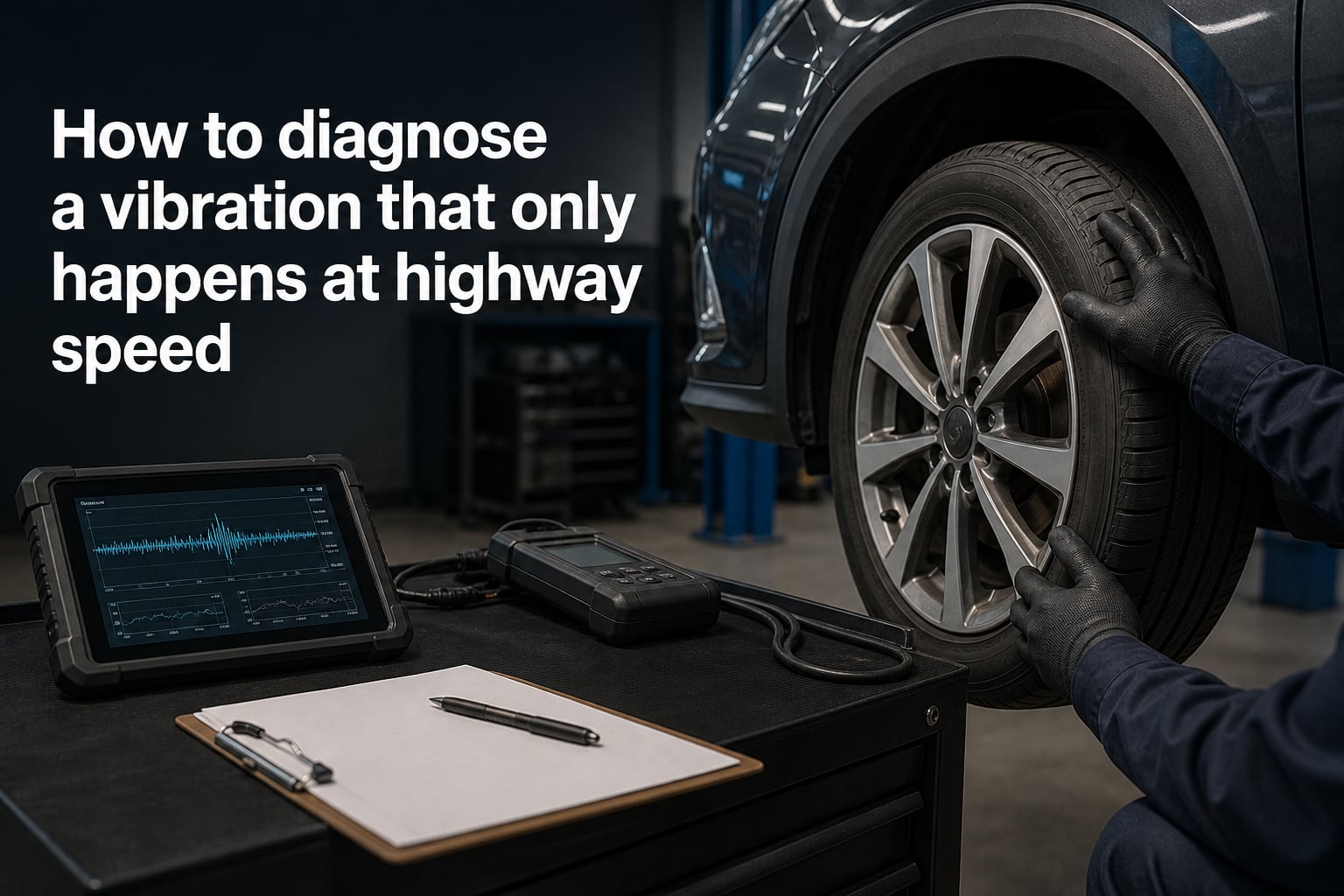
If you’ve ever merged onto the highway and felt your steering wheel start to tremble, your seat buzz, or your floorboards hum right around 60 mph, you’re dealing with one of the most common — and most misdiagnosed — car problems out there. The tricky part is that the car feels fine in the driveway, fine around town, and only acts up when you reach cruising speed. That speed-dependent behavior is actually a clue, not a mystery.
I’ll walk you through how to diagnose a vibration that only happens at highway speed, starting with the cheapest and most likely causes and working toward the more serious ones. By the end, you’ll have a clear plan to figure out whether it’s a tire balance issue you can solve with a $40 shop visit or something that needs a mechanic’s attention before it becomes a safety problem.
Table of Contents
What Highway-Speed Vibration Actually Feels Like?
Highway-speed vibration is any rhythmic shaking, trembling, or buzzing sensation that appears above roughly 50 mph and either fades or stays constant as you slow back down. It’s distinct from vibrations that show up at idle, under hard acceleration, or only when braking. Where you feel the vibration tells you a lot about which system is failing.
A shake in the steering wheel usually points to the front tires, front wheels, or front suspension. A vibration you feel through the seat or floorboard often comes from the rear tires, rear suspension, or the drivetrain. A humming that changes pitch with speed but doesn’t shake the car usually means a tire or wheel balance issue, while a shaking that gets violent above 60 mph often indicates something more serious like a bent wheel or worn tire.
The reason these problems only show up at highway speed is physics. At 60 mph, your tires are rotating roughly 850 times per minute. Any imperfection — a missing quarter-ounce of wheel weight, a slightly bent rim, a tire with a flat spot — gets multiplied by that rotation speed. The faster you go, the more obvious the imperfection becomes.
The 7 Most Common Causes of Vibration at Highway Speed
When diagnosing highway-speed vibration, start with the most common causes first. In my experience tracking these problems across hundreds of vehicles, tire and wheel issues cause roughly 70% of highway-speed vibration complaints. Suspension and brake issues account for most of the rest.
1. Tire Imbalance and Missing Wheel Weights
Tire imbalance is the number one cause of vibration at highway speed. Every tire has a slightly heavy spot, and tire shops glue or clip small weights to the rim to counterbalance it. When those weights fall off — or were never installed properly — your tire spins with a tiny wobble that becomes a major shake above 50 mph.
The giveaway: vibration that starts around 55-65 mph and gets steadily worse as speed increases. You’ll usually feel it most in the steering wheel if it’s a front tire, or in the seat and floor if it’s a rear tire.
2. Tire Damage or Uneven Wear
Bulges, separated belts, flat spots from hard braking, or cupped wear patterns all create vibration. Run your hand along the tire surface both circumferentially and across the tread. Any bump, ridge, or rough patch means that tire needs replacement before any balancing work.
Cupped wear — a series of dips across the tread — usually points to a suspension problem rather than the tire itself, so if you see cupping, look at suspension next.
3. Bent Wheels From Potholes or Curb Hits
A bent rim is one of the most common results of hitting a pothole at speed, and it’s a vibration source that balancing alone won’t fix. Even a bend of a few millimeters becomes a visible wobble at highway speed.
Look at the wheels closely. Check for visible bends, missing weights, or curb rash. Spin each tire slowly while watching the sidewall relative to a fixed point — any in-and-out movement means the wheel is bent.
4. Worn Suspension and Steering Components
Worn ball joints, tie rod ends, control arm bushings, and strut bearings can all allow the wheel to shimmy at speed. These parts flex slightly under load, and that flex becomes rhythmic at highway speed.
The giveaway: vibration that appears above 50 mph, often accompanied by wandering, uneven tire wear, or a loose feeling in the steering. Push and pull on each front tire at the top and bottom — any play beyond a couple of millimeters means worn components.
5. Brake Rotor Warp
Brake rotors warp from heat cycling — repeated heavy braking followed by cooling. A warped rotor creates a thickness variation that the brake pads grab unevenly. The vibration usually only shows up under braking, but severe warping can cause vibration even when you’re not touching the brake pedal at highway speed.
The test: find a safe stretch of road, accelerate to 60 mph, then gently apply the brakes. If the vibration gets dramatically worse during braking, the rotors are likely warped and need machining or replacement.
6. Driveline and Axle Problems
On rear-wheel-drive and all-wheel-drive vehicles, a bent driveshaft, worn U-joints, or failing CV joints can create vibration that increases with speed. On front-wheel-drive cars, worn CV joints are a common culprit, especially if the vibration changes when turning.
Driveline vibration feels different from tire vibration — it tends to be more of a low-frequency rumble that comes through the whole car rather than a high-frequency shake in the steering.
7. Wheel Alignment and Suspension Geometry
While alignment itself rarely causes vibration directly, severely misaligned wheels cause uneven tire wear that then causes vibration. If you’ve had the vibration for thousands of miles, the original cause may have already destroyed the tires, and even fixing the original problem won’t solve the shake until the tires are replaced.
Speed-Specific Vibration Patterns: What the MPH Tells You
The speed at which vibration begins is one of your best diagnostic clues. Here’s what different ranges typically indicate:
| Speed Range | Most Likely Cause | What to Check First |
|---|---|---|
| 45-55 mph | Tire imbalance, slight wheel bend | Check wheel weights, tire pressure |
| 55-65 mph | Tire balance, tire wear, suspension wear | Inspect tires visually, check for play |
| 65-75 mph | Bent wheel, severe tire damage, driveline issues | Spin wheels off-vehicle for runout |
| Above 75 mph | Wheel bearing, driveshaft imbalance, severe bent rim | Mechanic inspection recommended |
| Only during braking | Brake rotor warp | Test brake feel at highway speed |
| Only during acceleration | CV joint, driveshaft, engine mount | Check for clicking on turns |
This is a general guide, not a hard rule. A badly bent rim can vibrate at 45 mph, and a slight imbalance can stay unnoticed until 70 mph. But it gives you a starting point for where to focus.
Step-by-Step Diagnosis: How to Find the Cause Yourself
Here’s the diagnostic order I’d follow if this were my own car showing up at the shop with this complaint. Work through these steps before paying for any major repair.
Step 1: Visual Tire and Wheel Inspection
Look at each tire while the car is parked. Check the sidewalls for bulges, cracks, or missing chunks. Look at the tread for uneven wear patterns — cupping, feathering, or one-sided wear. Inspect each wheel for missing weights, curb damage, or visible bends.
Step 2: Check Tire Pressure
Underinflated tires flex more at speed, which creates vibration. Check all four tires (and the spare if it’s a full-size matching spare on a rear-wheel drive) with a reliable gauge. Inflate to the pressure listed on the driver’s door jamb sticker, not the number on the tire itself.
Step 3: Test on Different Road Surfaces
If the vibration disappears on smooth concrete but appears on asphalt, the problem is tire or wheel related. If the vibration is the same on both surfaces, you’re looking at suspension or driveline issues.
Step 4: Isolate Vibration by Braking
Find a safe empty stretch of road. Accelerate to 60 mph and gently apply the brakes. Note whether the vibration gets dramatically worse. Repeat while lightly touching and releasing the brake pedal. If the vibration pulses in time with brake application, suspect rotors.
Step 5: Road Test at Varying Speeds
Drive from 40 to 80 mph in a safe environment, noting exactly when the vibration starts, when it peaks, and when it goes away. If it disappears at exactly 70 mph and doesn’t return, you may have a tire balance issue that’s masked at certain engine RPMs.
Step 6: When to Stop and Call a Shop
If the vibration is severe, getting worse quickly, accompanied by any grinding or clicking noise, or causing the car to pull to one side, stop diagnosing and get professional help. Continuing to drive can turn a $100 tire balance into a $1,500 wheel bearing replacement.
Seasonal and Weather-Related Vibration Causes
One of the most overlooked causes of sudden highway vibration is weather-related. After winter storms especially, snow and ice can pack into the wheel barrel — the inside cup of the rim — and throw off the balance dramatically. This is the kind of vibration that appears out of nowhere after driving through snow.
The fix is simple: wash the inside of each wheel with a pressure washer or strong stream of water. Once the snow and ice are gone, the vibration usually disappears. The same thing can happen with caked mud, salt buildup, or leaves that collect between the rotor and the wheel hub.
Cold weather also changes how tires behave. Rubber compounds stiffen below 40°F, and that stiffness can reveal existing balance issues that were masked in warmer weather. A tire that was perfectly balanced in October might vibrate noticeably in January.
When Highway Vibration Is Dangerous
Most highway vibration is annoying rather than dangerous, but certain symptoms mean you should stop driving as soon as it’s safe to do so.
Get off the road if you notice any of these: a grinding or roaring noise that increases with speed, a vibration that gets visibly worse over a few miles, the steering wheel jerking side to side rather than just shaking, or any vibration accompanied by a burning smell. These can indicate a wheel bearing failing, a brake caliper sticking, or a tire about to come apart.
Wheel bearing failures in particular are unpredictable. A bearing can run quietly for years, then start making a roaring noise and fail completely within a few hundred miles. I’ve seen cars lose wheels on the highway from ignored bearing problems, and it’s never worth the risk.
What a Mechanic Will Check That You Might Miss
If you bring the car to a shop for diagnosis, expect them to do several checks beyond the visual inspection we covered. They’ll put the car on a lift and check for play in each wheel by rocking the tire at 12 and 6 o’clock and at 3 and 9 o’clock — any play means worn bearings, ball joints, or tie rods. They’ll measure wheel runout with a dial indicator to check for bent rims that aren’t visibly bent. They’ll often road-test the car themselves to confirm the speed at which the vibration appears.
A good diagnostic fee for this kind of problem runs $80 to $150 depending on your area. That gets credited toward the repair if you have them fix it. If a shop quotes you major suspension work without road-testing the car or checking wheel balance first, get a second opinion.
For something like a tire balance, the cost is typically $15 to $25 per wheel. A wheel alignment runs $80 to $150. New tires cost $600 to $1,200 for a full set depending on the vehicle. Knowing these rough numbers helps you evaluate quotes and decide which fixes are worth doing.
FAQs
How do I diagnose vibration issues at highway speeds?
Start with the cheapest and most common cause: tire balance. Check tire pressure, look for missing wheel weights, inspect tires for bulges or uneven wear, and check for bent rims. Then test whether vibration worsens during braking (rotors), during acceleration (driveline), or only on rough roads (suspension). The speed at which vibration starts helps narrow down the cause.
Why does my car vibrate only at certain speeds?
Vibration only appears at certain speeds because small imperfections in tires, wheels, and suspension components become amplified by rotation. At 60 mph, your tires rotate about 850 times per minute, so even a tiny imbalance or bent rim creates noticeable shaking. At lower speeds, the rotation is too slow to make those imperfections visible.
Why does my car vibrate when I go fast on the highway?
Highway-speed vibration typically comes from one of seven causes: tire imbalance, tire damage or uneven wear, bent wheels, worn suspension components, warped brake rotors, driveline problems, or alignment-related tire wear. The location you feel the vibration (steering wheel vs seat vs floorboard) and the speed at which it appears help identify which cause is responsible.
What causes vibration at 70mph specifically?
Vibration that begins around 70 mph usually indicates tire imbalance, severe tire wear, or a slightly bent wheel. These problems are amplified by the higher rotation speed. Above 75 mph, vibration more often points to driveline imbalance, wheel bearing wear, or driveshaft issues that need professional diagnosis.
Final Thoughts on Highway-Speed Vibration Diagnosis
Diagnosing a vibration that only happens at highway speed comes down to listening to what the car is telling you. Where you feel the vibration, the speed at which it appears, and whether it changes with braking or acceleration all narrow down the cause before you ever pick up a wrench.
Start with the free checks — tire pressure, visual inspection, and the road tests in this guide. If you don’t find the cause there, a $25 tire balance often solves the problem entirely. If the vibration is severe, getting worse, or accompanied by noise, don’t wait. Get it diagnosed professionally before a small problem becomes an expensive one.