
If your car drifts from one side of the lane to the other and you find yourself making constant small steering corrections just to stay straight, you are dealing with car wandering. Learning how to diagnose a car that wanders or will not track straight starts with separating three possible suspects: tires, alignment, and worn steering or suspension parts.
I have walked dozens of drivers through this exact puzzle over the years, and the same three categories come up every time. In this guide I will walk you through what wandering feels like, the causes organized by category, the diagnostic steps you can do at home, and the warning signs that tell you it is time to stop driving and book a professional inspection.
Table of Contents
What Car Wandering Actually Feels Like From the Driver Seat?
Car wandering is the sensation of needing continuous small steering corrections to keep the vehicle in its lane, most noticeable at highway speeds. The steering wheel feels loose, almost lazy, and there is a noticeable dead zone where the car seems to ignore your inputs for a moment.
Drivers describe it in different ways. Some say the car feels like a shopping cart with a wobbly wheel. Others describe the steering as having a mind of its own. A few even say it feels like driving on ice. These are all versions of the same problem: the front wheels are not holding a consistent direction relative to the road.
Wandering is different from pulling. A car that pulls drifts consistently toward one side and wants to keep going that direction. A car that wanders drifts in both directions, often unpredictably. Wandering is also different from a shimmy, which is a quick side-to-side vibration rather than a slow drift.
Common Causes of Car Wandering Organized by Category
The most common causes of car wandering fall into three categories: tire problems, wheel alignment issues, and worn steering or suspension components. Each category produces a slightly different feel, and knowing which category you are in saves hours of guessing.
Tire-related causes: uneven pressure, mismatched tires, uneven tread wear, and improper wheel balance.
Alignment causes: toe, camber, or caster angles out of specification.
Component wear causes: loose tie rods, worn ball joints, soft bushings, and worn steering racks.
Other contributors: road crown, crosswinds, soft suspension, and rim damage.
Start with tires because they are the cheapest check. Then move to alignment. Then look at components. That order matches how the costs climb and lets you rule out the simple stuff first.
Tire-Related Causes of Wandering and How to Spot Them
Tire issues are the easiest wandering causes to check first and include uneven pressure, mismatched tire sizes, uneven tread wear, and improper wheel balance. I always start a wandering diagnosis by looking at the tires because they are the only part of the car that touches the road.
Uneven pressure between the left and right front tires is the classic culprit. A tire that is 4 psi lower on one side will pull and wander toward that side. You can verify this in two minutes with a digital gauge. Check all four tires cold, before driving, and compare the readings.
Mismatched tires on the same axle also cause wandering. If you have a brand-new tire on one side and a half-worn tire on the other, the rolling diameters differ slightly and the car drifts. This is a common issue after a single tire replacement when the shop did not recommend matching by tread depth.
Uneven tread wear tells you a lot. Feathering (smooth on one side, sharp on the other) usually means a toe alignment problem. Cupping (scalloped wear) usually means a worn shock or strut. One-sided shoulder wear usually means camber is off.
Wheel balance is the last tire check. An unbalanced wheel will create vibration and wandering that gets worse at specific speeds. If the wandering appears around 55 mph but calms down at 70 mph, balance is a strong suspect.
How Alignment Angles Cause Tracking Problems?
Toe, camber, and caster angles that are out of specification cause the wheels to fight each other instead of rolling straight, which the driver feels as wandering. Three angles matter for tracking, and each one has a different effect on how the car behaves.
Toe angle is the most common wandering cause. Toe is the direction the front of the tires point relative to each other. Toe-in means the fronts point slightly toward each other. Toe-out means they point away. Even a small toe error, on the order of a few millimeters, makes the car want to wander because the tires are constantly fighting to roll in different directions.
Camber angle is the vertical tilt of the tire when viewed from the front. Too much positive camber (top of tire leaning outward) or negative camber (top leaning inward) creates uneven shoulder wear and reduces the tire’s contact patch on the road. The result is wandering, especially on crowned roads.
Caster angle is the tilt of the steering axis when viewed from the side, like the forks on a bicycle. Positive caster gives the car straight-line stability. If caster is unequal between the two sides, the car will pull toward the side with less positive caster. If caster is too low on both sides, you get wandering at speed because the steering lacks self-centering force.
Rear wheel alignment matters too. If the rear wheels are not parallel to each other or to the car’s centerline, the front wheels can never track straight. This is sometimes called dog tracking, and it is a common issue after rear suspension damage.
Worn Steering and Suspension Components That Create Play
Worn tie rods, ball joints, control arm bushings, steering rack mounts, and idler or pitman arms create the steering play that produces wandering. Components wear out gradually, which is why wandering often feels like it sneaks up on you rather than appearing overnight.
Tie rod ends connect the steering rack to the wheels. When the inner or outer tie rods wear, you get direct play between the steering wheel and the wheels. A worn tie rod end usually produces a clunk when you turn at low speed and visible wiggle in the tire when the wheel is off the ground.
Ball joints connect the control arms to the steering knuckles. A worn ball joint allows the wheel to tilt inward and outward as you drive. The classic symptom is a wandering car that gets worse over bumps and a tire that wears unevenly on the inside or outside edge.
Control arm bushings are the rubber or polyurethane pieces that cushion the control arms where they attach to the frame. When bushings harden or crack, the suspension shifts slightly under acceleration, braking, and cornering. The result is wandering plus uneven tire wear.
Steering rack mounts hold the steering rack to the frame. If the mounts are soft, the rack can move slightly when you turn the wheel, and the car wanders because the steering input is not going where it should. Steering rack mounts are an underrated cause and often missed by general mechanics.
On trucks and older rear-wheel-drive cars, idler arms and pitman arms serve similar functions to tie rods. Worn versions of either component produce identical wandering symptoms.
Step-by-Step Dry Park Test to Diagnose Steering Wander
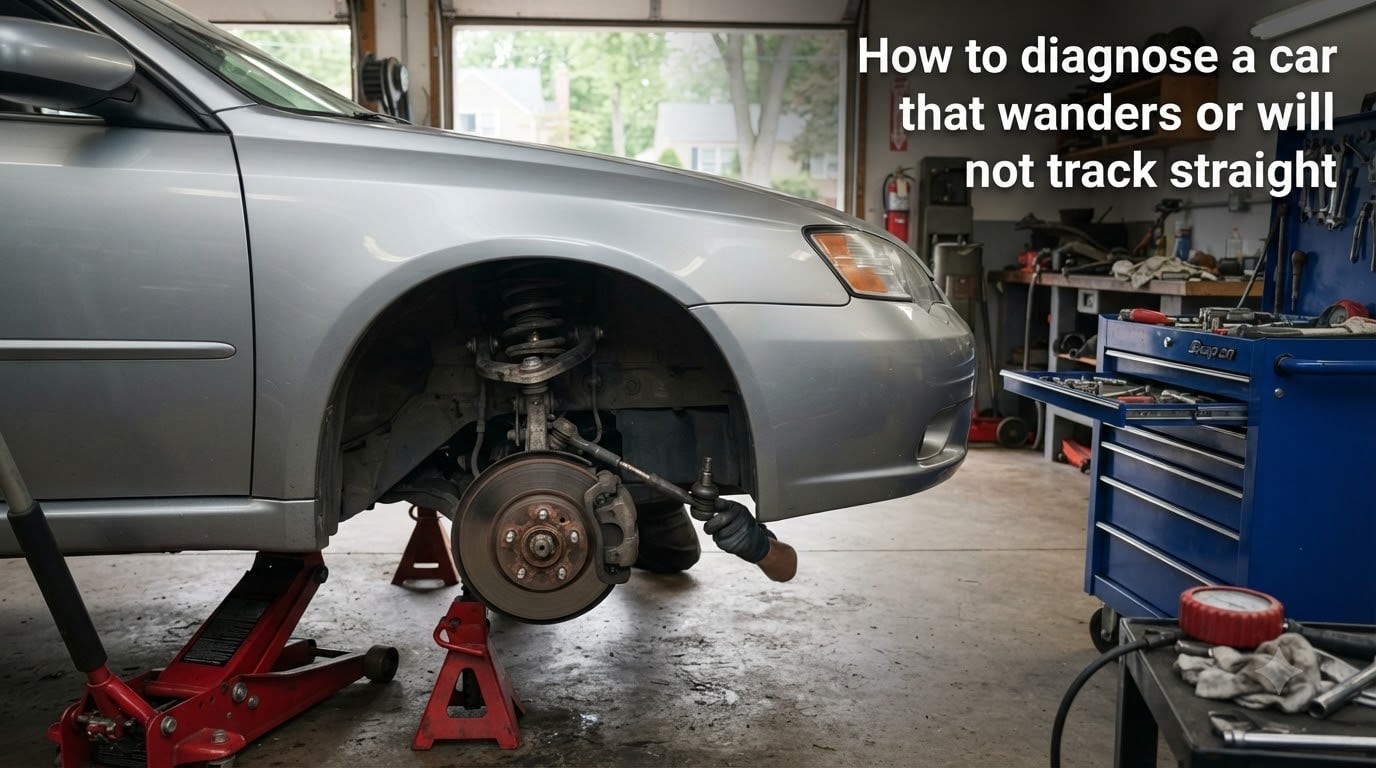
The dry park test loads the front wheels on the ground with the engine off and lets you check for looseness in the steering and suspension by hand. This is the test I run first when I am on a hoist or jack stands, and it catches most component wear before I ever turn a wrench.
Park on level ground. Make sure the parking brake is firmly set and the wheels are chocked. Safety comes first because you will be putting force on the vehicle.
Lift the front of the car with a floor jack and support it securely on jack stands. Both front wheels must be off the ground.
Grasp each front tire at the 9 and 3 o’clock positions and try to push in and pull out. Any clunk, click, or noticeable movement means worn ball joints, tie rods, or wheel bearings.
Now grasp each tire at the 12 and 6 positions and try to rock it top to bottom. Movement here usually points to wheel bearings or struts.
Have a helper slowly turn the steering wheel back and forth while you watch the tie rods and ball joints. Worn parts will show visible play.
Inspect the boots and bushings visually. Cracked or torn CV boots, split tie rod boots, or cracked control arm bushings are immediate red flags.
If you feel play in the dry park test, the cause is component wear, not alignment. If everything feels tight, you can move on to alignment without replacing parts.
Test-Drive Observations That Help Narrow the Cause
How the wandering behaves under braking, acceleration, speed bumps, and crosswinds tells you which system is at fault. A controlled test drive is one of the best diagnostic tools, and you already have it available every day.
Brake test. If the car pulls to one side only when you apply the brakes, suspect a sticking brake caliper or warped rotor on the opposite side. This is different from a true alignment problem because the pull goes away when you release the brakes.
Acceleration test. If the car wanders more during hard acceleration, suspect engine or transmission mounts, soft rear bushings, or worn differential mounts on rear-wheel-drive cars. The wandering usually calms down at steady throttle.
Speed bump test. Drive slowly over a speed bump and pay attention to secondary movements after the initial impact. If the steering wiggles side to side after the bump, the shock absorbers or struts are likely worn and not damping properly.
Crosswind and road crown test. On a calm day with no wind, drive on a flat section of straight road. If the car still wanders, alignment or components are the issue. If it only wanders in wind or on crowned roads, your car may simply be sensitive to external forces.
Why Wandering Often Worsens at Highway Speeds
Steering wander worsens at higher speeds because small geometric errors and small amounts of component play get amplified as the car covers more distance per second. A 2 mm toe error that is barely noticeable at 25 mph becomes a constant tug at 70 mph because the wheels cover that much misalignment many times per second.
Aerodynamic forces also kick in at speed. Crosswinds push harder on the side of the car, and any imbalance in the steering system turns that push into wandering. This is why many cars feel great in town but unpredictable on the highway.
Low-speed cars that feel fine are not always fine. The same condition is present, but the steering corrections are small and infrequent enough that you do not notice them.
Bump Steer and Road Crown: Two Often-Missed Causes
Bump steer is unwanted toe change when the suspension moves up and down, and road crown is the built-in slope of the road that every car naturally follows. Both are real causes that even experienced mechanics sometimes overlook.
Bump steer happens when the tie rods and the suspension arms do not move in the same arc as the wheel moves up and down. The result is that the toe angle changes as you hit a bump, and the steering wheel tugs in your hand. Bump steer is most common in lowered cars or cars with non-standard suspension components.
Road crown is the gentle slope built into most roads so water runs off. Every car naturally pulls slightly toward the lower side of the crown. If your car’s alignment is otherwise correct, the crown pull is normal. If your car wanders noticeably even on flat roads, the crown is just exposing an existing alignment or component issue.
Tramlining is the tendency of a car to follow grooves, ruts, or painted lines on the road. Tramlining is usually a tire stiffness or alignment issue, and it shows up most on highways with deep truck ruts.
When to Stop Driving and Get Professional Diagnosis?
Stop driving and seek professional diagnosis if wandering appears suddenly, gets rapidly worse, comes with noises, or follows a curb or pothole impact. Some wandering is annoying but safe. Other wandering is a sign of a part that is about to fail.
Sudden onset after a curb impact or pothole usually means a bent wheel, broken spring, or damaged suspension part. Get it inspected immediately.
Rapidly worsening wandering over days or weeks often means a tie rod or ball joint is wearing out fast.
Clunks, squeaks, or grinding accompanying the wandering point to a specific mechanical part that needs attention.
Steering wheel that jerks or pulls hard at any speed is a serious safety issue and the car should not be driven far.
Uneven tire wear showing up within a few thousand miles of new tires is a sign the alignment or components are off.
When in doubt, have it towed. Steering failures are not the place to gamble on making it to the shop.
Prevention Habits That Keep Your Car Tracking Straight
Monthly tire pressure checks, regular rotation, periodic alignment checks, and avoiding curb impacts are the four habits that prevent most wandering issues. Prevention is cheaper than repair, and these habits take only a few minutes per month.
Check tire pressure on every tire, including the spare, once a month. Use a quality digital gauge and check when the tires are cold. Rotate tires every 5,000 to 7,500 miles to promote even wear. Get a four-wheel alignment check every two years or after any suspension work, curb impact, or new tire installation. Avoid parking with the wheels against the curb because it slowly bends steering components.
Frequently Asked Questions
Can a bad alignment cause wandering?
Yes. Bad alignment is one of the most common causes of wandering. Toe, camber, or caster angles that drift out of specification make the wheels fight each other instead of rolling straight, and the driver feels it as constant small steering corrections needed to stay in the lane.
Why does my car not go straight when the wheel is straight?
If the steering wheel is centered but the car drifts, the most likely causes are unequal tire pressure, mismatched tires, alignment offset, or worn steering components such as tie rods or ball joints. Road crown and crosswinds can exaggerate the problem.
How can I check if my car is misaligned at home?
You cannot measure alignment angles precisely at home without equipment, but you can spot symptoms. Check for even tire wear across all four tires, look for a steering wheel that sits off-center when driving straight, and note whether the car pulls consistently to one side on a flat road with no wind.
Why does my car feel like it is wandering at high speeds?
Small alignment errors and small amounts of component play get amplified as speed increases because the wheels cover more distance per second. Aerodynamic forces from crosswinds also push harder on the car at speed, turning small steering issues into noticeable wandering.
Why is my steering wheel not straight after an alignment?
If the steering wheel sits off-center after an alignment, the technician set the toe angles correctly for the wheels to track straight but did not recenter the steering wheel sensor or adjust the tie rods equally. Most shops will re-center the wheel as part of the alignment at no extra charge if you point it out.
Final Thoughts on Diagnosing a Car That Wanders
Wandering is a diagnostic puzzle with three main suspects: tires, alignment, and components. Start with the cheapest and easiest checks first. Tire pressure, tire condition, and a dry park test take an afternoon and can save you hundreds of dollars in unnecessary parts. If those checks come back clean, a professional alignment is the next step. If alignment does not fix it, the answer is almost always a worn component that needs replacement.
The clear path from cheapest check to most complex inspection is what makes learning how to diagnose a car that wanders or will not track straight so valuable. You will save money, avoid unnecessary repairs, and most importantly, keep your car safe to drive on every trip.