
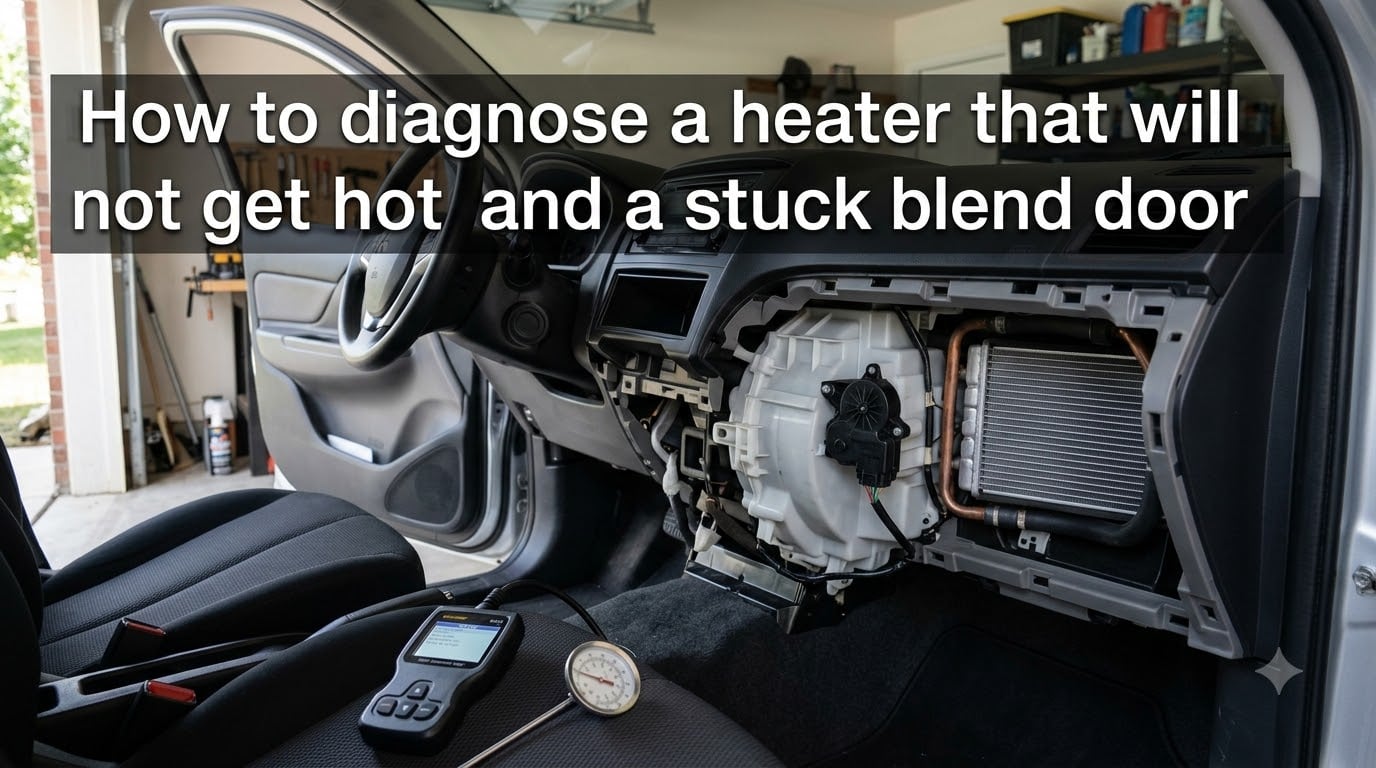
I’ve worked on enough vehicles to know that heater problems drive people crazy. Nothing ruins a cold morning faster than cranking the heat and getting nothing but cold air blowing in your face. Here’s the thing: most guides online only cover the blend door actuator, but your no-heat problem might actually be a failed heater core, a stuck thermostat, or a wiring fault. This guide walks you through how to diagnose a heater that will not get hot and a stuck blend door, covering both the heating system and the blend door actuator so you don’t waste money on the wrong repair.
Table of Contents
Understanding How Your Car’s Heating System Works
Your car’s heating system uses hot engine coolant as its heat source. The coolant flows through a small radiator called the heater core, which sits inside your dashboard. A blower motor pushes cabin air across the heater core fins, and that warmed air exits through your vents.
The blend door controls how much air passes over the heater core versus how much bypasses it. When you slide the temperature knob from cold to hot, the blend door actuator motor rotates the door to redirect airflow. A stuck blend door means the door cannot move, so you get only one temperature regardless of what you set on the climate control.
Two main failure points cause most no-heat complaints: the heater core (no hot coolant reaching the vents) or the blend door actuator (door cannot move to the hot position). Recognizing which one you have saves hours of diagnostic time.
Heater Core vs Blend Door Symptoms: A Quick Comparison
Before we dive into specific tests, here’s a comparison table to help you quickly identify which system is failing. I keep this mental checklist handy whenever I troubleshoot a no-heat complaint.
| Symptom | Heater Core Issue | Stuck Blend Door |
|---|---|---|
| Sweet coolant smell inside cabin | Yes (strong indicator) | No |
| Foggy or greasy windshield film | Yes (coolant vapor) | No |
| Clicking or tapping from dashboard | No | Yes (typical) |
| One temperature only, no blending | No | Yes |
| Coolant loss with no visible leak | Yes (internal leak) | No |
| Heat works on passenger side only | No | Yes (dual-zone fault) |
| Heater hoses both feel hot | No (system flowing) | Yes (door stuck closed) |
| Heater hoses both feel cool | Yes (no coolant flow) | Unlikely |
| Squeaking when adjusting temp | No | Yes (gear issue) |
| Wet passenger floor carpet | Yes (coolant leak) | No |
Tools You Need for HVAC Diagnosis
You don’t need a full shop to figure this out. Here’s what I grab before I start any heater diagnosis.
- Infrared thermometer or basic cooking thermometer (to measure vent air temperature)
- OBD2 scanner with HVAC module access (reads blend door error codes)
- Basic hand tools: screwdrivers, socket set, pliers
- Work light and inspection mirror (for actuator visibility)
- Vehicle service manual (wiring diagrams and torque specs)
- Catch pan and gloves (in case you need to check coolant)
Step-by-Step: How to Diagnose a Heater That Will Not Get Hot
Follow these steps in order. Each one rules out or confirms a specific failure point. Don’t skip ahead, or you might miss a simple problem like low coolant.
Step 1: Check Engine Coolant Level
Pop the hood and check the coolant reservoir when the engine is cold. Low coolant is the number one reason a heater blows cold air. The heater core sits highest in the cooling system, so it loses pressure first when coolant drops.
Step 2: Warm Up the Engine Fully
Run the engine at idle for 10 to 15 minutes until the temperature gauge reaches its normal midpoint. A cold engine cannot produce hot heater air regardless of how new your blend door actuator is.
Step 3: Feel Both Heater Hoses
Locate the two heater hoses entering the firewall. With the engine at operating temperature, both hoses should feel hot to the touch. If only the inlet hose is hot and the outlet is cool, the heater core is likely clogged. If both are cool, the coolant is not circulating through the heater core.
Step 4: Measure Vent Air Temperature
Set the climate control to full hot and the fan to medium. Hold your thermometer or infrared gun at the center vent. You should see air temperatures above 120 degrees Fahrenheit after a few minutes. Anything below 100 degrees indicates a heater core or coolant flow problem.
Step 5: Look for Coolant Leaks Inside the Cabin
Check the passenger side floor for dampness or a sticky residue. A sweet smell in the cabin or fogging on the windshield that won’t clear with the defroster points to a leaking heater core.
Step 6: Scan for HVAC Error Codes
Plug in your OBD2 scanner and check for body control module codes. Common blend door related codes include B1080, B1081, B1260, and B1318 depending on your vehicle make. These codes confirm electrical faults in the actuator circuit.
Step-by-Step: How to Diagnose a Stuck Blend Door
If your hoses are hot but no warm air reaches the cabin, the blend door is the prime suspect. Here’s how to confirm it.
Step 1: Listen for Clicking Noises
Sit in the cabin with the engine running and the radio off. Slowly move the temperature slider from cold to hot. A healthy system makes a single smooth adjustment sound. Repeated clicking, tapping, or squeaking from behind the dashboard indicates a failing actuator motor or stripped gears.
Step 2: Test the Temperature Range
Set the system to full cold, wait two minutes, then feel the vent air. Now set it to full hot and wait again. A stuck blend door will deliver the same temperature in both settings, or only partially respond.
Step 3: Check for One-Sided Temperature Difference
In dual-zone climate systems, set driver and passenger sides to different temperatures. If only one side responds correctly, you have identified which blend door actuator has failed.
Step 4: Run an Actuator Self-Test
Many vehicles have a hidden actuator self-test accessed through the climate control menu or by holding specific buttons. Check your owner’s manual for the exact procedure. A passing actuator cycles smoothly end to end. A failing one stalls or makes grinding noises.
Step 5: Manual Override Test
On some vehicles (notably certain Jeep Wrangler and Honda Element models), you can manually unlatch the actuator arm from the blend door and move the door by hand. If the door moves freely and the cabin heats correctly, the actuator motor is the problem, not the door itself.
Diagnostic Decision Tree: Which Problem Do You Have?
Use this flowchart concept to quickly narrow down your issue. Start at the top and answer each question in order.
- Is the engine fully warmed up? If no, wait 10 more minutes and retest.
- Are both heater hoses hot? If no, you have a heater core or coolant flow problem. If yes, continue.
- Do you smell coolant inside the cabin? If yes, the heater core is leaking. If no, continue.
- Do you hear clicking when adjusting temperature? If yes, the blend door actuator is failing. If no, continue.
- Does the temperature change at all when adjusting? If yes but limited, the blend door is partially stuck. If no, the door is fully jammed.
Following this path typically takes under 10 minutes and pinpoints the failure in most vehicles I’ve worked on.
DIY vs Professional Repair: When to Call a Mechanic
Some HVAC repairs are perfect for a Saturday afternoon. Others require pulling the entire dashboard apart, and those jobs belong in a shop.
DIY-Friendly Repairs
Replacing a blend door actuator is usually a one to two hour job. The actuator typically sits behind the glove box or under the dash, secured by three screws and an electrical connector. Total cost runs between 35 and 120 dollars for the part alone.
Fuses, relays, and HVAC control modules are also DIY accessible. A blown fuse or corroded connector causes no-heat symptoms more often than people expect.
Shop-Required Repairs
Heater core replacement is a different story. The job requires evacuating the cooling system, disconnecting heater hoses, and often removing the dashboard to access the core housing. Labor typically runs 800 to 1500 dollars, plus 100 to 200 for the part.
If your diagnostic tree points to a heater core issue and you don’t have advanced cooling system experience, this one belongs with a professional.
Frequently Asked Questions
How do you know if your blend door is stuck?
The most common signs are clicking or tapping noises from behind the dashboard when you adjust the temperature, only cold or only hot air regardless of the setting, and in dual-zone vehicles, different temperatures on the driver and passenger sides. A failing actuator often makes a single click then repeats it every few seconds.
Can a bad blend door cause no heat?
Yes. If the blend door is stuck in the cold position, hot air from the heater core cannot reach the cabin vents. Your engine coolant will be at full temperature, both heater hoses will feel hot, but only cold air comes out of the dashboard. The blend door physically blocks the airflow path.
What are some reasons why my heater isn’t getting hot?
The four most common causes are low engine coolant level, a stuck open thermostat that prevents the engine from reaching operating temperature, a clogged or leaking heater core that restricts coolant flow, and a failed blend door actuator that keeps the door in the cold position. Less common causes include air pockets in the cooling system, a failed blower motor resistor, or broken HVAC control module wiring.
How to unstick a blend door actuator?
First, run the actuator self-test cycle through your climate control menu to recalibrate it. If that fails, remove the actuator motor and inspect the gear for stripped teeth. On certain vehicles, you can manually unlatch the actuator arm from the blend door and move the door by hand to restore heat temporarily. For a permanent fix, replace the actuator motor, which typically costs between 35 and 120 dollars and takes one to two hours to install.
Final Thoughts
Diagnosing a heater that will not get hot and a stuck blend door comes down to separating the heating system from the air control system. Start with coolant level, verify both heater hoses are hot, then move into blend door actuator testing. Following this order catches most issues in under 30 minutes and prevents the expensive mistake of replacing a heater core when the real problem is a 60 dollar actuator. Keep your OBD2 scanner handy and trust your ears; clicking noises rarely lie.