
An exhaust leak can sneak up on you. One day your engine sounds normal, the next you hear a strange ticking or hissing that gets louder when you press the gas. Learning how to find an exhaust leak by sound and location is one of the most practical diagnostic skills any car, truck, or motorcycle owner can develop.
I have spent years tracking down exhaust leaks in everything from daily commuters to project cars, and the process comes down to two things: listening carefully and knowing where to look. The good news is that most leaks follow predictable patterns. They happen at specific failure points, produce recognizable sounds, and respond to a handful of tried-and-true DIY tests.
This guide walks you through every method I rely on, from sound-based detection to the soapy water test, the smoke test, and the shop vac trick that mechanics on Reddit swear by. By the end, you will know exactly how to pinpoint an exhaust leak in your own garage using nothing more than your ears, some soapy water, and a few household items.
Table of Contents
Sound Signatures of Exhaust Leaks
Sound is your first and best clue when tracking down an exhaust leak. Each type of leak produces a distinct noise, and the specific sound often tells you roughly where the leak is located along the system.
Hissing Sound
A steady hissing noise usually points to a small leak at a gasket or a hairline crack in the exhaust manifold or header pipe. The hiss is caused by high-pressure exhaust gases escaping through a narrow opening, similar to air leaking from a tire. I notice this sound most clearly at idle or light throttle, and it tends to get louder when you rev the engine slightly.
Hissing from the front of the engine bay typically means the leak is near the exhaust manifold or the manifold-to-downpipe gasket. This is one of the most common locations for an exhaust leak to develop.
Ticking Noise
A sharp, rhythmic ticking sound that speeds up with engine RPM is the classic signature of an exhaust manifold leak. Many people mistake it for a valve or lifter tick, but exhaust ticking has a sharper, more metallic quality. You can often hear it best when the engine is cold, before everything heats up and expands.
To tell the difference, try the rag test. If the ticking changes or quiets down when you briefly restrict the tailpipe, the noise is exhaust-related, not internal to the engine.
Popping Sound
A popping or burbling noise, especially on deceleration, often signals a leak at a flange connection or a cracked flex pipe. The popping happens because outside air is being drawn into the exhaust stream at the leak point, causing unburned fuel to ignite. If you hear popping under the car near the catalytic converter or mid-pipe, check the flange gaskets first.
Rumbling Noise
A sudden increase in exhaust rumble or volume that was not there before usually means a larger leak or a completely separated connection. A leak after the catalytic converter tends to produce a deeper rumble. A leak before the muffler often makes the whole system sound louder and more raspy under acceleration.
If your exhaust note changed overnight, suspect a broken hanger, a rotted flange, or a blown gasket rather than gradual wear.
Common Exhaust Leak Locations
Exhaust leaks do not happen randomly. They cluster at specific weak points where heat, vibration, and corrosion do the most damage. Knowing these spots saves you time during diagnosis.
Exhaust Manifold and Header Gaskets
The manifold-to-engine gasket sits at the hottest part of the exhaust system. Repeated heating and cooling cycles cause the gasket material to harden and crack. A leaking exhaust manifold gasket produces that telltale ticking sound and is one of the first places I check.
Cracked manifolds themselves are also common, especially on older vehicles and high-mileage trucks. Look for hairline cracks around the mounting bolts and runner intersections.
Flange Connections
Every flange in your exhaust system is a potential leak point. The downpipe-to-catalytic converter flange and the cat-to-midpipe flange see constant thermal cycling. Gaskets at these connections fail regularly, producing popping sounds and occasional exhaust smell.
Flex Pipe
The flex pipe is designed to absorb engine movement, but its corrugated construction makes it prone to cracking over time. Flex pipe leaks often produce a hissing or rattling sound from underneath the car, roughly below the firewall or front seats.
Muffler and Resonator
Mufflers rot from the inside out due to moisture condensation. Pinhole leaks in the muffler case may not be loud, but they can cause failed emissions tests and reduce backpressure. The resonator-to-tailpipe connection is another common spot for small leaks.
Oxygen Sensor Bungs
The threaded holes where oxygen sensors mount can leak if the sensor was cross-threaded or installed without proper sealant. This is an easy spot to overlook but a frequent source of small leaks that trigger check engine lights.
Visual Inspection: What to Look For
Before reaching for any tools, get under the car and look. A visual inspection catches problems that sound-based detection might miss.
Search for black soot marks around gasket surfaces, flanges, and welds. Soot is exhaust residue that has escaped and deposited on surrounding metal. A clean streak in an otherwise grimy area can also indicate a leak.
Look for rust scaling, especially on the bottom of pipes and mufflers where moisture collects. Check that all clamps and hangers are tight and that no pipe sections have separated. Hairline cracks often show up as faint lines of fresh rust surrounded by older, darker surface corrosion.
Soapy Water Test Method
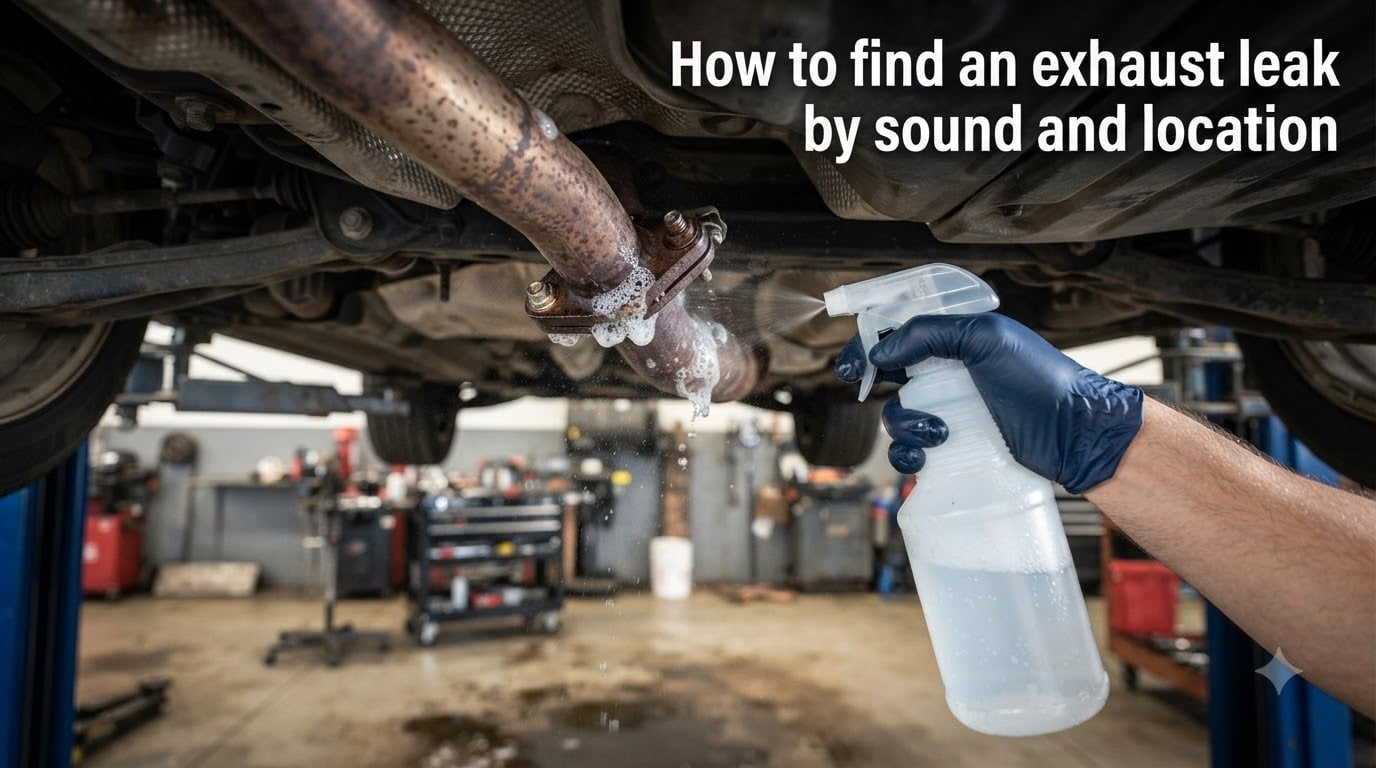
The soapy water test is the most accessible DIY method for finding an exhaust leak. It works on the same principle as checking a tire for a slow leak.
Here is how to do it step by step:
Step 1: Park the car on a level surface and let the exhaust cool completely. Spraying soapy water on a hot manifold can cause warping or even cracking.
Step 2: Mix a few squirts of dish soap into a spray bottle filled with water. Shake gently to create suds without too much foam.
Step 3: Have a helper start the engine and hold it at a steady idle. The exhaust system pressurizes from the engine’s combustion pulses.
Step 4: Spray the soapy mixture generously on suspected leak areas. Start at the exhaust manifold gasket and work your way back along the system.
Step 5: Watch for bubbles. Escaping exhaust gases will blow bubbles in the soapy film, pinpointing the exact leak location. Mark the spot with chalk or a paint pen.
This method works best on small to moderate leaks. Very large leaks may blow the soapy film away before bubbles can form, so you may need to apply a thicker foam layer.
Smoke Test Method
A smoke test is what professional shops use, and you can replicate it at home with a few creative approaches. The goal is to fill the exhaust system with visible smoke or vapor and watch where it escapes.
For a DIY smoke test, block the tailpipe with a rag or tennis ball, leaving a small gap. Have a helper blow cigarette smoke or hold a lit incense stick near the tailpipe opening while the engine is off. Use a shop vacuum in reverse (blower mode) connected to the tailpipe to push the smoke through the system. Any leak will show as wisps of smoke escaping at the failure point.
If you have access to a proper smoke machine, connect it to the tailpipe with the engine off. Pressurize the system at 1 to 2 psi and walk underneath the car looking for smoke. This method is extremely accurate and finds even the smallest pinhole leaks.
Smoke tests are especially useful for finding leaks that soapy water misses, such as hairline manifold cracks or slow leaks at oxygen sensor threads.
Shop Vac Pressurization Method
This is the method that gets recommended over and over on Reddit’s r/MechanicAdvice, and for good reason. It turns your shop vacuum into a homemade pressure tester.
First, set your shop vac to blow mode instead of vacuum mode. Most models have a detachable exhaust port on the motor housing. Connect a flexible hose from the blower port to the tailpipe and seal the connection with a rag or duct tape so air cannot escape backward.
Block any remaining tailpipe openings. If you have dual exhaust, block the second tailpipe as well. Turn on the shop vac to pressurize the exhaust system.
Now spray soapy water on every joint, gasket, weld, and suspect area while the system is under pressure. Bubbles will form at every leak point. Because the engine is off, you can safely reach into areas that would be dangerous around a running engine.
This method combines the precision of a smoke test with the accessibility of the soapy water test. It is my go-to recommendation for anyone who wants professional-level leak detection at home.
How to Differentiate Exhaust Leaks from Other Noises
Not every ticking or hissing sound under the hood is an exhaust leak. Misdiagnosis is a common frustration, so here is how to tell exhaust noise apart from other engine sounds.
Valve Tick vs Exhaust Tick
Valve train ticking tends to be consistent regardless of load. Exhaust ticking often changes with throttle position and may quiet down as the engine warms up and metal expands. If the tick goes away after the engine reaches operating temperature, suspect an exhaust manifold leak rather than a valve issue.
Lifter Noise vs Exhaust Leak
Lifter noise has a softer, more muffled quality compared to the sharp metallic tick of an exhaust leak. Lifters also tend to tick at a rate tied to camshaft speed rather than crankshaft speed, which changes the rhythm subtly.
Heat Shield Rattle vs Exhaust Leak
A loose heat shield produces a metallic buzzing or rattling at specific RPM ranges, often around 2000 to 2500 RPM. It does not change with throttle load the way an exhaust leak does. Tap the heat shields with a rubber mallet while the engine is off to check for loose fasteners.
The Rag Test
When in doubt, use the rag test. Have a helper hold a rag loosely over the tailpipe while the engine idles. This builds backpressure in the system. If the noise changes pitch or volume, you are dealing with an exhaust leak. If nothing changes, look elsewhere.
Be careful not to fully block the tailpipe for more than a few seconds, as excessive backpressure can damage the engine.
Safety Warnings: Carbon Monoxide Risks
This section is the most important one in this guide. Exhaust leaks are not just a noise problem. They are a serious health and safety hazard.
Carbon monoxide is a colorless, odorless gas produced by every internal combustion engine. When an exhaust leak develops anywhere upstream of the tailpipe, CO can enter the passenger cabin through the firewall, floor drains, or HVAC intake. Symptoms of CO exposure include headache, dizziness, nausea, confusion, and fatigue. Prolonged exposure can be fatal.
If you smell exhaust fumes inside the cabin, stop driving immediately and address the leak before using the vehicle again. Rolling down the windows is not a reliable fix, as CO can still accumulate at dangerous levels.
Always perform exhaust leak testing in a well-ventilated area. Never run an engine in a closed garage. If you are using the shop vac method with the engine off, you avoid CO exposure entirely, which is another reason I recommend that approach.
When to Seek Professional Help
If the leak is at the exhaust manifold and requires removing rusted bolts from the cylinder head, consider taking it to a shop. Manifold bolts are notorious for snapping off, and extracting a broken bolt from an aluminum head is a job best left to a professional with the right extraction tools.
Similarly, if you suspect the leak is before the catalytic converter and your check engine light is on with oxygen sensor or catalyst efficiency codes, a professional diagnosis can confirm whether the leak is the root cause or if the sensor itself has failed.
Effects of Exhaust Leaks on Your Vehicle
Beyond the noise and safety risks, exhaust leaks cause real mechanical problems if left unaddressed.
A leak before the oxygen sensor allows outside air into the exhaust stream, which the sensor reads as a lean condition. The engine computer responds by adding fuel, which richens the mixture, drops fuel economy, and can eventually foul spark plugs and damage the catalytic converter.
Leaks also reduce exhaust backpressure, which on some engines causes rough idling, hesitation under acceleration, and reduced low-end torque. Over time, the combination of rich running and reduced backpressure can lead to expensive repairs far beyond the cost of fixing the original leak.
FAQs
What does an exhaust leak sound like?
An exhaust leak typically sounds like a hissing, ticking, popping, or sudden rumbling noise. The ticking is sharp and metallic, speeds up with engine RPM, and is most noticeable when the engine is cold. Hissing indicates a smaller gasket or crack leak, while popping on deceleration often points to a flange or flex pipe issue.
What is a quick test for checking for exhaust leaks?
The quickest test is the soapy water method. Mix dish soap and water in a spray bottle, have a helper start the engine, and spray the mixture on suspected leak areas. Bubbles will form at the exact location of the leak. For an even safer approach, use a shop vac in blower mode to pressurize the system with the engine off.
Can I drive if I have an exhaust leak?
Driving with an exhaust leak is risky. If the leak is before the catalytic converter, carbon monoxide can enter the cabin and pose a serious health threat. Small leaks after the catalytic converter may be drivable short-term, but any leak can reduce fuel economy, damage oxygen sensors, and ruin the catalytic converter over time. Get it fixed as soon as possible.
Where are most exhaust leaks located?
Most exhaust leaks occur at the exhaust manifold gasket, flange connections between pipe sections, the flex pipe, oxygen sensor bungs, and muffler welds. These are the points subjected to the most heat cycling, vibration, and corrosion.
Will an exhaust leak affect gas mileage?
Yes. A leak before the oxygen sensor tricks the engine computer into running a richer fuel mixture, which reduces fuel economy. The check engine light may also illuminate with lean or oxygen sensor codes. Fixing the leak typically restores normal fuel efficiency.
What can be mistaken for an exhaust leak?
Valve tick, lifter noise, and loose heat shield rattles are commonly mistaken for exhaust leaks. Exhaust ticking is sharper and often quiets as the engine warms up. The rag test, where you partially block the tailpipe to build backpressure, helps confirm whether the noise is exhaust-related.
Conclusion
Finding an exhaust leak by sound and location is a methodical process that anyone can learn. Start by identifying the type of sound, whether it is hissing, ticking, popping, or rumbling, because that immediately narrows down the possible locations. Then confirm your suspicion with a soapy water test, smoke test, or shop vac pressurization method.
Remember that exhaust leaks are more than an annoyance. They can pump carbon monoxide into your cabin, wreck your fuel economy, and damage your catalytic converter. If you smell exhaust inside the vehicle or your check engine light comes on with oxygen sensor codes, do not wait to track down the source.
Now that you know how to find an exhaust leak by sound and location, grab a spray bottle, get under your car, and start listening. The answer is almost always hiding at a gasket, flange, or weld connection waiting to be found.