
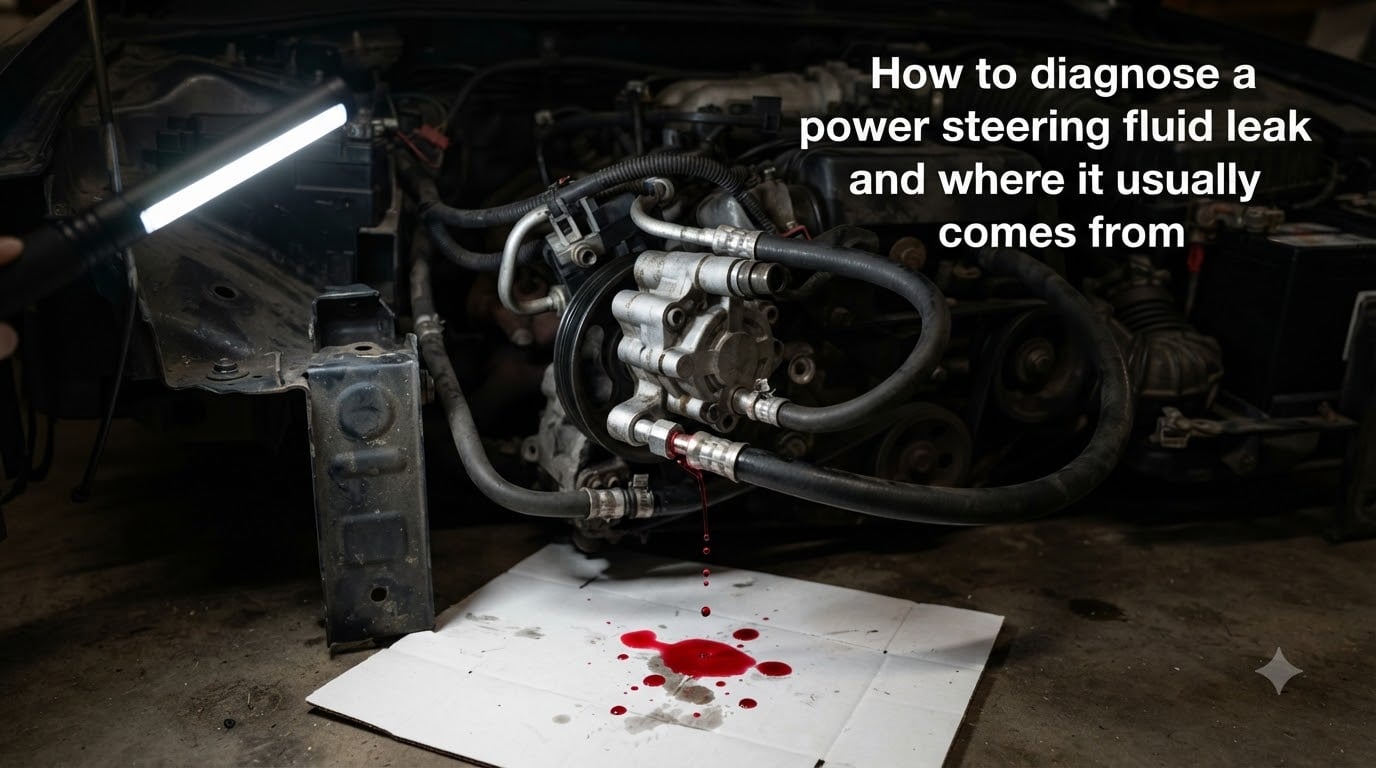
If you have ever walked out of a parking lot and seen a reddish or amber puddle under your car, you probably asked yourself one question first: is this power steering fluid? I have been there. After spending a weekend chasing an elusive leak on my old Ford F-150 and then another on a friend’s Honda Accord, I learned that knowing how to diagnose a power steering fluid leak saves time, money, and a tow truck bill.
This guide gives you the same diagnostic process I use now. We will walk through what power steering fluid looks like, the symptoms that tip you off, the 7 most common leak locations, a step-by-step DIY diagnosis, real repair costs, and the safety warnings that keep you out of trouble.
Table of Contents
What a Power Steering Fluid Leak Looks Like (And Why It Happens)?
A power steering fluid leak happens when the hydraulic fluid that assists your steering escapes from a seal, hose, or fitting. Your steering system runs at up to 1,500 PSI in some vehicles, so even a pinhole leak sprays fluid like a small garden hose when you turn the wheel.
The fluid itself is usually red, pink, or amber, depending on the type. Most modern cars use synthetic or semi-synthetic fluid that runs reddish, while some older Hondas use a clear amber fluid. If you see a slick puddle near the front of the car, especially on the passenger side where the pump often sits, that is your first clue.
Power Steering Fluid Leak Symptoms You Should Never Ignore
Symptoms show up before the puddle does in most cases. I always tell people to listen, feel, and look. Here are the warning signs I watch for during any inspection.
Whining or Groaning Noise When Turning
A high-pitched whine that rises with engine RPM and gets louder as you turn the wheel is the classic sign of low fluid. The pump is sucking air along with fluid, and that air-fluid mix makes a noise most drivers describe as a moan or a shriek.
Heavy or Jerky Steering
If the wheel suddenly feels like a truck without power assist, your fluid level is too low. You will notice it most at low speeds, like in parking lots, when the pump demands the most volume.
Visible Puddles Under the Car
Place clean cardboard or paper under your vehicle overnight. In the morning, you can see exactly where the drip pattern starts. A pool centered under the engine bay usually points to the pump, hoses, or rack.
Burning Smell and Smoke
If fluid hits the hot exhaust manifold, you will smell a sharp, burnt-fluid odor and may even see wisps of smoke. This is also a fire risk, which we will cover in the safety section.
Low Fluid Reading on the Dipstick
Most reservoirs have level marks on the cap or dipstick. A reading below MIN means either a leak or burned-out fluid. Refilling only to watch it drop again confirms a leak.
7 Common Power Steering Leak Locations
After tracking down dozens of these leaks, I can tell you the fluid almost always comes from one of seven spots. Check them in order from most to least common.
Place 1: Power Steering Pump Shaft Seal
The pump shaft seal is the single most common leak point, especially on Ford, Chevy, and Dodge trucks over 100,000 miles. The seal sits where the pump input shaft enters the housing. Over time, the rubber hardens and fluid weeps out behind the pulley.
The tell-tale sign is a wet dust pattern radiating from the pump pulley. A quick check: with the engine off, look behind the pulley for a dark, wet streak.
Place 2: High-Pressure Hose (Pump to Rack)
The high-pressure hose carries fluid from the pump to the steering rack at full system pressure. Crimped fittings at each end fail first, often spraying a fine mist of red fluid when you turn the wheel. Honda Accords and Nissan Altimas are notorious for hose failures around 80,000 to 120,000 miles.
Place 3: Return Hose (Rack to Reservoir)
The return hose runs at low pressure but takes constant heat cycles. It can crack, swell, or slip off the barb fitting at the reservoir. A simple worm-gear clamp often fixes a slipped hose, but a cracked hose means replacement.
Place 4: Steering Rack or Gearbox Seals
Inner and outer rack seals wear with age and let fluid seep past the input shaft or piston seals. Rack leaks are the most expensive to fix, since the rack often has to come out. Jeeps, Chevy trucks, and older sedans see this pattern frequently.
Place 5: Power Steering Reservoir or Cap
A cracked reservoir or loose cap lets fluid splash out during turns. The cap itself can fail to vent properly, building pressure that pushes fluid past the seal. Look for wet streaks down the side of the reservoir tank.
Place 6: Cooler Lines (If Equipped)
Some vehicles route power steering fluid through a cooler, similar to transmission fluid cooling. The cooler lines run to the radiator or a separate heat exchanger and can corrode or rub against other components, creating pinhole leaks.
Place 7: Loose or Damaged Fittings
Banjo bolts, flare nuts, and O-rings at every connection point can loosen over time. A drip at a fitting often responds to a simple tighten or a $5 O-ring swap. This is the cheapest fix and worth checking first.
DIY Diagnosis Steps: How to Find the Leak Yourself
This is the process I walk through on every car that comes into my shop. You need basic gear: a flashlight, a creeper, brake cleaner, clean rags, and either UV dye or patience.
Step 1: Top Off the Fluid and Clean the Area
Fill the reservoir to the MAX line with the correct fluid type. Then spray the engine bay, hoses, pump, and rack with brake cleaner. Wipe everything dry. Any new leaks will show up clean against the dry surfaces.
Step 2: Place Cardboard Under the Car Overnight
Lay clean white cardboard or butcher paper under the front of the car. Park on level ground. The next morning, the drip pattern tells you which side of the car the leak comes from and how active it is.
Step 3: Start the Engine and Turn the Wheel
With the car idling in park (or with the wheels off the ground if you have jack stands), slowly turn the wheel lock to lock. Have a helper watch with a flashlight. A high-pressure leak will spray visibly during this test.
Step 4: Add UV Dye for Hidden Leaks
If you still cannot find the source, add UV dye to the reservoir, run the engine for five minutes, then shut it off. Shine a UV blacklight across every connection. The dye glows bright yellow-green at the exact leak point. This works for slow leaks that never drip while you are watching.
Step 5: Pressure Test the System
A hand pump pressure tester lets you hold the system at operating pressure without running the engine. Watch the gauge. If pressure drops without turning the wheel, the leak is on the high-pressure side. If pressure holds, the leak is on the return side.
Step 6: Inspect Specific Components
With the leak located to a general area, focus on the most likely component. Squeeze hoses looking for soft spots, check fittings for crusty buildup, and look for rust trails on metal parts where fluid has run and dried.
Power Steering Leak Repair Cost Estimates
Here are real shop prices for 2026, based on what I see at independent garages and dealerships. Costs depend on your vehicle, but these ranges are accurate for most sedans and light trucks.
Loose fittings or hose clamps: A $5 clamp and 30 minutes of your time, or around $80 to $150 at a shop.
Hose replacement (high-pressure or return): $40 to $120 for the hose, plus $150 to $300 in labor.
Pump replacement: $150 to $500 for the part, $200 to $450 for labor. Rebuilt pumps save money.
Rack and pinion replacement or rebuild: $400 to $1,200 for parts and $300 to $600 in labor.
Reservoir replacement: $40 to $150 for the tank, plus $100 to $200 labor.
Doing the work yourself can save 40 to 60 percent on most jobs. The exception is rack replacement, which often requires special tools and alignments afterward.
When to Call a Mechanic (And When You Can Drive)
Not every leak means a tow truck. Here is how I make the call for my own cars and for customers.
You can usually keep driving short distances if: the leak is slow, the fluid stays above MIN, the steering is still assisted, and you can refill fluid every few days while scheduling a repair.
Tow the car to a shop if: the steering is suddenly very heavy, the pump is screaming, fluid is dripping onto the exhaust manifold, or the reservoir empties within hours. These are red flags that you are about to lose steering assistance entirely.
For vehicles with electronic power steering, the rules differ. There is usually no fluid to leak, but if the electric motor fails, you lose assist suddenly. Either way, do not ignore the warning signs.
Safety Warnings Every DIYer Should Know
I cannot stress this enough: power steering fluid on a hot exhaust manifold can ignite. I have personally seen fluid drip onto a manifold and smoke within seconds. If you see smoke from the engine bay, pull over and shut off the engine.
Never open a high-pressure hose while the engine is running. The system holds pressure even after shutdown. Crack the reservoir cap with the engine off and let any pressure bleed out before removing lines.
Wear gloves and eye protection. Power steering fluid strips oils from your skin and is slippery on concrete. Brake cleaner is also flammable, so keep it away from hot components during cleaning.
Preventing Power Steering Leaks Before They Start
The best fix is the one you never need. Here is the maintenance routine I follow on every vehicle I own.
Check fluid monthly: Look at the reservoir level and color. Dark or burnt-smelling fluid should be flushed.
Replace fluid every 50,000 to 75,000 miles: Fresh fluid keeps seals soft and the pump cool. Many owners never change it, which shortens seal life.
Inspect hoses at every oil change: Squeeze the high-pressure and return hoses. They should feel firm, not spongy. Look for cracks, swelling, or wet streaks.
Skip the stop-leak products: I know they promise a quick fix, but stop-leak additives swell seals and clog the tiny passages inside the rack and pump. They cause more damage than the original leak. Spend the money on the real repair instead.
Frequently Asked Questions
What is the most common cause of a power steering fluid leak?
The pump shaft seal is the number one cause, especially on Ford, Chevy, and Dodge trucks past 100,000 miles. The rubber seal hardens with heat cycles and lets fluid weep behind the pulley.
How much does it usually cost to fix a power steering leak?
Costs range from $80 for a loose clamp to $1,200 or more for a rack replacement. Hose and pump jobs typically fall between $200 and $700, while rack rebuilds push higher.
Can I drive my car if it is leaking power steering fluid?
Yes, if the leak is slow, fluid stays above MIN, and steering still feels normal. Tow the car if steering suddenly goes heavy, the pump screams, or fluid drips onto the hot exhaust.
What is the number one power steering stop leak?
Mechanics generally recommend against stop-leak products. They swell seals and clog the precision passages inside the rack and pump, often causing more damage than the original leak. A proper repair is the better fix.
Conclusion
Learning how to diagnose a power steering fluid leak is one of the most valuable DIY skills a car owner can pick up. With a flashlight, a clean rag, and 30 minutes of patience, you can usually pinpoint the source and decide whether to fix it yourself or hand it to a shop.
If you take one thing from this guide, let it be this: catch the leak early. A $5 O-ring today is a $1,200 rack replacement tomorrow. Top off the fluid, lay down the cardboard, and find the leak before it finds your wallet.