
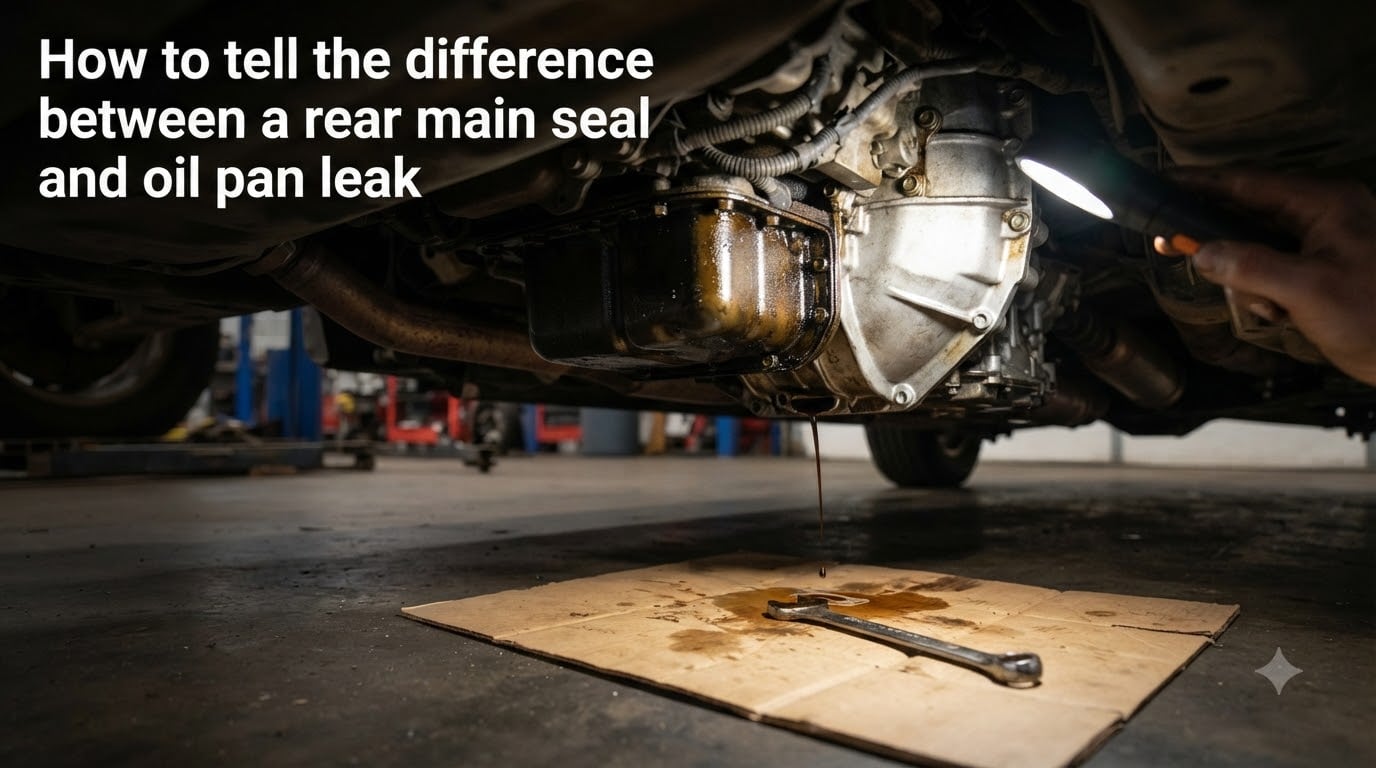
You pop the hood, check underneath, and there it is: a fresh oil spot on your driveway. Now the panic sets in. Is it a cheap oil pan gasket fix, or the dreaded rear main seal leak that can cost thousands?
Figuring out how to tell the difference between a rear main seal and oil pan leak saves you from misdiagnosis, wasted money, and unnecessary repairs. I have helped dozens of friends and forum members work through this exact problem, and the good news is you can narrow it down with a flashlight and a clean piece of cardboard.
This guide walks you through the exact diagnostic steps mechanics use, where each leak originates, and how the drip pattern tells the whole story. By the end, you will know whether you are looking at a weekend oil pan job or a transmission-pull repair.
Table of Contents
How to Tell the Difference Between a Rear Main Seal and Oil Pan Leak?
The fastest way to tell the difference is the location and pattern of the oil. A rear main seal leak shows oil inside the transmission bell housing and on the engine side of the flexplate or flywheel. An oil pan leak drips straight down from the pan gasket and stays below the engine block.
Here is the quick diagnostic in three steps:
Look at the bell housing. Oil dripping from where the engine meets the transmission, especially inside the bell housing opening, points to the rear main seal.
Check the drip pattern. Oil pan leaks drip straight down. Rear main seal leaks get flung outward by the spinning crankshaft, creating a splatter pattern.
Inspect the oil pan gasket itself. If the gasket seam around the pan is wet and oily but the bell housing is clean, your leak is the oil pan.
I always start here because these three checks take five minutes and eliminate 80 percent of the guesswork. Let me break down why each leak behaves differently so you understand what you are looking at.
What Is a Rear Main Seal?
A rear main seal is a rubber or silicone seal pressed into the back of the engine block where the crankshaft exits to connect with the transmission. Its job is to keep engine oil inside the block while the crankshaft spins freely through it. Think of it as a flexible lip that rides against the rotating metal surface.
Because the crankshaft spins at high RPM, any oil that gets past this seal does not just drip. It gets flung outward by centrifugal force. That is why rear main seal leaks create a messy splatter pattern inside the bell housing rather than a neat drip.
Rear main seals come in two designs: single-piece and two-piece seals. Older engines often use a two-piece seal that is notorious for leaking as the cork or rubber ages. Modern engines mostly use single-piece seals, which last longer but are harder to replace since the crankshaft has to come out or the seal has to be carefully installed in place.
When this seal fails, oil escapes from the rear of the crankshaft and ends up inside the bell housing, on the flexplate or flywheel, and eventually dripping from the lowest point of the bell housing where it meets the transmission.
What Is an Oil Pan Gasket?
An oil pan gasket seals the joint between the oil pan and the bottom of the engine block. The oil pan holds several quarts of engine oil, and the gasket keeps that oil from seeping out where the pan bolts to the block. These gaskets are typically made of rubber, cork, or a combination of both.
Because the oil pan sits at the very bottom of the engine, gravity does most of the work. A leaking oil pan gasket produces oil that drips straight down, collecting on the pan itself and dropping directly onto the ground below. There is no spinning component flinging it around.
Oil pan gasket leaks are common because the pan takes hits from road debris, temperature cycling degrades the gasket material over time, and the bolts can loosen. The good news is that an oil pan gasket replacement is one of the more affordable engine repairs, typically costing a fraction of a rear main seal job.
If you see oil wetness running along the gasket seam where the pan meets the block, and the area around the bell housing is dry, you are almost certainly dealing with an oil pan leak.
The Parking Lot Diagnostic Test
This is the test I recommend every car owner do before spending a dime at a shop. It takes about 30 minutes of waiting and five minutes of inspection. All you need is a clean piece of cardboard and a flashlight.
Step 1: Clean the Undercarriage
Jack up the car or slide underneath and wipe down the oil pan, the bell housing, and the area where the engine meets the transmission with a clean rag. You need a clean slate to see where fresh oil appears. If everything is already covered in old grime, you will not be able to tell the source.
If you have access to a hose or a can of brake cleaner, spray down the suspect areas thoroughly. Let it dry completely before moving on.
Step 2: Place Cardboard Under the Car
Slide a large piece of clean cardboard under the engine area, positioned so it catches drips from both the oil pan and the bell housing. Mark the cardboard with a Sharpie to show roughly where the oil pan sits and where the transmission bell housing is. This helps you map the drip location to the source.
Walk away and let the car sit overnight or for at least 8 hours.
Step 3: Read the Cardboard
Come back and look at where the oil landed on the cardboard. If the drips are concentrated directly under the oil pan, your leak is likely the oil pan gasket. If the oil landed further back, near or under the transmission bell housing, the rear main seal is the prime suspect.
The drip location matters because oil follows the path of least resistance. Rear main seal oil runs down the inside of the bell housing and drips from its lowest point, which is typically further rearward than the oil pan.
Step 4: Inspect the Bell Housing Opening
Take your flashlight and look at the inspection cover or the opening at the bottom of the bell housing where the engine meets the transmission. If you see fresh oil pooling inside that opening or running down from inside the bell housing, you are looking at a rear main seal leak. If that area is bone dry but the oil pan gasket seam is wet, it is the oil pan.
Forum members across Reddit and car-specific communities consistently confirm this method. One Pilot owner on Piloteers summed it up perfectly: if the main seal is leaking, oil gets flung around inside the bell housing chamber. Pan gaskets just drip straight down.
Bell Housing and Flexplate Inspection
This is the single most reliable diagnostic test for confirming a rear main seal leak. The flexplate (on automatic transmissions) or flywheel (on manual transmissions) sits directly behind the rear main seal. If the seal is leaking, that spinning component gets coated in oil.
Here is what to look for:
Remove the inspection cover at the bottom of the bell housing if your vehicle has one. Shine a flashlight inside.
Check the engine side of the flexplate or flywheel. If it is oily and wet, the rear main seal is leaking. The spinning motion throws oil in a circular splatter pattern you can see on the inside walls of the bell housing.
Look at the torque converter or clutch. Oil contamination here confirms rear main seal failure, not oil pan.
If the flexplate is dry and clean but oil is present on the outside of the bell housing or running down from the oil pan area, the leak is coming from above, not from behind the seal. This is a critical distinction.
One important note from experienced mechanics: flexplate and pressure plate bolts can also leak oil and be mistaken for a rear main seal leak. If you see oil around those bolt heads but the rest of the flexplate is relatively clean, check whether the bolts need resealing before assuming the worst.
I have seen too many people jump straight to rear main seal panic when the actual culprit was a simple valve cover gasket leaking oil down the back of the engine. Always trace the oil upward to confirm where it originates.
Rear Main Seal vs Oil Pan Leak: Key Differences
Now let me put the key differences side by side so you have a quick reference. These are the patterns I have confirmed across multiple vehicles and dozens of forum discussions.
Drip location: Oil pan leaks drip directly below the pan. Rear main seal leaks drip from the bell housing, further toward the transmission.
Drip pattern: Oil pan oil drips straight down in a neat line. Rear main seal oil gets flung by the spinning crankshaft, creating a circular splatter pattern inside the bell housing.
Bell housing condition: Clean and dry bell housing means oil pan. Wet, oily bell housing with oil on the flexplate means rear main seal.
Severity when parked: Oil pan leaks often continue dripping when parked because oil pools in the pan. Rear main seals can leak while sitting too, but many leak more noticeably when the engine is running and oil is under pressure.
Repair cost: Oil pan gasket replacement typically runs from under 200 to around 600 dollars depending on the vehicle. Rear main seal replacement often costs 1,000 to 2,500 dollars because the transmission has to come out.
Repair difficulty: Oil pan gaskets are a DIY-friendly job on many vehicles. Rear main seal replacement almost always requires a lift, transmission jack, and significant labor time.
Oil consumption: Both leaks cause gradual oil loss, but rear main seal leaks can consume oil faster because the spinning crankshaft actively pushes oil out.
The cost difference alone is why getting this diagnosis right matters so much. Telling a shop to replace your rear main seal when you only needed an oil pan gasket wastes over a thousand dollars.
Other Leaks That Get Mistaken for a Rear Main Seal
The rear main seal area is a magnet for misdiagnosis because oil from multiple sources can end up in the same vicinity. Before you commit to any repair, rule out these common imposters.
Valve cover gasket leaks are the most frequent lookalike. Oil from a leaking valve cover runs down the back of the engine block, pools near the bell housing, and looks exactly like a rear main seal leak. Trace the oil trail upward. If it starts at the valve cover, that is your source.
Camshaft seal leaks on overhead cam engines can also send oil down the back of the block. The cam seal sits behind the timing cover, so oil from there follows the same downward path as a valve cover leak.
Oil cooler line or adapter leaks can drip oil onto the bell housing area on certain engines. Check the oil cooler lines and the adapter housing for wetness before assuming the worst.
Upper oil pan leaks cause particular confusion on engines that have a two-piece oil pan design. The upper pan gasket sits very close to the rear main seal, making it nearly impossible to distinguish without cleaning the area and watching where fresh oil appears.
Head gasket leaks are less common but can send oil down the exterior of the block on certain engines. Look for oil traces between the cylinder head and the block.
The lesson here is simple. Clean the area thoroughly, run the engine, and trace the oil back to its true origin. The wettest point is almost always the leak source, not where the oil collects.
Can You Drive With a Rear Main Seal or Oil Pan Leak?
The short answer is: it depends on how fast oil is disappearing. A slow weep that loses less than a quart between oil changes is something many owners live with, especially on older vehicles where the repair cost exceeds the car’s value.
However, you should not ignore either leak. Here is how I think about the risk:
Check your oil weekly if you know there is a leak. Running an engine low on oil causes bearing damage, spun bearings, and total engine failure far more expensive than any seal replacement.
Watch the oil pressure light. If it flickers at idle or illuminates while driving, stop immediately. You are losing oil faster than the engine can tolerate.
A dripping oil pan is generally safer to drive than a fast rear main seal leak because pan oil stays outside the engine. Rear main seal oil can contaminate the clutch on manual transmissions, causing slipping.
Tow if the leak is sudden and severe. A gushing leak means a seal has completely failed and the engine can lose all its oil within minutes of driving.
Many forum members on older BMWs, F-150s, and 4Runners report driving for years with slow rear main seal weeps. The key is religious oil level monitoring and addressing it before it becomes a geyser.
FAQs
What could be mistaken for a rear main seal leak?
Valve cover gasket leaks, camshaft seal leaks, oil cooler line leaks, upper oil pan gasket leaks, and head gasket leaks can all send oil to the bell housing area and mimic a rear main seal leak. Always clean the area and trace the oil upward to find the true source before committing to a rear main seal replacement.
Can you still drive a car if the rear main seal is leaking?
Yes, if it is a slow weep and you monitor your oil level closely. Check the oil weekly and top off as needed. However, if the leak is fast enough to lose more than a quart between changes, or the oil pressure light comes on, stop driving and get it repaired to avoid catastrophic engine damage.
Is it worth fixing a rear main seal leak?
It depends on the vehicle value and leak severity. On a newer car or one you plan to keep, yes, because ignoring it risks engine damage. On an older car worth less than the repair cost, many owners monitor oil levels and live with a slow leak. Rear main seal replacement typically costs 1,000 to 2,500 dollars because the transmission must be removed.
Will the rear main seal leak while sitting?
Yes, a rear main seal can leak while parked because oil remains in the pan and can seep past a failed seal under gravity. However, many rear main seal leaks are more noticeable when the engine is running because oil pressure pushes more oil past the damaged seal. If you see fresh drips under the bell housing after sitting overnight, it could be the rear main seal.
Conclusion
Telling the difference between a rear main seal and oil pan leak comes down to three things: where the oil drips, whether the bell housing and flexplate are oily, and the pattern of the leak. Oil pan leaks drip straight down from the pan gasket. Rear main seal leaks show oil inside the bell housing and splattered on the flexplate because the spinning crankshaft flings it outward.
Run the parking lot diagnostic test with clean cardboard, inspect the bell housing with a flashlight, and trace any oil trail upward before assuming the worst. The difference between these two leaks can mean hundreds versus thousands of dollars in repair costs, so take the time to diagnose correctly.
If you are unsure after these tests, a UV dye test at a shop will give you a definitive answer for a fraction of what a wrong repair costs. Get the diagnosis right first, then decide whether to fix it yourself, take it to a shop, or monitor it on an older vehicle.