
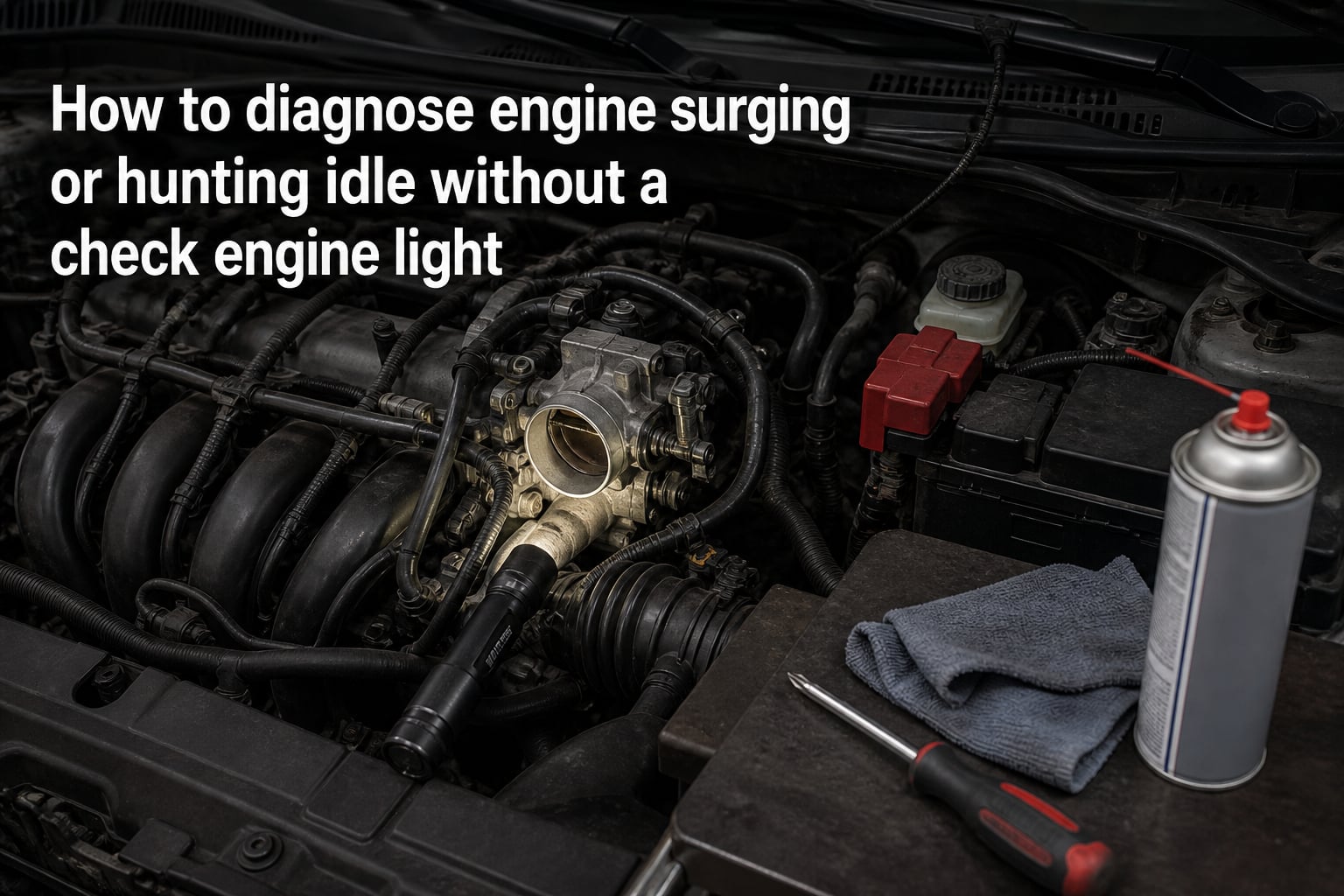
Your engine is hunting up and down at idle, the RPM needle is dancing between 600 and 1,200, and the dashboard is silent. No check engine light. No diagnostic trouble code. Just a rough, surging idle that makes your car shake at every stoplight.
If that scenario sounds familiar, you are not alone. We have worked through this exact problem with hundreds of vehicles, and in most cases the fix does not require an expensive trip to the dealer or even a scanner. The trick is knowing where to look and what to listen for.
This 2026 guide walks you through how to diagnose engine surging or hunting idle without a check engine light using nothing more than your eyes, ears, and a few inexpensive tools. You will learn the seven most common causes, a step-by-step DIY diagnostic procedure, and the warning signs that mean it is time to call a professional.
Table of Contents
What Is Engine Surging or Hunting Idle?
Engine surging or hunting idle is an erratic fluctuation in engine RPM that happens when the throttle is closed. Your engine is sitting in park or stopped at a light, but instead of holding a steady idle (usually 650 to 850 RPM), the revolutions bounce up and down in a 200 to 600 RPM range.
The pattern looks like this: idle drops low, the engine control unit compensates by opening the throttle or IAC valve, RPM spikes high, the system over-corrects, RPM drops again, and the cycle repeats every one to three seconds.
Hunting idle is different from a misfire. A misfire feels like a sharp, single-cylinder skip with a strong jerk. Surging feels like the whole engine is breathing in and out rhythmically, almost like the vehicle is idling in a strong wind. Both can happen with no check engine light, but the underlying causes overlap.
Why Your Check Engine Light Stays Off?
Modern vehicles monitor dozens of systems and only illuminate the check engine light when a parameter crosses a strict threshold for a specific duration. If your engine surge is mild, intermittent, or caused by a mechanical issue the OBD-II system cannot measure, no code will ever set.
Vacuum leaks are the classic example. A small crack in a hose lets unmetered air into the intake, but the ECU has no way to detect that leak directly. The long-term fuel trim may drift by 5 to 10 percent, which is well below the 25 percent threshold needed to trigger a stored code.
Other reasons the light stays off include pending codes that have not matured, intermittent sensor glitches that self-correct before the monitor runs, and purely mechanical problems such as a sticking IAC valve, carbon-fouled throttle plate, or weak fuel pump. The rough idle is real, but the computer never sees a reason to complain.
Common Causes of Rough Idle and Surging Without Codes
After diagnosing countless surging idle complaints, our team has narrowed the field to seven repeat offenders. We list them in order from most to least common based on what we see in independent shops.
1. Vacuum Leaks
A vacuum leak is the single most common cause of hunting idle with no check engine light. Cracks in rubber hoses, dried-out intake gaskets, and loose clamps let unmetered air bypass the mass air flow sensor, leaning out the air-fuel mixture.
Symptoms include a fast idle that drops when you spray carb cleaner near suspected leaks, a hissing sound under the hood at idle, and rough running that gets worse at higher altitudes where lower atmospheric pressure amplifies the leak rate.
2. Dirty or Sticking Idle Air Control (IAC) Valve
The IAC valve meters the small amount of air that bypasses the closed throttle plate. When carbon buildup jams the pintle or stepper motor, the ECU loses its ability to fine-tune idle speed, producing that classic up-and-down hunting pattern.
This issue shows up most often on cars with 60,000+ miles that rarely see highway driving. You will notice the surge is worst when cold and often smooths out once the engine is fully warm.
3. Dirty Throttle Body
A dirty throttle body behaves almost identically to a bad IAC valve. Carbon and oil vapors coat the throttle plate and bore, creating an erratic airflow channel that confuses the ECU’s closed-loop idle control.
Many owners discover the problem right after a routine air filter replacement. Replacing the filter suddenly changes airflow dynamics just enough to expose the throttle body buildup that was always there.
4. MAP or MAF Sensor Issues
The manifold absolute pressure (MAP) sensor and mass air flow (MAF) sensor both feed critical data to the ECU. A contaminated MAF sensor reads low, causing the computer to under-fuel the engine. A weak or intermittent MAP sensor produces the same RPM hunting without setting a hard code.
MAF-related problems are extremely common after oil changes where the air intake was bumped, or after driving through dusty conditions. Cleaning the MAF hot wire with a dedicated MAF cleaner spray often resolves the surge within minutes.
5. EGR Valve Carbon Buildup
The exhaust gas recirculation (EGR) valve routes small amounts of exhaust back into the intake to lower combustion temperatures. When the valve sticks open from carbon deposits, it introduces extra exhaust gas at idle, causing rough running and surging.
This is especially common on vehicles that do lots of short trips where the engine never gets hot enough to burn off carbon naturally.
6. Fuel Pressure or Delivery Problems
A weak fuel pump, clogged fuel filter, or failing fuel pressure regulator can produce RPM fluctuation under low-demand conditions like idle. The system has enough pressure for cruising but cannot maintain steady delivery at idle.
Listen for a whining sound from the fuel tank on startup, and pay attention to whether the surge gets worse when the fuel gauge drops below a quarter tank. Running low on fuel starves in-tank pumps that rely on submersion for cooling.
7. PCV Valve Failure
The positive crankcase ventilation (PCV) valve routes blow-by gases back into the intake. A stuck-open PCV valve acts like a small vacuum leak, while a stuck-closed valve increases crankcase pressure and pushes oil past seals.
PCV valves are cheap and easy to replace. Pull yours out and shake it. A healthy valve rattles. A silent one is stuck.
How to Diagnose Engine Surging Without a Scanner: Step-by-Step
This DIY diagnostic sequence is built around what works in a home garage with basic hand tools. Work through each step in order, and stop when you find the issue.
Step 1: Visual Inspection Under the Hood
With the engine off, pop the hood and look for the obvious. Check every visible vacuum hose for cracks, splits, or soft spots. Pay close attention to the small hoses around the intake manifold, brake booster line, and PCV system.
Squeeze each hose gently. Hard, brittle hoses that crack when bent are suspect. Also look for oil residue around the valve cover and intake manifold gaskets, which often indicate a leaking gasket admitting unmetered air.
Step 2: Listen for Vacuum Leaks at Idle
Start the engine and let it idle. Use a mechanic’s stethoscope or a long screwdriver held against the intake with your ear on the handle. Listen for a high-pitched hissing sound, which is the signature noise of a vacuum leak.
If you do not have a stethoscope, a piece of small-diameter rubber hose works the same way. Move the listening end around the intake manifold, vacuum lines, and throttle body gasket while the engine idles.
Step 3: The Soapy Water Test
For leaks you can hear but not see, mix dish soap and water in a spray bottle. With the engine idling, mist the mixture around suspected gasket surfaces and hose connections.
If a leak is present, the soapy water will bubble vigorously at the source, much like a bicycle tire with a slow leak. The RPM will also momentarily rise as water temporarily seals the leak.
Step 4: The Carb Cleaner Test
This is the fastest method our team uses. With the engine idling, spray small bursts of carb cleaner around the intake manifold gasket, throttle body gasket, and vacuum hose connections. When the spray hits a vacuum leak, the RPM will jump briefly because the volatile fluid adds fuel to the mixture.
Never spray near the alternator, hot exhaust, or any plastic component. Keep a fire extinguisher within reach.
Step 5: Inspect the Throttle Body and IAC Valve
Shut the engine off and remove the air intake duct from the throttle body. Shine a flashlight into the bore. A healthy throttle body has a clean, shiny throttle plate edge. A dirty one shows black carbon buildup, especially around the plate edges and behind it where the IAC passage sits.
Manually move the throttle plate with your fingers. It should snap closed smoothly when released. If it sticks or moves gritty, you have found at least part of your problem.
Step 6: Check the MAF Sensor
Pull the MAF sensor out of the intake tube. The hot wire or film element should look like a clean, thin wire between two posts. If it is coated with oil or dust, that contamination is throwing off the air measurement.
Spray MAF-specific cleaner (never brake cleaner or carb cleaner, which leave residue) onto the element and let it air-dry completely before reinstalling. This five-minute fix solves more rough idle complaints than most people expect.
Step 7: Listen to the Fuel Pump and Check Fuel Pressure
Turn the key to the run position without starting the engine. You should hear a two-second whine from the fuel tank as the pump primes. A silent pump or one that whines louder than usual indicates a fuel delivery issue.
Without a pressure gauge, you can still evaluate fuel pressure indirectly. Note whether the surge worsens with a low fuel level, and check the fuel filter for restriction by feeling the fuel line pressure at the engine with a rag-protected hand (professionals use a gauge).
DIY Fixes You Can Try Before Calling a Mechanic
Once diagnosis points to a likely culprit, several fixes are well within a home mechanic’s reach. Budget 30 to 90 minutes for any of these jobs.
Throttle Body Cleaning Procedure
Purchase a can of throttle body cleaner spray and a pack of lint-free shop towels. Remove the air intake duct and prop the throttle plate open with a clean screwdriver or have a helper hold the accelerator pedal slightly.
Spray the cleaner generously on both sides of the throttle plate and the surrounding bore. Let it soak for 30 seconds, then wipe away the dissolved carbon with a shop towel. Repeat two or three times until the towel comes away clean.
After reinstalling, leave the key off for 60 seconds so the ECU relearns the closed-throttle position. The idle may be erratic for the first few minutes of driving as the system adapts.
IAC Valve Cleaning or Replacement
Most IAC valves can be removed with a screwdriver and a pair of pliers. Spray cleaner into the valve opening while the engine is off, then let it drain. On many vehicles, you can also clean the IAC passage with the valve removed.
If cleaning does not help, replacement IAC valves typically run $30 to $80 and install in under 30 minutes. The savings versus a shop diagnosis fee are substantial.
PCV Valve Replacement
Pull the old PCV valve and shake it. If it does not rattle, replace it. A new PCV valve costs $5 to $20 and is one of the cheapest fixes in this guide. While you are there, inspect the hoses for cracks and replace any that feel soft or sticky.
Vacuum Hose Replacement
Most vacuum hoses cost $1 to $3 per foot at any auto parts store. Bring the old hose with you to match the inside diameter exactly. Silicone hoses last longer than the factory rubber, especially in hot engine bays.
When to Stop Diagnosing and Call a Professional
DIY diagnosis has limits. Stop and call a qualified mechanic if you encounter any of the following situations.
First, if the surge is accompanied by a flashing check engine light, stop driving. A flashing light indicates an active misfire that can destroy your catalytic converter in minutes.
Second, if you have completed all seven diagnostic steps without finding an obvious cause, the issue likely involves internal engine components, transmission torque converter problems, or a sensor requiring labscope testing beyond typical home tools.
Third, if the engine shows signs of serious mechanical trouble such as metal in the oil, white smoke from the exhaust, or coolant loss without an external leak, continuing to diagnose risks turning a repair into an engine replacement.
For most cases that elude home diagnosis, a flat-rate diagnostic fee of $80 to $150 is far cheaper than guessing at parts. Mechanics with factory scan tools can read pending codes, monitor live data streams, and catch intermittent issues your driveway tests miss.
Preventing Rough Idle and Surging Problems
Most surging idle issues develop slowly over years of neglected maintenance. A few simple habits will keep your idle smooth.
Replace your air filter every 12,000 to 15,000 miles, and use a quality filter that fits properly. A loose or oil-soaked air filter contaminates the MAF sensor and throttle body.
Use top-tier fuel with adequate detergent levels, especially if your vehicle is direct injection. Direct injection engines are particularly prone to carbon buildup on intake valves because fuel no longer washes over them.
Take a 20-minute highway drive once a week. Sustained high RPM and load burn off carbon deposits in the EGR, intake, and catalytic converter. Vehicles that only see short trips accumulate carbon much faster.
Finally, address small issues early. A minor hesitation today is a clogged injector or failing sensor away from a full-blown rough idle tomorrow.
Frequently Asked Questions
Why is my car revving by itself without check engine light?
Your car is likely hunting idle because of a vacuum leak, dirty throttle body, or sticking IAC valve. These mechanical issues introduce unmetered air or throttle plate drag without triggering OBD-II codes, so the check engine light stays off while the engine RPM fluctuates.
What can cause a rough idle without a check engine light?
The most common causes include vacuum leaks, dirty or sticking idle air control valves, carbon-fouled throttle bodies, contaminated MAF sensors, sticking EGR valves, weak fuel pressure, and failed PCV valves. All of these can produce rough idle without crossing the threshold needed to set a diagnostic trouble code.
Why is my engine surging while idling?
Engine surging at idle happens when the ECU cannot maintain a stable air-fuel mixture or idle speed. The most likely culprits are unmetered air entering the intake (vacuum leak), inconsistent fuel delivery, or a control component like the IAC valve or throttle body that cannot respond smoothly to closed-loop corrections.
Can a vacuum leak cause surging without triggering a code?
Yes. A small vacuum leak may only shift the long-term fuel trim by a few percent, well below the 25 percent threshold required to set a code. The engine surges because the ECU keeps over-correcting, but the fault never matures into a stored trouble code.
How do I test for a vacuum leak at home?
Use the soapy water test, the carb cleaner test, or simply listen for a hissing sound with a mechanic’s stethoscope. Spraying carb cleaner near suspected leaks and watching for an RPM jump is the fastest method for most home mechanics.
Can I drive my car with a surging idle?
You can usually drive short distances with a mild surge, but it is not recommended for long. Surging wastes fuel, overheats the catalytic converter, and can cause stalling in traffic. Diagnose and fix the issue as soon as practical.
Conclusion
Diagnosing engine surging or hunting idle without a check engine light comes down to a logical sequence: define the symptom, list the most likely causes, work through diagnostic steps from simplest to most involved, and stop when you find the issue. Vacuum leaks, IAC valves, throttle bodies, and PCV valves solve the majority of no-code rough idle cases.
If your DIY diagnosis does not reveal the source, a flat-rate diagnostic fee at a trusted shop is a worthwhile investment. Either way, do not ignore the symptom. Addressing surging idle now prevents catalytic converter damage, fuel economy loss, and the safety risk of stalling in traffic.