
I still remember the first time I heard a rod knock in a friend’s Subaru. He had been ignoring a deep thumping noise for two weeks, convinced it was “just a lifter tick.” By the time he pulled into my driveway, oil pressure was already dropping. That moment is exactly why I wrote this guide.
If you’re trying to figure out how to tell if engine knocking is a real rod knock or something harmless, you’ve come to the right place. I’ll walk you through the same diagnostic sequence I use in my own garage, the same one experienced techs rely on before ever opening up an oil pan. We’ll cover the four tests that separate benign noises from catastrophic ones, what each sound actually means, and the exact red flags that mean “stop driving now.”
Table of Contents
What Is Rod Knock and What Causes It?
Rod knock is a deep, heavy knocking sound caused by excessive clearance between the connecting rod bearings and the crankshaft journal. When that clearance grows past spec, the rod physically slaps the crank on every rotation. The result is the unmistakable low-pitched thump that gives rod knock its name.
Mechanically, it almost always traces back to wear on the bearing surface, low oil pressure starving the bearings of a hydrodynamic film, or a spun bearing where the rod literally spins on the crank. A spun bearing is the worst-case scenario, and the one that turns a weekend into an engine swap.
Engine knock and rod knock are NOT the same thing. “Engine knock” sometimes refers to detonation, where fuel ignites too early and pinges under load. That’s a timing and fuel issue. Rod knock is a mechanical failure inside the bottom end. Confusing the two is a common mistake, so make sure you know which one you’re dealing with.
What Does Rod Knock Sound Like?
A rod knock has three signature audio traits. It is deep, single, and rhythmic. It is also loud enough to make you ask, “What is THAT?” the first time you hear it.
The sound comes from the lower part of the engine, near the oil pan, never from the top end. Frequency-wise it’s a low thud or hollow knock, not a higher-pitched tick. The rhythm is tied to engine RPM – one knock per cylinder per two revolutions on a four-stroke. A slight rod knock at idle is just a quieter version of the same sound – thump-thump-thump at the same tempo as a tired heartbeat.
One mechanic on r/MechanicAdvice described it perfectly: “A loud dead sounding knock is always the connecting rod. And it sounds down low. A tick is a higher pitch and from up high.” That’s the rule of thumb I’d print on a sticker if I could.
Quick Audio Reference
Imagine dragging a heavy wrench across a concrete floor. Now imagine doing it once per second, in time with your engine’s idle. That’s a rod knock. Lifter tick, by contrast, sounds more like a sewing machine needle, fast and high.
How to Tell If Engine Knocking Is a Real Rod Knock or Something Harmless
To tell if engine knocking is a real rod knock or something harmless, run four tests in order: cold start observation, warm engine comparison, load/acceleration response, and localization with a mechanic’s stethoscope. Use the table below as your scorecard.
| Test | Real Rod Knock | Something Harmless |
|---|---|---|
| Cold start, first 30 seconds | Loud immediately, slow to fade | Quiet ticking that fades within 10 seconds |
| Warm idle behavior | Same loud thump or louder as engine warms | Gets quieter or disappears once warm |
| Load (in gear, climbing a hill) | Noticeably louder under load | Same volume or even quieter under load |
| Source location (stethoscope) | Bottom end, near oil pan | Top of engine, valve cover area |
| Repetition rate | Matches engine RPM, half of firing order | Faster, more irregular |
If the noise matches the left column across most tests, you’re likely dealing with a real rod knock. If most answers fall to the right, you’re probably chasing something benign like a lifter tick or an exhaust leak.
Cold Start vs Warm Engine Test
The cold start test is the single most useful diagnostic anyone can run at home. Listen to the engine for the first 30 to 60 seconds from a cold start. A rod knock is loudest right at startup when oil has drained out of the bearings overnight and the protective oil film isn’t there yet. Then it may or may not quiet slightly as pressure builds.
A lifter tick works the opposite way. It is also most noticeable at startup, but it fades fast, usually within 10 seconds as hydraulic lifters fill with oil. So if the noise goes away once the engine is warm, that’s a strong sign it’s NOT a rod knock.
From the StackExchange thread that originally inspired my approach: “When you start the engine and you hear the sound, does it sound better after the vehicle is warmed up? A rod knock will only sound worse (louder) as the engine heats up.” Clearance grows as aluminum rods and steel bearings expand at different rates. Heat makes rod knock louder, not quieter.
Cold Start Listening Steps
Step 1: Park on level ground. Turn off anything that makes noise (radio, fan). Open the hood.
Step 2: Crank the engine and immediately focus on the bottom end, near the oil pan.
Step 3: Time how long the noise lasts. Under 15 seconds of fading = likely not rod knock. Staying loud or growing louder = likely rod knock.
Load and Acceleration Test
A real rod knock gets worse under load. This is the second test, and in my experience it confirms the cold start finding more than 80% of the time. Put the car in drive (or in gear for a manual) and accelerate gently up a hill, or have a helper hold the brake while you rev the engine in park.
As one r/EngineBuilding regular noted, “Rod knock noise will get louder under load and louder at higher RPM, lifter noises stay the same.” Watch for that change. If the thumping intensifies by 50% under a hill climb, you almost certainly have a bottom-end issue.
Power Braking Test (Advanced)
For a more aggressive version, put the transmission in drive, hold the brake firmly with your foot, and gently rev the engine to 2000-2500 RPM for about 10 seconds. Do this with the parking brake as backup and never in an enclosed space. If the knock balloons under that load, you have your answer. Many forum threads (and a popular Reddit diagnostic video) treat this as the definitive confirmation step for a spun bearing.
DIY Stethoscope Diagnostic Technique
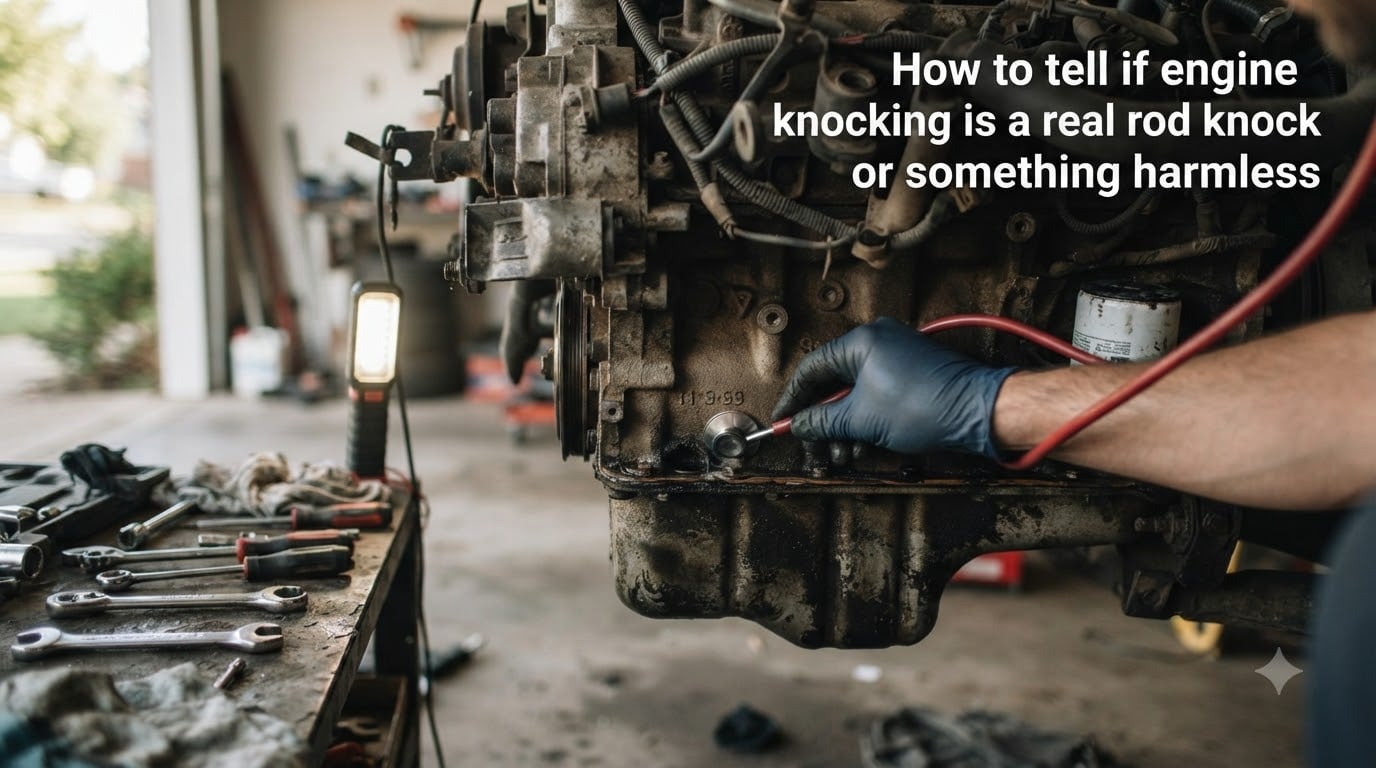
A mechanic’s stethoscope costs around $15 and is one of the best diagnostic tools you can own. With it, you can confirm where the noise is coming from – top end or bottom end – in about five minutes.
Step 1: With the engine idling (and the parking brake set), place the probe on the valve cover.
Step 2: Listen. Move the probe every 5 to 10 seconds to different bolts along the cover.
Step 3: Now move the probe down to the side of the block, just above the oil pan.
Step 4: If the noise is louder at the top of the engine, you’re chasing lifter or valvetrain noise. If it’s louder at the bottom near the oil pan, the rod bearings are suspect.
If you don’t own a stethoscope, a long screwdriver works in a pinch. Press the handle firmly against your ear and the tip gently against the engine block. You’ll hear the same thing – just don’t scratch the paint.
Other Noises Often Mistaken for Rod Knock
Several engine noises get misdiagnosed as rod knock. Before you assume the worst, rule these out one by one.
Lifter Tick
The most common confusion. Lifter tick is a higher-pitched, faster tapping from the top end. It usually fades once the engine is warm and stays the same under load. A hydraulic lifter that isn’t holding oil pressure can tick for thousands of miles without damaging anything.
Exhaust Leak
An exhaust manifold leak tick is sometimes loud enough to fool people. It’s a sharp, quick tick that often gets louder when the engine is cold and quiets down when warm. The location is along the manifold-to-head junction, right at the top of the engine.
Piston Slap
Usually only at cold start and usually on engines with aluminum blocks (older Ford Modulars, some Hondas). It’s a hollow, almost drum-like rattle that fades within 30 seconds as the piston expands. Not catastrophic, but does signal a worn cylinder bore.
Wrist Pin Knock
A double knock that speeds up dramatically with RPM. Often confused with rod knock because it is mechanical in nature. A wrist pin knock typically points to a worn wrist pin bushing and is generally less damaging (and cheaper to fix) than a spun bearing.
Timing Chain and Fuel Injector Click
A stretched timing chain rattles at startup and at very low idle. Fuel injectors click loudly on diesel engines and lightly on gas engines, but it’s a metronome-like click – not a deep thump.
Detonation Knock
Pinging under load, especially when climbing hills in hot weather. Caused by fuel octane being too low or the engine running too lean. Sounds metallic and pinging. Different mechanism entirely, but the term “engine knock” is often used for both detonation and rod knock – which is half the reason for confusion.
Oil Pressure and Maintenance History Clues
Your oil pressure gauge (or warning light) tells a critical side of the story. Healthy engines sit between 30-60 psi at idle when warm. If your gauge is reading low, or your warning light flickers on at idle, the bearings may not be getting enough lubrication.
Check the maintenance history too. Has the oil been changed on time? Has the car been driven hard with low oil? A spun bearing almost always has a story behind it – either severe neglect, a failed oil pump, or a clogged oil gallery. If your car was perfectly maintained and the noise just appeared recently, the cause may be different than if the oil had been neglected for 15,000 miles.
Another diagnostic hint from the StackExchange community: track how the oil pressure drops over weeks. A bearing that is failing will show progressively lower pressure readings at idle. That trend is one of the most reliable signs of advancing bottom-end damage.
When to Stop Driving Immediately?
Stop driving and have the car towed if: the noise is loud and rhythmic from the bottom of the engine, it gets worse under load, your oil pressure light comes on, or you can smell burning oil. These are the red flags that mean a bearing failure is imminent.
A thrown rod happens fast. Once a connecting rod breaks free, it can punch through the engine block, destroy the crankshaft, and turn a repairable engine into scrap metal in seconds. I have seen this happen in parking lots 30 seconds after the owner decided to “just drive it home.”
If the noise is faint, only on cold start, and goes away within 10-15 seconds, you can probably drive the car to a mechanic, but get it looked at within a week. If the noise is loud at idle, loud under load, or your oil pressure is dropping, the car needs to go on a flatbed, not under its own power.
Frequently Asked Questions
What could be mistaken for a rod knock?
Lifter tick is the most common confusion – a fast, higher-pitched tap from the top of the engine that often fades when warm. Exhaust manifold leaks, piston slap on cold start, wrist pin knock, timing chain rattle, and fuel injector click are all frequently misidentified as rod knock. None of these have the deep, low, rhythmic thump from the bottom end that defines a real rod knock.
How to tell if it’s a real rod knock?
Run four tests: cold start observation (rod knock is loud immediately and stays loud), warm engine comparison (rod knock gets louder, not quieter, when hot), load and acceleration test (rod knock intensifies under load), and a mechanic’s stethoscope to localize the noise at the bottom of the engine near the oil pan. If three of the four tests point to the bottom end, you are most likely looking at a rod knock.
Will rod knock go away on its own?
No. Rod knock never goes away on its own. It comes from mechanical wear on the rod bearings or crankshaft journal, and that wear only gets worse with time and heat. In many cases rod knock gets louder as engine heat expands the metals and clearances grow. The only fix is a mechanical repair – either rebuild the bottom end or replace the engine.
Is it safe to drive with rod knock?
It depends on severity. If the noise is faint, only on cold start, and disappears once warm, the car can usually be driven short distances to a mechanic. If the knock is loud, present at warm idle, gets worse under load, or your oil pressure is dropping, do not drive – the engine can throw a rod or seize at any moment. Have it towed instead.
What does a slight rod knock sound like?
A slight rod knock is a quiet, deep, rhythmic thump that is timed to engine RPM. You can usually feel it as much as hear it, especially through the floor pan. Unlike a sharper tick, a slight rod knock is more of a low knock or hollow thud. It is most audible at idle and in lower gears under light load.
Is engine knock and rod knock the same?
No. Engine knock usually refers to detonation – a fuel-related pinging or pinging sound under load, often caused by low octane fuel, lean air/fuel mixture, or incorrect ignition timing. Rod knock is a mechanical failure inside the bottom end where the connecting rod bearings have too much clearance. They sound different, happen for different reasons, and require different fixes – so confirm which one you have before repairing.
Final Thoughts on Diagnosing Rod Knock vs Harmless Engine Noises
Knowing how to tell if engine knocking is a real rod knock or something harmless comes down to a clear diagnostic sequence. Listen for a deep thump from the bottom of the engine that gets louder, not quieter, as the engine warms. Confirm that the noise intensifies under load. Localize it with a stethoscope near the oil pan. Cross-check your oil pressure gauge and maintenance history.
If your tests confirm rod knock, treat it as urgent. Schedule a mechanic visit, get a compression test and oil pressure test, and prepare for a bottom-end repair or engine replacement. If your tests point to lifter tick, exhaust leak, or another harmless noise, you can drive normally and address it on your own schedule. Either way, you’ll know the difference – and that knowledge alone can save you thousands of dollars and a tow bill.