
You check the coolant reservoir every week, and the level keeps dropping. Yet there is no puddle under the car, no sweet smell in the garage, and no steam from the exhaust. So where is the coolant going?
If you are trying to figure out how to find where coolant is disappearing when there is no visible leak, the short answer is this: the coolant is escaping somewhere you cannot see. It may be burning inside the engine, seeping into the oil, leaking into the cabin through the heater core, or evaporating from a tiny external seep before it ever hits the ground.
No visible leak does not mean no leak. A cooling system runs under 15 to 18 psi of pressure and operates above the boiling point of water. Small breaches that would leave a slow drip on your driveway can instead flash into steam and vanish before you ever notice them. Internal leaks are even sneakier because the coolant gets consumed inside the engine or hidden in the oil pan.
In this guide, I will walk you through every cause of invisible coolant loss, the exact diagnostic steps you can do at home with basic tools, the warning signs that mean stop driving immediately, and what each repair typically costs. By the end, you will know how to pinpoint your problem and decide whether it is safe to keep driving.
Table of Contents
How Much Coolant Loss Is Normal?
Before chasing a leak, you need to know whether you actually have one. Every cooling system loses a small amount of coolant over time through normal evaporation and the pressure relief valve in the radiator cap.
The widely accepted baseline is this: a drop of about half an inch in the reservoir over the course of a year is normal. If you are topping off more than that, or if the level drops noticeably over weeks or a few months, you have an abnormal loss that needs investigation.
Here is a quick way to think about it. If you have to add coolant more than once between oil changes, something is wrong. If you are adding coolant every week or every few days, you have an active problem that needs immediate attention.
One important detail: always check the coolant level the same way each time. The engine should be cold, and the car should be parked on level ground. The reservoir has MIN and MAX lines. Anything between those lines is fine. Only worry when the level falls below MIN on a cold engine.
Why Coolant Can Disappear With No Visible Leak
Your cooling system is a sealed, pressurized loop. Under normal operation, the radiator cap holds the system at roughly 15 to 18 psi above atmospheric pressure. That pressure raises the boiling point of the coolant, which keeps it liquid even at engine temperatures above 220 degrees Fahrenheit.
When that seal or pressure is compromised, coolant can escape in ways that leave no trace on the ground. Here are the three main pathways:
Internal consumption: Coolant enters the combustion chamber or mixes with engine oil. It burns with the fuel and exits the tailpipe as vapor, or it dilutes the oil where you may only catch it by checking the dipstick.
External evaporation: A tiny seep at a hose connection, thermostat housing, or water pump weep hole hits hot metal and evaporates before it can drip. No puddle, no trace.
Cabin leaks: The heater core sits inside the dashboard. A slow leak there drips into the cabin drain pan and exits under the car in a location you would never connect to coolant.
Understanding these pathways is the key to diagnosis. Each one has its own symptoms, and I will cover them in detail next.
7 Causes of Coolant Disappearing With No Visible Leak
Let me break down each cause, how it works, the symptoms to look for, and how serious it is.
1. Faulty Radiator Cap
The radiator cap is the most common and most overlooked cause of invisible coolant loss. The cap does two jobs: it maintains system pressure, and it acts as a two-way valve that routes coolant to the overflow reservoir and back.
When the cap’s rubber seal wears out or the spring weakens, it can no longer hold pressure. The coolant boils at a lower temperature, turns to steam, and escapes through the overflow tube. You never see a puddle because the steam just drifts away under the hood while you drive.
This is the cheapest fix in the entire list. A new radiator cap costs between 10 and 25 dollars, and you can install it yourself in two minutes. Many forum users report being relieved when a problem they feared would cost thousands turned out to be a 15-dollar cap.
Symptoms: Slow steady coolant loss, no other symptoms, possibly slight overheating under load, coolant may look rusty from repeated boiling.
2. Small External Seep That Evaporates
Not every external leak leaves a puddle. A pinhole in a radiator seam, a weeping hose clamp, a hairline crack at the thermostat housing, or a failing water pump weep hole can all produce a seep so small that the coolant hits hot engine metal and evaporates instantly.
You might notice a faint sweet smell after driving, or a slight residue that looks like white, green, or orange crust around a hose connection. That crust is dried coolant. It is a dead giveaway that something is seeping even if you never see liquid.
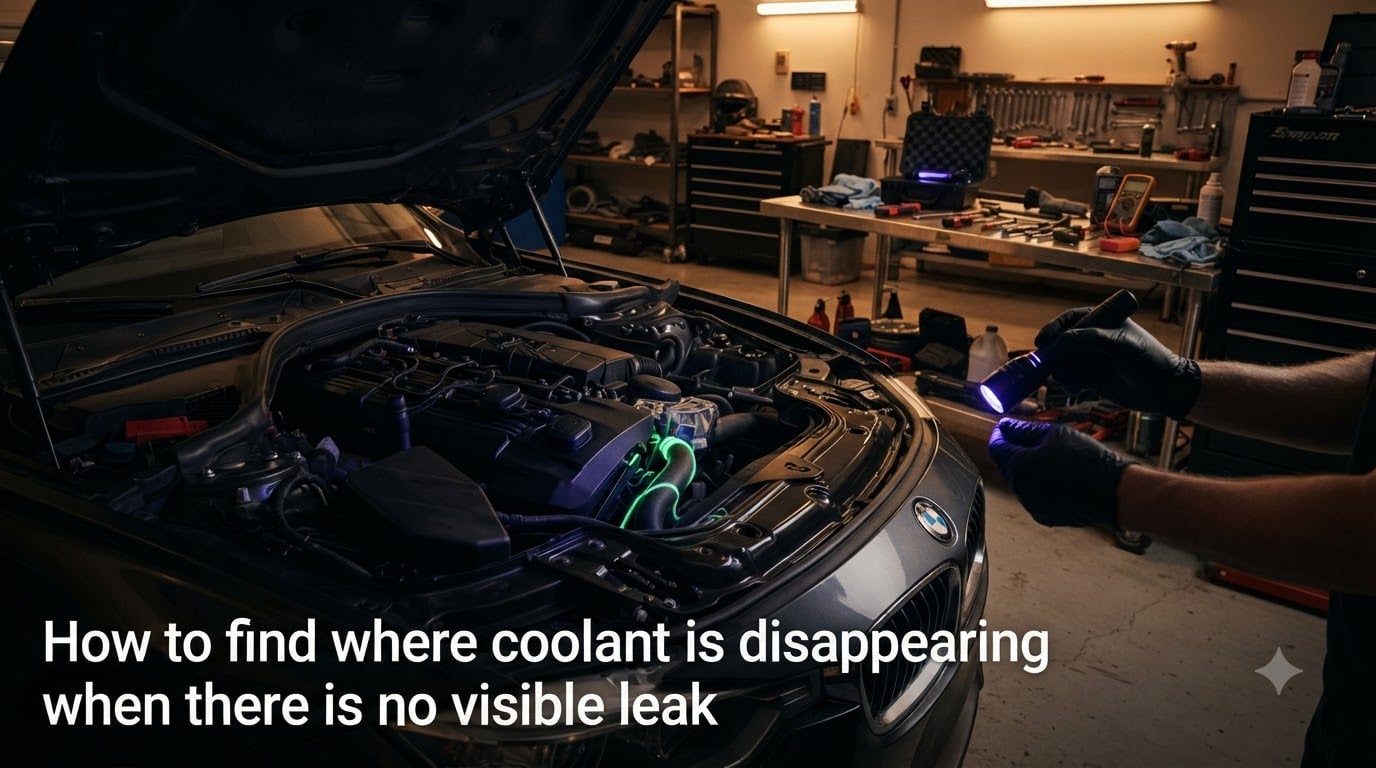
This is where a UV dye test shines. Add dye to the coolant, drive for a day, then shine a blacklight around the engine bay. Any seep will glow brightly even in tiny amounts.
Symptoms: Crusty residue at hose ends or seams, faint sweet smell, slow coolant loss, possibly a small spot that appears only when parked in the same spot overnight on cardboard.
3. Heater Core Leak
The heater core is a small radiator hidden behind your dashboard. Hot coolant circulates through it to provide cabin heat. When it develops a leak, the coolant drips into the evaporator drain pan and exits the car through a drain tube that runs to the underside of the vehicle.
Because the drain exits under the car, the puddle looks like it came from the engine compartment and you may dismiss it as condensation from the air conditioner. The real giveaway is inside the cabin.
If you notice a sweet syrupy smell when the heat is on, fogging on the inside of the windshield, or a damp carpet on the passenger side floor, the heater core is leaking. This is one of the most commonly misdiagnosed invisible coolant leaks.
Symptoms: Sweet smell inside the cabin, foggy windshield when heat is on, damp passenger floor, slow coolant loss that seems to have no source.
4. Intake Manifold Gasket Leak
The intake manifold gasket seals the manifold to the cylinder head, and on many engines, coolant passages run through that gasket. When it fails, coolant can be drawn into the intake and burned along with the air-fuel mixture.
This leak is sneaky because the consumption is gradual. You may not see white smoke at the tailpipe because the amount burned per combustion cycle is small. Over hundreds of miles, though, the coolant level steadily drops.
Intake manifold gasket failures are especially common on certain GM, Ford, and Chrysler V6 and V8 engines from the late 1990s through the 2000s, many of which used problematic plastic intake gaskets.
Symptoms: Slow coolant loss, no smoke, possibly rough idle when cold, possible slight coolant smell at the exhaust on cold start.
5. Head Gasket Failure
A failing head gasket is the diagnosis every car owner dreads, but it is also one of the most common causes of invisible coolant loss. The head gasket seals the cylinder head to the engine block, and it keeps combustion gases, coolant, and oil in their separate channels.
When the gasket fails between a coolant passage and a combustion chamber, coolant gets burned with every stroke of that cylinder. Here is a key point that many people miss: a small breach does not always produce visible white smoke. At low engine speeds and small leak volumes, the coolant vaporizes completely and exits as invisible steam.
The compression ratio of a running engine is high enough that even a tiny opening lets coolant through. The engine burns it so efficiently that you may never see smoke until the leak gets much worse. This is why a head gasket can leak for weeks or months with no visible sign except dropping coolant level.
The definitive home test is a block test, also called a combustion leak test. A kit costs about 25 to 40 dollars. You place a fluid-filled bulb over the radiator neck, and if combustion gases are present in the coolant, the fluid changes color from blue to yellow.
Symptoms: Steady coolant loss, possible bubbles in the radiator or reservoir, possible white smoke on cold start that clears up, possible unexplained overheating, possible loss of heat from the cabin when coolant gets low.
6. Cracked Engine Block or Cylinder Head
A crack in the engine block or cylinder head is less common but devastating. Coolant can seep into the oil passages, into a combustion chamber, or externally in a location where it evaporates. Cracks often develop after an overheating event that warped the metal.
If your car overheated recently and now it is losing coolant, this is a serious suspect. Aluminum cylinder heads are particularly prone to warping and cracking when overheated because aluminum expands more than iron.
Symptoms: Coolant loss following an overheating event, possible milky oil on the dipstick, possible persistent overheating, possible pressure in the cooling system after the engine sits overnight.
7. Coolant Mixing With Engine Oil
Any of the above failures can route coolant into the oil, but this deserves its own category because of how serious it is. Coolant in the oil destroys engine bearings and lubrication fast. If you catch it early, you may save the engine. If you keep driving, the engine will seize.
Check your dipstick. If the oil looks milky, frothy, or like chocolate milkshake, coolant is mixing with the oil. This is an immediate stop-driving situation. The same look appears under the oil filler cap on many engines.
Symptoms: Milky or frothy oil on the dipstick, cream-colored sludge under the oil cap, low oil pressure warning, rising oil level on the dipstick as coolant dilutes it.
How to Find Where Coolant Is Disappearing: Step-by-Step Diagnosis
Here is the exact sequence I recommend for diagnosing invisible coolant loss at home. Start at step 1 and stop when you find your answer. Each step builds on the previous one.
Step 1: Check the Dipstick and Oil Cap
Pull the dipstick and look at the oil. Then open the oil filler cap and look inside. If you see a milky, frothy, or chocolate-milkshake texture, coolant is mixing with the oil. Stop driving immediately and tow the car to a mechanic. This is the most urgent finding, so check it first.
Step 2: Inspect for External Residue and Smells
With the engine cold, shine a flashlight around every hose connection, the thermostat housing, the water pump area, and the radiator seams. Look for crusty white, green, orange, or pink residue. Smell for sweetness. Check the passenger footwell for dampness. Any of these point you toward a specific leak location.
Step 3: Replace or Test the Radiator Cap
For the price of a new cap, this is the cheapest test you can do. Buy a cap that matches your vehicle’s pressure rating (stamped on the old cap, usually 15 or 16 psi). Install it and monitor the coolant level for a week. If the loss stops, the cap was the culprit.
Alternatively, most auto parts stores loan a radiator cap tester for free with a deposit. It tests whether your current cap holds pressure.
Step 4: Do a Combustion Block Test
Buy a block test kit for around 25 to 40 dollars. The kit includes a bulb with a fluid-filled chamber and a syringe of blue test fluid. Drain a little coolant to make room, place the bulb over the radiator neck, and start the engine.
Squeeze the bulb to draw air from the radiator through the fluid. If combustion gases are leaking into the coolant, the blue fluid turns yellow or green within a few minutes. This is the single most reliable home test for a head gasket or cracked block.
Step 5: Use UV Dye to Find External Seeps
If the block test is negative, the leak is external or in the heater core. Add a bottle of UV-compatible coolant dye (about 10 to 15 dollars) to the coolant. Drive the car normally for a day or two.
Then, in a dim garage or at dusk, shine a UV blacklight around the engine bay, under the dashboard, and under the car. Any leak will glow brightly in neon green or yellow. This method catches seeps so small that no puddle ever forms.
Step 6: Perform a Cooling System Pressure Test
If you do not find it with dye, rent a pressure tester from an auto parts store. Pump the system up to its rated pressure (printed on the cap) with the engine off. If the pressure drops over 10 to 15 minutes, there is a leak. Re-inspect every connection, hose, and seam while the system is pressurized. Look under the dashboard too.
Step 7: Watch for Bubbles in the Radiator
With the engine cold and the radiator cap off, start the engine and let it warm up. Look into the radiator neck. Steady streams of bubbles rising to the surface mean combustion gases are entering the coolant. That confirms a head gasket or cracked block issue even if the block test was inconclusive.
Loss Rate Urgency Guide
Use this guide to gauge how urgently you need to act based on how fast your coolant is disappearing.
Half an inch per year in the reservoir: Normal evaporation. No action needed beyond regular checks.
Half an inch over several months: Likely a small seep or weak radiator cap. Get it diagnosed within a few weeks. Safe to drive short distances while monitoring temperature.
Top of reservoir to MIN line in a few weeks: Active leak. Diagnose within a week. Watch the temperature gauge closely and check the oil dipstick for milky texture before every drive.
Reservoir empties in a week or less: Serious leak. Diagnose immediately and avoid long drives. If the oil looks milky, do not drive at all.
Coolant drops noticeably in a single drive or overnight: Severe breach. Stop driving and tow the car. Continuing risks engine destruction.
Warning Signs You Should Not Ignore
Some symptoms mean the situation has moved from a slow leak to an active emergency. If you see any of the following, stop driving and get the car towed.
Milky or frothy oil: Coolant is mixing with the oil. Every mile you drive grinds the engine bearings toward failure.
Persistent overheating: If the temperature gauge climbs past the normal range and stays there, or if the engine overheats repeatedly, the cooling system can no longer do its job. Shut it off before the head warps.
Coolant loss after a recent overheat: If the car overheated once and now it is losing coolant, you may have warped the cylinder head. This is one of the most frequently mentioned scenarios in mechanic forums, and it almost always points to a serious problem.
Continuous white smoke from the exhaust: A small head gasket leak may produce no smoke, but a large one produces thick white smoke that lingers in the air behind the car. That is coolant burning in large volumes.
Sweet smell inside the cabin with foggy windows: The heater core is leaking into the ventilation system. It is not immediately engine-damaging, but the coolant can damage electronics and carpeting, and the loss rate will keep growing.
Is It Safe to Drive?
Whether you can keep driving depends entirely on the cause and how fast coolant is being lost. Here is how to decide.
Faulty radiator cap: Safe to drive short distances while you wait for the replacement part. Monitor the temperature gauge. Replace the cap as soon as possible.
Small external seep or evaporating leak: Safe for short trips if you check and top off coolant before each drive. Get it fixed within a couple of weeks to avoid it worsening.
Heater core leak: Safe to drive mechanically, but bypass the heater core (loop the two hoses together) if the leak is bad. You will lose cabin heat, but you will stop the leak temporarily.
Intake manifold gasket leak: Drive minimally and get it repaired soon. Continued driving risks worse gasket damage and possible overheating.
Head gasket leak: Drive only to the mechanic. Use a sealant additive as a temporary measure only if you have no other choice, and know it is a stopgap, not a fix.
Coolant in the oil: Do not drive. Tow the car. Every mile risks total engine failure.
The general rule: if you have to add coolant more than once per tank of gas, or if the temperature gauge ever moves above normal, stop driving and get a proper diagnosis.
Repair Cost Guide
Knowing what each repair typically costs helps you decide whether to fix the car or consider your options. These are rough ranges for parts and labor at an independent shop, not a dealership.
Radiator cap: 10 to 25 dollars for the part, minimal or no labor. The cheapest fix in the list.
Hose or thermostat housing seep: 30 to 120 dollars for the part, 50 to 100 dollars labor. Quick fix.
Water pump: 200 to 450 dollars including labor. Often done with the timing belt on interference engines.
Heater core: 500 to 1,200 dollars. The part is cheap, but the labor is high because the dashboard often has to come out.
Intake manifold gasket: 300 to 700 dollars depending on engine layout.
Head gasket: 1,200 to 2,500 dollars at an independent shop, sometimes more on V6 and V8 engines. This is the big one that makes people consider whether the car is worth fixing.
Cracked cylinder head or block: 2,500 to 4,000 dollars, and sometimes the engine has to be replaced entirely, which can run 3,500 to 6,000 dollars or more.
FAQs
Why do I keep losing coolant when I have no visible leaks?
Coolant can disappear without a visible puddle when it leaks internally into the combustion chamber, mixes with the engine oil, escapes through the heater core inside the dashboard, or evaporates from a tiny external seep before it ever reaches the ground. A faulty radiator cap that cannot hold system pressure is the most common and cheapest cause.
Where does coolant go if there is no leak?
When there is no visible puddle, coolant is going one of three places: into the combustion chamber where it burns as vapor and exits the tailpipe, into the engine oil where it mixes and turns the oil milky, or into the cabin through a leaking heater core. It can also flash to steam from a small external seep on hot engine metal.
Can coolant drain without a leak?
Yes, a small amount of coolant loss is normal. About half an inch of reservoir level per year is considered normal evaporation through the pressure relief system. Anything faster than that indicates an actual leak, even if you cannot see it. Always check the level cold and on level ground for an accurate reading.
How to find a coolant leak without visible leaks?
Start by checking the oil dipstick for a milky texture, then replace the radiator cap. Next, run a combustion block test kit to check for head gasket gases in the coolant. If that is negative, add UV dye to the coolant and check with a blacklight after a day of driving. Finally, rent a pressure tester, pressurize the system, and inspect every connection for seeps.
Can a head gasket leak without white smoke?
Yes. A small head gasket breach between a coolant passage and a combustion chamber can burn coolant in volumes too small to produce visible smoke. The high compression and temperature inside the cylinder vaporize the coolant completely, so it exits the tailpipe as invisible steam. A block test kit is the reliable way to detect this.
Is it safe to drive with low coolant?
It depends on the cause and how fast coolant is being lost. If the oil looks milky or the car overheats, do not drive at all and have it towed. For a slow seep or faulty radiator cap, short trips are safe if you check and top off coolant before each drive and watch the temperature gauge. If you have to add coolant more than once per tank of fuel, stop driving and get a diagnosis.
Conclusion
Finding out how to find where coolant is disappearing when there is no visible leak comes down to understanding that the coolant has to go somewhere. It is either burning inside the engine, mixing with the oil, leaking into the cabin, or evaporating from a tiny external seep you cannot see.
Work through the diagnostic steps in order. Check the oil dipstick first because that finding changes everything. Test or replace the radiator cap next because it is the cheapest possible fix. Then run a block test, use UV dye, and pressure-test the system. One of those steps will give you the answer.
Most importantly, pay attention to the warning signs. Milky oil, persistent overheating, and coolant loss after a recent overheat all mean stop driving immediately. The difference between a 25-dollar cap fix and a 2,500-dollar head gasket job often comes down to how soon you catch the problem. Check your coolant regularly, trust your observations, and act before a slow leak becomes an engine-killing emergency.