
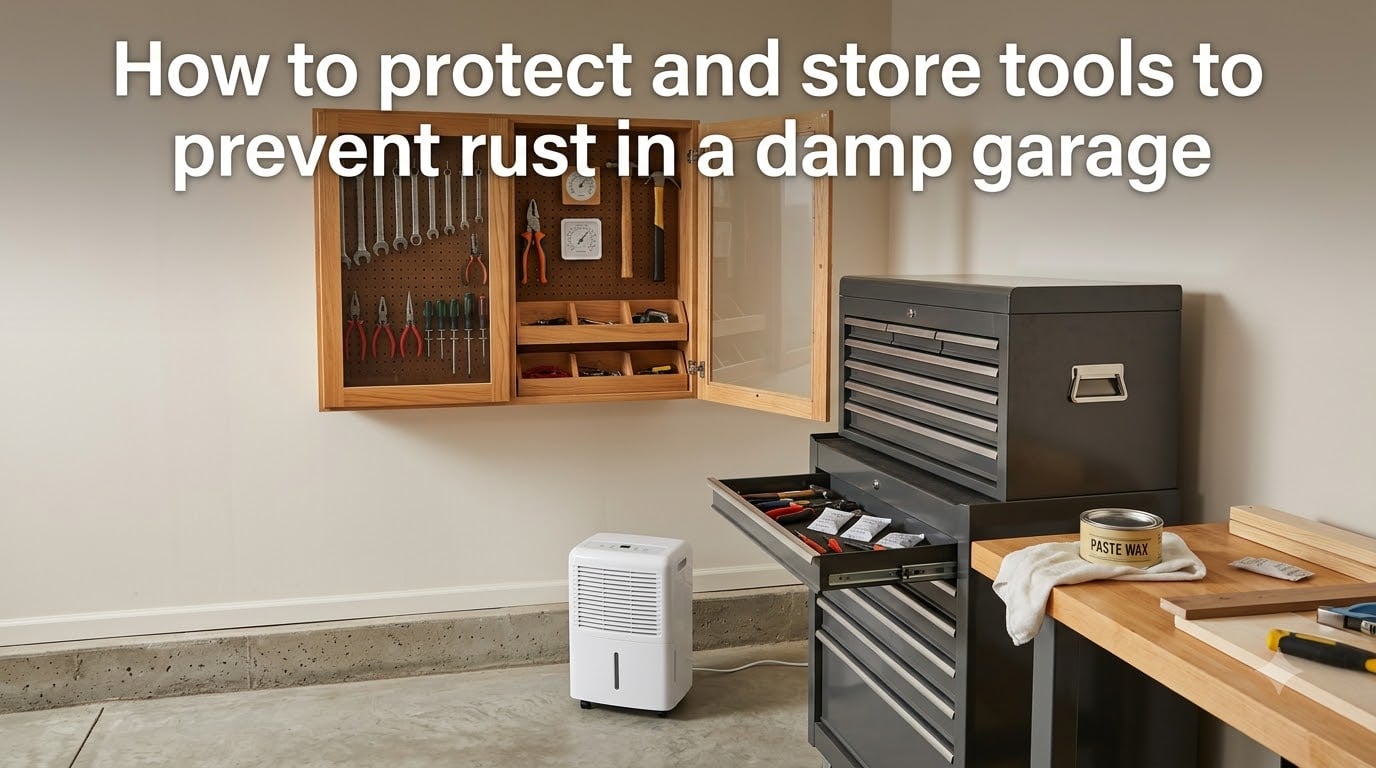
Last winter I pulled a favorite socket wrench out of my unheated garage and found a streak of orange running down the handle. That single moment sent me down a rabbit hole of research, and I lost about $260 worth of tools to surface rust before I figured out a real fix. If you are wondering how to protect and store tools to prevent rust in a damp garage, I will walk you through the exact routine I now use, plus the mistakes I made so you can skip them.
Moisture is patient. It will win the war against unprotected steel if you do not stack your defenses in the right order. Garage humidity, temperature swings, and bare concrete floors all work together to accelerate corrosion. In the next few minutes, I will show you what is actually happening on the metal, then give you a five-step routine that takes under an hour each month once set up.
Table of Contents
Why Rust Damages Tools and Why Damp Garages Make It Worse?
Rust is not just cosmetic. It is an electrochemical reaction that eats iron and steel from the outside in, and once it starts, it does not stop unless you do something about it. Understanding the why makes the how much easier to stick with.
The Real Cost of Rusted Tools
Rusted tools lose precision first. A pitted screwdriver tip slips out of screws, a corroded caliper gives you wrong measurements, and a sticky ratchet slows you down. Then comes the safety side: deep rust can harbor tetanus bacteria, and a wrench that snaps under load can cut your hand. The replacement cost adds up fast. A typical homeowner garage in 2026 holds around $1,500 to $4,000 worth of tools, and rust is the single biggest reason that value drops each year.
Why Damp Garages Are Tool-Killers
Garages are uniquely hostile to metal. Most sit at 60 to 80 percent relative humidity for at least part of the year, and the moment warm humid air hits a cold steel surface, you get condensation. Concrete floors wick moisture up from the ground, cardboard toolboxes absorb it, and metal-on-metal contact in a drawer traps humidity in tiny crevices. Rust formation accelerates sharply once humidity climbs above 50 percent, and a damp garage will cross that line on most mornings between October and April.
How to Protect and Store Tools to Prevent Rust in a Damp Garage: Step-by-Step
Here is the routine I run on every tool before it goes into storage, and what I do every month to keep them safe. The whole system takes about 45 minutes the first time, then 15 minutes for monthly check-ins.
Step 1: Clean Tools Thoroughly Before Storage
Any film left on metal will hold moisture against the surface. Wipe every tool down with a clean rag and a citrus-based degreaser or mineral spirits to remove old oil, sawdust, and sap. Hand tools need a dry microfiber towel after cleaning. Power tools need a soft brush around vents and switches. Make sure each piece is fully dry before you move to step two. I leave mine on a wire rack for at least 30 minutes after wiping.
Step 2: Apply a Protective Coating
This is where most beginners either skip the step or grab the wrong product. Light penetrating oils like WD-40 evaporate in a few weeks and are best for short-term wipe-downs. For long-term protection, you want a heavier coating. I use food-grade mineral oil on hand tools, paste wax on plane irons and chisels, and VCI (vapor corrosion inhibitor) emitters in drawers where I store less-used items. Apply a thin coat, let it sit for 10 minutes, then buff off the excess with a clean shop towel. The buff is what keeps the tool from feeling greasy.
Step 3: Control Moisture in the Storage Area
You cannot oil your way out of a moisture problem. Three layers of defense work best. First, run a small dehumidifier sized for your garage square footage and drain it into a floor drain or bucket. Second, drop silica gel packets or reusable desiccant packs into every drawer and closed toolbox. Third, add VCI paper or drawer liners to sealed cabinets. A 50-pint dehumidifier runs about $180 and protects thousands of dollars of tools, which is the best ROI in this whole guide.
Step 4: Choose the Right Storage System
Closed beats open in a damp garage. Open metal racks let humid air wash over every tool, while a closed cabinet or chest creates a microclimate you can actually control. Keep tools off the concrete floor. Mount wall cabinets at least 6 inches above the slab, or use a wood pallet under freestanding chests. Inside each drawer, lay down VCI-treated drawer liners or even clean cardboard that has been refreshed with a spray of rust inhibitor. Avoid stacking tools directly on top of each other.
Step 5: Inspect and Maintain on a Schedule
Mark your calendar for the first Saturday of every month. Pull a few drawers, look for orange dust or white oxidation, and re-oil any tool that looks dry. Every 6 months, regenerate or replace your silica gel packs. Once a year, drain and clean the dehumidifier tank and check the coils. This 15-minute habit is what stops the slow creep that ruins tools between major cleanings.
Best Rust Prevention Products Compared
Not every rust prevention product is right for every job. I have used each of these for at least six months, and here is how they stack up. Mineral oil is cheap, food-safe, and lasts about 3 months indoors. WD-40 works for short-term wipe-downs but evaporates in 2 to 4 weeks. Paste wax beats both on plane irons and chisels because it leaves a dry barrier that does not transfer to hands. VCI products are the best choice for stored-away or seasonal tools because they release an invisible protective vapor that lasts 1 to 2 years.
If you are storing tools in a metal shed or basement where you cannot control humidity, VCI zip bags and emitters are worth the extra cost. For workshop tools you use weekly, mineral oil or paste wax is plenty. Skip the silicone sprays on precision tools because they migrate into bearings and create more problems than they solve.
Power Tools vs Hand Tools: Storage Differences That Matter
Hand tools can handle a little oil and a damp drawer. Power tools cannot. Cordless batteries lose capacity fast when stored above 70 percent humidity, and circuit boards corrode even faster than steel. Store batteries at room temperature, between 40 and 60 percent charge, and never in a metal shed that sees big temperature swings. Remove batteries from tools if you are storing them for more than a month. Compressed air tools need their tanks drained and a few drops of air-tool oil before each use.
Hand tools can take a longer, rougher treatment. A wood chisel can sit in a damp drawer with a coat of paste wax and come out perfect. A jigsaw with the same treatment will have rust on the blade and a corroded switch terminal. Match the storage method to the tool’s weakest part, not its strongest.
Damp Garage DIY Storage Solutions on a Budget
You do not need a custom workshop to keep tools dry. A few low-cost moves go a long way. Cut 6-inch-tall stubs of 4-inch PVC pipe, mount them on a plywood backer, and slide screwdrivers and chisels into them. The sealed pipe acts like a mini storage tube. Build a 2-foot-tall platform from 2x4s and OSB to keep tool chests off the concrete floor. Both projects cost under $40 in materials and a Saturday afternoon.
For desiccants, you can repurpose crystal cat litter as a cheap silica alternative, just put it in breathable cloth bags and swap it every two months. A thrift-store crockpot with a light bulb inside works as a low-wattage dehydrator for small parts. None of these are fancy, but they each attack a different point on the moisture timeline.
Warning: Never store tools in a sealed plastic bag without a desiccant. Trapped moisture inside a closed bag will condense on the metal and cause flash rust within days.
When to Restore and When to Replace Rusty Tools?
Surface rust is fully restoreable. White vinegar soak for 30 minutes, scrub with a brass brush, rinse, dry, and oil. Evapo-Rust works even better for pitting. Forcing tools back into service with active rust just spreads the problem to your drawers and other tools.
Replace tools when rust has eaten more than 10 percent of the cross-section, when the teeth on a wrench are rounded, or when a moving part is frozen solid and the body is pitted. Cheap tools from big-box stores are usually not worth restoring. Higher-end hand tools can be brought back from years of neglect if you have patience. Power tools with corroded motors or circuit boards should be recycled, not stored, because the rust will migrate and damage anything nearby.
Frequently Asked Questions
Will tools rust in an unheated garage?
Yes. Unheated garages usually sit between 50 and 80 percent relative humidity, and most steels rust once humidity crosses the 50 percent line. Combine that with temperature swings that cause condensation, and any unprotected tool will show orange dust within weeks. Cleaning, oiling, and running a dehumidifier cuts rust formation to nearly zero in my own garage.
Does WD-40 keep tools from rusting?
WD-40 is a water-displacing short-term rust inhibitor. It works for a wipe-down or a few weeks of indoor storage, but it evaporates fast and leaves tools dry. For long-term garage storage, use mineral oil, paste wax, or VCI products instead. The WD-40 label even recommends a final coating of heavier oil for long-term protection.
Do silica gel packets really work for tool rust prevention?
Silica gel packets work well inside sealed drawers and toolboxes where the air volume is small. They drop humidity in a closed space by 10 to 20 points, which is enough to keep steel below the rust line. They are not enough on their own in a large open garage, but combined with a dehumidifier and coated tools, they finish the job.
Can I store tools in an unheated garage safely?
Yes, if you stack the right defenses. Clean and oil every tool, store them in a closed cabinet off the concrete floor, add VCI liners or emitters, and run a dehumidifier set to 50 percent humidity. This setup protects tools down to about 20 degrees Fahrenheit. Below that, move batteries and precision tools indoors.
How do you stop tools from rusting in a metal shed?
Metal sheds are the toughest case because they swing in temperature and humidity together. Seal every tool in a VCI bag inside a closed plastic bin, drop a desiccant pack in each bin, and bury the bins on a raised wooden pallet. A solar-powered mini dehumidifier also helps, but the gold standard is a real VCI storage system.
Final Thoughts on Keeping Tools Rust-Free Year-Round
You now have the full plan for how to protect and store tools to prevent rust in a damp garage. Clean them, coat them with the right product, control the humidity, store them in a closed cabinet off the concrete, and check them once a month. None of those steps are expensive or fancy on their own, but together they stop corrosion cold. If you are starting fresh, buy a 50-pint dehumidifier and a tin of paste wax this week. Your future self will thank you the next time you grab a wrench and it feels like new.