
A blown head gasket is one of those problems that can turn a normal Tuesday into a tow-truck day. I know because I have walked customers through this exact diagnosis in my garage for years, and the fear is the same every time: what if the engine is ruined?
The good news is that knowing how to tell if a head gasket is blown does not require a lift or a $10,000 engine analyzer. With a $40 block tester, a few minutes of patience, and a logical order of checks, you can get a confident answer in your own driveway. In this guide, I will walk you through the block tester procedure, the other diagnostic checks that confirm it, and the things that look like a head gasket but are something else entirely.
Table of Contents
What Is a Head Gasket and What Does It Do?
A head gasket is a thin, multi-layer metal and composite seal sandwiched between the engine block and the cylinder head. It is the only thing keeping three very different fluids from mixing inside your engine.
Specifically, the head gasket seals three separate channels at once: the coolant passages that run through the block and head, the oil passages that lubricate the camshaft and valvetrain, and the combustion chamber where the air-fuel mix burns. When the gasket is healthy, each fluid stays in its lane and the engine runs clean. When it fails, those fluids start crossing paths, and that is when symptoms appear.
This is also why a head gasket failure is rarely a single-symptom problem. A rupture between the combustion chamber and a coolant passage can push exhaust gases into the radiator. A failure between oil and coolant can turn your oil cap into a milkshake. A breach between two cylinders can cause a rough idle and a misfire. The job of the head gasket is simple, and the consequences of it failing are not.
Early Warning Signs of a Failing Head Gasket
Before you even reach for a tool, your car usually tells you something is wrong. Here are the five warning signs I look for first, in the order I trust them most.
Coolant Disappearing With No Visible Leak
If the overflow tank needs topping off every few weeks but you cannot find a puddle under the car, the coolant is going somewhere. In a head gasket failure, it is often being burned in the combustion chamber or pushed out as white exhaust.
White, Sweet-Smelling Exhaust Smoke
Normal exhaust is mostly invisible on a cold day and only briefly visible on a freezing start. Steady white smoke that smells sweet (like coolant) is a strong indicator that coolant is being burned. Water vapor disappears quickly; coolant smoke lingers.
Milky Oil or a Foamy Oil Cap
Pull the oil cap and look at the underside. If you see a tan or milky residue that looks like a chocolate milkshake, coolant is mixing with oil. This is one of the most diagnostic signs because very few other failures cause it.
Overheating Under Load
Engines that run fine at idle but climb above 220°F on the highway often have a head gasket issue. The added cylinder pressure exposes a leak that idle pressures do not.
Bubbles in the Coolant Reservoir
Open the radiator cap on a cool engine and start the car. If you see bubbles coming up through the coolant like a small aquarium, exhaust gases are entering the cooling system. This is exactly what the block tester is designed to confirm.
How to Use a Block Tester Step-by-Step?
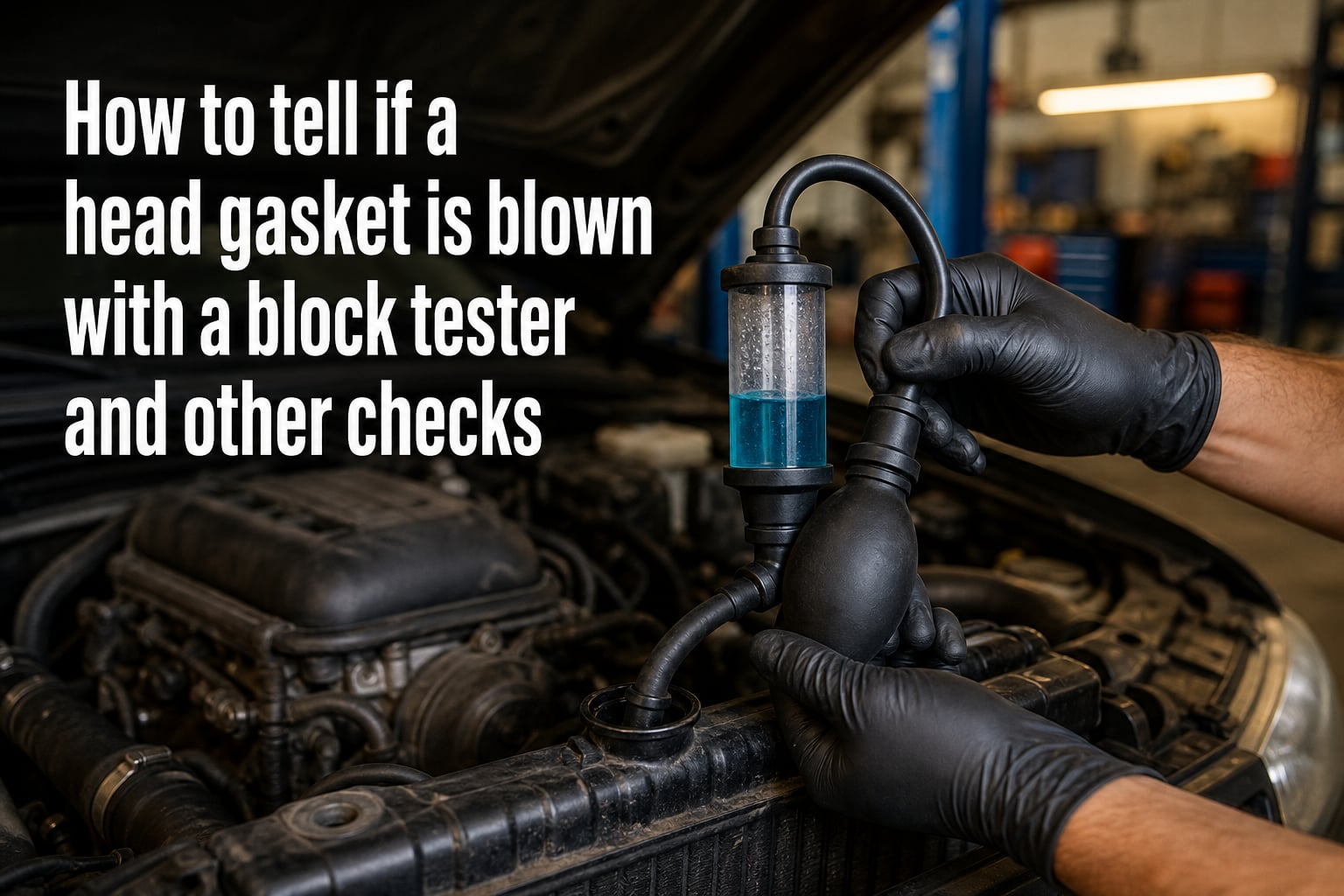
A block tester is a $30 to $50 hand-held chemical test that detects combustion gases in the cooling system. It works by drawing air from the radiator through a blue liquid reagent. If carbon dioxide from the combustion chamber is present, the liquid turns yellow or green. This is the single most reliable DIY test for a head gasket failure, and the chemistry is sound.
What You Need
Combustion leak tester (block tester) kit, available at any auto parts store
Blue reagent fluid (usually sold with the tester)
Radiator adapter that fits your vehicle
Coolant rated for the test environment
A helper to idle the engine while you watch
Step 1: Warm the Engine to Operating Temperature
The test is most accurate when the engine is at full operating temperature. Idle the car for 10 to 15 minutes, or drive it gently until the upper radiator hose is hot to the touch.
Step 2: Fill the Tester Chamber
Open the tester and pour the blue reagent fluid into the chamber up to the marked line. Snap the lid back on. The fluid should be a deep blue color. If it is already yellow or green, the tester is contaminated and you need fresh fluid.
Step 3: Connect the Tester to the Cooling System
Most block testers connect to the radiator filler neck with a rubber adapter. Some vehicles, especially those with a sealed coolant reservoir, require a different adapter. Follow the kit instructions for your specific setup.
Step 4: Start the Engine and Let It Idle
With the tester sealed to the radiator, start the engine. The tester has a hand pump that draws air from the cooling system through the blue fluid. Pump slowly and steadily.
Step 5: Watch the Fluid
Keep pumping for at least one to two minutes. Observe the fluid color. If the blue liquid turns yellow or green, exhaust gases are present in the cooling system and you have a head gasket failure or a cracked head. If the blue stays blue, no combustion gases are being introduced.
Step 6: Interpret the Result
A clear color change is a positive test. A faint or borderline change is a sign to retest the next day after a longer drive. No change after a thorough test is a strong negative, but it does not rule out an early-stage failure or a leak that only appears under load.
Other Diagnostic Checks You Can Perform
The block tester is the gold standard, but it is not the only check. Adding one or two of these tests will either confirm the result or help you find the real problem.
Compression Test
A compression test measures the pressure each cylinder can hold when the piston is at top dead center. Remove all spark plugs, screw the gauge into each cylinder, and crank the engine with the throttle open. Healthy cylinders should be within 10% of each other.
If two adjacent cylinders have low readings, the head gasket between them is likely blown. If one cylinder is low and the next is normal, suspect a valve or piston ring issue instead.
Leak-Down Test
A leak-down test goes further than compression. It pressurizes each cylinder with shop air and measures how much escapes. You can often hear air hissing from the radiator (gasket leak), the intake (intake gasket), or the oil filler (rings). This is the test most professional shops use to localize the failure.
Coolant Pressure Test
A cooling system pressure tester clamps onto the radiator and pressurizes the system externally. If the system holds pressure, your external leak suspicion is wrong. If pressure drops, you have an external leak that may or may not be the head gasket.
Saran Wrap Test Over the Reservoir
This is the cheapest DIY method and a great pre-screen before buying a block tester. Stretch a piece of clear plastic wrap over the open coolant reservoir while the engine idles. If the wrap pulls downward or bubbles vigorously, exhaust gases are pressure-charging the cooling system.
Balloon or Glove Test
Stretch a balloon or thin rubber glove over the coolant reservoir opening and run the engine. If the balloon inflates, combustion pressure is entering the cooling system. This is the same principle as the block tester, just visual and free.
What Can Be Mistaken for a Blown Head Gasket
Half of the vehicles that show up in my shop with a “head gasket” diagnosis actually have a different problem. Here are the five most common look-alikes.
Faulty Radiator Cap
A weak radiator cap will let coolant escape at low pressure, mimicking slow coolant loss. Replace the cap first if it is more than five years old.
Water Pump Failure
A failing water pump causes overheating but does not introduce exhaust gases into the coolant. A block tester will be negative.
Cracked Cylinder Head
A cracked head produces the same block tester result as a blown gasket. The two are only separable by removing the head. Both need the same repair path.
Intake Manifold Gasket Leak
Especially on V6 and V8 engines, intake manifold gasket failures can cause coolant loss and misfires. A block tester will often be negative because the intake is not part of the combustion chamber.
Faulty EGR Cooler
On diesel engines and some gasoline direct-injection models, the EGR cooler can fail internally and leak coolant into the exhaust. Symptoms overlap with head gasket failure, but the block tester is usually negative.
How Accurate Are Block Testers
Block testers are highly accurate when the engine is at operating temperature and the procedure is followed correctly. Industry sources and professional mechanics report accuracy rates near 90% or better for active leaks.
However, the test has limits. A small leak that only opens under high cylinder pressure may not trigger a color change at idle. Leaks that primarily mix oil and coolant without involving combustion gases will also test negative. The best practice is to use a block tester alongside a compression test and a cooling system pressure test for a complete picture.
If the block tester is negative but symptoms persist, do not stop there. Test again after a hard drive, or take the car to a shop for a leak-down test, which is more sensitive to small leaks.
Can You Drive with a Blown Head Gasket
Short answer: no, not for long. The moment coolant is entering the combustion chamber or oil is mixing with coolant, the engine is on a countdown. Continued driving risks hydrolock, oil starvation, and catastrophic failure that turns a $1,500 gasket job into a $5,000 engine replacement.
If the car must be moved a short distance to a safe spot, keep the engine under 2,000 RPM, watch the temperature gauge closely, and shut it off the moment it climbs above the normal range. For anything beyond a few miles, flat-tow the car or use a trailer. The repair cost far outweighs the tow fee.
When to See a Professional Mechanic
A block tester result you run yourself is just as chemically valid as one run by a shop. The reason to bring the car in is not the test itself; it is the follow-up work. If the test is positive, a mechanic can use a leak-down test to pinpoint which cylinder is affected and whether the head can be machined or replaced.
Professional diagnosis typically costs $100 to $250 depending on the shop and region. That fee is well worth it before committing to a multi-hour repair. When choosing a shop, ask whether they perform a leak-down test and a compression test together, and ask for the actual numbers, not just a yes or no answer.
Frequently Asked Questions
What is the easiest way to tell if you have a blown head gasket?
The easiest DIY method is a block tester, which uses a blue chemical reagent that turns yellow or green if combustion gases are present in the cooling system. As a free pre-check, stretch plastic wrap over the open coolant reservoir and look for suction or vigorous bubbling with the engine idling.
How accurate are block testers?
Block testers are highly accurate for active leaks, often 90% or higher when the engine is at full operating temperature. They can miss small leaks that only open under high cylinder pressure, so a negative test with persistent symptoms should be followed by a compression or leak-down test.
What else can be mistaken for a blown head gasket?
Common look-alikes include a faulty radiator cap, water pump failure, cracked cylinder head, intake manifold gasket leak, and a bad EGR cooler. Each of these can cause coolant loss or overheating, but only a cracked head and a true head gasket failure will usually produce a positive block test.
What is the best tool to check for a blown head gasket?
The best single tool is a combustion leak tester, also called a block tester. For the most complete picture, pair it with a compression test and a leak-down test, which together identify both the failure and the specific cylinder involved.
Final Thoughts on Diagnosing a Blown Head Gasket
Knowing how to tell if a head gasket is blown comes down to one consistent principle: trust the test, not the symptom list. A block tester is the most direct answer because it detects the exact thing a head gasket failure produces, which is combustion gases where they should not be. Pair it with a compression test for confidence, and you have a diagnosis that even a professional shop would accept.
If your test comes back positive, park the car and plan the repair. If it comes back negative but the symptoms still point to a head gasket, run the test again after a hard drive or bring it to a shop for a leak-down test. Either way, you now have a clear path forward instead of a guessing game.