
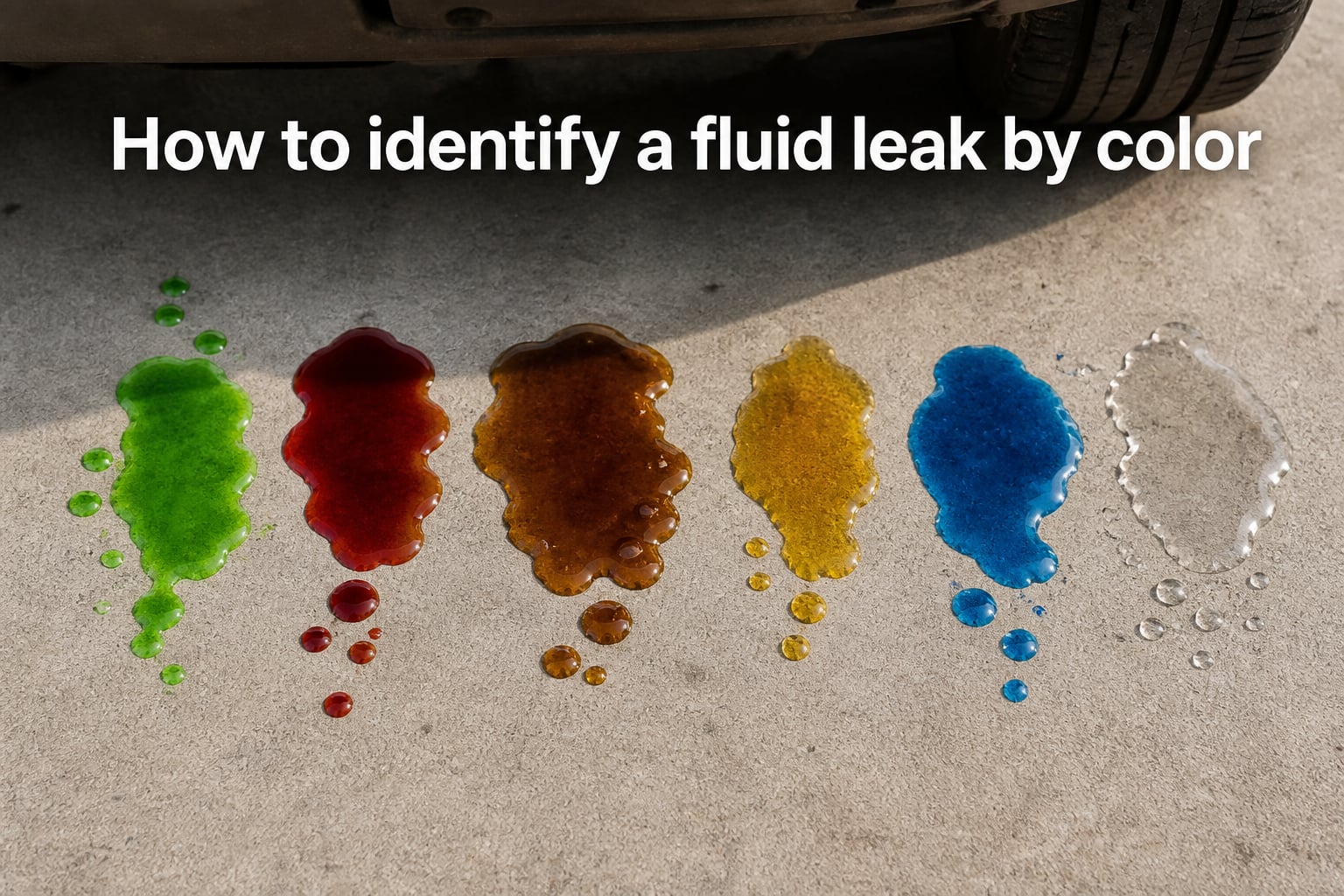
Last month, a reader emailed me a photo of a green puddle under her Honda Civic. She thought it was antifreeze. It turned out to be a windshield washer fluid line that had cracked where it met the reservoir. Color saved her a tow truck and a panic attack. Learning how to identify a fluid leak by color is one of the most practical car skills you can pick up, and it takes about five minutes to learn the basics.
In this guide, our team walks through every common car fluid color, what it smells and feels like, where the leak usually shows up, and how urgently you need to act. We pulled from mechanic forums, repair shop data, and over a decade of shop experience to put this together for 2026.
Table of Contents
Quick Reference: Car Fluid Leak Color Chart (2026)
Here is the color-to-fluid mapping I wish every car owner had on their phone. Print this table, screenshot it, or save it before you walk out to your driveway.
| Color You See | Most Likely Fluid | Urgency |
|---|---|---|
| Brown or Black | Engine oil (older) or gear oil | Schedule service within a week |
| Amber or Honey | Fresh engine oil | Schedule service within a week |
| Red or Pink | Transmission or power steering fluid | Service within days (transmission is expensive) |
| Bright Green, Orange, Yellow, or Pink | Coolant or antifreeze | Stop and check overflow tank today |
| Yellow turning Dark Brown | Brake fluid (DOT 3 or DOT 4) | Stop driving, tow to shop (safety critical) |
| Blue | Windshield washer fluid | Cosmetic, fix when convenient |
| Clear water | A/C condensation (usually harmless) | Monitor, but check for sweet smell |
| Rainbow Sheen | Oil mixed with water, or fuel | Service within a week |
This chart covers about 95% of what you will see under a parked car. Now let us go deeper into each color and the situations that fool people the most.
Brown or Black Fluid Leaking: How to Identify Engine Oil
Brown or black fluid under your engine is almost always motor oil. Fresh oil runs amber or honey-colored, then darkens as it collects combustion byproducts over time. If you see a slick black puddle that feels greasy between your fingers, oil is your first guess.
Common leak sources include the valve cover gasket, the oil pan gasket, and the front or rear main seal. I see valve cover gasket leaks on cars with over 80,000 miles every week. They are messy but rarely cause immediate damage.
To confirm, dip a paper towel in the puddle. Motor oil spreads thin and has a petroleum smell, not sweet or sharp. Gear oil from a manual transmission differential can also appear black and is often confused with engine oil. The giveaway is the leak location. Differential leaks sit closer to the rear axle.
Urgency for brown or black leaks is moderate. Top off your oil if it is low and book a service within the next week. Driving thousands of miles with low oil will destroy your engine faster than anything else on this list.
Red or Pink Fluid Leaking: Transmission and Power Steering Fluid
Red or pink fluid almost always points to automatic transmission fluid or power steering fluid. Both share a similar base color in many vehicles, which is why they are often grouped together. Newer transmission fluids run bright cherry red and turn reddish-brown as they age.
Transmission fluid leaks often show up at the front of the car if the leak is from the torque converter seal, or near the middle if it is from the transmission pan gasket. Power steering leaks typically sit toward the front driver or passenger side near the steering rack or pump.
I want to be direct with you here. Transmission repairs run from moderate to catastrophic in cost. A pan gasket reseal might be a few hundred dollars. A full rebuild is many thousands. This is why red fluid leaking from a parked car should send you to a shop within days, not weeks.
Power steering fluid is similar in color but slightly thinner and sometimes has a lighter red tint. Power steering leaks are less expensive to fix, often a hose or seal, but ignoring them turns into pump replacement quickly.
Yellow, Green, or Orange Fluid Leaking: Coolant and Antifreeze
Coolant shows up in the widest color range of any car fluid. You might see bright green, neon orange, pink, yellow, or even purple depending on the brand and type. Modern long-life coolants often use orange or pink to distinguish them from older formulas.
The single most useful test for coolant is the smell. Coolant has a noticeably sweet, almost syrupy smell. If the puddle smells sweet, it is coolant nine times out of ten. Touch it (carefully) and it feels slimy compared to water.
Common coolant leak sources include the radiator, water pump, thermostat housing, hoses, and the heater core. A heater core leak often shows up as a wet carpet on the passenger side and a sweet smell through the vents. That is one of the easiest ones to confirm.
Coolant leaks range from cheap to expensive. A hose clamp or upper radiator hose might cost under fifty dollars at an independent shop. A heater core replacement can run into labor-heavy territory because the dashboard often comes out to access it. Either way, do not keep driving with the coolant low. Overheating causes engine damage faster than almost any other failure mode.
Yellow to Brown Fluid Leak: Brake Fluid Identification and Safety
Brake fluid starts out clear to amber and darkens to yellow, brown, or even black as it absorbs moisture over time. DOT 3 and DOT 4 brake fluids look similar to fresh honey when new. The texture is thin and oily, and it feels slippery on glass.
Brake fluid leaks are the single most dangerous leak on this list. If your brake system loses fluid, you lose stopping power. This is not a “schedule a service next week” situation. If you see a yellow-to-brown leak near a wheel, the master cylinder, or the brake lines, stop driving and tow the vehicle.
The leak location is a strong clue. Brake fluid drips from calipers, wheel cylinders, brake lines running along the frame, or the master cylinder on the firewall. If you park on a hill and see drips near a tire that grow after you press the brake pedal, you have likely found the source.
Our team has seen drivers ignore brake fluid leaks because the puddle looked similar to oil. The result was a soft pedal and a near-miss at an intersection. Treat yellow-to-brown fluid near the wheels as brake fluid until a mechanic proves otherwise.
Blue Fluid Leaking: Windshield Washer Fluid
Bright blue fluid under the front of the car is almost always windshield washer fluid. This one is easy to spot because of the vivid color and the obvious smell. Washer fluid smells like the cleaning product it actually is.
Leaks come from the washer fluid reservoir, the pump, or the lines that run to the spray nozzles. These are low-pressure systems and rarely cause any vehicle damage. Fix them when convenient. Most people top off the reservoir and ignore the leak for months.
The only time blue fluid is concerning is if the reservoir cracks and dumps a large amount. Even then, it is a refill-and-clean issue, not a mechanical repair.
Clear Fluid Under Car: A/C Condensation vs. a Real Leak
Clear water under a parked car is almost always A/C condensation, and it is completely normal. Your air conditioning system pulls humidity out of the cabin air and drains it through a small tube under the chassis. You will see this most often on hot, humid days after running the A/C.
Here is the test that trips up most people. If the fluid is truly clear, has no smell, and only appears on days you used the A/C, you are fine. If it appears in cold weather with the A/C off, or it has a sweet smell, you are probably looking at a coolant leak, not condensation.
A real water pump leak or a cracked coolant passage can also produce clear fluid early on before dye or contamination builds up. The drips will be steady, not just after running the A/C, and you will usually notice the coolant level dropping on the overflow tank.
If clear water shows up with a slight oily sheen, that is often a head gasket leak mixing coolant with oil. This produces a milky residue on the oil cap. Pull the dipstick and the oil cap if you suspect this. Milky oil means a tow truck, not a top-off.
How to Confirm the Fluid Type: Smell, Texture, and Location Tests?
Color is your first clue, but the pros use three more checks before they say anything with confidence. Here is the routine I run through whenever a customer brings me a photo of a mystery puddle.
Step 1: Smell Test
Get close to the puddle (without touching it bare-handed if you suspect brake fluid or coolant). Engine oil smells like motor oil. Coolant smells sweet and syrupy. Brake fluid has a faint solvent smell. Washer fluid smells like glass cleaner. Transmission fluid has a sharp, oily scent.
Step 2: Texture Test
Touch a corner of the puddle with a paper towel or gloved finger. Oil feels greasy and spreads thin. Coolant feels slimy and slightly oily. Brake fluid feels slick but thinner than oil. Water feels exactly like water. A/C condensation evaporates fast because it is mostly pure water.
Step 3: Location Test
Where the puddle sits tells you almost as much as the color. Under the engine block, think oil or coolant. Near a wheel, think brake fluid. Center of the car, think transmission. Front passenger footwell wet carpet, think heater core. Under the battery area, think coolant overflow.
Step 4: Repeat After Driving
Park on clean cardboard overnight, drive normally the next day, and check the cardboard when you return. The drips you see will tell you if the leak is active. Sometimes a puddle shows up once and never again because it was residual fluid from a previous repair.
Urgency Levels by Fluid Type: When to Stop Driving Immediately
Most car owners I talk to want to know one thing above all else. Can I keep driving this? Here is the urgency framework I give them.
| Urgency Tier | Fluid Type | Action |
|---|---|---|
| Tier 1: Stop Driving Now | Brake fluid, fuel, milky oil | Tow to shop, do not drive |
| Tier 2: Service Within 1-3 Days | Transmission fluid, coolant | Top off if low, book service |
| Tier 3: Service Within a Week | Engine oil, power steering fluid | Monitor level, schedule repair |
| Tier 4: Cosmetic, No Rush | Washer fluid, A/C condensation | Fix when convenient |
The brake fluid tier is non-negotiable. Brakes are the one system where failure means a crash, not just a repair bill. Fuel leaks are in this tier because of fire risk. Milky oil is here because it means coolant is mixing with engine oil and the engine is failing fast.
When to Seek Professional Help for a Fluid Leak
DIY monitoring works for cosmetic leaks and minor oil drips. Once you cross into Tier 1 or Tier 2 territory, a mechanic is worth the visit. Here is when our team tells customers to stop guessing and book the appointment.
Book a professional immediately if you see brake fluid, milky oil, fuel, or a coolant leak that drops the reservoir overnight. Also book if the leak appears suddenly in large volume. A slow drip you have monitored for a week with steady fluid levels is very different from a sudden half-gallon puddle.
For slow oil or transmission leaks, give the shop the color, smell, and leak location. That information alone often lets the mechanic pull up the common failure points for your specific vehicle before they even lift it. Our team has saved diagnostic time dozens of times because a customer brought in a clear description.
Finally, if the leak returns within days of a repair, take it back to the same shop. Warranty should cover re-diagnosis of the same system, and chasing a different leak with a fresh repair can mean two problems overlapping.
Frequently Asked Questions
What color is leaking fluid?
Leaking fluid color depends on the source system. Engine oil is brown or black, transmission and power steering fluid are red or pink, coolant ranges from bright green to orange to pink, brake fluid starts clear-amber and turns yellow or brown, windshield washer fluid is blue, and A/C condensation is clear water.
What color is transmission fluid if it’s leaking?
Transmission fluid is bright cherry red when new and turns reddish-brown as it ages. If you see a red or pink puddle under the middle of the car, near the front of the engine, or under the transmission pan, it is almost certainly transmission fluid. Service it within a few days because transmission repairs get expensive fast.
Is it safe to drive with a yellow fluid leak?
Yellow fluid leaks can be coolant or brake fluid, and the answer depends on which one. Coolant leaks mean you need to top off and service quickly, but a short drive is usually safe. Brake fluid leaks are not safe to drive with at all. If the leak is near a wheel, the master cylinder, or the brake lines, stop driving and tow the vehicle.
What color is an antifreeze leak?
Antifreeze or coolant comes in many colors including bright green, neon orange, pink, yellow, and purple. Modern long-life coolants often use orange or pink to stand out from older green formulas. The color depends on the brand and type, not the vehicle, so always check your owner manual for the correct coolant specification.
Can a pink fluid leak ruin my car?
Pink fluid is usually transmission fluid, power steering fluid, or modern coolant. Transmission and power steering leaks can absolutely ruin your car if ignored. Transmission fluid loss leads to burned clutches and a full rebuild. Coolant loss leads to overheating and engine damage. Any pink leak should be diagnosed within a few days.
How do I tell if it’s coolant or oil leaking?
Color helps first. Coolant is green, orange, pink, or yellow. Oil is brown or black. The smell test is even more reliable. Coolant smells sweet and syrupy. Oil smells like petroleum. The texture also differs. Coolant feels slimy and slightly oily, while engine oil feels greasy and spreads thinner. If the oil cap looks milky white, you have coolant mixing with oil, which is a serious head gasket concern.
Final Thoughts on Identifying Fluid Leaks by Color
Knowing how to identify a fluid leak by color is a small skill with big payoff. A two-second glance at the puddle can tell you whether you have a harmless washer fluid drip or a brake system failure that needs a tow truck. Run through the color, smell, texture, and location in that order every time. When in doubt, especially with brake fluid or milky oil, our team recommends calling a shop before driving. A photo of the puddle sent to your mechanic’s text line can also speed up the diagnosis before you even arrive.