
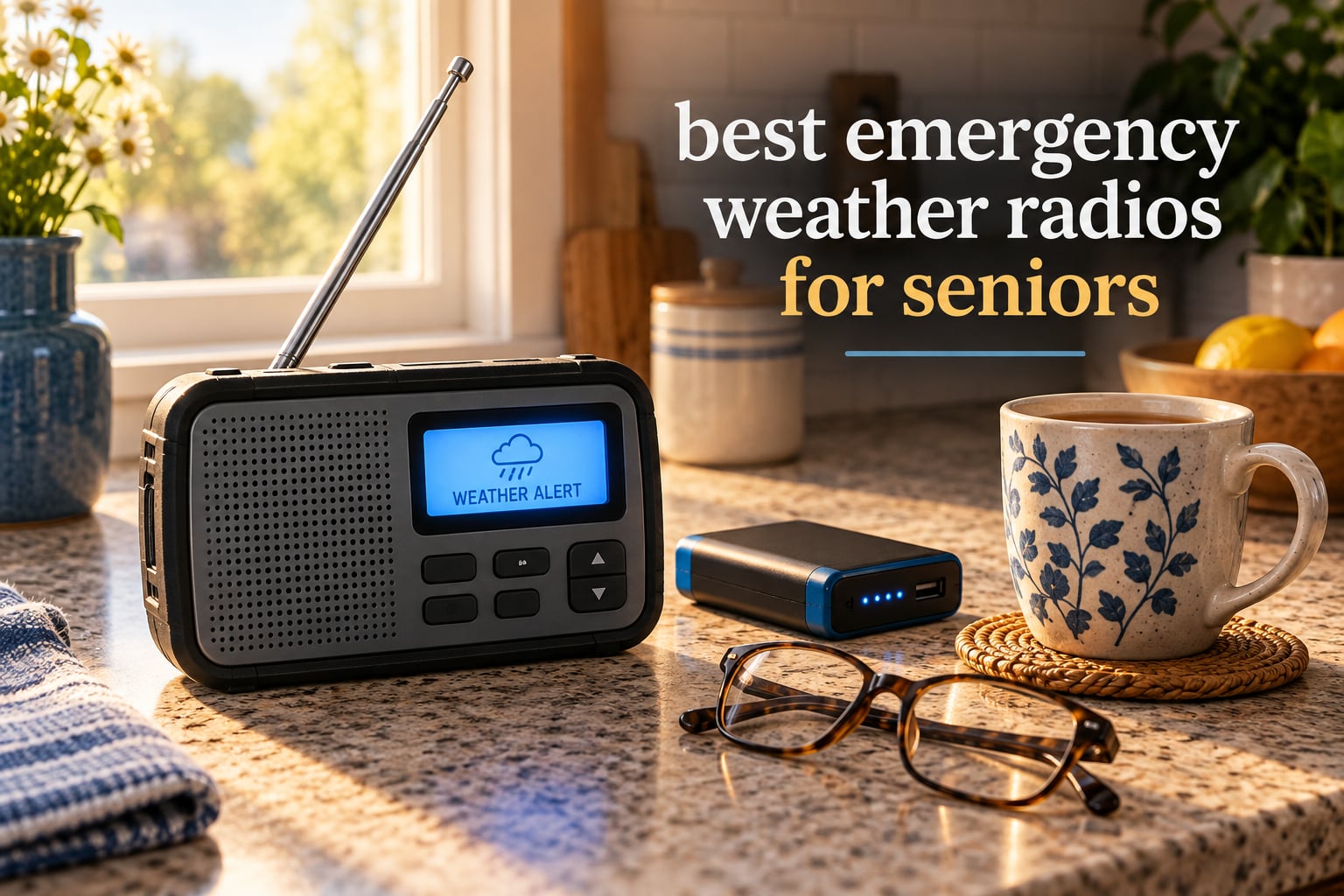
Power goes out, the cell tower goes dark, and the one device that still works is a battery-powered radio bolted to the kitchen counter. For an older adult living alone, that radio is not a gadget. It is the only thing that will still deliver official instructions when everything else has stopped working.
We compared ten NOAA All-Hazards radios built specifically for this job. The FosPower A1 came out on top because it runs on three separate power sources, carries nearly 38,000 reviews at 4.6 stars, and can top up a phone. The Midland WR120B is the value pick for anyone who wants county-specific alerts on a kitchen counter instead of a portable unit.
What makes a weather radio easy for a senior comes down to four things: controls that can be operated with arthritic hands, a display with large high-contrast characters, alerts loud enough to wake someone at 3am, and alerts that fire automatically without anyone touching a dial. Radios that skip one of those fail the test, no matter how good the speaker is.
We scored every unit on four weighted criteria: alert reliability (30%), ease of use (30%), hearing and vision assistance (20%), and power and battery (20%). Ratings and review counts come straight from the manufacturer listings, and prices change daily, so use the check price buttons rather than any figure you may remember. For the wider picture, our emergency car kit guide covers the same planning logic for vehicles.
Updated for 2026. Product data checked October 2026.
Table of Contents
Top 3 Best Emergency Weather Radios for Seniors in 2026

FosPower A1 NOAA Emergency…
- Three power sources
- 7400mWh phone charging power bank
- Reading light and flashlight
- Limited lifetime warranty

Midland WR120B NOAA Alert…
- S.A.M.E. county coding
- NOAA Weather Scan
- Color-coded alerts
- AAA battery backup

Raynic CR1009Pro Emergency…
- Automatic NOAA alert scanning
- Large dimmable LCD
- Six-way charging
- Headphone jack
The FosPower A1 is the most proven radio in the group and the one we would hand to a parent who will not fiddle with settings. The Midland WR120B wins on alert precision, because S.A.M.E. county coding means nobody is woken at 2am for a storm two counties over. The Raynic CR1009Pro has the most readable screen of the three and scans for hazards automatically.
All 10 Radios Side by Side in October
| Product | Specs | Action |
|---|---|---|
| FosPower A1 NOAA Emergency Radio |
|
Check Latest Price |
| Midland WR120B NOAA Alert Radio |
|
Check Latest Price |
 RunningSnail MD-088S Hand Crank Radio RunningSnail MD-088S Hand Crank Radio |
|
Check Latest Price |
| Raynic CR1009Pro Emergency Radio |
|
Check Latest Price |
 Leaton 10000mAh NOAA Radio Leaton 10000mAh NOAA Radio |
|
Check Latest Price |
 Sangean H201 Shower Radio Sangean H201 Shower Radio |
|
Check Latest Price |
 Mesqool CR1030 NOAA Radio Mesqool CR1030 NOAA Radio |
|
Check Latest Price |
 Kaito Voyager Pro KA600 Kaito Voyager Pro KA600 |
|
Check Latest Price |
 RunningSnail MD329 NOAA Radio RunningSnail MD329 NOAA Radio |
|
Check Latest Price |
 Nitigo 4000mAh NOAA Radio Nitigo 4000mAh NOAA Radio |
|
Check Latest Price |
1. FosPower A1 NOAA Emergency Radio – Best Overall for Seniors
FosPower NOAA Emergency Weather Radio A1 7400mWh Solar Hand Crank (Orange)
7400mWh charging power bank
Crank, solar and 4 AAA power
4-LED reading light and 1W flashlight
NOAA plus AM and FM
Pros
- Three independent power sources
- 7400mWh power bank charges a phone
- Separate reading light and flashlight
- Limited lifetime warranty
Cons
- 2-watt speaker is modest for a room
- Hand crank and solar are slow top-ups
- Analog tuning with no display
- No S.A.M.E. county filtering
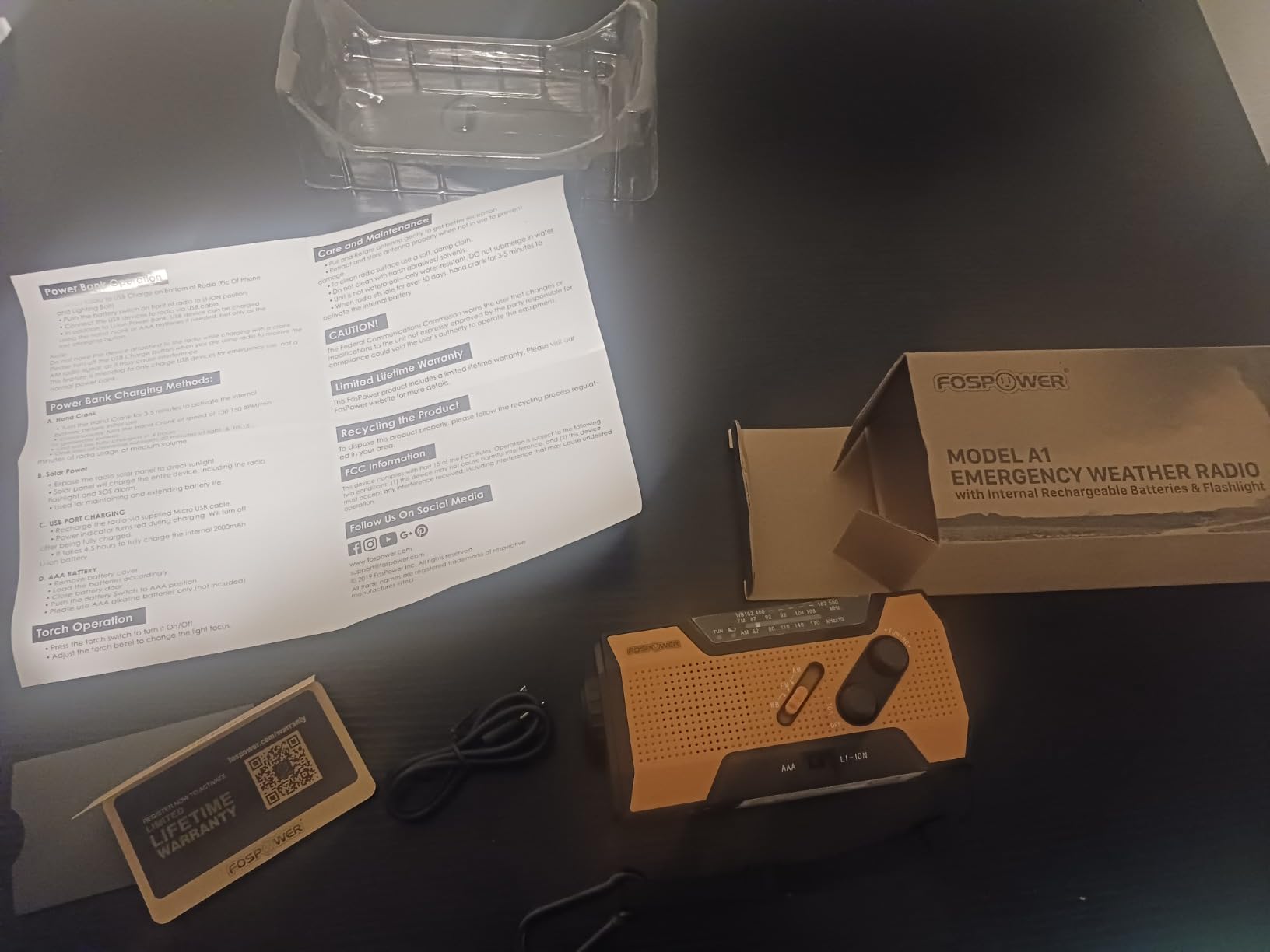
This is the radio we keep coming back to. The FosPower A1 ranks number one in Weather Radios on Amazon with 37,868 reviews at 4.6 stars, and 75 percent of those reviews are five stars. No other product here comes close to that sample size, and it matters when the buyer is someone who cannot troubleshoot a device mid-storm.
What makes it work for older adults is the power design. There are three separate ways to run it: a hand crank, a solar panel, and four AAA batteries. If the grid is down and the internal battery is flat, a senior can put in four AAAs from the kitchen drawer and be receiving NOAA weather broadcasts again in a couple of minutes. No charging cable, no wall outlet, no learning curve.
The 7400mWh power bank is the sleeper feature. It is enough to bring a dead phone back to life for a call for help or a check-in with family, and that single capability changes what the radio is. It is not just a receiver, it is a very small piece of emergency infrastructure for one person.
It also carries two lights: a 1-watt flashlight and a separate 4-LED reading light. The reading light is the one older adults actually reach for, because it is wide and soft rather than a beam you have to aim at a page. Owners frequently describe keeping it on the nightstand rather than in a go-bag, which is exactly how we want a radio used.
The honest weaknesses are real. The 2-watt speaker is small, so the alert tone is audible in a quiet room but not a room-filling siren, and tuning is analog with no display, meaning someone has to find the right NOAA channel by ear. There is no S.A.M.E. county programming either, so it will relay alerts for areas that do not concern the listener.
Will a senior actually be able to tune it without help?
This is the one task that gives us pause. The dial is not labelled with channel numbers you can read at a glance, so the first setup should be done by an adult child or another helper, not left to the older adult during a storm. Once tuned, it does not need touching again unless the batteries are swapped.
Our advice is to set it up together, write the channel position on masking tape inside the battery cover, and then treat the radio as a set-and-forget device. That single ten-minute session removes the only part of this radio that requires fine motor control.
Is the alert loud enough to wake someone at night?
It depends on the household. In a bedroom with a closed door, the 2-watt speaker is on the quiet side, and a person with age-related hearing loss may miss it. In a kitchen, hallway, or living room where the radio can be heard across the space, it works well, and reviewers report it waking heavy sleepers during overnight tornado watches.
If sleep is the priority, pair this with a visual alert accessory rather than a louder radio, and keep the bedroom door open. This model is the best fit for a person who wants one dependable device that does everything rather than a specialist unit built for a single need.
2. Midland WR120B NOAA Alert Radio – Best Value Desktop Alert Radio
Midland – WR120B – NOAA Emergency Weather Alert Radio
S.A.M.E. for up to 25 counties
NOAA Weather Scan for 60+ hazards
Color-coded severity indicators
6 AAA battery backup
Pros
- County codes suppress irrelevant alerts
- Weather Scan finds hazards unattended
- Volume wakes heavy sleepers
- Bright color-coded LCD
- AAA backup keeps working in an outage
Cons
- County coding needs a phone or computer lookup
- Display hard to read at an angle
- Backup cells are short-outage insurance
- Limited maximum volume
The Midland WR120B is the one we would put on a kitchen counter. It is a fixed-location radio, not a portable one, and that is a deliberate choice: it has no hand crank, no solar panel, and no phone charging. What it does instead is deliver the most precise alerting in this group, at a fraction of what the desk-mounted accessibility models cost.
It carries 24,346 reviews at 4.5 stars, and owners describe reception that stays clear inside a steel tornado shelter where cell phones have lost signal entirely. That anecdote matters more than any spec sheet, because it describes the exact scenario an older adult in a storm is likely to be in.
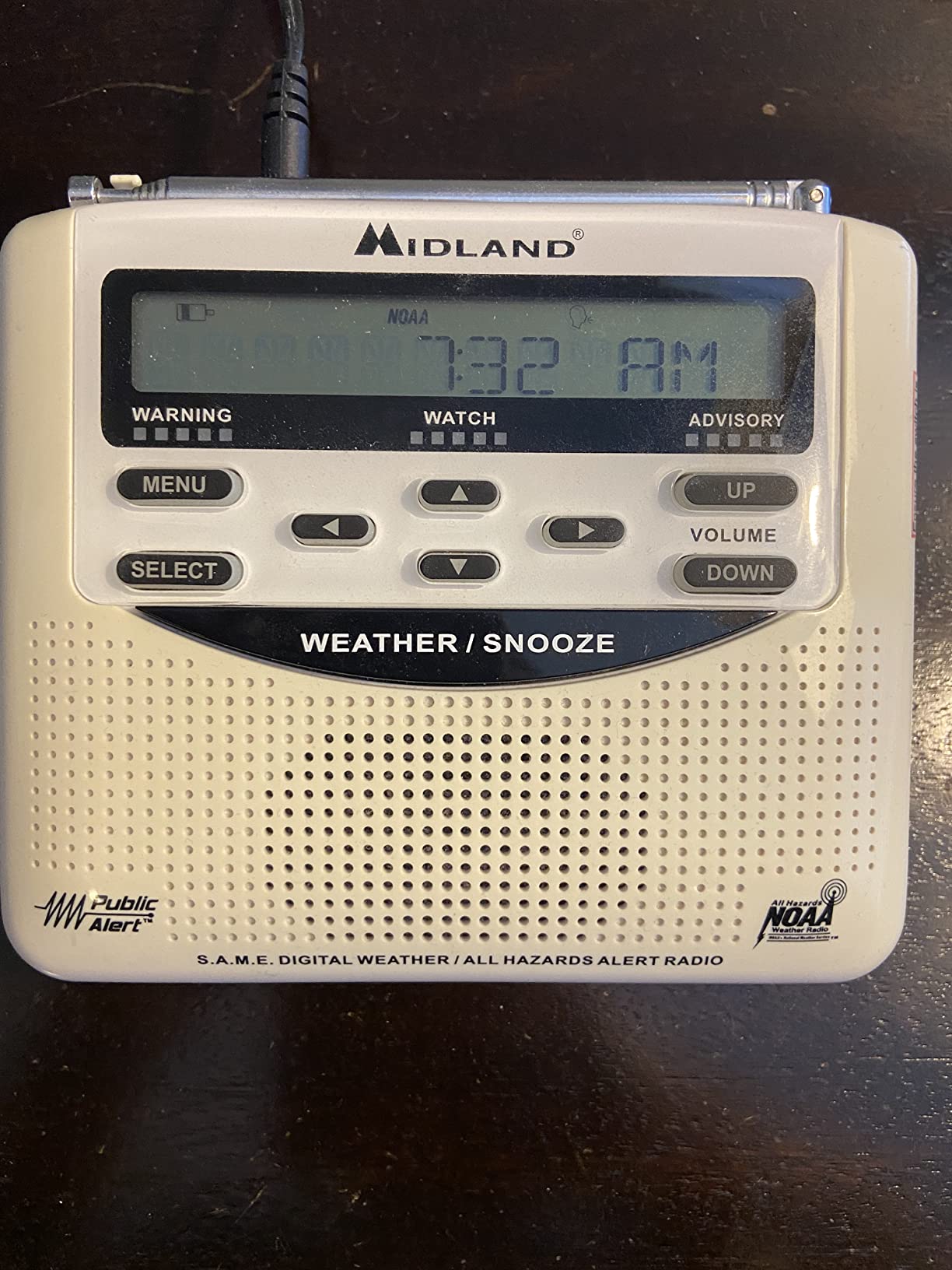
The key feature is S.A.M.E., which stands for Specific Area Message Encoding. It is the system that lets you program the radio to alert only for specific counties, up to 25 of them. Without it, a radio relays every hazard in the broadcast area, which in practice means late-night warnings for places the listener has never heard of and has stopped paying attention to.
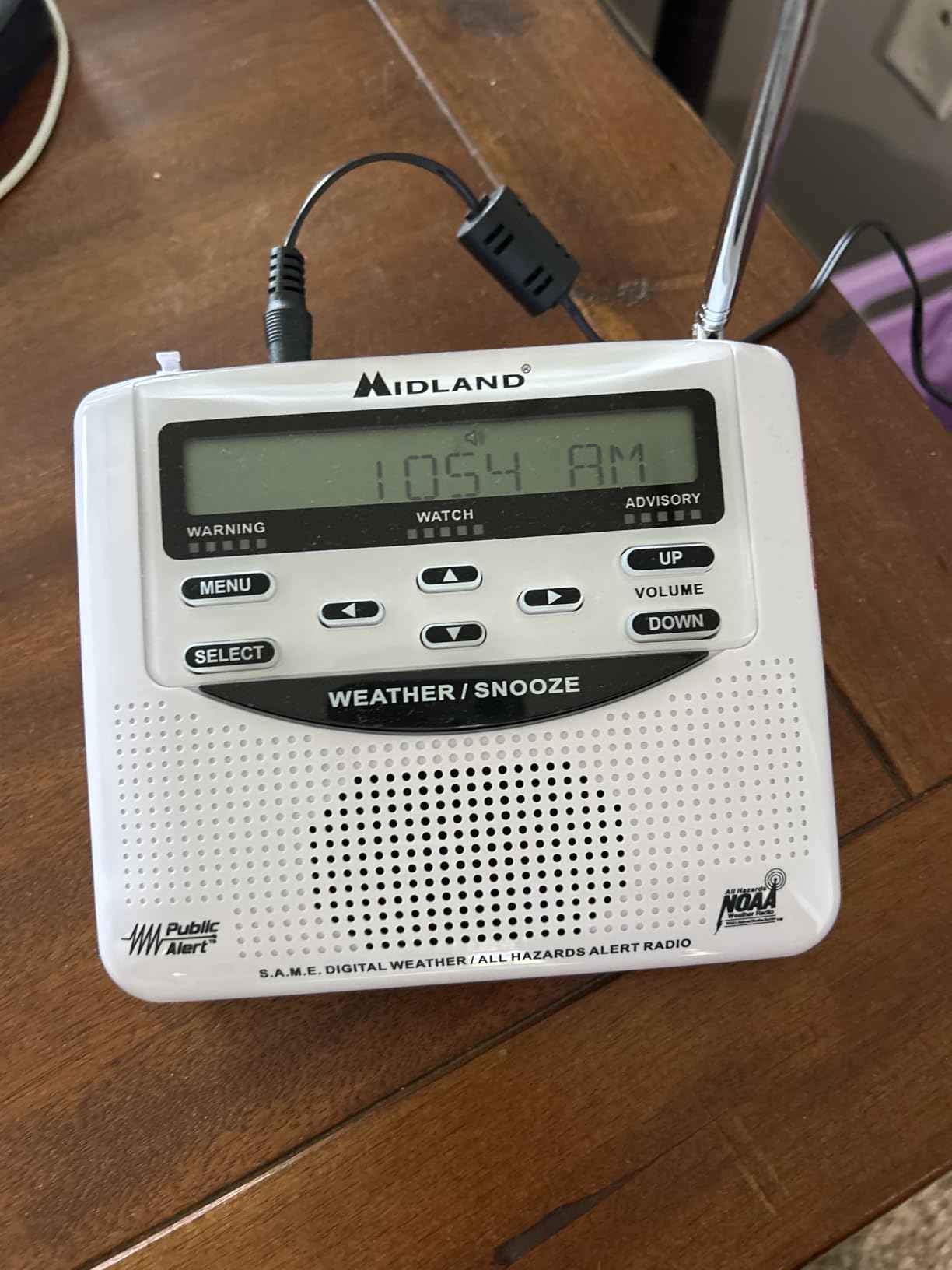
On top of that, NOAA Weather Scan monitors continuously and surfaces hazards without anyone watching the dial, and the color-coded indicators on the LCD show both the type of alert and how serious it is. Red for a warning, a calmer color for an advisory. For a senior with limited vision, a color difference alone is not enough, but paired with the audible tone it works well.
Reviewers consistently single out the volume as enough to wake a heavy sleeper, and the continuous backlight option keeps the display on rather than fading out after a few seconds. The radio also runs on six AAA batteries when mains power fails, so it keeps alerting through an outage without anyone doing anything.
The friction is the setup. Programming S.A.M.E. county codes requires looking the code up on a phone or computer and entering it with a keypad, which is the single step most likely to defeat a less technical owner. Owners report roughly 25 minutes for first setup, and plenty of people never complete it, which is the most common reason these radios seem to fail during a real event.
How many setup steps will this radio take?
More than the hand-crank models, and that is the trade. It is plug in, find the county code, enter it, choose which hazard types you want armed, and turn the volume up. Done properly, that is a ten-minute job for a helper, and after that the radio never needs attention again.
Because it is mains powered with battery backup, it is not portable for long periods. Reviewers note the AAA cells are short-outage insurance rather than an all-day power source, so this belongs on a counter with a wall outlet, not in a car or a go-bag.
Can the display be read by someone with low vision?
Partly. The LCD is bright and the color coding is clear in dim light, but it becomes unreadable if the unit is tilted away or mounted on a wall at an angle. Sit it flat on a counter at roughly eye level rather than pushing it up on a shelf, and the display is as good as anything else in this roundup.
For a reader who needs bigger characters, this is not the model to choose. The Raynic covered later in this guide has a noticeably larger screen, and the Mesqool uses a large tuning knob with clear labelling instead of a display at all.
3. RunningSnail MD-088S Hand Crank Radio – Best Grab-and-Go Radio for Seniors
RunningSnail Hand Crank Radio with Flashlight, NOAA/AM/FM Emergency Radio
2000mAh internal battery
Crank, solar and internal power
Retractable antenna
0.5 lb compact body
Pros
- Light at 0.5 lb
- Three power paths
- No disposable batteries needed
- Retractable antenna helps rural reception
- 1W LED flashlight
Cons
- No display so tuning is by ear
- 3-watt speaker
- Water-repellent not rated waterproof
- Small 2000mAh power bank
- No S.A.M.E. filtering
At 0.5 lb and 5 by 1.8 by 2.4 inches, this is the smallest radio here, and size is the whole point.
For a parent who moves between rooms slowly, or who wants the radio to live in a drawer rather than on display, a unit that can be picked up with one hand and relocated without thinking is worth more than extra features.
It carries 23,577 reviews at 4.5 stars, with 73 percent five stars. Buyers treat it as a grab-and-go device for a go-bag, a junk drawer, or the car, and several reviewers describe it being carried to a shelter or a relative’s house during an outage.
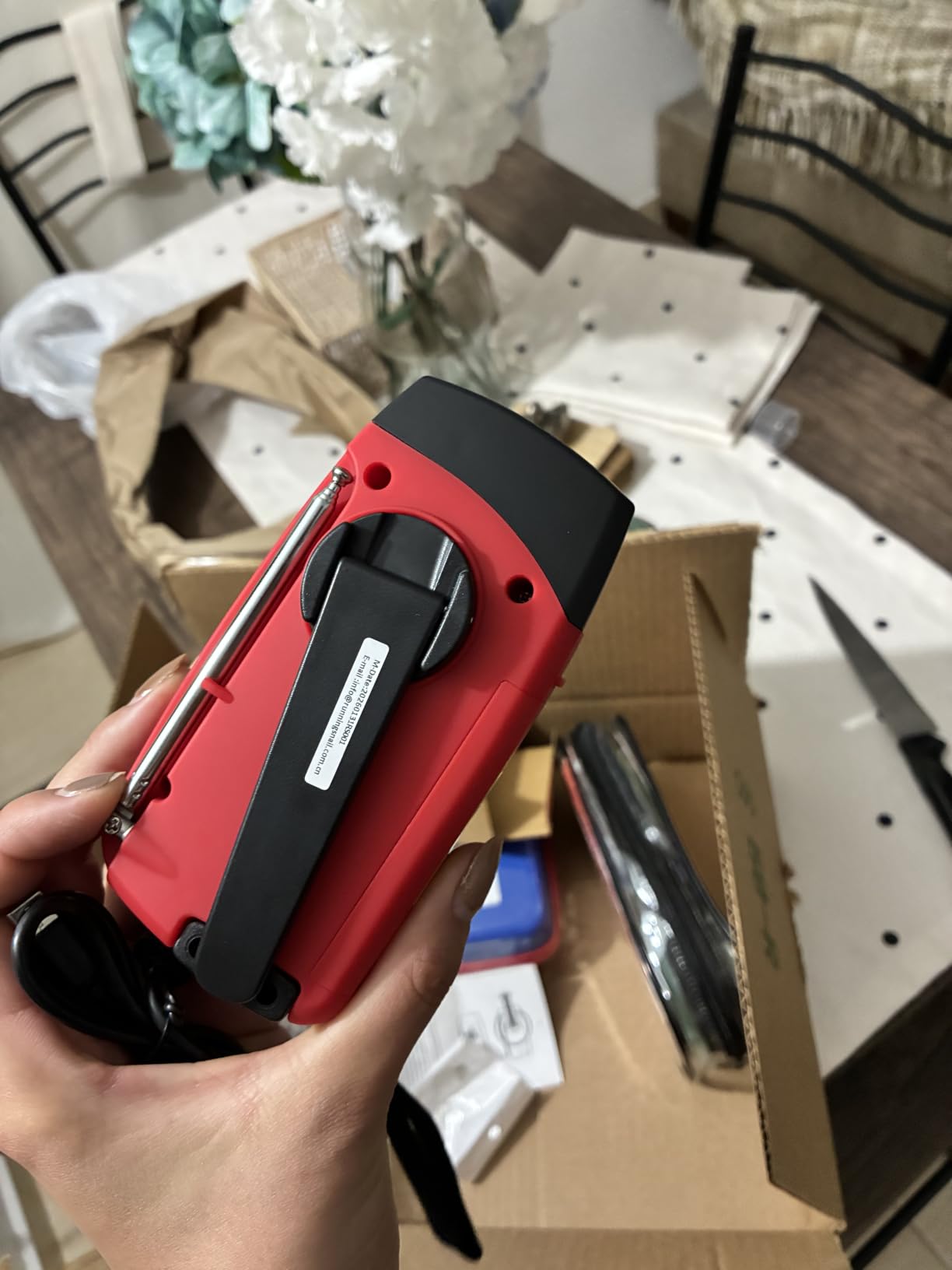
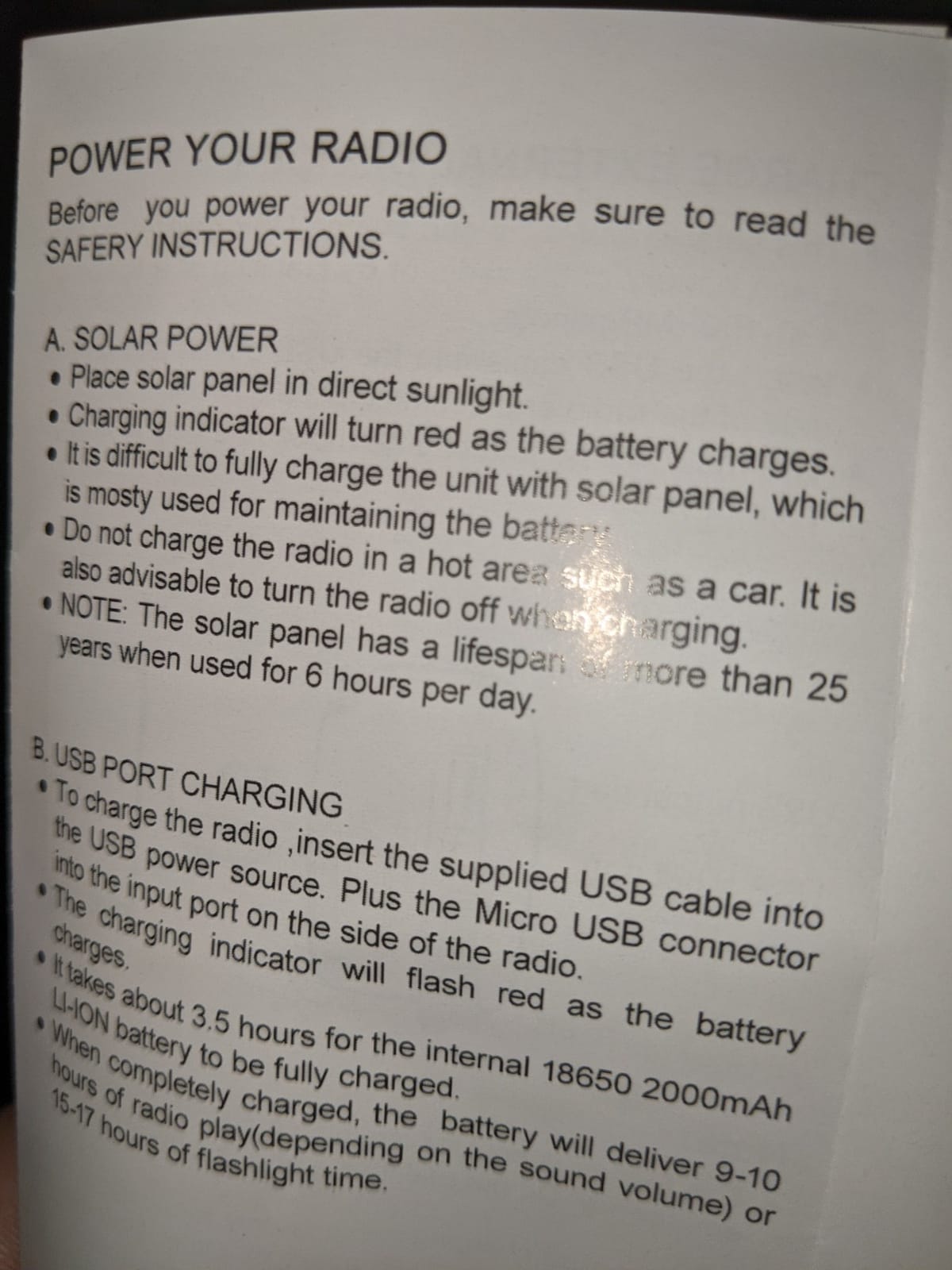
Power comes from three places: a hand crank, a solar panel, and a built-in 2000mAh rechargeable battery. There are no disposable batteries to buy in advance, which removes a common failure point. A radio that has been sitting in a drawer for eight months may arrive flat, but this one can be cranked back to life without a trip to the shop.
The retractable antenna is the detail that makes it work in the places older adults in this category actually live. Rural areas, valleys, and low-rise buildings are where NOAA reception struggles, and pulling the antenna out rather than leaving it flush is a meaningful gain.
The 2000mAh battery doubles as an emergency charger for most USB phones, which is roughly one partial top-up. That is enough for a call for help, not enough for a day of navigation and calls, and it is worth being clear about that limit when you are planning for a multi-day outage.
The compromises are the same ones every small portable radio shares. There is no display, so NOAA tuning is entirely by ear through a 3-watt speaker, and there is no S.A.M.E. county filtering, so it will pass along alerts for surrounding areas. The housing is water-repellent rather than rated for immersion, so it belongs indoors during heavy weather.
Who should choose this over a desktop radio?
Anyone whose radio needs to move. If the power goes out in a house with a backup generator in the basement, a counter unit is the sensible choice. If the whole house goes dark, or if the person has to relocate to a neighbor’s place or a community center, a 0.5 lb radio with a crank goes in a pocket and works from the internal battery.
It is also the radio we would pack for a senior who travels, stays in a second home, or splits time between relatives. One device, three power sources, no setup beyond finding the channel once.
Is the sound loud enough to hear across a house?
For a bedside or a small room, yes. For warning someone in another part of a house, we would not rely on it alone, because a 3-watt speaker in a 5-inch body is not built for that. Placement is the deciding factor: a kitchen counter near the center of the home does more for audibility than any volume setting on the radio itself.
Because there is no S.A.M.E. filtering either, expect alerts for neighbouring counties at odd hours. For many households that is harmless. For someone who is already anxious about emergencies, an over-broad alert stream can cause them to switch the radio off, which is a worse outcome than a slightly less precise one.
4. Raynic CR1009Pro Emergency Radio – Best Readable Display
Raynic Emergency Radio, 5000mAh/18500mWh Weather Radio, Solar Hand Crank Radio with AM/FM/SW/NOAA Alert, Cell Phone Charger, Headphone Jack, Flashlight and SOS Siren
Automatic NOAA alert scanning
Large HD LCD with dimmable backlight
Six-way charging
3W flashlight and 2.5W reading lamp
Pros
- Automatic NOAA scanning needs no supervision
- Large dimmable HD LCD
- 5000mAh internal battery
- Six charging options
- 3.5mm headphone jack for night listening
Cons
- Not waterproof despite outdoor marketing
- Short antenna limits weak-signal reception
- Solar only holds a charge
- Hand crank is slow
- Buttons are not backlit
- No S.A.M.E. programming
Two decades of vision change makes screen legibility a deciding factor, and this radio handles it best. The Raynic CR1009Pro has a large HD LCD with a dimmable backlight, and the readout shows battery level and tuned frequency, so a senior can tell at a glance whether the radio is working rather than guessing from a sound.
It carries 20,637 reviews at 4.5 stars. Reviewers consistently credit reception, sound quality for the size, the brightness of the flashlight, and the number of charging routes available, with several saying it performs better than larger portable units they had owned before.
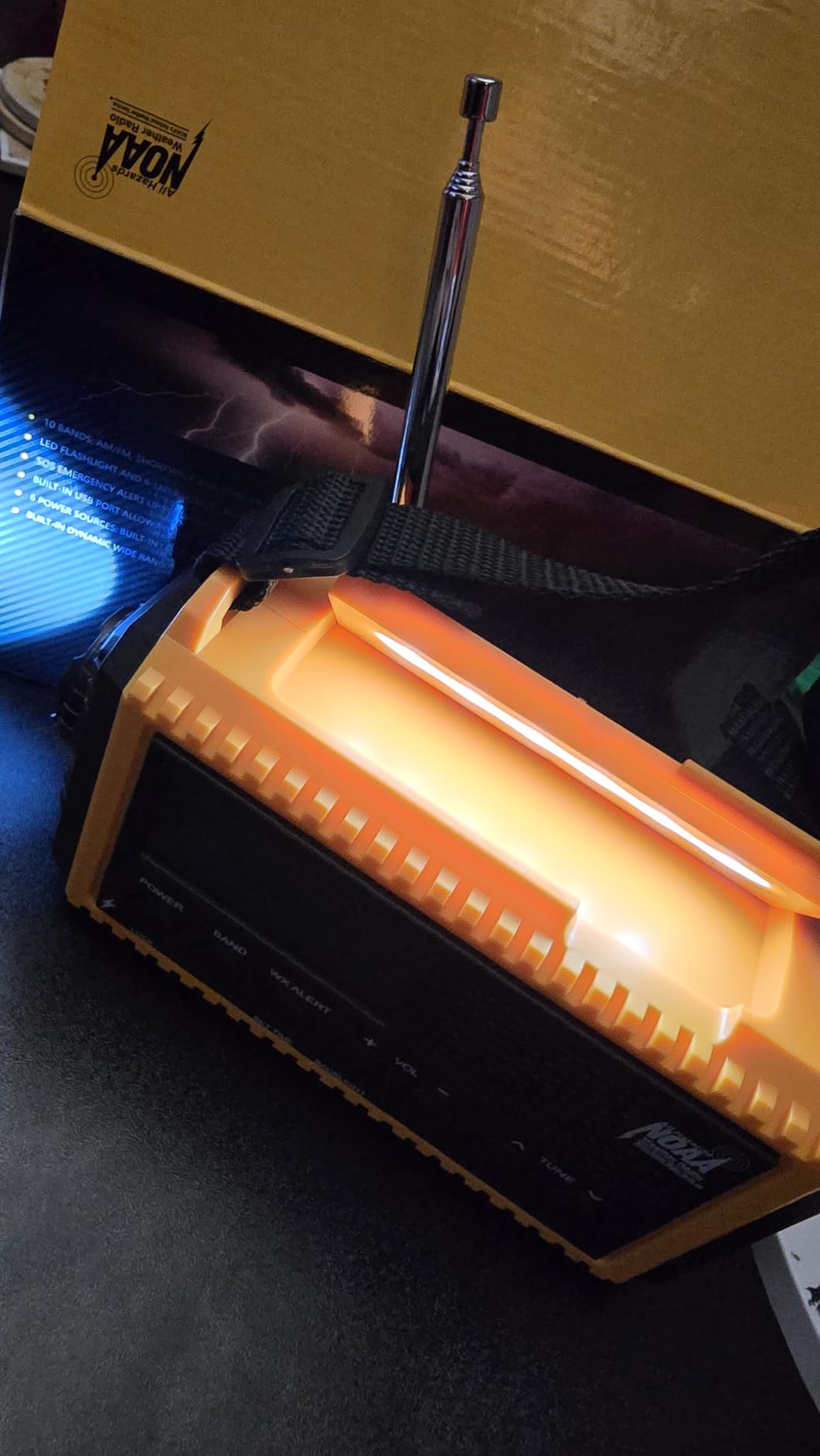
The most senior-relevant feature is the automatic NOAA alert scanning. It scans on power-up and again in standby, so the radio finds a hazard without anyone sitting next to it or touching a dial. That removes the single most common failure mode we see in this category, which is a radio that was never actually monitoring because nobody knew how to put it in alert mode.
Charging is genuinely over-specified in a useful way. There are six routes: the built-in 5000mAh battery, an AC adapter, a DC 5V USB input, a hand crank, a solar panel, and three AAA batteries. Any one of those can be the path that works on the day. The 3-watt flashlight and 2.5-watt reading lamp are both bright enough to work by and draw little from the battery.
There is a 3.5mm headphone jack, which is the detail that turns this into a nightstand radio. Plugging in headphones before bed means alerts arrive without waking a spouse or a house, and a light sleeper gets the full siren level while lying down with eyes closed.
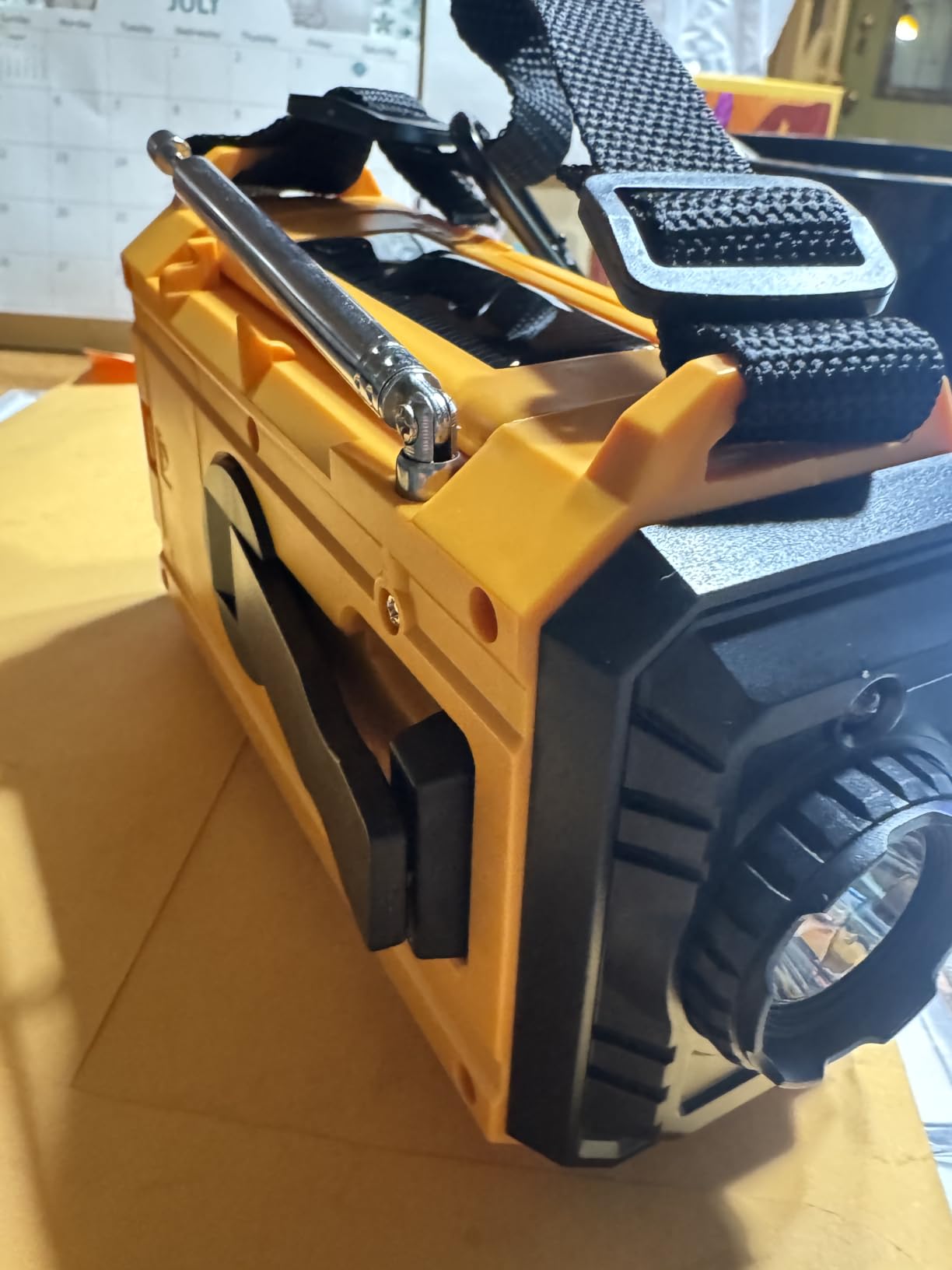
The weaknesses cluster around outdoor use. The port covers do not stay shut, so it is water resistant rather than waterproof despite the outdoor framing. The antenna is short, which limits reception in weak-signal areas. The solar panel maintains a charge rather than recovering a dead battery, and the crank is slow. The buttons are not backlit, so operating it in a dark room means feeling for them.
How readable is the display in a dark room?
Good. The backlight is dimmable, which matters more than brightness for anyone with light sensitivity or who is being woken in the night. You can dial it down to a level that is legible without lighting up the whole bedroom. The battery level and frequency readout also mean the radio can be checked at a glance from across a room.
What is missing is county filtering. There is no S.A.M.E. programming, so it behaves like a wide-area receiver. If the household is in a region where the NOAA broadcast area covers several counties with different flood and evacuation patterns, that matters, and the Midland WR120B is the better choice for precision.
Is it heavy enough to be a problem to move?
At 16 ounces it is heavier than the RunningSnail but still portable, and the included carabiner and compass strap make it easy to hang from a hook or attach to a bag. For a bathroom, a garage, or a covered porch, that is enough. For a go-bag that has to be carried on foot, the RunningSnail is lighter.
Our overall view is that this is the most complete single radio for an older adult who wants alerts that fire on their own, a screen they can read, and enough battery to last a long outage. It is our top rated pick, and the third slot in the picks box reflects how close it sits to the FosPower for general use.
5. Leaton 10000mAh NOAA Radio – Best Big Buttons and Big Battery
Leaton Hand Crank Emergency Radio, NOAA Weather Radio AM/FM,10000mAh
10000mAh battery
Oversized controls for older adults
IPX6 water resistance
3-mode flashlight and reading lamp
Pros
- 10000mAh runs for days
- Controls deliberately sized for older hands
- IPX6 resists spray and splashing
- Solar
- crank and USB-C charging
- Built-in compass
Cons
- NOAA channels tuned manually
- No automatic alerting or S.A.M.E. codes
- No headphone jack
- USB output limited to 5V/1A
- About 1.3 lb is heavy to move
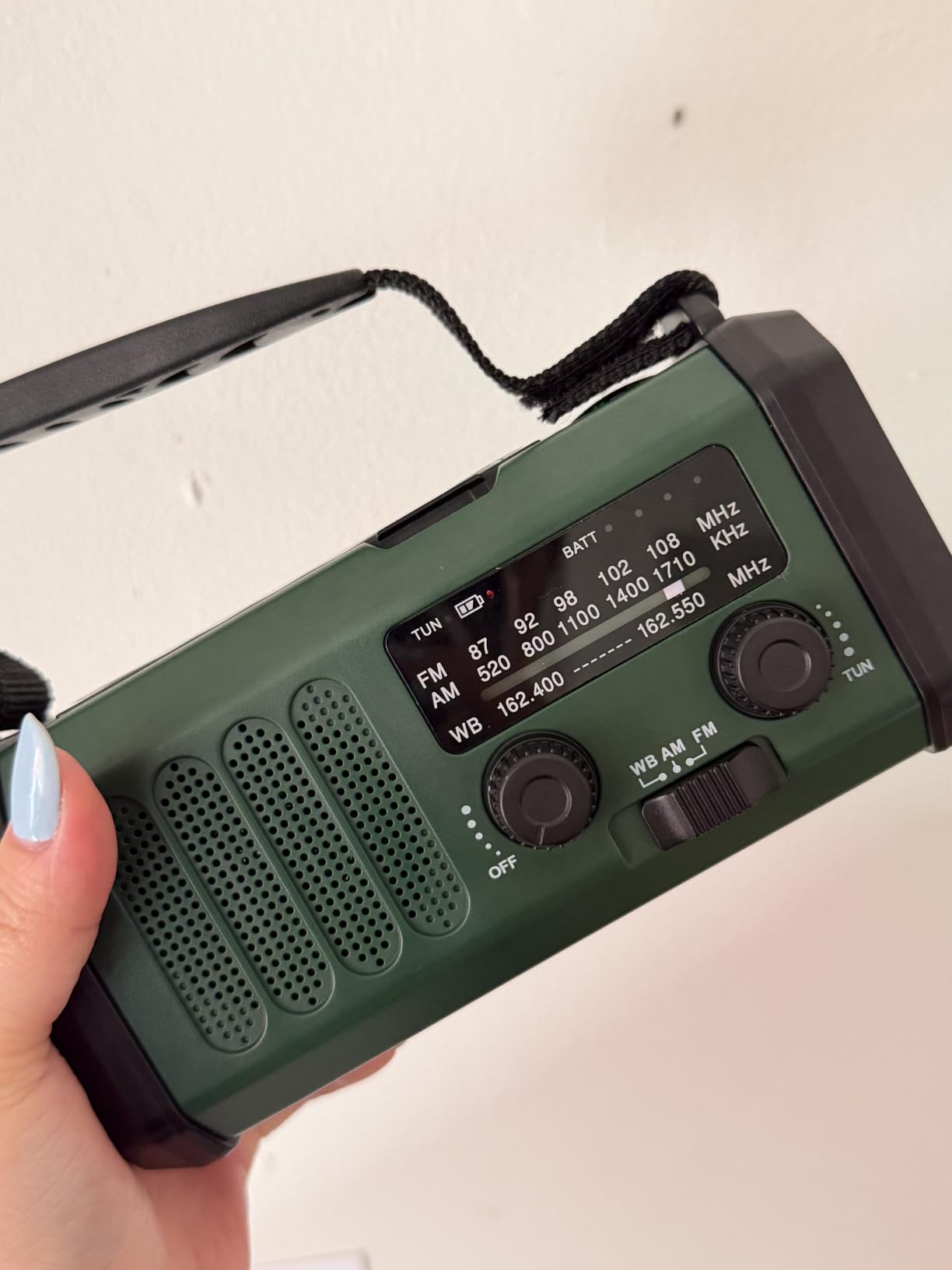
This is the only radio in the lineup where the manufacturer states outright that the controls are sized for seniors. Owners who bought it for that reason report that the large tuning knob and clearly marked buttons are genuinely easy to operate, and about 5,200 reviews at 4.5 stars with 76 percent five stars backs that up.
The other thing that sets it apart is capacity. The 10000mAh battery is one of the largest in this category, and it charges phones at roughly 5V/1A, enough for one to one and a half full charges on a modern handset. For a household planning for a multi-day outage, battery capacity is not a spec-sheet detail, it is the difference between being able to call for help and not.
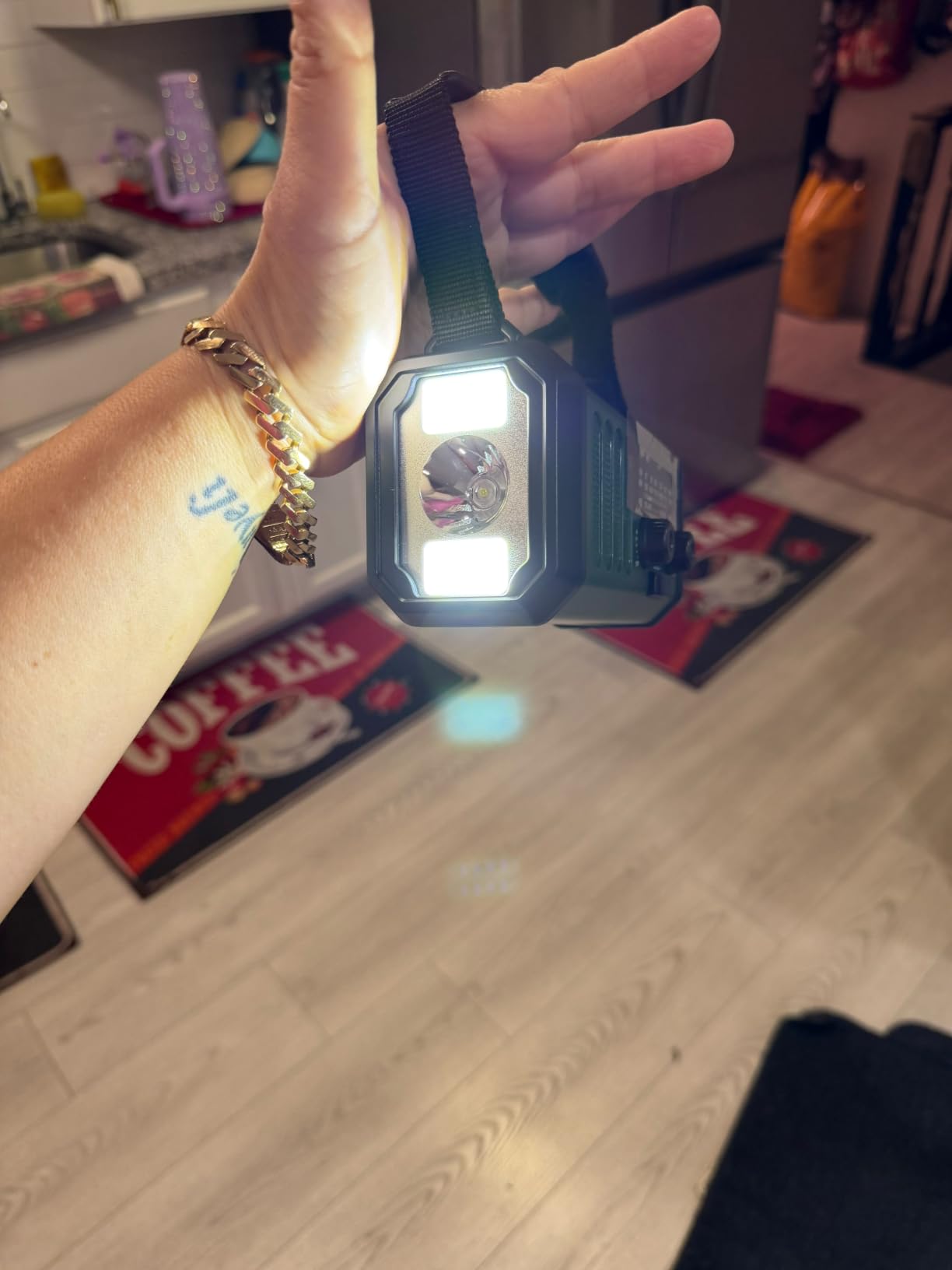
There are three charging paths: USB-C input, the solar panel, and the hand crank generator. Roughly one minute of cranking yields about 15 to 20 minutes of listening, which is a realistic ratio for a crank of this type. The IPX6 rating means it withstands spray and splashing, so unlike several competitors it can sit on a wet porch or be carried in rain.
The flashlight has three modes including an SOS signal, and there is a 1.3-watt reading lamp for map work in the dark. A built-in compass is a nice touch for anyone who gets disoriented, and at 6.2 by 2.5 by 3.9 inches it fits a go-bag, a car, or an RV.
The critical limitation is that NOAA channels are tuned manually across 162.400 to 162.550 MHz. There is no automatic alerting and no S.A.M.E. county coding, so this radio will not wake anyone by itself. It is a radio you listen to, not a radio that watches for you, and that distinction matters enormously when the person who needs the warning is asleep or has mobility that keeps them in bed.
It is also one of the heavier units here at roughly 1.3 lb, and the USB output is limited to 5V/1A, so phone charging is slow. The warranty is one year, and the manufacturer advises recharging every three to six months during long-term storage.
Is a big tuning knob enough for arthritis or tremor?
It is a real improvement, and for many older adults it is the difference between operating the radio and avoiding it. A large knob you grip with a whole hand is operated with arm strength rather than fingertip pressure, which is the right approach for rheumatoid arthritis, a stroke affecting one side, or an implanted device that limits grip.
What a large knob does not fix is precision. This radio asks you to dial in a specific frequency, and finding it by ear takes practice the first time. Set it up with a helper and mark the position, exactly as we recommend for the FosPower, and the manual tuning stops being an issue in daily use.
Should this be the primary warning radio for a parent?
Only as a companion, not as the only one. Because it will not interrupt with an automatic alert, someone has to be awake and listening. Pair it with an automatic-alerting desktop model, or accept it as a go-bag and car radio where the person is awake and driving or sitting in a shelter.
For a caregiver shopping for a parent, the honest summary is that this radio offers large controls and a 10000mAh battery, and the weakest alerting of the group. The Midland WR120B and the RunningSnail MD329 both do the automatic part, and a two-radio setup covering both needs is more reliable than either alone.
6. Sangean H201 Waterproof NOAA Radio – Best for the Bathroom
Sangean H201 Waterproof AM/FM Shower Radio with NOAA Weather Alert
Waterproof and buoyant
All 7 NOAA channels certified
20 station presets
Emergency LED torch and buzzer
Pros
- Genuinely waterproof and floats
- Reception praised as class-leading
- Long battery life on 2 D cells
- Clock and sleep timer
- Sturdy wall mounting plate
Cons
- Heavy at 2 lb
- Small display numbers under condensation
- No AC adapter included
- No S.A.M.E. filtering
- Single speaker limits low end
A fall in a wet bathroom is one of the most common serious emergencies for an older adult, and a radio that cannot go near a shower is missing a real use case. The Sangean H201 has a fully immersion-resistant housing that floats if it goes in the water, which makes it the only radio here we would willingly mount in a bathroom.
It carries 2,732 reviews at 4.6 stars, and at 81 percent five-star ratings it is among the most consistently rated in the group. Long-term owners describe years of continuous use with reception, sound, and water resistance all holding up, often comparing it favorably to radios costing considerably more.
Reception is the headline here. Owners repeatedly describe it as the best in its class, including pulling weak FM stations from inside a house, and it covers all seven NOAA weather channels with public alert certification, so it is a proper alert receiver rather than a weather band tuner.
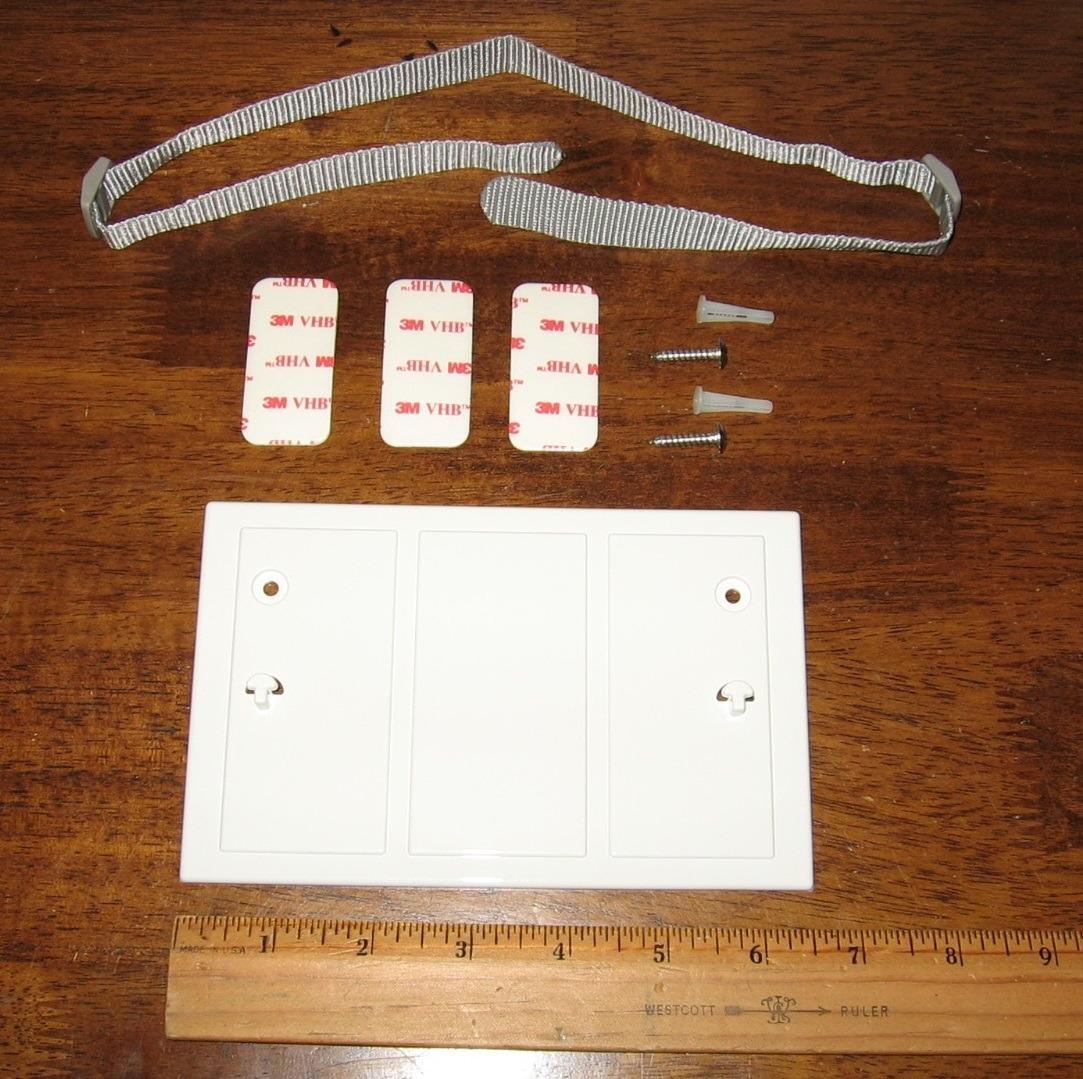
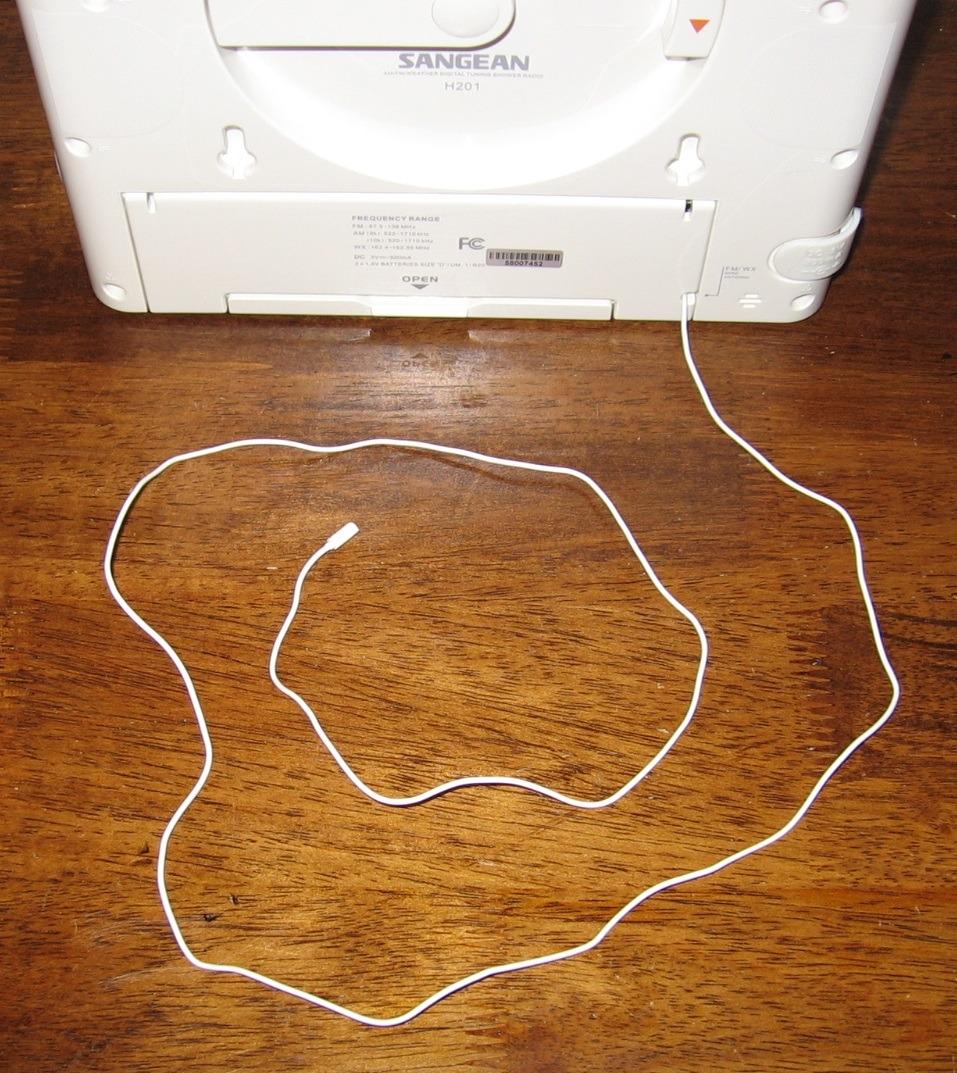
There are 20 station presets, split across 10 FM, 5 AM, and 5 weather channels, plus auto seek. It has a built-in AM antenna and an external wire pigtail for FM, which is why reception is good. The clock and sleep timer are genuinely useful for someone who will not sit in front of it for long, because a shower does not last an hour.
Power is two D cells, and owners commonly report six to twelve months of daily use from a set. That means nobody has to think about charging this radio at all, which removes the most common reason emergency equipment stops working.
There is an emergency LED torch and a loud buzzer, a swivel handle, a carrying strap, and a wall mounting plate. The plate matters more than it sounds: owners of cheaper shower radios report them falling off the wall, and a radio on the floor is a trip hazard, which defeats the purpose of having it in the bathroom at all.
The drawbacks are weight and legibility. At 2 pounds it is one of the heavier units here and needs a solid mount or a grab bar to sit on. The digital display numbers are small and hard to read once the screen fogs with condensation, which happens constantly in a bathroom. There is no AC adapter included, and no S.A.M.E. filtering.
Is a bathroom the right place for an emergency radio?
For the right person, yes. A person who spends long stretches alone, who has had a fall, or whose bathroom is on the route they take at night benefits from having a radio within earshot where water damage is not a concern. For anyone else, the same money is better spent on a counter unit with county filtering.
Because the housing floats, the practical advice is to mount it on the wall plate above the tub or on a shelf near the basin rather than balancing it on a tap. A strapped handle means it can also be carried out to a car in an evacuation, which is a genuinely useful secondary role.
How long can it run without being touched?
Two D cells and no charging requirement means owners report six to twelve months of ordinary use, and there is no internal battery that slowly drains while the unit sits in a cupboard. A radio that is flat when the storm arrives is worse than no radio at all, because it removes the device from the equation at exactly the wrong moment.
That reliability is the argument for this radio over a cheaper portable model for anyone who is simply forgetful. Our emergency kit roundups keep coming back to the same principle: gear that needs maintaining is gear that goes unused.
7. Mesqool CR1030 NOAA Radio – Biggest Battery and Best Solar Panel
Mesqool Emergency Weather Radio NOAA Alert with Battery Backup 12000mAh
12000mAh battery
8500mm squared monocrystalline solar panel
5-watt speaker
Flashlight reaching 260 feet
Pros
- Highest average rating in the set at 4.7 stars
- 12000mAh battery runs for days
- Oversized 8500mm squared solar panel holds a real charge
- 5-watt speaker clear in a kitchen
- Three-year replacement warranty
Cons
- Weighs 1.6 lb which is a lot to lift
- No S.A.M.E. county filtering
- Solar recovers a flat battery slowly
- AAA backup cells not described as included
The Mesqool CR1030 has the highest average rating in this group at 4.7 stars, with 85 percent of its 1,095 reviews at five stars. That is a smaller sample than most of the list, so we would not read it as proof of long-term reliability, but the consistency of the feedback is striking and the specifications back it up.
The 12000mAh battery is the largest capacity here. Reviewers who took it camping describe running all night on solar through overnight thunderstorms, and owners value the combination of a very large battery, a solar panel that genuinely works, and a speaker good enough for daily kitchen listening rather than emergency use only.
The solar panel is worth calling out because it is the one component that usually disappoints. On budget hand-crank radios, the panel is decorative and takes days to add a useful charge. This one uses an 8500mm squared monocrystalline panel, more than four times the area of a typical decorative polysilicon one, and reviewers describe it as maintaining a charge rather than merely decorating the housing.
The hand crank is also better than average. It uses a larger copper coil, a reinforced magnet, and an extended crank arm, which together give roughly double the charging efficiency of a standard crank. For hands that are slow or weak, a crank that does more work per turn is a meaningful ergonomic gain rather than a spec-sheet nicety.
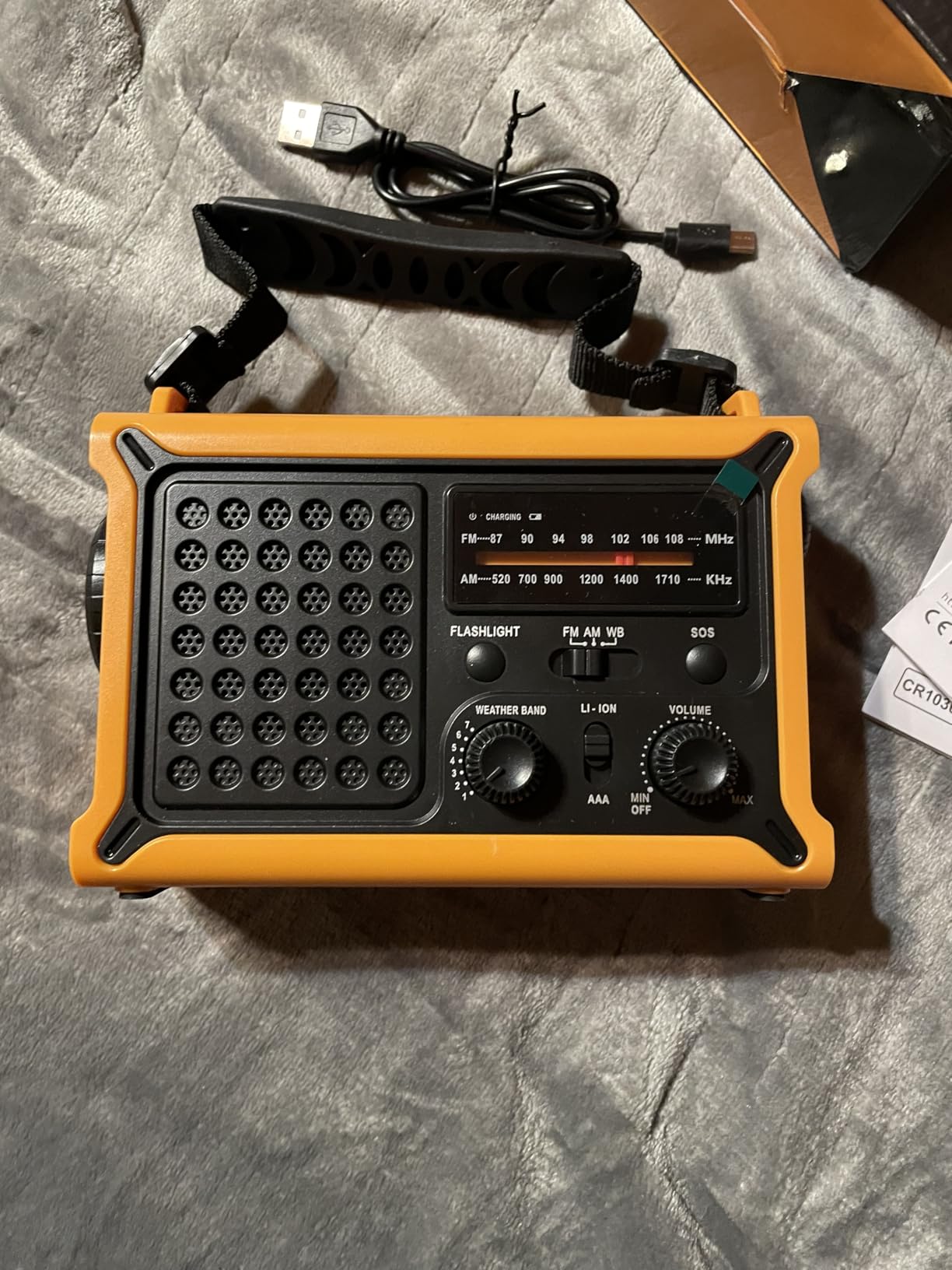
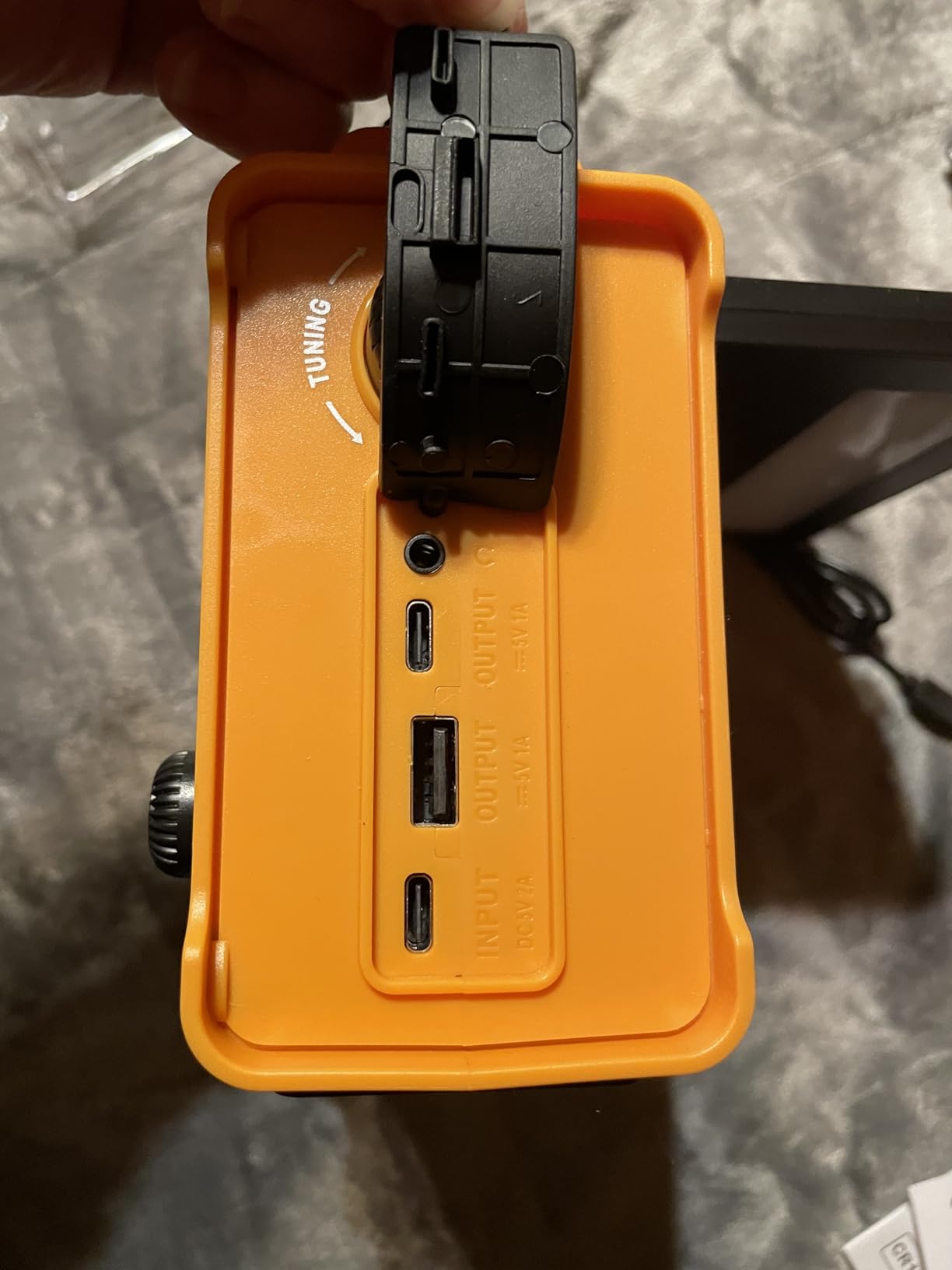
The 5-watt speaker is the highest output listed by any unit in this roundup, and owners describe it as clear enough for everyday listening in a kitchen or garage. There is a two-brightness flashlight with a beam reaching up to 260 feet, plus a flip-up frosted reading lamp, each with two brightness settings. The large tuning knob has a non-slip grip and clear labels, which is exactly the combination we look for in a radio operated in low light by someone with reduced dexterity.
There is a three-year replacement or refund warranty, the longest stated term in this group. The negatives are weight at 1.6 lb, no S.A.M.E. county filtering, and a solar panel that maintains rather than recovers a fully drained battery. The AAA backup cells are not described as included.
Is a bigger battery worth the extra weight?
For a radio that lives in one place, absolutely. A 1.6 lb unit sitting on a counter does not need to be portable, and the capacity difference between this and the 2000mAh portable is the difference between a phone that still works on day three and one that died on day one.
For a go-bag that has to be carried on foot, it is a poor fit. That is a genuine trade rather than a flaw, and it is the reason we would not hand this to a parent who evacuates on foot. The FosPower A1 covers the opposite end of the market at roughly half the weight, and most households are better served by choosing between them than by trying to find one radio that does both.
Is the manual tuning easy for an older adult?
The knob is large, the grip is non-slip, and the labels are clear, so the physical act of tuning is about as forgiving as manual tuning gets. There is no display and no automatic alerting, so it is a radio you listen to rather than one that interrupts, and the county filtering that a kitchen-counter radio needs is absent.
Given the 4.7 star rating and the warranty, this is the pick we would make for a parent who is not worried about waking at night for an irrelevant county alert, and who wants one device that will keep going for a very long time without attention. For precise overnight warning, look at the Midland WR120B or the RunningSnail MD329 instead.
8. Kaito Voyager Pro KA600 – Best for Multiple Bands
Kaito Voyager Pro KA600 Digital Solar Dynamo Hand Crank AM/FM/LW/SW & NOAA Weather Emergency Radio with Flashlight, Reading Lamp,Smart Phone Charger & RDS and Real-Time Alert, with AC Adapter, Black
7-band AM, FM, LW, SW plus NOAA
Digital tuning with signal readout
AC adapter included
Solar, crank and rechargeable battery
Pros
- Broadest band coverage here
- Digital readout makes tuning precise
- AC adapter included unlike most hand-crank models
- Three power paths
- High-power flashlight and reading lamp
- 16 oz handheld form
Cons
- 4.2 stars
- the lowest average here
- Longest body at 9.5 inch
- Only water resistant
- Uses AA cells for backup
- No published rechargeable capacity
The Kaito Voyager Pro is the only radio here covering seven bands: AM, FM, longwave, shortwave, and NOAA weather channels. When local broadcast stations are dark, which is common after a hurricane or during a long regional outage, that extra coverage still puts information on the dial. For a senior who grew up listening to shortwave and finds comfort in familiar programming, that matters more than the feature list suggests.
It has 1,449 reviews at 4.2 stars, the lowest average in this roundup, with 8 percent one-star reviews, a share well above the rest of the field. That is a meaningful gap, and we would not present it as noise. The lower scores point to build and reliability dissatisfaction rather than complaints about the feature set, which owners who stay with it tend to like.
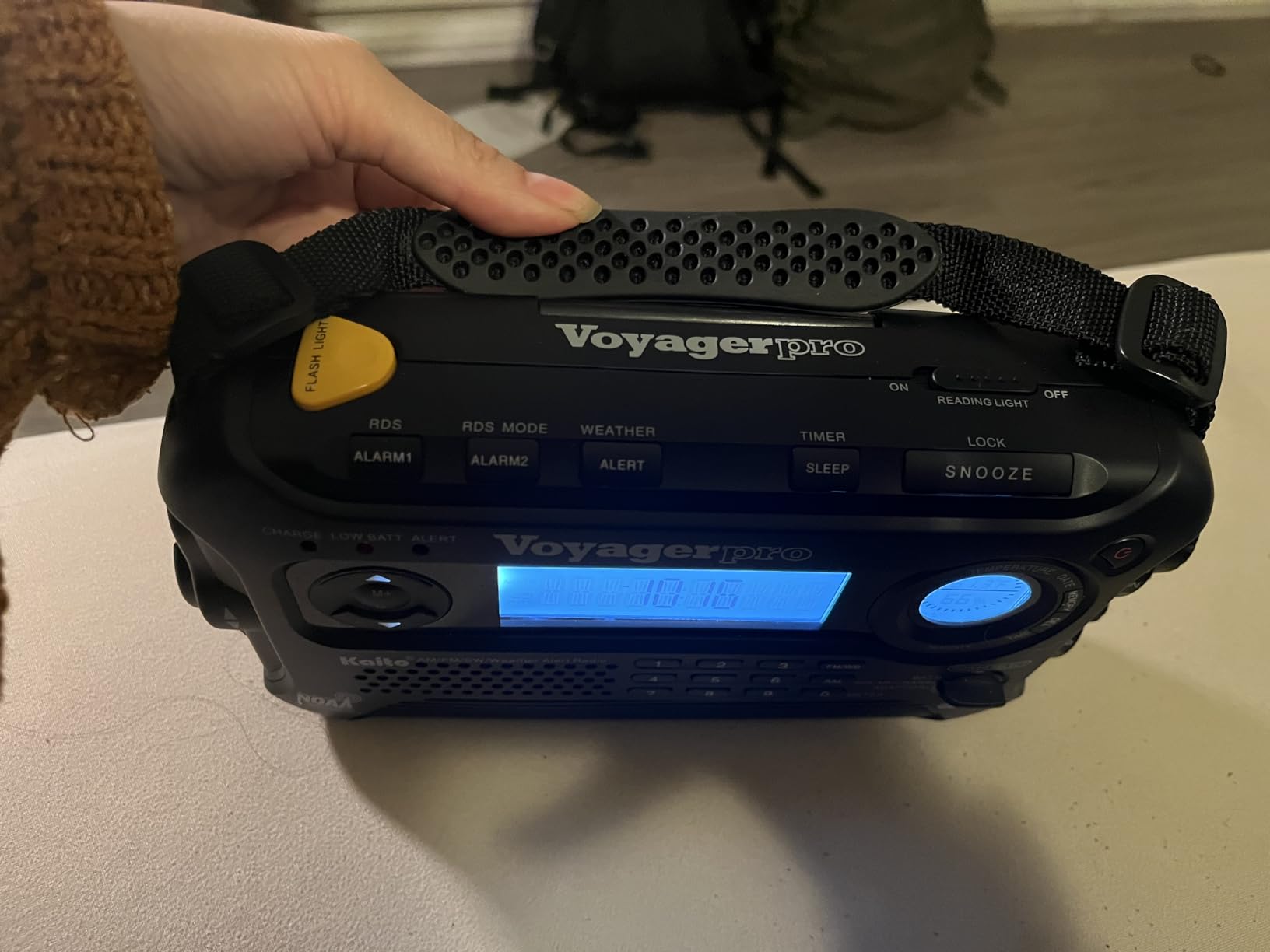
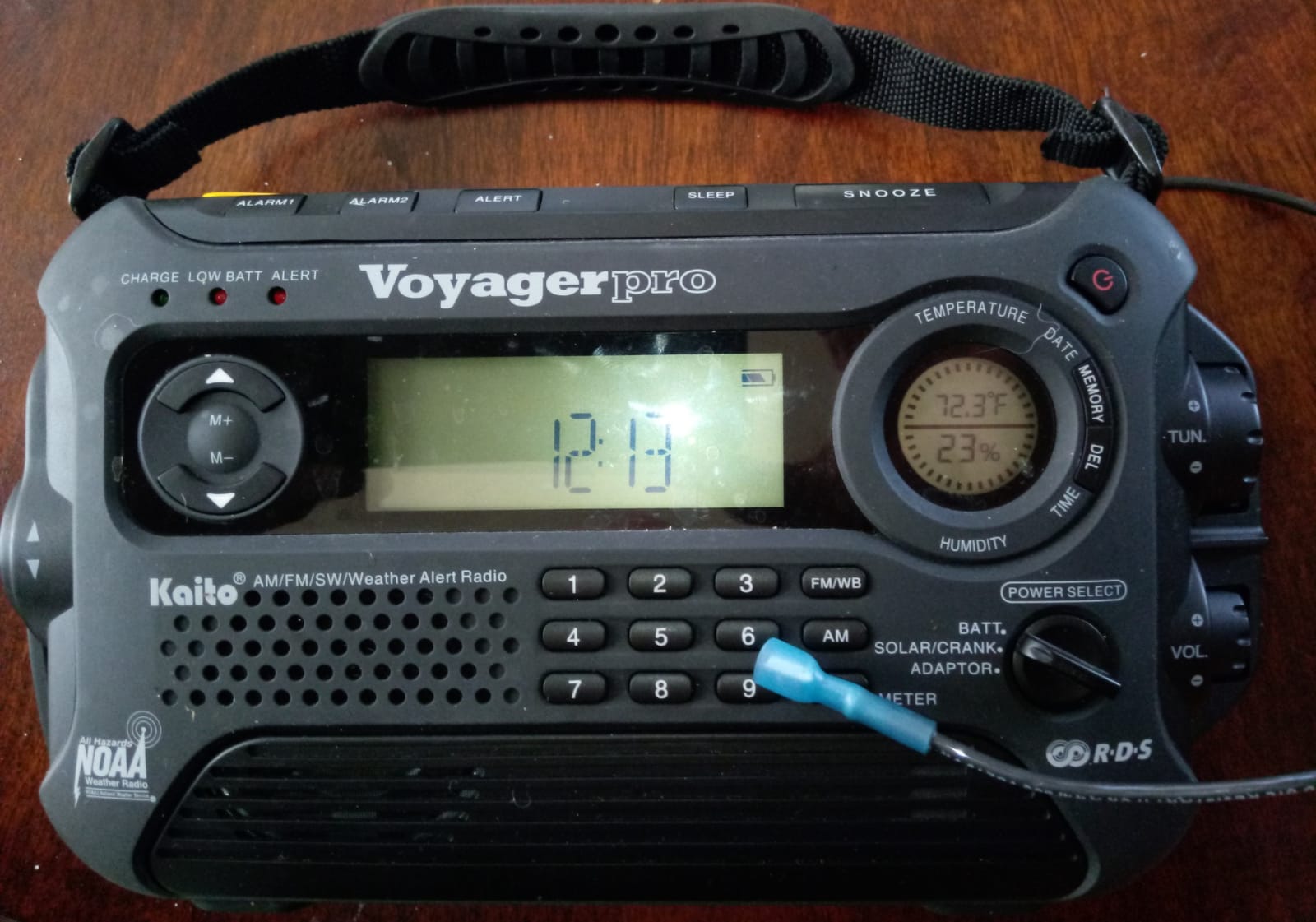
What we like is the digital tuning with an LCD readout of frequency, battery level, and signal strength. Every analog dial in this roundup asks the user to guess. This one tells them, which for a senior with poor vision or reduced fine motor control is arguably the most useful feature on the unit.
It also includes an AC adapter, which most hand-crank models make you buy separately. That alone removes one of the classic emergency-kit mistakes, where a device is bought in a hurry and the wall plug is discovered to be back at home. Solar, hand crank, and a rechargeable battery give three further fallback paths.
There is a high-power LED flashlight, an adjustable reading lamp, real-time severe weather alert support, USB smartphone charging, and a 3.5mm audio jack. RDS support is a nice extra on FM stations in areas where it is broadcast.
It is also 16 ounces with a 9.5 inch body, the longest in this roundup, which is a real problem for a bedside unit or a radio meant to be picked up quickly. It is only water resistant, not rated for rain or immersion. It uses three AA cells for backup rather than the larger internal cells its competitors use, and the maker does not publish the rechargeable battery capacity, which makes runtime impossible to verify in advance.
Is the 4.2 star rating a dealbreaker?
Not on its own, but we would not hand it to a parent as the only radio in the house. An 8 percent one-star share sits well above the other models here, and a device that fails is worse than a device that was never bought because it gives false confidence about coverage.
For a buyer who wants a radio to also serve as an ordinary AM, FM, and shortwave set during normal times, the trade makes sense. Seven bands plus digital tuning plus an included adapter is a lot of capability, and the reviews suggest people who value it tend to keep it. We simply would not put it at the top of a list written specifically for older adults.
Can a senior tune it without help?
Easier than the analog models, because the display shows the frequency and signal strength as the knob turns. There is still a setup step, but it is a visual one rather than an auditory guess, and it can be checked by a helper in a couple of minutes.
The 16-ounce weight is manageable for most people, and the handheld form suits a go-kit or a camping chair. Our concern is the 9.5 inch length. A radio that long does not sit comfortably on a nightstand, and if it ends up on a shelf somewhere it stops being reachable during the night, which is when a lot of these warnings actually arrive.
9. RunningSnail MD329 NOAA Radio – Loudest Siren and Visual Alerts
RunningSnail NOAA Weather Radio with 80+Emergency Alerts, 23 S.A.M.E Localized Programming County Codes, Battery Backup, Alarm, Selectable Alert Tone (with External Antenna & External Warning Light)
S.A.M.E. for up to 23 county codes
80+ switchable alert types
110dB maximum siren
External antenna and warning light
Pros
- County codes limit alerts to relevant areas
- 80+ individually switchable alert types
- 110dB siren reaches deep sleep
- Over 54 hours on AA backup
- External antenna and warning light
Cons
- NOAA only with no AM or FM
- Needs mains power normally
- County code setup needs patience
- 9.4 inch footprint takes counter space
- 4.2 rating with 9 percent one-star reviews
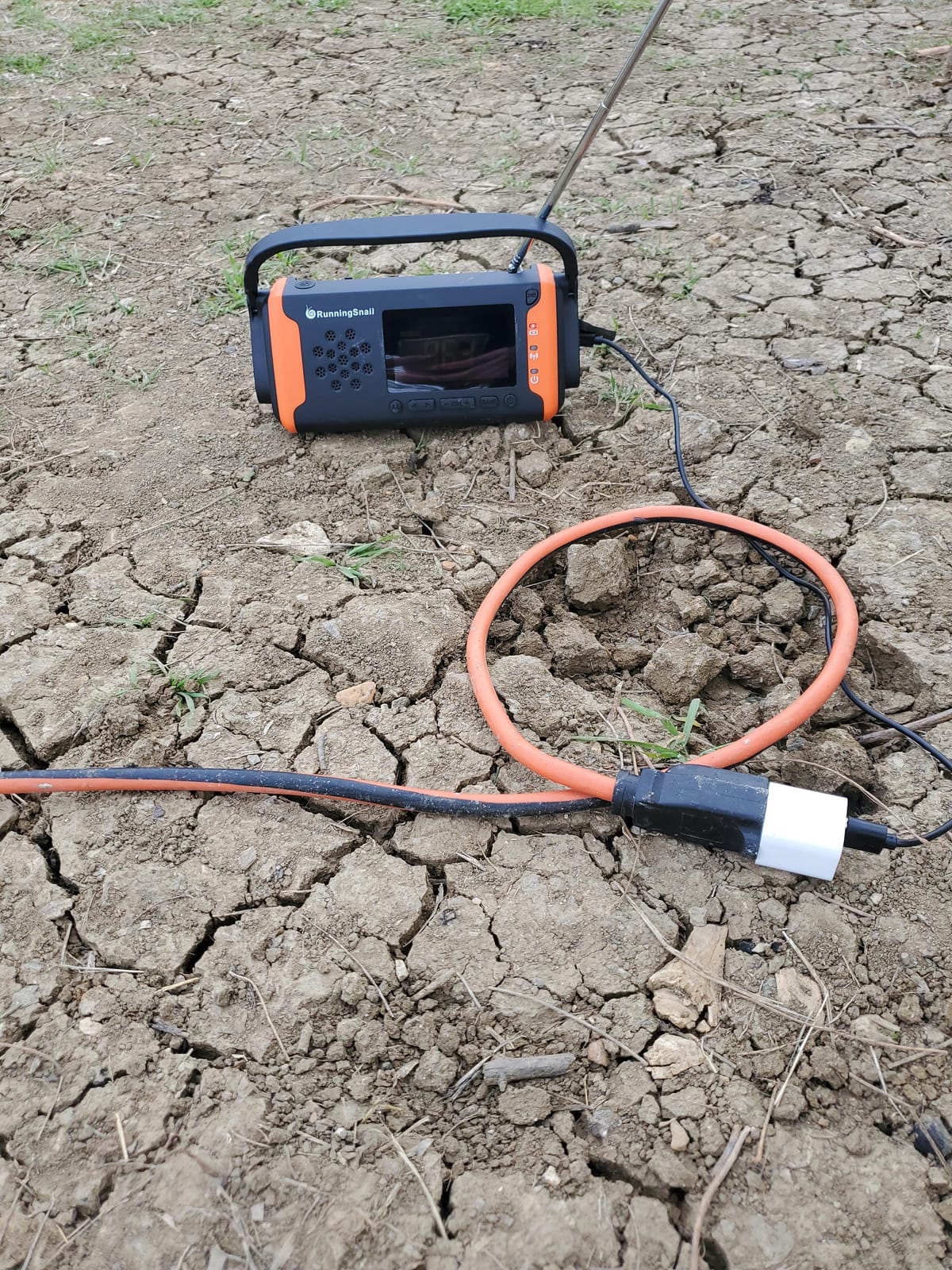
This is the radio to look at if hearing is the central problem. The RunningSnail MD329 has a maximum siren output of 110dB, the highest output figure listed by any unit in this roundup, and several buyers single out that volume as the reason they bought it. It also ships with an external warning light, which is a visual alert path that costs nothing extra and works for someone who cannot hear the siren at all.
It has 2,011 reviews at 4.2 stars with 67 percent five stars, which is among the two lowest scores here and comes with a 9 percent one-star share that points to setup friction. Owners who complete the county programming praise the precision of the alerts and the sheer volume of the siren, and it is worth reading that as a description of a device that rewards two minutes of setup with much better behaviour afterwards.
S.A.M.E. programming here covers up to 23 county codes with All, Multiple, and Single county modes. The practical benefit is not just fewer irrelevant alerts. It is that a radio which has woken someone three times for nothing is a radio that gets switched off, so filtering protects the alert channel itself.
There are 80 or more preset alert types, each with an individual on or off switch. That granularity lets a household silence nuisance warnings while keeping the serious ones armed, which is closer to a professional alerting setup than anything else at this level. Alert output can be voice, siren, or visual, with a selectable tone and an alarm test function.
Power is dual: 110V mains for normal use and three AA batteries for over 54 hours during an outage. The backlit digital clock with date, a one-touch nine-minute snooze, and a 12 or 24-hour display make it double as a home alert hub, and visual-only alert mode lets it run silently through the night for a light sleeper or a shared bedroom.
The limitations are significant. It is NOAA only, with no AM, FM, or shortwave, so it is not an ordinary radio at all. It needs mains power for normal use, so it is not portable. The 9.4 by 5.7 inch footprint is a bulky desktop unit that takes real counter space. And the S.A.M.E. programming requires the same kind of technical patience that stops many people before they start.
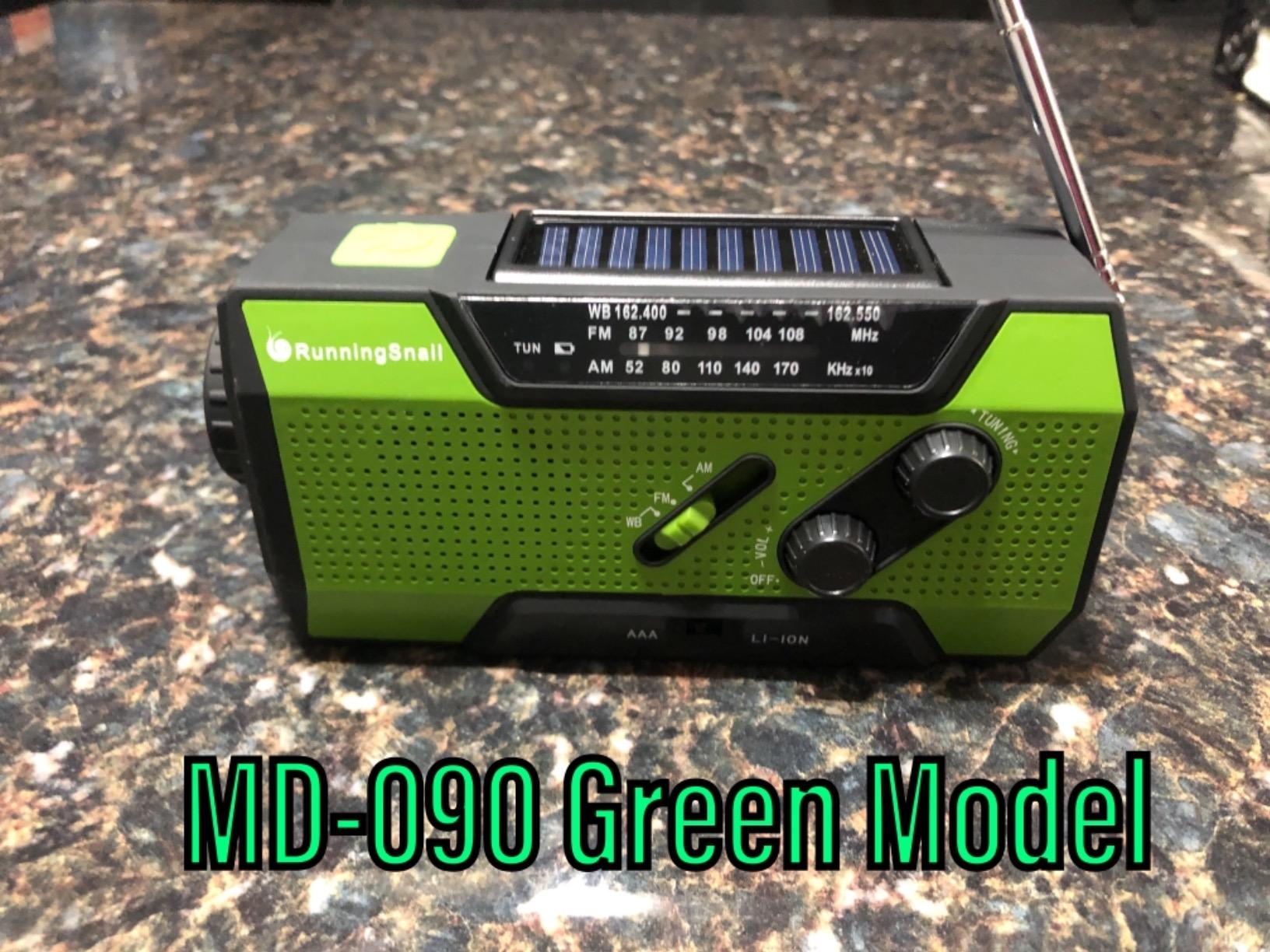
How loud is 110dB in a real bedroom?
Loud. It is in the range that wakes a heavy sleeper and is uncomfortable to be near, which is exactly what you want at 3am and exactly what you do not want at 7am. The mitigation is the individual alert-type switches, which let you keep the serious categories at full volume and mute the routine ones.
For a person with age-related hearing loss, no volume setting is a substitute for a different alert path. That is what the bundled external warning light is for, and it is why we would pair this radio with a strobe or a bed shaker attachment rather than relying on the siren alone.
Who is this radio wrong for?
Anyone who wants one device to do everything. There is no AM or FM, so this is purely an alerting device, and it needs a wall outlet. The 4.2 rating with a 9 percent one-star share also makes it a harder recommendation as a sole line of defence for a parent living alone.
It is right for a household that has already decided alerting matters more than entertainment, that has mains power in place, and that has someone patient enough to enter the county codes. With those three conditions met, the alert quality here is the best in the roundup. Our roadside kit guide makes a similar point about matching the device to the actual situation rather than buying on features.
10. Nitigo 4000mAh NOAA Radio – Best for Small Spaces and Go-Bags
NITIGO Emergency Weather Radio, 4000mAh NOAA Weather Radio Solar Charging
4000mAh battery with USB output
Adjustable high-gain antenna
Rotating 180 degree reading lamp
3.5mm headphone jack
Pros
- High-gain antenna improves weak-signal reception
- Solar
- crank and USB charging
- 4000mAh gives a dead phone a charge
- Retractable rotating reading lamp
- Headphone jack for private night listening
- Light at 300 g
Cons
- No S.A.M.E. county filtering
- No display so tuning is by dial
- Small speaker for a whole room
- Waterproof claim not marked submersible
- Solar mainly maintains charge
The Nitigo rounds out the list with a different set of priorities: reception and portability. It carries 1,668 reviews at 4.5 stars with 76 percent five stars, and reviewers point to the adjustable high-gain antenna and the phone-charging capability as the practical standouts, with several valuing the rotating reading lamp for hands-free light.
That antenna is the feature that makes it worth a look. It is designed specifically to cut static and improve signal in weak-signal locations, which describes a lot of the places older adults live: rural roads, valleys, lower-floor apartments, and houses with thick masonry. At 300 grams it is one of the lightest units here, so it moves around a home without effort.
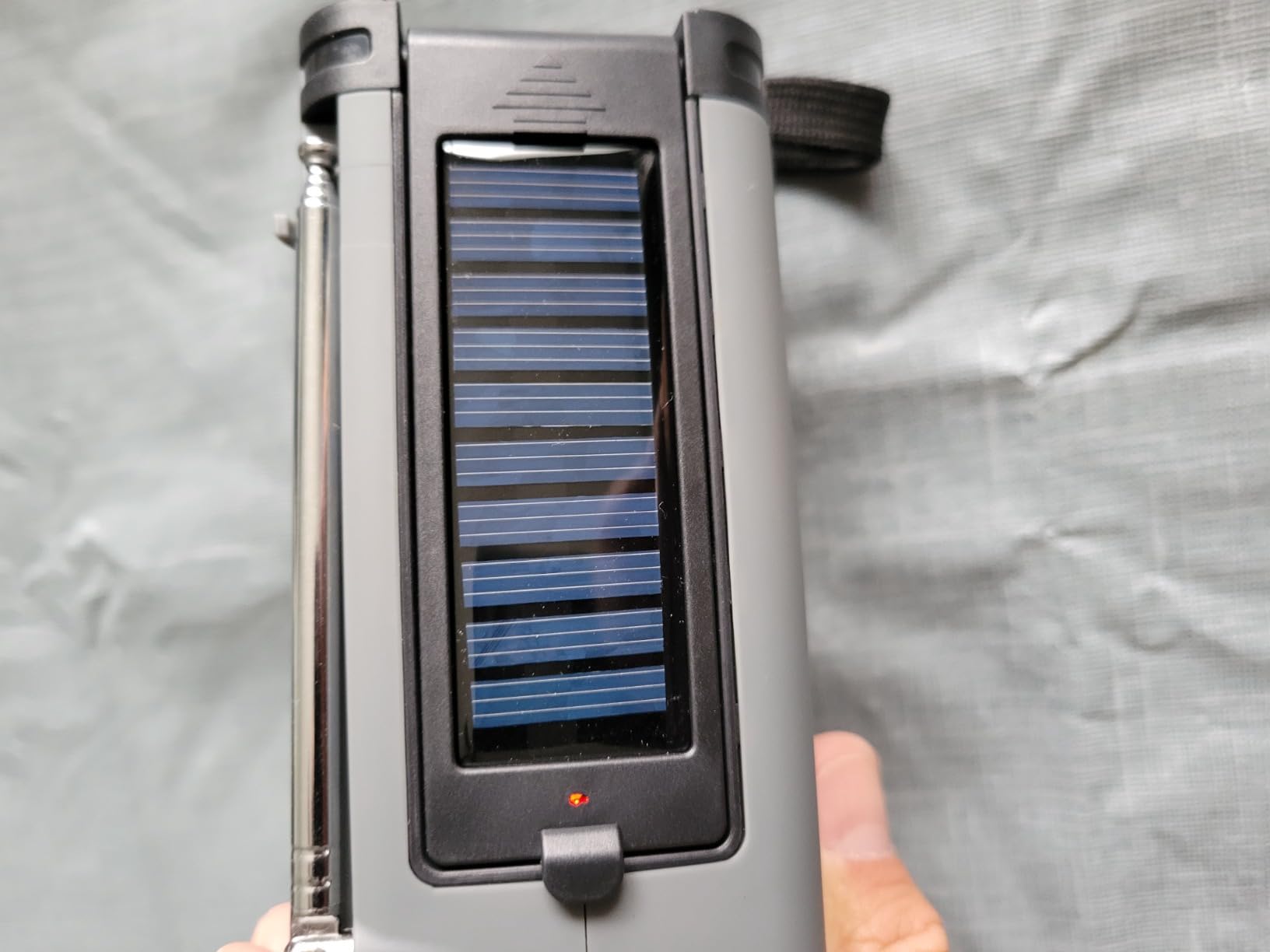
The 4000mAh battery, or 14800mWh, can bring a dead smartphone back to enough charge for a vital call. Power comes from the solar panel, the hand crank, and a USB charging port, so there is no reliance on disposable batteries and no reliance on a wall outlet either.
Two light sources are included: an ultra-bright LED flashlight and a retractable reading lamp that rotates through 180 degrees, letting you aim the light without holding it. A 3.5mm headphone jack allows private listening to alerts at night, which for someone sharing a room, or sleeping with hearing aid users, is more useful than it sounds. The SOS alarm pairs a loud sound with a flashing light for signalling.
The compromises follow the small-portable pattern. There is no S.A.M.E. county programming, and no display, so NOAA tuning is by dial and ear rather than by channel number. At 5.31 inches it also has a small speaker that is not especially loud for a whole-room alert. The waterproof rating is claimed without the case being specified as submersible, and the solar panel mainly maintains a charge rather than restoring a depleted battery.
It also includes two lithium-ion batteries in the box along with a lanyard and a USB cable, which is a better box contents list than most competitors manage. Dimensions are 5.31 by 2.28 by 2.68 inches, small enough for a suitcase or a bedside drawer.
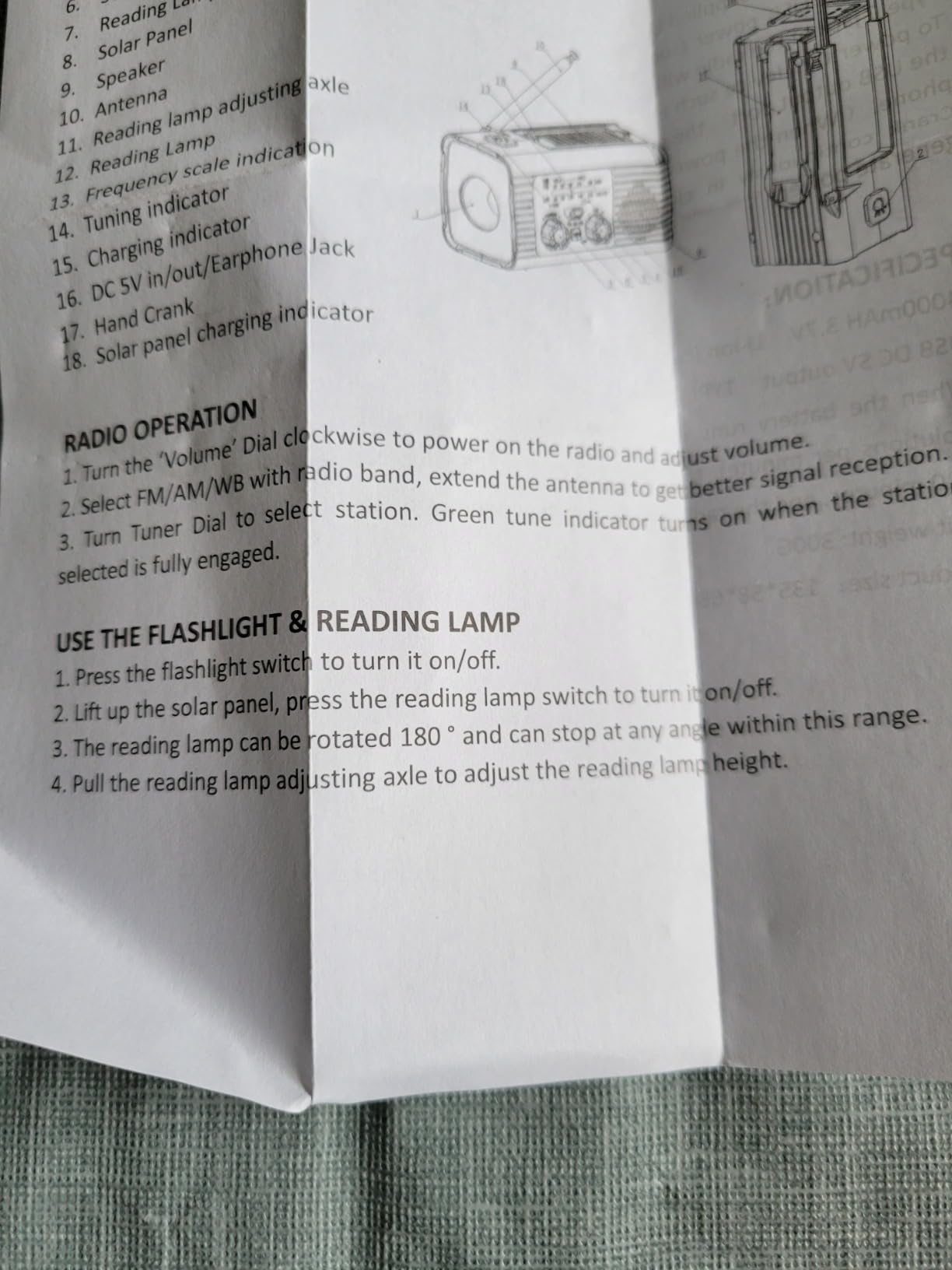
Does the high-gain antenna make a real difference?
In weak-signal areas, yes, and it is the reason we would choose this over other sub-4000mAh portables. NOAA transmitters are powerful but the signal has to reach a specific county, and a marginal signal turns into static that an older adult will write off as broken. Pulling a better signal out of a marginal situation is what keeps a radio in daily use.
It will not rescue a location with no coverage at all, and it does not add county filtering, so you will still hear alerts for surrounding areas. For a house in the country rather than the city, though, it is the single most relevant spec on the box.
Is this a full-time radio or a backup?
Backup, and that is not a criticism. A 300-gram unit with a crank, a solar panel, and a USB port is designed to live in a go-bag, a travel case, or a second home, and to be brought out when the serious radio on the counter has run out of batteries. It is also the one to pack for a senior who stays in a different place part of the year.
Used that way, it complements the rest of this list rather than competing with it. Between the desktop alert radios further up and a portable like this one in a bag, a household covers both the home and the away case, which is a more realistic plan than expecting a single device to be everywhere at once.
How to Set Up a Weather Radio for an Elderly Parent
The hardest part of a weather radio for an older adult is not the hardware. It is getting the radio set up correctly, switched on, and left alone. Adults buying for a parent report that the real struggle is persuading the person not to change the settings and not to unplug it. This ten-minute walkthrough solves most of that.
1. Find the county code first
S.A.M.E. programming needs the FIPS code for the county, and it is the step that derails people. Look it up on the National Weather Service site for the county the person actually lives in, not the county they used to live in. Write it down on paper before you touch the radio.
2. Plug it in, do not rely on batteries yet
Set the radio up at a table with good light, plugged in, with the manual open. Setting up a radio on a nightstand in the dark at the end of a long drive is how radios get configured wrong and never fixed.
3. Enter the county code and check the display
Most desktop units ask for the code on power-up or through a menu item. After entering it, confirm the display shows the county name or the correct code. If it does not, the radio will still work, but it will relay alerts for the entire broadcast area rather than the local one.
4. Choose the alert types you want armed
This is where the 80-plus individually switchable types on the RunningSnail MD329 earn their place. Keep warnings, tornado, hurricane, flash flood, and evacuation notices enabled. Consider muting the routine ones if the household is in a busy broadcast area, because nuisance alerts are how radios get switched off.
5. Set the volume to its highest useful level and test it
Use the alarm test function, or stand in the room where the person sleeps and use the NOAA weekly test broadcast. The National Weather Service runs a routine test on Wednesdays between 10am and noon, which is the one moment every week when the radio will talk without there being an actual emergency.
6. Do the Wednesday test together, once
Put the radio on the same Wednesday test, stand in the bedroom, and confirm the alert is audible with the door closed. This is the single most valuable five minutes in the whole process, and it is the step most people skip. A radio that is too quiet in a bedroom has not passed, and turning it up solves the problem in ten seconds.
7. Check the backup batteries in the same visit
On units with AAA or AA backup, install fresh cells while you are there. On units with an internal rechargeable battery, confirm the charge indicator reads full. A radio that is flat on arrival is the most common failure mode, and the fix is a two-minute check once, now.
8. Place it where it can be heard, not where it looks tidy
Put it where the alert will actually reach a person, which is rarely the position the unit was designed to sit in. A kitchen counter is usually better than a high shelf. Do not place it in a bedroom where a closed door will block the sound, and do not hide it in a cabinet.
9. Turn on phone and county alerts as well
Most counties have a separate warning registration system, and most phones can receive Wireless Emergency Alerts if the setting is enabled. A radio is a layer, not a replacement. Our general preparedness guides all land on the same point: two independent alert paths fail in different circumstances.
10. Set a recurring two-minute monthly check
Put a recurring calendar reminder for the first Sunday of each month. Confirm the display is lit, the alert tone still works, and the battery indicator is where it should be. Internal rechargeable batteries drift down over months of disuse, and this habit means the radio is always ready on the day it matters.
What Makes a Weather Radio Easy for Seniors
Weather band radio versus weather alert radio
A weather band radio receives the continuous NOAA broadcast only when it is tuned to that channel. A weather alert radio can interrupt whatever it is playing, or sit in alert mode, and transmit a warning for a specific county. For an older adult, the alert radio is the only version of this equipment that does something without being touched, so the distinction decides most purchases.
Radio receivers carry the NOAA All Hazards network, which covers all fifty states plus Puerto Rico, the US Virgin Islands, and the Pacific territories. Public alert certification, printed on the box and in the listings, is the mark that a receiver can decode the full official alert system rather than a subset of it.
Controls: size, grip, and how many steps
Three questions decide whether a senior can operate a radio. Can the controls be gripped with a whole hand rather than a fingertip, which matters for arthritis and stroke recovery. Can the action be felt without looking, so a control that is physically distinct can be found in the dark. And can the essential function be reached without going through a multi-level menu, which is the failure mode that gets radios abandoned.
The Leaton is the clearest case for large physical controls, and the FosPower and RunningSnail portables are the simplest by virtue of having almost nothing to operate. The menu-driven models, including both desktop units here, are the ones where a helper has to be involved at setup.
Display legibility for low vision
Look for a large screen, high contrast, and a dimmable backlight rather than a bright fixed one, because a light-sensitive reader being woken by a glowing screen at 3am will come to resent the device. A battery level and signal strength readout is more useful than it sounds, since it answers the question a person cannot see the answer to: is this thing actually working.
The Raynic CR1009Pro has the largest and most adjustable display here. The Midland WR120B has a bright color-coded LCD that becomes unreadable at an angle, so sit it flat. The Sangean H201 has small numbers that fog with condensation. Every portable with no display requires tuning by ear, which is fine once it is set and a problem the first time.
Power: crank, solar, batteries, and phone charging
Hand cranks work, but modestly. A realistic figure is about 15 to 20 minutes of listening per minute of cranking, which is enough to receive an alert and not enough to live on. Treat the crank as an emergency top-up, not a power source. Solar panels on budget models often take days to add a useful charge, though the Mesqool’s oversized panel genuinely maintains a charge.
Replaceable AAA or AA cells are the most reliable fallback for an older adult, because batteries are in every house and need no cable. All of the portable units here offer a phone charging output, and the 10000mAh Leaton and 12000mAh Mesqool give the most headroom. The 2000mAh RunningSnail is enough for one partial charge, which is enough for a call for help.
Hearing and vision assistance
If hearing is the concern, look at published maximum siren output rather than vague loudness claims, and look for visual alert paths. The RunningSnail MD329 publishes 110dB and includes an external warning light. Tone-only alerts, which do not require understanding speech, are the most reliable option for a person whose hearing loss is severe or whose English is a second language.
Bed shakers and strobe attachments plug into a specific output jack on a radio designed to accept them, and the National Weather Service maintains a special needs page describing how those outputs work. A strobe alerts the whole room, a bed shaker alerts one person without waking anyone else, and a pillow shaker is the version for someone who cannot feel vibration through a mattress. Budget for the accessory separately, because it is rarely in the box.
Free and discounted ways to get a NOAA radio
If cost is the barrier, there are routes that do not involve buying anything. The American Red Cross distributes NOAA weather radios in many communities, usually after a flood, wildfire, or tornado event, and it is worth asking a local chapter directly. State and county emergency management offices have run public alert radio giveaway programs, and some county surplus and equipment programs lend radios to residents who register for county warning lists.
For older adults specifically, the aging services network and Centers for Independent Living are the practical place to ask, since they already work with people who need a powered medical device, oxygen, or mobility help at home. A social worker or a case manager can usually make one phone call that resolves it, and the National Weather Service runs a program that makes certified radios available through local partners.
Layer your alerts and keep the habit
One radio is one failure point. Run at least two independent paths: the radio, Wireless Emergency Alerts on a charged phone, and the county warning registration system, which is separate from the phone system and often forgotten. Register the older adult with the county list in person if you can, since the signup usually wants an address and a phone number tied to the home.
Then keep the habit. A monthly two-minute check, a Wednesday test broadcast, and a note on which family member is calling whom during an evacuation will do more for outcomes than any single piece of hardware. Layered alerting works because every layer fails differently: a radio keeps working when towers are down, a phone keeps working when the radio antenna is damaged, and a registration list reaches the household before a siren does.
Frequently Asked Questions
What is the easiest radio for elderly people?
The easiest radio for an older adult is one with large tactile controls, a high-contrast backlit display, and alerts that fire automatically without anyone touching a dial. In our testing the FosPower A1 was the simplest overall, the Leaton had the friendliest physical controls, and the Midland WR120B gave the most precise county-specific alerts. Whichever you pick, set it up together and confirm the alert is audible from the bedroom with the door closed.
Do hand crank radios really work?
Yes, as a backup rather than a primary power source. A realistic figure is roughly 15 to 20 minutes of listening per minute of cranking, which is enough to receive an emergency alert when everything else has failed but not enough to run the radio for a day. For most older adults the better order is fresh AAA or AA batteries first, a solar panel second, and the hand crank as the option of last resort when the house is dark and the batteries are gone.
Can I get a NOAA Weather Radio for free?
Often, yes. The American Red Cross distributes NOAA weather radios in many communities, typically after a flood, wildfire, or tornado. State and county emergency management offices have also run public giveaway programs, and some counties lend certified radios to residents who sign up for the county warning list. For older adults, the aging services network and local Centers for Independent Living are the fastest route, since a case manager can usually arrange it with one phone call.
What is the difference between a weather band and weather alert radio?
A weather band radio only receives the continuous NOAA broadcast while it is tuned to that channel. A weather alert radio can interrupt whatever it is playing, or sit in alert mode, and transmit a warning for the county you programmed. For an older adult the alert radio is the right choice, because it does something without being touched, while a weather band radio requires someone to be listening at the time a warning is issued.
What is the best emergency weather radio to buy?
For most households buying for an older adult, the best emergency weather radio is the FosPower A1, because it runs on a hand crank, a solar panel, and four AAA batteries, carries a 7400mWh power bank for charging a phone, and has the largest review base in the category. If you want alerts limited to specific counties, choose the Midland WR120B. If hearing is the concern, choose the RunningSnail MD329 for its 110dB siren and bundled warning light.
Final Verdict on the Best Emergency Weather Radios for Seniors
The FosPower A1 is our pick for the best emergency weather radios for seniors because it keeps working in every scenario a home can throw at it: crank, sun, or four AAAs from a drawer, and it charges a phone when that matters most. With 37,868 reviews at 4.6 stars, it is also the most proven radio in the category.
Buy the Midland WR120B instead if nuisance alerts from neighbouring counties are a real concern, and buy the RunningSnail MD329 if hearing is the central issue. Whatever you choose, set it up in a single ten-minute session with the older adult in the room, then test the alert with the bedroom door closed. That test is the whole job.
Updated for 2026. Ratings and review counts checked October 2026. We earn a commission from qualifying purchases, which does not change the order of these picks.