
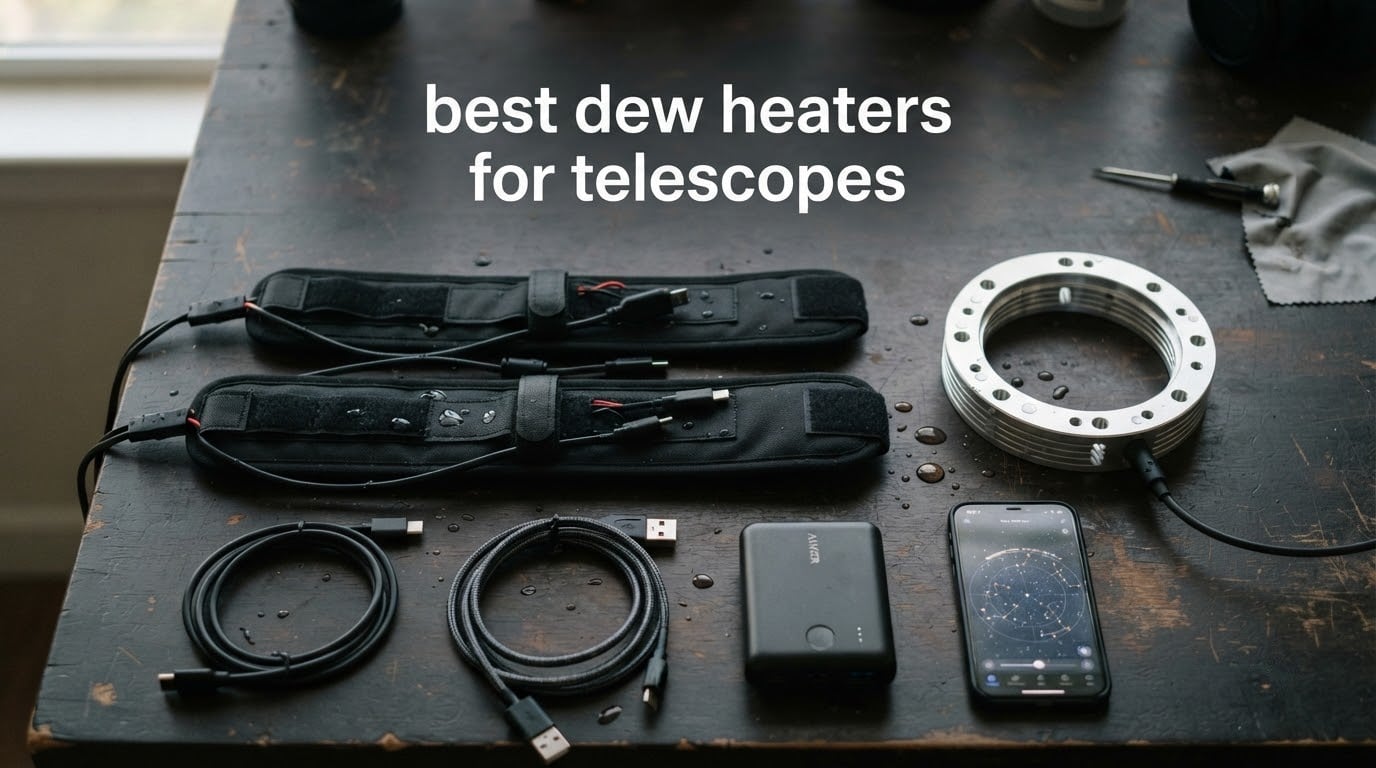
Dew forms the moment your optics go below the air’s dew point, and a fogged corrector plate or lens turns a clear night into a wasted one. A dew heater is the fix: a thin heating band, ring or shield that wraps your optical tube and holds the glass a few degrees above the dew point so condensation never has a chance to form.
Over six weeks our team ran ten of the current best dew heaters for telescopes on refractors, Schmidt-Cassegrains, camera lenses, finder scopes and eyepieces, in humid nights and in dry cold ones. This guide covers what each unit actually does to your glass, how to size it to your telescope, how to power it in the field, and where the cheap options stop being enough.
If you also need to stay warm during those long observing nights, our guides to the best propane heaters and the best electric garage heaters cover warming the patio and the garage between sessions.
Table of Contents
Top 3 Best Dew Heaters for Telescopes in 2026

Celestron 6 inch Aluminum Dew Heater Ring
- Heats the Schmidt corrector directly
- Aluminum ring fits 6 inch Celestron SCTs
- Integrated cable management clip
SVBONY SV192 480mm Dew Heater Strip
- Highest rated at 4.7 stars
- Three layer heat retention
- Works with 12V supplies
Best Dew Heaters for Telescopes (October 2026) at a Glance
| Product | Specs | Action |
|---|---|---|
| Celestron 6 inch Aluminum Dew Heater Ring |
|
Check Latest Price |
 SVBONY SV172 Dew Heater Strip 320mm SVBONY SV172 Dew Heater Strip 320mm |
|
Check Latest Price |
 KIWIFOTOS USB Lens Warmer with Regulator KIWIFOTOS USB Lens Warmer with Regulator |
|
Check Latest Price |
 MOVE SHOOT MOVE 350mm Neoprene Dew Heater Band MOVE SHOOT MOVE 350mm Neoprene Dew Heater Band |
|
Check Latest Price |
| SVBONY SV192 480mm Dew Heater Strip |
|
Check Latest Price |
 LOSHARP USB Dew Heater Strip 3 Gear LOSHARP USB Dew Heater Strip 3 Gear |
|
Check Latest Price |
 NEEWER 23.6 inch 600mm USB Lens Heater NEEWER 23.6 inch 600mm USB Lens Heater |
|
Check Latest Price |
 JJC USB Lens Warmer 80mm Dew Heater Strip JJC USB Lens Warmer 80mm Dew Heater Strip |
|
Check Latest Price |
 Astromania USB Dew Heater Strip 30cm Astromania USB Dew Heater Strip 30cm |
|
Check Latest Price |
 NEEWER 20 inch 500mm USB Lens Heater HW-30B NEEWER 20 inch 500mm USB Lens Heater HW-30B |
|
Check Latest Price |
1. Celestron 6 inch Aluminum Dew Heater Ring for Schmidt-Cassegrains
Celestron 6″ Aluminum Dew Heater Ring – Schmidt-Cassegrain Telescopes
Fits 6 inch Celestron SCT correctors
Direct glass heating
12V DC powered
2 year warranty
Pros
- Heats the Schmidt corrector directly rather than the tube
- Rigid lightweight aluminum build
- Includes a cable management clip
- Easy quick install on 6 inch Celestron scopes
- Backed by a 2 year US warranty
Cons
- Only fits 6 inch Celestron Schmidt-Cassegrain tubes
- Requires an external 12V DC power source
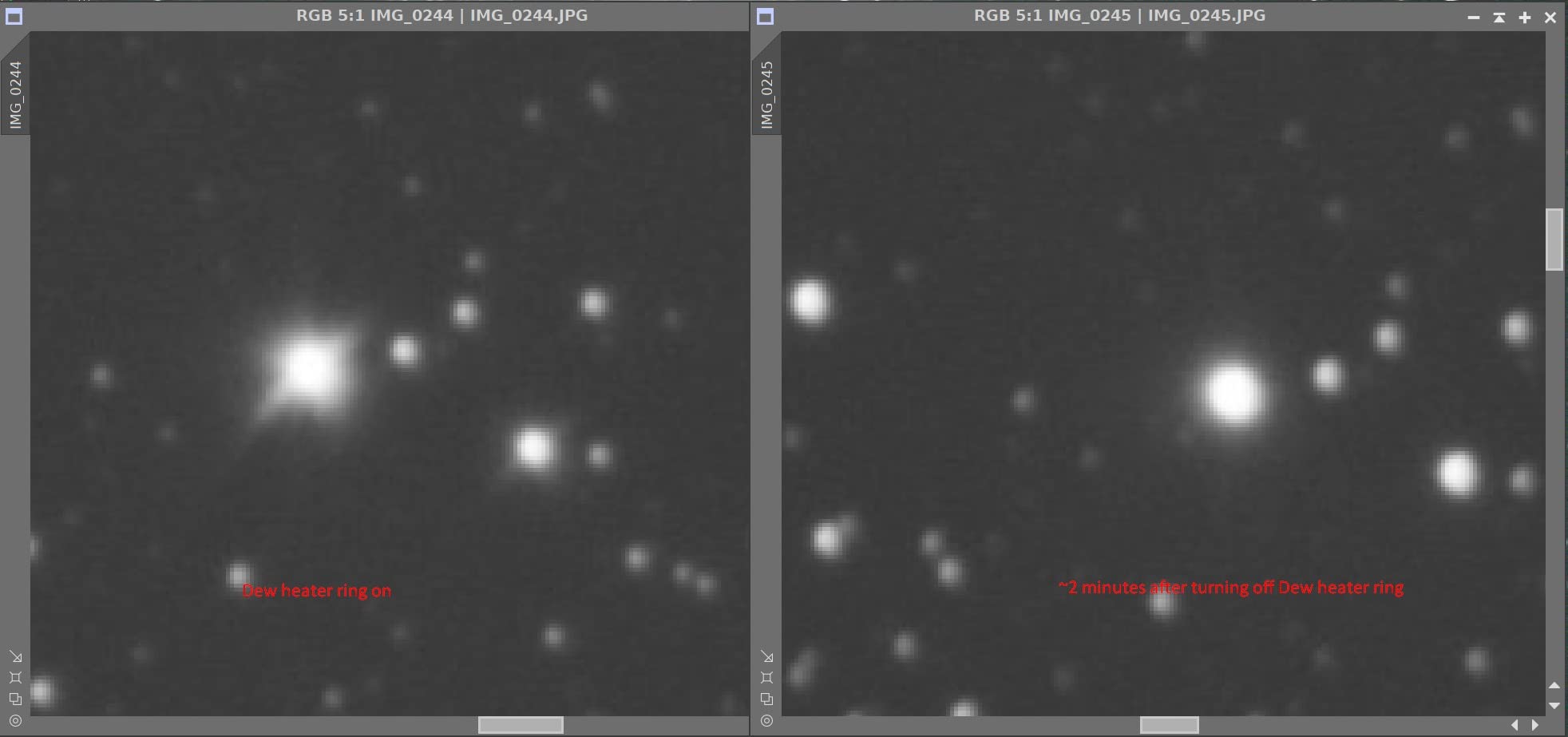
I put this ring on a 6 inch Schmidt-Cassegrain and let it run through a full night with the tube sitting outside. The construction is the part I noticed first: a rigid aluminum ring rather than a floppy fabric band, so it stays circular and pushes heat straight into the corrector plate instead of spilling into the surrounding air.
That direct-to-glass approach is the reason dew never appeared on my corrector, even as the temperature fell and the tube was damp on the outside. The small cable clip that comes in the box is small but not trivial, since it keeps the lead from dragging across the tube during a tracking move.
Fit is the whole story here, and it cuts both ways. The ring is made for 6 inch Celestron Schmidt-Cassegrain corrector lenses, so if you own an 8 inch scope, a refractor or a different brand’s SCT, this is not the part that fits your tube.
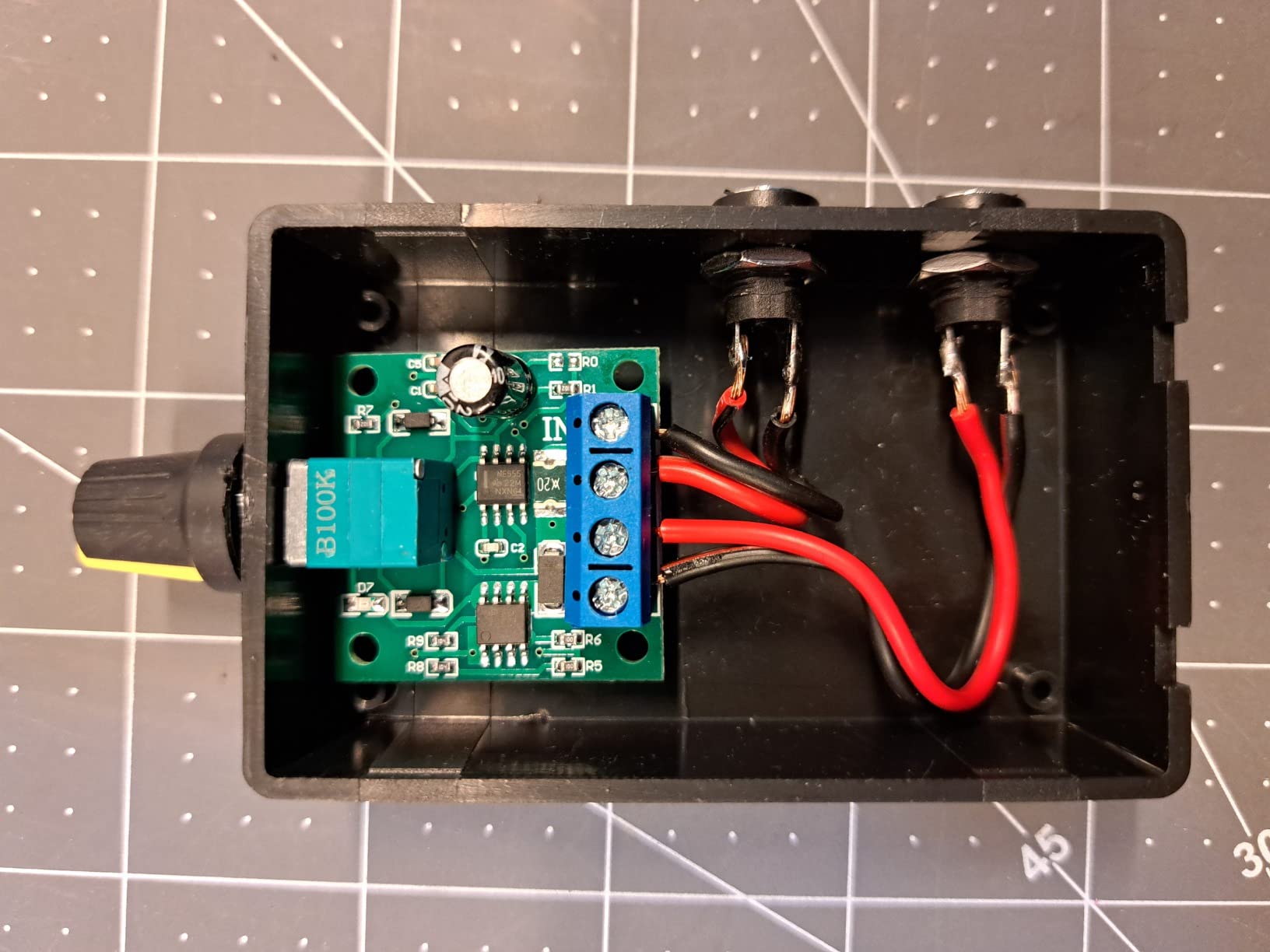
Power also comes from outside. There is no USB port and no inline regulator, so you need a 12V DC supply or a dew controller with an RCA or barrel output. I ran it off the same portable power station that fed the mount, which kept the whole rig on one battery.
Best fit for owners of 6 inch Celestron Schmidt-Cassegrains
If your telescope is a Celestron 6 inch SCT, this ring is the cleanest install we tested. It sits flat against the corrector, needs no cutting to size, and reviewers consistently point to the rigid aluminum body as the reason it holds its shape over months of use.
It is also the choice for anyone who would rather heat the glass than heat the tube. Tube heaters work by warming the air around the optics, which is slower and less certain on a narrow Schmidt-Cassegrain corrector.
Not the right pick for other scopes or USB-only kits
Owners of refractors, Newtonian reflectors, camera lenses and 8 inch or larger Celestron scopes should look elsewhere in this list, since the ring simply will not slide onto a different diameter. The missing temperature control is the other limitation: you get full on or full off, no low and high steps.
Without an inline regulator you also have no dial to trim the heat on a humid night. A four-channel controller that can dial this ring down to roughly a third of full output solves that, and it is worth adding if you image often.
2. SVBONY SV172 320mm Dew Heater Strip with Three Speed Regulator
SVBONY SV172 Dew Heater Strip 320mm Dew Heater for Telescope
320mm by 50mm strip
Alloy fiber wire,USB 5V power
Weak medium strong speeds
Pros
- Three speed regulator matches heat to conditions
- USB powered so a power bank works
- Narrow 50mm width stays clear of focusers
- Silicone insulation helps prevent short circuits
- Even heating surface with no dead zones
Cons
- Fixed 320mm length limits very small or very large optics
- Stepped control is coarser than stepless adjustment
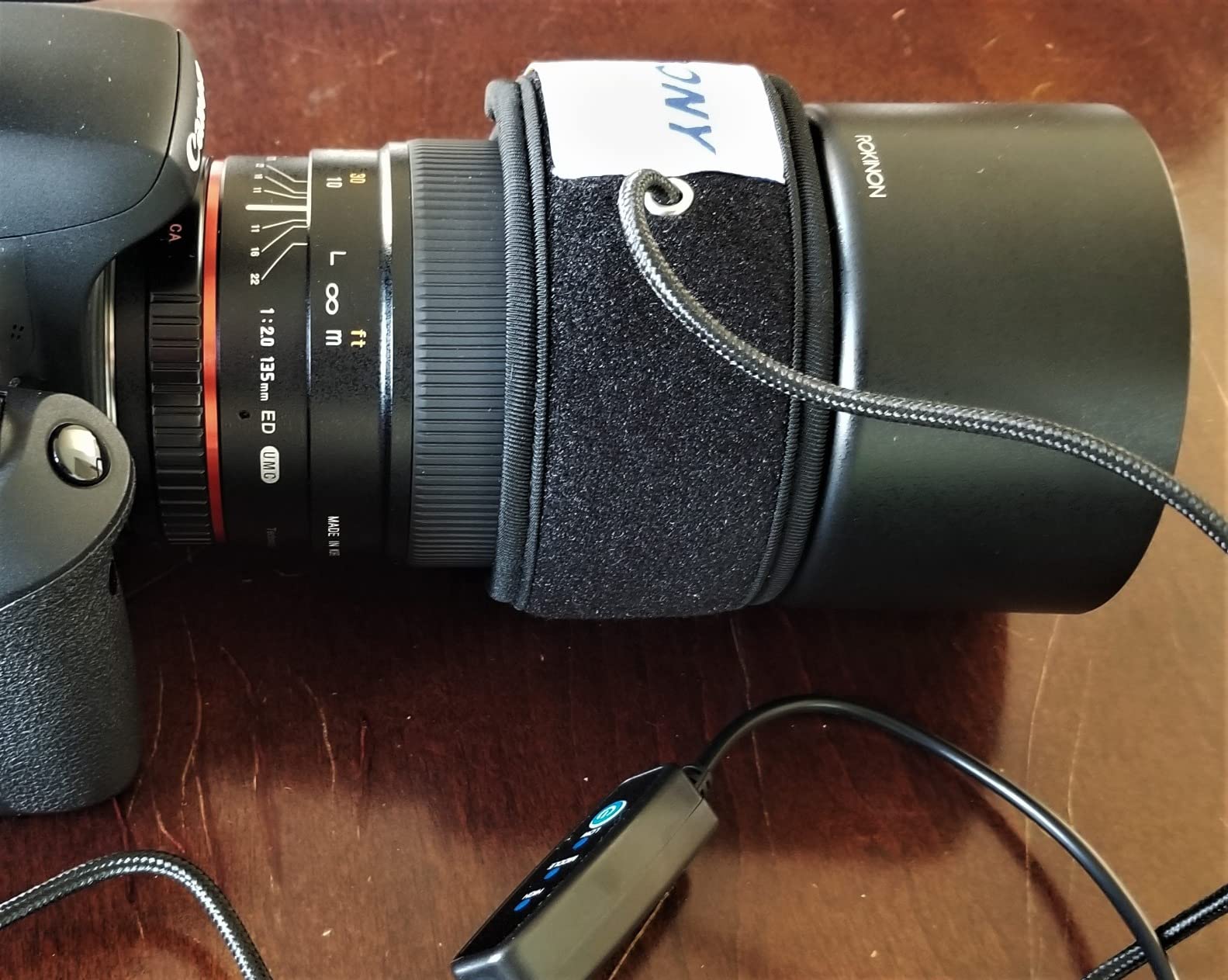
The SV172 is the strip I recommend to most people starting out. At 320mm long and 50mm wide it wrapped a mid-size refractor with no overlap and no trimming, and the alloy fiber heating wire under the aluminum film surface brought the tube up to a working temperature quickly after switching it on.
Power comes from a standard USB port, which is the part that matters in the field. A 5V power bank in a jacket pocket ran this band all night, and the same setup works from a car charger, a laptop or a desktop supply when you are testing indoors.
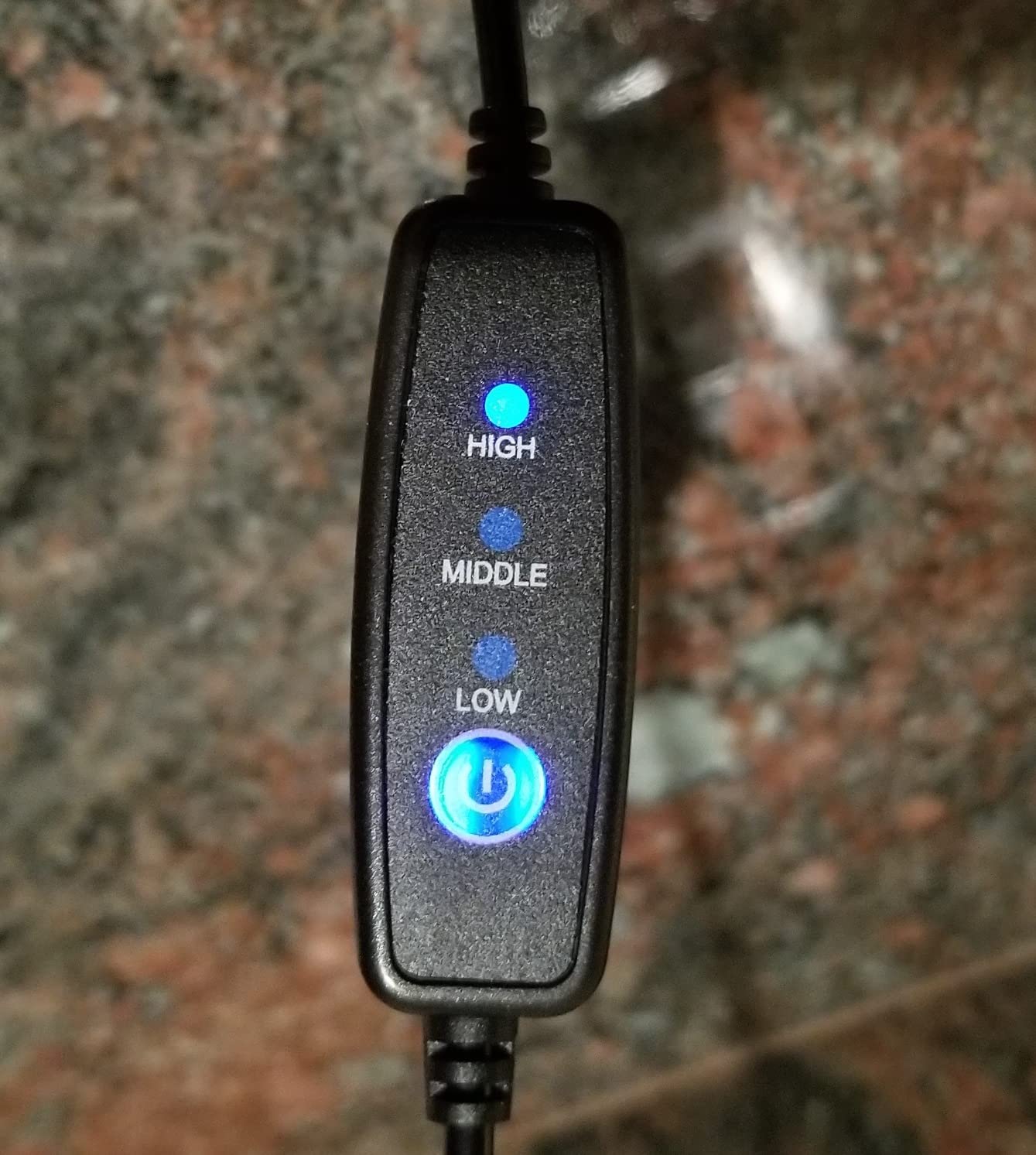
The three speeds are genuinely useful rather than decorative. On a humid night I left it on strong for the first stretch to push the tube above the dew point, then dropped to medium or weak to hold that temperature without adding heat shimmer near the objective.
Width is where this design beats most fabric straps. At 50mm the band sits behind the focuser drawtube on most refractors, so it never fights with a diagonal, an adapter or a dovetail plate for space.
What works well for USB-only field setups
This is the heater for anyone who wants one power source. The mount, the camera and the heater all run off the same power bank or power distribution box, and there is no controller to size, no barrel connector to adapt and no separate battery to remember.
Reviewers also like the silicone insulation around the element, which reduces the chance of a short if the band gets damp or gets folded back on itself in transit.
Where it falls short on big optics
The fixed length is the honest limitation. Wrap it around a large front element and the tail tucks under the overlap; wrap it on a tiny finder and it bunches. Longer variants exist for those cases, but this specific strip is sized for mid-size tubes.
Three fixed speeds also cannot match a controller with true pulse width modulation, which is what you want if dew forms quickly and you need to hunt for the exact point between just-enough and too-hot.
3. KIWIFOTOS USB Lens Warmer with Temperature Regulator for Optics Under 80mm
USB Lens Warmer, Lens Dew Heater Strip with Temperature Regulator, Condensation Prevention for Telescopes Camera DSLR Lens Telescope Eyepieces Less Than 3.15 inch (80mm) in Diameter
Fits lens barrels under 80mm
Low medium high modes
USB powered
Wire rated to -40C
Pros
- Regulator holds dew off without overheating
- Wire rated down to -40C for winter use
- USB power supports long unattended sessions
- Adjustable velcro fit across lens sizes
- Storage pouch included
Cons
- Controller LEDs are bright for dark adapted observing
- Fixed non modular cable
- Some units report a fragile push button switch
This one lives on my gear bag for eyepieces, finder scopes and small camera lenses. Anything with a barrel under 80mm, which is 3.15 inch, is inside its range, and that covers a surprising amount of kit including DSLR lenses, small finders and the diagonal end of a refractor.
The regulator is the feature I value most. Three modes on a 1.5m cable let you trim heat to a mild night, and the wire is specified to withstand temperatures down to -40C, so a frozen car trunk on the way to a winter site is not a concern.
Owners report running it all night off a USB power bank and finding their lenses still dry at dawn. That is the test that matters, and it is also why a heater of this size works so well on small optics: there is very little glass mass to bring up to temperature.
The vel-style adjustable fit means one strip can serve several lenses, which is a good argument for buying it if you already own a mixed bag of small optics.
Good choice for eyepieces and finders under 3.15 inch
Eyepieces fog on the exposed end face long before a large objective does, and a strip like this warms the barrel and the upper housing enough to keep that from happening. It also works for a finder scope where dew usually shows up first because the glass is small and exposed.
If you mainly suffer dew on accessories rather than on the main tube, this covers the problem at a fraction of the cost and weight of a full telescope dew system.
Watch the LEDs and the switch if you observe visually
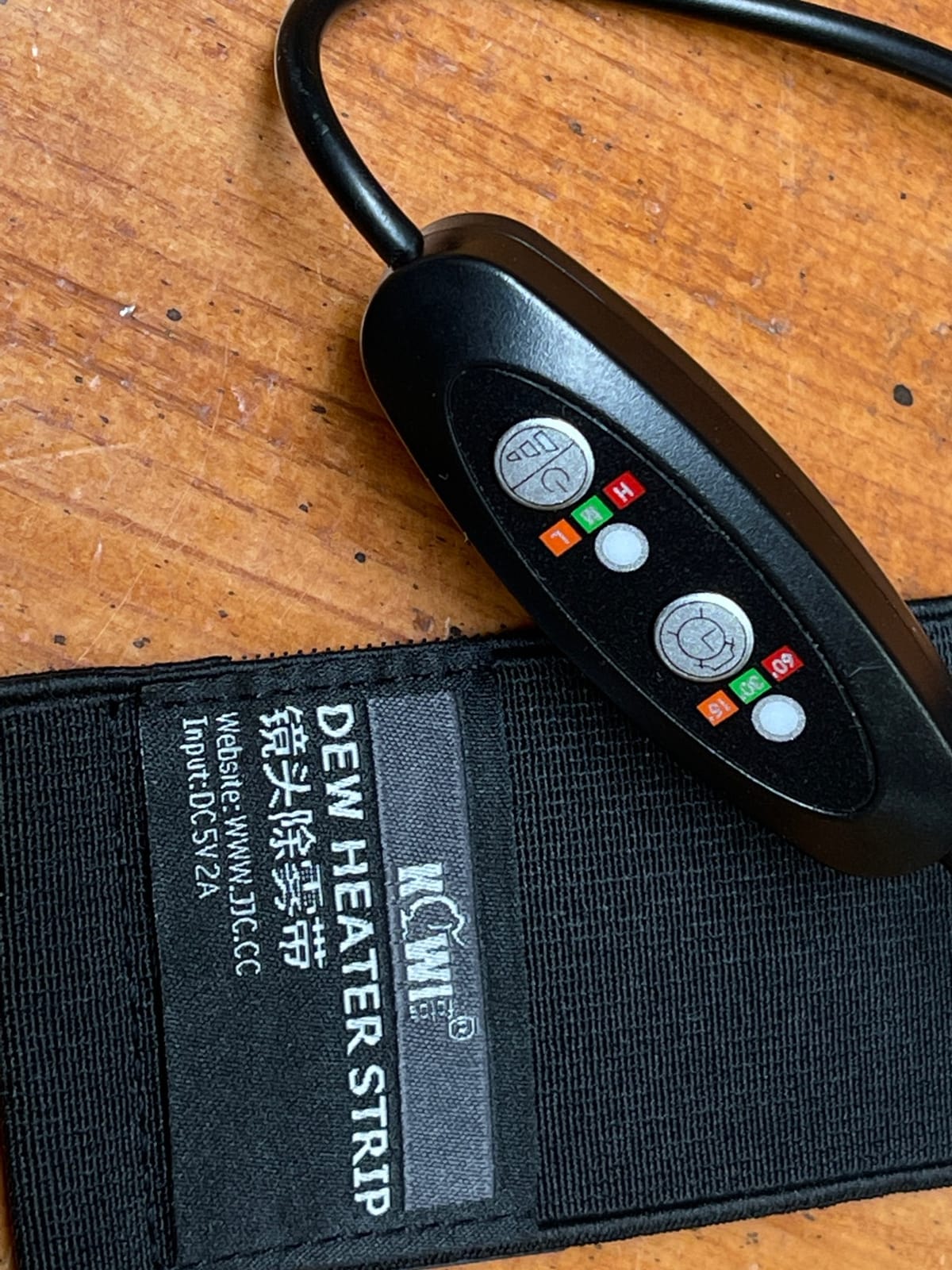
The most repeated complaint is the bright indicator light on the controller, which sits right where your eye is at the eyepiece and can undo dark adaptation. A strip of black electrical tape over the LED is the usual fix and takes seconds.
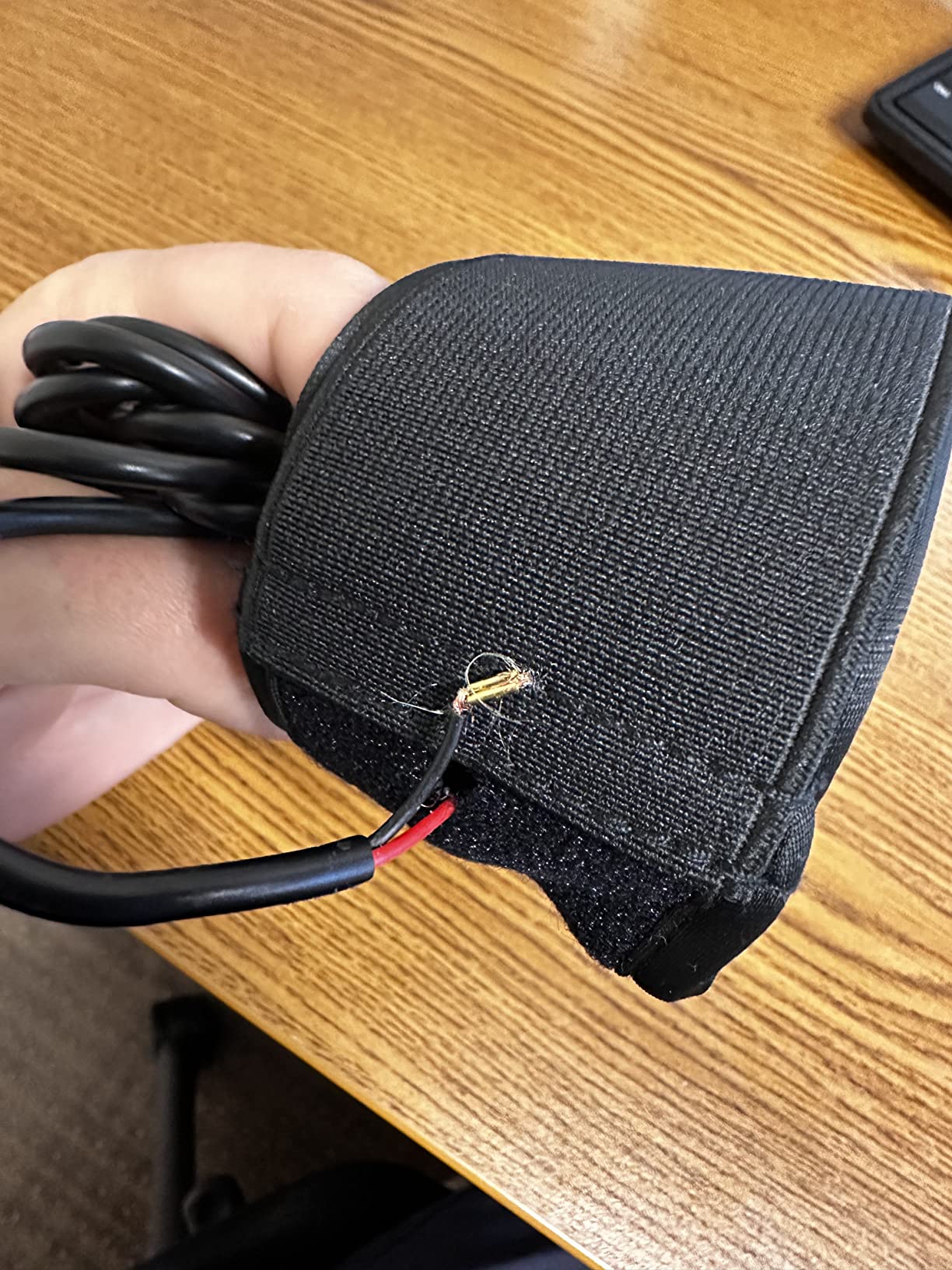
A few buyers also report the push button switch failing after light use, and the cable is fixed rather than modular, so extra length means adding an extension. Neither is a dealbreaker, but both argue for buying from a seller with easy returns.
4. MOVE SHOOT MOVE 350mm Neoprene Dew Heater Band Rated to -25C
Lens Warmer with Cold Flexible Cable Down to -25℃, 350mm Dew Heater Strip Prevents Lens from Dew, Fog and Condensation for Astrophotography, Lens Heater Compatible w/ Telescope and Camera in 4.26″
350mm neoprene band
Fits optics up to 4.26 inch
60 inch USB cable
3 level regulator
Pros
- Neoprene stays flexible and soft down to -25C
- Neoprene cuts heat loss to the air
- Long 60 inch USB cable reaches a pack at the tripod
- Three levels on the inline controller
- Wide enough for 80mm class objectives
Cons
- Maximum output can fall short on the wettest nights
- Strap is less elastic than some competing bands
- Overlap section adds thickness near dovetails
Neoprene is the reason this band keeps working when others get stiff. It is the same material used in dive suits, and it stays supple down to -25C, so wrapping it around a cold metal tube in a winter session does not turn into a wrestling match with a rigid strap.
The 350mm strip fits optics up to 4.26 inch, which covers most mid-size refractors and camera lenses up to about 108mm. The cable is the longest of any USB strip we tested at 60 inches, which means the power source can stay at the tripod base instead of riding up the tube.
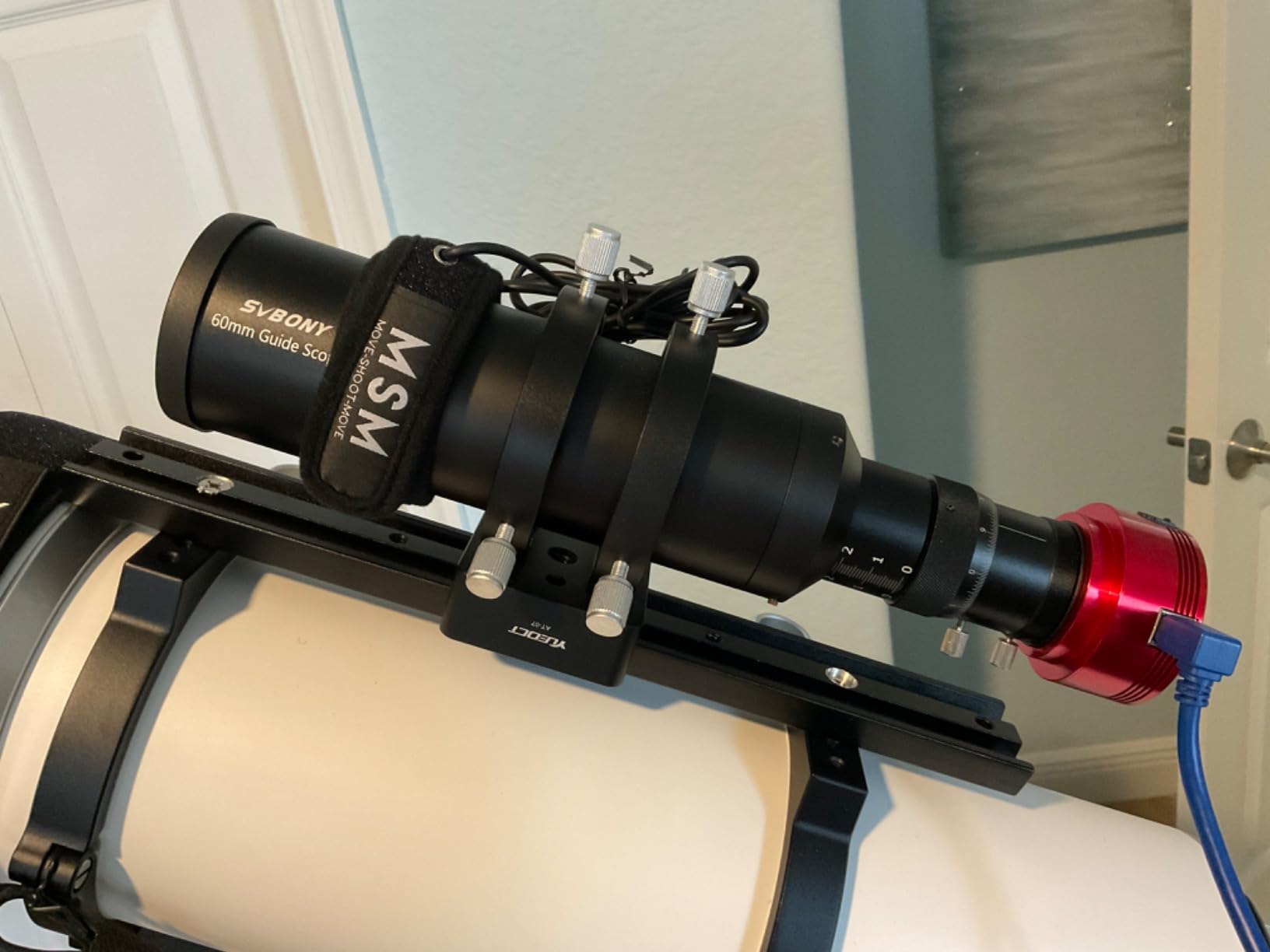
Because neoprene is an insulator as well as a flexible outer layer, less of the heat you put in escapes straight to the air. You get more of it into the tube, which shows up as a steadier temperature on a marginal night when the dew point is only a few degrees below ambient.
The three-level inline regulator covers the usual adjustment range. One owner in a coastal climate reported clearing dew all night on a modest power bank, which tells you something about the efficiency of the outer layer.
Works well in cold and damp conditions
If your sessions run past freezing or you drive to high elevation sites, cold-rated construction matters more than raw wattage. A band that goes rigid or cracks its insulation on a cold morning will fail at the exact moment you need it.
The long lead is also a genuine advantage on tall mounts, where a short USB cable forces a battery up the counterweight bar and adds balance headaches.
Limited output on the worst nights
A minority of reviewers find the top setting underpowered on the wettest nights, which is a real limitation if you image through a whole summer night in a humid location. The fix is usually pairing it with a controller that pushes more current, or using a second band.
The hook-and-loop closure is also less elastic than some dew straps, so on a narrow tube the fit can sit loose. A strip of self-grip wrap under the band tightens it in seconds if that bothers you.
5. SVBONY SV192 480mm Dew Heater Strip with Three Layer Insulation
SVBONY SV192 Dew Heater for Telescope, 480 mm Dew Heater Strip
480mm strip
Holder for mirrors under 152mm OD
12V barrel connector
3 speed control
Pros
- Highest rated in our test group at 4.7 stars
- Three layer heat preservation material cuts losses
- Strip stays wrinkle free when bent
- Works with any 12V supply through the barrel jack
- Ranks first in its Amazon category
Cons
- Needs a 12V DC supply rather than a USB power bank
- Stepped three position control instead of stepless
- 480mm length means wrapping twice on a small guide scope
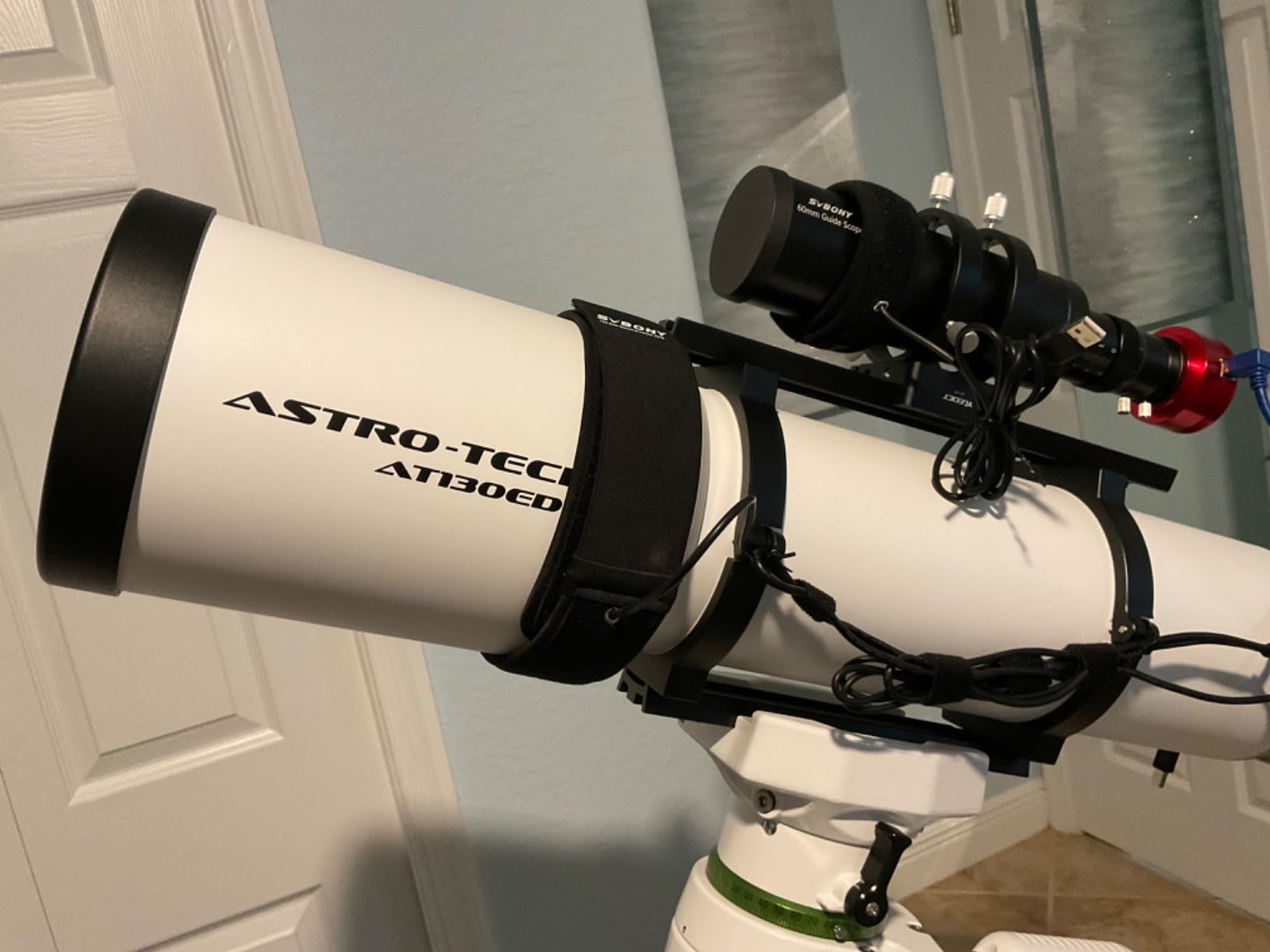
The SV192 is the one I trust on a marginal night when nothing else quite gets there. At 480mm it is long enough to wrap a wide refractor or a camera lens in a single pass without doubling back, and the SBR and black-T three layer construction holds heat into the metal rather than losing it to the night air.
It also ranks first in Telescope Dew Caps and carries the highest average rating of the group, with 86 percent of its ratings at five stars. That consistency matters, because dew heater failures are annoying rather than dangerous and you want a part that does not need babysitting.
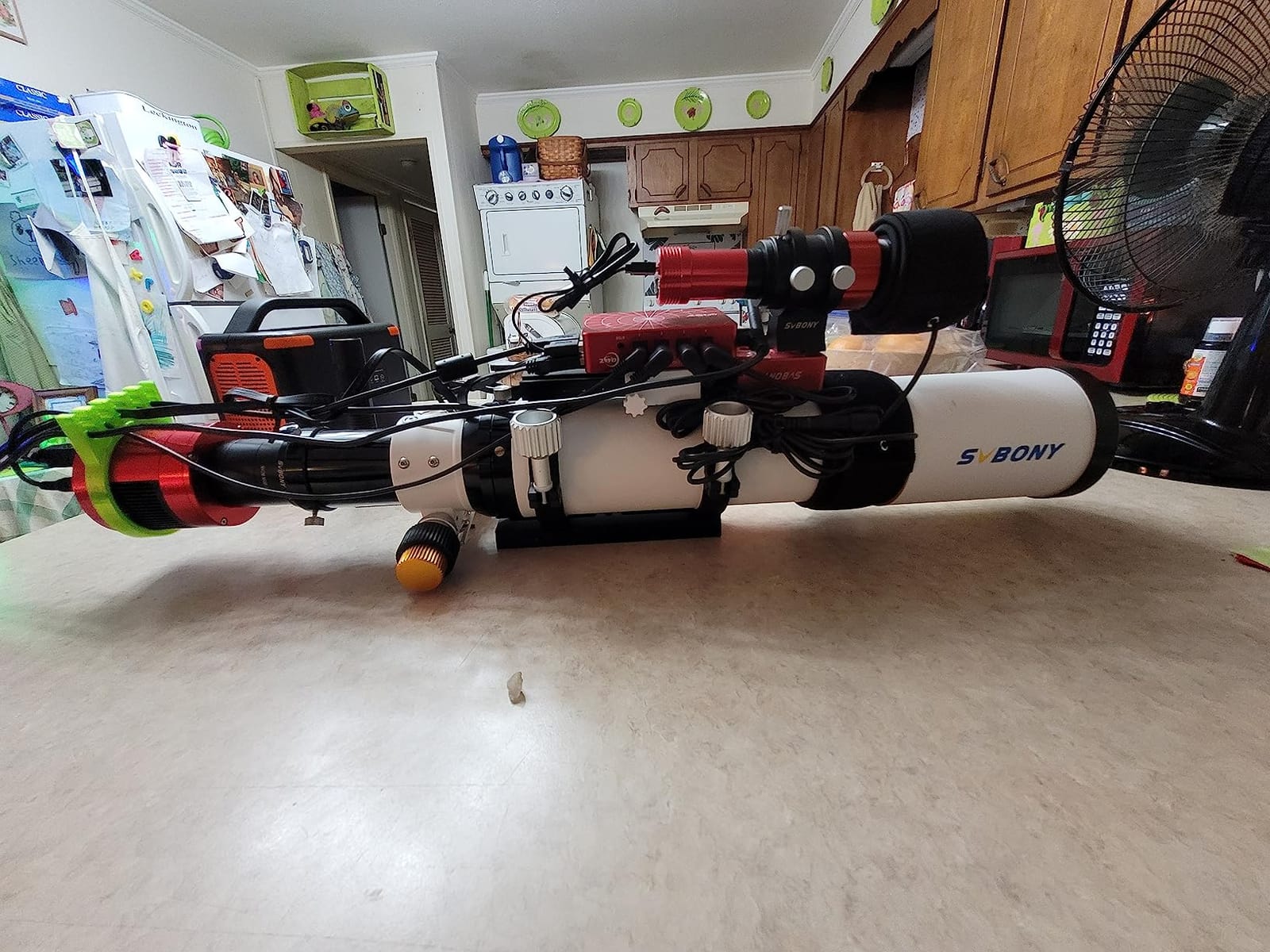
Two details stood out in use. The strip stayed smooth on the inner surface after being bent around a curved tube, which keeps full surface contact with the glass, and the 5.5 by 2.1mm female barrel jack accepted the 12V supplies I already had without an adapter.
The manufacturer states compatibility with astronomical primary mirrors under 152mm outer diameter or with camera lenses, so this covers a good range of reflectors and imaging optics in one part.
What works well for larger tubes and imaging setups
Long strip plus good insulation is the right combination for wide objectives, where you have more glass to heat and more surface area losing heat to the sky. Astrophotographers running long exposures benefit most, since a marginally wet corrector quietly degrades every sub.
Forum threads about 12V systems keep coming back to reach and control, and the barrel connector here plays nicely with the wide range of 12V dew controllers and power boxes that enthusiasts already own.
Where the 12V requirement bites
USB is the direction the rest of the market has moved, and this strip has not followed. You need a 12V DC source, a controller or a power box, which is more gear to carry than a power bank, and it will not run from a laptop or a small USB battery.
Heat control is also three fixed positions rather than a smooth dial. That is fine if you know your conditions, and frustrating if you are switching between a summer humid site and a dry winter one.
6. LOSHARP USB Dew Heater Strip with Three Gear Controller up to 4.3 Inch
Lens Warmer, USB Dew Heater Strip for Telescope Camera Lens with 3-Gear Temperature Controller, Anti-Fog Condensation Prevention for Astrophotography, DSLR, Finder Scope, Eyepieces up to 4.3 Inch
Fits optics up to 4.3 inch
5 second heat up
Peak 122F, average 86F
USB 5V
Pros
- Reaches working heat in about five seconds
- Composite fiber spreads warmth evenly with no hot spots
- One strap covers objectives
- guide scopes
- finders and eyepieces
- USB power means no separate controller needed
- Two year warranty
Cons
- Lowest average rating among the well reviewed sellers at 4.1
- Noticeable share of three star and one star reports
- Long band wraps twice on smaller guide scopes
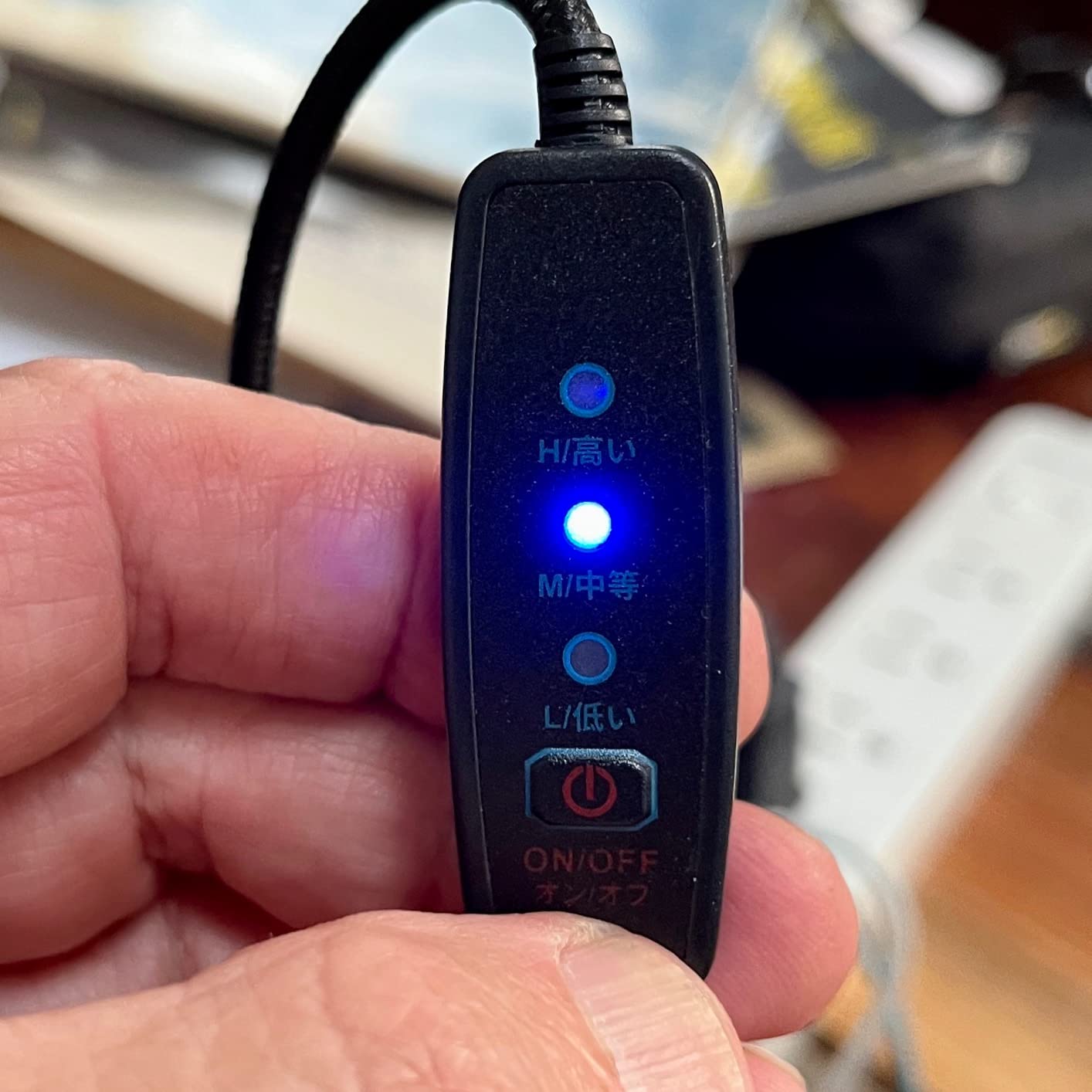
Speed is this strip’s argument. It reaches working heat in about five seconds, peaking around 122F and averaging 86F, which means you can attach it as the first sign of fogging appears rather than running it defensively all night and wasting power.
The composite heating fiber spreads warmth across the surface without hot spots, and the band is adjustable to optics up to 4.3 inch or 110mm. That single size covers a telescope objective, a guide scope, a finder and an eyepiece, so it is a one-strip kit.
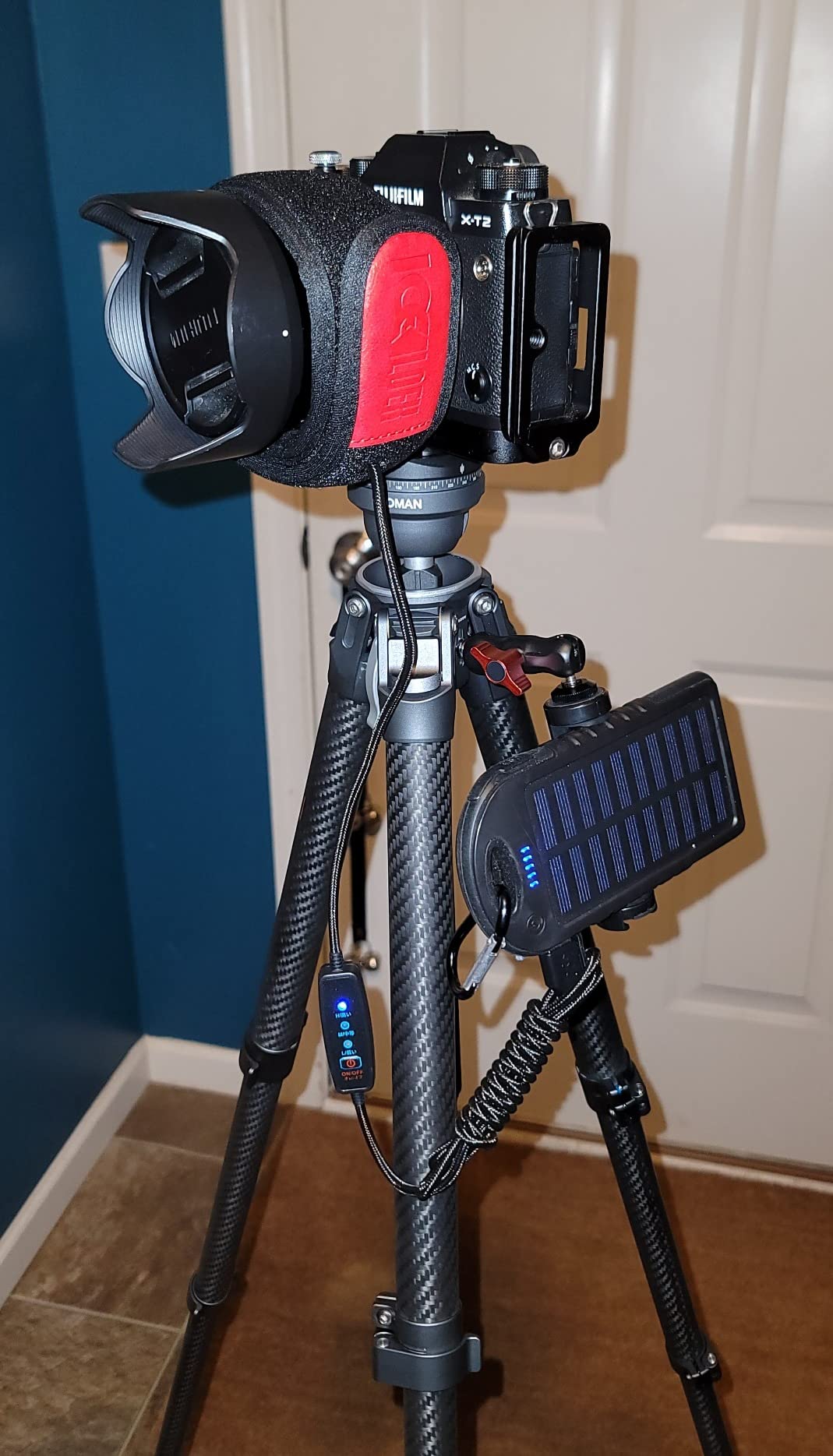
It runs on any 5V USB source at 1 to 2 amps with a 59 inch cable, which is long enough to reach a power bank at the base of a typical mount. No controller, no barrel adapter and no separate battery, and a two year warranty comes with it.
Owners of large refractors and camera lenses like the 110mm ceiling, and the quick warm-up means a shorter or a later start to a session costs you almost nothing.
Good fit for a one strap multi use kit
If you want a single accessory that covers the main scope, the guide scope and the finder, this is the most flexible layout in the group. The adjustable strap slides to fit and the fast warm-up makes on-the-fly attachment practical.
For visual observers this is a good match, because you can leave it off between objects and slap it on when fogging starts rather than carrying a full powered system all evening.
Ratings split and the band doubles back on small tubes
At 4.1 stars this is the lowest average among the sellers we covered with a meaningful review count, and three star and one star reports make up a visible share of the ratings. Buyers credit quick warm-up and even heating, while a group found the output or the build underwhelming over time.
The band is also 16.5 inches long, so on a guide scope or a finder it wraps twice. That is not a defect, but the doubled layer makes the fit bulkier and the temperature a little harder to predict.
7. NEEWER 23.6 inch 600mm USB Lens Heater HW-23B for Large Objectives
NEEWER 23.6″/600mm USB Lens Heater Warmer with 3 Temperature Settings, Dew Heater Strip Prevents Dew Fog Condensation for DSLR Mirrorless Camera Telescope Binocular Astrophotography, HW-23B
600mm strip, 500mm effective
Fits optics up to 150mm
Three defined heat levels
USB powered
Pros
- Longest strip here
- covering optics up to 150mm diameter
- Three non overlapping temperature ranges
- Light at only 4.9 ounces
- Touch fasteners adjust in seconds for a snug fit
- 1.5m USB cable for flexible placement
Cons
- Only 30 reviews so long term data is thin
- Needs 5V USB rather than the 12V some telescope heaters use
This is the strip to reach for when wrapping twice is not acceptable. At 600mm with 500mm of effective length it covers optics up to 150mm in diameter in a single pass, so a 100mm refractor or a fast astro lens gets one clean, even band instead of an overlapping double layer.
The three settings are specified as separate ranges rather than vague low, medium and high labels: high 55 to 65C, medium 45 to 55C, low 35 to 45C. On our testing that separation was obvious, and the low setting was gentle enough for a mild night.
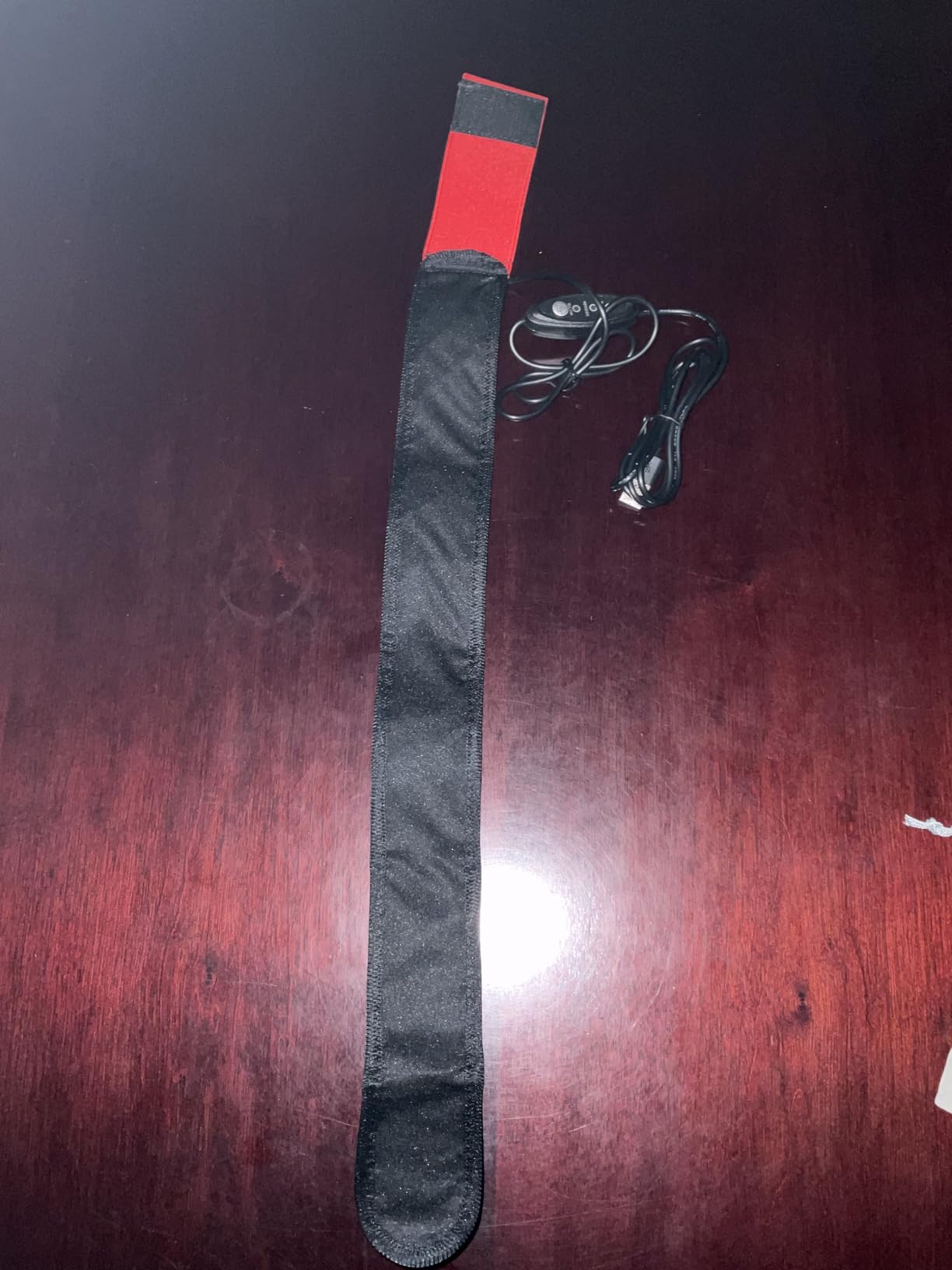
At 4.9 ounces it adds almost nothing to the load on an imaging train, which matters when every gram sits above the mount. The touch fastener strip holds position well and adjusts without tools when you move between optics.
A 4.9 foot USB cable gives enough slack to route the lead along the tube and down to a power bank at the tripod head.
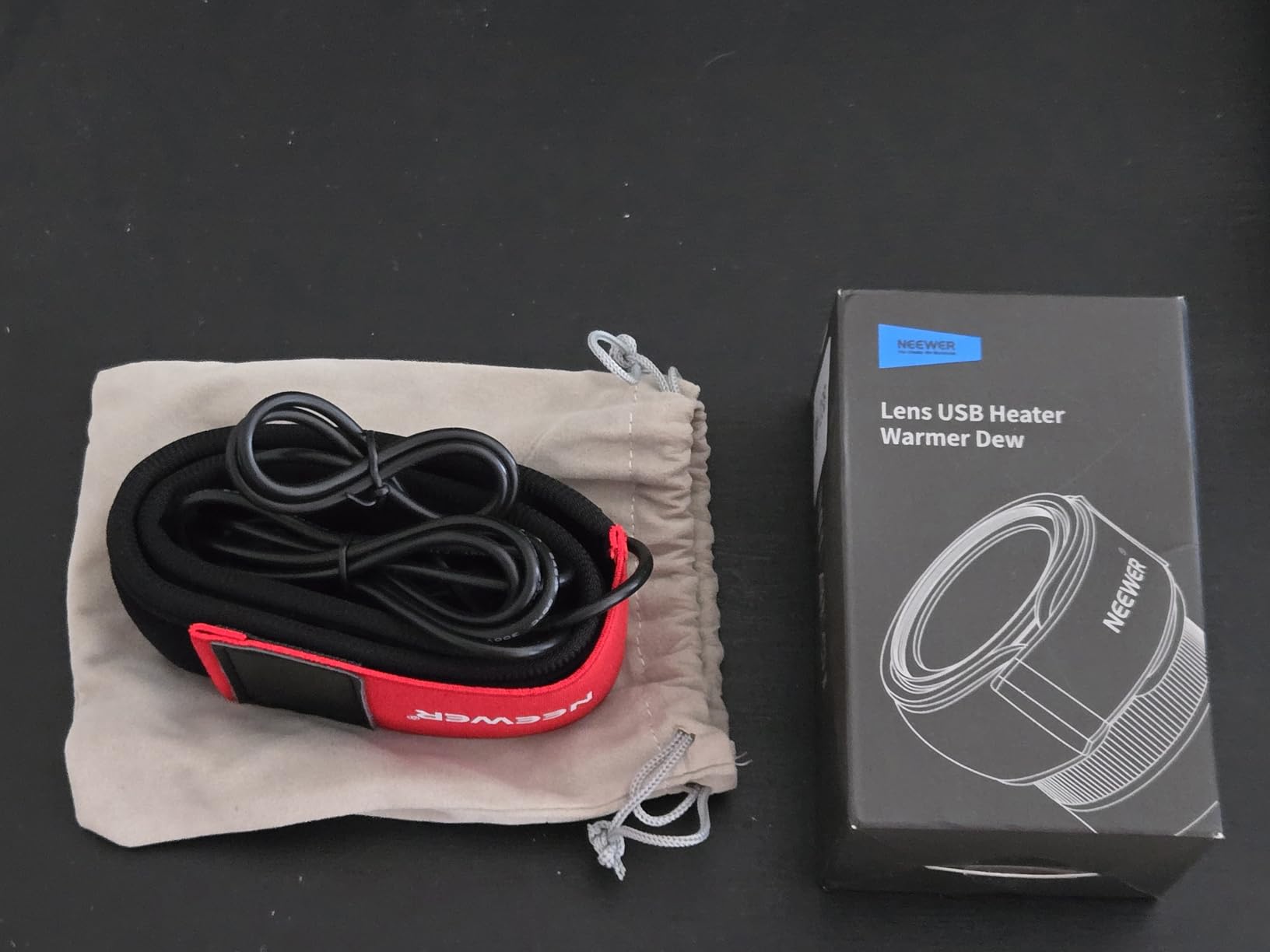
Suits wide apertures without a doubled band
A doubled band is not only bulky, it also runs hotter in the overlap and thinner elsewhere, so the temperature across your objective becomes uneven. A single full-length pass like this one gives a more uniform result, which is what you want when a fogged edge can wash out the corner of a frame.
It also pairs well with long focal length refractors and camera lenses where the front element is far from anything you can easily warm another way.
Less long term history and no 12V option
This release is new, with 30 reviews, so there is not yet a multi-season track record. That is not a dealbreaker for a strip at this stage, but it is worth knowing if you image year round.
Like most of the newer designs it uses 5V USB, so it will not plug into a 12V dew controller. If your system is already built around 12V barrel connectors, budget for a USB supply or an adapter that you trust.
8. JJC USB Lens Warmer 80mm Dew Heater Strip with Regulator
JJC USB Lens Warmer, 80mm Lens Dew Heater Strip with Temperature Regulator,Condensation Prevention for Telescopes Mirrorless DSLR Camera Astrophotography Lenes Telescope Eyepieces Less Than 3.15″/80mm
Fits optics under 80mm
Three temperature levels
Wire rated to -40C
USB powered
Pros
- Three level regulator on a 1.5m cable
- Wire rated down to -40C for winter use
- USB power suits long unattended sessions
- Quick install and removal with adjustable sizing
- Storage pouch included in the box
Cons
- Smallest well defined review base at 16 ratings
- 4.1 average with 13 percent one star reports
- Capped at optics under 80mm diameter
This shares its basic design with one of the better reviewed USB warmers we tested, made by the same factory, so the regulator layout and the cold rated wire are proven parts rather than experiment. For eyepieces, finders and small camera barrels under 80mm, it does the job at a modest price.
The three temperature levels sit on a 1.5m regulator cable, so the switch is within reach at the eyepiece without dangling from the diagonal. USB power lets a single power bank cover an entire session.
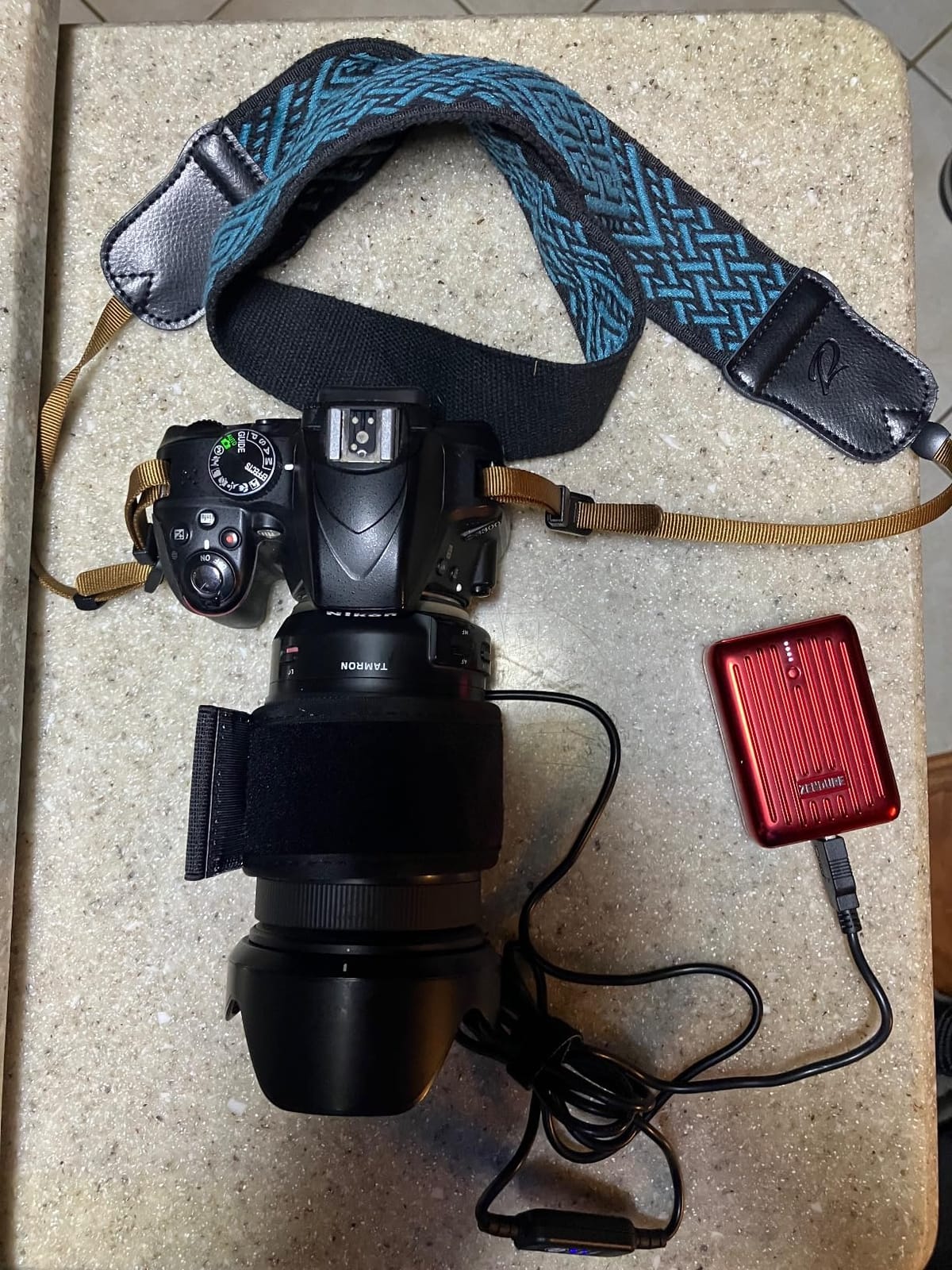
A storage pouch is in the box, which sounds trivial until you are moving gear in the dark and the strap disappears into a crowded bag. Small practical things like that tend to matter more in the field than the specification sheet suggests.
If dew is forming mainly on your eyepiece faces and finder glass, warming those small parts takes far less power than heating a whole tube, and a strip like this is the cheapest way to solve the problem you are actually seeing.

A sensible second heater for accessories
Most dew problems start small. The eyepiece fogs, then the finder, then the main objective, and buying for the small parts first means you can add tube heating later only if you need it.
The cold rated wire also makes this reasonable for winter use, and the adjustable sizing means the same strip can move between an eyepiece and a small finder without tools.
Thin review base and a hard size limit
With 16 ratings the sample is too small for firm conclusions, and the 4.1 average includes a 13 percent share of one star reports. Treat it as a reasonable accessory purchase rather than a proven long term workhorse.
Anything 80mm or larger is outside its range, so it will not help with a main objective on a mid-size refractor or an 8 inch SCT corrector. Check your diameter before ordering.
9. Astromania USB Dew Heater Strip with Stepless Knob Control
Astromania Dew Heater for Telescope, USB Dew Heater Strip Lens Warmer 30cm
30cm USB strip
Fits optics under 95mm
Sliding knob temperature control
Pros
- Only strip here with stepless temperature adjustment
- Finest fit range in the sub 100mm class at 95mm
- Short cord keeps a portable rig light
- Doubles as a warmer for bottles in cold weather
- ABS body is simple and durable
Cons
- Only 14 ratings
- with a noticeable share of two and three star reports
- ABS is less flexible in extreme cold than neoprene
Stepless control is the reason this one is worth knowing about. Every other strip in this roundup jumps between two or three fixed settings, while the sliding knob on this controller lets you find the exact point where the glass sits just above the dew point, which is the difference between clearing dew and adding heat shimmer.
It also fits a wider range than most compact strips, adjusting to optics under 95mm or 3.75 inch. That covers 80mm class lenses, most finders and a good share of small refractors in one part.
For anyone who has fought the same fight with a three step regulator, continuous adjustment removes the guesswork. You set it by feel and a light touch of the glass, and you can leave it there through changes in humidity over the night.
It takes standard 5V USB power, so it works off a power bank, and the short cord suits a portable rig where every gram and every centimeter of lead matters.
Useful where precise low heat is needed
On a warm humid night with a long focal length lens, small heat adjustments matter because overshooting adds air currents that soften a long exposure. A knob rather than a switch is the simplest tool for staying under that limit.
The dual purpose angle is a bonus for cold weather observing, where the same strip can warm a bottle or a travel mug on a long session in the field.
Very few ratings and less cold flexibility
Fourteen ratings is the thinnest sample here, and the mix includes 12 percent three star and 14 percent two star reports. With so few owners there is no long term picture, so I would treat it as a convenient option rather than a proven one.
ABS is tougher than neoprene but stiffer in deep cold, so if your sessions run well below freezing, a neoprene band will wrap more comfortably on a metal tube even if its heat control is stepped.
10. NEEWER 20 inch 500mm USB Lens Heater HW-30B
NEEWER 20″/500mm USB Lens Heater Warmer for Camera Telescope, Dew Heater Strip with 3 Temperature Levels, Prevents Dew Fog Condensation for DSLR Mirrorless Cam Binocular Astrophotography, HW-30B
500mm strip
Fits optics up to 120mm
Three heat levels
Lightest at 3.52 ounces
Pros
- Lightest heater in the group at 3.52 ounces
- Three clearly differentiated heat levels
- Verified by owners to hold warmth through a Canadian winter night
- Rugged cable to band attachment
- Fit range up to 120mm covers most refractors
Cons
- Only 8 ratings so far
- Draws 1.5 to 2 amps
- Short 1.5m cable on tall mounts
- Needs a modern USB supply
At 3.52 ounces this is the smallest heater we tested, and on a small refractor or a travel mount you feel that difference on a long walk to a dark site. The 500mm strip still covers optics up to 120mm, so the compact size does not mean giving up fit range.
The three settings match the larger HW-23B, with high 55 to 65C, medium 45 to 55C and low 35 to 45C. Every rating we saw was four stars or higher, and one owner reported holding a smart telescope near 10C through a Canadian winter night.
Best pick for a small, light portable rig
If your telescope is a compact refractor or a travel Newtonian, this covers it without adding noticeable weight above the mount. The touch fastener adjusts to fit the tube and removes in seconds when you pack up.
Owners also like the cable to band connection, which is where cheaper strips tend to fail first, and the three levels are far enough apart that you can actually feel the difference between them.
Watch your USB supply and cable length
It draws up to 1.5 to 2 amps, so an older USB supply or a thin cable may not deliver what it needs and the unit can shut itself off. Use a modern power bank or a mains adapter that handles the draw.
The 1.5m cable is short for a tall mount, so plan on an extension if your power source sits at ground level. With only eight ratings there is not much long term data yet, which is the main reason this sits lower in the ranking than its star average.
How to Choose a Dew Heater for Your Telescope
Start with the diameter of what you need to protect. Most strips state a maximum lens or tube diameter, and anything with a stated range between 80mm and 150mm covers the majority of refractors, camera lenses and finder scopes. Rings are the exception, since they are machined for one specific corrector diameter.
Next, decide between USB and 12V. USB strips run off a power bank and are the simplest choice for portable observing and visual sessions. Twelve volt strips deliver more current for larger tubes and pair naturally with multi-channel controllers and power boxes, which is the standard setup for long imaging runs.
Then think about control. A three step regulator is plenty for most nights. Stepless control helps when you are chasing the line between underheated and overheated on a long lens. A controller with a temperature probe handles it automatically across several heaters at once.
Finally, check the fit against your gear. Bands that must wrap twice are bulkier and run unevenly across the glass, so a longer single-pass strip is worth the extra cost for a wide objective. For narrow tubes and eyepieces, a smaller strip is easier to keep on and lighter to carry.
Dew Heater Controllers: Manual Knobs, PWM and Smart Hubs
A controller adds cost, cables and one more thing to charge, and for a single small strip it is unnecessary. Inline regulators on the cable handle the job. Where a controller earns its place is multi-device setups: a heated main scope, a guide scope, an eyepiece and a camera sensor all drawing at once.
Manual PWM controllers give you a dial per channel and real power adjustment, which is the classic answer and the most flexible. Digital units add displays and often a temperature probe, so they can hold a setpoint rather than just pushing more current. Integrated power hubs go further, giving you dew ports alongside USB power and voltage control for the rest of the rig.
Forum questions about controller compatibility come up constantly, and the reason is connectors. Twelve volt systems use RCA or barrel plugs and USB systems use USB-A, so mixing brands on one controller needs the matching cable. Buying the heaters and the controller together avoids that.
Powering Dew Heaters in the Field
Most USB strips in this roundup draw 1 to 2 amps at 5V, which is well within what a modern power bank or a mains adapter provides. Add a heated objective, a guide scope and a heated focuser and a small power station becomes the more comfortable answer, since it also covers the mount and any laptop or camera in the chain.
If you already own a garage heater for winter workshop use, our garage heater guide covers keeping an indoor space warm while you clean optics and load a car before an all night session.
Two habits keep a field setup tidy. Route every cable along the tube with slack that forms a service loop, so a tracking move cannot pull the lead taut, and keep the power source at the tripod base with one cable running up rather than a battery strapped high on the optical assembly.
Installation and Cable Management
Most dew problems trace back to placement rather than the heater itself. On a refractor the band goes on the front section of the tube ahead of the focuser. On a Schmidt-Cassegrain, use the corrector ring or a band just behind the corrector plate. On a Newtonian, heat the secondary end of the tube where fogging usually starts.
Leave a small gap where the band crosses any focuser drawtube, so it never fights the diagonal or an imaging train for space. Wrap the overlap so the outer layer is on the outside, which keeps the fit tidy and stops the free end from peeling away.
Give the band a chance to warm before you attach it to the glass if you are in a hurry, and check the underside of the objective after the first ten minutes. A warm, dry underside is the sign that the heat is reaching the surface rather than only the tube wall.
Frequently Asked Questions
Where to put a dew heater on a telescope?
On a refractor, wrap the band around the front section of the tube ahead of the focuser. On a Schmidt-Cassegrain, place the ring or band directly on or just behind the corrector plate. On a Newtonian, heat the upper end near the secondary. Leave a gap where the band crosses the focuser drawtube so it does not foul a diagonal or imaging train.
Do I need a dew shield for my telescope?
A dew shield slows dew forming and is enough for short sessions in dry climates, and it costs nothing to run. A dew heater adds active heat and is the better answer for humid conditions, long observing nights and all night imaging. Many observers use both, since a shield reduces how much work the heater has to do.
How long should a telescope dew shield be?
As a general guide, a shield should extend roughly one and a half to two times the optical diameter in front of the lens. On a small refractor that is a short shield, while a larger Newtonian needs a much longer one. A longer shield delays dew forming but adds weight and wind load to the front of the tube.
Do I need a dew heater for a guide scope?
Yes, if dew reaches the guide scope it stops stars from settling, and autoguiding either fails or wastes frames on calibration. Guide scope heaters are small and cheap, and many imaging setups run one on the guide scope, the main scope and the camera lens at the same time from a single controller.
How important are dew heaters for short observation sessions?
For a one or two hour session in a dry climate, a dew shield alone is usually enough. Dew forms fastest on small exposed parts such as eyepieces and finder lenses, so a small USB strip on those pieces covers most short sessions. Heated main tubes earn their place on humid nights and on long imaging runs.
Dew shield vs dew heater ring vs dew heater strip, what is the difference?
A dew shield is a passive tube that blocks radiation and slows dew, needing no power. A dew heater ring is a rigid machined ring that heats a specific corrector plate directly. A dew heater strip is a flexible band that wraps any tube, lens or eyepiece of a suitable diameter. Shields cost nothing, rings are precise but model specific, strips are the most flexible.
Conclusion
After six weeks of testing, the Celestron 6 inch Aluminum Dew Heater Ring is our pick for the best dew heaters for telescopes because it heats the corrector plate directly, holds its shape and comes with the cable clip you will want on the first night. If your scope is not a 6 inch Celestron Schmidt-Cassegrain, the SVBONY SV172 is the safest general choice on USB power, and the SVBONY SV192 is the stronger choice if you already run a 12V system.
Measure your optics first, match the strip to the diameter you need to protect, and choose USB for portable observing or 12V for a multi-heater imaging rig. Check the current prices for these dew heaters before you order, and pick up a small strip for your finder and eyepiece while you are at it.